
Showing 67 items matching "daily activities"
-
 University of Melbourne, Burnley Campus Archives
Book, Notebook, 1941-1947
... Littlejohn's writing, showing daily activities, payments, staff wages, etc....Littlejohn's writing, showing daily activities, payments, staff wages, etc. Notebook Book ...Notebook in E.B. Littlejohn's writing, showing daily activities, payments, staff wages, etc.e.b. littlejohn, principal -
University of Melbourne, Burnley Campus Archives
Diary, Daily Diary, 1980-1983
... ...daily activities...diary daily activities appointments jim davis reception Jim Davis handwritten on cover and M. ...Jim Davis handwritten on cover and M. Williamson.diary, daily activities, appointments, jim davis, reception -
 Whitehorse Historical Society Inc.
Book - 1956 Olympic Games - Melbourne, 1956
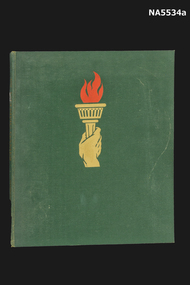
... Green hard cover book containing daily sporting activities: social events, dignitaries and event results 22nd November to 8th Dec 1956...Olympic games Colorgravure Publication Green hard cover book containing daily sporting activities: social events, dignitaries and event results 22nd November to 8th Dec 1956 Book 1956 Olympic Games - Melbourne Colorgravure Publication ...Daily sporting events - medal winners 1956 Melbourne Olympic games 22nd November to 8th December Ian Howie, ball bot for the Hockey.Green hard cover book containing daily sporting activities: social events, dignitaries and event results 22nd November to 8th Dec 1956olympic games, colorgravure publication -
 National Vietnam Veterans Museum (NVVM)
Document - Report of Proceedings, HMAS Brisbane ROP June 1971, 1971
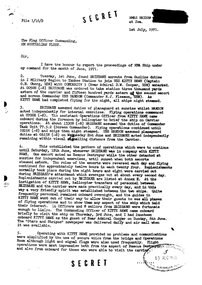
... Copy of once secret document recording the movements and daily activity of the HMAS Brisbane created in June 1971. ...Copy of once secret document recording the movements and daily activity of the HMAS Brisbane created in June 1971. ...Copy of once secret document recording the movements and daily activity of the HMAS Brisbane created in June 1971. Addressed to the Flag Officer Commanding, Her Majesty's Australian Fleet. Signed by Captain R G Loosli. Seventeen typed A4 pages, Report of Proceedings, pages stamped SECRET. (Copy)hmas brisbane, report of proceedings, navy, ran, 1971, royal australian navy, loosli, captain loosli -
 Mission to Seafarers Victoria
Administrative record (Item) - Ledger, Inward and Outward Mail, Artists payment
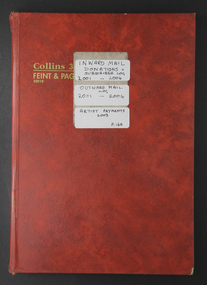
... Shows typical daily office activities....Shows typical daily office activities. Record of ongoing involvement of MTSV involvement with the community, donors and artists. accounts artist payments Three white labels on outside cover: 1. ...MTSV log of inward/outward mail, donations and artist payments, 2001 - 2004. Shows typical daily office activities.Record of ongoing involvement of MTSV involvement with the community, donors and artists. Three white labels on outside cover: 1. "INWARD MAIL DONATIONS + SUBSCRIBER LOG 2001 - 2004" 2. "OUTWARD MAIL LOG 2001 - 2004" 3. "ARTIST PAYMENTS 2003 P.167"accounts, artist, payments -
Tatura Irrigation & Wartime Camps Museum
Documents- Archives, Kuhne, 1946
... Donor was researching her father's service & obtained at her expense copies of these archives held by the AWM, related to daily activities in the camp during the time that her father was posted at Murchison. ...Donor was researching her father's service & obtained at her expense copies of these archives held by the AWM, related to daily activities in the camp during the time that her father was posted at Murchison. ...Donor is daughter of a member of Australian armed forces who served during WW2, and was member of garrison at Camp 13 after the war, in 1946. Donor was researching her father's service & obtained at her expense copies of these archives held by the AWM, related to daily activities in the camp during the time that her father was posted at Murchison. Records show, amongst other things, troop (garrison) movements, routine orders, outcomes of disciplinary proceedings. Copies of archival documents obtained from AWM, specifically Australian Army war diaries / intelligence summaries pertaining to Murchison POW group (Camp 13). For periods: 1. Jan-Mar 1946; 2. April-May 1946; 3. Jun-July 1946. Printed A4 pages. 3 separately bound parts. Series number: AWM52; Control Symbol: 8/7/40. Part 1 (Jan-Mar) - 110 pages. Part 2 (April-May) - 171 pages. Part 3 (June-July) - 99 pages. camp 13, murchison, prisoner of war camps, internee camps, world war ii, garrison -
 Australian National Surfing Museum
Programme, Australia 1970 Fifth World Surfboard Riding Championships, Bells Beach, Victoria, Circa 1970
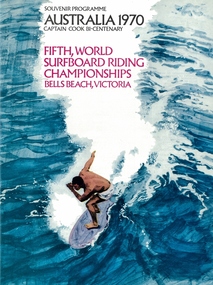
... The programme features an introduction by the Premier Sir Henry Bolte, Daily Programme of activities, feature articles about Bells Beach and previous World Surfboard Riding Championships plus advertisements for Qantas, Fiat, Peter's Icecream, Jantzen Surf clothing, Schweppes and Bower Boy Surfwax....The programme features an introduction by the Premier Sir Henry Bolte, Daily Programme of activities, feature articles about Bells Beach and previous World Surfboard Riding Championships plus advertisements for Qantas, Fiat, Peter's Icecream, Jantzen Surf clothing, Schweppes and Bower Boy Surfwax. ...The souvenir programme was produced for the Fifth World Surfboard Riding Championships at Bells Beach, Victoria. The championships were the first international surfing contest held at Bells Beach. The finals of this event were held at Johanna Beach, also a first. The programme features an introduction by the Premier Sir Henry Bolte, Daily Programme of activities, feature articles about Bells Beach and previous World Surfboard Riding Championships plus advertisements for Qantas, Fiat, Peter's Icecream, Jantzen Surf clothing, Schweppes and Bower Boy Surfwax.The Fifth World Surfboard Riding Championships were a first for Bells Beach and also significant for the role they played in the development of Bells Beach as an international surfing venue.24 page souvenir programme, colour cover, colour black, black and white pages inside. Cover features colour drawing of a surfer riding a wave.bells beach, 1970, surfing, world surfboard riding championships, melbourne surf shop, world surfing titles, australian surfriders association, rolf aurness, tony olsson -
 Flagstaff Hill Maritime Museum and Village
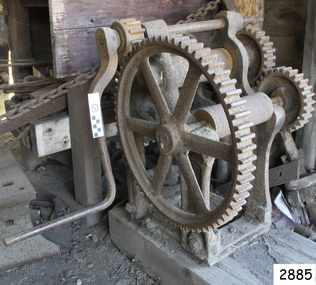
Tyre Bender, 1884
... The machine is a part of our social history as it demonstrates part of the process of making wagon wheels, which played an important part in aiding the continuation of daily transport needs that people had at the time, such as farming, personal transport and commercial activities. ...A tyre bender is used to bend and shape metal rims for wooden wagon wheels. This tyre bender’s model first appeared in the Day Bros catalogue in 1884 as the “Giant” model. The catalogue of 1883 only showed a lighter duty model called the “Lion”. It can be assumed that this later “Giant” model was a heavy duty improvement over the 1883 "Lion" and other smaller models which were still being advertised for sale in 1884. The Day Bros foundry, makers of this tyre bender, was operating as the manufacture of wheel right and blacksmith tools and general machinery in the 19th century in the USA and successfully exported their goods all over the world. Wagon tyre benders would have been very common circa 1850-1920, so there were probably many makers over the years. Early on, it would have become clear to the blacksmiths about which designs worked best so, eventually, the various makers would have made similar products to each other. This tyre bender was once used by Harry Goodall of H. Goodall & Sons Pty. Ltd. corner of McKinnon and High Streets, Terang. Victoria. Henry Goodall & Sons Henry Goodall (1870-1936) was proprietor of garages as H. Goodall & Sons Pty. Ltd., at both Terang (McKinnon and High Streets) and Mortlake (Dunlop Street). His business was in operation in at least in 1916 and perhaps well before, considering the date of the tyre bender and its use for wagons with wooden wheels. It was still in operation in 1953, chasing up debtors in Mount Gambier Court. Amongst the employees of H. Goodall & Sons Pty. Ltd. was Ernie Entwistle, a blacksmith (a soldier who died in 1916 ) and Alfred Hodgetts, radio expert (killed in a fatal accident in 1943, when he was in his early 30s ). Henry Goodall was involved in the community as a Justice of Peace, a deputy coroner, President of the Mortlake Hospital, trustee of the Soldiers’ Memorial Hall, and as a prominent Freemason. He and his wife had two sons (Charles and John) and one daughter (Mrs. Chas. Newton, of Skipton). The tyre bender is significant as it demonstrates how blacksmiths or wheelwrights could make new metal rims for wagon wheels for carts, wagons, stage coaches and carriages over a 135 years ago. The machine is a part of our social history as it demonstrates part of the process of making wagon wheels, which played an important part in aiding the continuation of daily transport needs that people had at the time, such as farming, personal transport and commercial activities. The machine or tool is locally significant as it was used by a local company in Terang and Mortlake in their blacksmith, wheelwright and garage business. Steel tyre bender mounted on timber base, used for wagon wheel steel rims. Made from cast iron and steel, double geared with four cogs to unite the upper and lower steel rollers. There are adjustable guide collars to keep the iron in line while it is being bent. It can also be used with two cranks for heavy duty work utilising the use to two operators. It is the Giant model, made in 1884 by Day Bros. of Philadelphia. This tyre bender once belonged to Harry Goodall & Sons, blacksmith's of Terang. Victoria. “DAY BROS. PHILAP. PA” cast into the side of machineflagstaff hill, warrnambool, shipwrecked coast, flagstaff hill maritime museum, maritime museum, shipwreck coast, flagstaff hill maritime village, great ocean road, machinery, wagon wheel, wheelwrights, blacksmith, steel rim wheels, tyre bender, tire bender, the giant tyre bender, henry goodall (1870-1936), terang, wheelwright tool, blacksmith trade, blacksmithing equipment and supplies, wagon tyre bender, day bros. philadelphia pennsylvania, h. goodall & sons of terang, terang blacksmith, h. goodall & sons pty ltd, mortlake, ernie entwistle blacksmith, alfred hodgetts radio expert, charles goodall, john goodall, mrs. chas. newton nee goodall -
 Flagstaff Hill Maritime Museum and Village
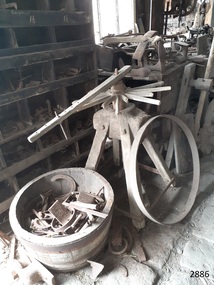
Vice, 1800s
... The machine is a part of our social history as it demonstrates part of the process of making wagon wheels, which played an important part in aiding the continuation of daily transport needs that people had at the time, such as farming, personal transport and commercial activities. ...A wheelwright’s spoke vice was used to hold the wheel hub firmly while the spokes were hammered into the wheel hub, then the spokes would be joined to the wooden wheel felloe before finally the metal flat tyre, or later the rubber tyre, would be attached to the felloe. A wheelwright’s spoke vice would have been very necessary for blacksmiths circa 1800s-1920s as it would have been used in the manufacture and repair of carts, wagons, coaches and other horse-drawn vehicles. This wheelwright’s spoke vice was once used by Harry Goodall of H. Goodall & Sons Pty. Ltd. corner of McKinnon and High Streets, Terang. Victoria. Henry Goodall & Sons Henry Goodall (1870-1936) was proprietor of garages as H. Goodall & Sons Pty. Ltd., at both Terang (McKinnon and High Streets) and Mortlake (Dunlop Street). His business was in operation in at least in 1916 and perhaps well before, considering the date of the tyre bender and its use for wagons with wooden wheels. It was still in operation in 1953, chasing up debtors in Mount Gambier Court. Amongst the employees of H. Goodall & Sons Pty. Ltd. was Ernie Entwistle, a blacksmith (a soldier who died in 1916) and Alfred Hodgetts, radio expert (killed in a fatal accident in 1943, when he was in his early 30s). Henry Goodall was involved in the community as a Justice of Peace, a deputy coroner, President of the Mortlake Hospital, trustee of the Soldiers’ Memorial Hall, and as a prominent Freemason. He and his wife had two sons (Charles and John) and one daughter (Mrs. Chas. Newton, of Skipton). The wheelwright’s spoke vice is significant as it demonstrates how blacksmiths or wheelwrights could make new metal rims for wagon wheels for carts, wagons, stage coaches and carriages over a 135 years ago. The machine is a part of our social history as it demonstrates part of the process of making wagon wheels, which played an important part in aiding the continuation of daily transport needs that people had at the time, such as farming, personal transport and commercial activities. The tool is locally significant as it was used by a local company in Terang and Mortlake in their blacksmith, wheelwright and garage business. Vice; wheelwright’s wheel spoke vice. Manufactured in 1800s. This was once belonged to Harry Goodall & Sons, blacksmith's of Terang. Victoria.flagstaff hill, warrnambool, shipwrecked-coast, flagstaff-hill, flagstaff-hill-maritime-museum, maritime-museum, shipwreck-coast, flagstaff-hill-maritime-village, machinery, wagon wheel, steel rim wheels, henry goodall (1870-1936), terang, wheelwright tool, blacksmith trade, blacksmithing equipment and supplies, h. goodall & sons of terang, terang blacksmith, h. goodall & sons pty ltd, mortlake, ernie entwistle blacksmith, alfred hodgetts radio expert, charles goodall, john goodall, wheel hub, wheel spoke, wheel felloe, wheel tyre, wheel tire -
 Flagstaff Hill Maritime Museum and Village
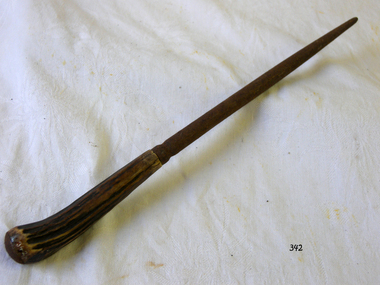
Domestic object - Sharpening Steel
... There has long been speculation about the efficacy of steeling (re-aligning the edge) vs honing (removing minor deformation with abrasives); studies tend to favour abrasives for daily maintenance, especially in high-carbide-volume "stainless" steels (such as the popular CPM S30V steel, which tends to "tear out" when steeled rather than re-forming an edge.) Small honing steel for outdoor activities...There has long been speculation about the efficacy of steeling (re-aligning the edge) vs honing (removing minor deformation with abrasives); studies tend to favour abrasives for daily maintenance, especially in high-carbide-volume "stainless" steels (such as the popular CPM S30V steel, which tends to "tear out" when steeled rather than re-forming an edge.) Small honing steel for outdoor activities ...A honing steel, sometimes referred to as a sharpening steel, whet steel, sharpening stick, sharpening rod, butcher's steel, and chef's steel, is a rod of steel, ceramic or diamond-coated steel used to restore keenness to dulled blade edges. They are flat, oval, or round in cross-section and up to 30 centimetres (1 ft) long. The steel and ceramic honing steels may have longitudinal ridges, whereas the diamond-coated steels are smooth but embedded with abrasive diamond particles. Non-abrasive honing rods such as smooth ceramic or ribbed steel are able to remove small amounts of metal via adhesive wear. In normal use, the rod is applied to the blade at a slightly higher angle than that of the bevel, resulting in the formation of a micro-bevel. The term "hone" is associated with light maintenance performed on a blade without the effort and precision normally associated with sharpening, so the name "hone" was borrowed. In the 1980s, ceramic abrasives became increasingly popular and proved an equal, if not superior, method for accomplishing the same daily maintenance tasks; manufacturers replaced steels with ceramic (and later, manufactured diamond abrasive) sharpening "steels" that were actually hones. Use Honing steels are used by lightly placing the near edge of the blade against the base of the steel, then sliding the blade away from yourself along the steel while moving it down – the blade moves diagonally, while the steel remains stationary. This should be done with the blade held at an angle to the steel, usually about 20°, and repeating on the opposite side at the same angle. This is repeated five to ten times per side. Steeling It is often recommended that steeling be performed immediately before or after using a knife and can be done daily. By contrast, knives are generally sharpened much less frequently. A traditional smooth honing steel is of no use if the edge is blunt, because it removes no material; instead it fixes deformations along the edge of a sharp blade, technically known as burnishing. There has long been speculation about the efficacy of steeling (re-aligning the edge) vs honing (removing minor deformation with abrasives); studies tend to favour abrasives for daily maintenance, especially in high-carbide-volume "stainless" steels (such as the popular CPM S30V steel, which tends to "tear out" when steeled rather than re-forming an edge.) Small honing steel for outdoor activities Usage trends Steels have traditionally been used in the West, especially in heavy-use scenarios (e.g. butchering, where the edge deforms due to forceful contact with bone). These scenarios also lead Western trends toward blades tempered to a lower level of hardness (and thus lower brittleness). In East Asia, notably Japan, harder knives are preferred, so there is little need for steeling intra-day, as the edge does not deform as much. Instead, the blade is honed as needed on a waterstone. While tradition has kept the practice of steeling alive in Western kitchens, the majority of honing steels sold are abrasive rather than smooth, and knives are harder and more frequently made of stainless steel, which does not respond to traditional steeling techniques as well as high-carbon/low alloy tool steels.The sharpening steel is essential to maintain the sharpness of carving and other knives.Steel knife sharpener with bone handle. Part of a carving set.None.flagstaff hill, warrnambool, shipwrecked-coast, flagstaff-hill, flagstaff-hill-maritime-museum, maritime-museum, shipwreck-coast, flagstaff-hill-maritime-village, sharpening steel, carving set, kitchen equipment -
 The Beechworth Burke Museum
Audio - Oral History, Jennifer Williams, Isabel Wells, 24th February 2000
... Isabel's mother was in a wheelchair, suffering from osteoarthritis; thus, Isabel had taken over the responsibility for looking after her mother and assisting her with daily living needs and personal care activities. She used to play golf and tennis and she was a member of the town tennis club. ...Isabel's mother was in a wheelchair, suffering from osteoarthritis; thus, Isabel had taken over the responsibility for looking after her mother and assisting her with daily living needs and personal care activities. She used to play golf and tennis and she was a member of the town tennis club. ...Isabel Wells was born in Beechworth in 1914. Her father, Mr. Newey, was a butcher; his shop was in Ford street and he took over from his grandfather. The family business, along with the local residents, was supplying the main government institutions in the region, like Mayday Hills Hospital and The Ovens and Murray Home, making a large percentage of his profit. Mr. Newey was also a captain of the fire brigade and Isabel mentioned that there were more fires happening in those days. The menace of a huge fire was impending in Beechworth for many years, due to the lack of adequate water supply and the absence of trained firefighters. The first fire brigade in the town was voluntary and was formed in 1858 under Superintendent Luke Reilly. A few other schemes deployed the following years, with all failing to sufficiently control the fires that occurred, until the creation of the first reliable fire brigade in the 1870s. The worst fire in the town's history happened on 23rd March 1867; it swept through many shops and the post office, leaving behind a damage cost estimated at £12,000. Isabel's mother was in a wheelchair, suffering from osteoarthritis; thus, Isabel had taken over the responsibility for looking after her mother and assisting her with daily living needs and personal care activities. She used to play golf and tennis and she was a member of the town tennis club. In terms of social life, Boxing Day was a big occasion for the town, with horse-races and games taking place. According to her narration, the use of cars was a turning point in the town's social activities, since people were able to visit nearby places and take day trips, such as having a picnic at Lake Kerferd or Buffalo. This oral history recording was part of a project conducted by Jennifer Williams in the year 2000 to capture the everyday life and struggles in Beechworth during the twentieth century. This project involved recording seventy oral histories on cassette tapes of local Beechworth residents which were then published in a book titled: Listen to what they say: voices of twentieth century Beechworth. These cassette tapes were digitised in July 2021 with funds made available by the Friends of the Burke. Isabel's account of her life in Beechworth and the local area during the 20th century is historically and socially significant as it offers valuable information about the business activity in the region and provides a deeper insight into the operation of butcher shops and meat supply during the first half of the previous century. Additionally, it offers invaluable information about the everyday life of people living in Beechworth, and highlights aspects of the overall social life and activities.This is a digital copy of a recording that was originally captured on a cassette tape. The cassette tape is black with a horizontal white strip and is currently stored in a clear flat plastic rectangular container. It holds up 40 minutes of recordings on each side.Mrs Isabel Wells/ isabel wells, beechworth, mr. newey, ford street, butcher, mayday hills hospital, the ovens and murray home, fire brigade, 23rd march 1867, fire, osteoarthritis, boxing day, horseraces, lake kerferd, buffalo, picnic, cars, firefighters, luke reilly, wheelchair -
 Shepparton RSL Sub Branch
Diary
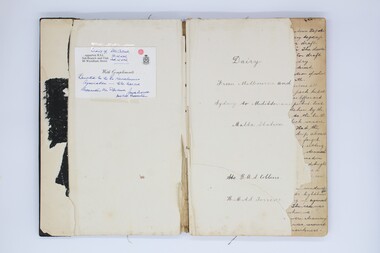
... Details of the personal daily activities onboard Destroyer during The Great War, descriptions include ports of call, other destroyers and warships on way to and including in the Mediterrainean. ...A rare hand written diary in chronological order from 31/05/1917 to 21/05/1919 by Stoker Richard Arthur Stephen Collins, DOB 1/12/1899 at Beeac Victoria, later residing at Shepparton Victoria. Service Number 6129 A descriptive diary written from pre embarkment on SS Zeelandia from Melbourne (31/05/1917) to Sydney and leaving on 9/06/1917 on the Destroyer flotilla including “Yarra-79”, “Parramatta - 55” and the “Warrego-70” for Malta Station in the Mediterrainean.Details of the personal daily activities onboard Destroyer during The Great War, descriptions include ports of call, other destroyers and warships on way to and including in the Mediterrainean. The social activities with shore leave and detailed description of the vista at different ports including Singapore and via th Suez Canal to the Mediterrainean.Black bound foolscap book with frayed top and bottom edges of cover. Areas are white markings on front and back covers. Hand written daily diary in ink, italiac script, pages are of ledger appearance with faint pink lines. Pages in book discoloured yellow around edges.Donated to the Ex Naval Association to be kept at the Shepparton RSL Sub Branch royal australian navy, the great war, first world war, diary, ww1 -
 Greensborough Historical Society
Newsletter, Greensborough Secondary College Student Bulletin 13 November 1991, 13/11/1991
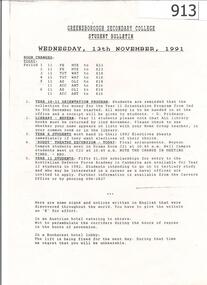
... This 2 page 'daily' bulletin gives information to students about the day's activities....This 2 page 'daily' bulletin gives information to students about the day's activities. An example of daily communication with the school. greensborough secondary college 2 pages text. ...This 2 page 'daily' bulletin gives information to students about the day's activities.An example of daily communication with the school.2 pages text.greensborough secondary college -
 City of Moorabbin Historical Society (Operating the Box Cottage Museum)
Education kit, Department of Veterans Affairs, Schooling, service and the Great War, 2014
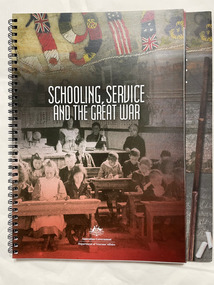
... -- INVESTIGATION 4: How did the Great War affect daily life in schools? -- INVESTIGATION 5: What patriotic activities did many students perform at school or home, and why? ...A resource for primary schools. Introduction -- Advice to Primary School Teachers -- Structure and components of this resource -- The Australian curriculum -- Disclaimer and acknowledgements -- What does that word mean? -- INVESTIGATION 1: What were schools like during the Great War? How did students learn? Which family members were likely to serve in the Great War? -- INVESTIGATION 2: What did students learn about the British Empire, its allies and enemies during the Great War? -- INVESTIGATION 3: What were some of the values taught by schools during the Great War? -- INVESTIGATION 4: How did the Great War affect daily life in schools? -- INVESTIGATION 5: What patriotic activities did many students perform at school or home, and why? -- INVESTIGATION 6: How did families and school communities cope with the sadness of losing people they knew? How did they remember people who did not return? How did they help those who did return?82 pages : illustrations - spiral bound Contains CDnon-fictionA resource for primary schools. Introduction -- Advice to Primary School Teachers -- Structure and components of this resource -- The Australian curriculum -- Disclaimer and acknowledgements -- What does that word mean? -- INVESTIGATION 1: What were schools like during the Great War? How did students learn? Which family members were likely to serve in the Great War? -- INVESTIGATION 2: What did students learn about the British Empire, its allies and enemies during the Great War? -- INVESTIGATION 3: What were some of the values taught by schools during the Great War? -- INVESTIGATION 4: How did the Great War affect daily life in schools? -- INVESTIGATION 5: What patriotic activities did many students perform at school or home, and why? -- INVESTIGATION 6: How did families and school communities cope with the sadness of losing people they knew? How did they remember people who did not return? How did they help those who did return?war and education, schooling, world war one, teaching -
Mission to Seafarers Victoria
Article, A Woman's Melbourne Letter
... The article describes the Mission and the use of several spaces a year after its opening and gives details about the daily activities. 717 flinders street seamen's mission norla dome lhlg reverend alfred gurney goldsmith celia little room garden frederica godfrey Digital copy of an article published in the Western Mail on the 13th of December 1918. ...A detailed description of the Mission and its activities written by a woman: Western Mail (Perth, WA : 1885 - 1954), Friday 13 December 1918, page 34 A WOMAN'S MELBOURNE LETTER. Melbourne, Dec. 4. There is an idea abroad, which as regards Melbourne, at any rate, is quite erroneous, that our sailors are not as well looked after as our soldiers, and that the noble men of the Mercantile Marine are much neglected ! For once, perhaps, my readers will pardon a letter dealing with only one subject, but the steady, unostentatious work done by the Ladies' Harbour Light Guild, in connection with the mission to seamen in Melbourne could not be adequately explained if dismissed in the usual short paragraph. Some of the most prominent names in Melbourne are associated with this guild and with the Mission Chaplain, and Mrs. Gurney Goldsmith, the members have made the Seamen's Institute a real home for those sailors of the Mercantile Marine, who touch our port. What we as a community owe to those men by their heroism in recent hostilities is certainly more understood by this band of enthusiastic workers than by the community generally. By using their unflagging energies, and influence on the sailor's behalf they endeavour to discharge a debt to which in some way or other we could and should all contribute. Even the most casual person can, if he thinks at all, sum up a few of the things our sailors - other than those belonging to our glorious navy - have done for us. On the spur of the moment we remember that those of the Mercantile Marine, are the men who manned our transports, who carried our wheat and wool, to oversea markets; who kept us in touch with our loved ones abroad; who kept the fires going in the furnaces of the great leviathans, bringing our wounded soldiers home again; who never flinched when self-sacrifice was demanded; who cared, with that tenderness, innate in all sailors, for the women and children, when the passenger ships were struck a dastardly blow by the wicked enemy; who, mocking death, gave up life with a heroism all the more heroic because it was always taken as a matter of course! Is it any wonder, then, that the members of the Ladies' Harbour Light Guild make it their business to provide a bright, homelike, spot in Melbourne, where the sailors are always certain of a cherry welcome ashore? The members of the guild are admirably drafted! The 360 non-workers each pay £1 1s. per annum. The workers, of whom there are between 700 and 800, donate 2s. 6d. and school members - it is confidently hoped that gradually all the schools will take an active interest in the mission - 1s. a year. The knights of the guild - as the men members are designated - are responsible for any sum they wish to name, from 5s. a year upwards. Everything is paid for out of these revenues, with the exception of a small grant from the Home Mission Fund - and such is the organisation, and management, that the entire concern is quite free from debt. The Seamen's Church and Institute, where the "Harbour Lights" gleam so brightly, is situated right in the midst of all the bustle and turmoil of the wharves, at the end of Flinders-street. The building, comprising chapel, and institute under the one red tiled roof, is grey stuccoed, with a small tower, from which flaunts the flag of 'The Flying Angel" - the badge of the guild. A visit to the institute makes one fully appreciate the boon the place must be to the voyage worn, weary, sailor. The atmosphere is eminently social in its best sense. While the architecture imparts an elegance, and quiet dignity which soothes by the very subtlety of its charm. With its comfortable furniture, its wealth of flowers, and the happy, wholesome, feminine influence which prevails everywhere, the quality which stands for the magic word "home" abounds. The Chaplain in the course of conversation said: -"We try to make this really a free club for sailors." But the habitues would probably tell you it was far more than that to them. The Institute is excellently appointed, and every little corner seems to have its particular history. It was built after the model of one of the old mission churches in California, and retains something of the old world attraction, while yet it combines all the advantages of modern, practical, conveniences. On entering the door the first thing, one notices is a huge compass, inlaid upon the floor, evidently to indicate one's proper bearings for it points due north - to the chapel! Only one other seamen's mission in the world boasts such a compass. As the sailor swings through the entrance he finds the office on his right, and there is, here, always a smiling face to welcome the shy, or timid, new comer. Quite a real post office is staffed by members of the guild, and all the letters received are listed alphabetically. Therefore, the expectant sailor has just to run his eye down the list, and he can immediately see whether there is a letter for him or not. If he is fortunate, he comes up to the member in charge, who unlocks the box, and produces the longed for missive. The boys are always encouraged to answer letters - and to write them. Often a few words about their mother, and their own home, will provoke a sleeping memory into activity. The writing room is well stocked with paper, envelopes, pens, and ink. The tables are so divided to ensure the utmost privacy, and through a calculated chain of circumstances, many an anxious mother receives a letter from her sailor lad, who, perhaps, might not have written but for these kindly inducements. The central hall - where social evenings are held every other night besides two special concerts a week - is inviting in the extreme. A handsome piano affords opportunity for those musically inclined. The tables are strewn with papers. The walls are bright with pictures, and here, and there, is a carved model, of a ship. One, of especial interest, is a model of "The Roon" carved, and presented by a French sailor. This German vessel will always be remembered in Australia. For it was across her bows that the first hostile shot was ever fired in Australian waters. In the corner is the canteen. It was fitted up entirely from the proceeds of a quotation calendar compiled by one of the members. The sailors may at any time, get a teapot of tea, or a tray of eatables, at a nominal cost. Before the canteen was in existence they had to go out for refreshments! - and sometimes they did not come back! Groups of sailors sit chatting at the tables. Half a dozen Swedes laugh and talk among themselves, for the simple reason they know no other language than their own. Several British sailors cluster about a dark-eyed Welsh lad - a perfect Celtic type - who, although only about twenty years of age, has been the victim of the Hun five times. Mines and torpedoes sank the ships he was in, either in the Channel or off the English coast, four times; and it is to his fifth experience, when the Inverness was wrecked, that everyone is eagerly listening. "We were in the boats eight days," he was saying, "I was pretty well mangled when they picked me up. The sufferings we endured were awful. At last we managed to reach Rapa, a Hawaiian island. The natives thought we were Germans, and came at us with spears. When they found we were British, they were awfully good to us. They even cried when we left, and the day before the rescue boat arrived they begged us to go into the hills and hide." At another table a Canadian lad - once a sailor - then a soldier, who trained at the Broadmeadows camp - was telling his experiences : - "The voyage which will always stick in my memory," he said, "was to a place which must be nameless. We left the United States not knowing whether we were bound, or what we were going to do. After some weeks we sighted a group of wonderfully beautiful islands, and we headed for the most remote and most lovely of them all. Then, and only then, we learned our mission from the skipper. We were taking their year's supply to a leprosy station! Oh no! I don't blame the skipper for not telling us ! Someone has to do these things, you know. A naval guard saw they didn't come near - and we all got sixty dollars extra. When the job was over we were quarantined on another island for two months, and one little chap - the baby of the crew, not eighteen - developed leprosy, and died before we left. Yes! I'll never forget that voyage, mates! Sometimes, I seem to see Leper's Island yet, with its lavish tropical vegetation and the gorgeous sunsets which stained all the water with blood. Then, too" - here the voice deepened - "there was an English girl - a leper - there. We heard she used to be an actress, and she contracted the disease somehow or other. She was always alone, and always watching us. In the distance we could see her come to the water's edge, and from there she would watch. Just watch . .. . watch . . .watch. ..." "Here come a couple of North Sea chaps," broke in an elderly man after pause. "One of them wounded, too, poor lad." It is not strange that all the sailors flock to the Institute. It is so comfortable, and essentially inviting, besides being full of human interest. The men's quarters comprise reading, writing and dressing rooms - hot and cold baths are always available - billiard room, and a special baggage room, where any sailor may leave his kit for as long as he likes. The payment of 3d. covers its complete insurance. Upstairs are the officers' quarters. These also have their own billiard room, writing and reading rooms, bath and dressing rooms. Just close are the apprentices' quarters - "The Half Deck," as popular parlance has it! The lads also have a billiard room of their own, and indulge in an easy armchair - amongst others - which was a donation from the Milverton School branch of the Guild. It is hoped by the committee to some day utilise the huge empty rooms, which run the length of the whole building. Their ultimate intention is to fit them up as cubicles, or "cabins," as they are to be called. They trust these "cabins" will be donated, either in memory, or in honour, of someone dear to the donor. Another forward movement soon to be put in hand, now that materials are available, is the establishment of "Norla Gymnasium." In a sailors' club such facility for exercise is absolutely essential. The men both need, and miss, exertion. As one boy, who had been backsliding, once said pathetically : -"If only there was something to do to get me into a good sweat, I would be all right." Soon such an one will be helped to swing from the trapese of the Norla Gymnasium into the right track! Sunday is always a fete day at the Institute, for 40 or 50 sailors generally come into tea. The up-to-date kitchen, which is fitted with every labour-saving appliance - all paid for out of working members' half crowns - is then a hive of animation, and methodical order. A formidable row of teapots await filling. Mrs. Goldsmith -, the chaplain's wife - rightly thinks it is far more homely to pour out the tea from a pot, than to serve it straight from the urns. So tea is poured out by a member, who sits at the head of a table gay with flowers, and chats to the guests. These latter are of all nationalities. But the French, the Spanish, Scandinavian, Norwegian - or any other sailor is equally welcome with the British. Two enthusiasts belonging to the Guild actually learnt Norwegian, so that men of this nation would have someone to talk to, and so be less lonely when they reached this, to them, foreign port ! The members of the Guild have their own private suite where they arrange the flow-err and do other necessary odds and ends undisturbed. No one appreciates flowers like a sailor, and the earliest and most beautiful may always be seen adorning the tables and rooms. Teas are served and lectures are held in the "Celia Little Hall," one of the most beautiful portions of the institute. It was erected by the chaplain in memory of his aunt from whom the hall takes its name. The Gothic windows open upon the cloisters, where, in the hot weather, the sailors enjoy their meals out of doors. The cloisters, indeed, form an exquisite spot. They are between a series of sweeping arches which lead to the chapel, and are sheltered by the open balcony of the chaplain's quarters. Grace of contour marks the architecture on every turn. Just around the corner is the chaplain's garden - a patch of green and colour, transformed from a desert waste, by a well-known woman horticulturist. The book room is a department especially valued by the sailors. There are two secretaries, one for home and the other for foreign literature. Books in French, English, Spanish, Scandinavian, Norwegian, and German may be found on the shelves. Each week about 36 convenient parcels of reading stuff are made up. These contain illustrated papers, books in various languages, and magazines. These parcels are eagerly accepted by the sailor with a long monotonous voyage before him. But complete as is every corner of the institute, no part is so well equipped as the memorial chapel erected by the Ladies' Harbour Light Guild, in memory of the officers and men, who have lost their lives during the war. St Peter's - for it is called after the sailor's patron saint - with its hallowed gentle dignity is a veritable sanctuary of peace, perhaps all the more so because it sprang out of war. The fittings are entirely of Australian wood. The pews, given in memory of some loved one by one of the members, are of Tasmanian hardwood. The reredos and altar chairs of carved blackwood. The rich carpet was provided by the members' magical half-crowns. Already this chapel holds memorials of peculiar historical interest. The altar lectern was given in memory of Commander Elwell, who, it will be remembered, was killed at Rabaul, in the early part of the war. The font commemorates two heroes - Nigel Hockley and Fred Hyde, who lost their lives at the hands of the Germans, although they survived the actual torpedoing of their ships, the Galgorn Castle off the coast of Ireland. The mother of one of them wrote out that her son had died as an Englishman should - fighting for the right. This noble sentiment is suitably paraphrased upon the inscription engraved upon the font. Practically every-hing enshrined in the chapel has its own sentimental value. The alms salver of beaten copper, studded with agate, is fragrant with the memory of a saintly woman.The eye of the sailor is caught and held by the pulpit, which is fashioned like a ship's hull and only a twist of rope guides the chaplain up the steps. For the last 13 years the Rev. A. Gurney Goldsmith, M.A., has acted as chaplain to the Seamen's Mission in Melbourne. Before that he and his wife worked in China. Mr Goldsmith visits all the boats and gets in touch personally with the sailor, over whom he has great influence. He is not only their chaplain and friend, but, amongst a wide range of other things, their banker besides. An exchange system exists between the various Missions, and the sailor who has "banked" his money with the chaplain, upon going away, receives a cheque which is cashed - minus exchange - by the chaplain of the next port. Mr. Goldsmith will tell you he has a soft spot in his heart for on old sailor he calls "Paddy." This ancient mariner has been wrecked ten times. It was a long time before the chaplain prevailed upon "Paddy" to partake of the spiritual and secular advantages afforded by the institute. He would not come, he said, until he could do so "with a good heart." Finally he frankly admitted that he had no "friends like those of 'the Flying Angel,' " and that he eventually proved his own "good heart" will be shown in this story. One day he came in to the chaplain and said bluffly, "Well, sir, I've been payin' off some old scores up Carlton way, an' I tells yer, plain, sir, not one of 'em would have seen a penny of their money but for the Mission." The Ladies' Harbour Light Guild has over thirty working suburban branches, and the excellent results achieved at the Institute now will no doubt be considerably augmented in the future. The practical actions of the members do more than anything else to convey the subtle meaning of the name of the Guild. To the visiting sailors the word "ladies" signifies the bread givers; "harbour" safety ; "lights" welcome; "guild" the welding of fraternity, and they one and all tell you the ideals thus embodied are unselfishly carried out by all the ladies who have banded together to care for the sailors' welfare.The article describes the Mission and the use of several spaces a year after its opening and gives details about the daily activities.Digital copy of an article published in the Western Mail on the 13th of December 1918. 717 flinders street, seamen's mission, norla dome, lhlg, reverend alfred gurney goldsmith, celia little room, garden, frederica godfrey -
 Eltham District Historical Society Inc
Book, Nillumbik Shire Council, These tiny threads remind me: The Written in the Time of COVID-19 anthology, 2020
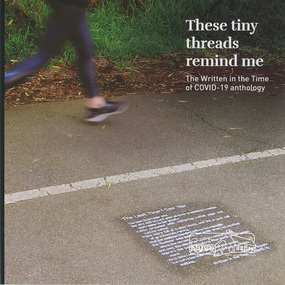
... activities, and in that way a reminder of 'normality' and the importance of community. Twenty texts were selected to be stencilled onto public walkways for the Written in the Time of COVID-19 project. There, on the pavements of locations throughout Nillumbik, they could intersect with the precious pleasure of the daily ...In response to impacts of COVID-19 on the lives of the people of Nillumbik, and on creative practitioners across Australia, Nillumbik Shire Council called for writers to provide short texts, reflecting on their pandemic experiences. At the time, and for months afterwards, walking was one of the few sanctioned recreational activities, and in that way a reminder of 'normality' and the importance of community. Twenty texts were selected to be stencilled onto public walkways for the Written in the Time of COVID-19 project. There, on the pavements of locations throughout Nillumbik, they could intersect with the precious pleasure of the daily stroll, jog or cycle.Such was the quality of writing received, that many other texts could have been chosen. Writers responded with humour, sadness and passion to the extraordinary times. Given this response from writers, who submitted work from across the country, and the importance of recording the public experience of COVID-19, it was determined that a collection should be created, gathering in one place the very best of Written in the Time of COVID-19 submissions.This anthology is the result. It takes its name from a phrase in the piece, Moss, by Eltham writer, Lucinda Bain. Within these pages are tiny threads that exist only because, in 2020, a virus changed our lives and caused us to reconsider how we lived them. Incudes some black and white photographs and illustrations and short biographies of participants.In response to impacts of COVID-19 on the lives of the people of Nillumbik, and on creative practitioners across Australia, Nillumbik Shire Council called for writers to provide short texts, reflecting on their pandemic experiences. At the time, and for months afterwards, walking was one of the few sanctioned recreational activities, and in that way a reminder of 'normality' and the importance of community. Twenty texts were selected to be stencilled onto public walkways for the Written in the Time of COVID-19 project. There, on the pavements of locations throughout Nillumbik, they could intersect with the precious pleasure of the daily stroll, jog or cycle.Such was the quality of writing received, that many other texts could have been chosen. Writers responded with humour, sadness and passion to the extraordinary times. Given this response from writers, who submitted work from across the country, and the importance of recording the public experience of COVID-19, it was determined that a collection should be created, gathering in one place the very best of Written in the Time of COVID-19 submissions.This anthology is the result. It takes its name from a phrase in the piece, Moss, by Eltham writer, Lucinda Bain. Within these pages are tiny threads that exist only because, in 2020, a virus changed our lives and caused us to reconsider how we lived them. Incudes some black and white photographs and illustrations and short biographies of participants.anthology, poetry, covid-19, coronavirus, pandemic, 2020, nillumbik shire council -
 Bendigo Military Museum
Photograph - CARD & PHOTOGRAPHS, AUST LIGHT HORSE WW1, The Australian Memorial Card Co
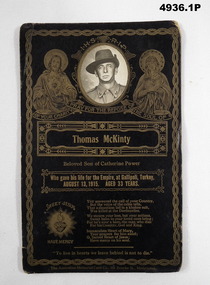
... activity. Beaches - Middle East buildings - locals - repairing train lines - daily life - campsites - ships off shore etc....activity. Beaches - Middle East buildings - locals - repairing train lines - daily life - campsites - ships off shore etc. ...In WW1 the Australian Light Horse served from the Suez Canal right around through Palestine - Syria.1. Memorial Card. Black cardboard with gold printing. It is a religious article with images and prayers. In the top centre is an oval shaped hole with a B & W portrait of an Aust soldier. Slouch hat with side up. 2. Set of 31 B & W photos depicting scenes of light horse activity. Beaches - Middle East buildings - locals - repairing train lines - daily life - campsites - ships off shore etc.Thomas McGinty, Beloved son of Catherine Power. "Who gave his life for the Empire. At Gallipoli, Turkey, August 13 - 1915. Aged 33 years.ww1, middle east, light horse -
 Kiewa Valley Historical Society
Minute Book - Mt Beauty Primary School Mothers Club, First minute book, 1948
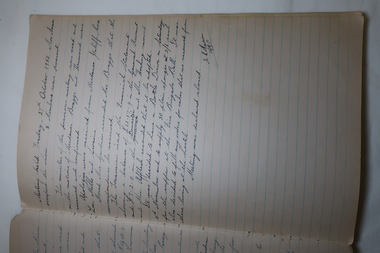
... They were also involved with policy eg. daily free milk delivery for students This book covers the period September 1948 to June 1956 and gives an insight into the activities of the club both locally and more broadly. ...Primary Schools were supported by Mothers' Clubs who met regulary as volunteers supporting the school with fundraising and classroom helpers. They were also involved with policy eg. daily free milk delivery for studentsThis book covers the period September 1948 to June 1956 and gives an insight into the activities of the club both locally and more broadly. It is a social history of the town and its people who were employed by the SECV. In the 1940s Mothers' Clubs were involved in advocacy for funding eg. equipment and included child endowment.Red and black foolscap book with red cloth spine. The Book contains minues of the Mt Beauty Primary School Mothers' Club meetings 1948 - 1956 - generally written in ink. 21 cm x 33 cm x 1.5 cm At the back there is a list of members.mt beauty mothers club, mt beauty primary school -
 Warrnambool and District Historical Society Inc.
Journal - Diary, Diary of Augustus Bostock 1862-1870, Circa 1860
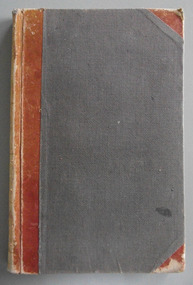
... He was involved in many aspects of life in the Western District, racing, cricket, and social activities to name a few. This diary shows the daily entries over a long period of time with activities ranging from fencing, visiting neighbours and weather details. ...He was involved in many aspects of life in the Western District, racing, cricket, and social activities to name a few. This diary shows the daily entries over a long period of time with activities ranging from fencing, visiting neighbours and weather details. ...Augustus Bostock was the 9th child of Robert & Rachael Bostock of Vaucluse Epping Forest, Van Diemen’s Land. He was only 4 years old when his mother died. He was inspired by his father to seek his fortune in the Western District of Victoria. He arrived around 1850. He married Margaret Aitkin in July 1865. Augustus owned several properties in the district and leased others. He sat on the court of Warrnambool, Mortlake or Hexham as required. He resided at Marramook in Hawkesdale and later moved to Vaucluse in Hopetoun Road Warrnambool, where he died in 1920 at the age of 87. He was involved in many aspects of life in the Western District, racing, cricket, and social activities to name a few. This diary shows the daily entries over a long period of time with activities ranging from fencing, visiting neighbours and weather details. It mentions many local people and many properties he visited. Augustus Bostock along with a number of his brothers was one of the earliest pioneers in the Western District of Victoria. This diary sheds considerable light onto the life of Augustus and people of his era. There is a wealth of information on a range of topics relating to early life in Warrnambool and district.Physical Description: Dark grey stippled cloth hard cover with tan leather corners and spine. Brown and gold coloured paper inside front and back covers. Pages written in black pen.Title page has A Bostock Grasmere. Diary from June 10th 1862.warrnambool, bostock, augustus bostock, bostock diary, augustus bostock 1862 -
 Warrnambool and District Historical Society Inc.
Journal - Diary, Diary of Augustus Bostock 1871-1873, Circa 1871
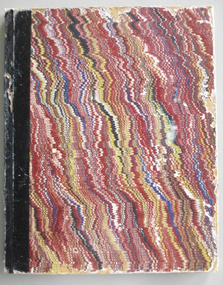
... He was involved in many aspects of life in the Western District, racing, cricket, and social activities to name a few. This diary shows the daily entries over a long period of time with activities ranging from fencing, visiting neighbours and weather details. ...He was involved in many aspects of life in the Western District, racing, cricket, and social activities to name a few. This diary shows the daily entries over a long period of time with activities ranging from fencing, visiting neighbours and weather details. ...Augustus Bostock was the 9th child of Robert & Rachael Bostock of Vaucluse Epping Forest, Van Diemen’s Land. He was only 4 years old when his mother died. He was inspired by his father to seek his fortune in the Western District of Victoria. He arrived around 1850. He married Margaret Aitkin in July 1865. Augustus owned several properties in the district and leased others. He sat on the court of Warrnambool, Mortlake or Hexham as required. He resided at Marramook in Hawkesdale and later moved to Vaucluse in Hopetoun Road Warrnambool, where he died in 1918 at the age of 87. He was involved in many aspects of life in the Western District, racing, cricket, and social activities to name a few. This diary shows the daily entries over a long period of time with activities ranging from fencing, visiting neighbours and weather details. It mentions many local people and many properties he visited. Augustus Bostock along with a number of his brothers was one of the earliest pioneers in the Western District of Victoria. This diary sheds considerable light onto the life of Augustus and people of his era. There is a wealth of information on a range of topics relating to early life in Warrnambool and district.Brown, blue, yellow and white wavy pattern cover with black binding. Edges of pages have a multi coloured pattern. Entries are handwritten in black ink.G. Bostock, Coomite Jan 1st 1871 warrnambool, augustus bostock, marramook hawkesdale, bostock brothers, pioneers warrnambool -
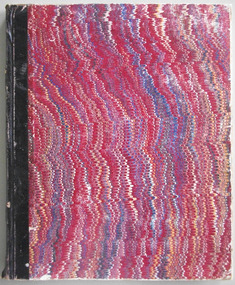 Warrnambool and District Historical Society Inc.
Journal - Diary, Diary of Augustus Bostock 1873-1876, Circa 1873
... He was involved in many aspects of life in the Western District, racing, cricket, and social activities to name a few. This diary shows the daily entries over a long period of time with activities ranging from fencing, visiting neighbours and weather details. ...He was involved in many aspects of life in the Western District, racing, cricket, and social activities to name a few. This diary shows the daily entries over a long period of time with activities ranging from fencing, visiting neighbours and weather details. ...Augustus Bostock was the 9th child of Robert & Rachael Bostock of Vaucluse Epping Forest, Van Diemen’s Land. He was only 4 years old when his mother died. He was inspired by his father to seek his fortune in the Western District of Victoria. He arrived around 1850. He married Margaret Aitkin in July 1865. Augustus owned several properties in the district and leased others. He sat on the court of Warrnambool, Mortlake or Hexham as required. He resided at Marramook in Hawkesdale and later moved to Vaucluse in Hopetoun Road Warrnambool, where he died in 1920 at the age of 87. He was involved in many aspects of life in the Western District, racing, cricket, and social activities to name a few. This diary shows the daily entries over a long period of time with activities ranging from fencing, visiting neighbours and weather details. It mentions many local people and many properties he visited. Augustus Bostock along with a number of his brothers was one of the earliest pioneers in the Western District of Victoria. This diary sheds considerable light onto the life of Augustus and people of his era. There is a wealth of information on a range of topics relating to early life in Warrnambool and district.Maroon, blue, white and yellow patterned cardboard cover with black binding on spine. Pages written in black pen apart from entries for August and September which are written in blue ink. Coomete 16th June 1873. C/N 2/- inside front cover.bostock, augustus bostock, vaucluse warrnambool, warrnambool -
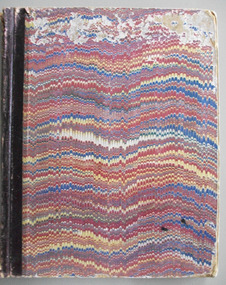 Warrnambool and District Historical Society Inc.
Journal - Diary, Diary of Augustus Bostock 1877-1881, Circa 1877
... He was involved in many aspects of life in the Western District, racing, cricket, and social activities to name a few. This diary shows the daily entries over a long period of time with activities ranging from fencing, visiting neighbours and weather details. ...He was involved in many aspects of life in the Western District, racing, cricket, and social activities to name a few. This diary shows the daily entries over a long period of time with activities ranging from fencing, visiting neighbours and weather details. ...Augustus Bostock was the 9th child of Robert & Rachael Bostock of Vaucluse Epping Forest, Van Diemen’s Land. He was only 4 years old when his mother died. He was inspired by his father to seek his fortune in the Western District of Victoria. He arrived around 1850. He married Margaret Aitkin in July 1865. Augustus owned several properties in the district and leased others. He sat on the court of Warrnambool, Mortlake or Hexham as required. He resided at Marramook in Hawkesdale and later moved to Vaucluse in Hopetoun Road Warrnambool, where he died in 1920 at the age of 87. He was involved in many aspects of life in the Western District, racing, cricket, and social activities to name a few. This diary shows the daily entries over a long period of time with activities ranging from fencing, visiting neighbours and weather details. It mentions many local people and many properties he visited. Augustus Bostock along with a number of his brothers was one of the earliest pioneers in the Western District of Victoria. This diary sheds considerable light onto the life of Augustus and people of his era. There is a wealth of information on a range of topics relating to early life in Warrnambool and district.Blue, tan, yellow and white patterned cover with maroon binding. Fawn pages inside front and back covers. Pages are all handwritten. Sticker inside front cover: J Hider Opposite the Post Office Warrnambool.1/9. A Bostock Coomite Diary for 1877 warrnambool, augustus bostock, gussy bostock, marramook hawkesdale, bostock brothers -
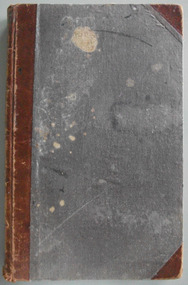 Warrnambool and District Historical Society Inc.
Journal - Diary, Diary of Augustus Bostock 1881-1890, Circa 1881
... He was involved in many aspects of life in the Western District, racing, cricket, and social activities to name a few. This diary shows the daily entries over a long period of time with activities ranging from fencing, visiting neighbours and weather details. ...He was involved in many aspects of life in the Western District, racing, cricket, and social activities to name a few. This diary shows the daily entries over a long period of time with activities ranging from fencing, visiting neighbours and weather details. ...Augustus Bostock was the 9th child of Robert & Rachael Bostock of Vaucluse Epping Forest, Van Diemen’s Land. He was only 4 years old when his mother died. He was inspired by his father to seek his fortune in the Western District of Victoria. He arrived around 1850. He married Margaret Aitkin in July 1865. Augustus owned several properties in the district and leased others. He sat on the court of Warrnambool, Mortlake or Hexham as required. He resided at Marramook in Hawkesdale and later moved to Vaucluse in Hopetoun Road Warrnambool, where he died in 1920 at the age of 87. He was involved in many aspects of life in the Western District, racing, cricket, and social activities to name a few. This diary shows the daily entries over a long period of time with activities ranging from fencing, visiting neighbours and weather details. It mentions many local people and many properties he visited. Augustus Bostock along with a number of his brothers was one of the earliest pioneers in the Western District of Victoria. This diary sheds considerable light onto the life of Augustus and people of his era. There is a wealth of information on a range of topics relating to early life in Warrnambool and district.Brown stippled cloth cover with brown corners and spine in leather. Purple and green patterned paper inside front and back covers. Pages are handwritten in black ink. Sticker inside front cover: J Hider Opposite the Post Office Warrnambool. M/R 6/- Augustus Bostock Coomite Diary 1881 warrnambool, augustus bostock, gussy bostock, vaucluse warrnambool, bostock brothers -
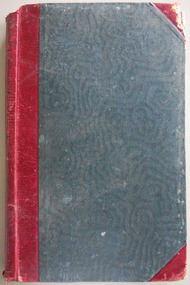 Warrnambool and District Historical Society Inc.
Journal - Diary, Diary of Augustus Bostock 1890, Circa 1890
... He was involved in many aspects of life in the Western District, racing, cricket, and social activities to name a few. This diary shows the daily entries over a long period of time with activities ranging from fencing, visiting neighbours and weather details. ...He was involved in many aspects of life in the Western District, racing, cricket, and social activities to name a few. This diary shows the daily entries over a long period of time with activities ranging from fencing, visiting neighbours and weather details. ...Augustus Bostock was the 9th child of Robert & Rachael Bostock of Vaucluse Epping Forest, Van Diemen’s Land. He was only 4 years old when his mother died. He was inspired by his father to seek his fortune in the Western District of Victoria. He arrived around 1850. He married Margaret Aitkin in July 1865. Augustus owned several properties in the district and leased others. He sat on the court of Warrnambool, Mortlake or Hexham as required. He resided at Marramook in Hawkesdale and later moved to Vaucluse in Hopetoun Road Warrnambool, where he died in 1920 at the age of 87. He was involved in many aspects of life in the Western District, racing, cricket, and social activities to name a few. This diary shows the daily entries over a long period of time with activities ranging from fencing, visiting neighbours and weather details. It mentions many local people and many properties he visited. Augustus Bostock along with a number of his brothers was one of the earliest pioneers in the Western District of Victoria. This diary sheds considerable light onto the life of Augustus and people of his era. There is a wealth of information on a range of topics relating to early life in Warrnambool and district.Blue cloth, water wave cover with maroon binding.Maroon, blue and white patterned pages inside front and back covers. Pages are all handwritten. Coomete 1890.diary of augustus bostock 1890, warrnambool, augustus bostock -
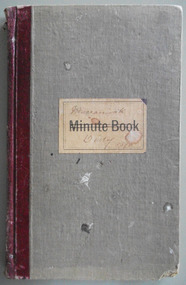 Warrnambool and District Historical Society Inc.
Journal - Diary, Diary of Augustus Bostock 1896-1904, Circa 1896
... He was involved in many aspects of life in the Western District, racing, cricket, and social activities to name a few. This diary shows the daily entries over a long period of time with activities ranging from fencing, visiting neighbours and weather details. ...He was involved in many aspects of life in the Western District, racing, cricket, and social activities to name a few. This diary shows the daily entries over a long period of time with activities ranging from fencing, visiting neighbours and weather details. ...Augustus Bostock was the 9th child of Robert & Rachael Bostock of Vaucluse Epping Forest, Van Diemen’s Land. He was only 4 years old when his mother died. He was inspired by his father to seek his fortune in the Western District of Victoria. He arrived around 1850. He married Margaret Aitkin in July 1865. Augustus owned several properties in the district and leased others. He sat on the court of Warrnambool, Mortlake or Hexham as required. He resided at Marramook in Hawkesdale and later moved to Vaucluse in Hopetoun Road Warrnambool, where he died in 1920 at the age of 87. He was involved in many aspects of life in the Western District, racing, cricket, and social activities to name a few. This diary shows the daily entries over a long period of time with activities ranging from fencing, visiting neighbours and weather details. It mentions many local people and many properties he visited. Augustus Bostock along with a number of his brothers was one of the earliest pioneers in the Western District of Victoria. This diary sheds considerable light onto the life of Augustus and people of his era. There is a wealth of information on a range of topics relating to early life in Warrnambool and district.Grey cloth cover over card with maroon leather binding. Blue pages inside front and back covers. Pages are all handwritten with dates in margin. Edges of pages orange blue and yellow. Label on front cover has Minute Book printed on cream label. Marramook Diary 1896 hand written in pen. 286 pages.Marramook Sept 15th 1896 Augustus Bostock. diary of augustus bostock 1896-1904, warrnambool, augustus bostock -
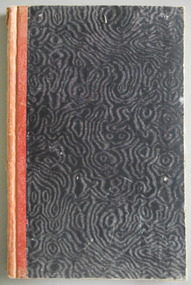 Warrnambool and District Historical Society Inc.
Journal - Diary, Diary of Augustus Bostock 1904-1907, Circa 1904
... He was involved in many aspects of life in the Western District, racing, cricket, and social activities to name a few. This diary shows the daily entries over a long period of time with activities ranging from fencing, visiting neighbours and weather details. ...He was involved in many aspects of life in the Western District, racing, cricket, and social activities to name a few. This diary shows the daily entries over a long period of time with activities ranging from fencing, visiting neighbours and weather details. ...Augustus Bostock was the 9th child of Robert & Rachael Bostock of Vaucluse Epping Forest, Van Diemen’s Land. He was only 4 years old when his mother died. He was inspired by his father to seek his fortune in the Western District of Victoria. He arrived around 1850. He married Margaret Aitkin in July 1865. Augustus owned several properties in the district and leased others. He sat on the court of Warrnambool, Mortlake or Hexham as required. He resided at Marramook in Hawkesdale and later moved to Vaucluse in Hopetoun Road Warrnambool, where he died in 1920 at the age of 87. He was involved in many aspects of life in the Western District, racing, cricket, and social activities to name a few. This diary shows the daily entries over a long period of time with activities ranging from fencing, visiting neighbours and weather details. It mentions many local people and many properties he visited. Augustus Bostock along with a number of his brothers was one of the earliest pioneers in the Western District of Victoria. This diary sheds considerable light onto the life of Augustus and people of his era. There is a wealth of information on a range of topics relating to early life in Warrnambool and district.Cardboard cover, water- waved patterned in black and grey with orange cloth binding. Pages are all handwritten with dates in margin. Augustus Bostock Diary for 1904.diary of augustus bostock 1904-1907, warrnambool, augustus bostock -
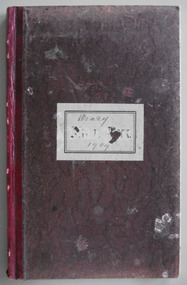 Warrnambool and District Historical Society Inc.
Journal - Diary, Diary of Augustus Bostock 1909-1913, Circa 1909
... He was involved in many aspects of life in the Western District, racing, cricket, and social activities to name a few. This diary shows the daily entries over a long period of time with activities ranging from fencing, visiting neighbours and weather details. ...He was involved in many aspects of life in the Western District, racing, cricket, and social activities to name a few. This diary shows the daily entries over a long period of time with activities ranging from fencing, visiting neighbours and weather details. ...Augustus Bostock was the 9th child of Robert & Rachael Bostock of Vaucluse Epping Forest, Van Diemen’s Land. He was only 4 years old when his mother died. He was inspired by his father to seek his fortune in the Western District of Victoria. He arrived around 1850. He married Margaret Aitkin in July 1865. Augustus owned several properties in the district and leased others. He sat on the court of Warrnambool, Mortlake or Hexham as required. He resided at Marramook in Hawkesdale and later moved to Vaucluse in Hopetoun Road Warrnambool, where he died in 1920 at the age of 87. He was involved in many aspects of life in the Western District, racing, cricket, and social activities to name a few. This diary shows the daily entries over a long period of time with activities ranging from fencing, visiting neighbours and weather details. It mentions many local people and many properties he visited. Augustus Bostock along with a number of his brothers was one of the earliest pioneers in the Western District of Victoria. This diary sheds considerable light onto the life of Augustus and people of his era. There is a wealth of information on a range of topics relating to early life in Warrnambool and district.Maroon coloured cloth bound card cover, with grey paper label on front. Spine binding is maroon leather. Pages inside front and back covers are blue. Pages numbered to 186 and are all handwritten in black pen with days written in margins.Diary 1909 handwritten on label on front cover. A Bostock Oct 1909 inside front cover.augustus bostock, warrnambool, bostock brothers, bostock diary -
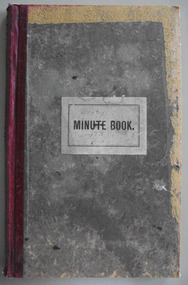 Warrnambool and District Historical Society Inc.
Journal - Diary, Diary of Augustus Bostock 1913-1918, Circa 1913
... He was involved in many aspects of life in the Western District, racing, cricket, and social activities to name a few. This diary shows the daily entries over a long period of time with activities ranging from fencing, visiting neighbours and weather details. ...He was involved in many aspects of life in the Western District, racing, cricket, and social activities to name a few. This diary shows the daily entries over a long period of time with activities ranging from fencing, visiting neighbours and weather details. ...Augustus Bostock was the 9th child of Robert & Rachael Bostock of Vaucluse Epping Forest, Van Diemen’s Land. He was only 4 years old when his mother died. He was inspired by his father to seek his fortune in the Western District of Victoria. He arrived around 1850. He married Margaret Aitkin in July 1865. Augustus owned several properties in the district and leased others. He sat on the court of Warrnambool, Mortlake or Hexham as required. He resided at Marramook in Hawkesdale and later moved to Vaucluse in Hopetoun Road Warrnambool, where he died in 1920 at the age of 87. He was involved in many aspects of life in the Western District, racing, cricket, and social activities to name a few. This diary shows the daily entries over a long period of time with activities ranging from fencing, visiting neighbours and weather details. It mentions many local people and many properties he visited. Augustus Bostock along with a number of his brothers was one of the earliest pioneers in the Western District of Victoria. This diary sheds considerable light onto the life of Augustus and people of his era. There is a wealth of information on a range of topics relating to early life in Warrnambool and district.Brown cloth over card cover with maroon leather spine. Grey paper label pasted on front cover.188 pages all handwritten in black ink.Augustus Bostock Vaucluse 1913 handwritten inside front cover.Diary 1913 handwritten on label on front cover.augustus bostock, bostock brothers, warrnambool, vaucluse warrnambool, marramook hawkesdale -
 Warrnambool and District Historical Society Inc.
Journal - Diary, Diary of Augustus Bostock 1918-1920, Circa 1918
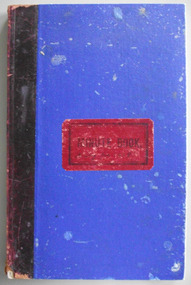
... He was involved in many aspects of life in the Western District, racing, cricket, and social activities to name a few. This diary shows the daily entries over a long period of time with activities ranging from fencing, visiting neighbours and weather details. ...He was involved in many aspects of life in the Western District, racing, cricket, and social activities to name a few. This diary shows the daily entries over a long period of time with activities ranging from fencing, visiting neighbours and weather details. ...Augustus Bostock was the 9th child of Robert & Rachael Bostock of Vaucluse Epping Forest, Van Diemen’s Land. He was only 4 years old when his mother died. He was inspired by his father to seek his fortune in the Western District of Victoria. He arrived around 1850. He married Margaret Aitkin in July 1865. Augustus owned several properties in the district and leased others. He sat on the court of Warrnambool, Mortlake or Hexham as required. He resided at Marramook in Hawkesdale and later moved to Vaucluse in Hopetoun Road Warrnambool, where he died in 1920 at the age of 87. He was involved in many aspects of life in the Western District, racing, cricket, and social activities to name a few. This diary shows the daily entries over a long period of time with activities ranging from fencing, visiting neighbours and weather details. It mentions many local people and many properties he visited. The last entry in the diary is for Wednesday June 2nd 1920 and states, “I have been a bit out of sorts, very short in the breath. Dr Connell called returning from Orford. Gus came down and brought our mail. W fair some rain” Augustus died seven weeks later, August 20th 1920.Augustus Bostock along with a number of his brothers was one of the earliest pioneers in the Western District of Victoria. This diary sheds considerable light onto the life of Augustus and people of his era. There is a wealth of information on a range of topics relating to early life in Warrnambool and district.Bright blue cloth over card cover with maroon leather binding on spine. Red label attached to front cover Pages are all handwritten.188 pages. Vaucluse W’Bool A Bostock 1918 handwritten on front page. Diary for 1918 handwritten on front label which has minute book printed on it.warrnambool, augustus bostock, bostock diary -
4th/19th Prince of Wales's Light Horse Regiment Unit History Room
Potographs, Turkish Prisoners, c. 1918
... activities of Turkish prisoners. 1. Ten prisoners sitting in a circle preparing vegetables. On the back - "Preparing the daily stew". 2. ...activities of Turkish prisoners. 1. Ten prisoners sitting in a circle preparing vegetables. On the back - "Preparing the daily stew". 2. ...A set of nine black & white photographs depicting mainly activities of Turkish prisoners. 1. Ten prisoners sitting in a circle preparing vegetables. On the back - "Preparing the daily stew". 2. A group of about 70 prisoners in ranks of four with hundreds more in the background. On the back "Led or fed up". 3. Three sets of 44 gallon drums set up for cooking with a line of 25 prisoners behind. On the back "One of the camp kitchens, prisoners, staff and interpreter". 4. An open plane with long lines of prisoners . On the back "Prisoners from Jenin to Lejjun". 5. A group of about 80 prisoners by a stream. On the back " The first batch of prisoners in Damascus district near Sasa". 6. Lines of graves decorated with rocks. On the back "Turkish Graveyard". 7. Another scene of the camp kitchen with a large gathering of prisoners and Light Horsemen. On the back "The stew issue". 8. A large gathering of prisoners, mainly sitting on the ground. On the back "Acres of prisoners at Tulkeram". 9. Graves of Turkish POW's who died of sickness Oct 18See descriptionphotos, turkish pow, ww1
