
Showing 85 items matching "dairies - kew"
-
 Kew Historical Society Inc
Archive (Sub-series) - Subject File, Dairies (Kew), 1958
... Dairies (Kew)...Archive file containing one item of correspondence seeking information on the following Kew Dairies: Willsmere park Dairy, Model Dairy, Henry Kennett’s dairy (Young Street), Connors dairy (51 Gladstone Street), George Hobbs dairy (35 Atkins Street). ...As well as seeking information on specific dairies, the inquirer also sought information on production and retail aspects of the industry. Dairies (Kew) Archive Subject File ...Various partiesReference, Research, InformationSecondary Values (KHS Imposed Order)Subject file containing one item of correspondence seeking information on the following Kew Dairies: Willsmere Park Dairy, Model Dairy, Henry Kennett’s dairy (Young Street), Connors dairy (51 Gladstone Street), George Hobbs dairy (35 Atkins Street). As well as seeking information on specific dairies, the inquirer also sought information on production and retail aspects of the industry.willsmere park dairy, model dairy, pickering's dairy, white's dairy, connors' dairy, hobbs' dairy, kennett's dairywillsmere park dairy, model dairy, pickering's dairy, white's dairy, connors' dairy, hobbs' dairy, kennett's dairy -
 Kew Historical Society Inc
Container, Model Dairy, Milk Bottle, Twentieth Century
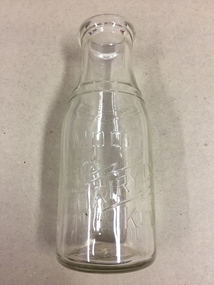
... ...model dairy (kew)...The Model Dairy was founded by the Kew pioneer, James Venn Morgan. ...Milk bottle - Model Dairy Kew. ...Pressed inscription: "Model Dairy Ltd Kew." Reverse: " This bottle contains milk bottled for sale by Model Dairey Ltd and always remains their property. ...A number of these named bottles have the additional attribute of rarity. milk bottles model dairy (kew) Pressed inscription: "Model Dairy Ltd Kew." ...The Model Dairy was founded by the Kew pioneer, James Venn Morgan. The dairy had a number of different locations in Kew depending on the time period. Its final incarnation was on the north side of Cotham Road, between Ridgeway Avenue and Kent Street, Kew. The final factory was designed by the architects Bates, Smart and McCutcheon.Kew was a major milk producing district in the Nineteenth and early Twentieth centuries, with three major dairy farms lining the Yarra between Studley Park in the west and Burke Road in the east. In addition to these dairy producers, there were also a number of accredited dairy retailers in the suburb. The largest and most enduring of these was the Model Dairy founded by the Kew pioneer James Venn Morgan. Milk bottles that include the name of the producer or retailer are historically significant as they represent a period in Kew's history before the mass production of milk in the second half of the Twentieth Century. A number of these named bottles have the additional attribute of rarity.Milk bottle - Model Dairy Kew. Pressed inscription: "Model Dairy Ltd Kew." Reverse: " This bottle contains milk bottled for sale by Model Dairey Ltd and always remains their property. It is loaned & cannot legally be used by others. One Imperial Pint. This bottle differs from 1981.0010 in that it has two pressed rings on the neck of the bottle.milk bottles, model dairy (kew) -
 Kew Historical Society Inc
Container, Model Dairy, Milk Bottle, Twentieth Century
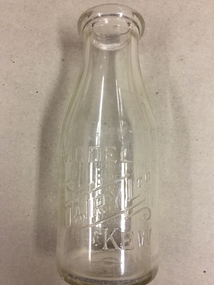
... ...model dairy (kew)...The Model Dairy was founded by the Kew pioneer, James Venn Morgan. ...Milk bottle - Model Dairy Kew. ...Pressed inscription: "Model Dairy Ltd Kew." Reverse: " This bottle contains milk bottled for sale by Model Dairey Ltd and always remains their property. ...A number of these named bottles have the additional attribute of rarity. milk bottles model dairy (kew) Pressed inscription: "Model Dairy Ltd Kew." ...The Model Dairy was founded by the Kew pioneer, James Venn Morgan. The dairy had a number of different locations in Kew depending on the time period. Its final location was on the north side of Cotham Road, Kew between Ridgeway Avenue and Kent Street. Its final factory was designed by the architects Bates, Smart and McCutcheon.Kew was a major milk producing district in the Nineteenth and early Twentieth centuries, with three major dairy farms lining the Yarra between Studley Park in the west and Burke Road in the east. In addition to these dairy producers, there were also a number of accredited dairy retailers in the suburb. The largest and most enduring of these was the Model Dairy founded by the Kew pioneer James Venn Morgan. Milk bottles that include the name of the producer or retailer are historically significant as they represent a period in Kew's history before the mass production of milk in the second half of the Twentieth Century. A number of these named bottles have the additional attribute of rarity.Milk bottle - Model Dairy Kew. Pressed inscription: "Model Dairy Ltd Kew." Reverse: " This bottle contains milk bottled for sale by Model Dairey Ltd and always remains their property. It is loaned & cannot legally be used by others. One Imperial Pint. This bottle differs from 1981.0009 in that it does not have two pressed rings on the neck of the bottle.milk bottles, model dairy (kew) -
 Kew Historical Society Inc
Container - Milk Bottle, Nursery Milk Bottle : Kennedy & Sons, Kew, Twentieth century
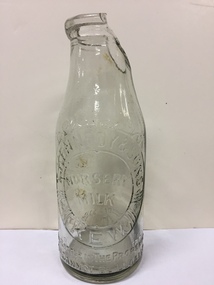
... dairy...kennedy and sons...dairies - kew...Kennedy and sons, Roselea Dairy operated in Kew (<1930-1945>). In 1945 Thomas Kennedy, Michael Kennedy and Patrick John Kennedy traded as Kennedy and sons, Roselea Dairy at 80 Pakington St, Kew. ...Milk bottle produced for and retailed by Kennedy & Sons Kew. The dairy operated under various names, and at one stage was described as the Rose Lea Dairy. ...Kennedy and sons, Roselea Dairy operated in Kew (<1930-1945>). In 1945 Thomas Kennedy, Michael Kennedy and Patrick John Kennedy traded as Kennedy and sons, Roselea Dairy at 80 Pakington St, Kew. ...Kennedy and sons, Roselea Dairy operated in Kew (<1930-1945>). In 1945 Thomas Kennedy, Michael Kennedy and Patrick John Kennedy traded as Kennedy and sons, Roselea Dairy at 80 Pakington St, Kew. (Victorian Government, 07 December 1945). Tom Kennedy, Jnr, and his wife, Lucy, lived at 109 Pakington St Kew. Tom Kennedy Jnr. died 02 November 1963. Lucy Kennedy died 28 November 1987. "CONTEMPT OF COURT. MILK-CARTER GUILTY. Breach of an Injunction. A Supreme Court writ has been issued by Thomas Kennedy, sen., Thomas Kennedy, jun., Patrick John Kennedy, and Michael Kennedy, trading as Kennedy and Sons, Rose Lea Dairy, against Gordon Allberry Shepherdly, of Barnard street, North Kew, milk-carter, claiming an injunction and damages. Plaintiffs carry on business at Pakington street. Kew, and Melville street, Hawthorn, and they claim In their writ an injunction restraining the defendant from soliciting or endeavouring to obtain the custom of people who were customers of plaintiffs when Shepherdly was employed by them under an agreement dated March 13 1928. Plaintiffs also claim damages. Mr Read (instructed by Messrs. Moule, Hamilton, and Derham) appeared for plaintiffs before Mr. Justice Macfarlan in the Practice Court yesterday, to ask for an order for the committal of Shepherdly to prison, or alternatively, for an order that plaintiffs be at liberty to Issue a writ of attachment against him for contempt of court in soliciting or endeavouring to obtain the custom of plaintiffs' customers. The affidavits set out that Shepherdly was employed by plaintiffs from March I3, 1928. until June 6. 1930. An Interlocutory injunction had been granted pending trial of the action for a permanent injunction. Shepherdly, who appeared in person yesterday, said that he had a sick wife and two children. He had not served any of the customers referred to since the granting of the injunction. He had passed them over to another man for whom he was working. Mr Justice Macfarlan - In doing that you have committed a breach of the injunction, and I have no alternative but to order that you be sent to gaol. I will make an order that you be committed to prison until further order of the Court. I will direct, however, that the order be not executed until Tuesday next. If you can then satisfy the Court that you have ceased to serve, or take any part in serving, the customers of Kennedy and Sons, the order will not be executed. (The Argus, 11 July 1930) Rare, if damaged milk bottle from an historic Kew dairyMilk bottle produced for and retailed by Kennedy & Sons Kew. The dairy operated under various names, and at one stage was described as the Rose Lea Dairy. The dairy was situated on the corner of Eglinton and Pakington Streets, Kew. "Kennedy & Sons / Kew / Nursery Milk / This bottle is the property of T.Kennedy & Sons, Kew/ and cannot be legally used by others."kennedy's dairy, kennedy and sons, dairies - kew (vic), milk bottles - kew - melbourne - victoria, thomas kennedy, michael kennedy -
 Kew Historical Society Inc
Card - Model Dairy Coy: Belmont Avenue, Kew, c.1907
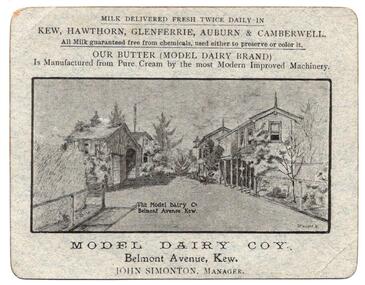
... Model Dairy Coy: Belmont Avenue, Kew......dairies -- kew (vic.)...This well-known Kew business, which would become known as The Model Dairy, was founded in 1863 by James Venn Morgan. ...Digital copy of a business card advertising the Model Dairy in Belmont Avenue, Kew, managed by John Simonton. ..."Milk delivered fresh twice daily in / Kew, Hawthorn & Camberwell / All Milk guaranteed free from chemicals, used either to preserve or colour it / Our butter (Model Dairy Brand) / I Manufactured from Pure Cream by the most improved Machinery / [DRAWING] The Model Dairy Co Belmont Avenue Kew / Model Dairy Co / Belmont Avenue, Kew / John Simonton, Manager"...The entire site has since been redeveloped. model dairy -- kew (vic.) john simonton belmont avenue -- kew (vic.) dairies -- kew (vic.) ...This well-known Kew business, which would become known as The Model Dairy, was founded in 1863 by James Venn Morgan. Morgan sold the company in the 1890s to John Simonton who renamed the business The Model Dairy Co. Simonton had experience in the local dairying industry having previously leased the Willsmere Park Dairy. He moved the business to Belmont Avenue in c.1899. In 1924, following his retirement, the company expanded to become The Model Dairy Pty Ltd with Arnold Thompson Simonton and John Tanner as its owner/directors. With new techniques and processes such a pasteurisation, the Belmont Avenue site no longer met required standards for processing and bottling, so its operations moved to 191 Cotham Road. The company celebrated its centenary in 1963. A new factory, built in 1959 to a design by Bates, Smart & McCutcheon, was purchased by Bib Stillwell Motors after the dairy closed. The entire site has since been redeveloped.Digital copy of a business card advertising the Model Dairy in Belmont Avenue, Kew, managed by John Simonton. (The card was donated by John Harvey Simonton in 2021,)"Milk delivered fresh twice daily in / Kew, Hawthorn & Camberwell / All Milk guaranteed free from chemicals, used either to preserve or colour it / Our butter (Model Dairy Brand) / I Manufactured from Pure Cream by the most improved Machinery / [DRAWING] The Model Dairy Co Belmont Avenue Kew / Model Dairy Co / Belmont Avenue, Kew / John Simonton, Manager"model dairy -- kew (vic.), john simonton, belmont avenue -- kew (vic.), dairies -- kew (vic.) -
 Kew Historical Society Inc
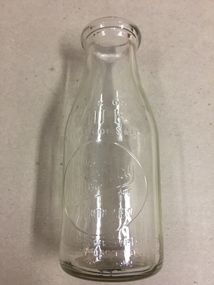
Container, White's Dairy, Milk Bottle, Twentieth Century
... ...white's dairy (kew)...Glass milk bottle from White's Dairy, North Kew. ...Pressed inscription: "This bottle contains milk bottled for sale by White's Dairy, North Kew, Phone HAW.2154. Bottle is the property of the above. ...A number of these named bottles have the additional attribute of rarity. milk bottles white's dairy (kew) north kew willsmere road Pressed inscription: "This bottle contains milk bottled for sale by White's Dairy, North Kew, Phone HAW.2154. ...White's dairy was at 52 Willsmere Road, near the Peel Street Intersection. Descendant known locally as Miss White lived at 33 Willsmere Road. This is across the road from the dairy location. Kew was a major milk producing district in the Nineteenth and early Twentieth centuries, with three major dairy farms lining the Yarra between Studley Park in the west and Burke Road in the east. In addition to these dairy producers, there were also a number of accredited dairy retailers in the suburb. The largest and most enduring of these was the Model Dairy founded by the Kew pioneer James Venn Morgan. Milk bottles that include the name of the producer or retailer are historically significant as they represent a period in Kew's history before the mass production of milk in the second half of the Twentieth Century. A number of these named bottles have the additional attribute of rarity.Glass milk bottle from White's Dairy, North Kew. Pressed inscription: "This bottle contains milk bottled for sale by White's Dairy, North Kew, Phone HAW.2154. Bottle is the property of the above. It is loaned and cannot legally be used by others". Reverse: "One Imperial Pint". milk bottles, white's dairy (kew), north kew, willsmere road -
 Kew Historical Society Inc
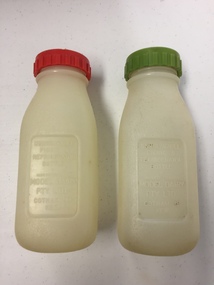
Container - Model Dairy Plastic Milk Bottles, Model Dairy, c.1960
... dairies - kew...This pair of milk bottles, produced for the Model Dairy in Cotham Road, Kew, were donated by Vik Sabaliauskas. ...Impressed on the front of both bottles: "Unbreakable picnic and refrigerator bottle made expressly for Model Dairy Pty Ltd Cotham Rd Kew"...This pair of milk bottles, produced for the Model Dairy in Cotham Road, Kew, were donated by Vik Sabaliauskas. ...This pair of milk bottles, produced for the Model Dairy in Cotham Road, Kew, were donated by Vik Sabaliauskas. They belonged to his father who worked at Model Dairy in the 1950s and 1960s. Vik wrote about his father: "As for my father, his whole life story is interesting. He was part of the big immigration program after WW2. He was a displaced person in Germany like lots of others who came out looking for a new life. Our family name is actually SABALIAUSKAS which is of Lithuanian descent. My Dad was also named Vik (Viktoras). He was known as Big Vik and I was little Vik. He arrived in Australia in 1947 and then did his 2 years of work organised by the Government and then he came to Melbourne. We lived in Tyler St Preston and he rode his pushbike to and from Kew every working day for years. In my estimation that was about 13 kms for about 6 or 7 years. Imagine that happening today. Freezing Winter mornings and hot Summer afternoons. His English was poor but he had a great work ethic like all European immigrants. His duties related to maintaining and operating all the machines. One story that he told me about was that after I was born (in 1959) he made friends with one of the drivers who delivered milk to the dairy. He asked him to get a container of milk from the farmer everyday which was just for me. I remember going to the Model Dairy Family Christmas parties which were always well patronised. I also remember visiting him in the PANCH Hospital (Bell Street Preston) where he was treated for kidney stones caused by drinking very creamy milk. He wasn't happy when he was told by the doctor to cut back on milk. My Dad was one month short of his 95th birthday when he died and he lived a pretty healthy life." (2019)Kew was a major milk producing district in the Nineteenth and early Twentieth centuries, with three major dairy farms lining the Yarra between Studley Park in the west and Burke Road in the east. In addition to these dairy producers, there were also a number of accredited dairy retailers in the suburb. The largest and most enduring of these was the Model Dairy founded by the Kew pioneer James Venn Morgan. Milk bottles that include the name of the producer or retailer are historically significant as they represent a period in Kew's history before the mass production of milk in the second half of the Twentieth Century. A number of these named bottles have the additional attribute of rarity.Pair of plastic milk bottles, designated on the front as to be used in the refigerator on on picnics. One bottle has a red screw on lid and the other a green lid. The bottles are semi-transparent. [The record also includes a photograph of Vic Sabaliauskas, provided by his son. The photograph dates from the period when he was employed at the Model Dairy].Impressed on the front of both bottles: "Unbreakable picnic and refrigerator bottle made expressly for Model Dairy Pty Ltd Cotham Rd Kew"dairies - kew, model dairy - cotham road - kew (vic) -
Kew Historical Society Inc
Archive (Sub-series) - Subject File, Farming (Kew), 1958
... ...kew (vic) - dairies...kew...Typically files will contain primary and secondary sources. kew (vic) - history kew (vic) - farming kew (vic) - dairies kew (vic) - agriculture Archive file containing a newspaper article/clipping called ‘Our Pastoral Routes’ by Jenny Brown. ...Various partiesReference, Research, InformationSecondary Values (KHS Imposed Order)Subject file containing a newspaper article/clipping called ‘Our Pastoral Routes’ by Jenny Brown.kew (vic) - history, kew (vic) - farming, kew (vic) - dairies, kew (vic) - agriculturekew (vic) - history, kew (vic) - farming, kew (vic) - dairies, kew (vic) - agriculture -
 Kew Historical Society Inc
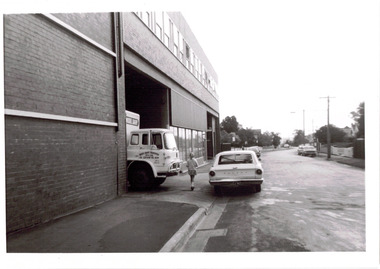
Photograph - The Model Dairy Pty Ltd, 1968
... dairy co...john simonton...james venn morgan...john tanner...cotham road...kent street...ridgeway avenue...bates smart & mccutcheon...dairies -- kew...This well-known Kew business, which would become known as The Model Dairy, was founded in 1863 by James Venn Morgan. ...Original black and white photographic positive of a Model Dairy Truck emerging onto Kent Street, Kew....The entire site has since been redeveloped. the model dairy pty ltd the model dairy co john simonton james venn morgan john tanner cotham road kent street ridgeway avenue bates smart & mccutcheon dairies -- kew (vic.) Original black and white photographic positive of a Model Dairy Truck emerging onto Kent Street, Kew. ...This well-known Kew business, which would become known as The Model Dairy, was founded in 1863 by James Venn Morgan. Morgan sold the company in the 1890s to John Simonton who renamed the business The Model Dairy Co. Simonton had experience in the local dairying industry having previously leased the Willsmere Park Dairy. He moved the business to Belmont Avenue in c.1899. In 1924, following his retirement, the company expanded to become The Model Dairy Pty Ltd with Arnold Thompson Simonton and John Tanner as its owner/directors. With new techniques and processes such a pasteurisation, the Belmont Avenue site no longer met required standards for processing and bottling, so its operations moved to 191 Cotham Road. The company celebrated its centenary in 1963. A new factory, built in 1959 to a design by Bates, Smart & McCutcheon, was purchased by Bib Stillwell Motors after the dairy closed. The entire site has since been redeveloped.Original black and white photographic positive of a Model Dairy Truck emerging onto Kent Street, Kew.the model dairy pty ltd, the model dairy co, john simonton, james venn morgan, john tanner, cotham road, kent street, ridgeway avenue, bates smart & mccutcheon, dairies -- kew (vic.) -
 Kew Historical Society Inc
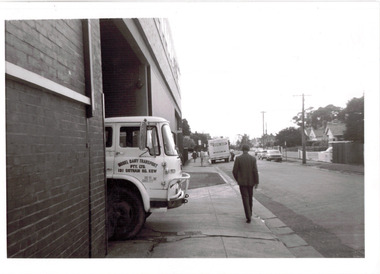
Photograph - The Model Dairy Pty Ltd, 1968
... dairy co...john simonton...james venn morgan...john tanner...cotham road...kent street...ridgeway avenue...bates smart & mccutcheon...dairies -- kew...This well-known Kew business, which would become known as The Model Dairy, was founded in 1863 by James Venn Morgan. ...Original black and white photographic positive of a Model Dairy Truck emerging onto Kent Street, Kew....The entire site has since been redeveloped. the model dairy pty ltd the model dairy co john simonton james venn morgan john tanner cotham road kent street ridgeway avenue bates smart & mccutcheon dairies -- kew (vic.) Original black and white photographic positive of a Model Dairy Truck emerging onto Kent Street, Kew. ...This well-known Kew business, which would become known as The Model Dairy, was founded in 1863 by James Venn Morgan. Morgan sold the company in the 1890s to John Simonton who renamed the business The Model Dairy Co. Simonton had experience in the local dairying industry having previously leased the Willsmere Park Dairy. He moved the business to Belmont Avenue in c.1899. In 1924, following his retirement, the company expanded to become The Model Dairy Pty Ltd with Arnold Thompson Simonton and John Tanner as its owner/directors. With new techniques and processes such a pasteurisation, the Belmont Avenue site no longer met required standards for processing and bottling, so its operations moved to 191 Cotham Road. The company celebrated its centenary in 1963. A new factory, built in 1959 to a design by Bates, Smart & McCutcheon, was purchased by Bib Stillwell Motors after the dairy closed. The entire site has since been redeveloped.Original black and white photographic positive of a Model Dairy Truck emerging onto Kent Street, Kew.the model dairy pty ltd, the model dairy co, john simonton, james venn morgan, john tanner, cotham road, kent street, ridgeway avenue, bates smart & mccutcheon, dairies -- kew (vic.) -
 Kew Historical Society Inc
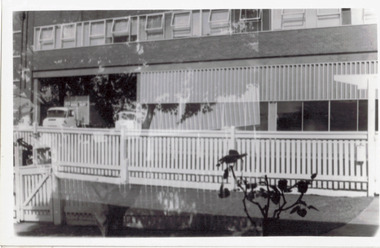
Photograph - The Model Dairy Pty Ltd, 1968
... dairy co...john simonton...james venn morgan...john tanner...cotham road...kent street...ridgeway avenue...bates smart & mccutcheon...dairies -- kew...This well-known Kew business, which would become known as The Model Dairy, was founded in 1863 by James Venn Morgan. ...Original black and white photographic positive of a Model Dairy Truck emerging onto Kent Street, Kew....The entire site has since been redeveloped. the model dairy pty ltd the model dairy co john simonton james venn morgan john tanner cotham road kent street ridgeway avenue bates smart & mccutcheon dairies -- kew (vic.) Original black and white photographic positive of a Model Dairy Truck emerging onto Kent Street, Kew. ...This well-known Kew business, which would become known as The Model Dairy, was founded in 1863 by James Venn Morgan. Morgan sold the company in the 1890s to John Simonton who renamed the business The Model Dairy Co. Simonton had experience in the local dairying industry having previously leased the Willsmere Park Dairy. He moved the business to Belmont Avenue in c.1899. In 1924, following his retirement, the company expanded to become The Model Dairy Pty Ltd with Arnold Thompson Simonton and John Tanner as its owner/directors. With new techniques and processes such a pasteurisation, the Belmont Avenue site no longer met required standards for processing and bottling, so its operations moved to 191 Cotham Road. The company celebrated its centenary in 1963. A new factory, built in 1959 to a design by Bates, Smart & McCutcheon, was purchased by Bib Stillwell Motors after the dairy closed. The entire site has since been redeveloped.Original black and white photographic positive of a Model Dairy Truck emerging onto Kent Street, Kew.the model dairy pty ltd, the model dairy co, john simonton, james venn morgan, john tanner, cotham road, kent street, ridgeway avenue, bates smart & mccutcheon, dairies -- kew (vic.) -
 Kew Historical Society Inc
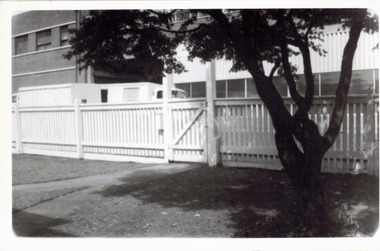
Photograph - The Model Dairy Pty Ltd, 1968
... dairy co...john simonton...james venn morgan...john tanner...cotham road...kent street...ridgeway avenue...bates smart & mccutcheon...dairies -- kew...This well-known Kew business, which would become known as The Model Dairy, was founded in 1863 by James Venn Morgan. ...Original black and white photographic positive of a Model Dairy Truck emerging onto Kent Street, Kew....The entire site has since been redeveloped. the model dairy pty ltd the model dairy co john simonton james venn morgan john tanner cotham road kent street ridgeway avenue bates smart & mccutcheon dairies -- kew (vic.) Original black and white photographic positive of a Model Dairy Truck emerging onto Kent Street, Kew. ...This well-known Kew business, which would become known as The Model Dairy, was founded in 1863 by James Venn Morgan. Morgan sold the company in the 1890s to John Simonton who renamed the business The Model Dairy Co. Simonton had experience in the local dairying industry having previously leased the Willsmere Park Dairy. He moved the business to Belmont Avenue in c.1899. In 1924, following his retirement, the company expanded to become The Model Dairy Pty Ltd with Arnold Thompson Simonton and John Tanner as its owner/directors. With new techniques and processes such a pasteurisation, the Belmont Avenue site no longer met required standards for processing and bottling, so its operations moved to 191 Cotham Road. The company celebrated its centenary in 1963. A new factory, built in 1959 to a design by Bates, Smart & McCutcheon, was purchased by Bib Stillwell Motors after the dairy closed. The entire site has since been redeveloped.Original black and white photographic positive of a Model Dairy Truck emerging onto Kent Street, Kew.the model dairy pty ltd, the model dairy co, john simonton, james venn morgan, john tanner, cotham road, kent street, ridgeway avenue, bates smart & mccutcheon, dairies -- kew (vic.) -
 Kew Historical Society Inc
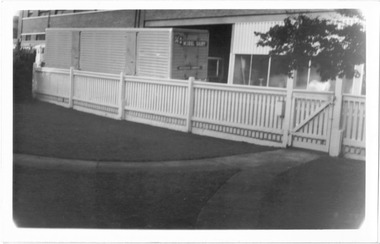
Photograph - The Model Dairy Pty Ltd, 1968
... dairy co...john simonton...james venn morgan...john tanner...cotham road...kent street...ridgeway avenue...bates smart & mccutcheon...dairies -- kew...This well-known Kew business, which would become known as The Model Dairy, was founded in 1863 by James Venn Morgan. ...Original black and white photographic positive of a Model Dairy Truck parked in Kent Street, Kew....The entire site has since been redeveloped. the model dairy pty ltd the model dairy co john simonton james venn morgan john tanner cotham road kent street ridgeway avenue bates smart & mccutcheon dairies -- kew (vic.) Original black and white photographic positive of a Model Dairy Truck parked in Kent Street, Kew. ...This well-known Kew business, which would become known as The Model Dairy, was founded in 1863 by James Venn Morgan. Morgan sold the company in the 1890s to John Simonton who renamed the business The Model Dairy Co. Simonton had experience in the local dairying industry having previously leased the Willsmere Park Dairy. He moved the business to Belmont Avenue in c.1899. In 1924, following his retirement, the company expanded to become The Model Dairy Pty Ltd with Arnold Thompson Simonton and John Tanner as its owner/directors. With new techniques and processes such a pasteurisation, the Belmont Avenue site no longer met required standards for processing and bottling, so its operations moved to 191 Cotham Road. The company celebrated its centenary in 1963. A new factory, built in 1959 to a design by Bates, Smart & McCutcheon, was purchased by Bib Stillwell Motors after the dairy closed. The entire site has since been redeveloped.Original black and white photographic positive of a Model Dairy Truck parked in Kent Street, Kew.the model dairy pty ltd, the model dairy co, john simonton, james venn morgan, john tanner, cotham road, kent street, ridgeway avenue, bates smart & mccutcheon, dairies -- kew (vic.) -
 Kew Historical Society Inc
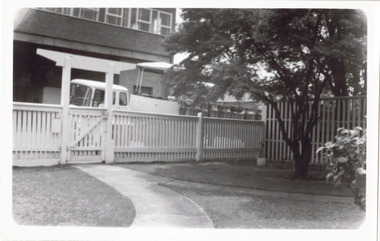
Photograph - The Model Dairy Pty Ltd, 1968
... dairy co...john simonton...james venn morgan...john tanner...cotham road...kent street...ridgeway avenue...bates smart & mccutcheon...dairies -- kew...This well-known Kew business, which would become known as The Model Dairy, was founded in 1863 by James Venn Morgan. ...Original black and white photographic positive of a Model Dairy Truck parked in Kent Street, Kew....The entire site has since been redeveloped. the model dairy pty ltd the model dairy co john simonton james venn morgan john tanner cotham road kent street ridgeway avenue bates smart & mccutcheon dairies -- kew (vic.) Original black and white photographic positive of a Model Dairy Truck parked in Kent Street, Kew. ...This well-known Kew business, which would become known as The Model Dairy, was founded in 1863 by James Venn Morgan. Morgan sold the company in the 1890s to John Simonton who renamed the business The Model Dairy Co. Simonton had experience in the local dairying industry having previously leased the Willsmere Park Dairy. He moved the business to Belmont Avenue in c.1899. In 1924, following his retirement, the company expanded to become The Model Dairy Pty Ltd with Arnold Thompson Simonton and John Tanner as its owner/directors. With new techniques and processes such a pasteurisation, the Belmont Avenue site no longer met required standards for processing and bottling, so its operations moved to 191 Cotham Road. The company celebrated its centenary in 1963. A new factory, built in 1959 to a design by Bates, Smart & McCutcheon, was purchased by Bib Stillwell Motors after the dairy closed. The entire site has since been redeveloped.Original black and white photographic positive of a Model Dairy Truck parked in Kent Street, Kew.the model dairy pty ltd, the model dairy co, john simonton, james venn morgan, john tanner, cotham road, kent street, ridgeway avenue, bates smart & mccutcheon, dairies -- kew (vic.) -
 Kew Historical Society Inc
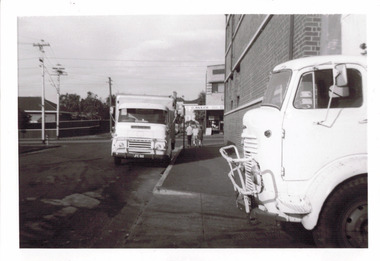
Photograph - The Model Dairy Pty Ltd, 1968
... dairy co...john simonton...james venn morgan...john tanner...cotham road...kent street...ridgeway avenue...bates smart & mccutcheon...dairies -- kew...This well-known Kew business, which would become known as The Model Dairy, was founded in 1863 by James Venn Morgan. ...Original black and white photographic positive of two Model Dairy Trucks in Kent Street, Kew. Barenya Court and Cotham Shopping Centre in distance...The entire site has since been redeveloped. the model dairy pty ltd the model dairy co john simonton james venn morgan john tanner cotham road kent street ridgeway avenue bates smart & mccutcheon dairies -- kew (vic.) Original black and white photographic positive of two Model Dairy Trucks in Kent Street, Kew. ...This well-known Kew business, which would become known as The Model Dairy, was founded in 1863 by James Venn Morgan. Morgan sold the company in the 1890s to John Simonton who renamed the business The Model Dairy Co. Simonton had experience in the local dairying industry having previously leased the Willsmere Park Dairy. He moved the business to Belmont Avenue in c.1899. In 1924, following his retirement, the company expanded to become The Model Dairy Pty Ltd with Arnold Thompson Simonton and John Tanner as its owner/directors. With new techniques and processes such a pasteurisation, the Belmont Avenue site no longer met required standards for processing and bottling, so its operations moved to 191 Cotham Road. The company celebrated its centenary in 1963. A new factory, built in 1959 to a design by Bates, Smart & McCutcheon, was purchased by Bib Stillwell Motors after the dairy closed. The entire site has since been redeveloped.Original black and white photographic positive of two Model Dairy Trucks in Kent Street, Kew. Barenya Court and Cotham Shopping Centre in distancethe model dairy pty ltd, the model dairy co, john simonton, james venn morgan, john tanner, cotham road, kent street, ridgeway avenue, bates smart & mccutcheon, dairies -- kew (vic.) -
 Kew Historical Society Inc
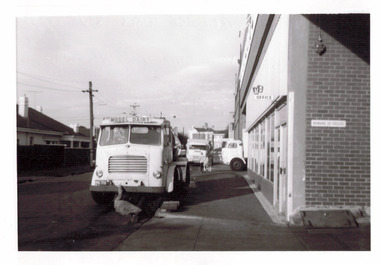
Photograph - The Model Dairy Pty Ltd, 1968
... dairy co...john simonton...james venn morgan...john tanner...cotham road...kent street...ridgeway avenue...bates smart & mccutcheon...dairies -- kew...This well-known Kew business, which would become known as The Model Dairy, was founded in 1863 by James Venn Morgan. ...Original black and white photographic positive of Model Dairy Trucks in Kent Street, Kew. Barenya Court and Cotham Shopping Centre in distance...The entire site has since been redeveloped. the model dairy pty ltd the model dairy co john simonton james venn morgan john tanner cotham road kent street ridgeway avenue bates smart & mccutcheon dairies -- kew (vic.) Original black and white photographic positive of Model Dairy Trucks in Kent Street, Kew. ...This well-known Kew business, which would become known as The Model Dairy, was founded in 1863 by James Venn Morgan. Morgan sold the company in the 1890s to John Simonton who renamed the business The Model Dairy Co. Simonton had experience in the local dairying industry having previously leased the Willsmere Park Dairy. He moved the business to Belmont Avenue in c.1899. In 1924, following his retirement, the company expanded to become The Model Dairy Pty Ltd with Arnold Thompson Simonton and John Tanner as its owner/directors. With new techniques and processes such a pasteurisation, the Belmont Avenue site no longer met required standards for processing and bottling, so its operations moved to 191 Cotham Road. The company celebrated its centenary in 1963. A new factory, built in 1959 to a design by Bates, Smart & McCutcheon, was purchased by Bib Stillwell Motors after the dairy closed. The entire site has since been redeveloped.Original black and white photographic positive of Model Dairy Trucks in Kent Street, Kew. Barenya Court and Cotham Shopping Centre in distancethe model dairy pty ltd, the model dairy co, john simonton, james venn morgan, john tanner, cotham road, kent street, ridgeway avenue, bates smart & mccutcheon, dairies -- kew (vic.) -
 Kew Historical Society Inc
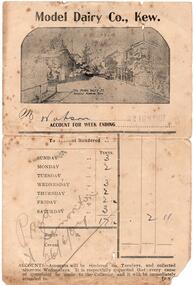
Document - Account for Week ending 22 June 1907
... ...dairies -- kew (vic.)...This well-known Kew business, which would become known as The Model Dairy, was founded in 1863 by James Venn Morgan. ...The entire site has since been redeveloped. model dairy -- kew (vic.) john simonton belmont avenue -- kew (vic.) dairies -- kew (vic.) invoices "[To M] Watson" / "Paid A Simonton 26/6.07" Digital copy of the front side of an invoice, for week ending 22 June 1907 by John Simonton of the Model Dairy in Belmont Avenue to Watson for delivery of 17 bottles of milk on six occasions during the week . ...This well-known Kew business, which would become known as The Model Dairy, was founded in 1863 by James Venn Morgan. Morgan sold the company in the 1890s to John Simonton who renamed the business The Model Dairy Co. Simonton had experience in the local dairying industry having previously leased the Willsmere Park Dairy. He moved the business to Belmont Avenue in c.1899. In 1924, following his retirement, the company expanded to become The Model Dairy Pty Ltd with Arnold Thompson Simonton and John Tanner as its owner/directors. With new techniques and processes such a pasteurisation, the Belmont Avenue site no longer met required standards for processing and bottling, so its operations moved to 191 Cotham Road. The company celebrated its centenary in 1963. A new factory, built in 1959 to a design by Bates, Smart & McCutcheon, was purchased by Bib Stillwell Motors after the dairy closed. The entire site has since been redeveloped.Digital copy of the front side of an invoice, for week ending 22 June 1907 by John Simonton of the Model Dairy in Belmont Avenue to Watson for delivery of 17 bottles of milk on six occasions during the week . A drawing of the Model Dairy is printed at the top of the invoice. (The card was donated by John Harvey Simonton in 2021,)"[To M] Watson" / "Paid A Simonton 26/6.07"model dairy -- kew (vic.), john simonton, belmont avenue -- kew (vic.), dairies -- kew (vic.), invoices -
 Whitehorse Historical Society Inc.
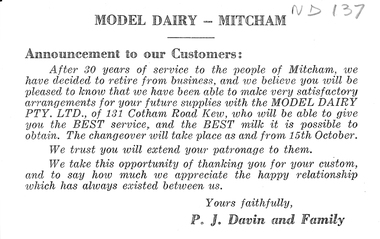
Work on paper - Ephemera, Model Dairy- Mitcham, 1939
... Also a notice of its closure and transfer of business to Model Dairy Kew. The dairy had been run by the Davin Family....Also a notice of its closure and transfer of business to Model Dairy Kew. The dairy had been run by the Davin Family. ...Collection of old photographs and notesCollection of old photographs and notes describing connections to the Model Dairy Mitcham. Also a notice of its closure and transfer of business to Model Dairy Kew. The dairy had been run by the Davin Family.Collection of old photographs and notes mitcham model dairy, davin, patrick j, mary helen, jack, dairies -
 Kew Historical Society Inc
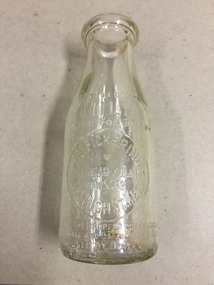
Container, FG Pickering, Milk Bottle, Twentieth Century
... ...pickering's dairy (kew)...Pickering's Dairy was located on the south Side of High Street, Kew, between Charles Street and Highbury Grove. ...Pickering, Highbury Dairy, 344 High St., Kew. ...Pickering, Highbury Dairy HAW5538, 344 High St., Kew. Bottle is the property of the above. ...Pickering, Highbury Dairy, 344 High St., Kew. Milk Bottle Container FG Pickering ...Pickering's Dairy was located on the south Side of High Street, Kew, between Charles Street and Highbury Grove. Kew was a major milk producing district in the Nineteenth and early Twentieth centuries, with three major dairy farms lining the Yarra between Studley Park in the west and Burke Road in the east. In addition to these dairy producers, there were also a number of accredited dairy retailers in the suburb. The largest and most enduring of these was the Model Dairy founded by the Kew pioneer James Venn Morgan. Milk bottles that include the name of the producer or retailer are historically significant as they represent a period in Kew's history before the mass production of milk in the second half of the Twentieth Century. A number of these named bottles have the additional attribute of rarity.Milk bottle - F.G. Pickering, Highbury Dairy, 344 High St., Kew. Pressed inscription: "This bottle contains MILK Bottled for Sale by F.G. Pickering, Highbury Dairy HAW5538, 344 High St., Kew. Bottle is the property of the above. It is loaned and cannot legally be used by others". Reverse: "One Imperial Pint". milk bottles, pickering's dairy (kew) -
 Whitehorse Historical Society Inc.
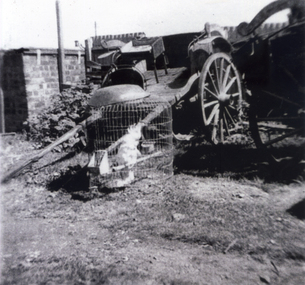
Photograph, Davin's Dairy, C 1945
... Eventually they closed the Mitcham branch and all supplies came from Model Dairy's headquarters in Kew....Mitcham Model Dairy was owned by Patrick and Mary Davin for 30 years. When they closed, Kew Model Dairy took over their customers. ...Mitcham Model Dairy was owned by Patrick and Mary Davin for 30 years. When they closed, Kew Model Dairy took over their customers. Eventually they closed the Mitcham branch and all supplies came from Model Dairy's headquarters in Kew.Black and white photograph of an old house-drawn buggy previously used by Davin's Dairy to deliver milk.Cockatoo in a cage in front.mitcham model dairy, davin's dairy -
 Whitehorse Historical Society Inc.
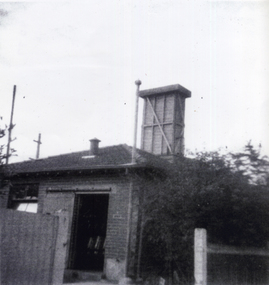
Photograph, Davin's Dairy, C 1945
... Eventually the Mitcham Model Dairy was closed down and all supplies come from the Model Dairy headquarters in Kew....Eventually the Mitcham Model Dairy was closed down and all supplies come from the Model Dairy headquarters in Kew. davin's dairy dairies patrick davin Black and white photo of the back of the dairy. ...Davin's Dairy was owned by Patrick and Mary Davin for 30 years. When they retired, Model Dairy took over - as it was doing with other small diaries. Eventually the Mitcham Model Dairy was closed down and all supplies come from the Model Dairy headquarters in Kew.Black and white photo of the back of the dairy. Sliding door and churns inside.davin's dairy, dairies, patrick davin -
 Kew Historical Society Inc
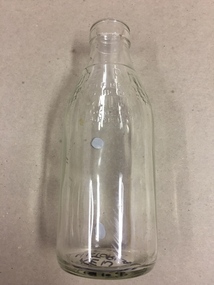
Container, Milk Bottles Recovery Ltd, Milk Bottle, 1930-1950
... It supplied milk bottles to dairies throughout metropolitan Melbourne, and possibly Victoria. It ended production in the 1950s. Smaller Kew...It supplied milk bottles to dairies throughout metropolitan Melbourne, and possibly Victoria. It ended production in the 1950s. Smaller Kew ...Milk Bottles Recovery Ltd began production in Melbourne in 1930. Its head office was located at 48 Market Street, Melbourne. It supplied milk bottles to dairies throughout metropolitan Melbourne, and possibly Victoria. It ended production in the 1950s. Smaller Kew dairies without their own named bottles, would have sourced bottles from a statewide provider such as Milk Bottles Recovery Ltd.Kew was a major milk producing district in the Nineteenth and early Twentieth centuries, with three major dairy farms lining the Yarra between Studley Park in the west and Burke Road in the east. In addition to these dairy producers, there were also a number of accredited dairy retailers in the suburb. The largest and most enduring of these was the Model Dairy founded by the Kew pioneer James Venn Morgan. Milk bottles that include the name of the producer or retailer are historically significant as they represent a period in Kew's history before the mass production of milk in the second half of the Twentieth Century. A number of these named bottles have the additional attribute of rarity.Milk bottle - Milk Bottles Recovery Ltd. Pressed inscription: "Milk. One Pint. This bottle belongs to Milk Bottles Recovery Ltd and cannot be used with out written permission. milk bottles, milk bottles recovery ltd -
 Kew Historical Society Inc
Photograph - Yarra Valley Floods: Kew East, 1916
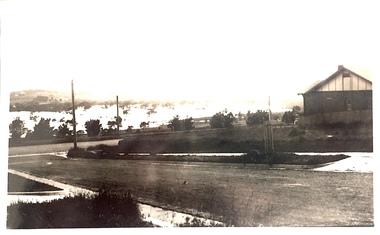
... During the nineteenth century, the land abutting the south side of the Yarra in Kew was devoted to dairy farming. In the twentieth century, before and after the construction of the Eastern Freeway, much of this low-lying area was used as golf courses and public parks....Kew in 1916. The view is taken from a street (maybe Birdwood Avenue) intersecting with Kilby Road looking northeast across the flood waters to Ivanhoe and Heidelberg. The extensive flooded area shown in the photograph would have included remnant dairy...Kew in 1916. The view is taken from a street (maybe Birdwood Avenue) intersecting with Kilby Road looking northeast across the flood waters to Ivanhoe and Heidelberg. The extensive flooded area shown in the photograph would have included remnant dairy ...Flooding of the Yarra Valley, including that section of the Yarra bordering Kew and Kew East in the north and west of the municipality, was a regular occurrence. Extreme flood events of the Yarra River are recorded to have occurred in 1891, 1901, 1916, 1923 and 1934. The Municipality of Kew's response to these floods was to enact planning decisions restricting residential development in flood prone areas following the floods of 1916, 1921 and 1934. While floods continued after the development of the Upper Yarra Reservoir (construction 1948-57), the regularity and extent of these inundations diminished. During the nineteenth century, the land abutting the south side of the Yarra in Kew was devoted to dairy farming. In the twentieth century, before and after the construction of the Eastern Freeway, much of this low-lying area was used as golf courses and public parks.One of a collection of photographs of flooding in the Kew section of the Yarra Valley which are in important research resource for the location and extent of flooding in the first half of the twentieth century. Flooding of the Yarra Valley at East Kew in 1916. The view is taken from a street (maybe Birdwood Avenue) intersecting with Kilby Road looking northeast across the flood waters to Ivanhoe and Heidelberg. The extensive flooded area shown in the photograph would have included remnant dairy farms and the Kew Golf Club. Verso: "Floods / Yarra River / East Kew / Kilby Road / 1917? / 87"yarra river, yarra valley, floods -- kew, kilby road -- kew (vic.), kew golf club -
Kew Historical Society Inc
Archive (series) - Subject File, Baby Health Centres, 1958
... While the article only makes one reference to milk supplied by Kew dairies, it contains useful descriptions of the role of Baby Health Centres and their staff. ...While the article only makes one reference to milk supplied by Kew dairies, it contains useful descriptions of the role of Baby Health Centres and their staff. ...Various PartiesReference, Research, InformationKHS OrderSubject file containing photocopies and a journal published by the RHSV (69:1, June 1998). The article, ‘Baby Boon: The Infant Welfare Movement in Victoria’, was written by Margaret Flood. While the article only makes one reference to milk supplied by Kew dairies, it contains useful descriptions of the role of Baby Health Centres and their staff. A newspaper article/clipping (1991) refers to the establishment of the Baby Changing Room in Walpole Street. There is also a photocopy of W D Vaughan’s text on Baby Health Centres in Kew (1960).infant welfare centres - kew (vic.)infant welfare centres - kew (vic.) -
 Kew Historical Society Inc
Plan, Melbourne & Metropolitan Board of Works : Borough of Kew : Detail Plan No.1588, 1904
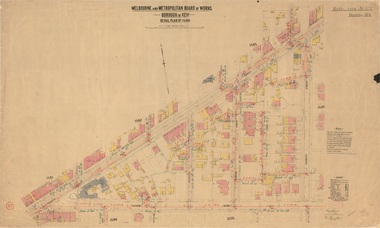
... He was first engaged as a bookmaker, but a fortunate venture on the goldfields enabled him to purchase land in Kew. He conducted a market garden and dairy in Kew for many years....He was first engaged as a bookmaker, but a fortunate venture on the goldfields enabled him to purchase land in Kew. He conducted a market garden and dairy in Kew for many years. ...The Melbourne and Metropolitan Board of Works (MMBW) plans were produced from the 1890s to the 1950s. They were crucial to the design and development of Melbourne's sewerage and drainage system. The plans, at a scale of 40 feet to 1 inch (1:480), provide a detailed historical record of Melbourne streetscapes and environmental features. Each plan covers one or two street blocks (roughly six streets), showing details of buildings, including garden layouts and ownership boundaries, and features such as laneways, drains, bridges, parks, municipal boundaries and other prominent landmarks as they existed at the time each plan was produced. (Source: State Library of Victoria)This plan forms part of a large group of MMBW plans and maps that was donated to the Society by the Mr Poulter, City Engineer of the City of Kew in 1989. Within this collection, thirty-five hand-coloured plans, backed with linen, are of statewide significance as they include annotations that provide details of construction materials used in buildings in the first decade of the 20th century as well as additional information about land ownership and usage. The copies in the Public Record Office Victoria and the State Library of Victoria are monochrome versions which do not denote building materials so that the maps in this collection are invaluable and unique tools for researchers and heritage consultants. A number of the plans are not held in the collection of the State Library of Victoria so they have the additional attribute of rarity.Original survey plan, issued by the MMBW to a contractor with responsibility for constructing sewers in the area identified on the plan within the Borough of Kew. The plan was at some stage hand-coloured, possibly by the contractor, but more likely by officers working in the Engineering Department of the Borough and later Town, then City of Kew. The hand-coloured sections of buildings on the plan were used to denote masonry or brick constructions (pink), weatherboard constructions (yellow), and public buildings (grey). This plan shows the original configuration of the Kew Post Office, Court House and Police Station, which had opened in 1888. This configuration was to essentially remain until the purchase of the Court House and Police Station by the City of Boroondara in 2007 and its subsequent renovation. Interestingly, the MMBW surveyors incorrectly labelled parts of the complex. In the triangle in front of the Post Office, before the erection of the Kew Cenotaph in 1925, was located a lawn and the Queen Victoria Jubilee Fountain. While many of the shops on the south side of High street had been constructed by 1903 a number of sites were still used as vegetable gardens. Further along High Street, on the corner of Charles Street, the Salvation Army Barracks can be seen on the plan. These Barracks predate the later Citadel and ‘Young People’s Hall’ that were opened in 1919. At 22 Charles Street can be seen the house of James Venn Morgan. Hailed as the ‘father of Kew’, Morgan arrived in Melbourne in 1840. He was first engaged as a bookmaker, but a fortunate venture on the goldfields enabled him to purchase land in Kew. He conducted a market garden and dairy in Kew for many years.melbourne and metropolitan board of works, detail plans, maps - borough of kew, mmbw 1588, cartography -
 Ringwood and District Historical Society
Document, Certificate of Title - W.G. Carter, Grandview Grove, Warranwood, Victoria, (later Bemboka Road) - part of Crown Section Twenty, Parish of Warrandyte, County of Evelyn - 1947
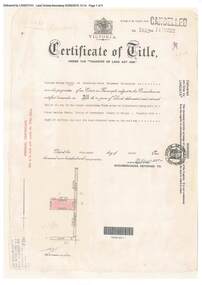
... Dairy. The family spent much of their spare time clearing the land, where Bill then grew and sold fruit, flowers and berries, particularly strawberries, as a hobby and to supplement their income. Bill continued to do so while Peter and Robin were growing up, and after Doreen died in 1958. In 1961 Bill sold one of the three acres to one of his seven sisters, Grace, who lived in Kew...Dairy. The family spent much of their spare time clearing the land, where Bill then grew and sold fruit, flowers and berries, particularly strawberries, as a hobby and to supplement their income. Bill continued to do so while Peter and Robin were growing up, and after Doreen died in 1958. In 1961 Bill sold one of the three acres to one of his seven sisters, Grace, who lived in Kew ...A4 copies of Landata Victoria Historical Search documents - Vol 7052 Fol 1410222. Includes Carter Family Tree property notes. William George Carter of Grandview Grove Ringwood, Nurseryman, is now the proprietor - three acres or thereabouts shown on map (12202a) - 14th March, 1947. Transfer B284834 Registered 21 September, 1961 - 1 acre shown on map (12202c) north of Plymouth Road. NOTES ON GRANDVIEW GROVE PROPERTY (Carter Family Tree extract) The Grandview Grove property was purchased by William (Bill) and Doreen Carter in 1947 as three acres of uncleared bushland. They had a 2 bedroom fibro-cement house built on the land which they informally called "Willoreen". With Doreen looking after sons Peter (born in 1940) and Robin (born in 1950), Bill worked locally at Croydon Dairy. The family spent much of their spare time clearing the land, where Bill then grew and sold fruit, flowers and berries, particularly strawberries, as a hobby and to supplement their income. Bill continued to do so while Peter and Robin were growing up, and after Doreen died in 1958. In 1961 Bill sold one of the three acres to one of his seven sisters, Grace, who lived in Kew but later moved to Rosebud and sold the land without ever building on it. During the 1960s, Grandview Grove was renamed Bemboka Road. After retiring as a milkman, Bill moved to Rosebud, Vic, and in 1977, sold the property to the Anglican Church, who were looking to invest in the site in anticipation of proposed future residential development in the area. As nearby properties were subdivided during the 1980s, the house, which the Church had initially utilised as low-cost family accommodation, was modified internaly to become a church/Sunday school. By the early 2000s, construction of a contemporary-design church and carparking area between the house and street alignment had been completed but the house remained as a detatched meeting room until falling into disrepair and was eventually demolished around 2010. -
Eltham District Historical Society Inc
Document - Folder, Stanton, Harry
... dairy business. Contents Newspaper article: "Harry Stanton reflects on a colorful life", Diamond Valley News, 17 June 1986. Life story of Harry Stanton and his ancestors. Harry Stanton Werribbe Park Chirmside family Hood and Stanton Malthouse Mayor of Collingsood Collingwood Town Hall Victoria Street Bridge Kew eltham Bowling Club Guests and Brockoff Yellow Cabs Second Field Regiment Newspaper clippings, A4 photocopies, etc Stanton, Harry Document Folder ...Harry Stanton, whose great-great grandfather laid out the gardens of Werribee Park, ultimately had his own landscaping business after working in many jobs including a family dairy business. Contents Newspaper article: "Harry Stanton reflects on a colorful life", Diamond Valley News, 17 June 1986. Life story of Harry Stanton and his ancestors.Newspaper clippings, A4 photocopies, etcharry stanton, werribbe park, chirmside family, hood and stanton malthouse, mayor of collingsood, collingwood town hall, victoria street bridge kew, eltham bowling club, guests and brockoff, yellow cabs, second field regiment -
 Kew Historical Society Inc
Photograph, Auburn Heights Bowling Club v Dairy Produce Salesmen, 1907
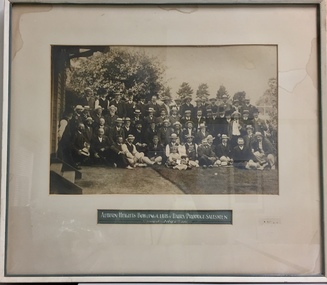
... Dairy Produce Salesmen in 1907. While the match-up might seem odd, during this period, there were many diary farms and milk outlets in Kew. ...The collection illuminates two of the Victorian historic themes - 'Building community life' through forming community organisations and 'Shaping cultural and creative life' by participating in sport and recreation. clubs - lawn bowls - kew (vic) auburn heights recreation club - barkers road - kew (vic) A framed and glazed large photograph of a tournament between members of the Auburn Heights Bowling Club and Dairy Produce Salesmen in 1907. ...Sports Clubs in Kew in the final decades of the 19th century and in the early 20th century were often umbrella organisations with facilities for a number of sports. Typically in Kew, this included teams in lawn bowls, tennis and croquet. The Kew Bowling Club was formed in 1880 while the privately owned Auburn Heights Recreation Club was opened in 1904. By 1998, the two Clubs decided to amalgamate at the Auburn Heights site in Barkers Road, forming the Kew Heights Sports Club. The combined club was itself taken over by the Melbourne Cricket Club in 2012 becoming MCC Kew Sports Club. In 2017 MCC Kew closed and its landholding was subsequently sold to Carey Baptist Grammar School. Both the Kew and Auburn Heights Clubs assembled important collections. These historically significant and large collections were donated to the Society in 2020. The collections include manuscripts, pictures, trophies, plans, honour boards etc. References Barnard FGA 1910, 'Sports and Pastimes' in Jubilee History of Kew Victoria: Its origin & progress 1803-1910. Chapman J & C 1999, The history of the Auburn Heights Recreation Club, 1904 to 1908. Reeve S 2012, City of Boroondara: Thematic Environmental History, p.216.The combined collections of the four sporting clubs making up the collection number hundreds of items that are historically significant locally. They are also significant to the sporting history of the greater Melbourne area and to the sports of lawn bowls and tennis in Australia in the 19th and 20th centuries. The collection illuminates two of the Victorian historic themes - 'Building community life' through forming community organisations and 'Shaping cultural and creative life' by participating in sport and recreation.A framed and glazed large photograph of a tournament between members of the Auburn Heights Bowling Club and Dairy Produce Salesmen in 1907. While the match-up might seem odd, during this period, there were many diary farms and milk outlets in Kew. [The item forms part of the large historic Auburn Heights Recreation Club collection, with items relating to the sports of lawn bowls, tennis and croquet, gifted to the Kew Historical Society in 2020].clubs - lawn bowls - kew (vic), auburn heights recreation club - barkers road - kew (vic) -
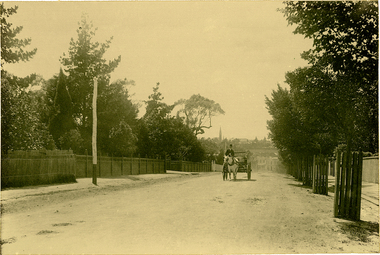 Kew Historical Society Inc
Photograph, J F C Farquhar, Studley Park Road, 1891
... Kew mansions were concealed. Contemporary advertisements for the sale of mansions in Studley Park Road often included fulsome descriptions of their elaborate formal gardens, as well as paddocks for grazing, stabling and dairies. ...Kew mansions were concealed. Contemporary advertisements for the sale of mansions in Studley Park Road often included fulsome descriptions of their elaborate formal gardens, as well as paddocks for grazing, stabling and dairies. ...At the beginning of the 1890s, the Kew businessman and Town Councillor, Henry Kellett, commissioned J.F.C. Farquhar to photograph scenes of Kew. These scenes included panoramas as well as pastoral scenes. The resulting set of twelve photographs was assembled in an album, Kew Where We Live, from which customers could select images for purchase.The preamble to the album describes that the photographs used the ‘argentic bromide’ process, now more commonly known as the gelatine silver process. This form of dry plate photography allowed for the negatives to be kept for weeks before processing, hence its value in landscape photography. The resulting images were considered to be finely grained and everlasting. Evidence of the success of Henry Kellett’s venture can be seen today, in that some of the photographs are held in national collections.It is believed that the Kew Historical Society’s copy of the Kellett album is unique and that the photographs in the book were the first copies taken from the original plates. It is the first and most important series of images produced about Kew. The individual images have proved essential in identifying buildings and places of heritage value in the district.In this view of Studley Park Road, looking northeast to the Junction, the photographer invites the viewer to participate in a point-of-view that emphasises the elevated, tranquil vantage point of the hill in contrast to the bustling commercial area in the distance. The view emphasises the exclusiveness of Studley Park, with its high fences behind which a number of significant Kew mansions were concealed. Contemporary advertisements for the sale of mansions in Studley Park Road often included fulsome descriptions of their elaborate formal gardens, as well as paddocks for grazing, stabling and dairies. None can be seen here. The use of high, protective wooden pickets to surround the newly planted avenue of elms on the south side of the road appears to be typical of the period. Similar examples can be seen in early photographs of Wellington and Princess Streets.The horse and carriage, selected as a central focus of the view, reinforces the residential, exclusive nature of this part of Kew in the early 1890s. Studley Park Roadkew illustrated, kew where we live, photographic books, henry kellett -
Kew Historical Society Inc
Archive (Sub-series) - Subject File, Elm House, 72 Walpole Street (Kew), 1983
... ...kew (vic) - dairies...Kew High School. Owners of the house recorded in the report include Horace Samson, George Gray Allan, George Brinsden Vasey, Matthew Montgomerie Wilson, and Ethel Dalton. The writer contends that at some stage, the house operated as a dairy...Typically files will contain primary and secondary sources. kew (vic) - history kew (vic) - dairies elm house - 72 walpole street (kew) cloverlea - 72 walpole street (kew) sally ann venables houses - walpole street - kew (vic) Reference file containing a school research assignment completed by Sally Ann Venables of the history of Elm House (later Cloverlea), 72 Walpole Street. ...Sally Ann VenablesReference, Research, InformationProvenance (Donor) OrderSubject file containing a school research assignment completed by Sally Ann Venables of the history of Elm House (later Cloverlea), 72 Walpole Street. The 15-page report was completed in 1983 while Sally was a pupil of Kew High School. Owners of the house recorded in the report include Horace Samson, George Gray Allan, George Brinsden Vasey, Matthew Montgomerie Wilson, and Ethel Dalton. The writer contends that at some stage, the house operated as a dairy. kew (vic) - history, kew (vic) - dairies, elm house - 72 walpole street (kew), cloverlea - 72 walpole street (kew), sally ann venables, houses - walpole street - kew (vic)kew (vic) - history, kew (vic) - dairies, elm house - 72 walpole street (kew), cloverlea - 72 walpole street (kew), sally ann venables, houses - walpole street - kew (vic)
