
Showing 94 items matching "decorative bowl"
-
 Wodonga & District Historical Society Inc
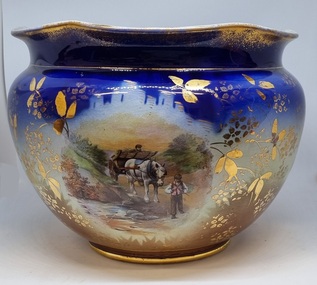
Decorative object - Decorative ceramic bowl
... Decorative ceramic bowl...Decorative ceramic bowl...bowl was used in the home of Mrs. Laura Sommer nee Costa grandmother of one of the life members of Wodonga & District Historical Society who donated this item to our collection. It is representative of decorative...A large ceramic decorative bowl featuring rural images. The primary colours of the bowl is a deep blue with gilt edges and markings. ...There is a maker's mark underneath the bowl. Decorative ceramic bowl Decorative object Decorative ceramic bowl ...This bowl was used in the home of Mrs. Laura Sommer nee Costa grandmother of one of the life members of Wodonga & District Historical Society who donated this item to our collection. It is representative of decorative household items in the early to mid 20th century.This item is an outstanding example of popular decorative household items from the 19th and early 20th century.A large ceramic decorative bowl featuring rural images. The primary colours of the bowl is a deep blue with gilt edges and markings. It features 2 rural scenes showing men with horses and a cart. The top edge is slightly contoured. There is a maker's mark underneath the bowl.Maker's map on base: A small flower within and larger flower shape with "MADE IN ENGLAND" written around it.decorative bowls, domestic items, ceramics, english ceramics and porcelain -
 Nhill and District Historical Society Inc.
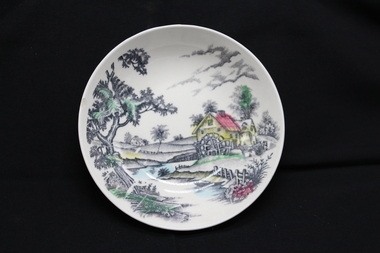
Ceramic - Japanese Decorative Bowl, Water Mill, c 1920 - 1935
... Japanese Decorative Bowl......decorative bowl...Round Japanese decorative bowl with a plain white rim. The central design depicts a picturesque rural landscape featuring a watermill and waterwheel, stream, large spreading tree, cottage, fields, fencing and flowering plants. ...Water Mill Ceramic Japanese Decorative Bowl ...An example of vintage Japanese export ceramic production using European-inspired picturesque imagery. The imagery reflects the international market for romantic European pastoral scenes, which Japanese ceramic manufacturers reproduced extensively for export, and is part of a set of six.Round Japanese decorative bowl with a plain white rim. The central design depicts a picturesque rural landscape featuring a watermill and waterwheel, stream, large spreading tree, cottage, fields, fencing and flowering plants. The scene is predominantly printed in black and grey, with selected areas highlighted in green, yellow, red and blue. The decoration has the appearance of a transfer-printed image with additional colour applied over the printed design. "WATER MILL" "MADE IN JAPAN" "UNDERGLAZE'made in japan, crockery-sweet bowl, decorative bowl, underglazed ceramics, ceramics -
 Nhill and District Historical Society Inc.
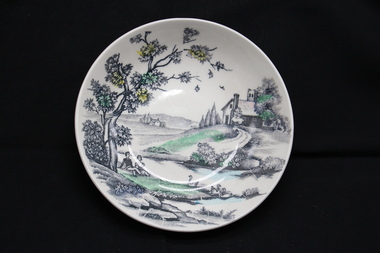
Ceramic - Japanese Decorative Bowl, Autumn Dreams
... Japanese Decorative Bowl......decorative bowl...Autumn Dreams Ceramic Japanese Decorative Bowl ...An example of vintage Japanese export ceramic production using European-inspired picturesque imagery. The imagery reflects the international market for romantic European pastoral scenes, which Japanese ceramic manufacturers reproduced extensively for export, and is part of a set of six.Round Japanese ceramic bowl with a plain white rim and a central picturesque landscape. The scene depicts a rural countryside with a broad-leaved tree in the foreground, a stream or lake, a small house or farm building, fields, a winding road and flowering vegetation. Two figures are seated beneath the tree beside the water, while a swan is visible in the foreground. The principal landscape is printed in black/grey, with selected areas highlighted in green, yellow, blue and red. The overall design is a romanticised European-style pastoral landscape, rather than a specifically Japanese scene. "AUTUMN DREAMS" "MADE IN JAPAN' "UNDERGLAZE'made in japan, ceramics, crockery-sweet bowl, decorative bowl, design autumn dreams, underglazed ceramics -
 Nillumbik Shire Council
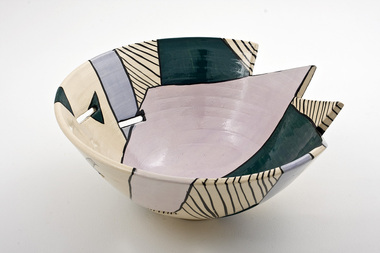
Ceramics (bowl): Mary-Lou Pittard, Mary-Lou Pittard, Decorative Bowl, 1983
... Decorative Bowl...'Decorative Bowl' is a wheel-thrown/moulded bowl, oblong in shape and has been manipulated by hand. ...They have been applied directly to the bisque surface and subsequently covered with a transparent glaze which protects them and enhances their permanency. Decorative Bowl Ceramics (bowl): Mary-Lou Pittard Mary-Lou Pittard ...Mary-Lou began exhibiting in the mid 1980s and over the years has been involved in producing unique pieces as well as developing a large range of domestic ware. In 1984, six months after graduating from a Bachelor of Fine Arts at Phillip Institute of Technology, Mary-Lou was invited to present a solo exhibition at Devise Gallery in South Melbourne. This objective, she says, compelled her to find a studio and was an incentive to focus on developing her ceramic practice independently.Mary-Lou Pittard holds close ties to the Shire of Nillumbik - living and working within Eltham. Her Eltham North Mudbrick Studio employed 5 assistants until recently when Mary-Lou and partner Chris Pittard have scaled down operations. They now produce everything themselves and find that this enables them to focus on producing unique, sculptural ceramic works. Mary-Lou is currently exploring the fine qualities of porcelain and combining these with her ongoing passion for decorative colour and form. 'Decorative Bowl' is a wheel-thrown/moulded bowl, oblong in shape and has been manipulated by hand. Narrow sections have been incised from the main body, perhaps a practical design feature for air circulation, and the rim has been altered to form a jagged edge. Bold colourful shapes decorate the interior of the bowl. They have been applied directly to the bisque surface and subsequently covered with a transparent glaze which protects them and enhances their permanency.mary-lou pittard, ceramic, chris pittard, eltham, nillumbik -
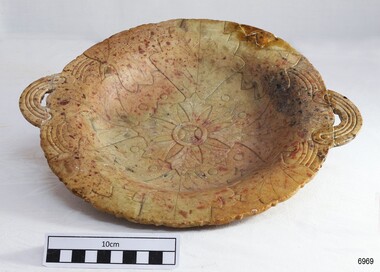 Flagstaff Hill Maritime Museum and Village
Domestic object - Bowl, 1880s
... bowl...alabaster...decorative...This decorative bowl is typical of items used in a Victorian household for decorative purposes or to serve items such as fruit. ...This decorative bowl is typical of items used in a Victorian household for decorative purposes or to serve items such as fruit. ...This decorative bowl is typical of items used in a Victorian household for decorative purposes or to serve items such as fruit. It has been lovingly handmade and restored carefully to match the original.This alabaster bowl is representative of handmade decorative and useful items of the Victorian era.Bowl; round, hand-crafted, shallow oval alabaster bowl on a short pedestal with carved handles on opposing sides. Light brown with dark grey/black and red flecks. Stone has a polished surface, leaves outline (acanthus plant) etched inside the bowl. The pedestal has been crafted separately and expertly attached to the base. Several careful repairs were previously made to preserve the bowl.flagstaff hill, warrnambool, maritime museum, maritime village, great ocean road, shipwreck coast, bowl, alabaster, decorative item, fruit bowl, handmade bowl -
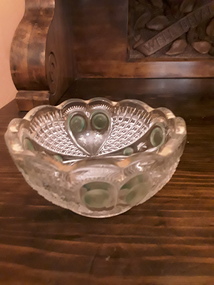 Mont De Lancey
Functional object - Glass Bowl, Unknown
... A small round cut glass decorative bowl with a green circular pattern and gold trim around the top scalloped edge....Bowls Containers Objects Decorative Objects A small round cut glass decorative bowl with a green circular pattern and gold trim around the top scalloped edge. ...A small round cut glass decorative bowl with a green circular pattern and gold trim around the top scalloped edge.bowls, containers, objects, decorative objects -
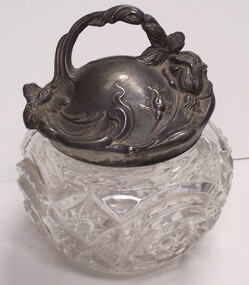 Glenelg Shire Council Cultural Collection
Functional object - Sugar Bowl with Lid, 1890-1910
... bowl... decorative object...Displayed in History House. sugar bowl decorative object domestic item art nouveau Pewter lid (538.2) and cut-glass sugar bowl (538.1). ...Displayed in History House.Pewter lid (538.2) and cut-glass sugar bowl (538.1). Bowl has cut-glass design of geometric and rounded shapes. Pewter lid has designs of roses, in an art nouveau style.sugar bowl, decorative object, domestic item, art nouveau -
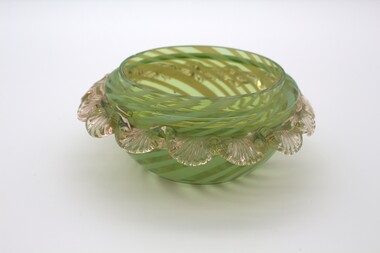 Friends of Westgarthtown
Decorative object - Ornament
... Decorative glass bowl with clear green base colour yellowish white opaque lines in spiral pattern. ...ornaments glass globular green bowl. Decorative glass bowl with clear green base colour yellowish white opaque lines in spiral pattern. ...Decorative glass bowl with clear green base colour yellowish white opaque lines in spiral pattern. Clear glass decorative flange trim on edge.ornaments, glass, globular, green, bowl. -
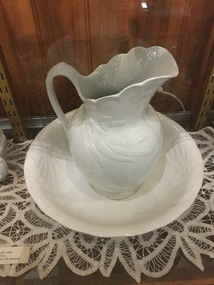 Mont De Lancey
Wash jug and bowl, J & G Meakin
... White jug and wash bowl with decorative pattern. Part of 1909 bedroom set....JUGS WATER PITCHER White jug and wash bowl with decorative pattern. Part of 1909 bedroom set. ...White jug and wash bowl with decorative pattern. Part of 1909 bedroom set.jugs, water pitcher -
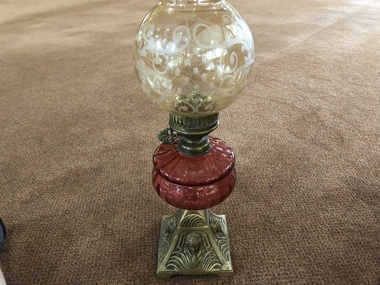 Mont De Lancey
Lamp, C1890
... Victorian lamp with ruby red glass bowl, decorative ornate gold coloured metal base, wick handle and frosted flue....From the late Miss Eva M Sebire lamps Victorian lamp with ruby red glass bowl, decorative ornate gold coloured metal base, wick handle and frosted flue. ...From the late Miss Eva M SebireVictorian lamp with ruby red glass bowl, decorative ornate gold coloured metal base, wick handle and frosted flue.lamps -
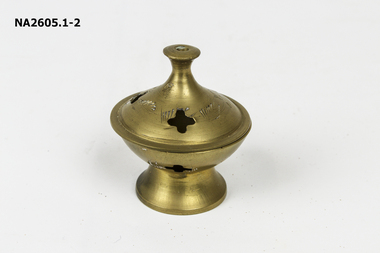 Whitehorse Historical Society Inc.
Decorative object - Incense burner
... Small brass incense burner with lid. Lid and bowl have decorative holes and an etched decoration....ornaments metal Small brass incense burner with lid. Lid and bowl have decorative holes and an etched decoration. ...Small brass incense burner with lid. Lid and bowl have decorative holes and an etched decoration.ornaments, metal -
 Federation University Historical Collection
Artwork, other - Enamelled punch bowl and ladle, Frederick Gladstone Procter, c1932
... Frederick Gladstone PROCTER (1898-1977) This decorative enamelled punch bowl mounted on blackwood pillars drew attention when it was exhibited in a shop window display to attract new students in 1932. ...Frederick Gladstone PROCTER (1898-1977) This decorative enamelled punch bowl mounted on blackwood pillars drew attention when it was exhibited in a shop window display to attract new students in 1932. ...Frederick Gladstone PROCTER (1898-1977) This decorative enamelled punch bowl mounted on blackwood pillars drew attention when it was exhibited in a shop window display to attract new students in 1932. The Ballarat Technical Art School was well known for its art metal work which was applied to product, interior and commemorative designs. Students undertook many commissions. A small jewellery and enamelling class was also introduced in 1922. Metal punch bowl (probably nickel silver), with enamelled features on blackwood stand, floating bowl and matching ladle. -
Emerald Museum & Nobelius Heritage Park
Domestic object - Pair of oil lamps, Unknown maker, 1880s - 1920s
... Pair of small oil lamps with matching glass chimneys- Circular brass bowl and base. Decorative impressed rim around bowl and base. ...Accidents such as explosions and fires could still happen if lamps were mishandled or not properly maintained. kerosene lamp USA Inscription on push button: 'Made in USA' Pair of small oil lamps with matching glass chimneys- Circular brass bowl and base. Decorative impressed rim around bowl and base. ...Oil lamps were a necessary feature of everyday domestic and working life in Emerald before the advent of electricity in 1934. Kerosene became a safe and affordable lamp fuel in the 2nd half of the 19th century. It produced a brighter and steadier light and was more efficient than previous oils. The invention of kerosene coincided with improvements in lamp design. Accidents such as explosions and fires could still happen if lamps were mishandled or not properly maintained.Pair of small oil lamps with matching glass chimneys- Circular brass bowl and base. Decorative impressed rim around bowl and base. Belonged to local collector, Alan Rockett (now aged 93) who later gave it to Bill Black who has now in turn donated it to the Museum.Inscription on push button: 'Made in USA'kerosene lamp, usa -
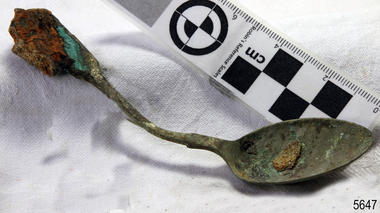 Flagstaff Hill Maritime Museum and Village
Spoon, circa 1878
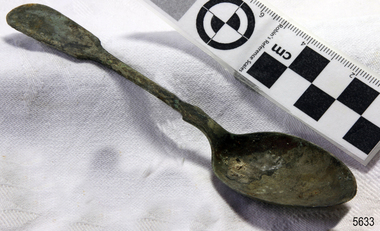
... Part of heraldic shield on upper rear of bowl (decorative rats-tail)....Part of heraldic shield on upper rear of bowl (decorative rats-tail). Spoon William Page & Co. ...This tea spoon is from the wreck of the LOCH ARD, a Loch Line ship of 1,693 tons which sailed from Gravesend, London, on 2 March 1878 with 17 passengers and a crew of 36 under Captain George Gibbs. “The intention was to discharge cargo in Melbourne, before returning to London via the Horn with wool and wheat”. Instead, on 1 June 1878, after 90 days at sea, she struck the sandstone cliffs of Mutton Bird Island on the south west coast of Victoria, and sank with the loss of 52 lives and all her cargo. The manifest of the LOCH ARD listed an array of manufactured goods and bulk metals being exported to the Colony of Victoria, with a declared value of £53,700. (202 bills of lading show an actual invoice value of £68, 456, with insurance underwriting to £30,000 of all cargo). Included in the manifest is the item of “Tin hardware & cutlery £7,530”. This teaspoon is one of 482 similar items of electro-plated cutlery from the LOCH ARD site, comprising spoons and forks of various sizes but all sharing the same general shape or design and metallic composition. 49 of these pieces display a legible makers’ mark — the initials “W” and “P” placed within a raised diamond outline, which is in turn contained within a sunken crown shape — identifying the manufacturer as William Page & Co of Birmingham. An electroplater’s makers’ marks, unlike sterling silver hallmarks, are not consistent identifiers of quality or date and place of manufacture. A similar line of five impressions was usually made to impress the consumer with an implication of industry standards, but what each one actually signified was not regulated and so they varied according to the whim of the individual foundry. In this case, the maker’s marks are often obscured by sedimentary accretion or removed by corrosion after a century of submersion in the ocean. However sufficient detail has survived to indicate that these samples of electro-plated cutlery probably originated from the same consignment in the LOCH ARD’s cargo. The following descriptions of maker’s marks are drawn from 255 tea spoons, 125 dessert spoons, and 99 table forks. These marks are clearly visible in 66 instances, while the same sequence of general outlines, or depression shapes, is discernible in another 166 examples. 1. A recessed Crown containing a raised Diamond outline and the initials “W” and “P” (the recognised trademark of William Page & Co) 2. An impressed Ellipse containing a raised, pivoted, Triangle in its lower part and bearing a Resurrection Cross on its upper section (a possible dissenting church symbol reflecting religious affiliation); OR a rounded Square impression containing a raised, ‘lazy’, letter “B” (possibly mimicking sterling silver hallmark signifying city of manufacture i.e. Birmingham) 3. An impressed rounded Square filled with a raised Maltese Cross (the base metal composite of nickel silver was also known as ‘German silver’ after its Berlin inventors in 1823) 4. A recessed Circle containing a Crab or Scarab Beetle image; OR a recessed Circle containing a rotated ‘fleur de lys’ or ‘fasces’ design 5. A depressed Diamond shape enclosing a large raised letter “R” and a small raised letter “D” (mimicking the U.K. Patent Office stamp which abbreviated the term ‘registered’ to “RD”, but also included date and class of patent) Suggested trade names for William Page & Co’s particular blend of brass plating are ‘roman silver’ or ‘silverite’. This copper alloy polishes to a lustrous gold when new, discolouring to a murky grey with greenish hue when neglected. HISTORY OF THE LOCH ARD The LOCH ARD belonged to the famous Loch Line which sailed many ships from England to Australia. Built in Glasgow by Barclay, Curdle and Co. in 1873, the LOCH ARD was a three-masted square rigged iron sailing ship. The ship measured 262ft 7" (79.87m) in length, 38ft (11.58m) in width, 23ft (7m) in depth and had a gross tonnage of 1693 tons. The LOCH ARD's main mast measured a massive 150ft (45.7m) in height. LOCH ARD made three trips to Australia and one trip to Calcutta before its final voyage. LOCH ARD left England on March 2, 1878, under the command of Captain Gibbs, a newly married, 29 year old. She was bound for Melbourne with a crew of 37, plus 17 passengers and a load of cargo. The general cargo reflected the affluence of Melbourne at the time. On board were straw hats, umbrella, perfumes, clay pipes, pianos, clocks, confectionary, linen and candles, as well as a heavier load of railway irons, cement, lead and copper. There were items included that intended for display in the Melbourne International Exhibition in 1880. The voyage to Port Phillip was long but uneventful. At 3am on June 1, 1878, Captain Gibbs was expecting to see land and the passengers were becoming excited as they prepared to view their new homeland in the early morning. But LOCH ARD was running into a fog which greatly reduced visibility. Captain Gibbs was becoming anxious as there was no sign of land or the Cape Otway lighthouse. At 4am the fog lifted. A man aloft announced that he could see breakers. The sheer cliffs of Victoria's west coast came into view, and Captain Gibbs realised that the ship was much closer to them than expected. He ordered as much sail to be set as time would permit and then attempted to steer the vessel out to sea. On coming head on into the wind, the ship lost momentum, the sails fell limp and LOCH ARD's bow swung back. Gibbs then ordered the anchors to be released in an attempt to hold its position. The anchors sank some 50 fathoms - but did not hold. By this time LOCH ARD was among the breakers and the tall cliffs of Mutton Bird Island rose behind the ship. Just half a mile from the coast, the ship's bow was suddenly pulled around by the anchor. The captain tried to tack out to sea, but the ship struck a reef at the base of Mutton Bird Island, near Port Campbell. Waves broke over the ship and the top deck was loosened from the hull. The masts and rigging came crashing down knocking passengers and crew overboard. When a lifeboat was finally launched, it crashed into the side of LOCH ARD and capsized. Tom Pearce, who had launched the boat, managed to cling to its overturned hull and shelter beneath it. He drifted out to sea and then on the flood tide came into what is now known as LOCH ARD Gorge. He swam to shore, bruised and dazed, and found a cave in which to shelter. Some of the crew stayed below deck to shelter from the falling rigging but drowned when the ship slipped off the reef into deeper water. Eva Carmichael had raced onto deck to find out what was happening only to be confronted by towering cliffs looming above the stricken ship. In all the chaos, Captain Gibbs grabbed Eva and said, "If you are saved Eva, let my dear wife know that I died like a sailor". That was the last Eva Carmichael saw of the captain. She was swept off the ship by a huge wave. Eva saw Tom Pearce on a small rocky beach and yelled to attract his attention. He dived in and swam to the exhausted woman and dragged her to shore. He took her to the cave and broke open case of brandy which had washed up on the beach. He opened a bottle to revive the unconscious woman. A few hours later Tom scaled a cliff in search of help. He followed hoof prints and came by chance upon two men from nearby Glenample Station three and a half miles away. In a state of exhaustion, he told the men of the tragedy. Tom returned to the gorge while the two men rode back to the station to get help. By the time they reached LOCH ARD Gorge, it was cold and dark. The two shipwreck survivors were taken to Glenample Station to recover. Eva stayed at the station for six weeks before returning to Ireland, this time by steamship. In Melbourne, Tom Pearce received a hero's welcome. He was presented with the first gold medal of the Royal Humane Society of Victoria and a £1000 cheque from the Victorian Government. Concerts were performed to honour the young man's bravery and to raise money for those who lost family in the LOCH ARD disaster. Of the 54 crew members and passengers on board, only two survived: the apprentice, Tom Pearce and the young woman passenger, Eva Carmichael, who lost all of her family in the tragedy. Ten days after the LOCH ARD tragedy, salvage rights to the wreck were sold at auction for £2,120. Cargo valued at £3,000 was salvaged and placed on the beach, but most washed back into the sea when another storm developed. The wreck of LOCH ARD still lies at the base of Mutton Bird Island. Much of the cargo has now been salvaged and some was washed up into what is now known as LOCH ARD Gorge. Cargo and artefacts have also been illegally salvaged over many years before protective legislation was introduced. One of the most unlikely pieces of cargo to have survived the shipwreck was a Minton porcelain peacock - one of only seven in the world. The peacock was destined for the Melbourne International Exhibition in 1880. It had been well packed, which gave it adequate protection during the violent storm. Today, the Minton peacock can be seen at the Flagstaff Hill Maritime Museum in Warrnambool. From Australia's most dramatic shipwreck it has now become Australia's most valuable shipwreck artefact and is one of very few 'objects' on the Victorian State Heritage Register. The LOCH ARD shipwreck is of State significance – Victorian Heritage Register S 417. Flagstaff Hill’s collection of artefacts from LOCH ARD is significant for being one of the largest collections of artefacts from this shipwreck in Victoria. It is significant for its association with the shipwreck, which is on the Victorian Heritage Register (VHR S417). The collection is significant because of the relationship between the objects, as together they have a high potential to interpret the story of the LOCH ARD. The LOCH ARD collection is archaeologically significant as the remains of a large international passenger and cargo ship. The LOCH ARD collection is historically significant for representing aspects of Victoria’s shipping history and its potential to interpret sub-theme 1.5 of Victoria’s Framework of Historical Themes (living with natural processes). The collection is also historically significant for its association with the LOCH ARD, which was one of the worst and best known shipwrecks in Victoria’s history. Unrestored tea spoon from the wreck of the LOCH ARD. The spoon design has a flattened fiddle-back handle, with a thin stem or shank, flared collar, and elongated bowl. The spoons metallic composition is a thin layer of brass alloy which has partially corroded back to a nickel-silver base metal. Stem is bent. 70% of dull plate remains. Handle is concreted with sediment. Part of heraldic shield on upper rear of bowl (decorative rats-tail).flagstaff hill, warrnambool, shipwrecked coast, flagstaff hill maritime museum, maritime museum, shipwreck coast, flagstaff hill maritime village, great ocean road, loch line, loch ard, captain gibbs, eva carmichael, tom pearce, glenample station, mutton bird island, loch ard gorge, electroplated cutlery, loch ard shipwreck, nickel silver, william page & co, birmingham, brass plating, makers marks -
 Flagstaff Hill Maritime Museum and Village
Spoon, circa 1878
... Plain heraldic shield embossed on rear of spoon bowl ('decorative ratstail')....Plain heraldic shield embossed on rear of spoon bowl ('decorative ratstail'). Spoon William Page & Co. ...This tea spoon is from the wreck of the LOCH ARD, a Loch Line ship of 1,693 tons which sailed from Gravesend, London, on 2 March 1878 with 17 passengers and a crew of 36 under Captain George Gibbs. “The intention was to discharge cargo in Melbourne, before returning to London via the Horn with wool and wheat”. Instead, on 1 June 1878, after 90 days at sea, she struck the sandstone cliffs of Mutton Bird Island on the south west coast of Victoria, and sank with the loss of 52 lives and all her cargo. The manifest of the LOCH ARD listed an array of manufactured goods and bulk metals being exported to the Colony of Victoria, with a declared value of £53,700. (202 bills of lading show an actual invoice value of £68, 456, with insurance underwriting to £30,000 of all cargo). Included in the manifest is the item of “Tin hardware & cutlery £7,530”. This teaspoon is one of 482 similar items of electro-plated cutlery from the LOCH ARD site, comprising spoons and forks of various sizes but all sharing the same general shape or design and metallic composition. 49 of these pieces display a legible makers’ mark — the initials “W” and “P” placed within a raised diamond outline, which is in turn contained within a sunken crown shape — identifying the manufacturer as William Page & Co of Birmingham. An electroplater’s makers’ marks, unlike sterling silver hallmarks, are not consistent identifiers of quality or date and place of manufacture. A similar line of five impressions was usually made to impress the consumer with an implication of industry standards, but what each one actually signified was not regulated and so they varied according to the whim of the individual foundry. In this case, the maker’s marks are often obscured by sedimentary accretion or removed by corrosion after a century of submersion in the ocean. However sufficient detail has survived to indicate that these samples of electro-plated cutlery probably originated from the same consignment in the LOCH ARD’s cargo. The following descriptions of maker’s marks are drawn from 255 tea spoons, 125 dessert spoons, and 99 table forks. These marks are clearly visible in 66 instances, while the same sequence of general outlines, or depression shapes, is discernible in another 166 examples. 1. A recessed Crown containing a raised Diamond outline and the initials “W” and “P” (the recognised trademark of William Page & Co) 2. An impressed Ellipse containing a raised, pivoted, Triangle in its lower part and bearing a Resurrection Cross on its upper section (a possible dissenting church symbol reflecting religious affiliation); OR a rounded Square impression containing a raised, ‘lazy’, letter “B” (possibly mimicking sterling silver hallmark signifying city of manufacture i.e. Birmingham) 3. An impressed rounded Square filled with a raised Maltese Cross (the base metal composite of nickel silver was also known as ‘German silver’ after its Berlin inventors in 1823) 4. A recessed Circle containing a Crab or Scarab Beetle image; OR a recessed Circle containing a rotated ‘fleur de lys’ or ‘fasces’ design 5. A depressed Diamond shape enclosing a large raised letter “R” and a small raised letter “D” (mimicking the U.K. Patent Office stamp which abbreviated the term ‘registered’ to “RD”, but also included date and class of patent) Suggested trade names for William Page & Co’s particular blend of brass plating are ‘roman silver’ or ‘silverite’. This copper alloy polishes to a lustrous gold when new, discolouring to a murky grey with greenish hue when neglected. HISTORY OF THE LOCH ARD The LOCH ARD belonged to the famous Loch Line which sailed many ships from England to Australia. Built in Glasgow by Barclay, Curdle and Co. in 1873, the LOCH ARD was a three-masted square rigged iron sailing ship. The ship measured 262ft 7" (79.87m) in length, 38ft (11.58m) in width, 23ft (7m) in depth and had a gross tonnage of 1693 tons. The LOCH ARD's main mast measured a massive 150ft (45.7m) in height. LOCH ARD made three trips to Australia and one trip to Calcutta before its final voyage. LOCH ARD left England on March 2, 1878, under the command of Captain Gibbs, a newly married, 29 year old. She was bound for Melbourne with a crew of 37, plus 17 passengers and a load of cargo. The general cargo reflected the affluence of Melbourne at the time. On board were straw hats, umbrella, perfumes, clay pipes, pianos, clocks, confectionary, linen and candles, as well as a heavier load of railway irons, cement, lead and copper. There were items included that intended for display in the Melbourne International Exhibition in 1880. The voyage to Port Phillip was long but uneventful. At 3am on June 1, 1878, Captain Gibbs was expecting to see land and the passengers were becoming excited as they prepared to view their new homeland in the early morning. But LOCH ARD was running into a fog which greatly reduced visibility. Captain Gibbs was becoming anxious as there was no sign of land or the Cape Otway lighthouse. At 4am the fog lifted. A man aloft announced that he could see breakers. The sheer cliffs of Victoria's west coast came into view, and Captain Gibbs realised that the ship was much closer to them than expected. He ordered as much sail to be set as time would permit and then attempted to steer the vessel out to sea. On coming head on into the wind, the ship lost momentum, the sails fell limp and LOCH ARD's bow swung back. Gibbs then ordered the anchors to be released in an attempt to hold its position. The anchors sank some 50 fathoms - but did not hold. By this time LOCH ARD was among the breakers and the tall cliffs of Mutton Bird Island rose behind the ship. Just half a mile from the coast, the ship's bow was suddenly pulled around by the anchor. The captain tried to tack out to sea, but the ship struck a reef at the base of Mutton Bird Island, near Port Campbell. Waves broke over the ship and the top deck was loosened from the hull. The masts and rigging came crashing down knocking passengers and crew overboard. When a lifeboat was finally launched, it crashed into the side of LOCH ARD and capsized. Tom Pearce, who had launched the boat, managed to cling to its overturned hull and shelter beneath it. He drifted out to sea and then on the flood tide came into what is now known as LOCH ARD Gorge. He swam to shore, bruised and dazed, and found a cave in which to shelter. Some of the crew stayed below deck to shelter from the falling rigging but drowned when the ship slipped off the reef into deeper water. Eva Carmichael had raced onto deck to find out what was happening only to be confronted by towering cliffs looming above the stricken ship. In all the chaos, Captain Gibbs grabbed Eva and said, "If you are saved Eva, let my dear wife know that I died like a sailor". That was the last Eva Carmichael saw of the captain. She was swept off the ship by a huge wave. Eva saw Tom Pearce on a small rocky beach and yelled to attract his attention. He dived in and swam to the exhausted woman and dragged her to shore. He took her to the cave and broke open case of brandy which had washed up on the beach. He opened a bottle to revive the unconscious woman. A few hours later Tom scaled a cliff in search of help. He followed hoof prints and came by chance upon two men from nearby Glenample Station three and a half miles away. In a state of exhaustion, he told the men of the tragedy. Tom returned to the gorge while the two men rode back to the station to get help. By the time they reached LOCH ARD Gorge, it was cold and dark. The two shipwreck survivors were taken to Glenample Station to recover. Eva stayed at the station for six weeks before returning to Ireland, this time by steamship. In Melbourne, Tom Pearce received a hero's welcome. He was presented with the first gold medal of the Royal Humane Society of Victoria and a £1000 cheque from the Victorian Government. Concerts were performed to honour the young man's bravery and to raise money for those who lost family in the LOCH ARD disaster. Of the 54 crew members and passengers on board, only two survived: the apprentice, Tom Pearce and the young woman passenger, Eva Carmichael, who lost all of her family in the tragedy. Ten days after the LOCH ARD tragedy, salvage rights to the wreck were sold at auction for £2,120. Cargo valued at £3,000 was salvaged and placed on the beach, but most washed back into the sea when another storm developed. The wreck of LOCH ARD still lies at the base of Mutton Bird Island. Much of the cargo has now been salvaged and some was washed up into what is now known as LOCH ARD Gorge. Cargo and artefacts have also been illegally salvaged over many years before protective legislation was introduced. One of the most unlikely pieces of cargo to have survived the shipwreck was a Minton porcelain peacock - one of only nine in the world. The peacock was destined for the Melbourne International Exhibition in 1880. It had been well packed, which gave it adequate protection during the violent storm. Today, the Minton peacock can be seen at the Flagstaff Hill Maritime Museum in Warrnambool. From Australia's most dramatic shipwreck it has now become Australia's most valuable shipwreck artefact and is one of very few 'objects' on the Victorian State Heritage Register. The LOCH ARD shipwreck is of State significance – Victorian Heritage Register S 417. Flagstaff Hill’s collection of artefacts from LOCH ARD is significant for being one of the largest collections of artefacts from this shipwreck in Victoria. It is significant for its association with the shipwreck, which is on the Victorian Heritage Register (VHR S417). The collection is significant because of the relationship between the objects, as together they have a high potential to interpret the story of the LOCH ARD. The LOCH ARD collection is archaeologically significant as the remains of a large international passenger and cargo ship. The LOCH ARD collection is historically significant for representing aspects of Victoria’s shipping history and its potential to interpret sub-theme 1.5 of Victoria’s Framework of Historical Themes (living with natural processes). The collection is also historically significant for its association with the LOCH ARD, which was one of the worst and best known shipwrecks in Victoria’s history. Unrestored tea spoon from the wreck of the LOCH ARD. The spoon design has a flattened fiddle-back handle, with a thin stem or shank, flared collar, and elongated bowl. The spoons metallic composition is a thin layer of brass alloy which has partially corroded back to a nickel-silver base metal. 60% of plate remains. Three outlines of makers marks are visible (Circle, Circle, Diamond). Plain heraldic shield embossed on rear of spoon bowl ('decorative ratstail').flagstaff hill, warrnambool, shipwrecked coast, flagstaff hill maritime museum, maritime museum, shipwreck coast, flagstaff hill maritime village, great ocean road, loch line, loch ard, captain gibbs, eva carmichael, tom pearce, glenample station, mutton bird island, loch ard gorge, electroplated cutlery, loch ard shipwreck, nickel silver, william page & co, birmingham, brass plating, makers marks -
 Bacchus Marsh & District Historical Society
Archive, Bacchus Marsh Players (Theatre Group)
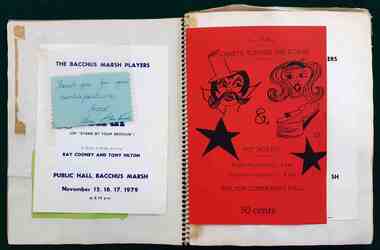
... Material comprises production programmes, tickets, flyers and other promotional ephemera, audio recordings (cassettes) of productions, one large reel tape recording of a production, one VHS video recording of a production, scrapbooks, photo albums of colour and black and white photos, colour slides of productions, newspaper clippings, recordings of published music used for productions, documents, certificates and awards, one ledger book containing financial records, one engraved decorative wooden bowl presented to Liba Novak in 2002. ...Material comprises production programmes, tickets, flyers and other promotional ephemera, audio recordings (cassettes) of productions, one large reel tape recording of a production, one VHS video recording of a production, scrapbooks, photo albums of colour and black and white photos, colour slides of productions, newspaper clippings, recordings of published music used for productions, documents, certificates and awards, one ledger book containing financial records, one engraved decorative wooden bowl presented to Liba Novak in 2002. ...The Bacchus Marsh Players were an amateur theatre group based in Bacchus Marsh. They formed in the 1950s and were active until the mid 1990s. They are known to have performed productions between 1955 and 1994. An important and extensive collection of material relating to a long running community theatre group.Mixed collection of material generated by the Bacchus Marsh Players an amateur theatre group in Bacchus Marsh. Material comprises production programmes, tickets, flyers and other promotional ephemera, audio recordings (cassettes) of productions, one large reel tape recording of a production, one VHS video recording of a production, scrapbooks, photo albums of colour and black and white photos, colour slides of productions, newspaper clippings, recordings of published music used for productions, documents, certificates and awards, one ledger book containing financial records, one engraved decorative wooden bowl presented to Liba Novak in 2002. Material also includes the programme and script for the 1986 production of 'Pieces of Glass' by Betty Osborn, and a hand-written list in date order of productions from the 1955 until 1994. bacchus marsh players theatre group, theatre groups (performers) -
 Flagstaff Hill Maritime Museum and Village
Decorative object - Ewer and Bowl
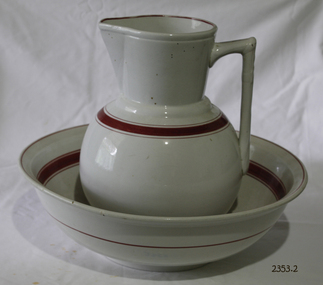
... Ewer and bowl are a matching pair, trimmed with a red-brown rings and bands. Decorative object Ewer and Bowl ...White ceramic jug and bowl. Ewer and bowl are a matching pair, trimmed with a red-brown rings and bands. flagstaff hill, warrnambool, shipwrecked-coast, flagstaff-hill, flagstaff-hill-maritime-museum, maritime-museum, shipwreck-coast, flagstaff-hill-maritime-village, ceramic jug and bowl, ewer, ewer set, jug, ceramic, earthenware -
 Flagstaff Hill Maritime Museum and Village
Ceremonial object - Font, 1940s
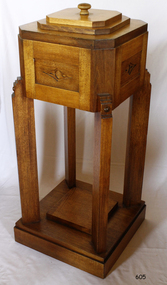
... bowl or basin insert. The box has a removable cover that has a round wooden knob. The sides of the box section have a decorative, diamond-shaped motif. ...bowl or basin insert. The box has a removable cover that has a round wooden knob. The sides of the box section have a decorative, diamond-shaped motif. ...This font is a piece of church furniture used in a baptism or christening service. It was originally installed in the St Nicholas Seamen's Church at 139 Nelson Place, Williamstown, Victoria. The church was a branch of the Victoria Missions to Seamen. THE MISSIONS TO SEAMEN (Brief History): - The Missions to Seamen was an Anglican charity that has served seafarers of the world since 1856 in Great Britain. Its symbol is a Flying Angel, inspired by a Bible verse. Today, there are centres in over 200 ports worldwide where seamen of all backgrounds are offered a warm welcome and provided with a wide range of facilities. In Victoria, the organisation began in Williamstown in 1857 as a Sailors’ Church, also known as ‘Bethel’ or the ‘Floating Church’ in an old hulk floating in Hobson’s Bay, Port of Melbourne. It soon became part of the Missions to Seamen, Victoria. In the year 2000, the organisation, now named Mission to Seafarers, still operated locally in Melbourne, Portland, Geelong and Hastings. The Ladies’ Harbour Lights Guild was formed in 1906 to support the Missions to Seamen in Melbourne and other centres, such as Williamstown. Two of the most significant ladies of the Guild were founder Ethel Augusta Godfrey and foundation member Alice Sibthorpe Tracy (who established a branch of the Guild in Warrnambool in 1920). The Guild continued its work until the 1960s. In 1943, a former Williamstown bank was purchased for the Missions to Seaman Club. The chapel was named St Nicholas’ Seamen’s Church and was supported by the Ladies’ Harbour Lights Guild, the Williamstown Lightkeepers’ Auxiliary and the League of Soldiers’ and Sailors’ Friends. It ceased operation in 1966. A Missions to Seamen Chapel and Recreation Room was a significant feature of ports during the late 1800s and into the 1900s. It seemed appropriate for Flagstaff Hill to include such a representation within the new Maritime Village, so the Melbourne Board of Management of Missions to Seamen Victoria gave its permission on 21st May 1979 for the entire furnishings of the Williamstown chapel to be transferred to Flagstaff Hill. The St Nicholas Seamen’s Church was officially opened on October 11, 1981, and closely resembles the Williamstown chapel. This font is significant through its association with the St Nicholas' Mission to Seamen Church in Williamstown, Melbourne, established in 1857. The collection of items from the Missions to Seamen in Williamstown, Victoria, has historical and social significance. They show that people of the 1800s and 1900s cared about the seafarers’ religious, moral, and social welfare, no matter what their religion, social status or nationality. It had its origins in Bristol, England, when a Seamen's Mission was formed in 1837. The first Australian branch was started in 1856 by the Rev. Kerr Johnston, a Church of England clergyman, and operated from a hulk moored in Hobson’s Bay; later, the Mission occupied buildings in Williamstown and Port Melbourne. Baptismal font: four-legged, varnished oak wood pedestal supporting a wooden box with a hand-beaten, rolled edge, copper ewer, bowl or basin insert. The box has a removable cover that has a round wooden knob. The sides of the box section have a decorative, diamond-shaped motif. The box and lid are octagonal, with four short sides and four long sides. The tops of the legs have an ornamental design. This is one of the original items in our St Nicholas Seamen's Church Williamstown Collection.flagstaff hill, warrnambool, shipwrecked-coast, flagstaff-hill, flagstaff-hill-maritime-museum, maritime-museum, shipwreck-coast, flagstaff-hill-maritime-village, font, baptisimal font, church furniture, religious ceremony, copper ewet, religious furniture, christening font, religion, religious service, sailors rest, bethel sailors’ church, bethel floating church, ladies harbour light guild, missions to seamen victoria, mission to seafarers, st nicholas seaman’s church williamstown, st nicholas mission to seamen church williamstown, mission to seamen williamstown, st nicholas seamen’s church flagstaff hill, 139 nelson place williamstown, anglican church, flying angel club, copper ewer, copper bowl, flagstaff hill maritime museum and village, maritime museum, maritime village, shipwreck coast, great ocean road, religious worship, worship service, st nicholas seamen’s church, williamstown, st nicholas missions to seamen’s church williamstown, missions to seamen, st nicholas missions to seamen’s church flagstaff hill, baptism, christening, ceremony, tradition, hand-beaten copper ewer -
 Flagstaff Hill Maritime Museum and Village
Instrument - Scale, Weighing Machine, G. Salter & Co, 1884-1909
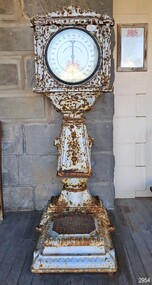
... Moulded motifs decorate the pedestal’s front and are repeated on its sides; they depict a tall, narrow urn with a bowl on top and fancy scrolls on either side. There is a decorative panel across the front top of the stand. ...Moulded motifs decorate the pedestal’s front and are repeated on its sides; they depict a tall, narrow urn with a bowl on top and fancy scrolls on either side. There is a decorative panel across the front top of the stand. ...This ornate, Victorian-era automatic weighing machine was made in England around 1884-1909, by George Salter and Co. of West Bromwich, UK, makers of scales since 1760. It is protected by Queen Victoria’s Royal Letters Patent, signed in 1900. The scale stood outside the Warrnambool Post Office in Timor Street from around 1909 to 1966, as shown on postcards and photographs held at the State Library of Victoria. The scale is identified by the Serial Number '665', and was installed by the distributors, the Australasian Automatic Weighing Machine Co. Ltd.. The scale’s weight measurements were in Imperial stones and pounds up to 20 stone (127 kg). The scale’s face included charts of average weights, for men, women, boys and girls, by various heights, in feet and inches. The coin slot and its face were converted to metric measurements by the Eastern Scale Company Pty. Ltd; that firm was registered on October 2, 1974. The Australasian Automatic Weighing Machine Co. Ltd was a large supplier of weighing scales in Australia and held the Royal Letters patent for their machines, distributing them in prominent locations. In 1902, the firm was listed under the Import Entries Passed at His Majesty’s Customs, importing into Sydney, NSW, eight cases of scales. In 1911, the company asked permission from the Port Pirie Corporation to install a machine in Alexander Street. In 1913, the company applied to the City of Sydney to install machines around the city, including at the tram depot. One application mentions “… three machines in three places for three pounds per year”. In 1923, the firm tendered for the right to place Automatic Weighing Machines on railway and tram premises throughout New South Wales, subsequently for five-year terms, in return for a fixed payment per machine and a portion of the revenue to the NSW Government. In 1928, the Sydney Harbour Trust gave the firm the right to place the weighing machines on various ferry jetties. The firm was still operating in 1941, advertising for two boys aged 14-16 for the workshop and messages, at the Rialto building, 497 Collins St., Melbourne. On December 21, 1946, the Commonwealth government invited offers to tender for the right to place automatic weighing machines on postal premises throughout the six states; the successful company then made arrangements with the federal Postmaster General's Department to place machines outside post offices across the country. A few years later, on September 11, 1950, the firm's Adelaide branch ceased trading. From 11th July 1950, the Australian and Eastern Engineering Company Pty. Ltd took over at the same premises, at 179 Pirie Street, Adelaide. The Perth branch ceased business in WA on July 6th, 1950. Percival Everitt invented and patented the automatic, coin-operated personal scale design. Everitt was a Norfolk-born engineer and regarded as the father of the coin-operated industry. As a young man in 1877, he invented a hay and corn pitcher, a turnip thinner in 1878 and an Automatic Travelling Anchor in 1880. But his fame came in 1883 with the first postcard-vending machine, over a hundred of which he distributed around London. In 1884, he patented one of his many inventions, the coin-operated scales for use in public places; for many people, it was their first exposure to coin-operated machines. His success prompted the formation of the Weighing Machine Company in 1885. Further inventions followed: a blow tester in 1887, the machine for testing a person's grip in 1888, and in 1889, the dispensing machine for hiring out opera glasses, and a device for shutting down the coin entry slot if the machine was empty. In 1890, he invented a fortune-telling machine. Everitt sadly did not make his fortune; he died suddenly in February 1893, in his late forties, with £71 to his name. George Salter & Co., West Bromwich, England, produced automatic weighing scale machines from Everitt’s patented design, and advertised them as suitable for hotels, pleasure gardens, theatres, exhibition halls, clubs, baths and places of public resort. The company was established in 1760 by brothers Richard and William Salter, and manufactured springs and pocket steelyards (spring balances). After several generations, the company was taken over in 1855 by a nephew, George, and renamed George Salter & Co. In 1884, Salter registered the trademark of a Staffordshire knot pierced by an arrow. The company's expanded range of products included the first coin-operated public weighing machines in the 1880s and, in 1895, the first English-made typewriter. In 1915, Salter became a limited company, Geo. Salter & Co. Ltd. When the last George Salter died in 1917, the company passed into the hands of other relatives, but continued to grow before being bought out by Staveley Industries in 1973. Despite several subsequent mergers, the Salter name continues to be seen on household products such as digital scales. This patented, coin-operated weight machine is significant for its association with Percival Everitt, the inventor of the world’s first slot machine, with the renowned maker of scales, G. Salter & Co., which began operating in 1760, and also with the Australasian Automatic Weighing Scale Co., which imported and widely distributed the scales throughout Australia from the early-to-mid 20th century. It is a rare example of an early vending machine used in public places from the late 19th through to the mid-20th century. These machines were the early step in the evolution of coin-in-the-slot machines, which are still used today. The scales give a glimpse into our history; they became quickly popular with the public, which, until then, had little access to weight scales apart from those at medical services. They also provided inexpensive entertainment for families, especially while waiting for trains or visiting the post office. The machines were also attractive and lucrative to the distributors; once installed, they required very little maintenance, and their low cost to customers kept the money coming in. This automatic weighing machine is also significant for its decades of service to the local and regional community of Warrnambool, for personal and commercial purposes. A public coin-operated weighing scale, also called a penny scale. It is a large, silver-painted cast metal stand with a square top on a pedestal that flares outwards to join a rectangular platform base with posts on the side and corners that may have had fitted wheels. The round, white face on top has red and black measurements and inscriptions. A slim indicator with a point at one end and an arc at the other is attached to the face’s centre. The coin slot is above the face, on the left, and the scale’s identification number is engraved on an oval plate on the right. Moulded motifs decorate the pedestal’s front and are repeated on its sides; they depict a tall, narrow urn with a bowl on top and fancy scrolls on either side. There is a decorative panel across the front top of the stand. The top of the pedestal has a small keyhole. The size of the coin slot fitted a penny coin, and the weight measurements on the face were in Imperial stones and pounds. Quite some time after 1966, when Australia introduced new decimal weights, measurements and currency, the scale was updated; the coin slot size was changed, and a new face with metric measurements was installed. The scale now accepts a $1 coin (one dollar) and the scale measures weight in kilograms and grams, from 0 to 125 kg.. The rear of the scale has a small, rectangular metal plate with printed text. The scale was made by G Salter & Co. of West Bromwich, UK, distributed by the Australasian Automatic Weighing Platform Co., and updated to metric measurements by Eastern Scale Co. Pty Ltd. It was previously installed at the Warrnambool Post Office. Engraved on an oval plate on the right: "665" Top centre of the face, in red: "$1 coin" Top of face: "EASTERN SCALE CO. PTY LTD" Base of face, in red: "[Royal Coat of Arms of Britain]" with words, below in red: "BY ROYAL LETTERS PATENT" Around the face, in black: "[numbers 0 to 125, in increments 5, and makes between the numbers for each 500g]" "kg" Below the face, moulded letters within a shield: "AUSTRALASIAN AUTOMATIC WEIGHING MACHINES CO. LTD." At the back of the weighing platform: "G SALTER & CO. / WEST BROMWICH", remnants of logo “[Staffordshire knot pierced by an arrow]” Plate on rear: THIS SCALE REMAINS THE PROPERTY OF EASTERN SCALE CO. PTY. LTD., 8 GEORGE COURT, GREENSBOROUGH, VIC, 3088. PHONE (03 ) _ 34 _ _ 33” (434 9333 ?_flagstaff hill, warrnambool, maritime village, maritime museum, flagstaff hill maritime museum and village, shipwreck coast, great ocean road, scale, weighing scale, salter, australasian, 1 dollar, $1 coin, 1p, 1 penny coin, penny scale, coin in slot scale, eastern scale co. pty. ltd., british royal coat of arms, royal letters patent, letters patent, health, ending machine, coin-operated machine, percival everett, weighing machine co., george salter & co., g salter & co, west bromwich, vending machine, weights & balances, measurements, slot machine, coin operated machine, penny-in-the-slot, coin fed, coin op scale, weights & measures, australasian automatic weighing machine co. ltd., warrnambool post office, machine 665, no. 665, blalnce technology, scales and weights, weights and measures, penny weight scales, vintage, weighing machine, coin in the slot, coin operated, public scale, public weighing machine, penny-weighing machines, penny weighing machines, penny scales, coin operated weighing machine, scale weighing machine -
 Flagstaff Hill Maritime Museum and Village
Ceramic - Dish, Johnson Bros, Circa 1883 (very early Mark)
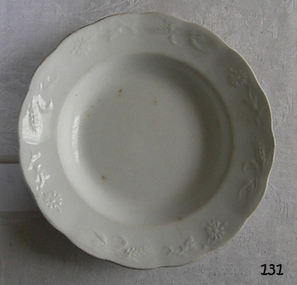
... Bowl white ceramic decorative with floral decoration around lip. ...This allowed potteries to produce fashionable pottery items that were affordable to all social classes of the time. flagstaff hill warrnambool shipwrecked coast flagstaff hill maritime museum flagstaff hill maritime village great ocean road bowl china bowl lion and unicorn crest table ware kitchen ware White Ware Johnson Brothers On base, "Royal Ironside China, Johnson Bros England" & crest of lion and unicorn Bowl white ceramic decorative with floral decoration around lip. ...Johnson Brothers were a British tableware manufacturer and exporter that was noted for its early introduction of "semi-porcelain" tableware. It was among the most successful of the Staffordshire potteries which produced tableware, much of it exported from the 1890s through the 1960s. They were also important manufacturers of large bathroom ceramics. The company was founded in 1883, but from 1968 to 2015 it operated as a part of the Wedgwood Group. However, after the Wedgwood Group was acquired by Fiskars in 2015, the production of Johnson Brothers was discontinued. The company's name derives from the names of the company's founders. The four original "Johnson Brothers" were Alfred, Frederick, Henry, and Robert. Their father married the daughter of a master potter, Alfred Meakin. In 1883, Alfred and Frederick Johnson began production at defunct pottery, known as the Charles Street Works, that they had purchased at a bankruptcy sale in Hanley, Stoke-on-Trent. At first, they specialised in the manufacture of durable earthenware, which they called "White Granite". The success of this venture led to rapid expansion. In 1888, the Rev. Henry Johnson joined them, followed ten years later by a fourth brother, Robert Johnson. Having established a solid reputation producing basic "whiteware", the company developed a product known as "semi-porcelain", a range of pottery that had the characteristics of fine china, but the durability of ironstone ware. This kind of tableware soon became very popular in the United States due to its durability and low cost. In 1889, the Hanley pottery was opened, later the Alexander pottery, and in 1891 the Imperial Works Pottery. In 1896, the Trent Sanitary Works was opened for the production of non-tableware products, and Alfred Johnson left the business to establish his pottery. By 1898, Robert Johnson had relocated to New York City to manage Johnson Brothers' rapid expansion into the North American market. An item that gives a snapshot into the emerging market for tableware that was reasonably priced and serviceable. The company produced "whiteware" but the innervation of the pottery line called semi-porcelain changed the industry. This allowed potteries to produce fashionable pottery items that were affordable to all social classes of the time. Bowl white ceramic decorative with floral decoration around lip. On base, "Royal Ironside China, Johnson Bros England" & crest of lion and unicorn flagstaff hill, warrnambool, shipwrecked coast, flagstaff hill maritime museum, flagstaff hill maritime village, great ocean road, bowl, china bowl, lion and unicorn crest, table ware, kitchen ware, white ware, johnson brothers -
 Flagstaff Hill Maritime Museum and Village
Ceramic - Bowl, 1910 to 1950
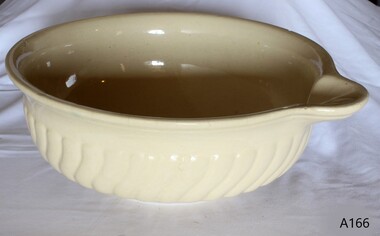
... Stoneware mixing bowl round cream with pouring lip and decorative scallop relief around body...A mass produced unbranded utilitarian item made for domestic use no history or provenance currently available, design indicates item made before 1950 Item at this time cannot be associated with an historical event, person or place, provenance is unknown, item assessed as a collection asset as made prior to 1950. flagstaff hill warrnambool shipwrecked coast flagstaff hill maritime museum flagstaff hill maritime village great ocean road bowl ceramic bowl pouring bowl kitchen ware cooking ware ironstone bowl salt glazed mixing bowl None Stoneware mixing bowl round cream with pouring lip and decorative scallop relief around body Ceramic Bowl ...A mass produced unbranded utilitarian item made for domestic use no history or provenance currently available, design indicates item made before 1950Item at this time cannot be associated with an historical event, person or place, provenance is unknown, item assessed as a collection asset as made prior to 1950.Stoneware mixing bowl round cream with pouring lip and decorative scallop relief around bodyNoneflagstaff hill, warrnambool, shipwrecked coast, flagstaff hill maritime museum, flagstaff hill maritime village, great ocean road, bowl, ceramic bowl, pouring bowl, kitchen ware, cooking ware, ironstone bowl, salt glazed, mixing bowl -
 Flagstaff Hill Maritime Museum and Village
Domestic object - Carafe
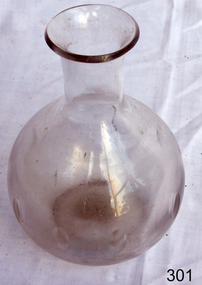
... Carafe with decorative oval shapes cut into the glass around the bowl area....Flagstaff Hill Warrnambool Shipwrecked-coast Flagstaff-Hill Flagstaff-Hill-Maritime-Museum Maritime-Museum Shipwreck-coast Flagstaff-Hill-Maritime-Village carafe vase decorative object flower arrangements Carafe with decorative oval shapes cut into the glass around the bowl area. Domestic object Carafe ...This carafe is an example of domestic objects in just in the early to mid-20th century.Carafe with decorative oval shapes cut into the glass around the bowl area.flagstaff hill, warrnambool, shipwrecked-coast, flagstaff-hill, flagstaff-hill-maritime-museum, maritime-museum, shipwreck-coast, flagstaff-hill-maritime-village, carafe, vase, decorative object, flower arrangements -
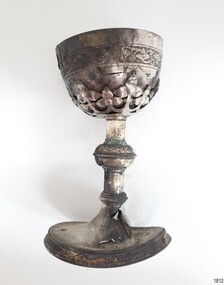 Flagstaff Hill Maritime Museum and Village
Ceremonial object - Chalice, 1855 or earlier
... The chalice has a wide bowl with an outer layer of intricately cut metal on the underside and a ribbon-like border of grapes and grapevine leaves is etched around it. It is supported by a tall stem with a circular knob partway down its length, and the stem is attached to a round base that is hollow underneath. The decorative...The chalice has a wide bowl with an outer layer of intricately cut metal on the underside and a ribbon-like border of grapes and grapevine leaves is etched around it. It is supported by a tall stem with a circular knob partway down its length, and the stem is attached to a round base that is hollow underneath. The decorative ...In 1975, divers from Flagstaff Hill, found an ornate communion set used to celebrate the Eucharist or holy communion by a number of different Christian faiths was recovered from the wreck of the Schomberg. The set comprised a jug, two chalices, a plate and a lid. The lid did not fit any of the other objects and in 1978 a piece of the lid broke off, revealing a glint of gold. As museum staff carefully examined the lid and removed marine growth, they found a diamond ring, which is currently on display in the Great Circle Gallery at Flagstaff Hill. The collection of artefacts from the Schomberg also contains ship fittings and equipment, personal effects, a lithograph, tickets and a photograph from the Schomberg. Most of the artefacts were salvaged from the wreck by Peter Ronald a former director of Flagstaff Hill maritime museum. The Schomberg was a large three-masted full-ship rigged wooden ship built in 1855 by Alexander Hall and Co in Aberdeen, Scotland for James Baines' famous Black Ball Line at £43,103. The vessel was 288 feet (88 meters) in length, with a beam of 45 feet (14 meters), a depth of 29.5 feet (8.99 meters) of 2,284 tons. The mainmast was 210 feet (64 meters) high and she carried 3.3 acres of sail. The vessel was constructed with three skins. One planked fore and aft, and two diagonally planked, fastened together with screw-threaded trunnels (wooden rails). The Schomberg is one of only three clipper wrecks in Victorian waters that operated the England to Australia run. While the other two, Empress of the Sea and Lightning, were built by the famous American shipbuilder, Donald Mac Kay. Schomberg was an attempt to build a faster ship than Mac Kay and a vessel fast enough to break the sailing record to Australia. The Schomberg sailed on her maiden voyage from Liverpool on 6 October 1855, under the command of Captain James Forbes, on its maiden voyage to Australia with a general cargo, jewellery, spirits, machinery, and 2,000 tons of iron rails and equipment intended to build the Melbourne to Geelong Railway and a bridge over the Yarra from Melbourne to Hawthorn. She also carried a cow for fresh milk, pens for fowls and pigs, plus 90,000 gallons of water for washing and drinking. She also carried 17,000 letters and 31,800 newspapers. There were approximately 473 passengers and a crew of 105. It was hoped that Schomberg would make Melbourne in sixty days, setting a record for the voyage, but light winds at the equator dashed those expectations. The ship sighted Moonlight Head in south west Victoria on Christmas Day but through a deadly combination of wind, currents and unmarked sand spits, the vessel gently ran aground on 26 December 1855 on a spit that juts into Newfield Bay, just east of Curdies Inlet, and the present town of Peterborough. Fortunately, the SS Queen was nearby and managed to save all passengers and crew. The steamers Keera and Maitland were dispatched to salvage the passenger's baggage and the more valuable cargo. Other salvage attempts were made, but deteriorating weather made the work impossible, and within two weeks the Schomberg's hull was broken up and the vessel abandoned. The wrecking of the Schomberg caused quite the public stir particularly in light of the fact the vessel was supposed to be, the most perfect clipper ship ever built. Captain Forbes was charged in the Supreme Court under suspicion that he was playing cards with two female passengers below decks when his ship ran aground. Despite a protest meeting, two inquiries and the court proceedings, he was found not guilty and cleared of all charges. In 1975, divers from Flagstaff Hill, including Peter Ronald, found an ornate communion set at the wreck. The set comprised a jug, two chalices, a plate and a lid. The lid did not fit any of the other objects and in 1978 a piece of the lid broke off, revealing a glint of gold. As museum staff carefully examined the lid and removed marine growth, they found a diamond ring, which is currently on display in the Great Circle Gallery at the Flagstaff Hill Maritime museum that also displays ship fittings and equipment, personal effects. Most of the artefacts were salvaged from the wreck by Peter Ronald, former director of Flagstaff Hill.This chalice is significant as an example of an item in common use in the mid-19th century that is still in use today. The Schomberg has historical significance as one of the first luxurious ships built to bring emigrants to Australia to cash in on the gold rush era. And is included on the Victorian Heritage Register (VHR S612). The collection of Schomberg artefacts held at Flagstaff Hill Museum is primarily significant because of the relationship between these recovered items having a high potential to interpret the story of the Schomberg and its foundering during a storm. The shipwreck is of additional historical significance for representing aspects of Victoria’s shipping history and for its association with the first passenger ship, which was designed not only to be the fastest and most luxurious of its day but foundered on its maiden voyage to Australia.Chalice; electroplated silver metal over metal, possibly nickle. The chalice has a wide bowl with an outer layer of intricately cut metal on the underside and a ribbon-like border of grapes and grapevine leaves is etched around it. It is supported by a tall stem with a circular knob partway down its length, and the stem is attached to a round base that is hollow underneath. The decorative pattern around the perimeter of the base is repeated on the knob on the stem. The base also has a pattern of lines around the vertical edge. There is a white sticker attached to the underside of the base. Its inscription is undecipherable. The chalice is part of a Communion set that was recovered from the wreck of the Schomberg. White sticker attached to the base of the chaliceflagstaff hill, flagstaff hill maritime museum and village, warrnambool, maritime museum, maritime village, great ocean road, shipwreck coast, schomberg, 1855, clipper ship, james baines & co, black ball line, luxury ship, emigrant ship, captain forbes, bully forbes, ss queen, peterborough shipwreck, communion set, religious service, communion service, ceremonial service, mass, chalice -
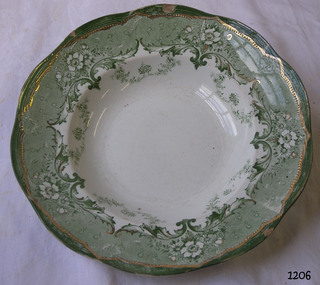 Flagstaff Hill Maritime Museum and Village
Bowl
... Bowl ceramic with decorative floral design around rim in green and gold. ...flagstaff hill warrnambool shipwrecked-coast flagstaff-hill flagstaff-hill-maritime-museum maritime-museum shipwreck-coast flagstaff-hill-maritime-village Bowl ceramic with decorative floral design around rim in green and gold. ...Bowl ceramic with decorative floral design around rim in green and gold. Bowl area is white. "Verona 5 ways England" stamped on back. Has several chips.flagstaff hill, warrnambool, shipwrecked-coast, flagstaff-hill, flagstaff-hill-maritime-museum, maritime-museum, shipwreck-coast, flagstaff-hill-maritime-village -
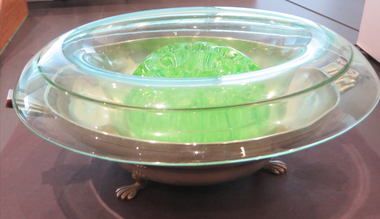 Federation University Historical Collection
Decorative object - Rose Bowl, Silcraft, Ballarat Teachers' College Rose Bowl, 1949
... Ballarat Teachers' College Rose Bowl Decorative object Rose Bowl Silcraft ...This rose bowl was presented to the Ballarat Teachers College by the students of 1949, particularly, Peter Fryar, J McIntosh, J McIntyre and J Holloway as a trophy for the Dimboola Regatta Relay. It was subsequently used to hold '49er' roses for the reunions of the students , the last being their 60th reunion. This three piece vase is made up of 1). a silver bowl with two handles in an art deco style sitting on three feet 2). a green glass vase with a central depression and domed walls which sits into the silver bowl 3). a dome of green glass containing 19 open ended cylinders in which the flowers sit.Engraved into the base - Ballarat Teachers College 1949, Presented to the college by P. Fryar, T. McIntosh, J. Holloway, T. McIntyre, Dimboola Regatta Relay. Stamped into one handle - Silcraft, E.P., N.S, A 1, Melb.rose bowl, vase, silver and glass vase, ballarat teachers college, p fyrar, j mcintosh, j mcintyre, j holloway, peter fryar, ballarat teachers' college, 49ers -
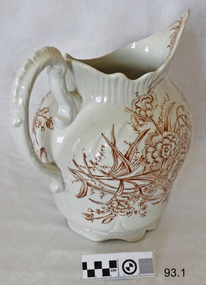 Flagstaff Hill Maritime Museum and Village
Domestic object - Ewer, Early-to-mid 20th century
... The early-to-mid 20th-century ewer set is an example of items used for personal hygiene in the 19th century. flagstaff hill warrnambool flagstaff hill maritime museum maritime museum shipwreck coast flagstaff hill maritime village great ocean road porcelain container toilet container beauty container ceramic decorative object pottery object ewer jug bathing personal grroming toiletry item Ewer or jug, cream ironstone with brown flower spray floral decoration.(Part of 5 piece set containing ewer, bowl ...This object and the set of five items is believed to have been made in or around the Staffordshire area in the United Kingdom. Over 1500 pottery firms have operated in Stoke-on-Trent since the early 1700's - Some lasted only a few years and some for well over 200 years. Some potters built and owned their own works. Many others were tenants in works built by others and a succession of potters occupied the same works. It was also a common practice for a works to be split between two different pottery companies or for a larger manufacturer to let out a smaller section of his works to a potter who would make wares which were not of interest to the pot works owner. Some potters purchased 'blanks' from other manufacturers and put their own decoration on them some items have two back stamps some have no marks at all. This adds to the confusion and frustration of trying to trace details of a particular manufacturer such as the subject item.The early-to-mid 20th-century ewer set is an example of items used for personal hygiene in the 19th century.Ewer or jug, cream ironstone with brown flower spray floral decoration.(Part of 5 piece set containing ewer, bowl, brush vase, soap dish lid and soap dish).flagstaff hill, warrnambool, flagstaff hill maritime museum, maritime museum, shipwreck coast, flagstaff hill maritime village, great ocean road, porcelain container, toilet container, beauty container, ceramic, decorative object, pottery object, ewer, jug, bathing, personal grroming, toiletry item -
 Flagstaff Hill Maritime Museum and Village
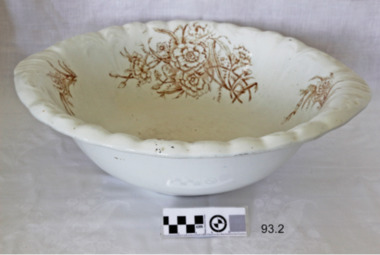
Domestic object - Wash Bowl, Early-to-mid 20th century
... bowl. The early-to-mid 20th-century ewer set is an example of items used for personal hygiene in the 19th century. flagstaff hill warrnambool flagstaff hill maritime museum maritime museum shipwreck coast flagstaff hill maritime village great ocean road porcelain container toilet container beauty container ceramic decorative object pottery object Wash bowl with scalloped edge, cream ironstone with brown flower spray decorations. ...This bowl, and the complete set of five items, is believed to have been made in or around the Staffordshire area in the United Kingdom. Over 1,500 pottery firms have operated in Stoke-on-Trent since the early 1700s - some lasted only a few years, while others endured for well over 200 years. Some potters built and owned their own works. Many others were tenants in works built by others, and a succession of potters occupied the same works. It was also a common practice for a work to be split between two different pottery companies or for a larger manufacturer to subcontract a smaller section of their work to a potter who would make wares that were not of interest to the potter's owner. Some potters purchased 'blanks' from other manufacturers and put their own decoration on them. Some items have two back stamps, some have no marks at all. This adds to the confusion and frustration of trying to trace details of a particular manufacturer, such as the bowl.The early-to-mid 20th-century ewer set is an example of items used for personal hygiene in the 19th century.Wash bowl with scalloped edge, cream ironstone with brown flower spray decorations. It is part of a five-piece set. (ewer, bowl, vase, soap dish and lid)flagstaff hill, warrnambool, flagstaff hill maritime museum, maritime museum, shipwreck coast, flagstaff hill maritime village, great ocean road, porcelain container, toilet container, beauty container, ceramic, decorative object, pottery object -
 Flagstaff Hill Maritime Museum and Village
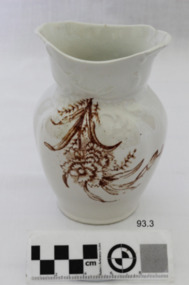
Domestic object - Brush Vase, Early-to-mid 20th century
... decorative object...pottery object...brush vase...bowl...The early-to-mid 20th-century ewer set is an example of items used for personal hygiene in the 19th century. flagstaff hill warrnambool flagstaff hill maritime museum maritime museum shipwreck coast flagstaff hill maritime village great ocean road porcelain container toilet container beauty container ceramic decorative object pottery object brush vase bowl ewer pottery Vase with scalloped edge, cream ironstone, with brown flower spray decorations. ...This brush vase and the complete set of five items are believed to have been made in or around the Staffordshire area in the United Kingdom. Over 1,500 pottery firms have operated in Stoke-on-Trent since the early 1700s - some lasted only a few years, while others endured for well over 200 years. Some potters built and owned their own works. Many others were tenants in works built by others, and a succession of potters occupied the same works. It was also a common practice for a work to be split between two different pottery companies or for a larger manufacturer to subcontract a smaller section of their work to a potter who would make wares that were not of interest to the potter's owner. Some potters purchased 'blanks' from other manufacturers and put their own decoration on them. Some items have two back stamps, some have no marks at all. This adds to the confusion and frustration of trying to trace details of a particular manufacturer, such as the brush vase.The early-to-mid 20th-century ewer set is an example of items used for personal hygiene in the 19th century.Vase with scalloped edge, cream ironstone, with brown flower spray decorations. It is part of a 5-piece set, comprising the vase, ewer, bowl, soap dish and lid.flagstaff hill, warrnambool, flagstaff hill maritime museum, maritime museum, shipwreck coast, flagstaff hill maritime village, great ocean road, porcelain container, toilet container, beauty container, ceramic, decorative object, pottery object, brush vase, bowl, ewer, pottery -
 Flagstaff Hill Maritime Museum and Village
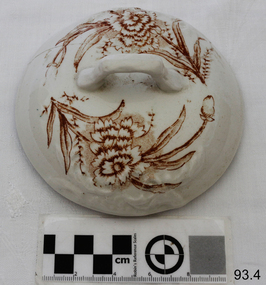
Domestic object - Soap dish lid, Early-to-mid 20th century
... decorative object...pottery object...brush vase...bowl...The early-to-mid 20th-century ewer set is an example of items used for personal hygiene in the 19th century. flagstaff hill warrnambool flagstaff hill maritime museum maritime museum shipwreck coast flagstaff hill maritime village great ocean road porcelain container toilet container beauty container ceramic decorative object pottery object brush vase bowl ewer pottery soap dish lid Soap dish lid, cream ironstone with brown flower spray decorations and a looped handle. ...This object and the complete set of five items is believed to have been made in or around the Staffordshire area in the United Kingdom. Over 1,500 pottery firms have operated in Stoke-on-Trent since the early 1700s - some lasted only a few years, while others endured for well over 200 years. Some potters built and owned their own works. Many others were tenants in works built by others, and a succession of potters occupied the same works. It was also a common practice for a work to be split between two different pottery companies or for a larger manufacturer to let out a smaller section of his works to a potter who would make wares which were not of interest to the potter's works owner. Some potters purchased 'blanks' from other manufacturers and put their own decoration on them. Some items have two back stamps, some have no marks at all. This adds to the confusion and frustration of trying to trace details of a particular manufacturer, such as the soap dish lid.The early-to-mid 20th-century ewer set is an example of items used for personal hygiene in the 19th century.Soap dish lid, cream ironstone with brown flower spray decorations and a looped handle. It is part of a 5-piece set that includes a ewer, bowl, soap dish with its lid, and a brush vase.flagstaff hill, warrnambool, flagstaff hill maritime museum, maritime museum, shipwreck coast, flagstaff hill maritime village, great ocean road, porcelain container, toilet container, beauty container, ceramic, decorative object, pottery object, brush vase, bowl, ewer, pottery, soap dish lid -
 Flagstaff Hill Maritime Museum and Village
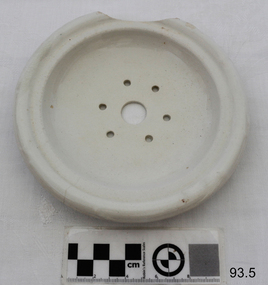
Domestic object - Soap dish base, Early-to-mid 20th century
... decorative object...pottery object...brush vase...bowl...Soap dish base, cream ironstone, part of a 5-piece set comprising ewer, bowl, soap dish with lid, and vase. The pieces have a decorative brown motif....The early-to-mid 20th-century ewer set is an example of items used for personal hygiene in the 19th century. flagstaff hill warrnambool flagstaff hill maritime museum maritime museum shipwreck coast flagstaff hill maritime village great ocean road porcelain container toilet container beauty container ceramic decorative object pottery object brush vase bowl ewer pottery soap dish lid soap dish base personal hygiene bathing washing Soap dish base, cream ironstone, part of a 5-piece set comprising ewer, bowl, soap dish with lid, and vase. ...This object and the complete set of five items is believed to have been made in or around the Staffordshire area in the United Kingdom. Over 1500 pottery firms have operated in Stoke-on-Trent since the early 1700's - Some lasted only a few years and some for well over 200 years. Some potters built and owned their own works. Many others were tenants in works built by others and a succession of potters occupied the same works. It was also a common practice for a works to be split between two different pottery companies or for a larger manufacturer to let out a smaller section of his works to a potter who would make wares which were not of interest to the pot works owner. Some potters purchased 'blanks' from other manufacturers and put their own decoration on them some items have two back stamps some have no marks at all. This adds to the confusion and frustration of trying to trace details of a particular manufacturer such as the subject item.The early-to-mid 20th-century ewer set is an example of items used for personal hygiene in the 19th century.Soap dish base, cream ironstone, part of a 5-piece set comprising ewer, bowl, soap dish with lid, and vase. The pieces have a decorative brown motif.flagstaff hill, warrnambool, flagstaff hill maritime museum, maritime museum, shipwreck coast, flagstaff hill maritime village, great ocean road, porcelain container, toilet container, beauty container, ceramic, decorative object, pottery object, brush vase, bowl, ewer, pottery, soap dish lid, soap dish base, personal hygiene, bathing, washing
