
Showing 29 items matching "diesel train engines"
-
 Orbost & District Historical Society
Photograph - Three colour photogaphs - Bairnsdale to Orbost Railway, 1970s-1980s
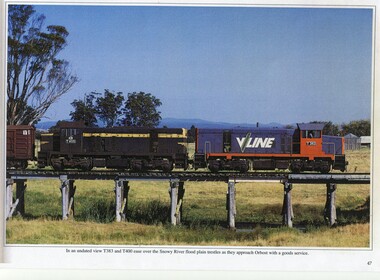
... ...diesel train engines...engines in these photographs are diesel. This 100 km. line was noted for its many wooden trestle bridges, two of which are shown in these photographs. These photographs are significant because they relate to the Bairsdale to Orbost railway line and show different engines which operated on this line in the 1970s. railways Bairnsdale-Orbost Railway line diesel train engines 2697.1 Orbost bound T397 and T393 head a goods service over Deep Creek trestle on the outskirts of Bruthen 17/03/1977 2697.2 From mid 1983, a number of units in the VR Locomotive fleet were equipped with cab-side rear view mirrors, with T386 one oof the early units to be fitted. ...These photographs all relate to the Bairnsdale-Orbost railway line, possibly dating from the 1970s. This line was opened in 1916 and closed in 1987. All of the engines in these photographs are diesel. This 100 km. line was noted for its many wooden trestle bridges, two of which are shown in these photographs.These photographs are significant because they relate to the Bairsdale to Orbost railway line and show different engines which operated on this line in the 1970s.Three coloured photographs, all of which relate to the Bairnsdale - Orbost railway line. 2697.1 Coloured photo of a train on a large wooden railway bridge, houses and farmland in the background. The train is moving from right to left within the photograph. 2697.2 Coloured photo of a train in a bushland setting, moving from right to left within the photo. 2697.3 Coloured photo of two linked train engines and part of a wagon, moving from left to right over a wooden bridge. 2697.1 Orbost bound T397 and T393 head a goods service over Deep Creek trestle on the outskirts of Bruthen 17/03/1977 2697.2 From mid 1983, a number of units in the VR Locomotive fleet were equipped with cab-side rear view mirrors, with T386 one oof the early units to be fitted. In this undated view, mirror equipped T400 and T383 work towards Bairnsdale with a good service from Orbost. 2697.3 In an undated view T383 and T400 ease over the Snowy River flood plain bridge, as they approach Orbost with a goods service.railways, bairnsdale-orbost railway line, diesel train engines -
 Bendigo Historical Society Inc.
Book - SEYMOUR RAILWAY BOOK
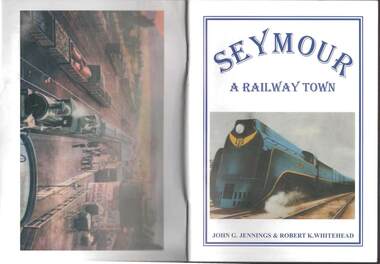
... White coloured cover with blue diesel train engine....White coloured cover with blue diesel train engine. Book SEYMOUR RAILWAY BOOK ...John G Jennings & Robert K Whitehead publication titled ' Seymour A Railway Town' reprint July 2005. Published by Seymour and District Historical Society. Seventy-five pages. White coloured cover with blue diesel train engine.books, technical, railways -
 Glenelg Shire Council Cultural Collection
Photograph - Photograph - Railway Construction, Port of Portland, n.d
... Black and white photo of goods train with diesel engine C510. Battery point in background....Port of Portland Authority Archives Port of Portland Archives Black and white photo of goods train with diesel engine C510. Battery point in background. ...Port of Portland Authority Archivesport of portland archives -
Glenelg Shire Council Cultural Collection
Photograph - Photograph - Spirit of Progress train, n.d
... Black and white photo of the 'Spirit of Progress' train, with the diesel engine 'Edward Henty'....Edward Henty diesel engine Back: 14.4 x 19.9 Black and white photo of the 'Spirit of Progress' train, with the diesel engine 'Edward Henty'. ...Black and white photo of the 'Spirit of Progress' train, with the diesel engine 'Edward Henty'.Back: 14.4 x 19.9edward henty, diesel engine -
 Orbost & District Historical Society
black and white photographs, Snowy River Mail, August 21 1987
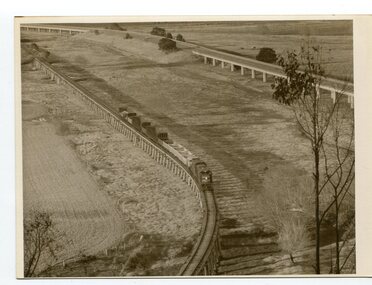
... train to run on the Orbost line. Ron Haywood (L) who 39 years and 6 months ago drove the first diesel loco to Orbost (T366T) presents the last staff to the driver, Bill Buckley, who took the last diesel out." 3104.3 - on back -" as above - 2nd paragraph only 3104.4 - on back - " Ron Hayward who took the first diesel engine from Bairnsdale to Orbost on February 21. 1957 when he was stationed at Orbosst. ...train to run on the Orbost line. Ron Haywood (L) who 39 years and 6 months ago drove the first diesel loco to Orbost (T366T) presents the last staff to the driver, Bill Buckley, who took the last diesel out." 3104.3 - on back -" as above - 2nd paragraph only 3104.4 - on back - " Ron Hayward who took the first diesel engine from Bairnsdale to Orbost on February 21. 1957 when he was stationed at Orbosst. ...These photographs are from the Snowy River Mail newspaper, September 9, 1987. Ron Hayward's family ran a shop in Rupert Street, Orbost.This item is associated with the history of the Orbost-Bairnsdale railway line and therefore reflects the role that the rail line played in the social and economic history of Orbost. The closure of the line was a significant event in Orbost's history.Five black / white photographs related to closure of the Orbost - Bairnsdale Railway Line.3104.1 - on back - "A view from Grandview, Newmerella, of the last train to leave Orbost on Friday August 21, 1987. As the afternoon sun lengthens the shadows on the Snowy River flats, the sun also sets on an era in Far East Gippsland transport as the last train crosses the viaduct." 3104,2 - 0n back - "Ron Hayward passes over the staff during the last crew changeover for the last train to run on the Orbost line. Ron Haywood (L) who 39 years and 6 months ago drove the first diesel loco to Orbost (T366T) presents the last staff to the driver, Bill Buckley, who took the last diesel out." 3104.3 - on back -" as above - 2nd paragraph only 3104.4 - on back - " Ron Hayward who took the first diesel engine from Bairnsdale to Orbost on February 21. 1957 when he was stationed at Orbosst. Last Friday he rode on the last diesel to Orbost after obtaining a special pass from V Line , he also handed over the staff for the last change at Orbost. The last driver was Bill Buckley." 3104.5 - on back - "LAST TRAIN ROLLS INTO ORBOST B/A Friday August 28 1987 For Ron Hayward the last train journey on the Orbost rail line was a sad occasion. Mr Hayward took the first diesel engine from Bairnsdale to Orbost on February 21, 1957, whe he was stationed at Orbost. Last Friday he rode on the last diesel too Orbost after obtaining a special pass from V-Line. He also handed over the staff for the last change at Orbost. The last driver was Bill Buckley. Mr Hayward was an engine driver with nhe railways and transferred to Orbost when steam engines used the line. He left the railways in in 1957 but took up a job with them again in 1968. He said also it was a privilege to have been able to ride on the last train, the occasion was a sad one,"east-gippsland-railway railway-closure hayward-ron buckley-bill orbost-bairnsdale-railway -
 Eltham District Historical Society Inc
Photograph, George Coop, Diesel-electric rail cars in the Railmotor Yard at Spencer Street Station, c.1951
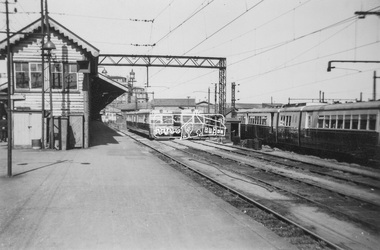
... diesel railcars, or train sets, that were designed to improve the passenger services on Victorian branchlines in Australia. They were practically a bus service on rails. These motors entered service in 1948 with the 102 hp and the 154 hp units. The 102 hp units were built until 1955 and the 153 hp units stopped being built one year before. The 280 hp units were built from 1950-1951. The engine...diesel railcars, or train sets, that were designed to improve the passenger services on Victorian branchlines in Australia. They were practically a bus service on rails. These motors entered service in 1948 with the 102 hp and the 154 hp units. The 102 hp units were built until 1955 and the 153 hp units stopped being built one year before. The 280 hp units were built from 1950-1951. The engine ...This photo was taken the same time as EDHS_04673-36 an A2-class Steam Locomotive 987 sitting on the other side of the platform at Spencer Street Railway Station. 280HP Walker Railmotor Walker Railmotors are diesel railcars, or train sets, that were designed to improve the passenger services on Victorian branchlines in Australia. They were practically a bus service on rails. These motors entered service in 1948 with the 102 hp and the 154 hp units. The 102 hp units were built until 1955 and the 153 hp units stopped being built one year before. The 280 hp units were built from 1950-1951. The engine and drive systems were built by the Walker Railcar Company in Wigan, England, and the bodies were built by Martin & King in Melbourne, Victoria, Australia. The railcars were put together by Victorian Railways. The railcars were, in the end, gradually replaced by a diesel electric railcar from 1978 on. Amazingly these railcars survived to this time, even though they were in direct competition with the bus service. By 1980 no Walker Railmotor cars or trainsets were in service. Very few are preserved. REF: Walker Railmotors, https://locomotive.fandom.com/wiki/Walker_RailmotorsDigital TIFF file Scan of black and white 620 format contact printgeorge coop collection, spencer street railway station, walker railmotor -
 Bendigo Historical Society Inc.
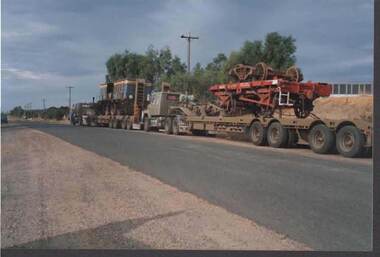
Photograph - RAILWAYS COLLECTION: A MULTI WHEEL SUPER HEAVY TRANSPORT VEHICLES
... PHOTOGRAPH Train Railways Collection - colour photo (part of a series) of an Unspecified number of Multi wheel Super Heavy Transport Vehicles - all of which appear to be transporting Railway related items. The front vehicle appears to be carrying a partly scrapped Locomotive Diesel engine ...Railways Collection - colour photo (part of a series) of an Unspecified number of Multi wheel Super Heavy Transport Vehicles - all of which appear to be transporting Railway related items. The front vehicle appears to be carrying a partly scrapped Locomotive Diesel engine. The second vehicle is carrying a red painted four wheeled Bogie which is carrying a smaller four wheeled Bogie.photograph, train -
 Bendigo Historical Society Inc.
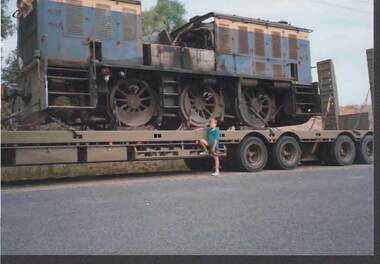
Photograph - RAILWAYS COLLECTION: A MULTI WHEEL SUPER HEAVY TRANSPORT VEHICLES
... PHOTOGRAPH Train diesel Railways Collection - colour photo (part of a series) of an Unspecified number of Multi wheel Super Heavy Transport Vehicles-all of which appear to be transporting Railway related items. The front vehicle appears to be carrying a partly scrapped Locomotive Diesel engine ...Railways Collection - colour photo (part of a series) of an Unspecified number of Multi wheel Super Heavy Transport Vehicles-all of which appear to be transporting Railway related items. The front vehicle appears to be carrying a partly scrapped Locomotive Diesel engine in VR gold and blue colours and a boy is standing on the road beneath the Locomotive.photograph, train, diesel -
 Bendigo Historical Society Inc.
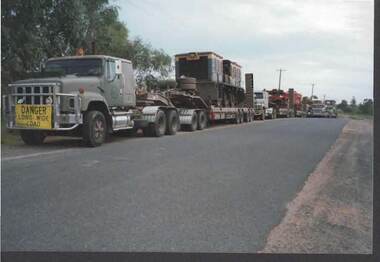
Photograph - RAILWAYS COLLECTION: A MULTI WHEEL SUPER HEAVY TRANSPORT VEHICLES
... PHOTOGRAPH Train diesel Railways Collection - colour photo (part of a series ) of an Unspecified number of Multi wheel Super Heavy Transport Vehicles - all of which appear to be transporting Railway related items. The front vehicle appears to be carrying a partly scrapped Locomotive Diesel engine ...Railways Collection - colour photo (part of a series ) of an Unspecified number of Multi wheel Super Heavy Transport Vehicles - all of which appear to be transporting Railway related items. The front vehicle appears to be carrying a partly scrapped Locomotive Diesel engine there is a sign on the front vehicle - 'Danger Long wide Load.'photograph, train, diesel -
 Bendigo Historical Society Inc.
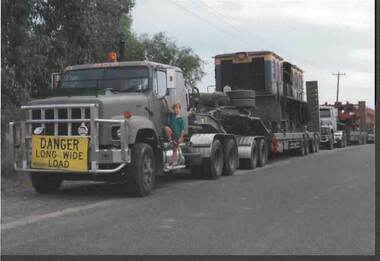
Photograph - RAILWAYS COLLECTION: A MULTI WHEEL SUPER HEAVY TRANSPORT VEHICLE
... PHOTOGRAPH Train diesel Railways Collection - colour photo (part of a series ) of an Unspecified number of Multi wheel Super Heavy Transport Vehicles-all of which appear to be transporting Railway related items. The front vehicle appears to be carrying a partly scrapped Locomotive Diesel engine ...Railways Collection - colour photo (part of a series ) of an Unspecified number of Multi wheel Super Heavy Transport Vehicles-all of which appear to be transporting Railway related items. The front vehicle appears to be carrying a partly scrapped Locomotive Diesel engine there is a sign on the front vehicle - 'Danger Long wide Load' and a boy is standing on the step to the Passenger door.photograph, train, diesel -
 Bendigo Historical Society Inc.
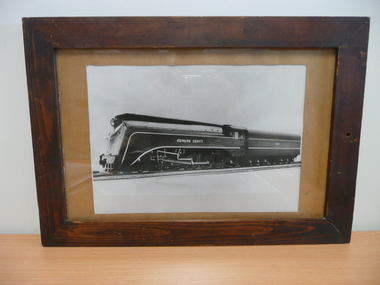
Photograph - DIESEL LOCOMOTIVE EDWARD HENTY
... PHOTOGRAPH Train diesel Black and white photograph of diesel locomotive Edward Henty engine number 302, under glass in a timber frame. ...Black and white photograph of diesel locomotive Edward Henty engine number 302, under glass in a timber frame.photograph, train, diesel -
 Stawell Historical Society Inc
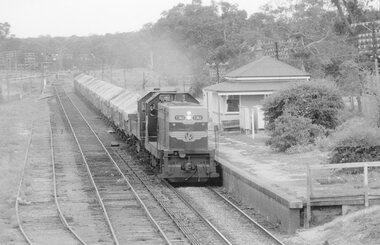
Photograph, Armstrong Railway Station & a Diesel Engine 1981
... Diesel Engine 1981. Stawell Armstrong Railway Station - 1981 1011 is a colour photograph of a freight train number T362 at the Armstrong Railway Station. ...Armstrong Rail Station & Diesel Engine 1981.1011 is a colour photograph of a freight train number T362 at the Armstrong Railway Station. Cream painted building with a red corrugated roof, windows right across the front of the building. 1011.1 is a black and white photograph of the front of the Armstrong railway Station. Shosw the station building, small sheds, toilets, tank. and seatArmstrong Railway Station - 1981stawell -
 Melton City Libraries
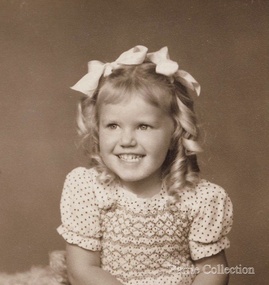
Photograph, Wendy Barrie, Unknown
... On other occasions the Motor Train was replaced with a diesel engine with carriages, it was also required to stop and the driver had to be notified in advance. ...On other occasions the Motor Train was replaced with a diesel engine with carriages, it was also required to stop and the driver had to be notified in advance. ...Eldest daughter of Edna and Bon Barrie, born on 03 November 1943 in Melbourne, Victoria, Memoirs of Wendy Barrie, recalling the early formative years of life in Melton: In 1949 I started school at Melton State School no 430 and was driven the 2½ miles to there by my parents at first. Later we walked home in the afternoons or were picked up by car as we made our way home along the Western Highway. In 1956 I went to Bacchus Marsh High School. There were 4 students in grade 6 and 3 of us went to the High School. The students from Melton, Melton South and Toolern Vale State Schools went by bus to Bacchus Marsh High School as far a fifth form. My parents drove me to the pick up point and during the five years of travel to High School. The bus travelled via Toolern Vale and later went through Exford and through Parwan. On the return journey in the afternoon the bus went in the reverse direction. The bridge at Exford was an old narrow wooden one, and the students had to get off the bus and walk across, with the driver crossing in the empty bus for safety reasons. There was a travelling allowance paid to parents and it was estimated from the distance the crow flies, a straight line. We lived a Ferris Lane, just where the Harness Racing entrance is now situated about 2 ½ miles by road to school too close to qualify for the subsidy. While at State School Melton we would walk home in a group with the Nixon and Gillespie children, along the main road over the bridge near the Shire Offices and down a hill. I was being dinked on Joyce Gillespie’s bike while holding onto the seat, toppled off the bike striking my chin and teeth on the bitumen and cracking my jaw. I was about 9 years old and stayed a couple of days in the Quamby Hospital in Bacchus Marsh, it seemed like and eternity at the time and quite traumatic being separated from my family. I can remember contemplating how I could get out of the window and run away but realised it was too far to walk home. Often we would cut across the Common on our way home from school picking up stray golf balls and collecting them from the creek when it dried out. We were warned about not accepting lifts from strangers passing along the Melbourne/ Ballarat Road. The only danger we faced was being swooped by the magpies particularly on the open ground on the Common. We were also fairly cautious when the Gypsies camped on the Common in the area just about opposite the small reservoir. “Mum” grandma Myers loved to have us call in on our way home, and usually would cut a slice of Jongebloed’s bread and spread it with home made butter. Sometimes we waited there until we were collected by car, usually driven by our mother. Margaret Nixon and Joyce Gillespie were a few grades ahead of me and Barbara Nixon was born just two months earlier than me. Our mothers were great friends for over 6o years, born in the same month three years apart. They lived within a few days of the same age as each other at the time their deaths. Dad and George Nixon attended Melton school at the same time. Sarah nee Hornbuckle Nixon and my grandfather Frederick Myers Snr were at school together at the same in the 1880s. The Nixon family lived in Keilor Road just past the Toolern Creek near the turnoff. Tom and Ann Collins lived on the southern side of the Western highway and Keilor road intersection. Jim and Ruby Gillespie’s house was further long Keilor road on the right. They backed onto the Myers who lived on the north side of Western Highway east of Myers Gully (Ryans Creek). The Bridge over the Toolern Creek as very narrow and as truck traffic increased there were accidents. One truck took out the side railing and plunged upside down into the bank and into the shallow water. Another fatal accident happened between a car and a truck right in front of the Myers house. Grandfather Fred had been a bike rider all his life, as far as the Riverina in his younger years, wryly made the comment about the drivers the speeding along the Ballarat Road were setting out to kill themselves. The road was busy particularly after the Races at Ballarat when the crowds were hurrying home to Melbourne. Train travel had changed very little from the time my mothers generation to mine. The timetable meant the usual rush to Melton South by bike in her case and if she was running late the train pulled up on the crossing. I was driven to the Station from home past Keith and Mary Gillespie’s house near the Ferris Road rail crossing to Bridge road to Melton South for the 7.32 train. While attending Sunshine High School in 1961 I would meet up with three other students, two of whom I knew from Bacchus Marsh High School days. We usually got into the same compartment on the train, it was a typical country train with a corridor along the side and compartments with a door, roof racks and sometimes heated metal containers for the feet in the winter. Some of the trains came through from Horsham and Ballarat, and the Overland from Adelaide passed through in the evening, we could hear it in the distance from the Ferris Lane home. The carriages had 1st and economy class compartments showing photographs of county scenes and holiday destinations. The engine was the large A class diesel. They are still running to Bacchus Marsh 50 years later, due to the need for the greatly increased number of commuters travelling to work in the city. Sometimes the carriages were pull by a Steam engine, these were a problem in the summer time because the sparks caused fires along the train lines and then quickly spread into the dry grass, crops and stubble. The Motor Train left Spencer Street at 4.23 pm and was the best train for me to catch. Ferris Road was a designated stop and train pulled up on the road crossing. It had steps at the door and rungs to hold while alighting to the ground. The ballast along the tracks was rough and uneven and awkward to land on. The train was painted blue and yellow with the letters VR pained on the front. This saved may parents the afternoon trip to collect me from the Station. On the walk home on the gravel road I would pass Uncle Tom and Aunty May’s house before reaching home. Melva Gillespie was studying at Sunshine Technical School and we sometimes both got off the train at the same time. On other occasions the Motor Train was replaced with a diesel engine with carriages, it was also required to stop and the driver had to be notified in advance. This meant getting into the guards van a Rockbank. It was more difficult alighting from the carriage as the gap was greater and more precarious to swing out and land on the ground. A few times in my last year of study at Melbourne Teachers College in Grattan Street Carlton. I managed to catch the 2.30 pm train to Serviceton, it was express to Melton and was very quick trip. The last train, was the 5.25 pm diesel to Ballarat and I usually caught this train to Melton South Station. On one occasion after being held up on the tram in Bourke street I had to make a mad dash to the platform chasing the train as it was just moving off and yelling to the guard, fortunately I was noticed and the train ground to halt. I scrambled into the end door and took most of the journey home to recover. After the last year at High School I continued to travel on the train, 2 years to Prahran Technical School changing at North Melbourne. There were a lot school children travelling to private schools and some at the primary level and mainly from Bacchus Marsh. Rockbank children also travelled by train from the beginning of their high school years, quite a few went to Sunshine High School. During my third year of teacher training I travelled to Flinders Street to RMIT for ceramics classes and Grattan St Teachers College located in the grounds of Melbourne University. There were many teachers being trained at the Secondary Teachers College due to the baby bulge creating a great shortage of teachers. Sunshine High School was very well represented amongst the different courses in Primary, Secondary and Art and Crafts. I attended Melbourne University lectures, studying a Fine Art subject. Bernard Smith was the most notable of the lecturers. he replaced Professor Joseph Bourke who had taken leave for the years. In 1962 he published the art book “Australian Painting”. The secondary art and craft student teachers from the College were in the majority, taking this subject and were well regarded due to their practical art and craft methods and their teaching round experience. In December 1964 I graduated as a Trained Secondary Teacher – Art and Crafts. The graduating ceremony was held at Wilson Hall. I received my appointment to work at Maryborough High School. Uncle Max and Aunty Rosemary Myers arranged my accommodation. Uncle Max was a teacher at the Maryborough Technical School fat the time. The appointment was suddenly changed when just before the school year was about to start when I received notification that I was now required to move to Warracknabeal High School. I was subject to a bond for the three years of training and three years of teaching and was under an obligation to comply with the directive of the Education Department. My father stood as guarantor when I was accepted as student at the Melbourne Teachers’ College, thus enabling me to receive my teacher training, and a 5 pounds a week allowance for expenses. After teaching for two years at Warracknabeal High School I was fortunate enough the gain a transfer to Sunshine West High School, returning to live at home in Melton and travelling by car to work with a fellow colleague, Jock Smith who lived at Station road Melton. I completed bond obligation and resigned at the end of the year. The employment regulations at that time did not allow the option of leave of absence for, indefinite overseas travel. I returned to Australia in October 1969. Visiting Arthur Hart the Principal of Sunshine High School he arranged with the Education Department for my re-employment at Sunshine High School until the end of the year. In 1970 I was transferred, and returned to Sunshine West High School where I worked for the next three years. In January 1968 I sailed on the “Oriana” to South Hampton with two teaching friends from Warracknabeal High School on a travelling and working holiday. Doreen Kiely, a former Bacchus Marsh High student and fellow train traveller from Bacchus Marsh, was already working in London, had arranged our accommodation at the London Travellers Club Hotel, Braham Gardens, Earls Court SW5. We based our stay at this address in London and travelled around Scotland, Ireland and England. In the summer we took a four month trip around the Continent and the Mediterranean. I registered with The Royal Borough Of Kingston Upon Thames as a Supply teacher, and worked at Chessington School form autumn to spring the following year and living with Mrs Rose Gillies at Kinross Avenue, Worcester Park, Surrey. In the spring of 1969 visiting Norway, Sweden and Finland joining an organised camping group to the Artic Circle, entered Russia at Leningrad (St Petersburg) Moscow, Minsk, to Poland and Czechoslovakia. In August returning to Worcester Park for the flight to Montreal to stay with cousin Lynette and husband Jurgen. A side trip was taken to Toronto, Niagara Falls and New York. The flight home from Montreal to Melbourne took 52 hours. A ½ day break in Vancouver before boarding the Qantas boeing 707 via San Francisco, Honolulu, Fiji, Sydney to Melbourne. Around the world in 21 months. Photographs of Wendy local identities -
 Melton City Libraries
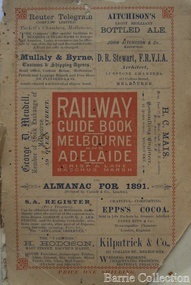
Book, 'Railway Guide Book Melbourne and Adelaide, 1891
... On other occasions the Motor Train was replaced with a diesel engine with carriages, it was also required to stop and the driver had to be notified in advance. ...On other occasions the Motor Train was replaced with a diesel engine with carriages, it was also required to stop and the driver had to be notified in advance. ...Memories of Train Travel compiled by Wendy Barrie 4/09/2013 Train travel had changed very little from the time my mothers generation to mine. The timetable meant the usual rush to Melton South by bike in her case and if she was running late the train pulled up on the crossing. I was driven to the Station from home past Keith and Mary Gillespie’s house near the Ferris Road rail crossing to Bridge road to Melton South for the 7.32 train. While attending Sunshine High School in 1961 I would meet up with three other students, two of whom I knew from Bacchus Marsh High School days. We usually got into the same compartment on the train, it was a typical country train with a corridor along the side and compartments with a door, roof racks and sometimes heated metal containers for the feet in the winter. Some of the trains came through from Horsham and Ballarat, and the Overland from Adelaide passed through in the evening, we could hear it in the distance from the Ferris Lane home. The carriages had 1st and economy class compartments showing photographs of county scenes and holiday destinations. The engine was the large A class diesel. They are still running to Bacchus Marsh 50 years later, due to the need for the greatly increased number of commuters travelling to work in the city. Sometimes the carriages were pull by a Steam engine, these were a problem in the summer time because the sparks caused fires along the train lines and then quickly spread into the dry grass, crops and stubble. The Motor Train left Spencer Street at 4.23 pm and was the best train for me to catch. Ferris Road was a designated stop and train pulled up on the road crossing. It had steps at the door and rungs to hold while alighting to the ground. The ballast along the tracks was rough and uneven and awkward to land on. The train was painted blue and yellow with the letters VR pained on the front. This saved may parents the afternoon trip to collect me from the Station. On the walk home on the gravel road I would pass Uncle Tom and Aunty May’s house before reaching home. Melva Gillespie was studying at Sunshine Technical School and we sometimes both got off the train at the same time. On other occasions the Motor Train was replaced with a diesel engine with carriages, it was also required to stop and the driver had to be notified in advance. This meant getting into the guards van a Rockbank. It was more difficult alighting from the carriage as the gap was greater and more precarious to swing out and land on the ground. A few times in my last year of study at Melbourne Teachers College in Grattan Street Carlton. I managed to catch the 2.30 pm train to Serviceton, it was express to Melton and was very quick trip. The last train, was the 5.25 pm diesel to Ballarat and I usually caught this train to Melton South Station. On one occasion after being held up on the tram in Bourke street I had to make a mad dash to the platform chasing the train as it was just moving off and yelling to the guard, fortunately I was noticed and the train ground to halt. I scrambled into the end door and took most of the journey home to recover. After the last year at High School I continued to travel on the train, 2 years to Prahran Technical School changing at North Melbourne. There were a lot school children travelling to private schools and some at the primary level and mainly from Bacchus Marsh. Rockbank children also travelled by train from the beginning of their high school years, quite a few went to Sunshine High School. Book provided a timetable and information about the stations the train travels to from Melbourne to Adelaide. transport -
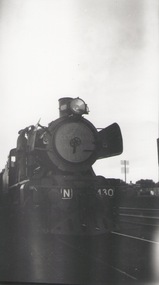 Sunbury Family History and Heritage Society Inc.
Photograph, Jubilee train 1951, c 1951
... When the photograph was taken the train was steaming into Sunbury where it stopped to allow people to board it and look at the exhibition Sunbury Station was an important stop for steam locomotives travelling on the Bendigo line. Even after diesel engines ...The 'N' Class steam locomotives were built by Victorian Railways to be used on branch lines throughout the state's regional areas. A total of 73 of these locomotives were built between 1925 and 1951. The locomotive in the photograph carried the Jubilee Train that travelled throughout Victoria in 1951 and had a display featuring 125 years of European settlement in Victoria. When the photograph was taken the train was steaming into Sunbury where it stopped to allow people to board it and look at the exhibitionSunbury Station was an important stop for steam locomotives travelling on the Bendigo line. Even after diesel engines were used to pull the trains in the 1950s, steam locomotives were also used until the early 1990s.A non-digital black and white photograph of a 'N'class steam engine on railway tracks.steam locomotives, jubilee train, sunbury -
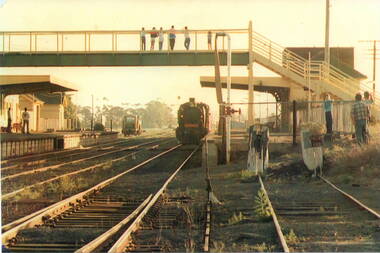 Sunbury Family History and Heritage Society Inc.
Photograph, 1970s
... The steam train has arrived at Number 2 platform at Sunbury Railway Station. Before diesel engines were used on the regional lines, steam trains were widely used. ...The steam train has arrived at Number 2 platform at Sunbury Railway Station. Before diesel engines were used on the regional lines, steam trains were widely used. ...The steam train has arrived at Number 2 platform at Sunbury Railway Station. Before diesel engines were used on the regional lines, steam trains were widely used. The pedestrian bridge spanning the railway line was replaced with a larger one and included a ramp, to allow for disabled people's in 2001. The water tank which supplied water for the steam engines is visible on the platform.The Sunbury line leads on to Bendigo and Echuca and is one of Victoria's important regional rail services.A non-digital coloured photograph of a steam train arriving at a station with six people on the pedestrian bridge looking at the train and five other bystanders on the two platforms.steam locomotives, sunbury station, bendigo rail line -
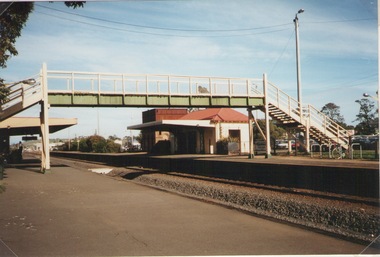 Sunbury Family History and Heritage Society Inc.
Photograph, Elwyn Davis, Pedestrian Bridge, C1990s
... The water tank beyond the station building was used to refill the engines with water when steam engines were used. Diesel driven V Line trains now convey commuters from the regional towns along the Bendigo region to Melbourne....The water tank beyond the station building was used to refill the engines with water when steam engines were used. Diesel driven V Line trains now convey commuters from the regional towns along the Bendigo region to Melbourne. ...The wooden pedestrian bridge spanned the rail tracks at Sunbury Railway Station and were replaced with a more modern bridge and ramp when upgrades were done at the station and along the Bendigo line in the late 1990s and early 2000s. The water tank beyond the station building was used to refill the engines with water when steam engines were used. Diesel driven V Line trains now convey commuters from the regional towns along the Bendigo region to Melbourne.The Bendigo Line was the first government rail line to open and it reached Sunbury in 1859. It was extended to Bendigo and opened in 1861.A non-digital coloured photograph of a wooden pedestrian bridge spanning rail tracks with a wooden station building and former water tower on the station platform. rail bridges, bendigo rail line, sunbury station, water towers, railways -
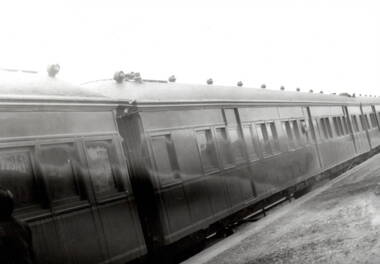 Sunbury Family History and Heritage Society Inc.
Photograph
... The train pulled into Sunbury Station were the type of red carriages that steam trains pulled on many regional rail tracks throughout Victoria. There were times also when the diesel engines pulled these carriages before the modern V Line trains were used to transport people to the regional areas. ...The train pulled into Sunbury Station were the type of red carriages that steam trains pulled on many regional rail tracks throughout Victoria. There were times also when the diesel engines pulled these carriages before the modern V Line trains were used to transport people to the regional areas. ...The train pulled into Sunbury Station were the type of red carriages that steam trains pulled on many regional rail tracks throughout Victoria. There were times also when the diesel engines pulled these carriages before the modern V Line trains were used to transport people to the regional areas. A non-digital black and white photograph of 7 visible old train carriages pulled into a railway platform. railways, train carriages, sunbury station -
 Sunbury Family History and Heritage Society Inc.
Photograph
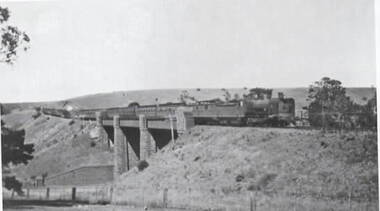
... The two steam trains are hauling the carriages over the viaduct that spans Jacksons Creek, situated north of Sunbury. From 1859 until the introduction of diesel engines, steam trains were in regular use on the Sunbury - Bendigo line carrying passengers and goods to and from Melbourne. ...The two steam trains are hauling the carriages over the viaduct that spans Jacksons Creek, situated north of Sunbury. From 1859 until the introduction of diesel engines, steam trains were in regular use on the Sunbury - Bendigo line carrying passengers and goods to and from Melbourne.A black and white non-digital photograph of two large steam trains hauling passenger carriages over a three arched bridge. The surrounding countryside is made up of bare hills.railways, railway viaduct, sunbury, jacksons creek -
 Sunbury Family History and Heritage Society Inc.
Photograph, Rosa McCall, Sunbury Station, November 2012
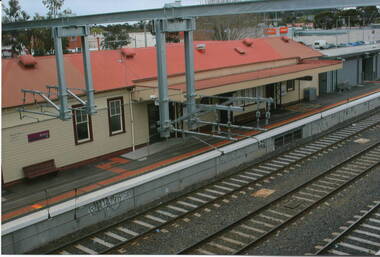
... Prior to 201to commute to and from Melbourne, Sunbury residents relied on steam trains which commenced in 1859. From the 1960s diesel driven engines gradually replaced the steam trains. ...Renovations and extensions were carried out at Sunbury Railway Station from 2010 to 2012 accommodate the electrification of the rail service from Watergardens to Sunbury. The grey buildings adjacent to the wooden building are the extensions on Platform 1. Both Platforms 1 and 2 were raised and extended to accommodate the electric trains. The old building on Platform 2 was replaced with a newer one. The smaller wooden bridge linking the two platforms was replaced with a higher one which had ramps as well as stairs. In November 2012, electric trains began terminating at Sunbury.Prior to 201to commute to and from Melbourne, Sunbury residents relied on steam trains which commenced in 1859. From the 1960s diesel driven engines gradually replaced the steam trains.A coloured photograph of weatherboard building with a red corrugated roof of a railway station along with the platform and some of the rail tracks and overhead wires.sunbury rail crossing, metro train service, sunbury -
 Whitehorse Historical Society Inc.
Newspaper - Article, Steaming ahead for a hobby, 12/08/1997
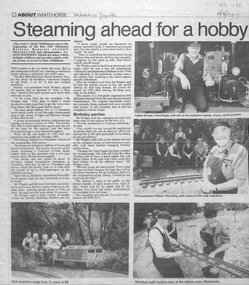
... miniature railways wrigley fred box hill miniature railway society steam trains standing robert diesel engines Newspaper cutting from the Whitehorse Gazette about the beginnings and current activities of the Box Hill Miniature Railway Society. ...Newspaper cutting from the Whitehorse Gazette about the beginnings and current activities of the Box Hill Miniature Railway Society.miniature railways, wrigley, fred, box hill miniature railway society, steam trains, standing, robert, diesel engines -
 Wodonga & District Historical Society Inc
Manual - Victorian Railways Loads of Goods Trains 1926, VLine
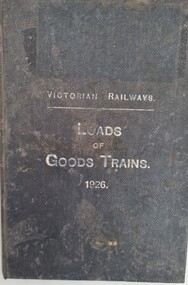
... diesel enginemen employed by Vline. It was donated by a retired engine driver from Wodonga. Vline safety Vline training Railways Victoria This training module was available to enginemen who had completed Modules 1 to 5 (1983 Scheme). The manual contained fault finding checklists and standard procedures to be carried out if faults occured. Every driver was required to be conversant with and follow the instructions. Enginemen issued with this manual had to carry it with them at all times when in charge of a diesel electric locomotive. On Cover L" 185 pp bg Victorian Railways Loads of Goods Trains ...This training module was available to enginemen who had completed Modules 1 to 5 (1983 Scheme). The manual contained fault finding checklists and standard procedures to be carried out if faults occured. Every driver was required to be conversant with and follow the instructions. Enginemen issued with this manual had to carry it with them at all times when in charge of a diesel electric locomotive.185 pp bg fictionThis training module was available to enginemen who had completed Modules 1 to 5 (1983 Scheme). The manual contained fault finding checklists and standard procedures to be carried out if faults occured. Every driver was required to be conversant with and follow the instructions. Enginemen issued with this manual had to carry it with them at all times when in charge of a diesel electric locomotive. vline safety, vline training, railways victoria -
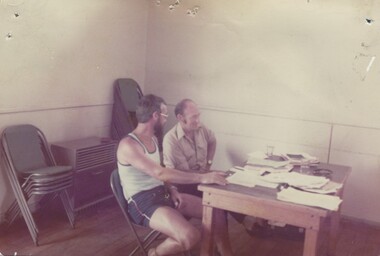 Wodonga & District Historical Society Inc
Photograph - Fred Rochow Railways Collection - David Naldrett and Rex McDonnell, 1982
... diesel trains, locomotives and even the modern XPT train. He worked throughout Victoria at different stages of his career, with his final working years focused on the northeast of Victoria and the Albury to Melbourne line. After his retirement, Fred continued to share his love of steam miniature trains with the community. The first railway union in the world was created in Melbourne in 1861 when twenty locomotive drivers banded together to form the Locomotive Engine...diesel trains, locomotives and even the modern XPT train. He worked throughout Victoria at different stages of his career, with his final working years focused on the northeast of Victoria and the Albury to Melbourne line. After his retirement, Fred continued to share his love of steam miniature trains with the community. The first railway union in the world was created in Melbourne in 1861 when twenty locomotive drivers banded together to form the Locomotive Engine ...The Fred Rochow Railways Collection incorporates photos related to the operation of the Wodonga Railway Station including different types of trains and railways staff C. 1930 – 1990. It was donated to the Wodonga Historical Society by Fred Rochow, a railwayman who spent many years based in Wodonga. He joined the Victorian Railways on 17th June l947 and retired in 1988. For some time, he was a member of the Australian Federated Union of Locomotive Enginemen and served a term as a member of the Trades Hall Council. He had an extensive knowledge of the struggles that took place to achieve better conditions for railway workers. Fred worked for many years as a fireman and then worked his way up the ranks to driver, experiencing many changes from the days of steam locomotives through to diesel trains, locomotives and even the modern XPT train. He worked throughout Victoria at different stages of his career, with his final working years focused on the northeast of Victoria and the Albury to Melbourne line. After his retirement, Fred continued to share his love of steam miniature trains with the community. The first railway union in the world was created in Melbourne in 1861 when twenty locomotive drivers banded together to form the Locomotive Engine Drivers Association of Victoria. The forerunner to the A.F.U.L.E., the Association continues today and is the oldest continuous railway union in the world.This collection has local and statewide significance as it captures images of trains, locomotives and personnel who operated the railway services in Wodonga and throughout Northeast Victoria. The railways played a critical role in opening up Victoria and connecting Australia for trade, business, social communication and transport.A photo of David Naldrett, AFULE Chairman and Rex McDonnell, Branch Secretary, conducting a meeting in Wodonga in 1982. AFULE is the Australian Federated Union of Locomotive Employees.railways wodonga, fred rochow, afule, railways workers unions -
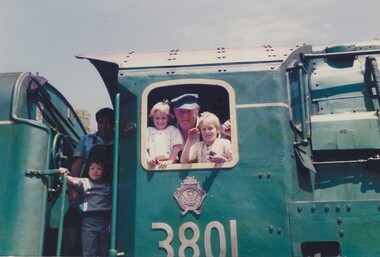 Wodonga & District Historical Society Inc
Photograph - Fred Rochow Railways Collection - Driver Fred Rochow with his grandchildren
... diesel trains, locomotives and even the modern XPT train. He worked throughout Victoria at different stages of his career, with his final working years focused on the northeast of Victoria and the Albury to Melbourne line. After his retirement, Fred continued to share his love of steam miniature trains with the community. Locomotive 3801 - The iconic streamlined engine...diesel trains, locomotives and even the modern XPT train. He worked throughout Victoria at different stages of his career, with his final working years focused on the northeast of Victoria and the Albury to Melbourne line. After his retirement, Fred continued to share his love of steam miniature trains with the community. Locomotive 3801 - The iconic streamlined engine ...The Fred Rochow Railways Collection incorporates photos related to the operation of the Wodonga Railway Station including different types of trains and railways staff C. 1930 – 1990. It was donated to the Wodonga Historical Society by Fred Rochow, a railwayman who spent many years based in Wodonga. He joined the Victorian Railways on 17th June l947 and retired in 1988. For some time, he was a member of the Australian Federated Union of Locomotive Enginemen and served a term as a member of the Trades Hall Council. He had an extensive knowledge of the struggles that took place to achieve better conditions for railway workers. Fred worked for many years as a fireman and then worked his way up the ranks to driver, experiencing many changes from the days of steam locomotives through to diesel trains, locomotives and even the modern XPT train. He worked throughout Victoria at different stages of his career, with his final working years focused on the northeast of Victoria and the Albury to Melbourne line. After his retirement, Fred continued to share his love of steam miniature trains with the community. Locomotive 3801 - The iconic streamlined engine was built by Clyde Engineering in Granville, entering service in January 1943 and leading a distinguished career as a crack express locomotive with the New South Wales Government Railways (NSWGR). It was withdrawn from regular service in October 1965. One of its most famous achievements was setting a record (2:01:51) for non-stop running between Sydney and Newcastle on 28 June 1964 which stood for a quarter of a century. This collection has local and statewide significance as it captures images of trains, locomotives and personnel who operated the railway services in Wodonga and throughout Northeast Victoria. The railways played a critical role in opening up Victoria and connecting Australia for trade, business, social communication and transport.Train driver Fred Rochow and driver David Brown, along with 3 grandchildren on the restored Locomotive 3801 during one of its visits to Albury. On the side of the locomotive, the insignia of Clyde Engineering above the number 3801fred rochow, david brown engine driver, steam locomotives australia, locomotive 3801 -
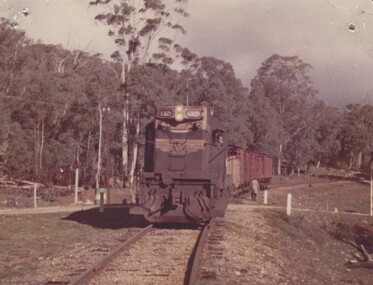 Wodonga & District Historical Society Inc
Photograph - Fred Rochow Railways Collection - Engine Instructor Geoff Williams
... Fred Rochow Victorian Railways Wodonga Locomotive 1329 At top of train between headlights "T329" In centre Victoria Railways logo "VR" Engine Instructor Geoff Williams walking beside Locomotive 1329 to lift the hand brakes. The T class were a class of diesel ...The Fred Rochow Railways Collection incorporates photos related to the operation of the Wodonga Railway Station including different types of trains and railways staff C. 1930 – 1990. It was donated to the Wodonga Historical Society by Fred Rochow, a railwayman who spent many years based in Wodonga. He joined the Victorian Railways on 17th June l947 and retired in 1988. For some time, he was a member of the Australian Federated Union of Locomotive Enginemen and served a term as a member of the Trades Hall Council. He had an extensive knowledge of the struggles that took place to achieve better conditions for railway workers. Fred worked for many years as a fireman and then worked his way up the ranks to driver, experiencing many changes from the days of steam locomotives through to diesel trains, locomotives and even the modern XPT train. He worked throughout Victoria at different stages of his career, with his final working years focused on the northeast of Victoria and the Albury to Melbourne line. After his retirement, Fred continued to share his love of steam miniature trains with the community.This collection has local and statewide significance as it captures images of trains, locomotives and personnel who operated the railway services in Wodonga and throughout Northeast Victoria. The railways played a critical role in opening up Victoria and connecting Australia for trade, business, social communication and transport.Engine Instructor Geoff Williams walking beside Locomotive 1329 to lift the hand brakes. The T class were a class of diesel locomotives built by Clyde Engineering, Granville, NSW for the Victorian Railways between 1955 and 1968. Locomotive T329 was part of the first order completed and entered service in June 1956. At that time, they became the most numerous diesel loco in Victoria. In 1984, the 13 first series T class locomotives were sent back to Clyde Engineering Plant at Somerton in Victoria for a complete rebuild after which they became the P class numbered P11 to P23. This included locomotive T329 which became Locomotive P12. The P Class have proven to be a reliable and dependable class, seeing service across the state in both passenger and freight duties. They often operated in push-pull mode, with a locomotive at each end of the train. The P class locomotives ceased being used for regular passenger operations in November 2012. Although locomotive P12 (T329) is primarily in storage it is still operational and can be hired for special events and as recently as 2017 was also used as an infrastructure maintenance train.At top of train between headlights "T329" In centre Victoria Railways logo "VR"fred rochow, victorian railways wodonga, locomotive 1329 -
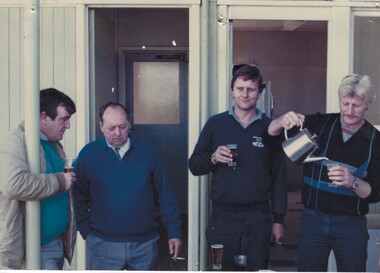 Wodonga & District Historical Society Inc
Photograph - Fred Rochow Railways Collection - Group of 4 men in Wodonga
... diesel trains, locomotives and even the modern XPT train. He worked throughout Victoria at different stages of his career, with his final working years focused on the northeast of Victoria and the Albury to Melbourne line. After his retirement, Fred continued to share his love of steam miniature trains with the community The first railway union in the world was created in Melbourne in 1861 when twenty locomotive drivers banded together to form the Locomotive Engine Drivers Association of Victoria. ...diesel trains, locomotives and even the modern XPT train. He worked throughout Victoria at different stages of his career, with his final working years focused on the northeast of Victoria and the Albury to Melbourne line. After his retirement, Fred continued to share his love of steam miniature trains with the community The first railway union in the world was created in Melbourne in 1861 when twenty locomotive drivers banded together to form the Locomotive Engine Drivers Association of Victoria. ...The Fred Rochow Railways Collection incorporates photos related to the operation of the Wodonga Railway Station including different types of trains and railways staff C. 1930 – 1990. It was donated to the Wodonga Historical Society by Fred Rochow, a railwayman who spent many years based in Wodonga. He joined the Victorian Railways on 17th June l947 and retired in 1988. For some time, he was a member of the Australian Federated Union of Locomotive Enginemen and served a term as a member of the Trades Hall Council. He had an extensive knowledge of the struggles that took place to achieve better conditions for railway workers. Fred worked for many years as a fireman and then worked his way up the ranks to driver, experiencing many changes from the days of steam locomotives through to diesel trains, locomotives and even the modern XPT train. He worked throughout Victoria at different stages of his career, with his final working years focused on the northeast of Victoria and the Albury to Melbourne line. After his retirement, Fred continued to share his love of steam miniature trains with the community The first railway union in the world was created in Melbourne in 1861 when twenty locomotive drivers banded together to form the Locomotive Engine Drivers Association of Victoria. The forerunner to the A.F.U.L.E., the Association continues today and is the oldest continuous railway union in the world. A.R.U. - The Australian Railways Union formed in September 1920 with the amalgamation of the Queensland Railways Union, the New South Wales Amalgamated Railway and Tramway Service Association, the Victorian Railway Union, the Railway and Tramway Employees Association of South Australia and the Tasmanian Railway Union. It was the first Australian all-grades organisation of railway workers and was federally registered on 8 February 1921. In 1993 the ARU merged with other unions to form the Rail Tram & Bus Industry Union.This collection has local and statewide significance as it captures images of trains, locomotives and personnel who operated the railway services in Wodonga and throughout Northeast Victoria. The railways played a critical role in opening up Victoria and connecting Australia for trade, business, social communication and transport.A group 4 men in Wodonga. Possibly at branch union meeting.Left to right: Driver R. Heathcote AFULE Branch Secretary; Guard J. Young, ARU Branch Secretary; Driver S. Withers; P. Murnane.fred rochow, victorian railways wodonga, railway employees wodonga, railway trade unions -
 Wodonga & District Historical Society Inc
Photograph - Fred Rochow Railways Collection - Members at A.F.U.L.E meeting in Wodonga
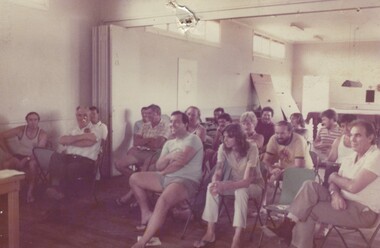
... diesel trains, locomotives and even the modern XPT train. He worked throughout Victoria at different stages of his career, with his final working years focused on the northeast of Victoria and the Albury to Melbourne line. After his retirement, Fred continued to share his love of steam miniature trains with the community The first railway union in the world was created in Melbourne in 1861 when twenty locomotive drivers banded together to form the Locomotive Engine Drivers Association of Victoria. ...diesel trains, locomotives and even the modern XPT train. He worked throughout Victoria at different stages of his career, with his final working years focused on the northeast of Victoria and the Albury to Melbourne line. After his retirement, Fred continued to share his love of steam miniature trains with the community The first railway union in the world was created in Melbourne in 1861 when twenty locomotive drivers banded together to form the Locomotive Engine Drivers Association of Victoria. ...The Fred Rochow Railways Collection incorporates photos related to the operation of the Wodonga Railway Station including different types of trains and railways staff C. 1930 – 1990. It was donated to the Wodonga Historical Society by Fred Rochow, a railwayman who spent many years based in Wodonga. He joined the Victorian Railways on 17th June l947 and retired in 1988. For some time, he was a member of the Australian Federated Union of Locomotive Enginemen and served a term as a member of the Trades Hall Council. He had an extensive knowledge of the struggles that took place to achieve better conditions for railway workers. Fred worked for many years as a fireman and then worked his way up the ranks to driver, experiencing many changes from the days of steam locomotives through to diesel trains, locomotives and even the modern XPT train. He worked throughout Victoria at different stages of his career, with his final working years focused on the northeast of Victoria and the Albury to Melbourne line. After his retirement, Fred continued to share his love of steam miniature trains with the community The first railway union in the world was created in Melbourne in 1861 when twenty locomotive drivers banded together to form the Locomotive Engine Drivers Association of Victoria. The forerunner to the A.F.U.L.E., the Association continues today and is the oldest continuous railway union in the world.This collection has local and statewide significance as it captures images of trains, locomotives and personnel who operated the railway services in Wodonga and throughout Northeast Victoria. The railways played a critical role in opening up Victoria and connecting Australia for trade, business, social communication and transport.A group members at a branch meeting of the A.F.U.L.E in Wodonga.Left to right: Mick Bergin, Mick Seymour, Mick O’Brien, Les Hallawell, John Wortman, John Hickey, Fred Rochow, Kevin Hammond, Ray Newton, Paul Hines, Peter Murnane, Paul Byrne, Keith Porter, Benny Hill, Mick Mathews, Keith Moore.fred rochow, victorian railways wodonga, railway employees wodonga, railway trade unions, australian federated union of locomotive enginemen -
 Wodonga & District Historical Society Inc
Photograph - Fred Rochow Railways Collection - John Bennet Bruce, Victorian Railways
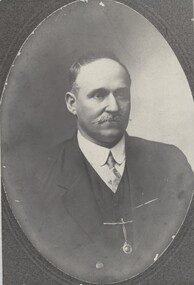
... diesel trains, locomotives and even the modern XPT train. He worked throughout Victoria at different stages of his career, with his final working years focused on the northeast of Victoria and the Albury to Melbourne line. After his retirement, Fred continued to share his love of steam miniature trains with the community. Locomotive Engine...diesel trains, locomotives and even the modern XPT train. He worked throughout Victoria at different stages of his career, with his final working years focused on the northeast of Victoria and the Albury to Melbourne line. After his retirement, Fred continued to share his love of steam miniature trains with the community. Locomotive Engine ...The Fred Rochow Railways Collection incorporates photos related to the operation of the Wodonga Railway Station including different types of trains and railways staff C. 1930 – 1990. It was donated to the Wodonga Historical Society by Fred Rochow, a railwayman who spent many years based in Wodonga. He joined the Victorian Railways on 17th June l947 and retired in 1988. For some time, he was a member of the Australian Federated Union of Locomotive Enginemen and served a term as a member of the Trades Hall Council. He had an extensive knowledge of the struggles that took place to achieve better conditions for railway workers. Fred worked for many years as a fireman and then worked his way up the ranks to driver, experiencing many changes from the days of steam locomotives through to diesel trains, locomotives and even the modern XPT train. He worked throughout Victoria at different stages of his career, with his final working years focused on the northeast of Victoria and the Albury to Melbourne line. After his retirement, Fred continued to share his love of steam miniature trains with the community. Locomotive Engine Drivers and Firemen’s Association - The first railway union in the world was created in Melbourne in 1861 with the formation of the Locomotive Engine Drivers Association of Victoria. The Association was formed seven years after the official opening of Victoria’s first railway line in 1854. In 1872, the association expanded to include firemen. The name of the association became the Locomotive Engine Drivers and Firemen’s Association to reflect the change in constitution. Over time this Association amalgamated with organisations in other states and eventually became the Australian Federated Union of Locomotive Employees which still operates today.This collection has local and statewide significance as it captures images of trains, locomotives and personnel who operated the railway services in Wodonga and throughout Northeast Victoria. The railways played a critical role in opening up Victoria and connecting Australia for trade, business, social communication and transport. A portrait of John Bennet Bruce. He was born on 8 February 1865. John started his railway career in North Melbourne on 13T February 1885. He achieved his driving certification in North Melbourne on 24 December 1899. John became President of the North Melbourne branch of in 1910. He transferred to Wodonga in 4 September 1914.railways wodonga, fred rochow, john bennet bruce, locomotive engine drivers and firemen’s association -
 Victorian Railway History Library
Book, David Burke, 30 Days On Australia's Railways - A diary of September journeys, 2014
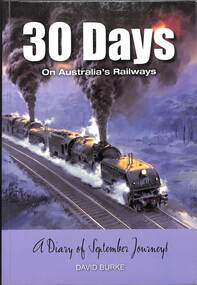
... engine was restored to working order. For some strange reason, September has been a month when particularly memorable railway events tend to occur. Author David Burke has crafted a 'diary' which documents, day by day, major happenings to do with railways in Australia - from the days of steam, to diesel, to diesel-electric and electrification, covering the first trains that ran between New South Wales and Queensland, and to Melbourne. ...An entertaining look at railway events in Australia in the month of September - from 1848, when a meeting was called to start a railway company in New South Wales, to 2013, when the great Bayer-Garrett AD6029 steam engine was restored to working order. For some strange reason, September has been a month when particularly memorable railway events tend to occur. Author David Burke has crafted a 'diary' which documents, day by day, major happenings to do with railways in Australia - from the days of steam, to diesel, to diesel-electric and electrification, covering the first trains that ran between New South Wales and Queensland, and to Melbourne. It was in also September that the first sod was dug for the Trans-Australian Railway across the Nullarbor to Perth. The book is heavily illustrated with historic photographs, both black and white and colour, newspaper cuttings, sketches and maps, and features 13 paintings by renowned railway artist Phil Belbin. Names that leap to the fore among those who made railway history happen include Ben Chifley, the locomotive driver who became Prime Minister of Australia, engineer Dr John Bradfield, designer of the Sydney Harbour Bridge and responsible for putting Sydney's city trains underground, James Fraser, first Australian-born Chief Commissioner for Railways, and Harold Young, the Scotsman who designed the C38 engine and the Silver City Comet. Cover picture shows: Climbing the steep Fassifern Grade with a heavy coal train maakes for plenty of Bayer-Garrett action in Phil Belbin's painting of the AD60 class at work on the Shorty North line to Newcastle New South Wales Australia.ill. p.172.non-fictionAn entertaining look at railway events in Australia in the month of September - from 1848, when a meeting was called to start a railway company in New South Wales, to 2013, when the great Bayer-Garrett AD6029 steam engine was restored to working order. For some strange reason, September has been a month when particularly memorable railway events tend to occur. Author David Burke has crafted a 'diary' which documents, day by day, major happenings to do with railways in Australia - from the days of steam, to diesel, to diesel-electric and electrification, covering the first trains that ran between New South Wales and Queensland, and to Melbourne. It was in also September that the first sod was dug for the Trans-Australian Railway across the Nullarbor to Perth. The book is heavily illustrated with historic photographs, both black and white and colour, newspaper cuttings, sketches and maps, and features 13 paintings by renowned railway artist Phil Belbin. Names that leap to the fore among those who made railway history happen include Ben Chifley, the locomotive driver who became Prime Minister of Australia, engineer Dr John Bradfield, designer of the Sydney Harbour Bridge and responsible for putting Sydney's city trains underground, James Fraser, first Australian-born Chief Commissioner for Railways, and Harold Young, the Scotsman who designed the C38 engine and the Silver City Comet. Cover picture shows: Climbing the steep Fassifern Grade with a heavy coal train maakes for plenty of Bayer-Garrett action in Phil Belbin's painting of the AD60 class at work on the Shorty North line to Newcastle New South Wales Australia.railroads -- australia -- history., railroad travel -- australia -- history.
