
Showing 123 items matching "diesel-electric locomotives"
-
 Wodonga & District Historical Society Inc
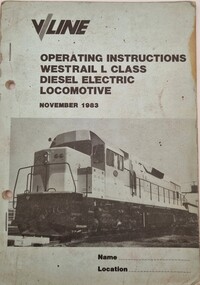
Manual - Collection of VLine operating instruction manuals for diesel electric locomotives
... Collection of VLine operating instruction manuals for diesel electric locomotives...Collection of VLine operating instruction manuals for diesel electric locomotives......Diesel-electric locomotives...Collection of VLine operating instruction manuals for diesel electric locomotives Manual Collection of VLine operating instruction manuals for diesel electric locomotives ...The manuals refer to the following locomotives:- Westrail L Class (November 1983) originally built by Clyde Engineering from 1967 for the Western Australian Government Railways (WAGR) for use on the Eastern Goldfields Railway between Perth and Kalgoorlie. In 1983, three were leased to V/Line to haul services on the standard gauge Melbourne to Albury line, sometimes extending through to Sydney.A class (January 1984) were initially used for "Intercity" passenger services within Victoria. In this service, they operated at speeds up towards 125 km/h. Later, they were also used for freight services.N class (September 1985) produced by Clyde Engineering and entered service in 1985 and still operating in 2023. 422 Class diesel-electric locomotives (August 1983), designed by Clyde Engineering were introduced in January 1969. Following crew training, the engines entered service on the Main Southern line between Sydney and Albury and the Illawarra line from Sydney to Port Kembla and Moss Vale. Among the passenger services they hauled were the Southern Aurora and the Spirit of Progress. From 1982, they began to operate through to Melbourne. This ceased in February 1990 when non-air-conditioned locomotives would no longer be accepted by Victorian drivers.A collection of Locomotive operation manuals. All are paperback and feature an image of the relevant locomotive on the cover. Relevant illustrations are included in each publication. Cover is of card and they are bound with staples.fictionThe manuals refer to the following locomotives:- Westrail L Class (November 1983) originally built by Clyde Engineering from 1967 for the Western Australian Government Railways (WAGR) for use on the Eastern Goldfields Railway between Perth and Kalgoorlie. In 1983, three were leased to V/Line to haul services on the standard gauge Melbourne to Albury line, sometimes extending through to Sydney.A class (January 1984) were initially used for "Intercity" passenger services within Victoria. In this service, they operated at speeds up towards 125 km/h. Later, they were also used for freight services.N class (September 1985) produced by Clyde Engineering and entered service in 1985 and still operating in 2023. 422 Class diesel-electric locomotives (August 1983), designed by Clyde Engineering were introduced in January 1969. Following crew training, the engines entered service on the Main Southern line between Sydney and Albury and the Illawarra line from Sydney to Port Kembla and Moss Vale. Among the passenger services they hauled were the Southern Aurora and the Spirit of Progress. From 1982, they began to operate through to Melbourne. This ceased in February 1990 when non-air-conditioned locomotives would no longer be accepted by Victorian drivers.railways victoria, diesel-electric locomotives -
 Eltham District Historical Society Inc
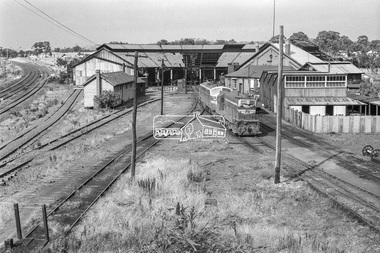
Photograph, B-class B85 and T-class T-326 diesel-electric locomotives in front of the Locomotive workshop at Seymour Railway Station, c.May 1963
... B-class B85 and T-class T-326 diesel-electric locomotives in front of the Locomotive workshop at Seymour Railway Station...B Class Diesel-Electric Locomotive...George Coop Collection Railway Workshop Seymour Seymour Railway Station B Class Diesel-Electric Locomotive B85 Scan - 35mm negative T-class Diesel Electric locomotive. ...Digital TIFF file Scan of 35mm Ilford FP3 black and white negative transparencygeorge coop collection, railway workshop, seymour, seymour railway station, b class diesel-electric locomotive, b85, scan - 35mm negative, t-class diesel electric locomotive., t-326 -
 Victorian Railway History Library
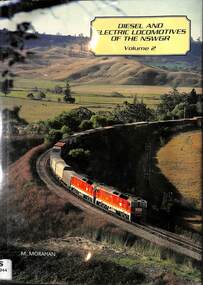
Book, Morahan, Mick, Diesel and Electric Locomotives of the NSWGR volume 2, 1998
... Diesel and Electric Locomotives of the NSWGR volume 2...diesel locomotives - New South Wales - history electric locomotives - New South Wales - history A history of the later diesel and electric locomotives operating on the New South Wales goverment railways. index, ill, p.224. ...A history of the later diesel and electric locomotives operating on the New South Wales goverment railways.index, ill, p.224.non-fictionA history of the later diesel and electric locomotives operating on the New South Wales goverment railways.diesel locomotives - new south wales - history, electric locomotives - new south wales - history -
 Victorian Railway History Library
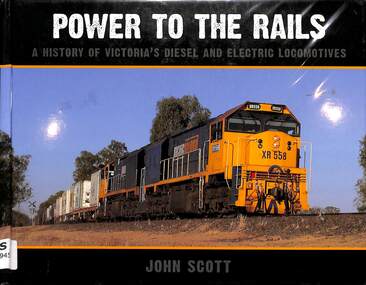
Book, Scott, John, Power to the Rails: A History of Victoria's Diesel and Electric Locomotives, 2011
... Power to the Rails: A History of Victoria's Diesel and Electric Locomotives...Locomotives - Australia - history Locomotives - Victoria - history A History of Victoria railway's Diesel and Electric Locomotives from the 1950s to the 2010s. ill, p.222. ...A History of Victoria railway's Diesel and Electric Locomotives from the 1950s to the 2010s.ill, p.222.non-fictionA History of Victoria railway's Diesel and Electric Locomotives from the 1950s to the 2010s.locomotives - australia - history, locomotives - victoria - history -
 Wodonga & District Historical Society Inc
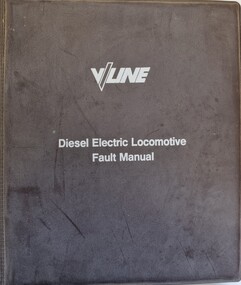
Manual - Locomotive Diesel Training Manual Module 5, VLine, c1990s
... On Cover beneath VLine logo: "DIESEL ELECTRIC LOCOMOTIVE / FAULT MANUAL"...Enginemen issued with this manual had to carry it with them at all times when in charge of a diesel electric locomotive. On Cover beneath VLine logo: "DIESEL ELECTRIC LOCOMOTIVE / FAULT MANUAL" A module of reading and requirements for the training module. ...This training module was available to enginemen who had completed Modules 1 to 5 (1983 Scheme). The manual contained fault finding checklists and standard procedures to be carried out if faults occured. Every driver was required to be conversant with and follow the instructions. Enginemen issued with this manual had to carry it with them at all times when in charge of a diesel electric locomotive.A module of reading and requirements for the training module. The pages are kept within a vinyl covered 2 ring binder. Text is printer on white paper and contains illustrations.fictionThis training module was available to enginemen who had completed Modules 1 to 5 (1983 Scheme). The manual contained fault finding checklists and standard procedures to be carried out if faults occured. Every driver was required to be conversant with and follow the instructions. Enginemen issued with this manual had to carry it with them at all times when in charge of a diesel electric locomotive. vline safety, vline training, railways victoria -
 Wodonga & District Historical Society Inc
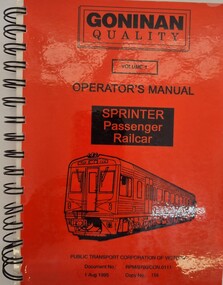
Manual - Sprinter Passenger Railcar, VLine, Locomotive Diesel Training Manual Module 5
... On Cover beneath VLine logo: "DIESEL ELECTRIC LOCOMOTIVE / FAULT MANUAL"...Enginemen issued with this manual had to carry it with them at all times when in charge of a diesel electric locomotive. On Cover beneath VLine logo: "DIESEL ELECTRIC LOCOMOTIVE / FAULT MANUAL" A module of reading and requirements for the training module. ...This training module was available to enginemen who had completed Modules 1 to 5 (1983 Scheme). The manual contained fault finding checklists and standard procedures to be carried out if faults occured. Every driver was required to be conversant with and follow the instructions. Enginemen issued with this manual had to carry it with them at all times when in charge of a diesel electric locomotive.A module of reading and requirements for the training module. The pages are kept within a vinyl covered 2 ring binder. Text is printer on white paper and contains illustrations.fictionThis training module was available to enginemen who had completed Modules 1 to 5 (1983 Scheme). The manual contained fault finding checklists and standard procedures to be carried out if faults occured. Every driver was required to be conversant with and follow the instructions. Enginemen issued with this manual had to carry it with them at all times when in charge of a diesel electric locomotive. vline safety, vline training, railways victoria -
 Eltham District Historical Society Inc
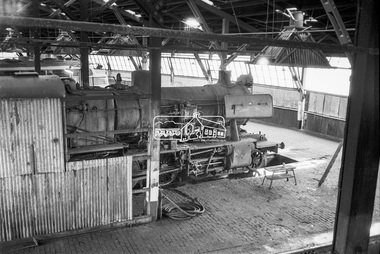
Photograph, George Coop, Steam locomotive J-508 in the Ararat Locomotive Shed, c.1971
... B Class Diesel-Electric Locomotive...In the background beside J-508 is a B-class diesel-electric locomotive ...In the background beside J-508 is a B-class diesel-electric locomotive George Coop Collection Ararat Locomotive Shed B Class Diesel-Electric Locomotive J-508 J-Class Steam Locomotive (Vulcan Foundry) Digital TIFF file Scan of 35mm Ilford FP3 black and white negative transparency Steam locomotive J-508 in the Ararat Locomotive Shed Photograph Photograph George Coop ...In the background beside J-508 is a B-class diesel-electric locomotive Digital TIFF file Scan of 35mm Ilford FP3 black and white negative transparencygeorge coop collection, ararat locomotive shed, b class diesel-electric locomotive, j-508, j-class steam locomotive (vulcan foundry) -
 Eltham District Historical Society Inc
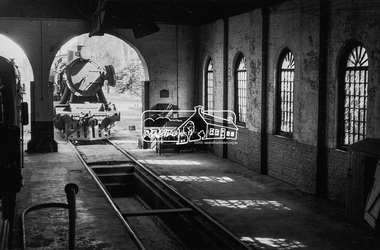
Photograph, Steam locomotive J-527 outside the locomotive shed, Echuca Railway Station, 1962, 1962
... Introduced almost concurrently with the diesel-electric locomotives that ultimately superseded them, these locomotives were only in service for a relatively short time. https://en.wikipedia.org/wiki/Victorian_Railways_J_class...Introduced almost concurrently with the diesel-electric locomotives that ultimately superseded them, these locomotives were only in service for a relatively short time. https://en.wikipedia.org/wiki/Victorian_Railways_J_class echuca railway station, george coop collection, j-527, j-class steam locomotive (vulcan foundry), railway workshop Digital TIFF file Scan of 35mm Ilford FP3 black and white negative transparency Steam locomotive J-527 outside the locomotive shed, Echuca Railway Station, 1962 Photograph George Coop George Coop ...The Victorian Railways J class was a branch line steam locomotive operated by the Victorian Railways (VR) between 1954 and 1972. A development of the successful Victorian Railways K class 2-8-0, it was the last new class of steam locomotive introduced on the VR. Introduced almost concurrently with the diesel-electric locomotives that ultimately superseded them, these locomotives were only in service for a relatively short time. https://en.wikipedia.org/wiki/Victorian_Railways_J_classDigital TIFF file Scan of 35mm Ilford FP3 black and white negative transparencyechuca railway station, george coop collection, j-527, j-class steam locomotive (vulcan foundry), railway workshop -
 Wodonga & District Historical Society Inc
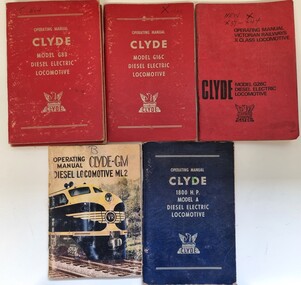
Manual - Operating Manuals for Clyde Diesel Locomotives
... It was one of the iconic Australian engineering firms whose history spanned just over a century and was one of the few locomotive and rolling stock builders in the world that transitioned from steam to diesel to electric traction. ...diesel locomotive used in Victoria. This model continued in operation until 1968, although many were modified for continued service. Clyde Model G16C, later superseded by the G26C operated in Victoria as the X class locomotive between 1966 and 1976. Clyde Model 1800HP Model A became the S class locomotives in Victoria. Additional numbers were purchased in preparation for the opening of the standard gauge line between Melbourne and Albury, They entered service between 1957 and 1961. Clyde Mainline Model 2 became the B class in Victoria. The B class were the first mainline diesel-electric...diesel locomotive used in Victoria. This model continued in operation until 1968, although many were modified for continued service. Clyde Model G16C, later superseded by the G26C operated in Victoria as the X class locomotive between 1966 and 1976. Clyde Model 1800HP Model A became the S class locomotives in Victoria. Additional numbers were purchased in preparation for the opening of the standard gauge line between Melbourne and Albury, They entered service between 1957 and 1961. Clyde Mainline Model 2 became the B class in Victoria. The B class were the first mainline diesel-electric ...This collection of Diesel Locomotive Manuals was published by the Clyde EngineeringA collection of 5 manuals for a range of Clyde Diesel Locomotives. The collection includes instructions for the Clyde G8B, G16C, G26C, 1800 HP Model A and the Clyde Mailiner Model 2. On the cover of each manual, the owner has written the letter for the name of class which the relevant locomotive was ascribed in Victoria. The Clyde Engineering Company Limited was registered on 30 September 1898 in New South Wales. It was one of the iconic Australian engineering firms whose history spanned just over a century and was one of the few locomotive and rolling stock builders in the world that transitioned from steam to diesel to electric traction. The company was formed by Walter Maplesden Noakes who purchased the works of Hudson Brothers Limited in the Sydney suburb of Granville, which had been established by in 1882. The manuals refer to the following locomotives:- Clyde Model G8B which operated in Victoria as the new T class locomotive. It was introduced in 1955 and was the most numerous class of diesel locomotive used in Victoria. This model continued in operation until 1968, although many were modified for continued service. Clyde Model G16C, later superseded by the G26C operated in Victoria as the X class locomotive between 1966 and 1976. Clyde Model 1800HP Model A became the S class locomotives in Victoria. Additional numbers were purchased in preparation for the opening of the standard gauge line between Melbourne and Albury, They entered service between 1957 and 1961. Clyde Mainline Model 2 became the B class in Victoria. The B class were the first mainline diesel-electric locomotives in Victoria entering service in June 1952. They were initially used on the main passenger and freight services, before moving out to other areas. They remained in service until the early 1990s.fiction This collection of Diesel Locomotive Manuals was published by the Clyde Engineeringclyde engineering, diesel locomotives, locomotives victoria -
 Eltham District Historical Society Inc
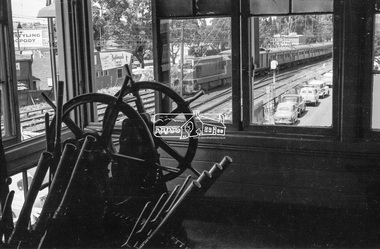
Photograph, George Coop, Box Hill Signal Box, c.Feb. 1964
... A T-class diesel-electric locomotive can bee seen through the window hauling a Tait train. ...A T-class diesel-electric locomotive can bee seen through the window hauling a Tait train. ...A T-class diesel-electric locomotive can bee seen through the window hauling a Tait train. Also advertising on the buildings facing passing train passengers including 'Dialyn's Theatre Shoppe for Nightingale Tightlets & Leotards'. This is not a conventional suburban Tait ‘Red Rattler’ service. It may have come from Lilydale where trains from both Warburton and Healsville were combined to continue the run into Melbourne, a normal service for them at the time. It is unusual as the train is hauled by a diesel which also suggests it may have been a special excursion train from either of those two towns. Normally these combined trains would be hauled by two swing door ‘Red Rattlers’ motor coaches from Lilydale, the start/end of electric service. Digital TIFF file Scan of 35mm Ilford FP3 black and white transparencygeorge coop collection, box hill railway signal box, box hill railway station, signal box -
 Bendigo Historical Society Inc.
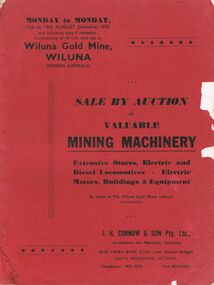
Document - IAN DYETT COLLECTION: AUCTION CATALOGUE - WILUNA GOLD MINE
... Red covered auction catalogu, Wiluna Gold Mine, Wiluna, for a sale of Mining Machinery including Extensive Stores, Electric and Diesel Locomotives, Electric Motors, Buildings & Equipment held on the 11th to 18th August (inclusive) 1952 and following days if necessary. ...BUSINESS Auctioneers j h curnow & son pty ltd Ian Dyett Collection - Auction Catalogue - Wiluna Gold Mine The Wiluna Gold Mines Limited J H Curnow & Son Pty Ltd The Prahran Telegraph Printing Co Red covered auction catalogu, Wiluna Gold Mine, Wiluna, for a sale of Mining Machinery including Extensive Stores, Electric and Diesel Locomotives, Electric Motors, Buildings & Equipment held on the 11th to 18th August (inclusive) 1952 and following days if necessary. ...Red covered auction catalogu, Wiluna Gold Mine, Wiluna, for a sale of Mining Machinery including Extensive Stores, Electric and Diesel Locomotives, Electric Motors, Buildings & Equipment held on the 11th to 18th August (inclusive) 1952 and following days if necessary. J. H. Curnow & Son Pty. Ltd. Were the auctioneers. Front of catalogue has notes on transport from Perth to Wiluna by plane, train and taxi.business, auctioneers, j h curnow & son pty ltd, ian dyett collection - auction catalogue - wiluna gold mine, the wiluna gold mines limited, j h curnow & son pty ltd, the prahran telegraph printing co -
 Eltham District Historical Society Inc
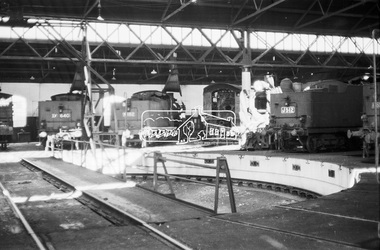
Photograph, Steam locomotives D3-640, K-182, K-158, J-512 and K-168 in the locomotive shed, Bendigo Railway Station, c.November 1962, 1962
... Introduced almost concurrently with the diesel-electric locomotives that ultimately superseded them, these locomotives were only in service for a relatively short time. https://en.wikipedia.org/wiki/Victorian_Railways_J_class The K class was a branch line steam locomotive that ran on Victorian Railways in Australia from 1922 to 1979. ...Introduced almost concurrently with the diesel-electric locomotives that ultimately superseded them, these locomotives were only in service for a relatively short time. https://en.wikipedia.org/wiki/Victorian_Railways_J_class The K class was a branch line steam locomotive that ran on Victorian Railways in Australia from 1922 to 1979. ...The Victorian Railways J class was a branch line steam locomotive operated by the Victorian Railways (VR) between 1954 and 1972. A development of the successful Victorian Railways K class 2-8-0, it was the last new class of steam locomotive introduced on the VR. Introduced almost concurrently with the diesel-electric locomotives that ultimately superseded them, these locomotives were only in service for a relatively short time. https://en.wikipedia.org/wiki/Victorian_Railways_J_class The K class was a branch line steam locomotive that ran on Victorian Railways in Australia from 1922 to 1979. Although its design was entirely conventional and its specifications unremarkable, the K class was in practice a remarkably versatile and dependable locomotive. It went on to outlast every other class of steam locomotive in regular service on the VR, and no fewer than 21 examples of the 53 originally built have survived into preservation. https://en.wikipedia.org/wiki/Victorian_Railways_K_classDigital TIFF file Scan of 35mm Ilford FP3 black and white negative transparencybendigo, d3-640, george coop collection, j-512, j-class steam locomotive (vulcan foundry), k-158, k-168, k-182, k-class steam locomotive (vr newport workshops), railway turntable, railway workshop, bendigo railway station -
 Orbost & District Historical Society
black and white photographs, second half 20th century
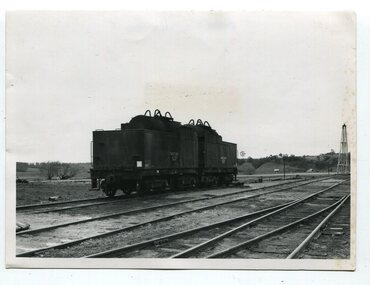
... The two tankers hels about 9,000 gallons (34068.7 litres) - from a news item in "Gippsland" September, 1971. 3151.2 is of Victoria's X class 1,800 H.P general purpose diesel electric locomotive. Si had been ordered for the Victorian Railways and cost about £ 250,000 each. 3151.3 is of several loaded, covered railway trucks on a rail line. 3151.4 was taken at the goods yard at Orbost Railway Station. 3151.5 has some rail wagons with "SHOWMOBILE COUNCIL OF ADULT EDUCATION" on the sides. 3151.6 is of goods wagons (Probably not at Orbost Station) 3151.7 is a goods train 3151.8 shows the loading or unloading of farm produce at Orbost railway Station. 3151.9 shows cattle being loaded at Orbost Railway Station. 3151.10 is of a container N.Y.K. ...The two tankers hels about 9,000 gallons (34068.7 litres) - from a news item in "Gippsland" September, 1971. 3151.2 is of Victoria's X class 1,800 H.P general purpose diesel electric locomotive. Si had been ordered for the Victorian Railways and cost about £ 250,000 each. 3151.3 is of several loaded, covered railway trucks on a rail line. 3151.4 was taken at the goods yard at Orbost Railway Station. 3151.5 has some rail wagons with "SHOWMOBILE COUNCIL OF ADULT EDUCATION" on the sides. 3151.6 is of goods wagons (Probably not at Orbost Station) 3151.7 is a goods train 3151.8 shows the loading or unloading of farm produce at Orbost railway Station. 3151.9 shows cattle being loaded at Orbost Railway Station. 3151.10 is of a container N.Y.K. ...3151.1 is of a water tanker on stand by at Orbost ready for emergency use. Similar suppliers were at Bairnsdale and Nowa Nowa. The two tankers hels about 9,000 gallons (34068.7 litres) - from a news item in "Gippsland" September, 1971. 3151.2 is of Victoria's X class 1,800 H.P general purpose diesel electric locomotive. Si had been ordered for the Victorian Railways and cost about £ 250,000 each. 3151.3 is of several loaded, covered railway trucks on a rail line. 3151.4 was taken at the goods yard at Orbost Railway Station. 3151.5 has some rail wagons with "SHOWMOBILE COUNCIL OF ADULT EDUCATION" on the sides. 3151.6 is of goods wagons (Probably not at Orbost Station) 3151.7 is a goods train 3151.8 shows the loading or unloading of farm produce at Orbost railway Station. 3151.9 shows cattle being loaded at Orbost Railway Station. 3151.10 is of a container N.Y.K. LINE ( a Japanese shipping company) This item is associated with the history of the Orbost-Bairnsdale railway line and therefore reflects the role that the rail line played in the social and economic history of Orbost.Ten black / white photographs related to Orbost rail. orbost-railway east-gippsland-railway transport-railway railway-engine orbost-railway-station export-produce -
 Orbost & District Historical Society
black and white photographs, August 21 1987
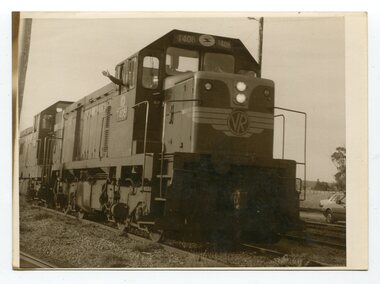
... Last train left on Friday August 27, 1987." 3105.9 - on back - " 3 "T" Class Diesel Electric locomotives often used in pairs to haul the timber trains out of Orbost. ...Last train left on Friday August 27, 1987." 3105.9 - on back - " 3 "T" Class Diesel Electric locomotives often used in pairs to haul the timber trains out of Orbost. ...These photographs are of the final train to leave Orbost railway Station on August 21 1987 signalling the closure of the line. 3105.12 shows Locomotive T408 and on the side is written "LAST TRAIN EX ORBOST 24.8.87". These photographs are associated with the history of the Orbost-Bairnsdale railway line and therefore reflects the role that the rail line played in the social and economic history of Orbost. The closure of the line was a significant event in Orbost's history.Fifteen black / white photographs of the last train to leave Orbost Railway station.3105.1 - on back - "Last Train leaving Orbost Railway Station on Friday August 21. 1987. SRM August 26 1987 Last train from Orbost, Friday last saw the end of an era when the last freight train to pull out of Orbost Station at about 4.co pm. A symbolic wave from engineer, Bill Buckley, was the only ceremony to mark the passing of rail transport for East Gippsland." 3105.2 - on back - " Last train prepares to leave from Orbost on August 21, 1987." 3105.3 - on back - " The Orbost railhead following the departure of the last train on Friday August 21, 1987. Shows spectators who farewelled the last train." 3105.4 - on back - "From Grandview, Newmerella, shows the last train from Orbost crossing the timber Trestle (sic) viaduct across the Snowy River flats on Friday August 21, 1987" 3105.5 - on back - " A pair of Series 3 "T" Class Diesel Electric locomotives which were used to haul the final train from the Orbost Rail Head on Friday, August 21, 1987. Goods shed on right" 3105.6 - on back - " VFTY Timber Wagons at the Orbost Railway Station. 30 of these large wagons were built for the timber traffic between Orbost and Melbourne. Part of last train to leave Orbost on August 1, 1987." 3105.7 - on back - "The Fordson powered Rail Tractor which was used during shunting at the Orbost railway station, hooked up behind the second locomotive for its final journal from Orbost on Friday August 21, 1987." 3105.8 - on back - "Two Series 3 "T" Class Locomotives (Diesel Electric) were used to haul the final train from Orbost - T408 and T347, T408 was the leading locomotive. Orbost Goods Shed is on the left. Last train left on Friday August 27, 1987." 3105.9 - on back - " 3 "T" Class Diesel Electric locomotives often used in pairs to haul the timber trains out of Orbost. This locomotive was used to lead (haul) the final train from Orbost on Friday August 21, 1987" 3105.10 - on back - "The Gantry at the Orbost Railway Yards - capacity 10 tons. The last wagons before being hooked up to the locos for their last trip out of Orbost on Friday August 21, 1987" 3105.11 - on back - " Station Masters Office and Goods Shed at Orbost Railway Station. The two Series 3 "T" Class Diesel Electric locomotives waiting to haul the final train from Orbost on Friday 21 1987" otrbost-bairnsdale-railway east-gippsland-railway orbosr-railway-closure -
 Wodonga & District Historical Society Inc
Booklet - Spirit of Progress, Victorian Railways, 1958
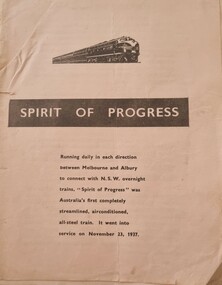
... After World War II the locomotives were converted to oil burners and were hauled by “S” class diesel-electric locomotives. In a normal year, the "Spirit of Progress" travelled about 146, 000 miles and carried over 300,000 passengers, while approximately 126,000 meals and 45, 000 serves of light refreshments would be provided in the dining car. ...After World War II the locomotives were converted to oil burners and were hauled by “S” class diesel-electric locomotives. In a normal year, the "Spirit of Progress" travelled about 146, 000 miles and carried over 300,000 passengers, while approximately 126,000 meals and 45, 000 serves of light refreshments would be provided in the dining car. ...The "Spirit of Progress' was constructed at the Railway Workshops, Newport, Victoria, and placed into service between Melbourne and Albury on 23rd November, 1937. It was the first completely streamlined, airconditioned, all steel train in the Southern Hemisphere. It travelled non-stop daily in both directions between Melbourne and Albury. On its daily run a speed of one mile a minute was averaged for much of the 1,904 mile journey. Eighty m.p.h. was exceeded in tests, but in normal running a 70 m.p.h. restriction was imposed. The average load of the "Spirit of Progress" was 499 tons, and it could carry 240 first-class and 192 second-class passengers. A luxurious dining car was a feature of the “Spirit of Progress” with Queensland beech walls and leather upholstered seats. It had a well-equipped kitchen with walls of stainless steel, a slow combustion coke-burning range and a modern air circulation system. The "Spirit of Progress" was hauled by one of the four giant "S" class steam locomotives. Each was named after a man famous in Australian History: Matthew Flinders, Edward Henty, Sir Thomas Mitchell and C.J. Latrobe. After World War II the locomotives were converted to oil burners and were hauled by “S” class diesel-electric locomotives. In a normal year, the "Spirit of Progress" travelled about 146, 000 miles and carried over 300,000 passengers, while approximately 126,000 meals and 45, 000 serves of light refreshments would be provided in the dining car. The Spirit of Progress ran for the last time on 2nd August 1986.This item is significant because it provides a description and information about an important locomotive which served the Wodonga DistrictA small leaflet of six pages plus cover outlining information about the Spirit of Progress. The cover features a picture of the Spirit of Progress. Printed on buff coloured paper in black ink.SPIRIT OF PROGRESS"spirit of progress", victorian railways, locomotives -- victoria -- history -
 Wodonga & District Historical Society Inc
Photograph - Fred Rochow Railways Collection - Last 8.30 am pilot at Wodonga, 23 August 1988
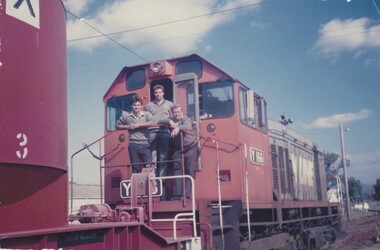
... diesel trains, locomotives and even the modern XPT train. He worked throughout Victoria at different stages of his career, with his final working years focused on the northeast of Victoria and the Albury to Melbourne line. After his retirement, Fred continued to share his love of steam miniature trains with the community. This locomotive, the Y166, was one of 25 general purpose diesel-electric...diesel trains, locomotives and even the modern XPT train. He worked throughout Victoria at different stages of his career, with his final working years focused on the northeast of Victoria and the Albury to Melbourne line. After his retirement, Fred continued to share his love of steam miniature trains with the community. This locomotive, the Y166, was one of 25 general purpose diesel-electric ...The Fred Rochow Railways Collection incorporates photos related to the operation of the Wodonga Railway Station including different types of trains and railways staff C. 1930 – 1990. It was donated to the Wodonga Historical Society by Fred Rochow, a railwayman who spent many years based in Wodonga. He joined the Victorian Railways on 17th June l947 and retired in 1988. For some time, he was a member of the Australian Federated Union of Locomotive Enginemen and served a term as a member of the Trades Hall Council. He had an extensive knowledge of the struggles that took place to achieve better conditions for railway workers. Fred worked for many years as a fireman and then worked his way up the ranks to driver, experiencing many changes from the days of steam locomotives through to diesel trains, locomotives and even the modern XPT train. He worked throughout Victoria at different stages of his career, with his final working years focused on the northeast of Victoria and the Albury to Melbourne line. After his retirement, Fred continued to share his love of steam miniature trains with the community. This locomotive, the Y166, was one of 25 general purpose diesel-electric locomotives built by Clyde Engineering, Granville NSW for the Victorian Railways between 1963 and 1968. Although built to dieselise Victoria's shunting operations and replace steam locomotives on branch line services, they were also used on mainline goods and passenger services. After closure of many branch lines across the state and the end of short pick-up goods trains, use of the class dropped. The Y166 entered service on 5 June 1968. It was withdrawn from service in November 1990 and eventually scrapped in 1991.This collection has local and statewide significance as it captures images of trains, locomotives and personnel who operated the railway services in Wodonga and throughout Northeast Victoria. The railways played a critical role in opening up Victoria and connecting Australia for trade, business, social communication and transport.Shunter Theo Edwards, Fireman Steve Ryan and Leading Shunter Lorry Beach standing on the front of a diesel pilot train, Y166. This was the last 8.30 am pilot train through Wodonga before the old Wodonga stations was closed and the railway line diverted away from the middle of Wodonga. In June 2011 a new station was opened on the northern edge of the town. On side of train "Y166"fred rochow, victorian railways wodonga, railway employees wodonga, y class diesel locomotives -
 Wodonga & District Historical Society Inc
Photograph - Fred Rochow Railways Collection - Les (Pee Wee) Hallawell, 1987
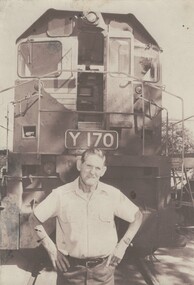
... diesel trains, locomotives and even the modern XPT train. He worked throughout Victoria at different stages of his career, with his final working years focused on the northeast of Victoria and the Albury to Melbourne line. After his retirement, Fred continued to share his love of steam miniature trains with the community. This locomotive, the Y170, was one of 25 general purpose diesel-electric...diesel trains, locomotives and even the modern XPT train. He worked throughout Victoria at different stages of his career, with his final working years focused on the northeast of Victoria and the Albury to Melbourne line. After his retirement, Fred continued to share his love of steam miniature trains with the community. This locomotive, the Y170, was one of 25 general purpose diesel-electric ...The Fred Rochow Railways Collection incorporates photos related to the operation of the Wodonga Railway Station including different types of trains and railways staff C. 1930 – 1990. It was donated to the Wodonga Historical Society by Fred Rochow, a railwayman who spent many years based in Wodonga. He joined the Victorian Railways on 17th June l947 and retired in 1988. For some time, he was a member of the Australian Federated Union of Locomotive Enginemen and served a term as a member of the Trades Hall Council. He had an extensive knowledge of the struggles that took place to achieve better conditions for railway workers. Fred worked for many years as a fireman and then worked his way up the ranks to driver, experiencing many changes from the days of steam locomotives through to diesel trains, locomotives and even the modern XPT train. He worked throughout Victoria at different stages of his career, with his final working years focused on the northeast of Victoria and the Albury to Melbourne line. After his retirement, Fred continued to share his love of steam miniature trains with the community. This locomotive, the Y170, was one of 25 general purpose diesel-electric locomotives built by Clyde Engineering, Granville NSW for the Victorian Railways between 1963 and 1968. Although built to dieselise Victoria's shunting operations and replace steam locomotives on branch line services, they were also used on mainline goods and passenger services. After closure of many branch lines across the state and the end of short pick-up goods trains, use of the class dropped. This locomotive, the Y170 entered service on 13 July 1968. It was withdrawn from service in April 1988 and was eventually scrapped in 1992.This collection has local and statewide significance as it captures images of trains, locomotives and personnel who operated the railway services in Wodonga and throughout Northeast Victoria. The railways played a critical role in opening up Victoria and connecting Australia for trade, business, social communication and transport.Les Hallawell standing in front of Locomotive Y170. He started with Victoria Railways on16 Mayv1949. . He passed his Driver qualification on 12 July 1955. Les retired in Wodonga on 29 March 1988.railways wodonga, fred rochow, wodonga railway men, y class locomotive, les hallawell -
 Ballarat Tramway Museum
Document, 'State Electricty Commission of Victoria Rail Transport: Yallourn Open Cut"
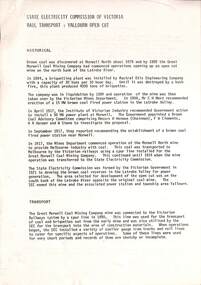
... locomotives used in the Latrobe Valley operations of the SEC. Possibly prepared in the early 1980s. Rail operations on the interconnecting railway ceased in 2000. Shows outline diagrams of the steam, electric and diesel...locomotives used in the Latrobe Valley operations of the SEC. Possibly prepared in the early 1980s. Rail operations on the interconnecting railway ceased in 2000. Shows outline diagrams of the steam, electric and diesel ...Provides details of the history of SECV rail operations in the Yallourn and other power station open cuts and the transport of coal and the locomotives used in the Latrobe Valley operations of the SEC. Possibly prepared in the early 1980s. Rail operations on the interconnecting railway ceased in 2000. Shows outline diagrams of the steam, electric and diesel locomotives and the coal wagons.Provides information about the SEC Coal railways and their rolling stock used for power generation in Victoria.Report or document - 16 A4 pages titled Report - 'State Electricty Commission of Victoria Rail Transport: Yallourn Open Cut"sec tramways, power supply, secv, open cut mining, locomotives, interconnecting railway -
 Federation University Historical Collection
Book, Modern Power Generators: steam electric and internal-combustion and their application to present-day requirements, 1908 (exact)
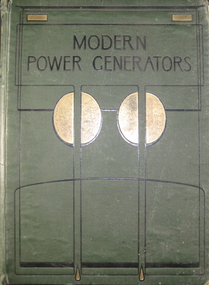
... locomotive otto diesel A large green cloth hardcover book with gold and black decorations on front cover. Title is engraved in black on front cover and in gilt on spine. Title is printed in black and red on title-page. Volume 1 with illustrations in b/w with diagrams and a series of coloured composite sectional models. 'Modern Power Generators' deals with the production of Steam, Electric ...James Weir graduated from Strathclyde University with a degree in Economics. James gained extensive industrial experience with anengineering group called the 'Weir Group". He then became a Director at Hambros Advanced Technology Trust. In 1990, James was the Founder and Director at Duke Street Capital. He speaks English and French. A large green cloth hardcover book with gold and black decorations on front cover. Title is engraved in black on front cover and in gilt on spine. Title is printed in black and red on title-page. Volume 1 with illustrations in b/w with diagrams and a series of coloured composite sectional models. 'Modern Power Generators' deals with the production of Steam, Electric and Gas power.boiler, steam, james weir french, engine, air brake, induction motor, internal combustion, turbine, locomotive, otto, diesel -
 Eltham District Historical Society Inc
Photograph, George Coop, B Class Diesel-Electric Locomotive No. B64, Ararat Locomotive Shed, c.1971
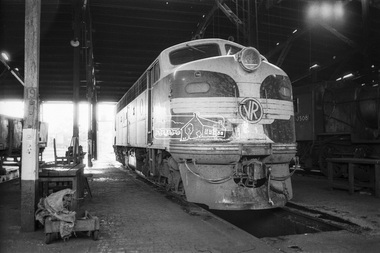
... B Class Diesel-Electric Locomotive No. B64, Ararat Locomotive Shed...B Class Diesel-Electric Locomotive...George Coop Collection Ararat Locomotive Shed B Class Diesel-Electric Locomotive B64 J-508 J-Class Steam Locomotive (Vulcan Foundry) Digital TIFF file Scan of 35mm Ilford FP3 black and white negative transparency B Class Diesel-Electric Locomotive No. ...Digital TIFF file Scan of 35mm Ilford FP3 black and white negative transparencygeorge coop collection, ararat locomotive shed, b class diesel-electric locomotive, b64, j-508, j-class steam locomotive (vulcan foundry) -
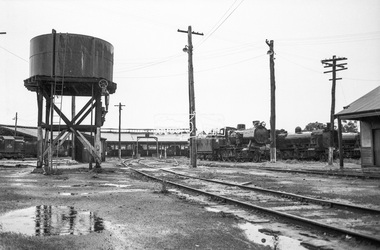 Eltham District Historical Society Inc
Photograph, George Coop, Ararat Locomotive Shed, c.1971
... T-class Diesel Electric locomotive....George Coop Collection Ararat Locomotive Shed J-539 J-Class Steam Locomotive (Vulcan Foundry) K-177 K-Class Steam Locomotive (VR Newport Workshops) T-335 T-class Diesel Electric locomotive. Digital TIFF file Scan of 35mm Ilford FP3 black and white negative transparency Ararat Locomotive Shed Photograph Photograph George Coop ...Digital TIFF file Scan of 35mm Ilford FP3 black and white negative transparencygeorge coop collection, ararat locomotive shed, j-539, j-class steam locomotive (vulcan foundry), k-177, k-class steam locomotive (vr newport workshops), t-335, t-class diesel electric locomotive. -
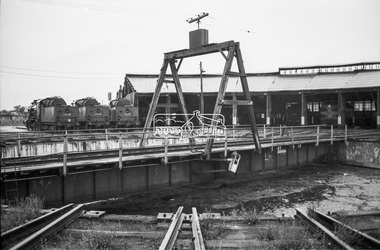 Eltham District Historical Society Inc
Photograph, George Coop, Steam locomotives J539, J-540 and J-541 at the Ararat Locomotive Shed, c.1971
... J-508 and a B Class Diesel-electric locomtive inside the workshop. George Coop Collection Ararat Locomotive Shed J-Class Steam Locomotive (Vulcan Foundry) J-508 J-539 J-540 J-541 Railway Digital TIFF file Scan of 35mm Ilford FP3 black and white negative transparency Steam locomotives J539, J-540 and J-541 at the Ararat Locomotive Shed Photograph Photograph George Coop ...J-508 and a B Class Diesel-electric locomtive inside the workshop.Digital TIFF file Scan of 35mm Ilford FP3 black and white negative transparencygeorge coop collection, ararat locomotive shed, j-class steam locomotive (vulcan foundry), j-508, j-539, j-540, j-541, railway -
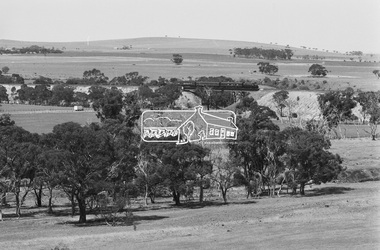 Eltham District Historical Society Inc
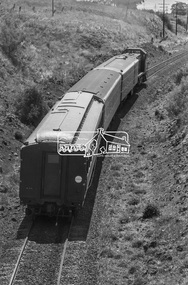
Photograph, George Coop, T-class Diesel Electric locomotive T-406 with three carriages heading for Ballarat near Ballan, c.October 1982, 1982
... T-class Diesel Electric locomotive T-406 with three carriages heading for Ballarat near Ballan, c.October 1982...ballan, T-406, T-class Diesel Electric locomotive., train of knowledge...Viewed from a road overpass where the train heading to Ballarat sweeps around from the right and passes below the road. ballan, T-406, T-class Diesel Electric locomotive., train of knowledge Digital TIFF file Scan of 35mm Ilford FP4 black and white transparency T-class Diesel Electric locomotive T-406 with three carriages heading for Ballarat near Ballan, c.October 1982 Photograph George Coop ...Waiting for the Train of Knowledge to come pass. Viewed from a road overpass where the train heading to Ballarat sweeps around from the right and passes below the road.Digital TIFF file Scan of 35mm Ilford FP4 black and white transparencyballan, t-406, t-class diesel electric locomotive., train of knowledge -
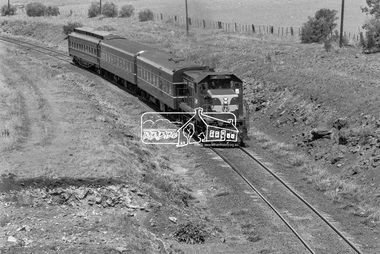 Eltham District Historical Society Inc
Photograph, George Coop, T-class Diesel Electric locomotive T-406 with three carriages heading for Ballarat near Ballan, c.October 1982, 1982
... T-class Diesel Electric locomotive T-406 with three carriages heading for Ballarat near Ballan, c.October 1982...ballan, t-406, t-class diesel electric locomotive., train of knowledge...Viewed from a road overpass where the train heading to Ballarat sweeps around from the right and passes below the road. ballan, t-406, t-class diesel electric locomotive., train of knowledge Digital TIFF file Scan of 35mm Ilford FP4 black and white transparency T-class Diesel Electric locomotive T-406 with three carriages heading for Ballarat near Ballan, c.October 1982 Photograph George Coop ...Waiting for the Train of Knowledge to come pass. Viewed from a road overpass where the train heading to Ballarat sweeps around from the right and passes below the road.Digital TIFF file Scan of 35mm Ilford FP4 black and white transparencyballan, t-406, t-class diesel electric locomotive., train of knowledge -
 Eltham District Historical Society Inc
Photograph, George Coop, T-class Diesel Electric locomotive T-406 with three carriages heading for Ballarat near Ballan, c.October 1982, 1982
... T-class Diesel Electric locomotive T-406 with three carriages heading for Ballarat near Ballan, c.October 1982...ballan, t-406, t-class diesel electric locomotive., train of knowledge...Viewed from a road overpass where the train heading to Ballarat sweeps around from the right and passes below the road. ballan, t-406, t-class diesel electric locomotive., train of knowledge Digital TIFF file Scan of 35mm Ilford FP4 black and white transparency T-class Diesel Electric locomotive T-406 with three carriages heading for Ballarat near Ballan, c.October 1982 Photograph George Coop ...Waiting for the Train of Knowledge to come pass. Viewed from a road overpass where the train heading to Ballarat sweeps around from the right and passes below the road.Digital TIFF file Scan of 35mm Ilford FP4 black and white transparencyballan, t-406, t-class diesel electric locomotive., train of knowledge -
 Eltham District Historical Society Inc
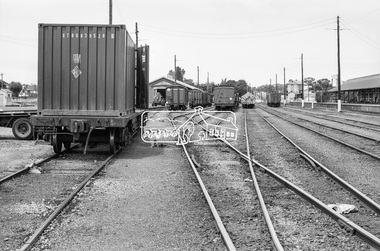
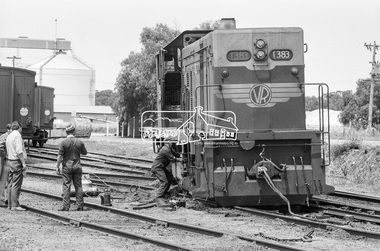
Photograph, Wheat train derailment near the yards of Dunolly Railway Station, Dunolly, Victoria, c.1983, 1983
... Derailment, Dunolly, Dunolly Railway Station, George Coop Collection, T-364, t-383, T-383 locomotive, t-class diesel electric locomotive, Victorian Railways, Wheat train, Y-150, y-class diesel electric locomotive...Derailment, Dunolly, Dunolly Railway Station, George Coop Collection, T-364, t-383, T-383 locomotive, t-class diesel electric locomotive, Victorian Railways, Wheat train, Y-150, y-class diesel electric locomotive Digital TIFF file Scan of 35mm Ilford XP1 black and white transparency Wheat train derailment near the yards of Dunolly Railway Station, Dunolly, Victoria, c.1983 Photograph George Coop George Coop ...GC visited Dunolly with his late father-in-law who used to be a gold miner up there. They were going past the station and noticed a wheat train had derailed in the yards and so he took the opportunity to photograph the goings-on. The fellow in the light grey slacks and beige shirt with tie approached GC and asked him what he was doing. He proposed that GC leave or alternatively, take as many photographs as he desired and then send him a complete set of prints, which GC did.Digital TIFF file Scan of 35mm Ilford XP1 black and white transparencyderailment, dunolly, dunolly railway station, george coop collection, t-364, t-383, t-383 locomotive, t-class diesel electric locomotive, victorian railways, wheat train, y-150, y-class diesel electric locomotive -
 Eltham District Historical Society Inc
Photograph, Wheat train derailment near the yards of Dunolly Railway Station, Dunolly, Victoria, c.1983, 1983
... derailment, dunolly, dunolly railway station, george coop collection, t-364, t-383, t-383 locomotive, t-class diesel electric locomotive, victorian railways, wheat train, y-150, y-class diesel electric locomotive...He proposed that GC leave or alternatively, take as many photographs as he desired and then send him a complete set of prints, which GC did. derailment, dunolly, dunolly railway station, george coop collection, t-364, t-383, t-383 locomotive, t-class diesel electric locomotive, victorian railways, wheat train, y-150, y-class diesel electric locomotive Digital TIFF file Scan of 35mm Ilford XP1 black and white transparency Wheat train derailment near the yards of Dunolly Railway Station, Dunolly, Victoria, c.1983 Photograph George Coop George Coop ...GC visited Dunolly with his late father-in-law who used to be a gold miner up there. They were going past the station and noticed a wheat train had derailed in the yards and so he took the opportunity to photograph the goings-on. The fellow in the light grey slacks and beige shirt with tie approached GC and asked him what he was doing. He proposed that GC leave or alternatively, take as many photographs as he desired and then send him a complete set of prints, which GC did.Digital TIFF file Scan of 35mm Ilford XP1 black and white transparencyderailment, dunolly, dunolly railway station, george coop collection, t-364, t-383, t-383 locomotive, t-class diesel electric locomotive, victorian railways, wheat train, y-150, y-class diesel electric locomotive -
 Eltham District Historical Society Inc
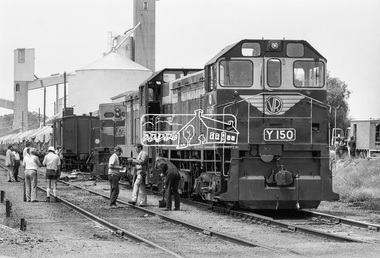
Photograph, Wheat train derailment near the yards of Dunolly Railway Station, Dunolly, Victoria, c.1983, 1983
... derailment, dunolly, dunolly railway station, george coop collection, t-364, t-383, t-383 locomotive, t-class diesel electric locomotive, victorian railways, wheat train, y-150, y-class diesel electric locomotive...He proposed that GC leave or alternatively, take as many photographs as he desired and then send him a complete set of prints, which GC did. derailment, dunolly, dunolly railway station, george coop collection, t-364, t-383, t-383 locomotive, t-class diesel electric locomotive, victorian railways, wheat train, y-150, y-class diesel electric locomotive Digital TIFF file Scan of 35mm Ilford XP1 black and white transparency Wheat train derailment near the yards of Dunolly Railway Station, Dunolly, Victoria, c.1983 Photograph George Coop George Coop ...GC visited Dunolly with his late father-in-law who used to be a gold miner up there. They were going past the station and noticed a wheat train had derailed in the yards and so he took the opportunity to photograph the goings-on. The fellow in the light grey slacks and beige shirt with tie approached GC and asked him what he was doing. He proposed that GC leave or alternatively, take as many photographs as he desired and then send him a complete set of prints, which GC did.Digital TIFF file Scan of 35mm Ilford XP1 black and white transparencyderailment, dunolly, dunolly railway station, george coop collection, t-364, t-383, t-383 locomotive, t-class diesel electric locomotive, victorian railways, wheat train, y-150, y-class diesel electric locomotive -
 Eltham District Historical Society Inc
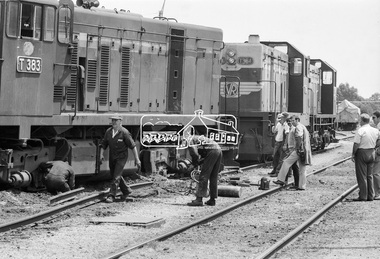
Photograph, Wheat train derailment near the yards of Dunolly Railway Station, Dunolly, Victoria, c.1983, 1983
... derailment, dunolly, dunolly railway station, george coop collection, t-364, t-383, t-383 locomotive, t-class diesel electric locomotive, victorian railways, wheat train, y-150, y-class diesel electric locomotive...He proposed that GC leave or alternatively, take as many photographs as he desired and then send him a complete set of prints, which GC did. derailment, dunolly, dunolly railway station, george coop collection, t-364, t-383, t-383 locomotive, t-class diesel electric locomotive, victorian railways, wheat train, y-150, y-class diesel electric locomotive Digital TIFF file Scan of 35mm Ilford XP1 black and white transparency Wheat train derailment near the yards of Dunolly Railway Station, Dunolly, Victoria, c.1983 Photograph George Coop George Coop ...GC visited Dunolly with his late father-in-law who used to be a gold miner up there. They were going past the station and noticed a wheat train had derailed in the yards and so he took the opportunity to photograph the goings-on. The fellow in the light grey slacks and beige shirt with tie approached GC and asked him what he was doing. He proposed that GC leave or alternatively, take as many photographs as he desired and then send him a complete set of prints, which GC did.Digital TIFF file Scan of 35mm Ilford XP1 black and white transparencyderailment, dunolly, dunolly railway station, george coop collection, t-364, t-383, t-383 locomotive, t-class diesel electric locomotive, victorian railways, wheat train, y-150, y-class diesel electric locomotive -
 Eltham District Historical Society Inc
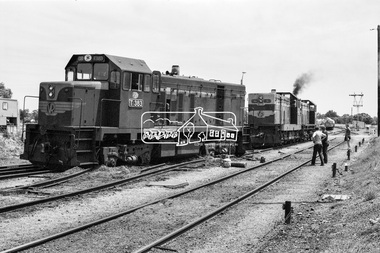
Photograph, Wheat train derailment near the yards of Dunolly Railway Station, Dunolly, Victoria, c.1983, 1983
... derailment, dunolly, dunolly railway station, george coop collection, t-364, t-383, t-383 locomotive, t-class diesel electric locomotive, victorian railways, wheat train, y-150, y-class diesel electric locomotive...He proposed that GC leave or alternatively, take as many photographs as he desired and then send him a complete set of prints, which GC did. derailment, dunolly, dunolly railway station, george coop collection, t-364, t-383, t-383 locomotive, t-class diesel electric locomotive, victorian railways, wheat train, y-150, y-class diesel electric locomotive Digital TIFF file Scan of 35mm Ilford XP1 black and white transparency Wheat train derailment near the yards of Dunolly Railway Station, Dunolly, Victoria, c.1983 Photograph George Coop George Coop ...GC visited Dunolly with his late father-in-law who used to be a gold miner up there. They were going past the station and noticed a wheat train had derailed in the yards and so he took the opportunity to photograph the goings-on. The fellow in the light grey slacks and beige shirt with tie approached GC and asked him what he was doing. He proposed that GC leave or alternatively, take as many photographs as he desired and then send him a complete set of prints, which GC did.Digital TIFF file Scan of 35mm Ilford XP1 black and white transparencyderailment, dunolly, dunolly railway station, george coop collection, t-364, t-383, t-383 locomotive, t-class diesel electric locomotive, victorian railways, wheat train, y-150, y-class diesel electric locomotive
