
Showing 567 items matching "divisional histories"
-
 Monbulk RSL Sub Branch
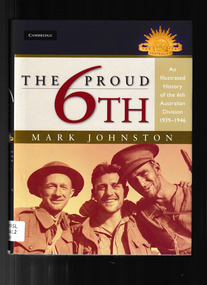
Book, Cambridge University Press, The proud 6th : an illustrated history of the 6th Australian Division, 1939-45, 2008
... The proud 6th : an illustrated history of the 6th Australian Division, 1939-45 ......Divisional histories...Australia - Army - 6th division - History Divisional histories Following Mark Johnston's acclaimed illustrated histories of the 7th and 9th Australian Divisions, this is his long-awaited history of the 6th Australian Division: the first such history ever published. ...Following Mark Johnston's acclaimed illustrated histories of the 7th and 9th Australian Divisions, this is his long-awaited history of the 6th Australian Division: the first such history ever published. The 6th was a household name during World War II. It was the first division raised in the Second Australian Imperial Force, the first division to go overseas and the first to fight. Its success in that fight, in Libya in 1941, indicated that the standard established in the Great War would be continued. General Blamey and nearly every other officer who became wartime army, corps and divisional commanders were once members of the 6th Division. Through photographs and an authoritative text, this book tells their story and the story of the proud, independent and tough troops they commanded.Index, bib, ill, maps, p.269.non-fictionFollowing Mark Johnston's acclaimed illustrated histories of the 7th and 9th Australian Divisions, this is his long-awaited history of the 6th Australian Division: the first such history ever published. The 6th was a household name during World War II. It was the first division raised in the Second Australian Imperial Force, the first division to go overseas and the first to fight. Its success in that fight, in Libya in 1941, indicated that the standard established in the Great War would be continued. General Blamey and nearly every other officer who became wartime army, corps and divisional commanders were once members of the 6th Division. Through photographs and an authoritative text, this book tells their story and the story of the proud, independent and tough troops they commanded. australia - army - 6th division - history, divisional histories -
 Moorabbin Air Museum
Booklet (item) - CAC Marketing booklets - see Description
... CAC Booklets Various general marketing publications Aircraft Fatigue Data Analysis System Type AYM-FI AFDAS Metal Casting Division Marketing - history and summary of products up to 1950s Australian Government Aero-Engine Test Facility Annual Report 1965 Technical Publications Aircraft Engine Support Service Blade and Vane Coating and Repair...CAC Booklets Various general marketing publications Aircraft Fatigue Data Analysis System Type AYM-FI AFDAS Metal Casting Division Marketing - history and summary of products up to 1950s Australian Government Aero-Engine Test Facility Annual Report 1965 Technical Publications Aircraft Engine Support Service Blade and Vane Coating and Repair Booklet CAC Marketing booklets - see Description ... -
 Ringwood and District Historical Society
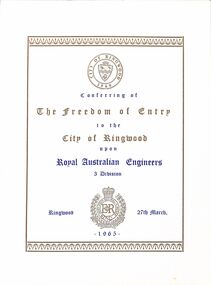
Booklet, Ringwood City Council, City of Ringwood - Freedom of Entry book for Royal Australian Engineers 3 Division, including history of the Division, 1965
... City of Ringwood - Freedom of Entry book for Royal Australian Engineers 3 Division, including history of the Division...Buff coloured book referring to the freedom of entry to the City of Ringwood being granted upon Royal Australian Engineers 3 Division, including how the ceremony originated for granting freedom of entry and order of ceremony.; History of the Royal Australian Engineers 3 Division 1948-1965 and history of the development of Ringwood....City of Ringwood - Freedom of Entry book for Royal Australian Engineers 3 Division, including history of the Division Booklet Ringwood City Council Whitehorse Press ...Buff coloured book referring to the freedom of entry to the City of Ringwood being granted upon Royal Australian Engineers 3 Division, including how the ceremony originated for granting freedom of entry and order of ceremony.; History of the Royal Australian Engineers 3 Division 1948-1965 and history of the development of Ringwood. -
 Flagstaff Hill Maritime Museum and Village
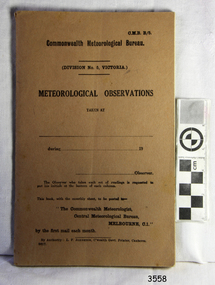
Book - Record Book, Commonwealth Meteorological Bureau, Meteorological Observations, May 1945
... Division No. 5 Victoria...weather readings...weather records...May 1945...weather history...Flagstaff Hill Flagstaff Hill Maritime Museum and Village Warrnambool Maritime Museum Maritime Village Great Ocean Road Shipwreck Coast Meteorological Observations Commonwealth Meteorological Bureau Commonwealth Meteorologist Central Meteorological Bureau Division No. 5 Victoria weather readings weather records May 1945 weather history weather measurement weather record Printed text includes "Commonwealth Meteorological Bureau / DIVISION NO. 5 VICTORIA / METEOROLOGICAL OBSERVATIONS " and "The Observer who takes each set of readings is requested to put his initials at the bottom of each column" " Meteorological Observations, dated May 1945. ...This book of meteorological observations is dated May 1945. The book was published by the Commonwealth Meteorological Bureau, Victora Division. It was printed by L. F. Johnston, Commonwealth Government Printer, Canberra. Readings were recorded daily for barometric pressure, temperature, rain and wind velocity. At the end of each month, they were posted to the central Branch in Melbourne. These Meteorological Observations are an important accurate record of the local weather since the decades. They are part of Flagstaff Hill's Meteorological Observations collection of over seventy record books dating from the late 19th century. The collected information gives a picture of the weather patterns for the months and seasons, which then allows for warnings of events out of the normal or extreme, such as forecasting floods or droughts.Meteorological Observations, dated May 1945. Small brown cardboard printed cover with printed pages prepared for adding records. Published by the Commonwealth of Australia. Printed text includes "Commonwealth Meteorological Bureau / DIVISION NO. 5 VICTORIA / METEOROLOGICAL OBSERVATIONS " and "The Observer who takes each set of readings is requested to put his initials at the bottom of each column" "flagstaff hill, flagstaff hill maritime museum and village, warrnambool, maritime museum, maritime village, great ocean road, shipwreck coast, meteorological observations, commonwealth meteorological bureau, commonwealth meteorologist, central meteorological bureau, division no. 5 victoria, weather readings, weather records, may 1945, weather history, weather measurement, weather record -
 Flagstaff Hill Maritime Museum and Village
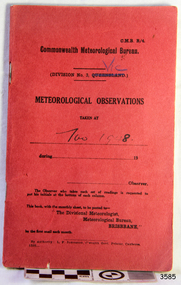
Book - Record Book, Commonwealth Meteorological Bureau, Meteorological Observations, November 1948
... history...weather measurement...weather record...Division...Flagstaff Hill Flagstaff Hill Maritime Museum and Village Warrnambool Maritime Museum Maritime Village Great Ocean Road Shipwreck Coast Meteorological Observations Commonwealth Meteorological Bureau weather readings weather records weather history weather measurement weather record Division No 3 Queensland Victoria November 1848 Printed cover text includes "Central Meteorological Bureau" "METEOROLOGICAL OBSERVATIONS DIVISION No. 3 QUEENSLAND" Handwritten on cover "VIC" "Nov 1948." ...This book of Warrnambool's meteorological observations is dated November 1948. The book was published by the Commonwealth Meteorological Bureau, Victora Division. It was printed by L. F. Johnston, Commonwealth Government Printer, Canberra. It was originally printed for Division 3, Queensland but has been overwritten with 'Vic' [Victoria] and used for Warrnambool. Readings were recorded daily for barometric pressure, temperature, rain and wind velocity. At the end of each month, they were posted to the central Branch in Melbourne.These Meteorological Observations are an important accurate record of the local weather since the decades. They are part of Flagstaff Hill's Meteorological Observations collection of over seventy record books dating from the late 19th century. The collected information gives a picture of the weather patterns for the months and seasons, which then allows for warnings of events out of the normal or extreme, such as forecasting floods or droughts.Meteorological Observations record book. Recordings were taken at Warrnambool in November 1948. Small red cardboard printed cover with printed pages prepared for adding records. Published by the Commonwealth of Australia. The book was printed for Queensland; the cover has been altered by hand to read Vic [Victoria], but the fly page has not been altered.Printed cover text includes "Central Meteorological Bureau" "METEOROLOGICAL OBSERVATIONS DIVISION No. 3 QUEENSLAND" Handwritten on cover "VIC" "Nov 1948."flagstaff hill, flagstaff hill maritime museum and village, warrnambool, maritime museum, maritime village, great ocean road, shipwreck coast, meteorological observations, commonwealth meteorological bureau, weather readings, weather records, weather history, weather measurement, weather record, division no 3 queensland, victoria, november 1848 -
 Flagstaff Hill Maritime Museum and Village
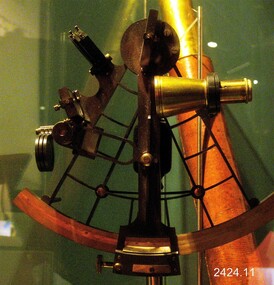
Instrument - Sextant, Late 20th Century
... division of the Smiths Group. In 2002, Kelvin Hughes continues to produce and develop marine instruments for commercial and military. G. Falconer Company History...division of the Smiths Group. In 2002, Kelvin Hughes continues to produce and develop marine instruments for commercial and military. G. Falconer Company History ...In 1941, the scientific instrument manufacturing firms of Henry Hughes & Son Ltd, London, England, and Kelvin Bottomley & Baird Ltd, Glasgow, Scotland, came together to form Kelvin & Hughes Ltd. Kelvin Company History: The origins of the company lie in the highly successful and strictly informal relationship between William Thomson (1824-1907), Professor of Natural Philosophy at Glasgow University from 1846-1899 and James White, a Glasgow optical maker. James White (1824-1884) founded the firm of James White, an optical instrument maker in Glasgow in 1850 and was involved in supplying and mending apparatus for Thomson university laboratory and working with him on experimental constructions. White was declared bankrupt in August 1861 and released several months later. In 1870, White was largely responsible for equipping William Thomson laboratory in the new University premises at Gilmore hill. From 1876, he was producing accurate compasses for metal ships to Thomson design during this period and this became an important part of his business in the last years of his life. He was also involved in the production of sophisticated-sounding machinery that Thomson had designed to address problems encountered laying cables at sea, helping to make possible the first transatlantic cable connection. At the same time, he continued to make a whole range of more conventional instruments such as telescopes, microscopes and surveying equipment. White's association with Thomson continued until he died. After his death, his business continued under the same name, being administered by Matthew Edwards (until 1891 when he left to set up his own company. Thomson who became Sir William Thomson and then Baron Kelvin of Largs in 1892, continued to maintain his interest in the business after James White's death. In 1884 raising most of the capital needed to construct and equip new workshops in Cambridge Street, Glasgow. At these premises, the company continued to make the compass Thomson had designed during the 1870s and to supply it in some quantity, especially to the Admiralty. At the same time, the firm became increasingly involved in the design, production and sale of electrical apparatus. In 1899, Lord Kelvin resigned from his University chair and became, in 1900, a director in the newly formed limited liability company Kelvin & James White Ltd which had acquired the business of James White. At the same time Kelvin's nephew, James Thomson Bottomley (1845-1926), joined the firm. In 1904, a London branch office was opened which by 1915 had become known as Kelvin, White & Hutton Ltd. Kelvin & James White Ltd underwent a further change of name in 1913, becoming Kelvin Bottomley & Baird Ltd. Hughes Company History: Henry Hughes & Sons were founded in 1838 in London as a maker of chronographic and scientific instruments. The firm was incorporated as “Henry Hughes & Sons Ltd” in 1903. In 1923, the company produced its first recording echo sounder and in 1935 a controlling interest in the company was acquired by S Smith & Son Ltd resulting in the development and production of marine and aircraft instruments. Following the London office's destruction in the Blitz of 1941, a collaboration was entered into with Kelvin, Bottomley & Baird Ltd resulting in the establishing “Marine Instruments Ltd”. Following the formal amalgamation of Kelvin, Bottomley & Baird Ltd and Henry Hughes & Sons Ltd in 1947 to form Kelvin & Hughes Ltd. Marine Instruments Ltd then acted as regional agents in the UK for Kelvin & Hughes Ltd who were essentially now a part of Smith's Industries Ltd founded in 1944 and the successors of S. Smith & Son Ltd. Kelvin & Hughes Ltd went on to develop various marine radar and echo sounders supplying the Ministry of Transport, and later the Ministry of Defence. The firm was liquidated in 1966 but the name was continued as Kelvin Hughes, a division of the Smiths Group. In 2002, Kelvin Hughes continues to produce and develop marine instruments for commercial and military. G. Falconer Company History: G Falconer (Hong Kong Ltd) appear to have had a retail presence in Hong Kong since 1885, according to the company website, and currently have a shop in the Peninsula Hotel. G Falconer was the Hong Kong selling agent for several British companies. Ross Ltd of 111 New Bond St London was one and the other was Kelvins Nautical Instruments. Falconers were primarily watchmakers, jewellers and diamond merchants.They were also agents for Admiralty Charts, Ross binoculars and telescopes, and sold English Silverware and High Class English Jewellery. In 1928 the company was operating from the Union Building opposite the Hong Kong general post office. It is unclear if the item is an original Sextant made by Kelvin prior to his amalgamation with Henry Hughes & Sons in 1941 as Kelvin appears to have only made compasses up to this date. If the Sextant can be established that it was made by Kelvin then it is very significant and a rare item made for and distributed through their Hong Kong selling agents G Falconer Ltd. There are many Sextants advertised for sale stating "Kelvin & Hughes 1917 model sextant". These can be regarded as replicas as the company was not formed until 1941 and production of marine instruments was not fully under way until after the war in 1947. Further investigation needs to be undertaken to accurately determine the provenance of this item. As the writer currently has the impression that the subject object was possibly made by Kelvin and Hughes in the mid to late 20th century or is a replica made by an unknown maker in the late 1970s. Purchased as an exhibition of marine navigational instruments for the Flagstaff Hill museum. The Sextant is a brass apparatus with filters and telescope lens, and comes with a wooden felt lined storage box. It is a doubly reflecting navigation instrument that measures the angular distance between two visible objects. The primary use of a sextant is to measure the angle between an astronomical object and the horizon for the purposes of celestial navigation.G Falconer and Co. Hong Kong (retailers of nautical equipmentflagstaff hill, warrnambool, shipwrecked-coast, flagstaff-hill, flagstaff-hill-maritime-museum, maritime-museum, shipwreck-coast, flagstaff-hill-maritime-village, sextant, kelvin & hughes ltd, hong kong, navigational instrument, g falconer, mariner's quadrants -
 Flagstaff Hill Maritime Museum and Village
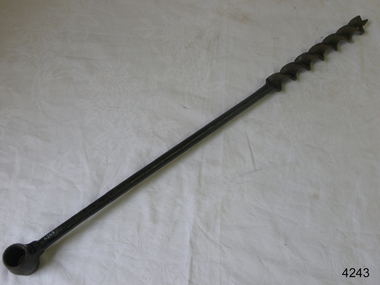
Tool - Auger, Thomas R Ellin, First half of the 20th century
... history as far back as the 1760s when Alfrid Ridge & Sons was established as a manufacturer of woodworking tools. Ridge was bought by the current owning family in 1932. The Footprint brand originates from 1875 when Thomas R Ellin, a member of a cutlery manufacturing family, started a tool manufacturing business under the brand "Footprint". This subsequently became known as Thomas R Ellin (Footprint Works). This company was bought by the current owning family in 1948 and began to manufacture a range of tools under the Footprint, Domino, Climax, John Bull, and Clinker brands. During World War 2 the divisions...history as far back as the 1760s when Alfrid Ridge & Sons was established as a manufacturer of woodworking tools. Ridge was bought by the current owning family in 1932. The Footprint brand originates from 1875 when Thomas R Ellin, a member of a cutlery manufacturing family, started a tool manufacturing business under the brand "Footprint". This subsequently became known as Thomas R Ellin (Footprint Works). This company was bought by the current owning family in 1948 and began to manufacture a range of tools under the Footprint, Domino, Climax, John Bull, and Clinker brands. During World War 2 the divisions ...Footprint Tools is a hand tool manufacturer based in Sheffield, England. In 2014 most of their hand tools were still made in Sheffield at the Footprint factory. Footprint Tools can trace its manufacturing history as far back as the 1760s when Alfrid Ridge & Sons was established as a manufacturer of woodworking tools. Ridge was bought by the current owning family in 1932. The Footprint brand originates from 1875 when Thomas R Ellin, a member of a cutlery manufacturing family, started a tool manufacturing business under the brand "Footprint". This subsequently became known as Thomas R Ellin (Footprint Works). This company was bought by the current owning family in 1948 and began to manufacture a range of tools under the Footprint, Domino, Climax, John Bull, and Clinker brands. During World War 2 the divisions of the business were engaged in manufacturing hand tools for British and Commonwealth forces. After the war Footprint continued to grow, manufacture, and expand its range of hand tools for the professional tradesman. In 2008 Footprint moved to a larger factory and invested in new forging equipment, but this process was interrupted by a global recession, and Footprint was unable to generate enough business to cover the cost of the upgrades. In early 2009 the company was forced to liquidate and lay off its staff to pay creditors. The Jewitt family retained the brand and intellectual property, and later that year revived the company under the name Footprint Sheffield and began producing a smaller range of products at first. With the same family of owner-managers, now run by the fourth generation, in 2015 Footprint continues to manufacture most of their products in Sheffield, England, and exports worldwide.This item gives us a look into the history of the beginnings of an early company that made tools in Sheffield England and is still producing tools today.Ring Auger, Double Twist with Lead Screw, bit 1" with round shaft Imprinted 'footprint' trademarkflagstaff hill, warrnambool, shipwrecked-coast, flagstaff-hill, flagstaff-hill-maritime-museum, maritime-museum, shipwreck-coast, flagstaff-hill-maritime-village -
 Federation University Historical Collection
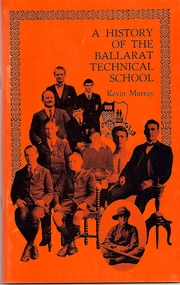
Booklet, Waller & Chester, A History of the Ballarat Technical School by Kevin Murray, 1969, 1969
... division of the Ballarat School of Mines. It was originally known as the Ballarat Junior Technical School. ballarat technical school ballarat junior technical school ballarat school of mines kevin murray albert steane Orange covered booklet A History of the Ballarat Technical School by Kevin Murray, 1969 Booklet Booklet Kevin Murray Waller & Chester ...The Ballarat Technical School was a division of the Ballarat School of Mines. It was originally known as the Ballarat Junior Technical School.Orange covered bookletballarat technical school, ballarat junior technical school, ballarat school of mines, kevin murray, albert steane -
 Federation University Historical Collection
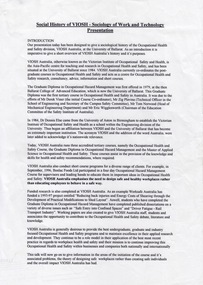
Document - Document - Presentation, VIOSH: Social History; Introduction to Sociology of Work and Technology Presentation, post 1997
... history of the development of VIOSH, and those responsible. They were Derek Viner (the initial Course Co-ordinator), Mr Tom Norwood (Head of the Mechanical Engineering Department), Mr Eric Wigglesworth (Chairman of the Education Committee of the Safety Institute of Australia) and Mr Zig Plavina (Technical Officer in the School of Engineering and Secretary of the Campus Safety Committee). Dr Dennis Else from the University of Aston, Birmingham arrived to establish the Victorian Institute of Occupational Safety and Health within the Engineering division...history of the development of VIOSH, and those responsible. They were Derek Viner (the initial Course Co-ordinator), Mr Tom Norwood (Head of the Mechanical Engineering Department), Mr Eric Wigglesworth (Chairman of the Education Committee of the Safety Institute of Australia) and Mr Zig Plavina (Technical Officer in the School of Engineering and Secretary of the Campus Safety Committee). Dr Dennis Else from the University of Aston, Birmingham arrived to establish the Victorian Institute of Occupational Safety and Health within the Engineering division ...Victorian Institute of Occupational Safety and Health (VIOSH) Australia is the Asia-Pacific centre for teaching and research in occupational health and safety (OHS) and is known as one of Australia's leaders on the field. VIOSH has a global reputation for its innovative approach within the field of OHS management. VIOSH had its first intake of students in 1979. At that time the Institution was known as the Ballarat College of Advanced Education. In 1990 it became known as Ballarat University College, then in 1994 as University of Ballarat. It was 2014 that it became Federation University. VIOSH Australia students are safety managers, senior advisors and experienced OHS professionals. They come from all over Australia and industry. Students are taught active research and enquiry; rather than textbook learning and a one-size fits all approach. VIOSH accepts people into the Graduate Diploma of Occupational Hazard Management who have no undergraduate degree - on the basis of extensive work experience and knowledge. Brief outline of the history of the development of VIOSH, and those responsible. They were Derek Viner (the initial Course Co-ordinator), Mr Tom Norwood (Head of the Mechanical Engineering Department), Mr Eric Wigglesworth (Chairman of the Education Committee of the Safety Institute of Australia) and Mr Zig Plavina (Technical Officer in the School of Engineering and Secretary of the Campus Safety Committee). Dr Dennis Else from the University of Aston, Birmingham arrived to establish the Victorian Institute of Occupational Safety and Health within the Engineering division of the University. Following the introductory speech, the talk gave information on the development, problems and theory of designing safe workplaces.One A4 page typed.viosh, victorian institute of occupational safety and health, social history, sociology, derek viner, course co-ordinator, tom norwood, head of mechanical engineering, eric wigglesworth, chairman, education committee of the safety institute of australia, zig plavina, technical officer, school of engineering, campus safety committee, university of aston, dennis else -
Federation University Historical Collection
Book - Book - Scrapbook, Ballarat School of MInes: Scrapbook of Newspaper Cuttings, Book 79. June 1997 to August 1997
... history...town and gown debate...viticulture traineeship program...one tafe division...The papers concerned are The Courier, Ballarat, The Australian, The Age and other region papers over the period of 7 June 1997 to 5 August 1997. teaching positions advertised pre-employment courses courses available enrolment for smb courses nathan holliday nrma top apprentice scott brady ballarat's gallows mystery solved federal tafe plan worries smb head memorial plaque to hanged men freighter's engineering traineeship tafe merger creates super-college smb agrees to merger wimmera tafe rejects merger new evidence points to remains' location peter bailey to compete in youth skills olympics switzerland merger official course on providing a home away from home roy schrieke retires descendant against memorial peter bailey gold medallist skill olympics in st gallen excellent results for ballarat region aquaculture course historic sites listed henry sutton reverse tafe decision stawell times-news more host families needed david belford award winner city yearning for cultural heart corporate learning gold medal for peter bailey competition on apprentice funding'play revisits our history town and gown debate viticulture traineeship program one tafe division career in food row looms over staff offers jeff kennet cuts new attitude to education victorian primary industries board apprenticeships rural studies department Book with yellow cover, front, spiral bound. ...Collection of newspaper articles related to Ballarat School Of Mines.They cover activities and advertisements for staff. The papers concerned are The Courier, Ballarat, The Australian, The Age and other region papers over the period of 7 June 1997 to 5 August 1997. Book with yellow cover, front, spiral bound. teaching positions advertised, pre-employment courses, courses available, enrolment for smb courses, nathan holliday, nrma top apprentice, scott brady, ballarat's gallows mystery solved, federal tafe plan worries smb head, memorial plaque to hanged men, freighter's engineering traineeship, tafe merger creates super-college, smb agrees to merger, wimmera tafe rejects merger, new evidence points to remains' location, peter bailey to compete in youth skills olympics, switzerland, merger official, course on providing a home away from home, roy schrieke retires, descendant against memorial, peter bailey gold medallist, skill olympics in st gallen, excellent results for ballarat region, aquaculture course, historic sites listed, henry sutton, reverse tafe decision, stawell times-news, more host families needed, david belford award winner, city yearning for cultural heart, corporate learning, gold medal for peter bailey, competition on apprentice funding'play revisits our history, town and gown debate, viticulture traineeship program, one tafe division, career in food, row looms over staff offers, jeff kennet cuts, new attitude to education, victorian primary industries board apprenticeships, rural studies department -
 Lara RSL Sub Branch
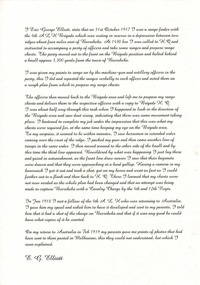
Statement By Eric George Elliott on the Light Horse Brigade charge at Beersheba
... Decisive victory at Beersheba fell to one of the last great charges of mounted troops in history. As Australian Light Horse Divisions captured the town and secured crucial water wells, their success also marked the beginning of the end of the war in the Middle East. ...This statement by Eric George Elliott tells how The battle of Beersheba took place on 31 October 1917 as part of the wider British offensive collectively known as the third Battle of Gaza. The final phase of this all day battle was the famous mounted charge of the 4th Light Horse Brigade. Commencing at dusk, members of the brigade stormed through the Turkish defences and seized the strategic town of Beersheba. The capture of Beersheba enabled British Empire forces to break the Ottoman line near Gaza on 7 November and advance into Palestine.Decisive victory at Beersheba fell to one of the last great charges of mounted troops in history. As Australian Light Horse Divisions captured the town and secured crucial water wells, their success also marked the beginning of the end of the war in the Middle East. This end came exactly a year to the day after success at Beersheba.Rectangular shaped glass covered picture frame with a photocopy of his statement on the charge of Beersheba.ww!, beersheba, statement, photocopy, australian light horse brigade. -
 Lara RSL Sub Branch
Photograph, Set 4 photographs. and others for Torquay Light Horse camp, 1940
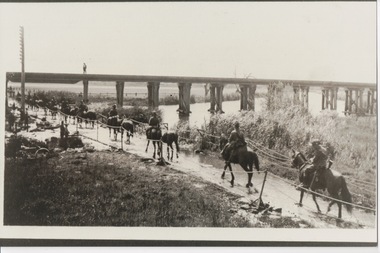
... history and the sentiments of ‘change’ for the Light Horse Brigade – from horses to machines. In 1940 the four Light Horse Regiments (4th, 8th, 13th and 20th), some 5000 Light Horse and 2000 horses camped and trained at Torquay. Three other regiments, formerly mounted on horses, were also at Torquay ‘mounted’ on privately owned trucks and cars. Division...history and the sentiments of ‘change’ for the Light Horse Brigade – from horses to machines. In 1940 the four Light Horse Regiments (4th, 8th, 13th and 20th), some 5000 Light Horse and 2000 horses camped and trained at Torquay. Three other regiments, formerly mounted on horses, were also at Torquay ‘mounted’ on privately owned trucks and cars. Division ...These images capture for all time Light Horsemen travelling through Geelong on their way to camp at Torquay for the last Group meeting in Australia . information following - details obtained from .........https://torquayhistory.com/light-horse-brigade/ On Australia Day, 1997, Sir John Young unveiled this plaque on Point Danger, Torquay. Torquay history, Light Horse Training Camp, WW2 Plaque at Pt. Danger Note----- (See images to view plaque) The plaque identifies a significant event in Torquay’s history and the sentiments of ‘change’ for the Light Horse Brigade – from horses to machines. In 1940 the four Light Horse Regiments (4th, 8th, 13th and 20th), some 5000 Light Horse and 2000 horses camped and trained at Torquay. Three other regiments, formerly mounted on horses, were also at Torquay ‘mounted’ on privately owned trucks and cars. Division troops included Artillery, Engineers, Signals, Field Ambulance and other branches of the Army necessary to enable a Division to function. It wasn’t just the sheer numbers of men coming to this little town that made the event significant, it was also the fact that the men of the Light Horse were dramatic, almost glamorous figures and it is easy to see their exploits as some splendid adventure. Horses have played a special role in the story of Australia. They were the only means of transport across this huge country, so it was necessary for everyone to have the ability to ride a horse. When war broke out in 1899 between Britain and the Boers of South Africa (“Boer” was Dutch for “farmer”) Australia sent troops to fight. At first Britain was wary of using untried, unprofessional colonial cavalrymen but soon saw that the slouch-hatted Australian “bushmen” were a match for the fast-moving and unconventional mounted commandos of the Boers. The Australians proved themselves to be expert rough-riding horsemen and good shots. Bush life had hardened them to go for long periods with little food and water. They also showed remarkable ability to find their way in a strange country and use its features for cover, in both attack and defence. By 1914, when Australia joined the war against Germany, there were 23 Light Horse regiments of militia volunteers. Many men from these units joined the Light Horse regiments of the Australian Imperial Force (AIF). Men were given remounts (if not using their own horses) – army horses bought by Commonwealth purchasing officers from graziers and breeders. These were called “walers” because they were a New South Wales stockhorse type – strong, great-hearted animals with the strains of the thoroughbred and semi-draught to give them speed, strength and stamina. On 1st November, 1914, Australia’s First Infantry Division and the first four Light Horse regiments sailed for England in a fleet of transport ships. The first of the Light Horse arrived at Gallipoli in May without their horses. Back with their horses after Gallipoli, they were formidable combatants across the Sinai and Palestine. Some British commanders observed that the light horseman moved with a “lazy, slouching gait, like that of a sleepy tiger” but described how the promise of battle “changes that careless gait, into a live athletic swing that takes him over the ground much quicker than other troops”. They had Light Horse, Torquay, training campdeveloped a reputation as formidable infantrymen. The Turks called them “the White Ghurkas” – a reference to their deadly skill with the bayonet. The Arabs called them “The Kings of the Feathers”. The plume had originally been a battle honour of the Queensland Mounted Infantry for their work in the shearer’s strike of 1891. During WW1 it was adopted by almost all the Light Horse Regiments. It was the proud badge of the light horseman. The most famous of their battles was the attack on Beersheba- the charge of the 4th Light Horse Brigade. Mounted infantrymen and their superb walers had carried out one of the most successful cavalry charges in history – against what seemed impossible odds. They surprised the Turks by charging cavalry-style, when they would normally have ridden close to an objective then dismounted to fight. The fall of Beersheba swung the battle tide against the Turks in Palestine; and changed the history of the Middle East. While 19 men from the Surf Coast Shire served with the 4th Light Horse over the course of WW1, only four were involved in the charge of Beersheba- John GAYLARD, Philip QUINN.(Winchelsea); Wallace FINDLAY (Anglesea); Harry TRIGG (Bambra). After the war, Light Horse units played a key role in the Australian Government’s compulsory military training programme. The Citizen Military Forces (C.M.F.) thrived on the glamour of the wartime Light Horse tradition, ignoring the possibility that motor vehicles would soon replace the horses. When training was no longer compulsory, the C.M.F. regiments declined and horses became more of a luxury during the 1930s depression years of poverty and unemployment. Some regiments were motorised. Then, in 1939, Australia joined Britain in another world war. Training was increased for the militia at both home bases and regional training camps. The camp at Torquay in 1940, commanded by Major General Rankin, was at Divisional strength. By the end of the camp some felt that the Division was ready for active service. Gradually, over the next four years, the Australian Light Horse units were mounted on wheels and tracks and the horses were retired. Six men enlisted at the Torquay camp and another 57 men and women enlisted at Torquay for service in WW2. Those who served in the Militia provided valuable Officers and NCOs and men for the armed services during the war. Each infantry division of the 2nd AIF had a Light Horse regiment attached to it. But the day of the Australian mounted soldier hadn’t quite passed. During World War II, Australia’s 6th Cavalry Regiment formed a mounted unit they called “The Kelly Gang” which did valuable scouting work. In New Guinea, a mounted Light Horse Troop did patrol duty and helped carry supplies. Some fully equipped walers were flown into Borneo for reconnaissance in rugged mountain country. But by the end of the war, in 1945, the horse had disappeared from the Australian Army. References: Australian Light Horse Association www.lighthorse.org.au National Australia Archives Australian War Memorial Surf Coast Shire WW1 memorials www.togethertheyserved.com The Light horse- a Cavalry under Canvas Light Horse, Training Camp, Torquay, WW2 Late in 1939 it was decided to set up a Lighthorse training camp in Torquay to train both men and horses for the battles of the Second World War. Horses, men and equipment came on special trains from all over Victoria and NSW, and as you would expect horseman came from areas such as Omeo and Sale, the Wimmera and the Western District. They arrived at the Geelong racecourse for watering in the Barwon River and then were ridden across the ford at the breakwater and began their 11 mile trek to Torquay. Light Horse, Training Camp, Torquay, WW2 Tent city By the end of January 1940 the camp at Torquay accommodated some 5000 men and 2500 horses of the Second Cavalry Division. The rows of horses, tents and huts near Blackgate Road were quite a sight. While the cavalrymen engaged in exercises on the land and on the beaches, many of the troops took over the Torquay School for special training of men and officers. Mr Bob Pettit local farmer and Councillor for the Barrabool Shire, wrote about the Light horse in the Surf Coast Community News in 1985 saying “They used to travel about the district riding four abreast in one long convoy. To my annoyance they went through my property and shut all the gates behind them. I had certain gates open to let stock in to the water holes and it would take me three -quarters of an hour to follow the horsemen up and put all the gates right again” he continued “the men from the Light Horse were here when the fire went through in March 1940. He recalled an incident when early one morning, as some one blew the bugle, a soldier putting a white sheet on the line frightened the horses. They panicked and ran off in all directions. Six went over the cliff near Bird Rock, five were never found, and the rest were gathered up after nearly a fortnight in the bush around Addiscott and Anglesea" Light Horse, Training Camp, Torquay, WW2, Geelong Parade Geelong parade The training camp culminated in a parade through the streets of Geelong on March 12th 1940. The salute was given at the Town Hall and the troops continued on a route to the You Yang’s for a training exercise. Note-----(see media section for photograph) The Camp was abandoned in mid 1940 as it was deemed unsuitable for training during winter and the cost of a permanent camp could not be justified if it could not be used all year. Historic.......Rare,,,Interpretive.Sepia photographs.set of four ....post card size ....Horses &LighthorsemenNo 1, Lighthorsemen Regiment Geelong 1940......No 2 Light Horse at Breakwater Geelong 1938 to 1940....No 3 Light Horse at Breakwater Geelong 1938 to 1940.....No 4 Light Horse crossing Breakwater camped at Geelong Showgrounds. These markings are on reverse of photographs.light horsemengeelong 1940., world war 2 -
 Lara RSL Sub Branch
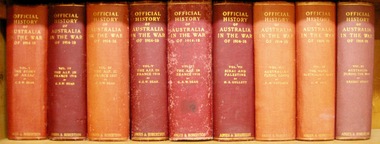
Book, The Anzac Book Official History of Australia in theWar of 1914-18 Volume III The AIFin France 1916. Author C.E.W. Bean 6th Edition 1938
... AIF in France 1916 egypt desert line france suez canal camel train ferry post armentieres ypres aif battle of fromelles 5th division pozieres mouquet farm The Anzac Book - Printed 1916 Hardback cardboard Illustrations, maps and diagrams Chronology of 1916 The Anzac Book Official History of Australia in theWar of 1914-18 Volume III The AIFin France 1916. ...The Australian Imperial Force in France 1916Historical chronology including colour patches. AIF in France 1916The Anzac Book - Printed 1916 Hardback cardboard Illustrations, maps and diagrams Chronology of 1916egypt, desert line, france, suez canal, camel train, ferry post, armentieres, ypres, aif, battle of fromelles, 5th division, pozieres, mouquet farm -
 Lara RSL Sub Branch
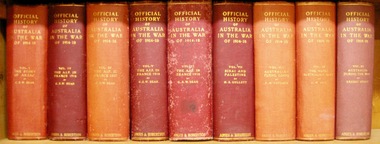
Book, Official History of Australia in the War of 1914-18 - Volume IV - The AIF in France 1917 Author C.E.W.Bean, Fifth edition 1937
... This volume discovers four of the five Australian Infantry Divisions expecting relief after their most depressing experience, the winter of 1916-17on the Somme. australian infantry divisions british armies hindenburg line bullecourt battle of messines battle of passchendaele polygon wood france ypres broodseinde ridge hill 60 Official History of Australia in the War of 1914-18 - Volume IV - The AIF in France 1917 Hardcover cardboard, Chronology, Maps, Illustrations Official History of Australia in the War of 1914-18 - Volume IV - The AIF in France 1917 Author C.E.W.Bean Book ...This volume discovers four of the five Australian Infantry Divisions expecting relief after their most depressing experience, the winter of 1916-17on the Somme.Official History of Australia in the War of 1914-18 - Volume IV - The AIF in France 1917 Hardcover cardboard, Chronology, Maps, Illustrationsaustralian infantry divisions, british armies, hindenburg line, bullecourt, battle of messines, battle of passchendaele, polygon wood, france, ypres, broodseinde ridge, hill 60 -
 Lara RSL Sub Branch
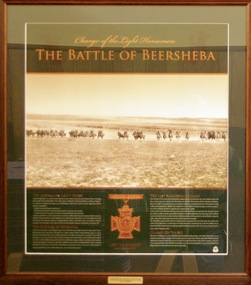
Photograph, Battle of Beersheba - Limited Edition of 1917, Rememberance Day 2008
... Decisive victory at Beersheba fell to one of the last great charges of mounted troops in history. As Australian Light Horse Divisions captured the town and secured crucial water wells, their success also marked the beginning of the end of the war in the Middle East. ...The battle of Beersheba took place on 31 October 1917 as part of the wider British offensive collectively known as the third Battle of Gaza. The final phase of this all day battle was the famous mounted charge of the 4th Light Horse Brigade. Commencing at dusk, members of the brigade stormed through the Turkish defences and seized the strategic town of Beersheba. The capture of Beersheba enabled British Empire forces to break the Ottoman line near Gaza on 7 November and advance into Palestine.Decisive victory at Beersheba fell to one of the last great charges of mounted troops in history. As Australian Light Horse Divisions captured the town and secured crucial water wells, their success also marked the beginning of the end of the war in the Middle East. This end came exactly a year to the day after success at Beersheba.Rectangular shaped glass covered picture frame showing the Light Horsemen.Charge of the Light Horsemen The Battle of Beershebabeersheba, the light horse, lara r.s.l.,world war one, battle of beersheba, ww1 -
 Federation University Historical Collection
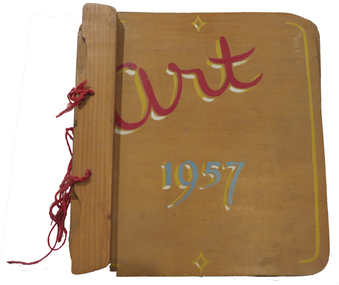
Book, Ballarat Technical Art School Student's Workbook, 1957
... art scrap book art history ballarat technical art school d. rash artists workbook journal Workbook and scrapbook compiled by a student of the Ballarat Junior Technical School or Ballarat Technical Art School a division of the Ballarat School of Mines. ...Workbook and scrapbook compiled by a student of the Ballarat Junior Technical School or Ballarat Technical Art School a division of the Ballarat School of Mines. art, scrap book, art history, ballarat technical art school, d. rash, artists workbook, journal -
 Flagstaff Hill Maritime Museum and Village
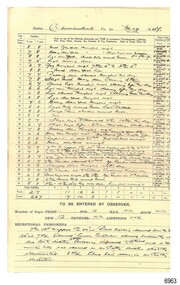
Journal - Record Book, Meteorological Observations, 1947-1948
... Division 5...weather measurement...weather forecast...weather history...The collected information gives a picture of the weather patterns for the months and seasons, which then allows for warnings of events out of the normal or extreme, such as forecasting floods or droughts. flagstaff hill warrnambool Great Ocean Road Shipwreck Coast Flagstaff Hill Maritime Museum and Village Maritime Museum Maritime Village Meteorological Observations Weather records Meteorology barometer readings temperature records barometer records wind records rain records Commonwealth of Australia Division 5 weather measurement weather forecast weather history Carrington Harbour Master Printed: "COMMONWEALTH OF AUSTRALIA METEROLOGICAL OBSERVATIONS / Division No. 5, Vic. " Meteorological Observations for Warrnambool March 1947 to May 1948. ...This bundel of twenty pages of meteorological observations covers the period between March 1947 and April 1948 but there are some gaps. The bundle includes handwritten records on pre-printed forms from the Commonwealth Government and brief records on plain paper. There are calculations for monthly totals of information such as rainfall, and there are some comparisons between the years. One of the forms has handwriting in three directions, which is quite unusual. Readings were recorded daily for barometer, temperature and wind. There was also a section for comments on Exceptional Phenomena such as storms and fog. . It was one of the many duties of the Lighthouse Keeper or his Assistant to keep these records and make the mathematical calculations required by the Government. Information gathered from Lighthouse Keepers' letters tells of the large amount of time taken for this detailed work and the lack of payment made for such a responsibility. The quite detailed record for May, June and July 1947 were signed by C Carrington, Harbour Master for Warrnambool. Captain Carrington was responsible to the Harborus Board. He was responsibilite for the fortnightly training of the Warrnambool Lifeboat Crew on the practice of lifesaving and using the Rocket Rescue equipment. These Meteorological Observations are an important accurate record of the local weather since the late 1899s. They are part of Flagstaff Hill's Meteorological Observations collection of over seventy record books dating from the late 19th century. The collected information gives a picture of the weather patterns for the months and seasons, which then allows for warnings of events out of the normal or extreme, such as forecasting floods or droughts.Meteorological Observations for Warrnambool March 1947 to May 1948. A bundle of unbound sheets of paper joined at the top left corner with a metal fastener. The pages are ordered from most recent on top to the oldest on bottom. The older records are on pre-printed forms and include many handwritten details. The more recent records are handwritten on plain paper. There is a line for each day of the month and lines for calculations at the bottom of the page. The handwritten Information includes readings for Barometer, Temperature, Wind and Rain. Printed: "COMMONWEALTH OF AUSTRALIA METEROLOGICAL OBSERVATIONS / Division No. 5, Vic. "flagstaff hill, warrnambool, great ocean road, shipwreck coast, flagstaff hill maritime museum and village, maritime museum, maritime village, meteorological observations, weather records, meteorology, barometer readings, temperature records, barometer records, wind records, rain records, commonwealth of australia, division 5, weather measurement, weather forecast, weather history, carrington, harbour master -
 Flagstaff Hill Maritime Museum and Village
Book - Reference Bible, Matthew Henry, An Exposition of The Old and New Testament Vol 2, 1790
... division, decline, exile, and return. In practical terms, it is the section of his commentary focused on narrative history rather than law, prophecy or poetry. ...Volume 2 of Matthew Henry’s An Exposition of the Old and New Testament covers the historical books of the Old Testament from Joshua through Esther, that is, Joshua, Judges, Ruth, 1–2 Samuel, 1–2 Kings, 1–2 Chronicles, Ezra, Nehemiah, and Esther. Henry says this volume spans Israel’s story “from their first settlement in the promised land” after Egypt and the wilderness to their restoration after Babylonian captivity. So the material moves from conquest and settlement to monarchy, division, decline, exile, and return. In practical terms, it is the section of his commentary focused on narrative history rather than law, prophecy or poetry.An Exposition of The Old and New Testament Vol 2 Author: Matthew Henry Publisher: Bell and Bradfute, Dickson and M'Cleish Date: 1790 Further Information: Badly worn brown hardcover and spine. The spine has a Library label with an inscription. non-fictionVolume 2 of Matthew Henry’s An Exposition of the Old and New Testament covers the historical books of the Old Testament from Joshua through Esther, that is, Joshua, Judges, Ruth, 1–2 Samuel, 1–2 Kings, 1–2 Chronicles, Ezra, Nehemiah, and Esther. Henry says this volume spans Israel’s story “from their first settlement in the promised land” after Egypt and the wilderness to their restoration after Babylonian captivity. So the material moves from conquest and settlement to monarchy, division, decline, exile, and return. In practical terms, it is the section of his commentary focused on narrative history rather than law, prophecy or poetry.flagstaff hill, warrnambool, shipwrecked coast, flagstaff hill maritime museum, maritime museum, shipwreck coast, flagstaff hill maritime village, great ocean road, book, pattison collection, warrnambool library, warrnambool mechanics’ institute, ralph eric pattison, corangamite regional library service, warrnambool city librarian, mechanics’ institute library, victorian library board, warrnambool books and records, warrnambool children’s library, matthew henry, an exposition of the old and new testament vol 1, bell and bradfute, dickson and m'cleish -
 Flagstaff Hill Maritime Museum and Village
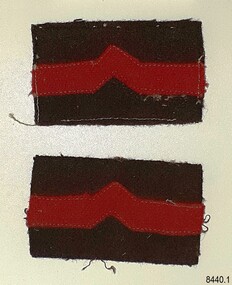
Badge - Australian Military cloth patch, Army Medical Corps, Non-Divisional Units, 1925 - 1942
... Angus Collection Australian Army Surgeon Captain Ballarat Bonegilla badge insignia badge collection World War 2 Second World War Australian Defence Forces Army Medical Corps Military uniform cloth patch insignia patch Australian Army Medical Corp (Militia) WW 2 ww II 1925-1940 Military badge Non-Divisional Unit AAMC 1940-1942 8th Field Ambulance peacetime training insignia history Badge, cloth insignia patch. ...The cloth insignia badges date to 1925-1940, after the First World War and into the early Second World War era. During peacetime training, the "brown with a cherry-red crossbar" badge was initially used for the 8th Field Ambulance, 2nd Military District Medical and Veterinary Stores. The colour patch was approved for wear by full-time duty personnel of all medical units apart from the Infantry and Cavalry. In 1942 these patches were replaced by the new scheme of colour patches introduced by the Australian Army Medical Corps. Dr W R Angus was a Surgeon Captain for the Australian Defence Forces, Army Medical Corps, stationed in Ballarat, Victoria, and in Bonegilla, N.S.W. He completed his service just before the end of the war due to suffering from a heart attack. The badges are now part of Flagstaff Hill’s comprehensive W.R. Angus Collection, donated by the family of Dr W R Angus (1901-1970), surgeon and oculist. The W.R. Angus Collection: - The W.R. Angus Collection includes historical medical equipment, surgical instruments and material belonging to Dr Edward Ryan and Dr Thomas Francis Ryan, (both of Nhill, Victoria) and Dr Angus’ own belongings. The Collection’s history spans the medical practices of the two Doctors Ryan, from 1885-1926 plus that of Dr Angus, up until 1969. It includes historical medical and surgical equipment and instruments from the doctors Edward and Thomas Ryan of Nhill, Victoria. Dr Angus married Gladys in 1927 at Ballarat, the nearest big city to Nhill where he began as a Medical Assistant. He was also Acting House surgeon at the Nhill hospital where their two daughters were born. During World War II He served as a Military Doctor in the Australian Defence Forces. Dr Angus and his family moved to Warrnambool in 1939, where Dr Angus operated his own medical practice. He later added the part-time Port Medical Officer responsibility and was the last person appointed to that position. Both Dr Angus and his wife were very involved in the local community, including the planning stages of the new Flagstaff Hill and the layout of the gardens there. Dr Angus passed away in March 1970.These colour insignia patches represent the history between the First and Second World Wars and the evolution of Australian Army Medical Corps patches. They Dr W R Angus (1901-1970), surgeon and oculist, collected a range of military objects including those he personally used during his time as Surgeon Captain in the Australian Defence Forces in World War II. The item allows insight into military life in the early-to-mid 20th century. The W.R. Angus Collection is significant for still being located at the site it is connected with, Doctor Angus being the last Port Medical Officer in Warrnambool. The Collection includes historical medical objects that date back to the late 1800s.Badge, cloth insignia patch. Pair of two Insignia colour patches.Red stripe with an inverted 'V' shape on brown fabric. Insignia of the Australian Army Medical Corps, Non-Divisional Units. One badge has light-coloured stitches around the perimeter. The cloth patches belonged to Dr W R Angus and are now part of the W. R. Angus Collection.flagstaff hill, warrnambool, maritime village, maritime museum, shipwreck coast, great ocean road, flagstaff hill maritime museum and village, dr w r angus, w.r. angus collection, australian army, surgeon captain, ballarat, bonegilla, badge, insignia, badge collection, world war 2, second world war, australian defence forces, army medical corps, military uniform, cloth patch, insignia patch, australian army medical corp (militia), ww 2, ww ii, 1925-1940, military badge, non-divisional unit, aamc, 1940-1942, 8th field ambulance, peacetime training, insignia history -
 Flagstaff Hill Maritime Museum and Village
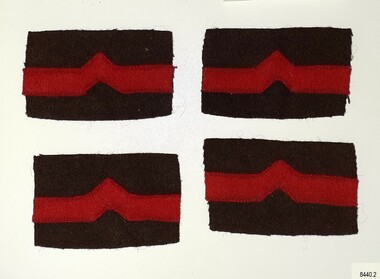
Badge - Australian Military cloth patch, Army Medical Corps, Non-Divisional Units, 1925 - 1942
... Angus Collection Australian Army Surgeon Captain Ballarat Bonegilla badge insignia badge collection World War 2 Second World War Australian Defence Forces Army Medical Corps Military uniform cloth patch insignia patch Australian Army Medical Corp (Militia) WW 2 ww II 1925-1940 Military badge Non-Divisional Unit AAMC 1940-1942 8th Field Ambulance peacetime training insignia history Badge, cloth insignia patch. ...The cloth insignia badges date to 1925-1940, after the First World War and into the early Second World War era. During peacetime training, the "brown with a cherry-red crossbar" badge was initially used for the 8th Field Ambulance, 2nd Military District Medical and Veterinary Stores. The colour patch was approved for wear by full-time duty personnel of all medical units apart from the Infantry and Cavalry. In 1942 these patches were replaced by the new scheme of colour patches introduced by the Australian Army Medical Corps. Dr W R Angus was a Surgeon Captain for the Australian Defence Forces, Army Medical Corps, stationed in Ballarat, Victoria, and in Bonegilla, N.S.W. He completed his service just before the end of the war due to suffering from a heart attack. The badges are now part of Flagstaff Hill’s comprehensive W.R. Angus Collection, donated by the family of Dr W R Angus (1901-1970), surgeon and oculist. The W.R. Angus Collection: - The W.R. Angus Collection includes historical medical equipment, surgical instruments and material belonging to Dr Edward Ryan and Dr Thomas Francis Ryan, (both of Nhill, Victoria) and Dr Angus’ own belongings. The Collection’s history spans the medical practices of the two Doctors Ryan, from 1885-1926 plus that of Dr Angus, up until 1969. It includes historical medical and surgical equipment and instruments from the doctors Edward and Thomas Ryan of Nhill, Victoria. Dr Angus married Gladys in 1927 at Ballarat, the nearest big city to Nhill where he began as a Medical Assistant. He was also Acting House surgeon at the Nhill hospital where their two daughters were born. During World War II He served as a Military Doctor in the Australian Defence Forces. Dr Angus and his family moved to Warrnambool in 1939, where Dr Angus operated his own medical practice. He later added the part-time Port Medical Officer responsibility and was the last person appointed to that position. Both Dr Angus and his wife were very involved in the local community, including the planning stages of the new Flagstaff Hill and the layout of the gardens there. Dr Angus passed away in March 1970.These colour insignia patches represent the history between the First and Second World Wars and the evolution of Australian Army Medical Corps patches. Dr W R Angus (1901-1970), surgeon and oculist, collected a range of military objects including those he personally used during his time as Surgeon Captain in the Australian Defence Forces in World War II. The item allows insight into military life in the early-to-mid 20th century. The W.R. Angus Collection is significant for still being located at the site it is connected with, Doctor Angus being the last Port Medical Officer in Warrnambool. The Collection includes historical medical objects that date back to the late 1800s.Badge, cloth insignia patch. Set of four Insignia colour patches.Red stripe with an inverted 'V' shape on brown fabric. Insignia of the Australian Army Medical Corps, Non-Divisional Units. The cloth patches belonged to Dr W R Angus and are now part of the W. R. Angus Collection.flagstaff hill, warrnambool, maritime village, maritime museum, shipwreck coast, great ocean road, flagstaff hill maritime museum and village, dr w r angus, w.r. angus collection, australian army, surgeon captain, ballarat, bonegilla, badge, insignia, badge collection, world war 2, second world war, australian defence forces, army medical corps, military uniform, cloth patch, insignia patch, australian army medical corp (militia), ww 2, ww ii, 1925-1940, military badge, non-divisional unit, aamc, 1940-1942, 8th field ambulance, peacetime training, insignia history -
 Flagstaff Hill Maritime Museum and Village
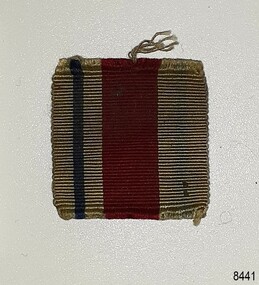
Badge - Insignia Ribbon, 1939-1945
... Angus Collection Australian Army Surgeon Captain Ballarat Bonegilla badge insignia badge collection World War 2 Second World War Australian Defence Forces Army Medical Corps Military uniform cloth patch insignia patch Australian Army Medical Corp (Militia) WW 2 ww II 1925-1940 Military badge Non-Divisional Unit AAMC 1940-1942 8th Field Ambulance peacetime training insignia history insignia ribbon ribbon patch Badge, woven ribbon insignia patch. ...The cloth insignia patch is one of a collection of military badges that date to the World War II period. This ribbon has not yet been identified. The badges are now part of Flagstaff Hill’s comprehensive W.R. Angus Collection, donated by the family of Dr W R Angus (1901-1970), surgeon and oculist. Dr W R Angus was a Surgeon Captain for the Australian Defence Forces, Army Medical Corps, stationed in Ballarat, Victoria, and in Bonegilla, N.S.W. He completed his service just before the end of the war due to suffering from a heart attack. The W.R. Angus Collection: - The W.R. Angus Collection includes historical medical equipment, surgical instruments and material belonging to Dr Edward Ryan and Dr Thomas Francis Ryan, (both of Nhill, Victoria) and Dr Angus’ own belongings. The Collection’s history spans the medical practices of the two Doctors Ryan, from 1885-1926 plus that of Dr Angus, up until 1969. It includes historical medical and surgical equipment and instruments from the doctors Edward and Thomas Ryan of Nhill, Victoria. Dr Angus married Gladys in 1927 at Ballarat, the nearest big city to Nhill where he began as a Medical Assistant. He was also Acting House surgeon at the Nhill hospital where their two daughters were born. During World War II He served as a Military Doctor in the Australian Defence Forces. Dr Angus and his family moved to Warrnambool in 1939, where Dr Angus operated his own medical practice. He later added the part-time Port Medical Officer responsibility and was the last person appointed to that position. Both Dr Angus and his wife were very involved in the local community, including the planning stages of the new Flagstaff Hill and the layout of the gardens there. Dr Angus passed away in March 1970.This insignia ribbon is connected to the collection of military badges in the W.R. Angus Collection. Dr W R Angus (1901-1970), surgeon and oculist, collected a range of military objects including those he personally used during his time as Surgeon Captain in the Australian Defence Forces in World War II. The item allows insight into military life in the early-to-mid 20th century. The W.R. Angus Collection is significant for still being located at the site it is connected with, Doctor Angus being the last Port Medical Officer in Warrnambool. The Collection includes historical medical objects that date back to the late 1800s.Badge, woven ribbon insignia patch. Rectangular patch has vertical stripes, one is a narrow blue stripe and the other is a wide red or crimson stripe. The cloth patches belonged to Dr W R Angus and are now part of the W. R. Angus Collection.flagstaff hill, warrnambool, maritime village, maritime museum, shipwreck coast, great ocean road, flagstaff hill maritime museum and village, dr w r angus, w.r. angus collection, australian army, surgeon captain, ballarat, bonegilla, badge, insignia, badge collection, world war 2, second world war, australian defence forces, army medical corps, military uniform, cloth patch, insignia patch, australian army medical corp (militia), ww 2, ww ii, 1925-1940, military badge, non-divisional unit, aamc, 1940-1942, 8th field ambulance, peacetime training, insignia history, insignia ribbon, ribbon patch -
 Flagstaff Hill Maritime Museum and Village
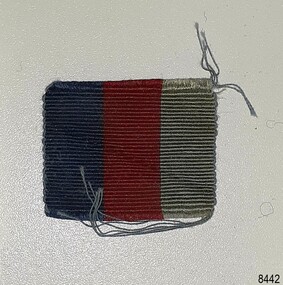
Badge - Insignia Ribbon, 1939-1945
... Angus Collection Australian Army Surgeon Captain Ballarat Bonegilla badge insignia badge collection World War 2 Second World War Australian Defence Forces Army Medical Corps Military uniform cloth patch insignia patch Australian Army Medical Corp (Militia) WW 2 ww II 1925-1940 Military badge Non-Divisional Unit AAMC 1940-1942 8th Field Ambulance peacetime training insignia history insignia ribbon ribbon patch Badge, woven ribbon insignia patch. ...The cloth insignia patch is one of a collection of military badges that date to the World War II period. This ribbon has not yet been identified. The badges are now part of Flagstaff Hill’s comprehensive W.R. Angus Collection, donated by the family of Dr W R Angus (1901-1970), surgeon and oculist. Dr W R Angus was a Surgeon Captain for the Australian Defence Forces, Army Medical Corps, stationed in Ballarat, Victoria, and in Bonegilla, N.S.W. He completed his service just before the end of the war due to suffering from a heart attack. The W.R. Angus Collection: - The W.R. Angus Collection includes historical medical equipment, surgical instruments and material belonging to Dr Edward Ryan and Dr Thomas Francis Ryan, (both of Nhill, Victoria) and Dr Angus’ own belongings. The Collection’s history spans the medical practices of the two Doctors Ryan, from 1885-1926 plus that of Dr Angus, up until 1969. It includes historical medical and surgical equipment and instruments from the doctors Edward and Thomas Ryan of Nhill, Victoria. Dr Angus married Gladys in 1927 at Ballarat, the nearest big city to Nhill where he began as a Medical Assistant. He was also Acting House surgeon at the Nhill hospital where their two daughters were born. During World War II He served as a Military Doctor in the Australian Defence Forces. Dr Angus and his family moved to Warrnambool in 1939, where Dr Angus operated his own medical practice. He later added the part-time Port Medical Officer responsibility and was the last person appointed to that position. Both Dr Angus and his wife were very involved in the local community, including the planning stages of the new Flagstaff Hill and the layout of the gardens there. Dr Angus passed away in March 1970.This insignia ribbon is connected to the collection of military badges in the W.R. Angus Collection. Dr W R Angus (1901-1970), surgeon and oculist, collected a range of military objects including those he personally used during his time as Surgeon Captain in the Australian Defence Forces in World War II. The item allows insight into military life in the early-to-mid 20th century. The W.R. Angus Collection is significant for still being located at the site it is connected with, Doctor Angus being the last Port Medical Officer in Warrnambool. The Collection includes historical medical objects that date back to the late 1800s.Badge, woven ribbon insignia patch. Rectangular patch has wide vertical stripes, one is a blue stripe and the other is a red or crimson stripe. The cloth patches belonged to Dr W R Angus and are now part of the W. R. Angus Collection.flagstaff hill, warrnambool, maritime village, maritime museum, shipwreck coast, great ocean road, flagstaff hill maritime museum and village, dr w r angus, w.r. angus collection, australian army, surgeon captain, ballarat, bonegilla, badge, insignia, badge collection, world war 2, second world war, australian defence forces, army medical corps, military uniform, cloth patch, insignia patch, australian army medical corp (militia), ww 2, ww ii, 1925-1940, military badge, non-divisional unit, aamc, 1940-1942, 8th field ambulance, peacetime training, insignia history, insignia ribbon, ribbon patch -
 Greensborough Historical Society
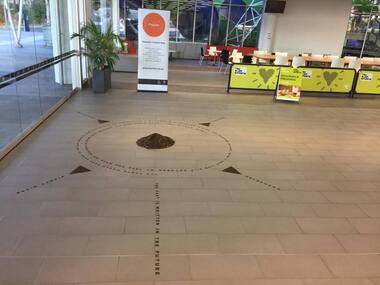
Photograph - Digital Image, Art at WaterMarc, July 2017, 22/07/2017
... This area's exceptionally fertile soil [used by] by white settlers for farms, market gardens and orchards reshaped the Wurundjeri's traditional lands - and today the private sale and division of these farms informs the streetscape and town plan. With soil sourced locally this work reveals some of the area’s history - the text running around the perimeter was written by former resident Val Wilson, a snippet of her recollections of growing up in the area in the 1950s. ...This area's exceptionally fertile soil [used by] by white settlers for farms, market gardens and orchards reshaped the Wurundjeri's traditional lands - and today the private sale and division of these farms informs the streetscape and town plan. With soil sourced locally this work reveals some of the area’s history - the text running around the perimeter was written by former resident Val Wilson, a snippet of her recollections of growing up in the area in the 1950s. ...Photographs of an art installation by Jessie Stanley at WaterMarc Greensborough on 22/07/2017. From Jessie Stanley's FaceBook page :Dust to Dust is complete... It's an ephemeral site-specific work about how the Melbourne suburb of Greensborough has transformed over time. This area's exceptionally fertile soil [used by] by white settlers for farms, market gardens and orchards reshaped the Wurundjeri's traditional lands - and today the private sale and division of these farms informs the streetscape and town plan. With soil sourced locally this work reveals some of the area’s history - the text running around the perimeter was written by former resident Val Wilson, a snippet of her recollections of growing up in the area in the 1950s. The arrows and text act like a compass to orientate this site with greater Melbourne. On display in the lobby of Banyule Council until chance, time (or a broom) sweeps it away, Many thanks to Banyule City Council, Greensborough Historical Society and Valerie Wilson. "An artistic representation of Greensborough's history.Digital photographs of art installation.jessie stanley, watermarc, greensborough historical society, banyule council -
 Geelong RSL Sub Branch
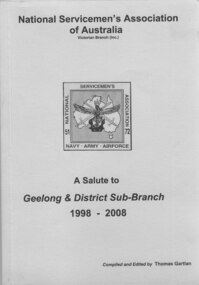
Book, National Servicemen's Association Australia A Salute to Geelong & District Sub- Branch 1998-2008, 2008
... history of the National Servicemen's Association of Australia Victorian Branch (Inc) Geelong and District Sub-Branch 1988-2008. This is an original book, there is a Heritage Page and the signatures of past President's, State and Sub Branch Patrons. NSAA Geelong & District Sub Branch Thomas Gartlan The book was printed by Deakin University, Logistics Division ...This book was compiled by Thomas Gartlan with the aim of providing a written history of the National Servicemen's Association of Australia Victorian Branch (Inc) Geelong and District Sub-Branch 1988-2008.This is an original book, there is a Heritage Page and the signatures of past President's, State and Sub Branch Patrons.An oblong book, thick yellow cardboard cover, 90 white pages.The book was printed by Deakin University, Logistics Division Print Services, 2008nsaa, geelong & district sub branch, thomas gartlan -
 Orbost & District Historical Society
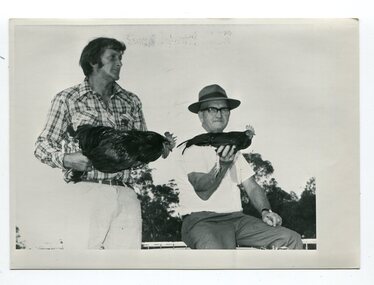
black and white photographs, March 13 1978
... division for goats. the photograph was taken during the judging. Linda and Val Donald are in the photograph' 3084.3 and 3084.4 are of the new pavillion at Newmerella Recreation Ground, This is a pictorial record associated with the annual Orbost Show which has been a major event in Orbost for over a century. Agricultural shows are an important part of cultural life in small country towns and the Orbost Show is an integral part of Orbost 's agricultural history ...3084.1 is titled "Ready For Launching" and is of Mr Lachlan Macalaster on the left and Mr Jim Holden preparing to release two roosters for a competition - The Rooster Chase,. 3084.2 was taken at the 1978 annual Orbost Show in a new division for goats. the photograph was taken during the judging. Linda and Val Donald are in the photograph' 3084.3 and 3084.4 are of the new pavillion at Newmerella Recreation Ground,This is a pictorial record associated with the annual Orbost Show which has been a major event in Orbost for over a century. Agricultural shows are an important part of cultural life in small country towns and the Orbost Show is an integral part of Orbost 's agricultural history.Four black / white photographs. 3084.1 shows two men each holding a rooster. 3084.2 shows a group of five people standing near some goats. 3084.3 and 3084.4 are of the construction of a large metal shed.Each photograph has a label on the back with detailed information.orbost-show macalaster-lachlan holden-jim donald-val agriculture -
 Glenelg Shire Council Cultural Collection
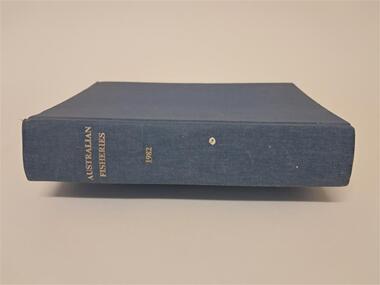
Book - Australian Fisheries 1982, Fisheries Division, Department of Primary Industry, Australian Government, January 1982
... history of Portland and the surrounding region. This object is part of a collection belonging to local Portland fisherman Robert Hodgson who also worked for Shore Line Engineering. Fisheries Fishing Maratime The Australian Fisheries Magazines Blue hard cover book with multiple sections inside, each section containing its own numbering system. Some advertisements and photos throughout the book. Australian Fisheries 1982 Book Australian Fisheries 1982 Fisheries Division ...The Australian Fisheries MagazinesBlue hard cover book with multiple sections inside, each section containing its own numbering system. Some advertisements and photos throughout the book. non-fictionThe Australian Fisheries Magazines fisheries, fishing, maratime -
 Glenelg Shire Council Cultural Collection
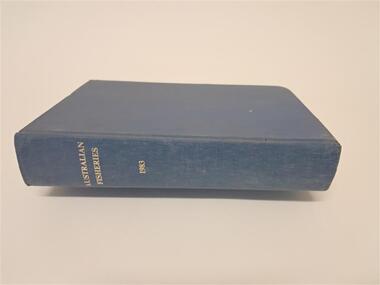
Book - Australian Fisheries 1983, Fisheries Division, Department of Primary Industry, Australian Government, January 1982
... history of Portland and the surrounding region. This object is part of a collection belonging to local Portland fisherman Robert Hodgson who also worked for Shore Line Engineering. Fisheries Fishing Maratime The Australian Fisheries Magazines Blue hard cover book with multiple sections inside, each section containing its own numbering system. Some advertisements and photos throughout the book. Australian Fisheries 1983 Book Australian Fisheries 1983 Fisheries Division ...The Australian Fisheries MagazinesBlue hard cover book with multiple sections inside, each section containing its own numbering system. Some advertisements and photos throughout the book. non-fictionThe Australian Fisheries Magazines fisheries, fishing, maratime -
 Montmorency–Eltham RSL Sub Branch
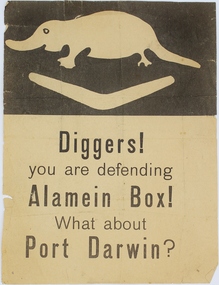
Pamphlet - German Propaganda Leaflet El Alamein 1942, El Alamein German Propaganda Leaflet, World War Two 1942
... This item relates to the history of the defence of El Alamein by Australian Forces in the Middle East 1942, and the bombing of Darwin by the Japanese in 1942. world war two el alamein propaganda leaflet plane drop port darwin diggers platypus boomerang Printed on pamphlet "Diggers! / you are defending / Alamein Box! / What about / Port Darwin?" Printed paper, colour black white. top of pamphlet depicts a stylized platypus and boomerang - the 9th Division's ...Leaflet dropped from German/Italian aircraft on to Australian troops defending El Alamein during 1942. These propagander leaflets were designed to lower moral of defending troops, but were generally unsuccessful. This item relates to the history of the defence of El Alamein by Australian Forces in the Middle East 1942, and the bombing of Darwin by the Japanese in 1942.Printed paper, colour black white. top of pamphlet depicts a stylized platypus and boomerang - the 9th Division's Formation Sign, with text below. Printed on pamphlet "Diggers! / you are defending / Alamein Box! / What about / Port Darwin?" world war two, el alamein, propaganda, leaflet, plane drop, port darwin, diggers, platypus, boomerang -
 Phillip Island and District Historical Society Inc.
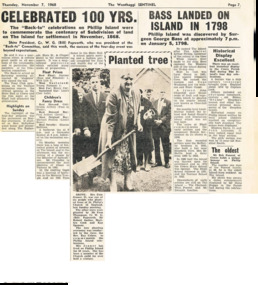
Newspaper Clipping, 100yrs Celebrations for Phillip Island, 7/11/1968
... Account of Back to Phillip Island 100yrs after first sub division of land at Phillip Island. Account of History of Phillip Island from discovery by Surgeon George Bass on January 5, 1979 to 1922. ...Account of Back to Phillip Island 100yrs after first sub division of land at Phillip Island. Account of History of Phillip Island from discovery by Surgeon George Bass on January 5, 1979 to 1922. ...Article from a collection of newspaper clippings from October 1968 to July 1971Article about the 100yrs celebrations at Phillip Island in November 1968. Account of Back to Phillip Island 100yrs after first sub division of land at Phillip Island. Account of History of Phillip Island from discovery by Surgeon George Bass on January 5, 1979 to 1922. Account of Historical Display in the Cowes Parish Hall.phillip island, back to phillip island celebrations, surgeon george bass -
 Red Cliffs Military Museum
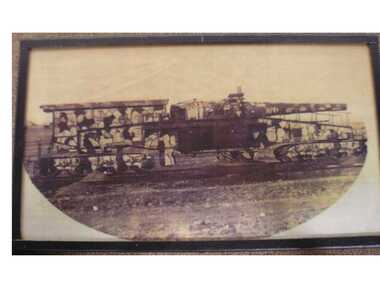
Copied Photos, The Amiens Gun, WW1
... Divisions broke the German Front before Amiens./ The Barrel of the Great Gun, 41 feet (12,5m) long and weighing more than 45tons (45-80 tonnes), is exhibited at the Australian War Memorial in Canberra. More information can be found at www.Wikipedia/The Amiens Gun ww1 gun the railway amiens harbonnieres villers bretonneaux None on Photos, the history frame has a short history and "Presented by the Canberra Services Club 2003" Two copied photos of the Amiens Gun (seperate Frames) and a history of the Amiens Gun in seperate frame. ...This 11 inch (28) Railway Gun was captured by the AIF in front of Harbonnieres near Villers Bretonneaux on the 8th of August 1918. It was one of the Guns used by the Germans to shell Amiens from a distance of 15 miles (24km) in an endeavor to destroy the railway centre in the city. However the destruction of the city was prevented by the advance of Allied Troops on the morning of 8th August when 5 Australian, 4 Canadian, 4 British and 9 French Divisions broke the German Front before Amiens./ The Barrel of the Great Gun, 41 feet (12,5m) long and weighing more than 45tons (45-80 tonnes), is exhibited at the Australian War Memorial in Canberra. More information can be found at www.Wikipedia/The Amiens Gun Two copied photos of the Amiens Gun (seperate Frames) and a history of the Amiens Gun in seperate frame.None on Photos, the history frame has a short history and "Presented by the Canberra Services Club 2003"ww1, gun, the, railway, amiens, harbonnieres, villers, bretonneaux
