
Showing 87 items matching "draper's shop"
-
 Flagstaff Hill Maritime Museum and Village
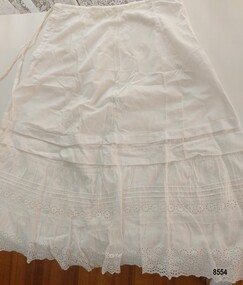
Clothing - Petticoat, late 19th century to early 20th century
... ...draper's shop...By the early 20th century, machine made lace, fabric, ribbons etc. were being sold in drapers shops all over England and Wales to women who were making clothes and furnishings for their families. ...By the early 20th century, machine made lace, fabric, ribbons etc. were being sold in drapers shops all over England and Wales to women who were making clothes and furnishings for their families. ...This petticoat was one of several items donated from the estate of Susan Henry OAM nee Vedmore (1944 - 2021). It is in very good condition and appears to be from the Edwardian era - early 20th century. A petticoat is a lady's undergarment - worn under a skirt or dress. They provided warmth, modesty and shape to the dress. In the middle of the 19th century, petticoats were worn over hoops, bustles or in layers. Petticoats varied according to the style of the outside skirt or dress. Plain petticoats tended to be worn with everyday wear whilst better dresses (party dresses or silk gowns) were worn with petticoats that often had more trim and embellishments. Edwardian petticoats had less volume than Victorian era petticoats and they had a "dust ruffle" or lining under a lace flounce. The "dust ruffle" protected the lace flounce and gave the petticoat more flare at the bottom, greater freedom when walking as well as saving the flounce (which was often made of finer material) from everyday wear and tear. Tucks are another feature of Edwardian petticoats - when the lace at the bottom became worn, it could be cut off and the tucks released. This extended the life of the petticoat. This petticoat features an intricate trim of broderie anglaise. Although broderie anglaise was a lace that could be made by hand, it was very time consuming to make. St Gallen was a city in Switzerland that had become known for producing quality textiles. At the beginning of the 19th century, the first embroidery machines were developed in St Gallen. Factories used embroidery machines but people also had them in their homes. They were able to produce broderie anglaise for export. By the early 20th century, machine made lace, fabric, ribbons etc. were being sold in drapers shops all over England and Wales to women who were making clothes and furnishings for their families. It is highly likely that the lady who made this petticoat brought the lengths of broderie anglaise already made to embellish and personalise her petticoat. Susan's family (Harold and Gladys Vedmore) immigrated to Australia from Wales in 1955 and settled in Warrnambool. Susan was well known in the Warrnambool community for her work supporting children and families across the district - particular those with disabilities, or those who were homeless, unemployed or isolated. Susan was the founding trustee of the "Vedmore Foundation" - a Warrnambool philanthropic trust set up in 2010 to support a range of charitable and not-for-profit causes by providing grant assistance. In 2021, she was awarded a Medal of the Order of Australia for services to the community.This item is an example of the needlework skills of women in the late 19th century - creating pintucks and adding lace to personalise and embellish a practical item of clothing. It is also significant as an example of a practical solution to the difficulties that women of this era faced with regard to the washing of clothes and household linens.A white lawn petticoat with a 22.5 cm opening that fastens with 2 small buttons and a drawstring tie. It is decorated with two wide pintucks followed by two gathered frills (or flounces) - one decorated with three rows of narrow pintucks and a single row of broderie anglaise and the bottom frilled hem finished with 3 rows of broderie anglaise in a flower design. The two bottom frills are lined with plain white cotton fabric.flagstaff hill maritime museum and village, great ocean road, petticoat, lady's petticoat, undergarment, lady's undergarment, lingerie, edwardian petticoat, broderie anglaise, lace, machine made lace, hand sewn, machine sewn, draper's shop, susan henry oam, vedmore foundation -
 Port Melbourne Historical & Preservation Society
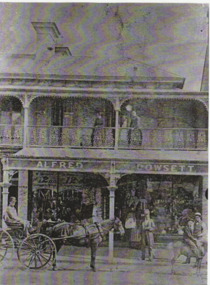
Photograph - Alfred Dowsett's shop, Bay Street, 1880s
... Laser copy of photograph of Alfred Dowsett's (clothier and draper) shop, 305 Bay Street c 1880s...Built Environment - Commercial Business and Traders - Tailors and Clothing Alfred DOWSETT Bay Street Laser copy of photograph of Alfred Dowsett's (clothier and draper) shop, 305 Bay Street c 1880s Photograph Alfred Dowsett's shop, Bay Street ...Laser copy of photograph of Alfred Dowsett's (clothier and draper) shop, 305 Bay Street c 1880sbuilt environment - commercial, business and traders - tailors and clothing, alfred dowsett, bay street -
 Clunes Museum
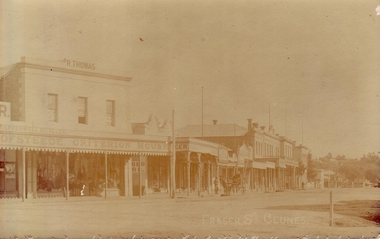
Photograph, C 1905
... r. thomas criterion house draper shop....THOMAS CRITERION HOUSE DRAPER SHOP....THOMAS CRITERION HOUSE DRAPER SHOP. Photograph PHOTOGRAPH ...EARLY PHOTOGRAPH OF FRASER STREET, CLUNESORIGINAL SEPIA POSTCARD PHOTOGRAPH OF CLUNES MAIN STREET, FEATURING HORSE AND CART AND R. THOMAS CRITERION HOUSE DRAPER SHOP.FRASER STREET CLUNESlocal history, photography, photographs, shops, r. thomas criterion house draper shop., clunes township -
 Clunes Museum
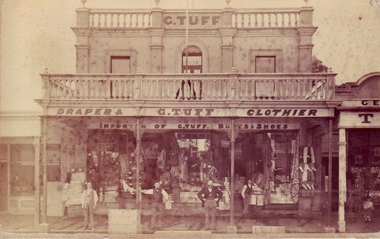
Photograph
... PHOTOGRAPH OF G. TUFF DRAPER CLOTHIER SHOP. FRASER STREET, CLUNES...NOW OWNERS LIVE PRIVATELY IN BUILDING. photographs shops tuff c. draper clothier PHOTOGRAPH OF G. TUFF DRAPER CLOTHIER SHOP. ...PHOTOGRAPH REMOVED FROM ALBUM DONATED BY MRS. TATNALL. THE SHOP LATER BECAME THE PROPERTY OF W.J. CHAMPION, THEN RUSSEL HORNER THEN MRS. LOTTE COLES. NOW OWNERS LIVE PRIVATELY IN BUILDING.PHOTOGRAPH OF G. TUFF DRAPER CLOTHIER SHOP. FRASER STREET, CLUNESphotographs, shops, tuff, c. draper, clothier -
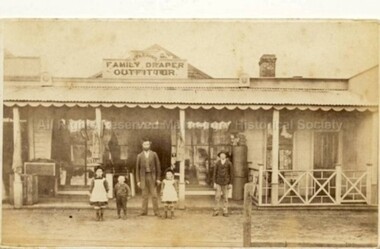 Malmsbury Historical Society
Photograph (Item), Draper Shop With Fleming Family Outside, Malmsbury c1890
... Draper Shop With Fleming Family Outside, Malmsbury c1890... People - "Fleming, S" Buildings - Draper Shop Associated with - "Fleming, S" ...People - "Fleming, S" Buildings - Draper Shop Associated with - "Fleming, S" Draper Shop With Fleming Family Outside, Malmsbury c1890 Photograph Photograph ...People - "Fleming, S" Buildings - Draper Shop Associated with - "Fleming, S" -
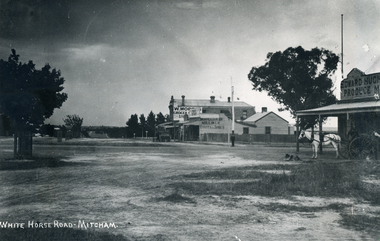 Whitehorse Historical Society Inc.
Photograph, Whitehorse Road Mitcham
... Very early view of shopping area of Whitehorse Road Mitcham; showing (corner Whitehorse and Mitcham Roads)- Edward Hughes Produce Merchant Draper Shop, Milliner, Boots & Shoes, W More's Grocer Horse and buggy in front of Produce store...Very early view of shopping area of Whitehorse Road Mitcham; showing (corner Whitehorse and Mitcham Roads)- Edward Hughes Produce Merchant Draper Shop, Milliner, Boots & Shoes, W More's Grocer Horse and buggy in front of Produce store Whitehorse Road Mitcham Photograph Photograph ...Black & white picture. Very early view of shopping area of Whitehorse Road Mitcham; showing (corner Whitehorse and Mitcham Roads)- Edward Hughes Produce Merchant Draper Shop, Milliner, Boots & Shoes, W More's Grocer Horse and buggy in front of Produce storewhitehorse road mitcham, hughes, edward, more, w. -
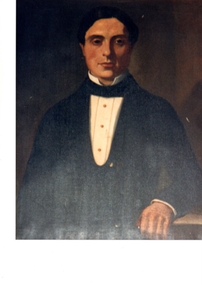 Linton and District Historical Society Inc
Photograph, Portrait of Samuel Steele
... Samuel Steele, who lived in Linton during the 1860s and built the draper's shop in Sussex Street known as Criterion House, brought this painting with him when he migrated to Victoria....Samuel Steele, who lived in Linton during the 1860s and built the draper's shop in Sussex Street known as Criterion House, brought this painting with him when he migrated to Victoria. ...Samuel Steele, who lived in Linton during the 1860s and built the draper's shop in Sussex Street known as Criterion House, brought this painting with him when he migrated to Victoria.Scan of a photograph of an original oil painting. The painting is a head and shoulders portrait of a young man with dark hair and eyes, who is wearing a dark jacket and white shirt which has three buttons and a stiff collar. His left hand resting on the arm of a chair, or a table.samuel steele, criterion house -
 Clunes Museum
Booklet - ALBUM - PHOTOGRAPH
... ONE IDENTIFIED AS DRAPER SHOP, CLUNES-TUFFS, LATER W.J. CHAMPION DRAPERY. ...ONE IDENTIFIED AS DRAPER SHOP, CLUNES-TUFFS, LATER W.J. CHAMPION DRAPERY. ...PHOTOGRAPH ALBUM WITH 57 UNIDENTIFIED PHOTOGRAPHS. ONE IDENTIFIED AS DRAPER SHOP, CLUNES-TUFFS, LATER W.J. CHAMPION DRAPERY. MRS. TATNALL, NEE COLLOCOTT- FATHER ARTHUR COLLOCOTT, GRANDFATHER JOHN COLLOCOTTBLACK VELLUM COVERED PHOTOGRAPH ALBUM-METAL FASTENER- GILT EDGED PAGES, COVER EMBOSSED.local history, book, album -
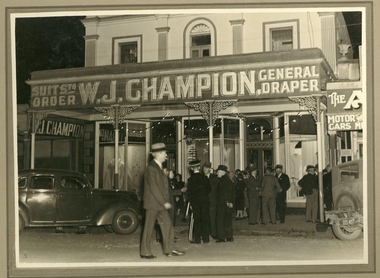 Clunes Museum
Photograph, RIALTO STUDIOS
... CHAMPION OWNED A GENERAL DRAPER SHOP IN FRASER STREET, CLUNES FOR MANY YEARS. ...CHAMPION OWNED A GENERAL DRAPER SHOP IN FRASER STREET, CLUNES FOR MANY YEARS. ...W.J. CHAMPION OWNED A GENERAL DRAPER SHOP IN FRASER STREET, CLUNES FOR MANY YEARS. TWO STOREY BUILDING, THREE SHOP WINDOWS, IRON VERANDAH POSTS, ORNATE CAST IRON DECORATION ON TOP OF POSTS..1 SEPIA PHOTOGRAPH MOUNTED ON CARDBOARD OF W. J. CHAMPION SHOP, FRASER STREET, CLUNES, GROUP OF GENTLEMEN IN FOREGROUND. .2 BLACK AND WHITE COPY OF THE ABOVE PHOTOGRAPH PRINTED ON GLOSS PHOTOGRAPHIC PAPERlocal history, photography, photographs, shops, w.j. champion.[ 2 storey building], buildings -
 Linton and District Historical Society Inc
Photograph, Janet Angus
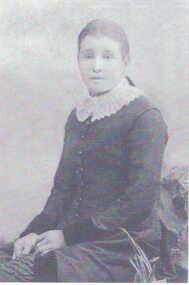
... Janet Angus was born in Linton and was a daughter of John Angus, a miner, and his wife Wilhelmina (nee Statemann) who ran a draper's shop in Linton. Janet married Richard Egan in Western Australia in 1898. ...Janet Angus was born in Linton and was a daughter of John Angus, a miner, and his wife Wilhelmina (nee Statemann) who ran a draper's shop in Linton. Janet married Richard Egan in Western Australia in 1898. ...Janet Angus was born in Linton and was a daughter of John Angus, a miner, and his wife Wilhelmina (nee Statemann) who ran a draper's shop in Linton. Janet married Richard Egan in Western Australia in 1898. She died in Western Australia in 1949. Janet's daughter Elsie married Fred Jennings of Linton in 1925.Black and white copy of original photograph, which shows a young woman wearing a dark coloured dress or coat which is buttoned at the front and has a large white lace or crocheted collar. Janet Angus, afterwards Janet Egan The photograph has been glued to an information sheet which provides birth, death and marriage details.janet angus, janet egan -
 Melbourne Tram Museum
Photograph - Northcote cable tram depot, early 1950s
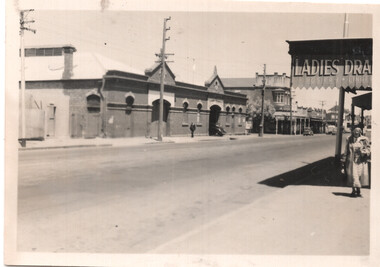
... Has the verandah of a ladies' draper shop on the right side of the photograph. ...Has the verandah of a ladies' draper shop on the right side of the photograph. ...The photograph shows the Northcote engine house and cable tram depot in High St Northcote looking southeast. Has the verandah of a ladies' draper shop on the right side of the photograph. Negative also held. Letter dated 14-2-1961 - one page only to Ken ? noting the history of the depot from Noel Gipps.Yields information about the Northcote cable tram depot early 1950s.Black and white photograph with notes on the rear and Negative. Has the number "150" in pencil in top right-hand corner. In ink "Melbourne Victoria, Northcote engine house & car shed (with letter) High St Northcote. See letter for full details. Taken prior to electrification of Bourke St cable lines (1950-55).tramways, cable trams, northcote cable trams, northcote depot, high st northcote -
 Linton and District Historical Society Inc
Photograph, Stamped on reverse: Free & Sons, Photographers, Melbourne, Linton Shire Hall
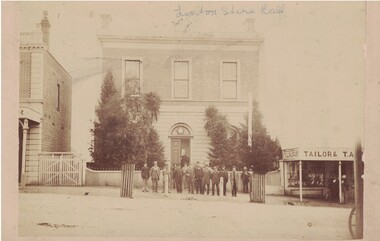
... Thomas Austin, who ran a draper's shop next to the Shire offices, left Linton in 1882....To the right, a shop has signs on its verandah: "TAILOR & DRAPER" and "TAILOR & T. ...Thomas Austin, who ran a draper's shop next to the Shire offices, left Linton in 1882. ...The Shire Hall/offices were completed in the mid 1860s. Dating the photograph: The photograph is thought to have been taken c.1880. An earlier photograph of the Town Hall in the LDHS collection, in which the trees are smaller, is dated 1875. Thomas Austin, who ran a draper's shop next to the Shire offices, left Linton in 1882.Original sepia photograph showing the Grenville Shire Offices (Linton Town Hall). A group of men, thought to be Grenville Shire Councillors, are standing in the street in front of the building, which has several trees growing in front of it, and a low front fence. To the right, a shop has signs on its verandah: "TAILOR & DRAPER" and "TAILOR & T. A. . . ." (thought to read T. Austin). To the left, a higher picket fence or gate separates the Shire Hall from the two-storey building next door. This building is 'Criterion House', built in 1862/1863 by Samuel Steele. The words "Linton Shire Hall" have been inscribed in ink across the top of the photograph.Handwritten in ink across top of photograph: "Linton Shire Hall".grenville shire offices, linton town hall, thomas austin [tailor & drapery store], shire of grenville councillors, linton shire hall -
 Charlton Golden Grains Museum Inc
Photograph - Sepia photo of Bilton's Chemist Shop 1889 mounted on cardboard, F. J. Stubbs Photographer, 1889
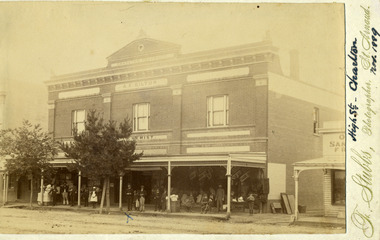
... E Bilton and T. Dillon (drapers shop 1889 - 1945) standing in front of the shop. ...E Bilton and T. Dillon (drapers shop 1889 - 1945) standing in front of the shop. ...Newly built premises in 1889 to replace former shops which burnt down.Sepia photo of newly built Bilton - Dillon two story premises in High St. Charlton. Photographed Nov. 1889. Centre shop is Charlton Chemist A.E Bilton from 1889 - 1920s. Local businessmen A. Stubbs, A. E Bilton and T. Dillon (drapers shop 1889 - 1945) standing in front of the shop. Along with a large crowd of people assembled in front of the shop. There are small shops either end of the Bilton - Dillon building.F. J. Stubbs Photographer St. Arnaud High St. Charlton November 1889f. j. stubbs, a. e. bilton, t. dillon, high st. charlton, charlton 1889 -
 Ballarat Tramway Museum
Photograph - Black & White Photograph/s, c1905
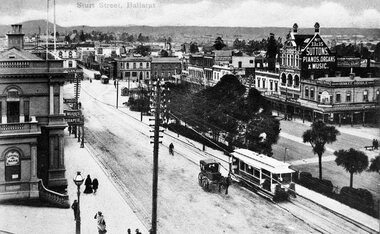
... Post office steps in photograph as well as Sutton store, Yankee Doodle store and Morris draper shop. Photo title "Sturt St. Ballarat". ...Post office steps in photograph as well as Sutton store, Yankee Doodle store and Morris draper shop. Photo title "Sturt St. Ballarat". ...Black and white print with negative (N148) of an ESCo tram descending the Sturt St. hill from Lydiard St. North towards Grenville St. Photograph taken from possibly the post office. looking south east. Photo taken soon after opening as tram is not fitted with a destination box. Has horse drawn vehicle and person on bicycle travelling up hill alongside the tram indicating traffic arrangements at the time. Post office steps in photograph as well as Sutton store, Yankee Doodle store and Morris draper shop. Photo title "Sturt St. Ballarat". Another two tramcars at end of Bridge St. Copy negative and photograph by John Phillips of a Postcard High Res Images added 5/3/2011. Original neg scanned at hi res and updated 11/5/2020.trams, tramways, sturt st, esco, grenville st, bridge st -
 Melbourne Tram Museum
Photograph - Black and White photograph, c1910
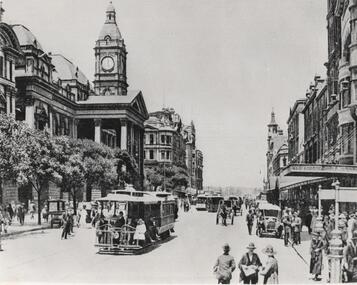
... In the view are shops for Rayners Ladies Drapers and a shop "Marlborough"...In the view are shops for Rayners Ladies Drapers and a shop "Marlborough" Photograph Black and White photograph ...Black and white photograph of Swanston St looking south from Little Collins St with the Town Hall in the view. Has a number of cable cars, horse drawn vehicles and motor vehicles in the view. In the view are shops for Rayners Ladies Drapers and a shop "Marlborough"Has "Brimson" on the rear in ink.trams, tramways, cable trams, town hall, swanston st -
 Linton and District Historical Society Inc
Photograph, Shire of Grenville Hall and Angus Shop, Sussex Street, Linton
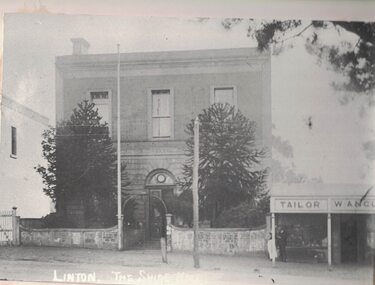
... Elsie Jennings, an Angus descendant, recalled in a letter to LDHS that her uncle had run a draper's shop at this site. (See letter in "Linton - Township History - Recollections and reminiscences' file.) ...Elsie Jennings, an Angus descendant, recalled in a letter to LDHS that her uncle had run a draper's shop at this site. (See letter in "Linton - Township History - Recollections and reminiscences' file.) ...Shire of Grenville Hall and Angus shop, Sussex Street, Linton. Dating the photograph: The photograph can be dated to after 1887, when John Angus purchased the shop building (originally owned by Thomas Austin) from B. N. Dodd. 'W. Angus': From 1887 until the late 1890s the shop was run by John Angus' wife Wilhelmina Angus, who often advertised her business in the local newspaper, the 'Grenville Standard' (see photograph of advertisement, Registration no. 2019-346). It is not known when Mrs Angus retired, but it is understood that her son William then took over the shop around 1901. Elsie Jennings, an Angus descendant, recalled in a letter to LDHS that her uncle had run a draper's shop at this site. (See letter in "Linton - Township History - Recollections and reminiscences' file.) In 1905, Will Angus advertised that he had moved his business to the building on the corner of Sussex and Clyde Streets (later this became J. H. Barr's drapery shop.) It is not clear whether the "W. Angus" in the sign refers to Wilhelmina Angus or to William Angus.Enlarged black and white copy of original photograph, which has been mounted on white card. The photograph shows a two-storey brick building, and next to it a double-fronted shop. The two-storey building is the original Grenville Shire Hall, built in the mid 1860s. The fence outside it is being used to post notices. Two large pine trees are between the fence and the building. The smaller shop next to the hall has a verandah supported by round timber posts, and signs across the front of the verandah read "Tailor" and "W. Angus". Two men engaged in conversation with each other are standing to the left under the verandah. There is a flagpole attached to one of the gate posts of the hall, and there is a telegraph pole in the street in front of the hall.w. angus, william angus, wilhelmina angus (née statemann), buildings, shire of grenville hall, shops, shire hall, town hall -
 Wodonga & District Historical Society Inc
Functional object - Stoneware Demijohn, 1910
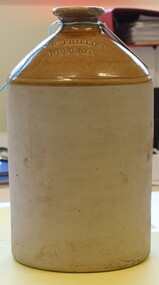
... On Friday 15 July 1921, a fire occurred in which Phillips grocer’s shop and a neighbouring draper’s shop, owned by Mr. R. W. McLeish, were seriously damaged. ...On Friday 15 July 1921, a fire occurred in which Phillips grocer’s shop and a neighbouring draper’s shop, owned by Mr. R. W. McLeish, were seriously damaged. ...Mr Robert Crone Phillips was born in Stanley, Victoria and later moved to Wangaratta where he worked at Pinkertons and Sons. On 1 April 1912 he purchased the grocery, ironmongery, and wine and spirits business conducted in Sydney Street, Wodonga, by Mr. D. M. Stavely. This business was beside the old Wodonga Police Station. He received a spirit merchant's license under the new Licensing Act in the Wodonga Licensing Court on 20 March 1912. This was the first occasion on which spirit merchants' licenses have been granted by the court. This license was renewed annually until November 1920. On Friday 15 July 1921, a fire occurred in which Phillips grocer’s shop and a neighbouring draper’s shop, owned by Mr. R. W. McLeish, were seriously damaged. In August 1921 Robert Philips filed for insolvency with assets of £660 10/ and liabilities of £1126 19/6. The cause of insolvency listed was loss sustained by fire and the pressure of creditors. Mr. Phillips retired to Wangaratta. He passed away in 1948. The demijohn is of local significance as it represents an artefact from a local business. Its provenance is clear due to the inscription in the item. It is representative of ceramic wares from the early 1900s.A ceramiic demijohn with business name"R C PHILLIPS/ WODONGA"wodonga businesses, sydney road wodonga, r c phillips -
 Bendigo Historical Society Inc.
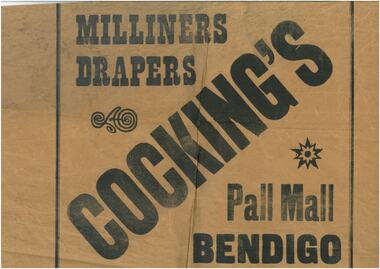
Ephemera - Three samples of wrapping paper
... Robert Samuel Valentine Cocking (1882 - 14/5/1945) Born in Bendigo, Val Cocking began hi retail career at Myer Bendigo before opening his own draper shop c. 1912 in the lower block Pall Mall. ...Robert Samuel Valentine Cocking (1882 - 14/5/1945) Born in Bendigo, Val Cocking began hi retail career at Myer Bendigo before opening his own draper shop c. 1912 in the lower block Pall Mall. ...Robert Samuel Valentine Cocking (1882 - 14/5/1945) Born in Bendigo, Val Cocking began hi retail career at Myer Bendigo before opening his own draper shop c. 1912 in the lower block Pall Mall. In 1914 he moved his stock into temporary premises while he renovated his new shop, which combined the former Post Office Hotel and adjacent grocery and stationary shops. The new emporium opened in Aug 1918 selling drapery and soft goods. Mr Cocking was a champion rifle shooter; President of the Bendigo Chamber of Commerce; President of the Sandhurst Football Club for 18 years and President of the Bendigo Cricket Club. Bennetts Hardware shop was in Hargeaves St near the entrance to Allan's Walk in the 1950's. Beehive buildings. This was originally the Sandhust Mining Exchange and as such was the oldest purpose built exchange in Australia and was one of only two in regional Australia. It was initially established in the 1850's to service the miners of the area. It's first double story incarnation as the Bendigo Stock Exchange, contained up to 2000 stockbrokers and 5000 shareholders. In 1871 the building burnt to the ground and the new and current building was completed in 1872. The modern building was designed by Charles Webb, who was also responsible for the Royal Arcade in Melbourne. and features a pitched glass roof similar to the Royal Arcade, Melbourne.Three samples of wrapping paper from a. Cockings, b. Bennetts Store & c. Beehive storeswrapping paper, cockings, bennetts, beehive -
 Flagstaff Hill Maritime Museum and Village
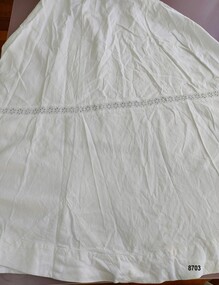
Textile - Skirt, circa 1910
... By the early 20th century, machine made lace, fabric, ribbons etc. were being sold in drapers shops all over England and Wales to women who were making clothes and furnishings for their families. ...By the early 20th century, machine made lace, fabric, ribbons etc. were being sold in drapers shops all over England and Wales to women who were making clothes and furnishings for their families. ...This item is one of a collection of clothing items that belonged to the Stephenson family who lived at 22 McCracken Street, Kensington, Melbourne. Matthew Stephenson (1861 – 1943) who had grown up on the Bendigo goldfields and shifted to Melbourne in the early 1900’s was a train driver and later, a fireman with the railways. His wife Elizabeth Jane (Betsy) Wigley (1865 – 1953) also grew up on the goldfields around Majorca and Bendigo. They married in 1885 in Bendigo. They had two daughters – Ethel Evelyn Stephenson (1886 – 1956) and Lillian or Lila (1891 – 1977) who were milliners and dressmakers and who continued to live in the family home after the death of their parents. The family are recorded as living at 22 McCracken Street, Kensington, as early as 1914. It is not known who made or owned the clothing that makes up this collection but as it appears to be from the late Victorian and early Edwardian era, the different pieces were probably made and worn by any of the three ladies of the house – Betsy, Ethel and/or Lila. During W.W.2, a local Warrnambool couple (Meryl and Tony Everard) boarded with them – Tony was in the airforce training paratroopers to jump into (and survive) enemy territory and his wife Meryl worked in the Methodist baby Home. The Everards developed a close friendship with the Stephensons and were responsible for clearing out the house (and finding this clothing collection) after Lila died in 1977. This skirt features broderie anglaise trim. Although broderie anglaise was a lace that could be made by hand, it was very time consuming to make. St Gallen was a city in Switzerland that had become known for producing quality textiles. At the beginning of the 19th century, the first embroidery machines were developed in St Gallen. Factories used embroidery machines but people also had them in their homes. They were able to produce broderie anglaise for export. By the early 20th century, machine made lace, fabric, ribbons etc. were being sold in drapers shops all over England and Wales to women who were making clothes and furnishings for their families. It is highly likely that the lady who made this skirt brought the lengths of broderie anglaise already made to embellish and personalise her skirt.This item is an example of the needlework skills of women in the late 19th century - creating pintucks and adding lace to personalise and embellish a practical item of clothing. A full length lady's skirt of heavy textured ribbed twill cotton. The top of the skirt is made from five pieces of fabric, sewn together and inserted into a simple waistband. It has an opening with room for 6 hook and eyes (but only the middle three remain). The top section of the skirt is separated from the bottom section by a strip of eyelet embroidery that has been inserted in a horizontal line at the back but becomes slightly diagonal at the front causing the two ends to cross in a decorative X fashion. The bottom of the skirt is the same heavy cotton as the top and one seam features a V shaped insert or patch.flagstaff hill maritime museum and village, great ocean road, shipwreck coast, warrnambool, broderie anglaise, needlework, sewing, stephenson family, skirt, lady's skirt -
 Flagstaff Hill Maritime Museum and Village
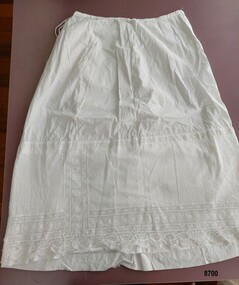
Textile - Petticoat, circa 1900
... By the early 20th century, machine made lace, fabric, ribbons etc. were being sold in drapers shops all over England and Wales to women who were making clothes and furnishings for their families. ...By the early 20th century, machine made lace, fabric, ribbons etc. were being sold in drapers shops all over England and Wales to women who were making clothes and furnishings for their families. ...This item is one of a collection of clothing items that belonged to the Stephenson family who lived at 22 McCracken Street, Kensington, Melbourne. Matthew Stephenson (1861 – 1943) who had grown up on the Bendigo goldfields and shifted to Melbourne in the early 1900’s was a train driver and later, a fireman with the railways. His wife Elizabeth Jane (Betsy) Wigley (1865 – 1953) also grew up on the goldfields around Majorca and Bendigo. They married in 1885 in Bendigo. They had two daughters – Ethel Evelyn Stephenson (1886 – 1956) and Lillian or Lila (1891 – 1977) who were milliners and dressmakers and who continued to live in the family home after the death of their parents. The family are recorded as living at 22 McCracken Street, Kensington, as early as 1914. It is not known who made or owned the clothing that makes up this collection but as it appears to be from the late Victorian and early Edwardian era, the different pieces were probably made and worn by any of the three ladies of the house – Betsy, Ethel and/or Lila. During W.W.2, a local Warrnambool couple (Meryl and Tony Everard) boarded with them – Tony was in the airforce training paratroopers to jump into (and survive) enemy territory and his wife Meryl worked in the Methodist baby Home. The Everards developed a close friendship with the Stephensons and were responsible for clearing out the house (and finding this clothing collection) after Lila died in 1977. A petticoat is a lady's undergarment - worn under a skirt or dress. They provided warmth, modesty and shape to the dress. In the middle of the 19th century, petticoats were worn over hoops, bustles or in layers. Petticoats varied according to the style of the outside skirt or dress. Plain petticoats tended to be worn with everyday wear whilst better dresses (party dresses or silk gowns) were worn with petticoats that often had more trim and embellishments. Edwardian petticoats had less volume than Victorian era petticoats and they had a "dust ruffle" or lining under a lace flounce. The "dust ruffle" protected the lace flounce and gave the petticoat more flare at the bottom, greater freedom when walking as well as saving the flounce (which was often made of finer material) from everyday wear and tear. Tucks are another feature of Edwardian petticoats - when the lace at the bottom became worn, it could be cut off and the tucks released. This extended the life of the petticoat. This petticoat features an intricate trim of broderie anglaise. Although broderie anglaise was a lace that could be made by hand, it was very time consuming to make. St Gallen was a city in Switzerland that had become known for producing quality textiles. At the beginning of the 19th century, the first embroidery machines were developed in St Gallen. Factories used embroidery machines but people also had them in their homes. They were able to produce broderie anglaise for export. By the early 20th century, machine made lace, fabric, ribbons etc. were being sold in drapers shops all over England and Wales to women who were making clothes and furnishings for their families. It is highly likely that the lady who made this petticoat brought the lengths of broderie anglaise already made to embellish and personalise her petticoat.This item is an example of the needlework skills of women in the late 19th century - creating pintucks and adding lace to personalise and embellish a practical item of clothing. A lady's fine cotton and lace ankle length petticoat featuring a deep decorative hem made from sheer pinspot fabric and bands of eyelet lace. The top section of the petticoat is made from five sections of fine cotton sewn together with french seams and gathered with pleats and darts into the waistband. The waistband opening has two button holes and one button (the top button is missing) and a front section with a drawstring. The lace hem is lined with the same fine cotton as the top of the petticoat. There are three different lace bands - a narrow one featuring small flowers, a similar wider band with larger flowers and it is finished at the bottom with a broad band of lace with an intricate leaf design.flagstaff hill maritime museum and village, great ocean road, warrnambool, shipwreck coast, petticoat, lady's petticoat, broderie anglaise, decorative petticoat, draw string waist, machine sewn, dressmaker, stephenson family, pintucks, needlework -
 Flagstaff Hill Maritime Museum and Village
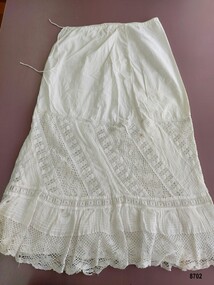
Textile - Petticoat, circa 1910
... By the early 20th century, machine made lace, fabric, ribbons etc. were being sold in drapers shops all over England and Wales to women who were making clothes and furnishings for their families. ...By the early 20th century, machine made lace, fabric, ribbons etc. were being sold in drapers shops all over England and Wales to women who were making clothes and furnishings for their families. ...This item is one of a collection of clothing items that belonged to the Stephenson family who lived at 22 McCracken Street, Kensington, Melbourne. Matthew Stephenson (1861 – 1943) who had grown up on the Bendigo goldfields and shifted to Melbourne in the early 1900’s was a train driver and later, a fireman with the railways. His wife Elizabeth Jane (Betsy) Wigley (1865 – 1953) also grew up on the goldfields around Majorca and Bendigo. They married in 1885 in Bendigo. They had two daughters – Ethel Evelyn Stephenson (1886 – 1956) and Lillian or Lila (1891 – 1977) who were milliners and dressmakers and who continued to live in the family home after the death of their parents. The family are recorded as living at 22 McCracken Street, Kensington, as early as 1914. It is not known who made or owned the clothing that makes up this collection but as it appears to be from the late Victorian and early Edwardian era, the different pieces were probably made and worn by any of the three ladies of the house – Betsy, Ethel and/or Lila. During W.W.2, a local Warrnambool couple (Meryl and Tony Everard) boarded with them – Tony was in the airforce training paratroopers to jump into (and survive) enemy territory and his wife Meryl worked in the Methodist baby Home. The Everards developed a close friendship with the Stephensons and were responsible for clearing out the house (and finding this clothing collection) after Lila died in 1977. A petticoat is a lady's undergarment - worn under a skirt or dress. They provided warmth, modesty and shape to the dress. In the middle of the 19th century, petticoats were worn over hoops, bustles or in layers. Petticoats varied according to the style of the outside skirt or dress. Plain petticoats tended to be worn with everyday wear whilst better dresses (party dresses or silk gowns) were worn with petticoats that often had more trim and embellishments. Edwardian petticoats had less volume than Victorian era petticoats and they had a "dust ruffle" or lining under a lace flounce. The "dust ruffle" protected the lace flounce and gave the petticoat more flare at the bottom, greater freedom when walking as well as saving the flounce (which was often made of finer material) from everyday wear and tear. Tucks are another feature of Edwardian petticoats - when the lace at the bottom became worn, it could be cut off and the tucks released. This extended the life of the petticoat. This petticoat features an intricate trim of broderie anglaise. Although broderie anglaise was a lace that could be made by hand, it was very time consuming to make. St Gallen was a city in Switzerland that had become known for producing quality textiles. At the beginning of the 19th century, the first embroidery machines were developed in St Gallen. Factories used embroidery machines but people also had them in their homes. They were able to produce broderie anglaise for export. By the early 20th century, machine made lace, fabric, ribbons etc. were being sold in drapers shops all over England and Wales to women who were making clothes and furnishings for their families. It is highly likely that the lady who made this petticoat brought the lengths of broderie anglaise already made to embellish and personalise her petticoat.This item is an example of the needlework skills of women in the late 19th century - creating pintucks and adding lace to personalise and embellish a practical item of clothing.A lady's ankle length petticoat made in three sections. The top section is made from three rectangles of fine cotton (batiste) joined into a round with narrow french seams and inserted into a simple drawstring waistband with a small opening. The second section is made with rows of alternating strips of fine pin tucked lawn, white cotton cut work embroidery and a wider cotton lace design all joined in a diagonal pattern and lined with fine lawn. The bottom section of the petticoat has a horizontal strip of eyelet lace followed by a wider strip of fine pin tucked lawn and is finished with a deep hem of white cotton crocheted lace fabric and has the same lawn lining as the section above.flagstaff hill maritime museum and village, great ocean road, shipwreck coast, warrnambool, petticoat, lady's petticoat, needlework, sewing, broderie anglaise, stephenson family, drawstring waistband -
 The Beechworth Burke Museum Research Collection
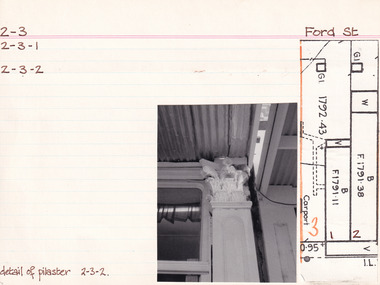
Card (Series) - Index Card, George Tibbits, Ford Street, Beechworth, 1976
... Auctioneers, same, Livery Stables, Pr + land 1884 - Rundle, S.H. Draper, same, shop 1889 - Richter, A. Watchmaker, W. ...Auctioneers, same, Livery Stables, Pr + land 1884 - Rundle, S.H. Draper, same, shop 1889 - Richter, A. Watchmaker, W. ...George Tibbits, University of Melbourne. Faculty of Architecture, Building and Town & Regional PlanningIndex system that support the research for Beechworth : historical reconstruction / [by] George Tibbits ... [et al]Arranged by street names of BeechworthEach index card includes: street name and number of property, image of property, allotment and section number, property owners and dates of ownership, description of the property according to rate records, property floor plan with dimensions.beechworth, george tibbitsbeechworth, george tibbits -
 Stawell Historical Society Inc
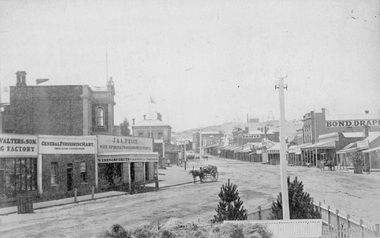
Photograph, Main Street Stawell looking East from the Present War Memorial site 1878
... On right south side of Main Street, two-storey wooden Bull & Mouth Hotel, Whiteside Taylors, Carters Boot shop, Lecky Draper, C. Mulcahy Post Office Hotel, G.J. ...On right south side of Main Street, two-storey wooden Bull & Mouth Hotel, Whiteside Taylors, Carters Boot shop, Lecky Draper, C. Mulcahy Post Office Hotel, G.J. ...Main St. looking East towards Big Hill from Coffee Palace Verandah over Present War Memorial area. 1878 Businesses from left Walters and Son Factory, General Furnishing Mart, Stawell Town Hall, J. & A. Price Wine Spirits & Provision Merchants, Stawell Post Office. On right south side of Main Street, two-storey wooden Bull & Mouth Hotel, Whiteside Taylors, Carters Boot shop, Lecky Draper, C. Mulcahy Post Office Hotel, G.J. Hewlett Baker & Confectionery, Iron Monger, Victoria House Bond Draper, Town Hall Hotel, J. Richards Fancy Repository. Victorian Views. C. Herbert, Photo. Stawell 1878stawell business streetscape -
 The Beechworth Burke Museum Research Collection
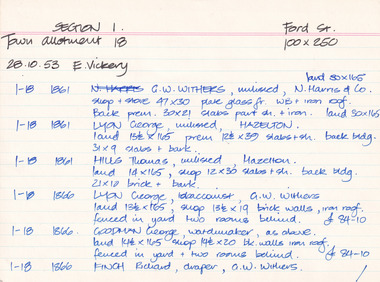
Card (Series) - Index Card, George Tibbits, Ford Street, Beechworth, 1976
... Crawford - land 27'x165' brick bldg. 26'6"x60' 2 stories ir rf. let as follows - -Dawson, James, draper, shop on street level. cellars under £78 - Duncan, Gordon + Flower, Charles, grocers, shop on street, room in rear and cellars under £104 - Hall, Algernon, photographer, 3 rooms rear, 1st floor £65 - Gillan, John, Tailor. 2 rooms front. 1st floor £41 - Morris, T.T. ...Crawford - land 27'x165' brick bldg. 26'6"x60' 2 stories ir rf. let as follows - -Dawson, James, draper, shop on street level. cellars under £78 - Duncan, Gordon + Flower, Charles, grocers, shop on street, room in rear and cellars under £104 - Hall, Algernon, photographer, 3 rooms rear, 1st floor £65 - Gillan, John, Tailor. 2 rooms front. 1st floor £41 - Morris, T.T. ...George Tibbits, University of Melbourne. Faculty of Architecture, Building and Town & Regional PlanningIndex system that support the research for Beechworth : historical reconstruction / [by] George Tibbits ... [et al]Arranged by street names of BeechworthEach index card includes: street name and number of property, image of property, allotment and section number, property owners and dates of ownership, description of the property according to rate records, property floor plan with dimensions.beechworth, george tibbitsbeechworth, george tibbits -
 The Beechworth Burke Museum Research Collection
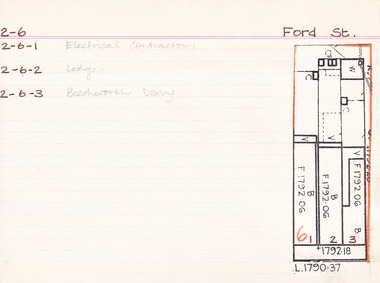
Card - Index Card, George Tibbits, Ford Street, Beechworth, 1976
... one 1900-1901 - Armstrong. double shop 1900 - Armstrong, John, draper, same shop + store £110 1900 - Bowen, Wm Johnston, Chemist, Kate Gammon, Sh. ...one 1900-1901 - Armstrong. double shop 1900 - Armstrong, John, draper, same shop + store £110 1900 - Bowen, Wm Johnston, Chemist, Kate Gammon, Sh. ...Property - Ford Street, Beechworth - Section 2, Town Allotment 6 - (Note: also 2-6-1 Electrical Contractors, 2-6-2 Lodge and 2-6-3 Beechworth Dairy) - 100' x250' Ownership details and history - 28 Oct 1853 - W.H. Neuber 1861 - Galbraith, Andrew - Faulkner George, unlisted, J.S. Clark. land 22'x165', shop 32'x20' glass + deal fr. 2 stories, WB + sh. Bakery 25'x20' slabs + bark. Stable 20'x10' WB + do. 1861 - Steel, William, unlisted, J. Manson. land 11'x140' shop 10'x33' plate glass & cedar front, slabs + sh. Back 10'6"x34' WB + sh. 1861 - Joel, Abraham, unlisted, J. Manson, land 11'x140' shop 10'x33' plate glass + cedar front, slabs + sh. bark, 10'6"x34' WB + do. 1861 - J. Manson, unlisted, same, land 22'x25' (in rear) stable 14'x14' slabs + bark 1861 - George Gammon, unlisted, same, land 22'x165' shop 14'x31' glazed front. deal + WB slabs + sh. Kitchen 15'x12' store in rear 20'x10' do + bark 1863/4 - Eveleigh, J.L. (A. Galbraith in '63-'63) J.S. Clark land + prem as 1861. 1863/4 - Hall, Algernon, J. Manson. land + prem as 1861 1863/4 - Faulkner, baker & confectioner, J. Manson, land + prem as 1861 1863/4 - Manson, John as 1861 1863/4 - Gammon as 1861, Kitchen 15'x12' bk. resid. 24'x12' 1866 - Raphael, Julius, Tobias, Sally, tobacconists, J.S. Clark, land 22'x165 shop 20'x38' bk. bldg. glass fr. + sh. rf. Kitch. in rear 14'x12' WB = sh. Do. Stable 20'x10' slabs + bark. £115 1866 - Cunningham, James & Robert, ironmongers, John Manson, land 22'x165' shop 20'x33' plate glass + cedar fr. slabs + sh. rf. prem in rear 21'x34' WB + sh. rf. £110 1866 - Gammon, George, Druggist, same. land 22'x165' prem. 30'x20' + 24'x12' bk. bldg. 2 stories with plate glass + cedar shop front + sh. rf. Kitchen 15'x12' WB + sh. rf. 1871 - Brown, John, Barber etc. J.S. Clark. land + prem as 1866 £75 1871 - Cunningham, J&R, ironmongers, same. land + prem as 1866 + stable 13'x8' slabs + bark £96 1871 - Gammon, G. Druggist, same land + prem as 1866 £144 1876 - Walton, Wm. Tailor, Mary Clark. prem as 1866 exc. kitch 16'x12' + 20'x10' 1876 - Cunningham, J&R, ironmongers, same land 22'x165' prem 20'x30' deal fr. bk walls sh. roof Do. in rear 34'x21. WB + sh. rf. stable 20'x20' WB + ir. rf. £90 1876 - Gammon, George, Chemist, same land + prem as 1866 exc. no. 24'x12' bk £120 1884 - Armstrong, John, Draper, Mary Clark. shop 1884 - Cunningham Js. Ironmonger, same shop 1884 - Gammon, G. Chemist, same, shop + dwelling 1889 - Armstrong, as above £45 1889 - Cunningham, JS. as above. Cunningham, J&R, shop, prem + land £70 1889 - Gammon, G. Chemist, smae shop, dwelling pr. l. £80 1899-1900 - Armstrong. One shop owned, other ....? one 1900-1901 - Armstrong. double shop 1900 - Armstrong, John, draper, same shop + store £110 1900 - Bowen, Wm Johnston, Chemist, Kate Gammon, Sh. DW + L £65 1906 - Armstrong, Draper, same S+L £110 1906 - Bowen, Wm. Johnston, Chemist, Kate Gammon, shop, prem + land £65 Sect. 2, Town Allot. 6 - Note: 2-6-1 Electrical Contractors, 2-6-2 Lodge and 2-6-3 Beechworth Dairy Architectural Index Card - Brian Pump and Tony Dugan - Photographers beechworth, george tibbits -
 The Beechworth Burke Museum Research Collection
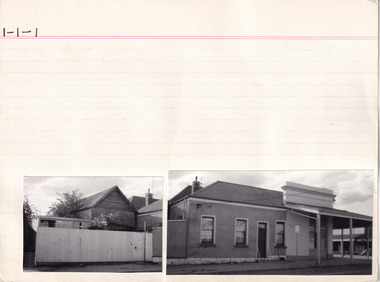
Card (Series) - Index Card, George Tibbits, Camp Street (Cnr Camp & High Streets), Beechworth, 1976
... shop 28'x21' WB. & sh rf, back prem 20'x18' slabs & sh. rf. Kitchen 10'x8'6" do-do £29 Camp Street 20-1 - 1889 - O'Bri8en-Frederick Christ, Draper, Same, shop + prem + land £50 1-1 - 1889 - Howard, Alfred H. ...shop 28'x21' WB. & sh rf, back prem 20'x18' slabs & sh. rf. Kitchen 10'x8'6" do-do £29 Camp Street 20-1 - 1889 - O'Bri8en-Frederick Christ, Draper, Same, shop + prem + land £50 1-1 - 1889 - Howard, Alfred H. ...George Tibbits, University of Melbourne. Faculty of Architecture, Building and Town & Regional PlanningIndex system that support the research for Beechworth : historical reconstruction / [by] George Tibbits ... [et al]Arranged by street names of BeechworthEach index card includes: street name and number of property, image of property, allotment and section number, property owners and dates of ownership, description of the property according to rate records, property floor plan with dimensions.beechworth, george tibbitsbeechworth, george tibbits -
 The Beechworth Burke Museum Research Collection
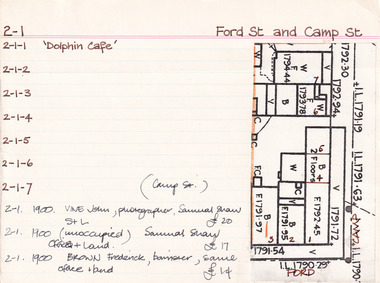
Card (Series) - Index Card, George Tibbits, Cnr Ford and Camp Streets, Beechworth, 1976
... Crawford. land 21'6"x66' "The Corner Hotel" 21'x50' 2 stories bk + iron roof, (see 3rd card) £200 1884 - Dawborn, B. Draper, J. Crawford, shop 1884 - Brown, J. Barber, same shop 1884 - Dreyer, F.W.H. ...Crawford. land 21'6"x66' "The Corner Hotel" 21'x50' 2 stories bk + iron roof, (see 3rd card) £200 1884 - Dawborn, B. Draper, J. Crawford, shop 1884 - Brown, J. Barber, same shop 1884 - Dreyer, F.W.H. ...George Tibbits, University of Melbourne. Faculty of Architecture, Building and Town & Regional PlanningIndex system that support the research for Beechworth : historical reconstruction / [by] George Tibbits ... [et al]Arranged by street names of BeechworthEach index card includes: street name and number of property, image of property, allotment and section number, property owners and dates of ownership, description of the property according to rate records, property floor plan with dimensions.beechworth, george tibbitsbeechworth, george tibbits -
 The Beechworth Burke Museum Research Collection
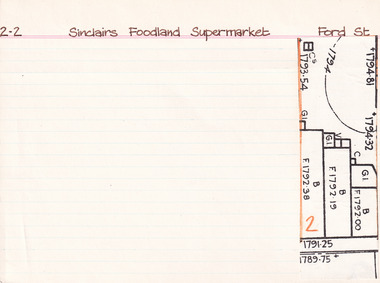
Card (Series) - Index Card, George Tibbits, Ford Street, Beechworth, 1976
... Land only 1884 - unoccupied, John Brown, land only 1884 - Dawborn, B, draper, same, shop 1889 - unoccupied, Wilson, land £10 1889 - Brown, J, draper, same S+P+L £60 1889 - Northeast, Edwin + Culliton, Martha, drapers - B. ...Land only 1884 - unoccupied, John Brown, land only 1884 - Dawborn, B, draper, same, shop 1889 - unoccupied, Wilson, land £10 1889 - Brown, J, draper, same S+P+L £60 1889 - Northeast, Edwin + Culliton, Martha, drapers - B. ...George Tibbits, University of Melbourne. Faculty of Architecture, Building and Town & Regional PlanningIndex system that support the research for Beechworth : historical reconstruction / [by] George Tibbits ... [et al]Arranged by street names of BeechworthEach index card includes: street name and number of property, image of property, allotment and section number, property owners and dates of ownership, description of the property according to rate records, property floor plan with dimensions.beechworth, george tibbitsbeechworth, george tibbits -
 The Beechworth Burke Museum Research Collection
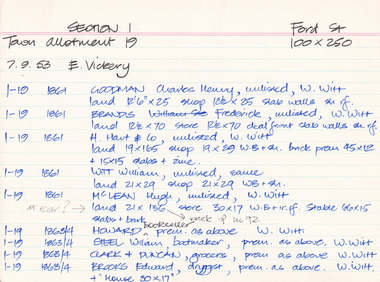
Card (Series) - Index Card, George Tibbits, Ford Street, Beechworth, 1976
... Johnston, S+L £55 1906 - Ryan, Michael P., Solicitor, Robert Johnston, office + land £40 1906 - as above - Robert Johnston, shop + land £35 1906 - O'Brien, Horace, Draper, Robert Johnston, shop + land £35 1906 - Woodhead, Benjamin, fancy goods dealer, Robert Johnston, shop + land £35 1-19-1 - Jeffrey's Stores, Drapers, Ford Street 1-19-2 - Jeffrey's 1-19-3 - Gwyn Morris 1-19-4 - Gwyn Morris, Chemist, 54 Ford St. ...Johnston, S+L £55 1906 - Ryan, Michael P., Solicitor, Robert Johnston, office + land £40 1906 - as above - Robert Johnston, shop + land £35 1906 - O'Brien, Horace, Draper, Robert Johnston, shop + land £35 1906 - Woodhead, Benjamin, fancy goods dealer, Robert Johnston, shop + land £35 1-19-1 - Jeffrey's Stores, Drapers, Ford Street 1-19-2 - Jeffrey's 1-19-3 - Gwyn Morris 1-19-4 - Gwyn Morris, Chemist, 54 Ford St. ...George Tibbits, University of Melbourne. Faculty of Architecture, Building and Town & Regional PlanningIndex system that support the research for Beechworth : historical reconstruction / [by] George Tibbits ... [et al]Arranged by street names of BeechworthEach index card includes: street name and number of property, image of property, allotment and section number, property owners and dates of ownership, description of the property according to rate records, property floor plan with dimensions.beechworth, george tibbitsbeechworth, george tibbits -
 The Beechworth Burke Museum Research Collection
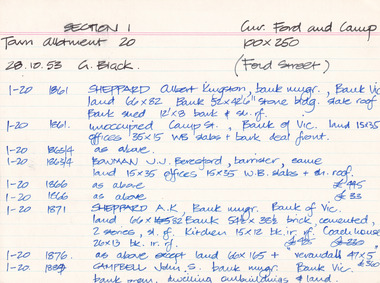
Card (Series) - Index Card, George Tibbits, Cnr Ford and Camp Streets (Ford St), Beechworth, 1976
... Fancy Goods, Repository, same shop & prem &+ land £12 1889 - Wilson, Joseph P. Draper, Henry T. ...Fancy Goods, Repository, same shop & prem &+ land £12 1889 - Wilson, Joseph P. Draper, Henry T. Littlewood, shop & dwelling & prem + land £135 1889 - O'Brien, Denis, bootmaker, O'Brien, Frederick C. ...George Tibbits, University of Melbourne. Faculty of Architecture, Building and Town & Regional PlanningIndex system that support the research for Beechworth : historical reconstruction / [by] George Tibbits ... [et al]Arranged by street names of BeechworthEach index card includes: street name and number of property, image of property, allotment and section number, property owners and dates of ownership, description of the property according to rate records, property floor plan with dimensions.beechworth, george tibbitsbeechworth, george tibbits
