
Showing 174 items matching "drilling tool"
-
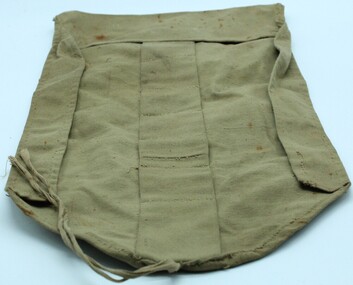 Ringwood RSL Sub-Branch
Equipment - Cotton Tool Roll cover
... Cotton Drill Tool roll...Cotton Drill Tool roll Equipment Cotton Tool Roll cover ...Cotton Drill Tool roll -
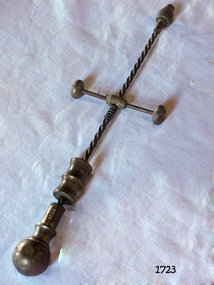 Flagstaff Hill Maritime Museum and Village
Tool - Archimedes Drill, 1900 to 1930s
... ...Drilling Tool...The Archimedes drill, also known as a fretwork drill, is an old type of drill which works on the Archimedian principle; the drill rotates quickly as the barrel on the stem is worked up and down. This tool provides a quick and easy way to bore holes through ordinary fret wood and other substances, smaller versions are used in jewellery making where precision drilling is required. ...Most old examples have no makers names. A vintage drilling tool that has been nickel plated with brass fitting and easier to sterilise. ...The Archimedes drill, also known as a fretwork drill, is an old type of drill which works on the Archimedian principle; the drill rotates quickly as the barrel on the stem is worked up and down. This tool provides a quick and easy way to bore holes through ordinary fret wood and other substances, smaller versions are used in jewellery making where precision drilling is required. There were numerous different sized Archimedes drills made from various materials, usually a combination of wood and steel, some being all steel and some including brass parts. The fancier versions of these drills included parts made from Rosewood, Ebony, Ivory and decorative brass parts. Some of the later Archimedes drills had technological improvements such as a ratchet device and the inclusion of fly-weights. The ratchet device allows the drill to revolve continuously in the cutting direction. The fly-weights give momentum to maintain the speed of the drill during the upward stroke of the hand. Most old examples have no makers names.A vintage drilling tool that has been nickel plated with brass fitting and easier to sterilise. The item therefore could have been used in the medical profession as a bone drill during surgery. Weighted Archimedes drill all metal construction, nickel plated with brass handles centrifugal typeNoneflagstaff hill, warrnambool, flagstaff-hill, flagstaff-hill-maritime-museum, maritime-museum, shipwreck-coast, flagstaff-hill-maritime-village, archimedean drill, drill, tool, drilling tool -
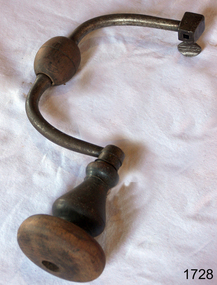 Flagstaff Hill Maritime Museum and Village
Tool - Drill Brace, 1800s
... ...Drilling Tool...The subject item is unmarked but could have been made in Glasgow Scotland by John Fray in the 1800s A significant early example of a drill brace made in the UK during the 1800s demonstrates the evolution of this type of tool from this time that today is a rare and collectable example of woodworking tools. flagstaff hill warrnambool flagstaff-hill flagstaff-hill-maritime-museum maritime-museum shipwreck-coast flagstaff-hill-maritime-village brace Carpenders Wheel Brace Cabinet Makers Tools Drilling Tool Wagon Makers Drill None Drill Brace metal with socket and thumbscrew, varnished wooden head and handle Tool Drill Brace ...The subject item is an early Victorian Scotch Brace with a 10-inch sweep. They were also known as a six penny or "gentleman's" brace and were designed to accept tapered square shank bits, early designs have a thumb screw to help secure the bit. Later designs had a catch to secure drilling bits. This type of brace was used in wagon making for boring & drilling holes into the wood for a variety of purposes, including driving screws. The subject item is unmarked but could have been made in Glasgow Scotland by John Fray in the 1800s A significant early example of a drill brace made in the UK during the 1800s demonstrates the evolution of this type of tool from this time that today is a rare and collectable example of woodworking tools.Drill Brace metal with socket and thumbscrew, varnished wooden head and handleNoneflagstaff hill, warrnambool, flagstaff-hill, flagstaff-hill-maritime-museum, maritime-museum, shipwreck-coast, flagstaff-hill-maritime-village, brace, carpenders wheel brace, cabinet makers tools, drilling tool, wagon makers drill -
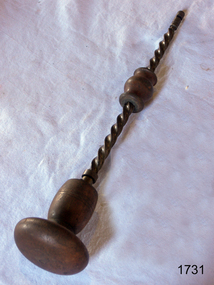 Flagstaff Hill Maritime Museum and Village
Tool - Archimedean drill, Late 19th Century
... Archimedean drill with wooden hand...Drilling Tool...The Archimedes drill, also known as a fretwork drill, is an old type of drill which works on the Archimedian principle; the drill rotates quickly as the barrel on the stem is worked up and down. This tool provides a quick and easy way to bore holes through ordinary fret wood and other substances, smaller versions are used in jewellery making where precision drilling is required. ...Tool Archimedean drill ...The Archimedes drill, also known as a fretwork drill, is an old type of drill which works on the Archimedian principle; the drill rotates quickly as the barrel on the stem is worked up and down. This tool provides a quick and easy way to bore holes through ordinary fret wood and other substances, smaller versions are used in jewellery making where precision drilling is required. There were numerous different sized Archimedes drills made from various materials, usually a combination of wood and steel, some being all steel and some including brass parts. The fancier versions of these drills included parts made from Rosewood, Ebony, Ivory and decorative brass parts. Some of the later Archimedes drills had technological improvements such as a ratchet device and the inclusion of fly-weights. The ratchet device allows the drill to revolve continuously in the cutting direction. The fly-weights give momentum to maintain the speed of the drill during the upward stroke of the hand. Most old examples such as the subject item have no makers names.A vintage drilling tool that gives a snapshot into how holes were drilled by hand into small or delicate objects during the Victorian era. Tools from this time are today regarded as collectable items eagerly sought by collectors of antique tools. Archimedean drill with Rosewood hand, brass bearings, steel twist and wooden grip. Noneflagstaff hill, warrnambool, flagstaff-hill, flagstaff-hill-maritime-museum, maritime-museum, shipwreck-coast, flagstaff-hill-maritime-village, archimedean drill, archimedean drill with wooden hand, drilling tool -
 Flagstaff Hill Maritime Museum and Village
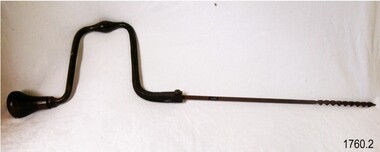
Tool - Drill Brace, 1800s
... ...Drilling Tool...Has a screw in the holding socket item also has an auger bit. Tool Drill Brace ...The subject item is an early Victorian Scotch Brace with a 10-inch sweep. They were also known as a six penny or "gentleman's" brace and were designed to accept tapered square shank bits, early designs have a thumb screw to help secure the bit. Later designs had a catch to secure drilling bits. This type of brace was used in wagon making for boring & drilling holes into the wood for a variety of purposes, including driving screws. The subject item is unmarked but could have been made in Glasgow Scotland by John Fray in the 1800s, early drill braces of this type were often unmarked by their makers. A significant early example of a drill brace made in the UK during the 1800s demonstrates the evolution of this type of tool from this time that today is a rare and collectable example of woodworking tools.Brace metal with wooden handle. Has a screw in the holding socket item also has an auger bit. Noneflagstaff hill, warrnambool, flagstaff-hill, flagstaff-hill-maritime-museum, maritime-museum, shipwreck-coast, flagstaff-hill-maritime-village, brace, carpenders wheel brace, cabinet makers tools, drilling tool, wagon makers drill -
 Maldon Vintage Machinery Museum Inc
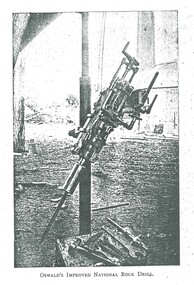
Photograph, Oswald's Improved National Rock Drill
... Grainy photograph of Oswald's Improved National Rock Drill with various tools laying in front....Mining Oswald's Improved National Rock Drill Grainy photograph of Oswald's Improved National Rock Drill with various tools laying in front. Oswald's Improved National Rock Drill Photograph ...Grainy photograph of Oswald's Improved National Rock Drill with various tools laying in front.Oswald's Improved National Rock Drillmining -
 Orbost & District Historical Society
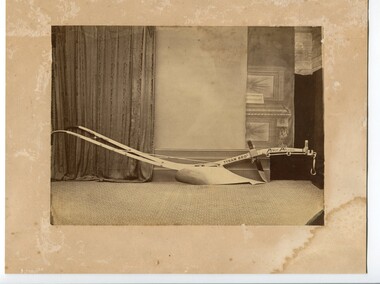
black and white photograph
... His company is also believed to be the first to have produced drilling tools suitable for use in basalt quartz-load gold mining. ...His company is also believed to be the first to have produced drilling tools suitable for use in basalt quartz-load gold mining. ...There is no information with this item. John Tynan's Victoria Agricultural Implement Factory began making ploughs in 1857. His company is also believed to be the first to have produced drilling tools suitable for use in basalt quartz-load gold mining. Tynan was the first person to manufacture swing ploughs. His ploughs won numerous prizes, including the first gold medal ever given in Victoria for a colonially made plough.This is a photograph of an early farming tool.A black / white photograph on a discoloured cream coloured card. It is of a shiny new plough on a carpet with walls and drapes in the background.on cutting arm - Tynan Bros Prize Ploughphotograph-plough-tynan -
 Warrnambool and District Historical Society Inc.
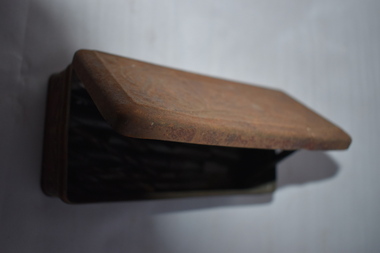
Tools, Drill bits in tin box, Early 20th century
... This tin contains tool bits that would have been used in conjunction with drills. Most handymen would have had such a collection amongst his tools and many still do today. ...It contains 39 tool and drill bits of various shapes and sizes....It contains 39 tool and drill bits of various shapes and sizes. ...This tin contains tool bits that would have been used in conjunction with drills. Most handymen would have had such a collection amongst his tools and many still do today. This tin of tool bits is kept as a memento of the type of tool kit a handyman would have had in the past. Although rusty the tin itself is of interest as one from the early 20th century.This is a rectangular-shaped tin with embossed patterns on the sides and top. It is completely rusted. It contains 39 tool and drill bits of various shapes and sizes.household tools, history of warrnambool, drill bits -
 City of Moorabbin Historical Society (Operating the Box Cottage Museum)
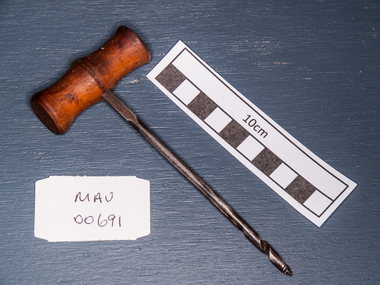
Tools, 2x Gimlet, boring screw, c1900
... A gimlet is a hand tool for drilling small holes, mainly in wood, without splitting. ...A gimlet is a hand tool for drilling small holes, mainly in wood, without splitting. ...A gimlet is a hand tool for drilling small holes, mainly in wood, without splitting. A gimlet is always a small tool made of a piece of steel of a semi-cylindrical form, hollow on one side, having a cross handle at one end and a worm or screw at the other. A similar tool of larger size is called an auger. Early settlers in Moorabbin Shire had to be self reliant as they established their farms and built their homes using tools like this gimlet. 2 x small hand tool with a screw point, grooved shank, and cross handle for boring holes early settlers, pioneers, market gardeners, moorabbin, bentleigh, brighton, cheltenham, tools, blacksmiths -
 City of Moorabbin Historical Society (Operating the Box Cottage Museum)
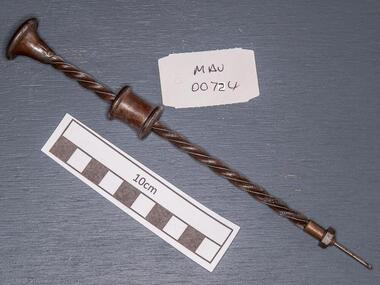
Tool - Steel Archimedes hand drill 'Hobbies', c1900
... Some of the most beautiful Archimedean drills appear in English tool auctions replete with brass, rosewood and even ivory. ...Some of the most beautiful Archimedean drills appear in English tool auctions replete with brass, rosewood and even ivory. tools metalwork woodwork carpentry early settlers pioneers market gardeners moorabbin bentleigh cheltenham blacksmiths bobbins augers hand drills marples william 'HOBBIES' on top of handle A steel hand drill with fine bit and sliding bobbin Tool Steel Archimedes hand drill 'Hobbies' possibly W. ...Archimedes drills, incorporate a bobbin sliding up and down a spiral shaft to bore a hole. Spiral-bit augers were precursors to modern drills, whose bits cleared the hole of chips as the user drilled. Some of the most beautiful Archimedean drills appear in English tool auctions replete with brass, rosewood and even ivory. A steel hand drill with fine bit and sliding bobbin'HOBBIES' on top of handletools, metalwork, woodwork, carpentry, early settlers, pioneers, market gardeners, moorabbin, bentleigh, cheltenham, blacksmiths, bobbins, augers, hand drills, marples william -
 Melbourne Tram Museum
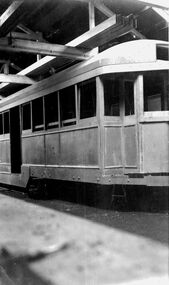
Photograph - Digital Image, construction of W class tramcars at the Holden Factory Woodville, 1924
... Note the brace drill type tool sitting on the destination box. .3 - completed body with an "A" sitting on dolly's outside the workshop buildings...Note the brace drill type tool sitting on the destination box. .3 - completed body with an "A" sitting on dolly's outside the workshop buildings. - see item 7403 for a print. .4 - ditto - another view .5 - interior view of the erecting shop with at least four bodies under construction and a frame. .6 - interior view showing a new underframe, and other bodies partly completed in the background. .7 - Woodville sidings and the plant in the far background. ...Set of 7 digital images provided by Dr John Radcliffe of Adelaide of the construction of W class tramcars at the Holden Factory Woodville, by a photographer known as Collins. All 1924. .1 - W class body in a low roofed shop near completion .2 - W Class body in a high roof area, with the roof slats being fitted. Note the brace drill type tool sitting on the destination box. .3 - completed body with an "A" sitting on dolly's outside the workshop buildings. - see item 7403 for a print. .4 - ditto - another view .5 - interior view of the erecting shop with at least four bodies under construction and a frame. .6 - interior view showing a new underframe, and other bodies partly completed in the background. .7 - Woodville sidings and the plant in the far background. Permission from John Radcliffe to be obtained prior to use.trams, tramways, new tramcars, w class, adelaide, holdens, construction -
 Tatura Irrigation & Wartime Camps Museum
Tools - Metal
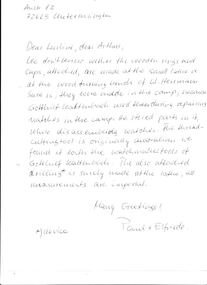
... Small square Swains typewriter ribbon tin with 41 items of metal tools inside: 1 square metal (typewriter ribbon) tin & lid; 9 metal bit holders (different sizes)|4 metal nuts; 1 solid metal cylinder; 1 hollow cylinder; 4 saws; 2 metal bits; 1 brass cylinder; 1 copper cylinder; 5 metal rings (various sizes); 1 metal threaded cylinder; 2 metal bits; 1 piece of wire; 3 metal spot drills; 1 watchmakers tool; 4 pieces of tin; 1 metal threaded cylinder....Sent from Germany by Elfriede & Paul Faig. tatura camp 3 faig p kaltenbach g hermann w horology tools Small square Swains typewriter ribbon tin with 41 items of metal tools inside: 1 square metal (typewriter ribbon) tin & lid; 9 metal bit holders (different sizes)|4 metal nuts; 1 solid metal cylinder; 1 hollow cylinder; 4 saws; 2 metal bits; 1 brass cylinder; 1 copper cylinder; 5 metal rings (various sizes); 1 metal threaded cylinder; 2 metal bits; 1 piece of wire; 3 metal spot drills; 1 watchmakers tool; 4 pieces of tin; 1 metal threaded cylinder. ...Sent from Germany by Elfriede & Paul Faig.Small square Swains typewriter ribbon tin with 41 items of metal tools inside: 1 square metal (typewriter ribbon) tin & lid; 9 metal bit holders (different sizes)|4 metal nuts; 1 solid metal cylinder; 1 hollow cylinder; 4 saws; 2 metal bits; 1 brass cylinder; 1 copper cylinder; 5 metal rings (various sizes); 1 metal threaded cylinder; 2 metal bits; 1 piece of wire; 3 metal spot drills; 1 watchmakers tool; 4 pieces of tin; 1 metal threaded cylinder.tatura, camp 3, faig, p, kaltenbach, g, hermann, w, horology, tools -
 Orbost & District Historical Society
emu egg
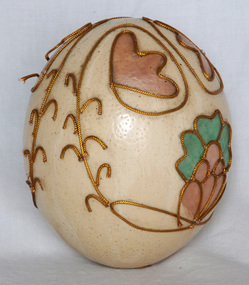
... The contents must be removed through a small hole (either tool drilled or poked with a needle). After the yolk has been blown out (scrambling the yolk first by poking with a needle will make it easier to remove), the egg needs to be washed through and left to drain dry. ...The contents must be removed through a small hole (either tool drilled or poked with a needle). After the yolk has been blown out (scrambling the yolk first by poking with a needle will make it easier to remove), the egg needs to be washed through and left to drain dry. ...Emu eggs are perfect for decorating, painting or carving. Emu egg shells have multiple layers ranging from an inner white layer through to the dark green outer layer. The contents must be removed through a small hole (either tool drilled or poked with a needle). After the yolk has been blown out (scrambling the yolk first by poking with a needle will make it easier to remove), the egg needs to be washed through and left to drain dry. It can then be painted, carved, etched or decorated. Emu decorating is a traditional Aboriginal art. The carving of emu eggs by Indigenous and non-Indigenous people was popular in the late 19th century but production declined in the 20th century, partly due to the protection of eggs through legislation. This has been overturned in recent years with the development of commercial emu farms. In the period between the two world wars particularly, with the production of other Aboriginal artefacts for an outside market, the carving of emu eggs provided an important source of income for Aboriginal people in many parts of Australia. It was a widespread practice in the south-east and it was not unusual for Aboriginal people to decorate their own homes with carved eggs and other items created by themselves or community members, serving to affirm an Indigenous identity within the domestic environment. (ref National Gallery of Australia)This item is significant for its uniqueness and its aesthetic appeal.An emu egg which has been painted white and decorated with glued on cord/thread to make a pattern of flowers and leaves.emu-egg ornament handcraft -
 Flagstaff Hill Maritime Museum and Village
Tool - Screwdriver Set, 1930-1955's
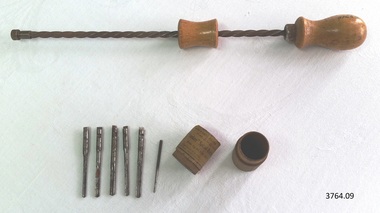
... drill...ratchet screwdriverset...north bros. mfc co philadelphia pa...tool...This Yankee spiral-ratchet Screw Driver (screwdriver) set was a hand tool with drills, used in the making of components for the ship model Sovereign of the Seas. ...Ratchet screwdriver plus 6 drill bits - sizes 1/16th to 11/64th - contained in a small round wooden tube with lid, label on outside. This Screw Driver set is part of a collection of tools and accessories once used by Jim Williams, maker of a series of ship models 1930-1955 including “HMS Sovereign of the Seas”. ...This Yankee spiral-ratchet Screw Driver (screwdriver) set was a hand tool with drills, used in the making of components for the ship model Sovereign of the Seas. ...This Yankee spiral-ratchet Screw Driver (screwdriver) set was a hand tool with drills, used in the making of components for the ship model Sovereign of the Seas. It is part of a collection of objects used by Jim Williams, maker of fine ship models from about 1930-1955. Most of the components for the models, as well as many of the tools, were handmade by Jim Williams. Jim’s family has donated the ship model “Sovereign of the Seas” and many tools, accessories and documents used in the making of this and other ship models have been donated to Flagstaff Hill Maritime Village. Ship model of HMS Sovereign of the Seas, scale model of 17th Century English war ship, was handmade and carved from plans, enclosed in airtight glass case. All components of that model, including even the smallest pulleys, were hand crafted using tools designed and made by Jim. Outstanding details include functional rigging and moving cannons. Please see our record 3732 of the mode Sovereign of the Seas for further details of the ship and the maker. This set is connected with the hobby and skill of ship model making that has been crafted as a leisure activity for many generations. The hobby is often chosen by serving and retired mariners who appreciate the connection with maritime history. This set was used by local Warrnambool man, Jim Williams, who was employed at Cramond and Dickson clothing store, and then at Fletcher Jones menswear for 27 years. It was used in making components for the model of the historic ship, the Sovereign of the Seas. The Sovereign of the Seas was a historic 17th century English war ship with important maritime heritage. Spiral-Ratchet Screw Driver set, also called an ‘American drill’ or hand drill. 9 parts, Yankee brand, No. 31 set. Made by North Bros. Mfc Co. Philadelphia, Pennsylvania, U.S.A.. Instructions for use are on label. Ratchet screwdriver plus 6 drill bits - sizes 1/16th to 11/64th - contained in a small round wooden tube with lid, label on outside. This Screw Driver set is part of a collection of tools and accessories once used by Jim Williams, maker of a series of ship models 1930-1955 including “HMS Sovereign of the Seas”. “WITH 6 DRILL POINTS / SIZES, 1/16 TO 11/64 includes - - with - - / “Yankee” Spiral-Ratchet Screw Driver No. 31 / Made by NORTH BROS. MFG. CO. PHILADELPHIA P [A?]- / Directions for use – First Insert Drill Point In - / Drill Chuck, and turn the – in Chuck of Screwdriver U.S.A.”flagstaff hill, warrnambool, flagstaff hill maritime museum, maritime museum, shipwreck coast, flagstaff hill maritime village, great ocean road, jim williams, james bernard williams, ship model hobby, ship model tools, ship model making equipment, ship model making accessories, wood working tool, model making tool, screwdriver set, spiral ratchet screwdriver set, yankee screwdriver set, spiral-ratchet screw driver set, american drill, ratchet drill set, ratchet hand drill, ratchet screwdriverset, north bros. mfc co philadelphia pa, tool, sovereign of the sea, ship model, hobby, ship model tool -
 Bendigo Historical Society Inc.
Document - IAN DYETT COLLECTION: AUCTION CATALOGUE - C.R.A. RESEARCH UNIT - EASTVILLE
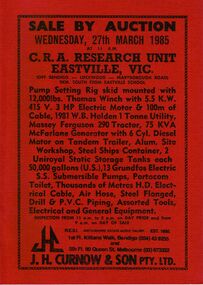
... Electrical Cable, Air Hose, Steel Flanged, Drill & P.V.C. Piping, Assorted Tools, Electrical and General Equipment. ...Electrical Cable, Air Hose, Steel Flanged, Drill & P.V.C. Piping, Assorted Tools, Electrical and General Equipment. ...Red covered auction catalogue with black printing for a sale at C.R.A. Research Unit, Eastville, Vic on 27th March 1985. For sale was Pump Setting Rig skid mounted with 12,000 lbs. Thomas Winch with 5.5 K.W. 415 V. 3 HP Electric Motor & 100m of Cable, 1981 W.B. Holden 1 Tonne Utility, Massey Ferguson 290 Tractor, 75 KVA McFarlane Generator with 6 Cyl. Diesel Motor on Tandem Trailer, Alum. Site Workshop, Steel Ships Container, 2 Uniroyal Static Storage Tanks each 50,000 gallons (U.S.), 13 Groundfos Electric S.S. Submersible Pumps, Portacom Toilet, Thousands of Metres H.D. Electrical Cable, Air Hose, Steel Flanged, Drill & P.V.C. Piping, Assorted Tools, Electrical and General Equipment. J. H. Curnow & Son Pty. Ltd. Were the auctioneers.business, auctioneers, j h curnow & son pty ltd, ian dyett collection - auction catalogue - c.r.a. research unit - eastville vic, j h curnow & son pty ltd, f c dyett, i m dyett, n f dyett, bolton bros pty ltd print -
 Orbost & District Historical Society
eggs
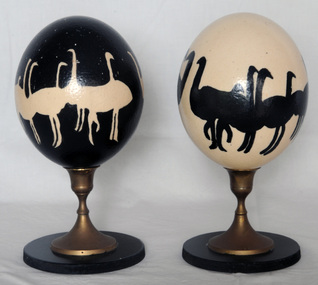
... The contents must be removed through a small hole (either tool drilled or poked with a needle). After the yolk has been blown out (scrambling the yolk first by poking with a needle will make it easier to remove), the egg needs to be washed through and left to drain dry. ...The contents must be removed through a small hole (either tool drilled or poked with a needle). After the yolk has been blown out (scrambling the yolk first by poking with a needle will make it easier to remove), the egg needs to be washed through and left to drain dry. ...These eggs could be ostrich eggs from an ostrich farm which operated just out of Marlo. It is likely that they were donated by Kate and Richard Earle who ran the enterprise. Emu and ostrich eggs are perfect for decorating, painting or carving. Emu egg shells have multiple layers ranging from an inner white layer through to the dark green outer layer. The contents must be removed through a small hole (either tool drilled or poked with a needle). After the yolk has been blown out (scrambling the yolk first by poking with a needle will make it easier to remove), the egg needs to be washed through and left to drain dry. It can then be painted, carved, etched or decorated. Emu decorating is a traditional Aboriginal art. The carving of emu eggs by Indigenous and non-Indigenous people was popular in the late 19th century but production declined in the 20th century, partly due to the protection of eggs through legislation. This has been overturned in recent years with the development of commercial emu farms. In the period between the two world wars particularly, with the production of other Aboriginal artefacts for an outside market, the carving of emu eggs provided an important source of income for Aboriginal people in many parts of Australia. It was a widespread practice in the south-east and it was not unusual for Aboriginal people to decorate their own homes with carved eggs and other items created by themselves or community members, serving to affirm an Indigenous identity within the domestic environment. (ref National Gallery of Australia)This item is significant for its uniqueness and aesthetic appeal.Two painted eggs on stands. 1907.1 is painted black and has white emus or ostriches painted on it. 1907.2 is painted white and has black emus or ostriches painted on it. Both stands are wooden with brass pedestals. The eggs are possibly ostrich eggs.handcraft emu-egg ornament ostrich-egg -
 Flagstaff Hill Maritime Museum and Village
Tool - Adze, Ward & Payne Ltd, Between 1843 to Mid 20th Century
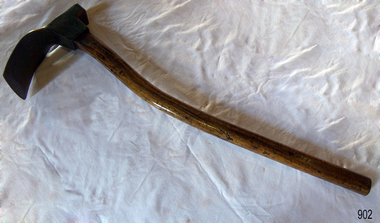
... By 1911 they had expanded into making spades, forks, sheep shears and many other types of edged tools including drills and wood planes. In 1967 Wilkinson Sword purchased all the company's share capital and continued to sell Ward & Payne tools until 1970 when a fire burned the factory down and housing development was built on the site....By 1911 they had expanded into making spades, forks, sheep shears and many other types of edged tools including drills and wood planes. In 1967 Wilkinson Sword purchased all the company's share capital and continued to sell Ward & Payne tools until 1970 when a fire burned the factory down and housing development was built on the site. ...An adze is an ancient and versatile cutting tool and has been in use for thousands of years. Adze are similar to an axe but with the cutting edge perpendicular to the handle rather than parallel. They have been used since the Stone Age. Adzes are hand tools used for smoothing or carving wood. The subject item was made by Ward & Payne of the Limbrick Works at Hillsborough, Sheffield England manufacturers of hand-forged tools. Their trademark registered in 1850 was a Letter "W" & "P" stamped into the steel. The firm was established by David Ward (1767-1822) in 1803 the company became David Ward & Sons, in 1837 after Ward's son Edward joined the firm. In 1845 Henry Payne the founder's son-in-law became a partner but died in 1850 after which the company reverted to the Ward family. The business then concentrated on making carving tools, chisels and gouges. In 1882 David Ward's grandson David Ward Jr. (1835-1889) purchased land and built a factory at Sheffield North known as the "Limerick Wheel". For a time Wards operated from both 106-114 West Street Sheffield and at Limbrick Road, Hillsborough on the river Loxley. By 1911 they had expanded into making spades, forks, sheep shears and many other types of edged tools including drills and wood planes. In 1967 Wilkinson Sword purchased all the company's share capital and continued to sell Ward & Payne tools until 1970 when a fire burned the factory down and housing development was built on the site.The subject item is significant as it gives a snapshot of the technological development of sailing ships and their operation before steam-powered vessels took over around the world. Tools such as the subject item demonstrate the traditional craftsmanship and skill of the shipwright and the aesthetic quality of the timber ships designs of the time. Adze with wooden handle curved painted green with patent number and maker's name inscribed on inside curve of blade. Inscribed "Patd 561 Ward" "2w". flagstaff hill, warrnambool, flagstaff-hill, flagstaff-hill-maritime-museum, maritime-museum, shipwreck-coast, flagstaff-hill-maritime-village, smoothing tool, hand tool, carpenders tool, adze, coopers tool, woodworking tools -
 Federation University Historical Collection
Book, Machinery for Metalliferous Mines, 1894, 1894
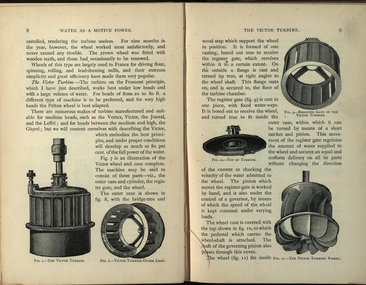
... There a a number of lovely line illustrations in the book including: Poncelot's undershot waterwheel; Fromont furnace;Victor turbine; Pelton waterwheel; Root's positive blower;Cross section and front elevation of Lancashire boiler; Robey's Compound Mill Engine; Portable Winding Plant; Iron Pit Head Gear ; Loading Arrangement in an Incline Shaft; kibble; Worthington Pump; California Pump; Scram's Air Compressor; Rock drill Bits; Special Sharpening tools; Boring tools;Rotating Picking table; Ore Feeder; roller crusher; stamp battery; round buddle; slime table; vanner; amalgamating plant; belt elevator;roasting furnace;splicing wire rope; capel; tipping waggon;...There a a number of lovely line illustrations in the book including: Poncelot's undershot waterwheel; Fromont furnace;Victor turbine; Pelton waterwheel; Root's positive blower;Cross section and front elevation of Lancashire boiler; Robey's Compound Mill Engine; Portable Winding Plant; Iron Pit Head Gear ; Loading Arrangement in an Incline Shaft; kibble; Worthington Pump; California Pump; Scram's Air Compressor; Rock drill Bits; Special Sharpening tools; Boring tools;Rotating Picking table; Ore Feeder; roller crusher; stamp battery; round buddle; slime table; vanner; amalgamating plant; belt elevator;roasting furnace;splicing wire rope; capel; tipping waggon; Machinery for Metalliferous Mines, 1894 Book Book Crosby Lockwood and Son E. ...The 1st edition of this famous work, giving an excellent account of the machinery used in late 19th century metal mining in the UK and overseas is very rare. It covers a wide range of equipment - pumps, steam engines, drills, winding engines, stamps & concentration mills, aerial ropeways, tramways and early uses of electricity etc. Brown hard cloth covered book. xvi 564 pages with additional advertisements, with over 300 illustrations and drawings, some fold out. Chapters include Water as a motive power, Wind engines and ventilating machinery, Steam boilers/engines and oil engines, hoisting machinery, draining of Mines, pumping engines, rock drilling machinery, boring machinery, concentration machinery, sizing and classifications trommels, joggers and jigging, fine concentration, milling of gold ores, milling of silver ores, amalgamation plates and machinery, dry and roasting machinery, chlorination and cyandide processes for the extraction of gold, electricity as a motive power for mining, electric lighting and blasting, aerial wire ropeways, transport by rail and road. There a a number of lovely line illustrations in the book including: Poncelot's undershot waterwheel; Fromont furnace;Victor turbine; Pelton waterwheel; Root's positive blower;Cross section and front elevation of Lancashire boiler; Robey's Compound Mill Engine; Portable Winding Plant; Iron Pit Head Gear ; Loading Arrangement in an Incline Shaft; kibble; Worthington Pump; California Pump; Scram's Air Compressor; Rock drill Bits; Special Sharpening tools; Boring tools;Rotating Picking table; Ore Feeder; roller crusher; stamp battery; round buddle; slime table; vanner; amalgamating plant; belt elevator;roasting furnace;splicing wire rope; capel; tipping waggon;mining, cornish pump, linkenbach table, water wheel, ventilation, oil engine, california, america, water, steam boilers, steam engines, oil engines, pumpimg, rock drilling, boring, jiggers, milling, silver, gold, drying and roasting, chlorination, cyaniding, lead, zinc, copper, electricity, electric lighting, wire ropes, transport, wind engine, poppet head -
 Flagstaff Hill Maritime Museum and Village
Tool - Caulking Tool, Ward & Payne Ltd, Late 19th century
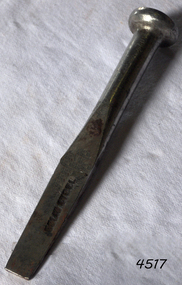
... By 1911 they had expanded into making spades, forks, sheep shears and many other types of edged tools including drills and wood planes. In 1967 Wilkinson Sword purchased all the company's share capital and continued to sell Ward & Payne tools until 1970 when a fire burned the factory down and housing development was built on the site. ...By 1911 they had expanded into making spades, forks, sheep shears and many other types of edged tools including drills and wood planes. In 1967 Wilkinson Sword purchased all the company's share capital and continued to sell Ward & Payne tools until 1970 when a fire burned the factory down and housing development was built on the site. ...Caulking is the traditional technique used on wooden vessels built with butted or clinker-built planks to fill the gaps between these planks while still allowing the wood to flex and move. This involved driving the irons, hammered in with the mallet, deep into the seams to open them up. After this, spun yarn, oakum (hemp) or cotton was driven deep into the gaps. The hemp or cotton was soaked in creosote or pine tar to make the joins watertight. Caulking also played a structural role in tightening up the hull or deck by reducing the longitudinal movement of the neighbouring planks. The subject item was made by Ward & Payne of the Limbrick Works at Hillsborough, Sheffield England manufacturers of hand-forged tools. Their trademark registered in 1850 was a Letter "W" & "P" stamped into the steel. The firm was established by David Ward (1767-1822) in 1803 the company became David Ward & Sons, in 1837 after Ward's son Edward joined the firm. In 1845 Henry Payne the founder's son-in-law became a partner but died in 1850 after which the company reverted to the Ward family. The business then concentrated on making carving tools, chisels and gouges. In 1882 David Ward's grandson David Ward Jr. (1835-1889) purchased land and built a factory at Sheffield North known as the "Limerick Wheel". For a time Wards operated from both 106-114 West Street Sheffield and at Limbrick Road, Hillsborough on the river Loxley. By 1911 they had expanded into making spades, forks, sheep shears and many other types of edged tools including drills and wood planes. In 1967 Wilkinson Sword purchased all the company's share capital and continued to sell Ward & Payne tools until 1970 when a fire burned the factory down and housing development was built on the site. The subject item is significant as it gives a snapshot of the technological development of sailing ships and their operation before steam-powered vessels took over around the world. Tools such as the subject item demonstrate the traditional craftsmanship and skill of the shipwright and the aesthetic quality of the timber ships designs of the time. Caulking tool with square end"WARD Sheffield"flagstaff hill, warrnambool, flagstaff hill maritime museum, shipwreck coast, flagstaff hill maritime village, james s steele, caulking iron, caulking tool, shipwright tools, ward & payne sheffield, forged tools -
 Flagstaff Hill Maritime Museum and Village
Equipment - Dentist Drill, Late 19th century
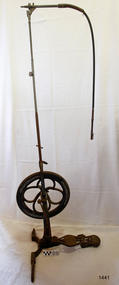
... This treadle-powered dentist drill, or dentist engine, is made of iron and steel and provides power for a mechanical dental hand-piece that would be fitted with a dental tool. ...This treadle-powered dentist drill, or dentist engine, is made of iron and steel and provides power for a mechanical dental hand-piece that would be fitted with a dental tool. ...The design of this and other similar treadle powered dental engine (or dentist drill) was in common use by dentists from the 1870’s into the 1920's. When electricity became accessible to most communities the electrically powered dental engines began to take over from the treadle power. Over the ages teeth were extracted using picks and scissors and other gouging instruments. Bow drills, hand drills and even a "bur thimble" drill were later used to prepare cavities for filling. Some drills were made bendable by attaching flexible shanks between the metal bur and the handle, giving access to the teeth at the back of the mouth. Other mechanical devices were introduced along the way, such as clockwork drills, but they were hard to handle and inefficient. Over the centuries “dentistry has been performed by priests, monks and other healers. This was followed by barbers; the barber’s chair may well have been the precursor to the dental chair. “(SA Medical Heritage Society Inc.) In 1871 James Morrison patented the first commercially manufactured 'foot treadle dental engine', the first practica dental engine although others had been introduced as early as 1790 (by John Greenwood). Handmade steel burs or drills were introduced for dental handpieces, taking advantage of the significant increase in the speed of the drill. In 1891 the first machine-made steel burs were in use. The treadle drill reduced the time to prepare a cavity from hours to less than ten minutes. In 1876 the Samuel S. White Catalogue of Dentist Instruments listed a 12 ½ inch wheel diameter dental engine, with 14 bright steel parts, for sale at US $55 In today’s market, this is the equivalent to US $1200 approx. The specifications of that dental engine are very similar to the this one in our Flagstaff Hill Maritime Village’s collection. It is interesting to note that workings of a similar treadle dentist drill were used and modified to power a treadle spinning wheel of one of the volunteer spinners at Flagstaff Hill Maritime Village. The foot treadle dental engine was a milestone in dental history. “Historic importance of treadle powered machines; they made use of human power in an optimal way” (Lowtech Magazine “Short history of early pedal powered machines”) The invention of a machine to speed up the process of excavation of a tooth lead to the invention of new burs and drills for the handpieces, improving speed and the surgical process of dentistry. They were the fore-runner of today’s electrically powered dental engines. This treadle-powered dentist drill, or dentist engine, is made of iron and steel and provides power for a mechanical dental hand-piece that would be fitted with a dental tool. The drill has a three footed cast iron base, one foot being longer than the other two. A vertical C shaped frame is joined into the centre of the base, holding an axle that has a driving-wheel (or flywheel) and connecting to a crank. A slender, shoulder height post, made from telescoping pipes, joins into the top of this frame and is height adjusted by a hand tightened screw with a round knob. On the post just above the frame is a short metal, horizontal bar (to hold the hand-piece when it is not in use). A narrow tubular arm is attached to the top of the stand at a right angle and can move up and down. At the end of the arm is a firmly fixed, flexible rubber hose protected for a short distance by a sheath of thin metal. At the end of the hose there is a fitting where the drill’s hand-piece would be attached; a small, silver coloured alligator clip is also at the end. A treadle, or foot pedal, is hinged to the heel to the long foot of the base, and joined at the toe to the crank that turns the driving-wheel. There is a spring under the toe of the treadle. The metal driving-wheel has a wide rim. Touching the inside of the rim are four tubular rings that bulge towards the outside of the driving-wheel, away from the pole, and all meet at the hub of the axle. The axle is bulbous between the inside of the driving-wheel and the frame then passes through the frame and is attached on the other side. The driving-wheel has a groove around which a belt would sit. The belt would also fit around a pulley on the arm, at the top of the post. The pulley is joined to a rod inside the arm and this spins the drill's hand-piece and dental tool holder. The two shorter feet of the base are made from a long metal bar that has been curved outwards, and its centre is bolted to the base of the pole. Under the ends of the curved legs of the base are wedge shaped feet. The driving-wheel is decorated in light coloured paint on both sides, each side having three sets of floral decals evenly spaced around them, and each about a sixth of the wheel's circumference. Similar decoration is along the sides of the frame. The foot pedal has decorative cutout patterns in the centre of the foot and at the toe. On the long foot of the stand is some lettering with a fine, light coloured border around it. The lettering is hard to read, being a dark colour and flaking off. There are also remnants of fine, light coloured flourishes. The foot pedal has lettering of the maker’s trade mark cast into the metal at the ball of the foot. Lettering on the base is peeling and difficult to read. The foot pedal has a trade mark cast into it that looks like a combination of ‘C’ , ‘S’ , ‘A’, ‘R’. flagstaff hill, warrnambool, shipwrecked coast, flagstaff hill maritime museum, maritime museum, shipwreck coast, flagstaff hill maritime village, great ocean road, dentist, teeth, dental drill, dental engine, treadle drill, foot powered drill, treadle engine, orthodontics, dental surgery, james morrison -
 City of Melbourne Libraries
Photograph, Bull, Hugh Jones, 1897-1993, Steel manufacturers, McPherson's Ltd, Melbourne
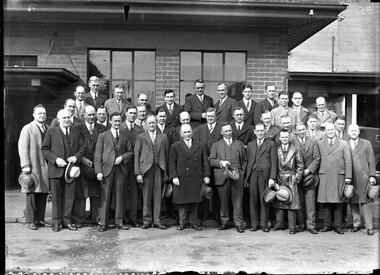
... By that time they also had controlling interests in several Australasian industries, including Ajax Bolt and Rivet Pty Ltd of NZ, F W Hercus Manufacturing Co Ltd, manufacturers in South Australia of lathes, guillotines and other heavy machinery, also of Patience and Nicholson (P & N), manufacturers in Maryborough, Victoria, of twist drills and thread-forming tools; also Wiltshire Files on Sunshine Road, Tottenham, manufacturing files and rasps. ...By that time they also had controlling interests in several Australasian industries, including Ajax Bolt and Rivet Pty Ltd of NZ, F W Hercus Manufacturing Co Ltd, manufacturers in South Australia of lathes, guillotines and other heavy machinery, also of Patience and Nicholson (P & N), manufacturers in Maryborough, Victoria, of twist drills and thread-forming tools; also Wiltshire Files on Sunshine Road, Tottenham, manufacturing files and rasps. ...Photographer notations on slide: Steel Manuf’rs at McPherson’s Ltd 1933 Published: The Age, 30 August 1933 BUREAU OF STEEL MANUFACTURERS OF AUSTRALIA. (1933, August 30). The Age (Melbourne, Vic. : 1854 - 1954), p. 11. Retrieved January 25, 2026, from http://nla.gov.au/nla.news-article204372874 Published title: Bureau of Steel Manufacturers of Australia Published caption: A group of Inter-State Visitors, from the Bureau of Steel Manufacturers of Australia, on a tour of inspection at the Bolt Works of McPhersons Pty. Ltd., Burnley-Richmond, yesterday. Research by Project Volunteer, Louise McKenzie: The photo shows a line up of 36 men, in three rows, in front of a building. They are mostly dressed in dark 3-piece suits, or camel coats. But one gentleman stands out in his full length leather coat! Striped ties are popular, and they are all holding hats. One man, at the rear towards the right, looks a bit younger with his thick, black, brylcreamed hair.. These interstate gentlemen are described in the newspaper caption as representatives of the Bureau of Steel Manufacturers "...on a tour of inspection at the Bolt Works of McPhersons Pty Ltd, Burnley, Richmond." Interestingly, the Bureau of Steel Manufacturers of Australia (BOSMA) still exists, and is the industry body for major Australian steel producers like BlueScope, Liberty, and InfraBuild, representing their interests, engaging with government, and participating in standards setting for the domestic steel market, with a history dating back to 1923. While BOSMA focuses on primary manufacturing, the Australian Steel Institute (ASI) serves as the broader peak body for the entire steel supply chain, from mills to end-users, promoting and supporting the industry. But at the time of this photo, the Australian steel industry was just starting to make headway. As the AST website explains, "Steelmaking in Australia began just a decade prior to the start of the 1851 Gold Rush whilst Australia was still divided into colonies. Iron ore deposits were discovered in 1840 at Iron Knob, South Australia but a lack of equipment meant that the process of producing steel was impossible. Even attempts at smelting the iron ore in a blast furnace to create pig iron were unsuccessful due to the poor quality of iron ore and coke available to the budding industry. In the other colonies at the time, such as Victoria, Tasmania, and New South Wales, there were minor discoveries of iron ore but poor technical expertise and limited quantity meant that the quality of steel was poor. Compared to the far superior steel being imported from Britain at the time, the steel manufacturing industry simply couldn’t compete and was unviable. By the 1870s, almost all steel production in Australia had been abandoned. The situation began to change at the turn of the century. Rapid growth sparked higher demand for industrial machinery made from steel and infrastructure such as rail. It became apparent that there was a need for locally manufactured steel and soon there would be an answer. In 1901, the year Australia united into a federation, the nation’s first blast furnace went into production at Eskbank near Lithgow in New South Wales. The development was spearheaded by William Stafford and his son Esk, and Stafford is known as the father of Australian steel production. In 1915, production expanded with another steel mill in Newcastle that was opened by BHP. It sourced coke from local mines and iron ore from South Australia, creating a domestic loop for steel manufacturing. In the following years, more steelworks opened in Whyalla, South Australia and Port Kembla in NSW. Steel manufacturing in Australia was now underway." The company mentioned in the photo’s notation and in the newspaper caption, was McPhersons, "...an Australian hardware firm, for many years a leading merchant of woodworking and metal-working machinery... [and founded by] Thomas McPherson (c.1823–1888) who had a home "Dudley House" at 142 Dudley Street, West Melbourne. [The] ironmongery business [was located] in 1860 at 149 Spencer Street, Melbourne. Merchandise carried included bells, lathes, horseshoes and steam engines." (Wikipedia - McPherson's Pty Ltd) Anyone who has read Robyn Annear’s excellent award-winning 2014 book Bearbrass – the name for early Melbourne - will remember only too well her description of West Melbourne, from where the city of Melbourne as we know it, emerged. Her book resurrects the village that was early Melbourne – from the arrival of white settlers in 1835 until the first gold rushes shook the town – and brings it to life in vivid colour. The McPherson family, whose arrival in Bearbrass coincides with this period (Thomas arrived in 1852), became intimately involved in the growth and development of Melbourne. Thomas was Mayor of Melbourne (1870-1871); his eldest son Hunter became a successful Sydney businessman; second son Edward and third son William inherited the company, and ran it together until 1896 when Edward killed himself. William had a notable career in politics as treasurer of Victoria 1917-1923, in which year he was knighted. 1928-1929 he was Premier of Victoria, and a noted philanthropist. The family were significant property owners in the city of Melbourne: 149 Spencer Street, 582-588 Collins Street, 554-566 Collins Street, together with a property on Jeffcott Street, West Melbourne, and factories in Sunshine, Tottenham, Kensington and Richmond – all by the mid 1940s. By that time they also had controlling interests in several Australasian industries, including Ajax Bolt and Rivet Pty Ltd of NZ, F W Hercus Manufacturing Co Ltd, manufacturers in South Australia of lathes, guillotines and other heavy machinery, also of Patience and Nicholson (P & N), manufacturers in Maryborough, Victoria, of twist drills and thread-forming tools; also Wiltshire Files on Sunshine Road, Tottenham, manufacturing files and rasps. The Acme Machine Tool Company became a branch of McPhersons, and the company claimed to have supplied, from their own manufacture, all five million rivets (some 3,600 tonnes) used in the building of the Sydney Harbour Bridge – described as a steel through arch bridge, which opened in 1932; the tallest of its kind in the world (Wikipedia – Sydney Harbour Bridge) McPherson’s was also innovative in other ways. It published a comprehensive catalogue, extensively detailed with prices, available free of charge to farmers and other businesses. In 1908 it had 148 pages. By 1937 it had grown to 372 pages. The University of Melbourne’s Archives entry on McPherson’s Limited notes: "After the outbreak of the Second World War, McPherson’s factories worked at full capacity and were crucial to Australia’s war efforts. On 5 December 1944 McPherson's converted to a public company named McPherson's Ltd, with William Edward as Chairman of Directors. By the start of the 1950s the company had a very different Board of Directors; in 1947 the Managing Director Oliver Addison died, and his replacement Marshall Eady died only six months later. Both had been Directors since McPherson’s became a proprietary company in 1913. Another Director, Philip Bevan, died in 1948 and this was followed by the death of William Edward in 1950. S.B Holder, F.G. Thorpe, H.L. Hastie, F. Grassick and D.G. Syme all joined the Board before 1950. The company continued to prosper for many years after the death of William Edward. His son, William David, was invited to join the McPherson’s Ltd Board in 1951. He married Angela Cumming in 1955 and soon after was sent to Brisbane as Director in Charge to oversee the building of a new warehouse. The opening of this warehouse in Queensland meant that the company now had major outlets in five states. As time went on, manufacturing in Australia began to decline and imports of everyday tools began arriving from Asia. These tools were being produced with much lower labour costs and could be sold at cheaper prices. William David retired in 1984 and eventually parts of the company were divested, such as the Richmond Bolt Works which closed in the early 1990s. Since the 1980s, McPherson's has diversified into housewares, printing, and health and beauty care products." This article also contains photos, one of which is a photograph of 'Bolt works picnic' 1920, showing workers in their shirt sleeves participating in a tug of war in a rural "picnic" setting. McPherson’s premises at 554-566 Collins Street more than lasted the test of time and is listed as historically significant. The magnificent art deco building from the 1930s in the heart of Melbourne was first commissioned in 1934 and completed in 1937. It is an imposing building fronting almost a quarter of the city block between Spencer Street and King Street, and was designed to be a warehouse, office and showroom for the hardware empire. International architects Stuart P Calder, and Reid and Pearson designed the four-storey building with a basement level and a stair tower at the centre that provides access to what was a tennis court on the roof. It is considered an example of the streamlined modern style in Melbourne and shows how the McPherson company, protected from taxes after World War I, was able to manufacture goods without being affected by the competition. The building has survived, and its current iteration is as the home to il Mercato Centrale – an Italian style artisan market concept. The University of Melbourne Archives hold a particularly good image of the building from its heyday, complete with Collins Street lamps on the pavement outside the store. And to return to our image, sited at "Bolt Works of McPhersons". Today this segment of McPhersons is still very well known - Ajax. A good summary of the company’s history, and the development of the name and business, can be found on the Mine Suppliers Online website: "AJAX Fasteners can trace its heritage back to 1900, when the Acme Bolt Company was established in West Melbourne, Victoria. In 1909, William McPherson used the company as the basis for establishing McPherson’s Bolt Works – adopting the brand ‘Ajax’ – and moved it to Richmond. Over the years, the company changed many times in response to industry needs to ensure that it remained the premier manufacturer of high quality fasteners in Australia. Many other names in the industry, such as Firth Cleveland, Spurway Cooke and Nettlefolds were merged or acquired into the company. McPhersons ended their 80-year ownership of Ajax in the early 90s when they sold their shares to National Consolidated, which was also a major shareholder at the time. In 1997, Ajax Fasteners moved to new purpose-built premises in Braeside, Victoria. Soon after, National Consolidated was taken over by the diversified manufacturer Austrim. The group soon acquired the iconic Nylex, and adopted the name Nylex Corporation. In January 2007, ACME Operations Pty Ltd acquired Ajax Fasteners and continues to operate the business today from the Braeside plant. The name ACME provides a nostalgic return by the new owners to the company’s heritage, when the Acme Bolt Company was founded in July 1900." REFERENCES: BUREAU OF STEEL MANUFACTURERS OF AUSTRALIA. (1933, August 30). The Age (Melbourne, Vic. : 1854 - 1954), p. 11. Retrieved January 25, 2026, from http://nla.gov.au/nla.news-article204372874 Wikipedia, McPherson’s Pty Ltd, https://en.wikipedia.org/wiki/McPherson%27s_Pty_Ltd Wikipedia, Richmond, Victoria, https://en.wikipedia.org/wiki/Richmond,_Victoria Industry: From the mid-19th century, Richmond was a centre of manufacturing industry, including many large complexes such as the Bryant & May match factory, Jaques Limited engineering works, the Wertheim Piano factory and Pelaco. Wikipedia, Sydney Harbour Bridge, https://en.wikipedia.org/wiki/Sydney_Harbour_Bridge eMelbourne, Manufacturing, https://www.emelbourne.net.au/biogs/EM00896b.htm 'New life for Melbourne's McPherson Building', The Urban Developer, https://www.theurbandeveloper.com/articles/mcphersons-building-melbourne-il-mercato-centrale-food-retail-destination Bureau Of Steel Manufacturers Of Australia Limited, http://www.bosma.org.au/ 'A Brief History of Steel Manufacturing in Australia', AST, https://astraders.com.au/a-brief-history-of-steel-manufacturing-in-australia/ 'Steel manufacturing in Australia: a brief history', Hard Bakka Steel Fabrication, https://www.hardbakka.com.au/component/virtuemart/steel-manufacturing-in-australia-a-brief-history?Itemid=494 McPherson's Limited, University of Melbourne Archives, https://archives.library.unimelb.edu.au/nodes/view/58364 Source of Description: 'Nuts and Bolts: A story of a family and a firm', Barbara Hamer (2006), McPherson’s Printing Group 'Photograph of 'Bolt works picnic' 1920', University of Melbourne Archives, https://archives.library.unimelb.edu.au/assets/display/1287217-max?u=dea2e4d2fd07ac822e624f1e7d39adb3 'Photograph of the exterior of the McPhersons Department store at 546 Collins Street, Melbourne.', University of Melbourne Archives, https://archives.library.unimelb.edu.au/assets/display/1287215-max?u=12430d30453a77059b7d10d49006a521 Robyn Annear, Bearbrass: imagining early Melbourne, Black Inc., 2014 (originally published 1995 by Mandarin) 'Company details', Ajax Fasteners, http://www.minesuppliersonline.com.au/australia/braeside/hardware/ajax-fasteners 'Former McPherson's Building', Victorian Heritage Database, https://vhd.heritagecouncil.vic.gov.au/places/741Photographer notations on slide: "Steel manuf'rs at McPherson's Ltd 1933 B5".1930-1939, industrial workers, clothing and dress, 1930, iron and steel industry, businesses, bridges, industry, melbourne, gold rush, moderne style architecture -
 Flagstaff Hill Maritime Museum and Village
Tool - Auger, Robert Sorby, First half of the 20th Century
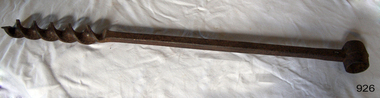
... The company has a long tradition of making edged tools for various uses and exporting them to Australia, however the subject item was probably made from the early 20th century up until 1967 when the company stopped exporting to Australia. flagstaff hill warrnambool flagstaff-hill flagstaff-hill-maritime-museum maritime-museum shipwreck-coast flagstaff-hill-maritime-village ring auger Carpenders tools Hole Drilling Rob Sorby & Sons Rob Sorbey Sheffield stamped on shaft with Kangaroo trade mark Scotch Eye Auger, Double Twist with Lead Screw, square shaft, socket set at right angle Tool Auger Robert Sorby ...A scotch eye auger is perfect for quickly making holes in dry or wet wood for making chairs, stools, and any number of woodworking projects. The scotch eye serves as a peg gauge and whatever peg you make to go into the hole should fit into the augers eye. Robert Sorby & Sons: The forbearer's of Robert Sorby had been cutlers in the Sheffield region of England, dating from the mid 17th century. Robert Sorby and Sons were registered in Sheffield in 1828 as a manufacturer of edge tools, saws, scythes and hay knives. In addition to manufacturing tools, they also diversified into the manufacture of crucible steel for tool manufacture. From circa 1860-1967, the Sorby factory in Sheffield was known as the “Kangaroo Works”. The Kangaroo Brand of tools was made by Robert Sorby & Sons. During the 19th century, they had a large trade in Australasia. By the early 20th century, they were manufacturing carving tools, planes and plane irons, circular saws, wood saws, butchers saws and cleavers, garden tools, pruning knives, coopers’ knives, bricklayers tools and joiners tools. In 1923 Robert Sorby & Sons was bought by Sheffield company Hattersley and Davidson. They are today one of the few remaining British tool manufacturers.The company has a long tradition of making edged tools for various uses and exporting them to Australia, however the subject item was probably made from the early 20th century up until 1967 when the company stopped exporting to Australia.Scotch Eye Auger, Double Twist with Lead Screw, square shaft, socket set at right angleRob Sorbey Sheffield stamped on shaft with Kangaroo trade markflagstaff hill, warrnambool, flagstaff-hill, flagstaff-hill-maritime-museum, maritime-museum, shipwreck-coast, flagstaff-hill-maritime-village, ring auger, carpenders tools, hole drilling, rob sorby & sons -
 Flagstaff Hill Maritime Museum and Village
Bench
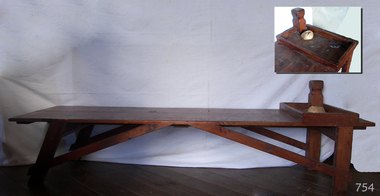
... Bench wooden trestle leg style sail maker's bench with one raised post, one drill hole for fid; end of bench enclosed by wood to form tray to prevent tools from rolling off. ...Flagstaff Hill Warrnambool Shipwrecked-coast Flagstaff-Hill Flagstaff-Hill-Maritime-Museum Maritime-Museum Shipwreck-coast Flagstaff-Hill-Maritime-Village Bench wooden trestle leg style sail maker's bench with one raised post, one drill hole for fid; end of bench enclosed by wood to form tray to prevent tools from rolling off. ...Bench wooden trestle leg style sail maker's bench with one raised post, one drill hole for fid; end of bench enclosed by wood to form tray to prevent tools from rolling off. flagstaff hill, warrnambool, shipwrecked-coast, flagstaff-hill, flagstaff-hill-maritime-museum, maritime-museum, shipwreck-coast, flagstaff-hill-maritime-village -
 Flagstaff Hill Maritime Museum and Village
Drill Press, 1920s-1950s
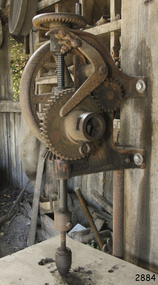
... The drill is locally significant as it was used by a local company in Terang and Mortlake in their blacksmith, wheelwright and garage business. It is an example of the tools ...This drill once belonged to Goodall and Sons, who were blacksmiths in Terang. The smith was called upon to do a variety of work. In the early 1900s he was often the nearest person to be able to perform an engineer’s services for many miles around. The Dawn Ball-bearing Post Drill no. 611 is described in McPherson’s Catalogue as a “drilling machine with adjustable automatic feed, with improved Dawn coupler and ball-bearing thrust’. The heavy design of the flywheel enables it to maintain momentum” and is “fitted with pulleys for belt drive if desired” The hand crank drives an automatic feed to work off a cam-follow system opposite a large wheel. Made by Dawn Manufacturing Co. Australia 1920-1950. DAWN MANUFACTURING CO. Dawn Manufacturing Co. was founded in Coburg, Melbourne, in 1917 by the four Blake brothers, who were all engineers. After World War I Dawn was supplying drills Australia wide and the company was growing at a healthy rate. During the depression they remained busy, with employees working 60-80 hour weeks. Dawn was contracted to supply vices and clamps to the Australian Defence Department and munitions factory during the World War II. In 1959 the company was taken over by G.N. Raymond Group, then in 1973 the Siddons Ramset Limited acquired Dawn. In December 1991, Dawn became a unit of the United States owned Stanley Works Pty. Ltd. In November 1998 Dawn became 100 per cent Australian owned. HENRY GOODALL & SONS Henry Goodall (1870-1936) was proprietor of garages as H. Goodall & Sons Pty. Ltd., at both Terang (McKinnon and High Streets) and Mortlake (Dunlop Street). His business was in operation in at least in 1916 and perhaps well before, considering the date of the tyre bender and its use for wagons with wooden wheels. It was still in operation in 1953, chasing up debtors in Mount Gambier Court. Amongst the employees of H. Goodall & Sons Pty. Ltd. was Ernie Entwistle, a blacksmith (a soldier who died in 1916 ) and Alfred Hodgetts, radio expert (killed in a fatal accident in 1943, when he was in his early 30s ). Henry Goodall was involved in the community as a Justice of Peace, a deputy coroner, President of the Mortlake Hospital, trustee of the Soldiers’ Memorial Hall, and as a prominent Freemason. He and his wife had two sons (Charles and John) and one daughter (Mrs. Chas. Newton, of Skipton). The drill is locally significant as it was used by a local company in Terang and Mortlake in their blacksmith, wheelwright and garage business. It is an example of the tools of the blacksmiths’ trade in Victoria in the 1920s-1950s.Dawn Ball-bearing Post Drill no. 611, made by Dawn of Melbourne, model no 611. Hand operated drill press. Self-feeding blacksmiths’ drill-press. This drill once belonged to Harry Goodall & Sons, blacksmiths of Terang. Dated 1920s-1950s. Gear ratio 2:1 main drive, 6" diam, 3:1 reduction gear. "Dawn", "Melbourne"flagstaff hill, warrnambool, shipwrecked-coast, flagstaff-hill, flagstaff-hill-maritime-museum, maritime-museum, shipwreck-coast, flagstaff-hill-maritime-village, h. goodall & sons of terang, terang blacksmith, h. goodall & sons pty ltd, mortlake, ernie entwistle blacksmith, alfred hodgetts radio expert, charles goodall, john goodall, mrs. chas. newton nee goodall, terang 1900s, warrnambool district 1900s, post drill, blacksmith’s drill, dawn post drill, dawn ball-bearing post drill no. 611, blacksmiths, dawn of melbourne -
 Flagstaff Hill Maritime Museum and Village
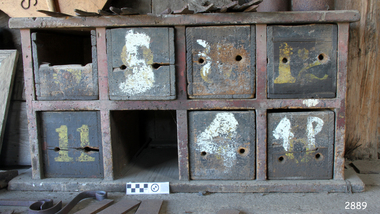
Drawer Cabinet, 1920-1950
... drilled holes in the drawers may have once had knotted rope handles. Some of the drawer fronts have been split, on broken, in the area of the holes, indicating that they drawers have had heavy use. The stencilled numbers could have been used for sorting different blacksmith items such as tools...drilled holes in the drawers may have once had knotted rope handles. Some of the drawer fronts have been split, on broken, in the area of the holes, indicating that they drawers have had heavy use. The stencilled numbers could have been used for sorting different blacksmith items such as tools ...This blacksmith’s drawer cabinet once belonged to Goodall and Sons, who were blacksmiths in Terang. The drilled holes in the drawers may have once had knotted rope handles. Some of the drawer fronts have been split, on broken, in the area of the holes, indicating that they drawers have had heavy use. The stencilled numbers could have been used for sorting different blacksmith items such as tools, scraps of materials, fasteners and horse shoes. The smith was called upon to do a variety of work. In the early 1900s he was often the nearest person to be able to perform an engineer’s services for many miles around. HENRY GOODALL & SONS Henry Goodall (1870-1936) was proprietor of garages as H. Goodall & Sons Pty. Ltd., at both Terang (McKinnon and High Streets) and Mortlake (Dunlop Street). His business was in operation in at least in 1916 and perhaps well before, considering the date of the tyre bender and its use for wagons with wooden wheels. It was still in operation in 1953, chasing up debtors in Mount Gambier Court. Amongst the employees of H. Goodall & Sons Pty. Ltd. was Ernie Entwistle, a blacksmith (a soldier who died in 1916 ) and Alfred Hodgetts, radio expert (killed in a fatal accident in 1943, when he was in his early 30s ). Henry Goodall was involved in the community as a Justice of Peace, a deputy coroner, President of the Mortlake Hospital, trustee of the Soldiers’ Memorial Hall, and as a prominent Freemason. He and his wife had two sons (Charles and John) and one daughter (Mrs. Chas. Newton, of Skipton). The drawer cabinet is locally significant as it was used by a local company in Terang and Mortlake in their blacksmith, wheelwright and garage business. It is an example of the furniture of the blacksmiths’ trade in Victoria in the early to mid-1900sBlacksmith's drawer cabinet with 8 compartments and 7 drawers (the 8th drawer is missing). The drawers each have two drilled holes. Both top and base of the cupboard extend past the sides, the base further than the top to give it stability. The cupboard once belonged to Harry Goodall & Sons, blacksmiths of Terang. Dated early to mid-1900s.Stencil or hand painted on drawers “5” “3” “12” “11” “4” “4P”flagstaff hill, warrnambool, shipwrecked-coast, flagstaff-hill, flagstaff-hill-maritime-museum, maritime-museum, shipwreck-coast, flagstaff-hill-maritime-village, h. goodall & sons of terang, terang blacksmith, h. goodall & sons pty ltd, mortlake, ernie entwistle blacksmith, alfred hodgetts radio expert, charles goodall, john goodall, mrs. chas. newton nee goodall, terang 1900s, warrnambool district 1900s, box cupboard, drawer cabinet, drawer storage unit, blacksmith’s furniture -
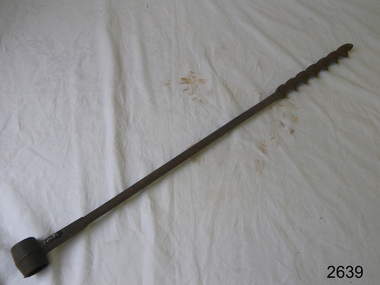 Flagstaff Hill Maritime Museum and Village
Tool - Scotch Eye Beam Auger, W M Ridgway, 1930s
... tools for export and sale. This item would have probably been used in Australia on a farm for drilling fence posts for wire to pass through or other tasks where a hole was required to be bored in timber. flagstaff hill warrnambool shipwrecked-coast flagstaff-hill flagstaff-hill-maritime-museum maritime-museum shipwreck-coast flagstaff-hill-maritime-village Ridgway Sheffield Scotch eye beam auger, with double twist and Lead screw. ...William Ridgway and Sons company of Sheffield, manufacturers of augers, bits, wood-boring, and motorising tools, was founded in 1878 and became a Private company in 1909, their factory was founded in the 1930s. William Ridgway Tools merged first with Record Tools in 1974 to form Record Ridgway Tools Ltd. Record was another Sheffield company that was renowned for the quality of their vices and industrial clamps. Following the merger Record, Ridgway Tools Ltd was made up of fourteen UK Companies and five overseas companies. A later merger with a woodwork tools company called Marple (which was part-owned by Record and Ridgway respectively before their original merger) led to the company becoming known as Record Marples Tools. Record Marples was taken over by the Swedish hardware manufacturer AB Bahco in 1982. Despite a management buyout leading to the company reverting to British ownership in 1985 the company struggled financially and the following administration was acquired by U.S.-based Irwin Tools in 1998 who has since moved production to China in recent years. A vintage tool made in the 1930s when Ridgway began mass producing augers and other tools for export and sale. This item would have probably been used in Australia on a farm for drilling fence posts for wire to pass through or other tasks where a hole was required to be bored in timber. Scotch eye beam auger, with double twist and Lead screw. Ridgway Sheffield flagstaff hill, warrnambool, shipwrecked-coast, flagstaff-hill, flagstaff-hill-maritime-museum, maritime-museum, shipwreck-coast, flagstaff-hill-maritime-village -
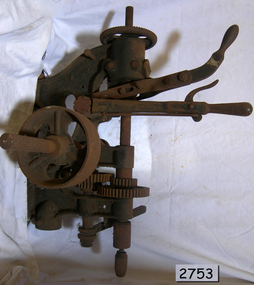 Flagstaff Hill Maritime Museum and Village
Drill Press, early to mid-20th century
... drill...trade tool...It is an example of the tools of the blacksmiths’ trade in Victoria in the early to mid-20th century. flagstaff hill warrnambool shipwrecked-coast flagstaff-hill flagstaff-hill-maritime-museum maritime-museum shipwreck-coast flagstaff-hill-maritime-village blacksmiths blacksmith’s drill blacksmith tools dawn drill model no. 611 dawn drill code no. 9157 dawn manufacturing coy melbourne dawn manufacturing coy coburg dawn post drill drilling machine drill with gear driven flywheel forging tool metal working tool post drill steam powered drill trade tool warrnambool district 1900s "DAWN MFG COY”, “MELB. ...This post drill press has been made by Melbourne business, Dawn Manufacturing Company. It can be operated manually or by a pulley driven flywheel, with the aid of an engine connected to a power supply. In the late 1800s early 1900s a drill press like this would have been driven by steam from a boiler, the main power source for manufacturer’s power at that time. Dawn’s Golden Anniversary 1917-1967 Catalogue describes this model 611 drill as … “Ruggedly constructed with accurately reamed bearings. The coupling between the main spindle and feed screw engages the full circumference of the spindle, and embraces a ball-bearing thrust race. The pillar, as in all “Dawn Drilling Machines” is a solid bright steel bar, in place of the usual light tubing. Adjustable automatic feed.” And “F. & l. Pulleys extra, if required”. DAWN MANUFACTURING CO. The Dawn Manufacturing Co. was founded in Coburg, Melbourne, in 1917 by the four Blake brothers, who were all engineers. After World War I Dawn was supplying drills Australia wide and the company was growing at a healthy rate. During the depression they remained busy, with employees working 60-80 hour weeks. Dawn was contracted to supply vices and clamps to the Australian Defence Department and munitions factory during the World War II. - 1959 the company was taken over by G.N. Raymond Group. - 1967 the Dawn Manufacturing Co. had distributors in Australia and overseas, including USA, Canada, New Zealand, Asia and the Middle East. - 1973 the Siddons Ramset Limited acquired Dawn. - December 1991, Dawn became a unit of the United States owned Stanley Works Pty. Ltd. - November 1998 Dawn became 100 per cent Australian owned. The drill is a typical tool of a blacksmith, cart wright, wheelwright and garage business. It is an example of the tools of the blacksmiths’ trade in Victoria in the early to mid-20th century.Post type drill press machine with gear driven flywheel. Drill press is attached to a post and is fitted with a pulley belt and will run at a speed of maxim 200 r.p.m. The machine can also be manually operated. It has an aperture in the centre, a chuck, for the drill bit and has two metal handles at the centre, on the right hand side. Gear ratio 2:1 main drive, 6" diam, 3:1 reduction gear. Made by Dawn of Melbourne, Australia. Model No. 611, Code No. 9157"DAWN MFG COY”, “MELB. AUSTRALIA", " 611"flagstaff hill, warrnambool, shipwrecked-coast, flagstaff-hill, flagstaff-hill-maritime-museum, maritime-museum, shipwreck-coast, flagstaff-hill-maritime-village, blacksmiths, blacksmith’s drill, blacksmith tools, dawn drill model no. 611, dawn drill code no. 9157, dawn manufacturing coy melbourne, dawn manufacturing coy coburg, dawn post drill, drilling machine, drill with gear driven flywheel, forging tool, metal working tool, post drill, steam powered drill, trade tool, warrnambool district 1900s -
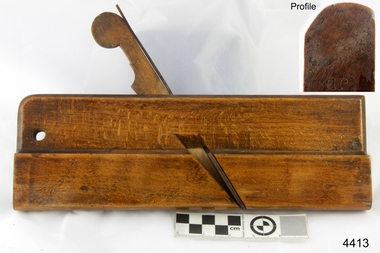 Flagstaff Hill Maritime Museum and Village
Tool - Plane, 20th century
... flagstaff hill warrnambool shipwrecked-coast flagstaff-hill flagstaff-hill-maritime-museum maritime-museum shipwreck-coast flagstaff-hill-maritime-village Moulding Plane plane W Goodell JB hand tool woodworking Woodworking Tool Stamped; "W GOODALL" "JB" "JB" Moulding plane, round type, with a formed hole drilled through it. ...Moulding plane, round type, with a formed hole drilled through it. Stamped with owner's name and inscriptions. Varnish has partly obscured the name.Stamped; "W GOODALL" "JB" "JB"flagstaff hill, warrnambool, shipwrecked-coast, flagstaff-hill, flagstaff-hill-maritime-museum, maritime-museum, shipwreck-coast, flagstaff-hill-maritime-village, moulding plane, plane, w goodell, jb, hand tool, woodworking, woodworking tool -
 Federation University Historical Collection
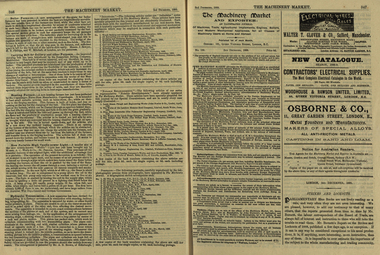
Newspaper, The Machinery Market, 02/12/1889
... tools and pumps cochran and co.'s launch, tug and boat building yard s.s. jeanette cochran boiler cochran and co's boiler shop stern wheel steamer s.s. esperanca cowles syndicate co, milton w.t. glover & co.'s patent compound rope making machine bendh drilling ...It's assumed that this journal was read at the Ballarat School of MinesA small illustrated journal with advertisements and pictures. pages 328-356 (and 26 pages of illustrated advertisements). Illustrations include machinery, corn crushers, condensers, chlorination plants. stea, hammers, steam engines, steam pumps, lamps, saw bench, leather belting, casks, barrels, machinery, boiler, cohran and co, birkenhead, stern, cowles syndicate company, electric smelting works, aluminium manufacturing, w t glover and co, rope machine, steam travelling crane, webster wood fibre machine, automatic govenor expansion gear, international exhibition edinburgh, beacon light, air propeller, well boring tools and pumps, cochran and co.'s launch, tug and boat building yard, s.s. jeanette, cochran boiler, cochran and co's boiler shop, stern wheel steamer, s.s. esperanca, cowles syndicate co, milton, w.t. glover & co.'s patent compound rope making machine, bendh drilling machine, steam launch, bicycle, well-boring tools -
 Federation University Historical Collection
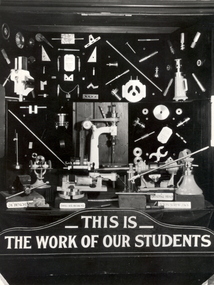
Photograph - Black and White, Ballarat School of Mines Student Display, 1937, 1937
... The Ballarat School of Mines often exhibited student work during Apprenticeship Week ballarat school of mines tools apprentice jack vice alfred hall Black and white photograph of Ballarat School of Mines Student work exhibited at Alfred Hall, Ballarat. The display features (bottom left to right) a 34 inch vice, a swivel based machine vice, a drilling machine and a 3 ton screw jack. ...The Ballarat School of Mines often exhibited student work during Apprenticeship WeekBlack and white photograph of Ballarat School of Mines Student work exhibited at Alfred Hall, Ballarat. The display features (bottom left to right) a 34 inch vice, a swivel based machine vice, a drilling machine and a 3 ton screw jack. ballarat school of mines, tools, apprentice, jack, vice, alfred hall
