
Showing 124 items matching "drink containers"
-
 Greensborough Historical Society
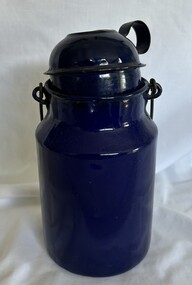
Functional object - Bottle, Enamel drink bottle, 1970s
... A sturdy metal container used to carry liquid, possibly a miner's drink bottle....Blue enamel drink container with white enamel interior and metal handle....A sturdy metal container used to carry liquid, possibly a miner's drink bottle. bottles drink bottles Blue enamel drink container with white enamel interior and metal handle. ...A sturdy metal container used to carry liquid, possibly a miner's drink bottle.Blue enamel drink container with white enamel interior and metal handle.bottles, drink bottles -
 Mont De Lancey
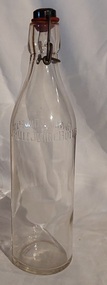
Domestic object - Glass Juice Bottle, Fowlers, c1900's
... ...Drink containers...Beverage bottles Glass bottles Juice bottle Drink containers 'Fowlers One Pint Fruit Juice Bottle' stamped on the glass. ...Vintage Fowlers juice bottles are part of a home preserving system started by English immigrant Joseph Fowler in Melbourne, Australia, in 1915. Vintage glass juice bottles with wire stoppers likely date to the late 19th or early 20th century, when they were developed to create a reusable, airtight seal for products like milk, juice, and other beverages. These bottles often used a "lightning" or "gravity" stopper, which relied on a wire bail and a rubber gasket to create a secure closure and keep contents fresh for longer periods, particularly in home kitchens. A large clear glass Fowlers Fruit Juice bottle with a wire clip and black stopper with a red rubber seal. 'Fowlers One Pint Fruit Juice Bottle' stamped on the glass. On the bottom of the bottle is stamped 'F452' On top of the black stopper "Fowlers Vacola' beverage bottles, glass bottles, juice bottle, drink containers -
 Mont De Lancey
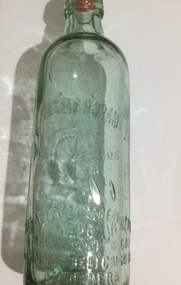
Glass bottle, Marchant & Co, 1915
... ...Drink containers...Beverage bottles Glass bottles Juice bottle Drink containers 'Marchant & Co. Trade Mark with the company's logo of a 12 spoked wheel. ...Vintage glass juice bottles with wire stoppers likely date to the late 19th or early 20th century, when they were developed to create a reusable, airtight seal for products like milk, juice, and other beverages. These bottles often used a "lightning" or "gravity" stopper, which relied on a wire bail and a rubber gasket to create a secure closure and keep contents fresh for longer periods, particularly in home kitchens. A large green tinted Marchant's soft drink bottle with a pink plastic screw in stopper.'Marchant & Co. Trade Mark with the company's logo of a 12 spoked wheel. Registered Australia' Visible are the 1/2 bottle joins. On the back of the bottle: 'This bottle is the property of Marchant & Co. & cannot be legally used by others'. On the base: 'M & Co. 1915'. beverage bottles, glass bottles, juice bottle, drink containers -
 Kiewa Valley Historical Society
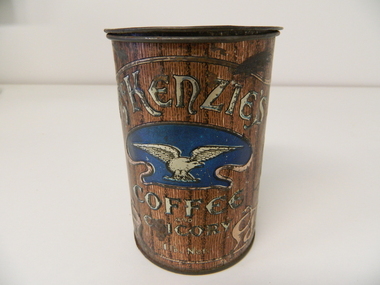
Can McKenzie's Coffee, mid to late 1900's
... tin food/drink mild steel containers...This transition was precipitated by the SEC Vic Hydro Scheme of the 1940's to 1960's which increased the valley population two fold. tin food/drink mild steel containers food/drink storage containers On one side (front) "McKenzie's Coffee and Chicory 1lb Net". ...This tin which once contained coffee with chicory was purchased in a period when the importation of coffee beans into Australia was quite expensive and to counter that local distributors of coffee mixed it with Chicory, a blended coffee, flavoured slightly milder depending on the amount of coffee(percentage) per serve. This provided a cheaper cup of "coffee" drink. This mixture was a spin off from the 1930's Great Depression and the naval blockages of World War II (imports from India and other regional coffee growers) and the scarcity of secure ship supplies. As supplies became more secure "pure" coffee as a drink became available at reasonable costs. This "insignificant" coffee/chicory tin is very significant as it demonstrates that the Kiewa Valley was becoming more accessible to reliable coffee supplies and general food items.This was brought about through reliable roads and an ever increasing population The need for travelling supply caravans to the area, and with the establishment of grocery stores in Tawonga and Mount Beauty the supply of previously "hard to get" groceries vanished. This transition was precipitated by the SEC Vic Hydro Scheme of the 1940's to 1960's which increased the valley population two fold.This container of McKenzie's Coffee and Chicory is made from pressed steel and has a tight fitting lid (steel with a protruding lip to allow finger pressured removal). The tin has one pressed seem (holding the cylinder together). The backdrop of the outside of the tin is "grained" brown painted with dark brown (worn) lettering and central between McKenzie's/Coffee is a figure of an eagle with its wings outstretched. All the letters and figure have been embossed into the tin surface. The weighted contents are listed at a capacity of 1Ib Net.On one side (front) "McKenzie's Coffee and Chicory 1lb Net". On the other side "COFFEE & CHICORY" underneath "Guaranteed under the Victorian Pure Food Act 1905" "No. 1000 guaranteed under the Pure Food Act 1908, N.S.W. by Jas F. McKenzie & Co. Pty Ltd., No. 1000." "No 22 Guaranteed under the Food and Drugs Act 1910 by Jas F. McKenzie Pty. Ltd No. 22 (Tasmania)." Further "No. 1000 Guaranteed under the Health Acts by Jas. F McKenzie & Co. Pty Ltd No. 1000 (Queensland) "Containing not less than 50 percent of coffee." And at the bottom Jas.F. McKENZIE & Co. Pty Ltd Melbourne and Sydney"tin food/drink mild steel containers, food/drink storage containers -
 Kiewa Valley Historical Society
Jar Stone Earthenware, circa early 1900s
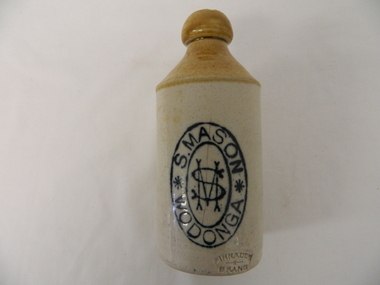
... This type of "stone" jar drinking container was used before glass and later plastic material made it "out of date" as a drink container. ...This type of "stone" jar drinking container was used before glass and later plastic material made it "out of date" as a drink container. ...This type of "stone" jar drinking container was used before glass and later plastic material made it "out of date" as a drink container. The qualities of the glazed pottery (stone) drinking containers made from this natural thermal insulation material was to contain the liquid to a prescribed temperature either hot or cold, as required. This was particularly important in rural environments that lacked adequate refrigeration means. The rural regions where the last areas in Australia where this type of drinking container remained in use. The late 1960's saw a revival of the basic rural ethos by the "hippie" culture of going to basic survival non "commercial" living.This particular stone jar drinking container was also a method of advertising for a Wodonga Stone masonry manufacturer. It is both relevant and significant to the Kiewa Valley because it highlights the type of industry that has breached the evolutionary trend for cheaper "throw away" drinking containers. Although this particular type of container is limited to quality liquids and it is still available in most rural sectors of the Australian "bush" environment.This stone/earthenware jar has a lip 250mm in length and 150mm thick. This lip will allow the thumb and forefinger to be used to grip the container for either pouring its contents out or securing it for any movement. The external glazed surface may become slippery when wet. The jar is heavy even when empty and would be too heavy for small children to carry. By using a cork seal the jar can be reused and therefore become more economical for the longer term. The thickness of the vessel provides a good insulation for the liquid contained. Most of this type of container would have contained ginger beer.Within two elliptical circles are painted (in freehand) "S. MASON" in the top half and "WODONGA" in the bottom half.These are separated by an asterisk on both sides. A large "S" overlaid by a similarly large "M" is within the inner circle. Stamped into the jar when still wet during manufacture is "PINNACLE BRAND" in 5mm lettering.drinking container, stone jar, ginger beer container, s. mason, wodonga earthen ware -
 Tatura Irrigation & Wartime Camps Museum
Water bottle (WW1), 1915 - 1918
... metal drink container with bakelite lid. Thick material cover held in place with press studs. ...He served in 8th field Ambulance Co 1915 - 18 with Fredrick Webb. world war 1 James Rose WW1 water bottles Frederick Webb metal drink container with bakelite lid. Thick material cover held in place with press studs. ...Issued to and used by James Rose during WW1. He served in 8th field Ambulance Co 1915 - 18 with Fredrick Webb.metal drink container with bakelite lid. Thick material cover held in place with press studs. Wire clips to attach unit to uniform. Approx 1 litre capacity.world war 1, james rose, ww1 water bottles, frederick webb -
 Cheese World Museum
Jug, Willow pattern milk jug
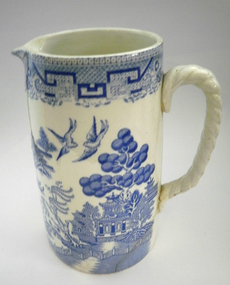
... food and drink consumption...containers...Uebergang catalogue No.H557 Allansford Uebergang jugs food and drink consumption containers Willow pattern H557 Tall white round china jug with a 'Blue Willow' pattern. ...The Percy Uebergang family lived at Tooram Park, Allansford from 1912 until 1992. Percy and Myrtle Uebergang's children were twins, Ray and Joyce born in 1926 who lived at Tooram Park until their deaths, Ray in 1986 and Joyce in 1992. Neither Ray nor Joyce married and following the death of her brother Joyce set up the Ray and Joyce Uebergang Foundation which supports the local community. This milk jug is part of the collection of items given into the care of the Cheese World Museum. Uebergang catalogue No.H557 Tall white round china jug with a 'Blue Willow' pattern. The handle has a 'twisted rope' design.H557allansford, uebergang, jugs, food and drink consumption, containers, willow pattern -
 Whitehorse Historical Society Inc.
Container - Butterscotch Tin
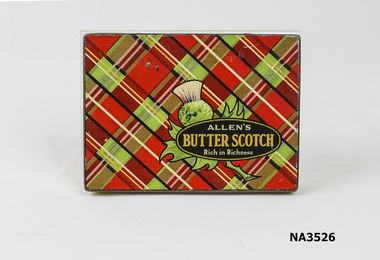
... food & drink consumption...containers...domestic items food & drink consumption containers Oblong metal container with hinged lid, transfer decoration and label on face - 'allen' Butter Scotch - Rich in Richness' Container Butterscotch Tin ...Oblong metal container with hinged lid, transfer decoration and label on face - 'allen' Butter Scotch - Rich in Richness'domestic items, food & drink consumption, containers -
 Bendigo Military Museum
Equipment - EQUIPMENT CAMOUFLAGED, C.1990 -91
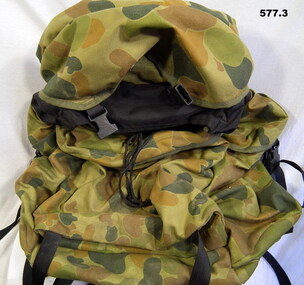
... ...containers - drink consumption...military equipment containers - drink consumption .3) Auscam NSN No. 8465-66-135-0685. ....1) Basic webbing. .2) Torch. .3) Backpack, Australian issue. Sniper bag, camouflage colours. .4) Alice back pack. .5) Water bottle, khaki colour plastic with screw lid, aluminium holder inside pouch. .6) Water bottle, khaki colour plastic with screw lid. .7) Millbank filter, khaki canvas, 2 metal eyelets. .8) Multi tool. Dole K.3) Auscam NSN No. 8465-66-135-0685. Written in red circle on back lower left corner: DOL 312 . Blue and white patch painted on back lower right corner. .7) 7 Aug 1991 ↑ NSC-8465-99-873-6663. .8) Victorinox.military equipment, containers - drink consumption -
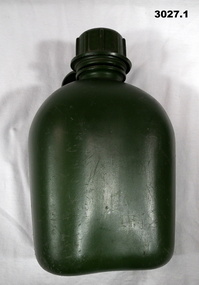 Bendigo Military Museum
Equipment - WATER BOTTLES, 1) 1968; .2) 1982; .3) 1964
... ...containers - drink consumption...military equipment - army containers - drink consumption Water bottle .1) “V1968 [up arrow] 8465-71-108-8703” .2) “ACMIL 1982 [up arrow] 8465-66--86-6349” .3) “US 1964 APC” .1), .2) & .3) Water bottles, plastic, screw top lids attached to the bottle. .1), .2) Green colour. .3) Greyish colour with green screw on lid. ....1), .2) & .3) Water bottles, plastic, screw top lids attached to the bottle. .1), .2) Green colour. .3) Greyish colour with green screw on lid..1) “V1968 [up arrow] 8465-71-108-8703” .2) “ACMIL 1982 [up arrow] 8465-66--86-6349” .3) “US 1964 APC”military equipment - army, containers - drink consumption, water, bottle -
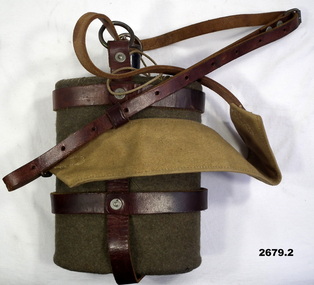 Bendigo Military Museum
Equipment - WATER BOTTLE, C.WW1 onwards
... ...containers - drink consumption...military equipment - kit containers - drink consumption trades - leather working Passchendaele barracks trust .1) Khaki felt cover in leather strap harness, metal top cork attached with cord. .2) Adjustable leather shoulder strap attached through rings on harness. ....1) Khaki felt cover in leather strap harness, metal top cork attached with cord. .2) Adjustable leather shoulder strap attached through rings on harness.military equipment - kit, containers - drink consumption, trades - leather working, passchendaele barracks trust -
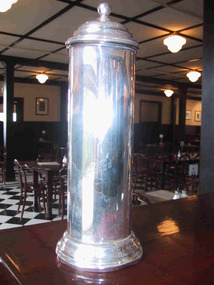 Parks Victoria - Mount Buffalo Chalet
Container
... Electroplated silver drinking straw container. Tube shape. Moulded circular base with matching lid with central post which can be pulled up to reveal drinking straws resting on it....LUKE / MELB / 6889" Electroplated silver drinking straw container. Tube shape. Moulded circular base with matching lid with central post which can be pulled up to reveal drinking straws resting on it. ...Straw container, original to the Cafe, which supplied afternoon teas and suppers to casual visitors and Chalet guests. Spiders and milkshakes were popular with yung guests after evening tournaments, films and concerts. 'When the Victorian railways took over managemen of the Chalet from 1 october 1924, they ran their dining room and cafe in similar fashion to the dining cars on their trains and refreshment rooms on their stations, using the same ceramic hotel-ware and electro plated nickel silverware (EPNS), all made to order items that are clearly idenitified by the distinctive 'VR' monogram. The Chalet retains a good selection of of the diverse range of EPNS item formerly used in the dining room..- which in all theoir variety and function help to interpret the dining room protocols of the 'tourist house' and the service provied by the Victorian Railways refreshment and Services Branch. Many of the items were manufactured by by Stoke & Sons of Melbourne (est. 1856.' (Pg 103. Historica) Listed in Draft Inventory of Significant Collection items. Appendix A.3.Tableware. (Pg 166 Historica).Electroplated silver drinking straw container. Tube shape. Moulded circular base with matching lid with central post which can be pulled up to reveal drinking straws resting on it.On front, "VR / Straws" Also silver stamp on base and inscription;"Parmount / plate / best / EP A1 NS / quality / warranted / hardsoldered / K. G. LUKE / MELB / 6889" -
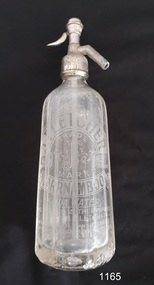 Flagstaff Hill Maritime Museum and Village
Soda Syphon, 1900-1930’s
... He eventually sold his business and stock in 1930 to Ralph Reeves, who may have continued using Fletcher’s supply of drink containers before renewing them with stock showing his own brand. ...The soda syphon is representative of drink containers used in the later 19th and early 20th century. ...This soda syphon (or siphon) was distributed by John Fletcher of Warrnambool, and made by the British Syphon Mfg. Co. Ltd. of London between the 1900s-1930s. It comprises a multi-sided clear glass bottle, an internal glass tube and a metal release valve and spout on the top. It was used to dispense pressurised, effervescent soda water. It was often used as an alternative to water or added to fruit juices and cordials. The text on this bottle states that it remains the property of the retailer, John Fletcher, and must be returned to him. Customers were asked for a deposit on the bottle, which would be refunded when the bottle was exchanged or continued as the deposit on a fresh bottle. Returned bottles would be cleaned and recharged with the gas and sold again. Soda syphon are bottles, glass or metal, with a release valve and spout on the top. The valve lever on the top of the syphon, when depressed, causes the gas in the syphon to force the water up through the tube and out of the spout. The bottle’s mechanism gives the water an effervescent quality to make bubbly drinks such as sparkling mineral water, soda water and sparkling water. ABOUT JOHN FLETCHER John Fletcher bought the Union Cordial Factory in Koroit Street, Warrnambool that was previously owned by John Davis. Fletcher operated the factory as J Fletcher, John Fletcher and Fletcher’s. He eventually sold his business and stock in 1930 to Ralph Reeves, who may have continued using Fletcher’s supply of drink containers before renewing them with stock showing his own brand. The soda syphon is representative of drink containers used in the later 19th and early 20th century. It also represents the system of returnable, recyclable containers. Soda syphon (or siphon). Glass bottle, clear, multi sided, tapered from a heavy glass base to a narrower shoulder, with glass tube at centre connected to metal pump mechanism at the top. Has elaborate frosted label for J. Fletcher of Warrnambool. Made by the British Syphon Mfg. Co. Ltd. London. Bottle remains the property of John Fletcher, Warrnambool.Metal syphon has impressed "J FLETCHER" and logo "S S" in centre of two concentric circles with text between circles "BRITISH SYPHON MFG. CO. LTD. LONDON". Etched into glass "J. FLETCHER / WARRNAMBOOL", "TRADE "[stylised] F" / MARK", "SODA WATER", "THIS SYPHON IS THE PROPERTY / OF JOHN FLETCHER / WARRNAMBOOL AND CONNOT BE / AND CONNOT BE LEGALLY USED BY OTHERS / BRITISH SYPHON CO. TLD. LONDON / - - - - "flagstaff hill, warrnambool, shipwrecked coast, flagstaff hill maritime museum, maritime museum, shipwreck coast, flagstaff hill maritime village, great ocean road, john fletcher, fletcher, john fletcher of warrnambool, soda siphon, soda syphon, british syphon mfg co ltd of london, soft drinks, soda drinks -
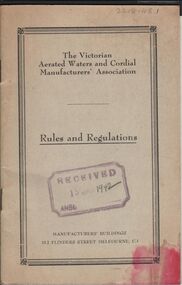 Bendigo Historical Society Inc.
Document - COHN BROTHERS COLLECTION: BUSINESS PAPERS, 1924 - 1951
... Collection. 1 - Black exercise book containing business papers and notes from meetings. 2 - Price list and zones for drinks and deposits on containers/bottles. 3 - The Victorian Aerated Waters and Cordial Manufacturer's Association Rules & Regulations (received 15 Jan 1942). 4 - Buff folder containing papers relating to business and price of drinks....Collection. 1 - Black exercise book containing business papers and notes from meetings. 2 - Price list and zones for drinks and deposits on containers/bottles. 3 - The Victorian Aerated Waters and Cordial Manufacturer's Association Rules & Regulations (received 15 Jan 1942). 4 - Buff folder containing papers relating to business and price of drinks. ...Document. Cohn Bros. Collection. 1 - Black exercise book containing business papers and notes from meetings. 2 - Price list and zones for drinks and deposits on containers/bottles. 3 - The Victorian Aerated Waters and Cordial Manufacturer's Association Rules & Regulations (received 15 Jan 1942). 4 - Buff folder containing papers relating to business and price of drinks.organization, business, cohn bros, cohn bros. collection, brewers, cordial & aerated water manufacturers, the victorian aerated waters and cordial manufacturer's association -
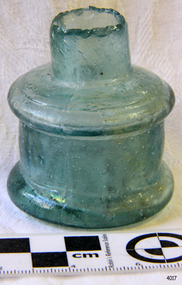 Flagstaff Hill Maritime Museum and Village
Container - Ink Bottle, Second half of 19th Century or first half of the 20th Century
... containers for wine and beer are probably 1,600 years old, much of their use began only in the late 17th century. In the United States, large-scale production of bottles was pioneered by Caspar Wistar in 1739 at his New Jersey plant. In the 1770s the carbonation process for producing soft drinks...containers for wine and beer are probably 1,600 years old, much of their use began only in the late 17th century. In the United States, large-scale production of bottles was pioneered by Caspar Wistar in 1739 at his New Jersey plant. In the 1770s the carbonation process for producing soft drinks ...Although glass containers for wine and beer are probably 1,600 years old, much of their use began only in the late 17th century. In the United States, large-scale production of bottles was pioneered by Caspar Wistar in 1739 at his New Jersey plant. In the 1770s the carbonation process for producing soft drinks was developed, and so began an entirely new bottling industry. At the Great Exhibition of 1851 in the Crystal Palace in London, one million “pop” bottles were consumed. The first beer pasteurised in glass was produced in Copenhagen in 1870. Pasteurisation of milk followed soon after. The moulding of a screw thread on a container was invented by John Mason in 1858. The principles of the “press-and-blow” process for making wide-mouth jars were shown in the United States by Philip Arbogast in 1882, and the “blow-and-blow” process for making narrow-neck containers was demonstrated by Howard Ashley in England in 1885. These processes employed manual delivery; fully automatic jar forming by a suction-and-blow process was perfected by Michael Owens over the period 1895–1917 at the Toledo (Ohio) Glass Company, which subsequently became the Owens Bottle Machine Company. The automatic single-gob feeder was developed in 1919–22 by Karl Peiler at the Hartford-Fairmont Company in Connecticut. Fully automatic machines followed, but the true rugged survivor, utilising fully automatic gob delivery to the maximum versatility, was the Individual Section, or IS, machine invented by Henry Ingle at the Hartford Empire Company in 1925. Source: https://www.britannica.com/topic/glass-properties-composition-and-industrial-production-234890/History-of-glassmakingUnlike item 4018, this is a much smaller ink bottle, and was probably used by an individual, as against the supply of ink to pupils from a much larger bottle.Cotton Reel Ink Bottle, green glass, small, chipped around the lip, bubbles in glass.None.flagstaff hill, warrnambool, shipwrecked-coast, flagstaff-hill, flagstaff-hill-maritime-museum, maritime-museum, shipwreck-coast, flagstaff-hill-maritime-village, ink, bottle, glass -
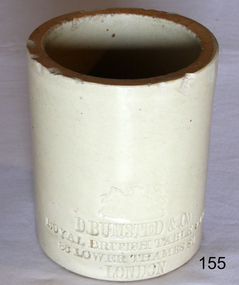 Flagstaff Hill Maritime Museum and Village
Container - Ceramic Salt Container, Doulton Lambeth, circa 1880
... container...salt jar...d. bumstead & co...london salt merchant...food and drink...A rare item now sought after by collector of ceramics and significant as a collectors item from the late 19th century. flagstaff hill warrnambool flagstaff hill maritime museum shipwreck coast flagstaff hill maritime village great ocean road ceramic container salt jar d. bumstead & co london salt merchant food and drink Doulton & Co Has lion and unicorn emblem and inscription impressed on outside. ...The 1846 London Directory lists David Bumsted & Co., trading at 86 Lower Thames Street, 35 Bridge Wharf, City Road Basin & 338 Wapping High Street Droitwich, as a salt merchant. The London Gazette had the following announcement dated 30th November 1887 advising his partnership with John Campbell Bumsted, carrying on business at 36, King William-street, in the city of London, as Salt Merchants, is dissolved as and from this date; and that the business will be continued to be carried on by the said John Campbell Bumsted alone.A rare item now sought after by collector of ceramics and significant as a collectors item from the late 19th century.Glazed Container; cream coloured ceramic salt jar, round shaped, Has lion and unicorn emblem and inscription impressed on outside. "D.BUMSTEAD & CO.\ ROYAL BRITISH TABLE SALT \ 86 LOWER THAMES ST \ LONDON"flagstaff hill, warrnambool, flagstaff hill maritime museum, shipwreck coast, flagstaff hill maritime village, great ocean road, ceramic container, salt jar, d. bumstead & co, london salt merchant, food and drink, doulton & co -
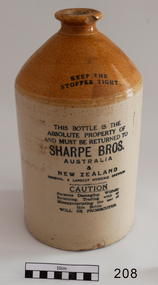 Flagstaff Hill Maritime Museum and Village
Container - Stoneware Demijohn, Bendigo Pottery , 1905-1950
... drinks such as Dandelion Ale, Ginger Beer and cordial. Sharpe Bros began in New Zealand and expanded to Australia in the early 20th century. The company was taken over by Cadbury Schweppes in 1972. An item made during the first half of the 20th century by a Bendigo pottery as a container ...This demijohn was made by Bendigo Pottery for Sharpe Bros, brewers of non-alcoholic drinks such as Dandelion Ale, Ginger Beer and cordial. Sharpe Bros began in New Zealand and expanded to Australia in the early 20th century. The company was taken over by Cadbury Schweppes in 1972.An item made during the first half of the 20th century by a Bendigo pottery as a container made for the Sharpe's brewery in Victoria to contain their non alcoholic drinks for retail sale.Glazed stoneware bottle with dark brown glaze to top section, one gallon size, narrow neck glazed stoneware stopper and wire handle missing. SHARPE BROS. AUSTRALIA & NEW ZEALAND Text printed in black on body: 'This bottle is the absolute property of and must be returned to Sharpe Bros. Australia and New Zealand.flagstaff hill, warrnambool, flagstaff hill maritime museum, shipwreck coast, flagstaff hill maritime village, great ocean road, bottle, stoneware bottle, sharpe bros., drink, non alcoholic drinks, bendigo pottery, demihohn -
 Flagstaff Hill Maritime Museum and Village
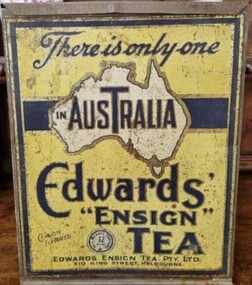
Container - Tin Tea Container, Wilson Bros, 1900-1940
... drink...container...An Australia icon during the first half of the 20th century as tea drinking was a popular past time and social activity. flagstaff hill warrnambool shipwrecked coast flagstaff hill maritime museum maritime museum shipwreck coast flagstaff hill maritime village great ocean road tea tin tea caddy drink container Wilson Bros Ensign Tea On label "Edwards Ensign Tea" Container for tea with hinged lid. ...The tin was made by Wilson Bros, Melbourne, for Edwards' Ensign Tea Pty Ltd, Melbourne, Victoria, Australia, 1900-1940. There was a fire at their factory in Flinders Street Melbourne on April 30, 1921 which completely destroyed the building. New premises were obtained at 310/18 King Street Melbourne in 1923. there continued to be bill board advertisements for Ensign tea at the King Street address, also regular adverts in the Argus newspaper during1942.An Australia icon during the first half of the 20th century as tea drinking was a popular past time and social activity.Container for tea with hinged lid. Label yellow with map of Australia. Lid is coming away on one hinge. "Edwards Ensign Tea" On label "Edwards Ensign Tea"flagstaff hill, warrnambool, shipwrecked coast, flagstaff hill maritime museum, maritime museum, shipwreck coast, flagstaff hill maritime village, great ocean road, tea tin, tea caddy, drink, container, wilson bros, ensign tea -
 Flagstaff Hill Maritime Museum and Village
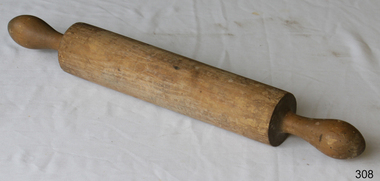
Domestic object - Wooden Rolling Pin, First half of 20th Century
... containers disguised the true contents. The straight-sided cylinder is a more recent development, although tapered glass pins are still common craft projects made by cutting two wine bottles in half and sealing the two ends together so that the necks serve as handles at each end.Tiny rolling pins are also twisted into shape using formed wire. The pins will not flatten and smooth pastry, and the handles do not turn. The metal pins are popular as kitchen decorations and also to hang pots, pans, and potholders. https://www.encyclopedia.com/sports-and-everyday-life/food-and-drink...containers disguised the true contents. The straight-sided cylinder is a more recent development, although tapered glass pins are still common craft projects made by cutting two wine bottles in half and sealing the two ends together so that the necks serve as handles at each end.Tiny rolling pins are also twisted into shape using formed wire. The pins will not flatten and smooth pastry, and the handles do not turn. The metal pins are popular as kitchen decorations and also to hang pots, pans, and potholders. https://www.encyclopedia.com/sports-and-everyday-life/food-and-drink ...A rolling pin is a simple tool used to flatten dough. The first civilisation known to have used the rolling pin was the Etruscans. Their advanced farming ability, along with a tendency to cultivate many plants and animals never before used as food and turn them into sophisticated recipes, were passed to invading Greeks, Romans, and Western Europeans. Thanks to the Etruscans, these cultures are associated with gourmet cooking. To prepare their inventive foods, the Etruscans also developed a wide range of cooking tools, including the rolling pin. Although written recipes did not exist until the fourth century B.C., the Etruscans documented their love of food and its preparation in murals, on vases, and on the walls of their tombs. Cooking wares are displayed with pride; rolling pins appear to have been used first to thin-roll pasta that was shaped with cutting wheels. They also used rolling pins to make bread (which they called puls) from the large number of grains they grew. Natives of the Americas used more primitive bread-making tools that are favoured and unchanged in many villages. Chefs who try to use genuine methods to preserve recipes are also interested in both materials and tools. Hands are used as "rolling pins" for flattening dough against a surface, but also for tossing soft dough between the cook's two hands until it enlarges and thins by handling and gravity. Tortillas are probably the most familiar bread made this way. Over the centuries, rolling pins have been made of many different materials, including long cylinders of baked clay, smooth branches with the bark removed, and glass bottles. As the development of breads and pastries spread from Southern to Western and Northern Europe, wood from local forests was cut and finished for use as rolling pins. The French perfected the solid hardwood pin with tapered ends to roll pastry that is thick in the middle; its weight makes rolling easier. The French also use marble rolling pins for buttery dough worked on a marble slab. Glass is still popular; in Italy, full wine bottles that have been chilled make ideal rolling pins because they are heavy and cool the dough. Countries known for their ceramics make porcelain rolling pins with beautiful decorations painted on the rolling surface; their hollow centres can be filled with cold water (the same principle as the wine bottle), and cork or plastic stoppers cap the ends. Designs for most rolling pins follow long-established practices, although some unusual styles and materials are made and used. Within the family of wooden rolling pins, long and short versions are made as well as those that are solid cylinders (one-piece rolling pins) instead of the familiar style with handles. Very short pins called mini rolling pins make use of short lengths of wood and are useful for one-handed rolling and popular with children and collectors. Mini pins ranging from 5 to 7 in (12.7-17.8 cm) in length are called texturing tools and are produced to create steam holes and decorations in pastry and pie crusts; crafters also use them to imprint clay for art projects. These mini pins are made of hardwoods (usually maple) or plastic. Wood handles are supplied for both wood and plastic tools, however. Blown glass rolling pins are made with straight walls and are solid or hollow. Ceramic rolling pins are also produced in hollow form, and glass and ceramic models can be filled with water and plugged with stoppers. Tapered glass rolling pins with stoppers were made for many centuries when salt imports and exports were prohibited or heavily taxed. The rolling pin containers disguised the true contents. The straight-sided cylinder is a more recent development, although tapered glass pins are still common craft projects made by cutting two wine bottles in half and sealing the two ends together so that the necks serve as handles at each end.Tiny rolling pins are also twisted into shape using formed wire. The pins will not flatten and smooth pastry, and the handles do not turn. The metal pins are popular as kitchen decorations and also to hang pots, pans, and potholders. https://www.encyclopedia.com/sports-and-everyday-life/food-and-drink/food-and-cooking/rolling-pinThe use of the rolling pin to make thin pastry or pasta.Wooden rolling pin with some damage on cylinder section.None.flagstaff hill, warrnambool, shipwrecked-coast, flagstaff-hill, flagstaff-hill-maritime-museum, maritime-museum, shipwreck-coast, flagstaff-hill-maritime-village, rolling pin, cooking, pastry -
 Flagstaff Hill Maritime Museum and Village
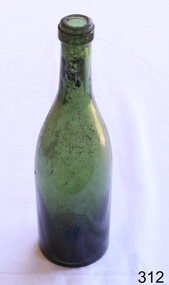
Container - Bottle, Late 19th century or early 20th century
... containers, automatic manufacturing is the preferred method to create glass bottles and jars. https://www.containerandpackaging.com/resources/glass-bottles-brief-history The invention and development of glass for domestic items including bottles, has been nothing short of revolutionary. The use of glass bottles, that could be easily washed, led to improved hygiene, and mass manufacturing of drinks ...Glass manufacturing has evolved over thousands of years. Glass making has been traced back to 3500 BC in Mesopotamia. The earliest known glass objects were beads, perhaps made by accident while working with metal. In the late Bronze Age, several civilizations discovered how to make vessels and glass bottles by wrapping threads of melted glass around cores of sand or clay. Later, moulds were used to form dishes and table wares. Around the 1st century BC, glassblowing was discovered. This made glass containers less expensive than pottery. Mould-blown glass, the process of blowing a piece of molten glass into a wooden or metal mould, was invented during the 1st century AD. This technique was faster with more consistent results. It paved the way for mass production. It wasn’t until the late 1800s that the production process to become more efficient. In 1887, a company in England created a semi-automatic process that could produce up to 200 bottles an hour. This process has been refined to the point where modern machines can yield more than 600 containers per minute. Blown vs. Manufactured Glass Bottles Nowadays, glass bottles, jars, and cups are usually manufactured on a bigger scale than is found in individual glassblowing studios. If we still depended on hand-blown glass for all of our glass containers, we would see some major differences in the process of creating bottles and jars. First, there's the time. Hand blowing glass takes a significant amount of time, even for one simple container. In contrast, hundreds of jars per minute can be made using modern technology. This leads to the second advantage: price. Because of the automated and streamlined process, the price for manufactured containers is much lower than that of hand-blown glass. Third, manufactured bottles will be much more consistently uniform than bottles blown by hand. Automated glass manufacturing produces nearly identical batches of jars. Glass blowing is awesome for unique, beautiful pieces of art. But for lots of lower priced and uniformly shaped containers, automatic manufacturing is the preferred method to create glass bottles and jars. https://www.containerandpackaging.com/resources/glass-bottles-brief-history The invention and development of glass for domestic items including bottles, has been nothing short of revolutionary. The use of glass bottles, that could be easily washed, led to improved hygiene, and mass manufacturing of drinks of all types, including milk, cordial and alcoholic beverages.Green Glass Bottle Possibly a ginger beer bottle.Concave indentation at the base. Also on base are two raised lumps. flagstaff hill, warrnambool, shipwrecked-coast, flagstaff-hill, flagstaff-hill-maritime-museum, maritime-museum, shipwreck-coast, flagstaff-hill-maritime-village, glass -
 Flagstaff Hill Maritime Museum and Village
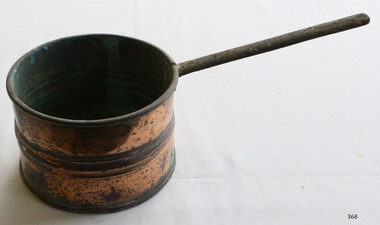
Domestic object - Saucepan
... containers, but it was also used to in medical practices. The antimicrobial nature of copper was exploited long before the concept of microorganisms was fully understood. The Smith Papyrus, a medical text written between 2600 and 2200BC records the use of copper in sterilising wounds and drinking water. ...containers, but it was also used to in medical practices. The antimicrobial nature of copper was exploited long before the concept of microorganisms was fully understood. The Smith Papyrus, a medical text written between 2600 and 2200BC records the use of copper in sterilising wounds and drinking water. ...It is no secret that copper is currently experiencing a huge upsurge in popularity. This is mainly thanks to its beautiful colour featuring heavily in the ranges of countless homeware retailers. There is, however, far more to this lustrous metal than just its appearance. For example, it has a greater level of thermal conductivity than any other metal (except silver); roughly 60% higher than aluminium and 3000% higher than stainless steel. This means copper is capable of heating up very quickly when compared to other metals. Perhaps a less commonly known property of copper is it being inherently antimicrobial. A wide range of harmful microbes are unable to survive for more than a couple of hours when in contact with a surface made of copper or one of its alloys (brass and bronze). This has led to it often being used for frequently touched surfaces such as door knobs, push plates and taps. A seemingly perfect material for cooking, it is therefore no surprise that it has been used in kitchens for millennia. But exactly when did we learn to utilise copper and its valuable assets? Origins It is hard to pin down an exact date when copper cookware was first introduced. Pieces discovered in regions of the middle east were dated as far back as 9000BC, suggesting cooking with copper began during the Neolithic period (≈10000-2000BC). As civilisations became increasingly capable in metallurgical techniques, metals such as copper became more widely used. It would have been around this time that copper replaced stone as the material used for making tools and cooking vessels. The use of copper is also well documented in Ancient Egypt. Not only was it used to produce water and oil containers, but it was also used to in medical practices. The antimicrobial nature of copper was exploited long before the concept of microorganisms was fully understood. The Smith Papyrus, a medical text written between 2600 and 2200BC records the use of copper in sterilising wounds and drinking water. Tin Lining Although copper is essential to many processes within the human body, it can become toxic if consumed in excess. It was this knowledge that gave rise to lining cookware with tin, a technique used for hundreds of years to prevent copper leaching in to food. These tin linings would eventually wear out and during the 18th and 19th century, it was common for people to send pans away to be re-tinned. This practice is becoming increasingly rare, as are the craftsmen who perform it. Despite this, there are still manufactures producing tin-lined copper cookware who also offer a re-lining service. Perhaps the best known of these is Mauviel, a French manufacturer who have been making this type of cookware since 1830. Tin has now largely been replaced by stainless steel as an interior cooking surface. Not only is it more cost effective, but the high grade of stainless steel used in premium cookware (typically 18/10) is highly resistant to corrosion and more durable than tin.Copper saucepans are still used in many kitchens.Small copper saucepan with long handle and three ridges around the circumference. Extensive corrosion.None.flagstaff hill, warrnambool, shipwrecked-coast, flagstaff-hill, flagstaff-hill-maritime-museum, maritime-museum, shipwreck-coast, flagstaff-hill-maritime-village, copper, saucepans, kitchen equipment -
 Flagstaff Hill Maritime Museum and Village
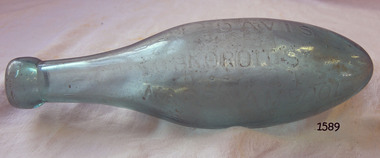
Container - Torpedo Bottle, Last quarter of the 19th century
... The bottle is significant for its unusual torpedo shape and for being sold by the long standing John Fletcher's soft drink business in Warrnambool who was a prominent soft drinks manufacturer in Warrnambool for over 40 years. flagstaff hill warrnambool shipwrecked-coast flagstaff-hill flagstaff-hill-maritime-museum maritime-museum shipwreck-coast flagstaff-hill-maritime-village torpedo shaped glass bottle torpedo bottle bottle john fletcher late and j. davis koroit st warrnambool john fletcher late and j. davis john fletcher late j. davis "John Fletcher Late and J. Davis Koroit St Warrnambool" Torpedo shaped green glass bottle, name of manufacture of contents, John Fletcher Late and J. Davis, of Koroit St Warrnambool, is impressed in the glass. Container ...This bottle has come from the aerated waters factory of John Fletcher of Warrnambool. This factory in Koroit Street was established in the mid 19th century by John Davis. As a young boy John Fletcher worked at the cordial factory of John Rowley in Banyan Street, Warrnambool and then worked for a number of years for John Davis at his Union Cordial Factory. In 1885 John Fletcher succeeded John Davis and continued in this business until 1930. The business was then taken over by Ralph Reeves. John Fletcher manufactured aerated waters, soda, tonic waters, lemonade, ginger ale, hop beer, hop bitters, sarsaparilla and cordials. The bottle would have been sealed with a cork stopper. The torpedo shape of the bottle would ensure that it was stored on its side, keeping the cork moist so that it didn't shrink and cause the bottle to leak its contents.The bottle is significant for its unusual torpedo shape and for being sold by the long standing John Fletcher's soft drink business in Warrnambool who was a prominent soft drinks manufacturer in Warrnambool for over 40 years.Torpedo shaped green glass bottle, name of manufacture of contents, John Fletcher Late and J. Davis, of Koroit St Warrnambool, is impressed in the glass."John Fletcher Late and J. Davis Koroit St Warrnambool"flagstaff hill, warrnambool, shipwrecked-coast, flagstaff-hill, flagstaff-hill-maritime-museum, maritime-museum, shipwreck-coast, flagstaff-hill-maritime-village, torpedo shaped glass bottle, torpedo bottle, bottle, john fletcher late and j. davis koroit st warrnambool, john fletcher late and j. davis, john fletcher late, j. davis -
 Greensborough Historical Society
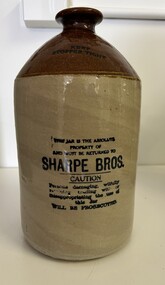
Container - Jar, Hoffman Australia, Sharpe Bros demijohn, 1930s
... drinks such as Dandelion Ale, ginger beer and cordial. Sharpe Bros began in New Zealand and expanded to Australia in the early 20th century. The company was taken over by Cadbury Schweppes in 1972. The likely manufacturer of this demijohn was Hoffman's Pottery of Brunswick. sharpe bros. hoffman pottery stoneware jars Transfer text on front: "This jar is the absolute property of and must be returned to Sharpe Bros. Australia and New Zealand" Glazed stoneware jar with dark brown glaze to top, narrow threaded neck, wire handle and stopper missing. Sharpe Bros demijohn Container ...This demijohn was made for Sharpe Bros., brewers of non- alcoholic drinks such as Dandelion Ale, ginger beer and cordial. Sharpe Bros began in New Zealand and expanded to Australia in the early 20th century. The company was taken over by Cadbury Schweppes in 1972. The likely manufacturer of this demijohn was Hoffman's Pottery of Brunswick.Glazed stoneware jar with dark brown glaze to top, narrow threaded neck, wire handle and stopper missing.Transfer text on front: "This jar is the absolute property of and must be returned to Sharpe Bros. Australia and New Zealand"sharpe bros., hoffman pottery, stoneware jars -
 Upper Yarra Museum
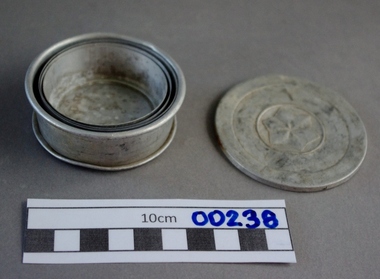
Drinking Cup
... drink...container...aluminium drinking cup star camping drink container collapsable Pressed star motif on lid Aluminium drinking cup, collapsable with a seperate lid. ...The first Patent for these cups was granted on June 5th 1860 to Niles Gutta Purcha Drinking cups. A later Patent was granted to Fred Harvey in 1897. Perhaps they were in different states, or Fred Harvey's had an inovation that improved the design or usage ?Aluminium drinking cup, collapsable with a seperate lid. The lid has a pressed star shape.Pressed star motif on lidaluminium, drinking, cup, star, camping, drink, container, collapsable -
 Flagstaff Hill Maritime Museum and Village
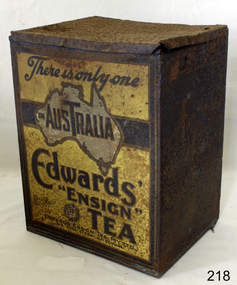
Container - Tin Tea Container, Wilson Bros, 1900-1940
... drink...container...An Australia icon during the first half of the 20th century as tea drinking was a popular past time and social activity. flagstaff hill warrnambool shipwrecked coast flagstaff hill maritime museum maritime museum shipwreck coast flagstaff hill maritime village great ocean road tea tin tea caddy drink container wilson bros ensign tea On label "Edwards Ensign Tea" Container for tea with hinged lid. ...The tin was made by Wilson Bros, Melbourne, for Edwards' Ensign Tea Pty Ltd, Melbourne, Victoria, Australia, 1900-1940. There was a fire at their factory in Flinders Street Melbourne on April 30, 1921 which completely destroyed the building. New premises were obtained at 310/18 King Street Melbourne in 1923. there continued to be bill board advertisements for Ensign tea at the King Street address, also regular adverts in the Argus newspaper during1942.An Australia icon during the first half of the 20th century as tea drinking was a popular past time and social activity.Container for tea with hinged lid. Label yellow with map of Australia. Lid is coming away on one hinge. "Edwards Ensign Tea" On label "Edwards Ensign Tea"flagstaff hill, warrnambool, shipwrecked coast, flagstaff hill maritime museum, maritime museum, shipwreck coast, flagstaff hill maritime village, great ocean road, tea tin, tea caddy, drink, container, wilson bros, ensign tea -
 Flagstaff Hill Maritime Museum and Village
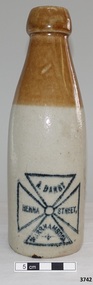
Bottle, circa 1899
... It is also a good example of soft drink containers used in the late 19th and early 20th century and of Australian made products. ...This clay soft drink bottle was made by Bendigo Pottery circa 1899. It was badged for and sold by A. [Alfred] Darby of Henna Street Warrnambool, (between Raglan Pde and Lava St). The internal screw thread in the neck of this bottle allows for an applied ‘blob’ top stopper to be added. The company A. Darby bottled soda water, cordial, lemonade, ginger ale and ginger beer. Darby’s also made cider, lime juice, raspberry vinegar and other specialties. There was a branch of Darby’s cordial factory in Shepparton Victoria. The building has the year 1910 on it and is now the council office. The bottle’s manufacturer, Bendigo Pottery, was established in the 1858 during the gold rush era. The bottle is part of the “W.R. Angus Collection” that includes historical medical equipment, surgical instruments and material once belonging to Dr Edward Ryan and Dr Thomas Francis Ryan, (both of Nhill, Victoria) as well as Dr Angus’ own belongings. The Collection’s history spans the medical practices of the two Doctors Ryan, from 1885-1926 plus that of Dr Angus, up until 1969. ABOUT THE “W.R.ANGUS COLLECTION” Doctor William Roy Angus M.B., B.S., Adel., 1923, F.R.C.S. Edin.,1928 (also known as Dr Roy Angus) was born in Murrumbeena, Victoria in 1901 and lived until 1970. He qualified as a doctor in 1923 at University of Adelaide, was Resident Medical Officer at the Royal Adelaide Hospital in 1924 and for a period was house surgeon to Sir (then Mr.) Henry Simpson Newland. Dr Angus was briefly an Assistant to Dr Riddell of Kapunda, then commenced private practice at Curramulka, Yorke Peninsula, SA, where he was physician, surgeon and chemist. In 1926, he was appointed as new Medical Assistant to Dr Thomas Francis Ryan (T.F. Ryan, or Tom), in Nhill, Victoria, where his experiences included radiology and pharmacy. In 1927 he was Acting House Surgeon in Dr Tom Ryan’s absence. Dr Angus had become engaged to Gladys Forsyth and they decided he further his studies overseas in the UK in 1927. He studied at London University College Hospital and at Edinburgh Royal Infirmary and in 1928, was awarded FRCS (Fellow from the Royal College of Surgeons), Edinburgh. He worked his passage back to Australia as a Ship’s Surgeon on the on the Australian Commonwealth Line’s T.S.S. Largs Bay. Dr Angus married Gladys in 1929, in Ballarat. (They went on to have one son (Graham 1932, born in SA) and two daughters (Helen (died 12/07/1996) and Berenice (Berry), both born at Mira, Nhill According to Berry, her mother Gladys made a lot of their clothes. She was very talented and did some lovely embroidery including lingerie for her trousseau and beautifully handmade baby clothes. Dr Angus was a ‘flying doctor’ for the A.I.M. (Australian Inland Ministry) Aerial Medical Service in 1928. Its first station was in the remote town of Oodnadatta, where Dr Angus was stationed. He was locum tenens there on North-South Railway at 21 Mile Camp. He took up this ‘flying doctor’ position in response to a call from Dr John Flynn; the organisation was later known as the Flying Doctor Service, then the Royal Flying Doctor Service. A lot of his work during this time involved dental surgery also. Between 1928-1932 he was surgeon at the Curramulka Hospital, Yorke Peninsula, South Australia. In 1933 Dr Angus returned to Nhill and purchased a share of the Nelson Street practice and Mira hospital (a 2 bed ward at the Nelson Street Practice) from Dr Les Middleton one of the Middleton Brothers, the current owners of what previously once Dr Tom Ryan’s practice. Dr Tom and his brother had worked as surgeons included eye surgery. Dr Tom Ryan performed many of his operations in the Mira private hospital on his premises. He had been House Surgeon at the Nhill Hospital 1902-1926. Dr Tom Ryan had one of the only two pieces of radiology equipment in Victoria during his practicing years – The Royal Melbourne Hospital had the other one. Over the years Dr Tom Ryan had gradually set up what was effectively a training school for country general-practitioner-surgeons. Each patient was carefully examined, including using the X-ray machine, and any surgery was discussed and planned with Dr Ryan’s assistants several days in advance. Dr Angus gained experience in using the X-ray machine there during his time as assistant to Dr Ryan. When Dr Angus bought into the Nelson Street premises in Nhill he was also appointed as the Nhill Hospital’s Honorary House Surgeon 1933-1938. His practitioner’s plate from his Nhill surgery is now mounted on the doorway to the Port Medical Office at Flagstaff Hill Maritime Village, Warrnambool. When Dr Angus took up practice in the Dr Edward and Dr Tom Ryan’s old premises he obtained their extensive collection of historical medical equipment and materials spanning 1884-1926. A large part of this collection is now on display at the Port Medical Office at Flagstaff Hill Maritime Village in Warrnambool. In 1939 Dr Angus and his family moved to Warrnambool where he purchased “Birchwood,” the 1852 home and medical practice of Dr John Hunter Henderson, at 214 Koroit Street. (This property was sold in1965 to the State Government and is now the site of the Warrnambool Police Station and an ALDI sore is on the land that was once their tennis court). The Angus family was able to afford gardeners, cooks and maids; their home was a popular place for visiting dignitaries to stay whilst visiting Warrnambool. Dr Angus had his own silk worm farm at home in a Mulberry tree. His young daughter used his centrifuge for spinning the silk. Dr Angus was appointed on a part-time basis as Port Medical Officer (Health Officer) in Warrnambool and held this position until the 1940’s when the government no longer required the service of a Port Medical Officer in Warrnambool; he was thus Warrnambool’s last serving Port Medical Officer. (Masters of immigrant ships arriving in port reported incidents of diseases, illness and death and the Port Medical Officer made a decision on whether the ship required Quarantine and for how long, in this way preventing contagious illness from spreading from new immigrants to the residents already in the colony.) Dr Angus was a member of the Australian Medical Association, for 35 years and surgeon at the Warrnambool Base Hospital 1939-1942, He served with the Australian Department of Defence as a Surgeon Captain during WWII 1942-45, in Ballarat, Victoria, and in Bonegilla, N.S.W., completing his service just before the end of the war due to suffering from a heart attack. During his convalescence he carved an intricate and ‘most artistic’ chess set from the material that dentures were made from. He then studied ophthalmology at the Royal Melbourne Eye and Ear Hospital and created cosmetically superior artificial eyes by pioneering using the intrascleral cartilage. Angus received accolades from the Ophthalmological Society of Australasia for this work. He returned to Warrnambool to commence practice as an ophthalmologist, pioneering in artificial eye improvements. He was Honorary Consultant Ophthalmologist to Warrnambool Base Hospital for 31 years. He made monthly visits to Portland as a visiting surgeon, to perform eye surgery. He represented the Victorian South-West subdivision of the Australian Medical Association as its secretary between 1949 and 1956 and as chairman from 1956 to 1958. In 1968 Dr Angus was elected member of Spain’s Barraquer Institute of Barcelona after his research work in Intrasclearal cartilage grafting, becoming one of the few Australian ophthalmologists to receive this honour, and in the following year presented his final paper on Living Intrasclearal Cartilage Implants at the Inaugural Meeting of the Australian College of Ophthalmologists in Melbourne In his personal life Dr Angus was a Presbyterian and treated Sunday as a Sabbath, a day of rest. He would visit 3 or 4 country patients on a Sunday, taking his children along ‘for the ride’ and to visit with him. Sunday evenings he would play the pianola and sing Scottish songs to his family. One of Dr Angus’ patients was Margaret MacKenzie, author of a book on local shipwrecks that she’d seen as an eye witness from the late 1880’s in Peterborough, Victoria. In the early 1950’s Dr Angus, painted a picture of a shipwreck for the cover jacket of Margaret’s book, Shipwrecks and More Shipwrecks. She was blind in later life and her daughter wrote the actual book for her. Dr Angus and his wife Gladys were very involved in Warrnambool’s society with a strong interest in civic affairs. He had an interest in people and the community. They were both involved in the creation of Flagstaff Hill, including the layout of the gardens. After his death (28th March 1970) his family requested his practitioner’s plate, medical instruments and some personal belongings be displayed in the Port Medical Office surgery at Flagstaff Hill Maritime Village, and be called the “W. R. Angus Collection”. This glazed clay bottle represents early Warrnambool industry. It is also a good example of soft drink containers used in the late 19th and early 20th century and of Australian made products. Bendigo Pottery is Australia’s oldest working pottery. The kilns at Bendigo Pottery are now on the Victorian Heritage Register. The W.R. Angus Collection is significant for still being located at the site it is connected with, Doctor Angus being the last Port Medical Officer in Warrnambool. The collection of medical instruments and other equipment is culturally significant, being an historical example of medicine, administration, household equipment and clothing from late 19th to mid-20th century. Dr Angus assisted Dr Tom Ryan, a pioneer in the use of X-rays and in ocular surgery. Earthenware soft drink bottle, part of the W.R. Angus Collection. Glazed clay, 'champ' shape, two-toned colour; caramel from mouth to shoulder, beige on lower section. Inside of neck has an internal thread that could have been sealed with an applied internal ‘blob’ top stopper. Black stamped Maltese cross design emblem on front with each quarter containing text, black oval stamp on back with maker’s details. Bottle was made by Bendigo Pottery of Victoria circa 1899 and sold by A Darby of Henna Street Warrnambool.Maltese cross design, each quarter has text "A. DARBY", "HENNA", 'STREET,", WARRNAMBOOL" Oval stamp” - - - - - -RE BENDIGO POTTERY [EPSO] M - - - - - O” flagstaff hill, warrnambool, shipwrecked coast, flagstaff hill maritime museum, maritime museum, shipwreck coast, flagstaff hill maritime village, great ocean road, dr w r angus, dr ryan, nhill base hospital, mira hospital, flying doctor, department of defence australia, australian army, army uniform, bottle, earthernware soft drink bottle, earthernware bottle, a. darby, henna street warrnambool, soft drink industry warrnambool, bendigo pottery, 1899 soft drink bottle, champ shape soft drink bottle, ginger beer bottle, cordial bottle, blob top, blob stopper, internal stopper -
 Flagstaff Hill Maritime Museum and Village
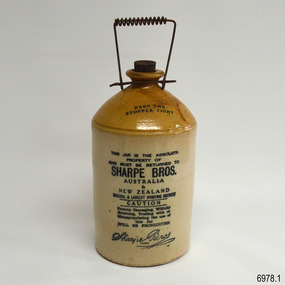
Container - Stoneware Demijohn, Bendigo Pottery , 1904-1930s
... ...drink container...Sharpe Bros. made ‘health’ beverages that were non-alcoholic drinks such as ginger beer, ginger ale, lime juice, soda and cordials. The containers of these drinks were not sold with the drinks but were marked as returnable items, to be cleaned and re-used, until this practice ceased in the 1930s. ...Bendigo Pottery Bottle stoneware bottle Demihohn one gallone bottle soft drink non-alcoholic drink drink container jar jug Warrnambool soft drink Hygienic brewery cordial factory New Zealand Australia John Sharpe Percy Sharpe non-alcoholic spiral wire handle ginger beer W.R. ...This Sharpe Bros. one gallon stoneware Demijohn is in excellent condition and includes its original stopper. It was made between 1904 and 1930, the date from the patent of the handle until the time that the factory no long produced returnable items. The bottle was once part of Dr W.R. Angus' household and is part of the W.R. Angus Collection and could have been purchased from Warrnambool's Sharpe Bros. factory. SHARPE BROS. 1903-1972- The first Sharpe Bros. cordial factory was opened in Dunedin, New Zealand, in 1903 by English prohibition brothers John and Percy Sharpe. Sharpe Bros. made ‘health’ beverages that were non-alcoholic drinks such as ginger beer, ginger ale, lime juice, soda and cordials. The containers of these drinks were not sold with the drinks but were marked as returnable items, to be cleaned and re-used, until this practice ceased in the 1930s. Sharpe Bros. made a niche in the soft drink market by delivering drinks by horse and cart to its customers’ homes. John Sharpe patented the unique wire spiral handle in 1904. By 1905 the New Zealand company also had factories in Australia. By 1910 the company had over 20 factories including Wanganui, New Zealand; Adelaide, Albury, Ballarat, Bathurst, Forbes, Geelong, Goulburn, Lithgow, Melbourne, Newcastle, Orange, Sydney, Tamworth, Warrnambool and Wollongong. The Warrnambool factory was established in 1919 and existed until 1951. The company won awards at Australian exhibitions for its carbonated drinks, including First Prize for its ginger beer made in the Brisbane factory. The company was taken over in 1962 by Tarax Drinks Holdings Ltd, which was in turn taken over by Cadbury Schweppes in 1972. W.R. Angus Collection- The W R Angus Collection spans from 1885 to the mid-1900s and includes historical medical and surgical equipment and instruments from the doctors Edward and Thomas Ryan of Nhill, Victoria. Dr Angus married Gladys in 1927 at Ballarat, the nearest big city to Nhill where he began as a Medical Assistant. He was also Acting House surgeon at the Nhill hospital where their two daughters were born. He and his family moved to Warrnambool in 1939, where Dr Angus operated his own medical practice. He later added the part-time Port Medical Officer responsibility and was the last person appointed to that position. Dr Angus and his wife were very involved in the local community, including the early planning stages of the new Flagstaff Hill, where they contributed to the layout of the gardens. Dr Angus passed away in March 1970.This stoneware Demijohn is connected to the history of Warrnambool, as it was owned by the daughter of Dr W. R. Angus and his wife Gladys. It is part of the W.R. Angus Collection, which is notable for still being located at the site connected to Doctor Angus, Warrnambool’s last Port Medical Officer. It is also connected through its manufacturer Sharpe Bros. which had a branch in Warrnambool from 1919 to 1951, overlapping the time when the Angus family resided there from 1939 to the 1970s. The bottle is also significant as an example of the early-20th-century beverages found in local households and could have been purchased from the local Sharpe Bros. factory.This stoneware Demijohn is glazed, with a brown neck with internal thread and shoulders and a cylindrical cream base. The one gallon bottle has a flat, black stopper with a cork stem and a rubber, threaded tip. The ‘U’ shaped wire carry handle has a spiral of wire around the handpiece. An overhanging lip is on top of the bottle’s short neck above its rounded shoulder. The clay has been joined at the base of the neck, shoulder and body. The underneath is unglazed. The brown glazing on the shoulder has a run mark. Inscriptions are on the stopper and bottle. This container is part of the W.R. Angus Collection.Stamped in black on the shoulder: “KEEP THE / STOPPER TIGHT” Stamped in black on the body: “THIS JAR IS THE ABSOLUTE PROPERTY OF AND MUST BE RETURNED TO SHARPE BROS. AUSTRALIA / & NEW ZEALAND. ORIGINAL & LARGEST HYGIENIC BREWERY. CAUTION Persons Damaging, Willfully Retaining, Trading with or Misappropriating the Use of this Jar WILL BE PROSECUTED “ Stamped in script writing: “Sharpe Bros. TRADE - - - ED “ Embossed on the stopper: “AUSTRALIA AND NEW ZEALAND, SHARPE BROS.”flagstaff hill, warrnambool, maritime village, maritime museum, shipwreck coast, great ocean road, dr w r angus, dr roy angus, dr ryan, sharpe bros., bendigo pottery, bottle, stoneware bottle, demihohn, one gallone bottle, soft drink, non-alcoholic drink, drink container, jar, jug, warrnambool soft drink, hygienic brewery, cordial factory, new zealand, australia, john sharpe, percy sharpe, non-alcoholic, spiral wire handle, ginger beer, w.r. angus collection, demijohn -
 Flagstaff Hill Maritime Museum and Village
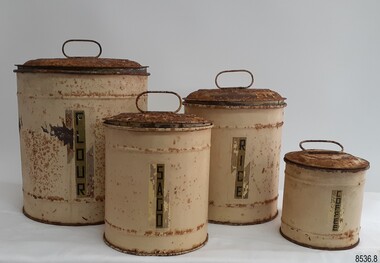
Container - Kitchen Canister set, Late 19th to early 20th century
... containers like these are reusable and can be re-purposed, which is advantageous when living in regional or rural areas. The type of manufacture indicates that the set was made in the late 19th to early 20th century. Gradually, colourful and attractive plastic kitchenware began to replace metalware. One of the canisters is labelled 'coffee'; coffee plants and seeds were transported from Brazil into Australia in 1788 when the First Fleet arrived although their growth was unsuccessful. However, by the 1920s, a tenth of the Australian population was drinking...containers like these are reusable and can be re-purposed, which is advantageous when living in regional or rural areas. The type of manufacture indicates that the set was made in the late 19th to early 20th century. Gradually, colourful and attractive plastic kitchenware began to replace metalware. One of the canisters is labelled 'coffee'; coffee plants and seeds were transported from Brazil into Australia in 1788 when the First Fleet arrived although their growth was unsuccessful. However, by the 1920s, a tenth of the Australian population was drinking ...This set of kitchen dry food canisters is made of metal; each container has a different height, width and capacity. The rolled thin metal has created a strong, round design with decorative rings on the circumference. The base and close-fitting lid protect the contents from vermin and most insects, and the handle on top aids in the removal of the lid. Metal containers like these are reusable and can be re-purposed, which is advantageous when living in regional or rural areas. The type of manufacture indicates that the set was made in the late 19th to early 20th century. Gradually, colourful and attractive plastic kitchenware began to replace metalware. One of the canisters is labelled 'coffee'; coffee plants and seeds were transported from Brazil into Australia in 1788 when the First Fleet arrived although their growth was unsuccessful. However, by the 1920s, a tenth of the Australian population was drinking readily stored coffee. Large quantities of harvested grains such as maize, wheat and barley were protected from pests by being stored in airy buildings, often raised from the ground. This was an age-old practice used by civilizations such as the ancient Egyptians and early Hebrews. Smaller quantities of food for short-term use in the homes were stored in woven baskets or clay pots.This set of kitchen food containers is an example of colonial food storage used in a domestic setting to store and preserve dry ingredients. These canisters give a snapshot of early domestic life in Australia. Canister set; four cylindrical cream coloured metal canisters with domed lids that have lift-up handles on top. They are made from rolled metal and the bases and lids have a side seam. Each canister is a different size and displays a label for different contents. The adhesive labels are vertical, and a gold colour with black vertical text. The cream paint has brush strokes and small areas have exposed green paint under the cream. The insides of the bases are painted dark grey but the lids have no paint underneath. The empty canisters can fit one inside the other. Labels, in descending order: "FLOUR" "RICE" "SAGO" "COFFEE"flagstaff hill, flagstaff hill maritime museum and village, warrnambool, maritime museum, maritime village, great ocean road, shipwreck coast, canister set, kitchen storage, food storage, metal canisters, dry food storage, food packaging, kitchen container, vintage, flour, rice, sago, coffee, kitchenalia, late 19th to early 20th centuries, nesting canisters -
 City of Moorabbin Historical Society (Operating the Box Cottage Museum)
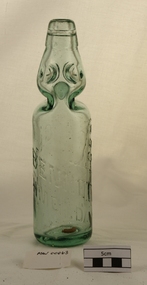
Container - Manufactured glass, Codd bottle, c1888
... Ltd of Richmond, Victoria for their Lemonade and sold as refreshment to early settlers of Moorabbin Shire c1880 codd hiram glass manufacture glass bottles moorabbin brighton barnsley england carbonated water soft drink mineral water bennetts lemonade maker richmond early settlers market gardeners melbourne BENNETTS / LEMONADE diagonally across bottle A slightly green tinted, glass bottle with a groove inside the top which held a rubber ring, against which, the small glass ball inside the bottle was held by the pressure of the 'fizzy' drink inside. Container Manufactured glass, Codd bottle Hiram Codd Pty Ltd ...The Codd Bottle was first invented by English manufacturer, Hiram Codd at Barnsley in 1870. The groove inside the top of the bottle held a rubber ring. A small glass balll was held against this ring by the pressure of the 'pop' or 'fizzy' carbonated drink inside the bottle. This style of bottle was widely manufactured and used in the production of mineral waters and lemonade. The glass has a slight green tint, known as aqua glass, and is what the Victorian era produced as 'clear glass'This glass Codd bottle with glass ball and partial rubber ring was probably imported from England by Bennetts Pty. Ltd of Richmond, Victoria for their Lemonade and sold as refreshment to early settlers of Moorabbin Shire c1880A slightly green tinted, glass bottle with a groove inside the top which held a rubber ring, against which, the small glass ball inside the bottle was held by the pressure of the 'fizzy' drink inside.BENNETTS / LEMONADE diagonally across bottlecodd hiram, glass manufacture, glass bottles, moorabbin, brighton, barnsley england, carbonated water, soft drink, mineral water, bennetts lemonade maker, richmond, early settlers, market gardeners, melbourne -
 City of Moorabbin Historical Society (Operating the Box Cottage Museum)
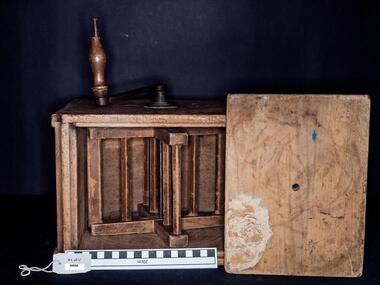
Churn, small domestic butter, c1880
... container when the handle was turned. Early settlers had to be self sufficient, growing their own vegetables, making tools and clothing and usually had a house cow to produce their milk supply This domestic butter churn is an example of the skill of the pioneer craftsman, carpenters and tool makers c1900. As pioneers and early settlers had to be self sufficient they usually kept a dairy cow or 'house cow' to provide milk for drinking ...A butter churn is a device used to convert cream into butter. This is done through a mechanical process, via a crank used to manually turn a rotating device inside the barrel shaped churn. The agitation of the cream, caused by the mechanical motion of the device, disrupts the milk fat. The membranes that surround the fats are broken down, subsequently forming clumps known as butter grains. These butter grains, during the process of churning, fuse with each other and form larger fat globules. Air bubbles are introduced into these fat globules via the continued mechanical action of the churn. The butter grains become more dense as fat globules attach to them while the air is forced out of the mixture. This process creates a liquid known as buttermilk. With constant churning, the fat globules eventually form solid butter and separate from the buttermilk. The buttermilk is then drained off and the butter is squeezed to eliminate excess liquid and to form it into a solid mass. Then rinsing could be done simply by washing in water, followed by draining, salting and working or "kneading" the butter with a pair of wooden butter pats, or with bare hands. This is a paddle churn, a barrel that contains a paddle, which is operated by a handle. The paddle churned the butter inside the container when the handle was turned. Early settlers had to be self sufficient, growing their own vegetables, making tools and clothing and usually had a house cow to produce their milk supplyThis domestic butter churn is an example of the skill of the pioneer craftsman, carpenters and tool makers c1900. As pioneers and early settlers had to be self sufficient they usually kept a dairy cow or 'house cow' to provide milk for drinking and for butter and cheese to made by the family.A small wooden, domestic butter churn with a lid and a crank that manually rotated the paddle inside. E. CHERRY / MAKER / GISBORNE / VICTORIA / Apioneers, early settlers, market gardeners, moorabbin, brighton, cheltenham, dairy products. dairy farmers, milk, butter, dairies
