
Showing 28 items matching "early departure"
-
 University of Melbourne, Burnley Campus Archives
Administration, Department of Agriculture, Staff Time Books, 1955-1972
... ...early departure...Register with columns for name, arrival time, explanation for late arrival or early departure, departure time. 1. 22.02.1955-12.06.1956. 2. 28.10.1959-15.06.1962 also roneod copy of advertisement for a male horticultural assistant. 3. 26.04.1963-07.12.1965. 4. 28.04.1971-28.11.1972...staff arrival time departure time late arrival early departure administration Register with columns for name, arrival time, explanation for late arrival or early departure, departure time. 1. 22.02.1955-12.06.1956. 2. 28.10.1959-15.06.1962 also roneod copy of advertisement for a male horticultural assistant. 3. 26.04.1963-07.12.1965. 4. 28.04.1971-28.11.1972 Staff Time Books Administration Department of Agriculture ...staff, arrival time, departure time, late arrival, early departure, administration -
University of Melbourne, Burnley Campus Archives
Book - Register, Timebook 1947 - student attendance, 1947-1948
... Cardboard bound register with columns for Arrival and Departure times and Explanations for late arrival or early departure. Dated 3rd May 1947 to 20 - 8 - 1948. ...Departmental official printed Attendence register.Fully utilised between 3/5/1947 and 20/8/1948. arrival departure students attendance Front cover TIMEBOOK 1947 Cardboard bound register with columns for Arrival and Departure times and Explanations for late arrival or early departure. Dated 3rd May 1947 to 20 - 8 - 1948. ...Departmental official printed Attendence register.Fully utilised between 3/5/1947 and 20/8/1948.Cardboard bound register with columns for Arrival and Departure times and Explanations for late arrival or early departure. Dated 3rd May 1947 to 20 - 8 - 1948. Each student had to sign in upon arrival and give an explanation about late or early. Then sign out upon departure with a signature. Read by teacher and red ink added with more details. eg sick leave train strikeFront cover TIMEBOOK 1947arrival, departure, students attendance -
 Eltham District Historical Society Inc
Folder, John Handfield
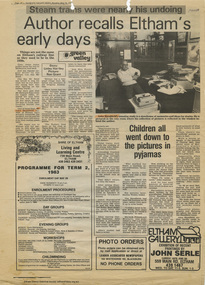
... News clipping: Author recalls Eltham's early days; story by Linley Hartley, photo by Ron Grant; Diamond Valley News, Thursday, May 24, 1983, p26 (On reverse side, p25, "A pot for every purpose" about potter Joan Armfield with references to artis Davd Armfield) 2. Three pages typed copy of John Handfield's original letter to Blanche Shallard (of the Shire of Eltham Historical Society), 16 May 1989 detailing the Handfield family's life in Eltham and various personalities between their arrival in 1919 and departure in 1928. ...News clipping: Author recalls Eltham's early days; story by Linley Hartley, photo by Ron Grant; Diamond Valley News, Thursday, May 24, 1983, p26 (On reverse side, p25, "A pot for every purpose" about potter Joan Armfield with references to artis Davd Armfield) 2. Three pages typed copy of John Handfield's original letter to Blanche Shallard (of the Shire of Eltham Historical Society), 16 May 1989 detailing the Handfield family's life in Eltham and various personalities between their arrival in 1919 and departure in 1928. ...1. News clipping: Author recalls Eltham's early days; story by Linley Hartley, photo by Ron Grant; Diamond Valley News, Thursday, May 24, 1983, p26 (On reverse side, p25, "A pot for every purpose" about potter Joan Armfield with references to artis Davd Armfield) 2. Three pages typed copy of John Handfield's original letter to Blanche Shallard (of the Shire of Eltham Historical Society), 16 May 1989 detailing the Handfield family's life in Eltham and various personalities between their arrival in 1919 and departure in 1928. With a postscript that John Handfield returned in 1961 to a house designed by friend Robin Boyd and built 1961. At the time of the letter John and Esta Handfield had been the only owners. 3. Note from John Handfield to Ron Smith about a proposed talk (to the Historical Society?) to tell the story about the writing of Friends and Brothers. Proposed title of talk "You Never Know What's Around The Corner" plus several copies of book reviews • Photocopy of news clipping; The rector who created a vision; Review by Bishop Holland; Newcastle Morning Herald, c.1980 - Book review of FRIENDS AND BROTHERS, The Life of Father Tucker, Founder of the Brotherhood of St Laurence and Community Aid Abroad, by John Handfield, Hyland House Publishing Pty Ltd • Photocopy of news clipping; The clergyman whose monuments continue to do good; Review by Geoffrey Hutton; Publication unknown, c.1980 - Book review of FRIENDS AND BROTHERS, The Life of Father Tucker, Founder of the Brotherhood of St Laurence and Community Aid Abroad, by John Handfield, Hyland House Publishing Pty Ltd • Photocopy of news clipping; Helper of the defeated; Review by Sandy Murray; Publication unknown, c.1980 - Book review of FRIENDS AND BROTHERS, The Life of Father Tucker, Founder of the Brotherhood of St Laurence and Community Aid Abroad, by John Handfield, Hyland House Publishing Pty Ltd • Photocopy of news clipping; Friends and Brothers by John Handfield; Review by Bishop James Grant; Publication unknown, c.1980 - Book review of FRIENDS AND BROTHERS, The Life of Father Tucker, Founder of the Brotherhood of St Laurence and Community Aid Abroad, by John Handfield, Hyland House Publishing Pty Ltd • Photocopy of news clipping; Off and running on his third career by Stuart Sayers; Writers & Readers, The Age, Saturday 17 January 1981 • Photocopy of news clipping; Determined to succeed; Review by Roy Cassin; The West Australian, n.d. - Book review of FRIENDS AND BROTHERS, The Life of Father Tucker, Founder of the Brotherhood of St Laurence and Community Aid Abroad, by John Handfield, Hyland House Publishing Pty LtdFolder of information on John Handfield, author, Elthamjohn handfield, joan armfield, david armfield, handfield family, eltham, 16 homestead road, handfield house, anne hunniford, dave lyon, esta handfield, mechanics insitute, mr bond, rechabite hall, robin boyd, rutter family, bishop reginald stephen, clem christesen, desmond annear, dr kent hughes, ethel boake, handfield street, john harcourt, kooringoorama, lady longstaff, nina christesen, peter street, shillinglaw farm, sir john longstaff, stanhope, yarra braes, a. copeland, alf baker, baker's cottage, ballakian, belackian, beulah alice rutter, bill withers, bird brothers cash grocer and fruiterer, blacksmith, burgoyne grocery store, butcher, david rutter, donald rutter, e. copeland, edward gadd, ernest james andrew, fanny withers (nee flinn), hubert rutter, jack baker, jack ryan, june rutter, margery withers, newsagency, oakley, ronnie baker, silver street bridge, tessie baker, walter withers, burke and wills, father g k tucker, frederick oliver handfield, friends and brothers (book), muriel elizabeth handfield (nee cochran), ss victoria, st laurence and community aid abroad, stanhope house, theodore louis hopton handfield, book review -
 Mission to Seafarers Victoria
Booklet - Manual, Sailing directions for Port Phillip, in the colony of Victoria including the ports of Melbourne and Geelong, 1854
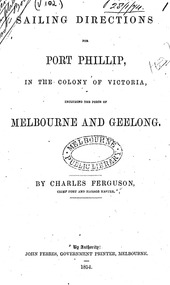
... early in December. However, certain misgivings in the mind of a medical gentleman, then in England, under whose care Captain Ferguson had at one time placed himself in Williamtown, led them to consider it judicious before departure to take the advice of some surgeon of eminence in London. ...early in December. However, certain misgivings in the mind of a medical gentleman, then in England, under whose care Captain Ferguson had at one time placed himself in Williamtown, led them to consider it judicious before departure to take the advice of some surgeon of eminence in London. ...Captain Charles Ferguson was born in Scotland in 1813. He was the Master of the "Rajah" from 1838 to 1850 on voyages from England to Australia and vice versa. He became the First Chief Harbour Master for the port of Melbourne in 1852 after being the first Harbour Master and Water Police Officer in Geelong for 12 months. On the 5th of April 1841, the Rajah sailed with James Donovan M.D. as Surgeon Superintendent, and the Rajah sailed from Woolwich with 180 female convicts. The Rajah arrived on the 19th of July in Hobart, with 179 females (one died during the voyage) and 10 children. Miss Kezia Elizabeth Hayter was the matron on board. On page 28 of the "Sailing directions for Port Phillip, in the colony of Victoria including the ports of Melbourne and Geelong", a mention is made of the Mariner's Hospital and Floating Church soon to be established. There were discussions to built the hospital in Williamstown but instead the Government decided to build it in Melbourne. The Harbour Master and a commiittee decided to use the water police hulk, Emily, left unsold in 1856, to create a floating church: the Bethel was open in July 1857 with Reverend Kerr Johnston as Chaplain. Latrobe wrote a letter to Captain Cole in 1869, a few months after learning his death : "To Captain George Ward Cole † [from a draft in another’s hand] Clapham House, Lewes, Sussex, January 28th, 1869. My dear Captain Cole, Last mail will have taken out the sad intelligence of the death of our excellent old friend, Captain Ferguson. This will have been a terrible blow to his children and to his friends in the colony, who may have held reason to expect his early return to his home, with a not unreasonable prospect of ultimate restoration to health and activity. In the course of last October I went up to town with one of my children, mainly with the purpose of finding my way to Pinner, where he and Mrs. Ferguson were staying with an intimate friend. I found him in excellent health and spirits, and enjoying the prospect of a speeding resumption of the service to which he had devoted his best days, and upon the furtherance of which his entire energy was still directed. A week or two later Captain and Mrs. Ferguson went to Dover for change of air, and being still under the impression received from the advisers by whom they had been guided during their residence at a hydropathic establishment at Matlock, felt encouraged to plan almost immediate return to the colony by the Jerusalem early in December. However, certain misgivings in the mind of a medical gentleman, then in England, under whose care Captain Ferguson had at one time placed himself in Williamtown, led them to consider it judicious before departure to take the advice of some surgeon of eminence in London. Accordingly they came up to town at the close of November. The first London practitioners they consulted shook their heads, and advised consultation with Sir Wm. Ferguson. The result was that amputation, without loss of time, was pronounced necessary. The rest is soon told. He received the painful intelligence with calmness and full resignation to God's will, and underwent the operation at King's College Hospital with exemplary firmness and Courage on the 28th of November. Perfect success seemingly attended it, and there seemed, humanly speaking, to be every prospect of a prompt cure and early convalescence; everything seemed in his favour. A few days later, however, all was clouded by symptoms of hospital fever (pyoe æm ia). This resisted all control, and finally carried him off on the 27th of December, just one month after the operation. He had lived a Christian life, and his death was the peaceful and resigned death of a Christian. It was a melancholy satisfaction to me to be able to join a few friends in following his remains to their resting place in one of the outlying London cemeteries on the last day of the year. You know Mrs Ferguson well, and will be prepared to hear me say that her whole conduct and demeanour throughout this period of suspense and bitter trial has been worthy of her high character and steadfast principle. Come what will, and happen what may, I have the fullest conviction that neither the widow nor the children will be forsaken, however doubtful and clouded the future may appear, in consequence of the irreparable loss which, they have sustained. And now, dear Captain Cole, it is possible that you may already have heard all this from other sources, but I have dictated it to you under strong impulse, for I feel assured that there is no member of the community in which you live who will more sincerely deplore the loss of Captain Ferguson on private grounds; at the same time that there is no one who, from long acquaintance with his official character and services, will be in a better position to estimate their real value or the loss which the colony has sustained. The circumstances in which Captain Ferguson's family are left not only demands the utmost display of sympathy and interest on the part of friends, but may call for decided and prompt action; therefore I cannot rest satisfied without discharging what I consider my duty, and seeking to strengthen your hands as far as I may in bringing the character of his long services before the existing colonial authorities. Of his private career previous to his entering the service of the Colonial Government in 1851 nothing need be said. Captain Ferguson was appointed as the Harbour Master at Geelong in April, 1851 – a few months before the separation of the colony from New South Wales. He there did excellent service in a variety of ways calculated to advance the interests of the port, and to introduce www.latrobesociety.org.au 27 order, where, from circumstances, but little order had hitherto prevailed. His was the first appointment of this class in that locality. The separation of the colony from New South Wales took place in the month of July following. Shortly after, the late Captain Bunbury resigned the Harbour Mastership of Port Phillip. Captain Ferguson was at once (February, 1852) appointed to succeed him, and from that time performed all duties of Chief Harbour Master of the colony. The previous year (May 1851) the first gold discoveries in New South Wales had taken place, and in the month of August those of our colony followed. At the time of Captain Ferguson’s taking charge of the Port of Melbourne their influence had begun to be fully felt, and in no department more seriously than in that of the Harbour Master. This is no place for statistical details, but they must bear me out in reminding you of a few facts connected with our late friend’s career. At the time of separation that department comprised only 30 individuals of all ranks, and when he took charge the number was much reduced. There were at that time, according to the returns, no fewer than 54 vessels, registering 26,785 tons, in Hobson’s Bay alone. The crews on arrival numbered 1,235 men. Of this number only 463 remained on board, 500 having deserted, and the rest having been discharged by arrangement or pure necessity. For the first six months after Captain Ferguson’s assumption of office as Harbour Master the duties of Police Magistrate and Chief of the Water Police were superadded, and how much labour they involved may be surmised from the fact that from 1st of April to the 31st July, 1852, four months only, no less than 236 marine cases were brought before the bench at Williamstown - sometimes as many as 30 in a day. A year later (March 1853) the returns show that the number of vessels in the harbour in Hobson’s Bay alone were 91, tonnage 43,754; and passing on to the still later returns of May, 1853, two years after Captain Ferguson’s assumption of office, we find from the records that the number of ships in port had increased to 129; tonnage, 63,292; crew on board on arrival, 2872, and at the date of report, 1628; the amount of desertions at that time having, however, proportionally diminished, in consequence of the abatement of the gold fever, caused by the non-success attendant upon the labours of thousands at the goldfields. The above numbers take no account of the large number of vessels and amount of tonnage lying at the wharves at Melbourne or elsewhere. From these figures alone it may be judged what must have been a struggle in which the Chief Harbour Master was engaged from the very outset to secure order, and answer the innumerable calls on every branch of his department, at the same time that there was for many months an almost complete impossibility of securing subordinate agency, such as boatmen, pilots, and police, at any price. But I may bear witness to the untiring diligence, energy, and self-devotion with which Captain Ferguson grappled with the difficulties of his position, and the seemingly insurmountable obstacles which stood in his way. Ashore and afloat he was always ready, showing the same directness of purpose, intelligence, and forgetfulness of self. He shunned no responsibility, and turned his hand from no work, whether within or beyond the ordinary scope of his duty, which the hard necessity of the times forced the Government to bring under his notice. Already in 1852, when the overflowing of our gaol and stockade rendered the adoption of other methods of restraint absolutely necessary, and addition to the existing buildings could not be thought of, it was Captain Ferguson who first suggested the employment of hulks; and it was with his personal assistance and supervision, and under his unflagging energy, that the three first of these – the Success, the President, and the Sacramento – were purchased, fitted up, and made available for the purpose in view, and the rules and regulations for the employment and safety of the men afloat and ashore prescribed and carried out. He carried the same energy into every branch of his department, and his influence was soon apparent. His subordinates of every class became actuated by his spirit. As time moved on, the range of his duties, both ordinary and extraordinary, increased. In the formation of the quarantine station at the heads, in the management if not the erection of lighthouses, sailing directions, port and wharf regulations, buoys, signal stations, www.latrobesociety.org.au 28 steam dredging &c., he was the main and most active agent. The whole pilot establishment and regulations, men, and vessels, were under his charge; and when I left the colony in May, 1854, the entire range of ports outside Port Phillip Heads from Point Lonsdale to Portland, as well as that of Geelong had felt the influence of his intelligent supervision and care. The entire department of Chief Harbour Master, which I have numbered at the period of separation about thirty individuals, then numbered 230. The character of Captain Ferguson’s unbroken service during the fourteen years which have elapsed since I left the colony must be well known to the Government and the people he has served so long and so faithfully. I confine myself to recalling to mind those earlier, and what must have been the hardest and most difficult, period – none can know how difficult but those who were in that fierce struggle for the maintenance of order under so many disadvantages; and on this subject I have spoken advisedly and with reason, for I may truly say he worked under my own eye. I had sincere regard for the man, and just pride in the qualities of his heart, head, and hand. Whatever mistakes may have been made by the Government of the colony in those hard and difficult times (and I am quite ready to admit that there were many, especially if the past is to be judged by the light of the present), I never have hesitated in believing that, in appointing Captain Ferguson to the office he has so long filled, it was the right man in the right place. I shall be heartily rejoiced to find that the Government and inhabitants of the colony admit that this has been the case, and to learn that they have not forgotten the strong claims of one who has served them so long and so faithfully, and who, removed by God’s providence, so to say, in the maturity of his powers, has left a widow and young family behind him. I have done, I leave you to make use of this communication, or any portion of it, which you may think judicious and called for. There may be among Ferguson’s friends those who may not be sorry to be reminded of facts. By-the-bye, I may mention as a proof how completely Captain Ferguson’s mind was engrossed by devotion to his public duty, that while in Dover, only ten days before the operation, he took an opportunity to drag himself up into the lantern of the S. Foreland Lighthouse, and made a most careful scrutiny of the whole apparatus and arrangement, with a view of the adoption of any hint for the perfection of those under his charge in the colony. And now, goodbye. I trust this will find you in good health, and in comparative vigour. Believe me ever, dear Captain Cole, Yours very truly, C. J. La Trobe"The attempt for a floating church was made as early as 1853 following similar examples in London like the Seamen's Hospital. Captain Ferguson was instrumental in the foundation of the Bethel Church.Digital copies of the 37 pages ; 22 cm.1854, hobsons bay, geelong, melbourne, williamstown, sandridge, mariner's hospital, floating church, seamen's hospital, captain charles ferguson (1813-1868), kezia elizabeth hayter (1818-1885), rajah quilt, prison hulks, water police, harbour master, harbor master, gaols -
 Mission to Seafarers Victoria
Painting, Robert Klein-Boonschate, Departure 7, 2003
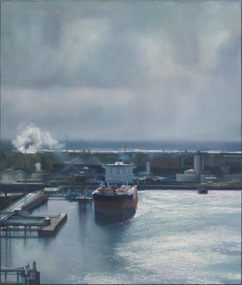
... Robert Klein-Boonschate is an early entrant to the Mission to Seafarers annual Maritime Art Prize which started in 2003. docks waterside maritime art Robert Klein-Boonschate artwork-paintings maritime art prize anl Large scale Oil on Belgian Linen depicting dockside and ships. Departure ...Finalist Robert Klein-Boonschate in the ANL Maritime Art Prize 2003 Biography: (https://www.artpartners.com.au/robert-kleinboonschate/) Born in The Netherlands, Robert migrated to Tallangatta, Australia with his family in 1971. Robert completed a degree in Graphic Art at Swinburne College and settled into Melbourne for the next seven years as a professional artist and art facilitator. Robert moved to Mparntwe (Alice Springs) in the 1980’s where he worked closely with Arrernte Peoples for the next 12 years. Robert’s beautiful landscapes reflect the influence of Arrernte artist Albert Namatjira and his love of the Australian landscape reflects his experiences with the Arrernte Peoples and their connection to ‘Country’. Robert opened the art studio located at his home in Alice Springs to Arrernte, Luritja, Warlpiri & Pintupi artists and worked alongside such artists as Johnny Warrangkula Tjupurrula. Robert helped to facilitate Johnny’s later body of work by constructing special brushes which could be used by Johnny after breaking his wrist. Robert has returned to NSW and now lives in Walla Walla surrounded by the rugged natural landscapes of Australia.Large scale Oil on Belgian Linen depicting dockside and ships.docks, waterside, maritime art, robert klein-boonschate, artwork-paintings, maritime art prize, anl -
 Eltham District Historical Society Inc
Photograph, The Australasian, Eltham - A series of four scenes of the local district, 2 May 1903
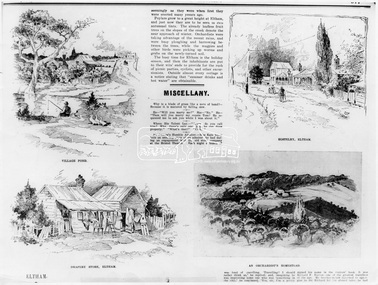
... early settlement. Prior to June last year one had to journey by coach from Heidelberg to Eltham, but now the railway conveys passengers through from Melbourne to Eltham, first-class return, for 1/9. The opening of this extension to Eltham was the last ceremony performed by Lord Hopetoun, on June 5, 1902, prior to his departure from Australia. ...early settlement. Prior to June last year one had to journey by coach from Heidelberg to Eltham, but now the railway conveys passengers through from Melbourne to Eltham, first-class return, for 1/9. The opening of this extension to Eltham was the last ceremony performed by Lord Hopetoun, on June 5, 1902, prior to his departure from Australia. ...Australasian (Melbourne, Vic. : 1864 - 1946), Saturday 2 May 1903, page 25 ________________________________________ ELTHAM A POPULAR HOLIDAY SPOT. By L.J.J. The village of Eltham, with its 377 in habitants, is prettily situated on Diamond Creek, a tributary of the Yarra, 16 miles from Melbourne. Yet, in spite of it being so easily accessible from town, few people are aware of the beauties of this early settlement. Prior to June last year one had to journey by coach from Heidelberg to Eltham, but now the railway conveys passengers through from Melbourne to Eltham, first-class return, for 1/9. The opening of this extension to Eltham was the last ceremony performed by Lord Hopetoun, on June 5, 1902, prior to his departure from Australia. Sauntering through the township one autumn morning recently I was constantly reminded of scenes characteristic of Surrey or Sussex villages. There is the village pond (so essentially English), reflecting in its clear water a quaint cottage, dwarfed by a huge gum tree, an old smithy, and a hostelry, built quite fifty years ago, the flooring-boards of which the landlord informed me with pride were of Singapore cedar, and quite fit for another fifty years' wear. Then there are the village school, the shoemaker's, the drapery store, and the butcher's shop, all seemingly as they were when first they were erected many years ago. Poplars grow to a great height at Eltham, and just now they are to be seen in rich autumnal tints. The already leafless fruit trees on the slopes of the creek denote the near approach of winter. Orchardists were taking advantage of the recent rains, and were busy ploughing and harrowing between the trees, while the magpies and other birds were picking up worms and grubs on the newly-turned soil. The busy time for Eltham is the holiday season, and then the inhabitants are put to their wits' ends to provide for the rush of picnic parties, cyclists, and other excursionists. Outside almost every cottage is a notice stating that "summer drinks and hot water" are obtainable. Sketches illustrating the article: VILLAGE POND. DRAPERY STORE, ELTHAM. ON DIAMOND CREEK. HOSTELRY, ELTHAM. AN ORCHADIST'S HOMESTEAD. ON THE HEIDELBERG-ROAD IN AND AROUND ELTHAM.This photo forms part of a collection of photographs gathered by the Shire of Eltham for their centenary project book,"Pioneers and Painters: 100 years of the Shire of Eltham" by Alan Marshall (1971). The collection of over 500 images is held in partnership between Eltham District Historical Society and Yarra Plenty Regional Library (Eltham Library) and is now formally known as the 'The Shire of Eltham Pioneers Photograph Collection.' It is significant in being the first community sourced collection representing the places and people of the Shire's first one hundred years.Digital image Print B&W 20 x 25 cmsepp, shire of eltham pioneers photograph collection, drapery store, hostelery, orchardist's homestead, village pond, eltham, dalton street, evelyn hotel, hostelry, jarrold cottage, john street, main road, maria street, white cloud cottage -
 Queenscliffe Maritime Museum
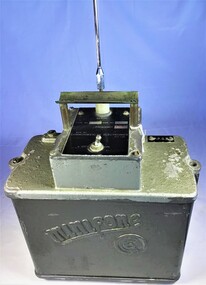
Equipment - Telephone, Radio Receiver and Transmitter, Commonwealth Electronics Pty Ltd
... An early model used from about 1956 for ship-to-ship and ship-to-shore communication during arrival and departure procedures....An early model used from about 1956 for ship-to-ship and ship-to-shore communication during arrival and departure procedures. ...A portable radio receiver and VHF transmitter used by the Sea Pilot Service. An early model used from about 1956 for ship-to-ship and ship-to-shore communication during arrival and departure procedures.Used by the Port Phillip Pilot service in the 1950sMiniphone radio receiver / transmitter and carry bag MFD by Commonwealth Electronics Pty Ltd Type No 180TRN Serial No 184communication, radio receiver and transmitter -
 Flagstaff Hill Maritime Museum and Village
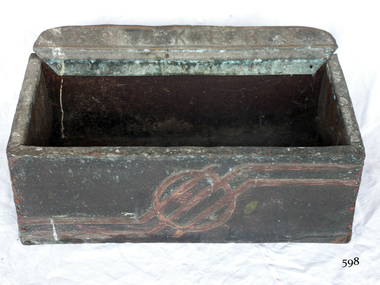
Functional object - Floor ash Tray, 1900 to 1960s
... As more women began to smoke. in the early 1900s, the ashtray went closer to being an art form as many women avoided the use of the traditional ashtray as it failed to reflect their feminine values, regarded as an item rather basic in design the general societal through of the time was that smoking was an activity exclusive to men. What emerged were detailed, often very fancy ashtrays acceptable to women depicting either pastoral scenes or vibrantly coloured landscapes. As time went on, and the onset of women smoking both cigars and cigarettes became less of a departure...As more women began to smoke. in the early 1900s, the ashtray went closer to being an art form as many women avoided the use of the traditional ashtray as it failed to reflect their feminine values, regarded as an item rather basic in design the general societal through of the time was that smoking was an activity exclusive to men. What emerged were detailed, often very fancy ashtrays acceptable to women depicting either pastoral scenes or vibrantly coloured landscapes. As time went on, and the onset of women smoking both cigars and cigarettes became less of a departure ...The word ashtray came into use around the 1920 and is a receptacle for ash from cigarettes and cigars and are typically made of fire retardant material such as glass, heat resistant plastic, pottery, metal, or stone. The most common ashtray design is a shallow cylinder with a flat base, designed to rest on a table. Other ashtrays, particularly in public places, are either wall or floor mounted. While simple, utilitarian forms of ashtrays existed long before the 19th century, it was during the start of the 20th century that the design, aesthetics and their popularity took off. As more women began to smoke. in the early 1900s, the ashtray went closer to being an art form as many women avoided the use of the traditional ashtray as it failed to reflect their feminine values, regarded as an item rather basic in design the general societal through of the time was that smoking was an activity exclusive to men. What emerged were detailed, often very fancy ashtrays acceptable to women depicting either pastoral scenes or vibrantly coloured landscapes. As time went on, and the onset of women smoking both cigars and cigarettes became less of a departure from the average person, ashtrays saw a decline in design and aesthetics beginning more of a shift towards practicality. The subject item is a primitive form of ashtray used in public spaces any time from the 1900 -1960s and is not associated with an historic person or event. However the item could have come from the Warrnambool Town Hall given the inscription on the base of the item.Ash tray-large rectangular floor model made from a wooden box covered with textured metal on the outsideThe metal has a relief design embossed at the top back "smokers" and "Town Hall" printed on bottom.flagstaff hill, warrnambool, flagstaff-hill-maritime-museum, maritime-museum, shipwreck-coast, flagstaff-hill-maritime-village, ash tray -
 Australian National Surfing Museum
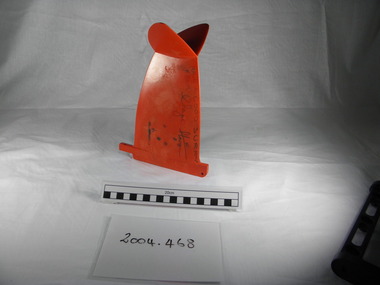
Fin, Circa 1984
... This fin design represents a radical departure from surfboard design thinking at that time (early 1980s) Most people were concentrating on multi fin designs Mark Richards with high performance twin fin designs, then Simon Anderson's 3 fin 'Thruster' design. ...An example of the innovative winged keel design based on the Australia 2 yacht (Americas Cup winner 1982). The Star Fin was a collaboration between Australian pro surfer, Cheyne Horan, and Australia 2 fin designer Ben Lexcen. Horan won 1984 Bells Beach surfing festival riding a board using this fin design. This fin design represents a radical departure from surfboard design thinking at that time (early 1980s) Most people were concentrating on multi fin designs Mark Richards with high performance twin fin designs, then Simon Anderson's 3 fin 'Thruster' design. Cheyne Horan employed the talents of innovative yachting designer Ben Lexcen (who designed the Americas Cup winning Australia 2) to design a unique Star Fin which would provide greater hold for a single fin at critical angles. Horan proved the effectiveness of this design by winning the 1984 Rip Curl Pro at Bells beach using a board mounted with one of the Star Fins. The Star fin represents an unusual (for surfing)scientific and innovative design approach. This is a rare and representative item signed by design instigator Cheyne Horan.Cheyne Horan Star Fin. Moulded polycarbonate red Star Fin. Fin is signed by Cheyne Horan with "HAVE A GOOD SURF FROM Cheyne Horan". Manufacturers and makers information embossed on base. Concept by Cheyne Horan Design by Ben Lexcen Patent Pending STAR FIN Made from Lexan Polycarbonate by Star Fin p/l PO Box 1293 Nth Syd Aust.red, star fin, cheyne horan, ben lexcen, winged keel, bells beach surf contest 1984 -
 City of Moorabbin Historical Society (Operating the Box Cottage Museum)
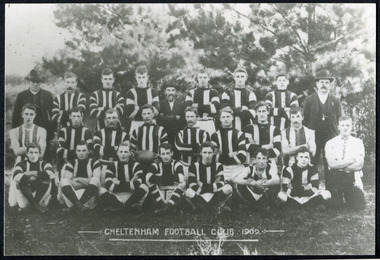
Photographs, x 3 Black & White Cheltenham Football Club 1909,1913, 1946, 20thC
... Known as the Rosellas, the early Cheltenham Football Club sides began playing on a regular basis in 1890, and would travel long distances by steam train to play country teams, such as Ballarat where they would arrive at their destination, play the match, socialize then return to the station. Opposition players and supporters would give three hearty cheers on their departure...City of Moorabbin Historical Society (Operating the Box Cottage Museum) Joyce Park Jasper Road Ormond melbourne Known as the Rosellas, the early Cheltenham Football Club sides began playing on a regular basis in 1890, and would travel long distances by steam train to play country teams, such as Ballarat where they would arrive at their destination, play the match, socialize then return to the station. Opposition players and supporters would give three hearty cheers on their departure ...Known as the Rosellas, the early Cheltenham Football Club sides began playing on a regular basis in 1890, and would travel long distances by steam train to play country teams, such as Ballarat where they would arrive at their destination, play the match, socialize then return to the station. Opposition players and supporters would give three hearty cheers on their departure. The Cheltenham home games were played on a paddock on the corner of Park and Charman roads in Cheltenham. In 1907 the Cheltenham progress committee made an application to the board of land works for land in Weatherall Road for recreational service to the public. That application was received and granted, then developed where Cheltenham Recreational Reserve now stands. The land in the early days was virgin bush and the response for voluntary help to clear the area was outstanding. Nearly all the market gardeners in the district along with horses, ploughs, axes, shovels completely cleared the area in three weeks. The Moorabbin council then leveled the playing area and erected a post and rail fence around the ground. Pine tree shrubs were then planted on the west side of the ground. The ground was opened in 1909 and the first Cheltenham side entered in the newly formed Federal Football Association along with seven other foundation members, Mordialloc, Mentone, Moorabbin, Frankston, Glenhuntly, Elsternwick, and Ellindale. The grand final for that year, 1909 was a hard encounter between Cheltenham and Ellindale with Cheltenham coming out victors, thus becoming the inaugural Federal Football Association premiers. Cheltenham went onto win five senior premierships in the Federal Football Association by the end of the 1920s, they won the flags in 1909, 1911, 1913, 1922 and 1925, with the late Percy Woff playing in all 5 premiership sides and was captain in 1922. 1928 saw the start of an outstanding career from our oldest living player Tom Connor. Cheltenham continued to win premierships in the 1920’s and 1930’s with juniors taking out the 1929 and 1933 flags, under the guidance of Woff, and that continued in 1934 when Cheltenham took out the 1st XVIII and 2nd XVIII premierships. Cheltenham produced its only Brownlow medallist in Peter Box who played in the late 1940s, before going to Footscray where he became a champion. The 3rd XVIII went through the season undefeated in 1974 winning the premiership, with Trevor Barker a key player before going to St Kilda the following year. The club won three senior premierships under coach Barry White in 1992, 1993 and 1995. ( from CFNC website 2019) Cheltenham Football Club was formed 1890 and succeeded in winning many Premierships as a member of the Federal Football Association, Outstanding players Peter Box Brownlow Medalist 1956 Footscay VFL, , Trevor Barker and Kevin Roberts St Kilda VFL.3x Black & White photographs of the players in the Australian Rules Cheltenham Football Club 1909, 1913 and 1946 extra photo of Peter Box Folio 10 MAV 01059a) CHELTENHAM FOOTBALL CLUB 1909 Cheltenham Football Club 1909. Back row: A Chandler, committee member; R. Robertson, back-pocket; J. Harris, half back flank; J Adams, ruck and forward-pocked; M. J. Monk, club president; L. Woff, back-pocket; W. Adams, ruck and back-pocket; P. Woff, rover and forward-pocket; A Monk, committee member. Middle row: W. Hore, back pocket and ruck; A. Towns, half-forward flank; W. Carson, full back; F. Andrews, captain-half forward flank; H. Butler, centre half back; J. Warburton, centre half-forward; A. Slater, half-back flank; F. Fisher, half-forward flank; C. Sherwood, trainer. Front Row: G Gouldthorpe, wing; H. King, full-forward; W. Johnston, ruck and forward-pocket; P Spears, rover and forward-pocket; F. Bichl, wing; A. Bichl. rover and forward-pocket; F. Butler, centre player. Courtesy, Lionel Seal. ( from CFC website 2019) b) CHELTENHAM 1913 PREMIERS c) CHELTENHAM -1946 / Back row - J. Fisher, G.Corrigan, N.Hocking, F.Virtue, R.Craven, L.Baker, M.Blundell / 2nd Row - J.Phillips, T.Connor, E.Hawkins, A.Blakely, G.Baker, A.Dark, J.Barker, D.Craven, J.Pickering, P.Cameron,/ W.Hicks, G.Hoskings, R.Beihl, A.Hubbard, R.Kier, C.Russell. / Front Row - Clark Taylor, J.Slade, N.Niel, J.Brooks, T,Butler, H.Hosking, C.Hacusler, E.Hornibrook, W.Briggs, B.Russell, L.Biehl, / W Ripponcheltenham football club, australian rules football, victorian football association, victorian football league, smith j l; smith mary ann, stanley helen, , chaff cutter, horse drawn carts, toll gates brighton, motor cars 1900, steam engines, early settlers, bentleigh, parish of moorabbin, city of moorabbin, county of bourke, moorabbin roads board, shire of moorabbin, henry dendy's special survey 1841, were j.b.; bent thomas, o'shannassy john, king richard, charman stephen, highett william, ormond francis, maynard dennis, market gardeners, vineyards, orchards, cheltenham, two acre village, holloway josiah,, woff percy, connor tom, box peter, barker trevor, white barry, browlow charles, -
 City of Moorabbin Historical Society (Operating the Box Cottage Museum)
Containers, small tin wedding cake, 20thC
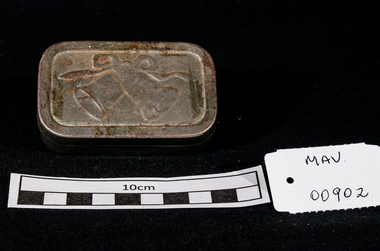
... departure from the reception. . Some customs suggest single women will find a husband if they put this piece of cake under their pillow at night. --- the man of their dreams will come calling …..! weddings early ...It was and still is customary for a piece of Wedding Cake to be given to the guests on their departure from the reception. . Some customs suggest single women will find a husband if they put this piece of cake under their pillow at night. --- the man of their dreams will come calling …..!A small tin with a lift -off lid for a piece of Wedding Cake traditionally given to guests at the reception as a take home gift .2 wedding bells engraved on lidweddings, early settlers, tinsmiths, moorabbin, bentleigh, cheltenham, celebrations, souvenirs -
 Flagstaff Hill Maritime Museum and Village
Functional object - Floor ash Tray, 1900 to 1960s
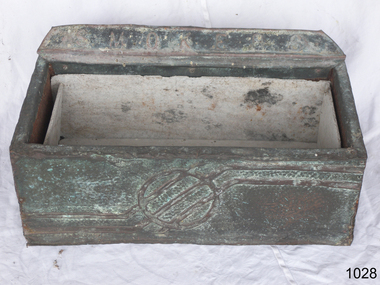
... As more women began to smoke. in the early 1900s, the ashtray went closer to being an art form as many women avoided the use of the traditional ashtray as it failed to reflect their feminine values, regarded as an item rather basic in design the general societal through of the time was that smoking was an activity exclusive to men. What emerged were detailed, often very fancy ashtrays acceptable to women depicting either pastoral scenes or vibrantly coloured landscapes. As time went on, and the onset of women smoking both cigars and cigarettes became less of a departure...As more women began to smoke. in the early 1900s, the ashtray went closer to being an art form as many women avoided the use of the traditional ashtray as it failed to reflect their feminine values, regarded as an item rather basic in design the general societal through of the time was that smoking was an activity exclusive to men. What emerged were detailed, often very fancy ashtrays acceptable to women depicting either pastoral scenes or vibrantly coloured landscapes. As time went on, and the onset of women smoking both cigars and cigarettes became less of a departure ...The word ashtray came into use around the 1920 and is a receptacle for ash from cigarettes and cigars and are typically made of fire retardant material such as glass, heat resistant plastic, pottery, metal, or stone. The most common ashtray design is a shallow cylinder with a flat base, designed to rest on a table. Other ashtrays, particularly in public places, are either wall or floor mounted. While simple, utilitarian forms of ashtrays existed long before the 19th century, it was during the start of the 20th century that the design, aesthetics and their popularity took off. As more women began to smoke. in the early 1900s, the ashtray went closer to being an art form as many women avoided the use of the traditional ashtray as it failed to reflect their feminine values, regarded as an item rather basic in design the general societal through of the time was that smoking was an activity exclusive to men. What emerged were detailed, often very fancy ashtrays acceptable to women depicting either pastoral scenes or vibrantly coloured landscapes. As time went on, and the onset of women smoking both cigars and cigarettes became less of a departure from the average person, ashtrays saw a decline in design and aesthetics beginning more of a shift towards practicality. The subject item is a primitive form of ashtray used in public spaces any time from the 1920-1960s and is not associated with an historic person or event. However the item could have come from the Warrnambool Town Hall given the inscription on the base of the item.Ash tray-large rectangular floor model with cement sheet lining. Made from a wooden box covered with textured metal on the outsideThe metal has a relief design embossed at the top back "smokers" and "Town Hall" printed on bottom.flagstaff hill, warrnambool, flagstaff-hill-maritime-museum, maritime-museum, shipwreck-coast, flagstaff-hill-maritime-village, ash tray, town hall, cigarette tray, smoker's ash tray -
 Narre Warren and District Family History Group
Book, Alfred Joyce, A homestead history : being the reminiscences and letters of Alfred Joyce of Plaistow and Norwood, Port Phillip, 1843 to 1864, 1969
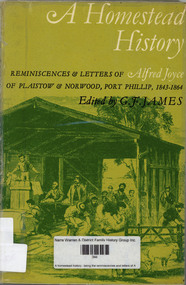
... early in 1844. His reminiscences reveal events of the venture, from the departure from Melbourne with the completion of a roomy homestead, from the threat of bankruptcy, to substantial success within a decade. ...A HOMESTEAD HISTORY Alfred Joyce began a pastoral partnership with his brother in the Upper Loddon early in 1844. His reminiscences reveal events of the venture, from the departure from Melbourne with the completion of a roomy homestead, from the threat of bankruptcy, to substantial success within a decade. In writing them, he was not dependent upon his memories; the many letters he had written to his parents in London had eventually been returned to him, and those written between 1851 and his mother's death in 1858 form a continuation of his own narrative. They describe in vivid detail the upheavals that followed the discovery of gold, the transformation of both town and country, the dissolution of the Joyce brothers' partnership, and Alfred's activities as pastoralist, farmer and miller at Norwood on die Bet Bet Creek. In this third edition, for which a much wider range of illustrations is available, an epilogue continues the story of George Joyce at Plaistow and Alfred Joyce at Norwood until both properties had passed into other hands. Domestic tragedy overwhelmed the one, while droughts and mortgages eventually ruined the other. It is a record which, in the words of the American Historical Review, 'would serve as script for a first-class documentary film and deserves high rank, in the literature of pastoral pioneering'. Other reviewers have been equally emphatic: 'The real history of Australia is written very largely in such records as this' (Australian Quarterly); 'of historical documents such as diese we cannot have too many' (Sydney Morning Herald). (back cover)non-fictionA HOMESTEAD HISTORY Alfred Joyce began a pastoral partnership with his brother in the Upper Loddon early in 1844. His reminiscences reveal events of the venture, from the departure from Melbourne with the completion of a roomy homestead, from the threat of bankruptcy, to substantial success within a decade. In writing them, he was not dependent upon his memories; the many letters he had written to his parents in London had eventually been returned to him, and those written between 1851 and his mother's death in 1858 form a continuation of his own narrative. They describe in vivid detail the upheavals that followed the discovery of gold, the transformation of both town and country, the dissolution of the Joyce brothers' partnership, and Alfred's activities as pastoralist, farmer and miller at Norwood on die Bet Bet Creek. In this third edition, for which a much wider range of illustrations is available, an epilogue continues the story of George Joyce at Plaistow and Alfred Joyce at Norwood until both properties had passed into other hands. Domestic tragedy overwhelmed the one, while droughts and mortgages eventually ruined the other. It is a record which, in the words of the American Historical Review, 'would serve as script for a first-class documentary film and deserves high rank, in the literature of pastoral pioneering'. Other reviewers have been equally emphatic: 'The real history of Australia is written very largely in such records as this' (Australian Quarterly); 'of historical documents such as diese we cannot have too many' (Sydney Morning Herald). (back cover)alfred joyce, upper loddon -
 Ballarat Tramway Museum
Photograph - Trams 30, 31 and 32 Ballarat North Power Station yard, Norm Cross, Oct. 1971
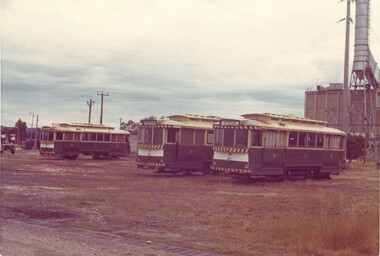
... early Oct. 1971. Has the Power station in the background. Dates based on the arrival of the trams from the SEC Ballarat depot by 6/10/71 and the departure of No. 31 for Perth on 11/10/1971....early Oct. 1971. Has the Power station in the background. Dates based on the arrival of the trams from the SEC Ballarat depot by 6/10/71 and the departure of No. 31 for Perth on 11/10/1971. ...Photograph taken of former SECV Ballarat trams 30, 31 and 32 stored in the yard at Ballarat B Power station yard following the closure of the system. Photo taken early Oct. 1971. Has the Power station in the background. Dates based on the arrival of the trams from the SEC Ballarat depot by 6/10/71 and the departure of No. 31 for Perth on 11/10/1971.Yields information about the three trams that were stored at Ballarat B Power station yard following the closure of the Ballarat system,Colour photograph with a plain back.tram disposal, ballarat b power station, tram 30, tram 31, tram 32, sale of trams -
 Whitehorse Historical Society Inc.
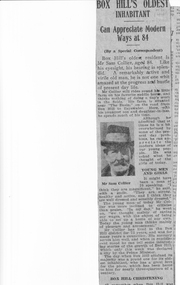
Article, Box Hill's oldest inhabitant, 1/06/1927 12:00:00 AM
... An interview with Mr Sam Collier, then Box Hill's oldest resident and his memories of early days. Included are the naming of Box Hill and the departure of the first train from Melbourne to Sandridge....early days. Included are the naming of Box Hill and the departure of the first train from Melbourne to Sandridge. ...An interview with Mr Sam CollierAn interview with Mr Sam Collier, then Box Hill's oldest resident and his memories of early days. Included are the naming of Box Hill and the departure of the first train from Melbourne to Sandridge.An interview with Mr Sam Collierellingworth, william, sutton, r, clisby, (school teacher), collier, samuel, box hill -
 Kew Historical Society Inc
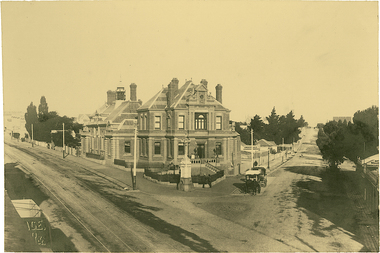
Photograph, J F C Farquhar, The Post Office, 1891
... The complex is important because it demonstrates a departure from the contemporaneously favoured High Victorian Classical to the Queen Anne style in the design of civic buildings. The earlier...The complex is important because it demonstrates a departure from the contemporaneously favoured High Victorian Classical to the Queen Anne style in the design of civic buildings. The earlier ...At the beginning of the 1890s, the Kew businessman and Town Councillor, Henry Kellett, commissioned J.F.C. Farquhar to photograph scenes of Kew. These scenes included panoramas as well as pastoral scenes. The resulting set of twelve photographs was assembled in an album, Kew Where We Live, from which customers could select images for purchase.The preamble to the album describes that the photographs used the ‘argentic bromide’ process, now more commonly known as the gelatine silver process. This form of dry plate photography allowed for the negatives to be kept for weeks before processing, hence its value in landscape photography. The resulting images were considered to be finely grained and everlasting. Evidence of the success of Henry Kellett’s venture can be seen today, in that some of the photographs are held in national collections.It is believed that the Kew Historical Society’s copy of the Kellett album is unique and that the photographs in the book were the first copies taken from the original plates. It is the first and most important series of images produced about Kew. The individual images have proved essential in identifying buildings and places of heritage value in the district.A panoramic photograph of the junction of High Street and Cotham Road. The photographer centres the point-of-view on the Kew Post Office and adjacent Court House. These were designed in the Queen Anne style by the Public Works Department's architect J Harvey and completed in 1888. The complex is important because it demonstrates a departure from the contemporaneously favoured High Victorian Classical to the Queen Anne style in the design of civic buildings. The earlier Jubilee Fountain in front of the Post Office was erected by the Kew Borough Council to commemorate the Golden Jubilee of Queen Victoria in 1887. It was created to a design of the architects Reed, Henderson and Smart. The fountain was later relocated to the Alexandra Gardens to make way for the Kew War Memorial. The tram tracks in High Street were used by the horse tram, which ran from the Victoria Street Bridge to the Boroondara General Cemetery. The tram was replaced by an electrified service in 1915.The Post Officekew post office, kew illustrated, kew where we live, photographic books, henry kellett -
 Kew Historical Society Inc
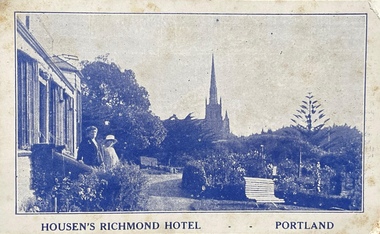
Postcard, Housen's Richmond Hotel | Portland
... departure from Portland in 1869. Though Edward Henty's first house was demolished in 1840, to make room for the new surveyed town streets, part of his wool store remains in the Hotel grounds, and is used as a wood shed. This is about the oldest building in the State : in it was held the first christening service in Portland on September 26th, 1841. On the site of the Richmond Hotel all the early...departure from Portland in 1869. Though Edward Henty's first house was demolished in 1840, to make room for the new surveyed town streets, part of his wool store remains in the Hotel grounds, and is used as a wood shed. This is about the oldest building in the State : in it was held the first christening service in Portland on September 26th, 1841. On the site of the Richmond Hotel all the early ...Many of the Henty's of the Western District of Victoria also owned houses in Kew, Victoria. Stephen Henty, referred to on the reverse of the postcard, lived while a member of the Vitoria Parliament at 'Findon' in Kew. Kew Historical Society also holds a nationally significant collection of costumes belonging to three generations of Henty women.Monochrome, blue tinted 'real photo' postcard of Housen's Richmond Hotel, Portland. Two women stand on the steps of the hotel at left, with the rose garden in front of them. Behind them is a church spire. The hotel and its significance is outlined in two columns of blue coloured text on the reverse.Printed reverse: "THE RICHMOND is the most historical building in the State. On the site of today's building Edward Henty, the founder of permanent settlement in Victoria, commenced his first house February 19, 1835, finishing the work in two months. He had landed in Portland on Nov. 19th, 1834, and turned the first plough furrows in Victoria where the Hotel now stands on the 26th of the following month. It was also here that Major Mitchell ended his explorations from Sydney, meeting the Hentys on August 29th, 1836. In December of the same year Mrs S. G. Henty joined her husband, their son Richmond, the first male white child in Portland, being born in the Henty cottage. The present Richmond Hotel was built in 1840, and became the home of Stephen Henty until his departure from Portland in 1869. Though Edward Henty's first house was demolished in 1840, to make room for the new surveyed town streets, part of his wool store remains in the Hotel grounds, and is used as a wood shed. This is about the oldest building in the State : in it was held the first christening service in Portland on September 26th, 1841. On the site of the Richmond Hotel all the early visiting celebrities were entertained - Mitchell, Wedge, La Trobe, Fyans, Sir John Franklin, Capt. Stokes, etc. No other hostelry in Victoria can give you the historical atmosphere of the RICHMOND. / THE ORIGINAL HOME OF THE HENTYS."henty family, richmond hotel -- portland (vic.), stephen henty, edward henty, richmond henty, henty houses -- victoria, portland, postcards -
Unions Ballarat
Melbourne's missing chronicle: Being the journal of preparations for departure to and proceedings at Port Philip by John Pascoe Fawkner (Don Woodward Collection), Fawkner, John Pascoe, 1982
... early settler in Port Philip Bay and (disputably) identified himself as having founded Melbourne. A journal that includes observation of the social life and customs of the period. Autobiographical and historical (Melbourne). BTLC Ballarat Trades Hall ballarat trades and labour council Fawkner, John Pascoe History - Melbourne social customs Autobiography Remainder sale mark. Book; 108 pages. Dust jacket (with plastic covering): black and red background; reproduction of a page from Fawkner's journals; black and white lettering; editor's and authors' names and title. Cover: Melbourne's missing chronicle: Being the journal of preparations for departure ...John Pascoe Fawkner was an early settler in Port Philip Bay and (disputably) identified himself as having founded Melbourne. A journal that includes observation of the social life and customs of the period. Autobiographical and historical (Melbourne).Book; 108 pages. Dust jacket (with plastic covering): black and red background; reproduction of a page from Fawkner's journals; black and white lettering; editor's and authors' names and title. Cover:Remainder sale mark.btlc, ballarat trades hall, ballarat trades and labour council, fawkner, john pascoe, history - melbourne, social customs, autobiography -
 Melton City Libraries
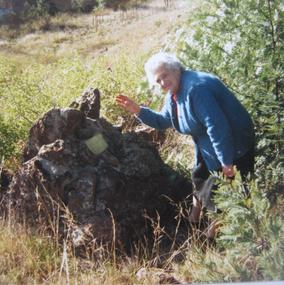
Photograph, The Cairn- Jimmy Melrose's plane crash site, 1988
... early in July was engaged by Mr. A.J. Campbell a director of several mining companies from Melbourne to Darwin to commence at Essendon on the4th July. However on that day low cloud and steady rain caused the postponement. There was little improvement and Melrose was advised to delay the departure...early in July was engaged by Mr. A.J. Campbell a director of several mining companies from Melbourne to Darwin to commence at Essendon on the4th July. However on that day low cloud and steady rain caused the postponement. There was little improvement and Melrose was advised to delay the departure ...Edna Barrie at the cairn, photo received from Graeme Minns in 1988. The cairn marks the site of Jimmy Melrose's plane crash in Melton South. The accident which happened on July 5th 1936. In 1934 Melrose made headlines with a series of spectacular flights. In July of that year, he set around Australia record and in that year established a new solo Australia England record when he flew to England to compete in the MacRoberston race with a De Havilland Puss Moth VH- YQO. The only Australian and the only solo pilot to complete the course within the time limit. He was seventh in finishing order and third in the handicap section making news again during the race with a dramatic landing in Darwin with empty fuel tanks. Late in 1935 Melrose imported the Phoenix for his “Adelaide to Anywhere” Charter Service. The previous year the Heston Aircraft Company had taken over the interests of the well known Comper Aircraft Company, and the first production of the new firm was the Phoenix, a single-engined all wooden five seater machine of sesquiplane configuration. The forward half of the fuselage was a streamlined rectangular section and the rear portion was a monocogue shell; the whole was of plywood fabric covered. The wing was built up of spruce box spars and lattice ribs, ply covered from the leading edge to the front spar and the fabric covered over the remainder. The tail surfaces were of similar construction. The most notable feature of the design was the lower stub wing which ran right across the fuselage embodying two box spars, plywood covered it housed the main undercarriage wheels when retracted and provided a substantial anchorage for the Nu form wing struts. The Dowty undercarriage retracted inwards, operated manually by hydraulic packs, Dual control fitted, with side by side seating for the pilots and three passenger seats behind. Power was a 200 h.p. De Havilland Gipsy VI 6 cylinder inverted in-line air-cooled engine. Six Phoenix were built; five of them registered in Great Britain and one of those was later sold abroad the remaining four were impressed into the R.A.F. in 1940. Specifications were: 40 feet 4 inches length 30 ft 2 ins height, 9ft 7ins, wing area 270 sq ft, Tare weight 2,600lbs loaded weight 3,300lbs; cruising speed 360 m.p.h. landing 50mph ceiling 14,000 ft range 700 miles. Melrose’s machine the first production aircraft was built early in 1936 and test flown of the 24th March. Painted green it carries the words “South Australian Centenary 1936” in silver of the fuselage and the name “Billing on the engine cowling in honor of Melrose’s uncle Noel Pemberton Billing, pioneer designer and founder of the Supermarine Aviation Company. The delivery flight was planned as a goodwill mission to publicise the forthcoming South Australian Centenary celebrations. Melrose left Dympne on the 9th April 1936, and flying via Marseilles, Naples, Athens, Baghdad, Basra, Karachi, Jodphur, Calcutta, Akyab, Penang, Singapore, Lombok, Darwin, Newcastle Waters and Alice Springs reached Adelaide on the 25th of April. Continuing the goodwill flight to other States, he visited Melbourne, Sydney, Newcastle, Grafton, Brisbane, Coff’s Harbour, Sydney again, Launceston, Hobart and Mount Gambier before returning to Adelaide on the 13th May. During June Jimmy made some charter flights and early in July was engaged by Mr. A.J. Campbell a director of several mining companies from Melbourne to Darwin to commence at Essendon on the4th July. However on that day low cloud and steady rain caused the postponement. There was little improvement and Melrose was advised to delay the departure again. However he wished to reach Oodnadatta that night, and when he observed the break in the clouds decided to leave. He planned to climb above the cloud and fly to Adelaide at 3,000 feet. The aircraft was airborne about 8.10 a.m. and was last seen from Essendon climbing above the clouds. At 8.45 people at Melton (30 miles West of Melbourne) heard an approaching aircraft. The engine noise increased abnormally and eye witnesses saw the machine fall out of control from the cloud base about 800 feet and then disintegrate, fragments were scattered for 1½ miles and both occupants were killed. Hand written carbon copy by Edna Barrie.Typed by Wendy Barrie March 2014 Last Flight of Jimmy Melrose by John Burke Parade Magazine July 1972 Page 2 –4 This article gives the take off time of 7.50 am from Essendon Airport Eyewitness account at the time Maisie Arthur’s description. Newspaper article. Edna Barrie at the site of the 'Cairn'local identities, local significant events -
 Melbourne Tram Museum
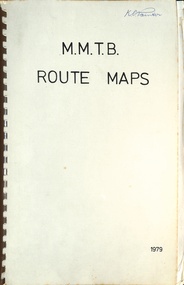
Map, Melbourne & Metropolitan Tramways Board (MMTB), MMTB Route Maps, 1979
... Buses 1 - Footscray, Sunshine, Deer Park, Nth Altona & Fishermans Bend - R2/79 2 - Box Hill bus routes to Templestowe, Heidelberg & East Kew - R6/78 - notes superseded by R3/82 3 - Plan of Russell St Melbourne bus departure bays. 4 - Box Hill, Mitcham & Ringwood bus routes to East Doncaster & Warrandyte - R3/82 5 - City - Warrandyte & East Doncaster bus routes - R3/82 & R6/78 6 - Bulleen - City - Port Melbourne - Garden City Bus route - R6/78 7 - North Altona - City bus route - 11/78 8 - Clifton Hill - Elsternwick - R2/79 9 - La Trobe - Northland - West Heidelberg - City Bus Service via East Freeway - 11/79 and R3/81 10 - Box Hill, Mitcham & Ringwood Bus Routes to East Doncaster & Warrandyte - R10/84 - with the Metropolitan Transit logo. Yields information about tram and bus routes in late 1970s early ...Series of colour maps for various tram and bus routes, dated 1979. Also contained, not scanned are letters, reports, and specifications for printing these maps for use in shelters etc. Some have the Transport Information Centre telephone printed on them. Some are finished with a plastic laminate finish on either one or both sides. Show the major cross streets, parks, schools, other tram routes, major stop numbers, and railway lines. See also item 3909 for another example of these. Trams 1 - City route guide - R9/77 - showing all route numbers and destinations that passed through the CBD. 2 - Bourke St tram routes - R4/77 - East Brunswick Blyth St and East Preston Tyler St and intermediate routes, routes 95, 96, 97, 90, 89 and 88. 3 - Malvern, East Malvern, Carnegie, and East Brighton Tram Routes (from St Kilda Junction) - R1/79 - shows routes 5, 3, 67, 66, 61, 62, and 64. 4 - Elizabeth St tram routes - R12/77 - Essendon Airport, West Maribyrnong, North Coburg lines, routes 50, 58, 60, 54, 57, 52. 49, 59, 18, 20 and 19 5 - Flinders St tram routes - R5/78 - North Balwyn, East Burwood, routes 48, 40, 41, Hartwell, 28, 74 and 75 6 - Kew - St Kilda Beach - R1/79 - Route 69. 7 - Mont - Albert City - R11/77, shows routes 43. 47. 45. 44 8 - St Kilda Rd Tram Routes R12/77 - details South Melbourne Beach, route 1 and route 2 and St Kilda Beach routes 15, 16, and 55 otherwise shows where the various routes branch off St Kilda Road 9 - Batman Ave tram routes - R9/77 - Wattle Park, North Richmond and Prahran - routes 70, 71, 78 and 79. 10 - Footscray - Moonee Ponds - R3/81 - Route 82 11 - Swanston St tram guide - R1/79 - lists all routes and route numbers that branch or cross Swanston St between Grattan St and St Kilda Junction. 12 - Toorak Camberwell and Glen Iris tram route with Camberwell Junction and Malvern Town Hall, R1/79, routes 8, 7, 6, 72, and 73 shown. 13 - West Preston - Beach tram routes - R12/77 - routes 10, 11, 9 and 12, 14 - William St tram routes - R12/77 - Route 55, 56, and 63 - South Melbourne Depot and Domain. Buses 1 - Footscray, Sunshine, Deer Park, Nth Altona & Fishermans Bend - R2/79 2 - Box Hill bus routes to Templestowe, Heidelberg & East Kew - R6/78 - notes superseded by R3/82 3 - Plan of Russell St Melbourne bus departure bays. 4 - Box Hill, Mitcham & Ringwood bus routes to East Doncaster & Warrandyte - R3/82 5 - City - Warrandyte & East Doncaster bus routes - R3/82 & R6/78 6 - Bulleen - City - Port Melbourne - Garden City Bus route - R6/78 7 - North Altona - City bus route - 11/78 8 - Clifton Hill - Elsternwick - R2/79 9 - La Trobe - Northland - West Heidelberg - City Bus Service via East Freeway - 11/79 and R3/81 10 - Box Hill, Mitcham & Ringwood Bus Routes to East Doncaster & Warrandyte - R10/84 - with the Metropolitan Transit logo.Yields information about tram and bus routes in late 1970s early 1980s.Book - brown comb binding, card and clear plastic covers containing both bound and unbound maps and documents.K C Painter on front cover in ink.tramways, mmtb, tram routes, maps, bus routes, route numbers, routes, route guide -
 Lauriston Girls’ School (incorporating Lauriston Museum and Gallery)
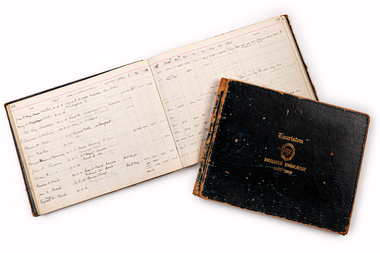
Administrative record (item) - Enrolment Books
... departure if no further education; also some accolades such as “Head of School”. The first column that held the student’s name was annotated with the year date and term. Below the student’s name in some of the early...departure if no further education; also some accolades such as “Head of School”. The first column that held the student’s name was annotated with the year date and term. Below the student’s name in some of the early ...Record Series 13. Enrolment Books comprises two enrolment registers and lose pages (for males), that were used to record the details of each new student starting at Lauriston. These volumes date back to the inception of our school and are Lauriston’s first system of documentation used to record student information. Both the enrolment entries and alphabetical index at the start of each book are handwritten into a hard bound volume that was commercially produced at the time as school stationery to record student enrolments. The first volume dates from 1901 to 1919, and the second from 1920 to 1930, but holds further details of the academic results of the students already enrolled up to 1933. The two registers are arranged in a double page column format. The column headings are as follows: • Name • Date of Birth • Name and Address of Parent • Occupation [sometimes empty] • Elementary [First year level for students] • I. • IIA. • IIB. • IIIIA. • IIIB. [annotated to become IVa] • IV. [annotated to become IVb] • VA. • VB. • VI. • Date of Leaving. • Remarks [includes such details as: academic results for student’s last couple of years such as Matric or Leaving and their individual subject results; where they went to if another school; reason for departure if no further education; also some accolades such as “Head of School”. The first column that held the student’s name was annotated with the year date and term. Below the student’s name in some of the early enrolment entries, extra information was added such as “died” and the date, or the student’s married name. The details of male students who went to Lauriston’s kindergarten from 1911 are also in the registers. There are details of male students also recorded separately in loose pages that detail the enrolments from 1922 to 1930. Up until 1944, Lauriston used school year level titles used within English Public Schools. In the registers the first year is “Elementary” (Prep) and the final year is “VI” (Year 12). The first girls who wanted to go to university sat their Senior Public Exam in their fifth year of secondary school. Students could take an extra year of study called Leaving Honours. In 1944 university entrance requirements were raised and this sixth year of secondary school became the Matriculation exam. In 1970 it was renamed High School Certificate and since 1991, the Victorian Certificate of Education. -
 Falls Creek Historical Society
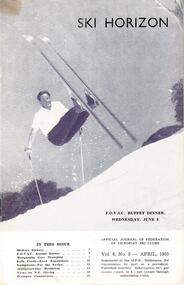
Journal - Ski-Horizon Vol 6 No 8
... early development of skiing in Victoria. N.E.D.S.A. events at Falls Creek Falls Creek regulations Falls Creek Village The journal features stories and events chronicling developments in Victoria and internationally. Items related to the Falls Creek Area in this issue include:- Page 4 - A list of N.E.D.S.A. events to be held at Falls Creek for the coming season, including of the T. W. Mitchell Downhill Course. Pages 10 - 11 A detailed outline of procedures to be followed by skiers at Falls Creek. These covered regulations related to applications for permits, times for entry and departure ...Ski-Horizon is the official journal of the Federation of Victorian Ski Clubs which began publication in 1949. The were 26 original member clubs which included Albury Ski Club, Bogong Ski Club, Myrtleford Ski Club, Tallangatta and District Ski Club and Wangaratta Ski Club. Two pioneers of Falls Creek, Tom Mitchell, M.L.A., and Martin Romuld were Vice-Presidents of the Federation.This Journal is significant because it documents the early development of skiing in Victoria.The journal features stories and events chronicling developments in Victoria and internationally. Items related to the Falls Creek Area in this issue include:- Page 4 - A list of N.E.D.S.A. events to be held at Falls Creek for the coming season, including of the T. W. Mitchell Downhill Course. Pages 10 - 11 A detailed outline of procedures to be followed by skiers at Falls Creek. These covered regulations related to applications for permits, times for entry and departure from the Kiewa area, limits and conditions of travel, approved parking areas and other traffic rules.n.e.d.s.a. events at falls creek, falls creek regulations, falls creek village -
 Melbourne Tram Museum
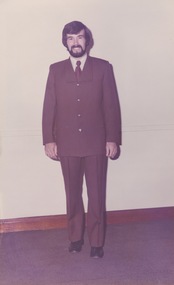
Photograph - M&MTB Brown Uniforms Male and Female - set of 6
... These uniforms marked a significant departure from the design and colour of the navy blue male uniform which had been standard for over 50 years, and the dark brown female uniform standard from the early 1940s....These uniforms marked a significant departure from the design and colour of the navy blue male uniform which had been standard for over 50 years, and the dark brown female uniform standard from the early 1940s. ...Photographs show the front, side and rear views of male and female models wearing the new brown coloured tram crew uniforms. They include male jacket with gold buttons, trousers, yellow shirt and brown tie. Female brown jacket with gold buttons, skirt and roll neck scivy. These uniforms were introduced for tram crews on the new Z class trams that entered service from 1975. These trams were painted in a distinctive orange and cream livery with brown coloured internal fittings. The photographs were taken against a plain cream wall with brown skirting board and carpet, possibly in part of the uniform factory at Hawthorn Tram Depot. These uniforms marked a significant departure from the design and colour of the navy blue male uniform which had been standard for over 50 years, and the dark brown female uniform standard from the early 1940s.Yields information about brown uniforms and the tramway's change from a long term previous stylecolour prints, no notes on the rear.tramways, uniform, brown uniform, z class tram, 1975, orange and cream livery, uniform factory, hawthorn tram depot, navy blue uniforms, dark brown uniforms -
 Melbourne Tram Museum
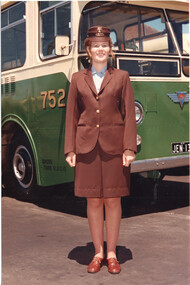
Photograph - MMTB Brown unifom - lady / female, Melbourne & Metropolitan Tramways Board (MMTB), 1975
... These uniforms marked a significant departure from the design and colour of the navy blue male uniform which had been standard for over 50 years, and the dark brown female uniform standard from the early 1940s. ...These uniforms marked a significant departure from the design and colour of the navy blue male uniform which had been standard for over 50 years, and the dark brown female uniform standard from the early 1940s. ...Colour photograph of a lady / female wearing the 1975 brown uniform standing in front of bus 752. Has badge number 4683. Bus an AEC Regal Mk 6 / Freighter. Shows the uniform introduced at the time of the Z class trams. These uniforms were introduced for tram crews on the new Z class trams that entered service from 1975. These trams were painted in a distinctive orange and cream livery with brown coloured internal fittings. In the following years, some buses were also painted in orange and cream. These uniforms marked a significant departure from the design and colour of the navy blue male uniform which had been standard for over 50 years, and the dark brown female uniform standard from the early 1940s. More examples can be seen in item 8513.Yields information about the female MMTB uniform introduced at the time of the Z class trams and buses.Colour photo with a plain backmmtb, buses, uniforms, brown uniform, orange and cream livery, mmtb buses -
Bendigo Historical Society Inc.
Newspaper - Bendigo Advertiser Collection: Small Town With Big Hearts Article on Raywood, June 23 1993
... departure of paid players, lacking reliable and affordable local players. A drought period followed, with Northern United going two years without a win. The club recently celebrated a rare victory, only its second in two-and-a-half years, which brought great joy to the community. The town now values these hard-earned wins more than the earlier...departure of paid players, lacking reliable and affordable local players. A drought period followed, with Northern United going two years without a win. The club recently celebrated a rare victory, only its second in two-and-a-half years, which brought great joy to the community. The town now values these hard-earned wins more than the earlier ...Raywood is portrayed as a close-knit, self-reliant rural community where local businesses and residents play a central role in sustaining town life. Residents take initiative, such as managing the swimming pool access themselves and seeking new financial services after the local bank agency closed. Local businesses adapt to challenges, like the butcher expanding to home deliveries to stay afloat. The butcher's shop, pub, general store, and newsagency are central to daily life and social interaction.Business owners, such as Ron the butcher and Stewie the shopkeeper, are deeply invested in the town's survival and continuity. The closure of the Commonwealth Bank agency was met with community resolve to prove their independence. Young people increasingly spend money outside town, posing a challenge to local commerce. Government costs and changing economic conditions have impacted local employment and services. Residents participate in school councils, volunteer firefighting, and community organizations. The town school remains a focal point, with about 80 pupils and hopes to avoid closure or change. Despite hardships, such as floods and fires, residents like Dennis and Jill O'Gorman (publicans) and the Neate family remain committed to Raywood.Long-term residents, like Stewie, emphasize the importance of keeping both their businesses and the town alive. Raywood's story highlights the importance of local initiative, adaptability, and strong community ties in maintaining rural town life. Northern United Football Club won four consecutive premierships, but some locals feel these victories were tainted because the club paid high prices to attract top players from Bendigo.When the financial support ended, these players left, leaving the club without a strong foundation or new local talent. The club struggled after the departure of paid players, lacking reliable and affordable local players. A drought period followed, with Northern United going two years without a win. The club recently celebrated a rare victory, only its second in two-and-a-half years, which brought great joy to the community. The town now values these hard-earned wins more than the earlier, expensive premierships.Small Towns With Big Hearts Ravenswood. Series of photos and information about Raywood. Pictures by Peter Hyett. Written by Wayne Gregson. This item contains the following documents newspaper articles and black and white photos: 8091.606a Part of Page 22, the Bendigo Advertiser Weds Nov 03 1993 8091.606b Part of Page 22, the Bendigo Advertiser Wednesday Nov 03 1993 8091.606c Black and White Photo of Ron the Butcher - Contact BHS for Details 8091.606d Black and White Photo of Beverley Neale, the Post Mistriss - Contact BHS for Details 8091.606e Black and White Elevated view of Raywood and countryside - Contact BHS for Details 8091.606f Black and White General Store and Town Hall - Contact BHS for Details 8091.606g Black and White Photo of Sign Posts - Contact BHS for Details 8091.606h Black and White Photo of Stewie McGregor Store-keeper - Contact BHS for Details 8091.606i Black and White Photo of Dennis and Jill O'Gorman Publicans of the Raywood Hotel - Contact BHS for Details 8091.606j Black and White Photo of an old cart behind a fence - Contact BHS for Detailsnewspaper, bendigo advertiser, raywood -
 Ballarat Tramway Museum
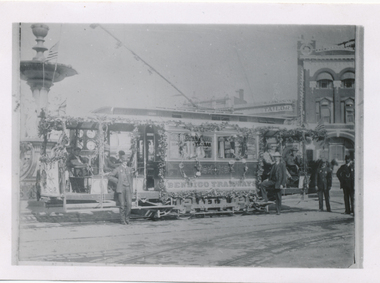
Photograph - Decorated Bendigo tram at Charing Cross, Peter Duckett, c1905
... departure clocks behind the tram. Copy print by Peter Duckett. Black and White copy print contained within the Wal Jack Bendigo and Geelong Album, see Reg Item 5003 for more details. Yields information about early ...Copy print of a published photographs of an ESCo tramcar at Charing Cross, decorated for an event, c1905? Note the tram departure clocks behind the tram. Copy print by Peter Duckett. Black and White copy print contained within the Wal Jack Bendigo and Geelong Album, see Reg Item 5003 for more details. Yields information about early Bendigo trams that had been decorated and shows a set of departure or next tram clocks.On rear in ink "PWD."trams, tramways, bendigo, esco, decorated trams -
 Melbourne Legacy
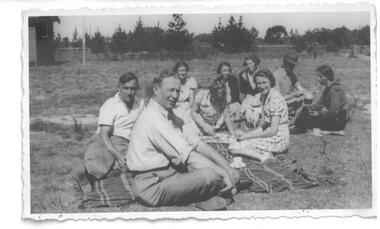
Photograph, Somers Camp, 1940
... early years, Legacy organised outings to the property of Legacy founder, Legatee Stan Savige, who had a place in Balnarring/Somers, close to the beach. Permanent camp buildings were built in 1930. Legacy Somers Camps continued intermittently at Stan's property until it was decided in 1951 to make other arrangements for holidays. A photograph of Stan Savige at Somers Camp. stan savige somers camp camp "Norman Smith ILC" in blue pen and "Stan Savige at Somers Camp just before his departure ...Photo of a group of people on a picnic rug at Somers Camp in 1940. Melbourne Legacy provide camps for junior legatees - the children of deceased servicemen. In the early years, Legacy organised outings to the property of Legacy founder, Legatee Stan Savige, who had a place in Balnarring/Somers, close to the beach. Permanent camp buildings were built in 1930. Legacy Somers Camps continued intermittently at Stan's property until it was decided in 1951 to make other arrangements for holidays. A photograph of Stan Savige at Somers Camp.Black and white photo of Stan Savige at Somers Camp 1940."Norman Smith ILC" in blue pen and "Stan Savige at Somers Camp just before his departure with 17th Bde 1940" in pencil on reverse.stan savige, somers camp, camp -
 Bendigo Historical Society Inc.
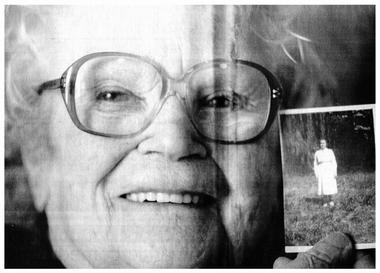
Newspaper - Fortuna Article - "Gold and Governors", Sept 23 1995
... Speechley, a former staff member, recalls her experiences working for the Lansell family, including her brief departure and return after Mrs. Lansell's advice. After the Army took over the mansion in the early 1940s, the elegant furnishings and gardens were lost, which Mrs. ...Speechley, a former staff member, recalls her experiences working for the Lansell family, including her brief departure and return after Mrs. Lansell's advice. After the Army took over the mansion in the early 1940s, the elegant furnishings and gardens were lost, which Mrs. ...Mrs. Speechley worked as a maid at Fortuna, Bendigo's grandest home, for eight years starting just after leaving school. The estate was renowned for its size (40 rooms) and beautiful gardens. The household employed a staff of seven, including two German maids who served the family for 50 years. Workdays were long, starting at 7:30 am and ending after 10 pm, with only brief afternoon breaks. Duties included serving afternoon tea to guests, often from Bendigo's leading families, and maintaining the entire house even though only two Lansell family members lived there. Despite the decline of the gold baron era, the Lansells maintained a lavish lifestyle, hosting elite guests such as Lords Stradbroke, Stonehaven, and Sommers.The family owned several of Bendigo's finest homes and frequently entertained high-profile visitors, including governors and relatives from England. Staff enjoyed simple pleasures like boating on the lake and relaxing in the gardens when the family was away.Mrs. Speechley recalls specific incidents, such as serving while Lord Stonehaven was in residence and working at other Lansell properties like Dendra and Lansellstowe.Mrs. Speechley's memories provide a unique glimpse into the domestic service and social life of one of Bendigo's most prominent families during the 1920s, preserving a romanticized view of a bygone era. The Lansell family maintained high standards at Fortuna mansion, especially during visits from governors, with special preparations such as new curtains, linens, and engraved silverware.Mrs. Lansell preferred to shop in Melbourne rather than Bendigo due to her high social status and discomfort with local attention. The document shares a lighthearted story about a governor misplacing his bathing suit and retrieving it himself. Mrs. Speechley, a former staff member, recalls her experiences working for the Lansell family, including her brief departure and return after Mrs. Lansell's advice. After the Army took over the mansion in the early 1940s, the elegant furnishings and gardens were lost, which Mrs. Speechley describes as a shame.Fortuna Restoration Article - "Gold and Governors" - Bendigo Advertiser Sat 23 Sept 1995- Author Mathew O'Sullivan This item contains the following: 11217.2a Black and White Photo of Myrtle Speechley displaying a picture of herself as a young maid at Fortuna 11217.3b Part of page 23 - Gold and Governors 11217.3c Part of page 23 - Gold and Governorsnon-fictionbendigo, fortuna, army tropographic support establishment, myrtle speechley
