
Showing 210 items matching "economy - australia"
-
 Flagstaff Hill Maritime Museum and Village
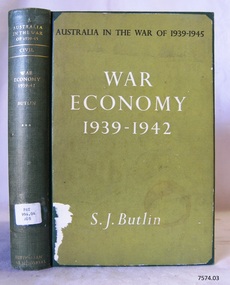
Book, War Economy 1939-1942
... ...war economy 1939-194...australia...War Economy 1939-194 Australia in the War of 1939-1945 Author: S J Butlin Publisher: Australian War Memorial Date: 1955...His aim was to foster portraiture, as well as support artists, and perpetuate the memory of great Australians. warrnambool shipwrecked-coast flagstaff-hill flagstaff-hill-maritime-museum maritime-museum shipwreck-coast flagstaff-hill-maritime-village shipwrecked-artefact book warrnambool mechanics’ institute pattison collection warrnambool library ralph eric pattison warrnambool city librarian mechanics’ institute library victorian library board warrnambool books and records warrnambool children’s library war economy 1939-194 australia in the war of 1939-1945 s j butlin australian war memorial Label on spine cover with typed text PAT 994.04 AUS Front pastedown endpaper has sticker from Warrnambool Public Library Front loose endpaper has a sticker from Corangamite Regional Library Service War Economy 1939-194 Australia in the War of 1939-1945 Author: S J Butlin Publisher: Australian War Memorial Date: 1955 War Economy 1939-1942 Book ...This item is from the ‘Pattison Collection’, a collection of books and records that was originally owned by the Warrnambool Mechanics’ Institute, which was founded in Warrnambool in 1853. By 1886 the Warrnambool Mechanics’ Institute (WMI) had grown to have a Library, Museum and Fine Arts Gallery, with a collection of “… choice productions of art, and valuable specimens in almost every branch and many wonderful national curiosities are now to be seen there, including historic relics of the town and district.” It later included a School of Design. Although it was very well patronised, the lack of financial support led the WMI in 1911 to ask the City Council to take it over. In 1935 Ralph Pattison was appointed as City Librarian to establish and organise the Warrnambool Library as it was then called. When the WMI building was pulled down in 1963 a new civic building was erected on the site and the new Warrnambool Library, on behalf of the City Council, took over all the holdings of the WMI. At this time some of the items were separated and identified as the ‘Pattison Collection’, named after Ralph Pattison. Eventually the components of the WMI were distributed from the Warrnambool Library to various places, including the Art Gallery, Historical Society and Flagstaff Hill. Later some were even distributed to other regional branches of Corangamite Regional Library and passed to and fro. It is difficult now to trace just where all of the items have ended up. The books at Flagstaff Hill Maritime Village generally display stamps and markings from Pattison as well as a variety of other institutions including the Mechanics’ Institute itself. RALPH ERIC PATTISON Ralph Eric Pattison was born in Rockhampton, Queensland, in 1891. He married Maude Swan from Warrnambool in 1920 and they set up home in Warrnambool. In 1935 Pattison accepted a position as City Librarian for the Warrnambool City Council. His huge challenge was to make a functional library within two rooms of the Mechanics’ Institute. He tirelessly cleaned, cleared and sorted a disarrayed collection of old books, jars of preserved specimens and other items reserved for exhibition in the city’s museum. He developed and updated the library with a wide variety of books for all tastes, including reference books for students; a difficult task to fulfil during the years following the Depression. He converted all of the lower area of the building into a library, reference room and reading room for members and the public. The books were sorted and stored using a cataloguing and card index system that he had developed himself. He also prepared the upper floor of the building and established the Art Gallery and later the Museum, a place to exhibit the many old relics that had been stored for years for this purpose. One of the treasures he found was a beautiful ancient clock, which he repaired, restored and enjoyed using in his office during the years of his service there. Ralph Pattison was described as “a meticulous gentleman whose punctuality, floorless courtesy and distinctive neat dress were hallmarks of his character, and ‘his’ clock controlled his daily routine, and his opening and closing of the library’s large heavy doors to the minute.” Pattison took leave during 1942 to 1942 to serve in the Royal Australian Navy, Volunteer Reserve as Lieutenant. A few years later he converted one of the Museum’s rooms into a Children’s Library, stocking it with suitable books for the younger generation. This was an instant success. In the 1950’s he had the honour of being appointed to the Victorian Library Board and received more inspiration from the monthly conferences in Melbourne. He was sadly retired in 1959 after over 23 years of service, due to the fact that he had gone over the working age of council officers. However he continued to take a very keen interest in the continual development of the Library until his death in 1969. WARRNAMBOOL PUBLIC LIBRARY The Warrnambool Mechanics’ Institute (WMI) was formed by a voluntary community group in 1863, within six years of Warrnambool’s beginnings, and its Reading Room opened in 1854. The WMI operated until 1963, at which time it was one of the oldest Mechanics’ Institutes in Victoria. Mechanics’ Institutes offered important services to the public including libraries, reading rooms and places to display and store collections of all sorts such as curiosities and local historical relics. In 1886 a Museum and Fine Arts Gallery were added to the WMI and by the beginning of the 20th century there was also a billiards room and a School of Art. By this time all Mechanics’ Institutes in country Victoria had museums attached. Over the years the Warrnambool Mechanics’ Institute Library was also known as the Warrnambool Public Library the Warrnambool Library and the Free Library. Early funding from the government was for the “Free Library”. The inscription in a book “Science of Man” was for the “Warrnambool Public Library”, donated by Joseph Archibald in 1899. Another inscription in the book “Catalogue of Plants Under Cultivation in the Melbourne Botanic Gardens 1 & 2, 1883” was presented to the “Warrnambool Library” and signed by the author W.R. Guilfoyle. In 1903 the Warrnambool Public Library decided to add a Juvenile Department to library and stock it with hundreds of books suitable for youth. In 1905 the Public Library committee decided to update the collection of books and added 100 new novels plus arrangements for the latest novels to be included as soon as they were available in Victoria. In July 1911 the Warrnambool Council took over the management of the Public Library, Art Gallery, Museum and Mechanics’ Institute and planned to double the size of the then-current building. In 1953, when Mr. R. Pattison was Public Librarian, the Warrnambool Public Library’s senior section 10,000 of the 13,000 books were fiction. The children’s section offered an additional 3,400 books. The library had the equivalent of one book per head of population and served around 33 percent of the reading population. The collection of books was made up of around 60 percent reference and 40 percent fiction. The library was lending 400 books per day. In 1963 the Warrnambool City Council allocated the site of the Mechanics’ Institute building, which included the Public Library, Museum and Art Gallery, for the new Municipal Offices and the Collections were dispersed until 1971. The Warrnambool Library took over the Mechanics’ Institute Library’s holdings on behalf of the Warrnambool City Council. Since the closure of the Warrnambool Mechanics’ Institute the exact location and composition of the original WMI books and items has become unclear. Other materials have been added to the collection, including items from Terang MI, Warrnambool Court House and Customs House. Many of the books have been identified as the Pattison Collection, named after the Librarian who catalogued and numbered the books during his time as Warrnambool Public Librarian in the time before the Mechanics’ Institute closed. It seems that when Warrnambool became part of the Corangamite Regional Library some of the books and materials went to its head office in Colac and then back to Warrnambool where they were stored at the Art Gallery for quite some time. Some then went to the Warrnambool Historical Society, some stayed at the Art Gallery and some were moved to Flagstaff Hill Maritime Village. The various stamps and labels on the books held at Flagstaff Hill show the variety of the collection’s distribution and origin. The books in the collection at Flagstaff Hill Maritime Village date from the 1850’s to the late 1950’s and include rare and valuable volumes. Many of the books are part of the “Pattison Collection” after the Warrnambool’s Public Librarian, Mr. R. Pattison The Pattison Collection, along with other items at Flagstaff Hill Maritime Village, was originally part of the Warrnambool Mechanics' Institute’s collection. The Warrnambool Mechanics’ Institute Collection is primarily significant in its totality, rather than for the individual objects it contains. Its contents are highly representative of the development of Mechanics' Institute libraries across Australia, particularly Victoria. A diversity of publications and themes has been amassed, and these provide clues to our understanding of the nature of and changes in the reading habits of Victorians from the 1850s to the middle of the 20th century. The collection also highlights the Warrnambool community’s commitment to the Mechanics’ Institute, reading, literacy and learning in the regions, and proves that access to knowledge was not impeded by distance. These items help to provide a more complete picture of our community’s ideals and aspirations. The Warrnambool Mechanics Institute book collection has historical and social significance for its strong association with the Mechanics Institute movement and the important role it played in the intellectual, cultural and social development of people throughout the latter part of the nineteenth century and the early twentieth century. The collection of books is a rare example of an early lending library and its significance is enhanced by the survival of an original collection of many volumes. The Warrnambool Mechanics' Institute’s publication collection is of both local and state significance. The Warrnambool Mechanics' Institute Collection is primarily significant in its totality, rather than for the individual objects it contains. Its contents are highly representative of the development of Mechanics' Institute libraries across Australia, particularly Victoria. A diversity of publications and themes has been amassed, and these provide clues to our understanding of the nature of and changes in the reading habits of Victorians from the 1850s to the middle of the 20th century. The collection also highlights the Warrnambool community’s commitment to the Mechanics’ Institute, and to reading, literacy and learning in the regions, and proves that access to knowledge was not impeded by distance. These items help to provide a more complete picture of our community’s ideals and aspirations. As with many Mechanics' Institutes in Australia, the one which operated in Warrnambool was established and overseen for many years by key individuals associated with the development of the city itself. The WMI publication collection is historically significant because of its association with local people, places and the key historical themes in the development of Warrnambool of rural development, industry, farming, education, and community. The collection documents and illustrates the changing interests, focus and tastes of Victorians, especially those in regional cities. Generally the individual items in the collection are not particularly rare, as examples of all probably exist in other public collections in Victoria. It is primarily because there are so very few surviving Mechanics' Institute collections in Victoria, which lends this overall collection its significance. Many items in the WMI Collection have the potential to support further research, both as individual objects and through the collection in its entirety. This material is significant for its ability to assist in the interpretation of the history of the area and adds to the general understanding of the development of the township. Many components of the WMI publication collection complement and reinforce the Flagstaff Hill Maritime Museum Collection, the Warrnambool Art Gallery Collection, and that in the Warrnambool Historical Society, and also contribute to a clearer understanding of the original Warrnambool Mechanics' Institute collections. This will greatly enhance the appreciation of the few surviving Mechanics' Institute collections across Victoria, and also in New South Wales. The similarities and differences between the small number of collections that have survived can provide further insights into how the people of Victoria in general, and Warrnambool in particular, constructed a civic culture of adult learning to foster an informed citizenry. The Warrnambool Mechanics' Institute publication collection is of both local and state significance. (This Statement of Significance is quoted from the Significance Assessment : Warrnambool Mechanics’ Institute Book Collection at Flagstaff Hill Maritime Museum, February 2009, by Annette Welkamp, Cultural Connections, for Delise Oldfied, FHMV) References Juvenile Department in Warrnambool Public Library In August 1903 The Age newspaper reported in its Warrnambool news section that “With the object of discouraging boys from reading literature of the “penny dreadful” class, the committee of the local public library has decided to open a juvenile department and to stock it with hundreds of suitable books attractive to the youthful mind.” 100 new novels added to Warrnambool Public Library Shelves In November 1905 The Argue newspaper’s Warrnambool news section announced “The committee of the Public Library is bringing the collection of books more up to date. It has recently added 100 new novels to the shelves, and arrangements have been made for a supply of the latest novels immediately they arrive in the state.” Warrnambool Town Council takes over Mechanics’ Institute, Art Gallery, Public Library, Museum – and will double the building’s size In 1912 The Age reported in its Warrnambool news section “Considerable improvements are being effected by the town council in the most picturesque part of Liebig Street. Between the fire brigade station and the mechanics’ institute and art gallery a vacant block of land is being transformed a garden for carpet bedding and flowering plants. The council, which recently took over the control of the art gallery, public library, museum and mechanics’ institute, is doubling the size of the substantial stone building containing these institutions. The new building will contain a supper room for use in conjunction with functions in the town hall, adjoining, and a new reading room.” Mr Pattison, Public Librarian, says Library has a book per head of population In 1953 The Age reported an interview with the Public Librarian, Mr. R. Pattison, who said “Warrnambool has an insatiable thirst for reading. And its reading recipe contains a strong dash of fiction – 73 percent of it. Fiction makes up 10,000 of the 13,000 books in the senior section of the public library. That works out at a book per head of population. Warrnambool today is really book minded. This city has an almost insatiable thirst for knowledge as well as fiction. We’re lending 400 books a day. We supply 33 percent of the reading population of Warrnambool.” The reporter goes on to say “Warrnambool Public Library also has an ultra-modern children’s section of 3,400 books, open to every boy and girl attending school in Warrnambool. Mr Pattison hopes to show travel-talk films and install a radiogram in the children’s section “later on”. But it won’t disturb adult reading next door because the junior section is sound proof. “ Mechanics’ Institutes and Museums Mechanics’ Institutes were important sites for collecting in country Victoria … Warrnambool … all had museums attached to Mechanics’ Institutes before the end of the twentieth century” Warrnambool Mechanics’ Institute Ms Tierney said FHMV holds the collection of the Warrnambool Mechanics’ Institute in three different locations on its site. “The Mechanics’ Institute opened in 1871, was demolished in the 1960s and was one of the oldest in Victoria. “FHMV intends to create a new storage area and bring the collection together in one place which will greatly facilitate access and research. “The collection consists of books and archives dating from the 1850s to 1959s. “Some of the books are rare and valuable but it is unclear as to their relevance to the history of Warrnambool or Victoria,” Ms Tierney said. Warrnambool TAFE History South West TAFE has a long and proud history of providing technical and specialist education, with links back to the formation of the Mechanic’s Institute in 1853. Warrnambool Art Gallery’s History The Warrnambool Art Gallery began in 1886 when retired police officer Joseph Archibald opened its doors in a building behind the mechanics institute in Liebig Street. The Gallery began with an eclectic mix of artworks and museum curios. Before long Archibald mobilised public support and paid for a new gallery annex. Loans and grants allowed the Gallery collection to grow with significant early acquisitions by French, German, and Belgian artists, which were less expensive than British works. Despite its enthusiastic start the economic downturn of the 1890s brought the Collection to a halt. In 1910 the Council took control of the Mechanics Institute and ran the Gallery there until 1963 when the building was allocated for municipal offices. The Collection was dispersed on loan to galleries in Shepparton and Hamilton and not reunited until 1971. In 1986 the Gallery’s Centenary year, a permanent home was built next to the ‘Civic Green’ and named in memory of one its champions Sir Fletcher Jones O.B.E. 2016 Warrnibald Entries Joseph Archibald established the Warrnambool Museum and Art Gallery in 1886 while his son Jules Francois Archibald founded the Archibald Prize through his bequest of 1919. His aim was to foster portraiture, as well as support artists, and perpetuate the memory of great Australians. War Economy 1939-194 Australia in the War of 1939-1945 Author: S J Butlin Publisher: Australian War Memorial Date: 1955Label on spine cover with typed text PAT 994.04 AUS Front pastedown endpaper has sticker from Warrnambool Public Library Front loose endpaper has a sticker from Corangamite Regional Library Servicewarrnambool, shipwrecked-coast, flagstaff-hill, flagstaff-hill-maritime-museum, maritime-museum, shipwreck-coast, flagstaff-hill-maritime-village, shipwrecked-artefact, book, warrnambool mechanics’ institute, pattison collection, warrnambool library, ralph eric pattison, warrnambool city librarian, mechanics’ institute library, victorian library board, warrnambool books and records, warrnambool children’s library, war economy 1939-194, australia in the war of 1939-1945, s j butlin, australian war memorial -
 Unions Ballarat
Open Australia (Don Woodward Collection), Tanner, Lindsay, 1999
... ...Economy - Australia...Addresses the issue of how we initiate change in Australia, including political representation, media, the economy, information and services. ...BTLC Ballarat Trades Hall ballarat trades and labour council ALP Australian Labor Party politics and government Cabinet Ministers Media - Australia Economy - Australia Information management Book; 248 pages. ...Written by Lindsay Tanner who was a Federal ALP cabinet minister. Addresses the issue of how we initiate change in Australia, including political representation, media, the economy, information and services. Political and social interest.Book; 248 pages. Front cover: blue background; picture of Australian shield; picture of a computer mouse; green, white and red text; author's name and title.btlc, ballarat trades hall, ballarat trades and labour council, alp, australian labor party, politics and government, cabinet ministers, media - australia, economy - australia, information management -
Unions Ballarat
The end of certainty: The story of the 1980s (Don Woodward Collection), Kelly, Paul, 1992
... ...economy - Australia...BTLC Ballarat Trades Hall ballarat trades and labour council Politics and government Prime Ministers - Australia Political parties Hawke, Bob premiers - bjelke-petersen, joh Elliott, John Kelty, Bill Howard, John Keating, Paul Peacock, Andrew Hewson, John economy - Australia ACTU Anthony, Doug Country Party Liberal Party Australia national party immigration industrial relations ALP australian labor party trade unions white australia policy Accord Book; 755 pages. ...Australian politics in the 1980s and the consequences. Includes: - Hawke-Keating leadership; - 1990s recession; - ALP leadership coup; - deregulation of financial systems; - John Hewson's bid for the prime ministership; - rivalry between John Howard and Andrew Peacock; - John Elliott's push for Liberal Party leadership; - Joh for PM campaign; - industrial relations and the Accord. Politics, industrial relations, economy and leadership issues.Book; 755 pages. Cover: red and purple background; photographs of Bill Kelty, Bob Hawke, Joh Bjelke-Petersen, John Elliott, John Howard, Paul Keating and John Hewson; white lettering; author's name and title.btlc, ballarat trades hall, ballarat trades and labour council, politics and government, prime ministers - australia, political parties, hawke, bob, premiers - bjelke-petersen, joh, elliott, john, kelty, bill, howard, john, keating, paul, peacock, andrew, hewson, john, economy - australia, actu, anthony, doug, country party, liberal party australia, national party, immigration, industrial relations, alp, australian labor party, trade unions, white australia policy, accord -
Unions Ballarat
Year Book Australia, No. 39, 1953, Commonwealth Bureau of Statistics, 1953
... An annual publication that includes statistical data about Australian population, economy, government, etc. ...An annual publication that includes statistical data about Australian population, economy, government, etc. Reference. abs australian bureau of statistics commonwealth bureau of statistics ballarat trades hall ballarat trades and labour council btlc population economy government statistics year books Paper - book. ...An annual publication that includes statistical data about Australian population, economy, government, etc. Reference.Paper - book.abs, australian bureau of statistics, commonwealth bureau of statistics, ballarat trades hall, ballarat trades and labour council, btlc, population, economy, government, statistics, year books -
Unions Ballarat
Year Book Australia, No. 56, 1970, Commonwealth Bureau of Statistics, 1970
... An annual publication that includes statistical data about Australian population, economy, government, etc. ...An annual publication that includes statistical data about Australian population, economy, government, etc. btlc ballarat trades and labour council ballarat trades hall population economy government statistics commonwealth bureau of statistics australian bureau of statistics abs year books Paper - book. ...An annual publication that includes statistical data about Australian population, economy, government, etc. Paper - book.btlc, ballarat trades and labour council, ballarat trades hall, population, economy, government, statistics, commonwealth bureau of statistics, australian bureau of statistics, abs, year books -
Unions Ballarat
Year Book Australia, No. 55, 1969, Commonwealth Bureau of Statistics, 1969
... An annual publication that includes statistical data about Australian population, economy, government, etc. ...An annual publication that includes statistical data about Australian population, economy, government, etc. Historical reference. btlc ballarat trades hall ballarat trades and labour council abs australian bureau of statistics commonwealth bureau of statistics populaton economy government statistics year books Paper - book. ...An annual publication that includes statistical data about Australian population, economy, government, etc. Historical reference.Paper - book.btlc, ballarat trades hall, ballarat trades and labour council, abs, australian bureau of statistics, commonwealth bureau of statistics, populaton, economy, government, statistics, year books -
 Bendigo Historical Society Inc.
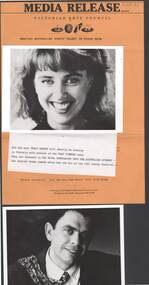
Document - MERLE HALL COLLECTION: BENDIGO PERFORMANCE OF THE ROYAL COMMISSION INTO THE AUSTRALIAN ECONOMY
... Merle Hall Collection - Bendigo Performance of The Royal Commission into the Australian Economy. 1991. with Gerry Connolly, Magda Szubanski, Marg Downey, Tracy Harvey, Craig Ashley, Sue Ingleton. ...Document MERLE HALL COLLECTION: BENDIGO PERFORMANCE OF THE ROYAL COMMISSION INTO THE AUSTRALIAN ECONOMY ...Merle Hall Collection - Bendigo Performance of The Royal Commission into the Australian Economy. 1991. with Gerry Connolly, Magda Szubanski, Marg Downey, Tracy Harvey, Craig Ashley, Sue Ingleton. Media release; Memo; B&W photo of Gerry Connolly; B&W photo of Tracy Harvey.victorian arts council, merle hall -
 Kiewa Valley Historical Society
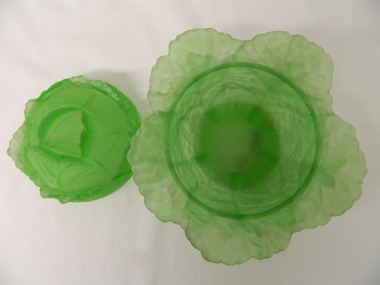
Bowl Covered, circa mid to late 1900's
... It was a time when the Australian economy "rode on the back of sheep"...It was a time when the Australian economy "rode on the back of sheep" This item has relative significance to the Kiewa Valley as part of the rural and mining(gold) era when the strong return from local gold mining and grazing was demonstrated by the "landed gentry" and significant household cutlery, crockery, etiquette and old English mores, influenced by "Mother Britain" glass bowls kitchen crockery serving etiquette meal presentation Barely visible "VALLERYSTHAL" This green opalescent covered bowl is similar to the French PV cabbage form. ...This covered glass bowl with lid was made in a period when there was a strict discipline in the use a various dishes and accompaniments with respect to the type of crockery used. This was in the English style, especially in well to do rural family estates. This period was part of the early 1900's, when large rural acreage was family owned and the economical return to rural produce was very high. It was a time when the Australian economy "rode on the back of sheep"This item has relative significance to the Kiewa Valley as part of the rural and mining(gold) era when the strong return from local gold mining and grazing was demonstrated by the "landed gentry" and significant household cutlery, crockery, etiquette and old English mores, influenced by "Mother Britain"This green opalescent covered bowl is similar to the French PV cabbage form. When the lid is on the bowl appears as a small cabage with three sets of half peeled leaves. There are five outer leaves, next row are five inner leaves and finally three core leaves. The main bowl has a lip encircling the inside of the bowl for the lid to rest upon with closed. The glass has been pressed to show the leaves with their web like stalks. The inside area of the bowl and lid are smooth. This is to allow the mashed up contents to be easily scraped into a serving ladle.Barely visible "VALLERYSTHAL"glass bowls, kitchen crockery, serving etiquette, meal presentation -
 Ringwood and District Historical Society
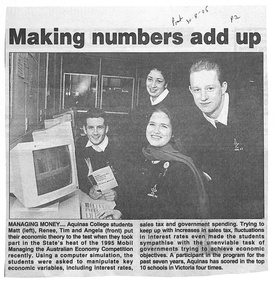
Newspaper, Aquinis College, Ringwood - Newspaper Clipping - 30 Aug 1995 "Making numbers add up"
... Summary - The article features four Aquinas College students — Matt, Renee, Tim, and Angela — who took part in the State heat of the 1995 Mobil Managing the Australian Economy Competition. Using a computer simulation, they adjusted economic variables such as interest rates, sales tax, and government spending to understand how governments attempt to meet economic goals. ...Summary - The article features four Aquinas College students — Matt, Renee, Tim, and Angela — who took part in the State heat of the 1995 Mobil Managing the Australian Economy Competition. Using a computer simulation, they adjusted economic variables such as interest rates, sales tax, and government spending to understand how governments attempt to meet economic goals. ...Summary - The article features four Aquinas College students — Matt, Renee, Tim, and Angela — who took part in the State heat of the 1995 Mobil Managing the Australian Economy Competition. Using a computer simulation, they adjusted economic variables such as interest rates, sales tax, and government spending to understand how governments attempt to meet economic goals. The piece notes that Aquinas College has ranked among Victoria’s top ten schools four times in seven years, highlighting the school’s strong academic performance. (Co-Pilot 11/7/2026) -
 Kiewa Valley Historical Society
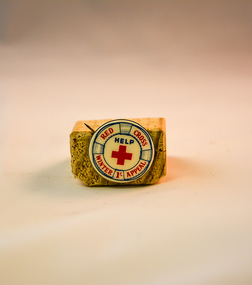
Badge Red Cross, circa 1968
... When this winter appeal badge was produced the Australian economy was in recession (financial down turn) and the ability of some of the unemployed sectors of the community required but could not purchase warm clothes. ...When this winter appeal badge was produced the Australian economy was in recession (financial down turn) and the ability of some of the unemployed sectors of the community required but could not purchase warm clothes. ...When this winter appeal badge was produced the Australian economy was in recession (financial down turn) and the ability of some of the unemployed sectors of the community required but could not purchase warm clothes. The Australian recessions of 1945 and 1961 left their mark on the economy and accounted for a long and slow recovery in the 1960's and 1970's. The Red Cross was one of a few benevolent agencies/organisations that provided those more affluent in society to donate money to these types of appeals for financial donations. the money collected was used in obtaining warm close for those in need.In the Kiewa Valley the lingering recessional consequences (high interest rates, slowdown in Australian manufacturing) had an effect upon those whose produce was consumed by large towns and cities. The manufacturing industries including textile and clothing industries were feeling the start of the invasion of cheaper imports. Unemployment was beginning to be an ongoing major political and social issue. The need for support for the financial strapped city and country towns was on the increase and this Red Cross Badge (Winter Appeal) was one of several appeals to help those financially disenfranchised families to overcome the severe clothing shortages in both country and city environments.This badge has an enamel front with red and blue lettering and the circumference is marked to represent a 'life ring, life buoy, life belt' which has all of the red lettering with in its boundary. The fastening mechanism is a "stick" pin made from mild steel (fashioned as a semi circular spring contained within the back rim of the badge. The "stick" protrudes beyond the badge allowing it to be fastened onto clothing.At the top of the badge and in red print "RED CROSS" and at the bottom "WINTER APPEAL" with a"1/-" (one shilling coin - modern equivalent to 10 cents). In the middle of the badge is printed a red cross and above that "HELP"societies, red cross appeals, apparel badges, numismatics badges -
 Bacchus Marsh & District Historical Society
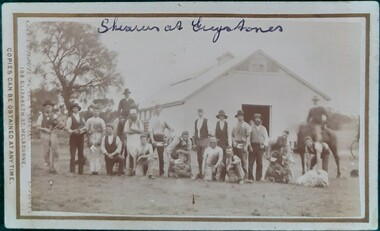
Photograph, Shearers and Overseers at Greystones Station 1883
... The wool industry was a major industry in the development of the Australian economy from pre-colonial times. It gave rise to the saying that Australia 'rode on the sheep's back.'...The wool industry was a major industry in the development of the Australian economy from pre-colonial times. It gave rise to the saying that Australia 'rode on the sheep's back.' ...Greystones station was originally part of the Glenmore run, established in 1840 by Charles Griffith. Originally a run of 55,00 acres, Glenmore was subdivided in the 1870s to form the Greystones property, owned and managed by Molesworth Greene, the nephew of Charles Griffith. The property had 11,000 sheep and was renowned for its high quality wool. In November 2023, the property of 4033 hectares was sold to overseas investors. The wool industry was a major industry in the development of the Australian economy from pre-colonial times. It gave rise to the saying that Australia 'rode on the sheep's back.'Small black and white 'carte de visite' style unframed photograph on card with gold border framing photograph. One of a set of photographs of Bacchus Marsh and District taken in 1883 by the photographers Stevenson and McNicoll. The photo shows a group of sixteen men standing or kneeling outside a large shearing shed at Greystones, Rowsley. Behind them are two mounted men, probably overseers or managers. The standing group includes a man with a fiddle and one with a concertina. The cook, wearing a white apron and hat can also be identified. Six men have hand-held shears, three in poses of shearing a sheep. Printed On the front: Stevenson & McNicoll. Photo. 108 Elizabeth St. Melbourne. COPIES CAN BE OBTAINED AT ANY TIME. On the back: LIGHT & TRUTH inscribed on a banner surmounted by a representation of the rising sun. Copies of this Portrait can be had at any time by sending the Name and Post Office Money Order or Stamps for the amount of order to STEVENSON & McNICOLL LATE BENSON & STEVENSON, Photographers. 108 Elizabeth Street, MELBOURNE. Handwritten in biro along the top: Shearers at Greystones. stevenson and mcnicoll 1883 photographs of bacchus marsh and district, shearers, greystones estate bacchus marsh, glenmore run, wool industry, charles james griffith 1808-1863, molesworth r. green 1827-1916 -
 Ballarat Tramway Museum
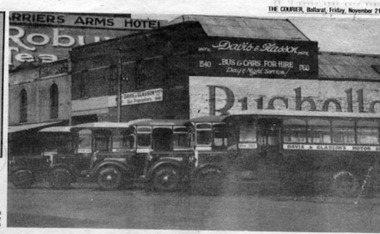
Newspaper, The Courier Ballarat, "Davis Bus Lines: 50 years of service", 21/11/1980 12:00:00 AM
... Features five photos, including one of Bert Davis, an advertisement featuring various buses, a photo outside the original depot in Creswick Road, one of the Mobil Around Australia Economy run in 1958 and one of a decorated bus in the early 1950's. ...Features five photos, including one of Bert Davis, an advertisement featuring various buses, a photo outside the original depot in Creswick Road, one of the Mobil Around Australia Economy run in 1958 and one of a decorated bus in the early 1950's. ...Three page feature article with associated advertisements of Davis Bus Lines, 50 years of services, printed in The Courier on 21/11/1980. Features five photos, including one of Bert Davis, an advertisement featuring various buses, a photo outside the original depot in Creswick Road, one of the Mobil Around Australia Economy run in 1958 and one of a decorated bus in the early 1950's. Article includes history of the bus lines, plans to move to a new depot in 1981 and taking over the tram services from the SEC. If removed for copying etc. copy to be made.trams, tramways, davis bus lines, ballarat public transport, closure -
 Wangaratta RSL Sub Branch
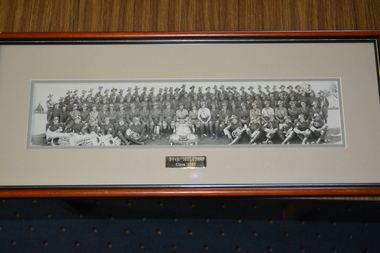
Photograph - Framed photograph, 59th Battalion
... They remained in existence until 1942 when, due to a manpower shortage in the Australian economy, the decision was made to amalgamate the battalion with the 58th Battalion to form the 58th/59th Battalion. ...They remained in existence until 1942 when, due to a manpower shortage in the Australian economy, the decision was made to amalgamate the battalion with the 58th Battalion to form the 58th/59th Battalion. ...The 59th Battalion was an infantry battalion of the Australian Army. Initially raised for service during World War I, the battalion fought on the Western Front in France and Belgium between 1916 and 1918, before being disbanded in 1919. In 1921, it was re-raised as a part-time unit of the Militia in Victoria. They remained in existence until 1942 when, due to a manpower shortage in the Australian economy, the decision was made to amalgamate the battalion with the 58th Battalion to form the 58th/59th Battalion. Together they remained linked throughout World War II, serving in New Guinea and Bougainville in 1943–1945. In 1952, the 59th Battalion was re-raised and subsequently was absorbed into the Royal Victoria Regiment in 1960.Brown timber frame containing cream coloured mount and photograph of large group of soldiers and bandsmenPlaque -59th Militia Circa 193959th militia, ww1, ww2, 1939 -
 Unions Ballarat
Stop the ABCC: Turnbull's War on Workers (bumper sticker), 2018
... The ABCC claims to, "ensuring that building work in Australia is carried out fairly, efficiently and productively—for the benefit of all employers and workers in the industry, and for the benefit of the Australian economy as a whole." Conversely, the organisation has been claimed by unions and workers to be anti-union and detrimental to the working conditions of employees. ...The ABCC claims to, "ensuring that building work in Australia is carried out fairly, efficiently and productively—for the benefit of all employers and workers in the industry, and for the benefit of the Australian economy as a whole." Conversely, the organisation has been claimed by unions and workers to be anti-union and detrimental to the working conditions of employees. ...The ABCC (Australian Building and Construction Commission) was first created during the government of John Howard (LNP). The ABCC claims to, "ensuring that building work in Australia is carried out fairly, efficiently and productively—for the benefit of all employers and workers in the industry, and for the benefit of the Australian economy as a whole." Conversely, the organisation has been claimed by unions and workers to be anti-union and detrimental to the working conditions of employees. A fact sheet from the CFMMEU is attached to this entry. Malcolm Turnbull was Prime Minister from 2015 to 2018. He became Prime Minister after deposing Tony Abbott, in a leadership challenge. The bumper sticker was produced by CFMMEU during the Turnbull Prime Ministership (2015-2018). The CFMMEU is one of the largest unions; membership coverage includes construction, forestry, maritime, mining, energy, textile, clothing and footwear production. Relevant to government, industrial relations and trade unions in Australia.Bumper sticker: colour picture of Malcolm Turnbull; red and white lettering. Stop the ABCC: Turnbull's War on Workers Subtext: exploits workers; destroys jobs; lies; attacks safety; ignores big business; union bashing; CFMEU.btlc, ballarat trades hall, ballarat trades and labour council, cfmeu, turnbull, malcolm, prime ministers - australia, liberal party australia, abcc, australian building and construction commission, industrial relations, cfmmeu, construction, forestry, maritime, mining and energy union, construction, forestry, mining and energy union, trade unions - australia -
 Wodonga & District Historical Society Inc
Tool - Shearing Hand Set
... The wool industry has been critical to the Australian economy from the early days of European settlement. ...The wool industry has been critical to the Australian economy from the early days of European settlement. ...The wool industry has been critical to the Australian economy from the early days of European settlement. The increase in wool production in the mid to late 19th century led to the need to replace the hand shears with some mechanized forms of shearing.The first commercially successful sheep shearing machinery by Frederick York Wolseley in New South Wales who was granted a patent for his machine on 28 March 1877. Many of the early settlers to North East Victoria droved sheep overland from both Sydney and South Australia and established large pastoral runs in the district. Wodonga became a major service centre for the industry and established major saleyards for the pastoral and cattle industries. The handset has the company name "Heiniger" on the side. Heiniger is a Swiss company with subsidiaries in Australia and New Zealand. It was originally established in 1946.This item is connected to a major rural industry in North East Victoria.A metal handpiece for a sheep shearing. A toothed blade is held in place with metal adjustable screws at one end. A jointed metal pipe at the other end allows attachment to the shearing machine. The hinge has been covered with leather.On adjustment knob "Heinger"shearing industry, shearing equipment, shearing handset -
 The Beechworth Burke Museum
Photograph - Stereoscopic Photograph, Unknown c1875
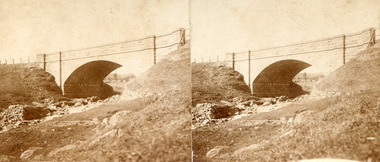
... The bridge indicates the growth of the town, replacing a previous timber structure as well as its association to the mining activity in the area and the rapid increase in Australia's economy that led to investment and development of roads and railways. ...The bridge indicates the growth of the town, replacing a previous timber structure as well as its association to the mining activity in the area and the rapid increase in Australia's economy that led to investment and development of roads and railways. ...Depicted in the photograph is Newtown Bridge or the Newtown Falls Bridge, in Beechworth, Victoria. Noted for its location, detailed craftsmanship and stonemasonry by Scottish stonemasons the Newtown Bridge was built in the 19th century provincial town of Beechworth (completed in 1875). The bridge was built over Spring Creek, spanning 6.3 meters wide and 24.8 meters tall. Beechworth held a distinct role in the administrative and commercial management of Victoria's north-eastern goldfields, with many objects and structures still well preserved from the towns establishment. The bridge indicates the growth of the town, replacing a previous timber structure as well as its association to the mining activity in the area and the rapid increase in Australia's economy that led to investment and development of roads and railways. The local granite used in the construction of the single arch Newtown Bridge makes the bridge and other buildings made with the granite unique to the area, the honey-toned material distinct to Beechworth. This photograph is historically significant as it provides insight into the industrial development of Beechworth and the surrounding area, contributed to by the goldfields. The photograph further captures the representation of vernacular engineering traditions and Scottish stonemasonry.Two sepia-toned rectangular photographs featuring a bridge in the background printed on matte photographic paper mounted on card.Reverse: 97.2324/ Newtown Bridge/ Beechworthbridge, newtown beechworth, newtown bridge, newtown, beechworth, beechworth falls bridge, beechworth mining district, spring creek, -
Emerald Museum & Nobelius Heritage Park
Book - Cookery text book, The Ruskin Press Pty Ltd, 1920s-1940s
... Examples of recipes featured in the book include apple pudding, boiled sheep's head, haricot mutton and Irish stew, among others.The Emily McPherson College of Domestic Economy was an Australian domestic science college for women based in Melbourne, Victoria. ...Examples of recipes featured in the book include apple pudding, boiled sheep's head, haricot mutton and Irish stew, among others.The Emily McPherson College of Domestic Economy was an Australian domestic science college for women based in Melbourne, Victoria. ...This book is compiled from the Grade I Cookery Notes, collected by teachers of cookery at the Emily McPherson College of Domestic Economy in Melbourne, Victoria. The aim of the book is to present a thorough knowledge of the principles of each cooking process so that the student, on completing this work, will be ready to pass on to more advanced cookery. Examples of recipes featured in the book include apple pudding, boiled sheep's head, haricot mutton and Irish stew, among others.The Emily McPherson College of Domestic Economy was an Australian domestic science college for women based in Melbourne, Victoria. During the 1920s, prominent businessman and former Victorian Premier Sir William Murray McPherson KBE, bequested £25,000 (≈ A$2.3 million in 2023) to the establishment of the college. It was officially opened by the Duchess of York on 27 April 1927. In 1979, the college became amalgamated with the Royal Melbourne Institute of Technology as is known as RMIT Building 13.The book is historically significant as it was published by a domestic science college for women which is no longer operational. Therefore, the record is an excellent example of the former college and gives us insight into its history and targeted audience. The recipes noted in the record present a unique research potential illustrating how diets and palates have changed over time. Further research potential can be attributed to the bygone societal views inextricably linking women with domestic duties.Mid-green coloured, canvas-bound hardcover book. 110 pages.Obverse: EMILY McPHERSON COLLEGE / UT DOMUM PATRIAM / ITA / HOUSEHOLD / COOKERY /melbourne, emily mcpherson college of domestic economy, recipe book, cooking, school history, schools -
 Bendigo Historical Society Inc.
Book - "Gold! Off to the Diggings", 2010
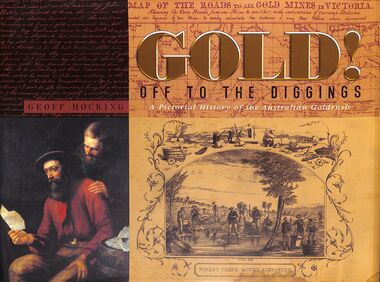
... Economic Contributions: Gold mining became a cornerstone of the Australian economy, contributing to export income and the development of infrastructure. ...Economic Contributions: Gold mining became a cornerstone of the Australian economy, contributing to export income and the development of infrastructure. ...A pictorial history of the Australian goldrush. In 1851 Australia's gold rush had begun, and the focus of the world suddenly turned to the hills, gullies and creeks of New South Wales and Victoria as people from all over the world rushed to the diggings. Gold mining in Australia has a rich history that began in the early 19th century, leading to significant economic growth and population influx during the gold rushes of the 1850s. The first documented discovery of gold in Australia occurred in 1823 near Bathurst, New South Wales. However, it wasn't until 1851 that significant gold deposits were found at Ophir, which triggered the first major gold rush. The discovery of payable gold led to a massive influx of prospectors and miners from around the world, particularly during the Victorian Gold Rush. By the mid-1850s, Australia was producing nearly 40% of the world's gold. The gold rushes significantly increased Australia's population, with estimates suggesting that the population tripled from 1851 to 1860 due to the influx of miners and their families. Economic Contributions: Gold mining became a cornerstone of the Australian economy, contributing to export income and the development of infrastructure. The wealth generated from gold mining helped finance the young colonies and led to the establishment of new towns and services."Gold! Off to the Diggings" by Geoff Hocking. Published by New Chum Press in 2010. Hard cover book which is black fabric. Title and author's name in gold on spine. Dust jacket is multi-colored, with different gold mining scenes on front and back. Title written on gold and black on front cover and spine. Printed in Castlemaine, Australia. 320 pp. Glossy pages. Contains both text and black and white images. Has index. ISBN 9780957897236. gold, mining, miners -
 Bacchus Marsh & District Historical Society
Photograph, Shearers at Greystones Station 1883
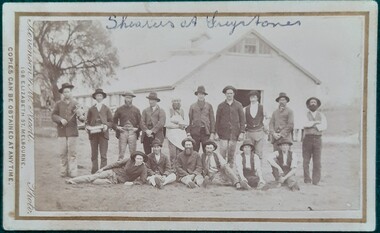
... In November 2023, the property of 4033 hectares was sold to overseas investors.The wool industry was a major industry in the development of the Australian economy from pre-colonial times. It gave rise to the saying that Australia 'rode on the sheep's back.' ...In November 2023, the property of 4033 hectares was sold to overseas investors.The wool industry was a major industry in the development of the Australian economy from pre-colonial times. It gave rise to the saying that Australia 'rode on the sheep's back.' ...This photo evokes Australian stories of shearing as an occupation, the hard work, the itinerant life-style, its legends and heroes. A strong part of the Australian identity is based on the perceptions of shearers. Banjo Paterson's song "Click Go The Shears" is still widely known and sung; the Tom Roberts painting" Shearing the Rams" is a much-loved and reproduced painting. The story of Jackie Howe who shore a record 321 sheep in October 1892 in seven hours and forty minutes remains an integral part of the shearing canon. In modern times, the film "Sunday Too Far Away", starring Jack Thompson, is ever-popular. The centrality of the shearer in Australia's understanding of itself may be traced to the central role played by the wool industry in the nation's economy, dating from its earliest colonial days. Fine Australian wool still enjoys a premier reputation in the fashion and furnishing industries. Greystones station was originally part of the Glenmore run, established in 1840 by Charles Griffith. Originally a run of 55,00 acres, Glenmore was subdivided in the 1870s to form the Greystones property, owned and managed by Molesworth Greene, the nephew of Charles Griffith. The property had 11,000 sheep and was renowned for its high quality wool. In November 2023, the property of 4033 hectares was sold to overseas investors.The wool industry was a major industry in the development of the Australian economy from pre-colonial times. It gave rise to the saying that Australia 'rode on the sheep's back.' Small black and white 'carte de visite' style unframed photograph on card with gold border framing photograph. One of a set of photographs of Bacchus Marsh and District in 1883 by the photographers Stevenson and McNicoll. This photo shows a group of sixteen men, ten standing in the back row, six lying or sitting in a row at the front. From a similar photo in this collection, (VC ID 918) it can be seen that this is a group of shearers standing outside a large shearing shed at Greystones station.Printed On the front: Stevenson & McNicoll. Photo. 108 Elizabeth St. Melbourne. COPIES CAN BE OBTAINED AT ANY TIME. On the back: LIGHT & TRUTH inscribed on a banner surmounted by a representation of the rising sun. Copies of this Portrait can be had at any time by sending the Name and Post Office Money Order or Stamps for the amount of order to STEVENSON & McNICOLL LATE BENSON & STEVENSON, Photographers. 108 Elizabeth Street, MELBOURNE. Handwritten in biro across the top: Shearers at Greystones.stevenson and mcnicoll 1883 photographs of bacchus marsh and district, shearers, greystones estate bacchus marsh, wool industry -
 National Wool Museum
Textile - Opera Cloak Cloth Sample, Macarthur Wool, John Macarthur, 1816-1821
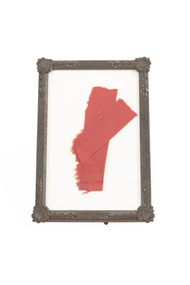
... Australia's first $2 banknote featured John Macarthur thanks largely to his establishment of wool as the backbone of the early Australian economy. The cloak was passed down through the family to Harold Lethbridge with whom the main part of the cloak resides, in Narrandera. ...Macarthur Wool Industry Australian economy opera cloak textile textile industry 19th century merino sheep woollen mills New South Wales 'ARCO' MADE IN ENGLAND Red fabric sample folded in half and mounted in the centre of a brown metal frame. ...Textile sample from an opera cloak made in England c.1820 from wool clipped from Macarthur's merino sheep in 1816. Macarthur is recognised as the pioneer of the wool industry that was to boom in Australia in the early 19th century and become a trademark of the nation. Macarthur was responsible for the first bale of Australian wool to be exported. The British woollen mills were desperate for wool at the time because of the Napoleonic blockade, and the Australian bale sold for a record price. Australia needed a product to sell in European markets which did not perish during long sea-voyages and which offered high value per unit of weight. Wool also had a ready market in England because the Napoleonic Wars had increased demand and cut English cloth-makers off from their traditional source of quality wool, Spain. Australia's first $2 banknote featured John Macarthur thanks largely to his establishment of wool as the backbone of the early Australian economy. The cloak was passed down through the family to Harold Lethbridge with whom the main part of the cloak resides, in Narrandera. The fragment was passed to Lethbridge's niece who gave it to the donor's mother who passed it onto him and then it was donated to the National Wool Museum. The cloth fragment was tested by Gordon Institute of Technology in 1974 showing the wool to be very fine (15-16 microns) which is consistent with the pure lineage of Macarthur's sheep. The cloth fragment was framed in 1952 and remains in the original frame to this day. Red fabric sample folded in half and mounted in the centre of a brown metal frame.'ARCO' MADE IN ENGLANDmacarthur, wool industry, australian economy, opera, cloak, textile, textile industry, 19th century, merino sheep, woollen mills, new south wales -
 National Wool Museum
Textile - Children's Jumper, Kathryn Knitwear, c.1975
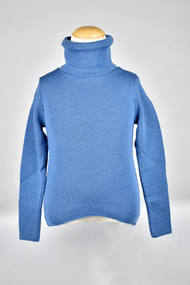
... In a world where wool garments all had to be washed by hand, the invention of machine-washable acrylic fibres and widespread adoption of washing machines in ordinary Australian homes in the 1950s and 60s posed a major risk to the wool industry, and by extension the entire Australian economy. With the price of wool falling, the CSIRO and the Australian Wool Board worked together from the 1950s on a number of developments to keep Australian wool competitive and desirable to the public, many of which came out of the Geelong research labs. ...In a world where wool garments all had to be washed by hand, the invention of machine-washable acrylic fibres and widespread adoption of washing machines in ordinary Australian homes in the 1950s and 60s posed a major risk to the wool industry, and by extension the entire Australian economy. With the price of wool falling, the CSIRO and the Australian Wool Board worked together from the 1950s on a number of developments to keep Australian wool competitive and desirable to the public, many of which came out of the Geelong research labs. ...Kathryn Knitwear, founded by Robert Blake, manufactured high quality children’s knitwear in Melbourne from the 1940s – 1980s. Robert Blake began manufacturing children’s knitwear in his bedroom in Strathmore using a hand powered machine in the late 1940s. The operation moved to Ascot Vale and Essendon, before eventually establishing a factory in Moonee Ponds in the early 1950s. The business continued to expand, necessitating a move to a new factory in Broadmeadows. By 1962, the Broadmeadows factory was producing an average of 20,000 garments per month, which increased to 24,000 by 1964. Robert Blake’s Son, Brendan recalls that “The Kathryn brand was famous around Australia, anywhere children needed to keep warm and dress smartly. It also won a number of wool fashion awards”, including the 1969 Wool Awards, which was held by the Australian Wool Bureau and published in Women’s Weekly. The Kathryn range was designed for durability, comfort and care, without sacrificing style. They used patterning techniques that increase stretchiness, comfort and fit, as well as integrating decorative elements into the fabric to prevent them from being bulky, uncomfortable or tight. Making longevity of style a priority, Brendan Blake remembers that “there was one particular garment that was in the range for at least thirty years”. He also recalls “In the past, when women have found out that I was associated with Kathryn Knitwear, they would often relate to me the story of a garment they had purchased or received as a gift and, when their child had grown out of it, they would hand it on to another child. Several ladies have told me of purchasing garments for their daughters’ glory box, or saving a particular garment after their daughter had grown out of it. Brendan Blake: “At the peak of their operation they employed approximately two hundred people, mainly women and girls. A family would often seek to send their daughter to work in this company because they knew they would be looked after and safe. One lady wrote to me telling me that working at the Moonee Ponds Factory prior to getting married was the happiest time of her life.” In 1963, workers at the Kathryn factory earned £13 per week, which was 8 shillings and 8 pence higher than the minimum weekly wage for female workers in the textile manufacturing industry (£12 11s 4d). By 1970, the Kathryn Knitwear brand expanded from children’s knitwear into womenswear under the brand name ‘Lady Kathryn’, and for boys and men under ‘Robert Blake’. Continuing to diversify their distribution, they also began exporting ‘Kathryn’ garments to New Zealand, the Pacific Islands, and Japan. ‘Kathryn Knitwear’ was well-known for their early adoption of modern materials and techniques that had broad appeal to their customer base. This is shown in their early use of the acrylic fibre ‘Orlon’ in the 50s and 60s and ‘Superwash’ wool in the 1970s. Many of Kathryn Knitwear’s styles, particularly those that were long running staples of the brand, were available in both wool and Orlon to suit the consumer’s preference. Wool has been renowned for its excellent properties for thousands of years, by people from all over the world. Not only good for thick winter woollens, it can help keep you cool in summer, as well as being durable and resistant to water, fire, ultraviolet light, stains and odour. In a world where wool garments all had to be washed by hand, the invention of machine-washable acrylic fibres and widespread adoption of washing machines in ordinary Australian homes in the 1950s and 60s posed a major risk to the wool industry, and by extension the entire Australian economy. With the price of wool falling, the CSIRO and the Australian Wool Board worked together from the 1950s on a number of developments to keep Australian wool competitive and desirable to the public, many of which came out of the Geelong research labs. While progress had been made in the preceding decades, 1970 saw a major breakthrough; the invention of a new method of making wool washable and shrink-proof, most commonly known as ‘Superwash’. It is a technology that is still highly used to this day, and is very recognisable to those who use commercial wool yarn to knit or crochet. Far from the humble origins of one man in his bedroom with a hand-cranked machine; at its closure in 1980, the Broadmeadows factory of ‘Kathryn’ housed more than 100 machines, including 53 sewing machines and 45 knitting machines. Robert Blake was “a passionate advocate for wool and Australian Made” throughout his whole life. A strong thread that ties through the lifespan of Robert Blake and Kathryn Knitwear is a balance between adopting new innovations without sacrificing the core values of durability, comfort, care and style that had made the brand so well known. Their legacy forms an integral part of both Australian social and manufacturing history.Blue wool turtleneck ‘skivvy’ jumper in all over rib pattern with long sleeves. .2) swing tag with woolmark logo for ‘Superwash Wool’1.)[white label at back neck with blue writing] KATHRYN REGD. (Woolmark Logo) PURE NEW WOOL Superwash SIZE 2 HGT. 92cm MADE IN AUSTRALIA 2.)[retail swing tag for ‘Superwash Wool’] [OBVERSE] [woolmark logo] [handwritten in blue pen] 314 [printed] PURE NEW WOOL [handwritten] 2 Superwash Wool Machine Washable [INTERNAL] [woolmark logo] PURE NEW WOOL YOU ARE NOW THE OWNER OF A SUPERWASH WOOL GARMENT That has been specially treated to withstand a lifetime of machine washing. SUPERWASH WOOL has all the desirable qualities of wool – soft handle, comfort, warmth and style. Not all wool knitwear has the SUPERWASH treatment so remember always to look for the special “SUPERWASH” label and swing ticket. To was SUPERWASH WOOL just follow the instructions of the garment label. [woolmark logo] PURE NEW WOOL SUPERWASH WOOL THE WOOL YOU WASH IN THE MACHINE.knitwear, children's knitwear, clothing, children's clothing, jumper, manufacturing, fashion textile production, machine knitting, csiro, national wool board, superwash, australian wool innovation -
 Federation University Historical Collection
Newspaper - Newsclippings, Tantanoola Tiger Newsclippings
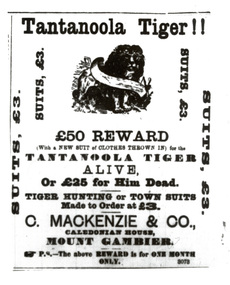
... economy was depressed. It is not known had the animal known as the Tantanoola Tiger came to Australia, but it is believed it survived one of three ships wrecked of the coast between 1890 and 1893, making it to shore along with some of the shipwrecked passengers. ...economy was depressed. It is not known had the animal known as the Tantanoola Tiger came to Australia, but it is believed it survived one of three ships wrecked of the coast between 1890 and 1893, making it to shore along with some of the shipwrecked passengers. ...In the early 1880s a small circus travelled between Millicent and Mt Gambier, South Australia. After camping overnight they discovered their Bengal Tiger at escaped and disappeared into dense scrub. After searching for hours they continued to Mt Gambier and reported the loss of the tiger to police. Police and local volunteers continued the search for the escaped tiger, but no sighting were made. In the early 1890s sheep in the Tantanoola area started to disappear with the still unsighted tiger being blamed. In 1893 reports of an unusual animal in the Tantanoola area started, with many describing the animal as the missing tiger, or a large dog. One eye witness claimed to have seen the animal carrying a full grown sheep in its mouth. The reports grew in number and exaggeration with sightings from Robe to Bendigo. In the Tantanoola district children were escorted with shotgun guards to and from school, with many homes keeping guns at the ready in case the tiger suddenly appeared. In August 1895 Tom Donovan shot the "Tantanoola Tiger" on Mt Salt Station, around 20 kms south of Tantanoola. The corpse was taken to Marks, a Mount Gambier taxidermist, at which time the animal was identified as an Assyrian or Northern Russian Wolf. Donovan displayed the animal far and wide. Despite the animal's death sheep continued to disappear from properties in the district over many years. It was of particular concern between 1909 and 1910. At that time Herbert Allchurch, an Adelaide detective, was sent to solve the mystery. A few days after his arrival Allchruch went to the front bar of the Tiger Hotel and arrested local rabbit shooter and trapper, Charlie Edmunson, with sheep stealing. After his 1911 trial Edmunson admitted to stealing over 4,000 sheep during the previous 20 years. He was gaoled for six years with hard-labour in January 1911. Edmunson had been selling the skins of the stolen sheep, leaving the carcusses to rot. He earned around five pounds per week during the 1990s and early 1900s, a time when the economy was depressed. It is not known had the animal known as the Tantanoola Tiger came to Australia, but it is believed it survived one of three ships wrecked of the coast between 1890 and 1893, making it to shore along with some of the shipwrecked passengers. (From a card produced by the Tantanoola Tiger Hotel, where the 'tiger' is on display.)A collection of Newsclippings from 1892 - 1895 photocopied onto A4 white paper. The clippings relate to the Tantanoola Tiger. Clippings include: * Border Watch 1892 - Tantanoola Tiger Reward * Sydney Morning Herald, 04/07/1857 - Animals in Zoological Gardens, including a number of large cats. * Claims the Tantanoola Tiger was an escaped circus animal (ie The Advertiser [Adelaide], 31 October 1893) * Search parties for the Tantanoola Tiger (ie Barrier Miner 19/05/1893; Barrier Miner 03/1081893) * Thylacine claim (ie Morning Bulletin [Rockhampton] 11/03/1895 * Afghan and Indian Hunters (ie Barrier Miner 07/02/1895) * Sighting by John Bird of Scarsdale - Wanganui Herald 15/12/1900. " ... Mr Bird was travelling on foot along a lonely track through very dense scrub, when he was stricken with amazement to see a full-grown tiger standing in a small dam about 30ft away, and holding in its jaws the carcass of a newly-killed lamb. He remained long enough to thoroughly take in the animals appearance, and then beat a hasty retreat unmolested. His description of the animal is as follows: A tawny-coloured creature, with a dirty mottled skin; in general appearance like an immense cat; body 4ft long, and of a uniform thickness from shoulder to hindquarters; in bulk equal to a very large pig. The legs were hidden in the water. A similar animal is reported to gave been seen near Canico, some miles away. ..." * Victorian country sightings # Bullarto - Argus 06/05/1905 # Dean - Launceston Examiner 28/01/1895 # Bendigo - Hobart Mercury 15/03/1895 # Ballan - Launceston Examiner 03/08/1895 * South Australian register 17/06/1885 " There is a tiger or panther wandering at large in Victoria, according to a rumour. It has taken the place of the Bunyip, whom hundreds have seen but none captured. This tiger is supposed to have broken loose from a travelling menagerie in the North-eastern district. At the beginning we should like it roved that such an escape ever took place. Perhaps the showmen were afraid to report the fact to the police; at any rate they did not do so. The first story about the tiger being seen came from the neighborhood of Wangaratta, 60 miles from the place where it is said to have commenced business on its own account. He was followed, but vanished among trees. Next we hear of a strange animal, bigger than a St Bernard's dog, but shorter legged, having appeared at least 150 miles from Wangaratta. Between Lilydale and Wangaratta there is a dividing range 2,000 feet high in the lowest past, besides several large rivers. An finally, the tiger - changed from a panther - is reported as having been seen within the suburban circle, about 8 miles from the general Post Office. They show you footprints, and point to the carcasses of mangled cows and calves. Casts have been taken of the footprints for examination by scientific men, who pronounce them doglike, and yet not doglike, but panther-like, which gives a nervous turn, for the panther may take up killing children and grown-up people. One tiger will not account for so many apparitions. There must have been a general strike among the menageries, and a breaking-up companies. ... * Research article by Philip A. Clarke "Indigenous Spirit and Ghost Folklore of 'Settled' Australia. australian animal folklore collection, tantanoola tiger, tom donovan, herbert allchurch, charles edmunson, sheep, charlie edmunson, mythical, myth, folklore -
 Federation University Historical Collection
CD-ROM, Big Cats sightings in Victoria, 2012
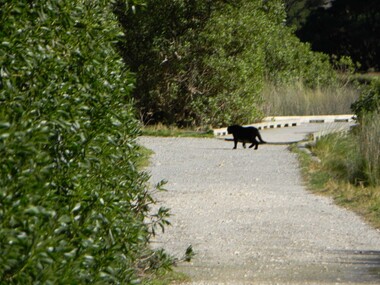
... While other types of unknown predator have been reported in various parts of Australia they are not the concern of this website. For purposes of economy we, John Turner and Simon Townsend, confine our investigations to western Victoria and south eastern South Australia. ...While other types of unknown predator have been reported in various parts of Australia they are not the concern of this website. For purposes of economy we, John Turner and Simon Townsend, confine our investigations to western Victoria and south eastern South Australia. ...The CD-Rom includes a range of electronic correspondence sent 'Big Cats Victoria and Simon Townsend and JohnTurner. Their website states: Big Cats Victoria Southern Australia, including south western West Australia, has a history of reports of ‘panther’ like predators dating back to the later half of the 19th century. The animals were usually described as being of black or tan colouration and with the proportions of a medium sized big-cat such as a Leopard or Puma. The records can be found in newspaper, radio and television archives, Government reports, a very few books and on the internet. The historical material is based on anecdotal reportage and has contributed to the mythification of the subject. Some Government agencies at both State and Local levels (in New South Wales), have collected records of sightings or investigated stock deaths purported to be associated with so called ‘panther’ kills. They remain understandably non committal due to the lack of a specimen of such a predator of undeniable authenticity. While other types of unknown predator have been reported in various parts of Australia they are not the concern of this website. For purposes of economy we, John Turner and Simon Townsend, confine our investigations to western Victoria and south eastern South Australia. (http://bigcatsvic.com.au/) A CD-ROM of multiple emails and image attachments relating to assorted sightings, footprints, killings, etc from big cats in the Otways of Victoria. The electronic mail was sent to 'Big Cats Victoria' Images include: This item is part of the Australian Animal Folklore Collectionaustralian animal folklore collection, ja sharp, simon townsend, neville bayley, st kilda, peter stefanis, toolangi, puma, tom daniel, footprint, pawprint, cryptozoology, rex gilroy, lancefield tiger, anglesea, berringa, matthew charles, jutin fitzclarence, harry carlin, patty smith, johannes beach, nerida, stirling ranges, daryl hardy, brook kelly, carl rose, ashley hall, jonathan smith, sally ballieu, lorraine balck, wayne bower, ian riordon, aleda turna, john turner, dave moyle, ben rayner, stewart leach, colin boord, sheryl mahoney, beech forest, otways, tooborac, geoff black, panther, brad blake, priscilla prescott, beau kapitiany, ramsay hosn, clare jones, darren guthrie, tallarook, josh fairway, linda wescon, lithgow, john turner, southern grampians -
 Federation University Historical Collection
Photograph - Photograph - Colour, Installation of University of Ballarat Chancellor Paul Hemming, 2012, 17/0/2012
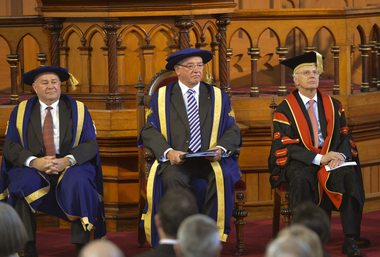
... Australia, and often in their own local communities. More specifically, almost three out of every four of the graduates from this University end up finding employment in Regional areas. Such figures highlight the University’s significant contribution to the Regional economy...Australia, and often in their own local communities. More specifically, almost three out of every four of the graduates from this University end up finding employment in Regional areas. Such figures highlight the University’s significant contribution to the Regional economy ...In April 2012 former Royal Australian College of General Practitioners president Dr Paul Hemming was appointed the University of Ballarat’s new chancellor. Dr Hemming was a deputy chancellor of the university since 2011 and a member of the university council since 2007, and replaces outgoing chancellor Robert Smith. He was a founding director of Beyondblue and has been president of the Royal Australian College of General Practitioners. He was also president of the Australian Medical Association Victoria and has served on numerous federal government medical bodies and tribunals. Chancellors are appointed to chair the university's council (governing body) as the senior office holder of the University. They also confer the academic awards of the university, and represent the university at meetings, functions and ceremonies. At the installation of Dr Hemming as the Fifth Chancellor Of The University Of Ballarat Governor of Victoria Alex Chrnov said: "I join Bonnie Fagan in acknowledging the traditional owners of this land and I pay my respects to their elders past and present. It is my great pleasure, as Governor of Victoria and Visitor to the University of Ballarat, to install Dr Paul Hemming as the fifth Chancellor of this University. I extend to him and his family my warmest congratulations on this appointment and wish him all the best in his new role. I have no doubt that he will be an industrious and wise leader of this University. Although the University of Ballarat is one of Australia’s newest Universities, it is the third oldest Tertiary institution in our country with the School of Mines being established in 1870. It has much to be proud of, and should be recognised for its commitment to being one of our most outstanding regionally focused higher education institutions. It offers on six campuses a diverse, yet suitably targeted, group of learning models that include higher education, TAFE and senior secondary school education, and is one of the few universities in the country that has an associated Technology Park. This University is uniquely placed to provide higher education in Regional Victoria. For example, I understand that by 2020 the population in the Ballarat area will increase by 20% so this University will have the responsibility and opportunity to provide educational opportunities for this growing population. The role of the Governor can be divided into three parts – ceremonial, constitutional and community engagement. It is the third aspect of the role that is most time consuming and, I add, enjoyable. It includes making official visits to Regional areas of Victoria. To date Elizabeth and I have been on 16 such visits and the thing that stands out is that despite the challenges that face Regional communities whether it be through natural disasters, or the economy more broadly – the stoicism, volunteerism and self reliance are always present. Ballarat is an example of such resilience and confidence in its future that can be dated back to this University’s inception. When the School of Mines was established in 1870 on the back of the gold rush era of the 1850s, the local community had vision and faith in its future that is reflected in the building of this institution. It is not dissimilar to Melbourne, where its relatively few citizens established the iconic pillars of our society like the State Library, the University of Melbourne, Parliament Houses and the National Gallery of Victoria. The contribution by the University of Ballarat to Regional Victoria cannot be overstated. Not only does it provide top educational opportunities for students from the Region but its graduates almost invariably end up working in Regional Australia, and often in their own local communities. More specifically, almost three out of every four of the graduates from this University end up finding employment in Regional areas. Such figures highlight the University’s significant contribution to the Regional economy. But its impact is not limited to our Regional areas – it extends to other parts of Australia and overseas. But like so many other higher education institutions in Australia, the University of Ballarat is facing challenges brought about by events such as global uncertainties and the high Australian dollar that impact on the inflow of international students, and dealing with students, more and more of whom come from the lower socio economic sector. It is in those circumstances that the Chancellor must show leadership that involves, amongst others, objectively guiding the Council and supporting the Vice-Chancellor, albeit without becoming involved in the day to day micro management of the University. A strong, trusting and respectful working relationship between the Chancellor and the Vice-Chancellor is, I believe, critical to the sound progress of a University. Before I turn more specifically to Dr Hemming, I would like to reflect briefly on his immediate predecessor, Emeritus Professor Robert Smith. I am sure that Dr Hemming has already found in Professor Smith an invaluable source of assistance. He was a skilled and effective leader not only here, but also in the broader higher education sector. I mention by way of example his instigation and leadership two years ago of the much acclaimed Chancellors’ Conference that was held in Melbourne. There was great diffidence amongst the Chancellors in having it at all. It was a little like herding cats. But Bob Smith spearheaded the organisation of it, with great attention to detail. And it was his hard work and leadership that resulted in the Conference being such a success and of assistance to all Chancellors who attended. It was an illustration of Bob Smith’s skills as a leader in the sector and of this University. And the sector, just as this University remains indebted to him. And I have no doubt that Dr Hemming will similarly lead this University through the challenging, yet exciting, times that lie ahead. He is eminently qualified to do so, in terms of his personal attributes, academic achievements and experience in governance. With his extensive medical career as a General Practitioner, service on a number of Federal Government medical boards and tribunals, and having been a Founding Director of ‘Beyondblue’, President of the Royal Australian College of General Practitioners and President of the Australian Medical Association (Victoria), his list of personal and professional achievements, as well as his strong sense of public and community duty, is impressive. Importantly, Dr Hemming has a long standing connection with the Ballarat community, having moved here with his family from the United Kingdom in 1977. He is now even accepted as a “local” I am told. Given his range of experience to which I have referred and the time he has already spent on the Council and Standing Committees of this University, he is obviously well placed to take part in leading this University. So it is a great pleasure for me to install Dr Hemming as the fifth Chancellor of the University of Ballarat." (http://www.governor.vic.gov.au/victorias-governor/publications/speeches/speech/speech/104) Colour photographS of three men in academic regalia sitting inside the Ballarat Uniting Church, Lydiard Street South. Chancellor Dr Paul Hemming sit in the centre, with Vice-Chancellor Professor david Battersby on the left. Also audience images, academics and a dinner at Craig's Hotel.university of ballarat, federation university, regalia, chancellor, vice chancellor, paul hemming, david battersby, alex chrnov, todd walker, andy smith, craig's hotel, academics -
 Flagstaff Hill Maritime Museum and Village
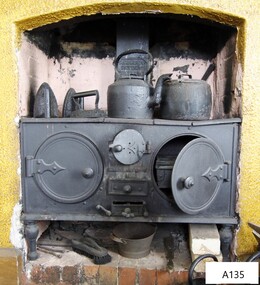
Domestic object - Stove, First quarter of the 20th Century
... Australian made kitchen stove on the market. When his patent expired numerous imitations were manufactured by other firms but the Nonpareil continued to earn a reputation for quality, economy and excellent cooking. ...Australian made kitchen stove on the market. When his patent expired numerous imitations were manufactured by other firms but the Nonpareil continued to earn a reputation for quality, economy and excellent cooking. ...The first Australian cast iron stove was made by Charles Andrews in 1877 he patented his design and called it the “Andrews Nonpareil stove.” That for many years was the only Australian made kitchen stove on the market. When his patent expired numerous imitations were manufactured by other firms but the Nonpareil continued to earn a reputation for quality, economy and excellent cooking. The company operated at 47-10 Gheringhap Street Geelong, Victoria, they also specialised in hot water generating services.The subject item is significant as a copy of the well known design for the original Nonpareil stove by Charles Andrews. The name Andrews Nonpareil in stamped on the flue however the doors on the stove front are wrong and indicate the item is a copy by an unknown manufacturer probably made in the first quarter of the 20th century. Stove cast iron on 4 legs, two oven spaces with round doors. On flue "Andrews Patent Nonpareil".On flue "Andrew Patent Nonpareil"flagstaff hill, warrnambool, shipwrecked coast, flagstaff hill maritime museum, maritime museum, shipwreck coast, flagstaff hill maritime village, great ocean road, stove, iron stove, andrew patent nonpareil, cooking appliance, oven, combustion oven, cooker -
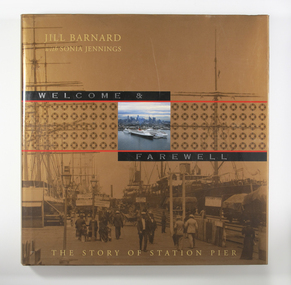 Mission to Seafarers Victoria
Book - Reference book, Jill Barnard et al, Welcome and Farewell: The Story of Station Pier, 2004
... economies, or to its physical development. The Government wanted a history that would also speak to ordinary Victorians, and other Australians, of their own experiences of this significant place. ...In the mid-nineteenth century, Victoria’s primitive maritime infrastructure was not coping with the volume of passenger and cargo traffic arriving in and departing from the burgeoning gold-fevered colony. However, the opening of Railway Pier at Port Melbourne in 1854 greatly improved the situation. Railway Pier serviced the steamships, which plied Port Phillip Bay and the Victorian coastal waters beyond, and also offered berths for vessels on the regular runs to other Australian colonies and to overseas destinations. However, as the larger and more powerful steamships of the early twentieth century found berthing increasingly difficult at Railway Pier, the need for a more modern pier became apparent. By 1930, the new Station Pier had replaced its predecessor. Itself extended and upgraded several times including during the past decade, Station pier still offers every contemporary convenience to shipping services using its busy facilities, just as did its predecessor Railway Pier, 150 years ago. The Victorian Government commissioned Welcome & Farewell to celebrate the 150 years since the opening of the Railway Pier. In doing so, it was mindful that the story of the site is not limited to its contribution to national and state economies, or to its physical development. The Government wanted a history that would also speak to ordinary Victorians, and other Australians, of their own experiences of this significant place. For indeed the Station Pier site has played its part in almost every milestone or phase in our history: at moments of celebration and commemoration, during economic booms and depressions, during times of war and peace. It has also won a place in the hearts of ordinary individuals affected by the welcomes and farewells they have experienced there: those for visiting royalty and celebrities, for servicemen and medical personnel off to war or returning home, for migrants from distant countries and refugees from war zones, for friends and family travelling for personal, professional or cultural reasons. Welcome & Farewell thoughtfully examines Station Pier’s significance and offers a splendid visual panorama of the experiences lived out there between 1854 and 2004.Illustrated large-format book with 224 pages [36] p. of plates. : ill., maps, ports.Bibliography: p. 199-201non-fictionIn the mid-nineteenth century, Victoria’s primitive maritime infrastructure was not coping with the volume of passenger and cargo traffic arriving in and departing from the burgeoning gold-fevered colony. However, the opening of Railway Pier at Port Melbourne in 1854 greatly improved the situation. Railway Pier serviced the steamships, which plied Port Phillip Bay and the Victorian coastal waters beyond, and also offered berths for vessels on the regular runs to other Australian colonies and to overseas destinations. However, as the larger and more powerful steamships of the early twentieth century found berthing increasingly difficult at Railway Pier, the need for a more modern pier became apparent. By 1930, the new Station Pier had replaced its predecessor. Itself extended and upgraded several times including during the past decade, Station pier still offers every contemporary convenience to shipping services using its busy facilities, just as did its predecessor Railway Pier, 150 years ago. The Victorian Government commissioned Welcome & Farewell to celebrate the 150 years since the opening of the Railway Pier. In doing so, it was mindful that the story of the site is not limited to its contribution to national and state economies, or to its physical development. The Government wanted a history that would also speak to ordinary Victorians, and other Australians, of their own experiences of this significant place. For indeed the Station Pier site has played its part in almost every milestone or phase in our history: at moments of celebration and commemoration, during economic booms and depressions, during times of war and peace. It has also won a place in the hearts of ordinary individuals affected by the welcomes and farewells they have experienced there: those for visiting royalty and celebrities, for servicemen and medical personnel off to war or returning home, for migrants from distant countries and refugees from war zones, for friends and family travelling for personal, professional or cultural reasons. Welcome & Farewell thoughtfully examines Station Pier’s significance and offers a splendid visual panorama of the experiences lived out there between 1854 and 2004.port melbourne, station pier -
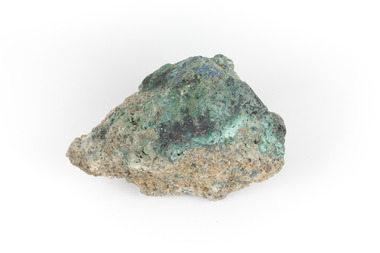 The Beechworth Burke Museum
Geological specimen - Malachite, Unknown
... Australia. Otherwise known as the 'Monster Mine', the Burra Burra Copper Mine was first established in 1848 upon the discovery of copper deposits in 1845. Within a few short years, people from around the world migrated to Burra to lay their claim in the copper economy. ...Australia. Otherwise known as the 'Monster Mine', the Burra Burra Copper Mine was first established in 1848 upon the discovery of copper deposits in 1845. Within a few short years, people from around the world migrated to Burra to lay their claim in the copper economy. ...Malachite is typically found as crystalline aggregates or crusts, often banded in appearance, like agates. It is also often found as botryoidal clusters of radiating crystals, and as mammillary aggregates as well. Single crystals and clusters of distinguishable crystals are uncommon, but when found they are typically acicular to prismatic. It is also frequently found as a pseudomorph after Azurite crystals, which are generally more tabular in shape. This particular specimen was recovered from the Burra Burra Copper Mine in Burra, South Australia. Otherwise known as the 'Monster Mine', the Burra Burra Copper Mine was first established in 1848 upon the discovery of copper deposits in 1845. Within a few short years, people from around the world migrated to Burra to lay their claim in the copper economy. By April 1848 the mine was employing over 567 people and supporting a population of 1,500 in the local township. Up until 1860, the mine was the largest metals mine in Australia, producing approximately 50,000 tonnes of copper between 1845 to its closure in 1877. The Burra Burra Mine was also famous for a number of other specimens, including; crystalline azurite, cuprite, and botryoidal and malachite. Malachite is considered a rare gemstone in that the original deposits for the stones have been depleted leaving behind very few sources. In addition, the use of Malachite as gemstones and sculptural materials remains just as popular today as they were throughout history. It is quite common to cut the stone into beads for jewellery. The fact that Malachite has such a rich colour and one that does not fade with time or when exposed to light makes it particularly rare. This specimen is part of a larger collection of geological and mineral specimens collected from around Australia (and some parts of the world) and donated to the Burke Museum between 1868-1880. A large percentage of these specimens were collected in Victoria as part of the Geological Survey of Victoria that begun in 1852 (in response to the Gold Rush) to study and map the geology of Victoria. Collecting geological specimens was an important part of mapping and understanding the scientific makeup of the earth. Many of these specimens were sent to research and collecting organisations across Australia, including the Burke Museum, to educate and encourage further study. A solid hand-sized copper carbonate hydroxide mineral with shades of blue and light green throughout. burke museum, beechworth, indigo shire, beechworth museum, geological, geological specimen, mineralogy, burra, burra burra mine, south australia, malachite, malachite specimen -
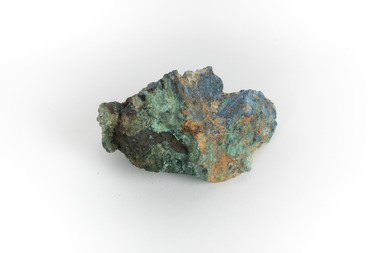 The Beechworth Burke Museum
Geological specimen - Malachite, Unknown
... Australia. Otherwise known as the 'Monster Mine', the Burra Burra Copper Mine was first established in 1848 upon the discovery of copper deposits in 1845. Within a few short years, people from around the world migrated to Burra to lay their claim in the copper economy. ...Australia. Otherwise known as the 'Monster Mine', the Burra Burra Copper Mine was first established in 1848 upon the discovery of copper deposits in 1845. Within a few short years, people from around the world migrated to Burra to lay their claim in the copper economy. ...Malachite is a green copper carbonate hydroxide mineral and was one of the first ores used to make copper metal. Malachite has been utilised as a gemstone and sculptural material in the past as its distinctive green color does not fade when exposed to light or after long periods of time. Malachite is formed at shallow depths in the ground, in the oxidizing zone above copper deposits. The material has also been used as a pigment for painting throughout history. This particular specimen was recovered from the Burra Burra Copper Mine in Burra, South Australia. Otherwise known as the 'Monster Mine', the Burra Burra Copper Mine was first established in 1848 upon the discovery of copper deposits in 1845. Within a few short years, people from around the world migrated to Burra to lay their claim in the copper economy. By April 1848 the mine was employing over 567 people and supporting a population of 1,500 in the local township. Up until 1860, the mine was the largest metals mine in Australia, producing approximately 50,000 tonnes of copper between 1845 to its closure in 1877. The Burra Burra Mine was also famous for a number of other specimens, including; crystalline azurite, cuprite, and botryoidal and malachite.Malachite is considered a rare gemstone in that the original deposits for the stones have been depleted leaving behind very few sources. In addition, the use of Malachite as gemstones and sculptural materials remains just as popular today as they were throughout history. It is quite common to cut the stone into beads for jewellery. The fact that Malachite has such a rich colour and one that does not fade with time or when exposed to light makes it particularly rare. This specimen is part of a larger collection of geological and mineral specimens collected from around Australia (and some parts of the world) and donated to the Burke Museum between 1868-1880. A large percentage of these specimens were collected in Victoria as part of the Geological Survey of Victoria that begun in 1852 (in response to the Gold Rush) to study and map the geology of Victoria. Collecting geological specimens was an important part of mapping and understanding the scientific makeup of the earth. Many of these specimens were sent to research and collecting organisations across Australia, including the Burke Museum, to educate and encourage further study. A solid hand-sized copper carbonate hydroxide mineral with shades of yellow, blue, and light green throughout.geological, geological specimen, burke museum, indigo shire, malachite, malachite specimen, burra burra mine, burra, south australia, australian mines, mines, monster mine -
Federation University Historical Collection
Book - Book - Scrapbook, Ballarat College of Advanced Education: Scrapbook of newspaper cutting, Book 10; September 1981 to May 1982
... Australian, The Herald. The cuttings cover the period from 2 September 1981 to 6 May 1982. . employment advertisements application for enrolment outline of courses more students less money bcae staff cuts fewer graduates in engineering half marathon need for more maths and science students energy resources control warning bcae spring festival companies woo bcae engineering graduates engineering students and 'the iron horse' recreation survey p e degree course energy saving project student winemakers tom nestor wins award nigerian students studies ground movement sir arthur nicholson golden taste of success ivan durrant on art students critical time for ballarat's economy first group to complete arts degree francis brown john mcmahon award in metallurgy award in mechanical engineering pottery group's first show rich clays of ballarat colleges to retrench staff retirement of frank ryan growing computer industry new job in northern territory break-in brumbies ballarat's young jobless librarians enter computer age tertiary chief sacked dr jim watson hsc seminar at bcae students eat too much fast food chemistry graduate to work in canberra stephen wilson dianne budge to work in alice springs physical fitness director of ymca revamp for key tertiary commission lake weed problem businessmen wooed move to promote health fitness scholarships for students robert allan artist move to save bendigo course hobby course for gold prospectors john crump ceramics day of firsts at bcae track and field titles win tamara beckier artist abstract art talks on future of regional colleges government funding Book with grey cover, front. ...Newspaper cuttings relating to Ballarat College of Advanced Education. These are from various newspapers and include The Age, Ballarat Courier, The Australian, The Herald. The cuttings cover the period from 2 September 1981 to 6 May 1982. . Book with grey cover, front. Image of image of two trotters. Spiral bound.employment advertisements, application for enrolment, outline of courses, more students less money, bcae staff cuts, fewer graduates in engineering, half marathon, need for more maths and science students, energy resources control warning, bcae spring festival, companies woo bcae engineering graduates, engineering students and 'the iron horse', recreation survey, p e degree course, energy saving project, student winemakers, tom nestor wins award, nigerian students studies ground movement, sir arthur nicholson, golden taste of success, ivan durrant on art students, critical time for ballarat's economy, first group to complete arts degree, francis brown, john mcmahon, award in metallurgy, award in mechanical engineering, pottery group's first show, rich clays of ballarat, colleges to retrench staff, retirement of frank ryan, growing computer industry, new job in northern territory, break-in brumbies, ballarat's young jobless, librarians enter computer age, tertiary chief sacked, dr jim watson, hsc seminar at bcae, students eat too much fast food, chemistry graduate to work in canberra, stephen wilson, dianne budge to work in alice springs, physical fitness director of ymca, revamp for key tertiary commission, lake weed problem, businessmen wooed, move to promote health fitness, scholarships for students, robert allan artist, move to save bendigo course, hobby course for gold prospectors, john crump ceramics, day of firsts at bcae, track and field titles win, tamara beckier artist, abstract art, talks on future of regional colleges, government funding -
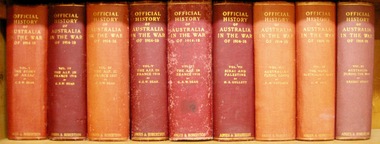 Lara RSL Sub Branch
Book, Official History of Australia in the War of 1914-18 - Volume XI - Australia During the War Author Ernest Scott Professor of History at Melbourne University, 1937
... australia...formation of armies...equipment of armies...matters of policy...gallipoli...conscription...conscription movement...military service referendum act...the last months of the war...economy...It describes the background - political, social, industrial, economic-against which the war effort of Australia was projected. australia declaration of war commonwealth cabinet war pledges of political leadeers censorship of newspapers censorship of mail blind codes internment camps hughes stress of war military organisations of australia formation of armies equipment of armies matters of policy gallipoli conscription conscription movement military service referendum act the last months of the war economy aspects of the war commonwealth taxation patriotic funds peace conference Official History of Australia in the War of 1914-18 - Volume XI - Australia During the War. ...This book deals almost entirely with occurrences within Australia. It describes the background - political, social, industrial, economic-against which the war effort of Australia was projected.This book deals almost entirely with occurrences within Australia. It describes the background - political, social, industrial, economic-against which the war effort of Australia was projected.Official History of Australia in the War of 1914-18 - Volume XI - Australia During the War. Illustrations, Photographs,australia, declaration of war, commonwealth cabinet, war pledges of political leadeers, censorship of newspapers, censorship of mail, blind codes, internment camps, hughes, stress of war, military organisations of australia, formation of armies, equipment of armies, matters of policy, gallipoli, conscription, conscription movement, military service referendum act, the last months of the war, economy aspects of the war, commonwealth taxation, patriotic funds, peace conference
