
Showing 425 items matching "education age"
-
 Federation University Historical Collection
Document - Fourth University, Documents relating to a Fourth University for Victoria collected by E.J. Barker
... ...Education Age...Smith City of Ballarat J.A Chisholm 16 named to plan fourth university Newsletter Report Future Developement of Tertiary Education Summary of Statements Education Age M.B. John Tertiary Education Advisory Council A.S Buchanan The Chartered Engineer Dr. ...E.J. Barker is a past principal of the School of Mines Ballarat and the Library at the Mt Helen Campus is named after him. School of Mines is a predecessor of Federation UniversityVarious Letters, Reports Newspaper articles and notes collected by E.J. Barker on the proposed Fourth University for Victoria victorian institute of colleges staff association, r.w. hinkley, e.j. barker, ballarat institute of advanced education, vicsac, fourth university, summary, k.l jennings, mr swanson, australian universities commission, plea on varsity staff rejected, list of visitors, professor p.h. karmel, professor f.b. bull, sir ernest coates, dr w.l. hughes, sir samuel jones, professor a.r. main, professor p.h. partridge, r.a. simpson, professor sir sydney sunderland, t.b. swanson, r.h. arthur, a. freebody, sir willis h. connolly, l.h.s. thompson, geelong advertiser, newspaper articles, the age, i.c. smith, city of ballarat, j.a chisholm, 16 named to plan fourth university, newsletter, report, future developement of tertiary education, summary of statements, education age, m.b. john, tertiary education advisory council, a.s buchanan, the chartered engineer, dr. d.m. myers, r. law, victorian institute of colleges, a.s. craig, meetings, mr hamer, h.p. mason, bendigo institute of technology, mary p. lawn, k.d. green, premiers department, recommendations, k. beazley, a.m mackinnon, gordon institute of technology, e. szomanski -
 Glen Eira Historical Society
Article - Caulfield Institute of Technology
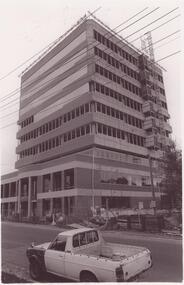
... Education... Mature age students...Boykett Building Monash University Dandenong Road Caulfield East Victorian Education Department School of Business School of Applied Sciences School of Engineering School of Industrial Studies School of General Studies (Humanities Sociology Art and Design) Technical Schools Technical Colleges Education Secondary Education Mature age students David Syme Business School 'Contact' Article Caulfield Institute of Technology ...Four items about the establishment,history and courses provided at this Institute: 1/Research notes (2 pages in all) regarding the renaming of Caulfield Technical School to Caulfield Institute of Technology in 1968 sourced from La Trobe Library Reference Index. Several dates listed. Reference also to article on construction of building in 'Australian Builder' of January 1950. 2/Photocopy of article from 'The Australian Accountant', April 1975. Gives history of C.I.T. and of Business School courses plus photos. (3 pages) 3/Advertising flyer for 'The David Syme Business School at CIT' listing courses for enrolment by 15/12/1978. 4/Undated black and white photograph of building in progress on site of Caulfield Institute/Monash University Caulfield. Noted on reverse'Chisholm Tower', 'Contact June 29, PIC 3 PG3 100% pl2' ie likely taken by photographer for 'Caulfield Contact'.miller j.o. mr. (b.a. b. com. f.a.s.a.), huggan noel, halstead h.j. mr., kurtz david professor, holmes graham, collins mike, chataway graham, erdonmez hassan, gleeson june, voumard lou, coombe jack, caulfield technical college, caulfield technical school, caulfield institute of technology (cit), k.h. boykett building, monash university, dandenong road, caulfield east, victorian education department, school of business, school of applied sciences, school of engineering, school of industrial studies, school of general studies (humanities sociology art and design), technical schools, technical colleges, education, secondary education, mature age students, david syme business school, 'contact' -
Tatura Irrigation & Wartime Camps Museum
Book, The War 50 Years On, 1989
... Produced by the Age Education Unit...Produced by the Age Education Unit the war 50 years on the age tatura ww2 books history local Off white soft cover book with black text front and back covers. ...Produced by the Age Education UnitOff white soft cover book with black text front and back covers. Slouch hat on front coverthe war 50 years on, the age, tatura, ww2, books, history, local -
 Northern District School of Nursing. Managed by Bendigo Historical Society Inc.
Document - Nursing vacancies
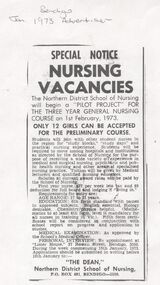
... Only 12 girls will be accepted. Includes Age Range, Education, Medical Examination and Personal Interview. ...Only 12 girls will be accepted. Includes Age Range, Education, Medical Examination and Personal Interview. ...The Northern District School of Nursing opened in 1950 in to address the issues around nurse recruitment, training and education that had previously been hospital based. The residential school was to provide theoretical and in-house education and practical training over three years. The students would also receive practical hands-on training in the wards of associated hospitals. The Northern District School of Nursing operated from Lister House, Rowan Street, Bendigo. It was the first independent school of nursing in Victoria and continued until it closed in 1989. The book "The First of its Kind" was published in 2015. Printed in Bendigo by "Bendigo Modern Press". Memories compiled by Peter Rosewall; who attended the last NDSN school PTS 108 between 1986 - 89.Copy of newspaper article from Bendigo Advertiser, January 1973 "Special Notice Nursing Vacancies". NDSN will being a PILOT PROJECT for three year general nursing on 1st February 1973. Only 12 girls will be accepted. Includes Age Range, Education, Medical Examination and Personal Interview. Article signed by "The Dean" Northern District School of Nursing. The newspaper article and photograph has been copied from the original newspaper. memoir, nursing, ndsn, mr norm phillips, nancy winifred long mbe -
 Northern District School of Nursing. Managed by Bendigo Historical Society Inc.
Pamphlet - Information Brochure
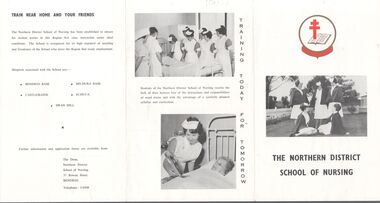
... Prerequisites and training scheme - Age, Education, Health, Training, Examinations. ...Prerequisites and training scheme - Age, Education, Health, Training, Examinations. ...Nursing as a Career- Nursing is a challenging and rewarding profession to both the girls who take it up as a career. Prerequisites and training scheme - Age, Education, Health, Training, Examinations. Your future assured Graduation then what - After graduating some nurses choose to work outside the Hospital in related occupations- Train near home and your friends. The NDSN has been established to ensure student nurses in this region first class instruction under ideal conditions.Nursing as a Career- Training today for tomorrow. Brochure folded in three sections double sided. White background - Photo of Nurses in the Middle and Red and Gold insignia in middle at top with a red double cross. Internal Black and White photos of nursing/hospital environment.nursing education equipment, nurse training, nursing information -
 Orbost & District Historical Society
globe, C1958
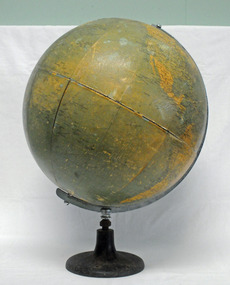
... She retired from the Education Department temporary staff, aged 76. ( More info.from Newsletter November 2015 by John Phillips). ...She retired from the Education Department temporary staff, aged 76. ( More info.from Newsletter November 2015 by John Phillips). ...This desk globe was owned by Evelyn Bessie Travaskis and used when teaching at State School Wairewa where she taught from 2-2-1945 until her retirement on 29-6-1956. She retired from the Education Department temporary staff, aged 76. ( More info.from Newsletter November 2015 by John Phillips). The Philips' Challenge Globe was commonly used in Australian schools in the teaching of geography. This item is associated with the history of education in East Gippsland. It is also associated with Evelyn Trevaskis.A large globe mounted on a round metal stand which has three holes for securing to a flat surface - a desk or tabletop. It sits in a half meridian.C 1958 Philips' Challenge Globetrevaskis-evelyn globe education-equipment-geography wairewa-school -
 Bendigo Historical Society Inc.
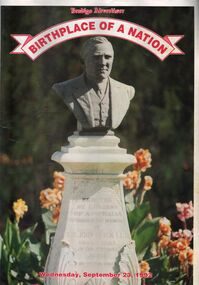
Newspaper - AILEEN AND JOHN ELLISON COLLECTION: BENDIGO ADVERTISER SEPTEMBER 23, 1992 - BIRTHPLACE OF A NATION
... Cover story: Sir John Quick (pages 2/26) - The Arts (pages 30/31) - Tourist Time (page32) - Water of Life (pages 38/40) - Snaps in Time (pages 45/56) - The Chinese (pages 62/65) - Education (pages83/89) - The Aged (pages 94/100)....Cover story: Sir John Quick (pages 2/26) - The Arts (pages 30/31) - Tourist Time (page32) - Water of Life (pages 38/40) - Snaps in Time (pages 45/56) - The Chinese (pages 62/65) - Education (pages83/89) - The Aged (pages 94/100). Newspaper AILEEN AND JOHN ELLISON COLLECTION: BENDIGO ADVERTISER SEPTEMBER 23, 1992 - BIRTHPLACE OF A NATION ...A special from the Bendigo Advertiser on birthplace of a Nation' issued Wednesday, September 23, 1992. This special issue has 100 pages. On the cover a colour photograph of the monument erected by citizens of Australia to honour the memory of Sir John Quick LLD 1852-1932. Lawyer, Statesman, Judge. Qui Patitur Vincet. Cover story: Sir John Quick (pages 2/26) - The Arts (pages 30/31) - Tourist Time (page32) - Water of Life (pages 38/40) - Snaps in Time (pages 45/56) - The Chinese (pages 62/65) - Education (pages83/89) - The Aged (pages 94/100).newspaper, bendigo advertiser, centenary supplements -
 Melbourne Legacy
Photograph, Annual Demonstration
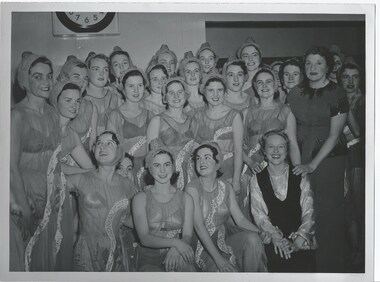
... She joined Melbourne Legacy in 1932 and became the chief instructor of girls' physical education until she retired aged 65 in 1970....She joined Melbourne Legacy in 1932 and became the chief instructor of girls' physical education until she retired aged 65 in 1970. A record of the displays at the Annual Demonstrations. ...A photo of senior girls in costumes from an annual demonstration with Miss Enez Domec Carre. Also a photo of them on stage during the performance. Throughout the year Melbourne Legacy provided classes for Junior Legatees such as dancing, gymnastics and Eurythmics. The Demonstration was an annual event to showcase their skills. Melbourne Legacy conducted Annual Demonstrations / Parades from 1928 through to 1979s, usually held at Melbourne Town Hall. The beautiful costumes were made by members of the Junior Legacy Mothers' Club and the Melbourne Legacy Wives' Association. Miss Enez Domec-Carre was the supervisor of girls classes and instrumental in the Annual Demonstration for many years. She joined Melbourne Legacy in 1932 and became the chief instructor of girls' physical education until she retired aged 65 in 1970.A record of the displays at the Annual Demonstrations. Also that Legacy provided classes for junior legatees and the skills learned were displayed in the Annual Demonstration.Black and white photo of junior legatee girls in costume back stage with Miss Carre at an Annual Demonstration and a photo of them on stage during the performance.annual demonstration, junior legatee, girls' classes, enez domec carre, costume -
 Flagstaff Hill Maritime Museum and Village
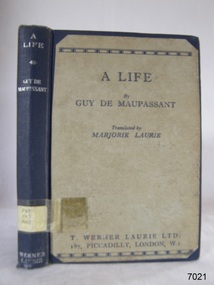
Book - A Fictional story, Henri René Albert Guy de Maupassant, A Life, 1933
... The story centres around Jeanne after returning to her family after finishing her convent education at the age of 17, she is eager to taste what the world has to offer and all the beautiful, exciting emotions one can experience. ...The story centres around Jeanne after returning to her family after finishing her convent education at the age of 17, she is eager to taste what the world has to offer and all the beautiful, exciting emotions one can experience. ...A Life is the English title of Guy De Maupassant’s French novel "Une Vie" (1883), is a realist story about Jeanne de Lamare, a sheltered young woman whose hopes for love and happiness are gradually worn down by marriage, betrayal, family burdens, and disappointment. Maupassant is the author and the book is generally read as a bleak and at time depressing study of illusion versus reality in a woman’s life.A Life Author: Guy De Maupassant, Translated by Marjorie Laurie Publisher: T Werner Laurie Ltd Date: 1933 Further Information: Cover cream, Spine blue with blue lettering to cover and Cream lettering to blue Spine. Library label to Spine.fictionA Life is the English title of Guy De Maupassant’s French novel "Une Vie" (1883), is a realist story about Jeanne de Lamare, a sheltered young woman whose hopes for love and happiness are gradually worn down by marriage, betrayal, family burdens, and disappointment. Maupassant is the author and the book is generally read as a bleak and at time depressing study of illusion versus reality in a woman’s life.warrnambool, shipwrecked-coast, flagstaff-hill, flagstaff-hill-maritime-museum, maritime-museum, flagstaff-hill-maritime-village, shipwrecked-artefact, book, a life, guy de maupassant, warrnambool mechanics’ institute, pattison collection, warrnambool library, corangamite regional library service, warrnambool city librarian, mechanics’ institute library, victorian library board, warrnambool books and records, warrnambool children’s library, henri rené albert guy de maupassant, ralph eric pattison -
 Melbourne Legacy
Letter, Enez Domec-Carre, 1971
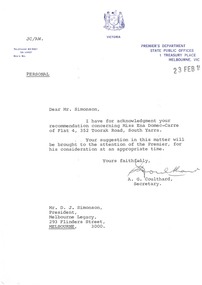
... Miss Domec-Carre joined Melbourne Legacy in 1932 and became the chief instructor of girls' physical education until she retired aged 65. In the post World War II baby boom the Legacy evening classes were attended by about 400 girls. ...Miss Domec-Carre joined Melbourne Legacy in 1932 and became the chief instructor of girls' physical education until she retired aged 65. In the post World War II baby boom the Legacy evening classes were attended by about 400 girls. ...A letter from the Secretary of the Victorian Premier's Department dated 23 February 1971 acknowledging the recommendation by President D.J. Simonson that Miss Ena (Enez) Domec-Carre be honoured. The suggestion bore fruit in the Queen's Birthday honours that year and Miss Domec-Carre was awarded the MBE. Miss Domec-Carre joined Melbourne Legacy in 1932 and became the chief instructor of girls' physical education until she retired aged 65. In the post World War II baby boom the Legacy evening classes were attended by about 400 girls. She helped organise Legacy Widows and Legatee wives to sew the costumes for performances. Among her proudest moments was a display by 1000 Junior Legatees at the MCG during the 1954 visit of Queen Elizabeth II. As well her work for Legacy she ran physical education, ballroom dancing and debutante preparation classes in Windsor, Elsternwick, Gardenvale and Geelong. See also Cat.No. 00978Primary source material for a dedicated teacher of both in Legacy and the wider community.Sheet of white letterhead, blue print and black type.Signed in black ballpoint 'A.G. Coulthard'girls' classes, enez domec carre -
 Melbourne Legacy
Photograph, Annual Demonstration 1953, 1953
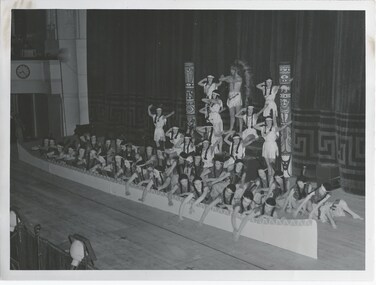
... She joined Melbourne Legacy in 1932 and became the chief instructor of girls' physical education until she retired aged 65 in 1970....She joined Melbourne Legacy in 1932 and became the chief instructor of girls' physical education until she retired aged 65 in 1970. A record of the set and costumes used at the Annual Demonstrations. ...A photo of senior girls in a scene from an annual demonstration. The girls were dressed as native American girls, some are in a kayak and others stand near totem poles. One of these two photos was used in the July 1954 newsletter to highlight the work of the girls classes. Throughout the year Melbourne Legacy provided classes for Junior Legatees such as dancing, gymnastics and Eurythmics. The Demonstration was an annual event to showcase their skills. Melbourne Legacy conducted Annual Demonstrations / Parades from 1928 through to the 1980's, usually held at Melbourne Town Hall or Olympic Pool Stadium. The beautiful costumes were made by members of the Junior Legacy Mothers' Club and the Melbourne Legacy Wives' Association. Miss Enez Domec-Carre was the supervisor of girls classes and instrumental in the Annual Demonstration for many years. She joined Melbourne Legacy in 1932 and became the chief instructor of girls' physical education until she retired aged 65 in 1970.A record of the set and costumes used at the Annual Demonstrations. Also that Legacy provided classes for junior legatees and the skills learned were displayed in the Annual Demonstration.Black and white photo of junior legatees in native American costume in a mock kayak on stage at an Annual Demonstration. There are two copies of different sizes.annual demonstration, junior legatee, costume, totem pole -
 Melbourne Legacy
Photograph, Annual Demonstration
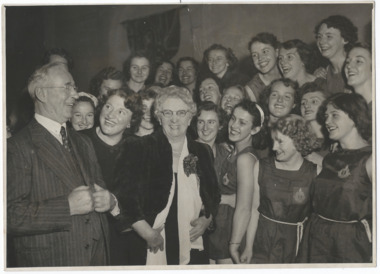
... She joined Melbourne Legacy in 1932 and became the chief instructor of girls' physical education until she retired aged 65 in 1970....She joined Melbourne Legacy in 1932 and became the chief instructor of girls' physical education until she retired aged 65 in 1970. A record of that Legatee Stan Savige attended Annual Demonstrations and that Legacy provided classes for junior legatees and the skills learned were displayed in the Annual Demonstration. annual demonstration junior legatee enez domec carre Gillies Black and white photo of L/ Stan Savige, Enez, Mrs Gillies and junior legatees at an Annual Demonstration. ...A photo of L/ Stan Savige with Miss Enez Domec-Carre and Mrs Gilles some of the senior girls. It was at an annual demonstration in the late 1940s or early 1950s as it was published in the newsletter with the news of Legatee Savige dying in 1954. The senior girls are all in their gymnastics outfits with Legacy logo. These were provided free of charge to Junior Legatees attending the weekly classes run by Legacy. Mrs Gillies was the first instructress of Girls' Classes. Throughout the year Melbourne Legacy provided classes for Junior Legatees such as dancing, gymnastics and Eurythmics. The Demonstration was an annual event to showcase their skills. Melbourne Legacy conducted Annual Demonstrations / Parades from 1928 through to the 1980's, usually held at Melbourne Town Hall or Olympic Pool Stadium. The beautiful costumes were made by members of the Junior Legacy Mothers' Club and the Melbourne Legacy Wives' Association. Miss Enez Domec-Carre was the supervisor of girls classes and instrumental in the Annual Demonstration for many years. She joined Melbourne Legacy in 1932 and became the chief instructor of girls' physical education until she retired aged 65 in 1970.A record of that Legatee Stan Savige attended Annual Demonstrations and that Legacy provided classes for junior legatees and the skills learned were displayed in the Annual Demonstration.Black and white photo of L/ Stan Savige, Enez, Mrs Gillies and junior legatees at an Annual Demonstration.annual demonstration, junior legatee, enez domec carre, gillies -
 Melbourne Legacy
Letter, Enez Domec-Carre, 01/01/1959
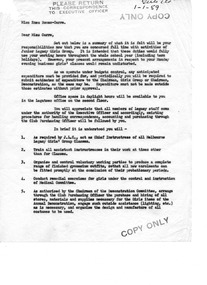
... In 1932 she joined Melbourne Legacy as assistant to Mrs Gilles (wife of a Legatee) later became the chief instructor of girls' physical education until she retired aged 65. In the post World War II baby boom the Legacy evening classes were attended by about 400 girls. ...In 1932 she joined Melbourne Legacy as assistant to Mrs Gilles (wife of a Legatee) later became the chief instructor of girls' physical education until she retired aged 65. In the post World War II baby boom the Legacy evening classes were attended by about 400 girls. ...A letter of appointment to Miss Enez Domec-Carre outlining duties and remuneration for Chief Instructress of all Melbourne Legacy Girls' Group Classes. Enez was the supervisor of the girls classes held at Legacy House for many years. She organised many annual demonstrations and was held in high regard by Legacy. The library at Legacy House is named in her honour. See also a newspaper article at 00978 which outlines her achievements, a summary of her career at 00458 and 00129. She was a former Miss Victoria and was known for her physical education skills and for introducing grace and culture to Melbourne. In 1932 she joined Melbourne Legacy as assistant to Mrs Gilles (wife of a Legatee) later became the chief instructor of girls' physical education until she retired aged 65. In the post World War II baby boom the Legacy evening classes were attended by about 400 girls. She helped organise Legacy Widows and Legatee wives to sew the costumes for performances. Among her proudest moments was a display by 1000 Junior Legatees at the MCG during the 1954 visit of Queen Elizabeth II. As well her work for Legacy she ran physical education, ballroom dancing and debutante preparation classes.A record of the appointment and duties of Miss Enez Domec-Carre as Chief Instructress of Legacy Girls' ClassesWhite quarto paper carbon copy, a letter x 2 pages to Enez Domec-CarreHandwritten "Girls classes 1-1-59" Stamped "COPY ONLY" and "PLEASE RETURN THIS CORRESPONDENCE TO EXECUTIVE OFFICER"annual demonstration, girls' classes, enez domec carre -
 Melbourne Legacy
Document - Speech, Miss Enez Domec-Carre, 1970
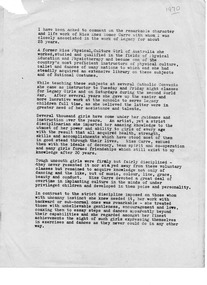
... In 1932 she joined Melbourne Legacy as assistant to Mrs Gilles (wife of a Legatee) later became the chief instructor of girls' physical education until she retired aged 65. In the post World War II baby boom the Legacy evening classes were attended by about 400 girls. ...In 1932 she joined Melbourne Legacy as assistant to Mrs Gilles (wife of a Legatee) later became the chief instructor of girls' physical education until she retired aged 65. In the post World War II baby boom the Legacy evening classes were attended by about 400 girls. ...A narrative of Miss Enez Domec-Carre's work with Melbourne Legacy. Appears to be text of a speech made on her retirement which was on 31 December 1970. Enez was the supervisor of the girls classes held at Legacy House for 36 years. She organised many annual demonstrations and was held in high regard by Legacy. The library at Legacy House is named in her honour. See also a newspaper article at 00978 which outlines her achievements, a summary of her career at 00458 and 00129. She was a former Miss Victoria and was known for her physical education skills and for introducing grace and culture to Melbourne. In 1932 she joined Melbourne Legacy as assistant to Mrs Gilles (wife of a Legatee) later became the chief instructor of girls' physical education until she retired aged 65. In the post World War II baby boom the Legacy evening classes were attended by about 400 girls. She helped organise Legacy Widows and Legatee wives to sew the costumes for performances. Among her proudest moments was a display by 1000 Junior Legatees at the MCG during the 1954 visit of Queen Elizabeth II. As well her work for Legacy she ran physical education, ballroom dancing and debutante preparation classes.Description of the contribution to the work of Melbourne Legacy by Miss Carre with Girls' Classes and in other areas.Off-white photocopy of typed speech by W.V. Scott. 3 pages.Top right corner of page one "1970" handwritten in blue pen. "W.V. Scott" handwritten in blue pen following text on page three.girls' classes, annual demonstration, enez domec carre -
 Melbourne Legacy
Letter, Enez Domec-Carre, 10/07/1970
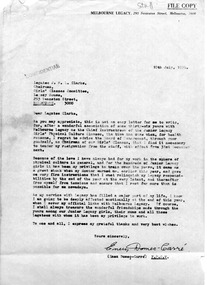
... In 1932 she joined Melbourne Legacy as assistant to Mrs Gilles (wife of a Legatee) later became the chief instructor of girls' physical education until she retired aged 65. In the post World War II baby boom the Legacy evening classes were attended by about 400 girls. ...In 1932 she joined Melbourne Legacy as assistant to Mrs Gilles (wife of a Legatee) later became the chief instructor of girls' physical education until she retired aged 65. In the post World War II baby boom the Legacy evening classes were attended by about 400 girls. ...Photocopy of a typed letter from Enez Domec-Carre to Legatee J.M.L. Clarke, Chairman of Girls' Classes Committee, tendering her resignation effective from 31st December 1970. Enez was the supervisor of the girls classes held at Legacy House for many years. She organised many annual demonstrations and was held in high regard by Legacy. The library at Legacy House is named in her honour. See also a newspaper article at 00978 which outlines her achievements, a summary of her career at 00458 and 00129. She was a former Miss Victoria and was known for her physical education skills and for introducing grace and culture to Melbourne. In 1932 she joined Melbourne Legacy as assistant to Mrs Gilles (wife of a Legatee) later became the chief instructor of girls' physical education until she retired aged 65. In the post World War II baby boom the Legacy evening classes were attended by about 400 girls. She helped organise Legacy Widows and Legatee wives to sew the costumes for performances. Among her proudest moments was a display by 1000 Junior Legatees at the MCG during the 1954 visit of Queen Elizabeth II. As well her work for Legacy she ran physical education, ballroom dancing and debutante preparation classes.Resignation of Miss Enez Domec-Carre as Chief Instructress of Legacy Girls' Classes after having served Legacy for 36 years.Off-white foolscap paper photocopy of a typed letter from Enez Domec-Carre to Legatee J.M.L. ClarkeStamped in purple "CONFIDENTIAL". "COPY TO .... FOR INFORMATION ONLY" and blue handwriting "Executive Officer"girls' classes, enez domec carre -
 Melbourne Legacy
Newspaper - Article, Salute to a Legacy Veteran, 1988
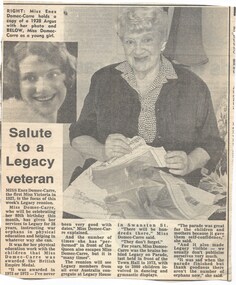
... In 1932 she joined Melbourne Legacy as assistant to Mrs Gilles (wife of a Legatee) later became the chief instructor of girls' physical education until she retired aged 65. In the post World War II baby boom the Legacy evening classes were attended by about 400 girls. ...In 1932 she joined Melbourne Legacy as assistant to Mrs Gilles (wife of a Legatee) later became the chief instructor of girls' physical education until she retired aged 65. In the post World War II baby boom the Legacy evening classes were attended by about 400 girls. ...A newspaper article published in The Sun on 25 March 1988 as Legacy was preparing to celebrate the a Legacy reunion featuring Miss Enez Domec-Carre who was turning 80. Enez was the supervisor of the girls classes held at Legacy House for many years - 38 years according to this article. She organised many annual demonstrations and was held in high regard by Legacy. The library at Legacy House is named in her honour. See also a newspaper article at 00978 which outlines her achievements, a summary of her career at 00458 and 00129. She was a former Miss Victoria and was known for her physical education skills and for introducing grace and culture to Melbourne. In 1932 she joined Melbourne Legacy as assistant to Mrs Gilles (wife of a Legatee) later became the chief instructor of girls' physical education until she retired aged 65. In the post World War II baby boom the Legacy evening classes were attended by about 400 girls. She helped organise Legacy Widows and Legatee wives to sew the costumes for performances. Among her proudest moments was a display by 1000 Junior Legatees at the MCG during the 1954 visit of Queen Elizabeth II. As well her work for Legacy she ran physical education, ballroom dancing and debutante preparation classes.A record that Legacy was saluting the hard work of Miss Domec-Carre in 1988.Newspaper cutting about Miss Enez Domec-Carre in 1988.girls' classes, enez domec carre -
 Melbourne Legacy
Newspaper - Article, Enez Domec-Carre / Epitomised Team Spirit, 1998
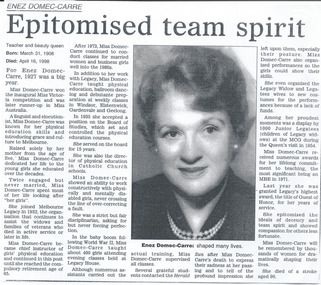
... In 1932 she joined Melbourne Legacy and became the chief instructor of girls' physical education until she retired aged 65. In the post World War II baby boom the Legacy evening classes were attended by about 400 girls. ...In 1932 she joined Melbourne Legacy and became the chief instructor of girls' physical education until she retired aged 65. In the post World War II baby boom the Legacy evening classes were attended by about 400 girls. ...Miss Enez Domec-Carre was the teacher of the girls classes at Legacy. This article was an obituary published in 1998 when she died of a stroke aged 90. She was a former Miss Victoria and was known for her physical education skills and for introducing grace and culture to Melbourne. In 1932 she joined Melbourne Legacy and became the chief instructor of girls' physical education until she retired aged 65. In the post World War II baby boom the Legacy evening classes were attended by about 400 girls. She helped organise Legacy Widows and Legatee wives to sew the costumes for performances. Among her proudest moments was a display by 1000 Junior Legatees at the MCG during the 1954 visit of Queen Elizabeth II. As well her work for Legacy she ran physical education, ballroom dancing and debutante preparation classes in Windsor, Elsternwick, Gardenvale and Geelong. She also held a position on the Board of Studies and as director of physical education in Catholic Schools. Recognition of her work included being awarded an MBE in 1971. And in 1997 she received Legacy's highest award, the title of Guest of Honour, for her years of service. See also Cat.No. 01300. Another copy of this article was found with 'Box 10 / JL12' in blue pen. This was part of an archive project JL standing for Junior Legacy items.A snapshot of the life of Enez Domec-Carre who was a huge influence in the life of Junior Legatee girls who attended Legacy classes.Photocopy of a newspaper article on Miss Domec-Carreenez domec carre, girls' classes, girls' club, annual demonstration -
 Melbourne Legacy
Photograph, Enez Domec-Carre, 1998
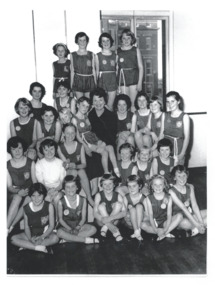
... In 1932 she joined Melbourne Legacy as assistant to Mrs Gilles (wife of a Legatee) later became the chief instructor of girls' physical education until she retired aged 65. In the post World War II baby boom the Legacy evening classes were attended by about 400 girls. ...In 1932 she joined Melbourne Legacy as assistant to Mrs Gilles (wife of a Legatee) later became the chief instructor of girls' physical education until she retired aged 65. In the post World War II baby boom the Legacy evening classes were attended by about 400 girls. ...A photo of junior legatee girls with Miss Enez Domec-Carre, who was the teacher of the girls classes at Legacy. The document outlines her career and achievements. She was a former Miss Victoria and was known for her physical education skills and for introducing grace and culture to Melbourne. In 1932 she joined Melbourne Legacy as assistant to Mrs Gilles (wife of a Legatee) later became the chief instructor of girls' physical education until she retired aged 65. In the post World War II baby boom the Legacy evening classes were attended by about 400 girls. She helped organise Legacy Widows and Legatee wives to sew the costumes for performances. Among her proudest moments was a display by 1000 Junior Legatees at the MCG during the 1954 visit of Queen Elizabeth II. As well her work for Legacy she ran physical education, ballroom dancing and debutante preparation classes in Windsor, Elsternwick, Gardenvale and Geelong. She also held a position on the Board of Studies and as director of physical education in Catholic Schools. Recognition of her work included being awarded an MBE in 1971. And in 1997 she received Legacy's highest award, the title of Guest of Honour, for her years of service. See also item at 01300 and her 80th birthday at 01541. The marking 'Box 10 / JL1' in black pen. This was part of an archive project JL standing for Junior Legacy items.A snapshot of the life of Enez Domec-Carre who was a huge influence in the life of Junior Legatee girls who attended Legacy classes.Photocopy of a photo of Miss Domec-Carre and a group of girls, and a summary of her life x 3 pages.Handwritten 10/JL12annual demonstration, girls' classes, girls' club, enez domec carre -
 Melbourne Legacy
Photograph, Girls' Classes
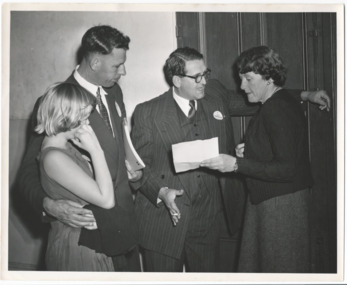
... In 1932 she joined Melbourne Legacy as assistant to Mrs Gilles (wife of a Legatee) later became the chief instructor of girls' physical education until she retired aged 65. In the post World War II baby boom the Legacy evening classes were attended by about 400 girls. ...In 1932 she joined Melbourne Legacy as assistant to Mrs Gilles (wife of a Legatee) later became the chief instructor of girls' physical education until she retired aged 65. In the post World War II baby boom the Legacy evening classes were attended by about 400 girls. ...A photo of 2 legatees (the man with glasses is L/ Schofield) with a junior legatee, talking to Miss Enez Domec-Carre. It appears to be a photo of legatees checking on the progress at one of the many girls classes run by Enez. Enez was the supervisor of the girls classes held at Legacy House for many years. She organised many annual demonstrations and was held in high regard by Legacy. The library at Legacy House is named in her honour. See also a newspaper article at 00978 which outlines her achievements, a summary of her career at 00458 and 00129. She was a former Miss Victoria and was known for her physical education skills and for introducing grace and culture to Melbourne. In 1932 she joined Melbourne Legacy as assistant to Mrs Gilles (wife of a Legatee) later became the chief instructor of girls' physical education until she retired aged 65. In the post World War II baby boom the Legacy evening classes were attended by about 400 girls. She helped organise Legacy Widows and Legatee wives to sew the costumes for performances. Among her proudest moments was a display by 1000 Junior Legatees at the MCG during the 1954 visit of Queen Elizabeth II. As well her work for Legacy she ran physical education, ballroom dancing and debutante preparation classes. The man in glasses is L/ Schofield and the other names and date are unknown. A record that Legatees were generous with their time and skills and that the well being of the junior legatees was very important.Black and white photo of 2 Legatees talking to Miss Enez Domec-Carre and a girl junior legatee.junior legatee, girls' classes, enez domec carre -
 Melbourne Legacy
Article, VALE Enez Domec-Carre - 31st March 1908 to 17th April 1998, 1998
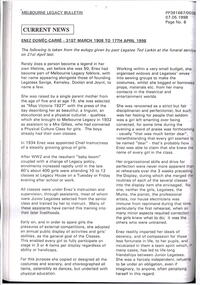
... In 1932 she joined Melbourne Legacy and in 1934 became the chief instructor of girls' physical education until she retired aged 65. In the post World War II baby boom the Legacy evening classes were attended by about 400 girls. ...In 1932 she joined Melbourne Legacy and in 1934 became the chief instructor of girls' physical education until she retired aged 65. In the post World War II baby boom the Legacy evening classes were attended by about 400 girls. ...Miss Enez Domec-Carre was the teacher of the girls classes at Legacy. This article was based on the Eulogy given by Legatee Ted Larkin at her funeral on 21st April 1998. She was a former Miss Victoria and was known for her physical education skills and for introducing grace and culture to Melbourne. In 1932 she joined Melbourne Legacy and in 1934 became the chief instructor of girls' physical education until she retired aged 65. In the post World War II baby boom the Legacy evening classes were attended by about 400 girls. She helped organise Legacy Widows and Legatee wives to sew the costumes for performances. Among her proudest moments was a display by 1000 Junior Legatees at the MCG during the 1954 visit of Queen Elizabeth II. As well her work for Legacy she ran physical education, ballroom dancing and debutante preparation classes in Windsor, Elsternwick, Gardenvale and Geelong. She also held a position on the Board of Studies and as director of physical education in Catholic Schools. Recognition of her work included being awarded an MBE in 1971. And in 1997 she received Legacy's highest award, the title of Guest of Honour, for her years of service. See also Cat.No. 01300. Another copy of this article was found with 'Box 10 / JL12' in blue pen. This was part of an archive project JL standing for Junior Legacy items.A snapshot of the life of Enez Domec-Carre who was a huge influence in the life of Junior Legatee girls who attended Legacy classes.Photocopy of a Bulletin article on Miss Domec-Carreenez domec carre, annual demonstration, vale, eulogy -
 Melbourne Legacy
Photograph, Enez Domec-Carre, 1988
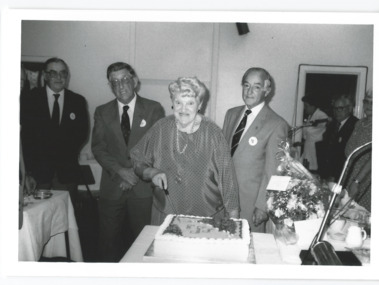
... In 1932 she joined Melbourne Legacy as assistant to Mrs Gilles (wife of a Legatee) later became the chief instructor of girls' physical education until she retired aged 65. In the post World War II baby boom the Legacy evening classes were attended by about 400 girls. ...In 1932 she joined Melbourne Legacy as assistant to Mrs Gilles (wife of a Legatee) later became the chief instructor of girls' physical education until she retired aged 65. In the post World War II baby boom the Legacy evening classes were attended by about 400 girls. ...Three photos of a function held at Legacy House to celebrate the 80th birthday of Miss Enez Domec Carre. Enez was the instructor for the girls' classes for many years, she organised many annual demonstrations and was held in high regard by Legacy. The library at Legacy House is named in her honour. See also a newspaper article at 00978 which outlines her achievements, a summary of her career at 00458 and 00129. She was a former Miss Victoria and was known for her physical education skills and for introducing grace and culture to Melbourne. In 1932 she joined Melbourne Legacy as assistant to Mrs Gilles (wife of a Legatee) later became the chief instructor of girls' physical education until she retired aged 65. In the post World War II baby boom the Legacy evening classes were attended by about 400 girls. She helped organise Legacy Widows and Legatee wives to sew the costumes for performances. Among her proudest moments was a display by 1000 Junior Legatees at the MCG during the 1954 visit of Queen Elizabeth II. As well her work for Legacy she ran physical education, ballroom dancing and debutante preparation classes in Windsor, Elsternwick, Gardenvale and Geelong. She also held a position on the Board of Studies and as director of physical education in Catholic Schools. Recognition of her work included being awarded an MBE in 1971. And in 1997 she received Legacy's highest award, the title of Guest of Honour, for her years of service. Photos were in a scrapbook of photos spanning 1983 to 1991. Photos were taken by Terry Walsh.A record of a Legacy function to celebrate the 80th birthday of a lady who worked for Legacy for many years and had a significant impact on the lives of many junior legatees.Black and white photo x 3 of a luncheon for Miss Domec Carre's 80th birthday.Handwritten in blue pen on reverse 'Legacy House Luncheon / Thur 31st March 1988 / 80th Birthday - Miss Enez Domec Carre. / L-R L/ Hugh Caffrey, L/ Peter Danby, Enez, L/Pres Alf Argent / Terry Walsh xo'birthday, enez domec carre -
 Melbourne Legacy
Letter, Enez Domec-Carre, 13/07/1970
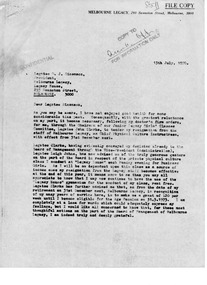
... In 1932 she joined Melbourne Legacy as assistant to Mrs Gilles (wife of a Legatee) later became the chief instructor of girls' physical education until she retired aged 65. In the post World War II baby boom the Legacy evening classes were attended by about 400 girls. ...In 1932 she joined Melbourne Legacy as assistant to Mrs Gilles (wife of a Legatee) later became the chief instructor of girls' physical education until she retired aged 65. In the post World War II baby boom the Legacy evening classes were attended by about 400 girls. ...Letter sent to Legatee D.J. Simonson by Miss Enez Domec-Carre thanking Melbourne Legacy for allowing her to continue to conduct her private physical culture classes at Legacy House rent free and also for granting her $20 per week after her retirement until she became eligible for the Age Pension. She also expresses her loyalty to Legacy and offers assistance at any time. Enez was the supervisor of the girls classes held at Legacy House for many years. She organised many annual demonstrations and was held in high regard by Legacy. The library at Legacy House is named in her honour. See also a newspaper article at 00978 which outlines her achievements, a summary of her career at 00458 and 00129. She was a former Miss Victoria and was known for her physical education skills and for introducing grace and culture to Melbourne. In 1932 she joined Melbourne Legacy as assistant to Mrs Gilles (wife of a Legatee) later became the chief instructor of girls' physical education until she retired aged 65. In the post World War II baby boom the Legacy evening classes were attended by about 400 girls. She helped organise Legacy Widows and Legatee wives to sew the costumes for performances. Among her proudest moments was a display by 1000 Junior Legatees at the MCG during the 1954 visit of Queen Elizabeth II. As well her work for Legacy she ran physical education, ballroom dancing and debutante preparation classes.The letter illustrates Miss Carre's loyalty to Legacy and Legacy's appreciation of her service.Off-white quarto photocopy of letter x 2 pages, sent to Legatee D.J. Simonson by Miss Enez Domec-CarreStamped in purple "CONFIDENTIAL". "COPY TO .... FOR INFORMATION ONLY" and blue handwriting "Executive Officer"girls' classes, enez domec carre -
 Federation University Historical Collection
Photograph - Photograph - Black and White, Mount Pleasant Primary School No 1436, 1874
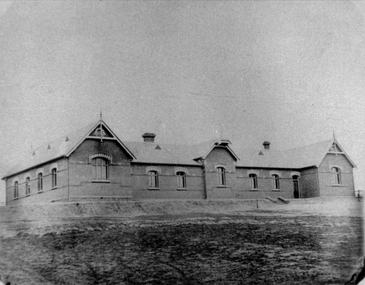
... (Visions and Realisations, Vol. 2, pg 653 and 767) William Henry Williams became the first classifier of teachers for the Victorian Education Department. He died aged 51 while Head Teacher at Yarra Park Primary School on 01 April 1899. ...(Visions and Realisations, Vol. 2, pg 653 and 767) William Henry Williams became the first classifier of teachers for the Victorian Education Department. He died aged 51 while Head Teacher at Yarra Park Primary School on 01 April 1899. ...Mount Pleasant Primary School 1435 was formerly known as Clayton's Hill, and evolved from a tent school, commenced in 1855 by William McIntosh. When changed from a Wesyleyan day school to a Common School it was given the number 424, received State funding and was conducted by William H. Nicholls. On 01 January 1873 the school became a non-vested school under control of the Education Department until 31 August 1873. The State then leased the school until 31 July 1874, with the current brick school, Mount Pleasant No.1436, opening on 01 August 1874. The Head Teacher of the new school was William H. Nicholls, remained at the school until 1887. His assistants were Thomas Gray, Jane Shaw, Jane Tratham, Catherine J. Berriman, John Blight, Herbert Berchaivaise and Annie Hicks, all who had worked at Mount Pleasant No. 424. William Nicholls and his assistant Gray established after school classes to enable students to gain Exhibitions and Scholarships to matriculate for the University of Melbourne, and courses enabling entry to teaching, pharmacy and civil service. Before the establishment of State Secondary and Technical Educaiton over 100 pupils from Mount Pleasant Primary School has matiriculated and entered the various professions. (Visions and Realisations, Vol. 2, pg 653 and 767) William Henry Williams became the first classifier of teachers for the Victorian Education Department. He died aged 51 while Head Teacher at Yarra Park Primary School on 01 April 1899. Some former students of this school include: J.G. Eagleston (County Court Judge); H.E. Starke (Judge of the High Court of Australia ); Bernard O'Dowd (parliamentary draughtsman and poet); Albert Coates (Surgeon and Medical Officer in Burmese Prisoner of War Camps). Gold was discovered at Caylton's Hill in 1853.Black and white photograph of a primary school in the Ballarat suburb of Mount Pleasant. The brick school is sat on bluestone foundations.mount pleasant primary school, mount pleasant state school, mount pleasant, mt pleasant, education, clayton's hill, bluestone, william h. nicholls, thomas gray, jane shaw, jane tratham, catherine j. berriman, john blight, herbert berchaivaise, annie hicks, albert coates, h.e. starke, j.g. eagleston -
 Melbourne Legacy
Letter, Enez Domec-Carre, 02/1973
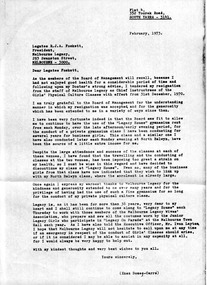
... In 1932 she joined Melbourne Legacy as assistant to Mrs Gilles (wife of a Legatee) later became the chief instructor of girls' physical education until she retired aged 65. In the post World War II baby boom the Legacy evening classes were attended by about 400 girls. ...In 1932 she joined Melbourne Legacy as assistant to Mrs Gilles (wife of a Legatee) later became the chief instructor of girls' physical education until she retired aged 65. In the post World War II baby boom the Legacy evening classes were attended by about 400 girls. ...Letter sent to Legatee R.J.A. Foskett by Miss Enez Domec-Carre informing him that she would be discontinuing the use of Legacy House for her private physical culture classes. Details in the letter explain that she had resigned from running Legacy Girls' Classes on 31st December 1970. Legacy continued to allow her to hold private classes in Legacy house for young business girls of the city on Monday afternoons. In this letter she mentions her health means she was stopping those classes and thanked Legacy for their generosity. She still offered assistance with costumes for the annual demonstration and could be called on if any need arose. Enez was the supervisor of the girls classes held at Legacy House for many years. She organised many annual demonstrations and was held in high regard by Legacy. The library at Legacy House is named in her honour. See also a newspaper article at 00978 which outlines her achievements, a summary of her career at 00458 and 00129. She was a former Miss Victoria and was known for her physical education skills and for introducing grace and culture to Melbourne. In 1932 she joined Melbourne Legacy as assistant to Mrs Gilles (wife of a Legatee) later became the chief instructor of girls' physical education until she retired aged 65. In the post World War II baby boom the Legacy evening classes were attended by about 400 girls. She helped organise Legacy Widows and Legatee wives to sew the costumes for performances. Among her proudest moments was a display by 1000 Junior Legatees at the MCG during the 1954 visit of Queen Elizabeth II. As well her work for Legacy she ran physical education, ballroom dancing and debutante preparation classes.The letter illustrates Miss Carre's loyalty to Legacy and discontinues her private classes at Legacy House.Off-white foolscap photocopy of letter sent to Legatee R.J.A. Foskett by Miss Enez Domec-Carre.Stamped in purple "COPY ONLY"girls' classes, enez domec carre -
 Melbourne Legacy
Photograph, Annual Demonstration
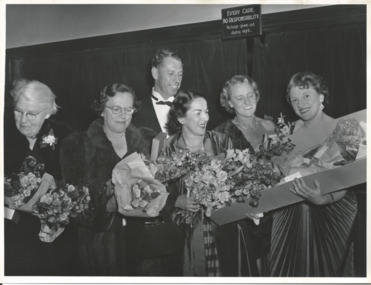
... In 1932 she joined Melbourne Legacy as assistant to Mrs Gilles (wife of a Legatee) later became the chief instructor of girls' physical education until she retired aged 65. In the post World War II baby boom the Legacy evening classes were attended by about 400 girls. ...In 1932 she joined Melbourne Legacy as assistant to Mrs Gilles (wife of a Legatee) later became the chief instructor of girls' physical education until she retired aged 65. In the post World War II baby boom the Legacy evening classes were attended by about 400 girls. ...A group of people with flowers and gifts after an Annual Demonstration. They appear to have been thanked for their efforts in producing the demonstration. The lady with the largest box of flowers was Miss Enez Domec-Carre, Miss Williams on far left was the Elocution teacher, other names are unknown. Enez was the instructor for the girls' classes for many years, she organised many annual demonstrations and was held in high regard by Legacy. The library at Legacy House is named in her honour. See also a newspaper article at 00978 which outlines her achievements, a summary of her career at 00458 and 00129, and her 80th birthday at 01541. She was a former Miss Victoria and was known for her physical education skills and for introducing grace and culture to Melbourne. In 1932 she joined Melbourne Legacy as assistant to Mrs Gilles (wife of a Legatee) later became the chief instructor of girls' physical education until she retired aged 65. In the post World War II baby boom the Legacy evening classes were attended by about 400 girls. She helped organise Legacy Widows and Legatee wives to sew the costumes for performances. Among her proudest moments was a display by 1000 Junior Legatees at the MCG during the 1954 visit of Queen Elizabeth II. As well her work for Legacy she ran physical education, ballroom dancing and debutante preparation classes in Windsor, Elsternwick, Gardenvale and Geelong. She also held a position on the Board of Studies and as director of physical education in Catholic Schools. Recognition of her work included being awarded an MBE in 1971. And in 1997 she received Legacy's highest award, the title of Guest of Honour, for her years of service. The year is unknown. Throughout the year Melbourne Legacy provided classes for Junior Legatees such as dancing, gymnastics and Eurythmics. The Demonstration was an annual event to showcase their skills. Melbourne Legacy conducted Annual Demonstrations / Parades from 1928 through to the late 1970's, usually held at Melbourne Town Hall or Olympic Pool Stadium. The beautiful costumes were made by members of the Junior Legacy Mothers' Club and the Melbourne Legacy Wives' Association.Miss Domec-Carre worked for Legacy for many years and had a significant impact on the lives of many junior legatees. Black and white photo x 2 of Miss Enez Domec-Carre and others with flowers or gifts after an Annual Demonstration.annual demonstration, enez domec carre -
 Ballarat Heritage Services
Photograph - Digital photographs, Clare Gervasoni, Exterior Views of Xavier College, 2025, 05/2025
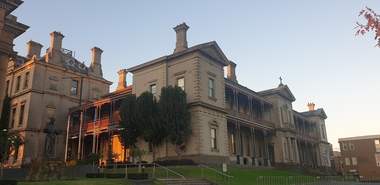
... In 2002 at our Burke Hall campus and in 2005 at our Kostka Hall campus, the College expanded its educational program, opening Early Years centres to provide the scope for a Jesuit education from the earliest ages. For the first time in the College’s history, girls were admitted to the Early Years, breaking the long-standing tradition of Xavier being a boys-only school. ...In 2002 at our Burke Hall campus and in 2005 at our Kostka Hall campus, the College expanded its educational program, opening Early Years centres to provide the scope for a Jesuit education from the earliest ages. For the first time in the College’s history, girls were admitted to the Early Years, breaking the long-standing tradition of Xavier being a boys-only school. ...Xavier College was first opened by the Society of Jesus (the Jesuits) in 1878. It belongs to a worldwide network of over 2,000 Jesuit educational institutions. The original Senior Campus location on Barkers Road, Kew is a culmination of modern innovation and rich historical preservation. The land on which Xavier stands was known as Mornane’s Paddock and was purchased by the Jesuits in 1872 from Patrick Mornane on a 20-year interest-free purchase plan. This enabled the Jesuits to get on with the funding and building of the College buildings almost immediately. Foundations for the South Wing commenced in 1872, with the front of the building completed in time for classes to begin in 1878. Many of the first boarders transferred from St Patrick’s College in East Melbourne. With the closure of St Patrick’s years later, many students, associated lay staff and Jesuits also transferred to Xavier College. Over the following century, Xavier College grew with two junior campuses; Burke Hall Campus and Kostka Hall Campus. In recent years, extensive refurbishments, renovations and improvements have moulded the properties into the beautiful sites they are today. In 2002 at our Burke Hall campus and in 2005 at our Kostka Hall campus, the College expanded its educational program, opening Early Years centres to provide the scope for a Jesuit education from the earliest ages. For the first time in the College’s history, girls were admitted to the Early Years, breaking the long-standing tradition of Xavier being a boys-only school. In 2021, after 85 years of inspiring education experiences, our Kostka Hall campus closed its gates for the final time. In 1920, Archbishop Daniel Mannix donated the house and land known as Studley Hall to Xavier College for use as a preparatory school. The property had been purchased and donated to Mannix by Mr T.M. Burke, a Catholic businessman. In 1921, Xavier Preparatory School opened and was later renamed Burke Hall in 1926 in honour of Mr Burke. The Kostka Hall location was opened in 1937 and was named in honour of St Stanislaus Kostka. To establish the second preparatory school, the Jesuits purchased two Brighton properties in mid-1936. Both were promptly remodelled to provide the facilities required for school life. (https://xavier.vic.edu.au/xavier-history, accessed 15/05/2025) Colour photograph of the buildings and Chapel at Xavier College, Kew, Victoria. heritage, kew, xavier college, chapel, catholic, st francis xavier, xavier chapel -
 Ballarat Heritage Services
Photograph - Digital photographs, Clare Gervasoni, Melbourne Views from Xavier College Chapel, 2025, 05/2025
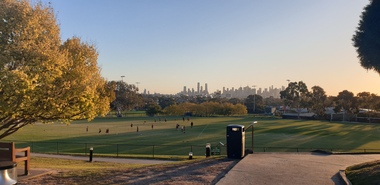
... In 2002 at our Burke Hall campus and in 2005 at our Kostka Hall campus, the College expanded its educational program, opening Early Years centres to provide the scope for a Jesuit education from the earliest ages. For the first time in the College’s history, girls were admitted to the Early Years, breaking the long-standing tradition of Xavier being a boys-only school. ...In 2002 at our Burke Hall campus and in 2005 at our Kostka Hall campus, the College expanded its educational program, opening Early Years centres to provide the scope for a Jesuit education from the earliest ages. For the first time in the College’s history, girls were admitted to the Early Years, breaking the long-standing tradition of Xavier being a boys-only school. ...Xavier College was first opened by the Society of Jesus (the Jesuits) in 1878. It belongs to a worldwide network of over 2,000 Jesuit educational institutions. The original Senior Campus location on Barkers Road, Kew is a culmination of modern innovation and rich historical preservation. The land on which Xavier stands was known as Mornane’s Paddock and was purchased by the Jesuits in 1872 from Patrick Mornane on a 20-year interest-free purchase plan. This enabled the Jesuits to get on with the funding and building of the College buildings almost immediately. Foundations for the South Wing commenced in 1872, with the front of the building completed in time for classes to begin in 1878. Many of the first boarders transferred from St Patrick’s College in East Melbourne. With the closure of St Patrick’s years later, many students, associated lay staff and Jesuits also transferred to Xavier College. Over the following century, Xavier College grew with two junior campuses; Burke Hall Campus and Kostka Hall Campus. In recent years, extensive refurbishments, renovations and improvements have moulded the properties into the beautiful sites they are today. In 2002 at our Burke Hall campus and in 2005 at our Kostka Hall campus, the College expanded its educational program, opening Early Years centres to provide the scope for a Jesuit education from the earliest ages. For the first time in the College’s history, girls were admitted to the Early Years, breaking the long-standing tradition of Xavier being a boys-only school. In 2021, after 85 years of inspiring education experiences, our Kostka Hall campus closed its gates for the final time. In 1920, Archbishop Daniel Mannix donated the house and land known as Studley Hall to Xavier College for use as a preparatory school. The property had been purchased and donated to Mannix by Mr T.M. Burke, a Catholic businessman. In 1921, Xavier Preparatory School opened and was later renamed Burke Hall in 1926 in honour of Mr Burke. The Kostka Hall location was opened in 1937 and was named in honour of St Stanislaus Kostka. To establish the second preparatory school, the Jesuits purchased two Brighton properties in mid-1936. Both were promptly remodelled to provide the facilities required for school life. (https://xavier.vic.edu.au/xavier-history, accessed 15/05/2025) Colour photograph of the Melbourne highrise from the Chapel at Xavier College, Kew, Victoria. heritage, kew, xavier college, chapel, catholic, st francis xavier, xavier chapel -
 Ballarat Heritage Services
Photograph - Digital photographs, L.J. Gervasoni, Xavier College Chapel, c2016, c2016
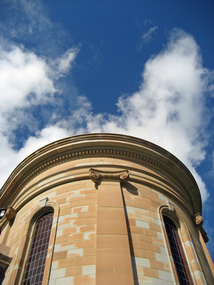
... In 2002 at our Burke Hall campus and in 2005 at our Kostka Hall campus, the College expanded its educational program, opening Early Years centres to provide the scope for a Jesuit education from the earliest ages. For the first time in the College’s history, girls were admitted to the Early Years, breaking the long-standing tradition of Xavier being a boys-only school. ...In 2002 at our Burke Hall campus and in 2005 at our Kostka Hall campus, the College expanded its educational program, opening Early Years centres to provide the scope for a Jesuit education from the earliest ages. For the first time in the College’s history, girls were admitted to the Early Years, breaking the long-standing tradition of Xavier being a boys-only school. ...Xavier College was first opened by the Society of Jesus (the Jesuits) in 1878. It belongs to a worldwide network of over 2,000 Jesuit educational institutions. The original Senior Campus location on Barkers Road, Kew is a culmination of modern innovation and rich historical preservation. The land on which Xavier stands was known as Mornane’s Paddock and was purchased by the Jesuits in 1872 from Patrick Mornane on a 20-year interest-free purchase plan. This enabled the Jesuits to get on with the funding and building of the College buildings almost immediately. Foundations for the South Wing commenced in 1872, with the front of the building completed in time for classes to begin in 1878. Many of the first boarders transferred from St Patrick’s College in East Melbourne. With the closure of St Patrick’s years later, many students, associated lay staff and Jesuits also transferred to Xavier College. Over the following century, Xavier College grew with two junior campuses; Burke Hall Campus and Kostka Hall Campus. In recent years, extensive refurbishments, renovations and improvements have moulded the properties into the beautiful sites they are today. In 2002 at our Burke Hall campus and in 2005 at our Kostka Hall campus, the College expanded its educational program, opening Early Years centres to provide the scope for a Jesuit education from the earliest ages. For the first time in the College’s history, girls were admitted to the Early Years, breaking the long-standing tradition of Xavier being a boys-only school. In 2021, after 85 years of inspiring education experiences, our Kostka Hall campus closed its gates for the final time. In 1920, Archbishop Daniel Mannix donated the house and land known as Studley Hall to Xavier College for use as a preparatory school. The property had been purchased and donated to Mannix by Mr T.M. Burke, a Catholic businessman. In 1921, Xavier Preparatory School opened and was later renamed Burke Hall in 1926 in honour of Mr Burke. The Kostka Hall location was opened in 1937 and was named in honour of St Stanislaus Kostka. To establish the second preparatory school, the Jesuits purchased two Brighton properties in mid-1936. Both were promptly remodelled to provide the facilities required for school life. (https://xavier.vic.edu.au/xavier-history, accessed 15/05/2025) Colour photograph of the section of the Chapel at Xavier College, Kew, Victoria. heritage, kew, xavier college, chapel, catholic, st francis xavier, xavier chapel -
Bendigo Historical Society Inc.
Document - History Notes - Information on Mining, statistics and early development of Bendigo, 1840-1990 approx
... Major rail and road hub with connections across Victoria and to New South Wales; tram and bus services.Education: Institute of Technology, Teachers College, multiple secondary and primary schools, and special education facilities. Several hospitals, aged care homes, and health services. 486 acres of parks and gardens, extensive sports facilities, and Lake Eppalock for water sports. ...Major rail and road hub with connections across Victoria and to New South Wales; tram and bus services.Education: Institute of Technology, Teachers College, multiple secondary and primary schools, and special education facilities. Several hospitals, aged care homes, and health services. 486 acres of parks and gardens, extensive sports facilities, and Lake Eppalock for water sports. ...Saddle, Fault, and Spur reefs are the main types, found in Ordovician slates and sandstones folded into anticlines and synclines. Major Productive Reefs: Hustlers, Garden Gully, Paddy's Gully, Sheepshead, New Chum, Nell Gwynne, and Carshalton.Mining Process: Gold is found in quartz lodes, extracted, crushed, and separated using mercury amalgamation. From 1851–1949, over 21 million ounces of gold were produced, valued at approximately £323 million (1964 prices). Located Bendigo is in central Victoria, north of the Dividing Range, between Campaspe Valley and Loddon flats; 100 miles from Melbourne. The City area is 8,030 acres; population around 40,000 (city), 47,000 (district).Climate is temperate, with average rainfall of 20 inches, and 320 sunny days per year. Gold First discovered in 1851 at Golden Square. Bendigo Became a municipal district in 1855, a town in 1861, a city in 1871, and changed its name from Sandhurst to Bendigo in 1891. Key Events: Establishment of hospital, police court, churches, schools, and infrastructure like railways and water supply.Governance and Civic Structure. Council Structure: 3 wards, each with 3 councillors serving 3-year terms; mayor elected by councillors. Main revenue from rates and property; principal duties include public works, health, parks, and enforcement of by-laws. Major Projects: Olympic swimming pool, market extensions, park improvements, road and drainage works.Economy and IndustryCommerce: 730 retail shops, 260 factories, and a major livestock market.Principal Industries: Meat processing, manufacturing (including ordnance, textiles, engineering), fruit and food processing, and egg production. Bendigo is Noted for sheep, lamb, fruit (especially tomatoes and apples), and dairy. Major rail and road hub with connections across Victoria and to New South Wales; tram and bus services.Education: Institute of Technology, Teachers College, multiple secondary and primary schools, and special education facilities. Several hospitals, aged care homes, and health services. 486 acres of parks and gardens, extensive sports facilities, and Lake Eppalock for water sports. Wide range of community, cultural, and sporting organizations. Regional library, art gallery, music and drama societies. Notable Figures and HeritageGeorge Lansell: Known as the "Gold King," a key figure in Bendigo's mining history. Transformation: From a sheep run to a major goldfield and then to a modern city with significant infrastructure and cultural assets. Motto Coat of Arms: Features symbols representing gold mining, agriculture, pioneering, and fruit growing.Motto: "Progress" in gold on a purple ribbon.Bendigo's history is marked by rapid growth from gold discovery, strong civic development, and a diverse economy, making it a significant regional center in Victoria.History Notes - Information on Mining, statistics and early development of Bendigo - author unknown This item contains the following document: 11217.65a Twelve Foolscap typed pages with information on Bendigonon-fictionbendigo, fortuna, george lansell, development of bendigo -
 Surrey Hills Historical Society Collection
photograph, Dr Una Porter
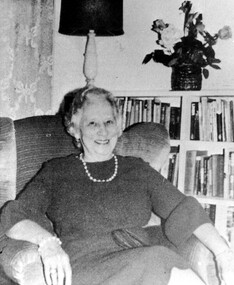
... Una was educated at Methodist Ladies College and the English boarding school "Farringtons" however her formal education ended at the age of 14 due to ill health. By the outbreak of the First World War her sisters were married and her brothers enlisted. ...Una was educated at Methodist Ladies College and the English boarding school "Farringtons" however her formal education ended at the age of 14 due to ill health. By the outbreak of the First World War her sisters were married and her brothers enlisted. ...Dr Unice (Una) Beatrice Porter, OBE, CBE (1900 - 1996) Una Porter was the youngest daughter of Frederick John Cato and his wife Fanny (née Bethune). She had 3 sisters and 4 brothers. Her father was of course the prominent businessman and co-founder of the Moran & Cato grocery company who was known for his generosity and commitment to the Methodist Church. Given this background it is not surprising that Una inherited a deep and lasting Christian faith that would become the driving force behind her own career and philanthropic activities. Una was educated at Methodist Ladies College and the English boarding school "Farringtons" however her formal education ended at the age of 14 due to ill health. By the outbreak of the First World War her sisters were married and her brothers enlisted. Una became very close to her father and assisted him in establishing hospitals and missions in Arnhem Land, Fiji and India. Una returned to formal study and matriculated at the age of 30. A niece with diabetes was the catalyst which led Una to study medicine. She enrolled at the University of Melbourne in 1933 and subsequently specialised in psychiatry with training at Prince Henry's Hospital, the Royal Park Mental Hospital and the Children's Hospital. In 1946 she took a post at the Ballarat Mental Hospital. Here she was the first female member of staff, overseeing 512 female patients. She later worked in private practice and was instrumental in the establishment of a psychiatric clinic at the Queen Victoria Hospital. Throughout her life, Una maintained a strong link with the Young Women's Christian Association (YWCA) and in 1963 was elected as the World President of this organisation and in 1964 she was elected Woman of the Year. Una's philanthropic work was extensive. In addition to administering the F.J. Cato Charitable and Benevolent Trust and later the James and Una Porter Trust Fund, she made substantial personal donations to hospitals, universities and community organisations including the University of Melbourne, Monash University, Epworth Hospital, Methodist Ladies College, Cato College, Queen Victoria Hospital and the YWCA. It is estimated that she gave over $1 million to various hospitals and institutions. Some of her projects included establishing a scholarship for rural female students to attend university, a Chair in Psychiatry, and extensive research into early childhood development. Una B. Porter was appointed O.B.E. (1961) and C.B.E. (1968) in recognition of her services to the community. At the age of 46 Una married James Roland Porter, an ex-RAAF squadron leader and a lifelong friend. Until this time, Dr Porter had lived at the Cato family home, ‘Kawarau’ at 192-198 Tooronga Road, Hawthorn (later Stephanie’s restaurant). In spite of having qualified as a doctor and with all her philanthropic activities, at age 43 the electoral rolls give her status as ‘home duties’! Dr Porter’s connection with Surrey Hills came after her marriage. In 1948 she and her husband bought 8 Kent Road. A black and white photograph of a screened image of a lady sitting in a winged-back chair. She is wearing a knee length dress with three-quarter length sleeves, and beads around her neck and wrist.psychiatrist, philanthropist, queen victoria hospital, mont albert, surrey hills, 8 kent road, dr una porter, mr james porter, dr unice beatrice porter, mr frederick cato, miss unice beatrice cato, mrs fanny cato, miss fanny bethune, young women's christian association, fj cato charitable and benevolent trust, james and una porter trust fund, methodist ladies college
