
Showing 51 items matching "edward prince of wales"
-
 Freemasons Victoria - United Grand Lodge of Victoria
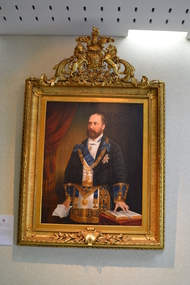
Painting, His Royal Highness Albert Edward, Prince of Wales - Grand Master of U.G.L. of England 1874-1901, early 1900s
... His Royal Highness Albert Edward, Prince of Wales - Grand Master of U.G.L. of England 1874-1901...His Royal Highness Albert Edward Prince of Wales...After being converted to Roman Catholicism, he felt it was essential that he resign from Freemasonry as his church at the time was opposed to Freemasonry. Albert Edward Prince of Wales, later King Edward VII, readily accepted nomination as Grand Master of England and continued in office until his Accession in 1901....Flintoff 1880', Placque: 'Grand Master U.G.L. of England 1874-1901 H.R.H. Albert Edward Prince of Wales by T. Flintoff'. ...His Royal Highness Albert Edward, Prince of Wales - Grand Master of U.G.L. of England 1874-1901 Painting ...In 1870 the Earl de Grey was Grand Master of England, but his rule was short lived. After being converted to Roman Catholicism, he felt it was essential that he resign from Freemasonry as his church at the time was opposed to Freemasonry. Albert Edward Prince of Wales, later King Edward VII, readily accepted nomination as Grand Master of England and continued in office until his Accession in 1901.This portrait the Prince of Wales was painted by Thomas Flintoff. It is held within a very elaborate gilded frame which comes apart in 3 sections and is one of only two known types existing.Portrait oil painting of Prince Albert on canvas stretched over stretcher/strainer. Framed in a very elaborate qilded wood and rosen frame. Heavy ornamentation on top and bottom of the frame. Signed: 'T. Flintoff 1880', Placque: 'Grand Master U.G.L. of England 1874-1901 H.R.H. Albert Edward Prince of Wales by T. Flintoff'. portrait, painting, his royal highness albert edward prince of wales, freemasonry, freemasons, freemasons victoria -
 Port Melbourne Historical & Preservation Society
Letter - Letter from Edward, Prince of Wales, 16 August 1920
... Letter from Edward, Prince of Wales......Edward Prince of Wales... of Wales HMS Renown On front in pencil - Florence Emily Myrtle Wale age 7 years Large printed letter fromEdward, Prince of Wales, to all the children in Australia. Letter Letter from Edward, Prince of Wales ...As his visit to Australia 1929 was drawing to a close, Edward, Province of Wales, wrote to a circular letter to all Australian children. He expressed his delight in seeing so many on his tour & regret that he didn't see everyone. He goes on to ask if as a special favour they might have an extra week's holiday.Large printed letter fromEdward, Prince of Wales, to all the children in Australia.On front in pencil - Florence Emily Myrtle Wale age 7 yearseducation - primary schools, florence emily myrtle (mary) wale, edward prince of wales, hms renown -
Whitehorse Historical Society Inc.
Document, Letter from 'H.M.S Renown', 16/08/1920 12:00:00 AM
... Edward...Prince of Wales...A letter from Edward, Prince of Wales addressed to Girls and Boys from H.M.S. ...Renown, Sydney. Edward Prince of Wales A letter from Edward, Prince of Wales. ...A letter from Edward, Prince of Wales.A letter from Edward, Prince of Wales addressed to Girls and Boys from H.M.S. Renown, Sydney.A letter from Edward, Prince of Wales. edward, prince of wales -
 Bendigo Historical Society Inc.
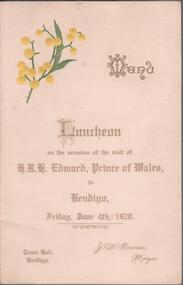
Document - LYDIA CHANCELLOR COLLECTION: LUNCHEON MENU
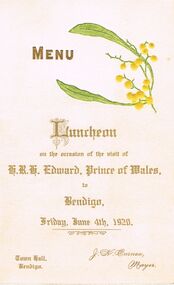
... Edward... Prince of Wales...On the front of the menu is a picture of green and gold wattle and the words 'MENU Luncheon on the occasion of the visit of H.R.H. Edward, Prince of Wales, to Bendigo, Friday, June 4th, 1920. ...PERSON Individual menu Lydia Chancellor collection menu person individual official ephemera luncheon civic mementoes food H.R.H. Edward Prince of Wales Yellow card with gold print. ...Yellow card with gold print. On the front of the menu is a picture of green and gold wattle and the words 'MENU Luncheon on the occasion of the visit of H.R.H. Edward, Prince of Wales, to Bendigo, Friday, June 4th, 1920. Town Hall, Bendigo. J.H. Curnow, Mayor.' On the inside is the menu. Bolton Bros., Printers Bendigo.person, individual, menu, lydia chancellor, collection, menu, person, individual, official, ephemera, luncheon, civic mementoes, food, h.r.h. edward, prince of wales -
 Whitehorse Historical Society Inc.
Letter - Letter to schoolchildren, 1/08/1920 12:00:00 AM
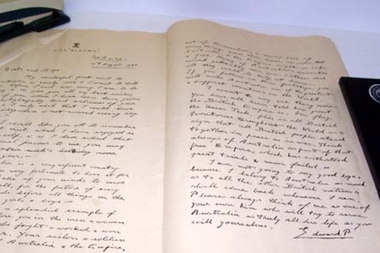
... This letter was written by Edward Prince of Wales during his first visit to Australia in 1920. ...2 page letter written to school children by Edward Prince of Wales during his tour of Australia in 1920....This letter was written by Edward Prince of Wales during his first visit to Australia in 1920. ...This letter was written by Edward Prince of Wales during his first visit to Australia in 1920. Father in Law of donor kept the letter2 page letter written to school children by Edward Prince of Wales during his tour of Australia in 1920.HMS 'Renown'documents, letters -
 Warrnambool and District Historical Society Inc.
Badge - Prince of Wales Badge 1920, 1920
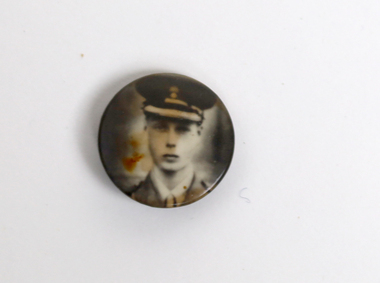
... This badge was issued in 1920 to commemorate the visit to Australia of Edward, Prince of Wales. It was issued to school children. ...This is a round metal badge with a black and white photograph of Edward, Prince of Wales on one side and a metal pin on the other side....This badge was issued in 1920 to commemorate the visit to Australia of Edward, Prince of Wales. It was issued to school children. ...This badge was issued in 1920 to commemorate the visit to Australia of Edward, Prince of Wales. It was issued to school children. The visit of the Prince of Wales was a gesture by the British Crown to recognize the sacrifices and efforts of the Australian people and defence forces during World War One. Edward, Prince of Wales, later became King of England in 1936 and abdicated that same year. During the 1920 visit to Victoria the Prince of Wales came to Terang and stayed overnight at Glenormiston, near Terang, at that time the property of Cr Black, the President of the Shire of Hampden.This badge is of interest as a memento of a Royal visit to Victoria in 1920.This is a round metal badge with a black and white photograph of Edward, Prince of Wales on one side and a metal pin on the other side.visit to australia of prince of wales 1920, glenormiston homestead -
 City of Greater Bendigo - Civic Collection
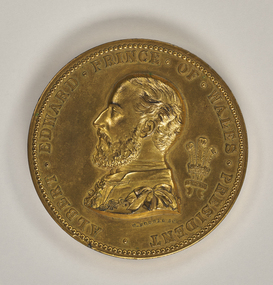
Medal - 1873 International Exhibition Medal, G. T Morgan, 1873
... Featuring the bust of Edward, Prince of Wales by G. Morgan with the Welsh plume behind and a scene from within the City of London....Front; Draped bust of the Prince of Wales left, plumes to right. ALBERT . EDWARD . PRINCE . OF . ...(source; Wikipedia) world fairs international exhibition Prince Albert Expo Front; Draped bust of the Prince of Wales left, plumes to right. ALBERT . EDWARD . PRINCE . OF . ...In 1791 Prague organized the first World's Fair, Bohemia (modern-day Czech Republic). The first industrial exhibition was on the occasion of the coronation of Leopold II as a king of Bohemia, which took place in Clementinum, and celebrated the considerable sophistication of manufacturing methods in the Czech lands during that time period. The French tradition of national exhibitions culminated with the French Industrial Exposition of 1844 held in Paris. This fair was followed by other national exhibitions in Europe. In 1851, under the title "Great Exhibition of the Works of Industry of All Nations", the World Expo was held in The Crystal Palace in Hyde Park, London, the United Kingdom. The Great Exhibition, as it is often called, was an idea of Prince Albert, Queen Victoria's husband, and is usually considered to be the first international exhibition of manufactured products. It influenced the development of several aspects of society, including art-and-design education, international trade and relations, and tourism. This expo was the precedent for the many international exhibitions, later called World Expos, that have continued to be held to the present time. (source; Wikipedia) Commemorative medal. Featuring the bust of Edward, Prince of Wales by G. Morgan with the Welsh plume behind and a scene from within the City of London.Front; Draped bust of the Prince of Wales left, plumes to right. ALBERT . EDWARD . PRINCE . OF . WALES . PRESIDENT . Verso; View of the Horticultural Society's arcades and the Albert Hall. MDCCCLXXIII below, LONDON . ANNUAL . INTERNATIONAL . EXHIBITION . OF . ALL . FINE . ARTS . INDUSTRIES AND INVENTIONSworld fairs, international exhibition, prince albert, expo -
 Hume City Civic Collection
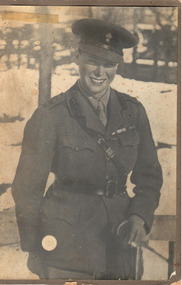
Photograph
... edward viii...the prince of wales...Mounted b/w phtograph of Edward VIII (Prince of Wales) walking and smiling with his left hand on his sword....PRINCE OF WALES! = THEN DUKE OF WINDSOR Printed on back: AUSTRALIA AT WAR, REFLEX-ART COMPANY 88 ALBERT STREET WINDSOR VIC. Handwritten on back: EDWARD...edward viii the prince of wales duke of windsor royalty soldiers george evans collection Typewritten on white paper and attached to front: THE PRINCE OF WALES! ...Mounted b/w phtograph of Edward VIII (Prince of Wales) walking and smiling with his left hand on his sword.Typewritten on white paper and attached to front: THE PRINCE OF WALES! = THEN DUKE OF WINDSOR Printed on back: AUSTRALIA AT WAR, REFLEX-ART COMPANY 88 ALBERT STREET WINDSOR VIC. Handwritten on back: EDWARD VIIIedward viii, the prince of wales, duke of windsor, royalty, soldiers, george evans collection -
 Rutherglen Historical Society
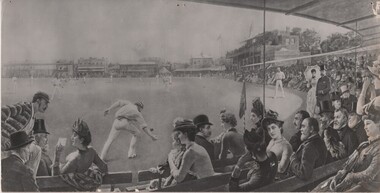
Image
... ...edward prince of wales...On the right is Edward VII when Prince of Wales"...cricket lords cricket ground edward prince of wales painting r ponsonby staples Caption stuck to back of photo: "England - v - Australia, 1884 | Oil painting by R. ...Black and white photograph of an oil painting by R. Ponsonby Staples, pasted onto cardboard.Caption stuck to back of photo: "England - v - Australia, 1884 | Oil painting by R. Ponsonby Staples (Collection National Gallery of British Sports and Pastimes) | Showing Lord's very much as it is today. On the right is Edward VII when Prince of Wales"cricket, lords cricket ground, edward prince of wales, painting, r ponsonby staples -
 Bendigo Historical Society Inc.
Newspaper - LONG GULLY HISTORY GROUP COLLECTION: CENTENARY MEMORIES - CORNISH EMIGRANTS IN BENDIGO
... Prince Albert Victor of Wales... Prince George (later King George V)... Edward...BENDIGO History long gully history group The Long Gully History Group - Centenary Memories - Cornsih Emigrants in Bendigo Bendigo Advertiser Mrs Kennedy Duke of Edinburgh 1867 Prince Albert Victor of Wales Prince George (later King George V) Edward Prince of Wales The Duke and Duchess of York French's Corner Long Gully Old Cornwall Society Mr John Ellis Bendigo Hospital Mr Harry Perak Malaya Mr and Mrs Charles Harry Mrs Boyns Hon Mrs J Keppel Lord St Levan Mr Keppel Victorian Railways Bendigo Railway Station Mr Herbert Thomas Copy of a newspaper article titled Centenary Memories, Cornish Emigrants in Bendigo, More Cornish spoken than at St. ...Copy of a newspaper article titled Centenary Memories, Cornish Emigrants in Bendigo, More Cornish spoken than at St. Just. Written on the side is - This was published in a West Cornwell Newspaper & sent back to Aust in a clipping George Ellis has original. Approx circa 1951. Items mentioned are: More Cornish spoken than at St Just, Best Cornsih Style, Singing Gullies particularly where Cornishmen and Welshmen were as they were fond of singing, Royal visits, St Just point and Open House for Cornish.bendigo, history, long gully history group, the long gully history group - centenary memories - cornsih emigrants in bendigo, bendigo advertiser, mrs kennedy, duke of edinburgh 1867, prince albert victor of wales, prince george (later king george v), edward prince of wales, the duke and duchess of york, french's corner long gully, old cornwall society, mr john ellis, bendigo hospital, mr harry perak malaya, mr and mrs charles harry, mrs boyns, hon mrs j keppel, lord st levan, mr keppel, victorian railways, bendigo railway station, mr herbert thomas -
Glen Eira Historical Society
Document - HRH Prince of Wales Visit to Caulfield 31/05/1920
... ... Edward Prince of Wales...This file contains four items about the visit of HRH Prince of Wales Edward (later Edward VIII) to Australia in 1920 and specifically a visit to Caulfield on 31/05/1920. 1/A souvenir program ‘HRH Prince of Wales’ visit to Caulfield 31/05/1920: it appears to contain copies of the pages of a book, which it is noted was embossed by a patient at a Rest House in Caulfield, signaller Don Ende, a soldier of World War I. ...Jowett F. Edward Prince of Wales Edward VIII George V Red Cross Comforts Funds Caulfield Military Hospital Ende Don Soldiers Rest House Caulfield World War 1914-1918 Voluntary Workers Charitable Organisations Military Hospitals Document HRH Prince of Wales Visit to Caulfield 31/05/1920 ...This file contains four items about the visit of HRH Prince of Wales Edward (later Edward VIII) to Australia in 1920 and specifically a visit to Caulfield on 31/05/1920. 1/A souvenir program ‘HRH Prince of Wales’ visit to Caulfield 31/05/1920: it appears to contain copies of the pages of a book, which it is noted was embossed by a patient at a Rest House in Caulfield, signaller Don Ende, a soldier of World War I. Included is a letter from the Caulfield Mayor W. A. Wharington and Town Clerk F. Jowett to Edward, as well as a typed reply from Edward to the mayor. Also included is a record of Caulfield’s contribution to the war effort during World War I, including numbers who enlisted and served, the number who died, and the amount of money raised from the Red Cross, Comforts Fund and other ‘Patriotic efforts’ by Caulfield residents. 2/Original letter by Edward to ‘Girls and Boys of Australia’, written in Sydney or 16/08/1920, thanking Australia for its contribution to the war effort and loyalty to the empire. 3/Three copies of the same letter by Edward to ‘Girls and Boys of Australia’. 4/A research note by Amy MacKintosh briefly describing the circumstance of Edward’s visit.royal visits, caulfields, wharington w. a., jowett f., edward prince of wales, edward viii, george v, red cross, comforts funds, caulfield military hospital, ende don, soldiers, rest house caulfield, world war 1914-1918, voluntary workers, charitable organisations, military hospitals -
 Phillip Island and District Historical Society Inc.
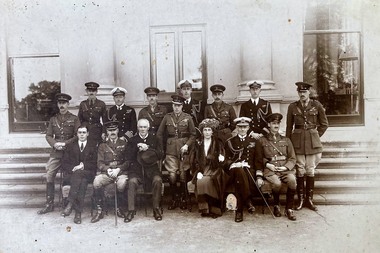
Photograph sepia, Photograph of British military group with the Prince of Wales, 1940
... Sepia photograph of 12 Navy, Airforce and Army officers with Edward, Prince of Wales and 2 civilians - two men and a woman - gathered outside Parliament House or Government House (unknown) ...Possible dates late WW1, 1918 to early 1920s. naval and army officers wwii jim blake Sepia photograph of 12 Navy, Airforce and Army officers with Edward, Prince of Wales and 2 civilians - two men and a woman - gathered outside Parliament House or Government House (unknown) Photograph of British military group with the Prince of Wales. ...Donated by Mr Jim Blake on the occasion of his talk to the Society. Lieutenant Colonel Neil C. Smith, a military historian, stated in 2013 that the photo was of British service men of WW1 or pre WW1. Some colonels and captains. Possible dates late WW1, 1918 to early 1920s.Sepia photograph of 12 Navy, Airforce and Army officers with Edward, Prince of Wales and 2 civilians - two men and a woman - gathered outside Parliament House or Government House (unknown) naval and army officers wwii, jim blake -
 Bendigo Historical Society Inc.
Document - FAVALORO COLLECTION: MENU FOR HRH EDWARD, PRINCES OF WALES VISIT
... Luncheon on the occasion of the visit of H.R.H. Edward, Prince of Wales to Bendigo. Friaday, June 4th,1920. ...ROYALTY British prince of wales Menu prepered by Favaloro's catereres. Luncheon on the occasion of the visit of H.R.H. Edward ...Menu prepered by Favaloro's catereres. Luncheon on the occasion of the visit of H.R.H. Edward, Prince of Wales to Bendigo. Friaday, June 4th,1920. Town Hall, Bendigo. J.H. Curnow, Mayor.royalty, british, prince of wales -
 St Kilda Historical Society
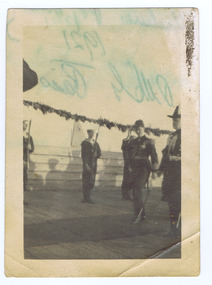
Photograph, St Kilda Pier, c. 1921
... St Kilda Pier at the time of visit of HRH Prince Edward of Wales 1921...On back: St Kilda Pier at the time of visit of HRH Prince Edward of Wales 1921. Presented by C Kelly 14-2-82...St Kilda Pier at the time of visit of HRH Prince Edward of Wales 1921 On back: St Kilda Pier at the time of visit of HRH Prince Edward of Wales 1921. ...St Kilda Pier at the time of visit of HRH Prince Edward of Wales 1921black and white photograph, unmounted, original, poor conditionOn back: St Kilda Pier at the time of visit of HRH Prince Edward of Wales 1921. Presented by C Kelly 14-2-82 -
 Mt Dandenong & District Historical Society Inc.
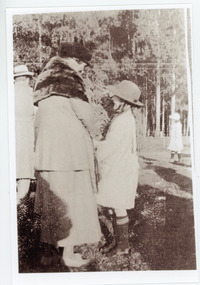
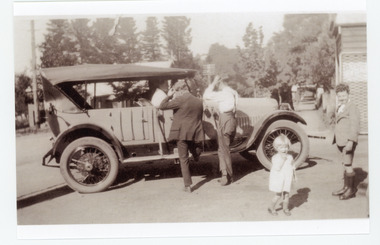
Photograph, Chatting in Main Street, Sassafras
... A smartly dressed lady speaking with a child during the visit of Edward, Prince of Wales to Sassafras in 1920....A smartly dressed lady speaking with a child during the visit of Edward, Prince of Wales to Sassafras in 1920. sassafras prince of wales Copy of a black and white photograph showing a close up picture of a well dressed lady talking to a child. ...A smartly dressed lady speaking with a child during the visit of Edward, Prince of Wales to Sassafras in 1920.Copy of a black and white photograph showing a close up picture of a well dressed lady talking to a child.sassafras, prince of wales -
 Mt Dandenong & District Historical Society Inc.
Photograph, Car in Sassafras Main Street
... Probably during the visit of Edward, Prince of Wales in 1920....Probably during the visit of Edward, Prince of Wales in 1920. sassafras car Copy of a black and white photo showing two men and two children standing near a car. ...Two men looking closely at a car in Main Street of Sassafras. Probably during the visit of Edward, Prince of Wales in 1920.Copy of a black and white photo showing two men and two children standing near a car. The men looking at the car, the children looking t the ca,era.sassafras, car -
 Bendigo Historical Society Inc.
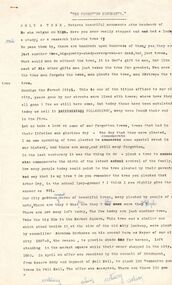
Document - THE FORGOTTEN MONUMENTS - TREES
... Prince George... of Wales... King George V... harney's Bridge... Prince Edward...DOCUMENT The Forgotten Monuments - Trees Abraham Harkness Mr Eddy Mr Rayment Jajowerong Origin of One Tree Hill Jerry Ryan Prince Albert Victor Prince George of Wales King George V harney's Bridge Prince Edward of Wales Madam Malba Miss Nellie Stewart Typed notes about the trees in Bendigo. ...Typed notes about the trees in Bendigo. In the early days trees were planted to provide shade for the horses while they waited for their owners to return from shopping. Also mentioned are trees planted to commerate visits by Princes and Madam Melba.document, the forgotten monuments - trees, abraham harkness, mr eddy, mr rayment, jajowerong, origin of one tree hill, jerry ryan, prince albert victor, prince george, of wales, king george v, harney's bridge, prince edward of wales, madam malba, miss nellie stewart -
 Tennis Australia
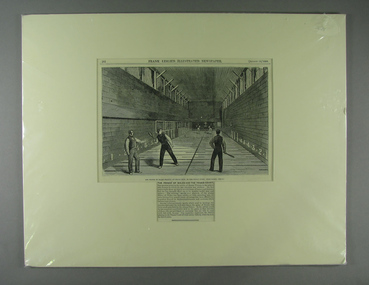
Clipping from newspaper page, 18 Aug 1860
... A clipping from page 202 of Frank Leslie's Illustrated Newspaper (18 Aug. 1860), feauring an article entitled: THE PRINCE OF WALES AT THE TENNIS COURT. Article is accompanied by an engraving print depicting the young Edward, Prince of Wales, playing a real tennis match, at the Oriel Tennis Court at Oxford. ...Tennis A clipping from page 202 of Frank Leslie's Illustrated Newspaper (18 Aug. 1860), feauring an article entitled: THE PRINCE OF WALES AT THE TENNIS COURT. Article is accompanied by an engraving print depicting the young Edward, Prince of Wales, playing a real tennis match, at the Oriel Tennis Court at Oxford. ...A clipping from page 202 of Frank Leslie's Illustrated Newspaper (18 Aug. 1860), feauring an article entitled: THE PRINCE OF WALES AT THE TENNIS COURT. Article is accompanied by an engraving print depicting the young Edward, Prince of Wales, playing a real tennis match, at the Oriel Tennis Court at Oxford. Materials: Paper, Ink, Cardboardtennis -
Federation University Bookplate Collection
Book - Bookplate, P. Neville Barnett, 'Woodcut Bookplates' by P. Neville Barnett, 1934
... Numerous text illustrations, of which 134 are tipped-in or mounted bookplates. 20 of these signed or initialled by the artist, including the coloured frontispiece bookplate of Edward, Prince of Wales, by Adrian Feint. A standard edition of 210 copies of this book was privately printed at Beacon Press, Sydney. ...Numerous text illustrations, of which 134 are tipped-in or mounted bookplates. 20 of these signed or initialled by the artist, including the coloured frontispiece bookplate of Edward, Prince of Wales, by Adrian Feint. A standard edition of 210 copies of this book was privately printed at Beacon Press, Sydney. ...Grey hardcovered book of 244 pages with a foreword by Lionel Lindsay. Numerous text illustrations, of which 134 are tipped-in or mounted bookplates. 20 of these signed or initialled by the artist, including the coloured frontispiece bookplate of Edward, Prince of Wales, by Adrian Feint. A standard edition of 210 copies of this book was privately printed at Beacon Press, Sydney. It contains fewer bookplates than the deluze edition. bookplate, adrien feint, thomas bewick, g.d. perrottet, albrecht durer, lucas cranach, john everett millais, timothy cole, w.e. home, george eve, bernard partidge, wiliam heinemann, edward gordon craig, lucien psisaro, w. sturge moore, james guthrie, frank bangwyn, john renniel, bruno heroux, adolf kinst, karl michel, edward wengert, r. rother, josef weiss, willi knabe, otto feil, rose reinhold, victor eichler, georg neurath, f. chalandre, victor stuyvaert, ludvic rudo, edward pellens, chris lebeau, agta mijer, anton pieck, harriet sundstrom, john refberg, s. joudowin, paul schillingorski, n. presirvesy, john rerberg, a.i. kravchenko, s.o. chrostowski, bruno osima, antonello moroni, bruno da osimo, alfred peter, peter boesch, k. hanny, o. stafl, j. votruba, jan paroubek, vojtech preissig, karel nemec, a. burka, jaro beran, fr bilek, ant dolezal, josepf hodek, joseph vachal, viktor vavra, fr horky, f. kobliha, anna mackova, j. dobrovolsky, george wolfe plank, j.j. lankes, allen lewis, rockwell kent, yumeji, tatsuo tuzawa, gentaro kobayashi, eikichi katori, kyosen kawasaki, shu hokusho, masama akinaga, hild wiseman, t.v. gilliver, peggy sherriff, stephen champ, roy hunt, alfred cook, norman lindsay, lionel lindsay, george collingridge, margaret oppen, edgar satchell, ethel spowers, j.c. goodchild, philip m. litchfield, h.r. gallop, w.f. mahony, adrian feint, john b. godson, john bewick, christian yandell, napier waller, erick thake, g. west, herman theodore radin, mabel dickinson, ex libris, w. halberg, peter lindsay, vere ritchie, percy nevile barnett, peter tansey, christain waller, w.c. schmidt, w.f. hopson, r.a. clive, bernard patridge, e. muruyamo, yoshimo muto, vioet pilling -
Dandenong/Cranbourne RSL Sub Branch
Memorabilia - Wooden Plaque with Photograph
... A set of Australian Flying Corps wings is carved underneath a photograph of HRH Edward, the Prince of Wales....A set of Australian Flying Corps wings is carved underneath a photograph of HRH Edward, the Prince of Wales. Memorabilia Wooden Plaque with Photograph ...Wooden plaque which appears to be part of an aircraft propeller. A set of Australian Flying Corps wings is carved underneath a photograph of HRH Edward, the Prince of Wales.AFC Wings -
 Orbost & District Historical Society
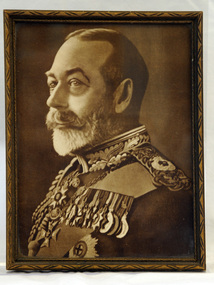
framed photograph, circa 1920's
... He was the second son of Albert Edward, Prince of Wales (later King Edward VII), and the grandson of the British monarch, Queen Victoria ...He was the second son of Albert Edward, Prince of Wales (later King Edward VII), and the grandson of the British monarch, Queen Victoria Saving an item dedicated to the royal family is typical of the general feeling of respect and admiration felt by the rural communities towards the British Royal Family. monarchy royal-family George-V photograph A framed sepia head and shoulders photograph of King George V in military uniform and wearing medals. ...George V was the first king of the House of Windsor. George V (George Frederick Ernest Albert; 3 June 1865 – 20 January 1936) was King of the United Kingdom and the British Dominions, and Emperor of India, from 6 May 1910 until his death in 1936. He was the second son of Albert Edward, Prince of Wales (later King Edward VII), and the grandson of the British monarch, Queen Victoria Saving an item dedicated to the royal family is typical of the general feeling of respect and admiration felt by the rural communities towards the British Royal Family.A framed sepia head and shoulders photograph of King George V in military uniform and wearing medals. It is in a wooden frame with decorated edging and has a cardboard stand.monarchy royal-family george-v photograph -
 Glen Eira City Council History and Heritage Collection
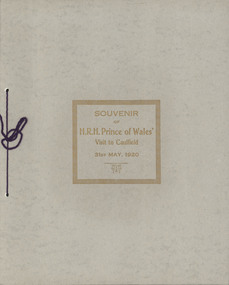
Booklet, "Souvenir of H.R.H. Prince of Wales' Visit to Caulfield 31ST MAY, 1920", c. 1920
... The booklet contains 5 pages with black and white facsimile copy of cover and pages from a book possibly presented to HRH Prince Edward of Wales on the occasion of his visit. ...Prince of Wales' to Australia in 1920. Grey paper cover with gold printed text bound with purple wool thread. The booklet contains 5 pages with black and white facsimile copy of cover and pages from a book possibly presented to HRH Prince Edward of Wales on the occasion of his visit. ...Booklet created by Caulfield City Council on the occasion of the visit of H. R. H. Prince of Wales' to Australia in 1920.Grey paper cover with gold printed text bound with purple wool thread. The booklet contains 5 pages with black and white facsimile copy of cover and pages from a book possibly presented to HRH Prince Edward of Wales on the occasion of his visit. Final page is a copy of a letter from H.R.H to the City of Caulfield. -
 Lilydale RSL Sub Branch
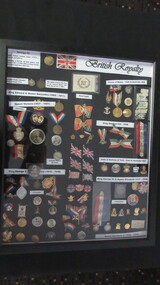
Memorabilia - Framed Display, British Royalty
... King Edward, Queen Alexandra 1914, Prince of Wales 1920, King Edward V11 1936, Queen Victoria 1837-1901, King George V1 1910-1936, King George V1, Queen Elizabeth 1937....King Edward, Queen Alexandra 1914, Prince of Wales 1920, King Edward V11 1936, Queen Victoria 1837-1901, King George V1 1910-1936, King George V1, Queen Elizabeth 1937. ...Framed Display of Badges and Ribbons of British Royalty. George 3rd. King Edward, Queen Alexandra 1914, Prince of Wales 1920, King Edward V11 1936, Queen Victoria 1837-1901, King George V1 1910-1936, King George V1, Queen Elizabeth 1937. -
 Mission to Seafarers Victoria
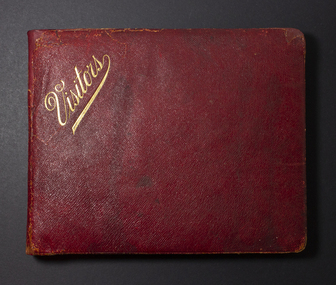
Administrative record (item) - Visitor logbook, Visitors, 1907 - 1951
... prince of wales...duchess of gloucester...seafarers...sailors...seamen...prince edward... - the signature of HRH Edward, then Prince of Wales, and a newspaper clipping, detailing his visit, during has Australian tour in 1920...The book also documents a visit from Edward, Prince of Wales in 1920, travelling on the H.M.S "Renown". ...The book was used as a visitors book for the early Mission to Seafarers. The first date in the book is the 13th of December, 1907, although there are almost six pages of signatures before this. The last signature is dated the 28th of June, 1951. The book documents some of the most significant moments of the Central Institute: - the Opening Ceremony of the "new" Mission to Seafarers building in September 1917. - the signature of HRH Edward, then Prince of Wales, and a newspaper clipping, detailing his visit, during has Australian tour in 1920. - the visit by the Governors General including HRH the Duke and Duchess of Gloucester in 1945. Also registered: the Australian Chaplains conference attendees of both 1936 and 1949. Many supporters, ladies from the Guild and seafarers signed the book.The book is a significant record of VIP visitors to the Mission to Seafarers 1907 to 1951. It records respective Opening Ceremonies for Mission Buildings of both 1907 and 1917 and attendees. The book also documents a visit from Edward, Prince of Wales in 1920, travelling on the H.M.S "Renown". Significant national and international visitors throughout the first half of the 20th Century range from the royal, Vice regal and political through to international Members of the Mission to Seafarers, participants in diocesan conferences and AGMs.Printed in gold on the front cover: VISITORS; First name registered and handwritten: "Northcote" in black ink ; Last name entered "Paul Morra"signatures, handwriting, 1907-1951, h.m.s-renown, duke of gloucester, chaplain conferences, catherine florence aviss nee frampton, martin frampton, elizabeth frampton, herbert aviss, prince of wales, duchess of gloucester, seafarers, sailors, seamen, prince edward, opening ceremony, edward northcote (1854-1926) -
 Bendigo Historical Society Inc.
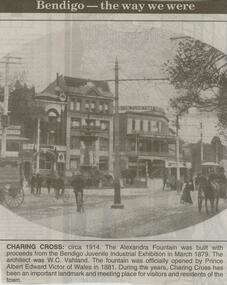
Newspaper - JENNY FOLEY COLLECTION: CHARING CROSS
... The fountain was officially opened by Prince Albert Edward Victor of Wales in 1881. During the years, Charing Cross has been an important landmark and meeting place for visitors and residents of the town. ...The fountain was officially opened by Prince Albert Edward Victor of Wales in 1881. During the years, Charing Cross has been an important landmark and meeting place for visitors and residents of the town. ...Bendigo Advertiser ''The way we were'' from 2000. Charing cross: circa 1914. The Alexandra Fountain was built with proceeds from the Bendigo Juvenile Industrial Exhibition in March 1879. The architect was W.C. Vahland. The fountain was officially opened by Prince Albert Edward Victor of Wales in 1881. During the years, Charing Cross has been an important landmark and meeting place for visitors and residents of the town. The clip is in a building.newspaper, bendigo advertiser, the way we were -
 Flagstaff Hill Maritime Museum and Village
Craft - Scrimshaw, Hero 1870, Late 20th Century
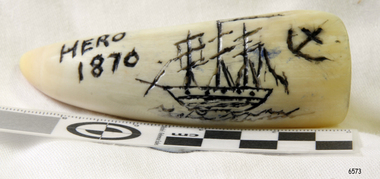
... On July 1860 the Prince of Wales embarked onboard HMS Hero, Albert Edward Prince of Wales, was the eldest son of Queen Victoria, and the future King Edward VII, at the time he was then nineteen years of age, and on route to Newfoundland, Canada and the United States on his first state tour. ...On July 1860 the Prince of Wales embarked onboard HMS Hero, Albert Edward Prince of Wales, was the eldest son of Queen Victoria, and the future King Edward VII, at the time he was then nineteen years of age, and on route to Newfoundland, Canada and the United States on his first state tour. ...Scrimshaw is regarded as early folk art and is associated primarily with whaling that was opened up in the Pacific at the end of the eighteenth century by sailors mainly from American, English and French vessels. As a result, some of the best scrimshaw from Pacific whales can be found in collections in these countries. Even though sailors must have had plenty of spare time between periods of whaling scrimshaw on whale teeth seems a rarity before the 1830s. One reason may have been the high price paid for whale teeth ivory in this period making scrimshaw on teeth popular only after the market was saturated and the price dropped. The earliest identified engraver of whale teeth is the English whaling master Captain J. S. King who was active between 1817 and 1823. There have been six ships called the Hero in the Royal Navy and this ship was the fourth named Hero, it was a screw-propelled 91-gun and second-rate. In the rating system of the British Royal Navy, this term is used to categorise sailing warships, a second-rate was a ship of the line which by the start of the 18th century mounted 90 to 98 guns on three gun decks. Earlier 17th-century second rates had fewer guns and were originally two-deckers or had only partially armed third gun decks. The Hero was launched in 1858 and sold in 1971. On July 1860 the Prince of Wales embarked onboard HMS Hero, Albert Edward Prince of Wales, was the eldest son of Queen Victoria, and the future King Edward VII, at the time he was then nineteen years of age, and on route to Newfoundland, Canada and the United States on his first state tour. He was the first member of the British royal family to visit North America. In 1860 the Queen had intended to pay a visit to Canada however stress prevented her from travelling. The then Prime Minister Lord Palmerston suggested that “Bertie” the prince of Wales could represent the Queen and on July 10th 1860, Bertie boarded HMS Hero for a tour of Canada and the USA. On July 23rd the ship arrived at Terranova. By the second week of August, the HMS Hero had sailed up the St. Lawrence River and anchored at Quebec. The Prince was successful with Canadian society visiting Quebec and Montreal during his stay. He went on to visit the United States following an invitation by President James Buchanan. His American journey was regarded as a great success. President Buchanan wrote to Queen Victoria: "He “Bertie” has faced a very difficult task for a person his age and his behaviour in all this has been that of his age and position. He has shown himself honourable, Frank and affable and he won the respect of the sensible and wise people". The scrimshaw is believed to be a modern reproduction of a typical scrimshaw scene and engraved very crudely onto a synthetic substance. Scrimshaw art carved into non-natural material in the shape of a whale tooth. The line artwork images of a three-masted, fully rigged ship and an anchor are coloured black. Inscription is engraved into tooth.Engraved "Hero 1870"warrnambool, flagstaff-hill, flagstaff-hill-maritime-museum, maritime-museum, shipwreck-coast, flagstaff-hill-maritime-village, scrimshaw, plastic, resin, replica, prince of wales, british navy vessel, whaling, hms hero, reproduction, carving, engraving -
 National Wool Museum
Currency - One Pound Note, John Ash, 1938 - 1948
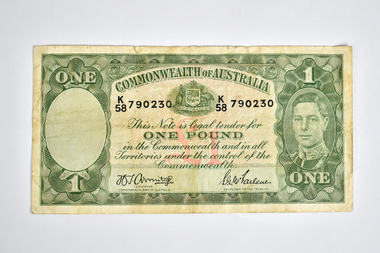
... Shaped as a medallion, the watermark showed the profile of Edward, the Prince of Wales. A new portrait of the King was also introduced, depicting him frontally rather than in profile as he had appeared in the prior banknotes of the Harrison Series (1923-1925). ...Shaped as a medallion, the watermark showed the profile of Edward, the Prince of Wales. A new portrait of the King was also introduced, depicting him frontally rather than in profile as he had appeared in the prior banknotes of the Harrison Series (1923-1925). ...John Ash succeeded Thomas Harrison as the Australian Note Printer in 1927 and oversaw the printing of a new series of banknotes, known as the Ash Series. First issued between 1933 and 1934, the new banknotes sought to improve the currency's resistance to counterfeiting. A special watermark was created to increase the security of the new series. Shaped as a medallion, the watermark showed the profile of Edward, the Prince of Wales. A new portrait of the King was also introduced, depicting him frontally rather than in profile as he had appeared in the prior banknotes of the Harrison Series (1923-1925). The back of each denomination contained an individual vignette that reflected a sector of the country's economy. The wool and agricultural industries were represented, as they had been in the first series of the nation's banknotes (1913-1914), and they were joined by manufacturing and commerce. The prominent British sculptor, Paul Montford, contributed to the design of the new series. Recognised for his sculptural works on the exterior of Melbourne's Shrine of Remembrance, Montford was commissioned to produce relief sculptures that formed the basis of the banknotes' vignettes. His sculptures were translated into wash drawings by Frank Manley, the artist and engraver for the Commonwealth Bank's Note Printing Branch. Manley accentuated the sculpture's three-dimensional qualities with deep shadows and touches of illusionism. A sheep in Montford's pastoral scene, for example, stands forward from the frame as if entering the viewer's space to escape branding and Manley preserves this visual conceit in his drawing. Whereas the printing of the previous series of Australian banknotes had been criticised for its poor definition, the sculptural basis of the Ash Series clarified the banknotes' imagery. During a period of record unemployment, the scenes emphasised the strength of the human figure in gestures of labour, evoking classical, heroic qualities in their poses. The sculptural forms suggested stability in the turbulence of the Great Depression and imparted a sense of solidity to paper currency. - museum.rba.gov.auCommonwealth of Australia paper one pound note in green and white tones depicting graphics and text. The obverse has a framed design with a blank portal to the left and King George VI in the right portal. The centre shows the Australian Coat of Arms, serial number, and detail over one pound symbol on a mosaic background, with signatories below. The reverse features a framed pastoral scene with farmers tending sheep, with a blank portal to the right.Obverse: ONE / 1 / 1 / ONE / COMMONWEALTH OF AUSTRALIA / K / 58 / 790230 / K / 58 / 790230 / This Note is legal tender for / ONE POUND / in the Commonwealth and in all / Territories under the control of the / Commonwealth. / [signature] / GOVERNOR / COMMONWEALTH BANK ON AUSTRALIA / [signature] / SECRETARY TO THE TREASURY Reverse: 1 /1 / 1 / 1 / PASTORALcurrency, money, pound note, pastoral scene, industry, commonwealth of australia, paul montford, king george vi, frank manly, john ash -
 National Wool Museum
Currency - One Pound Note, John Ash, 1938 - 1948
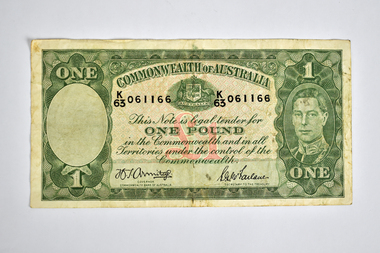
... Shaped as a medallion, the watermark showed the profile of Edward, the Prince of Wales. A new portrait of the King was also introduced, depicting him frontally rather than in profile as he had appeared in the prior banknotes of the Harrison Series (1923-1925). ...Shaped as a medallion, the watermark showed the profile of Edward, the Prince of Wales. A new portrait of the King was also introduced, depicting him frontally rather than in profile as he had appeared in the prior banknotes of the Harrison Series (1923-1925). ...John Ash succeeded Thomas Harrison as the Australian Note Printer in 1927 and oversaw the printing of a new series of banknotes, known as the Ash Series. First issued between 1933 and 1934, the new banknotes sought to improve the currency's resistance to counterfeiting. A special watermark was created to increase the security of the new series. Shaped as a medallion, the watermark showed the profile of Edward, the Prince of Wales. A new portrait of the King was also introduced, depicting him frontally rather than in profile as he had appeared in the prior banknotes of the Harrison Series (1923-1925). The back of each denomination contained an individual vignette that reflected a sector of the country's economy. The wool and agricultural industries were represented, as they had been in the first series of the nation's banknotes (1913-1914), and they were joined by manufacturing and commerce. The prominent British sculptor, Paul Montford, contributed to the design of the new series. Recognised for his sculptural works on the exterior of Melbourne's Shrine of Remembrance, Montford was commissioned to produce relief sculptures that formed the basis of the banknotes' vignettes. His sculptures were translated into wash drawings by Frank Manley, the artist and engraver for the Commonwealth Bank's Note Printing Branch. Manley accentuated the sculpture's three-dimensional qualities with deep shadows and touches of illusionism. A sheep in Montford's pastoral scene, for example, stands forward from the frame as if entering the viewer's space to escape branding and Manley preserves this visual conceit in his drawing. Whereas the printing of the previous series of Australian banknotes had been criticised for its poor definition, the sculptural basis of the Ash Series clarified the banknotes' imagery. During a period of record unemployment, the scenes emphasised the strength of the human figure in gestures of labour, evoking classical, heroic qualities in their poses. The sculptural forms suggested stability in the turbulence of the Great Depression and imparted a sense of solidity to paper currency. - museum.rba.gov.auCommonwealth of Australia paper one pound note in green and white tones depicting graphics and text. The obverse has a framed design with a blank portal to the left and King George VI in the right portal. The centre shows the Australian Coat of Arms, serial number, and detail over one pound symbol on a mosaic background, with signatories below. The reverse features a framed pastoral scene with farmers tending sheep, with a blank portal to the right.Obverse: ONE / 1 / 1 / ONE / COMMONWEALTH OF AUSTRALIA / K / 58 / 790230 / K / 58 / 790230 / This Note is legal tender for / ONE POUND / in the Commonwealth and in all / Territories under the control of the / Commonwealth. / [signature] / GOVERNOR / COMMONWEALTH BANK ON AUSTRALIA / [signature] / SECRETARY TO THE TREASURY Reverse: 1 /1 / 1 / 1 / PASTORALcurrency, money, pound note, pastoral scene, industry, commonwealth of australia, paul montford, king george vi, frank manly, john ash -
 Flagstaff Hill Maritime Museum and Village
Book - Birthday Book, Raphael Tuck & Sons et al, The Dickens Birthday Book, 1901-1911
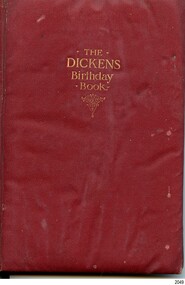
... Prince and Princess of Wales. This would suggest that this book was published from 1901 to 1910, when King Edward VII and Queen Alexandra, and Prince George and his wife Princess Mary were permitted to use these titles. ...Prince and Princess of Wales. This would suggest that this book was published from 1901 to 1910, when King Edward VII and Queen Alexandra, and Prince George and his wife Princess Mary were permitted to use these titles. ...Birthday Books are personal record books for names and birth dates of friends and relatives. This book includes a quote from Charles Dickens for each day of the year. The books were published in many editions, with different publishers, illustrators, covers and designs. This Dickens Birthday book was presented as a gift to fifteen-year-old Clara Skirrow on January 19th 1911, by Mr and Mrs B Watson, perhaps the 'Benji Watson' in the book, whose birthday was July 1st, 1887. The entries in the book include several with the surnames Watson and Skirrow. Interestingly, names are entered in various writing styles, perhaps because each entry was written by the person of that name, similar to an autograph book. Curiously, there are two entries for Connie Watson, one in brackets on March 16th, the other on March 23rd, without brackets. The artist, Pilford Fletcher Watson (1892-1907), was born in London. He moved to Sydney, where he became a prominent and well-established artist and a founding member of the Academy of Arts, Australia, established in 1891. His works included local scenery, architecture, and the interiors of historic buildings. Many of his pieces were bequeathed to the State Library of New South Wales. The firm, Raphael Tuck & Sons Ltd, was a printer and publisher that operated in London from 1866 to 1960. Its logo was the artist's easel, palette and brush. The firm that specialised in greeting cards and produced puzzles. It also became the world’s largest postcard publisher. In 1960, the firm amalgamated with others to become the British Printing Corporation. The fly page states that Ralph Tuck & Sons, Ltd. was the publisher to Their Majesties, the King and Queen, and Their Royal Highnesses, the Prince and Princess of Wales. This would suggest that this book was published from 1901 to 1910, when King Edward VII and Queen Alexandra, and Prince George and his wife Princess Mary were permitted to use these titles. NAMES LISTED IN THE BIRTHDAY BOOK (the museum has photographs of every entry in the book, which are available on enquiry): - January 1 Mrs J (or S) Watson January 11 Wilfred Skirrow, 1904 January 16 Elsie Watson, 1897 January 17 Elsie Hartley, 23/06/2012 [error?] January 21 Frances Victoria Haieck January 29 Annie Skirrow, 1884 February 14 Willie Illingworth February 17 Bessie Watson February 19 Mrs Butterfield, 22 Apperley Rd, Idle [UK] February 27 William Ernest Futter ? March 13 Carrie Barker March 16 Connie Watson March 19 Hilda Graham March 20 Mrs W. Illingworth March 23 Connie Watson April 5 Mrs Ruth Ann Skirrow April 6 William Dickinson Goldsbrough April 11 Norman Goldsbrough April 16 May Jessen April 19 Mrs A Dixon April 20 Mrs S Watson April 23 John Fred Stansfield, 1912 April 24 Reginald Goldsbrough May 12 Bertha Ellis May 18 Gladys McInnes May 28 Mrs Arthur Watson June 3 Jack Watson, 1910 June 10 Mr James Watmough June 18 Miss Hilda Hodgson, 1895 June 26 Sarah Atkinson, 1894 June 30 Mary A Bannister, 1896 July 1 Benji Watson, 1887 July 1 Ester Watmough, 1896 July 2 Clara Skirrow, 1896 July 2 Aunt Jinni July 2 Aunt Hannah July 10 Ellen Gertrude Connolly July 11 Violet Mathieson July 23 Hady Rogers July 26 Sarah Atkinson August 2 Allan Watson August 3 George Skirrow August 6 Thomas Skirrow August 6 Gladys Patten August 8 John Waite, 1909 August 21 Lilian Pattison, 1909 August 25 Ethel Watson, 1889 August 25 Evellyn Goldsbrough September 4 Miss Frances Barker September 12 Ernest Hartley, 1888 September 14 Harry Stansfield, 1895 September 20 Harry Padgett September 25 Leslie Watson September 26 Florrie Wise, 1896 September 27 Dorothy Watson, 1909 October 1 Madge Ferrier October 3 Elizabeth Padgett, 1896 October 5 Violet Altridge, 1895 October 13 Elsie Hodgson, 1893 October 18 Arthur Watson October 21 Emily Bradshaw November 14 Mr A Dixon December 27 Laura Hartley, 1890 December 29 Arther Skirrow, 1894 December 29 Dolly GrahamThis early 20th-century Birthday Book is significant for containing quotes by the famous writer Charles Dickens. It is also connected to the popular and prolific publisher and printer, Raphael Tuck & Sons Ltd, and the renowned illustrator and artist, Pilford Fletcher Watson. Ownership of a rare and beautifully presented book like this indicates the value placed on keeping records of family and friends, and remembering their birthdays, in the early 1900s. The book is highly significant for the entries of local family names, some with birth dates. Book: small book with padded maroon leather hard cover and embossed with gold text on cover and spine; cover also has a gold motif. The pages include coloured illustrations, sketches, and lines for personal entries. The first pages are about Charles Dickens. Title: The Dickens Birthday Book, with six illustrations in Colour by P. Fletcher-Watson Publisher: Raphael Tuck & Sons Ltd, Britain Printed in England 1901-1910 Artist: P. Fletcher-Watson This padded red leather hardcover book has embossed gold text on the front cover and spine. The six colour illustrations throughout the book were by artist P. Fletcher-Watson; one is a portrait of Dickens. Each day has a quote from Charles Dickens' works and blank lines below. The drawing on the fly page depicts a stone building with side pillars and a logo in the centre of the horizontal beam. It has a gift inscription for Clara Skirrow on January 19th, 1911. There are handwritten entries under many of the dates, some include years that range from 1884 to 1912, and one includes an address in the U.K.. Embossed on cover and spine: “The DICKENS Birthday Book” Handwritten in black ink: "From Mr & Mrs B. Watson / To Clara Skirrow / With Best wishes / January 19th 1911" Illustration on fly page: Logo [artist's palette, brush and easel] Publisher information: “Raphael Tuck & Sons Ltd, London, Paris, Berlin, New York, Montreal,” “Publishers to their Majesties the King and Queen, and T.R.H. the Prince and Princess of Wales” “Printed in England” Handwritten entries with names, some dates, and one address. flagstaff hill, flagstaff hill maritime museum and village, warrnambool, maritime museum, maritime village, great ocean road, shipwreck coast, birthday book, p. fletcher-watson, raphael tuck & sons ltd, 1901-1910, illustrated, 19-01-1911, mr & mrs b. watson, clara skirrow, red cover, british printing corporation, king and queen and trh prince and princess, king edward vii and queen alexandra, antique book, rare book, atkinson, bannister, barker, bradshaw, butterfield, connolly, dixon, ellis, ferrier, futter, goldsbrough, graham, hartley, hodgson, illingworth, jessen, mathieson, mcinnes, padgett, patten, pattison, rogers, stansfield, waite, watmough, watson, wise, dickens birthday book, charles dickens, dickens quotes, skirrow -
 City of Moorabbin Historical Society (Operating the Box Cottage Museum)
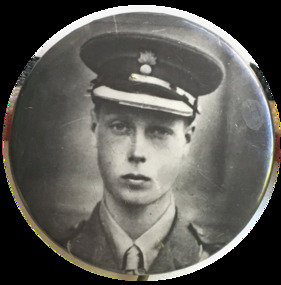
Badge - Visit of the Prince of Wales in 1920, 1954
... At the end of the War, the King kept his pledge and, following on from successful visits to other countries, including the USA and West Indies in 1919, Edward Albert Christian George Andrew Patrick David, the Prince of Wales, embarked on a journey to Australia. ...At the end of the War, the King kept his pledge and, following on from successful visits to other countries, including the USA and West Indies in 1919, Edward Albert Christian George Andrew Patrick David, the Prince of Wales, embarked on a journey to Australia. ...At the Imperial War Conference in 1917, and again at the conference of overseas Prime Ministers in 1918, King George V had foreshadowed a visit to the Dominions by his eldest son, “when peace comes”. At the end of the War, the King kept his pledge and, following on from successful visits to other countries, including the USA and West Indies in 1919, Edward Albert Christian George Andrew Patrick David, the Prince of Wales, embarked on a journey to Australia. The visit was in part to offer official thanks for the support Australia had shown Great Britain during World War I. It was also designed to strengthen the links between Australia and the Empire. The Prince of Wales arrived in Australia on board the HMS Renown in April 1920, having left England the previous month. He spent nine days in Victoria, eleven days in New South Wales, four days in Tasmania, eleven days in Western Australia, six days in South Australia and eight days in Queensland. In all, he visited 110 cities and towns across Australia.Metal badge with photo of Prince of Walesprince of wales, royal visit 1920, badge
