
Showing 25 items matching "eight wheel"
-
 Ballarat Tramway Museum
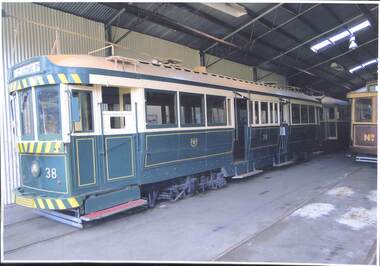
Photograph - Photograph - coloured, Tram No. 38- Maximum Traction truck bogie (eight wheels), drop end and centre combination, modified for one man operation
... ...eight wheel...This eight wheel tramcar was built 1914 for the Prahran and Malvern Tramways Trust. ...This eight wheel tramcar was built 1914 for the Prahran and Malvern Tramways Trust. ...This eight wheel tramcar was built 1914 for the Prahran and Malvern Tramways Trust. It was sold to the State Electricity Commission in 1951 for use on the Ballarat tramway system. The tram was altered to its present form in 1953 to permit one-man operation. It was modified to operate as a one man tram but limited use due to industrial bans. A conductor was used in Ballarat. In 1954 the tram was decorated for the visit of Queen Elizabeth II. In 1971 it was acquired by the Museum and repainted in the 1960s SEC colour scheme in 1979 Large colour photograph - laminatedGreen and cream tram with gold number and SEC symbol. St Aidens Dvs shown in destination window1914, melbourne, ballarat, tram 38, eight wheel, four wheel, one man tram, industrial ban, queen elizabeth -
 Flagstaff Hill Maritime Museum and Village
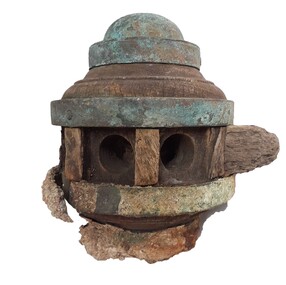
Functional object - Ship's Wheel
... ...steering wheel...eight...This wooden ship's wheel originally had eight spokes but four are no longer in their sockets. ...Ship's wheel; segment of a wooden ship's wheel. It once had eight spokes but only portions of four spokes remain. ...Great Ocean Road Warrnambool shipwreck artefact artefact ship's wheel ship's wheel segment portion of a ship's wheel Flagstaff Hill Maritime Museum Maritime Village Flagstaff Hill Divers marine technology navigation steering wheel eight spoke wheel King Island craypot diver Ship's wheel; segment of a wooden ship's wheel. ...This wooden ship's wheel originally had eight spokes but four are no longer in their sockets. One of the spokes has been shaped. Both sides of the wheel have a brass cap over the centre of the hub, covering the wooden hub. The wood is split and cracked, and parts of it have small holes, a sign of being affected by the sea worm. Thick encrustations are on parts of the wheel, showing that it has been on the sea bed for quite some time. The donor is a Warrnambool resident. Years ago he was cray fishing at King Island, which is in Bass Strait, northwest of Tasmania. His craypot got stuck in a reef so a diver helped him by retrieving the craypot for him. While the diver was underwater he also stumbled across the ship's wheel, which he gave to the donor. The Bass Strait is a very narrow route that was difficult and dangerous to navigate in the early 19th century, before good maps, communications and lighthouses were installed. The area, including King Island, is the graveyard of many ships that almost made it to their destination of Melbourne along Australia's treacherous coastline. Around King Island alone, many ships and lives were lost. There is no information about the history of this ship's wheel. Its condition shows that the item has been under the water for a long time. However, there is no evidence that it came from a shipwreck. It could even have been an old ship that could have been scuttled or destroyed as it was no longer useful. The wheel is significant as a sign of shipping around King Island. It is part of the island's history, and of maritime history. It is an example of an item manufactured by hand.Ship's wheel; segment of a wooden ship's wheel. It once had eight spokes but only portions of four spokes remain. The outer centres of the hub and the reinforcing bands around the hub are brass. The wheel is heavily encrusted in parts. It was recovered from an unknown shipwreck in the waters of King Island.great ocean road, warrnambool, shipwreck artefact, artefact, ship's wheel, ship's wheel segment, portion of a ship's wheel, flagstaff hill, maritime museum, maritime village, flagstaff hill divers, marine technology, navigation, steering wheel, eight spoke wheel, king island, craypot, diver -
 Dandenong/Cranbourne RSL Sub Branch
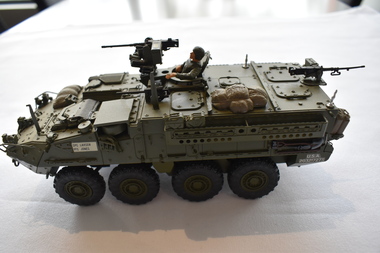
Model - Stryker Military Vehicle
... Model of a Stryker eight wheeled armored fighting vehicle ...USA 20321727 S on lower rear of vehicle SPC LARSEN & PFC JONES on front side of vehicle 25 D - 3 -21B A-34 on front of vehicle Model of a Stryker eight wheeled armored fighting vehicle Model Stryker Military Vehicle ...Model of a Stryker eight wheeled armored fighting vehicle USA 20321727 S on lower rear of vehicle SPC LARSEN & PFC JONES on front side of vehicle 25 D - 3 -21B A-34 on front of vehicle -
 4th/19th Prince of Wales's Light Horse Regiment Unit History Room
Photograph, Marman-Herrington Armoured Car
... Photograph of a Marmon-Herrington Mk VI, an eight wheeled, rear engined, armoured car fitted with a 2-pounder gun, .30 co-ax mg with twin .30 mgs for anti-aircraft mounted on a turret....photo Marmon-Herrington Photograph of a Marmon-Herrington Mk VI, an eight wheeled, rear engined, armoured car fitted with a 2-pounder gun, .30 co-ax mg with twin .30 mgs for anti-aircraft mounted on a turret. ...Photograph of a Marmon-Herrington Mk VI, an eight wheeled, rear engined, armoured car fitted with a 2-pounder gun, .30 co-ax mg with twin .30 mgs for anti-aircraft mounted on a turret.photo, marmon-herrington -
 Whitehorse Historical Society Inc.
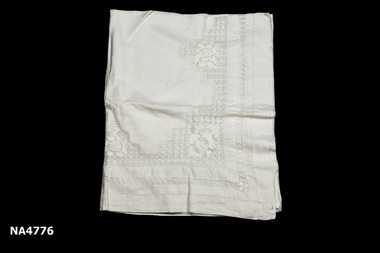
Domestic object - Large white table cloth
... Fine drawn thread work around edges. Eight wheel flower like pattern along each long edge and four on each short end. 6cm spoke stitched hem on all sides....Fine drawn thread work around edges. Eight wheel flower like pattern along each long edge and four on each short end. 6cm spoke stitched hem on all sides. ...Long white fine cotton table cloth. Fine drawn thread work around edges. Eight wheel flower like pattern along each long edge and four on each short end. 6cm spoke stitched hem on all sides.domestic items, table setting -
 Puffing Billy Railway
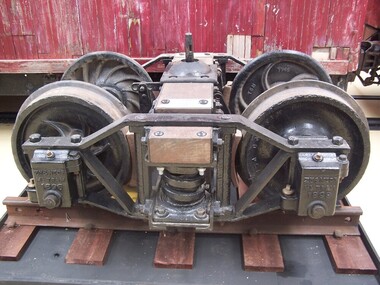
Zeehan & North East Dundas Tramway Bogie 1896, wagon bogie, 1896
... The rolling stock for the Tramway was built in the Launceston Railway workshops, and comprised twenty five eight-wheel low-side trucks, tare 3 tons 1 cwt. 1 qr., load 10 tons; six eight-wheel flat trucks, tare 2 tons 18 cwt. 1 qr., load 10 tons; two four-wheel bolster trucks, for carrying long timber, tare 1 ton 19 cwt., load 5 tons; and four passenger cars, each with six cross-seats with reversible backs, to carry eighteen passengers, also a locker for mails and parcels. ...The rolling stock for the Tramway was built in the Launceston Railway workshops, and comprised twenty five eight-wheel low-side trucks, tare 3 tons 1 cwt. 1 qr., load 10 tons; six eight-wheel flat trucks, tare 2 tons 18 cwt. 1 qr., load 10 tons; two four-wheel bolster trucks, for carrying long timber, tare 1 ton 19 cwt., load 5 tons; and four passenger cars, each with six cross-seats with reversible backs, to carry eighteen passengers, also a locker for mails and parcels. ...Zeehan & North East Dundas Tramway Bogie 1896 The North East Dundas Tramway (NEDT) was a 2 ft (610 mm) narrow gauge tramway on West Coast Tasmania that ran between Zeehan and Deep Lead (now Williamsford). It was part of Tasmanian Government Railways. The line was opened in 1896 to carry ore from the Williamsford mines to Zeehan where it would be loaded onto another train for shipment to Burnie. The narrow-gauge (2 ft) was chosen because of the extremely difficult terrain that the railway crossed, requiring several big trestle bridges, including one at the foot of Montezuma Falls. After some rain the engine and carriages would get soaked by spray from the falls. There was a break-of-gauge with the mainline 1,067 mm (3 ft 6 in) system at Zeehan. The railway was closed in 1932. The rolling stock for the Tramway was built in the Launceston Railway workshops, and comprised twenty five eight-wheel low-side trucks, tare 3 tons 1 cwt. 1 qr., load 10 tons; six eight-wheel flat trucks, tare 2 tons 18 cwt. 1 qr., load 10 tons; two four-wheel bolster trucks, for carrying long timber, tare 1 ton 19 cwt., load 5 tons; and four passenger cars, each with six cross-seats with reversible backs, to carry eighteen passengers, also a locker for mails and parcels. All trucks and cars have cast-steel wheels 21 inches in diameter and are fitted with automatic vacuum brakes. The trucks have side levers and the cars have hand-screw brakes. The vacuum brake can be worked from the engine or from the passenger cars, which act as brake vans. When this brake was introduced, one effect was to accelerate the journey speed by about 10 minutes owing to more even running on down gradients. Historic - Industrial Narrow Gauge railway - Bogie used on the Zeehan & North East Dundas Tramway, Tasmania, Australia Bogie made from steel, iron and wrought ironZN & NTDS ML TRAM 1896 Griffinpuffing billy, bogie, zeehan & north east dundas tramway bogie, zeehan & north east dundas tramway, industrial narrow gauge railway, gauge: 2' (610 mm) -
Bay Steamers Maritime Museum
Ship's Wheel
... Wooden Ship's wheel with eight spoke handles and a central brass reinforcing plate. ...This wooden wheel replaced the original steel wheel which was much larger and proved unwieldly. wood ships wheel wattle steering gear steam tug bay steamers maritime museum Wooden Ship's wheel with eight spoke handles and a central brass reinforcing plate. ...This is one of two ship's wheels that are associated with the steam tug Wattle. This wooden wheel replaced the original steel wheel which was much larger and proved unwieldly.Wooden Ship's wheel with eight spoke handles and a central brass reinforcing plate. The wheel is constructed of mid brown timber. The outer wheel is constructed of short timber lengths inbetween the eight turned spokes. A central circular brass plate is rivetted in the middle to hold the wooden components together.wood, ships wheel, wattle, steering gear, steam tug, bay steamers maritime museum -
 Bendigo Historical Society Inc.
Photograph - BILL ASHMAN COLLECTION: MAN STANDING BESIDE SCALEBUOY
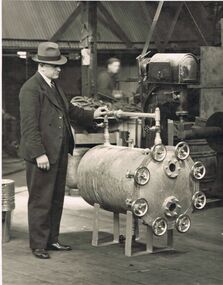
... The unit has a large end which is held on by eight large bolts with wheel fasteners and two inspection plates each with six bolts. ...The unit has a large end which is held on by eight large bolts with wheel fasteners and two inspection plates each with six bolts. ...Black and white photo of a man standing beside a large Scalebuoy unit. The unit has a large end which is held on by eight large bolts with wheel fasteners and two inspection plates each with six bolts. The unit is in a building and there is another man in the background. Cohuna Butter Factory written on the back.sciences, instruments - general, scalebuoy, bill ashman collection - correspondence, scalebuoy, cohuna butter factory -
 Flagstaff Hill Maritime Museum and Village
Equipment - Ship's Wheel, 1922
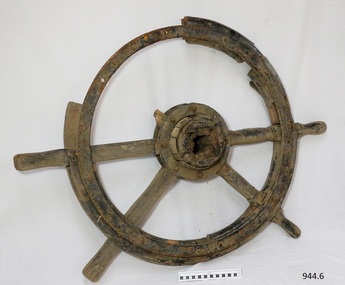
... Ship’s wheel, also called a Helm, eight spoke design. Centre of wheel is handmade of wood and has iron rings around each side. ...She is now listed on the Australian Register of Historic Vessels (ARHV Number: HV000562.) flagstaff hill warrnambool shipwrecked-coast flagstaff-hill flagstaff-hill-maritime-museum maritime-museum shipwreck-coast flagstaff-hill-maritime-village ship's wheel hand made ship's wheel coastal trader reginald m ketch john murch ch murch reg webb carribie station mt lyell copper company queenstown navy league andrew rennie melbourne ferry company r.f. dale Ship’s wheel, also called a Helm, eight spoke design. Centre of wheel is handmade of wood and has iron rings around each side. ...This ship's wheel was hand-made from wood and metal using a recycled cart wheel. It originally belonged to the "Reginald M", a coastal trading ketch. ‘REGINALD M’ 1922 to 1975- The vessel “Reginald M” was a two-masted coastal ketch, owned and built by Mr Jack (John) Murch of Birkenhead, Port of Adelaide, South Australia. Its construction took approximately 6 months, and it launched at Largs Bay in 1922. The Reginald M’s purpose was to serve the coastal trade of South Australia, to carry cargo cheaply and efficiently. Some have said that the keel was, in fact, hewn from two telegraph poles! Its builder frequented all the salvage yards for materials and fittings. Reginald M had a very shallow draft and a flat bottom that enabled it to come close to shore and to sit high and dry at low tide or to be beached on sand. The flat bottom was also to make the ship able to skim over reefs. Wagons could load and unload direct from their sides. Its cargo included Guano, Barley, Wool, Horses, Cattle, Timber, Explosives, Potatoes, Shell Gritt and Gypsum. On April 9th 1931Reginald M weathered a large storm in St Vincent Gulf, SA. The vessel suffered great damage; the mast snapped, and the crew laboured for four hours to free it by chopping off the mast and rigging. The crew patched it up and slowly returned to Port Adelaide with only a portion of the insured cargo being damaged. The crew members at the time were owner Mr John H Murch of Wells Street, Largs Bay; Skipper Mr R Murch, John’s brother; Murray, son of Captain Murch; and Seaman John Smith. Reg Webb purchased Carribie Station, at Marion in the Warooka District, south of Adelaide, in 1921. He cleared the land and farmed sheep and grain. In 1923, he shipped his own wool and grain from Marion Bay, having first carted 300 bags of the barley grain, 12 bags at a time, along the unmade track to the jetty. A photograph donated to Flagstaff Hill, dating about 1929 - 1942, shows two men on the Reginald M, holding between them their fishing catch of a large hammer shark. The photograph is stamped “GRENFELL STUDIO PORT LINCOLN PRINT” and titled “hammer shark caught on Reginald Emm”. The donor’s family lived on the Your Peninsula and dispatched their grain from a chute at Gleeson’s Landing to the awaiting transport vessel. Reg knew the Murch Brothers from Port Adelaide. The brothers had been using their ketch, Reginald M, to ship Guano from the Islands, led by Captain Richard Murch. Reg approached them in 1934 about shipping grain from Marion Bay. The brothers visited the bay and thought it was an ideal place. They showed Reg where to stack his grain, and they measured up the cliffs. When Reg was ready, they brought down and installed a ninety-foot wooden chute. The bags of grain were individually pushed down the chute, landing in a waiting small boat, then rowed to Reginald M with 14 bags at a time. After 10 hours, Reginald M would have a load of 1300 bags of grain to ship to waiting ports. At one time, a wild storm destroyed the chute, so they built a stronger replacement chute. Reginald M engaged in the shipping of grain from there until 1938. In 1940, Able Seaman Allan H Lucas served on the Reginald M between September and December, being engaged and discharged from Port Adelaide. The ship’s Master, W S Murch, signed his Certificate of Discharge. It seems that at the Reginald M was used, at one time, as a Customs vessel, as one photograph in Flagstaff Hill’s collection shows “H.M.C. No. 3, Pt Adelaide” on the bow. In 1969, the last freight left Marion Bay on the ketch Reginald M carrying grain, wool, and explosives. In late 1970, the Mt. Lyell Mining and Railway Company bought the vessel to use as a barge to carry explosives. In 1972, the Navy League of Strahan, Tasmania, purchased it for use by the Strahan Sea Cadet Unit to use at Macquarie Harbour and renamed it T.S. Macquarie. However, this plan for the use of Reginald M did not happen. In 1974, Mr Andrew Rennie, of East Brighton, Melbourne, bought it for a similar purpose, paying $5,000 and donating a ‘Cadet of the Year’ trophy to the Sea Cadets. He sailed it from Strahan to Melbourne, planning to use it for pleasure sailing. Also, in 1975, Reginald M was bought by the Melbourne Ferry Company at auction. Later in 1975, Flagstaff Hill Maritime Museum bought the Reginald M for $20,000. It became a popular exhibit in the Village’s lake. In 2006, using funds from a $4,000 government grant, the restoration of the vessel continued. Flagstaff Hill Maritime Village’s Collection holds other artefacts associated with Reginald M. They include - Photographs of the Reginald M, including one photograph of it in Outer Harbour, S.A., dated 1947, with Skipper- R.F. Dale and Owner- John Murch. Another shows it docked at Port Adelaide, with the lettering H.M.C. No. 3 Pt ADEL (standing for His /Her Majesty’s Customs). There is a black and white photo of it at a wharf and another showing a person on board. - a lifebuoy, made of cork, with the inscription of “Pt Adelaide” on it. - Helm section, removed and replaced during restoration. - a bullet found in pieces of timber when Reginald M was restored in 1979 Reginald M was a much-loved exhibit at the Maritime Village, where many visitors enjoyed boarding and exploring a real ship with a long history. Sadly, the Reginald M was decommissioned in late 2016, due to the continuing prohibitive cost of maintenance and the risk to public safety. Components from the Reginald M are held in Flagstaff Hill's collection as a reminder of the Reginald M’s history. This ship's wheel is significant because of its association with the REGINALD M. REGNIALD M was a coastal trading ketch from South Australia built in 1922. It is one of very few sailing coastal trading vessels still extant, and its flat bottom, single chine shape illustrates a very simple but robust method of construction, compared to other round bilged examples of trading vessels. She is now listed on the Australian Register of Historic Vessels (ARHV Number: HV000562.)Ship’s wheel, also called a Helm, eight spoke design. Centre of wheel is handmade of wood and has iron rings around each side. The spokes are fitted into this wooden hub. The outer wheel has an iron ring on one side and sections of a wooden ring on the other. There are both original and modern bolt and screw fastenings. The wheel has remnants of black paint. This ship’s wheel was originally fitted to the ketch REGINALD M and removed during its restoration. flagstaff hill, warrnambool, shipwrecked-coast, flagstaff-hill, flagstaff-hill-maritime-museum, maritime-museum, shipwreck-coast, flagstaff-hill-maritime-village, ship's wheel, hand made ship's wheel, coastal trader, reginald m, ketch, john murch, ch murch, reg webb, carribie station, mt lyell copper company, queenstown navy league, andrew rennie, melbourne ferry company, r.f. dale -
 Flagstaff Hill Maritime Museum and Village
Equipment - Ship's Wheel
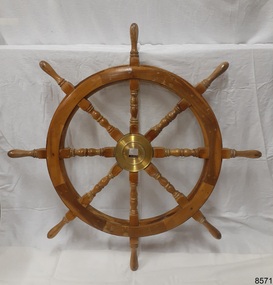
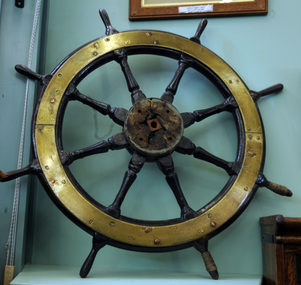
... Ship's wheel, light coloured wood, eight turned spokes, brass hub in centre with square hold. ...Port Phillip Ferries Pty Ltd Melbourne coastal trader timber steamer Huon Karri freighter supply ship charter ferry floating restaurant prawn boat Lakes Entrance ship's wheel Ship's steering wheel ship's steering direction Ship's wheel, light coloured wood, eight turned spokes, brass hub in centre with square hold. ...This is the whip's wheel that was on display for 40 years on the vessel SS Rowitta, installed on the lake at the Flagstaff Hill Maritime Museum and Village as an educational display and attraction. SS ROWITTA: - The 1909 steam ferry, SS Rowitta, was installed as an exhibit at Flagstaff Hill in 1975 and was enjoyed by many visitors for 40 years. Rowitta was a timber steam ferry built in Hobart in 1909 using planks of Huon and Karri wood. It was a favourite of sightseeing passengers along Tasmania’s Tamar and Derwent rivers for 30 years. Rowitta was also known as Tarkarri and Sorrento and had worked as a coastal trading vessel between Devonport and Melbourne, and Melbourne Queenscliff and Sorrento. In 1974 Rowitta was purchased by Flagstaff Hilt to convert into a representation of the Speculant, a historic and locally significant sailing ship listed on the Victorian Heritage Database. (The Speculant was built in Scotland in 1895 and traded timber between the United Kingdom and Russia. Warrnambool’s P J McGennan & Co. then bought the vessel to trade pine timber from New Zealand to Victorian ports and cargo to Melbourne. It was the largest ship registered with Warrnambool as her home port, playing a key role in the early 1900s in the Port of Warrnambool. In 1911, on her way to Melbourne, it was wrecked near Cape Otway. None of the nine crew lost their lives.) The promised funds for converting Rowitta into the Speculant were no longer available, so it was restored back to its original configuration. The vessel represented the importance of coastal traders to transport, trade and communication in Australia times before rail and motor vehicles. Sadly, in 2015 the time had come to demolish the Rowitta due to her excessive deterioration and the high cost of ongoing repairs. The vessel had given over 100 years of service and pleasure to those who knew her. The ship's wheel is an example of the equipment used on a steam ship for navigation. This wheel is connected to the history of the Rowitta, which was a large exhibit on display at Flagstaff Hill Maritime Village from the museum’s early beginnings until the vessel’s end of life 40 years later. The display was used as an aid to maritime education. The Rowitta represents the importance of coastal traders to transport, trade and communication along the coast of Victoria, between states, and in Australia before rail and motor vehicles. The vessel was an example of a ferry built in the early 20th century that served many different roles over its lifetime of over 100 years. Ship's wheel, light coloured wood, eight turned spokes, brass hub in centre with square hold. The wheel was part of the display of the vessel Rowitta at Flagstaff Hill.flagstaff hill maritime museum and village, warrnambool, great ocean road, shipwreck coast, flagstaff hill, maritime village, maritime museum, ss rowitta, navigation, marine technology, steam power, hobart, tasmania, devonport, tasmanian-built, ferry, steam ferry, steamer, 1909, early 20th century vessel, passenger vessel, tamar trading company, tamar river, launceston, george town, sorrento, tarkarri, speculant, peter mcgennan, p j mcgennan & co. port phillip ferries pty ltd, melbourne, coastal trader, timber steamer, huon, karri, freighter, supply ship, charter ferry, floating restaurant, prawn boat, lakes entrance, ship's wheel, ship's steering wheel, ship's steering, direction -
 Flagstaff Hill Maritime Museum and Village
Vehicle - Spring Cart, Late 19th to early 20th centuries
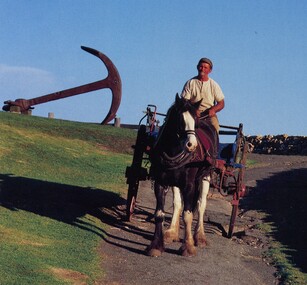
... wheeled cart with shallow box tray and plank seat bolted across the front. Wheels have metal rims and fourteen (14) wooden spokes. A plank is bolted from side to side. A decorative metal step is on the cart's left and has acorn cut-out shapes in the plate. Both wheels have a brake block that is operated by a lever on the cart's right. The cart has eight...wheeled cart with shallow box tray and plank seat bolted across the front. Wheels have metal rims and fourteen (14) wooden spokes. A plank is bolted from side to side. A decorative metal step is on the cart's left and has acorn cut-out shapes in the plate. Both wheels have a brake block that is operated by a lever on the cart's right. The cart has eight ...A spring cart is a two-wheeled, one-horse cart, often with the driver standing up to drive it, and otherwise seated on a simple seat. Carts like this one had springs to make the ride smoother. It is a lighter version of a farm dray and is sometimes called a spring dray. Spring carts were often used on farms for carrying loads. In the towns, some businesses used a spring cart for deliveries of bread, milk and other goods. The carts would be used for travel and for families going on outings and picnics. Visitors to Flagstaff Hill Maritime Village from 1986 to 1992 would enjoy watching a Clydesdale horse named Duke as he worked around the village with his driver Pat McGowan. He would be hitched to a wagon or to this lightweight spring cart or sometimes he would pull the wagon with the cart attached as a trailer. The cart was used for maintenance, carting loads of timber or stone around the site or from town to Flagstaff Hill. Sometimes Duke and the cart would take visitors for cart rides around the Village. Pat McGowan was known for his restoration of horse-drawn vehicles including this spring cart. He already had 40 years of horse handling experience when he began looking after Duke, feeding and harnessing him and driving the horse and cart around the Village. Pat’s dog ‘Yabbie’ would often join them. In August 1992 Duke had to be put down. Warrnambool Veterinary Clinic and other fund-raisers began well-supported appeals and the beloved horse was replaced by a Clydesdale also named Duke (the second), who began work in late October 1992. He, like his predecessor, had a quiet temperament and was comfortable in the traffic. The spring card is an example of vehicles used on farms, for business delivery and for domestic transport in the late-19th and early-20th century. This cart is of note for being associated with the Clydesdale horse Duke which pulled the cart around Flagstaff Hills in the 1980s and 1990s, representing transport of that period.Spring cart; two-wheeled cart with shallow box tray and plank seat bolted across the front. Wheels have metal rims and fourteen (14) wooden spokes. A plank is bolted from side to side. A decorative metal step is on the cart's left and has acorn cut-out shapes in the plate. Both wheels have a brake block that is operated by a lever on the cart's right. The cart has eight-leaf suspension from front to back. The box tray is painted blue and has decorative pale yellow detail. Each shaft pole has has a handle fitting on it. (Horse equipment with the cart is a leather covered, straw filled collar.) flagstaff hill, flagstaff hill maritime museum and village, warrnambool, maritime museum, maritime village, great ocean road, shipwreck coast, springcart, spring cart, jingle, horse-drawn cart, one horse cart, two-wheeled cart, dray, spring dray, wagon, transportation, travel, cart, duke, clydesdale, pat mcgowan, delivery cart, yabbie, cartwright, horse-drawn vehicle, transport, horse cart -
 Orbost & District Historical Society
ship's wheel, tiller, late 1800s
... A ship's tiller wheel, made of wood and faced with brass. The wood is painted black. It has eight spokes and handles to grip in order to steer a boat/ship. ...The significance of this item lies with its association with the shipping trade which serviced this region prior to the railway coming in 1915/16. ss stormbird orbost-shipping-company ship-fitting A ship's tiller wheel, made of wood and faced with brass. The wood is painted black. It has eight spokes and handles to grip in order to steer a boat/ship. ...This is the tiller from the SS Stormbird which traded for the Orbost Shipping Company (1906-1915) between Marlo and Lakes Entrance. Mr Peter Nixon (Min. for Transport and for the Navy, 1970s) and Mr Arthur McMullen had the wheel and mast which had been recovered from the wreck of the SS Stormbird in New Guinea. Mr Nixon donated this wheel to the Orbost Historical Society in 1969.The S S Stormbird was an auxiliary-ketch which was owned by the Orbost Shipping Company (Henry James was the principal shareholder and manager of this company). It, along with the Coringle and the Wongrabelle were the main steamers owned by this company. These boats also carried sails. The significance of this item lies with its association with the shipping trade which serviced this region prior to the railway coming in 1915/16.A ship's tiller wheel, made of wood and faced with brass. The wood is painted black. It has eight spokes and handles to grip in order to steer a boat/ship. Two of the grips have strong rope or wire rope wrapped around them.ss stormbird orbost-shipping-company ship-fitting -
Glen Eira Historical Society
Article - Joyous Gard
... The file also includes a copy of a typed letter, dated 19/05/1995, from Allan Doble to the Melbourne University Gallery with information about the Wheel of Life sculpture Also included in the file are photocopies of two Melway maps showing the location of Joyous Gard and Springthorpe Reserve with notes by Allan Doble, dated 24/03/1995. The file also includes eight...The file also includes a copy of a typed letter, dated 19/05/1995, from Allan Doble to the Melbourne University Gallery with information about the Wheel of Life sculpture Also included in the file are photocopies of two Melway maps showing the location of Joyous Gard and Springthorpe Reserve with notes by Allan Doble, dated 24/03/1995. The file also includes eight ...Two copies of a one page photocopy from the book Australian Sculptors (1980) by Ken Scarlett, describing the Springthorpe Memorial at Boroondara Cemetery, Kew. The file also includes a photocopy of an article by Chrys Spicer, date and source unknown, about the Springthorpe Memorial. The article includes seven photographs of the memorial. A research note by Chloe Stapleton, dated 31/08/12, suggests a possible source for this article. The file also includes a copy of a typed letter from Allan M Doble to Melbourne University Art Curator Heather Lowe, dated 24/03/1995, concerning the history of the Wheel of Life Sculpture originally located at Joyous Gard. The file also includes a copy of a typed letter, dated 19/05/1995, from Allan Doble to the Melbourne University Gallery with information about the Wheel of Life sculpture Also included in the file are photocopies of two Melway maps showing the location of Joyous Gard and Springthorpe Reserve with notes by Allan Doble, dated 24/03/1995. The file also includes eight coloured photographs (100mm x 150mm) of the Wheel of Life sculpture now located in the Medical School of the University of Melbourne, date and photographer unknown, probably 1990s. Negatives are also included.springthorpe memorial, boroondara cemetery, gilbert web c, gilbert webb, the wheel of life, springthorpe john william, inglis annie constance, springthorpe dorothy, springthorpe annie constance, springthorpe enid, springthorpe lancelot, springthorpe guy, joyous gard, doble allan m, doble mrs allan, murrumbeena primary school, springthorpe reserve, joyous gard court, tyers s w, outer circle railway, boyd park, wahroonga crescent, murrumbeena, caulfield city council, boyd’s pottery, linear park -
 Bendigo Military Museum
Photograph - 4th Field Survey Squadron - Land Rover Perentie Light Vehicles, Keswick Barracks, Adelaide SA, 1987
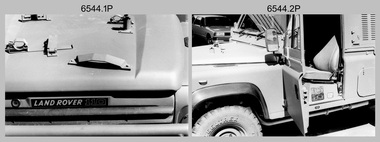
... wheel to a position under the rear of the load area, a galvanised chassis and the Isuzu engine. The Land Rover Perenties were produced in 4x4 and 6x6 variants and powered by an Isuzu 3.9-litre four-cylinder 4BD1 diesel engine. The Truck, Panel, Lightweight, Survey, FFR, Winch, MC2 model was one of eight...wheel to a position under the rear of the load area, a galvanised chassis and the Isuzu engine. The Land Rover Perenties were produced in 4x4 and 6x6 variants and powered by an Isuzu 3.9-litre four-cylinder 4BD1 diesel engine. The Truck, Panel, Lightweight, Survey, FFR, Winch, MC2 model was one of eight ...This is a set of 35 photographs featuring 4th Field Survey Squadron’s newly introduced Survey variant of the Land Rover Perentie light vehicle, at Keswick Barracks, Adelaide SA in 1987. The Land Rover Perentie is a nickname for the Land Rover 110 produced by JRA Limited for the Australian Army, and part manufactured and assembled in Moorebank, New South Wales, during the 1980s and 1990s The name Perentie originates from Land Rover's successful tender to Project Perentie, which was the official Australian Army trial to select new 1 and 2-tonne light vehicles to replace the ageing fleet of Series 2A and 3 Land Rovers. The major differences between the Land Rover Perentie and British Land Rovers were the relocation of the spare wheel to a position under the rear of the load area, a galvanised chassis and the Isuzu engine. The Land Rover Perenties were produced in 4x4 and 6x6 variants and powered by an Isuzu 3.9-litre four-cylinder 4BD1 diesel engine. The Truck, Panel, Lightweight, Survey, FFR, Winch, MC2 model was one of eight 4x4 variants built for the Australian Army. There were 35 vehicles built to satisfy the operational requirements of RA Svy’s units. Source – Wikipedia. See item 6545.9P for related photos of these vehicles.This is a set of 35 photographs featuring 4th Field Survey Squadron’s newly introduced Survey variant of the Land Rover Perentie light truck vehicle, at Keswick Barracks, Adelaide SA in 1987. The black & white photographs are on 35mm negative film and are part of the Army Survey Regiment’s Collection. The photographs were scanned at 96 dpi. .1) to .8) - Photo, black & white, 1987. Land Rover Perentie light truck vehicle features. .9) - Photo, colour, 1986. L to R: unidentified, RQMS - WO2 Peter Symmans, unidentified. .10) to .15) - Photo, black & white, 1987. Land Rover Perentie light truck vehicle features. .16) - Photo, black & white, 1987. Land Rover Perentie light truck vehicle. L to R: WO2 Russ Larsen, SSGT Barry Lutwyche, 2IC Terry Lord, SGT Mick Hogan, unidentified. .17) - Photo, black & white, 1987. Land Rover Perentie light truck vehicle features. .18) & .19) - Photo, black & white, 1987. Loading field trip stores into Land Rover Perentie light truck vehicle. .20) & .21) - Photo, black & white, 1987. L to R: SPR Steve Perks, SGT Mick Hogan loading field trip stores into Land Rover Perentie light truck vehicle. .22) to .25) - Photo, black & white, 1987. L to R: SPR Steve Perks loading field trip stores into Land Rover Perentie light truck vehicle. .26) - Photo, black & white, 1987. CAPT Danny Galbraith loading field trip stores into Land Rover Perentie light truck vehicle. .27) to .31) - Photo, black & white, 1987. Loading field trip stores into Land Rover Perentie light truck vehicle. .32) to .34) - Photo, black & white, 1987. Land Rover Perentie light truck vehicle – broken transfer case lever. .35) - Photo, black & white, 1987. Land Rover Perentie light truck vehicle’s Isuzu 3.9-litre four-cylinder 4BD1 diesel engine..1P to .35P – There are no personnel identified. ‘PERENTI MOTOR VEHICLES JUL 87’ annotated on negatives sleeve.royal australian survey corps, rasvy, 4 fd svy sqn -
 Bendigo Military Museum
Photograph - 4th Field Survey Squadron - Land Rover Perentie Light Vehicles in the Field, 1987
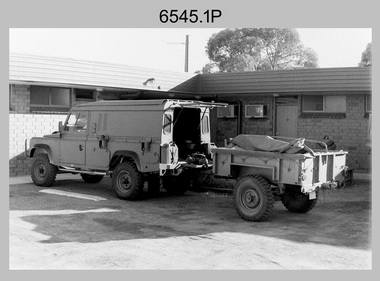
... wheel to a position under the rear of the load area, a galvanised chassis and the Isuzu engine. The Land Rover Perenties were produced in 4x4 and 6x6 variants and powered by an Isuzu 3.9-litre four-cylinder 4BD1 diesel engine. The Truck, Panel, Lightweight, Survey, FFR, Winch, MC2 model was one of eight...wheel to a position under the rear of the load area, a galvanised chassis and the Isuzu engine. The Land Rover Perenties were produced in 4x4 and 6x6 variants and powered by an Isuzu 3.9-litre four-cylinder 4BD1 diesel engine. The Truck, Panel, Lightweight, Survey, FFR, Winch, MC2 model was one of eight ...This is a set of nine photographs featuring 4th Field Survey Squadron’s newly introduced Survey variant of the Land Rover Perentie light truck vehicle on a field trip in SA, in 1987. The Land Rover Perentie is a nickname for the Land Rover 110 produced by JRA Limited for the Australian Army, and part manufactured and assembled in Moorebank, New South Wales, during the 1980s and 1990s The name Perentie originates from Land Rover's successful tender to Project Perentie, which was the official Australian Army trial to select new 1 and 2-tonne light vehicles to replace the ageing fleet of Series 2A and 3 Land Rovers. The major differences between the Land Rover Perentie and British Land Rovers were the relocation of the spare wheel to a position under the rear of the load area, a galvanised chassis and the Isuzu engine. The Land Rover Perenties were produced in 4x4 and 6x6 variants and powered by an Isuzu 3.9-litre four-cylinder 4BD1 diesel engine. The Truck, Panel, Lightweight, Survey, FFR, Winch, MC2 model was one of eight 4x4 variants built for the Australian Army. There were 35 Vehicles built to satisfy the operational requirements of RA Svy’s units. Source – Wikipedia. See item 6544.35P for related photos of these vehicles.This is a set of 35 photographs featuring 4th Field Survey Squadron’s newly introduced Survey variant of the Land Rover Perentie light truck vehicle, at Keswick Barracks, Adelaide SA in 1987. The black & white photograThis is a set of nine photographs featuring 4th Field Survey Squadron’s newly introduced Survey variant of the Land Rover Perentie light truck vehicle on a field trip in SA, in 1987. The black & white photographs are on 35mm negative film and are part of the Army Survey Regiment’s Collection. The photographs were scanned at 96 dpi. .1) - Photo, black & white, 1987. Perentie Land Rover with trailer parked outside unknown motel in SA. .2) & .3) - Photo, black & white, 1987. Field trip featuring Perentie Land Rover. .4) - Photo, black & white, 1987. Field trip featuring Perentie Land Rover. Series 3 Land Rover parked behind. Unidentified personnel. .5) & .6) - Photo, black & white, 1987. Field trip featuring Perentie Land Rover. Unidentified personnel. .7) & .8) - Photo, black & white, 1987. Field trip featuring Perentie Land Rover. Typical sandy 4WD track on fence line. .9) - Photo, black & white, 1987. Field trip featuring Perentie Land Rover. Probable gas extraction facility..1P to .9P – There are no personnel identified. ‘PERENTI MOTOR VEHICLES JUL 87’ annotated on negatives sleeve.tified. royal australian survey corps, rasvy, 4 fd svy sqn -
 Bendigo Military Museum
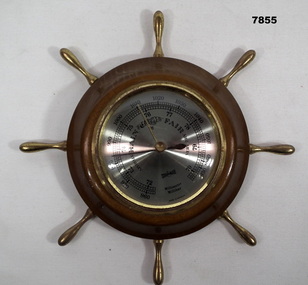
Instrument - BAROMETER
... wheel. Interior function made of copper and glass. Eight spikes all of etal - gold in colour. ...wheel. Interior function made of copper and glass. Eight spikes all of etal - gold in colour. ...Item donated to "A" Company Sgts Mess by two sergeants, G. Pickens and K. Pickens.Brown wooden round barometer in the shape of a boat steering wheel. Interior function made of copper and glass. Eight spikes all of etal - gold in colour. Plastic backing of working parts. hole drilled in back top to attach to wall.Written on back "Presented to A.Coy Sgt Mess 10th Nov 1990". By Sgt. G. Pickens & Sgt K. Pickens.sgts mess, a. company, barometer -
 Great Stupa of Universal Compassion
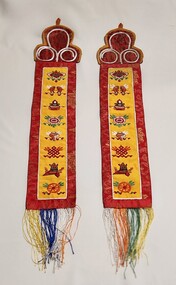
Artwork, other - Auspicious symbols hangings
... Two identical hangings feature the eight auspicious symbols of Buddhist iconography: the precious parasol, white conch shell, two golden fish, eternal knot, treasure vase, victory banner, lotus flower and dharma wheel....Holy objects worship devices Two identical hangings feature the eight auspicious symbols of Buddhist iconography: the precious parasol, white conch shell, two golden fish, eternal knot, treasure vase, victory banner, lotus flower and dharma wheel. ...These types of wall hangings are commonly used in homes, temples and meditation spaces to bring blessings, good fortune and to remind practitioners of the Buddhist teachings.The eight auspicious symbols represent blessings, spiritual qualities and the path to enlightenment. They symbolise the totality of the Buddha’s teachings and the harmony of the universe.Two identical hangings feature the eight auspicious symbols of Buddhist iconography: the precious parasol, white conch shell, two golden fish, eternal knot, treasure vase, victory banner, lotus flower and dharma wheel.holy objects, worship devices -
 Ballarat Tramway Museum
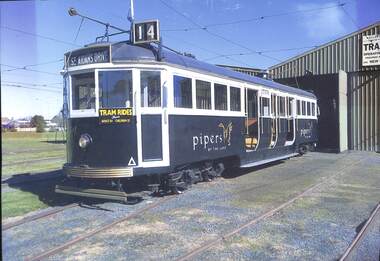
Photograph - Photograph - coloured, Tram No 671 - Pipers by the Lake
... It has an equal wheel truck bogie - eight wheels, with a drop centre combination. ...It has an equal wheel truck bogie - eight wheels, with a drop centre combination. ...This tram came to Ballarat in 1976. It has an equal wheel truck bogie - eight wheels, with a drop centre combination. It is in service at Ballarat Tramway Museum with a created livery using an all over advertising design for "Pipers" a restaurant on Lake Wendouree.Large coloured photograph, laminated. Blue and white tram - all over advertising for "Pipers""pipers by the lake" with yellow swan. St Aidans Drive in destination window. No.14, top LHS1976, truck bogie, eight wheels, drop centre combination, pipers, restaurant, lake wendouree -
 Ballarat Tramway Museum
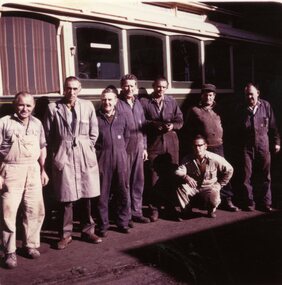
Photograph - Colour Print, Lilian Butler, Sep. 1971
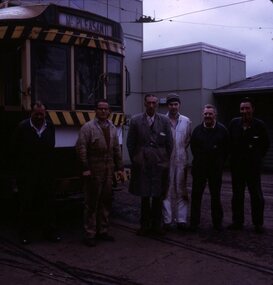
... Colour print of a group of eight depot workers standing alongside a four wheel tram with the depot building in the background. ...With my compliments Lilian Butler" Colour print of a group of eight depot workers standing alongside a four wheel tram with the depot building in the background. ...Possibly has a strong association with the tram and depot maintenance staff at the time of closure of the SEC operated Ballarat system.Colour print of a group of eight depot workers standing alongside a four wheel tram with the depot building in the background. Left to Right: G. Gray, Stan Lakey, ?, N.Lorensini, ? A. Domaschenz (kneeling), B. Peart and W. Trusler. See Reg Item 6543.4 for a colour slide of this photograph. See Reg Item 1861 for staff photo and Reg Item 3236 for other staff photos. Item was placed in an envelope marked "Mr. Tony Den Ouden" - retained with photograph in storage folder. Photo printed on Kodak Paper. Photograph by Lilian Butler?in ink on rear " Tram Depot Wendouree Parade Ballarat September 1971. With my compliments Lilian Butler"trams, tramways, sec, depot, personnel -
 Ballarat Tramway Museum
Slide - 27 mm sq slide/s - set of 4 - depot workers, Lilian Butler, Sep. 1971
... (See Reg Item 6446 for a colour print) .4 - group of eight depot workers standing alongside a four-wheel tram with the depot building in the background. ...(See Reg Item 6446 for a colour print) .4 - group of eight depot workers standing alongside a four-wheel tram with the depot building in the background. ...Yields information about the staff at the SEC depot at the time of closure.Set of four Colour 27 x 27 mm slide in Kodachrome white cardboard mounts showing various workers at the depot. .1 - Group of six depot workers standing in front of a bogie tram with the depot building in the background. Left to Right: E. Davis?, A. Domaschenz, Stan Lakey, W. Kell, B. Peart, E. Fish. (See Reg Item 6450 for a colour print) .2 - W Trusler, Works Superintendent standing by the depot "Bundy clock" .3 - E. Fish, holding a tea pot within the Ballarat depot. (See Reg Item 6446 for a colour print) .4 - group of eight depot workers standing alongside a four-wheel tram with the depot building in the background. Left to Right: G. Gray, Stan Lakey, ?, N.Lorensini, ? A. Domaschenz (kneeling), B. Peart and E Davis?. (See Reg Item 6452 for a colour print) Photo from the collection of Lilian Butler. ballarat, tramways, trams, depot, sec depot, personnel, clock, bundy clock -
 Emerging Writers' Festival
2004 Festival Program, The Melbourne Emerging Writers' Festival 2004 Program
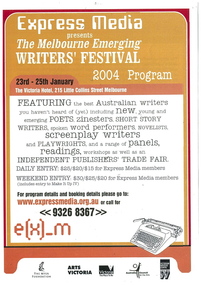
... In those early years the festival found its feet, its independence and a loyal and passionate audience. 2004 Emerging Writers' Festival Richard Watts Express Media literary programming The Wheeler Centre Emerging Writers' literary festival Melbourne "Featuring the best Australian writers / you haven't heard of (yet) including new, young and / emerging poets, zinesters, short story / writers, spoken word performers, novelists, / screenplay writers / and playwrights, and a range of panels, / readings, workshops as well as an / independent publishers' trade fair." An eight ...The first Emerging Writers’ Festival was held at the Victoria Hotel in Little Collins Street in January, 2004. The inaugural festival developed out of Express Media's Make It Up zine fair. It brought together the offerings of 68 writers from across Australia in a two-day series of panels, readings, performances and workshops. Express Media ‘s Artistic Director Richard Watts was the driving force behind the ground breaking initiative that was to become the Emerging Writers’ Festival. It was clear to him through the success and the demand of the Make It Up zine fair, which had its origins in 2000, that writing and writers were in the process of radical change and needed a new environment to grow. In response, Express Media formed a partnership with the Victorian Writers’ Centre and held the first Emerging Writers’ Festival with the tagline, the best Australian writers you haven’t heard of yet. The beginnings were humble but the foundations strong. In those early years the festival found its feet, its independence and a loyal and passionate audience.An eight page, stapled program for the 2004 Emerging Writers' Festival printed in black, white and three shades of orange."Featuring the best Australian writers / you haven't heard of (yet) including new, young and / emerging poets, zinesters, short story / writers, spoken word performers, novelists, / screenplay writers / and playwrights, and a range of panels, / readings, workshops as well as an / independent publishers' trade fair."2004 emerging writers' festival, richard watts, express media, literary programming, the wheeler centre, emerging writers', literary, festival, melbourne -
 Puffing Billy Railway
8 NB - Compartment Passenger Carriage, 1906
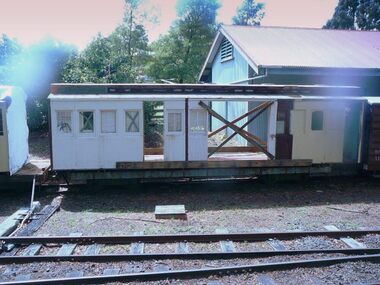
... Type: 2nd Class swing door carriage - 5 or 6 compartments 2'6" Bogie [8W]: Eight Wheels (2 x Four Wheel bogies) [CDG]: Continuous Draw Gear [WHB]: Westinghouse Brake circa 1910 - reclassed to NB 8 May 1926 - Modified with Automatic Couplers Malco Oct 1928 - Modified with Automatic Couplers Malco Bottom Operated 16 Dec 1937 - Consigned as to be scrapped 19 Feb 1938 - Condemned 4 Mar 1938 - Scrapped & Broken Up - Condemned Rolling stock Book Body to be offered for sale & underframe & bogies retained for use in construction of any additional NG trucks undertaken in near future. ...Type: 2nd Class swing door carriage - 5 or 6 compartments 2'6" Bogie [8W]: Eight Wheels (2 x Four Wheel bogies) [CDG]: Continuous Draw Gear [WHB]: Westinghouse Brake circa 1910 - reclassed to NB 8 May 1926 - Modified with Automatic Couplers Malco Oct 1928 - Modified with Automatic Couplers Malco Bottom Operated 16 Dec 1937 - Consigned as to be scrapped 19 Feb 1938 - Condemned 4 Mar 1938 - Scrapped & Broken Up - Condemned Rolling stock Book Body to be offered for sale & underframe & bogies retained for use in construction of any additional NG trucks undertaken in near future. ...8 NB - 6 compartments (40) Victorian Railways Service History 8 NB - passenger carriage (PBPS Body only - currently no underframe) 21 Dec 1906 Built New at Newport Workshops - numbered classed as NBB 8. Type: 2nd Class swing door carriage - 5 or 6 compartments 2'6" Bogie [8W]: Eight Wheels (2 x Four Wheel bogies) [CDG]: Continuous Draw Gear [WHB]: Westinghouse Brake circa 1910 - reclassed to NB 8 May 1926 - Modified with Automatic Couplers Malco Oct 1928 - Modified with Automatic Couplers Malco Bottom Operated 16 Dec 1937 - Consigned as to be scrapped 19 Feb 1938 - Condemned 4 Mar 1938 - Scrapped & Broken Up - Condemned Rolling stock Book Body to be offered for sale & underframe & bogies retained for use in construction of any additional NG trucks undertaken in near future. Sold by V.R and privately bought and used in the construction of a house at 80 Dare Street, Ocean Grove Puffing Billy Preservation Society Service History or Notes Sept 2010 - Ocean Grove house demolition results in PBPS being contacted that there were two carriages (6 NB & 8 NB) in the house. PBPS arrange to buy the two carriages bodies from the Demolition company Nov 2010 - Two carriages have been rescued from 80 Dare Street, Ocean Grove where they had been built into a house. Many people were involved in the move: thanks go to Raymond and Thelma Cotter for providing tarps to protect the cars from the elements. Dec 2010 - Two carriages rescued from Ocean Grove are now at Emerald, one being a platform NB car (6NB) and the other 8 NB a 2nd Class swing door carriage. Minor refurbishment has taken place along with covering with Tarpaulins. 29 Jan 2020 - 8 NB - passenger carriage - Body only is moved by the PBPS Heritage Rolling Stock Committee from Emerald Station sidings and placed into storage in a warehouse at Officer to enable it to be investigated into its possible restoration. 29 Feb 2020 - investigation on the carriage by the PBPS Heritage Rolling Stock Committee found the number of the carriage 8 NB stamped on the inside of the side of the windows frames. Current - At OfficerNB Class - Number Built (1st Series) 6 - Number Built (2nd Series) 17 - Number Built (3rd Series) 4 Historic - Victorian Railways Narrow Gauge - Passenger Rolling Stock: Passsenger carriage. 14 NB and this carriage (both of the 2nd Series) are the last known existing vehicles of this type out of the 17 built - maybe!.Passenger Rolling Stock: ? NB - Passenger carriage - Made of Timber NB - 2nd Class swing door carriage - 5 compartments number unknown ? NB puffing billy, nb passenger carriage, victorian railways, narrow gauge passenger rolling stock, 2'6" gauge -
 8th/13th Victorian Mounted Rifles Regimental Collection
Photograph - Benalla Troop 8/13 VMR
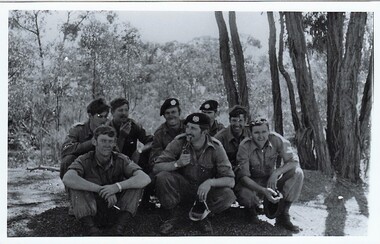
... wheeled armoured vehicles to tanks to M113 armoured personal carriers. Jackel Benalla 8/13 VMR " Left Front: Les Firth, Lt. Jackel, Bernie Ginivan, Rear: Laurie Green, Peter Sholders, Lance Gawley, Neville Grant. " Black and white photograph of eight soldoers from Benalla Troop 8th/13th Victorian Mounted Rifles photographed at Benalla Rifle Range c.1971. ...In 1965, B Squadron 8th/13th Victorian Mounted Rifles was drawn from Wangaratta and Benalla.Collection of photographs showing an armoured regiment of the Citizen Forces in the 1960s as it transitioned from wheeled armoured vehicles to tanks to M113 armoured personal carriers.Black and white photograph of eight soldoers from Benalla Troop 8th/13th Victorian Mounted Rifles photographed at Benalla Rifle Range c.1971." Left Front: Les Firth, Lt. Jackel, Bernie Ginivan, Rear: Laurie Green, Peter Sholders, Lance Gawley, Neville Grant. "jackel, benalla, 8/13 vmr -
 Falls Creek Historical Society
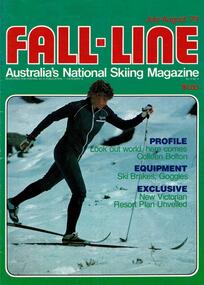
Magazine - Fall-Line - Australia's National Skiing Magazine July - Aug 1979
... FALLS CREEK The ski patrol has been increased from seven to eight, under the leadership of Senior Patroller John McDonald, and two new radios have been purchased. A four wheel...FALLS CREEK The ski patrol has been increased from seven to eight, under the leadership of Senior Patroller John McDonald, and two new radios have been purchased. A four wheel ...“Fall-Line” was one of a series of magazines published by the Victorian Ski Association. It was produced from 1979 until 1985. It superseded their previous publication, “Ski” magazine and was followed by the “Australian Skiing” magazine. The Victorian Ski Association was formed in 1955.This magazine is significant because it documents developments in the ski industry in Australia.A magazine featuring a coloured image on the cover and containing articles and advertising related to developments in skiing in Australia. This issue included an extensive article discussing the possible of the development of Lakeside Resort on the shores of Rocky Valley Dam as well as an update on recent changes at Falls Creek. FALLS CREEK The ski patrol has been increased from seven to eight, under the leadership of Senior Patroller John McDonald, and two new radios have been purchased. A four wheel drive ambulance has been purchased to replace the old conventional drive model. It will provide free ambulance transport between Falls Creek and Mt. Beauty, and will be driven by trained volunteer personnel. A new 165 vehicle day visitor car park has been completed at Windy Corner, adjacent to the approved toboggan slope. The closest car park to Falls Creek's Nordic Preferred Area, its capacity will be doubled next summer. A planning permit has been issued to Treglor Pty. Ltd. for its proposed hotel/convention centre. Construction is expected to begin after the season. A new Mercedes 800 tractor with Schmidt Snowcutter recently arrived on the mountain and will be used to clear the car parking areas Falls Creek continues to be among Australia's most expensive resorts, with a high season day ticket price of $13.50. Falls Creek's newest commercial lodge, Lakeside Lodge, has opened with accommodation for more than 50 people and luxury facilities including private rooms with full ensuite, sauna, spa pool, and a dining room for guests. It is located at the top of Schuss St. just behind Imaj flats and very close to the village bowl.australian ski magazines, skiing australia, victorian ski association -
 Melbourne Tram Museum
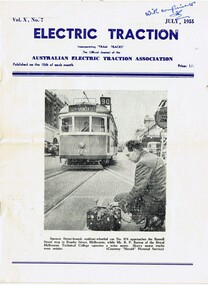
Magazine, Australian Electric Traction Association (AETA), "Electric Traction - July 1955", Jul. 1955
... Eight page magazine, centre stapled, "Electric Traction - July 1955", with a photo of 974 undergoing noise testing in Bourke St. Has an article on the Minister for Transport, Mr. A. G. Warner speech at the time of the opening of the new East Preston Depot, and the efficiency of tramways. Has an item on the Resilient wheel...Eight page magazine, centre stapled, "Electric Traction - July 1955", with a photo of 974 undergoing noise testing in Bourke St. Has an article on the Minister for Transport, Mr. A. G. Warner speech at the time of the opening of the new East Preston Depot, and the efficiency of tramways. Has an item on the Resilient wheel ...Eight page magazine, centre stapled, "Electric Traction - July 1955", with a photo of 974 undergoing noise testing in Bourke St. Has an article on the Minister for Transport, Mr. A. G. Warner speech at the time of the opening of the new East Preston Depot, and the efficiency of tramways. Has an item on the Resilient wheel that reduces noise. Also items on the new W7 tramcars, route numbers for the Bourke Street routes, NSW electric railways and Ballarat.trams, tramways, bourke st, w7 class, east preston depot, resilient wheels, wheels, testing
