
Showing 65 items matching "electrical circuits"
-
 Bendigo Military Museum
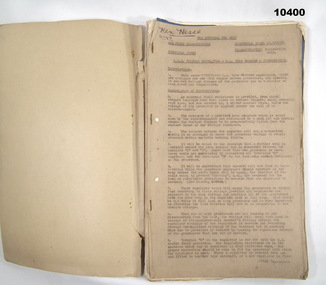
Document - TRAINING NOTES, ELECTRICAL, RAAF
... ...Electrical Circuits...Foolscap sized manila folder containing pages of text in black type and line drawings of electrical circuits. First pages stapled together with three metal staples....Kenneth William Hesse RAAF Training Notes Electrical Circuits Handwritten in black ink on first page: “Ken Hesse, 41144” Handwritten in pencil on folder back: “RLL 5813” Foolscap sized manila folder containing pages of text in black type and line drawings of electrical circuits. ...Part of the "Kenneth William Hesse”RAAF 41144, collection. See Cat No. 10364 for details of his service.Foolscap sized manila folder containing pages of text in black type and line drawings of electrical circuits. First pages stapled together with three metal staples.Handwritten in black ink on first page: “Ken Hesse, 41144” Handwritten in pencil on folder back: “RLL 5813”kenneth william hesse, raaf, training notes, electrical circuits -
 Bendigo Military Museum
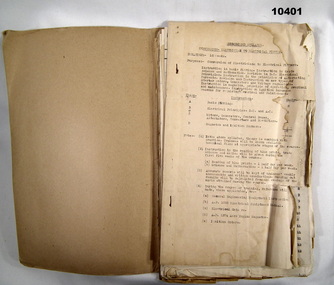
Document - TRAINING NOTES, ELECTRICAL, RAAF
... ...Electrical circuits...Foolscap sized manila folder containing pages of text in black type, line diagrams of electrical circuits and handwritten text. Some groups of pages are stapled together....Kenneth William Hesse RAAF Trining notes Electrical circuits Handwritten in red pencil on back of folder: 'Magneto Notes, 23'. ...Part of the "Kenneth William Hesse" RAAF No.41144, collection. See Cat No. 10364 for details of his service.Foolscap sized manila folder containing pages of text in black type, line diagrams of electrical circuits and handwritten text. Some groups of pages are stapled together.Handwritten in red pencil on back of folder: 'Magneto Notes, 23'.kenneth william hesse, raaf, trining notes, electrical circuits -
 Melbourne Tram Museum
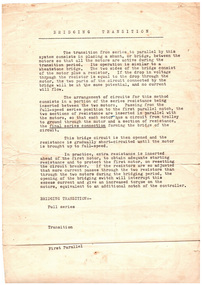
Document - Report, Melbourne & Metropolitan Tramways Board (MMTB), "Bridging Transition", early 1960's
... Report - single foolscap sheet titled "Bridging Transition" describing the electrical circuit arrangements while passing from series to parallel in DC traction tramway motors....Trams tramways Tramcars Controllers Electrical Engineering Electrical Equipment Motors Electric Traction Report - single foolscap sheet titled "Bridging Transition" describing the electrical circuit arrangements while passing from series to parallel in DC traction tramway motors. ...Report - single foolscap sheet titled "Bridging Transition" describing the electrical circuit arrangements while passing from series to parallel in DC traction tramway motors.trams, tramways, tramcars, controllers, electrical engineering, electrical equipment, motors, electric traction -
 Kiewa Valley Historical Society
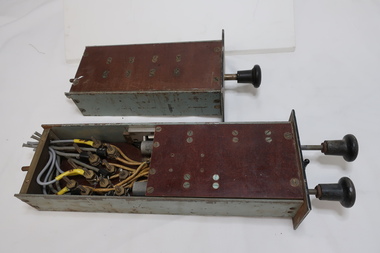
Electrical Equipment - Relays
... circuits...electrical equipment...electrical systems. Mitigate the effects of failure when it occurs. Switches that control other switches. Relays are used where it is necessary to control a circuit by an independent low-power signal, or where several circuits must be controlled by one signal....Collection of black metal rectangular boxes (heavy) containing electrical wires forming a circuit. The longer, narrower rectangles have a bakelite knob at one end. ...The relays were from a Kiewa Hydro Power Station control panel. power circuits electrical equipment electric power control power relays power station circuit breaker One has a plaque attached. ...Protective relays are one of the critical components of the elctrical power grid that serve to detect defective equipment or other dangerous or intolerable conditions and can either initiate or permit switching or simply provide an alarm to provide an alarm to provide a safer, more reliable delivery system. Used in power stations. The function of relay is to quickly remove from service any equipment that might suffer damage or otherwise affect the operation of the system. Relays protect the electrical system in 2 ways: Prevent failure or damage to electrical systems. Mitigate the effects of failure when it occurs. Switches that control other switches. Relays are used where it is necessary to control a circuit by an independent low-power signal, or where several circuits must be controlled by one signal.Used by the State Electricity Commission of Victoria for the Kiewa Hydro Electric Scheme in the power stations. Manually operated by remote control for an external circuit breaker. The relays were from a Kiewa Hydro Power Station control panel.Collection of black metal rectangular boxes (heavy) containing electrical wires forming a circuit. The longer, narrower rectangles have a bakelite knob at one end. Some of the boxes have one side of clear perspex and another has all sides of clear perspex. One is labelled "group relay". Another has windows with labels eg. 'turbine overspeed' 'emergency trip' and one has 3 steel knobs. - with 'stop', 'start'. One box is larger than the rest and has clear perspex side showing 'overcurrent relay' and workings.One has a plaque attached. Manufacture: "The English Co. Ltd. Londonpower circuits, electrical equipment, electric power control, power relays, power station, circuit breaker -
 Moorabbin Air Museum
Manual (item) - Trans-Australia Airlines Vickers Viscount Course Notes, For "C" Licence Vickers Viscount 720
... Contains a TAA amendment list and servicing notes for some instruments. Electrical circuit diagrams found in another identical course notes book....Contains a TAA amendment list and servicing notes for some instruments. Electrical circuit diagrams found in another identical course notes book. ...Owned by W. Wilson. Contains a TAA amendment list and servicing notes for some instruments. Electrical circuit diagrams found in another identical course notes book. -
 Bendigo Military Museum
Manual - RADIO TRAINING RAAF, RAAF Directorate of Training, 1945
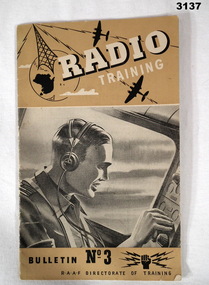
... The booklet is illustrated with cartoons & electrical circuits. ...The booklet is illustrated with cartoons & electrical circuits. Manual RADIO TRAINING RAAF RAAF Directorate of Training ...Soft covered booklet, 32 pages, black & white print. Front cover has an image of an airman tuning a radio transceiver. Airman is wearing a headset & is in an aircraft in flight. Top section of front cover shows a globe of earth with a transmitting tower over it. The booklet is illustrated with cartoons & electrical circuits. books - manuals/military/eduction/education, radio, training -
Ballarat Tramway Museum
Document, State Electricity Commission of Victoria (SECV), "6 Volt tail lamps on trams", 1949
... Memo dated 18/5/1949, titled "6 Volt tail lamps on trams", detailing costs, proposed lights, memo dated 9/6/1949 re charging of the battery, sketches of electrical circuit with details of the equipment proposed....Memo dated 18/5/1949, titled "6 Volt tail lamps on trams", detailing costs, proposed lights, memo dated 9/6/1949 re charging of the battery, sketches of electrical circuit with details of the equipment proposed. ...Memo dated 18/5/1949, titled "6 Volt tail lamps on trams", detailing costs, proposed lights, memo dated 9/6/1949 re charging of the battery, sketches of electrical circuit with details of the equipment proposed.Yields information about the design and costs of tail lights for SECV trams 1949.Set of 8 misc size sheets - typed, hand written or drawn.tail lights, secv, geelong, electrical equipment -
 Department of Energy, Environment and Climate Action
Incendiaries (various)
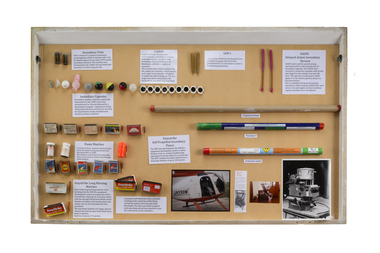
... Incendiaries used for planned burning operations All kind of pyrotechnics have been developed over the years from “strike anywhere” wax vestas, safety fusees, large DAIDs, burning tyres dragged behind vehicles, humble drip torches, incendiary shotguns and mortars, flame throwers of various designs, blow torches, jellied petrol blivets wired up to electrical circuits ...Incendiaries used for planned burning operations All kind of pyrotechnics have been developed over the years from “strike anywhere” wax vestas, safety fusees, large DAIDs, burning tyres dragged behind vehicles, humble drip torches, incendiary shotguns and mortars, flame throwers of various designs, blow torches, jellied petrol blivets wired up to electrical circuits Forests Commission Victoria (FCV) Bushfire Planned Burning Display table that includes various type of incendiaries including windproof matches, Fusse matches, self propelled incendiary flares, incendiary capsules, vials and balls, Delayed Action Incendiary Devices (DAIDS), Gun Operated Flares (GOF) Incendiaries (various) ...Incendiaries used for planned burning operations All kind of pyrotechnics have been developed over the years from “strike anywhere” wax vestas, safety fusees, large DAIDs, burning tyres dragged behind vehicles, humble drip torches, incendiary shotguns and mortars, flame throwers of various designs, blow torches, jellied petrol blivets wired up to electrical circuits Display table that includes various type of incendiaries including windproof matches, Fusse matches, self propelled incendiary flares, incendiary capsules, vials and balls, Delayed Action Incendiary Devices (DAIDS), Gun Operated Flares (GOF)forests commission victoria (fcv), bushfire, planned burning -
 Kiewa Valley Historical Society
Relay Protection Instrument, Circa 1950's
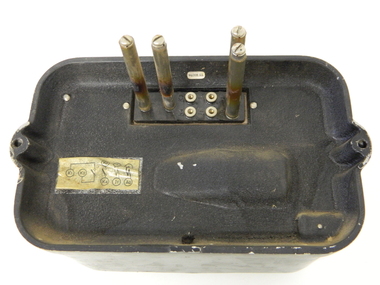
... This equipment acts similarly to a modern day circuit breaker found on the electrical circuit boards of residential homes....This equipment acts similarly to a modern day circuit breaker found on the electrical circuit boards of residential homes. Relay Protection Instrument ASEA ...This protection relay apparatus (a large electrical fuse), which permits the easy monitoring and disconnection of faulty electrical apparatus connected to the large SEC Victoria Hydro Scheme's electrical power producing generators. These generators are powered by the hydro force of "stored" water at a higher altitude. The establishment of both the NSW and Victorian Hydro Schemes was achieved from the early 1900's to the 1960's. At this point in time the need for additional power sources to quench both an industrial and domestic demand for electricity was purely an economic and not and environmental (carbon reduction) factor. This hydro scheme was instigated by "the Government of the day" as a bold move and was the major force of the World War II refugee and "technical" workforce inclusion of skilled and unskilled migration into the Australian environment. Although this mass "invasion" of workers with families was thought of in some circles as intrusive, the expansion of population post war years and its integration into the Australian rural sector, produced the multi- lingual multi-cultural diversity of later years.This protection relay is very significant to the Kiewa Valley as its use was introduced during the Kiewa Hydro Scheme. Although only a small apparatus it was part of the explosion of human resources into the valley. This influx of population transformed the region from that of a basically quiet rural region to one which evolved into both an industrial and a larger residential community. This evolution in the valley created a change, not only in the "physical" landscape but also the socio-economic expansion which permitted other "tourist" based industries into the valley.This protection relay unit has a black painted metal shell with four copper enclosed "prongs" fastened to the rear of the housing(from a bake-lite plate) . Between these "prongs" are four "empty" points allowing additional "screw on" bases. The front glass enclosed meter and recorder allows for the identification and automatic disconnection of any faulty equipment connected to the main power generator. This equipment acts similarly to a modern day circuit breaker found on the electrical circuit boards of residential homes.On the top section of the front panel "ASEA" to the left "Made in Sweden" and to the right "Frabrique en Suede" below this "RIS" below this a graph and next to it two columns of numbers and a pointer for each setkiewa hydro electricity scheme, victorian state electricity commission, relays, generators -
 National Communication Museum
Equipment - Morse key, Postmaster-General's Department, circa 1920
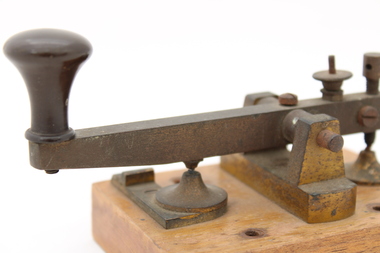
... The motion of the key acts to complete an electrical circuit between the sender and receiver, producing a short pulse 'dot' or longer 'dash,' the space between the code indicates a broken current or wave....The motion presses the key onto a circular metal disc, completing the circuit and sending an electrical pulse to the receiver. ...The motion of the key acts to complete an electrical circuit between the sender and receiver, producing a short pulse 'dot' or longer 'dash,' the space between the code indicates a broken current or wave. telegraph telegraphist morse code mechanisation Printed ink on base: "PMG" Device used to transmit telegraphic messages in Morse code through the manipulation of electric signals. ...A telegraph or Morse key, sends a series of electrical signals down a telegraph line or via radio frequencies; the signals are interpreted as Morse code, a binary form of language constructed of 'dots and dashes', combinations of which correspond to letters of the alphabet. The motion of the key acts to complete an electrical circuit between the sender and receiver, producing a short pulse 'dot' or longer 'dash,' the space between the code indicates a broken current or wave.Device used to transmit telegraphic messages in Morse code through the manipulation of electric signals. The metal 'key' sits in a central bracket on which it moves up and down aided by a spring, controlled by an operator pushing the black Bakelite knob on the protruding end of the device. The motion presses the key onto a circular metal disc, completing the circuit and sending an electrical pulse to the receiver. The apparatus is secured to a wooden base with wires attached to the terminals; a cut out section of the base suggests wires may have entered through this area, attaching to a battery.Printed ink on base: "PMG"telegraph, telegraphist, morse code, mechanisation -
 Kiewa Valley Historical Society
Timer Mechanical, Circa 1950
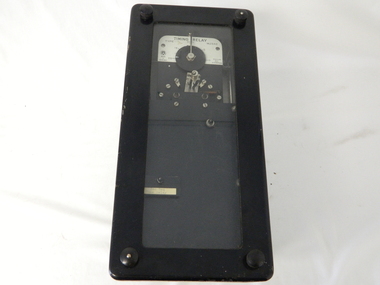
... Attached to this arm is a mercury switch which tips and makes an electrical circuit operate in a sequence control system. ...Attached to this arm is a mercury switch which tips and makes an electrical circuit operate in a sequence control system. ...This Timing Relay is quite a large (industrial type) apparatus. The Timer is started by having a voltage of 250 volts direct current (as supplied by batteries). A DC motor then rotates driving into a clockwork mechanism, the output of which is an arm rotating at the same speed as a minute hand on a clock. Attached to this arm is a mercury switch which tips and makes an electrical circuit operate in a sequence control system. The sequences that use these timers are when starting and stopping Hydro Generators. They check that the machine has connected to the power system grid before 20 minutes duration. Brakes must go on for a set time when shutting down a generator slowing at the right speed as measured by this apparatus. These generators are powered by the hydro force of "stored" water at a higher altitude. The establishment of both the NSW and Victorian Hydro schemes was achieved from the mid 1900's to the 1960's. At this point in time the need for additional power sources to quench both an industrial and domestic demand for electricity was purely an economic and not and environmental (carbon reduction) factor. This Timing Relay apparatus is very significant to the Kiewa Valley as its use was introduced during the Kiewa Hydro Scheme. Although only a relay apparatus, it was however part of the explosion of human resources into the valley. This influx of population transformed the region from that of a basically quiet rural region to one which evolved into both an industrial and a larger residential community. This evolution in the valley created a change, not only in the "physical" landscape but also the socio-economic expansion which permitted other "tourist" based industries into the valley. This Hydro Scheme was instigated by "the Government of the day" as a bold move and was the major force behind the acceptance of World War II refugee and "technical" workforce. Inclusion of skilled and unskilled migration into the Australian environment was of a higher priority than a selective quota system of later years.. Although this mass "invasion" of workers with families was thought of in some circles as intrusive, the expansion of population post war years and its integration into the Australian rural sector, produced the multi- lingual, multi-cultural diversity of later years.sec vic kiewa hydro scheme, alternate energy supplies, alpine population growth -
 Ballarat Tramway Museum
Document - Training, "Safety First - Section 1", c1974
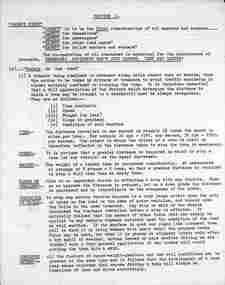
... Document retyped from possibly an SECV training document titled "Safety First" outlining tram driving safety practices, awareness for motormen, electrical aspects, tram circuits, line breakers, insulated trams, trolley poles, light bulbs, broken trolley wires and fallen wires around trams. ...Document retyped from possibly an SECV training document titled "Safety First" outlining tram driving safety practices, awareness for motormen, electrical aspects, tram circuits, line breakers, insulated trams, trolley poles, light bulbs, broken trolley wires and fallen wires around trams. ...Document retyped from possibly an SECV training document titled "Safety First" outlining tram driving safety practices, awareness for motormen, electrical aspects, tram circuits, line breakers, insulated trams, trolley poles, light bulbs, broken trolley wires and fallen wires around trams. Section 2 - "instructions to be Observed by members and workers working on track maintenance". Possibly prepared for use by the BTPS, c1974.Demonstrates a Safety document for use by tramway crews and workers.Document - typed 6 Quarto pages - original.tramways, tramcars, operations, passenger services, ballarat, training -
 Friends of the Cerberus Inc
Whitehead Torpedo Manual, Victorian Naval Forces Torpedo Manual Whitehead Torpedoes 1889, 1889
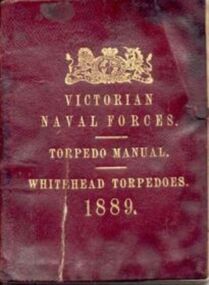
... Part 2 - Electrical section describing firing circuits, cells, fuzes, dynamoes, search lights....Part 2 - Electrical section describing firing circuits, cells, fuzes, dynamoes, search lights. ...The Torpedo Manual was created in 1889 presumably as part of the training program of the Victorian Naval Torpedo Corps.This item is significant partly because some of the information in the manual is not found elsewhere but also as it the only known copy of this manual. The manual is also evidence that a more professional approach to training was undertaken by the Victorian Naval Forces after the mid 1880s. Gunner/Instructor Corkle's of the Port Melboune Naval Brigade written in the manual is evidence of the manual's strong provenance.Victorian Naval Forces Manual printed in 1889 with 62 pages with a burgandy cover. Two sections:- Part 1 - Whitehead Torpedos and their component parts used in the Victorian Naval Forces. Part 2 - Electrical section describing firing circuits, cells, fuzes, dynamoes, search lights.Inside front cover - "Jno. Co[orkle] /Gunner & Instructor/oPort Melbourne Division/of/Naval Brigade/Port Melbourne/ January 1890." Inside back cover - "J Corkle GI/P.M.B. of N.B./January 1890" whitehead, torpedo, manual, torpedo corps. -
 Federation University Historical Collection
Book, Industrial Electricity
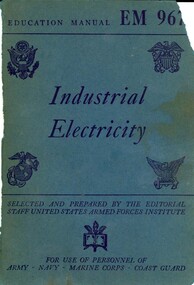
... Chapters include electrical Algebra, fundamentals of Electricity, Wiring, Magnetism, Armature Wiring, Generators, Motors, Controllers, Geometry and Trigonometry, Alternating Current, AC Circuits, Transformers, Polyphase Systems, Alternators, Induction Motors, Stator Winding, Multi-Speed Induction Motors, AC Controllers, electrical instruments, Electron Tubes, Welding Systems, Welding Systems, electrical Drawings. ...Chapters include electrical Algebra, fundamentals of Electricity, Wiring, Magnetism, Armature Wiring, Generators, Motors, Controllers, Geometry and Trigonometry, Alternating Current, AC Circuits, Transformers, Polyphase Systems, Alternators, Induction Motors, Stator Winding, Multi-Speed Induction Motors, AC Controllers, electrical instruments, Electron Tubes, Welding Systems, Welding Systems, electrical Drawings. ...The book was published for the use of personnel of the army, navy, marine corps and coast guard. The book was used by Charles Bacon who studied at the University of Nevada in the late 1930s/early 1940s. Bacon worked at Bunker Hill Mines and Kellogg Idaho, before arriving in Australian in 1951. He worked for CN Myers, a company involved with paper converting. CN Myers was a family business (on Charles Bacon's maternal line).Blue soft covered book of 607 pages. Chapters include electrical Algebra, fundamentals of Electricity, Wiring, Magnetism, Armature Wiring, Generators, Motors, Controllers, Geometry and Trigonometry, Alternating Current, AC Circuits, Transformers, Polyphase Systems, Alternators, Induction Motors, Stator Winding, Multi-Speed Induction Motors, AC Controllers, electrical instruments, Electron Tubes, Welding Systems, Welding Systems, electrical Drawings. charles bacon, mining engineering, metallurgy, university of nevada, armed forces, world war 2 -
 Federation University Historical Collection
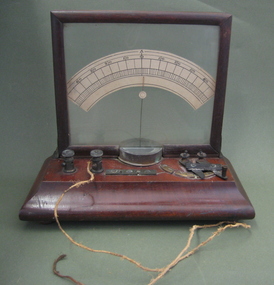
Ammeter, Henry Sutton (probably), Ammeter attributed to Henry Sutton, 1883 (estimated)
... circuit has been laid down between the [SMB] engine-house and workshops, to be used for experimental purposes.’ Henry Sutton spent much thought on artificial flight, and made some interesting experimental studies with flying birds. The storage of electricty also attracted his attention, and, after much work and thought evolved the Sutton Secondary Battery. A paper on this battery was presented to the Royal Society, London, and was afterwards printed in the 'Transactions'. Henry Sutton is listed on the Federation University Honour Roll at https://www.federation.edu.au/curator/honour-roll/honourroll_sutton.shtml ammeter henry sutton electrical ...W.B Withers wrote of Sutton: "In the realm of science Ballarat has become of world-wide fame through the inventions by Mr Henry Sutton, a native of the place. His skill and acquirements in electricity, telegraphy, telephony, photography and also in astronomical and microscopal studies have won for him a high position as a practical scientist, and the credit is the greater as he is a self-taught student … Mr Sutton, before he was fourteen years old, had read every book on science to be found in the library of the Ballarat Mechanics' Institute." The Ballarat School of Mines (SMB) was fortunate to have this genius appointed as the lecturer-in-charge of the new Electricity and Magnetism department from 23 April 1883. Although Henry Sutton submitted his resignation to the Council of SMB in October 1884 it was resolved that he be asked to reconsider, and Mr Sutton continued to teach at SMB until the end of 1886. He was a prominent member of the Camera Club, and many of the other SMB clubs. Sutton had an active and fertile brain, and was known for his inventions, especially his work on the telephone, telephane and carbon lamps. Sutton presented a vacuum pump, worked by water jet, for use in SMB Chemistry classes. His report of 1883 states: ‘A telephonic circuit has been laid down between the [SMB] engine-house and workshops, to be used for experimental purposes.’ Henry Sutton spent much thought on artificial flight, and made some interesting experimental studies with flying birds. The storage of electricty also attracted his attention, and, after much work and thought evolved the Sutton Secondary Battery. A paper on this battery was presented to the Royal Society, London, and was afterwards printed in the 'Transactions'. Henry Sutton is listed on the Federation University Honour Roll at https://www.federation.edu.au/curator/honour-roll/honourroll_sutton.shtmlA crude scientific instrument that measures amps, with a timber base and frame. Terminal posts and sliders contacts are positioned on top of the base, with flex attached. Henry Sutton lectured at the Ballarat School of Mines (SMB) in Electricty and Magnestism between 1883 and 1886. In 1883 Sutton reported: ‘…The class has been unfortunately situated, by having to wait for instruments of precision ordered from England, but which have not come to hand. The delay has caused us to start constructing instruments, which it is hoped will bear favourable comparison with those of older date.'ammeter, henry sutton, electrical, inventor, electricity and magnetism, sutton, scientific instruments -
 Federation University Historical Collection
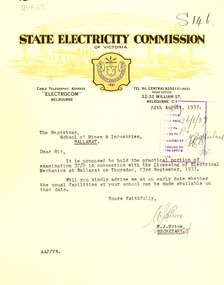
Correspondence, State Electricity Commission of Victoria to Ballarat School of Mines, 1937, 1937
... Electrical Mechanics at Ballarat on 23 September 1937 and is signed by W.J. Price .3) Dates 18 October 1937 this three page foolscap letter relates to radio interference suppressors, and the increasing us of earth leakage circuit breakers for the protection of installations, and is signed by D. ...Electrical Mechanics at Ballarat on 23 September 1937 and is signed by W.J. Price .3) Dates 18 October 1937 this three page foolscap letter relates to radio interference suppressors, and the increasing us of earth leakage circuit breakers for the protection of installations, and is signed by D. ...The Ballarat School of Mines trained electricians.Correspondence on State Electricity Commission of Victoria letterhead between the State Electricity Commission of Victoria to Ballarat School of Mines in 1937. .1) Dated 16/01/1937 this item relates to the licensing of Electrical Mechanics Regulations 1935 and is signed by W.J. Price .2) Dated 24/08/1937 this item relates to the practical portion of examination 37/2 in connection with Licensing of Electrical Mechanics at Ballarat on 23 September 1937 and is signed by W.J. Price .3) Dates 18 October 1937 this three page foolscap letter relates to radio interference suppressors, and the increasing us of earth leakage circuit breakers for the protection of installations, and is signed by D. Dunhamstate electricity commission of victoria, ballarat school of mines, electricity, trades, electricians, w.j. price, d. dunham, sec -
 Federation University Historical Collection
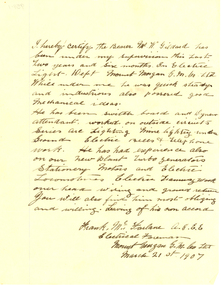
Letter - Correspondence, Norman F. White, Correspondence on Mount Morgan Gold-mining Company, Limited Letterhead, 1907, 22/03/1907
... circuits series are Lighting Mine Lighting under Ground Electric Bells and Telephone work. He has had experience also on our new plant turbo generators Stationary Motors and Electric Locomotives Electric Tramway Work over head wiring and ground return you will also find him most obliging and willing. Leaving of his own accord. Frank McFarlane A.G.E.E. Electric Foreman Mount Morgan G.M. Co. Ltd march 21st 1907 Typed letter on Mount Morgan Gold-mining Company, Limited Letterhead relating to staffmember W. Gildard who worked in the Electrical ...Typed letter on Mount Morgan Gold-mining Company, Limited Letterhead relating to staffmember W. Gildard who worked in the Electrical Department at Mount Morgan. The letter is signed by Norman F. White..1) I hereby certify the Bearer Mr W. Gildard has been under my supervision this last two years and six months in Electric Light Dept Mount Morgan G.M.Co. Ltd While under me he was quick steady and industrious also possessed good mechanical ideas. He has been switch board and Dynamo attendant worked on outside circuits series are Lighting Mine Lighting under Ground Electric Bells and Telephone work. He has had experience also on our new plant turbo generators Stationary Motors and Electric Locomotives Electric Tramway Work over head wiring and ground return you will also find him most obliging and willing. Leaving of his own accord. Frank McFarlane A.G.E.E. Electric Foreman Mount Morgan G.M. Co. Ltd march 21st 1907ballarat school of mines, mount morgan gold-mining company, mount morgan, norman f. white, electricity, w. gildard, letterhead -
 Federation University Historical Collection
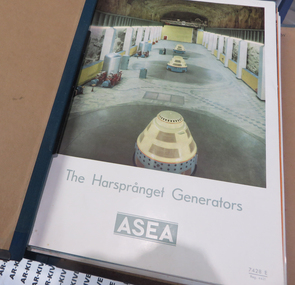
Magazine, ASEA magazines, 1953/58, 1953 to 1958
... electrical engineering...generators...graham beanland...power stations...voltage control...electrohydraulic governor for water turbines...high voltage dc transmission...oil-minimum contraction circuit...collected by Ballarat School of Mines Principal G.H.Beanland electrical engineering generators graham beanland power stations voltage control electrohydraulic governor for water turbines high voltage dc transmission oil-minimum contraction circuit-breakers lightening arresters air-blast circuit breakers testing circuit breakers closing mechanisms for high voltage circuit-breakers outdoor isolators series capacitors capacitor voltage transformers guide to current transformers routine testing of power tranformers generator Magazines bound in ASEA folder, blue spine and black cloth boards ASEA magazines, 1953/58 Magazine ...collected by Ballarat School of Mines Principal G.H.BeanlandMagazines bound in ASEA folder, blue spine and black cloth boardselectrical engineering, generators, graham beanland, power stations, voltage control, electrohydraulic governor for water turbines, high voltage dc transmission, oil-minimum contraction circuit-breakers, lightening arresters, air-blast circuit breakers, testing circuit breakers, closing mechanisms for high voltage circuit-breakers, outdoor isolators, series capacitors, capacitor voltage transformers, guide to current transformers, routine testing of power tranformers, generator -
 Federation University Historical Collection
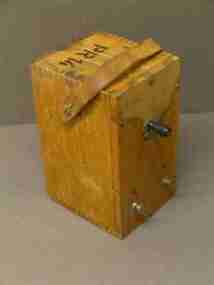
Object, Continuity Tester, c1927, c1927
... Used in the Ballarat School of Mines Electrical Engineering depatment for testing circuits. ...Used in the Ballarat School of Mines Electrical Engineering depatment for testing circuits. continuity tester electrical engineering ballarat school of mines Rectangular timber box with handle and two terminals on top, leather strap Continuity Tester, c1927 Object ...Thought to be public works issue. Used in the Ballarat School of Mines Electrical Engineering depatment for testing circuits. Rectangular timber box with handle and two terminals on top, leather strapcontinuity tester, electrical engineering, ballarat school of mines -
 Federation University Historical Collection
Magazine, The Radio Press, Popular Radio Weekly, 1925, 1925
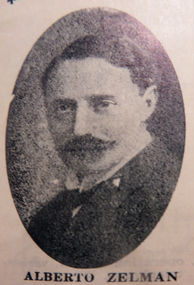
... radio valve electrical engineering frank tate alberto zelman Five 'Popular Radio Weekly Magazines. .1) Vol. 1, No. 1, 25 February 1925. (Purchasing a receiver, eliminating static, Morse Code, An Efficient one-valver, A Simple Crystal Circuit, Combining Valve and Crystle, the Alfred Hospital, Frank Tate on Radio. ...Five 'Popular Radio Weekly Magazines. .1) Vol. 1, No. 1, 25 February 1925. (Purchasing a receiver, eliminating static, Morse Code, An Efficient one-valver, A Simple Crystal Circuit, Combining Valve and Crystle, the Alfred Hospital, Frank Tate on Radio. Images of Josie Melville, Alberto Zelmanm circuits) .2) Vo. 1, No. 14, 27 May 1925. (Purity amplifier, Popular Wireless, Oscillations, Marconi's Wireless Beam Transmitter, Resistance coupled Amplifiers, Condenser Losses) .3) Vol. 1, No. 2, 04 March 1925. (A Crystal Receiver, Medium Wave Four-Valver, The Harkness Circuit, A One-Valve Super, The Aerial Mast, The Police Patrol, C Batteries, A Two Crysal set, La Bela Lingvo, Plain Aerial. Images - Transmitting Aeroplace, A. Nicholson - Chief Commissioner of Police) .4) Vol. 1, No 15, 03 June 1925. (The Ham and Radiophone, A Good Circuit, How the Microphone Transmitter Works, A Reflex Circuit, A Millionaire's Radio Installation, Teh Deresnadyne, Crystal Detectors, Hints an Accumulators, 3LO, Selection Radio Parts) .5) Vol 1, No. 6, 01 April 1925. (The Renartz Tuner, A 600 foot aerial, Measuring your Receiver, Doctoring Your Set, Understanding What You Read, The Vernier Condenser, Radio and Railways, Who Can Build the Smallest Set.)radio, valve, electrical engineering, frank tate, alberto zelman -
 Federation University Historical Collection
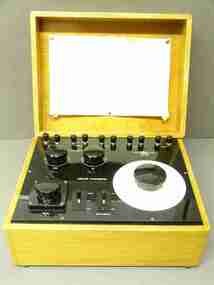
Scientific Instument, Students' Potentiometer
... scientific instrument potentiometer physics electrical engineering laboratory Serial Number 3008 Students potentiometer type D-73-A. Black top panel with terminal posts, elector knobs and switches. In a polished wood box wit lift-off lid. Circuit ...Students potentiometer type D-73-A. Black top panel with terminal posts, elector knobs and switches. In a polished wood box wit lift-off lid. Circuit diagram inside lid. Serial Number 3008scientific instrument, potentiometer, physics, electrical engineering, laboratory -
 Federation University Historical Collection
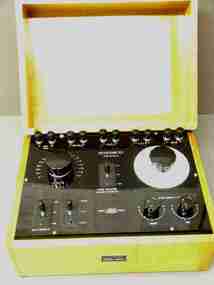
Scientific Instument, Potentiometer: Type D - 73 - E
... Used in Physics and Electrical Engineering laboratory experiments scientific instrument potentiometer physics electrical engineering laboratory Black Dymon tape on lid "Ass.No. 50" Potentiometer, Type D-73-E in polished wood box with lift out circuit diagram inside the lid. ...Used in Physics and Electrical Engineering laboratory experimentsPotentiometer, Type D-73-E in polished wood box with lift out circuit diagram inside the lid. Black top panel with terminal posts, switches and selector knobs.Black Dymon tape on lid "Ass.No. 50"scientific instrument, potentiometer, physics, electrical engineering, laboratory -
 Federation University Historical Collection
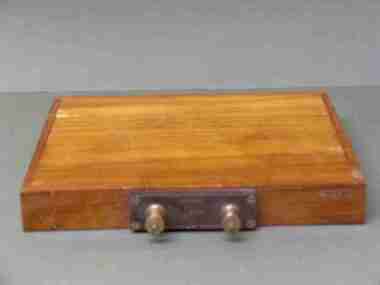
Scientific Instument, Capacitor
... circuits, and from about 0.001 µF to 0.1 µF for blocking and bypassing. At audio frequencies (AF), capacitances range from about 0.1 µF to 100 µF. In power-supply filters, capacitances can be as high as 10,000 µF. scientific instrument capacitor electrical engineering laboratory Maker's name and place 1/3 M.F.D No. 34402 Capacitor, 1/3 M.F.D. ...DEFINITION microfarad Posted by: Margaret Rouse WhatIs.com Contributor(s): Kenda, Jack Clements The microfarad (symbolized µF) is a unit of capacitance, equivalent to 0.000001 (10 to the -6th power) farad. The microfarad is a moderate unit of capacitance. In utility alternating-current (AC) and audio-frequency (AF) circuits, capacitors with values on the order of 1 µF or more are common. At radio frequencies (RF), a smaller unit, the picofarad (pF), is often used. This unit is equal to .000000000001 (10^-12) µF. In RF scenarios, capacitances range from about 1 pF to 1,000 pF in tuned circuits, and from about 0.001 µF to 0.1 µF for blocking and bypassing. At audio frequencies (AF), capacitances range from about 0.1 µF to 100 µF. In power-supply filters, capacitances can be as high as 10,000 µF. Capacitor, 1/3 M.F.D. (microfarad) within wooden insulating box. Two terminal posts set in an insulating box. Maker's name and place 1/3 M.F.D No. 34402scientific instrument, capacitor, electrical engineering, laboratory -
 Federation University Historical Collection
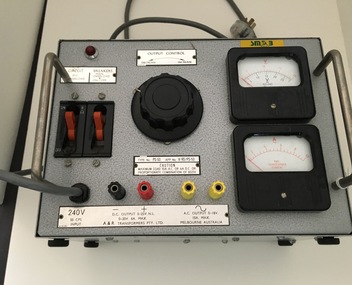
Electrical Equipment, AC / DC Control Unit - Rectifier
... electrical ballarat school of mines science maths physics AC/DC Scientific instrument Yellow sticker - SMB - with number 116069. Engraved on back - S.M.B.. Maths / Science / Physics Sticker on cord indicating inspection of unit - 13/04/2005. Tag Number - 032725 Grey metal unit with Dials on the front and vents at the back. Handles for carrying. Two circuit ...The unit was used at Ballarat School of Mines in the Maths, Science and Physics Departments.Grey metal unit with Dials on the front and vents at the back. Handles for carrying. Two circuit breaker switches, two DC output sockets, two AC output socketsYellow sticker - SMB - with number 116069. Engraved on back - S.M.B.. Maths / Science / Physics Sticker on cord indicating inspection of unit - 13/04/2005. Tag Number - 032725alternating current, direct current, ac, dc, electrical, ballarat school of mines, science, maths, physics, ac/dc, scientific instrument -
Federation University Historical Collection
Instrument, Decade Resistance Box
... Used in electrical emgineering separtment, Used for varying resistance in a circuit....Used in electrical emgineering separtment, Used for varying resistance in a circuit. Electrical engineering reistance box Timber box with black top and4 black knobs. ...Used in electrical emgineering separtment, Used for varying resistance in a circuit.Timber box with black top and4 black knobs.electrical engineering, reistance box -
 Kiewa Valley Historical Society
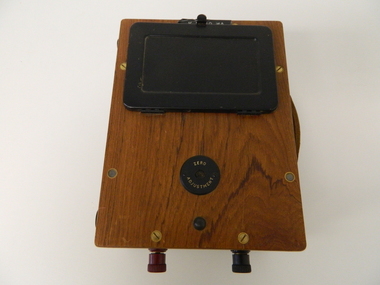
Meter Millivolt, after 1950
... circuit. During this time period, high quality testing instruments were either sourced from Europe or England. This milli-volt meter is very significant to the Kiewa Valley as it was used by those electrical technicians, who were part of the Kiewa Hydro Scheme. ...This milli-volt meter was manufactured after 1950 and used by the SEC Vic (Kiewa Hydro Electricity Scheme) from that date until late 1900's. It was used to measure very small voltages associated with the operation of the various Hydro Generators. The readings were able to be shown by the resistor in use in the current circuit. During this time period, high quality testing instruments were either sourced from Europe or England.This milli-volt meter is very significant to the Kiewa Valley as it was used by those electrical technicians, who were part of the Kiewa Hydro Scheme. An "off spin" from the Scheme was the beginning of an explosion in "human" resources into the Kiewa Valley. This influx of population transformed the region from that of a basically quiet rural region to one which evolved into both industrial and larger residential community. This evolution in the Kiewa Valley created a change, not only in the "physical" landscape(better roads and infrastructure), but also the socio-economic growth within the Valley allowing other "tourist" based industries to expand within the valley and Alpine areas.This millivolts DC meter was used in the 1950's. It is contained in a wooden box and has two coloured (red/black, positive and negative) screw tight knobs which have bake-lite connections. It also has a covered (black tin) view meter marked from zero to 10 millivolts. Underneath this and within a round bake-lite is a small adjustment screw. The top of the box is fastened onto the main structure by six brass screws. The back of the structure is fastened by eight brass screws and there are four small bake-lite rest knobs.On the face of the millivolt compartment , and at the top "TO BE USED WITH DIAL HORIZONTAL TEMP. COEF. +- .08 % PER oC. Underneath the scale "MILLIVOLTS D.C. F.G." (LEAD RESIS. .05 OHMS)" underneath and to the left "MADE IN ENGLAND BY" "EVERSHED & VIGNOLES Ltd" and to the right "No. 857842" underneath Regd. TRADE MARK MEGGERkiewa valley tourism, victorian alps, alternate energy supplies, alpine population growth -
 Kiewa Valley Historical Society
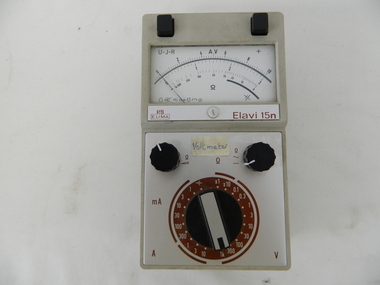
Meter Multi General Purpose, circa mid to late 1900's
... circuit. During this time period, high quality testing instruments were either sourced from Europe or England. This particular meter was manufactured in the Netherlands. This type of "old" analogue meter was replaced by digital meters whose electronic components are a fraction of the size of the older analogue ones. This analog General Purpose multi-meter is quite a large (for handheld mobile) apparatus which permits the easy monitoring of electrical ...This general purpose Multi-meter was manufactured after 1950 and used by the SEC Vic (Kiewa Hydro Electricity Scheme) from that date until late 1900's. It was used to measure very small voltages associated with the operation of the various Hydro Generators. The readings were able to be shown by the resistor in use in the current circuit. During this time period, high quality testing instruments were either sourced from Europe or England. This particular meter was manufactured in the Netherlands. This type of "old" analogue meter was replaced by digital meters whose electronic components are a fraction of the size of the older analogue ones.This analog General Purpose multi-meter is quite a large (for handheld mobile) apparatus which permits the easy monitoring of electrical variations within the large SEC Victoria Hydro Scheme's electrical generators. These generators are powered by the hydro force of "stored" water at a higher altitude. The establishment of both the NSW and Victorian Hydro schemes was achieved from the mid 1900's to the 1960's. At this point in time the need for additional power sources to quench both an industrial and domestic demand for electricity was purely an economic and not and environmental (carbon reduction) factor. This hydro scheme was instigated by "the Government of the day" as a bold move and was the major force of the World War II refugee and "technical" workforce inclusion of skilled and unskilled migration into the Australian environment. Although this mass "invasion" of workers with families was thought of in some circles as intrusive, the expansion of population post war years and its integration into the Australian rural sector, produced the multi- lingual multi-cultural diversity of later years.This General Purpose Multimeter is an analogue meter i.e. it has a needle arm that moves across a scale of divisions. This is a large(hand held) device due to the mechanical movement system within and the large size of its electronic components of its circuitry.There are two black bake-lite push buttons operating the wire inserts Positive/negative leads at the top. The meter (protected with a glass window) has clearly marked graduations (top - volts, bottom amperes). Below this are two bake-lite dials (left "potentiometer the right one measuring range selector). Below this is a "dial" switch to input the desired resistance measuring range "V" Front "H&B ELIMA" and to the right Elavi 15n. 0n the front side is a label "STATE ELECTRICITY COMMISSION OF VICTORIA TRANSMISSION DEPT E.C.No." On the bottom of the base is a stenciled layout of the battery "layout" including the fuse . The information notice is presented in five languages starting with German, English,French, Italian, Spanish and Dutchsec vic kiewa hydro scheme, alternate energy supplies, alpine population growth -
 Kiewa Valley Historical Society
Case for G.P. Multimeter, Circa 1950
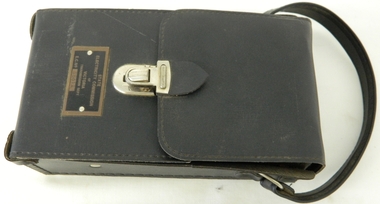
... circuit. During this time period, high quality testing instruments were either sourced from Europe or England. This particular carry case was manufactured in the Netherlands. This carry case for an analog General Purpose multi-meter which is quite a large (for a handheld mobile) apparatus.The bag however permits the easy monitoring of electrical variations within the large SEC Victoria Hydro Scheme's electrical generators. ...This leather case holder for a general purpose Multi-meter( KVHS 0307 (A)) was manufactured after 1950 and used by the SEC Vic (Kiewa Hydro Electricity Scheme) from that date until late 1900's. It was used to measure very small voltages associated with the operation of the various Hydro Generators. The readings were able to be shown by the resistor in use in the current circuit. During this time period, high quality testing instruments were either sourced from Europe or England. This particular carry case was manufactured in the Netherlands. This carry case for an analog General Purpose multi-meter which is quite a large (for a handheld mobile) apparatus.The bag however permits the easy monitoring of electrical variations within the large SEC Victoria Hydro Scheme's electrical generators. These generators are powered by the hydro force of "stored" water at a higher altitude. The establishment of both the NSW and Victorian Hydro schemes was achieved from the mid 1900's to the 1960's. At this point in time the need for additional power sources to quench both an industrial and domestic demand for electricity was purely an economic and not and environmental (carbon reduction) factor. This hydro scheme was instigated by "the Government of the day" as a bold move and was the major force of the World War II refugee and "technical" workforce inclusion of skilled and unskilled migration into the Australian environment. Although this mass "invasion" of workers with families was thought of in some circles as intrusive, the expansion of population post war years and its integration into the Australian rural sector, produced the multi- lingual multi-cultural diversity of later years.This leather case is to provide protection for this mobile G.P. Multimeter, therefore it is made from thick leather. It has a carrying strap from a thick "D" chromed link. This link is fastened to the main cover by a looped leather strip with a black coloured rivet. All the fasteners are either chrome or black coloured rivets. The front, which when opened back exposes fully the inside of the case. It is clip fastened to the lower section of the front piece which also can be pushed back allowing the meter to be removed from the frontal position. There is a strip retaining strap slightly higher from the mid point. This is fasted by a black press stud. There are two "L" shaped tin protrusions allowing the meter to slide only down the case until it rests on these shelves. This provides for an empty space for minimal storage,.On the front bottom and below the clasp is a tag "STATE ELECTRICITY COMMISSION OF VICTORIA TRANSMISSION DEPT."sec vic kiewa hydro scheme, alternate energy supplies, alpine population growth -
 Bendigo Military Museum
Manual - HUDSON ELECTRICAL RAAF, C. WW2
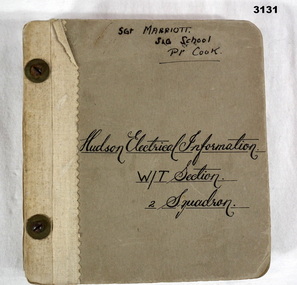
... , landing & bomb bay circuits. Hand made. Manual HUDSON ELECTRICAL RAAF ...Item relates to George William Alfred MARRIOTT RAAF. Refer Cat No 3117 for his service history.Hard cover, khaki coloured loose leaf book held together with screws. Black print. Contains aircraft generator technical data, circuits, landing & bomb bay circuits. Hand made.Front cover top right: “Sgt Marriott Sig School PT Cook”books - manuals/military/eduction/air force, hudson, electrical -
 Bendigo Historical Society Inc.
Document - BAKER & WOODS ELECTRICAL ENGINEERS AND PHOTO STOCK DEALERS, 23/07/1914
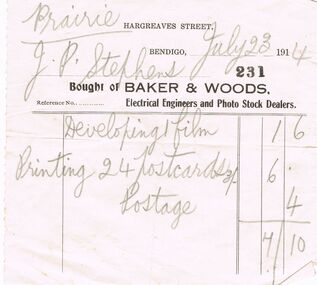
... A fire caused by a short circuit caused extensive damage to the building in 1914. BUSINESS Retail photography Hargreaves Street Bendigo. Baker & Woods. Baker & Woods Electrical ...Established in 1897, Baker and Woods were initially electricians. The property in Hargreaves was taken over by a saddler and Baker and Woods moved to premises at 313 Hargreaves Street. The business expanded to include photographic equipment, phonographs and phot development. In 1903, Baker and Woods were responsible for converting the gas lighting in the Bendigo Town Hall to electricity. A fire caused by a short circuit caused extensive damage to the building in 1914.Baker & Woods Electrical Engineers and Photo Stock Dealers. Cream paper with Black print. At the top Hargreaves Street, Bendigo, Docket 221. Bought of Baker & Woods, Electrical Engineers and Photo Stock Dealers. Written in Pencil on the Docket is *Prairie. July 18 1914. Mr J. R. Stephens. Items listed:- Developing Film 1/6, Printing 24 Postcards 3/- 6/, postage -4p = 7/10. On the back written in blue biro is - 1290B. Box 625business, retail, photography, hargreaves street bendigo. baker & woods.
