
Showing 21 items matching "empress court"
-
 Sunshine and District Historical Society Incorporated
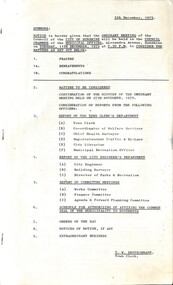
Administrative record - City of Sunshine - Commissioner Mr Alexander Alex George Gillon Collection 1976 - 1982 - Notice of ordinary meeting of the council 11th December 1979, City of Sunshine, 5th December 1979
... ...Empress Court...Notice of Ordinary Meeting of the Council 11th December 1979 Report of the Town Clerk's Department Report of the Town Clerk Melbourne and Metropolitan Board of Works Representation and Rate Rise Use of Sunshine Tip by City of Brunswick Variation to Agreement Maribyrnong Hall Use of Rooms as an Infant Welfare Centre and Library Acquisition of Lot 7 Van Ness Avenue Hume Pipes Proposed Variation to Separate Awards Proposed Sale of Surplus Land Porter Road Reserve, Raymond Street Reserve, Davey Street Reserve, Lewis Court Reserve, Empress Court / Harwood Close, Hilma Street Being the Discontinued Part of Charlotte Street, Hilma Street Being the Discontinued Part of Nina Street, Hilma Street Being the Discontinued Part of Eva Street, West Street Being the Discontinued Part of McLaughlin Street, West Street Being the Discontinued Part of Maxwell Street, West Street Being the Discontinued Part of Suspension Street, Lot 24 Corner Kosky Street and Killara Street and Land Between Lots 17 and 46 Glindon Avenue Transfer of Land from Council to Maribyrnong Timber & Buildings Supplies Road Construction Agreements Rosamond Road Tennis Club Request to Extend Usable Area Outside Court No 1 Rate Recovery Sale 27 Duke Street Proposed Lease Tottenham Technical School Report of the Rainbow Workshop Report of the Co-Ordinator of Welfare Services Sunshine Community Newsletter Victorian Housing Policy Review Family Dare Care Programme Community Youth Support Scheme Donation from Invicta Group Industries Pty Ltd for Welfare Projects Emergency Relief Funds West Sunshine Ethnic Community Club Child Care Co-Operative Report of the Chief Health Surveyor Railway Underpass Sunshine Railway Station Hours of Infant & Maternal Child Welfare Centres Health Act Registrations for 1980 Health Act Registrations Late Fee Health Act Registrations for 1979 Application for Transfer of Proprietorship of Premises Under the Health Act Health Surveyor's Conference Adelaide 1979 Report Report of the Superintendent Traffic & By-Laws Court Proceedings Sunshine Magistrate Court Disposal of Derelict Vehicles Dog Act Report of the City Librarian Bookmobile Sites 1980 Highpoint City Library Staff Hours Melton Library Staff Library Statistics 1st October 1978 to 30th September 1979 Melton Library Annual Report Report of the Municipal Recreation Officer January 1980 Holidays Programme Report of the City Engineer & Planner Alternative Strategies for Metropolitan Melbourne Prospects for Further Development in the Built-Up Areas of Melbourne Maribyrnong River Recreational Development New Anglers Hotel Amendment No 127 to the Melbourne Metropolitan Planning Scheme Proposed Amendment No 130 to the Melbourne Metropolitan Planning Scheme Planning Permit Application Extensions to Existing Warehouse Lots 6 & 7 Tottenham Parade Footscray West Planning Permit Application Child Care Services Centre Andrea Street St. ...Hume Pipe Company Maribyrnong Rosamond Road Tennis Club Rosamond Road Van Ness Avenue Sunshine Tip Maribyrnong Hall Raleigh Road Porter Road Reserve Porter Road Raymond Street Reserve Raymond Street Sunshine West Davey Street Reserve Davey Street Lewis Court Reserve Lewis Court Empress Court Harwood Close Hilma Street Charlotte Street Nina Street Eva Street West Street McLaughlin Street Maxwell Street Ardeer Kosky Street Killara Street Glindon Avenue St. ...Notice of Ordinary Meeting of the Council 11th December 1979 Report of the Town Clerk's Department Report of the Town Clerk Melbourne and Metropolitan Board of Works Representation and Rate Rise Use of Sunshine Tip by City of Brunswick Variation to Agreement Maribyrnong Hall Use of Rooms as an Infant Welfare Centre and Library Acquisition of Lot 7 Van Ness Avenue Hume Pipes Proposed Variation to Separate Awards Proposed Sale of Surplus Land Porter Road Reserve, Raymond Street Reserve, Davey Street Reserve, Lewis Court Reserve, Empress Court / Harwood Close, Hilma Street Being the Discontinued Part of Charlotte Street, Hilma Street Being the Discontinued Part of Nina Street, Hilma Street Being the Discontinued Part of Eva Street, West Street Being the Discontinued Part of McLaughlin Street, West Street Being the Discontinued Part of Maxwell Street, West Street Being the Discontinued Part of Suspension Street, Lot 24 Corner Kosky Street and Killara Street and Land Between Lots 17 and 46 Glindon Avenue Transfer of Land from Council to Maribyrnong Timber & Buildings Supplies Road Construction Agreements Rosamond Road Tennis Club Request to Extend Usable Area Outside Court No 1 Rate Recovery Sale 27 Duke Street Proposed Lease Tottenham Technical School Report of the Rainbow Workshop Report of the Co-Ordinator of Welfare Services Sunshine Community Newsletter Victorian Housing Policy Review Family Dare Care Programme Community Youth Support Scheme Donation from Invicta Group Industries Pty Ltd for Welfare Projects Emergency Relief Funds West Sunshine Ethnic Community Club Child Care Co-Operative Report of the Chief Health Surveyor Railway Underpass Sunshine Railway Station Hours of Infant & Maternal Child Welfare Centres Health Act Registrations for 1980 Health Act Registrations Late Fee Health Act Registrations for 1979 Application for Transfer of Proprietorship of Premises Under the Health Act Health Surveyor's Conference Adelaide 1979 Report Report of the Superintendent Traffic & By-Laws Court Proceedings Sunshine Magistrate Court Disposal of Derelict Vehicles Dog Act Report of the City Librarian Bookmobile Sites 1980 Highpoint City Library Staff Hours Melton Library Staff Library Statistics 1st October 1978 to 30th September 1979 Melton Library Annual Report Report of the Municipal Recreation Officer January 1980 Holidays Programme Report of the City Engineer & Planner Alternative Strategies for Metropolitan Melbourne Prospects for Further Development in the Built-Up Areas of Melbourne Maribyrnong River Recreational Development New Anglers Hotel Amendment No 127 to the Melbourne Metropolitan Planning Scheme Proposed Amendment No 130 to the Melbourne Metropolitan Planning Scheme Planning Permit Application Extensions to Existing Warehouse Lots 6 & 7 Tottenham Parade Footscray West Planning Permit Application Child Care Services Centre Andrea Street St. Albans Planning Permit Application Services Premises Addition to Existing Petrol Filling Station South East Corner Geelong Road and Francis Street Brooklyn Planning Permit Application Amusement Parlour Highpoint West Shopping Centre Rosamond Road Maribyrnong Planning Permit Application Car Sales Yard South West Corner Ballarat Road and Hampshire Road Sunshine Planning Permit Application Consulting Room (Dental Clinic) Lots 9, 10 and Part 11 Main Road West St. Albans Planning Permit Warehouse Lot 3 Emu Road Maidstone Planning Permit Application Signs South East Corner Geelong Road and Francis Street Brooklyn Planning Permit Application Three Villa Units Lot 13 Hertford Road North East Corner of Rawson Avenue Planning Permit Application Kindergarten Rogers Reserve Lot 3 Sonley Street Maidstone Planning Permit Application Access for the Manoeuvring of Historical Military Vehicles Lot 43 Judge Street Sunshine Planning Permit Application Detached House Lot 217 Collenso Street Sunshine West Planning Permit Application Panel Beating Works South West Corner Cromer Avenue and Baldwin Avenue Sunshine North Planning Permit Application Furniture and Carpet Sales Corner of Geelong Road and Francis Street Brooklyn Planning Permit Application Office Extension Lot 1 & 2 Ballarat Road Braybrook Planning Permit Application Illuminated Sign Lot 37 Perth Avenue Albion Planning Permit Application Finance Officer Lot 3 Sun Crescent Sunshine Planning Permit Application Factory Lots 42 & 42 Western Avenue South East Corner of Fourth Avenue Sunshine Planning Permit Application Dental Surgery Lot 2 Neale Road Deer Park Planning Permit Application Detached House Lot 433 Carroll Street Deer Park Planning Permit Application Transport Depot Lot 2 Geelong Road Brooklyn Planning Permit Application Two Service Premises and Consulting Rooms Lots 2, 3 & 4 Glengala Road Sunshine West Planning Permit Application Office Extension to Transport Depot 1 Alick Road North West Corner of Kalingra Road Tottenham Planning Permit Application Warehouse Lot 7 McIntyre Road Sunshine North Planning Permit Application Store Extension Lot 1 Suffolk Road Sunshine North Planning Permit Application Temporary Commercial Vehicle Park Lot 2 Neale Road Deer Park Planning Permit Application Extension to Viewing Area of Tennis Courts Robert Barrett Reserve Rosamond Road Maribyrnong for Rosamond Tennis Club Planning Permit Application Amusement Parlour Lot 2 Disraeli Street St. Albans Planning Permit Application New & Used Cars Sales and Service Dealership Corner of Ballarat Road and Ashley Street Consolidation of Title Wattle Road and George Street Maidstone Consolidation of Title Lots 52 & 53 Judge Street Sunshine Plan of Transfer of Land from Council to Sunshine R.S.L. Dickson Street Sunshine Construction Works Corner Furlong Road and St. Albans Road St. Albans Strata Subdivision 86 Phoenix Street Sunshine North Strata Subdivision 136 - 140 Wright Street Sunshine Council Vehicle Fleet Energy and Cost Considerations Traffic Control Items Transport of Wide Loads R.A.A.F. Huts Tottenham to Sunvale Primary School and Sunshine High School Prohibited Parking Ashley Street / Western Highway (Ballarat Road) Braybrook School Crossings Deer Park North Primary School Station Road Widening Melbourne Metropolitan Planning Scheme Amendment No 81 Part 4 88 Station Road Deer Park Traffic Signals Intersection Ashley Street / South Road Braybrook Declaration of Sewerage Area No 3885 Lots 1261 to 1244 Opie Road, Lots 1165 to 1148 Penfold Place, Lots 1174, 2219, 1147 to 135 and Lot 1262 Evergreen Avenue Albanvale Two-Day Hydraulic Course for Mechanics 28th - 29th November 1979 Proposed Pedestrian Operated Signals Western Highway (Ballarat Road) East of Darnley Street Braybrook Commonwealth Offices Near Devonshire Road and Martin Street Sunshine Proposed Traffic Signals Under Statcon Programme Ashley Street / Barkly Street Intersection Footscray West Load Limit Various Roads Stony Creek (Upper) Lysaghts Railway Culvert to Railway Reserve M.M.B.W. Western Reginal Depot St. Albans Road Sunshine North Widening of Carriageway at Entrance Aycliffe Drive Pre-School and Infant Welfare Centre Tenders Depot Amenities Block Anderson Road Sunshine Alterations and Additions Ballarat Road Infant Welfare Centre Report of the Building Surveyor Building Over Easement Lots 37 & 38 Balfour Avenue Sunshine North Building On Flood Prone Land Lot 2 Navigator Street Maribyrnong Installation of Underground Tanks 810 Ballarat Road Deer Park Installation of Underground Tanks 146 Ashley Street Maidstone Siting of Building 17 Chestnut Drive St. Albans Siting of Building Lot 109 Ballarat Road Deer Parkhume pipe company, maribyrnong, rosamond road tennis club, rosamond road, van ness avenue, sunshine tip, maribyrnong hall, raleigh road, porter road reserve, porter road, raymond street reserve, raymond street, sunshine west, davey street reserve, davey street, lewis court reserve, lewis court, empress court, harwood close, hilma street, charlotte street, nina street, eva street, west street, mclaughlin street, maxwell street, ardeer, kosky street, killara street, glindon avenue, st. albans, tottenham technical school, south road, duke street, braybrook, invicta, west sunshine ethnic community club child care co-operative, sunshine railway station underpass, new anglers hotel, tottenham parade, footscray west, andrea street, geelong road, francis street, highpoint west shopping centre, ballarat road, hampshire road, sunshine, main road west, emu road, maidstone, hertford road, rawson avenue, rogers reserve, sonley street, judge street, collenso street, cromer avenue, baldwin avenue, perth avenue, albion, sun crescent, western avenue, fourth avenue, neale road, deer park, carroll street, glengala road, alick road, kalingra road, tottenham, mcintyre road, sunshine north, suffolk road, robert barrett reserve, disraeli street, wattle road, george street, sunshine r.s.l., dickson street, furlong road, st. albans road, phoenix street, wright street, sunvale primary school, sunshine high school, western highway, deer park north primary school, station road, opie road, penfold place, evergreen avenue, albanvale, darnley street, devonshire road, martin street, stony creek, aycliffe drive pre-school and infant welfare centre, aycliffe drive, balfour avenue, navigator street, chestnut drive -
 Sunshine and District Historical Society Incorporated
Administrative record - City of Sunshine - Commissioner Mr Alexander Alex George Gillon Collection 1976 - 1982 - Minutes of the ordinary meeting of council held on 11th Dec 1979, City of Sunshine, 11th December 1979
... ...Empress Court...Minutes of the Ordinary Meeting of Council held on 11th Dec 1979 Report of the Town Clerk's Department Report of the Town Clerk Melbourne and Metropolitan Board of Works Representation and Rate Rise Use of Sunshine Tip by City of Brunswick Variation to Agreement Maribyrnong Hall Use of Rooms as an Infant Welfare Centre and Library Acquisition of Lot 7 Van Ness Avenue Hume Pipes Proposed Variation to Separate Awards Proposed Sale of Surplus Land Porter Road Reserve, Raymond Street Reserve, Davey Street Reserve, Lewis Court Reserve, Empress Court / Harwood Close, Hilma Street Being the Discontinued Part of Charlotte Street, Hilma Street Being the Discontinued Part of Nina Street, Hilma Street Being the Discontinued Part of Eva Street, West Street Being the Discontinued Part of McLaughlin Street, West Street Being the Discontinued Part of Maxwell Street, West Street Being the Discontinued Part of Suspension Street, Lot 24 Corner Kosky Street and Killara Street and Land Between Lots 17 and 46 Glindon Avenue Transfer of Land from Council to Maribyrnong Timber & Buildings Supplies Road Construction Agreements Rosamond Road Tennis Club Request to Extend Usable Area Outside Court No 1 Rate Recovery Sale 27 Duke Street Proposed Lease Tottenham Technical School Report of the Rainbow Workshop Report of the Co-Ordinator of Welfare Services Sunshine Community Newsletter Victorian Housing Policy Review Family Dare Care Programme Community Youth Support Scheme Donation from Invicta Group Industries Pty Ltd for Welfare Projects Emergency Relief Funds West Sunshine Ethnic Community Club Child Care Co-Operative Report of the Chief Health Surveyor Railway Underpass Sunshine Railway Station Hours of Infant & Maternal Child Welfare Centres Health Act Registrations for 1980 Health Act Registrations Late Fee Health Act Registrations for 1979 Application for Transfer of Proprietorship of Premises Under the Health Act Health Surveyor's Conference Adelaide 1979 Report Report of the Superintendent Traffic & By-Laws Court Proceedings Sunshine Magistrate Court Disposal of Derelict Vehicles Dog Act Report of the City Librarian Bookmobile Sites 1980 Highpoint City Library Staff Hours Melton Library Staff Library Statistics 1st October 1978 to 30th September 1979 Melton Library Annual Report Report of the Municipal Recreation Officer January 1980 Holidays Programme Report of the City Engineer & Planner Alternative Strategies for Metropolitan Melbourne Prospects for Further Development in the Built-Up Areas of Melbourne Maribyrnong River Recreational Development New Anglers Hotel Amendment No 127 to the Melbourne Metropolitan Planning Scheme Proposed Amendment No 130 to the Melbourne Metropolitan Planning Scheme Planning Permit Application Extensions to Existing Warehouse Lots 6 & 7 Tottenham Parade Footscray West Planning Permit Application Child Care Services Centre Andrea Street St. ...Maribyrnong Hall Raleigh Road Maribyrnong Van Ness Avenue Rosamond Tennis Club Rosamond Road Duke Street Sunshine North Sunshine Tip Porter Road Reserve Porter Road Raymond Street Reserve Raymond Street Sunshine West Davey Street Reserve Davey Street Lewis Court Reserve Lewis Court Empress Court Harwood Close Hilma Street Charlotte Street Nina Street Eva Street West Street McLaughlin Street Maxwell Street Suspension Street Ardeer Kosky Street Killara Street Glindon Avenue St. ...Minutes of the Ordinary Meeting of Council held on 11th Dec 1979 Report of the Town Clerk's Department Report of the Town Clerk Melbourne and Metropolitan Board of Works Representation and Rate Rise Use of Sunshine Tip by City of Brunswick Variation to Agreement Maribyrnong Hall Use of Rooms as an Infant Welfare Centre and Library Acquisition of Lot 7 Van Ness Avenue Hume Pipes Proposed Variation to Separate Awards Proposed Sale of Surplus Land Porter Road Reserve, Raymond Street Reserve, Davey Street Reserve, Lewis Court Reserve, Empress Court / Harwood Close, Hilma Street Being the Discontinued Part of Charlotte Street, Hilma Street Being the Discontinued Part of Nina Street, Hilma Street Being the Discontinued Part of Eva Street, West Street Being the Discontinued Part of McLaughlin Street, West Street Being the Discontinued Part of Maxwell Street, West Street Being the Discontinued Part of Suspension Street, Lot 24 Corner Kosky Street and Killara Street and Land Between Lots 17 and 46 Glindon Avenue Transfer of Land from Council to Maribyrnong Timber & Buildings Supplies Road Construction Agreements Rosamond Road Tennis Club Request to Extend Usable Area Outside Court No 1 Rate Recovery Sale 27 Duke Street Proposed Lease Tottenham Technical School Report of the Rainbow Workshop Report of the Co-Ordinator of Welfare Services Sunshine Community Newsletter Victorian Housing Policy Review Family Dare Care Programme Community Youth Support Scheme Donation from Invicta Group Industries Pty Ltd for Welfare Projects Emergency Relief Funds West Sunshine Ethnic Community Club Child Care Co-Operative Report of the Chief Health Surveyor Railway Underpass Sunshine Railway Station Hours of Infant & Maternal Child Welfare Centres Health Act Registrations for 1980 Health Act Registrations Late Fee Health Act Registrations for 1979 Application for Transfer of Proprietorship of Premises Under the Health Act Health Surveyor's Conference Adelaide 1979 Report Report of the Superintendent Traffic & By-Laws Court Proceedings Sunshine Magistrate Court Disposal of Derelict Vehicles Dog Act Report of the City Librarian Bookmobile Sites 1980 Highpoint City Library Staff Hours Melton Library Staff Library Statistics 1st October 1978 to 30th September 1979 Melton Library Annual Report Report of the Municipal Recreation Officer January 1980 Holidays Programme Report of the City Engineer & Planner Alternative Strategies for Metropolitan Melbourne Prospects for Further Development in the Built-Up Areas of Melbourne Maribyrnong River Recreational Development New Anglers Hotel Amendment No 127 to the Melbourne Metropolitan Planning Scheme Proposed Amendment No 130 to the Melbourne Metropolitan Planning Scheme Planning Permit Application Extensions to Existing Warehouse Lots 6 & 7 Tottenham Parade Footscray West Planning Permit Application Child Care Services Centre Andrea Street St. Albans Planning Permit Application Services Premises Addition to Existing Petrol Filling Station South East Corner Geelong Road and Francis Street Brooklyn Planning Permit Application Amusement Parlour Highpoint West Shopping Centre Rosamond Road Maribyrnong Planning Permit Application Car Sales Yard South West Corner Ballarat Road and Hampshire Road Sunshine Planning Permit Application Consulting Room (Dental Clinic) Lots 9, 10 and Part 11 Main Road West St. Albans Planning Permit Warehouse Lot 3 Emu Road Maidstone Planning Permit Application Signs South East Corner Geelong Road and Francis Street Brooklyn Planning Permit Application Three Villa Units Lot 13 Hertford Road North East Corner of Rawson Avenue Planning Permit Application Kindergarten Rogers Reserve Lot 3 Sonley Street Maidstone Planning Permit Application Access for the Manoeuvring of Historical Military Vehicles Lot 43 Judge Street Sunshine Planning Permit Application Detached House Lot 217 Collenso Street Sunshine West Planning Permit Application Panel Beating Works South West Corner Cromer Avenue and Baldwin Avenue Sunshine North Planning Permit Application Furniture and Carpet Sales Corner of Geelong Road and Francis Street Brooklyn Planning Permit Application Office Extension Lot 1 & 2 Ballarat Road Braybrook Planning Permit Application Illuminated Sign Lot 37 Perth Avenue Albion Planning Permit Application Finance Officer Lot 3 Sun Crescent Sunshine Planning Permit Application Factory Lots 42 & 42 Western Avenue South East Corner of Fourth Avenue Sunshine Planning Permit Application Dental Surgery Lot 2 Neale Road Deer Park Planning Permit Application Detached House Lot 433 Carroll Street Deer Park Planning Permit Application Transport Depot Lot 2 Geelong Road Brooklyn Planning Permit Application Two Service Premises and Consulting Rooms Lots 2, 3 & 4 Glengala Road Sunshine West Planning Permit Application Office Extension to Transport Depot 1 Alick Road North West Corner of Kalingra Road Tottenham Planning Permit Application Warehouse Lot 7 McIntyre Road Sunshine North Planning Permit Application Store Extension Lot 1 Suffolk Road Sunshine North Planning Permit Application Temporary Commercial Vehicle Park Lot 2 Neale Road Deer Park Planning Permit Application Extension to Viewing Area of Tennis Courts Robert Barrett Reserve Rosamond Road Maribyrnong for Rosamond Tennis Club Planning Permit Application Amusement Parlour Lot 2 Disraeli Street St. Albans Planning Permit Application New & Used Cars Sales and Service Dealership Corner of Ballarat Road and Ashley Street Consolidation of Title Wattle Road and George Street Maidstone Consolidation of Title Lots 52 & 53 Judge Street Sunshine Plan of Transfer of Land from Council to Sunshine R.S.L. Dickson Street Sunshine Construction Works Corner Furlong Road and St. Albans Road St. Albans Strata Subdivision 86 Phoenix Street Sunshine North Strata Subdivision 136 - 140 Wright Street Sunshine Council Vehicle Fleet Energy and Cost Considerations Traffic Control Items Transport of Wide Loads R.A.A.F. Huts Tottenham to Sunvale Primary School and Sunshine High School Prohibited Parking Ashley Street / Western Highway (Ballarat Road) Braybrook School Crossings Deer Park North Primary School Station Road Widening Melbourne Metropolitan Planning Scheme Amendment No 81 Part 4 88 Station Road Deer Park Traffic Signals Intersection Ashley Street / South Road Braybrook Declaration of Sewerage Area No 3885 Lots 1261 to 1244 Opie Road, Lots 1165 to 1148 Penfold Place, Lots 1174, 2219, 1147 to 135 and Lot 1262 Evergreen Avenue Albanvale Two-Day Hydraulic Course for Mechanics 28th - 29th November 1979 Proposed Pedestrian Operated Signals Western Highway (Ballarat Road) East of Darnley Street Braybrook Commonwealth Offices Near Devonshire Road and Martin Street Sunshine Proposed Traffic Signals Under Statcon Programme Ashley Street / Barkly Street Intersection Footscray West Load Limit Various Roads Stony Creek (Upper) Lysaghts Railway Culvert to Railway Reserve M.M.B.W. Western Reginal Depot St. Albans Road Sunshine North Widening of Carriageway at Entrance Aycliffe Drive Pre-School and Infant Welfare Centre Tenders Depot Amenities Block Anderson Road Sunshine Alterations and Additions Ballarat Road Infant Welfare Centre Report of the Building Surveyor Building Over Easement Lots 37 & 38 Balfour Avenue Sunshine North Building On Flood Prone Land Lot 2 Navigator Street Maribyrnong Installation of Underground Tanks 810 Ballarat Road Deer Park Installation of Underground Tanks 146 Ashley Street Maidstone Siting of Building 17 Chestnut Drive St. Albans Siting of Building Lot 109 Ballarat Road Deer Park Orders of the Day Accounts for Payment as at 30th November 1979 Extraordinary Business Report of the Town Clerk Lease 2 - 4 Burton Crescent Report of the City Engineer & Planner Planning Permit Application Factory Extensions Raleigh Road Planning Permit Application Illuminated Sign City Place Planning Permit Application Factory with Garage and Carport Display and Sales McIntyre Road Planning Permit Application Extension to Existing Weighbridge, Security Officer's Shelter and Alteration in the Layput of the Site for the Proposed Trucks Reversing Course to the Off-Load Ramp Planning Permit Application Alterations to Shops St. Albans Road Planning Permit Application Amusement Parlour and Cafe Main Road West Planning Permit Application Place of Worship Vule Street St. Albans Planning Permit Application Factory Site Layout Berkshire Road Sunshine North Plan of Subdivision Gooding Street Planning Permit Application Specialist Stone Services Geelong Road Brookylnmaribyrnong hall, raleigh road, maribyrnong, van ness avenue, rosamond tennis club, rosamond road, duke street, sunshine north, sunshine tip, porter road reserve, porter road, raymond street reserve, raymond street, sunshine west, davey street reserve, davey street, lewis court reserve, lewis court, empress court, harwood close, hilma street, charlotte street, nina street, eva street, west street, mclaughlin street, maxwell street, suspension street, ardeer, kosky street, killara street, glindon avenue, st. albans, tottenham technical school, south road, braybrook, sunshine, invicta, west sunshine ethnic community club child care co-operative, maribyrnong river, anglers hotel, tottenham parade, footscray west, andrea street, geelong road, francis street, highpoint west shopping centre, ballarat road, hampshire road, main road west, emu road, maidstone, hertford road, rogers reserve, sonley street, judge street, collenso street, cromer avenue, baldwin avenue, perth avenue, albion, sun crescent, western avenue, fourth avenue, neale road, deer park, carroll street, glengala road, alick road, kalingra road, tottenham, mcintyre road, suffolk road, robert barrett reserve, disraeli street, ashley street, wattle road, george street, sunshine r.s.l., dickson street, furlong road, st. albans road, phoenix street, wright street, sunvale primary school, sunshine high school, western highway, deer park north primary school, station road, opie road, penfold place, evergreen avenue, albanvale, darnley street, devonshire road, martin street, stony creek, aycliffe drive pre-school and infant welfare centre, aycliffe drive, anderson road, ballarat road infant welfare centre, balfour avenue, navigator street, chestnut drive, city place, burton crescent, vule street, gooding street -
 Sunshine and District Historical Society Incorporated
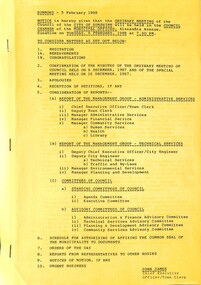
Administrative record - City of Sunshine Council Meetings 1986 - 1994 - Notice of Ordinary Meeting 9th February 1988, City of Sunshine, 5th February 1988
... Albans Legal Agreement Lot 1 & Lot 5 Boundary Road Laverton North Delegated Matters Statistical Information Building Permits Schedule for Authorising of Affixing the Common Seal of the Municipality to Documents Orders of the Day Tenders for Two 8 Man Capacity Amenities Caravans Proposed Discontinuance of the Right of Way Between Pizzey Street and Servante Street Adjacent to Lot 89 Pizzey Street Sunshine Proposal to Construct Fairbairn Road Private Street Scheme Under the Provisions of Division 10 of Part XIX of the Local Government Act 1958 Notices of Motions Construction of Neighbourhood Park Empress Court Ardeer City of Sunshine Wall Plaques Presentations to Commissioner of Richmond and the Archbishop of Nadur Report of the Town Clerk Civic Reception for Fr. ...Albans Legal Agreement Lot 1 & Lot 5 Boundary Road Laverton North Delegated Matters Statistical Information Building Permits Schedule for Authorising of Affixing the Common Seal of the Municipality to Documents Orders of the Day Tenders for Two 8 Man Capacity Amenities Caravans Proposed Discontinuance of the Right of Way Between Pizzey Street and Servante Street Adjacent to Lot 89 Pizzey Street Sunshine Proposal to Construct Fairbairn Road Private Street Scheme Under the Provisions of Division 10 of Part XIX of the Local Government Act 1958 Notices of Motions Construction of Neighbourhood Park Empress Court Ardeer City of Sunshine Wall Plaques Presentations to Commissioner of Richmond and the Archbishop of Nadur Report of the Town Clerk Civic Reception for Fr. ...Notice of Ordinary Meeting 9th February 1988 Report of the Management Group Administrative Services Report of the Chief Executive Officer / Town Clerk Proposed Subdivision of Altona into Wards Deutschmann Education Trust Request for Donation Australia Athletic Team Tour of the U.S.A. Maribyrnong River Flood Mitigation Supply of Valuation for Metropolitan Fire Brigades Board Dismissal of Sydney City Council Occupation of Selwyn Park Albion Turk Gucu Soccer Club Report of the Deputy Town Clerk Braybrook Escarpment McGrath Motors Land Acquisition of Land Between Duke Street and the Maribyrnong River Directly North of the Existing Council Reserve Sunshine Police Station Staff Levels Institute of Municipal Management Financial Management Course 6th - 11th March 1988 Clifton Springs Maternal and Child Health Nurses Regional Planning Committee (Western Region) Peace and Anti-Nuclear Movement Donations to People for Nuclear Disarmament and Australia Nuclear Free Zone Secretariat Australia Nuclear Free Zone Secretariat Meeting 26th - 27th February 1988 Report of the Manager Administrative Services Dorothy Carlton Preschool Centre Correspondence from Albion North Kindergarten Committee Victims of Crime Assistance League Australian Yugoslav Welfare Society Melbourne Workers' Theatre University of Melbourne 1988 Summer School Maribyrnong Neighbourhood Watch Security Services for The Parks & Recreation Depot, Sunshine West Community Centre, Marie Mill Community Centre and Brooklyn Tip Promotion state Insurance Office Notice of Motion Cleaning of Council Properties Proposed Discontinuance of the Right of Way Between Pizzey Street and Servante Street Adjacent to Lot 89 Pizzey Street Sunshine Insurance Premiums The Scouts Association of Australia Victorian Branch for the Lease of Scout Halls at Sassella Park, Errington Reserve, Dempster Park and Lowe Crescent Proposed Discontinuance of Part of Darnley Street and Treloar Crescent Braybrook Proposed Closure of Part of Burnside Street North of Harrison Street Deer Park Temperature Control Lions House of Sunshine Watt Street Sunshine Report of the Manager Financial Services Conference Expenses Supplementary Valuations Redemption of Inscribed Stock Accounts for Payment as at 15th January 1988 Fire Hazard Adjustments / Abandonments for the Month of November 1987 Private Street Adjustments / Abandonments for the Month of November 1987 General Rates, Sanitary & Interest Adjustments / Abandonments for the Month of November / December 1987 Rates, Sanitary & Interest Statements for the Period Ended 18th January 1988 Report of the Manager Community Services Easter Holiday Program 1988 Footscray Psychiatric Centre's Proposed Mental Health Clinic Albion Site Community Needs Assessment Marie Mill Community Centre Braybrook Youth Centre Variation of Bond for Hire Request for Donation Murdoch House Municipal Association of Victoria 1987 Update The Hunt Club Community Centre Committee of Management to include 2 Representatives from the Sunshine & District Historical Society, 1 Representative from the Rainbow Workshop, 1 Representative from the Sunshine Library, 3 Councillors (One from each ward) and 2 Representatives from the Arts and Education Groups Funding Victorian Ministry for the Arts Uniform Supply to Home Care Staff Bicentennial Projects Sunshine Adult Day Activities and Support Services Home and Community Care Programme Funding Announcement Podiatry Service for Older People 12th Annual Local Government Recreation Association of Victoria Conference 1987 Report 1988 Classes and Workshops Sunshine Community Arts Programme Arts Publicity and Promotion Seminar Report Sunshine Community Arts Programme Exhibition at The Hunt Club Sunshine Art Collection Statement of Objectives and General Principles for the Art Collection West Sunshine Three-Day Camp to Jubilee Lake Daylesford Free Outdoor Rock Concert Protective Behaviors Pilot Review West Launches West Project Creative Opportunities for Older Adults Sunshine West Community Centre YMCA Sunshine West Community Centre Official Opening 12th December 1987 Report Registrations of Premises Health Act & Food Act Transfer of Registration of Premises Prosecution Proceedings Magistrates Court National Conference Institute of Trading Standards 13th - 16th April 1988 Hobart Tasmania Nitrogen Dioxide Gas Emissions ICI Deer Park Plant Public Lending Right The Library Funding Review IFLA/LAA Conference 27th August - 3rd September 1988 Sydney Future Policy for Local Authority Library Services Western Region Commission Meeting on the Future of the Library Council of Victoria Report of the Deputy Executive Officer / City Engineer M.M.B.W. Hazardous Industrial Waste Treatment Facility Holden Road Diggers Rest Joint Taskforce on Intractable Waste City of Footscray Tipping Fees at Brooklyn Tip Local Government Engineers Association Annual Dinner Report of Deputy City Engineer Paramount Road - Dempster Street Connection Proposed Pedestrian Operated School Signals in Glengala Road Between Dinnell Street and Links Street Sunshine West Notice of Motion Fairbairn Road Private Street Scheme Appeal Geelong Road Service Road (North Side) Parking Prohibition Near 568 Geelong Road McKechnie Street (West Side) Parking Prohibition Somers Street Private Street Scheme Export Drive Private Subdivision (Francis Street) Stage 1 Traffic Control Items Keilor / Laverton Road (Station Road) Duplicate Bridge Over Kororoit Creek Pedestrian Operated Facility Western Highway (Ballarat Road) Between Marcellin Court and Summers Street Deer Park Devolution of Major Traffic Control Item (MTCI) Approval to Local Government Progress Report on Various Works up to 22nd January 1988 National Roads Strategy (NATROV) Victoria METPLAN Discussion Paper Dog Act Traffic & Parking Infringement Court Proceedings Big Apple Triathlon Event Court Proceedings Williamstown Magistrates Court Review of Subsidy Scheme School Crossing Supervisors Report of the Manager Environmental Services Maribyrnong High School Cutting of School Oval Removal of Building 242 Ballarat Road Braybrook to The Hunt Club 775 Ballarat Road Deer Park Relocation of North Sunshine Soccer Club to Carrington Drive Albion Sunshine Leisure Centre / Sunshine Swimming Pool Gas & Fuel Corporation Trenching Near Trees Progress Report on Various Works up to 21st January 1988 Report of the Manager Planning & Development Planning Permit Application Golf Driving Range Part Lot 1 Ballarat Road Deer Park Planning Permit Application Subdivision Ayton Street Sunshine North Planning Permit Application Educational Establishment 4 Andrea Street St. Albans Planning Permit Application Proposed 24 Hour Operation for Mobil Service Station Corner Neale Road and Station Road Deer Park Enforcement of Planning Scheme Illegal Truck Parking Corner Collenso Street and Glengala Road Sunshine West Rezonong Request 15 Hampstead Road Maidstone Rezoning Surplus M.M.B.W. Land St. Albans Road Sunshine North Additional 15 Amusement Machines 90 Hampshire Road Sunshine Planning Permit Application Major Utility Installation (Gas & Fuel Corporation District Centre) 740 Ballarat Road Ardeer Application Proposed 24 Hour Operation (Take Away Food Cafe) 720 Geelong Road Brooklyn Town Planning Policy Landscape Guidelines Planning Permit Application Alterations to Non-Conforming Use Peerless Holdings Pty Ltd 21 Evans Street Braybrook Planning Permit Application Bowling Green Sunshine V.R.I. Bowling Club Corner Kent Street & Hotham Street Braybrook Melbourne Metropolitan Planning Scheme Amendment No 437 140 Forrest Street Ardeer Rezoning Request Goldenreagh Receptions 461 - 467 Ballarat Road Sunshine Planning Permit Application Alterations to an Existing Institutional Home 16 Ridley Street Albion Amendment No 438 to Planning Scheme Rezoning Quinn Estate bounded by Lewin Street, Doherty Street, Quinn Street & Deer Street and Orama Street and part of Ballarat Road Deer Park Amendment No 438 to Planning Scheme Rezoning The East Side of Opie Road and Part of South Side of Main Road West Albanvale Amendment No 438 to Planning Scheme Rezoning The North Side of Neale Road Albanvale Planning Permit Application Light Industrial 44 Berkshire Road Sunshine North Planning Permit Application Trash & Treasure Market 2 McKechnie Street Appeal Planning Permit Application Sunshine Gardens Stage 3 Estate Factoryettes James Court Tottenham Sunshine District Centre Plans of Transfer and Consolidation Ayton Street Sunshine North Plan of Consolidation 66 - 68 Hampshire Road Sunshine Plan of Strata Subdivision North West Corner Rosamond Road and Verdun Street Maidstone Plan of Subdivision Opie Road (West Side) St. Albans Dangerous Building 154 Churchill Avenue Braybrook Stormwater from Jewel Food Barn Clarke Street Sunshine Urban Homesteading Program Dangerous Building 2 Devonshire Road Sunshine Dangerous Building 57 Reid Street Sunshine Dangerous Building 107 Denton Avenue St. Albans Legal Agreement Lot 1 & Lot 5 Boundary Road Laverton North Delegated Matters Statistical Information Building Permits Schedule for Authorising of Affixing the Common Seal of the Municipality to Documents Orders of the Day Tenders for Two 8 Man Capacity Amenities Caravans Proposed Discontinuance of the Right of Way Between Pizzey Street and Servante Street Adjacent to Lot 89 Pizzey Street Sunshine Proposal to Construct Fairbairn Road Private Street Scheme Under the Provisions of Division 10 of Part XIX of the Local Government Act 1958 Notices of Motions Construction of Neighbourhood Park Empress Court Ardeer City of Sunshine Wall Plaques Presentations to Commissioner of Richmond and the Archbishop of Nadur Report of the Town Clerk Civic Reception for Fr. Bernard Murphy of Our ladies Parosh Monash Street Sunshine Metropolitan Park M.M.B.W. McGrath's Quarry Plans by the Sunshine North Action Group Braybrook Maidstone Public Tenants Union Public Relations / Municipal Promotions Senior Citizen week Donation to Malta Star of the Sea West Esplanade St. Albans of 30 Unused Chairs Deer Park Co-Ordination Group Reception for Sunshine "Hatch" Shield Sidemaribyrnong river, albion turk gucu soccer club, selwyn park, selwyn street, albion, duke street, sunshine police station, dorothy carlton preschool centre, furlong road, sunshine north, albion north kindergarten committee, sunshine west community centre, kermeen street, sunshine west, marie mill community centre, randall street, maribyrnong, brooklyn tip, old geelong road, brooklyn, pizzey street, servante street, sunshine, sassella park, station road, deer park, errington reserve, main road east, st. albans, dempster park, phoenix street, lowe crescent, darnley street, treloar crescent, braybrook, burnside street, harrison street, lions house of sunshine, watt street, corio street, braybrook youth centre, the hunt club community centre committee of management, ballarat road, ici, paramount road, dempster street, tottenham, glengala road, dinnell street, links street, fairbairn road, geelong road, mckechnie street, somers street, export drive, kororoit creek bridge, western highway, marcellin court, summers street, maribyrnong high school, river street, north sunshine soccer club, carrington drive, sunshine leisure centre, sunshine swimming pool, kennedy street, ayton street, andrea street, neale road, collenso street, hampstead road, maidstone, st. albans roa, hampshire road, peerless holdings, evans street, sunshine v.r.i. bowling club, kent street, hotham street, forrest street, goldenreagh receptions, ridley street, lewin street, doherty street, quinn street, deer street, orama street, opie road, albanvale, berkshire road, james court, rosamond road, verdun street, churchill avenue, jewel food barn, clarke street, devonshire road, reid street, denton avenue, boundary road, laverton north, mcgrath's quarry, sunshine north action group, malta star of the sea, west esplanade -
 Embroiderers Guild, Victoria
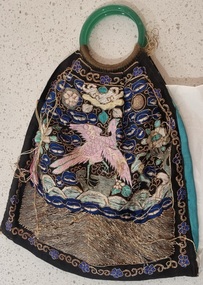
Functional object - Qing Dynasty Chinese Rank Badge Bag, 19 th C
... They were most innovative with the regal badges that had been displayed with great pride by mandarin on the black silk surcoats worn over the colorful dragon robes on all official occasions in the court of the last emperors and empresses of China. Two groups of men achieved badges, civil and military. ...They were most innovative with the regal badges that had been displayed with great pride by mandarin on the black silk surcoats worn over the colorful dragon robes on all official occasions in the court of the last emperors and empresses of China. Two groups of men achieved badges, civil and military. ...During the late 19th and early 20th century, the badges were prized collector items for wives of western diplomats stationed in Peking or Shanghai, and missionaries throughout China. The western collectors in old China not only framed the beautiful badges and hung them on walls, thus preserving them for future generations, but made evening purses of them. They put them under glass-covered serving trays, made decorative boxes adorned by them, and other imaginative items. They were most innovative with the regal badges that had been displayed with great pride by mandarin on the black silk surcoats worn over the colorful dragon robes on all official occasions in the court of the last emperors and empresses of China. Two groups of men achieved badges, civil and military. Each category had nine ranks. The civil rank badges feature birds for identification, and the military utilize animals, both real and mythological. The first civil examination was generally taken at approximately age 18. Those who passed were awarded the Flower of Talent or Hsiu-ts’ai title and were entitled to wear the ninth rank badge, the Paradise Flycatcher. This would be equivalent to receiving our Bachelor of Arts degree.Silk embroidery on silk fabric. Originally a Chinese Civil Rank Badge, repurposed into a bag. Satin stitch and metallic thread couching. Embroidery in pale mauve, aqua, blue and cream. Central panel has a bird with wings outstretched. Metal thread is used to attach to green Peking glass handles. Internal lining is degraded teal silk. -
 Embroiderers Guild, Victoria
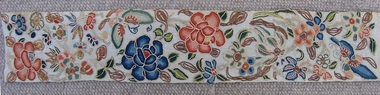
Clothing - Chinese Floral Sleeve Band, Late 19th Century
... Functionality: Women would fold their arms, often with their hands inside the sleeves, so the embroidered bands, which were sewn to hang down the back of the jacket, would be displayed prominently down the front. 19th century peak: The late 19th century was the peak of their popularity, with intricate designs becoming fashionable and even influenced by court tastes, such as those favoured by the Empress Dowager Cixi. ...Functionality: Women would fold their arms, often with their hands inside the sleeves, so the embroidered bands, which were sewn to hang down the back of the jacket, would be displayed prominently down the front. 19th century peak: The late 19th century was the peak of their popularity, with intricate designs becoming fashionable and even influenced by court tastes, such as those favoured by the Empress Dowager Cixi. ...Chinese sleeve embroidery bands, or wanxiu became popular in the late 19th century during the Qing Dynasty, evolving from the traditional Han cuff embroidery and Manchu styles. These detachable, decorated bands were added to women's informal jackets and robes, often featuring symbolic motifs like landscapes, flowers, and auspicious symbols. They served both a decorative function, displaying artistic skill and personal wishes, and a practical one by covering the sleeves when hands were folded at the waist. History and evolution: Origins: The practice of embroidering cuffs on robes existed during the previous Ming Dynasty for Han women, and this was adopted by the Manchu rulers who founded the Qing Dynasty. Qing Dynasty (1644-1911): The practice was popularized and elaborated upon during this era, with detachable bands becoming a fashionable element for informal wear. Symbolism: The embroidery included a complex visual vocabulary of wishes for a long life, many offspring, and a happy marriage, derived from nature, mythology, and classical literature. Functionality: Women would fold their arms, often with their hands inside the sleeves, so the embroidered bands, which were sewn to hang down the back of the jacket, would be displayed prominently down the front. 19th century peak: The late 19th century was the peak of their popularity, with intricate designs becoming fashionable and even influenced by court tastes, such as those favoured by the Empress Dowager Cixi. Later developments: The late 19th century saw the introduction of chemical 'aniline' dyes from Europe, leading to brighter, bolder colours in embroidery. Motifs and their Meanings: Auspicious symbols: Designs often included symbols for good fortune, wealth, and longevity. Natural imagery: Birds, flowers, and landscapes were common motifs that could represent natural beauty or convey specific symbolic meanings. Figurative scenes: Bands could also feature narrative scenes from classical stories or legends. The choice of motifs allowed women to express personal desires, cultural values, and aesthetic preferences, reflecting a more personal and informal style than official court attire.Sleeve band of grey brocade silk, embroidered design of peonies, and butterflies in coloured silk thread in Pekin knot stitch. Flowers are outlined in cream crinkle cord. china, late 19th century, silk, sleeve band, flower, peony, butterfly -
 Embroiderers Guild, Victoria
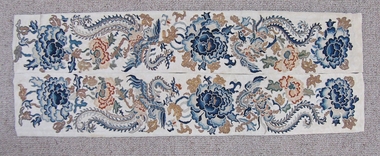
Accessory - Pair of Chinese Embroidered Sleeve Bands
... Functionality: Women would fold their arms, often with their hands inside the sleeves, so the embroidered bands, which were sewn to hang down the back of the jacket, would be displayed prominently down the front. 19th century peak: The late 19th century was the peak of their popularity, with intricate designs becoming fashionable and even influenced by court tastes, such as those favoured by the Empress Dowager Cixi. ...Functionality: Women would fold their arms, often with their hands inside the sleeves, so the embroidered bands, which were sewn to hang down the back of the jacket, would be displayed prominently down the front. 19th century peak: The late 19th century was the peak of their popularity, with intricate designs becoming fashionable and even influenced by court tastes, such as those favoured by the Empress Dowager Cixi. ...Chinese sleeve embroidery bands, or wanxiu became popular in the late 19th century during the Qing Dynasty, evolving from the traditional Han cuff embroidery and Manchu styles. These detachable, decorated bands were added to women's informal jackets and robes, often featuring symbolic motifs like landscapes, flowers, and auspicious symbols. They served both a decorative function, displaying artistic skill and personal wishes, and a practical one by covering the sleeves when hands were folded at the waist. History and evolution: Origins: The practice of embroidering cuffs on robes existed during the previous Ming Dynasty for Han women, and this was adopted by the Manchu rulers who founded the Qing Dynasty. Qing Dynasty (1644-1911): The practice was popularized and elaborated upon during this era, with detachable bands becoming a fashionable element for informal wear. Symbolism: The embroidery included a complex visual vocabulary of wishes for a long life, many offspring, and a happy marriage, derived from nature, mythology, and classical literature. Functionality: Women would fold their arms, often with their hands inside the sleeves, so the embroidered bands, which were sewn to hang down the back of the jacket, would be displayed prominently down the front. 19th century peak: The late 19th century was the peak of their popularity, with intricate designs becoming fashionable and even influenced by court tastes, such as those favoured by the Empress Dowager Cixi. Later developments: The late 19th century saw the introduction of chemical 'aniline' dyes from Europe, leading to brighter, bolder colours in embroidery. Motifs and their Meanings: Auspicious symbols: Designs often included symbols for good fortune, wealth, and longevity. Natural imagery: Birds, flowers, and landscapes were common motifs that could represent natural beauty or convey specific symbolic meanings. Figurative scenes: Bands could also feature narrative scenes from classical stories or legends. The choice of motifs allowed women to express personal desires, cultural values, and aesthetic preferences, reflecting a more personal and informal style than official court attire.Pale green brocade with Pekin knot stitch in blue, green, cream and brown. Large heads and the phoenix used in the design. Gold thread couched with cream thread.embroidery, garments, silk embroidery, oriental, china -
 Embroiderers Guild, Victoria
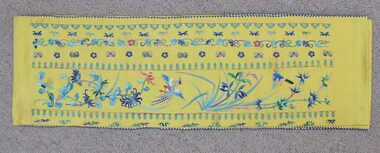
Accessory - Pair of Chinese Sleeve Bands, Late 19th Century
... Functionality: Women would fold their arms, often with their hands inside the sleeves, so the embroidered bands, which were sewn to hang down the back of the jacket, would be displayed prominently down the front. 19th century peak: The late 19th century was the peak of their popularity, with intricate designs becoming fashionable and even influenced by court tastes, such as those favoured by the Empress Dowager Cixi. ...Functionality: Women would fold their arms, often with their hands inside the sleeves, so the embroidered bands, which were sewn to hang down the back of the jacket, would be displayed prominently down the front. 19th century peak: The late 19th century was the peak of their popularity, with intricate designs becoming fashionable and even influenced by court tastes, such as those favoured by the Empress Dowager Cixi. ...Chinese sleeve embroidery bands, or wanxiu became popular in the late 19th century during the Qing Dynasty, evolving from the traditional Han cuff embroidery and Manchu styles. These detachable, decorated bands were added to women's informal jackets and robes, often featuring symbolic motifs like landscapes, flowers, and auspicious symbols. They served both a decorative function, displaying artistic skill and personal wishes, and a practical one by covering the sleeves when hands were folded at the waist. History and evolution: Origins: The practice of embroidering cuffs on robes existed during the previous Ming Dynasty for Han women, and this was adopted by the Manchu rulers who founded the Qing Dynasty. Qing Dynasty (1644-1911): The practice was popularized and elaborated upon during this era, with detachable bands becoming a fashionable element for informal wear. Symbolism: The embroidery included a complex visual vocabulary of wishes for a long life, many offspring, and a happy marriage, derived from nature, mythology, and classical literature. Functionality: Women would fold their arms, often with their hands inside the sleeves, so the embroidered bands, which were sewn to hang down the back of the jacket, would be displayed prominently down the front. 19th century peak: The late 19th century was the peak of their popularity, with intricate designs becoming fashionable and even influenced by court tastes, such as those favoured by the Empress Dowager Cixi. Later developments: The late 19th century saw the introduction of chemical 'aniline' dyes from Europe, leading to brighter, bolder colours in embroidery. Motifs and their Meanings: Auspicious symbols: Designs often included symbols for good fortune, wealth, and longevity. Natural imagery: Birds, flowers, and landscapes were common motifs that could represent natural beauty or convey specific symbolic meanings. Figurative scenes: Bands could also feature narrative scenes from classical stories or legends. The choice of motifs allowed women to express personal desires, cultural values, and aesthetic preferences, reflecting a more personal and informal style than official court attire.Yellow silk satin, silk embroidery depicting birds and flowers in bright blues, greens, mauve, orange and pinks.embroidery, garments, silk embroidery, china, late 19th century, flowers, garden, bird -
 Embroiderers Guild, Victoria
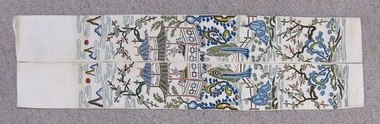
Accessory - Pair of Chinese Embroidered Sleeve Bands, 19 th C
... Functionality: Women would fold their arms, often with their hands inside the sleeves, so the embroidered bands, which were sewn to hang down the back of the jacket, would be displayed prominently down the front. 19th century peak: The late 19th century was the peak of their popularity, with intricate designs becoming fashionable and even influenced by court tastes, such as those favoured by the Empress Dowager Cixi. ...Functionality: Women would fold their arms, often with their hands inside the sleeves, so the embroidered bands, which were sewn to hang down the back of the jacket, would be displayed prominently down the front. 19th century peak: The late 19th century was the peak of their popularity, with intricate designs becoming fashionable and even influenced by court tastes, such as those favoured by the Empress Dowager Cixi. ...Chinese sleeve embroidery bands, or wanxiu became popular in the late 19th century during the Qing Dynasty, evolving from the traditional Han cuff embroidery and Manchu styles. These detachable, decorated bands were added to women's informal jackets and robes, often featuring symbolic motifs like landscapes, flowers, and auspicious symbols. They served both a decorative function, displaying artistic skill and personal wishes, and a practical one by covering the sleeves when hands were folded at the waist. History and evolution: Origins: The practice of embroidering cuffs on robes existed during the previous Ming Dynasty for Han women, and this was adopted by the Manchu rulers who founded the Qing Dynasty. Qing Dynasty (1644-1911): The practice was popularized and elaborated upon during this era, with detachable bands becoming a fashionable element for informal wear. Symbolism: The embroidery included a complex visual vocabulary of wishes for a long life, many offspring, and a happy marriage, derived from nature, mythology, and classical literature. Functionality: Women would fold their arms, often with their hands inside the sleeves, so the embroidered bands, which were sewn to hang down the back of the jacket, would be displayed prominently down the front. 19th century peak: The late 19th century was the peak of their popularity, with intricate designs becoming fashionable and even influenced by court tastes, such as those favoured by the Empress Dowager Cixi. Later developments: The late 19th century saw the introduction of chemical 'aniline' dyes from Europe, leading to brighter, bolder colours in embroidery. Motifs and their Meanings: Auspicious symbols: Designs often included symbols for good fortune, wealth, and longevity. Natural imagery: Birds, flowers, and landscapes were common motifs that could represent natural beauty or convey specific symbolic meanings. Figurative scenes: Bands could also feature narrative scenes from classical stories or legends. The choice of motifs allowed women to express personal desires, cultural values, and aesthetic preferences, reflecting a more personal and informal style than official court attire.Cream satin, silk embroidery in Pekin knot stitch. Fine couched cord. Rural setting with figures, trees and pagoda.embroidery, garments, silk embroidery, china, garden, figures, lanscape -
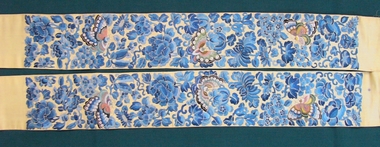 Embroiderers Guild, Victoria
Accessory - Pair of Chinese Sleeve Bands, Mid 19th Century
... Functionality: Women would fold their arms, often with their hands inside the sleeves, so the embroidered bands, which were sewn to hang down the back of the jacket, would be displayed prominently down the front. 19th century peak: The late 19th century was the peak of their popularity, with intricate designs becoming fashionable and even influenced by court tastes, such as those favoured by the Empress Dowager Cixi. ...Functionality: Women would fold their arms, often with their hands inside the sleeves, so the embroidered bands, which were sewn to hang down the back of the jacket, would be displayed prominently down the front. 19th century peak: The late 19th century was the peak of their popularity, with intricate designs becoming fashionable and even influenced by court tastes, such as those favoured by the Empress Dowager Cixi. ...Chinese sleeve embroidery bands, or wanxiu became popular in the late 19th century during the Qing Dynasty, evolving from the traditional Han cuff embroidery and Manchu styles. These detachable, decorated bands were added to women's informal jackets and robes, often featuring symbolic motifs like landscapes, flowers, and auspicious symbols. They served both a decorative function, displaying artistic skill and personal wishes, and a practical one by covering the sleeves when hands were folded at the waist. History and evolution: Origins: The practice of embroidering cuffs on robes existed during the previous Ming Dynasty for Han women, and this was adopted by the Manchu rulers who founded the Qing Dynasty. Qing Dynasty (1644-1911): The practice was popularized and elaborated upon during this era, with detachable bands becoming a fashionable element for informal wear. Symbolism: The embroidery included a complex visual vocabulary of wishes for a long life, many offspring, and a happy marriage, derived from nature, mythology, and classical literature. Functionality: Women would fold their arms, often with their hands inside the sleeves, so the embroidered bands, which were sewn to hang down the back of the jacket, would be displayed prominently down the front. 19th century peak: The late 19th century was the peak of their popularity, with intricate designs becoming fashionable and even influenced by court tastes, such as those favoured by the Empress Dowager Cixi. Later developments: The late 19th century saw the introduction of chemical 'aniline' dyes from Europe, leading to brighter, bolder colours in embroidery. Motifs and their Meanings: Auspicious symbols: Designs often included symbols for good fortune, wealth, and longevity. Natural imagery: Birds, flowers, and landscapes were common motifs that could represent natural beauty or convey specific symbolic meanings. Figurative scenes: Bands could also feature narrative scenes from classical stories or legends. The choice of motifs allowed women to express personal desires, cultural values, and aesthetic preferences, reflecting a more personal and informal style than official court attire.Pale gold satin. Design of peonies embroidered in shades of blue satin stitch with coloured butterflies..embroidery, garments, silk embroidery, mid 19th century, china, oriental -
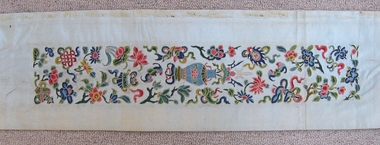 Embroiderers Guild, Victoria
Accessory - Chinese Floral Sleeve Band
... Functionality: Women would fold their arms, often with their hands inside the sleeves, so the embroidered bands, which were sewn to hang down the back of the jacket, would be displayed prominently down the front. 19th century peak: The late 19th century was the peak of their popularity, with intricate designs becoming fashionable and even influenced by court tastes, such as those favoured by the Empress Dowager Cixi. ...Functionality: Women would fold their arms, often with their hands inside the sleeves, so the embroidered bands, which were sewn to hang down the back of the jacket, would be displayed prominently down the front. 19th century peak: The late 19th century was the peak of their popularity, with intricate designs becoming fashionable and even influenced by court tastes, such as those favoured by the Empress Dowager Cixi. ...Chinese sleeve embroidery bands, or wanxiu became popular in the late 19th century during the Qing Dynasty, evolving from the traditional Han cuff embroidery and Manchu styles. These detachable, decorated bands were added to women's informal jackets and robes, often featuring symbolic motifs like landscapes, flowers, and auspicious symbols. They served both a decorative function, displaying artistic skill and personal wishes, and a practical one by covering the sleeves when hands were folded at the waist. History and evolution: Origins: The practice of embroidering cuffs on robes existed during the previous Ming Dynasty for Han women, and this was adopted by the Manchu rulers who founded the Qing Dynasty. Qing Dynasty (1644-1911): The practice was popularized and elaborated upon during this era, with detachable bands becoming a fashionable element for informal wear. Symbolism: The embroidery included a complex visual vocabulary of wishes for a long life, many offspring, and a happy marriage, derived from nature, mythology, and classical literature. Functionality: Women would fold their arms, often with their hands inside the sleeves, so the embroidered bands, which were sewn to hang down the back of the jacket, would be displayed prominently down the front. 19th century peak: The late 19th century was the peak of their popularity, with intricate designs becoming fashionable and even influenced by court tastes, such as those favoured by the Empress Dowager Cixi. Later developments: The late 19th century saw the introduction of chemical 'aniline' dyes from Europe, leading to brighter, bolder colours in embroidery. Motifs and their Meanings: Auspicious symbols: Designs often included symbols for good fortune, wealth, and longevity. Natural imagery: Birds, flowers, and landscapes were common motifs that could represent natural beauty or convey specific symbolic meanings. Figurative scenes: Bands could also feature narrative scenes from classical stories or legends. The choice of motifs allowed women to express personal desires, cultural values, and aesthetic preferences, reflecting a more personal and informal style than official court attire.Classical Chinese design, a wide band of pale green satin is partly decorated with a band of embroidery. Pekin knot stitch outlined with a very fine white cord is worked in shades of pink, blue, yellow and green. Subjects chosen are flower vase, bats, sea creatures and peony flowers.On reverse 438/4103embroidery, garments, china, silk embroidery, poeny, flower, vase, bat, animals -
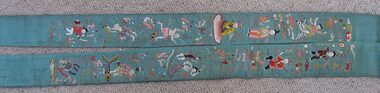 Embroiderers Guild, Victoria
Accessory - Pair of Chinese Sleeve Bands, Mid 19th Century
... Functionality: Women would fold their arms, often with their hands inside the sleeves, so the embroidered bands, which were sewn to hang down the back of the jacket, would be displayed prominently down the front. 19th century peak: The late 19th century was the peak of their popularity, with intricate designs becoming fashionable and even influenced by court tastes, such as those favoured by the Empress Dowager Cixi. ...Functionality: Women would fold their arms, often with their hands inside the sleeves, so the embroidered bands, which were sewn to hang down the back of the jacket, would be displayed prominently down the front. 19th century peak: The late 19th century was the peak of their popularity, with intricate designs becoming fashionable and even influenced by court tastes, such as those favoured by the Empress Dowager Cixi. ...Chinese sleeve embroidery bands, or wanxiu became popular in the late 19th century during the Qing Dynasty, evolving from the traditional Han cuff embroidery and Manchu styles. These detachable, decorated bands were added to women's informal jackets and robes, often featuring symbolic motifs like landscapes, flowers, and auspicious symbols. They served both a decorative function, displaying artistic skill and personal wishes, and a practical one by covering the sleeves when hands were folded at the waist. History and evolution: Origins: The practice of embroidering cuffs on robes existed during the previous Ming Dynasty for Han women, and this was adopted by the Manchu rulers who founded the Qing Dynasty. Qing Dynasty (1644-1911): The practice was popularized and elaborated upon during this era, with detachable bands becoming a fashionable element for informal wear. Symbolism: The embroidery included a complex visual vocabulary of wishes for a long life, many offspring, and a happy marriage, derived from nature, mythology, and classical literature. Functionality: Women would fold their arms, often with their hands inside the sleeves, so the embroidered bands, which were sewn to hang down the back of the jacket, would be displayed prominently down the front. 19th century peak: The late 19th century was the peak of their popularity, with intricate designs becoming fashionable and even influenced by court tastes, such as those favoured by the Empress Dowager Cixi. Later developments: The late 19th century saw the introduction of chemical 'aniline' dyes from Europe, leading to brighter, bolder colours in embroidery. Motifs and their Meanings: Auspicious symbols: Designs often included symbols for good fortune, wealth, and longevity. Natural imagery: Birds, flowers, and landscapes were common motifs that could represent natural beauty or convey specific symbolic meanings. Figurative scenes: Bands could also feature narrative scenes from classical stories or legends. The choice of motifs allowed women to express personal desires, cultural values, and aesthetic preferences, reflecting a more personal and informal style than official court attire.Mid green silk embroidered with a variety of coloured silk threads and some metal thread.embroidery, garments, china, mid 19th century, figures, fish, turtle, sea -
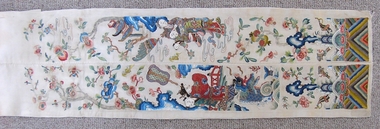 Embroiderers Guild, Victoria
Accessory - Pair of Chinese Embroidered Sleeve Bands, 19 th C
... Functionality: Women would fold their arms, often with their hands inside the sleeves, so the embroidered bands, which were sewn to hang down the back of the jacket, would be displayed prominently down the front. 19th century peak: The late 19th century was the peak of their popularity, with intricate designs becoming fashionable and even influenced by court tastes, such as those favoured by the Empress Dowager Cixi. ...Functionality: Women would fold their arms, often with their hands inside the sleeves, so the embroidered bands, which were sewn to hang down the back of the jacket, would be displayed prominently down the front. 19th century peak: The late 19th century was the peak of their popularity, with intricate designs becoming fashionable and even influenced by court tastes, such as those favoured by the Empress Dowager Cixi. ...Chinese sleeve embroidery bands, or wanxiu became popular in the late 19th century during the Qing Dynasty, evolving from the traditional Han cuff embroidery and Manchu styles. These detachable, decorated bands were added to women's informal jackets and robes, often featuring symbolic motifs like landscapes, flowers, and auspicious symbols. They served both a decorative function, displaying artistic skill and personal wishes, and a practical one by covering the sleeves when hands were folded at the waist. History and evolution: Origins: The practice of embroidering cuffs on robes existed during the previous Ming Dynasty for Han women, and this was adopted by the Manchu rulers who founded the Qing Dynasty. Qing Dynasty (1644-1911): The practice was popularized and elaborated upon during this era, with detachable bands becoming a fashionable element for informal wear. Symbolism: The embroidery included a complex visual vocabulary of wishes for a long life, many offspring, and a happy marriage, derived from nature, mythology, and classical literature. Functionality: Women would fold their arms, often with their hands inside the sleeves, so the embroidered bands, which were sewn to hang down the back of the jacket, would be displayed prominently down the front. 19th century peak: The late 19th century was the peak of their popularity, with intricate designs becoming fashionable and even influenced by court tastes, such as those favoured by the Empress Dowager Cixi. Later developments: The late 19th century saw the introduction of chemical 'aniline' dyes from Europe, leading to brighter, bolder colours in embroidery. Motifs and their Meanings: Auspicious symbols: Designs often included symbols for good fortune, wealth, and longevity. Natural imagery: Birds, flowers, and landscapes were common motifs that could represent natural beauty or convey specific symbolic meanings. Figurative scenes: Bands could also feature narrative scenes from classical stories or legends. The choice of motifs allowed women to express personal desires, cultural values, and aesthetic preferences, reflecting a more personal and informal style than official court attire. Symbolism: Mountains and sea, clouds and waves - Good luck. Dragon/fish tail/flaming pearl = Good fortune. This refers to the legend 'liyutiaolongmen' - a carp rising from the waves with the head already changed into a dragon implies the wish for success in the civil service examination. It is an allegory for the persistent effort needed to overcome obstacles. Male with black hat - Zhuang Yuan conferred. Among patterns with implied meanings , patterns related to the pursuits of scholarly honour and official rand include mainly the 'three number ones'. 'Zheng Yuan conferred' and 'carp jumping over the dragon gate'. In feudal society, examiners for the official positions had to go through three different levels of examinations. Bats - the work for bat is 'fu' and is a visual pun for the word happiness 'fu'. Rhino horn - wealth and good fortune. The ruyi sceptre - is a curved decorative Chinese object that symbolizes power, good fortune, and the wish that “things go as you desire.” The head of the sceptre resembles the 'lingzhi' of the 'longevity fungus'. Pomegranate - fertility ie; offspring, a virtue in China. Boy holding the flowering branch in the arms of the woman - in the selection of officials through imperial examinations in feudal society, the winner of an official position is described as ' having picked the crown'. 'Gui' (sweet scented osmanthus) and 'gui' (high rank or official) are very close in sound Chinese. In this design the boy in the woman's arms is seen waving a sweet scented osmanthus, thus an auspicious message is delivered. Information from Dr Rachel Silberstein, visiting Associate Professor at Rhode Island School of Design. "This pair of sleeve bands are two halves of a scene known as "tian xian song zi" or "Heavenly immortals deliver a son". The historical origins of this saying is a story from 'The History of the Wei Imperial records', involving the Emperor Sheng and an immortal maiden who presents him with a son. After this, the expression "tian xian song zi" came to be used as good wishes for marriage, closely associated with 'qilin song zi' (the qilin delivers a son), another popular topic in nianhua popular prints". Both cuffs show figures in an outdoor setting, done in colourful silk thread on a ivory satin. Reading from the bottom to the top of the cuff both have pointed mountains, clouds and sea with a rhino horn and a 'rui' coming out of the waves. Left cuff: above the sea there are a fish/dragon and a flaming pearl. Next two male figures standing on a bridge. One holds a fan and the other is wearing a black hat. More flowers, peonies and blossoms are above the figures. Right cuff: Above the water and mountains is a bat, peonies and pomegranates. Above these are three figures and another bat. The figure in there rear holds a feathered fan, while the front figure holds a child, who is holding a flowering branch. Above the trio is a low pagoda and blossoms. Silk satin stitch, Pekin knots and couched gold metal thread.embroidery, garments, silk embroidery, china, landscape, garden, figures -
 Embroiderers Guild, Victoria
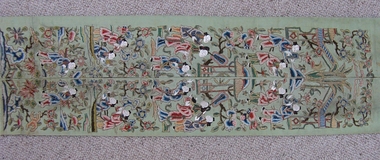
Accessory - Pair of Chinese Sleeve Bands, Late 19th century
... Functionality: Women would fold their arms, often with their hands inside the sleeves, so the embroidered bands, which were sewn to hang down the back of the jacket, would be displayed prominently down the front. 19th century peak: The late 19th century was the peak of their popularity, with intricate designs becoming fashionable and even influenced by court tastes, such as those favoured by the Empress Dowager Cixi. ...Functionality: Women would fold their arms, often with their hands inside the sleeves, so the embroidered bands, which were sewn to hang down the back of the jacket, would be displayed prominently down the front. 19th century peak: The late 19th century was the peak of their popularity, with intricate designs becoming fashionable and even influenced by court tastes, such as those favoured by the Empress Dowager Cixi. ...Chinese sleeve embroidery bands, or wanxiu became popular in the late 19th century during the Qing Dynasty, evolving from the traditional Han cuff embroidery and Manchu styles. These detachable, decorated bands were added to women's informal jackets and robes, often featuring symbolic motifs like landscapes, flowers, and auspicious symbols. They served both a decorative function, displaying artistic skill and personal wishes, and a practical one by covering the sleeves when hands were folded at the waist. History and evolution: Origins: The practice of embroidering cuffs on robes existed during the previous Ming Dynasty for Han women, and this was adopted by the Manchu rulers who founded the Qing Dynasty. Qing Dynasty (1644-1911): The practice was popularized and elaborated upon during this era, with detachable bands becoming a fashionable element for informal wear. Symbolism: The embroidery included a complex visual vocabulary of wishes for a long life, many offspring, and a happy marriage, derived from nature, mythology, and classical literature. Functionality: Women would fold their arms, often with their hands inside the sleeves, so the embroidered bands, which were sewn to hang down the back of the jacket, would be displayed prominently down the front. 19th century peak: The late 19th century was the peak of their popularity, with intricate designs becoming fashionable and even influenced by court tastes, such as those favoured by the Empress Dowager Cixi. Later developments: The late 19th century saw the introduction of chemical 'aniline' dyes from Europe, leading to brighter, bolder colours in embroidery. Motifs and their Meanings: Auspicious symbols: Designs often included symbols for good fortune, wealth, and longevity. Natural imagery: Birds, flowers, and landscapes were common motifs that could represent natural beauty or convey specific symbolic meanings. Figurative scenes: Bands could also feature narrative scenes from classical stories or legends. The choice of motifs allowed women to express personal desires, cultural values, and aesthetic preferences, reflecting a more personal and informal style than official court attire. Looking at the cuffs from bottom to top: there is a rock formation, a zig zag fence and flowers (chrysanthemums and a branch with Buddha's hand citron). Next is a male figure carrying a halberd over his shoulder and surrounded by flowers, foliage and hillocks. Above are two more males in a boat. One is standing, the other kneeling. The one kneeling holds a bamboo pipe, while the one standing holds a branch with pomegranates. The men are surrounded by more flowers, foliage, rocks and bats . Three more figures come next. A male holding a fan, a woman holding a dish and another male. The woman on the left cuff holds a dish which appears to hold fruit, whereas the woman on the right cuff holds a dish containing a ? hat. Further up is a pagoda with a pomegranate tree and two more male figures. One holds the sacred fungus, the other a vase with a lotus flower. Finally there are two pagodas, leaves, flowers and clouds. Symbolism: Buddha's (foshou) hand citron. This plant derives it's name from the shape of the fruit, which is said to resemble Buddha's hand. 'Foshou' is used as a pun from blessings (fu) and longevity (shou). Chrysanthemum - longevity. Halberd - a spear like object symbolizing rank and military achievement. Halberd (ji) is a pun for rank (ji) and represents rapid promotion and doing well in officialdom or politics. Bamboo pipe or mouth organ (skeng) is a pun for giving birth (skeng). The image of a boy with a mouth organ implies the wish for a son. Pomegranate- symbolizes many sons (or possibly children). Boat - may be travelling from or to. Fan (shan)- longevity, and also a pun for goodness (shan). Boy pointing upwards (?to the sun) - may you rise in rank (zhri goosheng). The act of pointing at the sun is a pun for 'soon' (zhri). Fungus - resembles the head of a wish granting wand (ruyi) and has the same meaning of 'as you wish'. Lotus flower - (he) is a pun for harmony. Vase - (ping) a pun for peace (ping'an) therefore a vase with lotus - peace and harmony. These sleeve bands are more generic but they do convey a wish for many sons who will become officials and bring fortune. Dr Rachel Silberstein, visiting Associate Professor at Rhode Island School of Design.Pair of Chinese Sleeve bands using Pekin knots, satin stitch. Depicts an outdoor scene with pagodas, people, zig zag fences, boats and plants embroidered on a pale green silk ground. Both cuffs have been joined at the bottom.embroidery, garments, silk embroidery, china, sleeve bands, late 19th century, garden, figures -
 Embroiderers Guild, Victoria
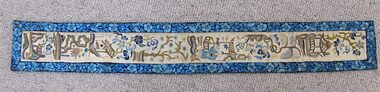
Accessory - Pair of Chinese Embroidered Sleeve Bands, 1880
... Functionality: Women would fold their arms, often with their hands inside the sleeves, so the embroidered bands, which were sewn to hang down the back of the jacket, would be displayed prominently down the front. 19th century peak: The late 19th century was the peak of their popularity, with intricate designs becoming fashionable and even influenced by court tastes, such as those favoured by the Empress Dowager Cixi. ...Functionality: Women would fold their arms, often with their hands inside the sleeves, so the embroidered bands, which were sewn to hang down the back of the jacket, would be displayed prominently down the front. 19th century peak: The late 19th century was the peak of their popularity, with intricate designs becoming fashionable and even influenced by court tastes, such as those favoured by the Empress Dowager Cixi. ...Label attached to record card states "Chinese Embroidery from the Royal Palace, Pekin J.M.S." Chinese sleeve embroidery bands, or wanxiu became popular in the late 19th century during the Qing Dynasty, evolving from the traditional Han cuff embroidery and Manchu styles. These detachable, decorated bands were added to women's informal jackets and robes, often featuring symbolic motifs like landscapes, flowers, and auspicious symbols. They served both a decorative function, displaying artistic skill and personal wishes, and a practical one by covering the sleeves when hands were folded at the waist. History and evolution: Origins: The practice of embroidering cuffs on robes existed during the previous Ming Dynasty for Han women, and this was adopted by the Manchu rulers who founded the Qing Dynasty. Qing Dynasty (1644-1911): The practice was popularized and elaborated upon during this era, with detachable bands becoming a fashionable element for informal wear. Symbolism: The embroidery included a complex visual vocabulary of wishes for a long life, many offspring, and a happy marriage, derived from nature, mythology, and classical literature. Functionality: Women would fold their arms, often with their hands inside the sleeves, so the embroidered bands, which were sewn to hang down the back of the jacket, would be displayed prominently down the front. 19th century peak: The late 19th century was the peak of their popularity, with intricate designs becoming fashionable and even influenced by court tastes, such as those favoured by the Empress Dowager Cixi. Later developments: The late 19th century saw the introduction of chemical 'aniline' dyes from Europe, leading to brighter, bolder colours in embroidery. Motifs and their Meanings: Auspicious symbols: Designs often included symbols for good fortune, wealth, and longevity. Natural imagery: Birds, flowers, and landscapes were common motifs that could represent natural beauty or convey specific symbolic meanings. Figurative scenes: Bands could also feature narrative scenes from classical stories or legends. The choice of motifs allowed women to express personal desires, cultural values, and aesthetic preferences, reflecting a more personal and informal style than official court attire. Pagoda: an omen of good. Two birds (possibly swallows): an omen approaching spring and also of approaching success. Rooster: a symbol of high rank (it's comb/crown (jinguan) is a pun for 'official' guan). Peony: a symbol of wealth. Deer (lu): means wealth and prosperity. Willow: a symbol of spring (chun). Willows with apricot blossoms (xinghuo), willlows (liu) and swallows (yan) symbolizes 'may you attend the spring banquet in the apricot grove (xinglin chunyan), or may you become a successful candidate. Pine: longevity. Mouth organ (sheng): is a pun for giving birth or 'to rise' as in rising in rank.Meaning : this pair of sleeve bands may have been wishing the owner of them good luck, success in an upcoming exam and that he may rapidly rise in rank, live a long life and continue to receive an official salary. Information from 'Hidden Meaning in Chinese Art' Terese Tse BartholomewFine white satin edged in shades oft blue silk flower embroidery. A fine example of Pekin knot stitch outlined with gold thread showing traditional Chinese motifs and figures. From bottom to top there is an outdoor scene with water and a building. Above this are flowers, hills, a rock formation, a pine and an animal (? pig or deer). Another building, blossoms and pine trees and a pot containing a cypress tree. Above the tree there is a male figure holding a bamboo pipe in one hand and a bird in the other. Further buildings follow, with a willow tree and two swallows flying.embroidery, garments, silk embroidery, late 19th century, china, trees, animals, pagoda -
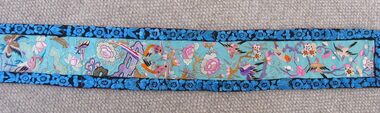 Embroiderers Guild, Victoria
Clothing - Chinese Embroidered Band, 1900
... Functionality: Women would fold their arms, often with their hands inside the sleeves, so the embroidered bands, which were sewn to hang down the back of the jacket, would be displayed prominently down the front. 19th century peak: The late 19th century was the peak of their popularity, with intricate designs becoming fashionable and even influenced by court tastes, such as those favoured by the Empress Dowager Cixi. ...Functionality: Women would fold their arms, often with their hands inside the sleeves, so the embroidered bands, which were sewn to hang down the back of the jacket, would be displayed prominently down the front. 19th century peak: The late 19th century was the peak of their popularity, with intricate designs becoming fashionable and even influenced by court tastes, such as those favoured by the Empress Dowager Cixi. ...Sleeve band is believed to have been brought from China by a sea captain. Chinese sleeve embroidery bands, or wanxiu became popular in the late 19th century during the Qing Dynasty, evolving from the traditional Han cuff embroidery and Manchu styles. These detachable, decorated bands were added to women's informal jackets and robes, often featuring symbolic motifs like landscapes, flowers, and auspicious symbols. They served both a decorative function, displaying artistic skill and personal wishes, and a practical one by covering the sleeves when hands were folded at the waist. History and evolution: Origins: The practice of embroidering cuffs on robes existed during the previous Ming Dynasty for Han women, and this was adopted by the Manchu rulers who founded the Qing Dynasty. Qing Dynasty (1644-1911): The practice was popularized and elaborated upon during this era, with detachable bands becoming a fashionable element for informal wear. Symbolism: The embroidery included a complex visual vocabulary of wishes for a long life, many offspring, and a happy marriage, derived from nature, mythology, and classical literature. Functionality: Women would fold their arms, often with their hands inside the sleeves, so the embroidered bands, which were sewn to hang down the back of the jacket, would be displayed prominently down the front. 19th century peak: The late 19th century was the peak of their popularity, with intricate designs becoming fashionable and even influenced by court tastes, such as those favoured by the Empress Dowager Cixi. Later developments: The late 19th century saw the introduction of chemical 'aniline' dyes from Europe, leading to brighter, bolder colours in embroidery. Motifs and their Meanings: Auspicious symbols: Designs often included symbols for good fortune, wealth, and longevity. Natural imagery: Birds, flowers, and landscapes were common motifs that could represent natural beauty or convey specific symbolic meanings. Figurative scenes: Bands could also feature narrative scenes from classical stories or legends. The choice of motifs allowed women to express personal desires, cultural values, and aesthetic preferences, reflecting a more personal and informal style than official court attire.Turquoise blue silk band embroidered in a delicate design of flowers, birds, butterflies and insects in classical Chinese style. The edge is bound with black silk worked with a bright blue design and the lining is a magenta brocade. garments, 1900-20, china, silk embroidery, flowers, birds, butterfly -
 Embroiderers Guild, Victoria
Textile - Chinese Silk Panel, c 1900
... Functionality: Women would fold their arms, often with their hands inside the sleeves, so the embroidered bands, which were sewn to hang down the back of the jacket, would be displayed prominently down the front. 19th century peak: The late 19th century was the peak of their popularity, with intricate designs becoming fashionable and even influenced by court tastes, such as those favoured by the Empress Dowager Cixi. ...Functionality: Women would fold their arms, often with their hands inside the sleeves, so the embroidered bands, which were sewn to hang down the back of the jacket, would be displayed prominently down the front. 19th century peak: The late 19th century was the peak of their popularity, with intricate designs becoming fashionable and even influenced by court tastes, such as those favoured by the Empress Dowager Cixi. ...Chinese sleeve embroidery bands, or wanxiu became popular in the late 19th century during the Qing Dynasty, evolving from the traditional Han cuff embroidery and Manchu styles. These detachable, decorated bands were added to women's informal jackets and robes, often featuring symbolic motifs like landscapes, flowers, and auspicious symbols. They served both a decorative function, displaying artistic skill and personal wishes, and a practical one by covering the sleeves when hands were folded at the waist. History and evolution: Origins: The practice of embroidering cuffs on robes existed during the previous Ming Dynasty for Han women, and this was adopted by the Manchu rulers who founded the Qing Dynasty. Qing Dynasty (1644-1911): The practice was popularized and elaborated upon during this era, with detachable bands becoming a fashionable element for informal wear. Symbolism: The embroidery included a complex visual vocabulary of wishes for a long life, many offspring, and a happy marriage, derived from nature, mythology, and classical literature. Functionality: Women would fold their arms, often with their hands inside the sleeves, so the embroidered bands, which were sewn to hang down the back of the jacket, would be displayed prominently down the front. 19th century peak: The late 19th century was the peak of their popularity, with intricate designs becoming fashionable and even influenced by court tastes, such as those favoured by the Empress Dowager Cixi. Later developments: The late 19th century saw the introduction of chemical 'aniline' dyes from Europe, leading to brighter, bolder colours in embroidery. Motifs and their Meanings: Auspicious symbols: Designs often included symbols for good fortune, wealth, and longevity. Natural imagery: Birds, flowers, and landscapes were common motifs that could represent natural beauty or convey specific symbolic meanings. Figurative scenes: Bands could also feature narrative scenes from classical stories or legends. The choice of motifs allowed women to express personal desires, cultural values, and aesthetic preferences, reflecting a more personal and informal style than official court attire.Cream silk panel with floral design - four circles surrounded by floral border. Blues, greens, pinks and cream silk in Pekin stitch bordered with fine couched gold passing thread. Traditional Chinese embroidered panel - possibly a sleeve band. -
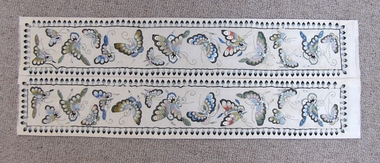 Embroiderers Guild, Victoria
Clothing - Pair of Chinese Embroidered Sleeve Bands, 19 th C
... Functionality: Women would fold their arms, often with their hands inside the sleeves, so the embroidered bands, which were sewn to hang down the back of the jacket, would be displayed prominently down the front. 19th century peak: The late 19th century was the peak of their popularity, with intricate designs becoming fashionable and even influenced by court tastes, such as those favoured by the Empress Dowager Cixi. ...Functionality: Women would fold their arms, often with their hands inside the sleeves, so the embroidered bands, which were sewn to hang down the back of the jacket, would be displayed prominently down the front. 19th century peak: The late 19th century was the peak of their popularity, with intricate designs becoming fashionable and even influenced by court tastes, such as those favoured by the Empress Dowager Cixi. ...Chinese sleeve embroidery bands, or wanxiu became popular in the late 19th century during the Qing Dynasty, evolving from the traditional Han cuff embroidery and Manchu styles. These detachable, decorated bands were added to women's informal jackets and robes, often featuring symbolic motifs like landscapes, flowers, and auspicious symbols. They served both a decorative function, displaying artistic skill and personal wishes, and a practical one by covering the sleeves when hands were folded at the waist. History and evolution: Origins: The practice of embroidering cuffs on robes existed during the previous Ming Dynasty for Han women, and this was adopted by the Manchu rulers who founded the Qing Dynasty. Qing Dynasty (1644-1911): The practice was popularized and elaborated upon during this era, with detachable bands becoming a fashionable element for informal wear. Symbolism: The embroidery included a complex visual vocabulary of wishes for a long life, many offspring, and a happy marriage, derived from nature, mythology, and classical literature. Functionality: Women would fold their arms, often with their hands inside the sleeves, so the embroidered bands, which were sewn to hang down the back of the jacket, would be displayed prominently down the front. 19th century peak: The late 19th century was the peak of their popularity, with intricate designs becoming fashionable and even influenced by court tastes, such as those favoured by the Empress Dowager Cixi. Later developments: The late 19th century saw the introduction of chemical 'aniline' dyes from Europe, leading to brighter, bolder colours in embroidery. Motifs and their Meanings: Auspicious symbols: Designs often included symbols for good fortune, wealth, and longevity. Natural imagery: Birds, flowers, and landscapes were common motifs that could represent natural beauty or convey specific symbolic meanings. Figurative scenes: Bands could also feature narrative scenes from classical stories or legends. The choice of motifs allowed women to express personal desires, cultural values, and aesthetic preferences, reflecting a more personal and informal style than official court attire.Pair of sleeve bands with embroidered butterflies worked in satin stitch. Ivory satin background and embroidered in silk thread silk embroidery, china, butterflies, sleeve band -
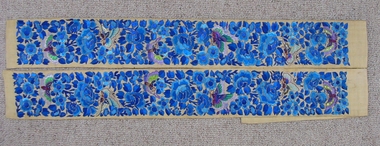 Embroiderers Guild, Victoria
Accessory - Pair of Chinese Sleeve Bands
... Functionality: Women would fold their arms, often with their hands inside the sleeves, so the embroidered bands, which were sewn to hang down the back of the jacket, would be displayed prominently down the front. 19th century peak: The late 19th century was the peak of their popularity, with intricate designs becoming fashionable and even influenced by court tastes, such as those favoured by the Empress Dowager Cixi. ...Functionality: Women would fold their arms, often with their hands inside the sleeves, so the embroidered bands, which were sewn to hang down the back of the jacket, would be displayed prominently down the front. 19th century peak: The late 19th century was the peak of their popularity, with intricate designs becoming fashionable and even influenced by court tastes, such as those favoured by the Empress Dowager Cixi. ...Butterfly is a symbol of happiness and conjugal bliss. Peonies - flowers of happiness. Chinese sleeve embroidery bands, or wanxiu became popular in the late 19th century during the Qing Dynasty, evolving from the traditional Han cuff embroidery and Manchu styles. These detachable, decorated bands were added to women's informal jackets and robes, often featuring symbolic motifs like landscapes, flowers, and auspicious symbols. They served both a decorative function, displaying artistic skill and personal wishes, and a practical one by covering the sleeves when hands were folded at the waist. History and evolution: Origins: The practice of embroidering cuffs on robes existed during the previous Ming Dynasty for Han women, and this was adopted by the Manchu rulers who founded the Qing Dynasty. Qing Dynasty (1644-1911): The practice was popularized and elaborated upon during this era, with detachable bands becoming a fashionable element for informal wear. Symbolism: The embroidery included a complex visual vocabulary of wishes for a long life, many offspring, and a happy marriage, derived from nature, mythology, and classical literature. Functionality: Women would fold their arms, often with their hands inside the sleeves, so the embroidered bands, which were sewn to hang down the back of the jacket, would be displayed prominently down the front. 19th century peak: The late 19th century was the peak of their popularity, with intricate designs becoming fashionable and even influenced by court tastes, such as those favoured by the Empress Dowager Cixi. Later developments: The late 19th century saw the introduction of chemical 'aniline' dyes from Europe, leading to brighter, bolder colours in embroidery. Motifs and their Meanings: Auspicious symbols: Designs often included symbols for good fortune, wealth, and longevity. Natural imagery: Birds, flowers, and landscapes were common motifs that could represent natural beauty or convey specific symbolic meanings. Figurative scenes: Bands could also feature narrative scenes from classical stories or legends. The choice of motifs allowed women to express personal desires, cultural values, and aesthetic preferences, reflecting a more personal and informal style than official court attire.Old gold satin embroidered with blue flowers and leaves in silks. Butterflies worked in mauve, green, blue, cream, burgundy and aquamarine.embroidery, garments, silk embroidery, china, oriental, butterflies, flowers -
 Embroiderers Guild, Victoria
Accessory - Sleeve Bands, Pre 1985
... Functionality: Women would fold their arms, often with their hands inside the sleeves, so the embroidered bands, which were sewn to hang down the back of the jacket, would be displayed prominently down the front. 19th century peak: The late 19th century was the peak of their popularity, with intricate designs becoming fashionable and even influenced by court tastes, such as those favoured by the Empress Dowager Cixi. ...Functionality: Women would fold their arms, often with their hands inside the sleeves, so the embroidered bands, which were sewn to hang down the back of the jacket, would be displayed prominently down the front. 19th century peak: The late 19th century was the peak of their popularity, with intricate designs becoming fashionable and even influenced by court tastes, such as those favoured by the Empress Dowager Cixi. ...Chinese sleeve embroidery bands, or wanxiu became popular in the late 19th century during the Qing Dynasty, evolving from the traditional Han cuff embroidery and Manchu styles. These detachable, decorated bands were added to women's informal jackets and robes, often featuring symbolic motifs like landscapes, flowers, and auspicious symbols. They served both a decorative function, displaying artistic skill and personal wishes, and a practical one by covering the sleeves when hands were folded at the waist. History and evolution: Origins: The practice of embroidering cuffs on robes existed during the previous Ming Dynasty for Han women, and this was adopted by the Manchu rulers who founded the Qing Dynasty. Qing Dynasty (1644-1911): The practice was popularized and elaborated upon during this era, with detachable bands becoming a fashionable element for informal wear. Symbolism: The embroidery included a complex visual vocabulary of wishes for a long life, many offspring, and a happy marriage, derived from nature, mythology, and classical literature. Functionality: Women would fold their arms, often with their hands inside the sleeves, so the embroidered bands, which were sewn to hang down the back of the jacket, would be displayed prominently down the front. 19th century peak: The late 19th century was the peak of their popularity, with intricate designs becoming fashionable and even influenced by court tastes, such as those favoured by the Empress Dowager Cixi. Later developments: The late 19th century saw the introduction of chemical 'aniline' dyes from Europe, leading to brighter, bolder colours in embroidery. Motifs and their Meanings: Auspicious symbols: Designs often included symbols for good fortune, wealth, and longevity. Natural imagery: Birds, flowers, and landscapes were common motifs that could represent natural beauty or convey specific symbolic meanings. Figurative scenes: Bands could also feature narrative scenes from classical stories or legends. The choice of motifs allowed women to express personal desires, cultural values, and aesthetic preferences, reflecting a more personal and informal style than official court attire.Two sleeve bands. Embroidered in coloured silk and gold metal thread. Motifs of lotus flowers, birds, swastikas and other flowers. Mostly satin stitch.embroidery, silk embroidery, japan, oriental, sleeve bands, garments -
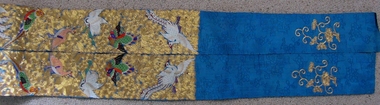 Embroiderers Guild, Victoria
Accessory - Sleeve Bands, Pre 1985
... Functionality: Women would fold their arms, often with their hands inside the sleeves, so the embroidered bands, which were sewn to hang down the back of the jacket, would be displayed prominently down the front. 19th century peak: The late 19th century was the peak of their popularity, with intricate designs becoming fashionable and even influenced by court tastes, such as those favoured by the Empress Dowager Cixi. ...Functionality: Women would fold their arms, often with their hands inside the sleeves, so the embroidered bands, which were sewn to hang down the back of the jacket, would be displayed prominently down the front. 19th century peak: The late 19th century was the peak of their popularity, with intricate designs becoming fashionable and even influenced by court tastes, such as those favoured by the Empress Dowager Cixi. ...Chinese sleeve embroidery bands, or wanxiu became popular in the late 19th century during the Qing Dynasty, evolving from the traditional Han cuff embroidery and Manchu styles. These detachable, decorated bands were added to women's informal jackets and robes, often featuring symbolic motifs like landscapes, flowers, and auspicious symbols. They served both a decorative function, displaying artistic skill and personal wishes, and a practical one by covering the sleeves when hands were folded at the waist. History and evolution: Origins: The practice of embroidering cuffs on robes existed during the previous Ming Dynasty for Han women, and this was adopted by the Manchu rulers who founded the Qing Dynasty. Qing Dynasty (1644-1911): The practice was popularized and elaborated upon during this era, with detachable bands becoming a fashionable element for informal wear. Symbolism: The embroidery included a complex visual vocabulary of wishes for a long life, many offspring, and a happy marriage, derived from nature, mythology, and classical literature. Functionality: Women would fold their arms, often with their hands inside the sleeves, so the embroidered bands, which were sewn to hang down the back of the jacket, would be displayed prominently down the front. 19th century peak: The late 19th century was the peak of their popularity, with intricate designs becoming fashionable and even influenced by court tastes, such as those favoured by the Empress Dowager Cixi. Later developments: The late 19th century saw the introduction of chemical 'aniline' dyes from Europe, leading to brighter, bolder colours in embroidery. Motifs and their Meanings: Auspicious symbols: Designs often included symbols for good fortune, wealth, and longevity. Natural imagery: Birds, flowers, and landscapes were common motifs that could represent natural beauty or convey specific symbolic meanings. Figurative scenes: Bands could also feature narrative scenes from classical stories or legends. The choice of motifs allowed women to express personal desires, cultural values, and aesthetic preferences, reflecting a more personal and informal style than official court attire.Pair of rich blue silk (figured) bands, 66 cm of which is heavily embroidered in couched gold metal threads in a swirling pattern, with coloured silk birds (18). There is a gold spray (floral) at the base of each band.embroidery, garments, silk embroidery, metal thread, chinese -
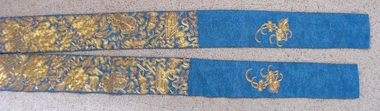 Embroiderers Guild, Victoria
Accessory - Chinese Sleeve Bands
... Functionality: Women would fold their arms, often with their hands inside the sleeves, so the embroidered bands, which were sewn to hang down the back of the jacket, would be displayed prominently down the front. 19th century peak: The late 19th century was the peak of their popularity, with intricate designs becoming fashionable and even influenced by court tastes, such as those favoured by the Empress Dowager Cixi. ...Functionality: Women would fold their arms, often with their hands inside the sleeves, so the embroidered bands, which were sewn to hang down the back of the jacket, would be displayed prominently down the front. 19th century peak: The late 19th century was the peak of their popularity, with intricate designs becoming fashionable and even influenced by court tastes, such as those favoured by the Empress Dowager Cixi. ...Purchased in Singapore circa 1920 and believed to be old then. Never been worn. Chinese sleeve embroidery bands, or wanxiu became popular in the late 19th century during the Qing Dynasty, evolving from the traditional Han cuff embroidery and Manchu styles. These detachable, decorated bands were added to women's informal jackets and robes, often featuring symbolic motifs like landscapes, flowers, and auspicious symbols. They served both a decorative function, displaying artistic skill and personal wishes, and a practical one by covering the sleeves when hands were folded at the waist. History and evolution: Origins: The practice of embroidering cuffs on robes existed during the previous Ming Dynasty for Han women, and this was adopted by the Manchu rulers who founded the Qing Dynasty. Qing Dynasty (1644-1911): The practice was popularized and elaborated upon during this era, with detachable bands becoming a fashionable element for informal wear. Symbolism: The embroidery included a complex visual vocabulary of wishes for a long life, many offspring, and a happy marriage, derived from nature, mythology, and classical literature. Functionality: Women would fold their arms, often with their hands inside the sleeves, so the embroidered bands, which were sewn to hang down the back of the jacket, would be displayed prominently down the front. 19th century peak: The late 19th century was the peak of their popularity, with intricate designs becoming fashionable and even influenced by court tastes, such as those favoured by the Empress Dowager Cixi. Later developments: The late 19th century saw the introduction of chemical 'aniline' dyes from Europe, leading to brighter, bolder colours in embroidery. Motifs and their Meanings: Auspicious symbols: Designs often included symbols for good fortune, wealth, and longevity. Natural imagery: Birds, flowers, and landscapes were common motifs that could represent natural beauty or convey specific symbolic meanings. Figurative scenes: Bands could also feature narrative scenes from classical stories or legends. The choice of motifs allowed women to express personal desires, cultural values, and aesthetic preferences, reflecting a more personal and informal style than official court attire.A pair of sleeve bands. Embroidered in gold metallic thread on blue silk fabric in a pattern of peonies, bats and other auspicious symbols.embroidery, metal thread, embroidery, garments, japan
