
Showing 21 items matching "eye care"
-
 Greensborough Historical Society
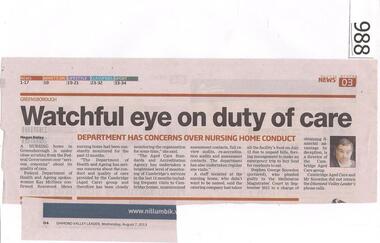
Newspaper Clipping, Diamond Valley Leader, Watchful eye on duty of care, 07/08/2013
... Watchful eye on duty of care....The Department of Health and Ageing has concerns over the quality of care provided by Cambridge Aged Care and has undertaken regular site visits. nursing homes cambridge aged care News article; text and image. Watchful eye on duty of care. ...The Department of Health and Ageing has concerns over the quality of care provided by Cambridge Aged Care and has undertaken regular site visits.News article; text and image.nursing homes, cambridge aged care -
 Flagstaff Hill Maritime Museum and Village
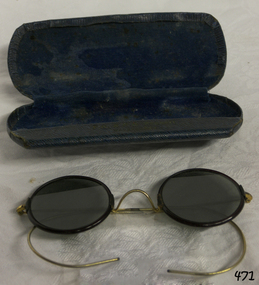
Functional object - Spectacles and case, Fred and Geoff Bennett (F.T. and P.G. Bennett), mid-29th century
... ...eye care...Bennett Warrnambool eye care magnifiers reading glasses fred and geoff bennett personal effects "F.G. & P.G. ...This pair of spectacles was prescribed and made in Warrnambool by brothers Fred and Geoff Bennet from about 1946 when they established their optometrist business at 192 Liebig Street Warrnambool. The business moved to 152 Liebig Street in 1988, by which time it had already changed hands to become McMahon and Owen Optometrists. Jayson Ward and Mathew Bucks purchased the business in 2012, then changed the name to Warrnambool Eyecare in 2016. They also own and practice at Portland Eyecare.This pair of glasses is significant as an example of locally owned and manufacture red eyewear from the mid 290th century. Spectacles, Pince-nez with oval shaped tinted lenses, metal bridge and rubber nose pads. Hard surfaced blue velvet lined spectacle case. Inscription on case. Made by F.G. & P..G. Bennett in Warrnambool."F.G. & P.G. Bennett Warrnambool"flagstaff hill, warrnambool, shipwrecked-coast, flagstaff-hill, flagstaff-hill-maritime-museum, maritime-museum, shipwreck-coast, flagstaff-hill-maritime-village, pince-nez, glasses, eyewear, seeing aids, vision, optician, f.g. & p.g. bennett warrnambool, eye care, magnifiers, reading glasses, fred and geoff bennett, personal effects -
 Sunshine and District Historical Society Incorporated
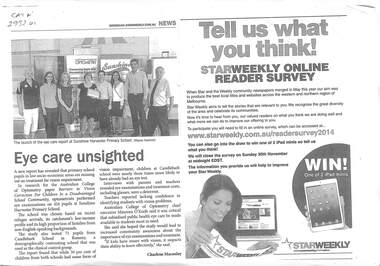
Archive - Sunshine Harvester Primary School School
... 2932.01 - Sunshine Harvester School Eye Care Program with photo of Princlipal Alan Dash (Right)|2932.02 - Australia College of Optometry Barriers To Vision Correction For Children|2932.03 - Information Brochure 2013...Sunshine Harvester Primary School Primary School Hertford Road Sunshine 2932.01 - Sunshine Harvester School Eye Care Program with photo of Princlipal Alan Dash (Right)|2932.02 - Australia College of Optometry Barriers To Vision Correction For Children|2932.03 - Information Brochure 2013 Collection of documents on the Sunshine Harvester Primary School Archive Sunshine Harvester Primary School School ...2932.01 - Sunshine Harvester School Eye Care Program with photo of Princlipal Alan Dash (Right)|2932.02 - Australia College of Optometry Barriers To Vision Correction For Children|2932.03 - Information Brochure 2013sunshine harvester primary school, primary school, hertford road, sunshine -
 Melbourne Tram Museum
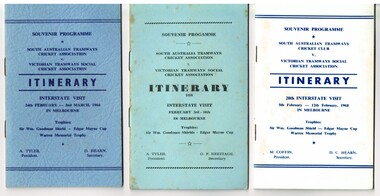
Document - Event Materials, Victorian Tramways Social Cricket Association, "Souvenir Programme - Itinerary", 1958 to 1968
... Inside covers have space for autographs. .1 - 8 pages inside a blue card cover, Feb. 3-10 - 1958 - has adverts for Carlton United beers (Victoria, Melbourne, Fosters and Abbots) and Coles & Garrard eye care. .2 - 8 pages inside a dark blue stippled cover, 24/2 to 2/3 1964 - with ads for Coles and Garrard eye care and the Three Crowns North Melbourne hotel. .3 - 8 pages inside a semi gloss off white card cover, 5/2 to 12/2/ 1968, with ads for Coles and Garrard eye care....Inside covers have space for autographs. .1 - 8 pages inside a blue card cover, Feb. 3-10 - 1958 - has adverts for Carlton United beers (Victoria, Melbourne, Fosters and Abbots) and Coles & Garrard eye care. .2 - 8 pages inside a dark blue stippled cover, 24/2 to 2/3 1964 - with ads for Coles and Garrard eye care and the Three Crowns North Melbourne hotel. .3 - 8 pages inside a semi gloss off white card cover, 5/2 to 12/2/ 1968, with ads for Coles and Garrard eye care. ...Set of three Souvenir Programmes for the Victorian Tramways Social Cricket Association v the South Australian Tramways Club for the 1958, 1964 and 1968 visits. Lists the Members / Committee of the MMTB, ATMOEA, officials of the VTSCA, the itinerary, results of previous matches played and teams. Centre stapled. Inside covers have space for autographs. .1 - 8 pages inside a blue card cover, Feb. 3-10 - 1958 - has adverts for Carlton United beers (Victoria, Melbourne, Fosters and Abbots) and Coles & Garrard eye care. .2 - 8 pages inside a dark blue stippled cover, 24/2 to 2/3 1964 - with ads for Coles and Garrard eye care and the Three Crowns North Melbourne hotel. .3 - 8 pages inside a semi gloss off white card cover, 5/2 to 12/2/ 1968, with ads for Coles and Garrard eye care.trams, tramways, cricket, sports, social club -
 Marysville & District Historical Society
THE TRIANGLE NEWS-VOL 5 NO 15-MAY 30 1980
... care centre...lost teddy bear...position wanted...church of england...eye...marysville victoria australia for sale pigeons marysville primary school thank you senior citizens engagement think it over auction keep fit classes indoor bowls narbethong pub fire brigade birthday greetings m.i.w.a.p.s.a. el kanah christian fellowship for sale community care centre lost teddy bear position wanted church of england eye tests footy news attention ratepayers THE TRIANGLE NEWS-VOL 5 NO 15-MAY 30 1980 ...marysville, victoria, australia, for sale pigeons, marysville primary school, thank you, senior citizens, engagement, think it over, auction, keep fit classes, indoor bowls, narbethong pub, fire brigade, birthday greetings, m.i.w.a.p.s.a., el kanah christian fellowship, for sale, community care centre, lost teddy bear, position wanted, church of england, eye tests, footy news, attention ratepayers -
 The Cyril Kett Optometry Museum
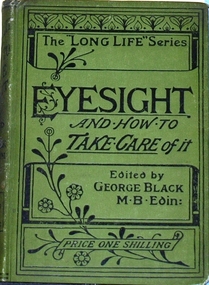
Book, Eyesight and how to take care of it, 1888 (estimated)
... eye eyesight eyecare Signature of J B Shattock on half title page. Small hardback book in original printed green cloth covers, 139 pages and 21 figures with 20 pages of book advertisements. The decorative Art Nouveau cover is visually attractive. It is a late nineteenth century guide to eyecare for the intelligent lay-reader. It was priced at one shilling. Eyesight and how to take care ...This book is a guide to eyecare for the intelligent lay-reader, not so different from books still published today. It appeared in a number of editions until about 1900. This one is edited by George Black MB(Edin) as part of the Long Life Series. As this book is a guide to eyecare for the lay-reader it is socially significant. It is not rare, but being somewhat ephemeral it would not be expected to see copies of this book surviving in the very good condition of our copy. No other copies are listed on WorlCat for Australia.Small hardback book in original printed green cloth covers, 139 pages and 21 figures with 20 pages of book advertisements. The decorative Art Nouveau cover is visually attractive. It is a late nineteenth century guide to eyecare for the intelligent lay-reader. It was priced at one shilling.Signature of J B Shattock on half title page.ophthalmology, eye, eyesight, eyecare -
 Flagstaff Hill Maritime Museum and Village
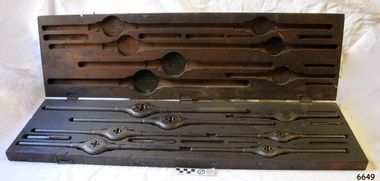
Tool - Taps and Dies set, Wiley and Russell Mfg. Co, C. 1884
... eye fittings. This set of Whitworth standard threads has metal die and stocks (seven), and taps (three - the case has provision for four more die). The manufacturer’s details and the sizes of the threads are impressed into the tools. The paper labels have instructions and a diagram for the use and care...eye fittings. This set of Whitworth standard threads has metal die and stocks (seven), and taps (three - the case has provision for four more die). The manufacturer’s details and the sizes of the threads are impressed into the tools. The paper labels have instructions and a diagram for the use and care ...This set of taps and dies tools was owned by Frederick William McDowell (Fred) (1880 to 15-6-1967). He was a wheelwright by trade. He made and repaired vehicles such gigs, buggies, jinkers, sulkeys, spring carts and farm wagons. His workshop was on the corner of Cramer Street and Raglan Parade in Warrnambool., previously the site of Fotheringhams, and after McDowell's, and still in 2023, occupied by Reece Plumbing Fred's workplace prior to retiring was at Bryant & Waterson's in Kepler Street, opposite the Criterian Hotel, making rubber tyred horse-driven farm wagons. This Wiley and Russell hand operated, thread cutting Die and Stock, or Die and Tap, set’s patent carries the description “The taper-headed screws adjust the size; the four side screws hold the cutters firmly in the holder. Marketed as the Wiley & Russell LIGHTNING SCREW PLATE. The taper-headed screws are carried over from the J.J. Grant October 21, 1871 patent (no. 120,266). This patent was improved by Smart's Oct. 21, 1884 patent (no. 306,783).” Dies are used to cut external screw thread, stocks are the tools that hold the dies in place with countersunk adjustable screws, and taps are the tools that make the internal threads. The tools would be used by farriers, blacksmiths, wheelwrights sailing and steam ship engineers for making new, or repairing old, threads in metal. WILEY AND RUSSELL Manufacturing Company The company Wiley and Russell was established in 1872 by Solon Wiley and Charles P Russell, whose uncle founded the J. Russell Cutlery Co. The company began with the purpose of manufacturing thread cutting tools in Green River U.S. This tap and die set is an example of tools used by blacksmiths, farriers, wheelwrights and engineers on sailing and steam ships. It is also an example of early U.S. made engineering tools.Tap, Die, Die Stock set of industrial tools, fitted inside original timber box with three instruction labels attached inside lid. The set is the “Wiley and Russell LIGHTNING SCREW PLATE Pat. Aug. 5, 1884”. The lid has three metal hinges and is secured by two metal hook and eye fittings. This set of Whitworth standard threads has metal die and stocks (seven), and taps (three - the case has provision for four more die). The manufacturer’s details and the sizes of the threads are impressed into the tools. The paper labels have instructions and a diagram for the use and care of the tools. Tools have a protective oil coating. Made by Wiley and Russell Manufacturing Co. of Greenfield, Massachusetts, U.S., c. 1884; the tools were patented in August 1884, U.S. Patent 303,060. “Wiley & Russell MFG.CO, Greenfield, Mass, Pat Aug 5 1884.” “WHIT. STD.”flagstaff hill, warrnambool, shipwrecked coast, flagstaff hill maritime museum, maritime museum, shipwreck coast, flagstaff hill maritime village, great ocean road, tap and die set, 1884 engineering tools, wiley and russell mfg co, lightning tap and die set, tap, die and stock set, screw thread cutting tools, taps and dies, stocks and dies, lightning screw plate, cutters, j.j. grant, patent no. 120266, solon wiley and charles p russell, wiley and russell, j. russell cutlery co, green river u.s, whitworth thread, fred mcdowell, frederick mcdowell, wheelwright, gig, buggy, jinker, sulkey, spring cart, farm wagon, 2-wheeled cart, horse cart, horse cart parts, jinker buggy, transport, vehicle, horse drawn, horse jinker, bryant & waterson -
 Warrnambool RSL Sub Branch
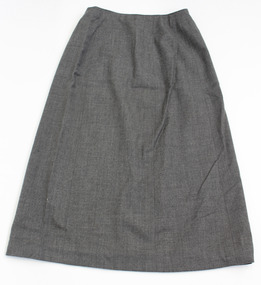
Skirt; Army Nurses Uniform, 1940-1942
... care and compassion to the servicemen who were wounded and sick. The nurses uniform is symbolic of the sacrifice and service of the many women who served their country in WW2. Grey A line skirt, bak fastening. Five press stud fasteners and two hook and eye ...This Skirt is part of the uniform worn by Sister Winifred Ride during World War 2. Nurses played a key role in the conflict through their care and compassion to the servicemen who were wounded and sick.The nurses uniform is symbolic of the sacrifice and service of the many women who served their country in WW2. Grey A line skirt, bak fastening. Five press stud fasteners and two hook and eye fasteners. One fabric hook on each side for hanging. -
 Royal Australian and New Zealand College of Obstetricians & Gynaecologists (RANZCOG)
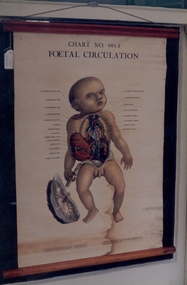
Foetal circulation chart associated with St George's Hospital, Kew, Adam, Rouilly and Co, c1947
... care A chart depicting foetal circulation in an infant male. The chart is made of paper with cloth backing and is supported by wooden hanging bars at top and bottom. Blue and wdhite hanging string is secured at the top with metal eye ...This chart was used in the antenatal classes and labour ward of St Georges Hospital, Kew. The original drawings for the chart by WJ Pardoe were made under the supervision of Assistant Professor CFV Smout, Department of Anatomy, Birmingham University 1945.A chart depicting foetal circulation in an infant male. The chart is made of paper with cloth backing and is supported by wooden hanging bars at top and bottom. Blue and wdhite hanging string is secured at the top with metal eye hooks. The char is secured at the top with metal tacks and there is a cotton tape to secure it when rolled. infant care -
 Bendigo Historical Society Inc.
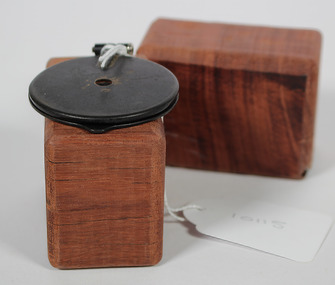
Instrument - Ophthalmoscope (or funduscope)
... eye drops (dilated fundus examination). However, undilated examination is more convenient (albeit not as comprehensive), and is the most common type in primary care. ...eye drops (dilated fundus examination). However, undilated examination is more convenient (albeit not as comprehensive), and is the most common type in primary care. ...Ophthalmoscopy, also called funduscopy, is a test that allows a health professional to see inside the fundus of the eye and other structures using an ophthalmoscope (or funduscope). It is done as part of an eye examination and may be done as part of a routine physical examination. It is crucial in determining the health of the retina, optic disc, and vitreous humor. The pupil is a hole through which the eye's interior can be viewed. For better viewing, the pupil can be opened wider (dilated; mydriasis) before ophthalmoscopy using medicated eye drops (dilated fundus examination). However, undilated examination is more convenient (albeit not as comprehensive), and is the most common type in primary care. The Photoscope, or Mirror. Many varieties of the photoscope are in use. .... Some prefer a mirror with a small, folding, protecting handle, or two mirrors, so made that one may serve for the handle while the other is in use. These are easily carried in the pocket, ... If the mirror is perforated in the center, the light rays pass freely to the examiner's eye, but the edge of the perforation, unless perfectly blackened and free from chipping, causes very annoying reflections.Round circular black compact hinged - When opened has mirror with hole in it on one side and black lid/cover on the other - Small lip on top cover. ophthalmoscope, fundoscope, eye testing -
 National Vietnam Veterans Museum (NVVM)
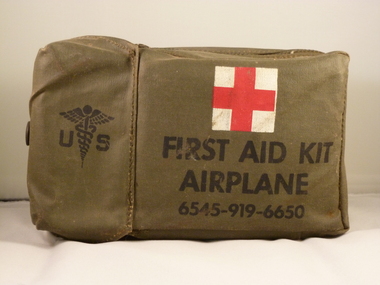
Equipment - Equipment, Army, United States First Aid Kit Airplane, 1963-1970
... Medical Vietnam War 1961-1975 - Medical care Kit First Aid United States US with Medic Logo First Aid Kit for use in aeroplane - Part number 6545-919-6650. Case contains:- First Aid field dressing; Petrolatum Gauze; Gauze Compress; Eye Dressing; Tourniquet; Razor blades; Adhesive Bandage; Dyed Sterilised dressing; Benzalkonium Chloride Tincture; Water Purification Tablets United States First Aid Kit Airplane. ...First Aid Kit for use in aeroplane - Part number 6545-919-6650. Case contains:- First Aid field dressing; Petrolatum Gauze; Gauze Compress; Eye Dressing; Tourniquet; Razor blades; Adhesive Bandage; Dyed Sterilised dressing; Benzalkonium Chloride Tincture; Water Purification TabletsUS with Medic Logomedical, vietnam war, 1961-1975 - medical care, kit, first aid, united states -
Vision Australia
Film - Video recording, Leading the Way: Child Care & Family Day Care Staff, 23/5/1991
... eye problems in young children, including testing advice. Royal Victorian Institute for the Blind Education John Blackman Hector Maclean RVIB Leading the Way - Child Care & Family Day Care Staff 23/5/91 1 colour moving picture recording with sound Leading the Way: Child Care & Family Day Care Staff Film Video recording ...Discussion of early indicators of eye problems in young children, including testing advice.1 colour moving picture recording with soundRVIB Leading the Way - Child Care & Family Day Care Staff 23/5/91royal victorian institute for the blind, education, john blackman, hector maclean -
 Vision Australia
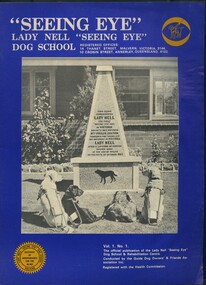
Administrative record - Text, "Seeing Eye" - Lady Nell "Seeing Eye" Dog School & Rehabilitation Centre for the Blind, Vol. 1, No. 1, 1979
... Annual newsletter from Lady Nell Seeing Eye Dog School featuring: the response to a student asking for assignment help on providing rehabilitation to a newly blinded male, overview of the school from it's beginning in Wonga Park to the transfer to Malvern and later extending to accommodation in Grace Street Malvern and Leopold Street Glen Iris, the proposed guest house opening in Wattletree Road, a description of Swish, Peter Walsh and Dr Frank Spence joining the committee, thanks to Dr Rowan Blogg and Dr John Stirling, 17 people were trained with dogs during this financial year, a profile of Harry Vanderjagt, facts about Lady Nell Seeing Eye Dog School, the need for more carers and volunteer drivers and an article on sculptor Michael Naranjo....Annual newsletter from Lady Nell Seeing Eye Dog School featuring: the response to a student asking for assignment help on providing rehabilitation to a newly blinded male, overview of the school from it's beginning in Wonga Park to the transfer to Malvern and later extending to accommodation in Grace Street Malvern and Leopold Street Glen Iris, the proposed guest house opening in Wattletree Road, a description of Swish, Peter Walsh and Dr Frank Spence joining the committee, thanks to Dr Rowan Blogg and Dr John Stirling, 17 people were trained with dogs during this financial year, a profile of Harry Vanderjagt, facts about Lady Nell Seeing Eye Dog School, the need for more carers and volunteer drivers and an article on sculptor Michael Naranjo. ...Annual newsletter from Lady Nell Seeing Eye Dog School featuring: the response to a student asking for assignment help on providing rehabilitation to a newly blinded male, overview of the school from it's beginning in Wonga Park to the transfer to Malvern and later extending to accommodation in Grace Street Malvern and Leopold Street Glen Iris, the proposed guest house opening in Wattletree Road, a description of Swish, Peter Walsh and Dr Frank Spence joining the committee, thanks to Dr Rowan Blogg and Dr John Stirling, 17 people were trained with dogs during this financial year, a profile of Harry Vanderjagt, facts about Lady Nell Seeing Eye Dog School, the need for more carers and volunteer drivers and an article on sculptor Michael Naranjo.1 volume with text and illustrationsannual reports, lady nell seeing eye dog school, phyllis gration, harry vanderjagt, peter walsh, dr rowan blogg, dr john stirling, michael narajo, dr frank spence -
 Vision Australia
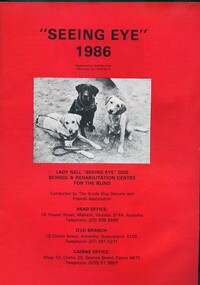
Administrative record - Text, "Seeing Eye" 1986 Lady Nell "Seeing Eye" Dog School & Rehabilitation Centre for the Blind, 1986
... Eye Dog School being located in a residential area and subsequent legal objections, the assistance of Alf Krummel in providing pedigreed puppies for training, the opening of a shop and welfare centre in Cairns (?), the need for more volunteers and the huge contribution made by Alec and Barbara Peach, three people were brought down from Cairns for rehabilitation training, the passing of volunteer Jane Orrell and Elizabeth Jackson as well as secretary of the Lady Nell Stawell and District Auxiliary Margaret Meagher, thanks to Dr Rowan Blogg and Dr John Stirling for the continued care of the dogs, and a press release and copies of letters on the background and actions taken with Peter Filgate and his seeing eye dog Sheba....Eye Dog School being located in a residential area and subsequent legal objections, the assistance of Alf Krummel in providing pedigreed puppies for training, the opening of a shop and welfare centre in Cairns (?), the need for more volunteers and the huge contribution made by Alec and Barbara Peach, three people were brought down from Cairns for rehabilitation training, the passing of volunteer Jane Orrell and Elizabeth Jackson as well as secretary of the Lady Nell Stawell and District Auxiliary Margaret Meagher, thanks to Dr Rowan Blogg and Dr John Stirling for the continued care of the dogs, and a press release and copies of letters on the background and actions taken with Peter Filgate and his seeing eye dog Sheba. ...President's overview of the year including: the objections of residents to the Seeing Eye Dog School being located in a residential area and subsequent legal objections, the assistance of Alf Krummel in providing pedigreed puppies for training, the opening of a shop and welfare centre in Cairns (?), the need for more volunteers and the huge contribution made by Alec and Barbara Peach, three people were brought down from Cairns for rehabilitation training, the passing of volunteer Jane Orrell and Elizabeth Jackson as well as secretary of the Lady Nell Stawell and District Auxiliary Margaret Meagher, thanks to Dr Rowan Blogg and Dr John Stirling for the continued care of the dogs, and a press release and copies of letters on the background and actions taken with Peter Filgate and his seeing eye dog Sheba.1 volume with text and illustrationsannual reports, lady nell seeing eye dog school, phyllis gration, alf krummel, alec peach, barbara peach, margaret meagher, dr rowan blogg, dr john stirling, jane orrell, elizabeth jackson, peter filgate -
Canterbury History Group
Book, Hutchinson, John, Reminiscences of St. John's Home for Boys
... Canterbury Balwyn Road St Johns Home for Boys and Girls Child Care Anglican Church Anglicare Victoria Hutchinson> John Dann> Robert> Archbishop Thornton> Eric> Rev. Molloy> Neale> Canon Eyers> Laurence> Father Shrublands Children's Services A history of the St John's Home for Boys with contributions from the children and staff. ...A history of the St John's Home for Boys with contributions from the children and staff.Includes many black and white photographs.A history of the St John's Home for Boys with contributions from the children and staff. canterbury, balwyn road, st johns home for boys and girls, child care, anglican church, anglicare victoria, hutchinson> john, dann> robert> archbishop, thornton> eric> rev., molloy> neale> canon, eyers> laurence> father, shrublands, children's services -
 Old Castlemaine Schoolboys Association Inc.
Poem, The Castlemaine Old Schoolboys' Annual Reunion
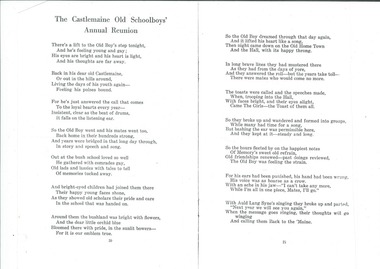
... And bright eyed children had joined them in there happy young faces shone, as they showed old scholars are pride and care in the school that was handed on. ...And bright eyed children had joined them in there happy young faces shone, as they showed old scholars are pride and care in the school that was handed on. ...Written by George E Scott who was born in Creswick March 1900. Moved to Vaughan in 1904. Attended Yapeen State School utill 1913 then to Castlemaine high school and technical schools. Poem written in 1950s.There is a lift to the old boys step tonight, and is feeling young and gay his eyes are bright and his heart is light, and his thoughts are far away. Back in his dear old Castlemaine, or out in the hills around living the days of his youth again feeling his pulses bound. For he's just answered the call that comes to the loyal hearts every year insistent, clear as the beating of drums it falls on the listening ear so the old boy went and his mates went to back home in their hundreds strong and years were bridged in at long day through in story and speech and song. At at the Bush school love so well he gathered with his comrades gay, old Lads and Lassie's with tales to tell of memories tucked away. And bright eyed children had joined them in there happy young faces shone, as they showed old scholars are pride and care in the school that was handed on. Around them the bushland was bright with flowers, and the dear little orchid blue Bloom there with bright, in the sunlit bowers- for it is our emblem true. So the old boy drained through that day again, and it lifted his heart like a song, then Knight came down on the old home town and the hall, with its happy throng. In long brave lines they had mustered there as they had on the days of yore, and as they answered the roll - but the years take toll- there were mates who would come no more. The toast called, and the speeches made, when, trooping into the hall, with faces bright, and their eyes alight, came the girls- the toast of them all. So they broke up and wandered and formed into groups, while many have time for a song, But bashing the ear was permissible here, and they kept at it- steady and long. So the hours flitted by happiest notes of memories sweet old refrain, old friendships renewed - past doing's reviewed, the old boy was feeling strain. For his ears had been punished, his hand had been wrung, his voice was hoarse as a crow, with an ache in his jaw- "I can't take any more, while I'm all in one piece, mates, I'll go." With Auld lang syne is singing a broke up and parted, "next year we will see you again" when the message goes ringing, their thoughts will go winging and calling them back to 'Mainepoem, yapeen -
 Northern District School of Nursing. Managed by Bendigo Historical Society Inc.
Book - Northern District School of Nursing Graduates Association - Lectures in Diseases of the Eye, Revised 1968
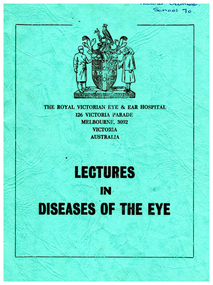
... Outlines examination techniques for various eye structures.Provides tests for retinal function and assessment of binocular vision.Injuries and Surgical CareDiscusses types of eye injuries, including contusions, penetrating wounds, and burns. Details pre-operative, operative, and post-operative care for intra-ocular operations. ...Outlines examination techniques for various eye structures.Provides tests for retinal function and assessment of binocular vision.Injuries and Surgical CareDiscusses types of eye injuries, including contusions, penetrating wounds, and burns. Details pre-operative, operative, and post-operative care for intra-ocular operations. ...The Northern District School of Nursing in Victoria, Australia Graduates Association: History of the School Managed by a committee including hospital administrators, medical professionals, and nursing leaders from several regional hospitals. Associated with major hospitals in the Northern District, including Bendigo Base, Mildura Base, Castlemaine, Echuca, Swan Hill, St. Arnaud, and Kyneton District Hospitals. Provide high-quality theoretical and practical nursing training. Raise the standard of nursing education in the region. Maintain the highest principles of nursing practice. Applicants must be at least 17 years old and hold a Proficiency Certificate or higher educational qualification. Application involves submitting forms, certificates, an interview, an aptitude test, and a medical examination. A three-month probationary period follows initial acceptance. Preliminary Training School: Four-week introductory course covering basic nursing, anatomy, hygiene, and practical skills. Practical experience in various hospital departments, guided by senior staff. Study Block Plan: Includes several blocks of theoretical and practical instruction throughout the three-year program. Regular school exams and two state exams (First Professional and Final State) are required for progression and graduation. Nurses work a 40-hour week with at least one or two days off per week and three weeks of annual leave. Accommodation is provided in comfortable hostels with good facilities. Uniforms are supplied free; nurses provide their own shoes and stockings. Salaries and allowances are regulated, with deductions for board and free medical care. Additional Information Post-Graduate Opportunities. Senior positions require further experience and additional certificates (e.g., Midwifery, Infant Welfare).Diploma courses available in administration, teaching, and specialized nursing fields. Bursaries are available for advanced study.Career Prospects: Graduates can pursue roles in administration, teaching, ward and departmental leadership, district and visiting nursing, industrial and school nursing, and more. Opportunities existed both within hospitals and in community or specialized settings.FAQs and Practical Details. Minimal training costs (mainly exam fees and personal items).Living out allowances and travel expenses are covered. Four training intakes per year; waiting periods are short if qualifications are met.Northern District School of Nursing Graduates Association - Lectures in Diseases of the Eye Revised 1968 39 pages, owned by Heather Gamble School 70 This item contains the following documents: 3793.1a Lectures in Diseases of the Eye Revised 1968 3793.1b Front Cover and Contents Page This document is a comprehensive educational guide for nurses at The Royal Victorian Eye and Ear Hospital, focusing on eye anatomy, diseases, examination techniques, and ophthalmic nursing practices. Detailed coverage of the orbit, eyeball, fibrous coat, uvea, retina, lids, lacrimal apparatus, and conjunctiva. Explains the function of extra-ocular muscles and the mechanics of vision. Describes diseases affecting the orbit, cornea, sclera, uvea, retina, lids, lacrimal apparatus, and conjunctiva. Covers errors in the optical properties of the eye and their corrections.Includes information on glaucoma and diseases of the crystalline lens. Outlines examination techniques for various eye structures.Provides tests for retinal function and assessment of binocular vision.Injuries and Surgical CareDiscusses types of eye injuries, including contusions, penetrating wounds, and burns. Details pre-operative, operative, and post-operative care for intra-ocular operations. Offers guidance on ophthalmic nursing techniques.Lists pharmaceuticals, accessories, instruments, and equipment used in eye surgery.nurse training, lister house, lectures in disease of the eye -
 Vision Australia
Functional object - Object, Bartel, Seeing Eye Dogs 2004: the calendar, 2003
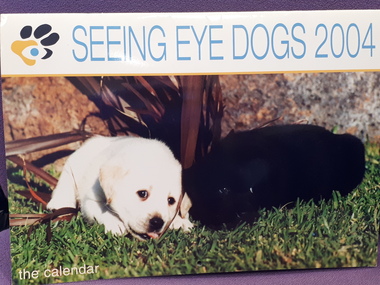
... care for one. That's why you can sponsor an adorable pup for as little as .50c a day. All contributions are tax deductible, so giving couldn't be easier. Simply call 1800Puppys (1800 787 797)". Common household items were often created to raise money for SEDA and to reinforce the work involved in training dogs from puppy to adult stage. Seeing Eye ...a13 month calendar featuring photos of Labrador puppies each month with the wording 'Did you know you can sponsor me or one of my friends? Simply call 1800 787 797'. Calendar has part of the monthly image reprinted on un-used days, and a monthly wall planner inserted in the middle of the calendar. On the back of the calendar, all images are featured as well as a final appeal from the organisation. "Love without the leash. 1800 Puppys - As irresistible as our puppies are, not everyone can care for one. That's why you can sponsor an adorable pup for as little as .50c a day. All contributions are tax deductible, so giving couldn't be easier. Simply call 1800Puppys (1800 787 797)". Common household items were often created to raise money for SEDA and to reinforce the work involved in training dogs from puppy to adult stage.Paper calendar with coloured photographsseeing eye dogs australia, fundraising -
 Melbourne Legacy
Photograph - Photo, Legatee Doc Sarjeant and a Junior, 1954
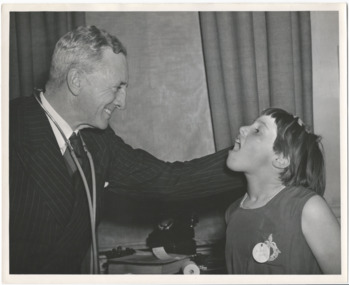
... care free of charge. When size of the demand was realised Melbourne Legacy opened a dental clinic. For many years the dental clinic was run out of Legacy House in Swanston St. The photo appeared in the July 1954 edition of the Legacy Newsletter with the caption "Legatee Doc Sargeant examines a Junior." The accompanying article say that girls joining Legacy are given a medical examination free of charge. A doctor is in attendance on Friday nights when the girls have classes and he may be consulted whenever necessary. Legacy has as it's disposal a large number of specialists . Eye...care free of charge. When size of the demand was realised Melbourne Legacy opened a dental clinic. For many years the dental clinic was run out of Legacy House in Swanston St. The photo appeared in the July 1954 edition of the Legacy Newsletter with the caption "Legatee Doc Sargeant examines a Junior." The accompanying article say that girls joining Legacy are given a medical examination free of charge. A doctor is in attendance on Friday nights when the girls have classes and he may be consulted whenever necessary. Legacy has as it's disposal a large number of specialists . Eye ...A photo of Legatee Doc Sargeant with a stethoscope looking at a junior legatee in 1954. The girl's badge says her name is Robyn Leggo. Melbourne Legacy began proving medical and dental care for junior legatees in the 1930s. At first Legatees who were professional doctors and dentists provided care free of charge. When size of the demand was realised Melbourne Legacy opened a dental clinic. For many years the dental clinic was run out of Legacy House in Swanston St. The photo appeared in the July 1954 edition of the Legacy Newsletter with the caption "Legatee Doc Sargeant examines a Junior." The accompanying article say that girls joining Legacy are given a medical examination free of charge. A doctor is in attendance on Friday nights when the girls have classes and he may be consulted whenever necessary. Legacy has as it's disposal a large number of specialists . Eye examinations and chest X-rays are carried out each year and Mantoux tests for tuberculosis as well.A record that Legatees were generous with their time and skills and that the well being of the junior legatees was very important.Black and white photo of a Legatee doctor examining a junior legatee.junior legatee, dental clinic, girls classes -
 Hymettus Cottage & Garden Ballarat
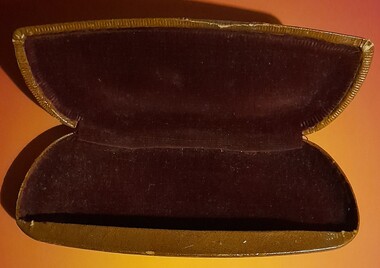
Container - Spectacle Case, Wastell & Cutter spectacle/glasses case
... A domestic item identifying Wastell & Cutter opticians at Ballarat who provided eye care and glasses to Mrs Mary Taffe of Hymettus from the 1940s until the 1990s. ...Wastell & Cutter were Ophthalmic Opticians at Ballarat, Victoria from the 1930s until the 1970s. A domestic item identifying Wastell & Cutter opticians at Ballarat who provided eye care and glasses to Mrs Mary Taffe of Hymettus from the 1940s until the 1990s. The metal proprietors plaque is an unusual embellishment.Small metal plaque on cover with Optometrist's name Wastell & Cutter embossed against medieval townscape image.optometrist, ballarat, glasses case, taffe -
 City of Melbourne Libraries
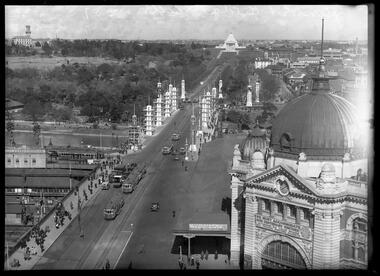
Photograph, Bull, Hugh Jones, 1897-1993, Princes Bridge Centenary pylons under construction
... eye level at the main entrance says: “Cheap Trips on Sundays”. The sign on the end of the roof along the eastern side of the station reads, “The Babies Need Your Help! Support Broadmeadows Foundling Hospital Appeal. July and August”. Run by the Sisters of St Joseph of the Sacred Heart, St Joseph’s Foundling Hospital was a purpose built infants’ home for up to 300 babies, plus accommodation for expectant mothers, mainly single women. In the early 1930s, the department (Victorian Children’s Welfare Department) contracted St Joseph’s Foundling Hospital to care...eye level at the main entrance says: “Cheap Trips on Sundays”. The sign on the end of the roof along the eastern side of the station reads, “The Babies Need Your Help! Support Broadmeadows Foundling Hospital Appeal. July and August”. Run by the Sisters of St Joseph of the Sacred Heart, St Joseph’s Foundling Hospital was a purpose built infants’ home for up to 300 babies, plus accommodation for expectant mothers, mainly single women. In the early 1930s, the department (Victorian Children’s Welfare Department) contracted St Joseph’s Foundling Hospital to care ...Princes Bridge Centenary pylons under construction Possibly taken from Young and Jacksons Hotel (formerly Princes Bridge Hotel) on the corner of Flinders and Swanston streets, Flinders Street Station’s clocks and main entrance dominate, along with its distinctive copper dome and decorative façade. The time on the main clock is 1.40pm, and the sign underneath, reflecting Melbourne’s upcoming Centenary reads, “We must accommodate our Centenary visitors! Citizens! Do your share by taking paying guests.” At left is the original Princes Bridge Station, today the site of Federation Square. The riverside tram terminus advertises a Café/Tobacconist/Refreshment Room selling cigars & cigarettes, fountain drinks & confectionery, and in smaller text: “Leave your boot repairs here”. Nearly everyone is dressed in dark suits, coats and hats. The footpaths are wide and there are no traffic lights. The roadway stretches towards the Shrine of Remembrance, not yet dedicated but very dominant on the skyline. Government House is clearly visible across the wide parkland that would come to be known as Kings Domain and that is an area of deep importance to the people of the Eastern Kulin. Originally, Birrarung was part of a network of swamps and lagoons linked to the course of the river. From 1896, Public Works Department engineer Carlo Catani, oversaw a new channel to straighten the river and the swamps and lagoons were filled with spoil from the channel works. From the same vantage point today, only the top of the tower of Government House would be visible. The photo captures the pylons along Princes Bridge, mid-construction and being installed to mark Melbourne’s Centenary. The pylons were not without controversy. Both The Argus and The Age bemoaned them for being “made almost entirely of imported softwood timber”, denying work to native hardwood timber workers and sawmillers, and leading visitors to think Australia did not have its own exceptional native hardwoods. The pylons were also variously described in their incomplete state, as unimaginative and resembling an oilfield. Published: The Age 5 September 1934 Featured in "Newsworthy: Melbourne in photographs 1933-1936" exhibition at East Melbourne Library, October to December 2023. Exhibition caption by project volunteer, Louise McKenzie Photographer notations on slide: "Pylons + St Kilda Rd C57" Published: Age (Melbourne, Vic. : 1854 - 1954), Wednesday 5 September 1934, page 11 Published title: DECORATIONS -- THEN AND NOW. Published caption: "Although not completed yet, some impression of the effect of the decorations on Princes-bridge may be obtained from the first picture which shows the majestic sweep of St Kilda road with the Shrine of Remembrance and Government House dominating the horizon. The area to the left of St. Kilda-road and in front of Government House is portion of the area which it is proposed to call the King's Domain, which extends to Domain-road and Anderson-street..." Description: East-facing, elevated view of Flinders Street Station and Princes Bridge, featuring partially completed pylons erected for Melbourne's Centenary celebrations. The Shrine of Remembrance and Government House can be seen in the distance. In the foreground are trams, cars and trucks, pedestrians, Batman Avenue tram terminus and refreshment rooms. Signage on Flinders Street Station encourages citizens to accommodate Centenary visitors. The Melbourne Centenary was held 1934-35 in celebration John Batman's proclamation that Melbourne "the place for a village". Centenary events included a visit by Prince Henry, Duke of Gloucester. A Centenary Cake measuring 50 feet in height and ten tons in weight was cut into 250,000 pieces and sold at 1 shilling per piece for charity. Spectacular floodlighting of city landmarks, the creation of the Pioneer Women's Memorial Garden, and the MacRobertson Air Race from London, were other notable activities. Research by project volunteer, Louise McKenzie: The photo in The Age collage of 5 September 1934 has a slightly cropped foreground. The original photo has been taken from an elevated vantage point, most probably the roof of the Nicholas Building on the corner of Flinders and Swanston streets. The right foreground is dominated by the main “clocks” entrance to Flinders Street Station, showing its distinctive copper dome and decorative façade. The time on the main clock is 1.40 pm. The main sign on the front of the Station reads, "We Must Accommodate our Centenary Visitors! Citizens! Do your share by taking paying guests. Write to The Official Centenary Accommodation Bureau, 436 Collins St. City. Tel M 4671”. Another sign at eye level at the main entrance says: “Cheap Trips on Sundays”. The sign on the end of the roof along the eastern side of the station reads, “The Babies Need Your Help! Support Broadmeadows Foundling Hospital Appeal. July and August”. Run by the Sisters of St Joseph of the Sacred Heart, St Joseph’s Foundling Hospital was a purpose built infants’ home for up to 300 babies, plus accommodation for expectant mothers, mainly single women. In the early 1930s, the department (Victorian Children’s Welfare Department) contracted St Joseph’s Foundling Hospital to care for an additional 60 infant state wards, and up to 175 non wards at any given time. In 1931 it also operated a mothercraft training school. The centre foreground shows the commencement of Princes Bridge. Beneath the left side of the bridge was the site of the original Princes Bridge Station, by this time incorporated into Flinders Street Station, and today the area is the site of Federation Square. It was linked to Flinders Street station by the railway tracks that ran underneath the northern approach to the bridge. This photo shows a tram terminus which has a Café/Tobacconist/Refreshment Room, selling cigars & cigarettes, fountain drinks & confectionary, and a sign: Leave your boot repairs here. In the foreground is a wide roadway running south/north, comprising two vehicle lanes each heading north/south, and a central section containing two sets of tram tracks. There are cars, buses and delivery vans on the roadway. The trams visible are Glen Iris (Route No. 6; tram no. 448), Toorak (Route No. 8, tram no. 333), ? (No. 7), ? (No. 1), and ? (No. 2A). The footpaths are extremely wide. There is a square newspaper/magazine stand on the eastern side footpath. And also a “Ferry” sign. There are no traffic lights, but a policeman is visible on the roadway. There are pedestrians – men, women, children, a porter with trolley, women with prams. Clothing comprises dark suits, coats and hats for nearly everyone. There are double headed “Collins Street” lights along the side of the roadway, and along the northern riverbank. The roadway in the foreground is an extension of Swanston Street, which becomes Princes Bridge, then St Kilda Road, stretching towards the Shrine of Remembrance, and diverting past it. The Shrine had not yet been officially dedicated, and looks very white and dominant on the skyline. On the LHS of St Kilda Road, Government House is clearly visible across the wide parkland to be known as Kings Domain. The Kings Domain area is important to the people of the Eastern Kulin nation, and also has historical importance for its association with the early settlement of Melbourne and the foundation of British colonial administration in Victoria. On the southern side of the Yarra River (Birrarung) an historic rowing boathouse is visible, located adjacent to the Alexandra Gardens. Originally Birrarung was part of a network of swamps and lagoons linked to the course of the river. From 1896, under the guidance of engineer Carlo Catani* a new channel to straighten the river was created and the swamps and lagoons were filled with spoil from the channel works. The gardens were then created and completed in time for a Royal visit by the Duke of York in May 1901. The gardens are named after Alexandra of Denmark, the wife of King Edward VII. Both these areas, plus the Royal Botanic Gardens Victoria, Shrine of Remembrance Reserve, Sidney Myer Music Bowl, Government House, and the Queen Victoria Gardens together form the Domain Parklands. The extent of the subsequent plantings is evident today, where from the same vantage point only the top of the tower of Government House would be visible. *Catani was born in Florence in 1852, but after arriving in Melbourne worked as a civil engineer for the Victorian Government. His last major project was the reclamation of the foreshore of St Kilda, envisaged in the style of a European resort, complete with a split level esplanade, bathing pavilions, dance halls, amusements and a French-Italian style of landscape complete with palms. The gardens at the end of Fitzroy Street, St Kilda, now bear his name. The historic boathouse visible across the Yarra is another glimpse into Melbourne’s past. “Boathouse Row” comprises 7 amateur rowing clubs, the first established in 1859 (Melbourne University Boat Club). Other Clubs were Richmond, Melbourne, Banks, Melbourne Grammar School, Yarra Yarra and Mercantile. South of the river and west of the bridge is an area today developed into the Melbourne arts precinct of Hamer Hall and the Arts Centre. But at this time it was the home of Wirths Olympia Circus, which comprised Wirths Pleasure Park (an amusement park), a 5,000 seat auditorium – Hippodrome, a roller skating rink, a glaciarium, a cinema, and the Green Mill Dance Hall. Dog shows were also held at Olympia. The Green Mill Dance Hall closed in 1950, and the remainder of the Wirth buildings on site were destroyed by fire in December 1953. The feature of the photo is the pylons erected along Princes Bridge to mark Melbourne’s Centenary in 1934. The sixteen plastered pylons were designed by Roy Prentice, the second person to qualify as an architect at The University of Melbourne’s Bachelor of Architecture degree, in 1933, aged 27. Simon Reeves in his article marking the 100th birthday of Roy Prentice on 20 June 2006 reports that the State Electricity Commission sponsored this work, and the Argus reported that “… the pylons were “illuminated from within to give the effect of soft radiance”. Australia Home Beautiful 1 Oct 1934 reports in a very detailed and comprehensive article: The 10 taller pylons, including flagpole, were 48 ft, with a base of 8 ft. Timber-framed and faced with fibrous plaster and galvanised sheet iron, each structure was securely bolted to a concrete foundation three feet in depth. Panels of glass let into the shaft of each pylon were indirectly lit by 40, 100 watt lamps, and the upper bank of internal lamps were dyed so as to flood the panels with a deep red light. The decorative painted shields and flagpoles/pennants were illuminated by three 200 watt projectors concealed in the roof of each pylon, and were part of an electric night light decoration scheme involving 28 miles of wire to supply more than 20,000 lights. An article in the Argus on 18 October 1934 provided minute detail of the lighting erected in Melbourne for the Centenary, converting it “… into a coloured fairyland by night.” The estimated cost of 10 pounds per hour the lights were on. The display included 800 standard light poles 30 feet high which were tiered with electric bulbs concealed in inverted cones, 138 specially designed “Venetian poles” draped in flags trophies and streamers. The streets included in the electric night light decoration scheme were Bourke Street from Spring to William, the entire length of Collins Street, Flinders Street from Elizabeth to Spring, Lonsdale Street from Elizabeth to Swanston, Swanston and Elizabeth Streets from Flinders to Lonsdale, and parts of Springs and Spencer Streets. Together with the Princes Bridge pylons, approximately 28 miles of wire was required to supply power to the more than 20,000 lights. And that is just in the city of Melbourne. It was estimated the same amount of lighting was duplicated among other local councils. The pylons were not without controversy. The Argus on 28 August 1934 in an article headed “Imported Timber in Pylons” reported that the Princes Bridge pylons are “made almost entirely of imported softwood timber”, and have therefore denied work to native hardwood timber workers and sawmillers. The same day the Melbourne Age ran a similar story, bemoaning the fact that foreign oregon had been used which may lead tourists to think Australia did not have its own exceptional native hardwoods. A Camberwell City Councillor described the pylons as unimaginative, and the Herald reported that skeletons of pylons for the Centenary decorations in their present form led the area to resemble an oilfield! The Yarra River and Princes Bridge have long been a focal point of Melbourne life. In the early days of European settlement in Melbourne a rope-hauled punt carried people across the Yarra River. A surge in population and increased shipping traffic created a need for a bridge. There was difficulty in agreeing on a suitable site for the bridge (options were crossing at Elizabeth, Swanston, Queen or Market Streets), but the NSW Government favoured Swanston Street and the Melbourne Town Council decided on a temporary bridge across the Yarra spanning from the foot of Swanston Street. This first bridge was a single span timber toll bridge designed by Scottish born bridge designer David Lennox, and completed in 1845. It was 120 feet long, had a roadway of 17 feet wide, and a footpath on one side of 4 feet. It was leased to the Melbourne Bridge Company in the name of Robert A Balbirnie. The tollhouse was on the north side of the river and the toll keeper, Patrick Doherty, was credited with saving nine lives during the four years he was in charge of the toll station. The second bridge was stone (completed 1850), and named Prince’s Bridge after the HRH Prince of Wales, later Edward VII. It was designed with an elliptical single arc and an exceedingly small rise in proportion to the span. However, this design created an obstacle for flood waters, and together with Melbourne’s increasing population it was quickly apparent that a new bridge was required. At its opening on 15 November 1850 coincided with the imminent declaration of Victoria as a separate colony, it provided a moment of great celebration for Melbournians and “The opening ceremony was described as the grandest processional display witnessed in the colony.” (ToMelbourne.com.au) Princes Bridge in its present form, as depicted in this photograph, was designed by Jenkins, D’Ebro and Grainger, and constructed in 1886-88 by David Munro. John Grainger (father of Australian composer Percy Grainger) did the majority of the design work for the bridge. The structure was to have three arches each 96 feet wide measured across the river, and the banks on both sides were raised to allow more space for floodwater to flow. St Kilda Road was originally many feet below the current level. The bridge is of architectural significance for its substantial size, giant half columns, extensive use of wrought and cast iron, decorative elements (cast-iron lamps) and the skilled stonemasonry in the construction of the abutments and piers. Its main design features are similar to those of Blackfriars Bridge in London (1870). The bluestones were quarried from Footscray, the Malmsbury stones were from quarries at Kyneton, and the granite from Harcourt. The cost was met by the State of Victoria, City of Melbourne, and six out of seven of its municipalities, and their coats of arms feature on the bridge. The building of the bridge reflected the boom period of Melbourne, including the Victorian gold rush 1851- late 1860s, and its contractor, David Munro, was also responsible for the construction of Queens Bridge and Sandridge Railway Bridge. The Centenary pylons are no longer in place, but today this intersection still plays a major part in Melbourne’s daily life: people still meet “under the clocks” at Flinders Street station, and the route in and out of the city along St Kilda Road is often a feature of parades such as Moomba, the Grand Final Parade, and of course the Anzac Day Parade which commences at the Princes Bridge intersection and finishes at the Shrine of Remembrance. There are many tram routes, which cross the Bridge, and it directs pedestrians towards the Arts Precinct, the various components of Domain Park, plus the Southbank restaurant and rowing precincts. Even though this is a street scene, it feels very intimate; the viewer is instantly immersed in the activity of a Melbourne afternoon, looking down St Kilda Road from a viewpoint near today’s Federation Square. References: DECORATIONS -- THEN AND NOW. (1934, September 5). The Age (Melbourne, Vic. : 1854 - 1954), p. 11. Retrieved September 21, 2023, from http://nla.gov.au/nla.news-article205880269 'Flinders Street railway station', Wikipedia, https://en.wikipedia.org/wiki/Flinders_Street_railway_station 'St Joseph’s Foundling Hospital (1901-75)', Finding Records, Department of Health and Human Services, State of Victoria, https://www.findingrecords.dhhs.vic.gov.au/collectionresultspage/St-JosephsFoundling-Hospital-Babies-Home#departmental-administration 'Alexandra Gardens', City of Melbourne, https://www.melbourne.vic.gov.au/community/parks-open-spaces/major-parks-gardens/Pages/alexandra-gardens.aspx 'Wirths Circus', Wikipedia, https://en.wikipedia.org/wiki/Wirth's_Circus 'Roy Prentice: Centenary Architect', Built Heritage Pty Ltd, Simon Reeves, https://www.builtheritage.com.au/downloads/prentice.pdf 'Princes Bridge', Heritage Council Victoria, https://vhd.heritagecouncil.vic.gov.au/places/817 PORT PHILLIP. (1846, April 1). The Sydney Morning Herald (NSW : 1842 - 1954), p. 3. Retrieved September 21, 2023, from http://nla.gov.au/nla.news-article12886251 'Edward VII', Wikipedia, https://en.wikipedia.org/wiki/Edward_VII 'Princes Bridge', ToMelbourne.com, https://tomelbourne.com.au/princes-bridge/ 'Princes Bridge', eMelbourne, https://www.emelbourne.net.au/biogs/EM01189b.htm 'Princes Bridge', Australia for everyone, http://australiaforeveryone.com.au/files/melbourne/princes-bridge.html 'Victorian gold rush', Wikipedia, https://en.wikipedia.org/wiki/Victorian_gold_rush IMPORTED TIMBER IN PYLONS (1934, August 28). The Argus (Melbourne, Vic. : 1848 - 1957), p. 9. Retrieved September 21, 2023, from http://nla.gov.au/nla.news-article10952507 Princes-Bridge Pylons. (1934, August 28). The Age (Melbourne, Vic. : 1854 - 1954), p. 7. Retrieved September 21, 2023, from http://nla.gov.au/nla.news-article205532235 Pylons Appear Near Princes Bridge (1934, August 18). The Herald (Melbourne, Vic. : 1861 - 1954), p. 1. Retrieved September 21, 2023, from http://nla.gov.au/nla.news-article243104375 PRINCES-BRIDGE PYLONS. (1934, September 20). The Age (Melbourne, Vic. : 1854 - 1954), p. 10. Retrieved September 21, 2023, from http://nla.gov.au/nla.news-article205873535 28 Miles of Wire (1934, October 18). The Argus (Melbourne, Vic. : 1848 - 1957), p. 1 (The Junior Argus). Retrieved September 21, 2023, from http://nla.gov.au/nla.news-article10977836 'Historical references for Boathouse Row, Melbourne', http://boathouserowmelbourne.com.au/history/ 'ITALIAN DELEGATION TO HONOUR CARLO CATANI, DESIGNER OF THE ST KILDA FORESHORE, St Kilda Historical Society, 2001, https://web.archive.org/web/20070928061938/http://www.skhs.org.au/~SKHSarticles/articles/Carlo_Catani.html# HISTORY IN LIGHTS (1934, July 12). The Herald (Melbourne, Vic. : 1861 - 1954), p. 16. Retrieved September 21, 2023, from http://nla.gov.au/nla.news-article243172436 'Dressing Melbourne for the Duke', The Australian home beautiful: a journal for the home builder. Vol 12 No. 10 (1 October 1934), page 21, 58. Retrieved September 14, 2023, from http://nla.gov.au/nla.obj-2950922209Photographer notations on slide: "Pylons + St Kilda Rd C57".centenaries, bridges, lighting, flinders street railway station
