
Showing 49 items matching "fire risk"
-
 Greensborough Historical Society
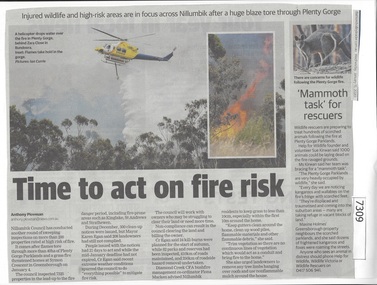
Article - Newspaper Clipping, Diamond valley Leader, Time to act on fire risk, 15/01/2020
... Time to act on fire risk......high fire risk...Nillumbik Council has conducted another round of sweeping inspections on more than 200 properties rated at high risk of fire. This follows a grass fire in Greensborough and a bushfire at Plenty Gorge Parklands....Time to act on fire risk Article Newspaper Clipping Diamond valley Leader Diamond Valley Leader Anthony Piovesan ...Nillumbik Council has conducted another round of sweeping inspections on more than 200 properties rated at high risk of fire. This follows a grass fire in Greensborough and a bushfire at Plenty Gorge Parklands.News article 1 page, black text.nillumbik council, high fire risk, symon crescent greensborough, plenty gorge park -
 Round the Bend Conservation Co-operative
All members were involved in this physically demanding work of laying the power and telephone cables underground, which resulted in mitigating the fire risk and the aesthetic value of no power poles!
... All members were involved in this physically demanding work of laying the power and telephone cables underground, which resulted in mitigating the fire risk and the aesthetic value of no power poles! ...All members were involved in this physically demanding work of laying the power and telephone cables underground, which resulted in mitigating the fire risk and the aesthetic value of no power poles! ... -
Marysville & District Historical Society
THE TRIANGLE NEWS-VOL 38 NO 16-MAY 20 2011
... ...fire risk...marysville victoria australia local architecture shortlisted in state awards victorian architecture award regional prize marysville rebuilding advisory centre yea kinglake bushfire memorial concepts church notices murrindindi shire council blumes fashions heritage trail photographic competition council community services advertisements cfa operations fire risk narbethong history group history book of narbethong black saturday fires marysville golf report marysville villains veterans football THE TRIANGLE NEWS-VOL 38 NO 16-MAY 20 2011 ...marysville, victoria, australia, local architecture shortlisted in state awards, victorian architecture award regional prize, marysville rebuilding advisory centre, yea, kinglake, bushfire memorial concepts, church notices, murrindindi shire council, blumes fashions, heritage trail, photographic competition, council community services, advertisements, cfa operations, fire risk, narbethong history group, history book of narbethong, black saturday fires, marysville golf report, marysville villains, veterans football -
Emerald Museum & Nobelius Heritage Park
Book - History Book, Mundie, Edward Hyland House, Cockatoo, Ash Wednesday 1983: the people's story, 1983
... The author lived in Cockatoo for 20 years and was at one time fire-risk contractor for the local council. Names used in the book are fictitious to protect privacy....The author lived in Cockatoo for 20 years and was at one time fire-risk contractor for the local council. Names used in the book are fictitious to protect privacy. bushfires Cockatoo Victoria Australia Edward Mundie Ash Wednesday 1983 'Donated to Emerald Museum by Robert Apedaile, 1995' 94 p. : ill. ; DDC994.520922 ISBN 0908090595Paper Cockatoo, Ash Wednesday 1983: the people's story Book History Book Mundie, Edward Hyland House ...Stories, mostly from first-hand accounts, of the Ash Wednesday bushfires in Cockatoo, February 1983. The author lived in Cockatoo for 20 years and was at one time fire-risk contractor for the local council. Names used in the book are fictitious to protect privacy.94 p. : ill. ; DDC994.520922 ISBN 0908090595Paper'Donated to Emerald Museum by Robert Apedaile, 1995'bushfires, cockatoo victoria australia, edward mundie, ash wednesday 1983 -
 Whitehorse Historical Society Inc.
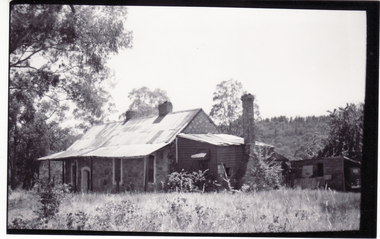
Photograph, Schwerkolt Cottage, 1962
... Accompanying text sent by Charles - 'This is another photo of front side (facing Mitcham township) You see there is a lot of dried grass lying about which is a serious fire risk to the new houses which have been built. ...Accompanying text sent by Charles - 'This is another photo of front side (facing Mitcham township) You see there is a lot of dried grass lying about which is a serious fire risk to the new houses which have been built. ...Photo sent to Mary Jack, Pittsburgh USA by Charles Schwerkolt. Accompanying text sent by Charles - 'This is another photo of front side (facing Mitcham township) You see there is a lot of dried grass lying about which is a serious fire risk to the new houses which have been built. The verandah posts on the corner have rotted away and let the verandah down a foot. The roof on the kitchen is in a bad way. You will notice the chimney has a lean of about a foot. Black and white photo of Schwerkolt Cottage showing the Rotting Verandah Posts and Leaning Chimney. Thin Black Border.schwerkolt, charles clarence victor, whalen, rosalie, jackschowsky, mary elizabeth, schwerkolt cottage -
 Melbourne Tram Museum
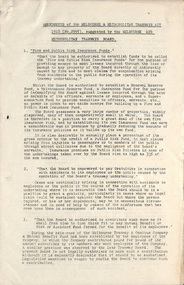
Document - Report, Melbourne & Metropolitan Tramways Board (MMTB), "Amendments of the MMTB Act 1918 (No. 2995) suggested by the MMTB", mid 1920's
... Suggests changes such as a fire and public risk insurance fund, payment of gratuities in event of accidents to employees or the public, payment to a Mutual benefit or sick fund for its employees, make donations to hospitals etc, a "welfare movement" fund, construct five tramways, road maintenance, change section 37 and change Board attendance fees. ...Suggests changes such as a fire and public risk insurance fund, payment of gratuities in event of accidents to employees or the public, payment to a Mutual benefit or sick fund for its employees, make donations to hospitals etc, a "welfare movement" fund, construct five tramways, road maintenance, change section 37 and change Board attendance fees. ...Report - 3 foolscap duplicated sheets, titled "Amendments of the MMTB Act 1918 (No. 2995) suggested by the MMTB". Suggests changes such as a fire and public risk insurance fund, payment of gratuities in event of accidents to employees or the public, payment to a Mutual benefit or sick fund for its employees, make donations to hospitals etc, a "welfare movement" fund, construct five tramways, road maintenance, change section 37 and change Board attendance fees. Document undated. Sought authorisation for East Brunswick, West Brunswick and Coburg, along Church St connecting Clifton Hill and Prahran, along Bell St connecting Preston to Coburg and East Northcote and Heidelberg districts. 2 copies held.trams, tramways, mmtb, acts of parliament, board members, insurance, road works, new tramway, east brunswick, west brunswick electric tramway, coburg, clifton hill, prahran, bell st, east northcote, heidelberg -
 Kiewa Valley Historical Society
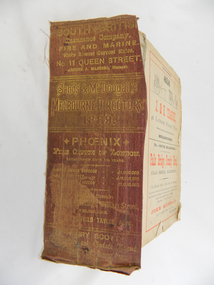
Book - Reference Melbourne Directory, Melbourne and Suburban Directory for 1889, Circa 1889
... On the spine in gold colour "South * British insurance Company Fire and Marine. Risks Lowest Current Rates No. 11 Queen Street, Arthur J Masters, Manager" and half way down " *Phoenix* Fire Office of London established over 100 years Annual Income exceeds (pound sign) 1,000,000" underneath "Losses Paid Over (pound sign) 16,000,000" underneath "Reserve Fund Exceeds (pound sign) 1,000,000" underneath "9 Market Buildings William Street, Melbourne " underneath " R. ...Increased populations and greater levels of communication and safe fast transport facilities permitted greater devolution of commercial enterprises into rural communities, such as the Kiewa Valley. state government listings names and location of early melbourne population business names 1889 members of the victorian executive council On the spine in gold colour "South * British insurance Company Fire and Marine. Risks Lowest Current Rates No. 11 Queen Street, Arthur J Masters, Manager" and half way down " *Phoenix* Fire Office of London established over 100 years Annual Income exceeds (pound sign) 1,000,000" underneath "Losses Paid Over (pound sign) 16,000,000" underneath "Reserve Fund Exceeds (pound sign) 1,000,000" underneath "9 Market Buildings William Street, Melbourne " underneath " R. ...This Directory of 1889 covers the location of Melbourne based trade and professional offices by street and in Alphabetical order. It covers all of Melbourne and its suburbs. It also covers government and official, ecclesiastic, legal, municipal and miscellaneous information. The directory details a cross section of a developing city with a splattering of advertisements opening up an in depth look of all aspects of living in the late 1800s. It is interesting to see that all the advertisements do not have any telecommunication numbers listed (personal shoppers or mail orders only). This was a period of high moral standing within the community and hotels advertised rooms " suites of rooms for families and single rooms for Ladies and Gentlemen" also "electric bells throughout the house. Telephone, night porter and hot and cold baths."This directory would be used by the majority of families and businesses working and living within the Kiewa Valley and the surrounding area. Melbourne was the only place where every aspect of living requirement was catered for. Although the delivery of services and goods were not at a high rate, certain items or transactions would require a visit to "the big smoke". Business information are listed both by suburb and alphabetically. There is also a section for British and Foreign Trade. This directory covered nearly everything to do with commerce, an example pay days for principle firms. Greater evolution of trade locations started to balloon out after the mid 1950's. Increased populations and greater levels of communication and safe fast transport facilities permitted greater devolution of commercial enterprises into rural communities, such as the Kiewa Valley.This directory has no front or back cover and is held together by its cloth spine. It contains over 1300 pages, however there may be some pages missing front and back of the directory which would have contained advertisements of some unknown shops. All the sides of this directory (except the spine) have advertisements and content information stamped on. The spine cover has been placed in the directory until further conservation work is carried out. It has gold coloured printing and in the central section, a gold coloured background with the words "Sands & McDougall's Melbourne Directory 1889." The spine has three adverts on the spine.On the spine in gold colour "South * British insurance Company Fire and Marine. Risks Lowest Current Rates No. 11 Queen Street, Arthur J Masters, Manager" and half way down " *Phoenix* Fire Office of London established over 100 years Annual Income exceeds (pound sign) 1,000,000" underneath "Losses Paid Over (pound sign) 16,000,000" underneath "Reserve Fund Exceeds (pound sign) 1,000,000" underneath "9 Market Buildings William Street, Melbourne " underneath " R. Manfield Taylor, Agent" and at the bottom section" Henry Scott Auctioneer and Estate Agent 49 Bridport St., Albert Park" stamped on the bottom side across the page endings "The Wonderful Wertheim Sewing Machines Swanston Street opposite Town Hall", stamped on the top side across the page endings " The Sweet Hapsburg Pianos & Organs Swanston Street Opposite Town Hall"state government listings, names and location of early melbourne population business names, 1889 members of the victorian executive council -
 Flagstaff Hill Maritime Museum and Village
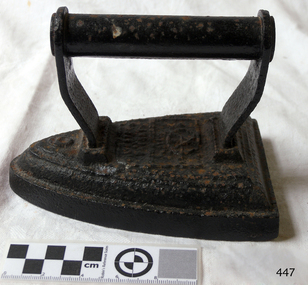
Domestic object - Iron
... Some houses were equipped with a system of pipes for distributing natural gas or carbide gas to different rooms in order to operate appliances such as irons, in addition to lights. Despite the risk of fire, liquid-fuel irons were sold in U.S. rural areas up through World War II. ...Some houses were equipped with a system of pipes for distributing natural gas or carbide gas to different rooms in order to operate appliances such as irons, in addition to lights. Despite the risk of fire, liquid-fuel irons were sold in U.S. rural areas up through World War II. ...Before the introduction of electricity, irons were heated by combustion, either in a fire or with some internal arrangement. An "electric flatiron" was invented by American Henry Seely White and patented on June 6, 1882. It weighed almost 15 pounds (6.8 kg) and took a long time to heat. The UK Electricity Association is reported to have said that an electric iron with a carbon arc appeared in France in 1880, but this is considered doubtful. Two of the oldest sorts of iron were either containers filled with a burning substance, or solid lumps of metal which could be heated directly. Metal pans filled with hot coals were used for smoothing fabrics in China in the 1st century BC. A later design consisted of an iron box which could be filled with hot coals, which had to be periodically aerated by attaching a bellows. In the late nineteenth and early twentieth centuries, there were many irons in use that were heated by fuels such as kerosene, ethanol, whale oil, natural gas, carbide gas (acetylene, as with carbide lamps), or even gasoline. Some houses were equipped with a system of pipes for distributing natural gas or carbide gas to different rooms in order to operate appliances such as irons, in addition to lights. Despite the risk of fire, liquid-fuel irons were sold in U.S. rural areas up through World War II. In Kerala in India, burning coconut shells were used instead of charcoal, as they have a similar heating capacity. This method is still in use as a backup device, since power outages are frequent. Other box irons had heated metal inserts instead of hot coals. From the 17th century, sadirons or sad irons (from Middle English "sad", meaning "solid", used in English through the 1800s[4]) began to be used. They were thick slabs of cast iron, triangular and with a handle, heated in a fire or on a stove. These were also called flat irons. A laundry worker would employ a cluster of solid irons that were heated from a single source: As the iron currently in use cooled down, it could be quickly replaced by a hot one. https://en.wikipedia.org/wiki/Clothes_ironThis iron is typical of the clothes iron used before electric irons superseded it.Salter iron no. 6, painted black but with rust showing through. Salter iron no. 6.flagstaff hill, warrnambool, shipwrecked-coast, flagstaff-hill, flagstaff-hill-maritime-museum, maritime-museum, shipwreck-coast, flagstaff-hill-maritime-village, iron, clothes, laundry -
 Flagstaff Hill Maritime Museum and Village
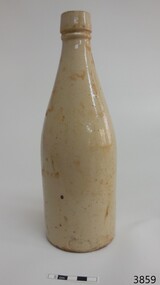
Ceramic - Stoneware Bottle, Henry Kennedy Pottery, Late 1800s to early 1900s
... fire clays. Pottery production reaches a high scale which presented a high risk of fire and Barrowfield was no exception. ...fire clays. Pottery production reaches a high scale which presented a high risk of fire and Barrowfield was no exception. ...This bottle was made in Scotland and recovered decades later from a shipwreck along the coast of Victoria. It may have been amongst the ship's cargo, its provisions or amongst a passenger's personal luggage. It is now part of the John Chance collection. Stoneware bottles similar to this one were in common use during the mid-to-late 19th century. They were used to store and transport. The bottles were handmade using either a potter's wheel or in moulds such as a plaster mould, which gave the bottles uniformity in size and shape. The bottle would then be fired and glazed in a hot kiln. Makers often identified their bottles with the impression of a small symbol or adding a colour to the mouth. The manufacturer usually stamped their bottles with their name and logo, and sometimes a message that the bottle remained their property and should be returned to them. The bottles could then be cleaned and refilled. The Barrowfield pottery was founded in 1866 by Henry Kennedy, an Irish native, in the Camlachie district east of Glasgow, close to the Campbellfield and Mount Blue potteries. It is believed that Kennedy started with just one kiln but by 1871 was employing forty men and six boys and such was the success of the enterprise that by 1880, no less than eight kilns were in operation and a year later one hundred and the pottery was employing eighteen people. Stoneware bottle production was a mainstay of the pottery and over “1500 dozen” were being turned out daily along with other wares, including 30-gallon ironstone containers. With so many kilns in operation, six hundred saggars were required every week but, unlike some potteries, these were made on the premises from Garnkirk and Glenboig fire clays. Pottery production reaches a high scale which presented a high risk of fire and Barrowfield was no exception. In April 1884 heat from a kiln set fire to the roof resulting in significant structural damage, the loss of unfinished wares alone amounting to £10,000 a very substantial sum in 1884. The pottery recovered from this reverse but then Henry Kennedy died in July 1890. The terms of his will indicated that he and his sons John and Joseph were partners and this was reflected in a change of title in the 1891-92 Post Office Directory to Henry Kennedy & Sons. Despite the growth of the business there was still space enough, however, to allow china, earthenware and glass retailers Daniel and John McDougall to commence production of their Nautilus wares there in 1894, the success of which allowed them to soon move to permanent quarters at the empty Saracen Pottery, Possil. In around 1900 John Kennedy left to resurrect the liquidated Cleland Pottery and although Barrowfield remained listed as Henry Kennedy & Sons, brother Joseph was in control. In 1911 Henry Kennedy & Sons Ltd was formed, with two of the four directors being the Kennedy brothers. The pottery’s growth to this point was reflected in the eighteen kilns the largest pottery kilns then recorded in Scotland. However, the disruption of the First World War and the combined effects of subsequent economic depression, US prohibition, hygiene regulations and competition from alternative materials posed severe challenges for stoneware potteries in the post-war years as they competed with each other for diminishing markets. Competitors such as Eagle and Caledonian Potteries fell by the wayside and finally, Barrowfield closed in 1929. This stoneware bottle is historically significant for its manufacture and use in the late 19th to the early 20th century. The bottle is also significant as it was recovered by John Chance, a diver, from a wreck on the coast of Victoria in the 1960s-70s. Items that come from several wrecks along Victoria's coast have since been donated to the Flagstaff Hill Maritime Village’s museum collection by his family, illustrating this item’s level of historical value. Stoneware was produced at Barrowfield pottery for the domestic and export markets, with South America being a large market. Barrowfield stoneware can be found throughout the world. Its longevity and abundant production makes the subject item a significant addition to the Flagstaff Hill Maritime Museum collection.Bottle, salt glazed stoneware, beige, some discolouration above base. Chip on base and on neck. Inscriptions stamped near base.Makers lozenge stamped, H Kennedy Barrowfield Pottery GLASGOW at base.flagstaff hill, warrnambool, flagstaff hill maritime museum, maritime museum, shipwreck coast, flagstaff hill maritime village, great ocean road, john chance, h kennedy pottery, stoneware, ironstone, pottery, barrowfield glasgow -
 City of Melbourne Libraries
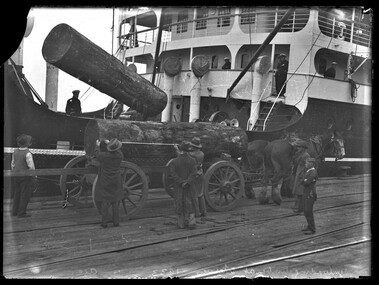
Photograph (item), Bull, Hugh Jones, 1897-1993, Unloading timber at Victoria Dock, 1933
... Furthermore, large stacks of timber posed a fire risk. The Trust asked the Victorian Government to reserve a site on the east side of the Yarra River opposite Yarraville and Spotswood. ...Furthermore, large stacks of timber posed a fire risk. The Trust asked the Victorian Government to reserve a site on the east side of the Yarra River opposite Yarraville and Spotswood. ...Photographer notations on slide: "Unloading Timber at Wharves 1933 Age B5" Published: Age (Melbourne, Vic.: 1854- ), Tuesday 15 August 1933 MAHOGANY FROM MANILA. (1933, August 15). The Age (Melbourne, Vic. : 1854 - 1954), p. 11. Retrieved January 16, 2026, from http://nla.gov.au/nla.news-article204377024 Published title: MAHOGANY FROM MANILA Published Caption: Age Tue 15 Aug 1933 Caption: Unloading Mahogany Logs brought from Manila, Philippine Islands, by the steamer Taiping, which berthed yesterday at Victoria Dock. The vessel discharged twenty logs, each weighing three tons, the first shipment of this type of timber landed in Melbourne. Research by Project Volunteer, Louise McKenzie: This photograph in many ways epitomises Melbourne in the 1930s. It is a time of enormous growth, development and change. But before delving into that, the photo itself is very powerful. The huge mahogany logs being unloaded appear to be so heavy that the ship itself seems to list to port as they are craned over the side. They are being levered into a cart to which two large and sturdy Clydesdale horses are hitched. In contrast to the traditional horses, the wharf is crisscrossed with modern railway tracks. Unloading is both mechanical and manual, and the scene is one of intense interest to a young boy bystander. The ship appears to be squat and solid, but the whole image also gives a feeling of movement and intensity. The mahogany being delivered to Melbourne would be intended for high quality furniture. In the 1930s Australia actually had a growing timber industry, but much of the eucalyptus wood was being utilised for mass produced furniture, and much of this furniture would then have had a veneer applied to it. The fact that it was economic to import this timber from the “Philippine Islands” – not a traditional trading market for Australia – reflects a Victorian economy that was strong enough to support a growing demand for good quality furniture Mahogany was described as a classic, strong hardwood, often used for dark opulent furniture. In the 1930s the importation of timber from Manila (Philippines) to Australia was a notable trade, particularly in Philippine Lauan (often referred to as Philippine Mahogany), which was used as a cheaper alternative to other hardwoods. 1930s furniture, dominated by the art deco style, used a mix of luxurious exotic woods like mahogany, macassar and ebony for high-end pieces, often veneered over less expensive woods such as walnut, birch and poplar, and with plywood, chrome and lacquer also popular for more practical, streamlined designs during the Depression era. By the mid 1930s timber mills were being relocated away from the immediate dock area, but the fact that these logs were being transported by horse-drawn cart implies that the load would not have had to be taken too far for milling. 1885 the Melbourne Harbour Trust Commissioners had decided that land in or near the city was far too valuable to be used as timber yards. Furthermore, large stacks of timber posed a fire risk. The Trust asked the Victorian Government to reserve a site on the east side of the Yarra River opposite Yarraville and Spotswood. Here, in 1889, the Trust began building six jetties and a wharf specifically for the landing of timber. Clydesdale horses were initially brought to Victoria from Tasmania in the 1830s, and with the 1850s gold rush they were imported direct from Scotland. Melbourne was from its earliest years an important centre of horse-breeding from both imported and colonial-bred stock, providing the well-built draught horse for pulling heavily loaded wagons, the harness horse for delivery work and drawing coaches, and the saddle-horse used for riding. Stud breeding facilities were advertised from the early 1840s. By the 1870s the horse export trade was thriving, and the Port of Melbourne was the country's busiest exporter of horses to Indian, Asian and New Zealand markets. Kirk's Melbourne Horse and Carriage Bazaar in Bourke Street first advertised for business in 1840, and by the 1850s Bourke Street West was famed for its horse bazaars and saleyards. The Victorian Clydesdale Horse Society reports that Clydesdale working horses were a vital part of Melbourne's infrastructure and agricultural industry in the 1930s, when they reached the peak of their popularity despite the increasing competition from mechanization. Their main roles and usage at this time were: • City Delivery: Clydesdales were a common sight for metropolitan deliveries, particularly for breweries (such as Carlton & United Breweries), milk runs, and bread deliveries. • Industrial Work: They were heavily used for hauling cargo at the docks, in construction, and at specialized sites like the Truganina Explosives Reserve, where they pulled wagons. • Agriculture: In surrounding rural areas, they were the primary power source for ploughing and agricultural machinery. • Specialization: By the 1930s, the Clydesdale was smaller and more compact than the Shire or Percheron breeds, making them ideal for navigation in urban environments. After the 1930s their numbers decreased due to the onset of WWI and mechanisation. Wartime petrol rationing led to a brief revival for the working horse, as suburban tradesmen, now used to motor delivery, took their old jinkers out of mothballs. By 1947, however, only 1.5% of city traffic was horse-drawn. In 1952 the large horse cartage company A. Kellet Pty Ltd sold its 250 horses and converted its Richmond stables to storage. In the 1950s at Station and Princes piers, wharf labourers refused to work with the six draught horses still being used to haul trolleys and which were soon superseded by the fork lift, semi-trailer and mobile crane. Where carefully trained horses had once shunted trains in city goods yards, a few hundred a week were now being killed at the abattoirs for pet and human consumption. The last MCC dray horse was withdrawn from service in 1958, but some of the few remaining working animals are used by the mounted police for crowd control at demonstrations and football games. The death knell had also sounded for the associated trades of farrier, saddler and blacksmith. Our photo, therefore, showing the wharf with both the haulage Clydesdales and the rail lines, is a strong visual summary of the social and economic changes experienced in Victoria in the 1930s and on towards the 1950s. Our photo is located at Victoria Dock (also known as Victoria Harbour) which is still an active component of Melbourne’s port system. In 1892 the West Melbourne Dock (later Victoria Dock) was opened, downstream and immediately west of the Spencer Street railway shunting yards. It contained a swing basin for ships, replacing the one which had been provided on the south side of the river, later to be the Duke and Orr dry dock, west of the Charles Grimes Bridge. Further west was the South Wharf along the river bank. The history of Victoria Dock is extremely well described by Ashley Smith in his 2 March 2022 article in Docklands News, and its accompanying aerial photo of the Dock taken in 1934. He writes: "In the early 1930s Victoria Dock was one of the biggest sites for trade and export in Melbourne. A constant queue of ships sailed in, unloaded their cargo, recharged and reloaded, then left for the next port. Around the time this photo was taken (found in a 1934 photo book), the trapezium-shaped basin had been through some changes since its construction in the 1890s. The 497-metre-long Central Pier, finished in 1919, now featured six sheds to house the ever-increasing volume of cargo. The entrance had also been widened in the 1920s to allow better access. Some of the berths featured three-ton jib electric cranes to help with loading cargo and a rail network connected to the State Railway service. By the time construction was completed, the dock was 39 hectares and hailed as the second-largest dock in the world (behind Cavendish Dock, Barrow-in-Furness). To further save costs, excavations were dug to a more reasonable seven metres below low water, instead of British engineer Sir John Coode’s recommended 8.3 metres. Even then, the costs were still around £900,000. It was envisaged, with the extra wharfage, that around thirty 90-metre ships could berth inside. On March 22, 1892, Victoria Dock was opened by Victoria’s Governor, the Earl of Hopetoun (later Australia’s first Governor-General) who opened the sluice to let the Yarra in. It took six days to fill the basin with The Leader newspaper estimating that it would take another six months to completely fill (March 26, 1892). In the end, it took nearly a year before the first ship was allowed to enter on February 20, 1893, when the steamer Hubbuck sailed in to unload 1200 tonnes of cargo in 15 hours. The Argus (February 23, 1893) reported that the ship’s captain, J. R. Brodie, called the Yarra “better than the Thames”, and compared Victoria Dock favourably to the Albert Dock (Liverpool)." This would be a good time to move our focus on to the Taiping, which is the transporter of these giant mahogany logs. The Taiping was a steel-hulled, single-screw passenger-cargo Chinese steamer, which today has the dubious legacy of being involved in a collision headlined as “The Chinese Titanic”. It was constructed by the Hong Kong and Shampoa Dock Company at its facility in Hong Kong, with completion in 1926 for service under the Australia Oriental Line. Her gross register tonnage measured 4,324 tons, reflecting her design for inter-island and coastal trade routes, accommodating both passengers and freight. She operated routes connecting Australian ports with East Asian destinations. As World War II approached, Taiping continued predominantly working the trade routes between China and Australia, until December 1941, when she evacuated women and children from Hong Kong to Manila just before Japanese forces overran the region. She then safely reached Australia despite enemy air raids. Taiping was then requisitioned by the Royal Navy and repurposed as a victualling stores issuing ship for the Eastern Fleet, supporting logistical needs in the Pacific and Indian oceans. Returned to the Australian Oriental Line in 1947, she underwent refitting and by mid-1948 was chartered to the Shanghai Shipping Company, and modified for greater passenger accommodation – approximately 500 passengers. In 1948/49 the Chinese Civil War took place. The Taiping departed Shanghai on 26 January 1949 as one of the final vessels evacuating civilians from to Keelung Harbour in Taiwan. Reports indicate that the Taiping carried double the rated capacity of passengers i.e. 1000. The ship carried families, military personnel, civilians, carrying personal belongings, gold and valuables in hope of resettlement in Nationalist Taiwan. It also held heavy cargo in the form of silver and gold bullion loaded by the Central Bank of China. Because of the risk of patrols, and to conserve fuel, the Captain took the ship away from the usual open-sea passage, and instead navigated along the coast. He also extinguished navigation lights to avoid detection. Shortly after midnight on 27 January 1949 the Taiping collided with the smaller cargo steamer Chien Yuan in the East China Sea near the Zhoushan Archipelago. The Chien Yuan was also operating in darkness. The subsequent collision was catastrophic. The Chien Yuan sank with in 5 minutes, with the loss of 72 of its 74 crew. The Taiping sustained severe structural compromise from the broadside strike and initially remained afloat, then made a swift descent into the freezing water, with no attempt at an organised evacuation. No formal recovery process was instigated, however a distress signal went out. 32 survivors were picked up by the Australian destroyer HMAS Warramunga (on patrol nearby), a passing US vessel found 2 more, and local Zhoushan fishermen retrieved others. In the end, only 37 people survived. The event is remembered as a poignant moment in the mass migration to Taiwan, with families tragically separated. A memorial to the disaster exists at the Keelung Harbour naval base on Taiwan. With its total of over 1,500 deaths, it constituted one of the worst peacetime maritime losses. It is sometimes referred to as the “Oriental Titanic” because of the similarly large loss of life and speed of demise with the RMS Titanic in 1912. A fictional depiction of this event appears in the John Woo movies “The Crossing (Part 1) (2014), and The Crossing II (2015), known in Chinese as “Taiping Wheel”. The narrative weaves a story around pre-disaster romances and wartime turmoil among passengers, culminating in the ship’s rapid sinking. “The production, a high-budget Sino-Taiwanese-Hong Kong co-effort, portrays the event as a microcosm of the 1940s Sino-Japanese and civil war legacies, though critics noted the melodramatic style prioritizing spectacle over historical precision.” In conclusion, it is nice to return to our photo, and observe the people involved in this moment. The dockworkers are, so typical of the 1930s, dressed in what looks to us like formal clothing – dark suits or coats, white shirts, and black hats. I am particularly drawn to the young boy, bare-headed, arms crossed, and so intent on the unloading process. He too is wearing a white shirt, black trousers and jacket, and black shoes. This is 1933 Melbourne – but the haircut he is sporting is now very “hipster” and modern in 2026 Melbourne. References: MAHOGANY FROM MANILA. (1933, August 15). The Age (Melbourne, Vic. : 1854 - 1954), p. 11. Retrieved January 30, 2026, from http://nla.gov.au/nla.news-article204377024 Wikipedia, Taiping steamer, https://en.wikipedia.org/wiki/Taiping_(steamer) Wikipedia, Victoria Dock, https://en.wikipedia.org/wiki/Victoria_Dock_(Melbourne) Docklands News, Ashley Smith, 2 Mar 2022, https://www.docklandsnews.com.au/victoria-dock/ Living Histories: Heritage Council of Victoria, Jill Barnard, 2008, Jetties and Piers, https://livinghistories.net.au/wp-content/uploads/2015/11/Jetties-ONL-intro_Part-1.pdf eMelbourne, Wharves and Docks, https://www.emelbourne.net.au/biogs/EM01612b.htm Australian Academy of Technological Sciences – Harvesting Wood, https://www.austehc.unimelb.edu.au/tia/225.html Old Treasury Building, On the Water – The Docks, https://tinyurl.com/3wkbk66m Old Treasury Building, On The Road, https://tinyurl.com/dw44yr3t Port of Melbourne, Victorian Places, https://www.victorianplaces.com.au/port-of-melbourne Docklands Heritage Study - Environmental History, https://mvga-prod-files.s3.ap-southeast-4.amazonaws.com/public/2024-05/docklands-heritage-review-thematic-environmental-history-1991.pdf eMelbourne, Horses, https://www.emelbourne.net.au/biogs/EM00723b.htm Victorian Clydesdale Horse Society, https://www.clydesdalesvic.org.au/history The Crossing, https://letterboxd.com/film/the-crossing-i/Photographer notations on slide: "Unloading Timber at Wharves 1933 Age B5"ships, shipping, timber industry, shipwrecks, horses, docks, wharves, 1930-1939, wars, docklands -
 Flagstaff Hill Maritime Museum and Village
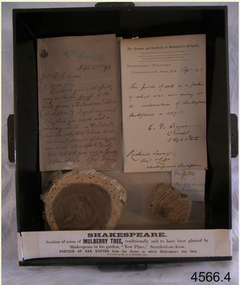
Wood Samples, 1891
... At the time it was thought necessary to avoid the risk of fire spreading to Shakespeare's birthplace. ...At the time it was thought necessary to avoid the risk of fire spreading to Shakespeare's birthplace. ...The timber display case was presented to Mr Richard Standcombe Harris of Warrnambool (1831-1923). He was a councillor (1875-1891) and predominant businessman. Mr C F Loggin had met Mr Harris while on a trip to Stratford upon Avon in the United Kingdom. Upon his return to Warrnambool, Mr Harris donated the item to the Warrnambool Museum and Art Gallery, (established 1886) where Joseph Archibald was Curator: he catalogued the case in 1894. THE LETTERS IN THE CASE The two letters contained within the display case confirm the authenticity of the oak wood sample. The first letter in the case includes the text; "[Stamped Header on banner] High Street, Stratford on Avon [Hand written] Sept. 22nd / 91. Mr. R. S. Harris, Dear Sir, Enclosed you will find [underlined next 3 words] every authentic proof of the Oak from Shakespeare's House (Birth place). I regret very much Sir, that you made a short-day at S. on A. I should have been delighted to have had the honour, & pleasure, of showing you around our Beautiful Country. You did not give [next 3 words underlined] me or yourself a fair chance. But however I hope that we may again some day have more time to go quietly around. With kind regards, and wishing you, Sir, a pleasant voyage, I remain, Dear Sir, Yours very truly, C.F. Loggin. P.S. A paper will be always acceptable to be as how you Jolly Warrnamboolites are desporting yourselves. “ The second letter includes text; “[Printed Letterhead with stamped impression] The Trustees and Guardians of Shakespeare’s Birthplace Incorporated by Act of 54 and 55, Vict. 1891 Secretary and Librarian - Richard Savage Shakespeare’s Birthplace Stratford-upon-Avon [handwritten] 22 Sept 1891 This piece of oak is a portion of what was cut away at at the restoration of Shakespeare’s Birthplace in 1857-58. C. F. Loggins Chemist 3 High Street Richard Savage Sec. – Shakespeare’s Birthplace Mr C F Loggin was connected with the Shakespeare Trust as the person who had originally donated a scion of Shakespeare's mulberry tree to the "Shakespearean Birthday Committee" in 1842. (The scion that was given to the Shakespearean Birthday Committee, from which the Mulberry sample is derived, still grows today in "New Place" garden.) Mr Richard Savage was the Secretary and Liberian of the then renamed “Trustees and Guardians of Shakespeare’s Birthplace when the display case was given to Mr Harris in 1891 by Mr Loggin. WILLIAM SHAKESPEARE Shakespeare was born in 1564 in Stratford-upon-Avon, where he also grew up. He married at 18 years and he and his wife, Anne Hathaway, had three children: They moved to London where he became successful as an actor, writer, and part-owner of a playing company. He later returned to Stratford and purchased his last home, which he called "New Place" in 1602 where he later died in 1616. For the next 150 years, it was known that there existed a black mulberry tree in the garden. At the time there was a fashion for planting mulberry trees. It was the early 17th century after King James had come to the throne, and he imported tens of thousands of saplings in an attempt to get landowners to start a silk industry in England. Unfortunately for posterity, Shakespeare's mulberry was felled around 1756, by the then owner of “New Place" the Reverend Francis Gastrell, who was apparently tired of continual visits by pilgrims asking to see the tree, so he chopped it down. Gastrell had applied for local permission to extend the garden but the application was rejected and his tax was increased. Gastrell retaliated by demolishing the house in 1759, this greatly outraged the local inhabitants. Gastrell was eventually forced to leave town having provoked the wrath of Stratford residents for committing such an act. Today only the garden remains where “New House" used to stand with a scion from the original mulberry tree still growing there. The wood from the felled mulberry tree at “New House" was purchased by an enterprising local clock-maker Thomas Sharp and he spent the next 40 years or so years making souvenirs from the wood. These became early tourist souvenirs and subsequently developed into a profitable sideline for various other makers, including George Cooper and John Marshall. These objects range from relatively small domestic wooden objects, such as snuff boxes and weight scales to large tea caddies and even tables. C. F. Loggin donated a scion or cutting from Shakespeare's mulberry tree to the Shakespeare Birthplace Trust in 1862, he was a chemist who lived and worked in Stratford. There is a note on the frame of the donation that the mulberry sample is from this scion, research shows that from Richard Savage's diary notes that there must have been a lot of wood taken from that scion over the years which was planted in the garden of “New Place” and is still growing there today. The "Trustees and Guardians of Shakespeare’s Birthplace" (1847 -1964) was formed after the house where Shakespeare is believed to have been born fell into disrepair. Subsequently in 1846 after the death of Thomas Court's widow the last owner. Interest in the house was revived when PT Barnum, the American showman, wanted to buy it and ship the house back to America. In response to this, the Shakespeare Birthday Committee was established (by a private Act of Parliament) with the help of such luminaries as Charles Dickens, the Committee of Trustees raised the necessary £3,000 and purchased the house the following year. Once the Committee had acquired the building, restoration work began. Originally the Birthplace formed part of a terrace with later houses built either side. The first stage in its conservation was their destruction. At the time it was thought necessary to avoid the risk of fire spreading to Shakespeare's birthplace. Reconstruction was carried out by the Shakespeare Trust between 1857 and 1864 that restored the outside of the building to its original 16th-century state. It is from this restoration that the donated piece of oak is derived, originally from a beam that was in the house. Communication from The Shakespeare Birthplace Trust, dated April 11th, 2019, confirms that the pieces displayed in this case have good provenance. The wood samples are significant for their association with the history of William Shakespeare. The display case and its content is significant to Warrnambool local history for its association with the establishment in 1886 of the Warrnambool Museum and Art Gallery. However, it should be noted that the letters of authentication that accompany the wood samples are only applicable to the oak sample. None the less, all the pieces have very good provenance, with Richard Savage's certificate of authenticity for the oak, and the mulberry sample with the letter to Mr Harris from Mr CF Loggin having also been the donor of the scion of mulberry in 1862 to the Shakespeare Birthplace Trust. This scion was then established at Shakespeare's garden at "New Home" that had been demolished by Rev Francis Gastrell in 1759. Two wood samples associated with William Shakespeare, presented in a hanging, timber and glass display case with metal trim around the frame. The case also contains two letters and a label printed on a card that refers to the contents, their origins and the donor. A card label with a printed number and a round adhesive label are attached on the back of the case. The left round section of wood is from a donated scion (or shoot) derived from the original mulberry tree planted by William Shakespeare at his last home "New Place", Stratford-upon-Avon. The outer section is light brown coloured while the centre is dark grain. The right wood sample in the case is a section of oak rafter from the house where Shakespeare was born in 1564. The wood is mid brown with a distinct grain. The included letters, each dated 22/9/1891, refer to only the oak sample. - The letter on the left comprises two handwritten pages from Mr CF Loggin to Mr Richard Standcombe Harris. The paper has the printed letterhead address of High Street, Stratford on Avon. - The letter on the right is a handwritten certificate of authenticity signed by Mr CF Loggin and counter signed by Mr Richard Savage, Secretary and Liberian of the Shakespeare Trust. It is on the printed letterhead of The Trustees and Guardians of Shakespeare’s Birthplace Cardboard label inside the glass case “Shakespeare Section of Mulberry Tree, traditionally said to have been planted by Shakespeare in his garden, “New Place,” Stratford-on-Avon. PORTION OF OAK RAFTER from the house in which Shakespeare was born. (Presented by R S Harris 1891.) Printed label on the back of the case “3 2 “ The handwritten adhesive label “0566” flagstaff hill, warrnambool, shipwrecked coast, flagstaff hill maritime museum, maritime museum, shipwreck coast, flagstaff hill maritime village, great ocean road, shakespeare display case, wood samples, oak from shakespeare's birthplace, mulberry from shakespeare's home "new place", stratford-upon-avon, shakespeare's birthplace, the trustees and guardians of shakespeare's birthplace &c., shakespeare trust, shakespeare birthday committee, r.s. harris, brunswick, victoria, richard s harris, brunswick, victoria, c.f. loggins, chemist, 3 high street stratford-on-avon, richard savage, warrnambool museum and art gallery, thomas court, pt barnum, charles dickins, anne hathaway, black mulberry tree, reverend francis gastrell -
Marysville & District Historical Society
THE TRIANGLE NEWS-VOLUME 40 NO 2-JANUARY 25 2013
... non approved bush fire shelters could put lives at risk...marysville victoria australia australia day celebrations murrindindi shire flag bearers wanted lions club community foundation marysville golfer wins foodworks mini masters at eildon beverley bellman church notices irresponsible campers putting lives at risk department of sustainability & environment funded governance training available for community groups australia day parade flags for all tougher penalties for failing to comply with fire prevention notices non approved bush fire shelters could put lives at risk maryton park beer & platter garden australia day weekend special healthy and active in the third age consultation murrindindi home based child care child care vacancies family day care program australia day office closures THE TRIANGLE NEWS-VOLUME 40 NO 2-JANUARY 25 2013 ...marysville, victoria, australia, australia day celebrations, murrindindi shire, flag bearers wanted, lions club, community foundation, marysville golfer wins foodworks mini masters at eildon, beverley bellman, church notices, irresponsible campers putting lives at risk, department of sustainability & environment, funded governance training available for community groups, australia day parade flags for all, tougher penalties for failing to comply with fire prevention notices, non approved bush fire shelters could put lives at risk, maryton park beer & platter garden, australia day weekend special, healthy and active in the third age consultation, murrindindi home based child care, child care vacancies, family day care program, australia day office closures -
Marysville & District Historical Society
THE TRIANGLE NEWS-VOL 40 NO 16-MAY 3 2013
... fire brigade...first aid training...invitation to business breakfast...marysville & triangle business owners...marysville golf report...staff wanted black spur roadhouse...buxton recreation reserve quarterly committee meeting...el kanah official opening...emotions anonymous international...strath creek bridge works to alleviate flood risk...marysville victoria australia el kanah alex burns and jen hawley band cafe culture series 2013 what's on when in may buxton progress assocn b.p.a. meeting the committee of management of the gallipoli park precinct marysville community market creative triangle narbethong public hall movie night murrindindi shire council notice of special meeting of council triangle community dinner marysville golf club church notices breakfast for men notice of application for planning permit mayor's chair narbethong public hall committee public meeting austen tayshus buxton hotel advertisements buxton fire brigade first aid training invitation to business breakfast marysville & triangle business owners marysville golf report staff wanted black spur roadhouse buxton recreation reserve quarterly committee meeting el kanah official opening emotions anonymous international strath creek bridge works to alleviate flood risk photographs from australian steelband festival available real estate black spur inn mother's day competition some victorian forest tracks closing from may 1 breakaway bridge refurbishment gets green light marysville community centre function room volunteers and friends of steelband festival invited murrindindi shire showcased at regional living expo brief history of el kanah council reappoints ceo margaret abbey THE TRIANGLE NEWS-VOL 40 NO 16-MAY 3 2013 ...marysville, victoria, australia, el kanah, alex burns and jen hawley band, cafe culture series 2013, what's on when in may, buxton progress assocn, b.p.a. meeting, the committee of management of the gallipoli park precinct, marysville community market, creative triangle, narbethong public hall movie night, murrindindi shire council, notice of special meeting of council, triangle community dinner, marysville golf club, church notices, breakfast for men, notice of application for planning permit, mayor's chair, narbethong public hall committee, public meeting, austen tayshus, buxton hotel, advertisements, buxton fire brigade, first aid training, invitation to business breakfast, marysville & triangle business owners, marysville golf report, staff wanted black spur roadhouse, buxton recreation reserve quarterly committee meeting, el kanah official opening, emotions anonymous international, strath creek bridge works to alleviate flood risk, photographs from australian steelband festival available, real estate, black spur inn mother's day competition, some victorian forest tracks closing from may 1, breakaway bridge refurbishment gets green light, marysville community centre function room, volunteers and friends of steelband festival invited, murrindindi shire showcased at regional living expo, brief history of el kanah, council reappoints ceo margaret abbey -
 Federation University Historical Collection
Book - Scrapbooks, William RObertson, Newsclips written by William Robertson, c1930-c1948, c1930-c1948
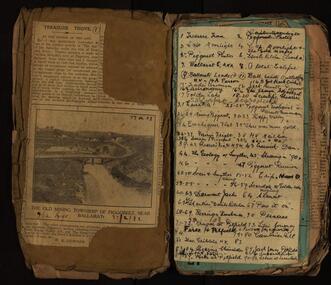
... Mailboy, Shearers, Creswick, Geology of Smythesdale, Shearing in the 1890s, Piggoreet reunion, Scarsdale and Smythesdale, Scarsdale to Golden Lake, Derwent Jacks, Shanties Devil's Kitchen, Berringa Bushmen, Perseus, Kruger at Pitfield, Fires and Pitfield, Football Memories, Cambrian Hill, Theo Gribble, Jack Jones Pitfield, Risks at Pitfield, Superstition, Scarsdale, death notice for William Robertson's mother....Mailboy, Shearers, Creswick, Geology of Smythesdale, Shearing in the 1890s, Piggoreet reunion, Scarsdale and Smythesdale, Scarsdale to Golden Lake, Derwent Jacks, Shanties Devil's Kitchen, Berringa Bushmen, Perseus, Kruger at Pitfield, Fires and Pitfield, Football Memories, Cambrian Hill, Theo Gribble, Jack Jones Pitfield, Risks at Pitfield, Superstition, Scarsdale, death notice for William Robertson's mother. ...Small brown covered scrapbook with newsclipping written by William Robertson, and his handwritten corrections to the articles. Newsclips include poetry and articles on: Piggoreet, Captain Moonlight, Devil's Kitchen, Ballarat East Australian Natives' Association, A Total Eclipse, Ballarat Leads, Joe Mack Cricket, Trade Unionism, Jack Hewitt of Piggoreet, Astronomy, Golden Lake, Scientific Shearers, Eureka, Piggoreet Geological, Piggoreet Mining, Happy Valley, Exchequer Flat, Fairy's Fright, H.V. Mailboy, Shearers, Creswick, Geology of Smythesdale, Shearing in the 1890s, Piggoreet reunion, Scarsdale and Smythesdale, Scarsdale to Golden Lake, Derwent Jacks, Shanties Devil's Kitchen, Berringa Bushmen, Perseus, Kruger at Pitfield, Fires and Pitfield, Football Memories, Cambrian Hill, Theo Gribble, Jack Jones Pitfield, Risks at Pitfield, Superstition, Scarsdale, death notice for William Robertson's mother.On cover: "Wm Robertson 10 Young Street Ballarat East"andrew christie, mrs nimon, william christie, alec christie, grand trunk, cape clear, donald mclean's, alchemist co, john lynch, golden belt lead, paddy webb, annie rooney, kruger hanging, pitfield, boer war, napoleons, cambran hill, hiscocks, john winter, john jenkins, bonshaw, john bird, nintingbool, moppianum station, w.h. bird, david clarke, william hamilton, john clarke, benjamin j. scott, julius kleberger, m.a. weatherston, j.h. vaughan, a. reid, alfred william crow, p. young, george clarkson, a.w. crowe, william henderson, claud pender, a. garside, mount erip, alec crothers, communism, basalt, italian gully, john roberts, john browne, john crossthwaite, patrick mcgrath, newtown, john boyd, john bruce, william irwin, george hatfield, d. croswaite, grand trunk mine, golden horn, jubilee lode, woady yallock, springdallah, fairy glen lead, linton lead, south berry, banshee, wil-o-the wisps, forest creek, chewton, mount alexander, jim crow ranges, trawalla, j.g. roberts, carngham, german lead, scarsdale railway, great western, beaumont mine, north grenville, shearing, piggoreet reunion, scarsdale and smythesdale, scarsdale to golden lake, derwent jacks, shanties, devil's kitchen, berringa bushmen, perseus, kruger at pitfield, fires and pitfield, football memories, cambrian hill, theo gribble, jack jones pitfield, risks at pitfield, superstition, scarsdale, golden point lead outlet, frenchman's lead, trooper o'brogue, peroni, morelli, lucky woman's gully, william robertson, piggoreet, captain moonlight, devil's kitchen, ballarat east australian natives' association, total eclipse, ballarat leads, joe mack cricket, trade unionism, jack hewitt of piggoreet, astronomy, golden lake, scientific shearers, eureka, piggoreet geological, piggoreet mining, happy valley, exchequer flat, fairy's fright, h.v. mailboy, shearers, creswick, geology of smythesdale -
 City of Moorabbin Historical Society (Operating the Box Cottage Museum)
Chemicals, Insecticide ‘KILSKEETO sticks
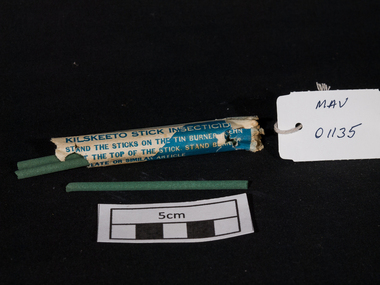
... STAND BURNER / ON A PLATE OR SIMILAR ARTICLE / TO AVOID RISK OF FIRE AND / PLACE THE WHOLE ON THE / FLOOR WELL OUT OF / DRAUGHTS...STAND BURNER / ON A PLATE OR SIMILAR ARTICLE / TO AVOID RISK OF FIRE AND / PLACE THE WHOLE ON THE / FLOOR WELL OUT OF / DRAUGHTS. / LIGHT HERE .. ...A paper wrap around 8 green sticks of ‘KILLSKEETO InsecticideOn wrapper ; KILSKEETO STICK INSECTICIDE / STAND THE STICKS ON THE TIN BURNER, THEN / LIGHT THE TOP OF THE STICK. STAND BURNER / ON A PLATE OR SIMILAR ARTICLE / TO AVOID RISK OF FIRE AND / PLACE THE WHOLE ON THE / FLOOR WELL OUT OF / DRAUGHTS. / LIGHT HERE .. (top of stick) insecticide, mosquitoes, infectious diseases, malaria, moorabbin, cheltenham -
Glenelg Shire Council Cultural Collection
Letter - Letter - National Fire and Marine Insurance Company of New Zealand Limited, n.d
... Letter from the National Fire and Marine Insurance Company of New Zealand Limited to KS Anderson re fire policy 326468 and Public Risk for Committee. White paper, blue company details, black type Free Public Library...Front: Manager's signature and policy details, black pen Letter from the National Fire and Marine Insurance Company of New Zealand Limited to KS Anderson re fire policy 326468 and Public Risk for Committee. White paper, blue company details, black type Free Public Library Letter Letter - National Fire and Marine Insurance Company of New Zealand Limited ...Letter from the National Fire and Marine Insurance Company of New Zealand Limited to KS Anderson re fire policy 326468 and Public Risk for Committee. White paper, blue company details, black type Free Public LibraryFront: Manager's signature and policy details, black pen -
Ringwood and District Historical Society
Newspaper - Scrapbook, Railways Related Newspaper Clippings - Ringwood Area, circa 1990s
... Headlines include: Fresh calls to transform rail stations Track pride Cuts threat to rail links Passengers fear train horror Safe Train needs help SOS on station Rail station 'risk' Rail staff cuts hit eastern suburbs - ASU Branch Secretary David Williams MET's staff at stations in firing line Railway station security boost Facelift for Heathmont station Behaviour clamp-down Overhaul for two railway stations Stations upgraded Lilydale line goes premium - Transport Minister Alan Brown, Station masters David Sands and Stephan Neville....Headlines include: Fresh calls to transform rail stations Track pride Cuts threat to rail links Passengers fear train horror Safe Train needs help SOS on station Rail station 'risk' Rail staff cuts hit eastern suburbs - ASU Branch Secretary David Williams MET's staff at stations in firing line Railway station security boost Facelift for Heathmont station Behaviour clamp-down Overhaul for two railway stations Stations upgraded Lilydale line goes premium - Transport Minister Alan Brown, Station masters David Sands and Stephan Neville. ...Newspaper cuttings glued to 8 A4 sheets. Various topics relating to Ringwood rail services -1993-1996Headlines include: Fresh calls to transform rail stations Track pride Cuts threat to rail links Passengers fear train horror Safe Train needs help SOS on station Rail station 'risk' Rail staff cuts hit eastern suburbs - ASU Branch Secretary David Williams MET's staff at stations in firing line Railway station security boost Facelift for Heathmont station Behaviour clamp-down Overhaul for two railway stations Stations upgraded Lilydale line goes premium - Transport Minister Alan Brown, Station masters David Sands and Stephan Neville. -
 Red Cliffs Military Museum
Certificate, Commendation notice for Military Medal, 1918 (estimated)
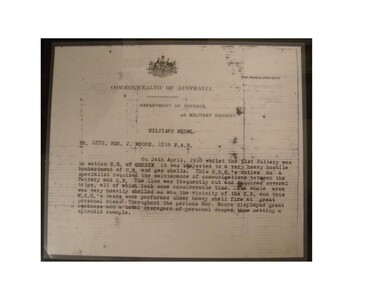
... s tasks were performed under heavy shell fire ar great/ personel risk. Throughout the periods Bdr. ...s tasks were performed under heavy shell fire ar great/ personel risk. Throughout the periods Bdr. ...Associated with BDR. Joseph Moore grouped framed certificatesPhotocopy of original dispatch notice for Military Medal to No 1272 BDR J. Moore, 13th F.A.B.No 1272, BDR. J. Moore, 13th F.A.B./ On 24th April, 1918 whilst the 51st Battery was/ in acrion N.E. of Cordie it was subjected to a very heavy hostile/ bombardment of H.E. and gas shells. This N.C.O.'s duries as a/ specialist required the maintenance of communications between the/ Battery an C.P. The line was frequently cut and required several/ trips, all of which took some considerable time. The whole area/ was very heavily shelled as was the vicinity of the C.P. and this/ N.C.O.'s tasks were performed under heavy shell fire ar great/ personel risk. Throughout the periods Bdr. Moore displayed great/ coolness and total disregard of personal danger thus setting a/ splendid examplemedal, 1918, military, moore, joseph, world, war, 1, corbie, 51st, battery, 4th, district -
 Flagstaff Hill Maritime Museum and Village
Equipment - Line throwing pistol, 1925-1945
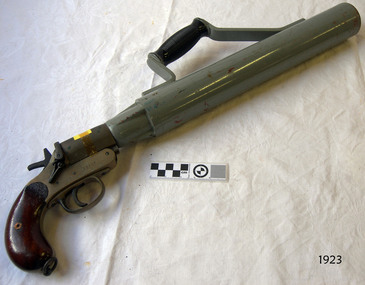
... risk lives to go out to the vessel in dangerous conditions. It could also be used from ship to ship rescue. The pistol would launch a line from shore to the vessel. The line would be attached to the vessel, then shore crew would send out equipment, including a breeches buoy, in which the stranded people could be pulled to shore. It has saved many lives at sea. The cartridge is loaded into the breech of the pistol and the rocket is inserted into the muzzle. On pulling the trigger, the gases generated by the fired...risk lives to go out to the vessel in dangerous conditions. It could also be used from ship to ship rescue. The pistol would launch a line from shore to the vessel. The line would be attached to the vessel, then shore crew would send out equipment, including a breeches buoy, in which the stranded people could be pulled to shore. It has saved many lives at sea. The cartridge is loaded into the breech of the pistol and the rocket is inserted into the muzzle. On pulling the trigger, the gases generated by the fired ...This is a SPRA, or Schermuly’s Pistol Rocket Apparatus. The large firearm type pistol would have been used to throw a line between ships, usually in the event of saving lives. The line throwing pistol consists of a long barrel with handle attached, a pistol grip and trigger, which fires a short blank cartridge. Accessories for the pistol included: flares, 12 gauge adaptor (to shoot 12 gauge flares), a wood plunger, and boxes of faked line. The stamp on the handle, Crown over "NP" is a Birmingham Proof House mark that dates the pistol between 1904 and 1954. However Schermuly's line throwing pistol was invented in the 192s and used on British Naval Ships from 1929. The serial number '22507' is only 806 numbers later than one on sale as a British Military WWII issue SRPA '21701'. This pistol appears to be made 125-1945. The apparatus was used as a life saving device for crew and passengers on vessels in distress that were only a few hundred metres from shore, often eliminating the need to launch a boat and risk lives to go out to the vessel in dangerous conditions. It could also be used from ship to ship rescue. The pistol would launch a line from shore to the vessel. The line would be attached to the vessel, then shore crew would send out equipment, including a breeches buoy, in which the stranded people could be pulled to shore. It has saved many lives at sea. The cartridge is loaded into the breech of the pistol and the rocket is inserted into the muzzle. On pulling the trigger, the gases generated by the fired cartridge eject the rocket on its correct line of flight, and at the same time, burst through the waterproof disc and ignite the propellant mixture, which carries the rocket and line on the remainder of the flight. The rocket consists of a weldless steel case filled with propellant mixture sealed in by a waterproof disc. Fixed to the rocket case is a direction bridle, to the end of which a short length of flexible steel wire is attached, this in turn being connected to the end of the line to be thrown. A complete rocket set, or line throwing kit. would include a wood carrying case, two coils of faked line in separate compartments, three rockets and a can of six cartridges. William Schermuly (1857 – 1929) - Founder of the Schermuly business. In 1897 he invented a trough-fired, line throwing apparatus. In 1920 he and his third son, Alfred James Schermuly, invented the pistol rocket apparatus and promoted this overseas during the 1920s. The system was approved by the British Navy in 1929 through an Act of Parliament, which made it compulsory for ships over 500 tons to carry this equipment. The company, Schermuly Pistol Rocket Apparatus Ltd., grew quickly during and after World War II but business eased off during the 1970s before it eventually closed in the 1990s. Saving lives in Warrnambool – The coastline of South West Victoria is the site of over 600 shipwrecks and many lost lives; even in Warrnambool’s Lady Bay there were around 16 known shipwrecks between 1850 and 1905, with eight lives lost. Victoria’s Government responded to the need for lifesaving equipment and, in 1858, the provision of rocket and mortar apparatus was approved for the lifeboat stations. In 1859 the first Government-built lifeboat arrived at Warrnambool Harbour and a shed was soon built for it on the Tramway Jetty, followed by a rocket house in 1864 to safely store the rocket rescue equipment. In 1878 the buildings were moved to the Breakwater (constructed from 1874-1890), and in 1910 the new Lifeboat Warrnambool arrived with its ‘self-righting’ design. For almost a hundred years the lifesaving and rescue crews, mostly local volunteers, trained regularly to rehearse and maintain their rescue skills. They were summoned when needed by alarms, gunshots, ringing bells and foghorns. In July 1873 a brass bell was erected at Flagstaff Hill specifically to call the rescue crew upon news of a shipwreck. Some crew members became local heroes but all served an important role. Rocket apparatus was used as recently as the 1950s. This line-throwing pistol is part of he Rocket Launching Equipment used to perform life-saving rescue at sea from the 1920s. It is significant for its connection with local history, maritime history and marine technology. Lifesaving has been an important part of the services performed from Warrnambool's very early days, supported by State and Local Government, and based on the methods and experience of Great Britain. Hundreds of shipwrecks along the coast are evidence of the rough weather and rugged coastline. Ordinary citizens, the Harbour employees, and the volunteer boat and rescue crew, saved lives in adverse circumstances. Some were recognised as heroes, others went unrecognised. In Lady Bay, Warrnambool, there were around 16 known shipwrecks between 1850 and 1905. Many lives were saved but tragically, eight lives were lost.Pistol, line-throwing, SPRA (Schermuly's Pistol Rocket Apparatus). This line throwing pistol has a wooden pistol grip, brass trigger mechanism, and a long, wide, steel barrel with Bakelite handle attached to the top. Inscriptions are stamped onto the pistol.Stamped on handle: "5" and "[symbol of a Crown] above NP" , "22507", "[within oval] SPRA" Stamped on barrel: "L22507".gun, pistol, flagstaff hill, warrnambool, shipwrecked coast, flagstaff hill maritime museum, maritime museum, flagstaff hill maritime village, great ocean road, line throwing, line throwing pistol, spra, schermuly's pistol rocket apparatus, sea rescue, pyrotechnicks, marine technology, schermuly pistol rocket apparatus ltd., william schermuly, alfred schermuly, pistol line thrower, flagstaff hill maritime museum and village, maritime village, lady bay, warrnambool harbour, port of warrnambool, shipwreck, life-saving, lifesaving, rescue crew, rescue, rocket rescue, rocket crew, beach rescue, line rescue, rescue equipment, rocket firing equipment, rocket rescue equipment, maritime accidents, shipwreck victim, rocket equipment, rescue boat, lifeboat, volunteer lifesavers, volunteer crew, life saving rescue crew, lifesaving rescue crew, rocket apparatus, rocket rescue method, shore to ship, rocket apparatus rescue, stranded vessel, line throwing mortar, rocket rescue apparatus, line thrower, lifeboat warrnambool, rocket machine, rocket head, rocket launcher, rocket line, beach rescue set, rocket set, schermuly, line-firing pistol, line throwing gun, pistol rocket apparatus, line throwing cartridge, line-throwing rocket, firearm, life saving, lsrc -
 Eltham District Historical Society Inc
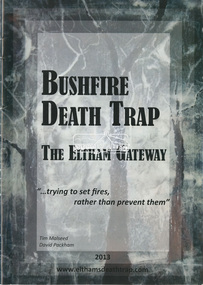
Book - Booklet, Tim Malseed et al, Bushfire Death Trap: The Eltham Gateway, 2013
... Discussion paper about the bushfire risks in Eltham to people's lives in order to evacuate safely following the Black Saturday fire of February 2009. ...Discussion paper about the bushfire risks in Eltham to people's lives in order to evacuate safely following the Black Saturday fire of February 2009. ...Discussion paper about the bushfire risks in Eltham to people's lives in order to evacuate safely following the Black Saturday fire of February 2009. Investigates the environmental, historical and political landscape. Newspaper clipping "Ignoring burning issue", Tim Malseed, Eltham, Letters, Diamond Valley Leader, April 24, 2013eltham gateway, eltham, bushfire, black saturday -
 Bendigo Military Museum
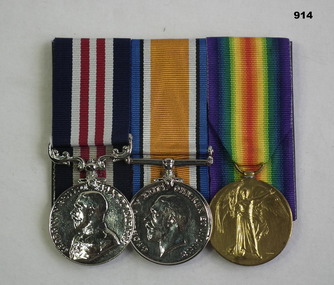
Award - MEDAL SET WW1, Post 1919
... The citation is quite long but the main part is the following; During heavy shelling one of their ammunition dumps was hit and caught fire, Pryde and another NCO at great risk pulled rounds away from the fire area likely to explode and extinguished the fire saving 600 out of 1000 rounds, 400 had exploded....The citation is quite long but the main part is the following; During heavy shelling one of their ammunition dumps was hit and caught fire, Pryde and another NCO at great risk pulled rounds away from the fire area likely to explode and extinguished the fire saving 600 out of 1000 rounds, 400 had exploded. medals military bravery history 3. "11986 Sgt L.Pryde. 1 D.A.C A.I.F" Medal set, court mounted, set of (3) re L Pryde. 1 Military medal, replica not engraved. 2 War medal 1914-1918, replica not engraved. 3 Victory Medal 1914 - 19 Award MEDAL SET WW1 ...Leslie Pryde (Born Pyramid Hill, enlisted Melbourne) Enlisted in the AIF 2.8.15 in Divisional Ammunition Column 1 reinforcement 14 age 28 years. Embarked for Egypt 28.1.1916, transfers to 13th FAB 16.4.1916, embarks for France 16.6.1916, promoted to Cpl 7.6.1917, hospital with Trench Fever 12.12.1917, return to unit 30.12.1917, promoted to Sgt 26.1.1918, discharged from the AIF on 7.4.1919. Leslie Pryde was awarded the Military Medal on 15.10.1917 East of Westhoek serving in the 49th Battery. The citation is quite long but the main part is the following; During heavy shelling one of their ammunition dumps was hit and caught fire, Pryde and another NCO at great risk pulled rounds away from the fire area likely to explode and extinguished the fire saving 600 out of 1000 rounds, 400 had exploded.Medal set, court mounted, set of (3) re L Pryde. 1 Military medal, replica not engraved. 2 War medal 1914-1918, replica not engraved. 3 Victory Medal 1914 - 19 3. "11986 Sgt L.Pryde. 1 D.A.C A.I.F" medals, military, bravery, history -
 Colac RSL Sub Branch
Work on paper (item) - ARTUR CLARENCE NEALE
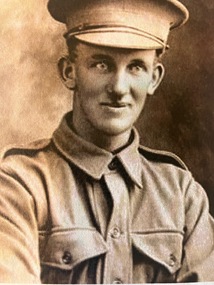
... ARTHUR CLARENCE NEALE SERVICE 774 DATE OF BIRTH UNKNOWN PLACE OF BIRTH COLAC VICTORIA DATE OF ENLISTEMENT 3/4/1915 PLACE OF ENLISTEMENT WARRION VICTORIA RANK MARKSMAN RUNNER PRIVATE OF THE 24th BATTALION DATE OF DISCHARGE NEVER DISCHARGED DIED ON ACTIVE DUTY HONOURS ARTHUR WAS AWARDED A MILITARY MEDAL BY KING GOERGE V FOR GALLANTRY IN ADVANCE ON BROODSEINE RIDGE ON 4/10/1917 HE WAS A RUNNER FOR THE ADVANCE \COMMAND POST PARTY AN FEARLESSLY CAIRIED A MESSAGE UNDER HEAVY SHELL FIRE A DISTANCE OF 700 YARDS TO THE COMMAND OPERATIONS IN A LATER RUN ENROUT BETWEEN COYS HE found ANOTHER WOUNDED RUNNER TOOK THE IMPORTED MESSAGE AN AT GREAT PRESONAL RISK THROUGH HEAVY ENEMY FIRE SUCCEEDED IN DELIVERING IT Work on paper ARTUR CLARENCE NEALE ...ARTHUR CLARENCE NEALE SERVICE 774 DATE OF BIRTH UNKNOWN PLACE OF BIRTH COLAC VICTORIA DATE OF ENLISTEMENT 3/4/1915 PLACE OF ENLISTEMENT WARRION VICTORIA RANK MARKSMAN RUNNER PRIVATE OF THE 24th BATTALION DATE OF DISCHARGE NEVER DISCHARGED DIED ON ACTIVE DUTY HONOURS ARTHUR WAS AWARDED A MILITARY MEDAL BY KING GOERGE V FOR GALLANTRY IN ADVANCE ON BROODSEINE RIDGE ON 4/10/1917 HE WAS A RUNNER FOR THE ADVANCE \COMMAND POST PARTY AN FEARLESSLY CAIRIED A MESSAGE UNDER HEAVY SHELL FIRE A DISTANCE OF 700 YARDS TO THE COMMAND OPERATIONS IN A LATER RUN ENROUT BETWEEN COYS HE found ANOTHER WOUNDED RUNNER TOOK THE IMPORTED MESSAGE AN AT GREAT PRESONAL RISK THROUGH HEAVY ENEMY FIRE SUCCEEDED IN DELIVERING IT -
4th/19th Prince of Wales's Light Horse Regiment Unit History Room
Military Insurance Ticket, 1910
... risk of death or disablement on duty. insurance military No 44998. Signed by Manager and Issuing officer Yearly military insurance ticket to cover death or disablement while on military duty. Premium was 7 shillings per annum for cover of 100 pounds for death or 2 pounds/week up to 13 weeks for disablement. Military Insurance Ticket The Colonial Mutual Fire ...Issued to Roy Taylor, a Sergeant in the 9th Australian Light Horse. At that time soldiers had to take out private insurance to cover the risk of death or disablement on duty.Yearly military insurance ticket to cover death or disablement while on military duty. Premium was 7 shillings per annum for cover of 100 pounds for death or 2 pounds/week up to 13 weeks for disablement.No 44998. Signed by Manager and Issuing officerinsurance, military -
 Warrnambool and District Historical Society Inc.
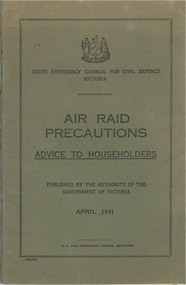
Booklet, Air Raid Precautions, 1941
... The booklet itself sets out action to be taken in the event of an air raid happening, lighting restrictions fire prevention, refuge rooms and garden shelters and risks from air raids. ...The booklet itself sets out action to be taken in the event of an air raid happening, lighting restrictions fire prevention, refuge rooms and garden shelters and risks from air raids. ...This booklet was published on the recommendation of the Commonwealth government as part of a plan to offer protection to the people in the event of air strikes. Local councils and individuals were called to help to protect themselves in taking precautions,. The booklet itself sets out action to be taken in the event of an air raid happening, lighting restrictions fire prevention, refuge rooms and garden shelters and risks from air raids. It contains the relevant siren signals which denote different types of events and explains in detail various aspects of preparing for possible attack. There was discussion about issues such as evacuation of children should such an event occur with the focus primarily on the larger centres such as Geelong and Melbourne. From 1942 the number of air attacks increased mainly from Japan on the northern and western parts of Australia including over 60 on Darwin. Attacks continued into 1943 and it wasn’t until later in that year that the Prime Minister, John Curtin announced that the threat of invasion had passed.While the link to Warrnambool’s history is tenuous, it was a government publication to all persons in the state of Victoria in 1941.This item relates to a significant period in Australia’s history. All Australians were affected by the war. It has historical and scientific or research interest as it gives a number of diagrams and possible plans and the effectiveness of same. Olive green soft card cover with black text. 36 pages, with 2 extra pages depicting plans for shelters pasted inside back cover. Victorian coat of arms at top of cover.April 1941. H. E. Daw, Government printer. Forward by Sir John Harris KBE MLC Minister of Public Instruction and Public Healthhistory of warrnambool, air raid precautions 1941 -
 Monbulk RSL Sub Branch
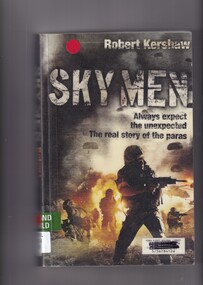
Book, Robert Kershaw, Sky men: The real story of the paras, 2010
... risks, and what marks these sky warriors out from ordinary soldiers. How do military paratroopers conquer the fear of jumping from aircraft at low level, by night, and frequently under fire? ...From the 1930s through WWII to Afghanistan today, from total war to counterinsurgency, this history unravels and defines the intangible qualities that differentiate the "Sky Men" from other soldiers Seventy years ago the Parachute Regiment was formed - the army's elite air assault force was tough, well-trained, and designed to fight hazardous operations behind enemy lines with little or no backup. Dropping into the middle of enemy territory, these "Sky Men"- British, American, German, and Russian soldiers - engage in gruelling combat in the most dangerous conflict zones around the world. Ex-Parachute Regiment officer Robert Kershaw reveals the history of these airborne forces and their role during the most dramatic battles of the 20th century. He finds out what drives a "Sky Man" to take these extraordinary risks, and what marks these sky warriors out from ordinary soldiers. How do military paratroopers conquer the fear of jumping from aircraft at low level, by night, and frequently under fire? Has the helicopter replaced the need for parachutists in the 21st Century? Has the increasing lethality of anti-aircraft weapons made the airborne option redundant? These issues are examined alongside the personal experiences of the Soviet "Locust Warriors," German Fallschirmjäger, British Red Devils, American "devils in baggy-pants," and Les Paras. Based on letters, diaries, and exclusive interviews with soldiers from around the world, this book is full of vivid personalities and nail-biting action.Index, bibliography, notes, ill (b/w), p.348.From the 1930s through WWII to Afghanistan today, from total war to counterinsurgency, this history unravels and defines the intangible qualities that differentiate the "Sky Men" from other soldiers Seventy years ago the Parachute Regiment was formed - the army's elite air assault force was tough, well-trained, and designed to fight hazardous operations behind enemy lines with little or no backup. Dropping into the middle of enemy territory, these "Sky Men"- British, American, German, and Russian soldiers - engage in gruelling combat in the most dangerous conflict zones around the world. Ex-Parachute Regiment officer Robert Kershaw reveals the history of these airborne forces and their role during the most dramatic battles of the 20th century. He finds out what drives a "Sky Man" to take these extraordinary risks, and what marks these sky warriors out from ordinary soldiers. How do military paratroopers conquer the fear of jumping from aircraft at low level, by night, and frequently under fire? Has the helicopter replaced the need for parachutists in the 21st Century? Has the increasing lethality of anti-aircraft weapons made the airborne option redundant? These issues are examined alongside the personal experiences of the Soviet "Locust Warriors," German Fallschirmjäger, British Red Devils, American "devils in baggy-pants," and Les Paras. Based on letters, diaries, and exclusive interviews with soldiers from around the world, this book is full of vivid personalities and nail-biting action.great britain - history - military, great britain - parachute regiment -
 Monbulk RSL Sub Branch
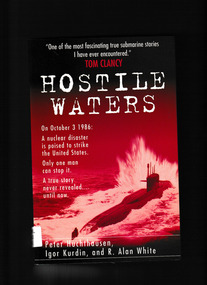
Book, Hutchinson, Hostile waters, 1997
... This is the gripping, true story of the young Soviet sailors who fought to save their submarine, risking fire, smoke, poison gas, and intense radioactivity. ...The cold war was nearly over by 1986, yet under the sea the deadly game of hide-and-seek played by Soviet and American submarines continued unabated. Off the east coast of America, an aging Soviet ballistic missile sub, a "boomer," suffered a crippling accident, coming within moments of a nuclear meltdown. Had her reactors exploded, the radioactivity released into the Gulf Stream would have dwarfed the Chernobyl disaster. This is the gripping, true story of the young Soviet sailors who fought to save their submarine, risking fire, smoke, poison gas, and intense radioactivity. Their secret struggle and sacrifice saved the American coast from nuclear catastrophe. Told in the words of the survivors, it is a story never before revealed outside the submarine community.Bib, ill, p.303.The cold war was nearly over by 1986, yet under the sea the deadly game of hide-and-seek played by Soviet and American submarines continued unabated. Off the east coast of America, an aging Soviet ballistic missile sub, a "boomer," suffered a crippling accident, coming within moments of a nuclear meltdown. Had her reactors exploded, the radioactivity released into the Gulf Stream would have dwarfed the Chernobyl disaster. This is the gripping, true story of the young Soviet sailors who fought to save their submarine, risking fire, smoke, poison gas, and intense radioactivity. Their secret struggle and sacrifice saved the American coast from nuclear catastrophe. Told in the words of the survivors, it is a story never before revealed outside the submarine community. nuclear submarines - soviet union, nuclear submarines - accidents -
 Bendigo Historical Society Inc.
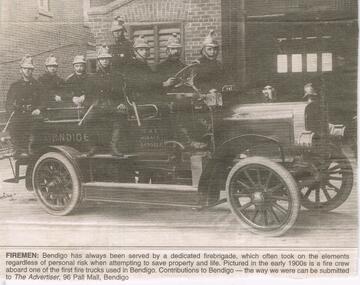
Newspaper - JENNY FOLEY COLLECTIONL FIREMEN
... Firemen: Bendigo has always been served by a dedicated fire brigade, which often took on the elements regardless, of personal risk when attempting to save property and life. ...Firemen: Bendigo has always been served by a dedicated fire brigade, which often took on the elements regardless, of personal risk when attempting to save property and life. ...Bendigo Advertiser "The way we were" from Thursday, April 21, 2005. Firemen: Bendigo has always been served by a dedicated fire brigade, which often took on the elements regardless, of personal risk when attempting to save property and life. Pictured in the early 1900s is a fire crew aboard one of the first trucks used in Bendigo.newspaper, bendigo advertiser, the way we were -
 Bendigo Historical Society Inc.
Document - COHN BROTHERS COLLECTION: WHERE IS IT BOOK
... Hand written in blue ink inside front cover is: Agency Agreement, Fire Insurance, The Coy only to undertake all risks for Stocks in Store & the (sic) and on the oposite pageis: Magnus Cohn on Bent Newell....Hand written in blue ink inside front cover is: Agency Agreement, Fire Insurance, The Coy only to undertake all risks for Stocks in Store & the (sic) and on the oposite pageis: Magnus Cohn on Bent Newell. ...Document. Cohn Bros. Collection. Black covered notebook with red, blue, lt blue, cream & black marbled pattern on the inside front & back covers. Alphabet index book contains information relating to business, number of drinks to a hogshead, cost of running a motor lorry & Municipal Rates to 30/9/22. Hand written in blue ink inside front cover is: Agency Agreement, Fire Insurance, The Coy only to undertake all risks for Stocks in Store & the (sic) and on the oposite pageis: Magnus Cohn on Bent Newell.organization, business, cohn bros, cohn bros. collection, brewers, cordial & aerated water manufacturers, index book -
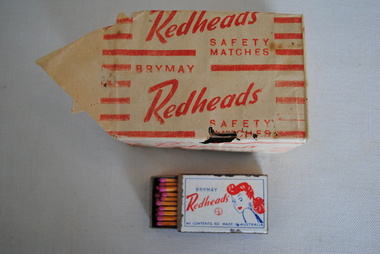 Anglesea and District Historical Society
Safety Matches, Bryant & May, Estimated: 1st in 1946
... "Safety matches" presented fewer health risks than earlier matches and greatly minimizes the risk of accidental fire...."Safety matches" presented fewer health risks than earlier matches and greatly minimizes the risk of accidental fire. Safety Matches Bryant & May. ...Carton (paper) with 12 boxes of Brymay Redhead matches containing 20 matches. The boxes depict the head and left shoulder of a red-headed woman and has had 4 major updates since the Logo's introduction in 1946. "Safety matches" presented fewer health risks than earlier matches and greatly minimizes the risk of accidental fire.Top: BRYMAY Redheads. (1/3). Box: Drawing of head and shoulders of red-headed girl (long hair tied back). Av. contents 60 made in Australia.brymay, redheads -
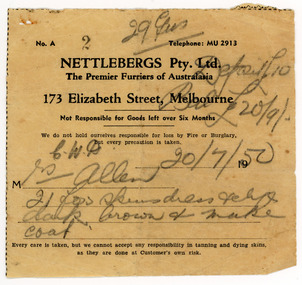 National Wool Museum
Document - Receipt, Fox Fur Coat, Nettlebergs Pty Ltd, Nettlebergs Pty. Ltd, 20/7/1950
... Fire or Burglary, / but every precaution is taken. / 19 / M / Every care is taken, but we cannot accept any responsibility in tanning and dying skins, / as they are done at Customer's own risk. ...Fire or Burglary, / but every precaution is taken. / 19 / M / Every care is taken, but we cannot accept any responsibility in tanning and dying skins, / as they are done at Customer's own risk. ...This receipt is for a fox fur coat made in Melbourne in 1950 by Nettlebergs. It is associated with the fox fur coat in the National Wool Museum Collection, NWM-9090. "The foxes were shot in the 1950's by my Father, Charles Winnet Daniel Allen at two properties around Bacchus Marsh. One was Greystones at Glenmore, owned by the O'Keith family and the other was at Parwan, owned by the Miles Family. In the late 1940's and early 1950's, the Government put a bounty on the fox head. A pair of ears were sent to the Council and you were paid 2 pennies and the skins were sold to a skin buyer. My Father would go out on moon lit nights and shoot the foxes then skin them, which he would peg on a board to dry. He took 21 fox skins to Nettlebergs Pty. Ltd., Furriers at 173 Elizabeth Street Melbourne, Victoria, to have this coat made for my Mother, Gladys Eileen Allen. It cost Twenty Pound and Nine Shillings to have the skins made into this coat. My Father died on the 1st July 1982 and my Mother on the 15th October 1993, aged 76. This coat was inherited by me Theresa Joy Hodge (nee Allen) on the passing of my Mother. I have worn it on cold days, but seeing that I am 84 and the coat is 74 years old, I would like to donate it to you, as I have no-one to leave it to and hope that you and the visitors to your Museum will enjoy looking at it." Theresa Hodge, 2025 Theresa was a dairy farmer, who grew up in Bacchus Marsh with her parents, before moving to South Australia in 1980 to a 167 acre farm in Burrungale.Single sided paper receipt with black printed text and handwritten text in pencil.front: [printed] No. A / 2 / Telephone: MU 2913 / NETTLEBERGS Pty. Ltd. / The Premier Furriers of Australasia / 173 Elizabeth Street, Melbourne / Not Responsible for Goods left over Six Months / We do not hold ourselves responsible for loss by Fire or Burglary, / but every precaution is taken. / 19 / M / Every care is taken, but we cannot accept any responsibility in tanning and dying skins, / as they are done at Customer's own risk. front: [handwritten] 29 ? / Deposit £10 / Bal £20/9 / C. W. A. 20/7/50 / Mrs Allen / 21 fox skins dress pelts / dark brown + make / coatfox fur coat, fashion, hunting, pest eradication, farming, rural life, bacchus marsh, greystones, glenmore, parwan, fox, nettlebergs pty ltd, furriers, clothing, theresa hodge, charles allen, gladys allen
