
Showing 61 items matching "flying on the ground"
-
 Moorabbin Air Museum
Book - Flight Simulation & Simulators, The Pilot Maker
... Flying on the ground...Flight Simulation & Simulators Flying on the ground The birth of the first simulator Army takes the trainer Trainers to simulators The age of sophistication The airlines & the computer Simulation & the space program Future unlimited Story of flight simulation, circa 1970 The Pilot Maker Book Flight Simulation & Simulators ...Story of flight simulation, circa 1970non-fictionStory of flight simulation, circa 1970flying on the ground, the birth of the first simulator, army takes the trainer, trainers to simulators, the age of sophistication, the airlines & the computer, simulation & the space program, future unlimited -
 National Vietnam Veterans Museum (NVVM)
Photograph - Digital Image, 9 Squadron
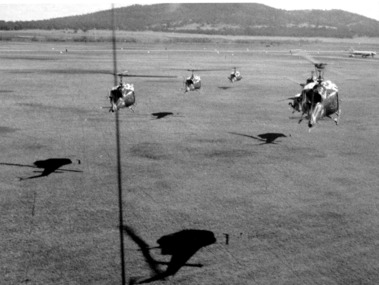
... B&W image of 4 helicopters flying low over flat ground, with shadows below them. ...This image is of helicopters flying back to the RAAF base, Fairbairn, Canberra, ACT helicopter 9 Squadron No9 Squadron 9 Sqn RAAF McDiarmid Service No: A222880 RAAF Base Fairbairn B&W image of 4 helicopters flying low over flat ground, with shadows below them. ...Part of a collection of 13 images donated by Kevin Rowland McDiarmid, Service No: A222880, Leading Aircraftman, Aircraft fitter who served with Royal Australian Air Force No.9 Squadron, 30 Apr 1968 –16 Apr 1969. This image is of helicopters flying back to the RAAF base, Fairbairn, Canberra, ACTB&W image of 4 helicopters flying low over flat ground, with shadows below them. In the distance is a plane beside a landing strip and beyond that is a mountain.helicopter, 9 squadron, no9 squadron, 9 sqn, raaf, mcdiarmid, service no: a222880, raaf base fairbairn -
 Bendigo Military Museum
Photograph - PHOTOGRAPH of an AIRPLANE, RAAF, c1942
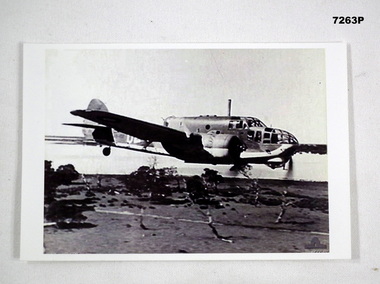
... This is a black and white photo of a twin engine Beaufort Bomber in flight. It is flying low to the ground. Under the plane is flat ground with a few gum trees. ...This is a black and white photo of a twin engine Beaufort Bomber in flight. It is flying low to the ground. Under the plane is flat ground with a few gum trees. ...This photo relates to Ronald Leslie Schorey Dickinson RAAF, refer Cat No 7260 for service details. This is a black and white photo of a twin engine Beaufort Bomber in flight. It is flying low to the ground. Under the plane is flat ground with a few gum trees. In the background is a water way of some sort.Written on the back in blue ink is; "Beaufort Bomber being flown at Sale by Flying Officer Peter John Gibbs D.F.C in 1942. When I was at RAAF Laverton as a RAAF Cadet in 1942, F/O Peter Gibbs took me for my first ever flight in a similar plane".ww2, photo, aircraft, beaufort bomber -
 Bendigo Historical Society Inc.
Postcard - BASIL WATSON COLLECTION: POSTCARD. BROOKLANDS MOTOR TRACK AND FLYING GROUND, ca. 1914
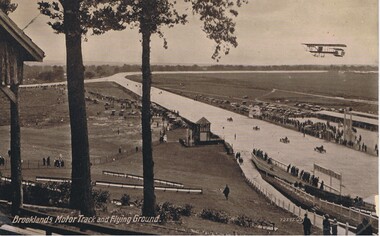
... BROOKLANDS MOTOR TRACK AND FLYING GROUND...On bottom of postcard: 'Brooklands Motor Track and Flying Ground' . Track shown with four racing cars near finish. ...flying above this scene. Postcard BASIL WATSON COLLECTION: POSTCARD. BROOKLANDS MOTOR TRACK AND FLYING GROUND ...On bottom of postcard: 'Brooklands Motor Track and Flying Ground' . Track shown with four racing cars near finish. Biplane flying above this scene.Valentine's Seriesaviation, civilian, brooklands motor track -
![Sculpture - Bas-relief, Untitled [Early Agricultural Industries], n.d](/media/collectors/4f729f5597f83e03086015b1/items/655a82f77f3f3810362edbc4/item-media/655a83c17f3f3810362ef7db/item-fit-380x285.jpg?cb=6) Glenelg Shire Council Cultural Collection
Glenelg Shire Council Cultural CollectionSculpture - Bas-relief, Untitled [Early Agricultural Industries], n.d
... Three birds are flying close to the ground in the foreground, and there is a stylized sunburst (a partial circular form with radiating lines) depicted in the background. ...Three birds are flying close to the ground in the foreground, and there is a stylized sunburst (a partial circular form with radiating lines) depicted in the background. ...Commissioned by State Bank to produce 5 copper bas-reliefs for 73 Percy Street, Portland. Spoke with Miss Betty Vivian (Member of the Portland Historical Society) re Portland's history. Commonwealth Bank stored objects in Melbourne (c.1991). Negotiations between Portland Historical Society and Commonwealth Bank of Australia led to gift of works to People of Portland. Stored at Council depot c.1998, retrieved for Maritime Discovery Centre display.Copper bas-relief depicting two horses pulling a plow, which a man is walking behind and guiding. Three birds are flying close to the ground in the foreground, and there is a stylized sunburst (a partial circular form with radiating lines) depicted in the background. More abbreviated bird forms are depicted against the sun and sky.sculpture, bas-relief, copper -
Port Melbourne Historical & Preservation Society
Photograph - Various aircraft, Ron Laing, 1990s
... A set of 22 colour photographs on flight, including Whitman's air ship, aircraft over Avalon Air Show, helicopters - both flying advertising flags and on the ground at the beach, and several hot air balloons and their near misses at the beach in Port Melbourne, 1990s...Donated to the PMH&PS by the photographer. transport - aviation and aerodrome celebrations fetes and exhibitions ron laing A set of 22 colour photographs on flight, including Whitman's air ship, aircraft over Avalon Air Show, helicopters - both flying advertising flags and on the ground at the beach, and several hot air balloons and their near misses at the beach in Port Melbourne, 1990s Photograph Various aircraft Ron Laing ...Part of Ron Laing's collection of photographs recording Port Melbourne over a thirteen year period. Donated to the PMH&PS by the photographer.A set of 22 colour photographs on flight, including Whitman's air ship, aircraft over Avalon Air Show, helicopters - both flying advertising flags and on the ground at the beach, and several hot air balloons and their near misses at the beach in Port Melbourne, 1990stransport - aviation and aerodrome, celebrations fetes and exhibitions, ron laing -
 Bendigo Historical Society Inc.
Postcard - BASIL WATSON COLLECTION: BROOKLANDS MOTOR TRACK AND FLYING GROUND
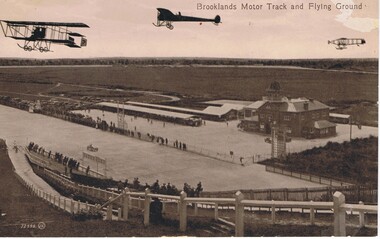
... BASIL WATSON COLLECTION: BROOKLANDS MOTOR TRACK AND FLYING GROUND...The postcard shows three planes flying above the Brooklands motor track with 'Brooklands Motor Track and Flying Ground'. ...Postcard BASIL WATSON COLLECTION: BROOKLANDS MOTOR TRACK AND FLYING GROUND ...The postcard shows three planes flying above the Brooklands motor track with 'Brooklands Motor Track and Flying Ground'. To the right is a large two story brick building and on the left of the building is a long open covered vehicle stall. To the back are work sheds, further to the left are spectators cars and in the distance is open space with trees. Spectators line the race track both sides watching a racing car. In the foreground is a hill with fencing down to the track and spectators along the fence.Valentine Seriesaviation, civilian, brooklands motor track -
 Shepparton RSL Sub Branch
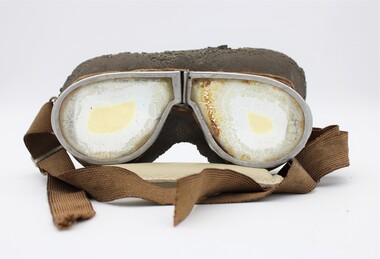
Goggles
... Flying Corps in the First or Second World War. Unlike other examples, this set does not have fur lined interior suggesting that it may have been used by ground crew rather than those at altititude....Flying Corps in the First or Second World War. Unlike other examples, this set does not have fur lined interior suggesting that it may have been used by ground crew rather than those at altititude. flying royal australian air force raaf flying corps goggle eyemask aviation equipment pilot first world war second world war Goggles constructed of various materials: rubber edging, metal frames, plastic lens, canvas sides and elastic strap attached via metal buckles. ...Flying goggles possibly used by a member of the Flying Corps in the First or Second World War. Unlike other examples, this set does not have fur lined interior suggesting that it may have been used by ground crew rather than those at altititude.Goggles constructed of various materials: rubber edging, metal frames, plastic lens, canvas sides and elastic strap attached via metal buckles. Rubber hand stitched to convas sides. Lens cracked and yellowed in centre.flying, royal australian air force, raaf, flying corps, goggle, eyemask, aviation, equipment, pilot, first world war, second world war -
 Glenelg Shire Council Cultural Collection
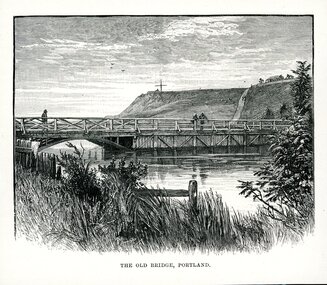
Artwork, other - Illustration, THE OLD BRIDGE, PORTLAND, n.d
... ground has part of a fence visible through long grass and some shrubbery. Observatory Hill in background with a large cross structure on the top to the left. A road or path is visible up the side of the hill towards a dwelling with a panel fence and trees. Two people are on the path and what appears to be 3 sheep to the left of them grazing on the hill. Sky appears cloudy with 3 birds flying...ground has part of a fence visible through long grass and some shrubbery. Observatory Hill in background with a large cross structure on the top to the left. A road or path is visible up the side of the hill towards a dwelling with a panel fence and trees. Two people are on the path and what appears to be 3 sheep to the left of them grazing on the hill. Sky appears cloudy with 3 birds flying ...Illustration. Taken and cut from a book. View of bridge across Salt Creek. Bridge has the appearance of being timber and features to the left of the bridge a half arch opening through to the other side of the creek. 3 people are on the bridge. Fore ground has part of a fence visible through long grass and some shrubbery. Observatory Hill in background with a large cross structure on the top to the left. A road or path is visible up the side of the hill towards a dwelling with a panel fence and trees. Two people are on the path and what appears to be 3 sheep to the left of them grazing on the hill. Sky appears cloudy with 3 birds flying. Underneath is written THE OLD BRIDGE, PORTLAND.portland victoria -
Glenelg Shire Council Cultural Collection
Photograph - Photograph - Portland, Victoria, n.d
... ground in prone position, with rifles. 7775 - Black and white photo. Rural setting, hills in background. Several men sitting on benches or standing near an easel with a board on it, all with backs to camera. Old ute and motorbike on right, several firearms leaning against benches, flag flying...ground in prone position, with rifles. 7775 - Black and white photo. Rural setting, hills in background. Several men sitting on benches or standing near an easel with a board on it, all with backs to camera. Old ute and motorbike on right, several firearms leaning against benches, flag flying ...Black and white photo. Same location as 7775, photo taken from front of group, some on ground in prone position, with rifles. 7775 - Black and white photo. Rural setting, hills in background. Several men sitting on benches or standing near an easel with a board on it, all with backs to camera. Old ute and motorbike on right, several firearms leaning against benches, flag flying. Possible at the Portland rifle range. -
 Rye RSL Sub Branch
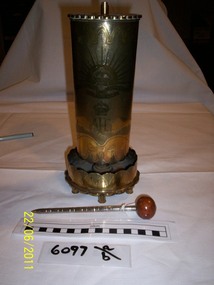
Dinner Gong
... A slightly smaller diameter inverted as the 'gong' with decorative engravings depicting, a Rising Sun emblem on a decorated back ground, 'AFC' (Australian Flying Corps) crowned wings, on the same decorated back ground. ...Flying Corps, the beginings of the Royal Australian Air Force. It relates to the embrionic stages of a part of the now Australian Defence Force. A commemorative Dinner Gong construted from Artillery Shell Casings of various sizes. The largest cut short at the bottom, mounted on rifle or machine gun casings cut short as 'feet'. A slightly smaller diameter inverted as the 'gong' with decorative engravings depicting, a Rising Sun emblem on a decorated back ground ...Hand theatre made "trench art", utilising used artillery brass shell casings, of various calibres, hand made with such "tools" as were available at the time. They have been decoratively trimmed at the mouth of each with a "scalloped" pattern, the shallowest casing mounted on small arms casings as "feet" and the large casing inverted engraved and embossed with a depiction of the Australian Commonwealth Military Forces "Rising Sun" badge.This "Dinner Gong" and "Striker" are significant Historically and Socially, as it is believed to be the only example of a dinner gong and striker made in theatre as contemporary "trench art" by serving members of this group. Around the top of the main part of the Gong are stamped the initials of the Australian members of the Royal Flying Corps at the time, it is of possible National historical significance, as they were such a small group at best, and a highly vulnerable group, quite likely to not survive the conflict. This group and their desendants went on to be a part of the formation of the Australian Flying Corps, the beginings of the Royal Australian Air Force. It relates to the embrionic stages of a part of the now Australian Defence Force.A commemorative Dinner Gong construted from Artillery Shell Casings of various sizes. The largest cut short at the bottom, mounted on rifle or machine gun casings cut short as 'feet'. A slightly smaller diameter inverted as the 'gong' with decorative engravings depicting, a Rising Sun emblem on a decorated back ground, 'AFC' (Australian Flying Corps) crowned wings, on the same decorated back ground. The open ends of these larger casings is 'scalloped' and decorated beautifully, while the closed ends have a 'pie crust effect around the flanged edge. There is a biforcated mount at the top to hold the 'striker' made from white metal ballastered rod with a wooden eliptical knob. On the top around the striker mount are stamped the initials of those believed to be the first Australian Aviators in the then AFC. -
 Bendigo Military Museum
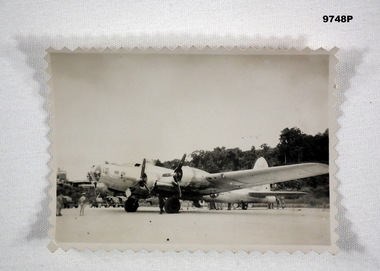
Photograph - PHOTOGRAPH, BENNETTS
... Flying Fortress". Black and white photograph of a large propellor powered aeroplane. Aircraft ground crew visible on tarmac. ...Part of the Bennetts Collection. See Catalogue No. 9726P for details of service for "Alva Marie Bennetts"Black and white photograph of a large propellor powered aeroplane. Aircraft ground crew visible on tarmac. Four jeeps visible in background. Photograph has a white border which has been trimmed with pinking shears.handwritten on back in black ink: American "Flying Fortress".bennetts collection, alva bennetts, flying fortress, boeing b17. -
 Bendigo Military Museum
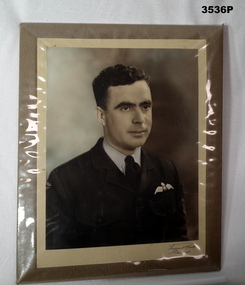
Film - PHOTOGRAPH, FRAMED
... ground staff were from Rhodesia. Fred flew on the Nuremberg Raid on 30/31.3.1944 which suffered the costliest in terms of RAF losses in a single night. A total of 779 aircraft were on the raid & 105 aircraft were lost with 534 crew & 157 captured. His Sqd during the war had the 3rd highest losses in Bomber Command. Fred flew 35 missions in total & was awarded the Distinguished Flying...ground staff were from Rhodesia. Fred flew on the Nuremberg Raid on 30/31.3.1944 which suffered the costliest in terms of RAF losses in a single night. A total of 779 aircraft were on the raid & 105 aircraft were lost with 534 crew & 157 captured. His Sqd during the war had the 3rd highest losses in Bomber Command. Fred flew 35 missions in total & was awarded the Distinguished Flying ...Frederick Gardner DAVEY was born in Bendigo & worked at Hume & Iser prior to enlisting. He initially enlisted as No V24918 in the 17th Machine Gun Regt in 1939 aged 22. Fred was discharged from the Army with the rank of Sgt in 10.9.1941. He then applied to join the RAAF & was finally accepted & began his service on 30.1.1942 No 410533. Finally he was posted to No 44 Sqd RAF Rhodesian which were Lancasters on 16.3.1944, so named because 25% of the aircrew & ground staff were from Rhodesia. Fred flew on the Nuremberg Raid on 30/31.3.1944 which suffered the costliest in terms of RAF losses in a single night. A total of 779 aircraft were on the raid & 105 aircraft were lost with 534 crew & 157 captured. His Sqd during the war had the 3rd highest losses in Bomber Command. Fred flew 35 missions in total & was awarded the Distinguished Flying Cross in 1944. He was presented with his DFC at an investure at Buckingham Palace on 18.5.1945. Fred was discharged from the RAAF with the rank of Flying Officer on 28.9.1945.Framed colour portrait photo of a man in RAAF uniform. Frame is metal with photo covered in clear plastic. Folding stand attached at back.On mounting of photo: Vincent Riely Bendigophotography, portrait, raaf -
 Bendigo Military Museum
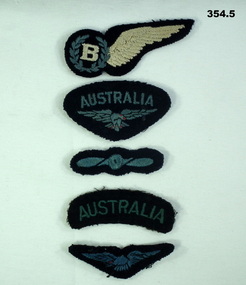
Uniform - CLOTH BADGES, RAAF, 1939-45
... ground staff No. From 12.2.1942 to 12.9.43 he went through various courses at Sale, Lake Boga, Somerset, Richmond and Adelaide. Finally accepted into Aircrew he embarked from Melbourne for Canada for training as a Bomb Aimer on 27.9.1943, arriving Canada via San Francisco 19.10.1943. He then attended Bomb Aimers Courses at Mossbank and Edmonton. Granted a Commission as a Flying...ground staff No. From 12.2.1942 to 12.9.43 he went through various courses at Sale, Lake Boga, Somerset, Richmond and Adelaide. Finally accepted into Aircrew he embarked from Melbourne for Canada for training as a Bomb Aimer on 27.9.1943, arriving Canada via San Francisco 19.10.1943. He then attended Bomb Aimers Courses at Mossbank and Edmonton. Granted a Commission as a Flying ...The patches and insignia belonged to Arthur COWLEY RAAF. (Born Collingwood, enlisted Melbourne) on 22.1.1942 age 18 years 6 months as No 50704 which was a ground staff No. From 12.2.1942 to 12.9.43 he went through various courses at Sale, Lake Boga, Somerset, Richmond and Adelaide. Finally accepted into Aircrew he embarked from Melbourne for Canada for training as a Bomb Aimer on 27.9.1943, arriving Canada via San Francisco 19.10.1943. He then attended Bomb Aimers Courses at Mossbank and Edmonton. Granted a Commission as a Flying Officer on 24.3.1943, embark for England 10.4.1944 and posted to various bases for advanced training. Finally on 7.3.1945 he is posted to No 462 Sqd RAAF flying Halifax Bombers in Bomber Command and begins operations from Foulsham. Arthur completes 8 missions before the war is over with Germany. Departs England 28.11.1945 for Australia and is discharged on 11.1.1946. .1) Bomb Aimers Wings, Cloth, dark blue background with White "B" and Wing. .2) Shoulder Badge, cloth, dark blue with light blue "Australia"& Eagle. .3) Rank Badge, light blue propellor on dark blue background. .4) Badge Shoulder, cloth, Australia light blue on a dark background. .5) Badge Shoulder, cloth, light blue eagle on a dark blue background.air force, raaf, badges uniform -
 Waverley RSL Sub Branch
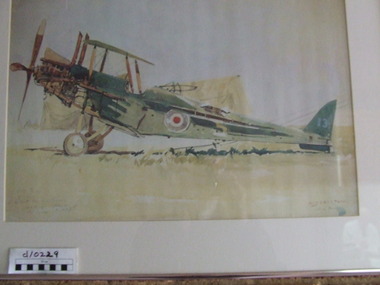
Print WWI Aircraft
... Print of WWI Aircraft on ground showing damage to engine cowling This is a Royal Aircraft Factory RE.8. This plane was used by 3 Squadron, Australian Flying Corps from 1917 onwards, among others. ...Signed Arthur Streeton Print of WWI Aircraft on ground showing damage to engine cowling This is a Royal Aircraft Factory RE.8. This plane was used by 3 Squadron, Australian Flying Corps from 1917 onwards, among others. ...Print of WWI Aircraft on ground showing damage to engine cowling This is a Royal Aircraft Factory RE.8. This plane was used by 3 Squadron, Australian Flying Corps from 1917 onwards, among others. It was nick-named "Harry Tate" after a popular musical artist of the time http://www.3squadron.org.au/indexpages/history1.htm#WW%20I .Signed Arthur Streeton -
 Waverley RSL Sub Branch
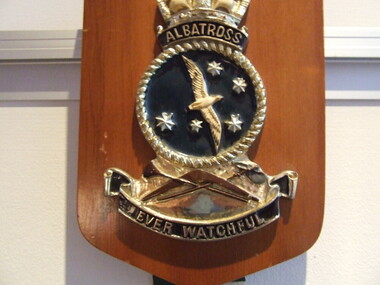
Plaque H.M.A.S. Albatross, H.M.A.S. Albatross
... flying Sea Furies and Fireflies. HMAS Albatross has been expanding ever since. As more capable aircraft have been acquired, so ground support facilities have had to be built. ...flying Sea Furies and Fireflies. HMAS Albatross has been expanding ever since. As more capable aircraft have been acquired, so ground support facilities have had to be built. ...In July 1947, the Commonwealth Defence Council approved the formation of a Fleet Air Arm which would be controlled and operated by the RAN. The initial planning included purchase of two aircraft carriers, aircraft and establishment of shore facilities. The carriers were named HMA Ships Sydney and Melbourne, and the shore facilities were at Nowra. HMAS Albatross was commissioned in August 1948 and the 20th Carrier Air Group, comprising Sea Fury and Firefly aircraft, was brought from England to Australia by HMAS Sydney. These aircraft, operated by 805 and 816 Squadrons, disembarked to Nowra in May 1949. In November 1950, they were joined by the Carrier Air Group of 808 and 817 Squadrons, also flying Sea Furies and Fireflies. HMAS Albatross has been expanding ever since. As more capable aircraft have been acquired, so ground support facilities have had to be built. In 1955, Sea Venoms and Gannets arrived, requiring radar workshops and test facilities. More aircraft necessitated stricter standards of air traffic control and a new control tower was built in 1958. In 1964 the introduction of Wessex helicopters, with a dunking sonar capability, required a further expansion of services. In 1965, it was decided to buy American aircraft to replace the ageing British Gannets and Sea Venoms. McDonnell Douglas Skyhawks and Grumman Trackers were chosenand additional avionics facilities were built to service the complex equipment they carried. The helicopters now based at HMAS Albatross have restored to the RAN much of the anti-submarine capability lost when the Tracker squadron was disbanded in 1983. In recent years significant redevelopment has taken place, continuing the operation of HMAS Albatross and recognising its strategic importance as the sole Royal Australian Navy Air Station.Wooden Plaque 15cm x 13cm with insignia of H.M.A.S. Albatross H.M.A.S. Albatross -
 Bendigo Military Museum
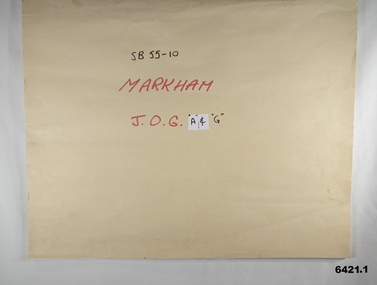
Map - SB55-10 Markham Joint Operations Graphics Air and Ground print separations, Royal Australian Survey Corps, Bendigo, Dec 1981
... The ground users required that heights and measurements were in Metres, whilst air users required height information in Feet for altimeters. The Air Version also contained more Aeronautical information including safe flying height information called Maximum Elevation Figures (MEF). ...The ground users required that heights and measurements were in Metres, whilst air users required height information in Feet for altimeters. The Air Version also contained more Aeronautical information including safe flying height information called Maximum Elevation Figures (MEF). ...This set of map prints was assembled as a training aid. The collection is a complete set of individual color prints of each colour used on the final printed maps for each map Joint Operations Graphic (JOG) JOG Ground and JOG Air versions. This map series was produced in two versions to help coordinate military Ground Operations and Air Operations. The ground users required that heights and measurements were in Metres, whilst air users required height information in Feet for altimeters. The Air Version also contained more Aeronautical information including safe flying height information called Maximum Elevation Figures (MEF). Later printing of JOG incorporated printing in just four colours Cyan, Magenta, Yellow and Black (CMYK). Item 6421.1 is an example of a JOG Ground and item 6421.2 is an example of its matching JOG Air version.1:250,000 SB55-10 Markham JOG A and G colour separations bound together in a manilla card covered folder bound with a timber edge. royal australian survey corps, rasvy, fortuna, army survey regiment, army svy regt, asr -
 Bendigo Military Museum
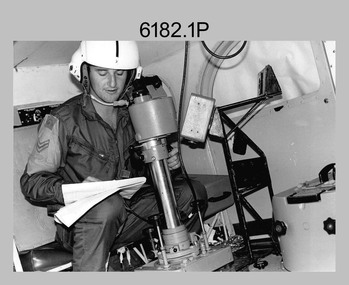
Photograph - Royal Australian Survey Corps Aerial Surveys, c1980
... flying mission with Aerodist, APR and RC10 camera equipment. The Australian Army’s Pilatus Porter (short take-off and landing turbo propeller) was also equipped with a Wild RC10 aerial mapping camera for identification photography. The Pilatus Porter was also used on RA Svy’s map field checking operations. Photo .9P was taken at a survey station at an unknown location. In this photo an Australian Army Kiowa Light Observation Helicopter (LOH) is supporting a field survey party undertaking Magnavox AN/PRR-14 portable Doppler satellite observations. The satellite receiver’s antenna is plumbed over the survey ground...flying mission with Aerodist, APR and RC10 camera equipment. The Australian Army’s Pilatus Porter (short take-off and landing turbo propeller) was also equipped with a Wild RC10 aerial mapping camera for identification photography. The Pilatus Porter was also used on RA Svy’s map field checking operations. Photo .9P was taken at a survey station at an unknown location. In this photo an Australian Army Kiowa Light Observation Helicopter (LOH) is supporting a field survey party undertaking Magnavox AN/PRR-14 portable Doppler satellite observations. The satellite receiver’s antenna is plumbed over the survey ground ...This is a set of nine photographs of technicians from the Royal Australian Survey Corps operating aerial surveys equipment c1980s. In photo .1P, CPL Steve Gloster was operating a RC10 air survey camera mounted in an Australian Army Pilatus Porter aircraft. The Wild RC10 super wide-angle air survey cameras were first introduced in 1971, were equipped with virtual distortion free lenses for supplementary, spot and special photography. In photo .2P, Roger Rees was operating Air Profile Recorder (APR) equipment. it was possibly taken during OP NERVOSE 84, sometime between June – August 1984 when based in Ngukurr, Northern Territory. The APR was operated at this time in unison with an RC10 camera. In 1963 the Royal Australian Survey Corps introduced the radar airborne profile recorder (Canadian Applied Research Ltd, Mark V, Airborne Profiler Recorder) was introduced for 1:100,000 mapping to replace terrain heighting by aneroid barometry. Later in 1974-1975, the Australian developed WREMAPS II airborne laser terrain profile recorder was introduced. In photo .3P, Neil Jones appears at the door of Airsearch Beechcraft Queen Air aircraft, Registration / Serial VH-MWX. This aircraft was typically used by RA Svy on air survey operations flying mission with Aerodist, APR and RC10 camera equipment. The Australian Army’s Pilatus Porter (short take-off and landing turbo propeller) was also equipped with a Wild RC10 aerial mapping camera for identification photography. The Pilatus Porter was also used on RA Svy’s map field checking operations. Photo .9P was taken at a survey station at an unknown location. In this photo an Australian Army Kiowa Light Observation Helicopter (LOH) is supporting a field survey party undertaking Magnavox AN/PRR-14 portable Doppler satellite observations. The satellite receiver’s antenna is plumbed over the survey ground mark surrounded by white plastic panels. The panels were used to identify the survey station on aerial photography. Introduced in 1974–1975, the Magnavox AN/PRR-14 portable Doppler satellite (US Navy Navigation Satellite System – TRANSIT) receivers and computing system provided independent three-dimensional point positions anywhere in the world, anytime, in any weather accurate to about 1.5metres with precise satellite ephemerides. The Bell OH-58 Kiowa LOH was a family of military helicopters used for observation, utility, and direct fire support. It was identified by RA Svy in the mid-1970s that considerable time was lost in replacing unserviceable remote equipment by road. Therefore Aerodist operations (pre-dating satellite receiver operations) were fully supported by Army’s Kiowa LOH aircraft. This is a set of nine photographs of technicians from the Royal Australian Survey Corps operating aerial surveys equipment c1980s. .1P to .3P, .5P to .9P - Colour and black and white photos on photographic paper and scanned at 300 dpi. .4P - Colour photo on 35mm slide film and scanned at 96 dpi. .1) & .2) - Photo, black & white, c1980s, CPL Steve Gloster operating an RC10 air camera. .3) - Photo, colour, 1984, Roger Rees operating Air Profile Recorder (APR) equipment. .4) - Photo, colour, c1980s, Neil Jones at the door of an Airsearch Beechcraft Queen Air aircraft, typically used by RA Svy on air survey operations. .5) - Photo, colour, c1980s. A Beechcraft King Air aircraft, also used by RA Svy on air survey operations. .6) - Photo, colour, c1980s. An Australian Army Pilatus Porter, used by RA Svy on air survey and map field checking operations. SGT Peter Mustart is possibly in the foreground. .7) to .8) - Photo, colour, c1980s. An Australian Army Pilatus Porter and unidentified personnel, used by RA Svy on air survey and map field checking operations. .9) - Photo, colour, c1980s. An Australian Army Kiowa helicopter supporting a field survey party undertaking Magnavox AN/PRR-14 portable Doppler satellite observations. There are biro marks on photos .4P to .9Proyal australian survey corps, rasvy, army survey regiment, asr, fortuna, aerial surveys -
 Bendigo Military Museum
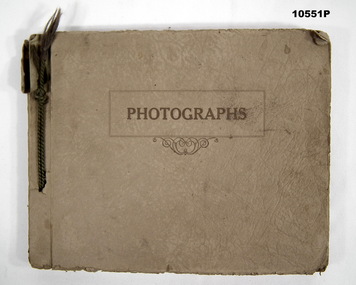
Album - PHOTOGRAPH ALBUM, Unknown
... Inside various photos of WW1 era planes and naval ships (including the HMS Hood) and some pictures of ground crew. On 1st inside page of album identifying flying squadron No. 671....Inside various photos of WW1 era planes and naval ships (including the HMS Hood) and some pictures of ground crew. On 1st inside page of album identifying flying squadron No. 671. ...Name inside was G.H. Sainsbury, Squadron 671, No. 3 Flt group. Wikipedia said this was a Glider Squadron. In WW2 that never saw action as war finished against Japan prior to entering action. Photos seem inconsistent with this in time and type. Part of the William (Bill) Thomason collection. Refer Cat No. 4136P.Brown photo album with brown string binding. Inside various photos of WW1 era planes and naval ships (including the HMS Hood) and some pictures of ground crew. On 1st inside page of album identifying flying squadron No. 671.Title on front "Photographs".collection of william (bill) thomason, photograph album -
 B-24 Liberator Memorial Restoration Australia Inc
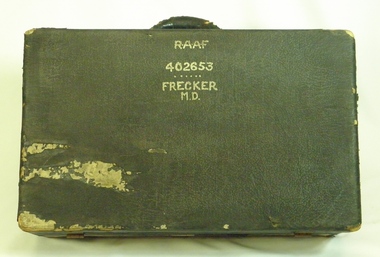
Suitcase from Mason Day Frecker, 1930s
... Suitcase contains Flying Log Book RAAF, Wedding Photo, National Archives Record Search Mason Day Frecker, Distinguished Flying Medal Register WW2 x 3, Papers on Medals and Victorian Ground Crew Numbers, Files 1 - 2 - 3 - Photographs, Leaflets, Pilots' Notes, Maps - Germany (28 maps), Buttons and badges and other medals....Suitcase contains Flying Log Book RAAF, Wedding Photo, National Archives Record Search Mason Day Frecker, Distinguished Flying Medal Register WW2 x 3, Papers on Medals and Victorian Ground Crew Numbers, Files 1 - 2 - 3 - Photographs, Leaflets, Pilots' Notes, Maps - Germany (28 maps), Buttons and badges and other medals. ...Suitcase issued to aircraft captains or crew by RAAF during World War II. The contents of M D Frecker's suitcase include World War II medals awarded to the owner, photographs, maps, pilots' handbooks, language dictionaries (Malay, Pidgin, Japanese), propaganda leaflets dropped by Japanese.Has historical and social significance, also research significance. Provenance known, owner piloted B-24 Liberator bombers and General Blamey's personal aircraft; item was donated by son. Great interpretive potential.Worn dark suitcase belonging to Mason Day Frekker, strong cardboard covered with 'leatherette', metal fasteners on front, with carry handle. Suitcase contains Flying Log Book RAAF, Wedding Photo, National Archives Record Search Mason Day Frecker, Distinguished Flying Medal Register WW2 x 3, Papers on Medals and Victorian Ground Crew Numbers, Files 1 - 2 - 3 - Photographs, Leaflets, Pilots' Notes, Maps - Germany (28 maps), Buttons and badges and other medals."RAAF/402653/Frecker/M.D." on top surface, "M.D.F." on front surface under handle.b24 liberator bomber, world war ii, raaf pilot, world war ii aerial photographs, a22.00 -
 B-24 Liberator Memorial Restoration Australia Inc
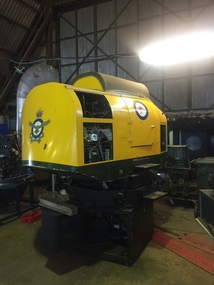
Link Trainer, c.1950
... The instrument Flying Trainer Type D4 MK1 (Link Trainer c1950) is an electrical, mechanical and vacuum operated motion simulator. It was used by the RAAF as ground...link trainer The instrument Flying Trainer Type D4 MK1 (Link Trainer c1950) is an electrical, mechanical and vacuum operated motion simulator. It was used by the RAAF as ground ...The instrument Flying Trainer Type D4 MK1 (Link Trainer c1950) is an electrical, mechanical and vacuum operated motion simulator. It was used by the RAAF as ground equipment in teaching all phases of elementary and advanced instrument flying.link trainer -
 B-24 Liberator Memorial Restoration Australia Inc
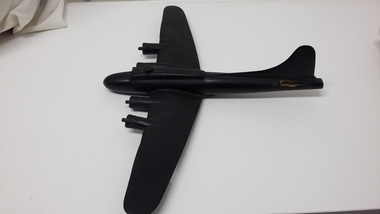
Aircraft Recognition Model, Department of Defence, Model Aircraft, Circa 1940's
... Expanded the skills of recognition for air crew, ground crew and defence activities. "Flying Fortress" Boeing B17E.E9-2324 DS^D DLTDC Large bakelite B17 Flying Fortress aircraft, coloured matt black, including hole for suspension and mobility. ...Created to supply training and recognition of friendly/enemy aircraft.Expanded the skills of recognition for air crew, ground crew and defence activities.Large bakelite B17 Flying Fortress aircraft, coloured matt black, including hole for suspension and mobility."Flying Fortress" Boeing B17E.E9-2324 DS^D DLTDC -
 Monbulk RSL Sub Branch
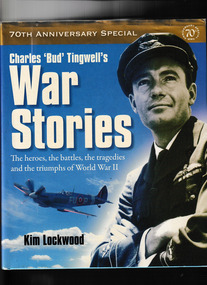
Book, Wilkinson Publishing, Charles 'Bud' Tingwell's war stories : the heroes, the battles, the tragedies and the triumphs of World War II, 2009
... World War 1939-1945 - Australian involvement Charles (Bud) Tingwell ollow Bud's journey from his early days as a young radio announcer in Sydney to his training and voyages across the oceans to Canada, Europe Europe and the Middle East, to his experiences flying aircraft and ground fire while doing his part in providing a valuable service to allied war effort. ...ollow Bud's journey from his early days as a young radio announcer in Sydney to his training and voyages across the oceans to Canada, Europe Europe and the Middle East, to his experiences flying aircraft and ground fire while doing his part in providing a valuable service to allied war effort. This book includes many the biographies of soliders.Index, ill, p.360.non-fictionollow Bud's journey from his early days as a young radio announcer in Sydney to his training and voyages across the oceans to Canada, Europe Europe and the Middle East, to his experiences flying aircraft and ground fire while doing his part in providing a valuable service to allied war effort. This book includes many the biographies of soliders.world war 1939-1945 - australian involvement, charles (bud) tingwell -
 Bendigo Historical Society Inc.
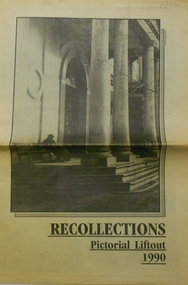
Newspaper - PETER ELLIS COLLECTION: RECOLLECTIONS PICTORIAL LIFTOUT
... flying horses (ride). 14 processions past city hall. 15 Original ANZ bank corner Williamson St. & Pall Mall. 16 Chinese Dragons Bendigo Easter Fair 1940's. 17 City Hall viewed from Bull St. 18 City Hall original ceiling. 19 new town hall 1861. Mike Butcher, local historian. 21 Interior plan of city hall (ground...flying horses (ride). 14 processions past city hall. 15 Original ANZ bank corner Williamson St. & Pall Mall. 16 Chinese Dragons Bendigo Easter Fair 1940's. 17 City Hall viewed from Bull St. 18 City Hall original ceiling. 19 new town hall 1861. Mike Butcher, local historian. 21 Interior plan of city hall (ground ...Historical lift out. Newspaper. Titled RECOLLECTIONS Pictorial Lift out 1990.1 looking down Mitchell St. from Railway Bridge. 2 Original railway station viewed from Mitchell St. bridge. 3 The great extended Hustlers mine. 4 1873 photo recently extended town hall with corn exchange at front left. 5 looking north westerly from city rec reserve at royal hustlers. 6 children play on mullock heap in front of a view of westerly quarter of Sandhurst. 7 Bank of Victoria, Mitchell St. left is Bendigo's original post office. 8 Looking down from what is now Rosalind Park. Shamrock Hotel can be seen on corner of Williamson St. and Pall Mall. This photo predates the construction of post office and law courts. 9 girl eating fairy floss. 10 4 kids on 1 horse in procession. 11 monkey and pedal car, a novelty attraction 1940's. 12 pony rides. 13 flying horses (ride). 14 processions past city hall. 15 Original ANZ bank corner Williamson St. & Pall Mall. 16 Chinese Dragons Bendigo Easter Fair 1940's. 17 City Hall viewed from Bull St. 18 City Hall original ceiling. 19 new town hall 1861. Mike Butcher, local historian. 21 Interior plan of city hall (ground floor) 22 circa 1920's 23 Tattered fragment original architect's drawing. 24 original assembly room. 25 Camp Hill PS Shamrock hotel without top story 27 shop with signage advertising Bushells, Bex and Swallow's Biscuits. 28 View from where fountain is now. 29 Hargreaves St. Looking south, now Hargreaves mall. Horse drawn water tank watering down road. 30 Central Deborah Gold mine poppet head. 31 Borough town hall, tram ways. 32 Original ANZ Bank corner Williamson St. and Pall Mall, demolished in mid 1960's. 33 Bush's store corner Williamson and Myer streets.34 Men on boat, don't know what or where. 35 Shearers. 36 men on a three wheeled bike. 37 4 Gold miners with shovels. 38 6pm closing, no trade Sundays, no women in main bar. 39 Peaceful scene Castlemaine 1940's Photographer Allan Doney. 40 Qantas Jet the City of Bendigo Tullamarine Airport. BCV-8 camera man & Advertiser photographer. 41 Ladies. 42 Tennis -> men and women (women in hats). 43 Sandhurst footy team. 44 Early school photos.bendigo, history, photographic history -
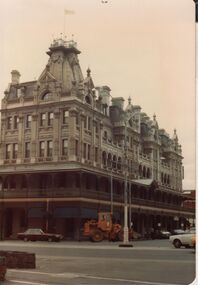 Bendigo Historical Society Inc.
Photograph - BENDIGO HOTEL COLLECTION: SHAMROCK HOTEL, PALL MALL, BENDIGO
... ground floor and balcony on first floor. Shamrock Hotel situated on corner of Williamson Street and Pall Mall, Bendigo. Cupola on roof, flag flying...ground floor and balcony on first floor. Shamrock Hotel situated on corner of Williamson Street and Pall Mall, Bendigo. Cupola on roof, flag flying ...Colour photograph: four storey brick hotel, grey render. Verandah on ground floor and balcony on first floor. Shamrock Hotel situated on corner of Williamson Street and Pall Mall, Bendigo. Cupola on roof, flag flying on top. Ornate façade. Photo potentially early 1980's?bendigo, hotel, shamrock hotel -
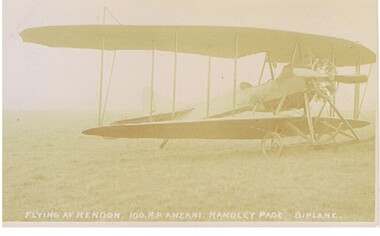 Bendigo Historical Society Inc.
Postcard - BASIL WATSON COLLECTION: POSTCARD 100 HP ANZANI HANDLEY PAGE BIPLANE
... Biplane on ground. On bottom ' Flying at Hendon, 100 H.P. Anzani, Handley Page, Bi-plane'....Biplane on ground. On bottom ' Flying at Hendon, 100 H.P. Anzani, Handley Page, Bi-plane'. ...Postcard: faded sepia. Biplane on ground. On bottom ' Flying at Hendon, 100 H.P. Anzani, Handley Page, Bi-plane'.aviation, civilian, anzani handley, basil watson -
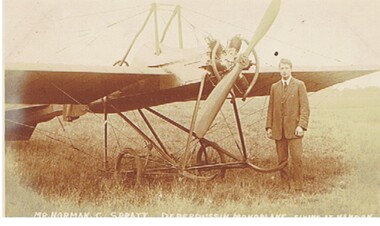 Bendigo Historical Society Inc.
Postcard - BASIL WATSON COLLECTION: DEPERDUSSIN MONOPLANE AT MENDON
... ground. Man in three piece suit on right hand front of photo. Written on bottom of card in white ' Mr. Norman C. Spratt, Deperdussin Monoplane flying...ground. Man in three piece suit on right hand front of photo. Written on bottom of card in white ' Mr. Norman C. Spratt, Deperdussin Monoplane flying at Mendon' Postcard BASIL WATSON COLLECTION: DEPERDUSSIN MONOPLANE AT MENDON ...Postcard: monoplane sitting on ground. Man in three piece suit on right hand front of photo. Written on bottom of card in white ' Mr. Norman C. Spratt, Deperdussin Monoplane flying at Mendon'aviation, civilian, deperdussin monoplane, basil watson, norman c. spratt, deperdussin monoplane. mendon. -
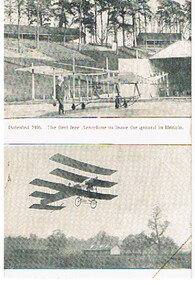 Bendigo Historical Society Inc.
Postcard - BASIL WATSON COLLECTION: AVRO PLANE
... On top aeroplane, 'Patented 1906, the first free aeroplane to leave the ground in Britain' On bottom of card, photo of three tiered wing aeroplane. Written on bottom' Avro' plane flying with only 14 h.p. ...On top aeroplane, 'Patented 1906, the first free aeroplane to leave the ground in Britain' On bottom of card, photo of three tiered wing aeroplane. Written on bottom' Avro' plane flying with only 14 h.p. ...Postcard: black and white card - two sections. On top aeroplane, 'Patented 1906, the first free aeroplane to leave the ground in Britain' On bottom of card, photo of three tiered wing aeroplane. Written on bottom' Avro' plane flying with only 14 h.p. On back of card: The 'Avro'plane. The first aeroplane illustrated was the first free heavier-than-air machine to leave the the ground. Before this however, very interesting flights were made when towed by a motor car at Brooklands Track. The other photo shows a flight with 14 horse power, but previous to this some hundreds of flights were made with only a nine horse power engine. A record which has not yet been beaten or equalled. Mr. A.V. Roe is now making monoplanes, biplanes and triplanes &c. For full particulars please write to A.V. Roe & Co., Brownsfield Mills, Manchester.aviation, civilian, avro biplane, basil watson, biplane, aeroplane -
 National Vietnam Veterans Museum (NVVM)
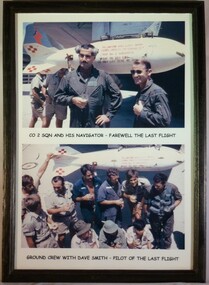
Photograph - Two Coloured Photograph is a Timber Frame Titled CO 2 Sqn and His Navigator -Farewell the last flight and Ground crew with pilot of The Last Flight Dave Smith, 1962 - 1972
... Flying Officer David Robert Smith O224754 No 2 Squadron RAAF Royal Australian Air Force Last Flight Photograph Co 2 SQN and his Navigator - Farewell The Last Flight / Ground crew with Dave Smith - Pilot of The Last Flight. ...Two Coloured Photograph is a Timber Frame. The top one is titled CO 2 Sqn and His Navigator -Farewell the last flight and shows the CO talking to another crewman. The bottom photograph is of several ground crew with pilot of the Last flight Dave Smith. The crew are all having a farewell drink.Co 2 SQN and his Navigator - Farewell The Last Flight / Ground crew with Dave Smith - Pilot of The Last Flight.flying officer david robert smith, o224754, no 2 squadron, raaf, royal australian air force, last flight, photograph -
 National Vietnam Veterans Museum (NVVM)
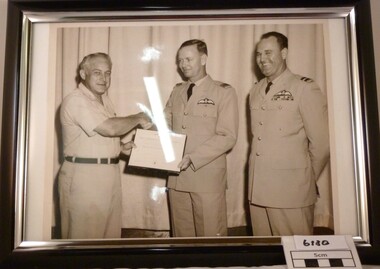
Photograph - Photograph of SQN LDR Alan Reed receiving a citation to accompany Distinguished Flying Cross, C.1968
... CITATION TO ACCOMPANY THE AWARD OF THE DISTINGUISHED FLYING CROSS (First Oak Leaf Cluster) Squadron leader Alan R Reed distinguished himself by extraordinary achievement while participating in aerial flight as and RD-4C Aircraft Commander in Southeast Asia on 24 August 1968. On that date, he flew his aircraft repeatedly through intense hostile ground...CITATION TO ACCOMPANY THE AWARD OF THE DISTINGUISHED FLYING CROSS (First Oak Leaf Cluster) Squadron leader Alan R Reed distinguished himself by extraordinary achievement while participating in aerial flight as and RD-4C Aircraft Commander in Southeast Asia on 24 August 1968. On that date, he flew his aircraft repeatedly through intense hostile ground ...CITATION TO ACCOMPANY THE AWARD OF THE DISTINGUISHED FLYING CROSS (First Oak Leaf Cluster) Squadron leader Alan R Reed distinguished himself by extraordinary achievement while participating in aerial flight as and RD-4C Aircraft Commander in Southeast Asia on 24 August 1968. On that date, he flew his aircraft repeatedly through intense hostile ground fire to obtain complete photographic coverage of the target. In addition, he voluntarily remained in that hostile environment for as long as fuel would allow, to act as a spotter and to pass firing corrections to friendly artillery. The professional competence, aerial skill, and devotion to duty displayed by Squadron Leader Reed reflect great credit upon himself and the United States Air Force. Squadron Leader Alan Reed from the Royal Australian Air Force 052363 served in Vietnam from 26 May 1968 until 20 November 1968. He spent most of his tour detached to the 12th Tactical Reconnaissance Squadron, US Air Force. He was made an Officer of the Order of Australia (AO) in June 1989 for his service to the RAAF as Air Officer Commanding, Support Command. For his service with the USAF, Alan Reed was awarded the United States Distinguished Flying Cross with oak leaf cluster. His final rank with the Air Force was Air Vice Marshal and his last posting was with Headquarters, Australian Force Vietnam (RAAF Element) Black and White photo in black and white frame of SQN LDR Alan Reed receiving a citation to accompany Distinguished Flying Cross 21 /08 /1968. with supporting info.photograph, alan reed, squadron leader alan reed, royal australian air force, raaf, 052363, 12th tactical reconnaissance squadron, united states air force, usaf, officer of the order of australia, air vice marshall allan reed, headquarters, australian force vietnam
