
Showing 49 items matching "food mould"
-
 Clunes Museum
Domestic object - FOOD MOULD
... FOOD MOULD...FOOD MOULD...CHINA FOOD MOULD, CREAM COLOURED WITH RIDGES ON THE OUTSIDE....FOOD MOULD DOMESTIC OBJECT CHINA FOOD MOULD, CREAM COLOURED WITH RIDGES ON THE OUTSIDE. ...CHINA FOOD MOULD, CREAM COLOURED WITH RIDGES ON THE OUTSIDE.food mould, domestic object -
 Flagstaff Hill Maritime Museum and Village
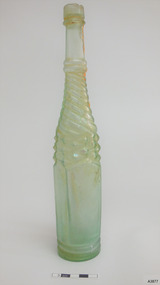
Container - Bottle, 1870s-1910s
... ...two piece mould...food...Items that come from several wrecks, including the Loch Ard, have since been donated to the Flagstaff Hill Maritime Village’s museum collection by his family, illustrating this item’s level of historical value. flagstaff hill warrnambool flagstaff hill maritime museum maritime museum shipwreck coast flagstaff hill maritime village great ocean road shipwreck artefact john chance glass bottle antique bottle handmade mouth blown blown bottle 19th century bottle collectable bottle green glass tinged green two piece mould food bottle oil bottle salad oil bottle whirley whirly half whirley condiment bottle Embossed "133" or “833” (the first character may be an “8”) Bottle; glass Half Whirley salad oil bottle, green-tinged, with some opalescence. ...This clear, green tinged, Half Whirley (or Whirly) salad oil bottle has been handmade by a glassblower from 1870s-1910s. A bottle with such elaborate decoration would have been sought after as there was no need to decant the sauce into another jug or bottle to make it acceptable for table service. It is possible that this bottle was recovered from the Loch Ard, wrecked in 1878. A diver found the bottle on a shipwreck in the coastal waters of Victoria about 100 years from when it was made. The diver who found this bottle has recovered objects from several different shipwrecks between the late 1950s and early 1970s. A sizeable proportion of those objects was from the wreck of the famous clipper ship Loch Ard. This salad oil bottle may very well have been amongst that ship’s cargo. It is part of the John Chance Collection. A paper titled ‘Glass Bottles from the Loch Ard Shipwreck (1878): A Preliminary Study’ by Iain Stuart, (published in Australian Historical Archaeology, 9, 1991) included a study of twelve salad oil bottles from the wreck of the Loch Ard. The bottles were of this same Half Whirley design (half meaning that it was Whirley on the upper half but not on the lower half of the body), as well as the same colour and size. A diagram of one of these twelve bottles matches the bottle in our collection. The paper mentions that eleven of the twelve bottles have a number on their base, just as this one has. It is estimated that foreign and salad oil bottles totalled four percent of all of the bottles carried as cargo on the ship. The Half Whirley bottle has side seams from below the lip to the base, indicating that the bottle was made in a two-piece mould that included the heel, body, shoulder and neck. The fancy ‘whirly’ twist pattern and panelled sides would have been cut into the mould’s inner surface. The uneven thickness of the ridge around the base comes from adding a separately moulded and embossed base after the bottle was removed from the mould. The applied finish (mouth and lip) was also added to the bottle. The elongated bubbles in the glass are evidence of the glass being mouth blown into the mould, thus forming the shape and pattern from the inside shape of the mould. The bottle probably had a glass stopper with a round top and wedge-shaped shank with a ground surface, allowing the bottle to be re-sealed. The ring between upper and lower lip allows the closure to be sealed and anchored. The embossed numbers are either “133” or “833” and may represent a particular bottle pattern, manufacturer or filler. Although the bottle is not currently linked to a particular shipwreck, it is recognised as being historically significant as an example of bottles imported for use in Colonial Victoria in the mid-to-late 19th century. This whirley salad oil bottle is matches the whirley salad oil bottles recovered from the Loch Ard in the 1990s, adding depth of interpretation to the array of salvaged Loch Ard artefacts in Flagstaff Hill’s collection. The salad oil bottle is an example of the type of food condiment containers that were used in Victoria’s early days. The bottle is also significant as it was recovered by John Chance, a diver in Victoria’s coastal waters in the late 1960s to early 1970s. Items that come from several wrecks, including the Loch Ard, have since been donated to the Flagstaff Hill Maritime Village’s museum collection by his family, illustrating this item’s level of historical value. Bottle; glass Half Whirley salad oil bottle, green-tinged, with some opalescence. Handmade, elaborately decorated bottle with round neck and base, and five-sided body. Applied double lip; straight upper, flared lower. The lower neck and shoulder have twisted spiral whirley patterns in the glass. The body tapers slightly inwards towards the base. It has five plain panels, one wider than the others. Side seams run from below the lip to the heel. The heel of the bottle is uneven in width, height and density where it joins the body of the bottle. The base is not level. Embossed characters on base. Glass has elongated bubbles towards the base and orange-brown sediment inside, on one side. Embossed "133" or “833” (the first character may be an “8”) flagstaff hill, warrnambool, flagstaff hill maritime museum, maritime museum, shipwreck coast, flagstaff hill maritime village, great ocean road, shipwreck artefact, john chance, glass bottle, antique bottle, handmade, mouth blown, blown bottle, 19th century bottle, collectable, bottle, green glass, tinged green, two piece mould, food bottle, oil bottle, salad oil bottle, whirley, whirly, half whirley, condiment bottle -
 Flagstaff Hill Maritime Museum and Village
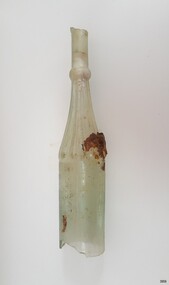
Container - Bottle, Ca. 1855
... ...two piece mould...food...The collection as a whole is historically significant for representing aspects of Victoria's maritime history and its potential to interpret social and historical themes. flagstaff hill warrnambool flagstaff hill maritime museum maritime museum shipwreck coast flagstaff hill maritime village great ocean road shipwreck artefact john chance glass bottle antique bottle handmade mouth blown blown bottle 19th century bottle collectable bottle two piece mould food bottle oil bottle salad oil bottle sauce bottle condiments bottle neck ring ribbed sides Bottle; slim, round, clear, slightly green-tinged, glass condiment bottle, possibly for salad oil or sauce. ...The slim, green-tinged clear glass condiment bottle was possibly used for storing and serving sauce or salad oil. The handmade bottle would have had an applied lip. It has hand blown into a two-piece mould that finished just below the neck ring, with the rest of the neck and mouth hand blown. It was recovered from the wreck of the Schomberg. ABOUT THE SCHOMBERG (October 6 to December 27, 1855)- When the ship Schomberg was launched in 1855, she was considered the most perfect clipper ship ever to be built. James Baine’s Black Ball Line had commissioned her for their fleet of passenger liners. The Aberdeen builders designed her to sail faster than the clippers designed the three-masted wooden clipper ship to be fast. The timber used for the diagonal planking was British oak with layers of Scottish larch. This luxury emigrant vessel was designed for superior comfort. She had ventilation ducts to provide air to the lower decks and a dining saloon, smoking room, library and bathrooms for the first-class passengers. The master for Schomberg’s maiden voyage was Captain ‘Bully’ Forbes. He drunkenly predicted at her launch that he would make the journey between Liverpool and Melbourne in 60 days. Schomberg departed Liverpool on 6 October 1855 with 430 passengers and 3000 tons of cargo including iron rails and equipment intended the build the Geelong Railway and a bridge over the Yarra from Melbourne to Hawthorn. The poor winds slowed Schomberg’s sail across the equator. She was 78 days out of Liverpool when she ran aground on a sand spit near Peterborough, Victoria, on 27 December; the sand spit and currents were not marked on Forbes’s map. The ship’s Chief Officer spotted the coastal steamer SS Queen at dawn and sent a signal. The master of the SS Queen approached the stranded vessel and all of Schomberg’s passengers safely disembarked. In 1975, 120 years after the Schomberg was wrecked, divers from Flagstaff Hill found an ornate communion set at the wreck site along with many other artefacts. In 1978 a diamond ring was discovered under the concretion in the lid of the communion set, which is currently on display. Former Director of Flagstaff Hill, Peter Ronald, had salvaged most of the artefacts from the wreck. This bottle is significant as an example of an item in common use in the mid-19th century. The Schomberg collection as a whole is of historical and archaeological significance at a State level. Flagstaff Hill’s collection of artefacts from the Schomberg is also significant for its association with the Victorian Heritage Registered shipwreck (VHR S 612). The collection is of prime significance because of the relationship between the objects salvaged, as together they help us to interpret the story of the Schomberg. The collection as a whole is historically significant for representing aspects of Victoria's maritime history and its potential to interpret social and historical themes.Bottle; slim, round, clear, slightly green-tinged, glass condiment bottle, possibly for salad oil or sauce. Handmade bottle with a broken and missing lip and base. The neck is straight and plain down to a high horizontal neck ring. The neck then flares outward towards the shoulder with a vertical ribbed design, finished with a scalloped border on the top of the body. The body has straight sides. Side seams run from below the neck ring to the heel. The glass has imperfections, bubbles and an uneven surface. There is brown sediment on its shoulder. A long white plug is in the narrow part of the neck. The bottle was recovered from the wreck of the Schomberg.flagstaff hill, warrnambool, flagstaff hill maritime museum, maritime museum, shipwreck coast, flagstaff hill maritime village, great ocean road, shipwreck artefact, john chance, glass bottle, antique bottle, handmade, mouth blown, blown bottle, 19th century bottle, collectable, bottle, two piece mould, food bottle, oil bottle, salad oil bottle, sauce bottle, condiments bottle, neck ring, ribbed sides -
 Bendigo Historical Society Inc.
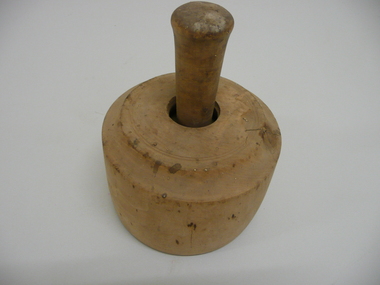
Domestic Object - WOODEN BUTTER MOULD
... ...Food preparation...butter mould...DOMESTIC EQUIPMENT Food preparation butter mould K166.2 K166.1 Butter mould or press for imprinting butter, round wooden cylinder containing a circular disc on handle with carving of a cow surrounded by other carved patterns. ...Butter mould or press for imprinting butter, round wooden cylinder containing a circular disc on handle with carving of a cow surrounded by other carved patterns.domestic equipment, food preparation, butter mould, k166.2 k166.1 -
 Bendigo Historical Society Inc.
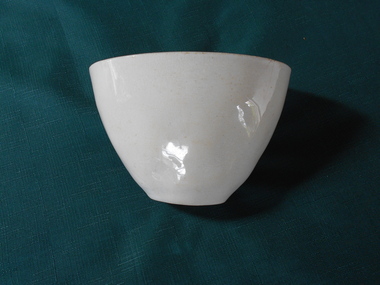
Domestic Object - GRAYDON COLLECTION: JELLY MOULD, 1880's
... ...Food consumption...jelly mould...DOMESTIC EQUIPMENT Food consumption jelly mould Object. Cream coloured ceramic jelly mould. ...Object. Cream coloured ceramic jelly mould. U-shaped patterns inside. Oval shape.domestic equipment, food consumption, jelly mould -
 Federation University Historical Collection
Container - Exhibition Catalogue, University of Ballarat, Graphic Design / Multimedia, 03, 2003
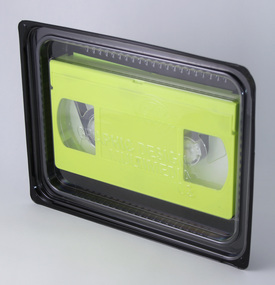
... This pack consists of a plastic food tray and custom moulded lid, featuring student designed type and graphic. ...This pack consists of a plastic food tray and custom moulded lid, featuring student designed type and graphic. ...This pack consists of a plastic food tray and custom moulded lid, featuring student designed type and graphic. ...Promotional catalogue of third year, University of Ballarat, Bachelor of Visual Arts (Graphic Design / Multimedia) graduating student work, 2003. This pack consists of a plastic food tray and custom moulded lid, featuring student designed type and graphic. Pack houses an unlabelled lime green video cassette tape and a single sided sheet listing student names and their associated time code on the video. Students would have generated their work digitally, so the use of the VHS video tape would likely have been considered "retro". Listed students: Brooke Jury, Kat Kandera, Luke Vanstan, Amber Smith, Bree McKenzie, Rene Furlong, Chris Stephen, Lauren Drew, Stu Shepherd, Eliza Steele, Tim Ware, Sarah Birks, Alison White, Jarrod Vanstan, Mark Bickerdike, Alison Wright, Cam Suttie, Mark Iskra This pack consists of a plastic food tray and custom moulded lid, featuring student designed type and graphic. Pack houses an unlabelled lime green video cassette tape and a single sided sheet listing student names and their associated time code on the video.university of ballarat, federation university, graphic design, multimedia, brooke jury, kat kandera, luke vanstan, amber smith, bree mckenzie, rene furlong, chris stephen, lauren drew, stu shepherd, eliza steele, tim ware, sarah birks, alison white, jarrod vanstan, mark bickerdike, alison wright, cam suttie, mark iskra -
 Orbost & District Historical Society
bottle, 1900's
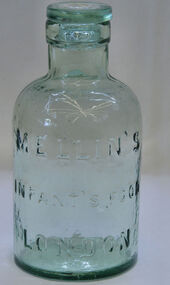
... Moulded baby food bottle. Squat and round with green glass stopper. ...They reflect the type of glassware that was used for food containers in the early 20th century. bottle glass food -container Bottom -M4 Front- Mellin's Infants' Food, LOndon Moulded baby food bottle. Squat and round with green glass stopper. ...Australia was not self sufficient in glass making until the turn of the 20th century and many bottles were made overseas and shipped to Australia with their contents and when emptied were re-filled with other company’s products. These bottles have an aesthetic element in that the shapes , colours and textures are visually appealing. They reflect the type of glassware that was used for food containers in the early 20th century. Moulded baby food bottle. Squat and round with green glass stopper. Moulded writing on front. The thick glass has a slight blue-green tinge to it.Bottom -M4 Front- Mellin's Infants' Food, LOndonbottle glass food -container -
Federation University Historical Collection
Film - Artists' Book (VHS), University of Ballarat, Graphic Design / Multimedia, 03, 2003
... This pack consists of a plastic food tray and custom moulded lid, featuring student designed type and graphic. ...This pack consists of a plastic food tray and custom moulded lid, featuring student designed type and graphic. ...Promotional catalogue of third year, University of Ballarat, Bachelor of Visual Arts (Graphic Design / Multimedia) graduating student work, 2003. This pack consists of a plastic food tray and custom moulded lid, featuring student designed type and graphic. Pack houses an unlabelled lime green video cassette tape and a single sided sheet listing student names and their associated time code on the video. Students would have generated their work digitally, so the use of the VHS video tape would likely have been considered "retro". Listed students: Brooke Jury, Kat Kandera, Luke Vanstan, Amber Smith, Bree McKenzie, Rene Furlong, Chris Stephen, Lauren Drew, Stu Shepherd, Eliza Steele, Tim Ware, Sarah Birks, Alison White, Jarrod Vanstan, Mark Bickerdike, Alison Wright, Cam Suttie, Mark Iskra Lime green video cassette tape, unlabelleduniversity of ballarat, federation university, graphic design, multimedia, brooke jury, kat kandera, luke vanstan, amber smith, bree mckenzie, rene furlong, chris stephen, lauren drew, stu shepherd, eliza steele, tim ware, sarah birks, alison white, jarrod vanstan, mark bickerdike, alison wright, cam suttie, mark iskra -
 Federation University Historical Collection
Booklet, University of Ballarat, Research@YourUB, 2007 -2010
... .1) Spring 2009 .2) Spring 2007 - Rob Wallis, green packaging, mould, food safety, Zhaohao Sun, Widcorp, Jesica Block, Arts Academy anniversary, Dorothy Wickham, Dora Pearce, Loris Button, SmartGreen, Marilyn Davidson, Overcoming bullying in schools, overweight patients. .3) Autumn 2009 - Australian Security Laboratory to fight cybercrime, brewing better beer, John Yearwood, Centre do Informatics and Applied Optimizaton, John Smyth, Angela Murphy? ...Research@YourUB is a newsletter highlighting research at the University of Ballarat university of ballarat wallis wickham Wayne Robinson toenail research dora pearce biodiversity in modified landscapes centre for informatics and applied optimization john yearwood lawrie angus barry golding Georgina tsolidis .1) Spring 2009 .2) Spring 2007 - Rob Wallis, green packaging, mould, food safety, Zhaohao Sun, Widcorp, Jesica Block, Arts Academy anniversary, Dorothy Wickham, Dora Pearce, Loris Button, SmartGreen, Marilyn Davidson, Overcoming bullying in schools, overweight patients. .3) Autumn 2009 - Australian Security Laboratory to fight cybercrime, brewing better beer, John Yearwood, Centre do Informatics and Applied Optimizaton, John Smyth, Angela Murphy? ...Research@YourUB is a newsletter highlighting research at the University of Ballarat.1) Spring 2009 .2) Spring 2007 - Rob Wallis, green packaging, mould, food safety, Zhaohao Sun, Widcorp, Jesica Block, Arts Academy anniversary, Dorothy Wickham, Dora Pearce, Loris Button, SmartGreen, Marilyn Davidson, Overcoming bullying in schools, overweight patients. .3) Autumn 2009 - Australian Security Laboratory to fight cybercrime, brewing better beer, John Yearwood, Centre do Informatics and Applied Optimizaton, John Smyth, Angela Murphy? Willows by the water. Patrice Braun, Laura Kostanski, preventing injuries, why should we research art. .4) October 2009 - Future Research Directions .5) January 2009 - Research themes, Wayne Robinson, John yearwood, Andrew Stranieri, Peter Gell, Julian Lowe, John Smyth, John McDonald, Caroline Finch, Dennis Else, Informatics and Applied Optimization, Regional Futures, Disadvantage and Inequality in Education and Health, Injury Prevention and Safety Promotion. .6) Spring 2010 - Frank Stagnitti, Brad Mitchell, Diane Clingin, Robyn Brandenburg, Amanda McGraw-Pleban, Charlynn Miller, Fadi Charchar, Robert Hodder, Amber Stabek, ACSL maps, Murray Darling Basin, Peter Gell, John Smyth, Kate Brass, gaming machines, John McDonald, Helen Aucote, Andrew Cooper, Deborah greeenslade, Dara twomey, Andrew Warnock, synthetic grass, .7) Autumn 2006 - Wayne Robinson, toenail research, Dora Pearce, biodiversity in modified lansdscapes, Centre for Informatics and Applied Optomization (CIAO), John Yearwood, Lawrie Angus, Barry Golding, Georgina Tsolidis, John Smyth, Maxine Cooper, Mary Hollick, Emil Milos, Jeff Woodger, Michelle Ziccolo, Rosemary Green, Raelene Gregory, Julian Lowe, Jessie Harman, Debora Campbell, John McDonald, Denise Corboy, Catherine Knox, Henry Lawson, Meg Tasker, Warren Young, Amanda Telford.university of ballarat, wallis, wickham, wayne robinson, toenail research, dora pearce, biodiversity in modified landscapes, centre for informatics and applied optimization, john yearwood, lawrie angus, barry golding, georgina tsolidis -
 Flagstaff Hill Maritime Museum and Village
Domestic object - Stove, Cox and Rizzetti Stove Works, ca. 1918-1930s
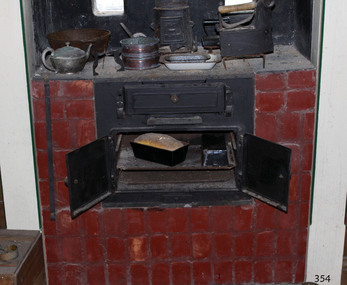
... mould to make rectangular plates that were then joined together to make a box. Benjamin Franklin invented the more efficient Pennsylvania stove in 1744, and this efficient design is still used today. After the mid-19th century cast iron stoves were produced with burners in different positions, giving varied temperatures, so a wide variety of foods could be cooked at the same time at the most suitable heat, from slow cooking to baking scones. ...mould to make rectangular plates that were then joined together to make a box. Benjamin Franklin invented the more efficient Pennsylvania stove in 1744, and this efficient design is still used today. After the mid-19th century cast iron stoves were produced with burners in different positions, giving varied temperatures, so a wide variety of foods could be cooked at the same time at the most suitable heat, from slow cooking to baking scones. ...Cast iron stoves burn solid fuel such as wood or coal, and are used for cooking and warmth. The stoves have a firebox with a grate where the fuel is burned. The hot air flows through flues and baffles that heat the stove top and the oven. Before cast iron stoves were invented, cooking and heating were carried out in outdoor open fires, and later, in fireplaces inside the home. In 1642 the first cast iron stove was manufactured in Lynn, Massachusetts, where molten cast iron was poured into a sand mould to make rectangular plates that were then joined together to make a box. Benjamin Franklin invented the more efficient Pennsylvania stove in 1744, and this efficient design is still used today. After the mid-19th century cast iron stoves were produced with burners in different positions, giving varied temperatures, so a wide variety of foods could be cooked at the same time at the most suitable heat, from slow cooking to baking scones. In contemporary times people the new wood-burning stoves had to meet the anti-pollution standards now in place to protect our environment. By the 1920s gas cookers were being introduced for domestic use, and by the 1930s electric home cookers were being offered to householders. PLANET STOVES In August 1925 the firm Cox and Rizzetti, Stove Works, and also Sydney Road, South Melbourne, advertised in the Brunswick and Coburg Leader of November 11, 1925 as "formerly with Harnwell and Sons" and as "specialists in solid cast iron Planet stoves ... which merit an inspection from builders and householders". The firm continued in business and was mentioned as sponsors in the King Island News in 1971. Harnwell and Sons was listed in the Victorian Government Gazette of 1894. It is curious that the firm was mentioned in an article in the Sunrasia Daily of June 14, 1934 titled 'Planet Stoves' as a manufacturer of Planet Stoves. This Planet No 3 stove is an uncommon example of cooking equipment used in kitchens in the early 20th century, as the firebox is above the oven rather than beside it. The cast iron combustion stove is significant as part of the evolution of domestic cooking. Previously cooking was mostly carried out in outdoors in open fires, and later in fireplaces indoors. Cast iron stoves are still used today and have additional features such as thermostats to monitor and maintain temperature, water heating pipes connected, and environmentally approved anti-pollution fittings. Stove; a compact, blackened cast iron combustion cooker, installed within a fireplace and enclosed by bricks on both sides. The upright rectangular stove has a flat top with three round, removable cook plates and a flue connected at the back. The front has three doors with round knob handles; a swing-down firebox door above a sliding ashtray, and two side-hinged oven doors above a sliding opening. Inside on the side walls are two pairs of runners. Behind the pair of doors is an oven with two pairs of rails and two removable metal shelves. The stove has cast inscriptions on the chimney flue and on the front of the right hand side stove door. The model of the stove is The Planet No 3, made in Melbourne.Chimney flue, "[within rectangle] THE / PLANET" Stove door, "(within oval) PLANET / No 3"flagstaff hill, flagstaff hill maritime museum and village, warrnambool, maritime museum, maritime village, great ocean road, shipwreck coast, stove, cast iron stove, combustion stove, wood-burning stove, wood stove, wood oven, solid fuel stove, cooker, the planet, planet, planet no. 3, kitchen equipment, baking, domestic cooking, cooking equipment, food preparation, planet stove, planet cooker, cooking range, slow combustion stove, antique, range cooker, cox and rizzetti, harnwell and sons, melbourne manufacturer -
 Greensborough Historical Society
Domestic object - Container, S & M Utility Plastics Container, 1950s
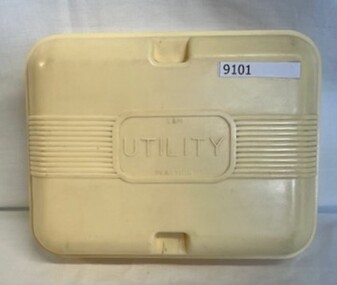
... Item used for covering and storing food in the refrigerator. household implements container storage containers "S & M Utility Plastics" moulded into lid. ...Item used for covering and storing food in the refrigerator. Cream plastic container with lid."S & M Utility Plastics" moulded into lid.household implements, container, storage containers -
 Flagstaff Hill Maritime Museum and Village
Container - Fruit Preserving Jar, John Landis Mason, 1858-1910
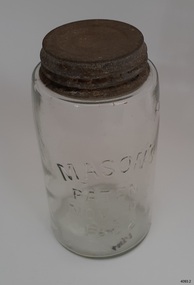
... An early item used in most kitchens by women who preserved fruit and vegetables before the arrival of refrigeration giving a snapshot into the domestic lives of families during the late 19th to early 20th century's and how they preserved food for later use without refrigeration. warrnambool flagstaff-hill flagstaff-hill-maritime-museum maritime-museum shipwreck-coast flagstaff-hill-maritime-village food preserving mason jar john landis mason domestic container glass jar fruit & vegetable jar domestic jar food preparation handmade glass blown glass Moulded into glass: MASON'S / PATENT / NOV 30TH / 1838" Preserving jar, glass, with metal screw top lid. ...The Masons patent of Nov 30th, 1858 phrase was originally embossed on countless glass fruit jars and canning jars, most ranging in age from circa 1858 to the mid-1910s. John Landis Mason was awarded patent No 22186, issued on November 30, 1858, by the U.S. Patent & Trademark Office it was termed an "Improvement in screw-neck bottles", for his invention concerning the process of creating a threaded screw-type closure on bottles and jars. Similar screw-threading had been done before on some bottles, but the process of forming the upper lip area of the container so that it was smooth, even, and sturdy enough for a lid of standard size to be screwed thereon was difficult and expensive to do properly, often with unsatisfactory results. His improvement revolutionized home canning in the United States and many other countries. In any case, throughout the next 60-odd years, production of jars with the Nov. 30, 1858 embossing continued at a high rate, with untold tens of millions being produced. The phrase was soon considered an important marketing device, adding to the perception of quality and reliability of the container to the average consumer. This perception continued to at least 1879 21 years after the patent was issued, nearly every glass bottle factory was likely producing their version. The 1880s and 1890s likely saw the peak of popularity of these jars. A considerable percentage have a mold number or letter on the base, a means of identifying the particular mold in use at the factory.An early item used in most kitchens by women who preserved fruit and vegetables before the arrival of refrigeration giving a snapshot into the domestic lives of families during the late 19th to early 20th century's and how they preserved food for later use without refrigeration. Preserving jar, glass, with metal screw top lid. Glass has side seams, impurities and slightly concave base. It has been hand blown into a mould. Inscription is moulded into glass. Moulded into glass: MASON'S / PATENT / NOV 30TH / 1838"warrnambool, flagstaff-hill, flagstaff-hill-maritime-museum, maritime-museum, shipwreck-coast, flagstaff-hill-maritime-village, food preserving, mason jar, john landis mason, domestic container, glass jar, fruit & vegetable jar, domestic jar, food preparation, handmade glass, blown glass -
 Flagstaff Hill Maritime Museum and Village
Ceramic - Vase, 1921-1932
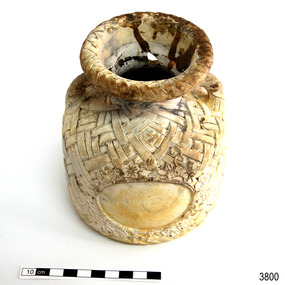
... moulded sides of the vase together, then adding the round base. The coastal trader SS Casino (1882–1932) had a run of almost 50 years along the coast of Western Victoria. She traded goods and food...moulded sides of the vase together, then adding the round base. The coastal trader SS Casino (1882–1932) had a run of almost 50 years along the coast of Western Victoria. She traded goods and food ...This Japanese ceramic vase was recovered from the wreck of the S.S. Casino (1882 – 1932) between the late 1960s to early 1970s. It is one of the shipwreck artefacts in the John Chance Collection. The design is an example of vintage basket weave pottery. The base of the vase is stamped ‘MADE IN JAPAN’ , which dates its probable manufacture to circa 1921-1932. The vase has side seams indicating that it was made by joining two moulded sides of the vase together, then adding the round base. The coastal trader SS Casino (1882–1932) had a run of almost 50 years along the coast of Western Victoria. She traded goods and food as well as carrying passengers from port to port on her many voyages. This vase may have been included in her cargo or could have been amongst the personal luggage of the people on board. The ceramic vase is an example of ceramic pottery in Victoria the 1930s. The vase is also significant as it was recovered by John Chance, a diver from the wreck of the Loch Ard in the 1960s-70s. Items that come from several wrecks along Victoria's coast have since been donated to the Flagstaff Hill Maritime Village’s museum collection by his family, illustrating this item’s level of historical value. The vase is also significant as it is associated with the S.S. Casino, which played an historical role in Western Victoria, providing transport, communication and trade along the coast between Melbourne and Portland in the late 19th and the early 20th century, visiting the ports at Apollo Bay, Warrnambool and Belfast (Port Fairy). The S.S. Casino was the only regular trader with normal passenger accommodation along the West Coast and the only Western District steamship that was in service between 1854 and 1939, and to be represented in the Victorian Heritage Shipwreck register, and to have been wrecked in the Western District, and to have the wreck located, and to be accessible to divers. The wreck of the S.S. Casino, and its associated relics, is considered an important part of Victorian and Australian cultural heritage and is now protected as a Historic Shipwreck under State and Commonwealth Law in the Commonwealth Historic Shipwrecks Act (1976). Vase, round, cream coloured, unglazed ceramic, basket weave design. Wide mouth, short neck that tapers out to wide shoulders and straight down to round base. Seams on each side, mouth to base. Small handle on each side of vase between mouth and shoulder. Front and back of vase have a plain oval space bordered by a floral design. Inscription stamped onto base. Made in Japan. Stamped onto base in black ink "MADE IN / JAPAN"flagstaff hill, warrnambool, flagstaff hill maritime museum, maritime museum, shipwreck coast, flagstaff hill maritime village, great ocean road, vase, japanese vase, s.s. casino, john chance, vintage pottery, newcastle and hunter river steam navigation company, belfast and koroit steam navigation company, west coast trader, apollo bay, captain middleton, basket weave, ceramic -
 Flagstaff Hill Maritime Museum and Village
Container - Glass Jar, Nestle, 1920s
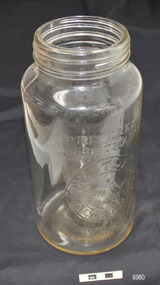
... food found in local households and businesses, and could have been purchased from the local Nestle factory. Flagstaff Hill Warrnambool Maritime Village Maritime Museum Shipwreck coast Great Ocean Road Nestle Malted Milk glass jar nestle jar Nestle Malted Milk Dennington Nestle Australia W.R. Angus Collection Inscription: “PREPARED / IN AUSTRALIA” and “TRADE MARK / REGISTERED” Logo; “NESTLES MALTED MILK” around image [bird feeding young in next] Round tall clear glass jar with a wide mouth, short neck and straight sides on a cylindrical body. The jar has been blow-moulded ...This glass jar once contained Australian-made Nestle’s Malted Milk. The jar carries the company’s familiar logo. This jar would have originally had a screw-top metal lid. The large jar may have been used in a canteen, hospitality business or hospital due to its capacity. The jar was owned by Dr W.R. Angus, surgeon and oculist, who lived in Warrnambool with his wife and growing family for over thirty years. It may have been purchased from the Nestle factory in nearby Dennington. The jar was donated by his family and is part of the W.R Angus Collection. Nestles Malted Milk powder is usually added to either hot or cold milk as a nutritious drink supplement. The powder is a combination of evaporated whole milk powder, malted barley and wheat flour. Nestle began in 1867 and its products were available in Australia since the 1880s. Australia had become Nestle’s second-largest export market by 1906 and by 1908 Nestle had set up business in Australia. The Nestle factory in Dennington, Warrnambool, opened in 1911 and was the world’s largest condensed milk plant. For over 100 years the factory produced dried milk powder from the produce of local dairy farmers. It was a major employer for the district until an announcement was made on May 2019 by its recent owner Fonterra that it was closing its Dennington site for financial reasons. This Nestle Malted Milk jar is connected to the history of Warrnambool, as it was owned by the daughter of Dr W. R. Angus and his wife Gladys. It is part of the W.R. Angus Collection, which is notable for still being located at the site connected to Doctor Angus, Warrnambool’s last Port Medical Officer. It is also connected through its manufacturer Nestle. which had a branch in Warrnambool from 1911 to 2019, overlapping the time when the Angus family resided there, from 1939 to the 1970s. The jar is also significant as an example of the early-20th-century food found in local households and businesses, and could have been purchased from the local Nestle factory.Round tall clear glass jar with a wide mouth, short neck and straight sides on a cylindrical body. The jar has been blow-moulded in two pieces with a side seam running from the base to the top of the lip. There are air bubbles in the glass, and the base has been ground flat. The outside of the mouth is threaded. Inscriptions are moulded on one side and there is a round logo with text around an image of a mother bird with three young birds in a nest. The jar once contained Nestles Malted Milk and was made in Australia around the 1920s. The jar is part of the W.R. Angus Collection.Inscription: “PREPARED / IN AUSTRALIA” and “TRADE MARK / REGISTERED” Logo; “NESTLES MALTED MILK” around image [bird feeding young in next]flagstaff hill, warrnambool, maritime village, maritime museum, shipwreck coast, great ocean road, nestle, malted milk, glass jar, nestle jar, nestle malted milk, dennington, nestle australia, w.r. angus collection -
 City of Moorabbin Historical Society (Operating the Box Cottage Museum)
Manufactured Glass, jar 'Mason's', c1900
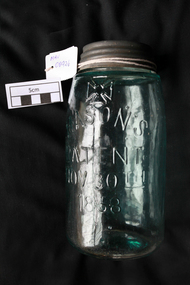
... A Mason jar is a moulded glass jar used in canning to preserve food. The mouth of the jar has screw threads on its outer perimeter to accept a metal ring (or "band"). ...A Mason jar is a moulded glass jar used in canning to preserve food. The mouth of the jar has screw threads on its outer perimeter to accept a metal ring (or "band"). ...A Mason jar is a moulded glass jar used in canning to preserve food. The mouth of the jar has screw threads on its outer perimeter to accept a metal ring (or "band"). The band, when screwed down, presses a separate stamped steel disc-shaped lid against the rim of the jar. An integral rubber ring on the underside of the lid creates a hermetic seal to the jar. The bands and lids usually come with new jars, and bands and lids are also sold separately; while the bands are reusable, the lids are intended for single use when canning.The Mason jar was invented and patented in November1858 by Philadelphia tinsmith John Landis Mason. The same design was used on the jars well into the 1900'sThe early settlers of Moorabbin Shire had to be self sufficient and grew their own fruit and vegetables even if not market gardeners They preserved their produce for use all year. A clear, glass jar with a metal screw top lid used for preserving food c1900. This jar has a 'keystone' symbol. 'keystone' symbol / MASON'S / PATENT / NOV 30TH / 1858 base 67. PAT NOV 96early settlers, market gardeners, mason's jar, mason john landis, food preservation, moorabbin, bentleigh, cheltenham -
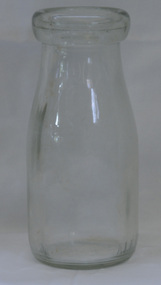 Orbost & District Historical Society
milk bottle, 1930's -1950's
... The dairy industry in Orbost and the surrounding area has always been a major contributor to the milk supply of Victoria. glass-bottles commercial-milk-containers food dairy IMPERIAL HALF PINT A clear glass half-pint milk or cream bottle. Moulded in two halves, made to take either a cork or cardboard disc pressed into top with wire grip. ...Milk was delivered by the "milk man" direct to the homes of consumers. Delivery to homes in Orbost and district and was made initially by horse and cart and later by truck. .The dairy industry in Orbost and the surrounding area has always been a major contributor to the milk supply of Victoria.A clear glass half-pint milk or cream bottle. Moulded in two halves, made to take either a cork or cardboard disc pressed into top with wire grip. The bottle was meant to be recycled and the glass is therefore quite thick. IMPERIAL HALF PINTglass-bottles commercial-milk-containers food dairy -
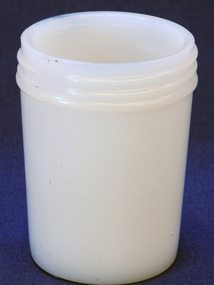 Orbost & District Historical Society
jar, 1935-1945
... food sources of vitamin B. It was sent to war with the troops and rationed at home. The marketing strategy that put Vegemite in 9 out of every 10 Australian homes in the 1940s, 50s and 60s emphasised the value of Vegemite to children's health. On the base - AGM Vegemite V879 A cylindrical Vegemite jar made of white opal glass. It has a threaded rim and two mould ...Vegemite hit the market in 1923 but failed to sell. In 1928 the company renamed its spread Parwill to compete against the top-selling British import, Marmite but Parwill flopped too. In 1922 the Fred Walker Company hired a chemist, Percy Callister, to develop a useful food from vitamin-rich used yeast being dumped by breweries. Using enzymes to split open the yeast cells, Callister extracted the contents and blended them with vegetables and salt into a sticky black paste with a sharp taste. They tried the Vegemite name again and gave the product away with Walker cheese products and a couple of cars as prizes before Australians finally fell for it. In 1939 Vegemite was officially endorsed by the British Medical Association as a good source of Vitamin B and was included in Australian Army rations during World War II. Buyers were now assured of the nutritional value of Vegemite, which has been a market leader ever since. The Fred Walker Company became the Kraft Walker Cheese Co. Pty Ltd in 1926 and Kraft Foods Limited in 1950. (from Powerhouse Museum) This type of jar was used to package Vegemite between 1935 and 1945. Vegemite has been an 'Australian icon' since World War II when it was recognised as one of the world's highest food sources of vitamin B. It was sent to war with the troops and rationed at home. The marketing strategy that put Vegemite in 9 out of every 10 Australian homes in the 1940s, 50s and 60s emphasised the value of Vegemite to children's health. A cylindrical Vegemite jar made of white opal glass. It has a threaded rim and two mould seams. On the base - AGM Vegemite V879 -
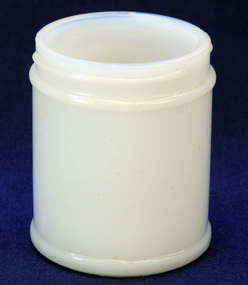 Orbost & District Historical Society
jar, 1930's
... jar storage container sanitarium-health-food-co. australian-glass-maunufacturers Base of the jar has 'PROPERTY OF SANITARIUM HEALTH FOOD CO' AGM 21 V888 A cylindrical mould-formed white opaque glass jar that possibly originally contained Marmite, a yeast extract, made as a by product from beer brewing. ...A cylindrical mould-formed white opaque glass jar that possibly originally contained Marmite, a yeast extract, made as a by product from beer brewing. It has a threaded lip to fit screw-on lid. Base of the jar has 'PROPERTY OF SANITARIUM HEALTH FOOD CO' AGM 21 V888jar storage container sanitarium-health-food-co. australian-glass-maunufacturers -
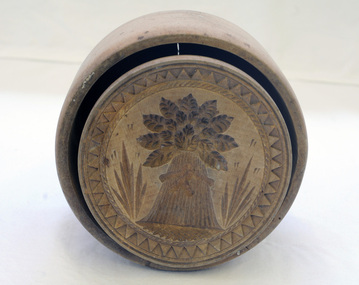 Orbost & District Historical Society
butter mold
... butter-mould domestic food-preparation...It would have been before the time of mass food processing factories butter-mould domestic food-preparation A wooden bowl which uses the lid as an imprint plunger. ...This butter mold is typical of the period when food processing was done at home. It would have been before the time of mass food processing factoriesA wooden bowl which uses the lid as an imprint plunger. The imprint is a floral design and has a long handle. The bowl has a hole in the base for easy removal of butter.butter-mould domestic food-preparation -
 Orbost & District Historical Society
cheese mold
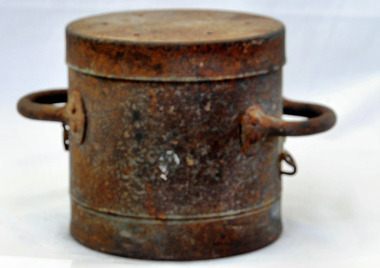
... cheese-mould domestic food-preparation...It would have been before the time of mass food processing factories cheese-mould domestic food-preparation Very rusted round tin with detachable bottom and lid for easy removal of cheese. ...This domestic kitchen appliance is typical of the period when food processing was done at home. It would have been before the time of mass food processing factoriesVery rusted round tin with detachable bottom and lid for easy removal of cheese. Small eyelets on each side and large handles each side. Top and bottom lids have holes in them to allow moisture to escape.cheese-mould domestic food-preparation -
 Orbost & District Historical Society
glass rolling pin, 1930's
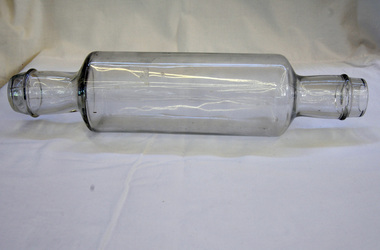
... A moulded clear glass cylinder rolling pin with glass handles at each end. It is hollow and can be filled with cold or warm water to better roll a preferred food. ...This item is an example of a once commonly used kitchen item. domestic kitchen glass rolling-pin, one one end - M A moulded clear glass cylinder rolling pin with glass handles at each end. It is hollow and can be filled with cold or warm water to better roll a preferred food. ...Starting in the 18th century, glassworks in English port towns like Bristol, London, Sunderland, and Newcastle began producing hollow glass rolling pins. They were originally produced for sailors to give to loved ones, particularly young women they were hoping to woo for marriage. Plain, clear glass rolling pins became a common kitchen item in the first half of the 20th century as they were seen to be more easily cleaned that wooden ones.This item is an example of a once commonly used kitchen item.A moulded clear glass cylinder rolling pin with glass handles at each end. It is hollow and can be filled with cold or warm water to better roll a preferred food. There is no stopper at one end. It is marked with M at one end (probably indicating size).one one end - Mdomestic kitchen glass rolling-pin, -
 Orbost & District Historical Society
bottle, 1930 - 1950
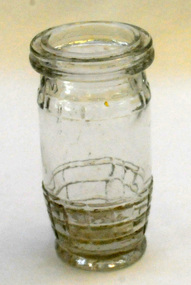
... This is an example of a food container used in the mid 20th century. container Peck's-paste jar on base - PECKS with some indecipherable numbers A small clear moulded glass jar. ...Peck’s meat spreads were introduced in England in 1891. Thirteen years later, the British-based Harry Peck & Co. began exporting its products to Australia. By 1938, Peck’s set up in Australia and began making canned meat and fish products.This is an example of a food container used in the mid 20th century.A small clear moulded glass jar. It has a check pattern at the top and bottom with a smooth band in the middle. It has a wide opening tapering to the bottom. It is lipped for a rubber seal. It was used for Pecks paste.on base - PECKS with some indecipherable numberscontainer peck's-paste jar -
 Orbost & District Historical Society
bottle, C 1950's
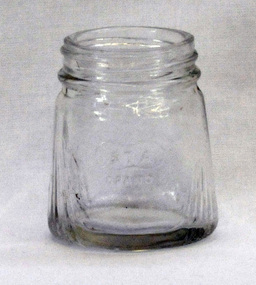
... on base - This jar always remains the property of NUT FOODS LIMITED 936 A small, cylindrical moulded bottle with a screw thread top. bottle Eta Nut Foods Limited ...Many Australian children went to school with ETA Peanut Butter on their sandwiches. These bottles are distinctively patterned and embossed with the ETA BRAND.This container was a common food container found in Australian homes in the mid 20th century.A small, cylindrical moulded bottle with a screw thread top.ETA inside a peanut shape. on base - This jar always remains the property of NUT FOODS LIMITED 936bottle-glass food-container -
 Warrnambool and District Historical Society Inc.
Domestic object - glass salt cellar, c.1950
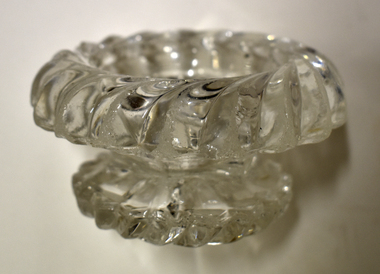
... food. Today an item such as this may still be in a domestic kitchen cupboard but the salt would be used more sparingly. This item is retained as an example of a domestic item used extensively in the past. vintage domestic items glass salt cellar This is a clear glass salt cellar with a round moulded bowl with fluted edges. ...This salt cellar is typical of the ones used extensively for cooking or for table use at mealtime in households of the 19th and 20th centuries (popular up to about the 1970s). These were the times when salt was used more so than today in households to preserve and to add to the flavour of food. Today an item such as this may still be in a domestic kitchen cupboard but the salt would be used more sparingly.This item is retained as an example of a domestic item used extensively in the past.This is a clear glass salt cellar with a round moulded bowl with fluted edges. The bowl is on a glass stand, also with fluted edges.vintage domestic items, glass salt cellar -
 Kiewa Valley Historical Society
Cast Iron Camp Oven with Lid
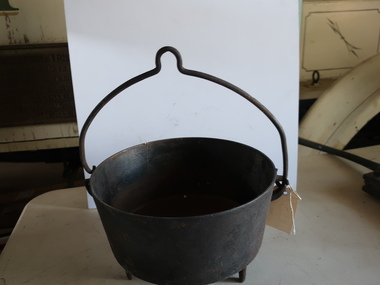
... They were used to perform a variety of tasks and to last forever.The use of dry sand moulds for casting the iron created a smoother surface. A more even surface meant more even contact points with food. ...They were used to perform a variety of tasks and to last forever.The use of dry sand moulds for casting the iron created a smoother surface. A more even surface meant more even contact points with food. ...Camp ovens were used for cooking indoors and outdoors. They were used to perform a variety of tasks and to last forever.The use of dry sand moulds for casting the iron created a smoother surface. A more even surface meant more even contact points with food. The lid is close fitting.Used by people in the Kiewa Valley including campers, drovers, shearers, bushmen, miners and groups eg.scouts to cook food.Camp ovens originally named Dutch ovens were made from cast iron, were heavy and were developed in the Netherlands in the 1700s. Australian drovers, shearers, bushmen, campers and miners used the cast iron camp ovens. This one has legs and was used outside. The lid is slightly concave enabling coals from the cooking fire to be placed on top as well as below. This provides more uniform internal heat and lets the inside act as an oven. Formerly UKV 023cast iron oven, outdoor cooking -
 Kiewa Valley Historical Society
Butter Stamp Block, Circa 1950
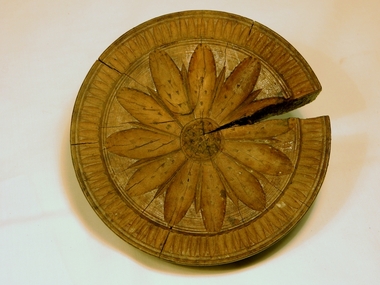
... food preparations. shortbread stamp dairy butter On the dome stamped in black ink "T. & W. Davies" This shortbread / butter stamp is made from wood, round and fashioned from a flat bed to a dome top. The top has a round moulded ...At the time when this shortbread / butter stamp block was used, rural dairies and larger properties who manufactured their own butter used butter stamps blocks for identifying the source of the butter or for decoration.. The patterns stamped into the warmed butter provided for a range of decorative visual enhancement to the "plain" and "boring" straight leveled normal butter surface. Although the wooden surfaces could be hard to keep clean commercial usage would have been limited and eventually replaced by a non porous and hygienically cleaner material. Greater hygiene controls where introduced. from the late 1940s on. These controls were the result of high infectious illnesses due to contaminated milk and dairy handling methods.This shortbread / butter stamp was used by a Kiewa Valley dairy and it presents what the domestic butter beautification processes were available during the mid to latter 1900s was. Their was a pride by rural properties in their produce and its by-products.This shortbread / butter stamp is made from wood, round and fashioned from a flat bed to a dome top. The top has a round moulded hole with screw indentations for fastening a pressure pole. The pattern on the face of the stamp is of an eleven petalled flower pattern around a small circular flower head. Both the head and petals have indentations which are will produce raised points in the pressed butter. Enclosing the flower pattern is a pattern which when pressed against the butter would produce small ridges radiating outward.On the dome stamped in black ink "T. & W. Davies"butter stamp, domestic butter blocks, domestic food preparations., shortbread, stamp, dairy, butter -
 Kiewa Valley Historical Society
Mould Butter, unknown, post 1967
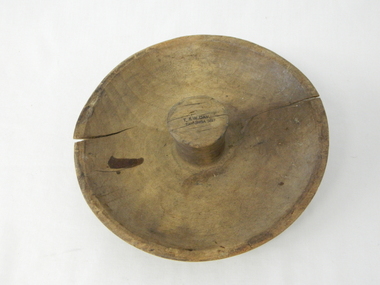
... food preparation...wooden butter pat...butter mould...food processing implements used by Kiewa Valley households in the mid 1900s, whether on the farm or in the small towns and hamlets. Self sufficiency was the key to survival during these early times. Where ever possible supplies from within the valley were preferred to that brought in by travelling salesmen or traders. This butter mould ...This butter mould/pat may have been manufactured post 1967(year post codes appeared in Australia) however the post code was only stamped on after it was machined. This type of butter mould was used by rural families to fashion home/farm made butter. This period was in most rural regions a time of self sufficiency where any domestic type implement which could be fashioned by the family would be crafted with skill. Shopping for goods required catalogues from stores located in major rural towns and cities and involved lengthy waiting times. Travelling to and from these specialised stores was not pleasant due to the relatively poor quality of the roads and the lengthy times taken. The small general stores in the Kiewa Valley could not cater for all the needs of the valley. The 1960's was a time when facilities especially goods and services started to improve drastically. The S.E.C. of Victoria with its Kiewa Hydro Electricity Scheme provided not only an improvement of facilities in the valley but also a increase in the population. This increase resulted in a greater demand for local produce. This item is one of many domestic food processing implements used by Kiewa Valley households in the mid 1900s, whether on the farm or in the small towns and hamlets. Self sufficiency was the key to survival during these early times. Where ever possible supplies from within the valley were preferred to that brought in by travelling salesmen or traders. This butter mould and butter pat was commonly used to fashion "home" made butter throughout the valley and in some cases supplied to "outside" regional towns. Although this method of production was phased out by better access to goods from nearby cities the revival of the good organic home grown produce in the 1980s saw a greater demand of this type of farm based produce.This well crafted circular wooden butter mould could also be used as a butter pat.The handle in the middle of the mould was not added after the crafting but has been fashioned from the initial block of wood when the bowl was crafted. The bowl structure has a rim around the edge.The top of the handle has an ink stamp "T. & W. Dav" on the top line and "Tawonga 3697" underneath.domestic food preparation, wooden butter pat, butter mould circular, dairy industry -
 Kiewa Valley Historical Society
Pat Butter Profiler, Circa 1950s
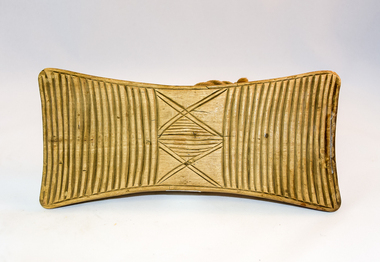
... food preparation...wooden butter pat...butter mould...food processing implements used by Kiewa Valley households in the mid 1900s, whether on the farm or in the small towns and hamlets. Self sufficiency was the key to survival during these early times. Where ever possible supplies from within the valley were preferred to that brought in by travelling salesmen or traders. This butter mould ...This butter pat profiler may have been manufactured post 1967(year post codes appeared in Australia) however the post code was only stamped on after it was machined. This type of butter mould was used by rural families to fashion home/farm made butter. This period was in most rural regions a time of self sufficiency where any domestic type implement which could be fashioned by the family would be crafted with skill. Shopping for goods required catalogues from stores located in major rural towns and cities and involved lengthy waiting times. Travelling to and from these specialised stores was not pleasant due to the relatively poor quality of the roads and the lengthy times taken. The small general stores in the Kiewa Valley could not cater for all the needs of the valley. The 1960's was a time when facilities especially goods and services started to improve drastically. The S.E.C. of Victoria with its Kiewa Hydro Electricity Scheme provided not only an improvement of facilities in the valley but also a increase in the population. This increase resulted in a greater demand for local produce.This item is one of many domestic food processing implements used by Kiewa Valley households in the mid 1900s, whether on the farm or in the small towns and hamlets. Self sufficiency was the key to survival during these early times. Where ever possible supplies from within the valley were preferred to that brought in by travelling salesmen or traders. This butter mould and butter pat was commonly used to fashion "home" made butter throughout the valley and in some cases supplied to "outside" regional towns. Although this method of production was phased out by better access to goods from nearby cities the revival of the good organic home grown produce in the 1980s saw a greater demand of this type of farm based produce.This butter Pat/Profiler has on its base two patterns. On each end it has horizontal grooves cut into the wood which produce distinct lines onto the surface of the butter. between these grooves there is a section of two double lines crossing in the middle and separated by eleven horizontal lines The base has an elongated rectangular shape. The upper body has been sanded into a smooth convex shaped form where a wooden circular hand grip has been fashioned.On the top of the hand grip is stamped in black print"T. & W. Davies" and under this"TAWONGA 3697"domestic food preparation, wooden butter pat, butter mould circular, dairy industry -
 Kiewa Valley Historical Society
Pat Butter, Circa 1950
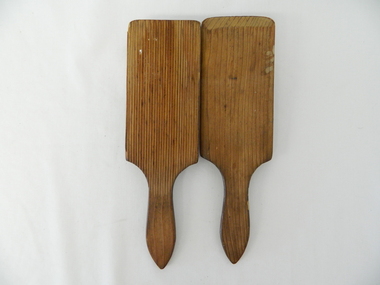
... food preparation...wooden butter pat...butter mould...food processing implements used by Kiewa Valley households in the mid 1900s, whether on the farm or in the small towns and hamlets. Self sufficiency was the key to survival during these early times. Where ever possible supplies from within the valley were preferred to that brought in by travelling salesmen or traders. This butter mould ...This butter pat profiler may have been manufactured post 1967 (year post codes appeared in Australia) however the post code was only stamped on after it was machined. This type of butter mould was used by rural families to fashion home/farm made butter. This period was in most rural regions a time of self sufficiency where any domestic type implement which could be fashioned by the family would be crafted with skill. Shopping for goods required catalogues from stores located in major rural towns and cities and involved lengthy waiting times. Travelling to and from these specialised stores was not pleasant due to the relatively poor quality of the roads and the lengthy times taken. The small general stores in the Kiewa Valley could not cater for all the needs of the valley. The 1960's was a time when facilities especially goods and services started to improve drastically. The S.E.C. of Victoria with its Kiewa Hydro Electricity Scheme provided not only an improvement of facilities in the valley but also a increase in the population. This increase resulted in a greater demand for local produce.This item is one of many domestic food processing implements used by Kiewa Valley households in the mid 1900s, whether on the farm or in the small towns and hamlets. Self sufficiency was the key to survival during these early times. Where ever possible supplies from within the valley were preferred to that brought in by travelling salesmen or traders. This butter mould and butter pat was commonly used to fashion "home" made butter throughout the valley and in some cases supplied to "outside" regional towns. Although this method of production was phased out by better access to goods from nearby cities the revival of the good organic home grown produce in the 1980s saw a greater demand of this type of farm based produce.This butter pat is one of two,see KVHS 0071 (B). It has been crafted from wood. One side has grooves running from the handle to the square shaped bottom. These grooves would stop the wet butter from clinging to the pat. The top side of the pat has been bevelled on both sides and the bottom edge. The hand grip is flat and curved to allow for a comfortable hold.domestic food preparation, wooden butter pat, butter mould circular, dairy industry, butter -
 Kiewa Valley Historical Society
Pat Butter Profiler, Circa 1950
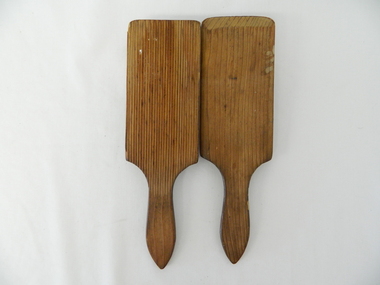
... food preparation...wooden butter pat...butter mould...food processing implements used by Kiewa Valley households in the mid 1900s, whether on the farm or in the small towns and hamlets. Self sufficiency was the key to survival during these early times. Where ever possible supplies from within the valley were preferred to that brought in by travelling salesmen or traders. This butter mould ...This butter pat profiler may have been manufactured post 1967(year post codes appeared in Australia) however the post code was only stamped on after it was machined. This type of butter mould was used by rural families to fashion home/farm made butter. This period was in most rural regions a time of self sufficiency where any domestic type implement which could be fashioned by the family would be crafted with skill. Shopping for goods required catalogues from stores located in major rural towns and cities and involved lengthy waiting times. Travelling to and from these specialised stores was not pleasant due to the relatively poor quality of the roads and the lengthy times taken. The small general stores in the Kiewa Valley could not cater for all the needs of the valley. The 1960's was a time when facilities especially goods and services started to improve drastically. The S.E.C. of Victoria with its Kiewa Hydro Electricity Scheme provided not only an improvement of facilities in the valley but also a increase in the population. This increase resulted in a greater demand for local produce.This item is one of many domestic food processing implements used by Kiewa Valley households in the mid 1900s, whether on the farm or in the small towns and hamlets. Self sufficiency was the key to survival during these early times. Where ever possible supplies from within the valley were preferred to that brought in by travelling salesmen or traders. This butter mould and butter pat was commonly used to fashion "home" made butter throughout the valley and in some cases supplied to "outside" regional towns. Although this method of production was phased out by better access to goods from nearby cities the revival of the good organic home grown produce in the 1980s saw a greater demand of this type of farm based produce.This butter pat is one of two,see KVHS 0071 (A). It has been crafted from wood. One side has grooves running from the handle to the square shaped bottom. These grooves would stop the wet butter from clinging to the pat. The top side of the pat has been bevelled on both sides and the bottom edge. The hand grip is flat and curved to allow for a comfortable hold.domestic food preparation, wooden butter pat, butter mould circular, dairy industry
