
Showing 72 items matching "forest officer"
-
 Marysville & District Historical Society
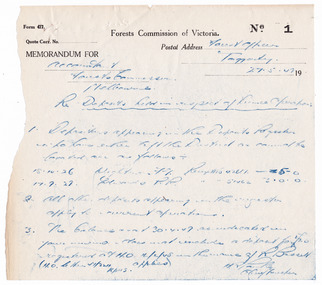
Ephemera (item) - Inter-office memorandum, Forests Commission Victoria, 27-05-1948
... ...forest officer...A handwritten interoffice memorandum between the Forest Officer at Taggerty and the Accountant at the Forests Commission of Victoria. ...A handwritten interoffice memorandum between the Forest Officer at Taggerty and the Accountant at the Forests Commission of Victoria. ...A handwritten interoffice memorandum between the Forest Officer at Taggerty and the Accountant at the Forests Commission of Victoria. ...A handwritten interoffice memorandum between the Forest Officer at Taggerty and the Accountant at the Forests Commission of Victoria. The memorandum, which is dated 27th May 1949, is written on a forests commission letterhead and is numbered No. 1. The memorandum was written and signed by Mr. R. Parke, Chief Forester.A handwritten interoffice memorandum between the Forest Officer at Taggerty and the Accountant at the Forests Commission of Victoria.marysville, victoria, australia, taggerty, forest officer, forests commission of victoria, mr. r. parke, memorandum -
 Linton Mechanics Institute and Free Library Collection
Book - Novel, Penny, Mrs Frank (Fanny Emily Penny), A forest officer : being episodes in the life of Jim Burns, 1900
... A forest officer : being episodes in the life of Jim Burns...Fiction Fanny Emily Penny Mrs Frank Penny Colonial India The life of a forest officer in Madras. Book plate and stamps indicating book was previously in another collection: 'Ballaarat Mechanics' Institute Circulating Library'. 289 p. : dark green cover with illustration of a man in a turban and a man in a pith helmet A forest officer : being episodes in the life of Jim Burns Book Novel Penny, Mrs Frank (Fanny Emily Penny) Methuen & Co. ...The life of a forest officer in Madras.289 p. : dark green cover with illustration of a man in a turban and a man in a pith helmetfictionThe life of a forest officer in Madras.fiction, fanny emily penny, mrs frank penny, colonial india -
 Marysville & District Historical Society
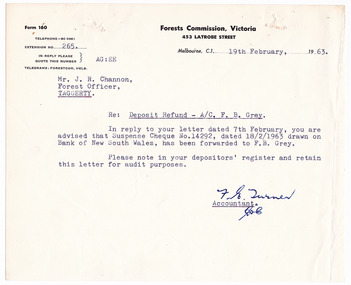
Letter (item), Forests Commission Victoria, 19-02-1963
... Channon, the Forest Officer at Taggerty. The letter, dated February 19th 1963, is regarding the refund of a deposit in the name of F.B. ...Channon, the Forest Officer at Taggerty. The letter, dated February 19th 1963, is regarding the refund of a deposit in the name of F.B. ...Channon, the Forest Officer at Taggerty. The letter, dated February 19th 1963, is regarding the refund of a deposit in the name of F.B. ...A typed letter from the Accountant at the Forests Commission of Victoria to Mr. J.R. Channon, the Forest Officer at Taggerty. The letter, dated February 19th 1963, is regarding the refund of a deposit in the name of F.B. Gray by a cheque dated February 18th 1963.A typed letter from the Accountant at the Forests Commission of Victoria to Mr. J.R. Channon, the Forest Officer at Taggerty.marysville, victoria, australia, taggerty, forests commission of victoria, mr. j.r. channon, f.b. gray, letter -
 Creswick Campus Historical Collection - University of Melbourne
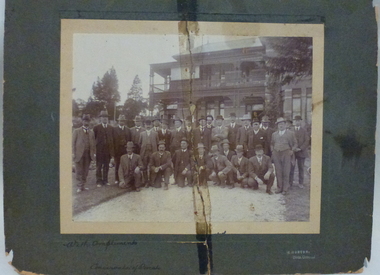
Photograph - Photograph of Department Forestry Refresher Course, 1913, R. Morton, Forestry Refresher Course, 1913, 1913
... The photograph shows the Conservator of Forests, H MacKay and the Chief Superintendent of State Plantations, John Johnstone, with the Forest Officers of the department outside the Victorian School of Forestry (Tremearne House) in Creswick....On separate card backing: Forest Officers (with list of names) including J.Johnstone Chief Supt of Plantations, H McKay Conservator of Forests...The photograph shows the Conservator of Forests, H MacKay and the Chief Superintendent of State Plantations, John Johnstone, with the Forest Officers of the department outside the Victorian School of Forestry (Tremearne House) in Creswick. ...Department Forestry Refresher Course, 1913. The photograph shows the Conservator of Forests, H MacKay and the Chief Superintendent of State Plantations, John Johnstone, with the Forest Officers of the department outside the Victorian School of Forestry (Tremearne House) in Creswick.sepia photograph mounted on cardboard with separate cardboard backing.On the front: With compliments, Conservator of Forests. R. Morton Photo. Creswick. On the Back: Photo presented to Forester J.S.Ritchie, Glen Park. Passed down to Asst Supt Pltns. W.Ritchie and finally Divl Forester N.E. Division, R.J. Ritchie. On separate card backing: Forest Officers (with list of names) including J.Johnstone Chief Supt of Plantations, H McKay Conservator of Forests -
 Friends of Kurth Kiln
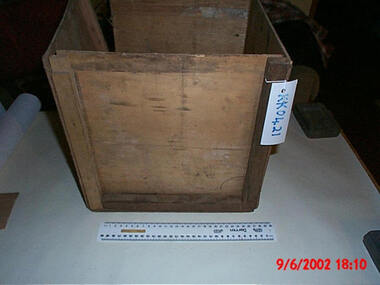
Wooden Box
... Forest Comm. Victoria / Forest Officer T Wescott / Kallista / via / FernTree Gully / Rly Station...Forest Comm. Victoria / Forest Officer T Wescott / Kallista / via / FernTree Gully / Rly Station Rectangular Wooden Box made from 3plywood with reinforced corners and wire banding. ...Rectangular Wooden Box made from 3plywood with reinforced corners and wire banding. Open at the topForest Comm. Victoria / Forest Officer T Wescott / Kallista / via / FernTree Gully / Rly Station -
 Tarnagulla History Archive
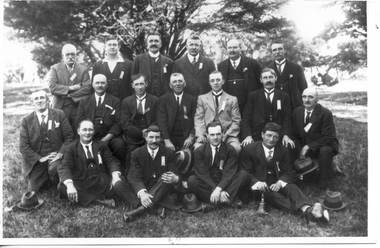
Photograph, Shire of Bet Bet Councillors (?), circa 1910
... Writing on back gives donor information and indicates identity of man 4th from left in rear as John Rogers, Forest Officer at Tarnagulla....Writing on back gives donor information and indicates identity of man 4th from left in rear as John Rogers, Forest Officer at Tarnagulla. A monochrome photograph possibly depicting Shire of Bet Bet Councillors. ...Donald Clark Collection. A monochrome photograph possibly depicting Shire of Bet Bet Councillors. Copy photograph. Writing on back gives donor information and indicates identity of man 4th from left in rear as John Rogers, Forest Officer at Tarnagulla. -
 Halls Gap & Grampians Historical Society
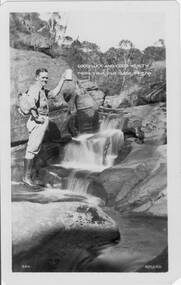
Postcard - B/W, C 1930s
... He was also a Forest Officer so knew the Grampians well....He was also a Forest Officer so knew the Grampians well. PEOPLE Gilbert Rogers SCENERY Waterfalls 'Good luck and good health from your old friend'( written on front) Rogers - (bottom Right) no,264 Postcard shows a man standing beside a waterfall holding up a cup. the waterfall is flowing rapidly over rocks. ...Man in photo was well known photographer and bushwalking guide Gilbert Rogers. He was also a Forest Officer so knew the Grampians well.Postcard shows a man standing beside a waterfall holding up a cup. the waterfall is flowing rapidly over rocks. The man has on a backpack and long hiking boots.'Good luck and good health from your old friend'( written on front) Rogers - (bottom Right) no,264people, gilbert rogers, scenery, waterfalls -
 Department of Energy, Environment and Climate Action
Badge - Honorary Forester badge
... Each was issued with this distinguishing badge and given the authority to act, and were requested to cooperate with District Forest Officers in the protection of State forests....Each was issued with this distinguishing badge and given the authority to act, and were requested to cooperate with District Forest Officers in the protection of State forests. ...A system of appointment of responsible members of the general public as Honorary Foresters was enabled initially under the Forests Act of 1918. Many organisations actively interested in forestry were invited to nominate suitable persons. The first appointments were made in 1924 and, by 1939, there were about 350 Honorary Foresters in the State. Each was issued with this distinguishing badge and given the authority to act, and were requested to cooperate with District Forest Officers in the protection of State forests.brass badges with loops for suspension by ribbon; two-toned blue enamel background to letteringObverse: ISSUED BY FORESTS COMMISSION OF VICTORIA; PLANT PROTECT PRESERVE OUR TREES; HONORARY FORESTER Reverse (badge1): 116; P.J. KING MELB Reverse (badge2): 886; P.J. KING MELB -
 Department of Energy, Environment and Climate Action
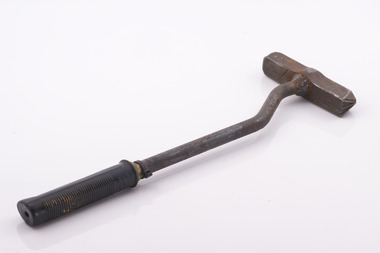
Branding Hammer issued to FCV overseer Jim Browning at Beechworth
... Hammers were traditionally only ever issued to forest officers and were an important, and closely guarded tool-of-trade. ...Hammers were traditionally only ever issued to forest officers and were an important, and closely guarded tool-of-trade. ...Metal branding hammers were the most common way to control the sale and movement of hardwood timber produce like logs, railway sleepers, fence posts, and poles from Victorian State forests. Royalty was also paid on this basis. The hammer has a crown stamp on one end with a unique number in the middle (453) which identified its owner, and a crows foot or broad arrow on the other. The broad arrow was a symbol traditionally used in Britain and its colonies to mark government property. Forest regulations state that an authorised officer may use the crown mark to identify produce which has been sold and may be removed from the forest, whereas the broad arrow can be used to brand and mark trees which are not to be felled, or to indicate forest produce which has been seized. Hammers were traditionally only ever issued to forest officers and were an important, and closely guarded tool-of-trade. They were not transferred between staff and lending hammers was not permitted. But it was an onerous task for staff to hammer and tally hundreds of logs, or thousands of fence posts each week, so in about 1990 a system was introduced whereby hammers were allocated to logging contractors to grade logs and tally them instead. But there was still spot checking by authorised officers. A register was kept, and contractors paid a substantial deposit to make sure they didn't lose them, but they occasionally turn up by fossickers with metal detectors. While branding hammers are still used in some smaller locations, plastic tags and barcodes are now more common.Metal log branding hammer with a crown stamp on one end with a unique number (453) in the middle which identified its owner, and a crows foot or broad arrow on the other. The unusual bent metal handle was designed to protect user from banging their fingers on the log. It was also fitted with a rubber hand grip. Most FCV branding hammers were issued with wooden handles. The branding hammer 453 was initially issued to Wally Cowell at Beechworth. It was reissued to Jim Browning upon Wally’s retirement The hammer still had a wooden handle, but the it broke and became loose inside hammer head. Russel Pritchard from the Beechworth Depot replaced the handle with a new metal one and put a dog leg in it It mainly branded forest produce cut in Mt. Pilot and Reedy Creek areas. The main logging contractors were Gordon Habeck from Chiltern and Steven Goldsworthy from BeechworthCrown mark one end (453) and Crows foot other endforest harvesting, forests commission victoria (fcv) -
 Department of Energy, Environment and Climate Action
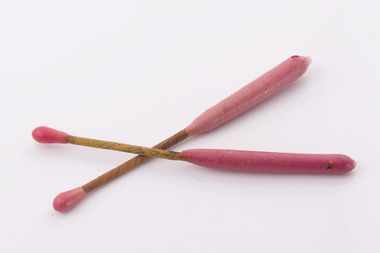
Delayed Action Incendiary Device (DAID), Bryant and May - Richmond, Large double ended match
... There was a crash of an FCV helicopter conducting aerial ignition near Wandiligong on 19 April 1978 with the tragic death of two forest officers and their pilot. The crash led to the immediate end of the use of DAIDs and the adoption of the safer Premo ping-pong ball incendiary machine which originally came from Canada but was modified at the Altona workshops. ...There was a crash of an FCV helicopter conducting aerial ignition near Wandiligong on 19 April 1978 with the tragic death of two forest officers and their pilot. The crash led to the immediate end of the use of DAIDs and the adoption of the safer Premo ping-pong ball incendiary machine which originally came from Canada but was modified at the Altona workshops. ...The Forests Commission developed the use of helicopters for aerial ignition from the mid 1960s. Bryant and May at Richmond worked with the Commission to develop a Delayed Action Incendiary Device. DAIDs as the were known, had an overall length of 180 mm, striker end length - 10 mm. Ignition end length - 80 mm, then a layer of high melting point wax (to prevent accidental ignition when rubbing together in transit). Both ends coated with a modified match head compound with safety fuse exposed length between coated match ends. There was a 17-second delay from when the small end was struck to an intense flaming of the large end, which lasted for 40 seconds. DAIDs were dangerous so were stored in a metal box outside the helicopter along with a disposable striker patch attached with a quick release pin to a special half-door. The first test was with a Bell 47G on 4 October 1967 and the first use, anywhere in the world, of DAIDs to backburn a large bushfire was undertaken in north eastern Victoria in February 1968. There was a crash of an FCV helicopter conducting aerial ignition near Wandiligong on 19 April 1978 with the tragic death of two forest officers and their pilot. The crash led to the immediate end of the use of DAIDs and the adoption of the safer Premo ping-pong ball incendiary machine which originally came from Canada but was modified at the Altona workshops. Overall, the development of aerial ignition techniques by the Forests Commission from the mid-1960s resulted in a steady climb in the area burnt each year…. peaking at 477,000 ha in 1980-81 and with an impressive 10-year rolling average of 220,000 ha around the time of 1983 Ash Wednesday Bushfires.Developed in Victoria for aerial ignitionLarge double ended match used for aerial ignition and back burning by dropping from a helicopterbushfire, forests commission victoria (fcv) -
 Department of Energy, Environment and Climate Action
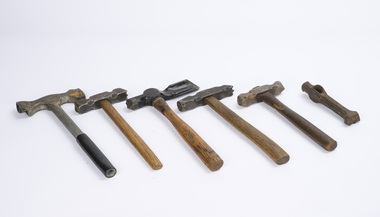
Log Branding Hammers (various)
... Hammers were traditionally only ever issued to forest officers and were an important, and closely guarded tool-of-trade. ...Hammers were traditionally only ever issued to forest officers and were an important, and closely guarded tool-of-trade. ...Metal branding hammers were the most common way to control the sale and movement of hardwood timber produce like logs, railway sleepers, fence posts, and poles from Victorian State forests. Royalty was also paid on this basis. Hammers most commonly had a crown stamp on one end with a unique number in the middle which identified its owner, and a crows foot or broad arrow on the other. The broad arrow was a symbol traditionally used in Britain and its colonies to mark government property. Other local configurations were used by sawmillers, post cutters and pulpwood contactors. Forest regulations state that an authorised officer may use the crown mark to identify produce which has been sold and may be removed from the forest, whereas the broad arrow can be used to brand and mark trees which are not to be felled, or to indicate forest produce which has been seized. Hammers were traditionally only ever issued to forest officers and were an important, and closely guarded tool-of-trade. They were not transferred between staff and lending hammers was not permitted. But it was an onerous task for staff to hammer and tally hundreds of logs, or thousands of fence posts each week, so in about 1990 a system was introduced whereby hammers were allocated to logging contractors to grade logs and tally them instead. But there was still spot checking by authorised officers. A register was kept, and contractors paid a substantial deposit to make sure they didn't lose them, but they occasionally turn up by fossickers with metal detectors. While branding hammers are still used in some smaller locations, plastic tags and barcodes are now more common.Log Grading hammersforests commission victoria (fcv), hand tools, forest harvesting -
 Department of Energy, Environment and Climate Action
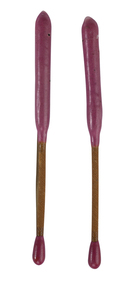
Delayed Action Incendiary Device (DAID)
... There was a crash of an FCV helicopter conducting aerial ignition near Wandiligong on 19 April 1978 with the tragic death of two forest officers and their pilot. The crash led to the immediate end of the use of DAIDs and the adoption of the safer Premo ping-pong ball incendiary machine which originally came from Canada but was modified at the Altona workshops. ...There was a crash of an FCV helicopter conducting aerial ignition near Wandiligong on 19 April 1978 with the tragic death of two forest officers and their pilot. The crash led to the immediate end of the use of DAIDs and the adoption of the safer Premo ping-pong ball incendiary machine which originally came from Canada but was modified at the Altona workshops. ...The Forests Commission developed the use of helicopters for aerial ignition from the mid 1960s. Bryant and May at Richmond worked with the Commission to develop a Delayed Action Incendiary Device. DAIDs as the were known, had an overall length of 180 mm, striker end length - 10 mm. Ignition end length - 80 mm, then a layer of high melting point wax (to prevent accidental ignition when rubbing together in transit). Both ends coated with a modified match head compound with safety fuse exposed length between coated match ends. There was a 17-second delay from when the small end was struck to an intense flaming of the large end, which lasted for 40 seconds. DAIDs were dangerous so were stored in a metal box outside the helicopter along with a disposable striker patch attached with a quick release pin to a special half-door. The first test was with a Bell 47G on 4 October 1967 and the first use, anywhere in the world, of DAIDs to backburn a large bushfire was undertaken in north eastern Victoria in February 1968. There was a crash of an FCV helicopter conducting aerial ignition near Wandiligong on 19 April 1978 with the tragic death of two forest officers and their pilot. The crash led to the immediate end of the use of DAIDs and the adoption of the safer Premo ping-pong ball incendiary machine which originally came from Canada but was modified at the Altona workshops. Overall, the development of aerial ignition techniques by the Forests Commission from the mid-1960s resulted in a steady climb in the area burnt each year…. peaking at 477,000 ha in 1980-81 and with an impressive 10-year rolling average of 220,000 ha around the time of 1983 Ash Wednesday Bushfires.Developed in Victoria for aerial ignition by the FCV and Byant & MayLarge double ended match used for aerial ignition and back burning by dropping from a helicopterforests commission victoria (fcv), bushfire, planned burning -
 Department of Energy, Environment and Climate Action
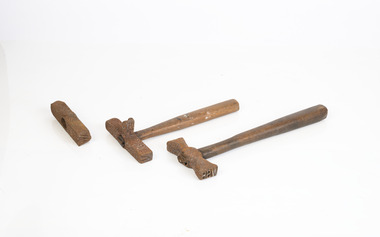
Log Branding Hammer
... Hammers were traditionally only ever issued to forest officers and were an important, and closely guarded tool-of-trade. ...Hammers were traditionally only ever issued to forest officers and were an important, and closely guarded tool-of-trade. ...Metal branding hammers were the most common way to control the sale and movement of hardwood timber produce like logs, railway sleepers, fence posts, and poles from Victorian State forests. Royalty was also paid on this basis. Hammers most commonly had a crown stamp on one end with a unique number in the middle which identified its owner, and a crows foot or broad arrow on the other. The broad arrow was a symbol traditionally used in Britain and its colonies to mark government property. Other local configurations were used by sawmillers, post cutters and pulpwood contactors. Forest regulations state that an authorised officer may use the crown mark to identify produce which has been sold and may be removed from the forest, whereas the broad arrow can be used to brand and mark trees which are not to be felled, or to indicate forest produce which has been seized. Hammers were traditionally only ever issued to forest officers and were an important, and closely guarded tool-of-trade. They were not transferred between staff and lending hammers was not permitted. But it was an onerous task for staff to hammer and tally hundreds of logs, or thousands of fence posts each week, so in about 1990 a system was introduced whereby hammers were allocated to logging contractors to grade logs and tally them instead. But there was still spot checking by authorised officers. A register was kept, and contractors paid a substantial deposit to make sure they didn't lose them, but they occasionally turn up by fossickers with metal detectors. While branding hammers are still used in some smaller locations, plastic tags and barcodes are now more common.Log Grading hammersforests commission victoria (fcv), hand tools, forest harvesting -
 Department of Energy, Environment and Climate Action
Helibox, Cardboard food delivery box, Early 1960s
... The basic concept was brought back from America by then Chief Fire Protection Officer, Ted Gill. From this concept, in 1964, Athol Hodgson, the Forests Commission's Fire Research Officer, experimented with various types before arriving at this large, heavy-duty corrugated cardboard container which employed fold-out fins. ...The basic concept was brought back from America by then Chief Fire Protection Officer, Ted Gill. From this concept, in 1964, Athol Hodgson, the Forests Commission's Fire Research Officer, experimented with various types before arriving at this large, heavy-duty corrugated cardboard container which employed fold-out fins. ...The successful dropping of supplies to remote fire crews involved a great deal of experimentation. The basic concept was brought back from America by then Chief Fire Protection Officer, Ted Gill. From this concept, in 1964, Athol Hodgson, the Forests Commission's Fire Research Officer, experimented with various types before arriving at this large, heavy-duty corrugated cardboard container which employed fold-out fins. Athol's experiments showed that the container, called the 'helibox', must be able to free-drop for some 200 feet (66 metres) before the fins, which had a large angle of attack, could open and cause the container to rotate, so slowing the rate of descent. The cardboard boxes were so designed that they could be flat-packed for delivery and storage at the Forest Districts. They were suitable for supplies weighing less than 9 kg and best dropped from about 300 feet. It was found that even eggs survived the fall when they were packed inside loaves of bread. The helibox became a standard technique for delivery of supplies from fixed-wing aircraft and was used extensively in the Corryong, Tallangatta, Mansfield and Tinambra areas where the alternative was to back-pack supplies into fire crews in the mountainous terrain. The technique was adopted Australia-wide. The increasing availability of helicopters and extensive network of four-wheel-drive tracks eventually made the helibox redundant. Unique to Victoria but adopted across Australia.Large cardboard box with 'fins' that caused it to rotate when dropped from an aircraft. Fins held in place by means of office type string 'Ty-Tite' fasteners.bushfire, forests commission victoria (fcv) -
Federation University Historical Collection
Document, Zelda Martin, Central Victorian Goldmining towns - Boom Towns or Ghost Towns?, c1996
... Addresses on behalf of : the people of Bendigo; Members of the Church of England, Bendigo; Members of the Wesleyan Church on the Bendigo Gold Fields; Bendigo Gold District General Hospital; the Bendigo Prospecting Association; Committee of the Bendigo Local Exhibition; Bendigo District Medical Association; Coloured Americans Resident at Bendigo; German Inhabitants of Bendigo; Landowners, Inhabitants, and Miners of Castlemaine; Inhabitants of Forest Creek; Inhabitants of Heathcote and Gold Miners of McIvor; Residents and landholders of the District of Bacchus Marsh; Inhabitants of Kilmore and Vicinity. *Gold Fields Correspondence 1853: letter from Lieutenant Colonel Valiant, (Officer...Addresses on behalf of : the people of Bendigo; Members of the Church of England, Bendigo; Members of the Wesleyan Church on the Bendigo Gold Fields; Bendigo Gold District General Hospital; the Bendigo Prospecting Association; Committee of the Bendigo Local Exhibition; Bendigo District Medical Association; Coloured Americans Resident at Bendigo; German Inhabitants of Bendigo; Landowners, Inhabitants, and Miners of Castlemaine; Inhabitants of Forest Creek; Inhabitants of Heathcote and Gold Miners of McIvor; Residents and landholders of the District of Bacchus Marsh; Inhabitants of Kilmore and Vicinity. *Gold Fields Correspondence 1853: letter from Lieutenant Colonel Valiant, (Officer ...Zelda Martin was a PhD candidate at the University of Melbourne.[.1] 4th item in light blue display book titled Research Approach/Overview of Chapters/Confirmation of Canditure/Chapters1,2,3&4 of proposed thesis. *Twenty-seven page article on Victorian goldfields towns titled: Central Victorian Goldmining Towns - Boom Towns or Ghost Towns. The article was written during the author's PhD study. It outlines the context methodology, and resources and the chapters of the proposed thesis: (1) Central Victorian Goldmining Towns - The Context (2) Contemporary Views of the Factors Necessary for Town Growth (3) Outward Manifestations of Town Growth (4) The Trappings of Government (5-9) The Main Towns and Their Hinterland. [.2] 5th item in Light Blue display book as above item. *Chapter 1 of proposed thesis titled 'Pick, Shovel and Tin Dish Mining.' Covers in Section A: Central Victoria - Pre 1851: Aborigines in Central Victoria, Squatters, and Government. Section B: The years 1851-1854: The Early Gold Rushes, Government Reaction, Township Surveys, Legislation, Town Development, Local Government and Early Settlement. [.3] 6th item in Light Blue display book as above item. *2A of proposed thesis titled 'Contemporary Views of the Factors Necessary for Town Growth'. Similar information to Chapter 1 plus extra re towns and maps. Sections: Introduction, Context of Place - Geographical Towns Listed, The Context of Time - Pre1851 Aborigines, Governance of Port Phillip, The Squatters, The Villages of Central Victorian Highlands, Conclusion, Condensed Version of Chapter2B. [.4] 7th item in Light Blue display book as above item. *Chapter2B of proposed thesis. Sections: Area of Research, Schools, Banks, Newspapers, Progress Association, Town Development - Sandhurst (Bendigo), Ballarat, Castlemaine,, Maryborough, Ararat and Stawell. [.5] 8th item in Light Blue display book as above item. *Chapter 3 of proposed thesis titled 'Outward Manifestations of Town Growth'. Sections: Introduction, Contemporary Writing, Educationalists, The Bankers, The Townsfolk, Current Theory, General Theories of Urban Development, and Conclusion. [.6] 9th item in Light Blue display book as above item. *Chapter 4 of proposed thesis titled 'Trappings of Government' Sections: Introduction, Early Government Attitudes to Mining and Town Development, Law and Order, Township Surveys, Legislation, Local Government, Transport and Communication, The People and Lobbyists. [.7] 10th item in Light Blue display book as above item. *'The Rise and Fall of Central Victorian Goldmining Towns'. Includes a map showing main Goldfields, a table showing towns and villages at two points in time - 1857 and 1871; a Bibliography of Primary and Secondary Sources. [.8] Resource No1. Black display book titled Local Towns 1 : Alma: *Brief history *Directory *Maps Amphitheatre / Mountain Hut: *Brief History Post Office Directory Ararat: *Brief History *Post Office Directory 1869 - Alphabetical Listing by Occupation *Ararat - Prominent Citizens of 1858 *Langi-Morgala Museum Avoca: *Brief History *Excerpts from 'Avoca The Early Years', Margery and Betty Beavis; pg1 - Beginnings; pg11 - The Midas Touch; pg25 - Local Gold Escorts; pg27 - A Town is Born; pg51- The Administration of Justice; pg53 - The Ways of the Law; pg61 - News of the Day; pg65 - A Time to Play; pg72 - Land Ownership *Post Office Directory (Bailliere's) 1869 *Tourism Map and Information of area *Historic Avoca - A 5.5km Tour *Avoca & the Pyrenees Region - information pamphlet Ballarat: *Early History of Ballarat - Ballarat Historical Society, Publication No.1: origin of the name; Ballaarat - the Beginning; Fabulous Yields from the Ballaarat Goldfield; *Streetscape Lydiard Street. *Hand drawn map showing Leigh River, Old Portland Bay Road, plaque on road to Colac; etc. *Newspaper article re 'The Theatre Royal' ( which stood in the vicinity of the current Owen Williams store) - 'The News'15/04/1998 *Article - 'Ballarat's Mechanics' Institute Lives On' Ballarat Courier, 14/09/1985 *Article - Standing the Test of Time' The News 17/11/1993 re The Mechanics Institute & picture of the Reading Room *'Ballarat a Study of a City, Phyllis Reichl, pub. Nelson, 1968; no.3 place, time and people field studies series *Investigator Vol.33 No.2, 1998 Geelong Historical Society. Article on pg75 describes Ballarat in 1861 *Folded poster - 'Ballarat 100' a history of telegraph communication, pub. Telecom. Beaufort (Fiery Creek): *Brief history *Post Office Directory [.9] Resource No.2 Black Folder Titled Towns cont.No2 Bendigo (Sandhurst): *'Family & Local History at the Bendigo Library - 1851-2001 150 years of gold'. *Bendigo Government Camp in 1853 illustration; key to sketch and names of Government officers stationed there *Excerpts from 'Bendigo and Vicinity' Adolph Haman *The Bendigo Goldfield Registry - pgs 1-7 Introduction *Excerpt: 'Breaking the Grip' *Excerpt: The Most Go-Ahead Place *Excerpts from 'History of Bendigo' - anti license agitation; laying out of town; proposed railway; gold calls and dividends; the Sandhurst Municipality; journalism *Bibliography Blackwood: *Excerpts from 'Aspects of Early Blackwood - The Goldfield, the Landmarks, the Pioneers' Alan J Buckingham and Margaret F Hitchcock, JG Publishing,1980 Buninyong: *A Brief History *Investigator Vol1 No.2 Feb 1966 Geelong Historical Society. Pg3 - Article re gold escort route - Mt Alexander to Adelaide - (see a simple monument on the Western Highway a few miles out of Horsham. Pg 15 - Ballarat Excursion - re the finding of gold. *Three articles published by Buninyong and District Historical Society Inc: (Magpie Exploration; Finding Gold In The Green Hills; Magpie Exploration; Burnt Bridge to Cargarie to Mt Mercer) *Copies of newspaper articles/items *Buninyong Street Directory Carisbrook: *In the Beginning There Was Carisbrook *The History of the Carisbrook Racecourse Carngham / Snake Valley: *Brief History *Directory Castlemaine: *Directory 1865-1866 - Alphabetical and Street *Poster - Castlemaine A Contemporary Guide "The Great Centre" 1866 - A Contemporary Guide to the Fascinating Past *Pamphlet - Castlemaine District Community Hospital *Map - Castlemaine, Maldon & Surrounding Districts *Map and Information - The Dry Diggings Track - a 55kl walk among historic goldfields relics ( Castlemaine Fryerstown Vaughan Mt Franklin Hepburn Daylesford) *Postcard - Former Court House *Directory 1867 - Alphabetical, Trade [.10] Resource No.3 Grey folder Titled Towns 3 Creswick to Maryborough Creswick: *Brief History *Booklet - "Creswick Cemetery Walk" *Booklet - The Buried Rivers of Gold Heritage Trail Creswick *Creswick Historical Museum Information Sheet *Chronological History of Creswick *Alphabetical Directory of the Borough of Creswick *Creswick's Creek Directory 1856 *Historic Creswick Walking Tour *A Brief Account of the Schools of Creswick - Past and Present *100 Years of Railway Travel in Creswick *The Berry Deep Leads *The Spence Home at Jackass Gully in the Creswick State Forest ( William Guthrie Spence - Pioneer) *The New Australian Mine and the 1882 Disaster *Creswick District News, Issue 7, July August 1999 *The Creswick Miners Walk - Information and Map *Maps Chewton: *Brief History *Directory Clunes: *Brief History *Clunes Street Directory Daylesford: *Brief History *Notable Bushfires in Daylesford District Over More Than a Century - "Black Thursday" 1851; 1862; 1899; the Disastrous Hepburn Fire of 1906; 1939; 1944; 1969. *Post Office Directory -Daylesford and Hepburn Dunolly / Inkerman: *Brief History *Directory *Pamphlet - Goldfields Historical Museum *Pamphlet - Historic Dunolly - Victoria's Best Kept Secret *Map of Gold Workings at Dunolly Area - showing where the main gold rushes occurred *Brief History - Inglewood *Directory - Inglewood - Name Occupation, Dwelling Kingower: *Brief History *Directory - Name / Ocupation / Dwelling Linton / Happy Valley / Piggoreet: *Brief History *Directory - Lintons McIvor: *"A History of the Shire and the Township of Heathcote" by J.O. Randell Majorca: *Brief History *Official Post Office Directory 1869 - Name / Occupation/ Address Maldon (Tarrangower): *Brief History Part 1 *Brief History Part 2 *Post Office Directory *List - Alphabetical Order by Names plus Business and Trade (Tarrangower Times Oct/1858) *List - Alphabetical Order by Trade plus Name and Business *Directory - Name / Occupation / Dwelling Maryborough: *Worsley Cottage - built by Arthur Worsley, a contractor in stonework in 1894 [.11] Resource No. 4 Blue Display Book titled Towns 4 Moliagul to Stawell Moliagul: *Brief History *Moligul Legislative Assembly (Voting?) List - Names and Occupations *Moliagul Victorian Post Office Directory 1868 - Name / Ocupation / Address / Comments *"The Welcome Stranger" gold nugget *The Sunday School *The Welcome Stranger Discovery Walk - information and map Moonambel (Mountain Creek) Redbank *Brief History *List of names extracted from advertisments of the Pioneer and Mountain Creek Advertiser 16/02/1861. *Bailliere's Directory 1869 - Alphabetical List of Name / Occupation / Place St Arnaud: *Brief History Sebastapol: *Brief History *Directory 1869 - Alphabetical by Name; plus occupation and address. Browns and Scarsdale: *Brief History *Browns Street Directory - Name and Occupation Smythesdale: *Brief Description *Smythesdale Street Directory -Name and Occupation Stawell (Pleasant Creek) *Brief History *Victorian Official Post Office Directory - Name /Occupation / Dwelling *Chronology - 1841-1920 *Production of gold statistics - 1879 - 1900 *Big Hill *Extracts from "The Golden Years of Stawell". Chapt 1 - Stawell's Coming Out. Capt. 2 - The Gold Rush. Caapt.3 - Cradle of Democracy. Chapt.4 - The Reefs Becomes Stawell. Chapt. 5 - Rushing In. Chapt.6 - The Pioneers. Chapt 7 - The Decade of Optimism. [.12] Resource No. 5: Blue Display Book titled 'Towns Steiglitz to the The Golden Triangle. Steiglitz: Brief History Victorian Post Office Directory 1869 *Map of Steiglitz *List of maps relevant to Steiglitz history *Information 6 tables of data from "Reports of Mining Surveyors Talbot (Back Creek) Brief History Taradale: Post office Directory 1869 - Name/Occupation/Street. Also list in alphabetical order by Occupation Taradale *Chronological Reference to Taradale Mines *Water - The Coliban System of Waterworks *Joseph Brady *The Syphon Tarnagulla (Sandy Creek) *Brief History *Tarnagulla Businessmen Cameos to give depth to advertisments in 'The Tarnagulla Courier' various issues 1864-1871 *Directory - Name/Occupation /Address *List - Name/Business/Trade Wedderburn (Koorong) *Brief History *List - Name/Occupation The Golden Triangle: *The Early Rushes - Wedderburn / Moliagul / Sandy Creek - Tarnagulla / Jones Creek - Waanyarra / Kingower / Dunolly - Goldsborough / Inglweood *Census of 1857 - Population / Occupations *1858-1871 - A Time of Consolidation- Wedderburn / Moliagul / Sandy Creek- Tarnagulla / Arnold *Census 1871 - Population *Information gleaned from the census data - Demographics / Population / Occupations / marital / Birthplace / Religion / Literacy/ Occupation and Housing Cameos *Graphs - Birthplace of settlers /Male-Female Ratio / Married males / Children under 15 as Percentage of Population / Religion *Census 1857 - Statistical data *Maps *Bibliography [.13] Resource No. 6 - Black Display Book Information and Research in Central Victoria including: *Banking - Research from ANZ Bank Archives *Institutions - also includes articles listed from the Ballarat Times Newspaper *Australian mining History Association - A.M.H.A. Bibliography *Australia's Mining History * Bibliography - Land Surveys Victoria - *1853 Administration (Statistics and Other) includes: schools / ministers of religion / police / military / local administration / licences for sale of spirits / distances between various Victorian gold fields. * Victoria Government Gazette (Copy) - N0. 116, 12/12/1854 includes: Gold Felds Commission of Enquiry & No. 85, 15/09/1854 - Addresses presented to the Lieutenant Governor (Sir Charles Hotham) during his tour through the Gold Fields of Victoria,1854. Addresses on behalf of : the people of Bendigo; Members of the Church of England, Bendigo; Members of the Wesleyan Church on the Bendigo Gold Fields; Bendigo Gold District General Hospital; the Bendigo Prospecting Association; Committee of the Bendigo Local Exhibition; Bendigo District Medical Association; Coloured Americans Resident at Bendigo; German Inhabitants of Bendigo; Landowners, Inhabitants, and Miners of Castlemaine; Inhabitants of Forest Creek; Inhabitants of Heathcote and Gold Miners of McIvor; Residents and landholders of the District of Bacchus Marsh; Inhabitants of Kilmore and Vicinity. *Gold Fields Correspondence 1853: letter from Lieutenant Colonel Valiant, (Officer commanding the Troops in Victoria) to the Lieutenant Governor re threatened disturbance at Sandhurst (Bendigo) regarding the Gold License Fee. * Extracts from a book "Victoria" re Gold Fields Commission of Enquiry involving mainly Ballarat and Castlemaine and a chapter titled 'A Tour to the Victorian Gold-Fields' *Lists of central Victorian newspapers - listed by date published 1851to 1874; by first date available to State Library. *A list of cities and towns showing County, population in 1861 &1871, and municipal status. [.14] Resource no.7. Black display book. *Reference: Papers presented to Parliament Victoria - 1859-1860 4 volumes - relevant sections copied. Contains information on Branches of Government. General / Finance / Gold / Gazette / Commission and Warrant / Statistic. *Gold Fields Act. In accordance with the Act the gold fields are divided into six districts - Ballaarat, Castlemaine , Sandhurst, Avoca, Ararat, and Beechworth.. Official staff in each gold district consists of a Resident Warden, Wardens, Wardens' Clerks, Bailiffs, Chinese Protectors, Chinese Interpreters, and Mining Surveyors. *Gold Receiver *Gaols *Police magistrates and Clerks of Petty Sessions, etc. *Field Branch *Immigration and Emigration Overland - Chinese - 1859 *Population on the Goldfields *The Geological Survey - The Government Geologist is assisited by staff from four branches - the office Branch; the Publishing Branch; the Field Branch and the Museum Branch. *Commission to Enquire Into Sludge dated 10/02/1859 (Some sections copied) - Report to the Honorable Chief Commissioner of Public Works, Melbourne re the mode of carrying the sludge from the puddling mills in Sandhurst without interfering with the drainage of the town and the roads in the neighbourhood. [.15] Resource No.8: Camel display book titled Resource No. 8. Aborigines *Lists of book titles - +"Readings in Victorian prehistory" +"The Aborigines of Port Phillip" +Aboriginal languages and clans" +"A History of the Port Phillip District" +"Langi Ghiran 1: Aboriginal Rock...." +"Koorie History: sources for aboriginal studies in the State Library of Victoria", ed. Tom Griffiths, Melb. Friends of the State Library, 1989 +"The Public Lands of Australia Felix"; settlement and land appraisal in Victoria1834-91 with special reference to the Western Plains", J.M.Powell, Melb. Oxford University Press 1970 +*Bibliography of the Victorian Aborigines' from the earliest manuscripts to 31st December 1970, Massoa, Aldo, Melb. Hawthorn Press, 1971 +"Aborigines in Colonial Victoria, 1836-1886", M.F. Christie, Sydney University Press, 1979 +"Urban and Industrial Australia: readings in Human Geography" ed J.M. Powell, Melb. Sorrett Pub. 1974 *Extracts: -Processes of Pioneer Settlement - The Squatting Occupation of Victoria, 1834-60. J.M. Powell -Areal Variations in the Class Structure of the Central-Place Hierarchy. P. Scott - Volume1 and Volume 2: Notes Relating to the Habits of the Natives of Other Parts of Australia and Tasmania. Compiled from various sources for the Government of Victoria by R Brough Smyth. John Curry, O'Neil, Melb. 1st pub. Melb. 1876. p31-45 - Numbers and Distribution of the Aborigines in Victoria -Victorian Aborigines 1835-1901 - A Resource Guide to the Holdings of the Public Record Office, Victoria; published by the Government Information Centre 1984. *History of the Aboriginal Artefacts Displayed in the Daylesford Museum. F. G. Powell (4 page pamphlet) *Letter to Zelda Martin from Peter Lovett, Cultural Officer, Ballarat & District Aboriginal Co- Operative, 05/02/1997 *Map: Ian Clarke Victorian Tribunal Boundary Map - Clans of Central Victoria. *Victorian Rock Art and Mythology - Article about Mount Langhi Ghiran and myths of the Tjapwarong people. *Two Aboriginal myths relating to the Grampians - 'The Monster Emu' / 'The Aquisition of Fire', by the Aborigines in the Grampians Areas *Article titled (chapter 8) Ballarat - information re camping sites in the region. Lake Wendouree / Lake Burrumbeet (includes a myth) / Mt Bunninyong / Lal Lal / Pitfield / Mount Elephant / Mount Egerton / Meredith / Lake Goldsmith / Lake Learmonth / Ercildoune *Notes on the Aborigines of the Wider Ballarat Region plus European names=Aboriginal names. John Morris 26/07/1995 *Role of Aborigines in Town Development in Central Victoria. Mentions Native Police Force est. in Port Phillip 1842 and Central Board for Aborigines est. 1860 *The Grave of King Billy. (Frank Wilson) Pamphlet. *Camping Places in Central and Northern Victoria. Article re Lake Burrumbeet site. *Programme for the Unveiling of Memorial Cairn for Edward Stone Parker 1802-1865. Note portrait not accurate. Accurate portrait is available in the book "A Successful Failure A Trilogy The Aborigines and Early Settlers", Edgar Morrison, Graffiti Publications, 2002. * Large envelope addressed to Mr G Netherway containing newspaper cuttings regarding the life of Edward Stone Parker, the unveiling of the Memorial Cairn as mentioned above, articles titled 'Episodes from Our Early Days' (Edgar Morrison, Yandoit)- The Black's School, A School At Last and The Final years. Also a typed page titled 'Historical Background to E.S.Parker's Career. Includes an interesting tale titled 'When the cat lay doggo' re laying power leads for the unveiling ceremony at the memorial site. [.16] green display folder titled 'Research Aids' *List of references to Commissioners' & W'ardens' Reports (formerly held at La Trobe Library Archives, now at Public Records Office [PRO]). Indicates town referred to / date of report / name of camp if different to town. * Archive information re Anglican Records *Movement around the Goldfields - Miners and Storekeepers - usefulness of newspapers in providing information - areas covered - Castlemaine, Maldon, Ararat, Stawell, Tarnagulla, Dunolly. *Port Phillip /Victoria Directories 1839/1867 - Chronological list of Directories included in this series. *"Notes on the History of Local Government in Victoria" A.W. Greig Melb. University Press 1925 - Photo-copied extract p5-p40. (Source - Deakin University Library) - Introduction by W.Harrison Moore. Section 1 - Development in New South Wales Before Separation. Section 2 - Development in Victoria After Its Separation from New South Wales. Hand written notations: 'roads, markets, and local government 1855 on' ;'opportunity of squatters in parliament' and 'opportunities of matters in parliament p33' * Notes on the Establishment of Surveyor General's Department 1851and Commissioner of Crown Lands and Survey. * Newspaper articles from The Argus, 1849, re the discovery of gold in the Pyrenees region. * Excerpt - a report on schools - A.B.Orlebar, Inspector; re the need for permanent school buildings rather than tents. *Excerpt from - 'Approaches to Urban History', Sean Glynn: The Case for Caution * Except from - 'The Urban Sprinkle', Weston Bate: Country Towns and Australian Regional History *Reference- 'The History of Land Tenure in the Colony of Victoria', John Quick. References the Haines Land Bill, land tenure and Land Leagues. [.17] Light blue envelope folder titled 'Birtchnell's Ballarat, etc. Directory 1862 *Contains various directories for Smythesdale, Buninyong, Clunes, Brown's and Creswick. [.18] Red envelope folder no.2 titled Victorian Gazetteer *Selected pages from 1869 Victorian Gazetteer on A4 paper (with a handwritten note questioning if some pages are from 1868 Victorian Gazetteer as appears to be different sizes - A3 pages.) Information includes locations and descriptions of towns, hotels, banks, communications and populations. (Does not include names, residences and occupations) [.19] Red Envelope folder titled Bailliere's Official Post Office Directory 1868 (or1869 or a mixture of both?) *Preface *Contains a selection of pages of towns highlighted in yellow in the the index *Work on this directory was commenced in 1867. *Information includes: Municipalities - mayors and councilors; lists of towns naming male inhabitants and their occupations. [.20]Yellow manila folder titled Post Grad Seminar Presentation 1996 *Gives some background to Zelda Martin's proposed thesis and why she chose the topic Gold Mining Towns Boom or Bust [.21] A3 display book - No. 1A * A list of 'Relevant Newspapers collected: The Tarrangower Times and Maldon Advertiser (first published 1858) Includes dates 1858-1867. The Mount Alexander Mail. Includes dates 1854-1866 The Tarnagulla Courier. Includes dates from1864-1871 Dunolly and Burnt Creek Express. Includes dates from 1862-1871 * Selection of newspaper pages from The Mount Alexander Mail 1854 to 1856, mostly showing advertisements for businesses and services provided to that community. [.22] A3 display book - No. 1B * Selection of newspaper pages from The Mount Alexander Mail 1857 to 1866, mostly showing advertisements for businesses and services provided to that community. [.23] A3 display book -No. 2 * Selection of newspaper pages from The Tarnagulla Courier 1864 to 1871, mostly showing advertisements for businesses and services provided to that community. [.24] A3 display book - No. 3 *Selection of newspaper pages from The Tarrangower Times (and Maldon and Newstead) Advertiser 1858 to1867, mostly showing advertisements for businesses and services provided to that community. [.25] A3 display book - No.4 * Selection of newspaper pages from The Dunolly and Burnt Creek Express; and The Dunolly and Betbetshire Express 1862 to 1871, mostly showing advertisements for businesses and services provided for that community. [.26] A3 display book - No.5 Includes: * Bryce Ross's Diggings Directory. Includes instructions for using this directory. This directory was used by "all persons having connexion or desiring to communicate with 'working parties, private friends, or Stores at the Diggings." As a directory for each area wwas completed it was published in each month's issue of Bonwick's "Digger's Magazine." Years c1852/1853. This Directory commences first at the head of Forest Creek. Includes a directory for Bendigo and Ballarat. Of interest at the end of the Bendigo and Ballarat directory is a list of the number of storekeepers, butchers, doctors, smiths, eating houses, lemonade sellers and chapels. * The Castlemaine Directory and Book of General Information Comprehending Glass's Model Calendar for the Two Years 1862 and1863. "zelda martin, victorian goldfield towns, bendigo, castlemaine, ballarat, maldon, stawell, ararat, maryborough, creswick, avoca, heathcote, banks, bank of australasia, union bank of australia, government camp, sandhurst, water supply, tarnagulla, talbot, back creek, mountain creek, police court, carisbrook, dunolly, thompson's foundry, charles clacy, anthony trollope, robert cecil, mount alexander, urbanisation, national schools, education, govenrment, industry, railway, transport, settlement, land settlement in central victoria, steiglitz, joseph brady, the new australian mine, berry deep leads, william guthrie spence, creswick state forest, arthur worsley, worsley cottage, the welcome stranger, moliagul, moonambel, redbank, st arnaud, sebastapol, brown's, scarsdale, clunes, chewton, daylesford, bushfires, inkerman, inglewood, kingower, lintons, happy valley, piggoreet, mcivor, majorca, tarrangower, taradale, the coliban system, the syphon, sandy creek, wedderburn, koorong, arnold, jones creek, waanyarra, the golden triangle, census 1857, blackwood, buninyong, durham lead, magpie, carngham, snake valley, alma, amherst, daisy hill, amphitheatre, mountain hut, beaufort, fiery creek, counties, population, gold fields commission of enquiry1854, william westgarth, gold license fee, lieutenant colonel valiant, administration of the victorian gold fields, commission to enquire into sludge 1859, e.s. parker, edward stone parker, edgar morrison, mount franklin protectorate, dja dja wurrung, memorial cairn, franklinford, mt franklin memorial cairn, jajowurrong, dja dja wurung, tjaowarong, wothowurong, assistant protectors, daylesford museum, buluk, rock art - grampians, aboriginal mythology - grampians, aborigines, first nations people, mount franklin, aboriginal artifacts, lake burrumbeet, native police force, central board of aborigines, yandoit, commissioners' reports, wardens' reports, port phillip/victoria directories 1839-1867, local government - victoria 1853/1854, surveyor general's department - 1850's, victorian schools 1850's, a.b.orlebar, haines land bill, william charles haines, wilson gray, land tenure, land leagues, victorian gazetteer, the tarrangower times and maldon advertiser - 1858-1867, the mount alexander mail 1854-1866, the tarnagulla courier 1864, dunolly and burnt creek express 1862-1871, bryce rose's diggings directory, the castlemaine directory 1862-1863 -
 Marysville & District Historical Society
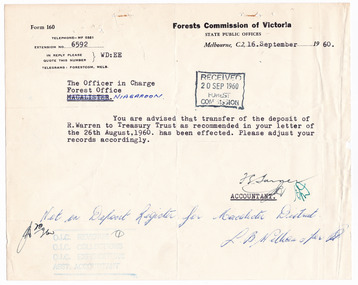
Letter (item), Forests Commission Victoria, 16-09-1960
... A typed letter from the Accountant at the Forests Commission of Victoria to The Officer in Charge, Forest Office, Niagaroon. ...A typed letter from the Accountant at the Forests Commission of Victoria to The Officer in Charge, Forest Office, Niagaroon. ...A typed letter from the Accountant at the Forests Commission of Victoria to The Officer in Charge, Forest Office, Niagaroon. ...A typed letter from the Accountant at the Forests Commission of Victoria to The Officer in Charge, Forest Office, Niagaroon. The letter is regarding that the transfer of a deposit from R. Warren to the Treasury Trust has been effected. The letter is dated September 16th 1960 and has been date stamped received at the Forest Commission on September 20th 1960.A typed letter from the Accountant at the Forests Commission of Victoria to The Officer in Charge, Forest Office, Niagaroon.RECEIVED/ 20 SEP 1960/ FOREST/ COMMISSION Not on Deposit Register for Macalister District/ Illegible O.I.C. REVENUE/ O.I.C. COLLECTIONS/ O.I.C. EXPENDITURE/ ASST. ACCOUNTANTmarysville, victoria, australia, taggerty, niagaroon, forests commission of victoria, r. warren, treasury trust, letter -
Federation University Historical Collection
Document, License under Section 19 of "The Land Act 1869", 1875
... forest...william foster stawell...acting governor...land officer...Forest. The fee for occupation was to be paid in advance by half-yearly payments to the Land Officer at Ballarat. ...Forest. The fee for occupation was to be paid in advance by half-yearly payments to the Land Officer at Ballarat. ...Full license and authority to enter and occupy Crown Land outlined was given to James Cowan. This was for a period of three years and subjected to conditions outlined on the document. The area was in the County of Bourke, Parish of Blackwood. The area concerned is located on the Lerderderg River in the Wombat State Forest. The fee for occupation was to be paid in advance by half-yearly payments to the Land Officer at Ballarat. The document signed on 1 July 1875 by William F Stawell, Acting Governor of Victoria.Thick pale blue paper. Hand written in ink Hand drawn map of land in questionDated 1 July 1875 Signed William F Stawelllicence, license, crown land, james cowan, county of bourke, parish of blackwood, lerderberg river, wombat state forest, william foster stawell, acting governor, land officer, ballarat -
 Marysville & District Historical Society
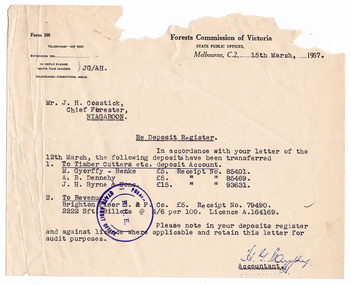
Letter (item), Forests Commission Victoria, 15-03-1957
... A typed letter from the Accountant at the Forests Commission of Victoria to Mr. J.H. Cosstick, Chief Officer, Niagaroon. ...A typed letter from the Accountant at the Forests Commission of Victoria to Mr. J.H. Cosstick, Chief Officer, Niagaroon. ...A typed letter from the Accountant at the Forests Commission of Victoria to Mr. J.H. Cosstick, Chief Officer, Niagaroon. ...A typed letter from the Accountant at the Forests Commission of Victoria to Mr. J.H. Cosstick, Chief Officer, Niagaroon. The letter is regarding the transfer of 3 deposits have been transferred between a timber cutters account and to the revenue account. The deposits were for licences to collect timber. The letter is dated March 15th 1957.A typed letter from the Accountant at the Forests Commission of Victoria to Mr. J.H. Cosstick, Chief Officer, Niagaroon.R.H.E. Illegible/ STATE AUDIT OFFICEmarysville, victoria, australia, taggerty, niagaroon, forests commission of victoria, mr. j.h. cosstick, m. gyorffy-benke, a.b. dennehy, j.h. byrne, letter -
 Orbost & District Historical Society
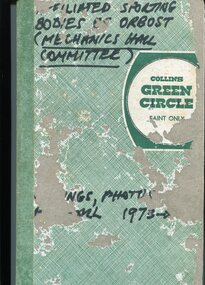
book, 1978
... Forests Commission Victoria. He was in Orbost from 1968 - 1973. The contents of the book are all related to sporting groups in Orbost at the Mechanics Hall. Peter Fagg was the Publicity Officer...Forests Commission Victoria. He was in Orbost from 1968 - 1973. The contents of the book are all related to sporting groups in Orbost at the Mechanics Hall. Peter Fagg was the Publicity Officer ...This collection was compiled by Peter Fagg who worked as a scientist with the Department of Sustainability and Environment (now DELWP) to study dieback in eucalypts. He specialised in the silviculture of the eucalypt forest types of South-East Australia for most of his 40-year career, which started with the Forests Commission Victoria. He was in Orbost from 1968 - 1973. The contents of the book are all related to sporting groups in Orbost at the Mechanics Hall. Peter Fagg was the Publicity Officer for the group as well as president. He was also associated with the Orbost municipal bands.This item is related to Peter Fagg, a prominent member of the Orbost community. The item is a record of sporting activities in Orbost.A hard-covered book with a green spine and a green thatched cover. It contains financial statements, newspaper cuttings, photos which have labels hand-written in pen, minutes and a brief history of the Orbost Mechanics Hall.on front cover in black marker - Affiliated Sporting Bodies of Orbost ( Mechanics Hall Committee)fagg-peter sport-orbost mechanics-hall-orbost -
 Greensborough Historical Society
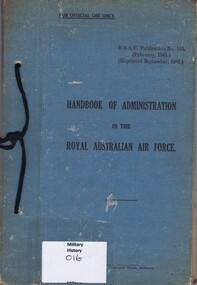
Book - Handbook, Handbook of Administration in the Royal Australian Air Force, 1941_
... Contains hand drawn cartoon on Officers' Mess stationery (RAAF Forest Hill)...Contains hand drawn cartoon on Officers' Mess stationery (RAAF Forest Hill) 62p., hard cover, loose leaf pages, bound with shoe lace. ...RAAF, World War IIOfficial Military Manual62p., hard cover, loose leaf pages, bound with shoe lace. Inscribed s/l Poulton. Contains hand drawn cartoon on Officers' Mess stationery (RAAF Forest Hill)world war ii, raaf, royal australian air force, military manuals -
 Bendigo Military Museum
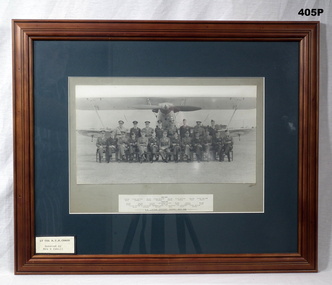
Photograph - PHOTOGRAPH, FRAMED, Bethany Gallery, c.1938
... Rectangular sepia photo, re LT COL BENJAMIN THOMAS ROY CHADD, of a group of participants in the Air Liaison Officer's Course in September 1938. Wooden frame with moulding, glass front & forest green mount. ...Refer Cat No 2039 for his Service History. photography-photographs military history - airforce frames Rectangular sepia photo, re LT COL BENJAMIN THOMAS ROY CHADD, of a group of participants in the Air Liaison Officer's Course in September 1938. Wooden frame with moulding, glass front & forest green mount. ...LT COL BENJAMIN THOMAS ROY CHADD No's 10594, VX20311, 1st & 2nd AIF. Refer Cat No 2039 for his Service History.Rectangular sepia photo, re LT COL BENJAMIN THOMAS ROY CHADD, of a group of participants in the Air Liaison Officer's Course in September 1938. Wooden frame with moulding, glass front & forest green mount. There is a plane in the background of 21 men whose names are listed under the photo. photography-photographs, military history - airforce, frames -
 Bendigo Military Museum
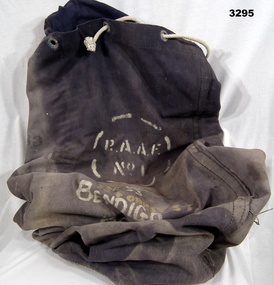
Equipment - KIT BAG RAAF WW2, c.1939 - 1945
... Officer Geoffrey Wilkin NEVILLE No 438263 RAAF. Refer Cat No 3291 for his Service History. military equipment containers -personal Kit bag RAAF F/O NEVILLE 438263 53 Forest Street Bendigo Vic K36/Q. ...Item issued to Flying Officer Geoffrey Wilkin NEVILLE No 438263 RAAF. Refer Cat No 3291 for his Service History.RAAF Kit Bag, blue canvas, white rope attached through brass eyelets. Identification details stenciled on. A white circle has RAAF No 1. F/O NEVILLE 438263 53 Forest Street Bendigo Vic K36/Q.military equipment, containers -personal, kit bag raaf -
 Bendigo Military Museum
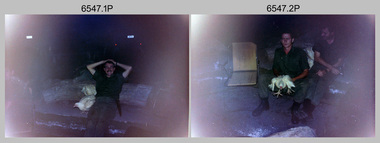
Photograph - 4th Field Survey Squadron Adventurous Training, Mount Remarkable National Park, Flinders Ranges, SA, 4th Field Survey Squadron Adventurous Training, Mount Remarkable National Park, SA, 1987
... Hootchie set-up, unidentified officer. .9) - Photo, colour, 1987. Camp activities. Results from foraging the forest for food. .10) - Photo, colour, 1987. ...Hootchie set-up, unidentified officer. .9) - Photo, colour, 1987. Camp activities. Results from foraging the forest for food. .10) - Photo, colour, 1987. ...This is a set of 40 photographs of 4th Field Survey Squadron undergoing adventurous training at Mount Remarkable National Park, South Australia in May 1987. It is evident the training focussed on teamwork, leadership, abseiling, rock climbing, field craft and living off the land survival skills. Elements from units of the Army Reserve also participated in the training. Refer to items 6546.42P and 6548.14P for additional photographs taken during the adventurous training.This is a set of 40 photographs of 4th Field Survey Squadron undergoing adventurous training at Mount Remarkable National Park, South Australia in May 1987. The colour photographs are on 35mm negative film and are part of the Army Survey Regiment’s Collection. The photographs were scanned at 96 dpi. .1) - Photo, colour, 1987. Camp activities, unidentified soldier. .2) - Photo, colour, 1987. Camp activities, unidentified personnel. .3) & .4) - Photo, colour, 1987. Hootchie set-up. .5) - Photo, colour, 1987. Camp activities, unidentified personnel. .6) - Photo, colour, 1987. Hootchie set-up. .7) - Photo, colour, 1987. Camp activities. .8) - Photo, colour, 1987. Hootchie set-up, unidentified officer. .9) - Photo, colour, 1987. Camp activities. Results from foraging the forest for food. .10) - Photo, colour, 1987. Camp set-up. .11) - Photo, colour, 1987. Camp activities. .12) - Photo, colour, 1987. Camp activities. L to R: CPL Jeff Prince, unidentified (x3). .13) to .16) - Photo, colour, 1987. Camp activities. .17) & .18) - Photo, colour, 1987. Mount Remarkable National Park terrain. .19) - Photo, colour, 1987. Hootchie set-up. L to R: unidentified, CPL Jeff Prince, SPR Perry Langeberg, unidentified (x3). .20) - Photo, colour, 1987. Camp activities. .21) - Photo, colour, 1987. Camp activities, unidentified personnel. .22) & .23) - Photo, colour, 1987. Camp set-up. .24) - Photo, colour, 1987. Hootchie set-up. .25) - Photo, colour, 1987. Hootchie set-up, unidentified personnel. .26) - Photo, colour, 1987. Camp activities. L to R: CPL Jeff Prince, SPR Steve Ellis, SGT Peter Imeson, CPL Neale ‘Tex’ Houston, SPR Perry Langeberg, unidentified exchange officer, WO2 Russ Larsen. .27) - Photo, colour, 1987. Hootchie set-up. .28) - Photo, colour, 1987. Camp activities. L to R: SPR Bruce Graham, LT Geoff ‘GT’ Ford, CPL Jamie ‘Fish’ McRae, SGT Wally Chilcott, SPR Shaun Hynes, CPL Kevin Whitty. .29) - Photo, colour, 1987. Camp activities. L to R: unidentified, SPR Todd Hayley, unidentified, WO2 Peter Symmans, SSGT Cam Chapman, CPL Dave Irving. .30) - Photo, colour, 1987. Camp activities. L to R: unidentified (x2), LT Greg Oaten CSC, unidentified (x2), CPL Peter Hardy, unidentified. .31) - Photo, colour, 1987. Camp activities. L to R: CPL Roger Graf, WO2 Bob Rogister, SSM WO1 Bill Griggs, unidentified officer, SPR Simon Reynolds, SPR John Keely. .32) - Photo, colour, 1987. Camp activities. L to R: unidentified, SPR Steve Nokes, SGT Stu Symonds, WO2 Brett ‘Dutchy’ Van Leeuwen, unidentified (x3). .33) - Photo, colour, 1987. Camp activities. L to R: unidentified, SGT Derek Stanmore, CAPT Danny Galbraith, unidentified in foreground. .34) - Photo, colour, 1987. Camp activities. L to R: unidentified (x3), SGT Derek Stanmore, CAPT Danny Galbraith. .35) - Photo, colour, 1987. Camp activities. .36) - Photo, colour, 1987. Camp activities. OC MAJ Peter Cates. .37) - Photo, colour, 1987. Camp activities. L to R: unidentified, CPL Dave Longbottom. .38) - Photo, colour, 1987. Camp activities, unidentified personnel. .39) & .40) - Hootchie set-up..1P to .40P – There are no personnel identified. ‘1987 ADV TRAINING’ annotated on negatives sleeve.royal australian survey corps, rasvy, 4 fd svy sqn -
 Bendigo Military Museum
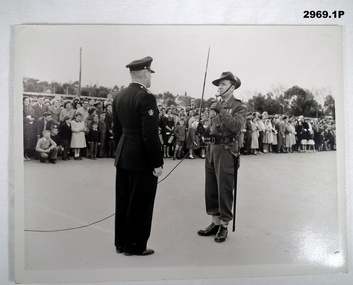
Photograph - PHOTOGRAPHS, 38TH BN POST WW2, 1) - .3) 1958; .4) 1956
... 4 x Black & white photos mounted on cardboard. .1) Chief of Police on L & Second Officer on R in front of a crowd of people for The Challenge for the Freedom of Entry to City of Bendigo. .2) March past parade of 38th Infantry Battalion in front of a crowd of people at Queen Elizabeth Oval, Bendigo. .3) 38th Infantry Battalion marching on Forest Street on return from Queen Elizabeth Oval, 2 churches & houses in background. .4) 38th Infantry Battalion in foreground on a street with buildings in background....Forest Street on return from Queen Elizabeth Oval Freedom of Entry - City of Bendigo 24th August 1958” .4) On printed label bottom centre: “38th Infantry Battalion - Northern Victorian Rgt Band. On Parade for the Governor of Victoria” 14 March 1956. 4 x Black & white photos mounted on cardboard. .1) Chief of Police on L & Second Officer on R in front of a crowd of people for The Challenge for the Freedom of Entry to City of Bendigo. .2) March past parade of 38th Infantry Battalion in front of a crowd of people at Queen Elizabeth Oval, Bendigo. .3) 38th Infantry Battalion marching on Forest Street on return from Queen Elizabeth Oval, 2 churches & houses in background. .4) 38th Infantry Battalion in foreground on a street with buildings in background. ...4 x Black & white photos mounted on cardboard. .1) Chief of Police on L & Second Officer on R in front of a crowd of people for The Challenge for the Freedom of Entry to City of Bendigo. .2) March past parade of 38th Infantry Battalion in front of a crowd of people at Queen Elizabeth Oval, Bendigo. .3) 38th Infantry Battalion marching on Forest Street on return from Queen Elizabeth Oval, 2 churches & houses in background. .4) 38th Infantry Battalion in foreground on a street with buildings in background.On printed label on rear: .1) “38th Infantry Battalion - Northern Victorian Rgt. The Challenge” .2) “38th Infantry Battalion - Northern Victorian Rgt. March Past - Queen Elizabeth Oval” .3) “38th Infantry Battalion - Northern Victorian Rgt. Forest Street on return from Queen Elizabeth Oval Freedom of Entry - City of Bendigo 24th August 1958” .4) On printed label bottom centre: “38th Infantry Battalion - Northern Victorian Rgt Band. On Parade for the Governor of Victoria” 14 March 1956. photography-photographs, military history, 38th bn, passchendaele barracks trust -
 Bendigo Historical Society Inc.
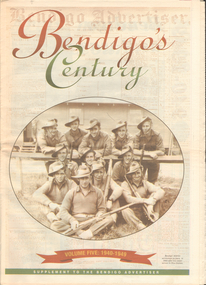
Newspaper - LONG GULLY HISTORY GROUP COLLECTION: BENDIGO'S CENTURY VOLUME FIVE: 1940 - 1949
... Forest Street Methodist Church... Pte Charles Phillips... Pte W E durward... Pte T Foley... William John Stephens... Central Nell Gwynne... Air Chief Marshall Sir Arthur Tedder... Cr Taylor... United Nations... Flying Officer...BENDIGO History long gully history group The Long Gully History Group - Bendigo's Century - Volume Five: 1940 - 1949 Bendigo Advertiser Central Deborah Mine Jackie Lewis Bob Johnson W Landy Ryga Yates Les Johnson Central Nell Gwynne Department of Defence Bendigo Jockey Club 8th Division Robert Menzies Deborah Mine Bendigo Decentralisation Vigilance Committee Cr W H Taylor Bendigo War Funds Organisation The Easter Fair Society Bendigo Agricultural Show Committee Mr E G Ham Mr J V Fairbairn Cr A Staples The Bendigo Chamber of Commerce Richard Hartley Smith Abbott Captain Harley Abbott Bendigo Art Gallery Bill Woodfull Bendigo High School North Deborah Mine Boardwalk Toni Riley Pharmacy Windermere Hotel Cr G A Pethard Coliban System North Deborah Mine Bendigo Pottery Bendigo Trades Hall Council Private Lawrence Burstall Major-General G J Rankin MHR Andrew Dunstan Ordnance Factory Royal Australian Navy HMAS Bendigo SEC Offices MUIOOF YMCA Georger Addlem Fred Addlem Cr A J Anderson Pauline Buvhan Thompson Leslie Thompson Edward Joseph Leonski Bendigo Football League Mr J Dedman William Stephens Forest Street Methodist Church Pte Charles Phillips Pte W E durward Pte T Foley William John Stephens Central Nell Gwynne Air Chief Marshall Sir Arthur Tedder Cr Taylor United Nations Flying Officer R Bruce Tuff Flight Lieutenant Owens Royal Air Force Commonwealth War Workers Housing Trust Scheme Mr S McKinnon Bendigo Decentralised Vigilance Committee Ravenswood Estate John Lienhop MLC Margaret (Peggy) Brennan Strathfieldsaye Shire Council School of Mines Bendigo Base Hospital William George Ashman Ashman's Tailors Bendigo Jockey Club Victorian Football Association Bendigo East Swimming Pool Deborah Anticline Specimen Hill Methodist Church North Deborah Adolf Hitler Benito Mussolini Australian 7th Division Cr Galvin Bendigo War Funds Organisation HMAS Bendigo Lt-Commander Jackson Bendigo Football League Central Deborah Mine Victoria Day Cr Truscott Bendigo Gaol Lansellstowe AWAS Barracks Bendigo Citizens Committee John Cain Snr Ordnance Factory Bendigo Agricultural Society The Duke of Gloucester Duchess of Gloucester Bendigo Tennis Association North Deborah Gillies Famous Pies Aids & Appliance Shop Mrs Georgina Scott Dr J A Neptune Scott Alfred Sisley Corot Daubigney Louis Sonnenberg Gas Employees' Union John Lienhop Soldier Settlement Commission Burnewang Estate King George VI Princess Elizabeth Lt Philip Mountbatten Mr E J W Herbert Ansett Airways Reg Ansett Most Rev Dr John McCarthy Dr Bernard Stewart Michael Giudice Bendigo United Breweries Bendigo Lyric Photo Plays Bendigo Sun Newspaper Shamrock Hotel West Bendigo Progress Association Alan McDonald South Bendigo Football Club Albert Collier J T Webbo Mervyn Tresize State Rivers and Water Supply Commission Eppalock Reservoir Public Works Committee Bendigo Rotary Club John Edgar Bendigo Base Hospital Albert Dunstan Benevolent Home Magetti's Wine Hall Wallace Reef Wine Hall Magetti Family Albert Magetti Lance Galvin Bradford Cotton Spinnings (Victoria) Pty Otd Arthur Syer Stanley Crossman Albert Arthur Dunstan Rev Dr Henry Backhaus City Family Hotel Lyric Theatre Bank of Australasia City Club HotelColonial Mutual Building R Matchett & Co Lansellstowe Leonard Lansell Bendigo Bas Hospital Australian Women's Army Service Mr Hollway Kenworth (Aust) Ltd Foggitt Jones's Bacon Factory Gordon Sayers Sandhurst Trustees Dr John Drowley Alexander Hislop Royal Mint North Deborah Mine Ironbark South Mining Company Central Nell Gwynne Company New Chum Syncline Newspaper supplement titled Bendigo's Century Volume Five: 1940 - 1949. ...Newspaper supplement titled Bendigo's Century Volume Five: 1940 - 1949. Each year has heading of Who's Who, Weather, Sport and Business. Front page is titled Bendigo's Century and has a photo of a group of soldiers in uniform and with rifles. They were district servicemen on leave in 1944. Each year has heading of Who's Who, Weather, Sport and Business. First years are 1940 - 1949 titled Bendigo as it was. It has two photos of women wading through the 1949 Pall Mall flood waters and one of Miners in the crib room of the Central Deborah Mine. They are Jackie Lewis, Bob Johnson, W Landy, Ryga Yates and Les Johnson. 1940 - Army moves in to racecourse, 1941 - Devastating fire at pottery, 1942 - Forces expand, 1943 - Nation's eyes on Bendigo, 1944 - News dawns of D-day landing, 1945 - City cheers the end of the war, 1946 - Celebrations begin in city, 1947 - Gallery gets top paintings, 1948 - Water plan looks good and 1949 - Flood takes a toll on city.bendigo, history, long gully history group, the long gully history group - bendigo's century - volume five: 1940 - 1949, bendigo advertiser, central deborah mine, jackie lewis, bob johnson, w landy, ryga yates, les johnson, central nell gwynne, department of defence, bendigo jockey club, 8th division, robert menzies, deborah mine, bendigo decentralisation vigilance committee, cr w h taylor, bendigo war funds organisation, the easter fair society, bendigo agricultural show committee, mr e g ham, mr j v fairbairn, cr a staples, the bendigo chamber of commerce, richard hartley smith abbott, captain harley abbott, bendigo art gallery, bill woodfull, bendigo high school, north deborah mine, boardwalk, toni riley pharmacy, windermere hotel, cr g a pethard, coliban system, north deborah mine, bendigo pottery, bendigo trades hall council, private lawrence burstall, major-general g j rankin mhr, andrew dunstan, ordnance factory, royal australian navy, hmas bendigo, sec offices, muioof, ymca, georger addlem, fred addlem, cr a j anderson, pauline buvhan thompson, leslie thompson, edward joseph leonski, bendigo football league, mr j dedman, william stephens, forest street methodist church, pte charles phillips, pte w e durward, pte t foley, william john stephens, central nell gwynne, air chief marshall sir arthur tedder, cr taylor, united nations, flying officer, r bruce tuff, flight lieutenant owens, royal air force, commonwealth war workers housing trust scheme, mr s mckinnon, bendigo decentralised vigilance committee, ravenswood estate, john lienhop mlc, margaret (peggy) brennan, strathfieldsaye shire council, school of mines, bendigo base hospital, william george ashman, ashman's tailors, bendigo jockey club, victorian football association, bendigo east swimming pool, deborah anticline, specimen hill methodist church, north deborah, adolf hitler, benito mussolini, australian 7th division, cr galvin, bendigo war funds organisation, hmas bendigo, lt-commander jackson, bendigo football league, central deborah mine, victoria day, cr truscott, bendigo gaol, lansellstowe, awas barracks, bendigo citizens committee, john cain snr, ordnance factory, bendigo agricultural society, the duke of gloucester, duchess of gloucester, bendigo tennis association, north deborah, gillies famous pies, aids & appliance shop, mrs georgina scott, dr j a neptune scott, alfred sisley, corot, daubigney, louis sonnenberg, gas employees' union, john lienhop, soldier settlement commission, burnewang estate, king george vi, princess elizabeth, lt philip mountbatten, mr e j w herbert, ansett airways, reg ansett, most rev, dr john mccarthy, dr bernard stewart, michael giudice, bendigo united breweries, bendigo lyric photo plays, bendigo sun newspaper, shamrock hotel, west bendigo progress association, alan mcdonald, south bendigo football club, albert collier, j t webbo, mervyn tresize, state rivers and water supply commission, eppalock reservoir, public works committee, bendigo rotary club, john edgar, bendigo base hospital, albert dunstan, benevolent home, magetti's wine hall, wallace reef wine hall, magetti family, albert magetti, lance galvin, bradford cotton spinnings (victoria) pty otd, arthur syer, stanley crossman, albert arthur dunstan, rev dr henry backhaus, city family hotel, lyric theatre, bank of australasia, city club hotelcolonial mutual building, r matchett & co, lansellstowe, leonard lansell, bendigo bas hospital, australian women's army service, mr hollway, kenworth (aust) ltd, foggitt jones's bacon factory, gordon sayers, sandhurst trustees, dr john drowley, alexander hislop, royal mint, north deborah mine, ironbark south mining company, central nell gwynne company, new chum syncline -
 Monbulk RSL Sub Branch
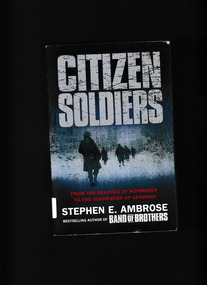
Book, Stephen E Ambrose, Citizen soldiers : the U.S. Army from the Normandy Beaches to the surrender of Germany, 2002
... In between comes the battles in the hedgerows of Normandy, the breakout of Saint-Lo, the Falaise gap, Patton tearing through France, the liberation of Paris, the attempt to leap the Rhine in operation Market-Garden, the near-miraculous German recovery, the battles around Metz and in the Huertgen Forest, the Battle of the Bulge, the capture of the bridge at Remagen and, finally, the overunning of Germany. From the enlisted men and junior officers, Ambrose draws on hundreds of interviews and oral histories from those on both sides of the war. ...his sequel to D-DAY opens at 00:01 hours, June 7, 1944 on the Normandy Beaches and ends at 02:45 hours, May 7, 1945. In between comes the battles in the hedgerows of Normandy, the breakout of Saint-Lo, the Falaise gap, Patton tearing through France, the liberation of Paris, the attempt to leap the Rhine in operation Market-Garden, the near-miraculous German recovery, the battles around Metz and in the Huertgen Forest, the Battle of the Bulge, the capture of the bridge at Remagen and, finally, the overunning of Germany. From the enlisted men and junior officers, Ambrose draws on hundreds of interviews and oral histories from those on both sides of the war. The experience of these citizen soldiers reveals the ordinary sufferings and hardships of war. They overcame their fear and inexperience, the mistakes of their high command and their enemy to win the war.Index, bibliography, notes, ill, maps, p.528.non-fictionhis sequel to D-DAY opens at 00:01 hours, June 7, 1944 on the Normandy Beaches and ends at 02:45 hours, May 7, 1945. In between comes the battles in the hedgerows of Normandy, the breakout of Saint-Lo, the Falaise gap, Patton tearing through France, the liberation of Paris, the attempt to leap the Rhine in operation Market-Garden, the near-miraculous German recovery, the battles around Metz and in the Huertgen Forest, the Battle of the Bulge, the capture of the bridge at Remagen and, finally, the overunning of Germany. From the enlisted men and junior officers, Ambrose draws on hundreds of interviews and oral histories from those on both sides of the war. The experience of these citizen soldiers reveals the ordinary sufferings and hardships of war. They overcame their fear and inexperience, the mistakes of their high command and their enemy to win the war. operation overlord, world war 1939-1945 - campaigns - europe -
 Bendigo Historical Society Inc.
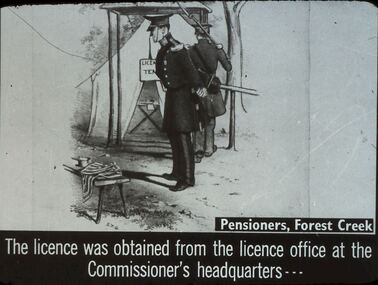
Slide - DIGGERS & MINING. THE GOLD LICENCE, c1850s
... Forest Creek. The licence was obtained from the licence office at the Commissioner's headquarters. Slide shows Commissioner and an officer outside the Licence Tent. ...Forest Creek. The licence was obtained from the licence office at the Commissioner's headquarters. Slide shows Commissioner and an officer outside the Licence Tent. ...Diggers & Mining. The gold licence. The Government Camp. Slide: Pensioners, Forest Creek. The licence was obtained from the licence office at the Commissioner's headquarters. Slide shows Commissioner and an officer outside the Licence Tent. Markings: 9 994.LIF. 4. Used as a teaching aid.hanimounteducation, tertiary, goldfields -
 Bendigo Historical Society Inc.
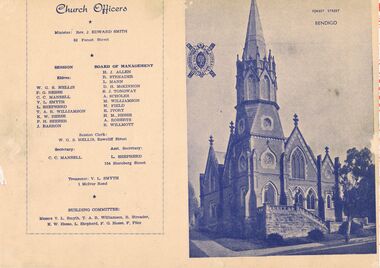
Document - MCCOLL, RANKIN AND STANISTREET COLLECTION: FOREST STREET PRESBYTERIAN CHURCH, 9th September, 1951
... Outlining the work they have done at the Forest Street Presbyterian Church also contains a list of Church Officers and the names of the building Committee. ...Outlining the work they have done at the Forest Street Presbyterian Church also contains a list of Church Officers and the names of the building Committee. ...Portions of a booklet? Outlining the work they have done at the Forest Street Presbyterian Church also contains a list of Church Officers and the names of the building Committee. Also a list of the Opening Services to be held on Sunday 9th September 1951. Some sections of a 1952 calendar had been attached to this document as well. A photo of the Church in Blue tones is on the cover?church, history, presbyterian church forest st bendigo, bendigo, religion, forest street presbyterian church -
 Bendigo Historical Society Inc.
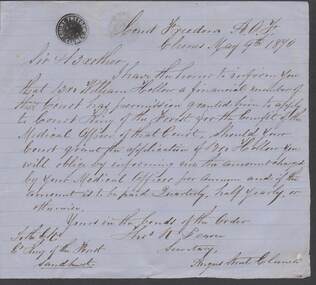
Document - ANCIENT ORDER OF FORESTERS NO. 3770 COLLECTION: CORRESPONDENCE
... Bro William Hollows has permission to apply to Court King of the Forest for the benefit of the Medical Officer of that Court. Should Court King of the Forest grant the application Court Freedom would like to be informed the amount charged by the Medical Officer per Annum and if it is to be paid Quarterly, half Yearly, or otherwise. ...Bro William Hollows has permission to apply to Court King of the Forest for the benefit of the Medical Officer of that Court. Should Court King of the Forest grant the application Court Freedom would like to be informed the amount charged by the Medical Officer per Annum and if it is to be paid Quarterly, half Yearly, or otherwise. ...Letter written on blue paper and dated May 9 1870. Bro William Hollows has permission to apply to Court King of the Forest for the benefit of the Medical Officer of that Court. Should Court King of the Forest grant the application Court Freedom would like to be informed the amount charged by the Medical Officer per Annum and if it is to be paid Quarterly, half Yearly, or otherwise. Signed Thos. H. Pearce.societies, aof, correspondence, ancient order of foresters no. 3770 collection - correspondence, court freedom, william hollow, court king of the forest, thos h pearce -
 Bendigo Historical Society Inc.
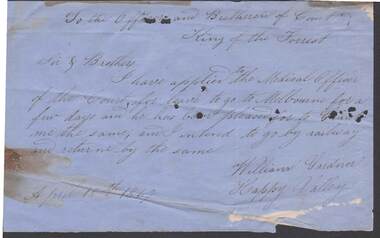
Document - ANCIENT ORDER OF FORESTERS NO. 3770 COLLECTION: CORRESPONDENCE
... SOCIETIES Aof correspondence Ancient Order of Foresters No. 3770 Collection - Correspondence Court King of the Forest William gardner Letter written on blue paper and dated April 18th 1867. Letter informing the Court the Medical Officer has granted him leave to go by train to Melbourne for a few days. ...Letter written on blue paper and dated April 18th 1867. Letter informing the Court the Medical Officer has granted him leave to go by train to Melbourne for a few days. Signed by William gardner, Happy Valley.societies, aof, correspondence, ancient order of foresters no. 3770 collection - correspondence, court king of the forest, william gardner
