
Showing 59 items matching "fourteen years"
-
 Ballarat Tramway Museum
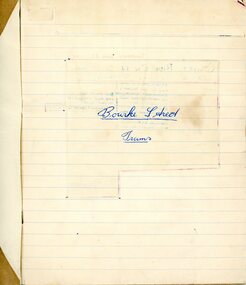
Book - Book - Scrapbook, Newspaper articles on "Bourke Street Trams"' from June 1955
... ...fourteen years...He would have been about fourteen years old when he started this scrapbook. ...He would have been about fourteen years old when he started this scrapbook. trams scrapbook bourke street photographs the argus the age the herald the sun news pictorial 1955 fourteen years ron bridger collection melbourne AS Box 48A Title of book on first page. ...Ron Bridger was an avid collector of items related to transport, predominately Trams. These items include newspaper cuttings, pamphlets, reports, timetables, fares prices plus special items relating to events. Items from Melbourne and regional Victoria, interstate - Adelaide and Sydney, plus overseas, make up this collection. Scrapbook contains photographs and written article related to the Bourke Street trams in Melbourne, Victoria. These have been collected by Ron Bridger from various newspaper outlets - The Argus, The Age, The Herald, The Sun News-Pictorial, all printed in Melbourne. He would have been about fourteen years old when he started this scrapbook. Small lined exercise book covered in brown paper.Title of book on first page. Each article labelled with date and name of newspaper. R Bridger on back covertrams, scrapbook, bourke street, photographs, the argus, the age, the herald, the sun news pictorial, 1955, fourteen years, ron bridger collection, melbourne, as box 48a -
 Lakes Entrance Historical Society
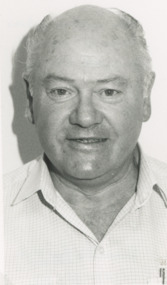
Photograph - Ken Lapham Lakes Entrance Victoria 1995, Lakes Post Newspaper
... Black and white photograph of Ken Lapham Security Officer upon his retirement after fourteen years in Lakes Entrance and thirty six years in the office, Lakes Entrance Victoria...Black and white photograph of Ken Lapham Security Officer upon his retirement after fourteen years in Lakes Entrance and thirty six years in the office, Lakes Entrance Victoria...Black and white photograph of Ken Lapham Security Officer upon his retirement after fourteen years in Lakes Entrance and thirty six years in the office, Lakes Entrance Victoria Businesses People Commerce Black and white photograph of Ken Lapham Security Officer upon his retirement after fourteen years in Lakes Entrance and thirty six years in the office, Lakes Entrance Victoria Photograph Ken Lapham Lakes Entrance Victoria 1995 Lakes Post Newspaper ...Black and white photograph of Ken Lapham Security Officer upon his retirement after fourteen years in Lakes Entrance and thirty six years in the office, Lakes Entrance VictoriaBlack and white photograph of Ken Lapham Security Officer upon his retirement after fourteen years in Lakes Entrance and thirty six years in the office, Lakes Entrance Victoriabusinesses, people, commerce -
 National Vietnam Veterans Museum (NVVM)
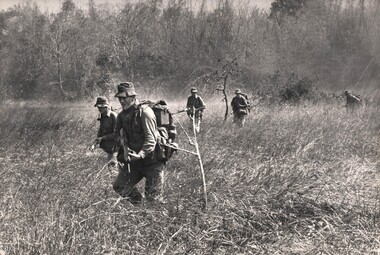
Photograph, Gibbons, Denis, Operation Finschafen
... Maj Thompson had previously spent fourteen years with Gurka Battalions in Malaya and Hong Kong...Maj Thompson had previously spent fourteen years with Gurka Battalions in Malaya and Hong Kong Operation Finschafen Photograph Gibbons, Denis ...Denis Gibbons (1937 – 2011) Trained with the Australian Army, before travelling to Vietnam in January 1966, Denis stayed with the 1st Australian Task Force in Nui Dat working as a photographer. For almost five years Gibbons toured with nine Australian infantry battalions, posting compelling war images from within many combat zones before being flown out in late November 1970 after sustaining injuries. The images held within the National Vietnam Veterans Museum make up the Gibbons Collection. A black and white photograph of elements of A Company, 7 RAR under command of Maj Chris Thompson move out on Operation Finschafen 13/03/1970. Maj Thompson had previously spent fourteen years with Gurka Battalions in Malaya and Hong Kongphotograph, maj chris thompson, operation finschafen, 7 rar, gibbons collection catalogue, a company, denis gibbons -
 Bendigo Historical Society Inc.
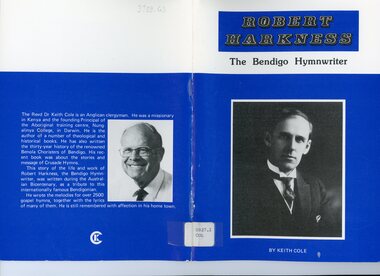
Book - LYDIA CHANCELLOR COLLECTION: ROBERT HARKNESS 'THE BENDIGO HYMWRITER', 1988
... Walker Pty Ltd Railway Place Bendigo Vic 3550 Contents: Godly Parents His early years and conversion Fourteen years with Charles M. Alexander Dedicated Service in the United States His musical development The Gospel Hymwriter Death and eulogy...Walker Pty Ltd Railway Place Bendigo Vic 3550 Contents: Godly Parents His early years and conversion Fourteen years with Charles M. Alexander Dedicated Service in the United States His musical development The Gospel Hymwriter Death and eulogy Book LYDIA CHANCELLOR COLLECTION: ROBERT HARKNESS 'THE BENDIGO HYMWRITER' ...LYDIA CHANCELLOR COLLECTION: Robert Harkness 'The Bendigo Hymwriter' By Keith Cole. 1988 Published by Keith Cole Publications, 28 Woodbury Stree Victoria 3550, printed by D.G. Walker Pty Ltd Railway Place Bendigo Vic 3550 Contents: Godly Parents His early years and conversion Fourteen years with Charles M. Alexander Dedicated Service in the United States His musical development The Gospel Hymwriter Death and eulogybendigo, history, bendigo churches -
 Ithacan Historical Society
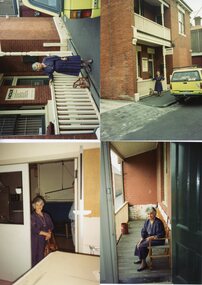
Photograph, Anthi Chilianis - House no. 10, 1994
... Anthi Chilianis and her husband George lived in this house at 4 Hotham Street, South Melbourne for fourteen years from 1945 to 1959. They left the house when the family went to live in Ithaca. ...Anthi Chilianis and her husband George lived in this house at 4 Hotham Street, South Melbourne for fourteen years from 1945 to 1959. They left the house when the family went to live in Ithaca. ...Anthi Chilianis and her husband George lived in this house at 4 Hotham Street, South Melbourne for fourteen years from 1945 to 1959. They left the house when the family went to live in Ithaca. The house now houses a printing business. It was Anthi's favourite house and she and George often sat on the balcony drinking Greek coffee. Four photos showing different views of a terrace house in a narrow street. Clockwise from L-R: A lady standing in front of a verandah which is level with the street, A full view of the double fronted terrace house, Sitting on a seat on the narrow verandah, Standing in the kitchen inside the house. chillianis -
 Vision Australia
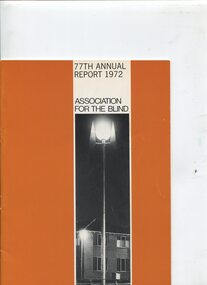
Administrative record - Text, 77th Annual Report 1972 Association for the Blind of Victoria, 1973
... Lightfoot, who organised drivers for home visitor Elsie Henderson, has stepped down after fourteen years of service....Lightfoot, who organised drivers for home visitor Elsie Henderson, has stepped down after fourteen years of service. Association for the Blind H.M. ...Articles in annual report include: branch committees, President's report, finance report, balance sheet, welfare, hospital homes, day centres, auxiliaries, volunteer service group, senior staff, life governors, formal establishment of the Low Vision Clinic which had been begun with discussions with Professor Gerard Crook in 1970 and supported for a year by the Hecht Trust, John Wilson accompanied Hugh Jeffrey, Australia's delegate on the Executive Committee for the Welfare of the Blind and IFB, businessman John Wicking joined the committee, plans for the future development of the George Vowell Centre are being formulated, Derek Nimmo entertained at multiple Auxiliary functions, the Toorak Auxiliary closed but two new ones at Kyneton and Narcoonah (Hampton), were formed, introduction of training course for volunteer workers and Mrs H.M. Lightfoot, who organised drivers for home visitor Elsie Henderson, has stepped down after fourteen years of service.1 volume of text and photographsassociation for the blind, h.m. lightfoot, john wilson, hugh jeffrey, derek nimmo, iris barnier, annual reports -
 Federation University Historical Collection
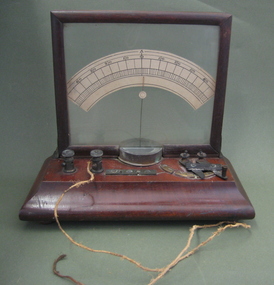
Ammeter, Henry Sutton (probably), Ammeter attributed to Henry Sutton, 1883 (estimated)
... His skill and acquirements in electricity, telegraphy, telephony, photography and also in astronomical and microscopal studies have won for him a high position as a practical scientist, and the credit is the greater as he is a self-taught student … Mr Sutton, before he was fourteen years old, had read every book on science to be found in the library of the Ballarat Mechanics' Institute." ...His skill and acquirements in electricity, telegraphy, telephony, photography and also in astronomical and microscopal studies have won for him a high position as a practical scientist, and the credit is the greater as he is a self-taught student … Mr Sutton, before he was fourteen years old, had read every book on science to be found in the library of the Ballarat Mechanics' Institute." ...W.B Withers wrote of Sutton: "In the realm of science Ballarat has become of world-wide fame through the inventions by Mr Henry Sutton, a native of the place. His skill and acquirements in electricity, telegraphy, telephony, photography and also in astronomical and microscopal studies have won for him a high position as a practical scientist, and the credit is the greater as he is a self-taught student … Mr Sutton, before he was fourteen years old, had read every book on science to be found in the library of the Ballarat Mechanics' Institute." The Ballarat School of Mines (SMB) was fortunate to have this genius appointed as the lecturer-in-charge of the new Electricity and Magnetism department from 23 April 1883. Although Henry Sutton submitted his resignation to the Council of SMB in October 1884 it was resolved that he be asked to reconsider, and Mr Sutton continued to teach at SMB until the end of 1886. He was a prominent member of the Camera Club, and many of the other SMB clubs. Sutton had an active and fertile brain, and was known for his inventions, especially his work on the telephone, telephane and carbon lamps. Sutton presented a vacuum pump, worked by water jet, for use in SMB Chemistry classes. His report of 1883 states: ‘A telephonic circuit has been laid down between the [SMB] engine-house and workshops, to be used for experimental purposes.’ Henry Sutton spent much thought on artificial flight, and made some interesting experimental studies with flying birds. The storage of electricty also attracted his attention, and, after much work and thought evolved the Sutton Secondary Battery. A paper on this battery was presented to the Royal Society, London, and was afterwards printed in the 'Transactions'. Henry Sutton is listed on the Federation University Honour Roll at https://www.federation.edu.au/curator/honour-roll/honourroll_sutton.shtmlA crude scientific instrument that measures amps, with a timber base and frame. Terminal posts and sliders contacts are positioned on top of the base, with flex attached. Henry Sutton lectured at the Ballarat School of Mines (SMB) in Electricty and Magnestism between 1883 and 1886. In 1883 Sutton reported: ‘…The class has been unfortunately situated, by having to wait for instruments of precision ordered from England, but which have not come to hand. The delay has caused us to start constructing instruments, which it is hoped will bear favourable comparison with those of older date.'ammeter, henry sutton, electrical, inventor, electricity and magnetism, sutton, scientific instruments -
 Flagstaff Hill Maritime Museum and Village
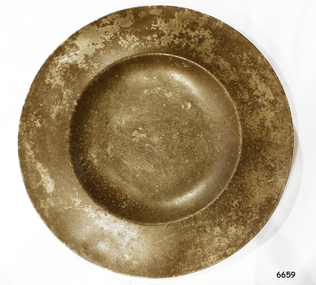
Domestic object - Plate, c. 1850's
... The successful applicant also had to pay one pound sterling for each adult, and ten shillings for each child between the ages of one and fourteen years. This payment covered the cost of a mattress, bolster, blanket, small box, knife and fork, two spoons, metal plate, and drinking mug, all of which became the emigrant's property on arrival in the colony. ...The successful applicant also had to pay one pound sterling for each adult, and ten shillings for each child between the ages of one and fourteen years. This payment covered the cost of a mattress, bolster, blanket, small box, knife and fork, two spoons, metal plate, and drinking mug, all of which became the emigrant's property on arrival in the colony. ...In the words of the donor, Betty Stone, "This pewter plate belonged to Joshua and Susan Chamberlain. They, with their family, arrived in Australia as assisted migrants in January 1855. Our Chamberlain family was among those chosen to participate in a Bounty Scheme and on 24 October 1854 embarked on SS Shand to begin their journey. A few years later they set up a home on a small farming property in Wangoom, Warrnambool with the possessions they had brought with them from the village of Thriplow, Cambridgeshire, England. Amongst those household possessions was this plate. During the first half of the nineteenth century, a Bounty scheme was introduced to encourage migrants to Australia to work on properties granted or sold to settlers. Agents in England were engaged to select suitable emigrants; applicants had to be "sober, industrious and of good moral character....and married men over the age of forty-eight were only eligible to receive the bounty if they had five or more children over the age of ten years'. The successful applicant also had to pay one pound sterling for each adult, and ten shillings for each child between the ages of one and fourteen years. This payment covered the cost of a mattress, bolster, blanket, small box, knife and fork, two spoons, metal plate, and drinking mug, all of which became the emigrant's property on arrival in the colony. The pewter plate, handed down from one generation to the next, was always valued by members of the family as an important artefact. The plate has a mark stamped on the back which is almost indecipherable." (Reference- Brown Martyn- Australia Bound! The story of West Country connections 1688- 1888 Bradford on Avon Wiltshire Ex Libris Press 1988 p 112.) (Note: For additional information please refer to Betty Stone’s book “Pioneers and Places - A History of three Warrnambool Pioneering Families” ie. Chamberlain, Dale and Lees Families)This item is associated with the families of Chamberlain, Dale and Lees. These families are listed in the "Pioneers' Register" for Warrnambool Township and Shire, 1835-1900, published by A.I.G.S. Warrnambool Branch. The plate is an example of the goods emigrants brought to Australia under the Bounty Scheme in the 1850s.Pewter plate: metal plate with a wide rim and shallow bowl. The top has a gold-brown colour, underside is grey with a red-brown mark. Made c. 1850. The plate has an Inscription stamped on the back and front.It is part of the 'Chamberlain, Dale and Lees Collection' Maker's Mark on back: 'rectangle with rounded corners / T H all within a circle' almost indecipherable. Mark heavily stamped on front: 'L / T M'flagstaff hill, warrnambool, shipwrecked coast, flagstaff hill maritime museum, maritime museum, shipwreck coast, flagstaff hill maritime village, great ocean road, chamberlain, dale, lees, stone, betty stone, warrnambool pioneers, pewter plate, emigration, bountey system, dinner ware, joshua chamberlain, susan chamberlain, 1855, emigrant, assisted migrant, ss shand, wangoom, triplow, cambridgeshire -
 Ballarat Heritage Services
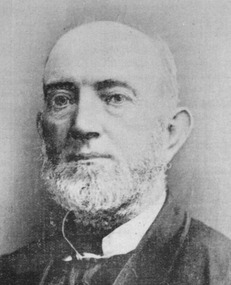
Photograph - Photograph - Colour, Clare Gervasoni, Daniel Brophy
... William Brophy escaped to Newfoundland returning after fourteen years and regained some of his property. ...William Brophy escaped to Newfoundland returning after fourteen years and regained some of his property. ...Daniel Brophy was born on 13 November 1832 at Castlecomer, County Kilkenny, Ireland. He was the youngest son of William Brophy, farmer, and his wife Margaret Purcell. In the Irish rebellion of 1798 the family estates had been confiscated. William Brophy escaped to Newfoundland returning after fourteen years and regained some of his property. Daniel Brophy was educated in local schools including a Quakers school. At 15 Daniel Brophy went with his family to Quebec in a migrant ship whose passengers were decimated by fever. His mother died on the voyage and his father soon after landing. Daniel found work in a shipyard but did not like it and entered a grocery warehouse. Brophy arrived at Melbourne in 1853 in search of gold. With four Irish friends he set off for Bendigo on foot. Water was scarce on the track and they worked at a quarry near Keilor until the winter rains began. The party was credited with the first discovery of payable gold at Taradale, but by 1855 they had moved to Ballarat. There Daniel Brophy proved himself a shrewd investor in many successful mining ventures. He started as the first sluice man in the Great Extended Mine and later became a director and chairman when it was renamed the Band of Hope and Albion; its total yield was about £3,000,000. Brophy also invested in a Ballarat hotel which he greatly enlarged and in landed property. An enthusiastic promoter of local industries, he became a director of the Phoenix Foundry Co. and of the Ballarat Woollen Mills. Brophy was an Irish Nationalist who first dug for gold at Bendigo and Taradale. He was a Knight of the Order of St George, mining manager, mining Investor and hotelkeeper. In 1859 he had married Ellen Mary Berkery; he was survived by five of their ten children.Black and white image of Daniel Brophy . ballaarat old cemetery, eureka stockade, daniel brophy, ellen brophy, bartholomew brophy, ellen maria brophy, james henry brophy, thomas edward brophy, mary berkery, daniel patrick brophy, william brophy, ellen berkery -
 Ballarat Heritage Services
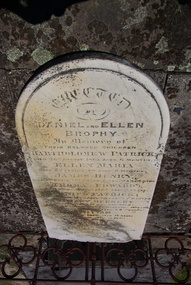
Photograph - Photograph - Colour, Clare Gervasoni, Brophy Gravestone at the Ballaarat Old Cemetery, 2013, 2013
... William Brophy escaped to Newfoundland returning after fourteen years and regained some of his property. ...William Brophy escaped to Newfoundland returning after fourteen years and regained some of his property. ...Daniel Brophy was born on 13 November 1832 at Castlecomer, County Kilkenny, Ireland. He was the youngest son of William Brophy, farmer, and his wife Margaret Purcell. In the Irish rebellion of 1798 the family estates had been confiscated. William Brophy escaped to Newfoundland returning after fourteen years and regained some of his property. Daniel Brophy was educated in local schools including a Quakers school. At 15 Daniel Brophy went with his family to Quebec in a migrant ship whose passengers were decimated by fever. His mother died on the voyage and his father soon after landing. Daniel found work in a shipyard but did not like it and entered a grocery warehouse. Brophy arrived at Melbourne in 1853 in search of gold. With four Irish friends he set off for Bendigo on foot. Water was scarce on the track and they worked at a quarry near Keilor until the winter rains began. The party was credited with the first discovery of payable gold at Taradale, but by 1855 they had moved to Ballarat. There Daniel Brophy proved himself a shrewd investor in many successful mining ventures. He started as the first sluice man in the Great Extended Mine and later became a director and chairman when it was renamed the Band of Hope and Albion; its total yield was about £3,000,000. Brophy also invested in a Ballarat hotel which he greatly enlarged and in landed property. An enthusiastic promoter of local industries, he became a director of the Phoenix Foundry Co. and of the Ballarat Woollen Mills. Brophy was an Irish Nationalist who first dug for gold at Bendigo and Taradale. He was a Knight of the Order of St George, mining manager, mining Investor and hotelkeeper. In 1859 he had married Ellen Mary Berkery; he was survived by five of their ten children.Colour photographs of the Brophy headstone in the Ballaarat Old Cemetery . ballaarat old cemetery, eureka stockade, daniel brophy, ellen brophy, bartholomew brophy, ellen maria brophy, james henry brophy, thomas edward brophy, mary berkery, daniel patrick brophy, william brophy, ellen berkery -
 Federation University Historical Collection
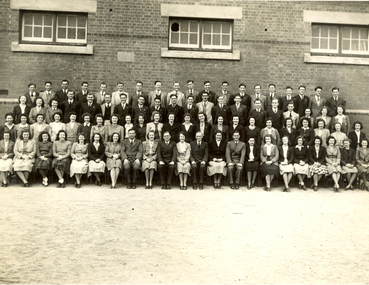
Photograph - Black and White, Ballarat Teachers' College, 1947, 1947
... Inclusive of Manual Arts students, and private fee-paying students, exactly 400 trainees passed through the college in its brief span of life (1926-1931) Fourteen years were to pass before they were again opened to students on February 2nd, 1946. ...Inclusive of Manual Arts students, and private fee-paying students, exactly 400 trainees passed through the college in its brief span of life (1926-1931) Fourteen years were to pass before they were again opened to students on February 2nd, 1946. ...Ballarat Teachers' College was opened on may 4th, 1926, at S.S. 33, Dana Street, with an enrollment of sixty-one students, its original staff consisted of the Principal, Mr W. H. Ellwood, M.A., m.Ed. (Chairman of the Teachers' tribunal from its inception in 1946 until 1954), Miss A. Bouchier, B.A., and Mr A.B. Jones, B.A. (Lecturers). In 1927 Miss P.A. Hamano joined the staff. Teaching practice and special rural school work were carried on in schools in or near Ballarat - drawing, crafts and singing were taught by local teachers. In 1927 the college moved to the old Ballarat East Town Hall (remodelled for their use) in Barkly Street. During 1927 the numbers in the College were augmented by twenty-six Manual arts students who had formerly received their training at Ballarat High School. Manual Arts students continued till 1930, when, on grounds of economy, their training was concentrated at Melbourne Teachers' College.\During the four succeeding years approximately sixty students annually entered the primary course. Inclusive of Manual Arts students, and private fee-paying students, exactly 400 trainees passed through the college in its brief span of life (1926-1931) Fourteen years were to pass before they were again opened to students on February 2nd, 1946. The college was re-commenced at S.S. Dana Street under the guidance of Mr W.F. Lord, M.C., M.M., B.A., Dip.Ed., (Acting Principal 1946-1950), and a staff consisting of Miss E.B. Hughes, B.A., Dip. Ed., Mr C.B. Bryan, B.A., V.Com., Dip.Ed., Miss M.H. Miller, L.Mus.A., and Miss G. Kentish, Dip.Phys.Ed. The opening ceremony was performed by the Minister for education at that time, the Hon. F. Field, M.L.A., accompanied by the Hon. T.T. Hollway, M.L.A., and the then Director of Education, Mr J.A. Seitz. It was originally intended to cater for women students only (for whom 130 Victoria Street was purchased as a hostel) but, at the last moment, men were also accepted. A co-educational college was thus set up instead, and has continued as such. The original Staff has been considerable augmented, and the number of Students has been more than trebled. 1951 saw the introduction of the two-year course, successful students being presented with the Trained Primary Teachers' Certificate at the final College assembly each year. In December, 1855, College held its first Graduation Ceremony, with its own Graduation hymn, the words of which were written by Miss C.M. Canty of the staff. Mr Ellwood, former Principal,delivered the occasional address and presented the Ellwood Prize to the outstading student of the year (Mr C.P. Handreck). Students who had successfully completed the course received their certificates from Mr E.B. Pederick, Chief Inspector of Primary Schools. College accomodation having been strained for several years, it was pleasant news when tenders were called in July, 1956, for the building of the first section of the new Ballarat Teachers' College in Gillies Street, near the Botanical Gardens. At the beginning of 1958 the new College was occupied, and staff and students have appreciated greatly the appointments and cacilities of the new buildign. In 1968 the three-year Diploma Course began, co-existent with the other courses which will continue during the transitional period. Successful students in the course receive the Diploma of Teaching (Primary).Black and white photograph of students and staff of the Ballarat Teachers' College. The people are in four rows, and they stand in front of the Dana Street Primary School. Back Row: Jim Howlett; Milton Rice; Keith McLean; Jim Williams; George Nield, David Cooper, Ray Terrill, William Gleeson; Tom Pascoe; Lindsay Harley; Ron Carless; Robert Giddings; Colin Connelly; Alex Magill; Eddie Blake; William Punshon; Athol Aisbett; Kevin Collins; John O'Shannessy. Second Row: Beth Leslie; Faye Dreher; Gwen Pamphilon; Arthur Lelean; Howard Pattenden; Jack Tyers; Hugh Fraser; William Henderson; Jack Mallett; Alan Martin; Keith Boyd; John Ellifson; John Collins; Tom Hill; Wal Henning; Burns Roddis; Fred Marshman; Dawn Doney; Pat Watts; Ann McKinnon. Third Row: Ethel Esmore; Joy Love; Pat Luxford; Jean Elliott; Josie Bunny; Phyllis Borley; Joyce Matheson; Val Witney; Ruth Tozer; Nancy Kerr; K.ath Tobin; Muriel Morrish; Jean Clode; Peg Purdue; Joyce Kennedy; Margaret Palmer; Marie Faulds; Thelma Ritchie. Fourth Row: Pat Lewin; Mavis Poland; Lorna Welsh; Lynette Lynch; Nancy Alexander; Betty Williams, Val Gorrie; Alan Sonsee; Trudy Kentish; Carl Bryan; Monica Miller; W.F. Lord; Beth Hughes; Mephan McMcEwin; Mattie Hayes; Neila Vallance; Pat Robinson; Elva Surman; Joan Gunning; Norma Dally; Beatrice Freeman; Kath Crossett.ballarat teachers' college, education, dana street primary school, 1947 -
 Federation University Historical Collection
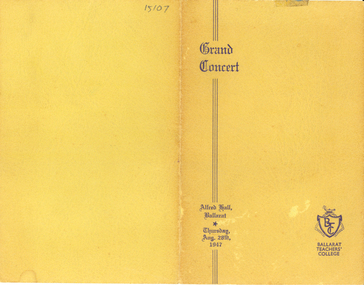
Programme, Ballarat Teachers' College, Ballarat Teachers' College Grand Concert, 1947, 1947
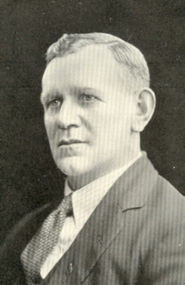
... With the advent of the economic depression of the ‘thirties, Ballarat Teachers' College closed its doors in December, 1931. Fourteen years were to pass before the College opened again on February 2nd, 1946. ...With the advent of the economic depression of the ‘thirties, Ballarat Teachers' College closed its doors in December, 1931. Fourteen years were to pass before the College opened again on February 2nd, 1946. ...Ellwood was the Principal of the Ballarat Teachers' College. Ballarat Teachers’ College was opened on 04 May 1926, at S.S. 33 Dana Street, with an enrolment of 61 students. Its original staff consisted of the Principal, Mr W.H. Ellwood, M.A., M.Ed. (Chairman of the Teachers’ Tribunal from its inception in 1946 until 1954), Miss A. Bouchier, B.A., and Mr A.B. Jones, BA., (lecturers). In 1927 Miss P.A. Hamano joined the staff. In 1927 the college moved to the old Ballarat East Town Hall (remodelled for their use) in Barkly Street. During 1927 the numbers in the College were augmented by 26 Manual Arts students, who had formerly received their training at Ballarat High School. Manual Art students continued till 1930 when, on grounds of economy, their training was concentrated at Melbourne Teachers’ College. During the four succeeding years, approximately 60 students annually entered the primary course. Inclusive of Manual Arts students, and private fee-paying students, exactly 400 trainees passed through the College in its brief span of life (1926-1931). Five per cent of each year’s students were granted an extension of their studentship to enable them to proceed to Melbourne Teachers’ College, and to take the first year’s course for a University degree. With the advent of the economic depression of the ‘thirties, Ballarat Teachers' College closed its doors in December, 1931. Fourteen years were to pass before the College opened again on February 2nd, 1946. The college re-commenced at SS Dana Street, under the guidance of Mr W.F. Lord, M.C., M.M., B.A., Dip. Ed., (acting, later Principal 1946-1950) and a staff consisting of Miss E.B. Hughes, B.A., Dip. Ed., Mr C.B. Bryan, B.A., B. Com., Dip. Ed., Miss Monica H. Miller, L.Mus.A., and Miss G. Kentish, Dip. Phys. Ed. The opening ceremony was performed by the Minister of Education at that time, the Hon. F. Field, M.L.A., accompanied by the Hon. T.T. Hollway, M.L.A., and the then Director of Education, Mr J.A. Seitz. It was originally intended to cater for women students only but, at the last moment, men resident in Ballarat were also accepted. A co-educational college was thus set up instead, and it has continued as such. 1951 saw the introduction of the two-year course, successful students being presented with the Trained Primary Teacher’s Certificate at the final College Assembly each year. In December 1955, College held its first Graduation Ceremony, with its own Graduation Hymn, the words of which were written by Miss C.M. (Mavis) Canty of the staff. Lord remained as principal until 1951 when he transferred to establish a teachers' college at Toorak. Tom William Turner was Lord's successor. A highlight of his term was the construction of new college buildings at Gillies Street with the students commencing their lessons there in February 1958. Turner retired in 1970, having overseen a period of substantial growth in the institution. In that year alone more than one hundred and forty students completed their primary teaching qualification to meet a severe shortage of teachers. Doug Watson commenced as principal in 1971. In 1973 Ballarat Teachers' College became the State College of Victoria at Ballarat. Three years later Ballarat College of Advanced Education was formed and the teacher education students moved to the Mount Helen Campus. In 1990 Ballarat College of Advanced Education became Ballarat University College, an affiliated college with the University of Melbourne. The University of Ballarat was formed in January 1994.Yellow folded card programme for the Ballarat Teachers' College Grand Concert held at Alfred Hall Ballarat on Thursday 28 August 1947. Student Teachers from the 1947 class performed, including Jessie Batson, Ruth Tozer, Joy Love, N. Kerr, Arthur Lelean, D. Cooper, John Collins, Ann McKinnnon, Peg Purdue, Lindsay Harley.ballarat teachers' college, education, alfred hall -
 Federation University Historical Collection
Programme, Ballarat Teachers' College Reunion Programme, 1934, 1934
... With the advent of the economic depression of the ‘thirties, Ballarat Teachers' College closed its doors in December, 1931. Fourteen years were to pass before the College opened again on February 2nd, 1946. ...With the advent of the economic depression of the ‘thirties, Ballarat Teachers' College closed its doors in December, 1931. Fourteen years were to pass before the College opened again on February 2nd, 1946. ...Ellwood was the Principal of the Ballarat Teachers' College. Ballarat Teachers’ College was opened on 04 May 1926, at S.S. 33 Dana Street, with an enrolment of 61 students. Its original staff consisted of the Principal, Mr W.H. Ellwood, M.A., M.Ed. (Chairman of the Teachers’ Tribunal from its inception in 1946 until 1954), Miss A. Bouchier, B.A., and Mr A.B. Jones, BA., (lecturers). In 1927 Miss P.A. Hamano joined the staff. In 1927 the college moved to the old Ballarat East Town Hall (remodelled for their use) in Barkly Street. During 1927 the numbers in the College were augmented by 26 Manual Arts students, who had formerly received their training at Ballarat High School. Manual Art students continued till 1930 when, on grounds of economy, their training was concentrated at Melbourne Teachers’ College. During the four succeeding years, approximately 60 students annually entered the primary course. Inclusive of Manual Arts students, and private fee-paying students, exactly 400 trainees passed through the College in its brief span of life (1926-1931). Five per cent of each year’s students were granted an extension of their studentship to enable them to proceed to Melbourne Teachers’ College, and to take the first year’s course for a University degree. With the advent of the economic depression of the ‘thirties, Ballarat Teachers' College closed its doors in December, 1931. Fourteen years were to pass before the College opened again on February 2nd, 1946. The college re-commenced at SS Dana Street, under the guidance of Mr W.F. Lord, M.C., M.M., B.A., Dip. Ed., (acting, later Principal 1946-1950) and a staff consisting of Miss E.B. Hughes, B.A., Dip. Ed., Mr C.B. Bryan, B.A., B. Com., Dip. Ed., Miss Monica H. Miller, L.Mus.A., and Miss G. Kentish, Dip. Phys. Ed. The opening ceremony was performed by the Minister of Education at that time, the Hon. F. Field, M.L.A., accompanied by the Hon. T.T. Hollway, M.L.A., and the then Director of Education, Mr J.A. Seitz. It was originally intended to cater for women students only but, at the last moment, men resident in Ballarat were also accepted. A co-educational college was thus set up instead, and it has continued as such. 1951 saw the introduction of the two-year course, successful students being presented with the Trained Primary Teacher’s Certificate at the final College Assembly each year. In December 1955, College held its first Graduation Ceremony, with its own Graduation Hymn, the words of which were written by Miss C.M. (Mavis) Canty of the staff. Lord remained as principal until 1951 when he transferred to establish a teachers' college at Toorak. Tom William Turner was Lord's successor. A highlight of his term was the construction of new college buildings at Gillies Street with the students commencing their lessons there in February 1958. Turner retired in 1970, having overseen a period of substantial growth in the institution. In that year alone more than one hundred and forty students completed their primary teaching qualification to meet a severe shortage of teachers. Doug Watson commenced as principal in 1971. In 1973 Ballarat Teachers' College became the State College of Victoria at Ballarat. Three years later Ballarat College of Advanced Education was formed and the teacher education students moved to the Mount Helen Campus. In 1990 Ballarat College of Advanced Education became Ballarat University College, an affiliated college with the University of Melbourne. The University of Ballarat was formed in January 1994. Programme for the 1934 Ballarat Teachers' College Reunion run by the Ballarat teachers' College ex- Students Association. Inside the programme is an image of W.H. Ellwood and copy of his 14 points. ballarat teachers' college, ellwood, reunion, w.h. elwood, elwood's fourteen points -
 Federation University Historical Collection
Booklet, Ballarat Teachers' College, Ballarat Teachers' College Handbook, 1968, 1968
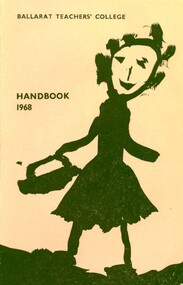
... Inclusive of Manual Arts students, and private fee-paying students, exactly 400 trainees passed through the college in its brief span of life (1926-1931) Fourteen years were to pass before they were again opened to students on February 2nd, 1946. ...Inclusive of Manual Arts students, and private fee-paying students, exactly 400 trainees passed through the college in its brief span of life (1926-1931) Fourteen years were to pass before they were again opened to students on February 2nd, 1946. ...History of the Ballarat Teachers, College as outlined on page 9 of the handbook. Ballarat Teachers' College was opened on may 4th, 1926, at Dana Street State School (no 33), with an enrollment of sixty-one students, its original staff consisted of the Principal, Mr W. H. Ellwood, M.A., M.Ed. (Chairman of the Teachers' tribunal from its inception in 1946 until 1954), Miss A. Bouchier, B.A., and Mr A.B. Jones, B.A. (lecturers). In 1927 Miss P.A. Hamano joined the staff. Teaching practice and special rural school work were carried on in schools in or near Ballarat - drawing, crafts and singing were taught by local teachers. In 1927 the college moved to the former Ballarat East Town Hall (remodelled for their use) in Barkly Street. During 1927 the numbers in the College were augmented by twenty-six Manual arts students who had formerly received their training at Ballarat High School. Manual Arts students continued until 1930, when, on grounds of economy, their training was concentrated at Melbourne Teachers' College. During the four succeeding years approximately sixty students annually entered the primary course. Inclusive of Manual Arts students, and private fee-paying students, exactly 400 trainees passed through the college in its brief span of life (1926-1931) Fourteen years were to pass before they were again opened to students on February 2nd, 1946. The college was re-commenced at S.S. Dana Street under the guidance of Mr W.F. Lord, M.C., M.M., B.A., Dip.Ed., (Acting Principal 1946-1950), and a staff consisting of Miss E.B. Hughes, B.A., Dip. Ed., Mr C.B. Bryan, B.A., V.Com., Dip.Ed., Miss M.H. Miller, L.Mus.A., and Miss G. Kentish, Dip.Phys.Ed. The opening ceremony was performed by the Minister for education at that time, the Hon. F. Field, M.L.A., accompanied by the Hon. T.T. Hollway, M.L.A., and the then Director of Education, Mr J.A. Seitz. It was originally intended to cater for women students only (for whom 130 Victoria Street was purchased as a hostel) but, at the last moment, men were also accepted. A co-educational college was thus set up instead, and has continued as such. The original Staff has been considerable augmented, and the number of Students has been more than trebled. 1951 saw the introduction of the two-year course, successful students being presented with the Trained Primary Teachers' Certificate at the final College assembly each year. In December, 1855, College held its first Graduation Ceremony, with its own graduation hymn, the words of which were written by Miss C.M. (Mavis) Canty of the staff. Mr Ellwood, former Principal, delivered the occasional address and presented the Ellwood Prize to the outstanding student of the year (Mr C.P. Handreck). Students who had successfully completed the course received their certificates from Mr E.B. Pederick, Chief Inspector of Primary Schools. College accomodation having been strained for several years, it was pleasant news when tenders were called in July, 1956, for the building of the first section of the new Ballarat Teachers' College in Gillies Street, near the Botanical Gardens. At the beginning of 1958 the new College was occupied, and staff and students have appreciated greatly the appointements and cacilities of the new building. In 1968 the three-year Diploma Course began, co-existent with the other courses which will continue during the transitional period. Successful students in the course receive the Diploma of teaching (Primary). Orange and black soft covered booklet with a childlike image of a woman on the cover. The 44 page book is the handbook of the Ballarat Teachers' College and includes: history of the college, 1968 programme, courses, teaching Practice, practising school, classification, certification, Ellwood Prize, Lord Prize, hostels, college tripsInside front page signed "Peter Fryar".ballarat teachers' college, peter fryar, t.w.h. turner, tom turner, frank lord, monica miller, dana street primary school, art collection, hostels -
 Federation University Historical Collection
Ballarat Teachers' College Ceremonial Collar, Unknown
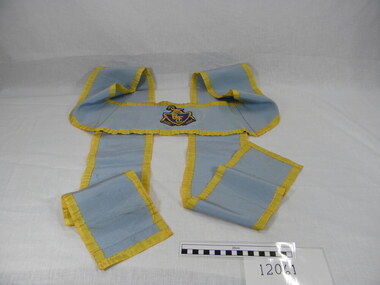
... With the advent of the economic depression of the ‘thirties, Ballarat Teachers' College closed its doors in December, 1931. Fourteen years were to pass before the College opened again on February 2nd, 1946. ...With the advent of the economic depression of the ‘thirties, Ballarat Teachers' College closed its doors in December, 1931. Fourteen years were to pass before the College opened again on February 2nd, 1946. ...Worn by the principal of Ballarat Teachers' College over black academic gown at formal assemblies. Ellwood was the Principal of the Ballarat Teachers' College. Ballarat Teachers’ College was opened on 04 May 1926, at S.S. 33 Dana Street, with an enrolment of 61 students. Its original staff consisted of the Principal, Mr W.H. Ellwood, M.A., M.Ed. (Chairman of the Teachers’ Tribunal from its inception in 1946 until 1954), Miss A. Bouchier, B.A., and Mr A.B. Jones, BA., (lecturers). In 1927 Miss P.A. Hamano joined the staff. In 1927 the college moved to the old Ballarat East Town Hall (remodelled for their use) in Barkly Street. During 1927 the numbers in the College were augmented by 26 Manual Arts students, who had formerly received their training at Ballarat High School. Manual Art students continued till 1930 when, on grounds of economy, their training was concentrated at Melbourne Teachers’ College. During the four succeeding years, approximately 60 students annually entered the primary course. Inclusive of Manual Arts students, and private fee-paying students, exactly 400 trainees passed through the College in its brief span of life (1926-1931). Five per cent of each year’s students were granted an extension of their studentship to enable them to proceed to Melbourne Teachers’ College, and to take the first year’s course for a University degree. With the advent of the economic depression of the ‘thirties, Ballarat Teachers' College closed its doors in December, 1931. Fourteen years were to pass before the College opened again on February 2nd, 1946. The college re-commenced at SS Dana Street, under the guidance of Mr W.F. Lord, M.C., M.M., B.A., Dip. Ed., (acting, later Principal 1946-1950) and a staff consisting of Miss E.B. Hughes, B.A., Dip. Ed., Mr C.B. Bryan, B.A., B. Com., Dip. Ed., Miss Monica H. Miller, L.Mus.A., and Miss G. Kentish, Dip. Phys. Ed. The opening ceremony was performed by the Minister of Education at that time, the Hon. F. Field, M.L.A., accompanied by the Hon. T.T. Hollway, M.L.A., and the then Director of Education, Mr J.A. Seitz. It was originally intended to cater for women students only but, at the last moment, men resident in Ballarat were also accepted. A co-educational college was thus set up instead, and it has continued as such. 1951 saw the introduction of the two-year course, successful students being presented with the Trained Primary Teacher’s Certificate at the final College Assembly each year. In December 1955, College held its first Graduation Ceremony, with its own Graduation Hymn, the words of which were written by Miss C.M. (Mavis) Canty of the staff. Lord remained as principal until 1951 when he transferred to establish a teachers' college at Toorak. Tom William Turner was Lord's successor. A highlight of his term was the construction of new college buildings at Gillies Street with the students commencing their lessons there in February 1958. Turner retired in 1970, having overseen a period of substantial growth in the institution. In that year alone more than one hundred and forty students completed their primary teaching qualification to meet a severe shortage of teachers. Doug Watson commenced as principal in 1971. In 1973 Ballarat Teachers' College became the State College of Victoria at Ballarat. Three years later Ballarat College of Advanced Education was formed and the teacher education students moved to the Mount Helen Campus. In 1990 Ballarat College of Advanced Education became Ballarat University College, an affiliated college with the University of Melbourne. The University of Ballarat was formed in January 1994.Light blue grosgrain sash, bound in yellow taffeta, sewn by machine. Two mitred seams, one at each shoulder, hand sewn and two seams machine stitched on straight part of sash. A BTC insignia is placed in the centre back. The insignia is stitched in yellow, royal blue and dark blue cotton. This sash is hand sewn at the end of one side length, in order to shorten it. Extra Muros (Beyond the Wall) on insignia BTC (Ballarat Teachers' college)education, teaching, assembly, btc, ballarat teachers college, university of ballarat, regalia, ceremony, graduation, stoll, balalrat teachers' college -
 Eltham District Historical Society Inc
Folder, Andrew
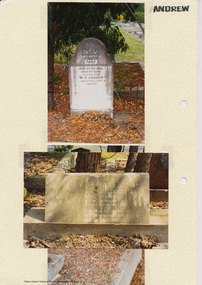
... Coming out to Australia in 1842, he lived in Brighton, Victoria for fifteen years, when he re-visited England for a year. Returning to Victoria fourteen or fifteen years ago, he commenced storekeeping at Eltham, where he has carried on that business ever since. ...Coming out to Australia in 1842, he lived in Brighton, Victoria for fifteen years, when he re-visited England for a year. Returning to Victoria fourteen or fifteen years ago, he commenced storekeeping at Eltham, where he has carried on that business ever since. ...James Andrew Kangaroo Ground, 1870 "James Andrew, Whittlesea, born in East Palford, Devonshire, England, in 1827, arrived in Adelaide in February 1850 per ship Lady McCaughton and almost immediately sailed in a coasting vessel to Melbourne, where the first work he undertook was clearing earth from a stone quarry in Collingwood. He next carried stones for masons engaged in building the Bishop’s Palace, and then was employed in Cambellfield mowing hay. He was at Saltwater River on Black Thursday, and afterwards took a little farm at Darebin Creek, remaining there for four years. He went up to Kangaroo Ground in 1859 and lived there until he bought his present property at Whittlesea, a farm of between 300 and 400 acres. He has been twice married, and had a family of six children." "Andrew, W. B. Eltham, is a native of England, born in 1822. Coming out to Australia in 1842, he lived in Brighton, Victoria for fifteen years, when he re-visited England for a year. Returning to Victoria fourteen or fifteen years ago, he commenced storekeeping at Eltham, where he has carried on that business ever since. Mr Andrew has always taken a lively interest in the public affairs of town and district” from "Victoria and its Metropolis: Past and Present" written in 1888 by Alexander Sutherland. Chapter 19, "The Upper Yarra District" pages [402] - 415. Includes descriptions of some townships and short biographies of local residents. Page 405 Folder of information on James Andrew, Trustee Kangaroo Ground Cemetery, Kangaroo Ground 1870 William Bravery Andrew, Eltham, 1870s-1880s Ernest James Andrew, Eltham, Eltham Shire Councillor, 1920s-1950 and Ellen Matilda Brown Andrewjames andrew, pioneer, kangaroo ground, ernest james andrew, william bravery andrew, ellen andrew, eltham cemetery, biography, ellen harper andrew (nee clarke), ellen matilda andrew (nee brown), eltham war memorial gate, eltham war memorial trust -
 Eltham District Historical Society Inc
Slide - Photograph, Nillumbik Cemetery, 35 Main Street, Diamond Creek, 27 May 1990
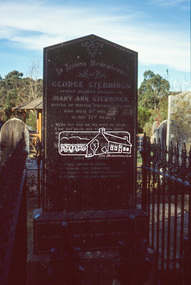
... years. She had been a widow for some time, her husband, the late Mr. Geo. Stebbings, having pre-deceased her some fourteen or fifteen years. ...years. She had been a widow for some time, her husband, the late Mr. Geo. Stebbings, having pre-deceased her some fourteen or fifteen years. ...George Stebbing arrived from England in 1857 and settled at Eltham after a short period at Kangaroo Ground. His occupation is often listed as a farmer but he built a number of important buildings between the late 1860’s and the 1880’s. Those remaining include Shillinglaw Cottage, St. Margaret’s Church, Uniting church (formerly Methodist Church) and House at 84 Pitt Street, Eltham. From 1871 to 1875 he was a member of the Eltham Shire Council. Evelyn Observer and Bourke East Record (Vic. : 1902 - 1917), Friday 12 March 1909, page 2 ELTHAM. (FROM OUR OWN CORRESPONDENT.) One of the oldest inhabitants of Eltham passed away during the early hours of Saturday last in the person of Mrs Mary Ann Stebbings. Her residence here covered a period of some-what over 50 years. She had been a widow for some time, her husband, the late Mr. Geo. Stebbings, having pre-deceased her some fourteen or fifteen years. During the later years of her life, she had resided with her niece, Mrs. Wm. Williams. She lived a very retired life and is said to have owned a considerable amount of property, local and suburban, at the time of her death, at the age of 82 years. She was interred at Diamond Creek on Sunday, 7th inst. Local Cemetery Excursion Sunday 27 May 1990 departed Eltham Shire Office at 9.30am and finish mid afternoon. Visits to Eltham , Kangaroo Ground, Queenstown (Smiths Gully), Nillumbik (Diamond Creek), St Katherines (St Helena) Hurst family graves at Hurstbridge and a little known early cemetery at Greensborough. Attended by 20 members. In each case we were introduced to the cemetery with a brief talk. At Eltham, Frank Burgoyne gave us the benefit of his knowledge as a member of the cemetery trust and at Kangaroo Ground, Bruce Ness spoke in a similar capacity. The lunch stop was at Hurstbridge where we visited the Hurst family graves. The President of Nillumbik Historical Society, Jock Ryan, joined us at the Nillumbik (Diamond Creek) cemetery. He travelled on to St Katherines, St Helena, where he talked on the history of the church and cemetery. 35mm colour positive transparency (1 of 23) Mount - Agfachrome Agfa CS System black 8 dotsshire of eltham historical society, cemetery excursion, graves, activities, cemeteries, george stebbing, george stebbings, mary ann stebbing, mary ann stebbings, nillumbik cemetery -
 Eltham District Historical Society Inc
Slide - Photograph, Nillumbik Cemetery, 35 Main Street, Diamond Creek, 27 May 1990
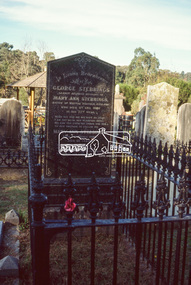
... years. She had been a widow for some time, her husband, the late Mr. Geo. Stebbings, having pre-deceased her some fourteen or fifteen years. ...years. She had been a widow for some time, her husband, the late Mr. Geo. Stebbings, having pre-deceased her some fourteen or fifteen years. ...George Stebbing arrived from England in 1857 and settled at Eltham after a short period at Kangaroo Ground. His occupation is often listed as a farmer but he built a number of important buildings between the late 1860’s and the 1880’s. Those remaining include Shillinglaw Cottage, St. Margaret’s Church, Uniting church (formerly Methodist Church) and House at 84 Pitt Street, Eltham. From 1871 to 1875 he was a member of the Eltham Shire Council. Evelyn Observer and Bourke East Record (Vic. : 1902 - 1917), Friday 12 March 1909, page 2 ELTHAM. (FROM OUR OWN CORRESPONDENT.) One of the oldest inhabitants of Eltham passed away during the early hours of Saturday last in the person of Mrs Mary Ann Stebbings. Her residence here covered a period of some-what over 50 years. She had been a widow for some time, her husband, the late Mr. Geo. Stebbings, having pre-deceased her some fourteen or fifteen years. During the later years of her life, she had resided with her niece, Mrs. Wm. Williams. She lived a very retired life and is said to have owned a considerable amount of property, local and suburban, at the time of her death, at the age of 82 years. She was interred at Diamond Creek on Sunday, 7th inst. Local Cemetery Excursion Sunday 27 May 1990 departed Eltham Shire Office at 9.30am and finish mid afternoon. Visits to Eltham , Kangaroo Ground, Queenstown (Smiths Gully), Nillumbik (Diamond Creek), St Katherines (St Helena) Hurst family graves at Hurstbridge and a little known early cemetery at Greensborough. Attended by 20 members. In each case we were introduced to the cemetery with a brief talk. At Eltham, Frank Burgoyne gave us the benefit of his knowledge as a member of the cemetery trust and at Kangaroo Ground, Bruce Ness spoke in a similar capacity. The lunch stop was at Hurstbridge where we visited the Hurst family graves. The President of Nillumbik Historical Society, Jock Ryan, joined us at the Nillumbik (Diamond Creek) cemetery. He travelled on to St Katherines, St Helena, where he talked on the history of the church and cemetery. 35mm colour positive transparency (1 of 23) Mount - Agfachrome Agfa CS System black 8 dotsshire of eltham historical society, cemetery excursion, graves, activities, cemeteries, george stebbing, george stebbings, mary ann stebbing, mary ann stebbings, nillumbik cemetery -
 Mission to Seafarers Victoria
Booklet - Manual, Sailing directions for Port Phillip, in the colony of Victoria including the ports of Melbourne and Geelong, 1854
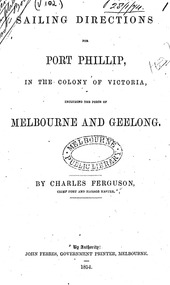
... The character of Captain Ferguson’s unbroken service during the fourteen years which have elapsed since I left the colony must be well known to the Government and the people he has served so long and so faithfully. ...The character of Captain Ferguson’s unbroken service during the fourteen years which have elapsed since I left the colony must be well known to the Government and the people he has served so long and so faithfully. ...Captain Charles Ferguson was born in Scotland in 1813. He was the Master of the "Rajah" from 1838 to 1850 on voyages from England to Australia and vice versa. He became the First Chief Harbour Master for the port of Melbourne in 1852 after being the first Harbour Master and Water Police Officer in Geelong for 12 months. On the 5th of April 1841, the Rajah sailed with James Donovan M.D. as Surgeon Superintendent, and the Rajah sailed from Woolwich with 180 female convicts. The Rajah arrived on the 19th of July in Hobart, with 179 females (one died during the voyage) and 10 children. Miss Kezia Elizabeth Hayter was the matron on board. On page 28 of the "Sailing directions for Port Phillip, in the colony of Victoria including the ports of Melbourne and Geelong", a mention is made of the Mariner's Hospital and Floating Church soon to be established. There were discussions to built the hospital in Williamstown but instead the Government decided to build it in Melbourne. The Harbour Master and a commiittee decided to use the water police hulk, Emily, left unsold in 1856, to create a floating church: the Bethel was open in July 1857 with Reverend Kerr Johnston as Chaplain. Latrobe wrote a letter to Captain Cole in 1869, a few months after learning his death : "To Captain George Ward Cole † [from a draft in another’s hand] Clapham House, Lewes, Sussex, January 28th, 1869. My dear Captain Cole, Last mail will have taken out the sad intelligence of the death of our excellent old friend, Captain Ferguson. This will have been a terrible blow to his children and to his friends in the colony, who may have held reason to expect his early return to his home, with a not unreasonable prospect of ultimate restoration to health and activity. In the course of last October I went up to town with one of my children, mainly with the purpose of finding my way to Pinner, where he and Mrs. Ferguson were staying with an intimate friend. I found him in excellent health and spirits, and enjoying the prospect of a speeding resumption of the service to which he had devoted his best days, and upon the furtherance of which his entire energy was still directed. A week or two later Captain and Mrs. Ferguson went to Dover for change of air, and being still under the impression received from the advisers by whom they had been guided during their residence at a hydropathic establishment at Matlock, felt encouraged to plan almost immediate return to the colony by the Jerusalem early in December. However, certain misgivings in the mind of a medical gentleman, then in England, under whose care Captain Ferguson had at one time placed himself in Williamtown, led them to consider it judicious before departure to take the advice of some surgeon of eminence in London. Accordingly they came up to town at the close of November. The first London practitioners they consulted shook their heads, and advised consultation with Sir Wm. Ferguson. The result was that amputation, without loss of time, was pronounced necessary. The rest is soon told. He received the painful intelligence with calmness and full resignation to God's will, and underwent the operation at King's College Hospital with exemplary firmness and Courage on the 28th of November. Perfect success seemingly attended it, and there seemed, humanly speaking, to be every prospect of a prompt cure and early convalescence; everything seemed in his favour. A few days later, however, all was clouded by symptoms of hospital fever (pyoe æm ia). This resisted all control, and finally carried him off on the 27th of December, just one month after the operation. He had lived a Christian life, and his death was the peaceful and resigned death of a Christian. It was a melancholy satisfaction to me to be able to join a few friends in following his remains to their resting place in one of the outlying London cemeteries on the last day of the year. You know Mrs Ferguson well, and will be prepared to hear me say that her whole conduct and demeanour throughout this period of suspense and bitter trial has been worthy of her high character and steadfast principle. Come what will, and happen what may, I have the fullest conviction that neither the widow nor the children will be forsaken, however doubtful and clouded the future may appear, in consequence of the irreparable loss which, they have sustained. And now, dear Captain Cole, it is possible that you may already have heard all this from other sources, but I have dictated it to you under strong impulse, for I feel assured that there is no member of the community in which you live who will more sincerely deplore the loss of Captain Ferguson on private grounds; at the same time that there is no one who, from long acquaintance with his official character and services, will be in a better position to estimate their real value or the loss which the colony has sustained. The circumstances in which Captain Ferguson's family are left not only demands the utmost display of sympathy and interest on the part of friends, but may call for decided and prompt action; therefore I cannot rest satisfied without discharging what I consider my duty, and seeking to strengthen your hands as far as I may in bringing the character of his long services before the existing colonial authorities. Of his private career previous to his entering the service of the Colonial Government in 1851 nothing need be said. Captain Ferguson was appointed as the Harbour Master at Geelong in April, 1851 – a few months before the separation of the colony from New South Wales. He there did excellent service in a variety of ways calculated to advance the interests of the port, and to introduce www.latrobesociety.org.au 27 order, where, from circumstances, but little order had hitherto prevailed. His was the first appointment of this class in that locality. The separation of the colony from New South Wales took place in the month of July following. Shortly after, the late Captain Bunbury resigned the Harbour Mastership of Port Phillip. Captain Ferguson was at once (February, 1852) appointed to succeed him, and from that time performed all duties of Chief Harbour Master of the colony. The previous year (May 1851) the first gold discoveries in New South Wales had taken place, and in the month of August those of our colony followed. At the time of Captain Ferguson’s taking charge of the Port of Melbourne their influence had begun to be fully felt, and in no department more seriously than in that of the Harbour Master. This is no place for statistical details, but they must bear me out in reminding you of a few facts connected with our late friend’s career. At the time of separation that department comprised only 30 individuals of all ranks, and when he took charge the number was much reduced. There were at that time, according to the returns, no fewer than 54 vessels, registering 26,785 tons, in Hobson’s Bay alone. The crews on arrival numbered 1,235 men. Of this number only 463 remained on board, 500 having deserted, and the rest having been discharged by arrangement or pure necessity. For the first six months after Captain Ferguson’s assumption of office as Harbour Master the duties of Police Magistrate and Chief of the Water Police were superadded, and how much labour they involved may be surmised from the fact that from 1st of April to the 31st July, 1852, four months only, no less than 236 marine cases were brought before the bench at Williamstown - sometimes as many as 30 in a day. A year later (March 1853) the returns show that the number of vessels in the harbour in Hobson’s Bay alone were 91, tonnage 43,754; and passing on to the still later returns of May, 1853, two years after Captain Ferguson’s assumption of office, we find from the records that the number of ships in port had increased to 129; tonnage, 63,292; crew on board on arrival, 2872, and at the date of report, 1628; the amount of desertions at that time having, however, proportionally diminished, in consequence of the abatement of the gold fever, caused by the non-success attendant upon the labours of thousands at the goldfields. The above numbers take no account of the large number of vessels and amount of tonnage lying at the wharves at Melbourne or elsewhere. From these figures alone it may be judged what must have been a struggle in which the Chief Harbour Master was engaged from the very outset to secure order, and answer the innumerable calls on every branch of his department, at the same time that there was for many months an almost complete impossibility of securing subordinate agency, such as boatmen, pilots, and police, at any price. But I may bear witness to the untiring diligence, energy, and self-devotion with which Captain Ferguson grappled with the difficulties of his position, and the seemingly insurmountable obstacles which stood in his way. Ashore and afloat he was always ready, showing the same directness of purpose, intelligence, and forgetfulness of self. He shunned no responsibility, and turned his hand from no work, whether within or beyond the ordinary scope of his duty, which the hard necessity of the times forced the Government to bring under his notice. Already in 1852, when the overflowing of our gaol and stockade rendered the adoption of other methods of restraint absolutely necessary, and addition to the existing buildings could not be thought of, it was Captain Ferguson who first suggested the employment of hulks; and it was with his personal assistance and supervision, and under his unflagging energy, that the three first of these – the Success, the President, and the Sacramento – were purchased, fitted up, and made available for the purpose in view, and the rules and regulations for the employment and safety of the men afloat and ashore prescribed and carried out. He carried the same energy into every branch of his department, and his influence was soon apparent. His subordinates of every class became actuated by his spirit. As time moved on, the range of his duties, both ordinary and extraordinary, increased. In the formation of the quarantine station at the heads, in the management if not the erection of lighthouses, sailing directions, port and wharf regulations, buoys, signal stations, www.latrobesociety.org.au 28 steam dredging &c., he was the main and most active agent. The whole pilot establishment and regulations, men, and vessels, were under his charge; and when I left the colony in May, 1854, the entire range of ports outside Port Phillip Heads from Point Lonsdale to Portland, as well as that of Geelong had felt the influence of his intelligent supervision and care. The entire department of Chief Harbour Master, which I have numbered at the period of separation about thirty individuals, then numbered 230. The character of Captain Ferguson’s unbroken service during the fourteen years which have elapsed since I left the colony must be well known to the Government and the people he has served so long and so faithfully. I confine myself to recalling to mind those earlier, and what must have been the hardest and most difficult, period – none can know how difficult but those who were in that fierce struggle for the maintenance of order under so many disadvantages; and on this subject I have spoken advisedly and with reason, for I may truly say he worked under my own eye. I had sincere regard for the man, and just pride in the qualities of his heart, head, and hand. Whatever mistakes may have been made by the Government of the colony in those hard and difficult times (and I am quite ready to admit that there were many, especially if the past is to be judged by the light of the present), I never have hesitated in believing that, in appointing Captain Ferguson to the office he has so long filled, it was the right man in the right place. I shall be heartily rejoiced to find that the Government and inhabitants of the colony admit that this has been the case, and to learn that they have not forgotten the strong claims of one who has served them so long and so faithfully, and who, removed by God’s providence, so to say, in the maturity of his powers, has left a widow and young family behind him. I have done, I leave you to make use of this communication, or any portion of it, which you may think judicious and called for. There may be among Ferguson’s friends those who may not be sorry to be reminded of facts. By-the-bye, I may mention as a proof how completely Captain Ferguson’s mind was engrossed by devotion to his public duty, that while in Dover, only ten days before the operation, he took an opportunity to drag himself up into the lantern of the S. Foreland Lighthouse, and made a most careful scrutiny of the whole apparatus and arrangement, with a view of the adoption of any hint for the perfection of those under his charge in the colony. And now, goodbye. I trust this will find you in good health, and in comparative vigour. Believe me ever, dear Captain Cole, Yours very truly, C. J. La Trobe"The attempt for a floating church was made as early as 1853 following similar examples in London like the Seamen's Hospital. Captain Ferguson was instrumental in the foundation of the Bethel Church.Digital copies of the 37 pages ; 22 cm.1854, hobsons bay, geelong, melbourne, williamstown, sandridge, mariner's hospital, floating church, seamen's hospital, captain charles ferguson (1813-1868), kezia elizabeth hayter (1818-1885), rajah quilt, prison hulks, water police, harbour master, harbor master, gaols -
 Flagstaff Hill Maritime Museum and Village
Tool - Scotch Eye Beam Auger, W M Ridgway, 1930s
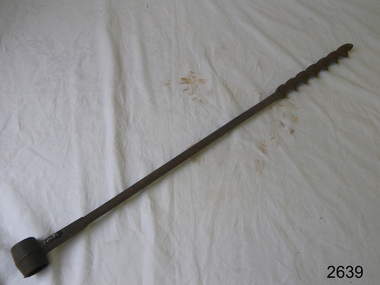
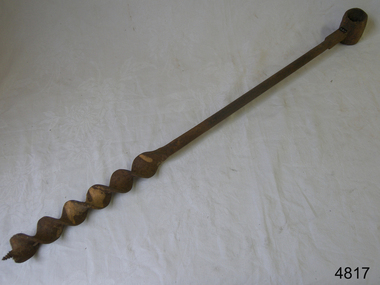
... fourteen UK Companies and five overseas companies. A later merger with a woodwork tools company called Marple (which was part-owned by Record and Ridgway respectively before their original merger) led to the company becoming known as Record Marples Tools. Record Marples was taken over by the Swedish hardware manufacturer AB Bahco in 1982. Despite a management buyout leading to the company reverting to British ownership in 1985 the company struggled financially and the following administration was acquired by U.S.-based Irwin Tools in 1998 who has since moved production to China in recent years...fourteen UK Companies and five overseas companies. A later merger with a woodwork tools company called Marple (which was part-owned by Record and Ridgway respectively before their original merger) led to the company becoming known as Record Marples Tools. Record Marples was taken over by the Swedish hardware manufacturer AB Bahco in 1982. Despite a management buyout leading to the company reverting to British ownership in 1985 the company struggled financially and the following administration was acquired by U.S.-based Irwin Tools in 1998 who has since moved production to China in recent years ...William Ridgway and Sons company of Sheffield, manufacturers of augers, bits, wood-boring, and motorising tools, was founded in 1878 and became a Private company in 1909, their factory was founded in the 1930s. William Ridgway Tools merged first with Record Tools in 1974 to form Record Ridgway Tools Ltd. Record was another Sheffield company that was renowned for the quality of their vices and industrial clamps. Following the merger Record, Ridgway Tools Ltd was made up of fourteen UK Companies and five overseas companies. A later merger with a woodwork tools company called Marple (which was part-owned by Record and Ridgway respectively before their original merger) led to the company becoming known as Record Marples Tools. Record Marples was taken over by the Swedish hardware manufacturer AB Bahco in 1982. Despite a management buyout leading to the company reverting to British ownership in 1985 the company struggled financially and the following administration was acquired by U.S.-based Irwin Tools in 1998 who has since moved production to China in recent years. A vintage tool made in the 1930s when Ridgway began mass producing augers and other tools for export and sale. This item would have probably been used in Australia on a farm for drilling fence posts for wire to pass through or other tasks where a hole was required to be bored in timber. Scotch eye beam auger, with double twist and Lead screw. Ridgway Sheffield flagstaff hill, warrnambool, shipwrecked-coast, flagstaff-hill, flagstaff-hill-maritime-museum, maritime-museum, shipwreck-coast, flagstaff-hill-maritime-village -
 Flagstaff Hill Maritime Museum and Village
Tool - Scotch Eye Beam Auger, W M Ridgway, 1930s
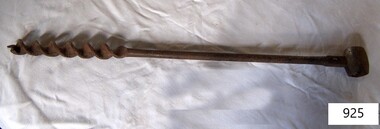
... fourteen UK Companies and five overseas companies. A later merger with a woodwork tools company called Marple (which was part-owned by Record and Ridgway respectively before their original merger) led to the company becoming known as Record Marples Tools. Record Marples was taken over by the Swedish hardware manufacturer AB Bahco in 1982. Despite a management buyout leading to the company reverting to British ownership in 1985 the company struggled financially and the following administration was acquired by U.S.-based Irwin Tools in 1998 who has since moved production to China in recent years...fourteen UK Companies and five overseas companies. A later merger with a woodwork tools company called Marple (which was part-owned by Record and Ridgway respectively before their original merger) led to the company becoming known as Record Marples Tools. Record Marples was taken over by the Swedish hardware manufacturer AB Bahco in 1982. Despite a management buyout leading to the company reverting to British ownership in 1985 the company struggled financially and the following administration was acquired by U.S.-based Irwin Tools in 1998 who has since moved production to China in recent years ...William Ridgway and Sons company of Sheffield, manufacturers of augers, bits, wood-boring, and motorising tools, was founded in 1878 and became a Private company in 1909, their factory was founded in the 1930s. William Ridgway Tools merged first with Record Tools in 1974 to form Record Ridgway Tools Ltd. Record was another Sheffield company that was renowned for the quality of their vices and industrial clamps. Following the merger Record, Ridgway Tools Ltd was made up of fourteen UK Companies and five overseas companies. A later merger with a woodwork tools company called Marple (which was part-owned by Record and Ridgway respectively before their original merger) led to the company becoming known as Record Marples Tools. Record Marples was taken over by the Swedish hardware manufacturer AB Bahco in 1982. Despite a management buyout leading to the company reverting to British ownership in 1985 the company struggled financially and the following administration was acquired by U.S.-based Irwin Tools in 1998 who has since moved production to China in recent years. A vintage tool made in the 1930s when Ridgway began mass producing augers and other tools for export and sale. This item would have probably been used in Australia on a farm for drilling fence posts for wire to pass through or other tasks where a hole was required to be bored in timber. Scotch eye beam auger, with double twist and Lead screw. Ridgway Sheffield warrnambool, flagstaff-hill, flagstaff-hill-maritime-museum, maritime-museum, shipwreck-coast, flagstaff-hill-maritime-village, wood boring tool, scotch auger, carpenters tools, shipwrights tools, coopers tools, ridgway & sons, auger bits -
 Flagstaff Hill Maritime Museum and Village
Tool - Scotch Eye Beam Auger, W M Ridgway, 1930s
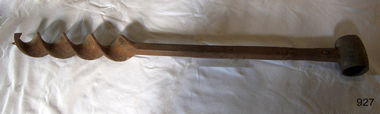
... fourteen UK Companies and five overseas companies. A later merger with a woodwork tools company called Marple (which was part-owned by Record and Ridgway respectively before their original merger) led to the company becoming known as Record Marples Tools. Record Marples was taken over by the Swedish hardware manufacturer AB Bahco in 1982. Despite a management buyout leading to the company reverting to British ownership in 1985 the company struggled financially and the following administration was acquired by U.S.-based Irwin Tools in 1998 who has since moved production to China in recent years...fourteen UK Companies and five overseas companies. A later merger with a woodwork tools company called Marple (which was part-owned by Record and Ridgway respectively before their original merger) led to the company becoming known as Record Marples Tools. Record Marples was taken over by the Swedish hardware manufacturer AB Bahco in 1982. Despite a management buyout leading to the company reverting to British ownership in 1985 the company struggled financially and the following administration was acquired by U.S.-based Irwin Tools in 1998 who has since moved production to China in recent years ...William Ridgway and Sons company of Sheffield, manufacturers of augers, bits, wood-boring, and motorising tools, was founded in 1878 and became a Private company in 1909, their factory was founded in the 1930s. William Ridgway Tools merged first with Record Tools in 1974 to form Record Ridgway Tools Ltd. Record was another Sheffield company that was renowned for the quality of their vices and industrial clamps. Following the merger Record, Ridgway Tools Ltd was made up of fourteen UK Companies and five overseas companies. A later merger with a woodwork tools company called Marple (which was part-owned by Record and Ridgway respectively before their original merger) led to the company becoming known as Record Marples Tools. Record Marples was taken over by the Swedish hardware manufacturer AB Bahco in 1982. Despite a management buyout leading to the company reverting to British ownership in 1985 the company struggled financially and the following administration was acquired by U.S.-based Irwin Tools in 1998 who has since moved production to China in recent years. A vintage tool made in the 1930s when Ridgway began mass producing augers and other tools for export and sale. This item would have probably been used in Australia on a farm for drilling fence posts for wire to pass through or other tasks where a hole was required to be bored in timber. Scotch eye beam auger, with double twist and Lead screw. Ridgway Sheffield flagstaff hill, warrnambool, flagstaff-hill-maritime-museum, maritime-museum, shipwreck-coast, flagstaff-hill-maritime-village, ridgway & sons, wood boring tool, carpenters tools, coopers tools, marine tools -
 Flagstaff Hill Maritime Museum and Village
Tool - Scotch Eye Beam Auger, W M Ridgway, 1930s
... fourteen UK Companies and five overseas companies. A later merger with a woodwork tools company called Marple (which was part-owned by Record and Ridgway respectively before their original merger) led to the company becoming known as Record Marples Tools. Record Marples was taken over by the Swedish hardware manufacturer AB Bahco in 1982. Despite a management buyout leading to the company reverting to British ownership in 1985 the company struggled financially and the following administration was acquired by U.S.-based Irwin Tools in 1998 who has since moved production to China in recent years...fourteen UK Companies and five overseas companies. A later merger with a woodwork tools company called Marple (which was part-owned by Record and Ridgway respectively before their original merger) led to the company becoming known as Record Marples Tools. Record Marples was taken over by the Swedish hardware manufacturer AB Bahco in 1982. Despite a management buyout leading to the company reverting to British ownership in 1985 the company struggled financially and the following administration was acquired by U.S.-based Irwin Tools in 1998 who has since moved production to China in recent years ...William Ridgway and Sons company of Sheffield, manufacturers of augers, bits, wood-boring, and motorising tools, was founded in 1878 and became a Private company in 1909, their factory was founded in the 1930s. William Ridgway Tools merged first with Record Tools in 1974 to form Record Ridgway Tools Ltd. Record was another Sheffield company that was renowned for the quality of their vices and industrial clamps. Following the merger Record, Ridgway Tools Ltd was made up of fourteen UK Companies and five overseas companies. A later merger with a woodwork tools company called Marple (which was part-owned by Record and Ridgway respectively before their original merger) led to the company becoming known as Record Marples Tools. Record Marples was taken over by the Swedish hardware manufacturer AB Bahco in 1982. Despite a management buyout leading to the company reverting to British ownership in 1985 the company struggled financially and the following administration was acquired by U.S.-based Irwin Tools in 1998 who has since moved production to China in recent years. A vintage tool made in the 1930s when Ridgway began mass producing augers and other tools for export and sale. This item would have probably been used in Australia on a farm for drilling fence posts for wire to pass through or other tasks where a hole was required to be bored in timber. Ring Auger, Double Twist with Lead Screw, square shaft (which has had a welded repair), socket set at right angle. Broad arrow mark Ridgway Sheffield and DO stamped. warrnambool, flagstaff-hill, flagstaff-hill-maritime-museum, maritime-museum, shipwreck-coast, flagstaff-hill-maritime-village, wood boring tool, scotch auger, carpenters tools, shipwrights tools, coopers tools, ridgway & sons, auger bits -
 City of Moorabbin Historical Society (Operating the Box Cottage Museum)
Book, John Sands, The Bulletin Centenary Issue 1880-1980 : one hundred years of Australia's best in this issue, 1980
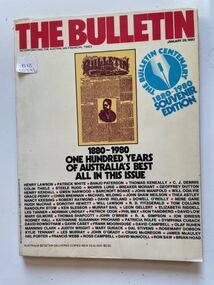
... A larger white soft cover book with the title written in large red letters at the top underneath this is a sepia photo of the Bulletin front page January 31st. 1880 followed by bold black letters 1880 - 1980 One Hundred Years Of Australia's Best All In This Issue followed by fourteen lines across the bottom of the cover listing 76 Australian authors....A larger white soft cover book with the title written in large red letters at the top underneath this is a sepia photo of the Bulletin front page January 31st. 1880 followed by bold black letters 1880 - 1980 One Hundred Years Of Australia's Best All In This Issue followed by fourteen lines across the bottom of the cover listing 76 Australian authors. ...A larger white soft cover book with the title written in large red letters at the top underneath this is a sepia photo of the Bulletin front page January 31st. 1880 followed by bold black letters 1880 - 1980 One Hundred Years Of Australia's Best All In This Issue followed by fourteen lines across the bottom of the cover listing 76 Australian authors.non-fictionbulletin, 1890, 1980, art, history, poetry, writing, centenary, souvenir, edition. -
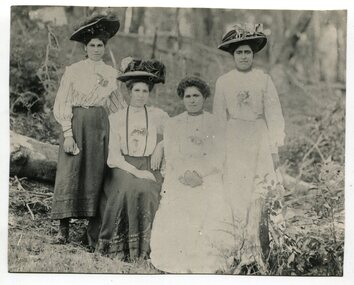 Orbost & District Historical Society
black and white photograph, late 19th century - early 20th century
... years had passed George had met and fallen in love with a young half-caste girl, known as Agnes Patterson. Agnes was of Monaro descent and came from New South Wales. George and Agnes got married at Lake Tyers. Because of the half-caste act George and Agnes had to leave the reserve along with their nine girls. They moved to Newmerella, situated outside the township of Orbost. This was the place that George and his wife and children came to call home. Soon after, George and Agnes would add to their family bringing the total of children to fourteen...years had passed George had met and fallen in love with a young half-caste girl, known as Agnes Patterson. Agnes was of Monaro descent and came from New South Wales. George and Agnes got married at Lake Tyers. Because of the half-caste act George and Agnes had to leave the reserve along with their nine girls. They moved to Newmerella, situated outside the township of Orbost. This was the place that George and his wife and children came to call home. Soon after, George and Agnes would add to their family bringing the total of children to fourteen ...This is a photograph of the four daughters of Mrs George Thomas. L -R : Elleen Parsons, Julia Eaton, Eva Murray and Violet Gay. George Thomas and Gtranny Thomas lived at Newmerella on Grand View Road until the 1950's. In the Newmerella Koorie Community, there were about 15 families. The family was a very well-respected local Aboriginal family. . George was a stockman for Jas Stirling. From Colin Thomas "I learned that George Thomas was Kitty Johnson’s oldest son. As a young boy George had been found by the Reverend John Bulmer, in addition to other young Aboriginal children in the bush around the Lake Tyers area. He had gathered them all together and took them onto the reserve at the Mission. After quite a number of years had passed George had met and fallen in love with a young half-caste girl, known as Agnes Patterson. Agnes was of Monaro descent and came from New South Wales. George and Agnes got married at Lake Tyers. Because of the half-caste act George and Agnes had to leave the reserve along with their nine girls. They moved to Newmerella, situated outside the township of Orbost. This was the place that George and his wife and children came to call home. Soon after, George and Agnes would add to their family bringing the total of children to fourteen, the last five of whom were boys. At the time of the First World War George’s boy’s volunteered their services and joined the army. When in Europe one of the boys sustained an injury which caused the loss of an arm. Following the end of the war the boys came home, as men." The Thomas family was a well-respected family in Newmerell in the late 19th and first half of the 20th century. The daughter were well known for their needlework and craft skills.A black / white photograph of four women wearing log skirts / dresses and elaborate hats, two sitting on a log and two standing on either side.thomas-family newmerella koori-family -
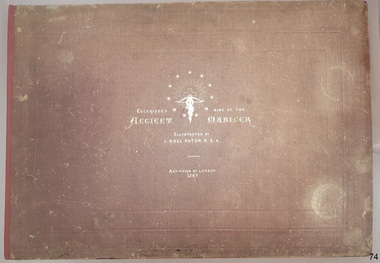 Flagstaff Hill Maritime Museum and Village
Book - Reference, Samuel Taylor Coleridge et al, Coleridge's Rime of the Ancient Mariner, 1863
... years, based on various editions of his poem and illustrated by other artists. When this book was first published, Paton’s illustrations were available individually for the public to purchase. The author, Samuel Taylor Coleridge (1772-1834), was a notable late 18th to early 19th century English poet. He was the youngest of fourteen...years, based on various editions of his poem and illustrated by other artists. When this book was first published, Paton’s illustrations were available individually for the public to purchase. The author, Samuel Taylor Coleridge (1772-1834), was a notable late 18th to early 19th century English poet. He was the youngest of fourteen ...This book includes the classic poem ‘Rime of the Ancient Mariner’ by Samuel Taylor Coleridge, the lines of which are set out in twelve pages of double columns. Each section of the poem is titled, such as 'Part the Sixth'. The twenty lithographed line drawings by J. Noel Paton RSA illustrate major events of the story and repeat the applicable verse below them. Most of the drawings have the initials of the artist and the lithographer on the bottom corners, below which are printed their names. The margins of the poem contain printed author's notes. Interestingly, the printer's name is added as a footnote on page 12, at the end of the poem. The book is included in the Rare Books collection of Flagstaff Hill. Its description closely matches one of two copies of the book held by the British Museum. There have been other publications of Coleridge’s poem over the years, based on various editions of his poem and illustrated by other artists. When this book was first published, Paton’s illustrations were available individually for the public to purchase. The author, Samuel Taylor Coleridge (1772-1834), was a notable late 18th to early 19th century English poet. He was the youngest of fourteen children. His father was a vicar as well as the master of a grammar school, with Samuel attended. Coleridge's longest poem, 'Rime of the Ancient Mariner', was written about 1797-1798 and tells of the experiences and adventures of a sailor. It was included in a collection of poetry titled 'Lyrical Ballads', jointly written with his friend William Wordsworth. The volume is considered the beginning of the Romantic era of British poetry. Coleridge acknowledges William Wordsworth in this poem, in ‘Part the Forth’ with the footnote “For the two left lines of this stanza, I am indebted to Mr Wordsworth. It was on a delightful walk from Nether Stowey to Dulverton, with him and his sister, in the autumn of 1797, that this poem was planned, and in part composed”. Sir Joseph Noel Paton RSA (1821-1901) is a well-known Scottish-born artist and painter of historical artwork, created the line illustrations in 1863, highlighting the main points of the poem. In the same year he also illustrated Charles Kingsley's 'Water Babies'. He was appointed Queen’s Limner for Scotland from 1866. The book was published in 1863 by the Art Union of London, an organisation whose members paid an annual subscription, and who received an annual prize of a work of art. The organisation was established in 1837 and membership quickly grew until the 1870's. Membership then slowly dropped off until the organisation was would up in 1912. Lithographer William Husband McFarlane, of Edinburgh, Scotland, created the black and white lithograph outlines from Paton’s drawings, illustrating many of the lines of the poem. The book of poetry and Illustrations was then printed by Neill & Company, Edinburgh, in 1763. The company was formed by Patrick Neill in 176. The company was known for inventing one of the early mechanical typesetting machines, which was used for the Company's publications as well as sold to other companies even into the early 1900s. The firm continued in business until 1973. This copy of the book was presented to Emily Taylor Smith by her father on September 16, 1867, four years after it was published. There is no further information available about Emily at this point in time.This Victorian era book of poetry with illustrated prints, the 'Rime of the Ancient Mariner' by Samuel Taylor Coleridge, is considered to be a rare book. The British Museum holds two copies, one of which is very similar in description. The book is significant for containing a poem written by the renowned British poet Samuel Coleridge, who acknowledges the contribution of a couple of the lines to his friend William Wordsworth. The book's significance is increased for being included in a collection of poetical works jointly written by Coleridge and his friend William Wordsworth, entitled 'Lyrical Ballads' and published in 1797. The printer of the book, Neill & Company, was known for pioneering an early mechanical typesetting machine. It’s significance also includes the collection of Victorian artwork within. Coleridge's poem is significant for being included in 'Lyrical Ballads', which is considered to signify the beginning of the Romantic era of British poetry. Book: large, burgundy linen covered, hard cover, with gold embossed title and images, landscape orientation. Title: Coleridge's Rime of the Ancient Mariner. Author: Samuel Taylor Coleridge Illustrator: J. Noel Paton, R.S.A. Publisher: Art-Union of London in 1863. Lithographer: W.H. McFarlane in Edinburgh, Scotland, 1863. Printer: Neill & Company, Edinburgh, Scotland Contents include the lines of a poem, with lithograph illustrations above applicable short verse. The cover and fly page have the same emblems. A personal inscription is handwritten in a nib pen inside the book.Printed: "COLERIDGE'S RIME OF THE ANCIENT MARINER" "ILLUSTRATED BY J. NOEL PATON, R.S.A." "ART-UNION OF LONDON, 1863" " W.H. McFARLANE, LITHOGr, EDINBURGH" "Printed by Neill & Company, Edingurgh" Emblems embossed on cover, and a repeat printed on fly page, include stars encircling a crucifix and a snake entwined around a cross bow with a branch in its mouth.flagstaff hill, warrnambool, flagstaff hill maritime museum, maritime museum, shipwreck coast, flagstaff hill maritime village, great ocean road, coleridge's rime of the ancient mariner, rime of the ancient mariner, ancient mariner, samuel coleridge, j. noel paton, art-union of london, 1863, rare book, samuel taylor coleridge, art union of london, w.h. mcfarlane, william husband macfarlane, sir joseph noel paton, poem, emily taylor smith, 1867, romantic period, william wordsworth, lithograph, poetry, lyrical ballads, british romantic movement, literary work, neill & company edinburgh, j. noel paton rsa, mechanical typesetting, alexander neill fraser, mechanical typesetting machine -
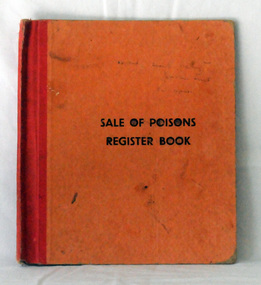 Orbost & District Historical Society
register, Felton, Grimwade & Duerden's, Sale of Poisons Register Book, 1951
... (2) Such person shall thereupon make a faithful entry of such sale, specifying the poison and the quantity thereof, and all such particulars so given by the purchaser, together with the day of the month and year of such sale, in a book to be kept by the vendor for that purpose in the form prescribed. (3) Every such entry shall be signed by the person making the same, and shall, subject to sections thirteen and fourteen of this Act, be also signed by the purchaser, unless he declares himself unable to write, in which case the person making the entry shall add thereto the words "Purchaser cannot write". (4) Whenever a witness to the sale is required by this Act, such entry shall be signed by such witness, and shall also state his place of abode. (5) The book referred to in subsection two of this section shall be preserved by the vendor for at least five years from the date on which the final entry in the book is made." ... (2) Such person shall thereupon make a faithful entry of such sale, specifying the poison and the quantity thereof, and all such particulars so given by the purchaser, together with the day of the month and year of such sale, in a book to be kept by the vendor for that purpose in the form prescribed. (3) Every such entry shall be signed by the person making the same, and shall, subject to sections thirteen and fourteen of this Act, be also signed by the purchaser, unless he declares himself unable to write, in which case the person making the entry shall add thereto the words "Purchaser cannot write". (4) Whenever a witness to the sale is required by this Act, such entry shall be signed by such witness, and shall also state his place of abode. (5) The book referred to in subsection two of this section shall be preserved by the vendor for at least five years from the date on which the final entry in the book is made." ...This item was used at J.D, Torley, Nicholson Street in Orbost by Mr H.A. Murray.. Chemists who worked in Orbost included Henry Cottman; James Alfred Dubois Williams; Harry Arthur Murray; Miss P.E .Mason (Phyllis Estelle?); Miss Sybil Monica Buzza; Thomas James Frayer; Australia Shaw; James David Torley; John William Zimmer; Dalkeith William Steele; William Thomas Hollingsworth; E.E. Cohen; R.S. Anderson; Frances John Perry Faith Everard Pardew and Charles Anthony Wurf. From POISONS ACT. Act No. 54, 1952. "1 2 . (1) Every person who sells any poison included in the first part of Schedule One of the Poisons List shall, before delivery thereof to the purchaser, inquire his name, place of abode, and occupation and the purpose for which such poison is required or stated to be required. (2) Such person shall thereupon make a faithful entry of such sale, specifying the poison and the quantity thereof, and all such particulars so given by the purchaser, together with the day of the month and year of such sale, in a book to be kept by the vendor for that purpose in the form prescribed. (3) Every such entry shall be signed by the person making the same, and shall, subject to sections thirteen and fourteen of this Act, be also signed by the purchaser, unless he declares himself unable to write, in which case the person making the entry shall add thereto the words "Purchaser cannot write". (4) Whenever a witness to the sale is required by this Act, such entry shall be signed by such witness, and shall also state his place of abode. (5) The book referred to in subsection two of this section shall be preserved by the vendor for at least five years from the date on which the final entry in the book is made." Before these ledgers were used there had an increasing number of proprietary medicines appearing on an unregulated market, with many products regarded as ‘quack’ medicines with amazing therapeutic claims.State governments moved to control claims for these product sand the Commonwealth strengthened controls on imported biological products. This item reflects the history of pharmaceutical practices. Until the mid 1950s there was no government co-ordinated record-keeping of the sales of poisons. This item is indicative of that period.A thin cardboard covered book - orange cover with red cloth binding. It contains information -dates, names, addresses, occupations, witnesses and name and purpose of poison. The details are hand-written.ledger-sale-of-poisons turley-chemist zimmer-john pharmacies-orbost -
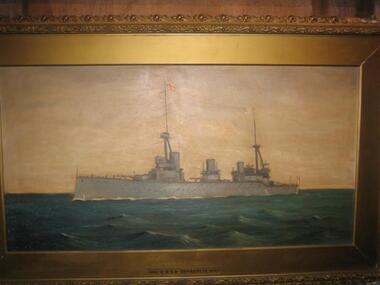 Running Rabbits Military Museum operated by the Upwey Belgrave RSL Sub Branch
Oil Painting HMAS Australia (1), HMAS Australia (1), 26/06/1910
... fourteen 4 inch guns for surface and air contacts. On the 12 of April 1924 HMAS Australia (1) was with "Full Military Honours" Scuttled 50 km east of Sydney. Only 14 Years...fourteen 4 inch guns for surface and air contacts. On the 12 of April 1924 HMAS Australia (1) was with "Full Military Honours" Scuttled 50 km east of Sydney. Only 14 Years ...HMAS Australia (1) The largest war ship in the Australian fleet was the first flagship of the Australian fleet in WW1. She was Commissiond and paid for by the Australian Goverment to ensure sdequate protection for the Australasion Pacific Region. She had a crew of 900 "Officers and Crew" and was equipted with four sets of 12 inch breech loading guns,side firing torpedos and fourteen 4 inch guns for surface and air contacts. On the 12 of April 1924 HMAS Australia (1) was with "Full Military Honours" Scuttled 50 km east of Sydney. Only 14 Years old.Framed Oil Paintinghmas australia oil painting pictures -
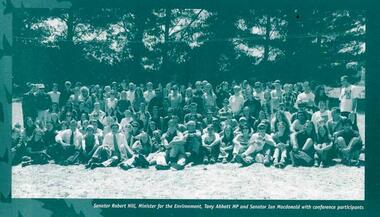 Conservation Volunteers
Key Document: First Green Corps National Conference, Canberra, 21-24 February 1998, Conference Organisers David Clark and Mark Purcell, Proceedings of First Green Corps National Conference, Canberra, 21-24 February 1998
... Winning a $36 million contract was a big breakthrough for ATCV. Fourteen years before, a small non-profit group had started in Ballarat in country Australia with a vision – but little else. ...In March 1995 ATCV had circulated a proposal for an ‘Australia Corps’. The proposal emerged over time from ATCV board and staff through debate and experience. ATCV Board member Alan Wright had written earlier: “There is in our society a terrible vacuum for adolescents to give expression to their independence and idealism in a constructive way, a chance to try themselves out independent of their parents/teachers in adult roles.” ATCV’s Brisbane office manager Phil Harrison had first been involved with ATCV as a volunteer from UK, drew together ideas about an ‘Australia Corps’, that had been discussed with Alan Wright, John Fenton and others at the ATCV staff/board planning workshop at Sorrento in December 1993 and “…based upon our experience and participation in the LEAP program and observations of Conservation Corps around the world”. The concept of a six-month program for young people with a training wage and accredited training which encouraged both competencies and personal development emerged, with a standard format of ten participants working fopr six months under the direction of a supervisor. The ‘Australia Corps’ proposal was widely distributed to Federal, State and Territory parliamentarians and received positive feedback. The Liberal Party, then in Opposition, included the idea of a “Green Army” in their environmental policy, placing more emphasis on environmental outcomes and less on job creation than the Keating ALP Government had. A young and up-and-coming parliamentarian, Tony Abbott MP, was enthusiastic and was to visit several ATCV projects (both before and after Green Corps started) to learn about their workings direct from volunteers and CVA staff. Several times he visited projects with Ian Smith project and Ian recalls being impressed by the efforts he made to talk at length with all participants. Tony Abbott took a personal interest in the progress of Green Corps. Colin Jackson and Phil Harrison were guests of Abbott in Parliament House, Canberra, on the evening of 20 August 1996. The Federal Treasurer, Peter Costello, announced in his first Budget Speech that: - “the Government will provide $42 million over the next 3 years to establish the Green Corps. The Green Corps will be open to young Australians aged 17 to 20 to demonstrate their commitment to the environment by working on projects to preserve and restore Australia's natural environment and cultural heritage. The projects will also contribute to their career and employment prospects through training, skills development, work experience and personal development.” ATCV’s chief executive officer Colin Jackson worked with senior staff Madeline Townsend, Garry Snowden, Phil Harrison, and John Fenton to fine-tune the ATCV proposal. On the strength of unique national coverage and credible record ATCV went on to win the tender to administer and manage the day-to-day operations of the Green Corps program for five years (1997-2002). Winning a $36 million contract was a big breakthrough for ATCV. Fourteen years before, a small non-profit group had started in Ballarat in country Australia with a vision – but little else. Its key people had shaped opinion and won political support for a concept. There was about to be transformation from hand-to-mouth existence into a nation-wide business with resources to build for the long term. This documents records many positive comments about Green Corps and ATCV's implementation of it.24pp illustrated booklet printed in green and some gold.atcv green corps australia-corps tony abbott mp phil-harrison -
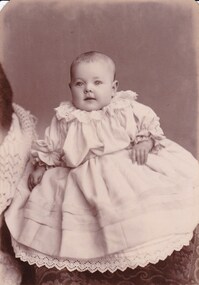 Bendigo Historical Society Inc.
Photograph - GRAYDON COLLECTION: FAMILY PHOTOGRAPHS
... Years Day 1875. Evidently C.W.G.G.1st. must have retained fond memories of a young fourteen-year-old girl named Elizabeth Richardson who travelled from Scotland with her mother and family (her father had arrived earlier) because three years later at Kyneton they were married. ...Years Day 1875. Evidently C.W.G.G.1st. must have retained fond memories of a young fourteen-year-old girl named Elizabeth Richardson who travelled from Scotland with her mother and family (her father had arrived earlier) because three years later at Kyneton they were married. ...Charles Wallace Gordon Graydon the First came out to Victoria on the S.S. Almora, the same ship on which Eliza Richardson and her family arrived on New Years Day 1875. Evidently C.W.G.G.1st. must have retained fond memories of a young fourteen-year-old girl named Elizabeth Richardson who travelled from Scotland with her mother and family (her father had arrived earlier) because three years later at Kyneton they were married. It was December 26th 1860, and Elizabeth was just seventeen. As the bridegroom’s age is written as 24 years on the wedding certificate, he certainly must have been more than eighteen when he sailed on the "Almora" in 1856. The newly married couple went to live at Taradale, Victoria, and they made a good life for themselves in that town which had then a thriving gold mine. They lived in a large two-storied house in Survey Paddock, and it was there that four daughters - Susan Emily (1861-1906), Elizabeth Constance (1863-1945), Amelia Amy (1865 -1952, Ada Mary Maude (1867-1901), and one son Newenham Edward Eustace (1869-1945) named after his Irish Grandfather, were born. On his wedding certificate C.W.G. Graydon, is described as a foreman. His father-in-law, Robert Richardson was employed as a time-keeper on the Melbourne to Bendigo Railway works, and he and his family lived first in Prahran, then Kyneton, and then Taradale. Perhaps Charles Graydon worked on the railway with him. In Taradale however, he worked for a gold mining company in a surveying capacity. C.W.G.G.1st was to become Shire President of the Shire of Metcalfe. That particular year the Graydon Family entertained the visiting English cricket Eleven at their home in Taradale. He was certainly regarded as an important man in the district when he was requested by a great number of the residents to nominate for the Legislative Assembly election. About 1876 the Graydons left Taradale, and went to live at Sandhurst, now Bendigo, at Barkly Place East. The Richardsons had also left Taradale to go into the grocery business in the same town. Charles Wallace Gordon Graydon the First became a legal manager of mines, and a well-known and popular resident. Sad to say he became ill with a lung infection, and on June 4th. 1885 he died, and was buried at Sandhurst, now Bendigo Cemetery, Back Creek Rd. Eliza Richardson's brother was Mr. James Richardson, the well-known grocer, of Pall Mall and Golden-square, who died at his residence, "Balgownie," Short street, on Thursday 22 Jan 1914. James Richardson was a native of Scotland. He was born at Glasgow in1849 and was only eight years of age when his parents sailed for Australia in the ship Balmoral. The family arrived in Melbourne in 1857 and went to Taradale, where Mr. Richardson, senr., acted as inspector of works during the construction of the Taradale Viaduct. James Richardson, who had commenced his educationin Glasgow, attended school at Taradale until the family removed to Bendigo at the time the railway was being built from Bendigo to Echuca. The contractors for this work engaged Mr Richardson, senr., as their timekeeper. When he left school James Richardson applied himself to learn the grocery business, and he gained a thorough knowledge of it with different employers at Bendigo, Taradale, and Daylesford. In 1872 he opened a grocery store on his own account in High-Street, Bendigo, but within a few months he had the great misfortune to be burnt out. The fire originated in an adjoining building early one morning and both places were burnt to the ground. In spite of his loss, Mr. Richardson was not discouraged, for he soon made another start. His trade improved and he extended his business, opening the Eclipse Cash Store at Golden Square. A little later another branch was opened at the Oddfellows' Hall, and subsequently this business was transferred to the Eureka Cash Store, in Pall Mall, which was the head depot. In addition to the retail trade, Mr. Richardson had, for many years carried on an extensive wholesale business with the Northern District, and had made a specialty of fodder seeds. James was a man of probity and sincerity in business, and as a citizen he was highly esteemed and respected. He was a prominent member of the Bendigo Caledonian Society in the earlier days of his citizenship. He was a staunch member of St Andrew's Presbyterian Church, and was a member of the board of management. In the Easter Fair procession, Mr Richardson's display was always a prominent and attractive one. Mr. Richardson was a member of the Masonic Order, and was a life member of the Bendigo Art Gallery and the old Mechanics Institute. He was married at Daylesford in 1871. Mr James Richardson was interred in the Presbyterian section of the Bendigo Cemetery.A selection of black and white Graydon and Richardson family photographs taken by Bendigo photographers. All photos unnamed. Mounted as Cabinet cards. Photographers - D. Mendelfson, Bartlett Bros., The Studio - Chuck, Eden Society Studios, Alan Spicer, R. Bloomfield Rees,graydon, richardson, cabinet card
