
Showing 26 items matching "frieze work"
-
 Williamstown Historical Society Inc
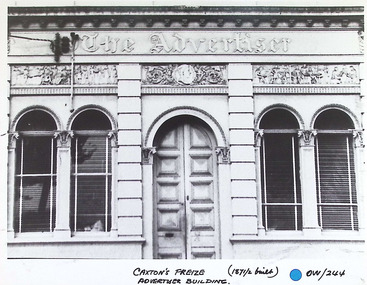
Photograph - Nelson Place, No. 205, Frieze work
... Nelson Place, No. 205, Frieze work......Frieze work...Undated photograph of Caxton's frieze work on 205 Nelson Place. ...Nelson Place Advertiser Building 205 Nelson Place Frieze work Undated photograph of Caxton's frieze work on 205 Nelson Place. ...Undated photograph of Caxton's frieze work on 205 Nelson Place. nelson place, advertiser building, 205 nelson place, frieze work -
 Williamstown Historical Society Inc
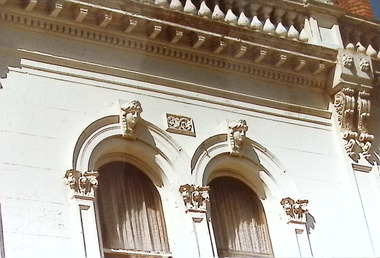
Photograph - Nelson Place, Frieze work on building
... Nelson Place, Frieze work on building...Photograph Nelson Place, Frieze work on building ...Undated photograph, showing the frieze on buildings located at 135-137 Nelson Place. The shops and residences at 131-137 Nelson Place, were designed by Michael Egan and constructed between 1873 and 1885. nelson place, shops, 135 nelson place -
 Williamstown Historical Society Inc
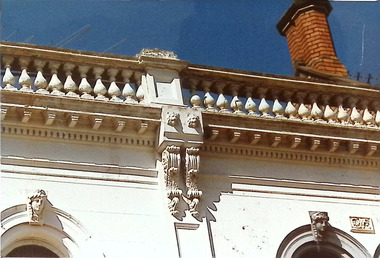
Photograph - Nelson Place, Frieze work on building
... Nelson Place, Frieze work on building...Photograph Nelson Place, Frieze work on building ...Undated photograph, showing the frieze on buildings located at 135-137 Nelson Place. The shops and residences at 131-137 Nelson Place, were designed by Michael Egan and constructed between 1873 and 1885. nelson place, shops, 135 nelson place -
 Federation University Historical Collection
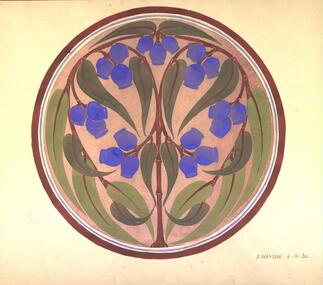
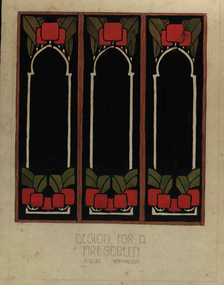
Painting - Artwork, Edith Alice Watson, Examples of General Design from folio of artwork undertaken at the Ballarat Technical Art School, 1931,1932
... The works include including the application of Australian flora to designs, including for pottery, leather and applique. .2) is a design for a table runner to be executed in richelieu work .3) frieze including fish .4) "Design for a border to be executed in stencil". 1932 .12) "Design on the waratah for a bowl to be executed in clay". 1932 .14) "Time test" .12) .17) .15) .18) show the combination of Australian flora with Art Nouveau-inspired designs .9) is a design for a wallet to be executed in raffia showing elevation, side elevation and plan views .11) is a design for a prayer book carrier to be executed in leather work .10) is an example of pencil transfer method of design seen on .11) .18) Design for a fan, image of birds and berries on a blue ground. .25) landscape illustration .27) "development" design based on a correa .29) "Design for a tea cosy based on the Cobia-Scanden to be executed in applique. 1931 (see also .31) .30) "Design for a writing tablet to be executed in embossed leather work and based on the native fuschia" (correa). 1931 .31) a completed doily holder: applique work...The works include including the application of Australian flora to designs, including for pottery, leather and applique. .2) is a design for a table runner to be executed in richelieu work .3) frieze including fish .4) "Design for a border to be executed in stencil". 1932 .12) "Design on the waratah for a bowl to be executed in clay". 1932 .14) "Time test" .12) .17) .15) .18) show the combination of Australian flora with Art Nouveau-inspired designs .9) is a design for a wallet to be executed in raffia showing elevation, side elevation and plan views .11) is a design for a prayer book carrier to be executed in leather work .10) is an example of pencil transfer method of design seen on .11) .18) Design for a fan, image of birds and berries on a blue ground. .25) landscape illustration .27) "development" design based on a correa .29) "Design for a tea cosy based on the Cobia-Scanden to be executed in applique. 1931 (see also .31) .30) "Design for a writing tablet to be executed in embossed leather work and based on the native fuschia" (correa). 1931 .31) a completed doily holder: applique work Examples of General Design from folio of artwork undertaken at the Ballarat Technical Art School Painting Artwork Edith Alice Watson ...Edith (Alice) WATSON (1914–2010) Murtoa | Australia Alice Watson studied at the Ballarat Technical Art School (at the School of Mines, Ballarat) from 1930 until 1933. Watson sat several departmental exams, including drawing and painting plant forms from nature, lettering, Composition of Form and Colour and advanced General Design, as well as dressmaking and embossed leatherwork. General Design examinations required only designs on paper, and not the full execution of an object (which was the case for Applied Design exams). Watson's folio applies many Australian native floral elements to design. Upon graduating, Watson taught at the Murtoa High School, living with her parents until their deaths in 1972 and 1988 when she was 74 years old. Alice Watson died in Ballarat, aged 95, having conserved her beautiful student folio, which was generously gifted to the Federation University permanent Historical Collection by the Watson family. A folio of thirty three drawings and paintings undertaken by Alice Watson at the Ballarat Technical Art School. The works include including the application of Australian flora to designs, including for pottery, leather and applique. .2) is a design for a table runner to be executed in richelieu work .3) frieze including fish .4) "Design for a border to be executed in stencil". 1932 .12) "Design on the waratah for a bowl to be executed in clay". 1932 .14) "Time test" .12) .17) .15) .18) show the combination of Australian flora with Art Nouveau-inspired designs .9) is a design for a wallet to be executed in raffia showing elevation, side elevation and plan views .11) is a design for a prayer book carrier to be executed in leather work .10) is an example of pencil transfer method of design seen on .11) .18) Design for a fan, image of birds and berries on a blue ground. .25) landscape illustration .27) "development" design based on a correa .29) "Design for a tea cosy based on the Cobia-Scanden to be executed in applique. 1931 (see also .31) .30) "Design for a writing tablet to be executed in embossed leather work and based on the native fuschia" (correa). 1931 .31) a completed doily holder: applique workMost are signed A. Watson 1931 .2) Paper is embossed with stamp of 'Goodall's Bristol Boards' stamp. (Crown depicted in centre) .20 and .22) Paper is embossed with 'Windsor & Newtons Bristol Board' stamp.(Griffin depicted in centre)ballarat technical art school, alice watson, flora, design, artwork, folio, art nouveau, alumni, leather work design, richelieu work, applique, doily holder, doyley holder, general design, edith alice watson -
 Flagstaff Hill Maritime Museum and Village
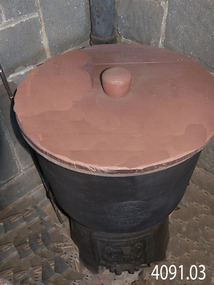
Domestic object - Boiling Copper, Newberry & Walker, Boiling Tub, Circa1900
... worked. Newberry & Walker Foundry & Enameling Works was built adjoining a cottage that was to be the home of the Newberry family during the ensuing years. Although Walker soon relocated to New Zealand, the Newberry and Walker foundry had become a local success. The foundry produced numerous cast iron products such as washing copper frames, and friezes...worked. Newberry & Walker Foundry & Enameling Works was built adjoining a cottage that was to be the home of the Newberry family during the ensuing years. Although Walker soon relocated to New Zealand, the Newberry and Walker foundry had become a local success. The foundry produced numerous cast iron products such as washing copper frames, and friezes ...Francis John Newberry founded the Victoria Foundry and Enameling Works in 1890 with a workmate from the Humbles iron foundry in Lupton Street Geelong where he worked. Newberry & Walker Foundry & Enameling Works was built adjoining a cottage that was to be the home of the Newberry family during the ensuing years. Although Walker soon relocated to New Zealand, the Newberry and Walker foundry had become a local success. The foundry produced numerous cast iron products such as washing copper frames, and friezes, balustrades and verandah columns. Verandah posts are to be found in declining numbers, but the Newberry and Walker mark can sometimes be seen on the few which remain. A certain number of iron culvert posts were also made; some of them were still in place on the road to Cressy as late as 1961. Perhaps half the iron friezes on Geelong West verandahs came from the local firm’s foundry. A significant item made in Geelong giving a snapshot into the early beginnings of Victoria's industrial manufacturing of products that helped to replace previously imported items from England or America.Copper boiling tub, cast iron frame copper bowl inside of 14 gallon capacity Newberry & Walkerflagstaff hill, warrnambool, flagstaff-hill-maritime-museum, maritime-museum, shipwreck-coast, flagstaff-hill-maritime-village, copper, cast iron, newberry & walker, washing copper frame, laundry, dairy, butchering -
 Federation University Historical Collection
Book - Artwork, Ivy Wilson, Album of original Ballarat Technical Art School folio by Ivy Wilson, c1922
... friezes and murals. One of Wilson's examples, a wreath was subsequently translated into embroidered needlework. Wilson’s folio possibly consists of mostly junior technical work, as she appears to only have sat a single senior Education Department examination, Drawing Plant Forms from Nature. ...friezes and murals. One of Wilson's examples, a wreath was subsequently translated into embroidered needlework. Wilson’s folio possibly consists of mostly junior technical work, as she appears to only have sat a single senior Education Department examination, Drawing Plant Forms from Nature. ...Ivy WILSON (1907-1998) Ballarat | Australia Ivy Wilson was born on 05 July 1907 to Charlotte and Edward Wilson of 167 Mair Street, Ballarat. She attended Humffray Street Primary School and the Ballarat Technical Art School (a division of the Ballarat School of Mines) in 1922. Wilson's student folio contains several stencils hand-cut from paper and card. Among them are stylised graphics of correa, waratah, gum, and kangaroo apple as well as kookaburras, cockatoos and a koala. With diverse applications, stencilling attracted a range of students at the Ballarat Technical Art School. Stencilling was applied to interior surfaces like cushions and curtains. Commercial briefs included wall friezes and murals. One of Wilson's examples, a wreath was subsequently translated into embroidered needlework. Wilson’s folio possibly consists of mostly junior technical work, as she appears to only have sat a single senior Education Department examination, Drawing Plant Forms from Nature. Alternatively, given her focus on textile-based arts, she may have been an evening trade student. Ivy Wilson married Frederick Henry Russell on 23 December 1933 at St Mary's Church of England Caulfield, and had one daughter - Nola, who gifted this folio to the University’s permanent Historical Collection. Ivy died on 17 November 1998 at Caulfield.Silver cloth covered photo album of artworks by Ivy Wilson. Gift of Nola Jones, daughter of Ivy Wilson, 2016 Contains original stencils, plus four photographs of a works kept by Ivy Wilson's family (2016).(Handwritten note) This art is the work of Ivy Wilson. born" 5th July 1907 to Charlotte & Edward Wilson of 17 Mair St. Ballarat. Attended Humffray St. Primary School and Ballarat School of Mines 1922. Married: Frederick Henry Russell December 23rd 1933 at St Marys CofE Caulfield Died 17th November 1998 at Caulfield. Mother of one daughter, Nola. ivy wilson, ballarat tecnical art school, artwork, dana street primary school, alumni, stencilling, stencils, embroidery, textiles, design -
 Glen Eira Historical Society
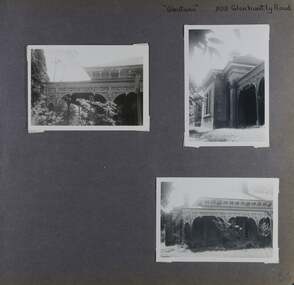
Album - Album page, Glentana, Glen Huntly Road, 805, Circa 1972
... frieze...decorative brackets...italianate...return verandah...glentana...glen huntly road...caulfield...cast iron work...Melbourne Mansions database indicates that its architect may have been Charles Webb. trevor hart brick polychrome brickwork cast iron frieze decorative brackets italianate return verandah glentana glen huntly road caulfield cast iron work verandahs glenhuntly road charles webb glen tana house names Hand written: "Glentana" 805 Glenhuntly Road [top right] / 66 [bottom right] Page 66 of Photograph Album with three exterior photographs (two portrait and one landscape) of Glentana, a single storey Victorian residence, focussing on views of its verandah. ...This photograph is part of the Caulfield Historical Album 1972. This album was created in approximately 1972 as part of a project by the Caulfield Historical Society to assist in identifying buildings worthy of preservation. The album is related to a Survey the Caulfield Historical Society developed in collaboration with the National Trust of Australia (Victoria) and Caulfield City Council to identify historic buildings within the City of Caulfield that warranted the protection of a National Trust Classification. Principal photographer thought to be Trevor Hart, member of Caulfield Historical Society. Most photographs were taken between 1966-1972 with a small number of photographs being older and from unknown sources. All photographs are black and white except where stated, with 386 photographs over 198 pages. Melbourne Mansions database indicates that its architect may have been Charles Webb.Page 66 of Photograph Album with three exterior photographs (two portrait and one landscape) of Glentana, a single storey Victorian residence, focussing on views of its verandah.Hand written: "Glentana" 805 Glenhuntly Road [top right] / 66 [bottom right] trevor hart, brick, polychrome brickwork, cast iron frieze, decorative brackets, italianate, return verandah, glentana, glen huntly road, caulfield, cast iron work, verandahs, glenhuntly road, charles webb, glen tana, house names -
 Glen Eira Historical Society
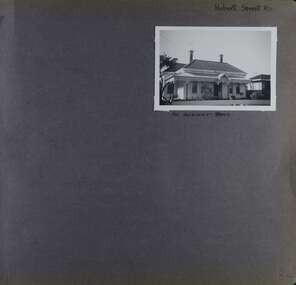
Album - Album page, Hobart Road, Circa 1972
... frieze...decorative brackets...iron roof...cast iron work...All photographs are black and white except where stated, with 386 photographs over 198 pages. trevor hart 1880's cast iron verandah murrumbeena hobart road victorian columns cast iron frieze decorative brackets iron roof cast iron work houses chimneys Handwritten: Hobart Street RD - the word Street has been crossed out [top right] / 40 HOBART ROAD [Under photo] / 84 [bottom right] Page 84 of Photograph Album with one portrait photograph of a house on Hobart Road. ...This photograph is part of the Caulfield Historical Album 1972. This album was created in approximately 1972 as part of a project by the Caulfield Historical Society to assist in identifying buildings worthy of preservation. The album is related to a Survey the Caulfield Historical Society developed in collaboration with the National Trust of Australia (Victoria) and Caulfield City Council to identify historic buildings within the City of Caulfield that warranted the protection of a National Trust Classification. Principal photographer thought to be Trevor Hart, member of Caulfield Historical Society. Most photographs were taken between 1966-1972 with a small number of photographs being older and from unknown sources. All photographs are black and white except where stated, with 386 photographs over 198 pages. Page 84 of Photograph Album with one portrait photograph of a house on Hobart Road. Handwritten: Hobart Street RD - the word Street has been crossed out [top right] / 40 HOBART ROAD [Under photo] / 84 [bottom right]trevor hart, 1880's, cast iron verandah, murrumbeena, hobart road, victorian, columns, cast iron frieze, decorative brackets, iron roof, cast iron work, houses, chimneys -
 Glen Eira Historical Society
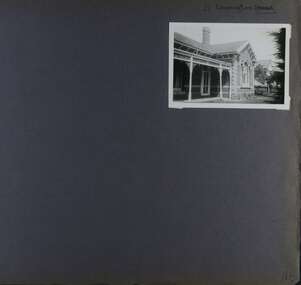
Album - Album page, Leamington Crescent, Circa 1972
... frieze...victorian architectural style...cast iron work...All photographs are black and white except where stated, with 386 photographs over 198 pages. trevor hart verandah arched windows leamington crescent ornate cornerstone slate roof triple windows decorative brackets eave brackets leamington street caulfield east cast iron frieze victorian architectural style cast iron work polychrome bricks Handwritten: 21 Leamington (Street) [crossed out] / Crescent [top right] / 118 [bottom right] Page 118 Photograph Album with one photograph (landscape) of a brick house at Leamington Crescent. ...This photograph is part of the Caulfield Historical Album 1972. This album was created in approximately 1972 as part of a project by the Caulfield Historical Society to assist in identifying buildings worthy of preservation. The album is related to a Survey the Caulfield Historical Society developed in collaboration with the National Trust of Australia (Victoria) and Caulfield City Council to identify historic buildings within the City of Caulfield that warranted the protection of a National Trust Classification. Principal photographer thought to be Trevor Hart, member of Caulfield Historical Society. Most photographs were taken between 1966-1972 with a small number of photographs being older and from unknown sources. All photographs are black and white except where stated, with 386 photographs over 198 pages. Page 118 Photograph Album with one photograph (landscape) of a brick house at Leamington Crescent.Handwritten: 21 Leamington (Street) [crossed out] / Crescent [top right] / 118 [bottom right]trevor hart, verandah, arched windows, leamington crescent, ornate cornerstone, slate roof, triple windows, decorative brackets, eave brackets, leamington street, caulfield east, cast iron frieze, victorian architectural style, cast iron work, polychrome bricks -
 Wycheproof & District Historical Society Inc.
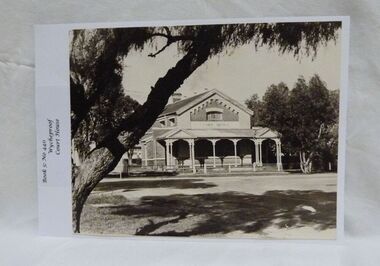
Photograph, Wycheproof Court House, (estimated); mid to late 19th century
... A simple form of Court House built of red-face-brick but embellished by stepped brick work in the principal gable and by the traverse veranda with elaborate frieze and gabled pavilions that protect the street facade. ...A simple form of Court House built of red-face-brick but embellished by stepped brick work in the principal gable and by the traverse veranda with elaborate frieze and gabled pavilions that protect the street facade. ...The Court House opened as a court of petty sessions in 1890 and closed as a court in the early 1980s. It is now a 'Place of Deposit' for paper based products, maps, documents and photographs, and the home of the Wycheproof and District Historical Society Inc. The local Craft Group met at the Court House between 1982 and 2010. The Buloke Shire Council oversees the maintenance of the building.The Court House is No H 1656 on the Victorian Heritage Register. It is the one of only two buildings with this listing in Wycheproof, and characteristic of the type of building constructed in the early days of settlement in Wycheproof. The architecture is of aesthetic value and although some restoration work has taken place to maintain the structure, it remains in good condition and with some of the original furnishings intact.Sepia print of the Wycheproof-Court-House. It was constructed during 1889/90 and commissioned on September 23,1890 as a court-of-petty-sessions. A simple form of Court House built of red-face-brick but embellished by stepped brick work in the principal gable and by the traverse veranda with elaborate frieze and gabled pavilions that protect the street facade. The roof is of slate.Nonecourt house, wycheproof heritage 1890, petty sessions, building, red face brick, gabled pavilions -
 Glen Eira Historical Society
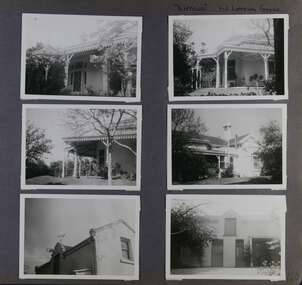
Album - Album page, Lirrewa, 1-3 Lirrewa Grove, Circa 1972
... frieze...gables...cast iron ridging...lirrewa grove...cast iron work...This latter style was particularly attractive to persons of means on account of its English precedents, the combination of influences being skillfully handled in this instance. trevor hart verandah lirrewa tarqua 1880's montague william langdon italian style shallow hipped roof symmetrical facade gothic revival pointed arches fretted barges battlemented parapet terraces boom era single storey timber roof brackets frieze gables cast iron ridging lirrewa grove cast iron work caulfield arches parapets gardens houses victorian style caulfield south Handwritten: "Lirrewa" 1-3 Lirrewa Grove [top right] / 120 [bottom right] Page 120 of Photograph Album with six photographs (all landscape) of views of Lirrewa, mostly including its garden. ...This photograph is part of the Caulfield Historical Album 1972. This album was created in approximately 1972 as part of a project by the Caulfield Historical Society to assist in identifying buildings worthy of preservation. The album is related to a Survey the Caulfield Historical Society developed in collaboration with the National Trust of Australia (Victoria) and Caulfield City Council to identify historic buildings within the City of Caulfield that warranted the protection of a National Trust Classification. Principal photographer thought to be Trevor Hart, member of Caulfield Historical Society. Most photographs were taken between 1966-1972 with a small number of photographs being older and from unknown sources. All photographs are black and white except where stated, with 386 photographs over 198 pages.From Victorian Heritage Database citation for Lirrewa - HO39 Tarqua and Stables, 1-3 Lirrewa Grove Caulfield South https://vhd.heritagecouncil.vic.gov.au/places/120932 (as at 26/10/2020) "Tarqua", now "Lirrewa", is situated at nos. 1-3 Lirrewa Grove, Caulfield South, and was built in 1886 for Montague William Langdon, son of the merchant Joseph Henry Langdon of nearby "Rosecraddock". It is historically and aesthetically significant. It is historically significant (Criterion A) as one of the Langdon family residences, comparing in Glen Eira also with "Rosecraddock" at 10 Craddock Avenue (1857) and "Hengar" at 356 Glen Eira Road (1889-90). It is aesthetically significant (Criterion E) for its capacity to demonstrate the stylistic influences prevailing at the time especially for substantial residences. At "Tarqua", the design acknowledges the prevailing popularity of the Italian Style in the shallow hipped roof form and symmetrical facade as well as the picturesque Gothic Revival style demonstrated especially by the use of pointed arches, fretted barges and the battlemented parapeted section. This latter style was particularly attractive to persons of means on account of its English precedents, the combination of influences being skillfully handled in this instance.Page 120 of Photograph Album with six photographs (all landscape) of views of Lirrewa, mostly including its garden.Handwritten: "Lirrewa" 1-3 Lirrewa Grove [top right] / 120 [bottom right]trevor hart, verandah, lirrewa, tarqua, 1880's, montague william langdon, italian style, shallow hipped roof, symmetrical facade, gothic revival, pointed arches, fretted barges, battlemented parapet, terraces, boom era, single storey, timber roof brackets, frieze, gables, cast iron ridging, lirrewa grove, cast iron work, caulfield, arches, parapets, gardens, houses, victorian style, caulfield south -
 Glen Eira Historical Society
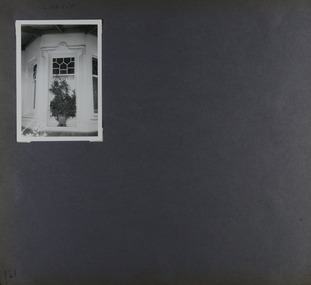
Album - Album page, Lirrewa, 1-3 Lirrewa Grove, Circa 1972
... frieze...gables...cast iron ridging...lirrewa grove...bay window...cast iron work...This latter style was particularly attractive to persons of means on account of its English precedents, the combination of influences being skillfully handled in this instance. trevor hart verandah lirrewa tarqua 1880's montague william langdon italian style shallow hipped roof symmetrical facade gothic revival pointed arches fretted barges battlemented parapet ornamented parapets terraces boom era timber roof brackets frieze gables cast iron ridging lirrewa grove bay window cast iron work lead lights houses victorian style caulfield caulfield south Handwritten: Lirrewa [top left ] / 121 [bottom left] Page 121 of Photograph Album with one landscape photograph of Lirrewa - external view of a bay window. ...This photograph is part of the Caulfield Historical Album 1972. This album was created in approximately 1972 as part of a project by the Caulfield Historical Society to assist in identifying buildings worthy of preservation. The album is related to a Survey the Caulfield Historical Society developed in collaboration with the National Trust of Australia (Victoria) and Caulfield City Council to identify historic buildings within the City of Caulfield that warranted the protection of a National Trust Classification. Principal photographer thought to be Trevor Hart, member of Caulfield Historical Society. Most photographs were taken between 1966-1972 with a small number of photographs being older and from unknown sources. All photographs are black and white except where stated, with 386 photographs over 198 pages.From Victorian Heritage Database citation for - HO39 Tarqua and Stables, 1-3 Lirrewa Grove Caulfield South https://vhd.heritagecouncil.vic.gov.au/places/120932 as at (26/10/2020) "Tarqua", now "Lirrewa", is situated at nos. 1-3 Lirrewa Grove, Caulfield South, and was built in 1886 for Montague William Langdon, son of the merchant Joseph Henry Langdon of nearby "Rosecraddock". It is historically and aesthetically significant. It is historically significant (Criterion A) as one of the Langdon family residences, comparing in Glen Eira also with "Rosecraddock" at 10 Craddock Avenue (1857) and "Hengar" at 356 Glen Eira Road (1889-90). It is aesthetically significant (Criterion E) for its capacity to demonstrate the stylistic influences prevailing at the time especially for substantial residences. At "Tarqua", the design acknowledges the prevailing popularity of the Italian Style in the shallow hipped roof form and symmetrical facade as well as the picturesque Gothic Revival style demonstrated especially by the use of pointed arches, fretted barges and the battlemented parapeted section. This latter style was particularly attractive to persons of means on account of its English precedents, the combination of influences being skillfully handled in this instance.Page 121 of Photograph Album with one landscape photograph of Lirrewa - external view of a bay window.Handwritten: Lirrewa [top left ] / 121 [bottom left]trevor hart, verandah, lirrewa, tarqua, 1880's, montague william langdon, italian style, shallow hipped roof, symmetrical facade, gothic revival, pointed arches, fretted barges, battlemented parapet, ornamented parapets, terraces, boom era, timber roof brackets, frieze, gables, cast iron ridging, lirrewa grove, bay window, cast iron work, lead lights, houses, victorian style, caulfield, caulfield south -
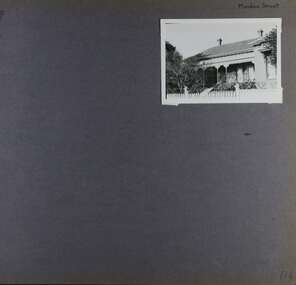 Glen Eira Historical Society
Album - Album page, Meadow Street, Circa 1972
... frieze...meadow street...st kilda east...caulfield...victorian style...cast iron work...All photographs are black and white except where stated, with 386 photographs over 198 pages. trevor hart east st kilda decorative brackets picket fence slate roof chimneys garden cast iron columns cast iron frieze meadow street st kilda east caulfield victorian style cast iron work verandahs Handwritten: Meadow Street [top right] / 134 [bottom right] Page 134 of Photograph Album with one landscape photograph of a Victorian house on Meadow Street. ...This photograph is part of the Caulfield Historical Album 1972. This album was created in approximately 1972 as part of a project by the Caulfield Historical Society to assist in identifying buildings worthy of preservation. The album is related to a Survey the Caulfield Historical Society developed in collaboration with the National Trust of Australia (Victoria) and Caulfield City Council to identify historic buildings within the City of Caulfield that warranted the protection of a National Trust Classification. Principal photographer thought to be Trevor Hart, member of Caulfield Historical Society. Most photographs were taken between 1966-1972 with a small number of photographs being older and from unknown sources. All photographs are black and white except where stated, with 386 photographs over 198 pages. Page 134 of Photograph Album with one landscape photograph of a Victorian house on Meadow Street.Handwritten: Meadow Street [top right] / 134 [bottom right]trevor hart, east st kilda, decorative brackets, picket fence, slate roof, chimneys, garden, cast iron columns, cast iron frieze, meadow street, st kilda east, caulfield, victorian style, cast iron work, verandahs -
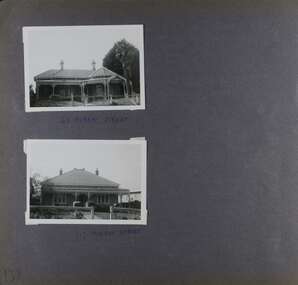 Glen Eira Historical Society
Album - Album page, Murray Street, Circa 1972
... Important contributory elements include the polychrome brickwork, frieze and verandah including the half timbered gablet which would have been stylistically innovative in its day. trevor hart garden verandah murray street elsternwick victorian style houses Marston house names J E Guest verandahs polychrome bricks cast iron work chimneys Handwritten: 63 MURRAY STREET [under top photo] / 117 MURRAY STREET [under bottom photo] / 139 [bottom left] Page 139 of Photograph Album with two landscape photographs of two different houses in Murray Street. ...This photograph is part of the Caulfield Historical Album 1972. This album was created in approximately 1972 as part of a project by the Caulfield Historical Society to assist in identifying buildings worthy of preservation. The album is related to a Survey the Caulfield Historical Society developed in collaboration with the National Trust of Australia (Victoria) and Caulfield City Council to identify historic buildings within the City of Caulfield that warranted the protection of a National Trust Classification. Principal photographer thought to be Trevor Hart, member of Caulfield Historical Society. Most photographs were taken between 1966-1972 with a small number of photographs being older and from unknown sources. All photographs are black and white except where stated, with 386 photographs over 198 pages. 63 and 117 Murray Street houses are extant (Google maps image capture Dec 2018).Victorian Heritage Database - HO131 63 Murray Street Caulfield https://vhd.heritagecouncil.vic.gov.au/places/35569 (as of 14/08/2021) "Marston" at no. 63 Murray Street, Caulfield South, was built by J.E. Guest, a contractor resident in nearby Downshire Road, in 1889-90, presumably as a speculative venture together with the extant house at adjoining No.61. It is aesthetically significant. It is aesthetically significant (Criterion E) as an exceptionally richly ornamented medium sized Boom period villa in Caulfield South, being unusual in this respect in its locale and comparing with nearby "Sprouston" at 19 Blanche Street (1887). Important contributory elements include the polychrome brickwork, frieze and verandah including the half timbered gablet which would have been stylistically innovative in its day.Page 139 of Photograph Album with two landscape photographs of two different houses in Murray Street. Handwritten: 63 MURRAY STREET [under top photo] / 117 MURRAY STREET [under bottom photo] / 139 [bottom left]trevor hart, garden, verandah, murray street, elsternwick, victorian style, houses, marston, house names, j e guest, verandahs, polychrome bricks, cast iron work, chimneys -
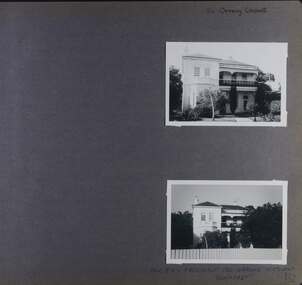 Glen Eira Historical Society
Album - Album page, 84 Orrong Crescent, Circa 1972
... frieze rail protects a black and white tiled floor. The hipped roof has patterned slates. trevor hart verandah porch slate roof garden decorative brackets fanlight protruding bay bay window garden lamp asymmetrical bonhurst st reliers rendered orrong crescent caulfield north cast iron work victorian style mansions house names slate roofs italianate style Handwritten: 84 Orrong Crescent [top right] / NOW 84 - PREVIOUSLY 120 ORRONG CRESCENT / "BONHURST" [under bottom photo] / 152 [bottom right] Page 152 of Photograph Album with two landscape photographs of Bonhurst on Orrong Crescent. 84 Orrong Crescent Album Album page ...This photograph is part of the Caulfield Historical Album 1972. This album was created in approximately 1972 as part of a project by the Caulfield Historical Society to assist in identifying buildings worthy of preservation. The album is related to a Survey the Caulfield Historical Society developed in collaboration with the National Trust of Australia (Victoria) and Caulfield City Council to identify historic buildings within the City of Caulfield that warranted the protection of a National Trust Classification. Principal photographer thought to be Trevor Hart, member of Caulfield Historical Society. Most photographs were taken between 1966-1972 with a small number of photographs being older and from unknown sources. All photographs are black and white except where stated, with 386 photographs over 198 pages. From Victorian Heritage Database citation for 84 Orrong Crescent https://vhd.heritagecouncil.vic.gov.au/places/35584 as at (28/10/2020) "St. Reliers" at 84 Orrong Crescent is important as an unusually excessively enriched asymmetrical villa residence of the Boom period. From Victorian Heritage Database citation for HO50 84 Orrong Crescent Caulfield North https://vhd.heritagecouncil.vic.gov.au/places/35584 as at (28/10/2020) An imposing Italianate two storeyed asymmetrical villa with overpainted stuccoed surfaces to the facade, distinguished by their ornate treatment. Unusually rich ornamentation includes the acanthus leaf impost capitals, aedicules with swags and volutes, foliated panels to the frieze, ashlar treatment to the lower level and quoins above. The two storeyed cast iron verandah with timber frieze rail protects a black and white tiled floor. The hipped roof has patterned slates.Page 152 of Photograph Album with two landscape photographs of Bonhurst on Orrong Crescent.Handwritten: 84 Orrong Crescent [top right] / NOW 84 - PREVIOUSLY 120 ORRONG CRESCENT / "BONHURST" [under bottom photo] / 152 [bottom right]trevor hart, verandah, porch, slate roof, garden, decorative brackets, fanlight, protruding bay, bay window, garden lamp, asymmetrical, bonhurst, st reliers, rendered, orrong crescent, caulfield north, cast iron work, victorian style, mansions, house names, slate roofs, italianate style -
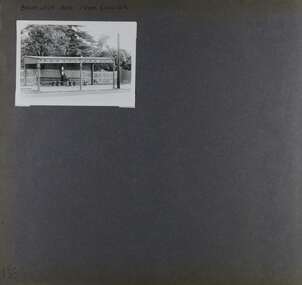 Glen Eira Historical Society
Album - Album page, Balaclava Road Tram Shelter, Circa 1972
... frieze...victorian style...caulfield north...leonard flanagan...cast iron work...The shelter has a rinceau pattern frieze along the road frontage with centrally placed shield motif (which does not contain a coat of arms). The side and rear panels are lined with ripple iron and the upper panel at the rear is lattice work. ...The shelter has a rinceau pattern frieze along the road frontage with centrally placed shield motif (which does not contain a coat of arms). The side and rear panels are lined with ripple iron and the upper panel at the rear is lattice work. ...This photograph is part of the Caulfield Historical Album 1972. This album was created in approximately 1972 as part of a project by the Caulfield Historical Society to assist in identifying buildings worthy of preservation. The album is related to a Survey the Caulfield Historical Society developed in collaboration with the National Trust of Australia (Victoria) and Caulfield City Council to identify historic buildings within the City of Caulfield that warranted the protection of a National Trust Classification. Principal photographer thought to be Trevor Hart, member of Caulfield Historical Society. Most photographs were taken between 1966-1972 with a small number of photographs being older and from unknown sources. All photographs are black and white except where stated, with 386 photographs over 198 pages. From Victorian Heritage Database citation H0174 TRAM VERANDAH SHELTER CORNER BALACLAVA AND ORRONG ROADS CAULFIELD NORTH - Vic Heritage Register https://vhd.heritagecouncil.vic.gov.au/places/2721 (as at 28/10/2020) The waiting shelter at the corner of Balaclava Road and Orrong Road, Caulfield was constructed in 1916/17 for the Prahran and Malvern Tramways Trust and is one of only three remaining tram shelters in Melbourne designed in the form of a verandah. The shelter has a corrugated iron roof fixed to an angle iron roof frame. The roof, which extends in the form of a skillion over the pavement, is supported on three squared, chamfered timber posts at the rear and three cast iron reeded columns with round bases and Corinthian capitals at the front. (The columns are hollow and function as downpipes, with rainwater discharging from the verandah roof, through the columns and under the ground). The shelter has a rinceau pattern frieze along the road frontage with centrally placed shield motif (which does not contain a coat of arms). The side and rear panels are lined with ripple iron and the upper panel at the rear is lattice work. The shelter has two timber slatted bench seats.From Victorian Heritage Database citation for H0174 TRAM VERANDAH SHELTER CORNER BALACLAVA AND ORRONG ROADS CAULFIELD NORTH - Vic Heritage Register https://vhd.heritagecouncil.vic.gov.au/places/2721 (as at 28/10/2020) How is it significant? The waiting shelter at the corner of Balaclava Road and Orrong Road, Caulfield is of historical and architectural significance to the State of Victoria. Why is it significant? The waiting shelter is of historical significance for its association with the development of the suburban (electric) tram network which assisted the expansion of Melbourne as a suburban metropolis. It is also of historical significance for its connection with the Prahran & Malvern Tramways Trust. The Prahran & Malvern Tramways Trust (1907-1920) was the first municipal electric tramway in Melbourne, becoming the largest and most successful of all the municipal tramway trusts. Its services played a key role in facilitating suburban expansion and the development of the southern and eastern suburbs. The growth of tramways was one of the greatest municipal developments in Victoria during the first decade of the twentieth century. The waiting shelter is an important remnant of this period of Melbourne's transport history and a tangible reminder of the Prahran & Malvern Tramways Trust. The shelter indicates the extent of the Prahran & Malvern tram network. The waiting shelter at corner of Balaclava Road and Orrong Road, Caulfield is one of only three remaining tram shelters in Melbourne designed in the form of a verandah. The waiting shelter is of architectural significance for the distinctive design and construction which is unique to the Prahran & Malvern Tramway Trust tram network. The shelter was designed by notable Melbourne architect Leonard J. Flannagan (1864-1946). Flannagan was responsible for a number of buildings for the Prahran and Malvern Tramways Trust including the early waiting shelter at the junction of Dandenong Road and Hawthorn Road, Caulfield, and sections of the tram depot at Malvern, and also designed a depot for the Hawthorn Tramways Trust. The waiting shelter, a conservative design influenced by Victorian architecture, is based on the Melbourne City Council late 19th century standard cast iron verandah. It is of significance as an intact example of the cast iron type shelter and for its detail, including Corinthian columns and a 'rinceau' pattern cast-iron frieze. The shelter is largely in keeping with the original design and retains its integrity. The cast iron waiting shelter is also of significance as an unusual example of early twentieth century street architecture. Page 155 of Photograph Album with one landscape photograph of a tram shelter on Balaclava Road.Handwritten: BALACLAVA ROAD TRAM SHELTER [top] / 155 [bottom left]trevor hart, verandah, garden, grimwade house, grimwade, orrong road, balaclava road, melbourne grammar, melbourne grammar junior school, mgs, m.g.s, school, tram shelter, waiting shelter, prahran & malvern tramway trust, leonard j. flannagan, cast iron verandah, cast iron type shelter, corinthian columns, 'rinceau' pattern cast-iron frieze, rinceau, cast iron frieze, victorian style, caulfield north, leonard flanagan, cast iron work, prahran and malvern tramways trust, trams -
 Glen Eira Historical Society
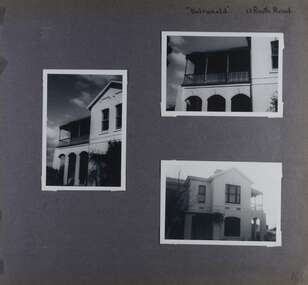
Album - Album page, Balranald, Poath Road, Circa 1972
... frieze...victorian style...cast iron work...Elements of stylistic significance include the ornamentation of the brickwork in polychrome work with tiled panels, the effect of the banding being especially striking and representative of the period. trevor hart decorative brackets chimneys verandah porch poath road arches cast iron columns return verandah croft head balranald victorian villa restoration 1880's edward tweddell murrumbeena hughesdale cast iron frieze victorian style cast iron work rendered brick house names polychrome brick poath street crofthead the croft head Handwritten: "Balranald" 13 Poath Road [top right] / 166 [bottom right] Page 166 of Photograph Album with three photographs of Balranald on Poath Road. ...This photograph is part of the Caulfield Historical Album 1972. This album was created in approximately 1972 as part of a project by the Caulfield Historical Society to assist in identifying buildings worthy of preservation. The album is related to a Survey the Caulfield Historical Society developed in collaboration with the National Trust of Australia (Victoria) and Caulfield City Council to identify historic buildings within the City of Caulfield that warranted the protection of a National Trust Classification. Principal photographer thought to be Trevor Hart, member of Caulfield Historical Society. Most photographs were taken between 1966-1972 with a small number of photographs being older and from unknown sources. All photographs are black and white except where stated, with 386 photographs over 198 pages. Originally named Crofthead or The Croft Head, later changed to Balranald according to Melbourne Mansions database.From Victorian Heritage Database citation for HO136 13 Poath Street MURRUMBEENA https://vhd.heritagecouncil.vic.gov.au/places/35389 as at 30/10/2020 "Croft Head" is situated at no. 13 Poath Road, Murrumbeena, and was built in 1887 for the accountant Edward Tweddell. It is historically and aesthetically significant. It is historically significant (Criterion A) as a substantial and now rare (Criterion B) surviving late Victorian villa residence east of Booran Road within the Municipality and demonstrating the attraction of Melbourne's rural fringe as a residential location rendered accessible by the opening of the railway between South Yarra and Oakleigh in 1879. It is aesthetically significant (Criterion E) as one of the Municipality's finest late Victorian polychrome brick villas, comparing with ''Fresch'' and ''Monkleigh'' both erected in 1899 at nos. 11 and 12 Gladstone Parade, Elsternwick respectively, ''Hartington'' (1888) at 15 Gladstone Parade and ''Hengar'' (1889) at no. 356 Glen Eira Road, Caulfield South. Elements of stylistic significance include the ornamentation of the brickwork in polychrome work with tiled panels, the effect of the banding being especially striking and representative of the period.Page 166 of Photograph Album with three photographs of Balranald on Poath Road.Handwritten: "Balranald" 13 Poath Road [top right] / 166 [bottom right]trevor hart, decorative brackets, chimneys, verandah, porch, poath road, arches, cast iron columns, return verandah, croft head, balranald, victorian villa, restoration, 1880's, edward tweddell, murrumbeena, hughesdale, cast iron frieze, victorian style, cast iron work, rendered brick, house names, polychrome brick, poath street, crofthead, the croft head -
 Glen Eira Historical Society
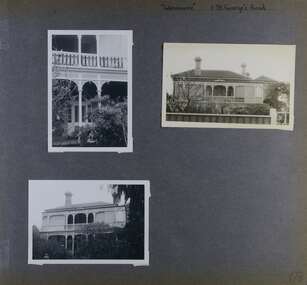
Album - Album page, Glenmoore, St George's Road, Circa 1972
... frieze...glenmoore...1860's...hugh moore...glenmoore estate...double storey...elsternwick shops...st george's road...thomas watts...elsternwick...victorian style...protruding bay windows...cast iron work...Original grounds included adjoining "Carramar". trevor hart chimneys porch mansion slate roof return verandah stained glass cast iron frieze glenmoore 1860's hugh moore glenmoore estate double storey elsternwick shops st george's road thomas watts elsternwick victorian style protruding bay windows cast iron work bi-chromatic bricks gardens balconies moore's buildings glen huntly road stairs house names Handwritten: "Glenmoore" 1 St George's Road [top right] / 178 [bottom right] Page 178 of Photograph Album with three photographs of Glenmoore, St Georges Road. ...This photograph is part of the Caulfield Historical Album 1972. This album was created in approximately 1972 as part of a project by the Caulfield Historical Society to assist in identifying buildings worthy of preservation. The album is related to a Survey the Caulfield Historical Society developed in collaboration with the National Trust of Australia (Victoria) and Caulfield City Council to identify historic buildings within the City of Caulfield that warranted the protection of a National Trust Classification. Principal photographer thought to be Trevor Hart, member of Caulfield Historical Society. Most photographs were taken between 1966-1972 with a small number of photographs being older and from unknown sources. All photographs are black and white except where stated, with 386 photographs over 198 pages. From Victorian Heritage Database citation for HO59 Glenmoore, 1 St Georges Road Elsternwick https://vhd.heritagecouncil.vic.gov.au/places/35202 as at 30/10/2020 "Glenmoore" is locally significant as a surviving mid nineteenth century villa residence in the then fashionable bi-chromatic brick form. It is also important as the home of Hugh Moore who built several shops in nearby Glen Huntly Road and which remain as important contributors to the architectural character of the Elsternwick Shopping Centre.Victorian Heritage Database citation HO59 Glenmoore, 1 St Georges Road Elsternwick https://vhd.heritagecouncil.vic.gov.au/places/35202 An imposing two storeyed villa in bichrome brick with two storeyed timber posted verandah, coupled with cast iron lace frieze, spandrels and central tympanum enrichment. The hipped roof is in slate and has a prominent crean1 brick chimney stack forming part of the facade. Openings are flat arched although the entrance is round arched with a fan light. The south elevation has bayed windows. Two storeyed hip roofed additions are sympathetic and attached on the north side and at the rear. Inside, the staircase and stained glasswork with initials "HM" and family coat of arms are important surviving elements. INTEGRITY: Good, timber outbuildings of an early date, mature and spacious front garden includes early palm trees. Alterations include reconstruction of facade verandah including tiled pavement and front door on east side. Interior has a high level of integrity. Original grounds included adjoining "Carramar".Page 178 of Photograph Album with three photographs of Glenmoore, St Georges Road. Handwritten: "Glenmoore" 1 St George's Road [top right] / 178 [bottom right]trevor hart, chimneys, porch, mansion, slate roof, return verandah, stained glass, cast iron frieze, glenmoore, 1860's, hugh moore, glenmoore estate, double storey, elsternwick shops, st george's road, thomas watts, elsternwick, victorian style, protruding bay windows, cast iron work, bi-chromatic bricks, gardens, balconies, moore's buildings, glen huntly road, stairs, house names -
 Glen Eira Historical Society
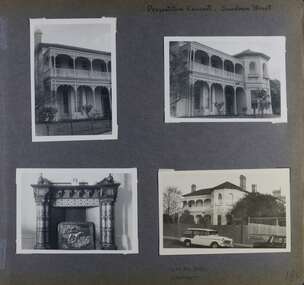
Album - Album page, Presentation Convent, Sandham Street, Circa 1972
... frieze...cast iron columns...protruding bay...bay window...1880's...late victorian...cromarty...chiselhurst...chisel hurst...horatio beauchamp...elsternwick...victorian style...cast iron work...From Victorian Heritage Database citation for Presentation Convent, 28 Sandham Street https://vhd.heritagecouncil.vic.gov.au/places/35476 (as at 1/11/2020) - HO61 City of Glen Eira A substantial two storeyed stuccoed asymmetrical Italianate villa residence, representative of its period, with two storeyed cast iron verandah and projecting facetted bay with trabeated treatment to the ground floor and round arched upper level windows with distinctive moulds. trevor hart chimneys porch school education presentation sisters catholic girls college balcony verandah presentation convent sandham street victorian villa residence cast iron frieze cast iron columns protruding bay bay window 1880's late victorian cromarty chiselhurst chisel hurst horatio beauchamp elsternwick victorian style cast iron work catholic church mansions house names gardens mantelpieces fireplaces streetscapes cars cromarty school for girls st joseph's primary school st josephs primary school Handwritten: Presentation Convent, Sandham Street [top right] / CHISEL HURST / CROMARTY [under bottom right photo] / 184 [bottom right] Page 184 of Photograph Album with one portrait and three landscape photographs of Presentation Convent, Elsternwick. ...This photograph is part of the Caulfield Historical Album 1972. This album was created in approximately 1972 as part of a project by the Caulfield Historical Society to assist in identifying buildings worthy of preservation. The album is related to a Survey the Caulfield Historical Society developed in collaboration with the National Trust of Australia (Victoria) and Caulfield City Council to identify historic buildings within the City of Caulfield that warranted the protection of a National Trust Classification. Principal photographer thought to be Trevor Hart, member of Caulfield Historical Society. Most photographs were taken between 1966-1972 with a small number of photographs being older and from unknown sources. All photographs are black and white except where stated, with 386 photographs over 198 pages. From Victorian Heritage Database citation for Presentation Convent, 28 Sandham Street https://vhd.heritagecouncil.vic.gov.au/places/35476 (as at 1/11/2020) - HO61 City of Glen Eira The "Presentation Convent" is locally significant as a substantial late Victorian villa residence in Elsternwick and for its more recent role in the educational and spiritual lives of the community. Other names: formerly "Cromarty School for Girls", "Chiselhurst". (National Trust entry on VHD mentions an association with Horatio Beauchamp without elaborating.) Currently this is St Joseph's Primary School.From Victorian Heritage Database citation for Presentation Convent, 28 Sandham Street https://vhd.heritagecouncil.vic.gov.au/places/35476 (as at 1/11/2020) - HO61 City of Glen Eira A substantial two storeyed stuccoed asymmetrical Italianate villa residence, representative of its period, with two storeyed cast iron verandah and projecting facetted bay with trabeated treatment to the ground floor and round arched upper level windows with distinctive moulds.Page 184 of Photograph Album with one portrait and three landscape photographs of Presentation Convent, Elsternwick. One is an internal fireplace and its mantelpiece.Handwritten: Presentation Convent, Sandham Street [top right] / CHISEL HURST / CROMARTY [under bottom right photo] / 184 [bottom right]trevor hart, chimneys, porch, school, education, presentation sisters, catholic girls college, balcony, verandah, presentation convent, sandham street, victorian villa residence, cast iron frieze, cast iron columns, protruding bay, bay window, 1880's, late victorian, cromarty, chiselhurst, chisel hurst, horatio beauchamp, elsternwick, victorian style, cast iron work, catholic church, mansions, house names, gardens, mantelpieces, fireplaces, streetscapes, cars, cromarty school for girls, st joseph's primary school, st josephs primary school -
 Glen Eira Historical Society
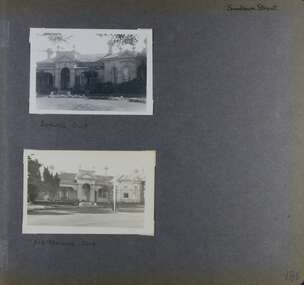
Album - Album page, Elsternwick Club, Sandham Street, Circa 1972
... frieze...cast iron columns...protruding bay...bay window...1880's...late victorian...decorative brackets...rendered...arched windows...ornamented parapet...short family...premier building association...elsternwick club...boom years...elsternwick...pediment...stanmere...bowling club...club...bowling...land subdivision...cast iron work...From Victorian Heritage Database citation for HO60 Stanmere/Elsternwick Club, 19 Sandham Street Elsternwick https://vhd.heritagecouncil.vic.gov.au/places/35422 as at (1/11/2020) "Stanmere" is locally important as the home of the Short family whose decision to sub divide its holdings was linked closely with the profiteering ventures of the directors of the Premier Building Association, leading to the construction of low cost workers housing characteristic of the land boom speculators prior to the bank crash of the early 1890's. trevor hart victorian chimneys porch cast iron lacework verandah sandham street victorian villa residence villa residence cast iron frieze cast iron columns protruding bay bay window 1880's late victorian decorative brackets rendered arched windows ornamented parapet short family premier building association elsternwick club boom years elsternwick pediment stanmere bowling club club bowling land subdivision cast iron work tessallated floors Handwritten: Sandham Street [top right] / BOWLING CLUB [under top photo] / ELSTERNWICK CLUB [under bottom photo] / 186 [bottom right] Handwritten: Page 186 of photo album with two photographs of the Elsternwick Club. ...This photograph is part of the Caulfield Historical Album 1972. This album was created as part of a project from approximately 1966-1972 by the Caulfield Historical Society to assist in identifying buildings worthy of preservation. This album is related to a Survey the Caulfield Historical Society developed in collaboration with the National Trust of Australia Victoria and Caulfield City Council to identify historic buildings within the City of Caulfield that warranted the protection of a National Trust Classification. Photographers Jenny O’Donnell and Trevor Hart, members of Caulfield Historical Society. Some photographs are older and from unknown sources. All photographs are black and white except where stated. From Victorian Heritage Database citation for HO60 Stanmere/Elsternwick Club, 19 Sandham Street Elsternwick https://vhd.heritagecouncil.vic.gov.au/places/35422 as at (1/11/2020) An imposing single storeyed stuccoed Boom period Italianate villa residence, distinguished by its bayed and pedimented projecting wing and central portico with surmounting pediment and urns. The cast iron verandahs, to two elevations, have tessellated floors and are partly built-in. From Victorian Heritage Database citation for HO60 Stanmere/Elsternwick Club, 19 Sandham Street Elsternwick https://vhd.heritagecouncil.vic.gov.au/places/35422 as at (1/11/2020) "Stanmere" is locally important as the home of the Short family whose decision to sub divide its holdings was linked closely with the profiteering ventures of the directors of the Premier Building Association, leading to the construction of low cost workers housing characteristic of the land boom speculators prior to the bank crash of the early 1890's.Handwritten: Page 186 of photo album with two photographs of the Elsternwick Club.Handwritten: Sandham Street [top right] / BOWLING CLUB [under top photo] / ELSTERNWICK CLUB [under bottom photo] / 186 [bottom right]trevor hart, victorian, chimneys, porch, cast iron lacework, verandah, sandham street, victorian villa residence, villa residence, cast iron frieze, cast iron columns, protruding bay, bay window, 1880's, late victorian, decorative brackets, rendered, arched windows, ornamented parapet, short family, premier building association, elsternwick club, boom years, elsternwick, pediment, stanmere, bowling club, club, bowling, land subdivision, cast iron work, tessallated floors -
 Glen Eira Historical Society
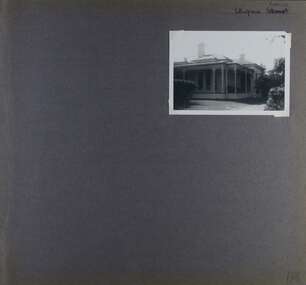
Album - Album page, Ulupna Road, Circa 1972
... frieze...cast iron columns...full length windows...villa residence...cast iron work...All photographs are black and white except where stated, with 386 photographs over 198 pages. trevor hart chimneys porch garden single storey return verandah ulupna road ormond decorative brackets cast iron frieze cast iron columns full length windows villa residence cast iron work victorian period Handwritten: Ulupna Street (crossed out) Road [ top right] / 196 [bottom right] Page 196 of Photograph Album with one photograph of a Victorian house on Ulupna Road Ulupna Road Album Album page ...This album was created in approximately 1972 as part of a project by the Caulfield Historical Society to assist in identifying buildings worthy of preservation. The album is related to a Survey the Caulfield Historical Society developed in collaboration with the National Trust of Australia (Victoria) and Caulfield City Council to identify historic buildings within the City of Caulfield that warranted the protection of a National Trust Classification. Principal photographer thought to be Trevor Hart, member of Caulfield Historical Society. Most photographs were taken between 1966-1972 with a small number of photographs being older and from unknown sources. All photographs are black and white except where stated, with 386 photographs over 198 pages. Page 196 of Photograph Album with one photograph of a Victorian house on Ulupna RoadHandwritten: Ulupna Street (crossed out) Road [ top right] / 196 [bottom right]trevor hart, chimneys, porch, garden, single storey, return verandah, ulupna road, ormond, decorative brackets, cast iron frieze, cast iron columns, full length windows, villa residence, cast iron work, victorian period -
 Villa Alba Museum
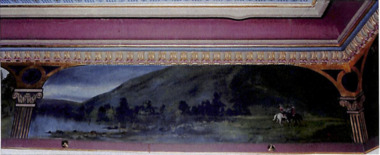
Painting - The 'Rob Roy' frieze in the Dining Room of Villa Alba painted by Hugh Paterson, 1883-1884
... work. The decorative schemes in the ground floor hall, the dining room, the drawing, the vestibule, the stair hall, the upper hall, bedroom 1 and the boudoir are also individually of significance as outstanding examples of Victorian decoration. The frieze...work. The decorative schemes in the ground floor hall, the dining room, the drawing, the vestibule, the stair hall, the upper hall, bedroom 1 and the boudoir are also individually of significance as outstanding examples of Victorian decoration. The frieze ...The internal decorative scheme of Villa Alba is significant as a fine example of the work of the leading Melbourne decorators, the Paterson Brothers. It is one of their first interiors to depart totally from the use of pre-prepared wallpapers of repetitive designs and it is a rare and comprehensive extant example of their domestic work. The decorative schemes in the ground floor hall, the dining room, the drawing, the vestibule, the stair hall, the upper hall, bedroom 1 and the boudoir are also individually of significance as outstanding examples of Victorian decoration. The frieze in the Dining Room of Villa Alba was painted by Hugh Paterson in 1883-1884, and depicts scenes from Walter Scott's novels 'Rob Roy' and 'The Heart of Mid-Lothian.'High quality photographic record of the Rob Roy section of the frieze with annotations by Robyn Riddett and Andrew Dixon. Photographs were taken by Trevor Mein.Panels 1 to 10 of scenes from Sir Walter Scott's novel 'Rob Roy'. Positioned below the architrave, each panel or lunette is separated by trompe-l'œil columns. The Rob Roy section of the frieze begins on the north wall, continues above the fireplace on the west wall, and concludes above the bay window on the south wall. [The panels on the east wall depict scenes from Scott's 'The Heart of Mid-Lothian.][The captions on each image were created by Robyn Riddett and Andrew Dixon using the text of each novel as a reference]villa alba museum, domestic interiors -- 1880s, hugh paterson, the paterson brothers, walter scott, rob roy -
 Villa Alba Museum
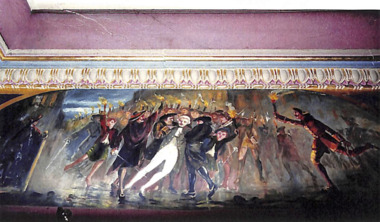
Painting - 'The Heart of Mid-Lothian' frieze panels in the Dining Room of Villa Alba by Hugh Paterson, 1883-1884
... work. The decorative schemes in the ground floor hall, the dining room, the drawing, the vestibule, the stair hall, the upper hall, bedroom 1 and the boudoir are also individually of significance as outstanding examples of Victorian decoration. The frieze...work. The decorative schemes in the ground floor hall, the dining room, the drawing, the vestibule, the stair hall, the upper hall, bedroom 1 and the boudoir are also individually of significance as outstanding examples of Victorian decoration. The frieze ...The internal decorative scheme of Villa Alba is significant as a fine example of the work of the leading Melbourne decorators, the Paterson Brothers. It is one of their first interiors to depart totally from the use of pre-prepared wallpapers of repetitive designs and it is a rare and comprehensive extant example of their domestic work. The decorative schemes in the ground floor hall, the dining room, the drawing, the vestibule, the stair hall, the upper hall, bedroom 1 and the boudoir are also individually of significance as outstanding examples of Victorian decoration. The frieze in the Dining Room of Villa Alba was painted by Hugh Paterson in 1883-1884, and depicts scenes from Walter Scott's novels 'Rob Roy' and 'The Heart of Mid-Lothian.'High quality photographic record of 'The Heart of Mid-Lothian' section of the frieze with annotations by Robyn Riddett and Andrew Dixon. Photographs were taken by Trevor Mein.Panels 11 to 17 of scenes from Sir Walter Scott's novel 'The Heart of Mid-Lothian'. Positioned below the architrave, each panel or lunette is separated by trompe-l'œil columns. The Heart of Midlothian section of the frieze is located on the east wall, continuing clockwise from above the door. [The panels on the north, west and east walls depict scenes from Scott's 'Rob Roy'.][The captions on each image were created by Robyn Riddett and Andrew Dixon using the text of each novel as a reference]villa alba museum, domestic interiors -- 1880s, hugh paterson, the paterson brothers, walter scott, the heart of mid-lothian -
 Villa Alba Museum
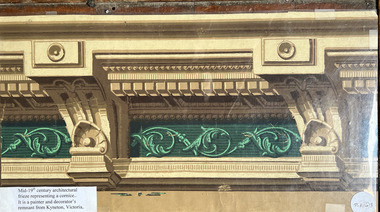
Wallpaper sample - Architectural border frieze, mid 19th century
... frieze section. The sample demonstrates the elaborate ornamental style characteristic of the High Victorian Period which utilised classical motifs like scrolls and floral patterns. This particular example was a remnant wallpaper from the work...frieze section. The sample demonstrates the elaborate ornamental style characteristic of the High Victorian Period which utilised classical motifs like scrolls and floral patterns. This particular example was a remnant wallpaper from the work ...Part of a collection of historic wallpapers collected by Phyllis Murphy, most of whose wallpapers were donated to the collection of Historic Houses Sydney. This wallpaper sample, annotated and encased in mylar was used by Phyllis for educational purposes, and donated by her son to Villa Alba Museum's collection in 2025.Mid 19th century architectural frieze wallpaper representing a cornice. The design features a classic cornice with prominent corbels (bracket-like supports) and a decorative frieze section. The sample demonstrates the elaborate ornamental style characteristic of the High Victorian Period which utilised classical motifs like scrolls and floral patterns. This particular example was a remnant wallpaper from the work of a painter and decorator in Kyneton, Victoria. P. A3 (f)heritage interiors, wallpapers, 19th century design, wallpaper borders, classical friezes -
 Federation University Art Collection
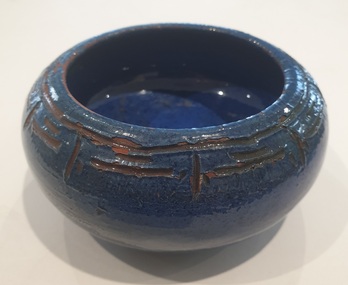
Ceramic, Gladys Reynell et al, Blue Bowl By Osrey, 1923
... work of one of Australia's earliest studio potters, have been avidly collected since the late 1960s and are in most major art galleries. Gladys Reynell Osrey Pottery Blue Bowl Incised Bowl Australian Studio pottery ceramics native clay Incised on the base "(Dam Clay) Ballarat 1923, Osrey" Small blue glazed ceramic bowl incised around the top with a decorative frieze. ...Gladys REYNELL (04/091881 - 16/11/1956) Born Glenelg, South Australia Gladys Reynell was South Australia's first studio potter and the first Australian artist to apply modernist principles to the crafts. For four years she worked from Ballarat. Osrey Pottery Ballarat operated between 1922 and 1926 by Gladys Reynell and George Osborne. The name of the pottery was an acronym formed from their surnames. Gladys Reynell, her sister Emily and brothers Rupert and Carew supported the war effort during World War One. Rupert Reynell was a neurologist who valued handicrafts in the rehabilitation of shell-shocked soldiers. He influenced Gladys and Margaret Rose (Rose) McPherson (later known as Margaret Preston) to learn pottery at the Camberwell School of Arts and Crafts, London, in 1916. Next year a friend sent Gladys some Kangaroo Island clay which excited her: 'I thought then that it could be the most delightful thing on earth to make pots in Australia from virgin clay'. In 1918 Gladys and Rose began teaching pottery to soldiers at Seale Hayne Neurological Hospital, Devon. In September 1919 Gladys Reynell came home in September due to her father's illness. She established the Reynella Pottery and became responsible for all stages of pottery production. Using a seasoned dump of buff-coloured clay from a well at nearby McLaren Vale Gladys Reynell built and fired her own kiln; threw simple, robust forms based on early European folk pottery; and decorated them with designs inspired by both Aboriginal art—one of the earliest to use this as a source. Gladys Reynell decorated her earthenware pottery with the characteristic rich 'Reynella blue' slip. On 14 August 1922 at St Mary's Church, Edwardstown, Gladys married George Samuel Osborne, an ex-serviceman and gardener at Reynella; they had no children. Between 1922 and 1926 they set up Osrey Pottery In Ballarat. Gladys produced pottery for sale at fairs with George as her assistant. She would throw her pots in the street, causing a sensation. In 1926 George contracted lead poisoning from lead in the glazes. They moved to rural Curdievale where Gladys resumed painting and making woodcuts. From 1939 Gladys and George lived in Melbourne. In World War II she worked in the army pay corps, in the Taxation Office, and as a translator of French. Gladys died of cancer on 16 November 1956; her husband scattered her ashes at Reynella. Her ceramics, the work of one of Australia's earliest studio potters, have been avidly collected since the late 1960s and are in most major art galleries. Small blue glazed ceramic bowl incised around the top with a decorative frieze. Incised on the base "(Dam Clay) Ballarat 1923, Osrey"gladys reynell, osrey pottery, blue bowl, incised bowl, australian studio pottery, ceramics, native clay -
 City of Ballarat Libraries
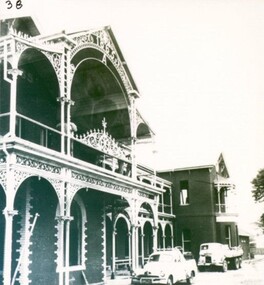
Photograph, Ballarat Orphanage, Victoria Street circa 1955
... frieze and brackets. It also shows the Polychrome brickwork. Ballarat Orphange Ballarat Victoria Street Iron work Demolition Ballarat Orphanage, Victoria Street circa 1955. ...Demolition of Orphanage iron frieze and brackets. It also shows the Polychrome brickwork.ballarat orphange, ballarat, victoria street, iron work, demolition
