
Showing 44 items matching "front suspension"
-
 Trafalgar Holden Museum
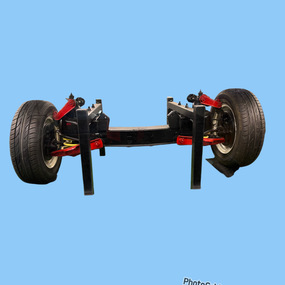
Functional object - Holden front suspension
... Holden front suspension......Front suspension...Used by Holden Holden Front suspension Shock and spring suspended on two tyres Functional object Holden front suspension ...Used by HoldenShock and spring suspended on two tyresholden, front suspension -
 Trafalgar Holden Museum
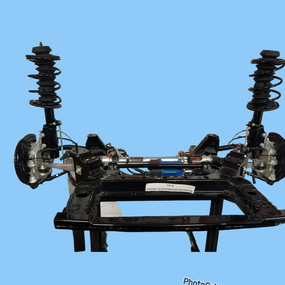
Functional object - VF Front suspension module
... VF Front suspension module...Black metal front suspension module...Used by Holden Holden VF Suspension Black metal front suspension module Functional object VF Front suspension module ...Used by HoldenBlack metal front suspension moduleholden, vf suspension -
 Phillip Island and District Historical Society Inc.
Postcard Folder, Unknown
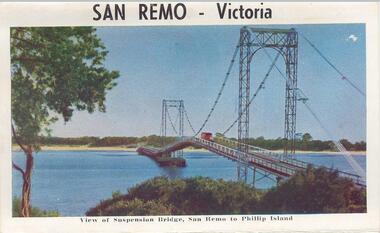
... Colour Postcard Folder of 7 Photographs of San Remo and Phillip Island. 1. Front Cover: View of Suspension Bridge, San Remo to Phillip Island. 2. ...Donated By Edith Elms san remo wildlife - koala wildlife - seals wildlife - penguins coastline jetty san remo phillip island suspension bridge san remo/phillip island edith elms As in Physical Description Colour Postcard Folder of 7 Photographs of San Remo and Phillip Island. 1. Front ...Donated By Edith ElmsColour Postcard Folder of 7 Photographs of San Remo and Phillip Island. 1. Front Cover: View of Suspension Bridge, San Remo to Phillip Island. 2. "Penguin Parade ""Always Dressed for Dinner"" 3. "Marine Parade, San Remo, Vic." 4. "The Picturesque Cost, San Remo, Vic.," 5. "A Seal on the Rocks, Phillip Island, Vic." 6. "The Wharf, San Remo, Vic." 7. "Koalas or Australian Native Bears" Above descriptions as per Inscriptions on photographs. As in Physical Descriptionsan remo, wildlife - koala, wildlife - seals, wildlife - penguins, coastline, jetty san remo, phillip island, suspension bridge san remo/phillip island, edith elms -
 Flagstaff Hill Maritime Museum and Village
Vehicle - Spring Cart, Late 19th to early 20th centuries
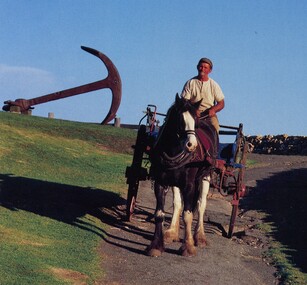
... front. Wheels have metal rims and fourteen (14) wooden spokes. A plank is bolted from side to side. A decorative metal step is on the cart's left and has acorn cut-out shapes in the plate. Both wheels have a brake block that is operated by a lever on the cart's right. The cart has eight-leaf suspension...front. Wheels have metal rims and fourteen (14) wooden spokes. A plank is bolted from side to side. A decorative metal step is on the cart's left and has acorn cut-out shapes in the plate. Both wheels have a brake block that is operated by a lever on the cart's right. The cart has eight-leaf suspension ...A spring cart is a two-wheeled, one-horse cart, often with the driver standing up to drive it, and otherwise seated on a simple seat. Carts like this one had springs to make the ride smoother. It is a lighter version of a farm dray and is sometimes called a spring dray. Spring carts were often used on farms for carrying loads. In the towns, some businesses used a spring cart for deliveries of bread, milk and other goods. The carts would be used for travel and for families going on outings and picnics. Visitors to Flagstaff Hill Maritime Village from 1986 to 1992 would enjoy watching a Clydesdale horse named Duke as he worked around the village with his driver Pat McGowan. He would be hitched to a wagon or to this lightweight spring cart or sometimes he would pull the wagon with the cart attached as a trailer. The cart was used for maintenance, carting loads of timber or stone around the site or from town to Flagstaff Hill. Sometimes Duke and the cart would take visitors for cart rides around the Village. Pat McGowan was known for his restoration of horse-drawn vehicles including this spring cart. He already had 40 years of horse handling experience when he began looking after Duke, feeding and harnessing him and driving the horse and cart around the Village. Pat’s dog ‘Yabbie’ would often join them. In August 1992 Duke had to be put down. Warrnambool Veterinary Clinic and other fund-raisers began well-supported appeals and the beloved horse was replaced by a Clydesdale also named Duke (the second), who began work in late October 1992. He, like his predecessor, had a quiet temperament and was comfortable in the traffic. The spring card is an example of vehicles used on farms, for business delivery and for domestic transport in the late-19th and early-20th century. This cart is of note for being associated with the Clydesdale horse Duke which pulled the cart around Flagstaff Hills in the 1980s and 1990s, representing transport of that period.Spring cart; two-wheeled cart with shallow box tray and plank seat bolted across the front. Wheels have metal rims and fourteen (14) wooden spokes. A plank is bolted from side to side. A decorative metal step is on the cart's left and has acorn cut-out shapes in the plate. Both wheels have a brake block that is operated by a lever on the cart's right. The cart has eight-leaf suspension from front to back. The box tray is painted blue and has decorative pale yellow detail. Each shaft pole has has a handle fitting on it. (Horse equipment with the cart is a leather covered, straw filled collar.) flagstaff hill, flagstaff hill maritime museum and village, warrnambool, maritime museum, maritime village, great ocean road, shipwreck coast, springcart, spring cart, jingle, horse-drawn cart, one horse cart, two-wheeled cart, dray, spring dray, wagon, transportation, travel, cart, duke, clydesdale, pat mcgowan, delivery cart, yabbie, cartwright, horse-drawn vehicle, transport, horse cart -
 Federation University Historical Collection
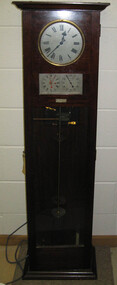
Object, Synchronome Co. Ltd, Synchronome Frequency Checking Master Clock No. 2191, c1930
... front-plate Inside case, back panel, top enamel plate: >Seconds Battery + Pos. > Battery Common or - Neg. >1/2 min dials Inside case, back panel, bottom enamel plate: external seconds dial Inside case, right hand side, electrical knobs: two switches, both "A.C. mains" Pendulum rod, below suspension spring: Serial number (?) ...front-plate Inside case, back panel, top enamel plate: >Seconds Battery + Pos. > Battery Common or - Neg. >1/2 min dials Inside case, back panel, bottom enamel plate: external seconds dial Inside case, right hand side, electrical knobs: two switches, both "A.C. mains" Pendulum rod, below suspension spring: Serial number (?) ...Information from Norman F. Dalton: Ballarat had a reticulated DC supply in the early part of last century and in 1905 had sufficient generating capacity to enable the trams to be changed from horse drawn to DC electricity. The use of electricity increased with the main power station located on Wendouree Parade, near Webster Street, under the ownership of The Electric Supply Company of Victoria. AC generating plant was installed in 1925 and conversion to AC proceeded. In 1934 the company was taken over by the State Electricity Commission Victoria (SECV) and more AC generation was installed and the changeover of customers was accelerated. This is around the time that the Synchronome Frequency Checking Mast Clock was installed at the Wendouree Parade Power Station. The SECV Annual Report of 1921 states: ::Section 11 of the act directed the COmmission to enquire into the question of securing the adoption of such standards of plant and equipment of a system, frequency and pressure for the generation and distribution of electricity as will admit of the efficient interconnection of undertakings throughout the State. In 1934 when the SECV took over the Ballarat operations the question of linking with the State grid had been a planned operation for some years but due to financial considerations had hindered it and in fact would continue to do so for a further 10 years. So while the need for close frequency control for interconnection was hardly an issue, the need to keep electric clocks correct was important, particularly as this item was a frequent sales point to cover the inconvenience and sometimes expense of converting from DC to AC. The clock is a very accurate pendulum clock with provision for varying effective length during operation for precise time regulation. There are two normal time dials and one is controlled by the pendulum and the other is operated by the system frequency. When the clock was in use it was installed by the MEter and Tests Laboratory and the time was checked daily by radio time signals. The two dials were repeated in the operators control panel in the Power Station. A maximum deviation between the two dials was set in the operating instructions (eg 5 seconds) and the operator would correct this when necessary by remote manual alteration of the turbine governor set point. The clock was used to drive and regulate a system of "slave" clocks which were used to display the time in various locations around the power station. A slave clock is a simple clock which is driven by a small electric motor, its accuracy is regulated by the master clock every 30 seconds to ensure that it and all the other slave clocks in the station are on exactly the right time; slave clocks were placed in various locations, from common rooms to workshops. A master clock could potentially run thousands of slave clocks at one plant. The clock also contains a rectifier. A rectifier is a device that is used to convert AC power to more stable DC current.Two clocks in a timber case. Both are electric, one is powered by the main pendulum mechanism, the other is a self contained electric clock. The main mechanism is of the gravity arm and roller type, which sends an impulse to the slave clocks every 30 seconds. The This Synchronome Frequency Checking Master Clock was used at the Ballarat Power Station. Below the main section of the case is a smaller cabinet containing a rectifier to provide consistent DC power for the clock. The rectifier was made by the Victorian company Hilco, which was located in Burwood. There is a high chance this is not the original rectifier from this clock as there appears to be brackets to hold a larger device in the space the rectifier occupies.Front below main clock face on front of case: "Patented Sychronome Brisbane" Lower left-hand clock face: "Frequency time" Lower right-hand clock face: "Standard Seconds" Synchronous electric clock mechanism on door (Frequency time clock): >200/250 V. 50~ >"Synchronomains" Made in England >Direction indicator for clock starting switch >"To start move lever in direction of arrow and release" >"Patent applied for" Mechanism for "standard seconds" clock: >"English Made" >"Patented" >Serial number "321" >0 above right-hand pillar on front-plate Mechanism for "standard seconds" clock: >"English Made" >"Patented" >Serial number "321" >0 above right-hand pillar on front-plate Mechanism for main clock face: >"English Made" >"Patented" >Serial number "8751" >0 above right-hand pillar on front-plate Inside case, back panel, top enamel plate: >Seconds Battery + Pos. > Battery Common or - Neg. >1/2 min dials Inside case, back panel, bottom enamel plate: external seconds dial Inside case, right hand side, electrical knobs: two switches, both "A.C. mains" Pendulum rod, below suspension spring: Serial number (?) 0000005 Rectifier in bottom cabinet: >"Hilco Rectifier" >"A.C. Volts 230/240" >"Model 1060/S" >"A.C. Amperes" >"Serial No. 1060/S >"Phases 1" >"D.C. Volts 6" >"C.P.S. 50" >"D.C. Amperes 1" >"Made in Australia by Hilco Transformers McIntyre St., Burwood, Victoria." Bakelite electrical plug: makers mark Lower cabinet, RH side panel, pressed tin plate: "AC" (upside down) Brass speed adjustment, outer right RH side: "S" and "F" Ivory and wood pendulum beat ruler: >Ruler, with 0 in centre and numbers 1-5 in ascending order from centre on left and right. > "Synchronome Patent." Steel plate, back panel, inside case, right hand side: >N R A" (descending) >"2191" serial number/part number Face of main clock: "Synchronome Electric" synchronome frequency checking master clock, electricity, state electricity commission, wendouree parade power station, secv, clock, time, pendulum, electric supply company of victoria, norman f. dalton, ballarat power station, rectifier, slave clock -
 Frankston RSL Sub Branch
Helmet, Australian M1, circa 1960's
... front " Australian Military Forces" with rising sun badge. The steel outer has an olive green elastic cover (similiar to cargo net) to hold camouflage material. The M1 is two "one-size-fits-all" helmets: an outer shell made of metal and a hard hat-type liner that is nestled inside the shell and contains the suspension system that would be adjusted to fit the wearer's head. ...front " Australian Military Forces" with rising sun badge. The steel outer has an olive green elastic cover (similiar to cargo net) to hold camouflage material. The M1 is two "one-size-fits-all" helmets: an outer shell made of metal and a hard hat-type liner that is nestled inside the shell and contains the suspension system that would be adjusted to fit the wearer's head. ...Standard issue United States M1 pattern steel helmet, olive drab in colou, stretch cotton cargo type net, with fibreglass liner. On the inside of a strap in the liner '8415-153-6671' is printed in black ink. This number would appear to be the "Federal Stock Number (FSN)" which was used 1949 to 1975 when ti was replaced by "National Stock Number (NSN)' by additional of 00 after the first 4 numbers. this would indicate that it was made in USA. The chin strap and liner are both complete and fully operable. These helmets were first issued in 1941 to the United States Armed Forces. They were adopted after the Korean War by the Australian Defence Force. In the 1990s they were replaced by the Kevlar based Personnel Armour System-Ground Troop (PASGT) type helmet. However, as evidenced by this helmet, some M1 Steel helmets were not replaced in-service by the PASGT helmet and survived into the early 21st Century. Used by Royal Australian Army in Vietnam in areas where mines were significnat, such as Long Hai's mountains (together with US flak jackets), and also by Royal Australain Navy.An example of an Australian Army issue M1 steel battle helmet complete with fibreglass liner. This helmet type was issued to Australian defence personnel during the Vietnam conflict. The inner line has a transfer on the front " Australian Military Forces" with rising sun badge. The steel outer has an olive green elastic cover (similiar to cargo net) to hold camouflage material. The M1 is two "one-size-fits-all" helmets: an outer shell made of metal and a hard hat-type liner that is nestled inside the shell and contains the suspension system that would be adjusted to fit the wearer's head. Helmet covers and netting would be applied by covering the steel shell with the extra material tucked inside the shell and secured by inserting the liner. The helmet is 7 inches in height, width is 9.5 inches and length is 11 inches. The weight of a World War II era M1 is approximately 2.85 pounds including the liner and chinstrap. (From Wikipepedia) the inner line has a transfer on the front " Australian Military Forces" with rising sun badge.steel helmet -
 Flagstaff Hill Maritime Museum and Village
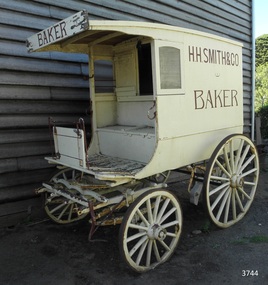
Vehicle - Wagon, H.H. Smith & Co. Baker, Circa 1930s - 1940s
... Front has a metal lamp holder, brake lever, metal hand grips and decorative metal foot plates. The wagon has suspension leaves on back and sides and double suspension leaves on the front. ...Front has a metal lamp holder, brake lever, metal hand grips and decorative metal foot plates. The wagon has suspension leaves on back and sides and double suspension leaves on the front. ...This baker’s wagon or cart transported and delivered bread and other baked goods in the Warrnambool area. It currently has advertising for H.H. Smith & Co. Henry Huntington Smith (1857-1941) owned and operated his Warrnambool bakery in the late 19th and early 20th century. However, the design of the wagon is similar to those used by local bakers in the 1930s and 1940s and probably originated from Stephenson’s Bakery in Warrnambool, which operated around that time. The wagon’s original internal shelves were removed in the early days of Flagstaff Hill so that children could have rides around the village in a horse-driven cart. BAKERS’ HISTORY There were many bakeries in Warrnambool in the 19th to mid-20th century. Each bread bakery made horse and cart deliveries in its allocated zone. SMITH’S BAKERY; – as shown on the wagon’s signage. Henry Huntington Smith (1857-1941) was born and educated in Warrnambool. He worked at Davis’ steam biscuit factory in Timor Street before he began his own bakery business in 1885 near the corner of Fairy and Koroit Streets. A few years later Smith built a new bakery on the corner of Fairy and Lava Street where it still stands today (2025) as Monaghan’s Pharmacy. The building was designed by James McLeod in 1892 as a bakehouse, shop and residence for Smith The address was known locally as Smith’s Corner. Next door to the bakery, at 136 Fairy Street, were stables built by Jobbins and McLeod in 1886 for William Cust. A photograph in the archives of the Warrnambool and District Historical Society shows the 1892 building with four fancy horse-drawn wagons on the street with white-clad drivers and a promotional stand erected with 5 bakers in uniform and the signage “H H Smith & Co, Pastry Cooks and Confectioners”. One of the wagons appears to have “H H Smith” painted on the side. H.H. Smith & Co. placed an Advertisement in the Weekly Times in December 1896 promoting its business as bakers, confectioners and pastry cooks, praising their shop as an ‘ornament to the town’ with ‘neat appointments’ and ‘dainty decorations’. It also boasted of supplying a large number of customers within a twelve-mile radius of Warrnambool. In November 1919 The Warrnambool Standard announced the marriage of Henry H Smith, Mayor of Warrnambool, to Jeannie Samson-Goodman in East Adelaide. In the same newspaper was a notice that Frank Crossley was to open as baker and pastry cook in H.H. Smith’s premises. As well as being the proprietor of the H.H. Smith Bakery, Henry Huntington Smith was a Councillor for the Warrnambool Municipality from 1913 to 1937 and Mayer for two terms. In December 1919 during his first term as Mayor, he was honoured for the work he had done with returning soldiers after World War I, receiving a document in recognition of this work, presented by the Mothers, Wives and Sisters of returned soldiers. Smith was very interested and involved in the community in many roles, including being the Vice President of the first Warrnambool and District Historical Society. STEPHENSON’S BAKERY: – believed to be the past owner of the wagon. The last owner of the bakery was Harold Stephenson. Stephenson was enlisted in the A.I.F. and was invalided home in 1943 before the end of the Second World War. He also served as a Councillor from 1958 to 1976, during which time he served six terms as Mayor for the City of Warrnambool (1966-1973) while he had the bakery. He was very involved in many local organisations including the Warrnambool Surf Life Saving Club and the Road Race Committee. He died in 1985, lauded as being one of Warrnambool’s “most distinguished civic leaders”. It has been said that the baker injured in World War II invented a special contraption to enable him to get up into the wagon and that he alerted his customers that he was in their vicinity by blowing a whistle. The customers would come out and choose their bread from the back of his wagon then pay him for it. However, another account is given by a man who once earned pocket money by helping the baker on his rounds. He says that it was Stephenson, the owner and manager of the bakery, and not the delivery baker who received a significant injury during the war, making him unable to climb the stairs of his upstairs accommodation at the bakery, therefore causing him to sleep downstairs. At this time in the early to late 1940 Stephenson’s bakery had three wagons, one for each of the delivery rounds. The wagons were painted black and yellow. Two of the drivers were Stan Lake and Ali (Alec) Dean who both had wagons with the covered cabin design. The third driver was Bill Lake who had a flat wagon. Stan Lake delivered in the area around Lava and Koroit Streets, Ali Dean had another round and Bill Lake had the Dennington area. Bread continued to be delivered into the 1960s but by this time the delivery vehicles were motorised. The goods produced at Stephenson’s bakery included bread baked in different shaped tins such as High Tin, Sandwich and Vienna. Some shapes were easily divided into half by breaking them apart, therefore the baker could make two-quarter loaves from a half loaf, satisfying different needs. There was the option of white or brown bread, sweet buns, fruit buns and Boston buns. The baker’s assistant was known to take great delight in ‘trimming’ the broken halves of excess bread and crust, enjoying his treat. THE BAKERY PREMISES: – Southeast corner of Fairy and Lava Streets, Warrnambool. The building retains the original cast iron veranda. Above the veranda, a motif of a wheat sheaf in ornamental plaster can be seen. Inside the building, there are still some of the original fittings. The building was classified by the National Trust in August 1979. After the Second World War, an official system of zoning was introduced as a fair way for the baking industry to operate. In 1949 different pricing was introduced by the Government for either delivered or retail purchased bread. Many of the small local bakeries went out of business after the Government banned zoning. The way was made open for the larger bread manufacturers to enter the local market with cheaper prices. Some of those companies were Mc Queens, Tip Top, Twisties, and Sunicrust, (Mc Queens ‘new’ bakery building was where the current Toyworld shop now stands, is, in the Ozone carpark.) O’Grady’s Bakery, later changing hands and known as Burkes Bakery, was on Fairy Street near the Timor Street intersection, on the North West side. There was also a bakery named Almay. The baker’s wagon is significant because of its association with H.H. Smith’s Bakery in Warrnambool.. The H.H. Smith’s Bakery building on the corner of Fairy and Lava Streets, built in 1892, is classified by the National Trust, August 1979. Smith Street Warrnambool was named after Henry Huntington Smith, who was a Warrnambool Councillor 1913 – 1937 and Mayor 1919 – 1921. Baker’s wagon, often referred to as a baker’s cart. Four wheeled horse-drawn delivery wagon, front wheels smaller than rear wheels. Wagon is clad with metal sheets and lined with varnished timber panels. Wheels have metal rims, wooden spokes and rear wheels have wooden brake pads. Horse shaft is timber with metal fittings. Front has a metal lamp holder, brake lever, metal hand grips and decorative metal foot plates. The wagon has suspension leaves on back and sides and double suspension leaves on the front. Driver’s area at front has a roof, glass side windows and wooden box seat with hinged compartment accessing wagon storage area. Door above back of seat has buckled leather handgrip strap attached, door slides open for access to wagon area. Back of wagon has a wooden step and a split door; top door has ventilation louvers, both doors have metal latches. Wagon is painted cream with brown trim and signage and green step. Remnants of red and green paint are visible; underside of seat panel is painted grey. Wagon advertises H.H. Smith & Co. Baker, a Warrnambool business established in 1885, but is of a more modern design seen around 1930’s and 1940’s and most likely belonging to Stephenson's bakery. Brown signwriting on sides of wagon “H.R. SMITH & CO. / BAKER” Brown signwriting across front of wagon “BAKER” warrnambool, shipwrecked-coast, flagstaff-hill, flagstaff-hill-maritime-museum, maritime-museum, shipwreck-coast, flagstaff-hill-maritime-village, shipwrecked-artefact, great ocean road, baker’s wagon, h.h. smith baker, warrnambool, henry h smith, jeannie samson-goodman, frank crossley, mayor of city of warrnambool, vice president of warrnambool and district historical society, stephenson’s bakery warrnambool, harold stephenson, warrnambool surf life saving club, road race committee, national trust building, stan lake, bill lake, ali dean, 19th and 20th century bakers, davies steam biscuit factory warrnambool, james mcleod building designer, jobbins and mcleod, william cust, h h smith & co, pastry cooks and confectioners, bakery trade, bread delivery wagon -
 Flagstaff Hill Maritime Museum and Village
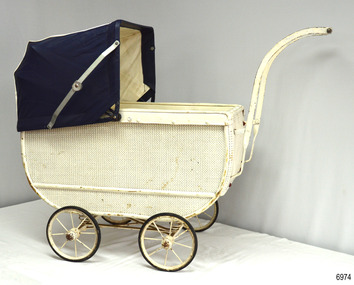
Leisure object - Doll's pram, late-1930s to early-1940s
... The Hood is hinged to flip from the back to the front of the pram and is designed to can fold. The undercarriage has suspension springs. ...The Hood is hinged to flip from the back to the front of the pram and is designed to can fold. The undercarriage has suspension springs. ...This doll's pram was owned by the daughter of Dr William Roy Angus and his wife Gladys when the family came to Warrnambool in the late 1930s. It is part of the W.R. Angus collection, donated by the family of Dr W R Angus, surgeon and oculist. The W R Angus Collection spans the years 1885 to the mid-1900s and includes historical medical and surgical equipment and instruments from the doctors Edward and Thomas Ryan of Nhill, Victoria. Dr Angus married Gladys in 1927 at Ballarat, the nearest big city to Nhill where he began as a Medical Assistant. He was also Acting House surgeon at the Nhill hospital where their two daughters were born. Dr Angus and his family moved to Warrnambool in 1939, where Dr Angus operated his own medical practice. He later added the responsibility of part-time Port Medical Officer and was the last person appointed to that position. Both Dr Angus and his wife were very involved in the local community, including the planning stages of the new Flagstaff Hill and the layout of the gardens there. Dr Angus passed away in March 1970.This doll's pram is connected to the history of Warrnambool, as it was owned by the daughter of Dr W. R. Angus and his wife Gladys, and is part of the W.R. Angus Collection, which is important for still being located at the site connected to Doctor Angus, Warrnambool’s last Port Medical Officer. Dr Angus and his wife brought their young family to Warrnambool in 1939 and he remained a resident until his death in 1970. Early in his profession in the town of Nhill, Dr Angus assisted Dr Tom Ryan in his pioneering use of X-rays and in ocular surgery, and Dr Angus later inherited these items. The W.R. Angus Collection includes these medical instruments and other related equipment and is culturally and historically significant as an example of the medical practice of the late 19th to the mid-20th century. Other items in the collection relate to Dr Angus’ service in the Flying Doctor Service and the Army.Pram has a folding blue vinyl hood and a rectangular, white wicker base with curved corners at the bottom. The base and hood are lined with white vinyl. The wheels have eight spokes and black rubber tyres. The curved handle has a metal bard the width of the pram, which is covered in a white rubber tube. The handle sides are joined to two curved flat bars that extend in an outwards curve away from the pram. The Hood is hinged to flip from the back to the front of the pram and is designed to can fold. The undercarriage has suspension springs. The pram is part of the W.R. Angus Collection.flagstaff hill, warrnambool, maritime village, maritime museum, shipwreck coast, great ocean road, dr w r angus, dr roy angus, dr ryan, warrnambool oculist, port medical officer, nhill base hospital, mira hospital nhill, doll's pram', toy pram, child's pram, toy, w.r. angus collection -
Glenelg Shire Council Cultural Collection
Postcard - Postcard - Suspension bridge Casterton, 1900-1930
... SOURCED FROM CASTERTON TOWN HALL (FORMER SHIRE OF GLENELG) Sourced from Casterton Town Hall (Former Shire of Glenelg) Front: 'SUSPN BRIDGE CASTERTON' Back: Handwritten correspondence, addressed to 'Miss M. Sythaleigh, Henty St Casterton' Postcard, black and white,, showing the suspension bridge at Casterton, view across river towards township Postcard Postcard - Suspension bridge Casterton ...SOURCED FROM CASTERTON TOWN HALL (FORMER SHIRE OF GLENELG) Sourced from Casterton Town Hall (Former Shire of Glenelg)Postcard, black and white,, showing the suspension bridge at Casterton, view across river towards townshipFront: 'SUSPN BRIDGE CASTERTON' Back: Handwritten correspondence, addressed to 'Miss M. Sythaleigh, Henty St Casterton' -
Glenelg Shire Council Cultural Collection
Photograph - Photograph - construction site, 1964
... Front: (no inscriptions) Back: P.H.T./ Print No. ... Neg. No 134/ Date taken 28-10-64/ SUBJECT./ ... (Ink stamp with blue pen and pencil additions, centre) Black and white photograph close-up of metal framing with support/suspension wires. ...Port of Portland Authority archivesFront: (no inscriptions) Back: P.H.T./ Print No. ... Neg. No 134/ Date taken 28-10-64/ SUBJECT./ ... (Ink stamp with blue pen and pencil additions, centre)port of portland archives, construction -
 Phillip Island and District Historical Society Inc.
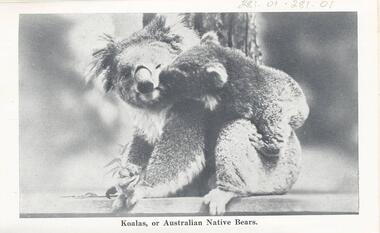
Photograph Folder, The Rose Stereographs, Early 20th Century
... front of the folder: Cowes, Phillip Island. Greetings from Cowes, P.I. Inside and description of Phillip Island as shown on Photograph 281-12. 281.01. Koalas, or Australian Native Bears. 281-02. "Come on, Hurry, Baby's waiting." 281-03. View of Suspension...Souvenir history of Phillip Island. wildlife - koala wildlife - seals wildlife - penguins the nobbies the pinnacles forrest caves pyramid rock cowes foreshore - cowes pier - phillip island cowes beach phillip island phillip island suspension bridge phillip island race track stan harris On the front of the folder: Cowes, Phillip Island. ...Souvenir history of Phillip Island.A collection of black & white photographs in a souvenir folder. Photographs include: Koalas, Penguins, Seals, The Suspension Bridge, Cowes Pier, Cowes Beach, The Race Track, The Nobbies, Pyramid Rock, The Pinnacles and Forrest Cave. On the front of the folder: Cowes, Phillip Island. Greetings from Cowes, P.I. Inside and description of Phillip Island as shown on Photograph 281-12. 281.01. Koalas, or Australian Native Bears. 281-02. "Come on, Hurry, Baby's waiting." 281-03. View of Suspension Bridge, looking from San Remo to Phillip Island. 281-04. View from the Pier, Cowes. 281-05. On the Seal Rocks, Phillip Island, Vic. 281-06. Western Beach, Cowes, Phillip Island. 281-07. The straight, Racing Circuit, Cowes, Phillip Island. 281-08. the Nobbies, Phillip Island. 281-09. The Pyramide, Back Beach, Phillip Island. 281-10. The Pinnacles, Cape Woolamai, Phillip Island. 281-11. Forest Cave, Phillip Island, Vic. wildlife - koala, wildlife - seals, wildlife - penguins, the nobbies, the pinnacles, forrest caves, pyramid rock, cowes foreshore - cowes pier - phillip island, cowes beach phillip island, phillip island suspension bridge, phillip island race track, stan harris -
 Phillip Island and District Historical Society Inc.
Photographs, Kodak, c 1948
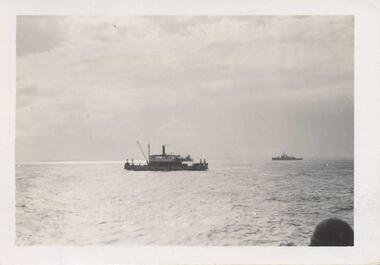
... front gate. 327-04 - Black & White photograph of the Cowes Vehicular Ferry arriving/departing from the Cowes Pier. 327-05 - Black & White photograph of the Proprietor of the Hollydene Guest House with Janet ? 327-06 - Black & White photograph of The Nobbies, Phillip Island. 327-07 - Black & White photograph of The Nobbies with Seal Rocks in the distance. 327-08 - Black & White photograph of The Nobbies with Janet ? in the foreground. 327-09 - Black & White photograph of Churchill Island from Phillip Island. 327-10 - Black & White photograph of the Phillip Island Suspension...Taken whilst her parents were courting and had a trip to Phillip Island. the nobbies cowes pier phillip island westernport cowes car ferry hollydene guesthouse cowes phillip island churchill island phillip island suspension bridge bert west 327-01 - Black & White photograph of Westernport with Cowes Ferry and other ships in the background. 327-02 - Black & White photograph of Cowes Pier looking towards Cowes. 327-03 - Black & White photograph of the Hollydene Guest House with people standing at the front gate. 327-04 - Black & White photograph of the Cowes Vehicular Ferry arriving/departing from the Cowes Pier. 327-05 - Black & White photograph of the Proprietor of the Hollydene Guest House with Janet ? ...A collection of photographs donated by Rhonda McInnes (nee Closs) from her father, Don Closs 's collection. Taken whilst her parents were courting and had a trip to Phillip Island.327-01 - Black & White photograph of Westernport with Cowes Ferry and other ships in the background. 327-02 - Black & White photograph of Cowes Pier looking towards Cowes. 327-03 - Black & White photograph of the Hollydene Guest House with people standing at the front gate. 327-04 - Black & White photograph of the Cowes Vehicular Ferry arriving/departing from the Cowes Pier. 327-05 - Black & White photograph of the Proprietor of the Hollydene Guest House with Janet ? 327-06 - Black & White photograph of The Nobbies, Phillip Island. 327-07 - Black & White photograph of The Nobbies with Seal Rocks in the distance. 327-08 - Black & White photograph of The Nobbies with Janet ? in the foreground. 327-09 - Black & White photograph of Churchill Island from Phillip Island. 327-10 - Black & White photograph of the Phillip Island Suspension Bridge taken from San Remo. 327-11 - Black & White photograph of Bert West and his bus with two passengers getting onto the bus. the nobbies, cowes pier phillip island, westernport, cowes car ferry, hollydene guesthouse cowes phillip island, churchill island, phillip island suspension bridge, bert west -
 Phillip Island and District Historical Society Inc.
Photograph Folder, 1957
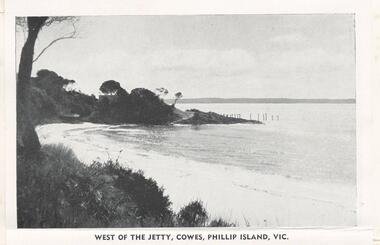
... Souvenir postcard folder from 1950's phillip island the nobbies wildlife - koala wildlife - penguins wildlife - mutton birds wildlife - shearwaters the pinnacles cape woolamai the blowhole phillip island pyramid rock suspension bridge phillip island m arnall Front of folder: Cowes Phillip island - 18 Selected Glimpses. ...Folder donated by M Arnell. Souvenir postcard folder from 1950'sColoured Folder with 18 Black & White photographs of Cowes and Phillip Island. Includes: Cowes Beach area, San Remo Suspension Bridge, Berry's Beach, Lover's Walk, The Pinnacles, Seal Rocks, The Blowhole, Penguin Parade, Nobbies, San Remo Jetty, Cascades at The Nobbies, Seals, Seal Rocks & The Nobbies, Pyramid Rock, Mutton Bird, Summerland Surf Beach, Koala and East of Erehwon Point Cowes.Front of folder: Cowes Phillip island - 18 Selected Glimpses.phillip island, the nobbies, wildlife - koala, wildlife - penguins, wildlife - mutton birds, wildlife - shearwaters, the pinnacles cape woolamai, the blowhole phillip island, pyramid rock, suspension bridge phillip island, m arnall -
 Phillip Island and District Historical Society Inc.
Photograph Folder, approx 1940's - 1950's
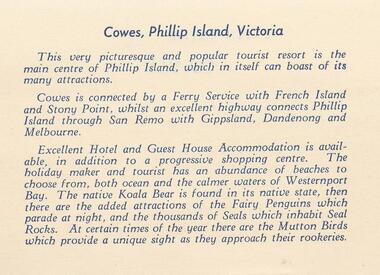
... Front cover: A Souvenir of Picturesque Cowes. A Special selection of Scene in Full Colour. Souvenir Colour Folder of 12 colour postcards of Cowes and Phillip Island. Photographs Include: Cowes Beach, Cowes Pier, Koalas, Cowes Township, The Nobbies, Summerland Surf Beach, Suspension Bridge, Thompson Avenue, Cowes, Penguin Parade, Seal Rocks, The Isle of Wight Hotel and The Blowhole. ...Coloured Souvenir folder of 12 postcards donated by M Arnell.Souvenir Colour Folder of 12 colour postcards of Cowes and Phillip Island. Photographs Include: Cowes Beach, Cowes Pier, Koalas, Cowes Township, The Nobbies, Summerland Surf Beach, Suspension Bridge, Thompson Avenue, Cowes, Penguin Parade, Seal Rocks, The Isle of Wight Hotel and The Blowhole.Front cover: A Souvenir of Picturesque Cowes. A Special selection of Scene in Full Colour.phillip island, cowes phillip isand, the isle of wight hotel cowes phillip island, the blowhole phillip island, penguins, koalas, seals, m arnell -
 Phillip Island and District Historical Society Inc.
Photograph Folder, 1940's - 1950's approx
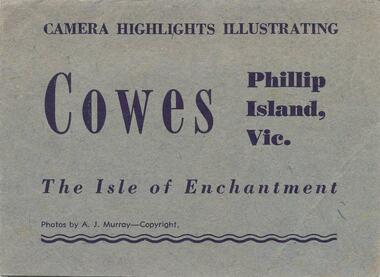
... suspension bridge phillip island seal rocks phillip island stan harris Each photograph similar to Physical Description. On back: Postage Rates within the British Empire. Without correspondence, in an unsealed envelope, will be 1.1/2d. If correspondence is added, postage will be 2.1/2d. whether envelope is sealed or unsealed. Foreign rate, 3.1/2d. Front ...8 photographs in a fold-out pack entitled: "Camera Highlights Illsutrating Coes, Phillip Island, Vic. The Isle of Enchentment" Black & White Souvenir Folder of 8 photographs taken around Phillip Island. 1. Summerland Surf Beach 2. Koala in a tree 3. Breakers at The Nobbies 4. The Jetty at Cowes with many people and the Cowes Jetty Shed on left of photo. 5. Seals on Seal Rocks 6. The Newhaven - San Remo Suspension Bridge 7. Penguins coming in after a day's fishing at Summerland Beach 8. The Nobbies and Seal Rocks.Each photograph similar to Physical Description. On back: Postage Rates within the British Empire. Without correspondence, in an unsealed envelope, will be 1.1/2d. If correspondence is added, postage will be 2.1/2d. whether envelope is sealed or unsealed. Foreign rate, 3.1/2d. Front Cover: Camera Highlights Illustrating Cowes Phillip Island, Vic. The Isle of Enchantment. Photos by A. J. Murray.summerland surf beach phillip island, wildlife - koala, wildlife - seals, wildlife - penguins, the nobbies phillip island, cowes jetty phillip island, cowes pier phillip island, suspension bridge phillip island, seal rocks phillip island, stan harris -
 Phillip Island and District Historical Society Inc.
Photographs, 1940
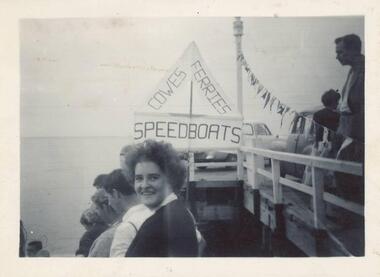
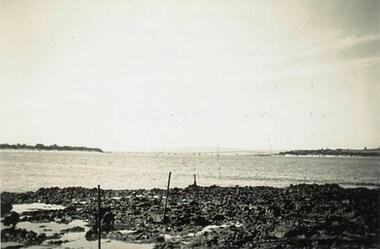
... Suspension Bridge viewed from Newhaven at very low tide. Photograph 215-20. A couple enjoying a picnic in a bush setting. Photograph 215-21. Three people sitting on the stone fence in front...Suspension Bridge viewed from Newhaven at very low tide. Photograph 215-20. A couple enjoying a picnic in a bush setting. Photograph 215-21. Three people sitting on the stone fence in front ...Four of a collection of 33 photographs donated by Leonie Brennan. The collection belonged to Edward (Ted) Sands, hairdresser.Photograph 215-18. People on the Cowes Pier enjoying an event. A sign reads "Cowes - Ferries - Speedboats" and a string of bunting decorates the pier. There are also cars on the pier. Photograph 215-19. Phillip Island - San Remo Suspension Bridge viewed from Newhaven at very low tide. Photograph 215-20. A couple enjoying a picnic in a bush setting. Photograph 215-21. Three people sitting on the stone fence in front of the Isle of Wight Hotel. A large sign shows "ENTRANCE RESIDENTIAL & BAR - MELBOURNE BITTER"isle of wight hotel, isle of wight hotel phillip island, phillip island - suspension bridge, suspension bridge phillip island, cowes pier phillip island, mr edward (ted) sands, leonie brennan -
 Phillip Island and District Historical Society Inc.
Photographs, 1948
... Suspension Bridge taken from Quarry area with Bass Hills in the background. 221-02 Copy of a Postcard of the Phillip Island Granite Quarry at Cape Woolamai. Rocks in the foreground and jetty with crane on the right. An F & J Postcard. 221-03 Photograph of W Kennon's Jetty at Cape Woolamai with large rocks on the beach in the foreground. 221-04 Photograph of Mr C Richardson standing in front of a beacon at Cape Woolamai....Suspension Bridge taken from Quarry area with Bass Hills in the background. 221-02 Copy of a Postcard of the Phillip Island Granite Quarry at Cape Woolamai. Rocks in the foreground and jetty with crane on the right. An F & J Postcard. 221-03 Photograph of W Kennon's Jetty at Cape Woolamai with large rocks on the beach in the foreground. 221-04 Photograph of Mr C Richardson standing in front of a beacon at Cape Woolamai. ...Four photographs donated by Jim Osterlund221-01 Photograph of Suspension Bridge taken from Quarry area with Bass Hills in the background. 221-02 Copy of a Postcard of the Phillip Island Granite Quarry at Cape Woolamai. Rocks in the foreground and jetty with crane on the right. An F & J Postcard. 221-03 Photograph of W Kennon's Jetty at Cape Woolamai with large rocks on the beach in the foreground. 221-04 Photograph of Mr C Richardson standing in front of a beacon at Cape Woolamai.granite quarry cape woolamai, phillip island suspension bridge, w kennon jetty cape woolamai, c richardson, cape woolamai beacon, jim osterlund -
 Orbost & District Historical Society
black and white photograph, first half 20th century
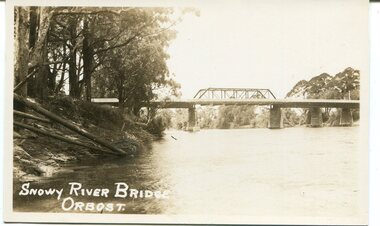
... suspension bridge. Its building was a combined effort of the Victorian Railways and the Country Roads Board at a cost of 35,000 pounds. It was replaced in 1976 by the present bridge after several major floods. This bridge was replaced in 1976 after several major floods. Orbost Snowy-River-bridge transport-bridge on front ...This is a photograph of the second Snowy River Bridge at Orbost. The section in the central span could have been built after flood damage. This bridge over the Snowy River was opened on July 4 1922. It was constructed in 1922 alongside the previous suspension bridge. Its building was a combined effort of the Victorian Railways and the Country Roads Board at a cost of 35,000 pounds. It was replaced in 1976 by the present bridge after several major floods.This bridge was replaced in 1976 after several major floods.A black / white photograph / postcard of a bridge over a river. It has what looks like a bo girder in the central section. On the left is the river bank.on front bottom left - "SNOWY RIVER BRIDGE"orbost snowy-river-bridge transport-bridge -
 Bendigo Military Museum
Photograph - Johnson Ground Elevation Meter (JGEM) Survey Vehicle - Army Survey Regiment, Fortuna, Bendigo, c1960s
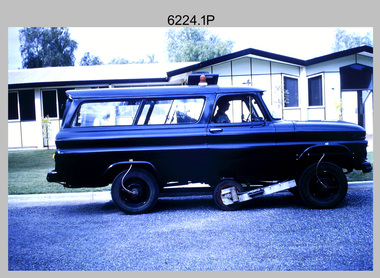
... front axle and connected them to form the four-wheel steering mechanism. The two Australian GEM vehicles, referred to as Johnson GEMs (JGEMs) were converted into right-hand drive. After delivery in 1964, acceptance Natmap and RA Svy testing and operator training was undertaken at the Army's School of Military Survey located at Balcombe, Victoria. A small fifth wheel was mounted on a cantilever arm suspension...front axle and connected them to form the four-wheel steering mechanism. The two Australian GEM vehicles, referred to as Johnson GEMs (JGEMs) were converted into right-hand drive. After delivery in 1964, acceptance Natmap and RA Svy testing and operator training was undertaken at the Army's School of Military Survey located at Balcombe, Victoria. A small fifth wheel was mounted on a cantilever arm suspension ...This is a set of 16 photograph of the Royal Australian Survey Corps’ Johnson Ground Elevation Meter (JGEM) Survey Vehicle taken at the Army Survey Regiment, Fortuna, Bendigo. The JGEM vehicle was extensively used by RA Svy within Australia from the late 1960s. A limited number of Ground Elevation Meter (GEM) station wagon type vehicles were manufactured by General Motors Corporation (GMC) in the USA for the United States Geological Survey, Canada’s mapping agencies, RA Svy and National Mapping (Natmap). The GEM was a four-wheel drive, four-wheel steer vehicle. Four-wheel steering was necessary to avoid systematic errors caused by non-tracking of front and rear wheels on conventionally steered vehicles. The manufacturer substituted the rear axle with a front axle and connected them to form the four-wheel steering mechanism. The two Australian GEM vehicles, referred to as Johnson GEMs (JGEMs) were converted into right-hand drive. After delivery in 1964, acceptance Natmap and RA Svy testing and operator training was undertaken at the Army's School of Military Survey located at Balcombe, Victoria. A small fifth wheel was mounted on a cantilever arm suspension midway between the front and rear wheels on the right side of the vehicle. It was lowered to and raised from its operating position by use of a constant pressure air cylinder. A telescopic bar, suspended between the front and rear axles, provided the reference datum for the angle measurement. The wheel provided the velocity or distance signal through a pulse generator system. A sensitive pendulum mounted on this bar provided the angle measurement for each minute distance traversed. The JGEM contained electromechanical instruments used to determine relative elevations, by trigonometric principles, along a traversed path. These relative elevations were obtained through apparatus which measures the instantaneous angle of inclination of the road and the instantaneous velocity of the meter along such a path. Road routes over which the JGEM operated were planned so that each started and ended as near as practicable to an existing point of known elevation (formally referred to as a level traverse bench mark). The difference in height from the bench mark and the road surface alongside the JGEM’s fifth wheel was measured with a level and staff. Along each route, mapping control photo reference points where new elevation values were required were identified on aerial photographs. Under favourable conditions it was possible to survey as much as 160km in an ordinary working day. The first of RA Svy’s JGEM operations was undertaken in 1:250,000 scale map areas of Queensland. CPL John Hook was the JGEM’s main operator in the early 1970s undertaking operations covering 1:250,000 scale map blocks over northern Victoria and central NSW, each requiring 36 points (9 runs of photography and 4 points across. SPR Lyn Thompson and SPR Bob McDonagh teamed with CPL Hook on some of these JGEM operations. When RA Svy was integrated into the Royal Australian Engineers in 1996, the JGEM vehicle with the Survey Corps collection was donated to its museum. It is believed to be the last of the original manufactured fleet in existence. The JGEM has undergone extensive refurbishment to achieve roadworthiness and is currently housed at The Australian Army Museum of Military Engineering, Hoslworthy Barracks, NSW. It can be viewed by making an appointment with the museum’s curator.This is a set of 16 photograph of the Royal Australian Survey Corps’ Johnson Ground Elevation Meter (JGEM) Survey Vehicle taken at the Army Survey Regiment, Fortuna, Bendigo. The photographs were on 35mm slide film and were scanned at 96 dpi. They are part of the Army Survey Regiment’s Collection. .1) - Photo, colour, c1960s, Johnson Ground Elevation Meter (JGEM) Survey Vehicle .2) - Photo, colour, c1960s, JGEM instrumentation, on-board computer. .3) - Photo, colour, c1960s, JGEM instrumentation. .4) - Photo, colour, c1960s, JGEM instrumentation, on-board computer. .5) - Photo, colour, c1960s, JGEM tyre pressure controller .6) - Photo, colour, c1960s, JGEM rear doors, SGT Geoff Briggs. .7) - Photo, colour, c1960s, JGEM 5th wheel distance/angle measurement device in lowered position, SGT Geoff Briggs. .8) - Photo, colour, c1960s, JGEM 5th wheel distance/angle measurement device in lowered position. .9) & .10) - Photo, colour, c1960s, JGEM tyre pressure system, SGT Geoff Briggs. .11) - Photo, colour, c1960s, JGEM tyre pressure system. SGT Geoff Briggs. .12) - Photo, colour, c1960s, JGEM levelling scope, levelling staff, unidentified technicians. .13) & .14) - Photo, colour, c1960s, JGEM levelling scope, unidentified technician. .15) & .16) - Photo, colour, c1960s, probably survey operation adjusted height plotted on block base sheet. .1P to .16P - Some of the equipment is annotated on the frame of the 35mm slides.royal australian survey corps, rasvy, army survey regiment, army svy regt, fortuna, asr, surveying -
 Warrnambool and District Historical Society Inc.
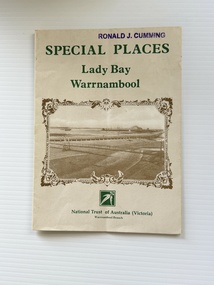
Pamphlet - Special Places Lady Bay Warrnambool, Philprint Warrnambool, 1989
... The front cover has green printing with the National Trust symbol of three eucalyptus leaves in green. There is a brown sepia photograph showing a view across Lady Bay with the suspension bridge across the Merri River in the foreground, Viaduct Road in the middle ground and the breakwater in the background. ...The front cover has green printing with the National Trust symbol of three eucalyptus leaves in green. There is a brown sepia photograph showing a view across Lady Bay with the suspension bridge across the Merri River in the foreground, Viaduct Road in the middle ground and the breakwater in the background. ...This pamphlet was produced for the Warrnambool Branch of the National Trust of Australia (Victoria) for Heritage Week, April 16-23, 1989 and contains information written by Warrnambool residents about their locality. This was a co-operative venture by people with a common interest in protecting the natural environment near their home. Areas covered in the written information include: Formation of the Coast, Archaeological survey, Gunditjmara History, vegetation, history and recreational uses of the Lady Bay area. The map shows special places of interest including past and present navigational aids, sites of shipwrecks and other historical places of interest. The Warrnambool Branch of the National Trust was originally formed in March 1969 and merged with the Port Fairy Branch in late 1970. In October 1979, the Warrnambool Branch was reformed and operated into the late 1990's. This is an example of a publication produced by the Warrnambool Branch of the National Trust Australia (Victoria). It provides historical information and perspectives of the recreational uses in and around Lady Bay Warrnambool.An A2 piece of buff coloured thick paper folded into eight to make an A5 pamphlet. The front cover has green printing with the National Trust symbol of three eucalyptus leaves in green. There is a brown sepia photograph showing a view across Lady Bay with the suspension bridge across the Merri River in the foreground, Viaduct Road in the middle ground and the breakwater in the background. There is a purple inked stamp on the top right hand corner. The rear cover has brown writing and includes logos of bodies who assisted with the publication. There is a brown line drawing of the viaduct and pier at the Warrnambool Breakwater. The inside of the unfolded pamphlet contains a map of Lady Bay and adjacent area showing places of interest and shipwrecks marked in red circlesFront cover: Special Places Lady Bay Warrnambool National Trust of Australia (Victoria) Warrnambool Branch Ronald J. Cummingwarrnambool, lady bay warrnambool, national trust australia victoria warrnambool branch, heritage week 1989, lady bay shipwrecks -
 Eltham District Historical Society Inc
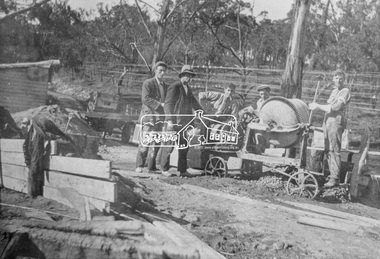
Photograph, Construction of the new concrete bridge over the Diamond Creek on Main Road, Eltham, c.May 1926
... front of Eltham Park (Eltham Lower Park). Also visible is a tree situated beside the roadway. It is believed this is the same tree that remains today as a dead tree trunk immediately adjacent to the road verge armco near the corner of Antoinette Boulevard. The original long suspension...front of Eltham Park (Eltham Lower Park). Also visible is a tree situated beside the roadway. It is believed this is the same tree that remains today as a dead tree trunk immediately adjacent to the road verge armco near the corner of Antoinette Boulevard. The original long suspension ...Construction of the new concrete bridge over the Diamond Creek on Main Road, Eltham, c.May 1926. Viewed from northern approach looking east, the access drive running off Antoinette Boulevard parallel to Main Road is visible as well as the power lines that used to run in front of Eltham Park (Eltham Lower Park). Also visible is a tree situated beside the roadway. It is believed this is the same tree that remains today as a dead tree trunk immediately adjacent to the road verge armco near the corner of Antoinette Boulevard. The original long suspension bridge over the Diamond Creek on Main Road at Eltham collapsed during flooding of the Diamond Creek on October 13 and 14, 1923. The original bridge was built around 1840 for the coach road when Cobb & Co.'s coach was the only conveyance between Eltham and Melbourne. Widespread damage was done in Melbourne and surrounding areas by floods resulting from the overflow of the Yarra at many points along its banks. A temporary bridge rigged up was severely damaged by the flooding of the creek and was closed to vehicular traffic in April 1924. A new concrete bridge was constructed to replace it and by May 1926 all the concrete piles and abutments had been completed. The bridge was finally completed and opened for traffic in September 1926, almost three years after it initially collapsed.This photo forms part of a collection of photographs gathered by the Shire of Eltham for their centenary project book,"Pioneers and Painters: 100 years of the Shire of Eltham" by Alan Marshall (1971). The collection of over 500 images is held in partnership between Eltham District Historical Society and Yarra Plenty Regional Library (Eltham Library) and is now formally known as the 'The Shire of Eltham Pioneers Photograph Collection.' It is significant in being the first community sourced collection representing the places and people of the Shire's first one hundred years.Photo print 9 x 12.5 cmshire of eltham pioneers photograph collection, eltham, bridge, diamond creek (creek), eltham south, main road bridge, wingrove park, antoinette boulevard, significant tree, cement mixer, bridge construction -
 Eltham District Historical Society Inc
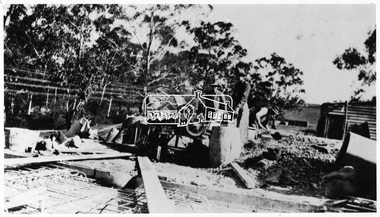
Negative - Photograph, Construction of the new concrete bridge over the Diamond Creek on Main Road, Eltham, c.May 1926
... Viewed from northern approach looking south east towards Eltham Park (Eltham Lower Park), showing the power lines that used to run in front of the park. The original long suspension bridge over the Diamond Creek on Main Road at Eltham collapsed during flooding of the Diamond Creek on October 13 and 14, 1923. ...Viewed from northern approach looking south east towards Eltham Park (Eltham Lower Park), showing the power lines that used to run in front of the park. The original long suspension bridge over the Diamond Creek on Main Road at Eltham collapsed during flooding of the Diamond Creek on October 13 and 14, 1923. ...Construction of the new concrete bridge over the Diamond Creek on Main Road, Eltham, c.May 1926. Viewed from northern approach looking south east towards Eltham Park (Eltham Lower Park), showing the power lines that used to run in front of the park. The original long suspension bridge over the Diamond Creek on Main Road at Eltham collapsed during flooding of the Diamond Creek on October 13 and 14, 1923. The original bridge was built around 1840 for the coach road when Cobb & Co.'s coach was the only conveyance between Eltham and Melbourne. Widespread damage was done in Melbourne and surrounding areas by floods resulting from the overflow of the Yarra at many points along its banks. A temporary bridge rigged up was severely damaged by the flooding of the creek and was closed to vehicular traffic in April 1924. A new concrete bridge was constructed to replace it and by May 1926 all the concrete piles and abutments had been completed. The bridge was finally completed and opened for traffic in September 1926, almost three years after it initially collapsed.This photo forms part of a collection of photographs gathered by the Shire of Eltham for their centenary project book,"Pioneers and Painters: 100 years of the Shire of Eltham" by Alan Marshall (1971). The collection of over 500 images is held in partnership between Eltham District Historical Society and Yarra Plenty Regional Library (Eltham Library) and is now formally known as the 'The Shire of Eltham Pioneers Photograph Collection.' It is significant in being the first community sourced collection representing the places and people of the Shire's first one hundred years.Digital image 4 x 5 inch B&W Negshire of eltham pioneers photograph collection, bridge, bridge construction, cement mixer, diamond creek (creek), eltham, eltham lower park, eltham south, main road bridge -
 Warrnambool and District Historical Society Inc.
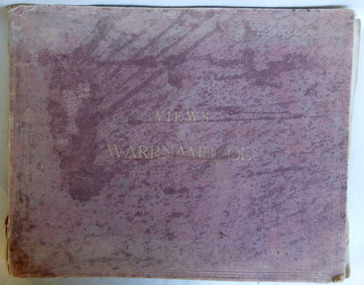
Album - Views of Warrnambool by J Jordan, C 1901
... front and back covers. The album contains a number of black and white photographs from around Warrnambool, including the Titan crane at the Breakwater, banks of the Hopkins, Stephens Coachbuilders, Grand Annual Show, panorama of Warrnambool and Suspension Bridge on the Merri. ...front and back covers. The album contains a number of black and white photographs from around Warrnambool, including the Titan crane at the Breakwater, banks of the Hopkins, Stephens Coachbuilders, Grand Annual Show, panorama of Warrnambool and Suspension Bridge on the Merri. ...Joseph Jordan was born in 1841 in Leicester England and spent over a decade in India with his regiment. In 1867 he gained first prize for his views of Indian scenery. He followed the same profession when he came to Victoria in 1884 and set up a professional photographic studio in Warrnambool He became very well known in the Western District for family photographs as well as official photographs of local councillors and groups as well as views of local scenery. This album is one which was advertised in 1901. Of the two albums in the collection they seem to consist of a core number of the same photographs with others included in the selection. The business was taken over by his son Arthur around 1917. This album includes a number of professionally taken photographs which give a high quality view of Warrnambool and the popular spots around the district at the turn of the century.Faded Maroon cloth over card cover with title in gold lettering on front cover. Advertisements for local businesses inside front and back covers. The album contains a number of black and white photographs from around Warrnambool, including the Titan crane at the Breakwater, banks of the Hopkins, Stephens Coachbuilders, Grand Annual Show, panorama of Warrnambool and Suspension Bridge on the Merri. All are mounted on card. It includes advertisements of J J O Mullane, Bay View Hotel, Hopkins Hotel, T Redford, Royal Hotel, Robinson and Morse, H D Stewart & Co, F Uren.2142 in grey lead inside front cover.warrnambool, joseph jordan, views of warrnambool, photograph album of warrnambool, views of warrnambool 1891 -
 Bendigo Historical Society Inc.
Accessory - BADGE COLLECTION: SECV PROVINCIAL TRAMWAYS PASSES, UK
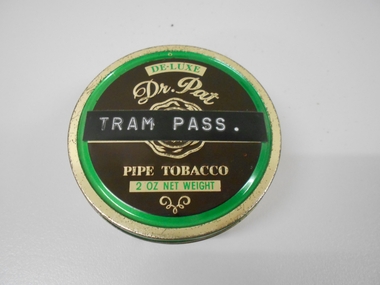
... front. Concentric circles from edge of blue enamel and white enamel. Suspension piece at crest. ...front. Concentric circles from edge of blue enamel and white enamel. Suspension piece at crest. ...Object. Round tobacco tin made of gold coloured metal. Tin has concentric circles of gold and green with black centric section. Written on lid ""De Luxe Dr PAT TOBACCO 2 oz net weight. Black Dymo Label -''Tram Pass''. Tin of twenty-one round metal tokens with enameled front. Concentric circles from edge of blue enamel and white enamel. Suspension piece at crest. Centre section of gold coloured enamel with red shield in centre with gold coloured Southern Cross. Hand above shield holding a stick. On outer blue enamel. "SUPPLY DEPARTMENT PROVINCIAL TRAMWAYS'', On white inner enamel ring ''STATE ELECTRICITY COMMISSION OF VICTORIA''.Imprinted on reverse, Various 3-digit numbers - different on each token.numismatics, tokens, secv provincial tram passes -
 Bendigo Historical Society Inc.
Medal - HAMILTON COLLECTION: SCROLL MEDAL ALEXANDER JOHN HAMILTON
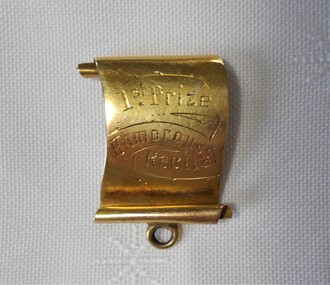
... suspension ring on top edge. It has two vertical bars (1.8 cm x 2 mm) attached top and bottom on the back. Engraving on the front...suspension ring on top edge. It has two vertical bars (1.8 cm x 2 mm) attached top and bottom on the back. Engraving on the front ...Gold Award Medal. Small scroll shaped award medal with suspension ring on top edge. It has two vertical bars (1.8 cm x 2 mm) attached top and bottom on the back. Engraving on the front of the scroll "First Prize Humorous Recital" Engraving is upside down on the scroll.medal, alexander john hamilton -
 Bendigo Historical Society Inc.
Domestic Object - JOSEPH & CO, SANDHURST, CLOCK
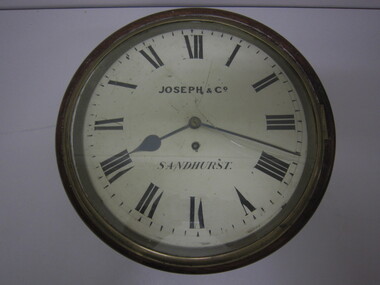
... Time only with a chain driven fusee movement, brass bezel with flat glass. 1 side and 1 bottom inspection doors, top and bottom wall securing hooks, front of clock secured to case with wooden pegs. Brass pendulum with circular brass bob, rating nut and suspension spring. ...Time only with a chain driven fusee movement, brass bezel with flat glass. 1 side and 1 bottom inspection doors, top and bottom wall securing hooks, front of clock secured to case with wooden pegs. Brass pendulum with circular brass bob, rating nut and suspension spring. ...Large round cedar cased wall clock with black hands and Roman numerals on a white painted metal dial pan. Time only with a chain driven fusee movement, brass bezel with flat glass. 1 side and 1 bottom inspection doors, top and bottom wall securing hooks, front of clock secured to case with wooden pegs. Brass pendulum with circular brass bob, rating nut and suspension spring. Written on clock face 'Joseph & Co., Sandhurst' (Bendigo).Joseph & Co Sandhursthorology, clocks, joseph & co -
The Ed Muirhead Physics Museum
Electrometer, Quadrant Elliot
... front: “Elliott Bros London” Brass quadrant electrometer consists of four quarter-cylindrical brass boxes (quadrants ) each mounted on a glass insulating pillar. The whole is housed within an electrostatic shield (Faraday cage) - a beehive shaped wire cage enclosure (aka a “bird cage”). The quadrants and cage stand on a round base platform on three legs with levelling screws (tribach base?). Arising from the platform is a separate vertical rod arises from the periphery and terminates over the axis of cylindrical symmetry and from which provision is made for a conducting suspension ...Brass quadrant electrometer consists of four quarter-cylindrical brass boxes (quadrants ) each mounted on a glass insulating pillar. The whole is housed within an electrostatic shield (Faraday cage) - a beehive shaped wire cage enclosure (aka a “bird cage”). The quadrants and cage stand on a round base platform on three legs with levelling screws (tribach base?). Arising from the platform is a separate vertical rod arises from the periphery and terminates over the axis of cylindrical symmetry and from which provision is made for a conducting suspension fibre which supports the horizontal “paddle” which is free to rotate within the cylindrical cavity of the four quadrants. The suspension and paddle are unfortunately missing.Label on front: “Natural Philosophy Laboratory No. University of Melbourne” Engraved on front: “Elliott Bros London” -
 National Wool Museum
Photograph - Product Photograph, Patent Automatic Feed Machine
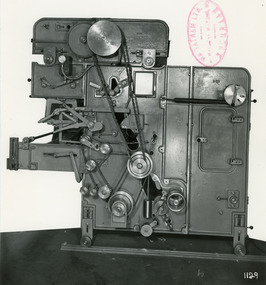
... Machine Maker Front bottom right corner - 1129 Rear - Patent Automatic Feed with Extended Hopper fitted with balanced pressure plate which operates through Variable Speed Device to regulate speed of spiked lattice in accordance with material in Hopper. Electro-Magnetic Clutch Drive to spiked lattice controlled by Mercery Switch on scale arm. Diagonal Scale Pan with improved knife edge suspension...Machine Maker Front bottom right corner - 1129 Rear - Patent Automatic Feed with Extended Hopper fitted with balanced pressure plate which operates through Variable Speed Device to regulate speed of spiked lattice in accordance with material in Hopper. Electro-Magnetic Clutch Drive to spiked lattice controlled by Mercery Switch on scale arm. Diagonal Scale Pan with improved knife edge suspension ...These are sales photographs for William Tatham Ltd. of Rochdale. These photographs are taken in the fitting shop at William Tatham Ltd. where final assembly would have taken place. An Automatic Feeding Machine automatically and sequentially supplies uncarded wool to carding machines, The photographed machine was made by William Tatham Ltd, a textile engineering company based in Rochdale, UK. Established in 1866 Tatham developed innovative textile machinery and send their products to Australia and other countries around the world.A black and white photo of a Patent Automatic Feed Machine in a portrait format. Black wiritng on the rear, typed with a typewriter.Front - mid left corner - Wm. TATHAM Ltd. ROCHDALE. Machine Maker Front bottom right corner - 1129 Rear - Patent Automatic Feed with Extended Hopper fitted with balanced pressure plate which operates through Variable Speed Device to regulate speed of spiked lattice in accordance with material in Hopper. Electro-Magnetic Clutch Drive to spiked lattice controlled by Mercery Switch on scale arm. Diagonal Scale Pan with improved knife edge suspension. Dual Trap Doors over Pan actuated by Solenoid. Automatic device to slow spiked lattice just prior to weigh being obtained. Ball or roller bearings to main shaft, combs and other parts. Self-aligning bearing to timing shaft etc.textile machinery, tatham, wool manufacture, carding, automatic feeding machine, wool -
 Ballarat Tramway Museum
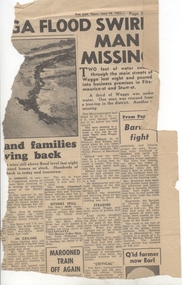
Newspaper, Herald Sun, "Barwon fight", 19/06/1952 12:00:00 AM
... Notes the flooding over the Barwon River which caused suspension of the tram services. Contained originally within Reg Item 5623 at the front of this note book. ...Notes the flooding over the Barwon River which caused suspension of the tram services. Contained originally within Reg Item 5623 at the front of this note book. ...Newspaper Clipping from the Melbourne "The Sun", dated 19/6/1952 about widespread flooding in Victoria and Wagga and on the right hand side of the clipping the Barwon River Geelong titled "Barwon fight". Notes the flooding over the Barwon River which caused suspension of the tram services. Contained originally within Reg Item 5623 at the front of this note book. For items see btm5623 loose items list.pdf.geelong, flooding -
 Ballarat Tramway Museum
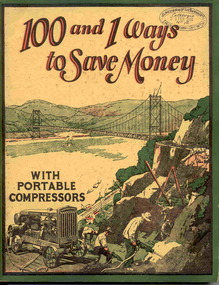
Book, Ingersoll Rand Company, "101 and 1 ways to Save Money with Portable Compressors", 1929
... On front cover has an colour picture of a large work scene with a the construction of a suspension bridge in the background. ...On front cover has an colour picture of a large work scene with a the construction of a suspension bridge in the background. ...Book, titled "101 and 1 ways to Save Money with Portable Compressors", published by Ingersoll-Rand Co. London, 120 page book, within yellow covers, centre stapled. Published 1929. On front cover has an colour picture of a large work scene with a the construction of a suspension bridge in the background. Details equipment that is available and the possible uses it could be put to, with numerous photos. Has a list of equipment, index and on last page a list of officers and directors. Has been stamped on the top left hand corner with the ESCo Company stamp but overwritten in ink with a BTPS catalogue number and information. Stamped dated 23 Feb. 1934.On front cover and page 1, hand written in black ink "Ballarat Tramway Preservation Society Catalogue No. 18".trams, tramways, trackwork, doors, safety, compressors, esco
