
Showing 106 items matching "fruit blocks"
-
 University of Melbourne, Burnley Campus Archives
Document, The Orchard at Burnley Gardens, 1951-1960
... ...fruit blocks...Notes re history of the orchard; plans of various fruit blocks, 1-page of notes "The Orchard at Burnley Garden" in Box 74....orchards fruit blocks burnley Notes re history of the orchard; plans of various fruit blocks, 1-page of notes "The Orchard at Burnley Garden" in Box 74. ...Notes re history of the orchard; plans of various fruit blocks, 1-page of notes "The Orchard at Burnley Garden" in Box 74.orchards, fruit blocks, burnley -
University of Melbourne, Burnley Campus Archives
Book (item) - Register, Orchard, 1955-1959
... ...fruit tree blocks...Hand-drawn diagram inserts : "Rough plan of crops section - Burnley Gardens 22.2.55" , Apple and pear block, Apples in old stone fruit block, Re-organisation of Apple Block. Other inserted roneo charts Blooming Dates Week Ending. 2 Original undated newspaper cuttings "A New Apple- Appears in Tasmania," and "Outstanding Fig Raised at Preston." ...orchard field station history fruit tree blocks planting plans newspaper cutting red delicious apple preston prolific fig ORCHARD on name sticker on front page. ...ORCHARD on name sticker on front page. Brand of folio - No. 01310H Norman Bros. Pty. Ltd. 60-62 Elizabeth St., Melbourneorchard, field station, history, fruit tree blocks, planting plans, newspaper cutting, red delicious apple, preston prolific fig -
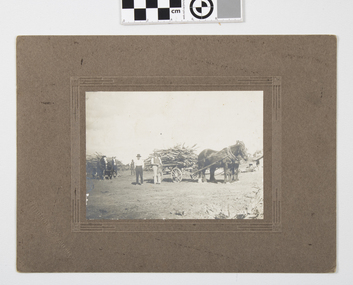 Merbein District Historical Society
Finnigan Photos Mildura
... block clearing fruit blocks horses Merbein...block clearing fruit blocks horses Merbein Finnigan Photos Mildura Sepia photograph mounted on embossed board. ...Sepia photograph mounted on embossed board.Finnigan Photos Mildurablock clearing fruit blocks horses merbein -
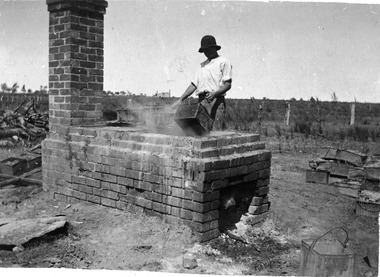 Merbein District Historical Society
Photograph, Hot dipping on Fred Tyers' (Snr) Fifth Street, block, Merbein, unknown
... Fruit... Blocks...Fred (Senior) Tyers Dried Fruit Blocks Hot dipping on Fred Tyers' (Snr) Fifth Street, block, Merbein. ...fred (senior) tyers, dried fruit, blocks -
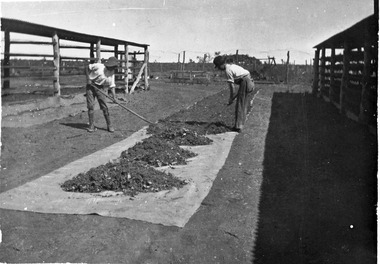 Merbein District Historical Society
Photograph, Spreading dried grapes on Fred Tyers' (Snr) 5th St. Block, Merbein, unknown
... Fruit... Blocks...Fred (Senior) Tyers Dried Fruit Blocks Spreading dried grapes on Fred Tyers' (Snr) 5th St. ...fred (senior) tyers, dried fruit, blocks -
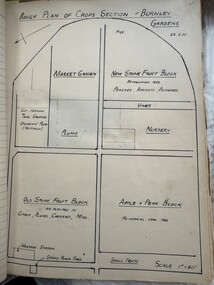 University of Melbourne, Burnley Campus Archives
Book (item) - Register, The Orchard at Burnley Gardens, 22.05.1955
... ...fruit tree blocks...orchard field station history fruit tree blocks planting plans newspaper cutting red delicious apple preston prolific fig No. 237 (book number reference handwritten inside cover) Brand of folio - No. 01310H Norman Bros. ...No. 237 (book number reference handwritten inside cover) Brand of folio - No. 01310H Norman Bros. Pty. Ltd. 60-62 Elizabeth St., Melbourneorchard, field station, history, fruit tree blocks, planting plans, newspaper cutting, red delicious apple, preston prolific fig -
Merbein District Historical Society
Book, Fruits of the Vine, 1887-1962
... Fruit... Harvest... Industry... Blocks...Commonwealth Research Station - Merbein Dried Fruit Harvest Industry Blocks Vineyard Fruits of the Vine Book ...commonwealth research station - merbein, dried fruit, harvest, industry, blocks, vineyard -
 Greensborough Historical Society
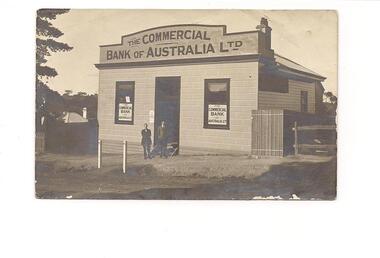
Photograph - Digital image, Commercial Bank Greensborough, 1913_
... Elliot and moved to a soldier settlement fruit block at Redcliffs....Elliot and moved to a soldier settlement fruit block at Redcliffs. commercial bank of australia main street greensborough Digital copy of black and white photograph. ...An early photograph of the Commercial Bank of Australia, Greensborough Branch in Main Street Greensborough, taken before 1914. Teller Walter West stands on the left (according to his grandson John Cramp). The rings on the white posts are for tethering the horses. After service in World War 1 West married the daughter of Greensborough butcher Mr. N. Elliot and moved to a soldier settlement fruit block at Redcliffs.Digital copy of black and white photograph.commercial bank of australia, main street greensborough -
University of Melbourne, Burnley Campus Archives
Plan - Photocopies, Orchard Plan, c. 1980
... Names and positions of fruit trees in each block. (8 pages stapled together)...Names and positions of fruit trees in each block. (8 pages stapled together) Orchard Plan Plan Photocopies ...Handdrawn plan of the Orchard with some parts dated 1980-1981. Names and positions of fruit trees in each block. (8 pages stapled together)orchard, fruit trees -
 Bendigo Military Museum
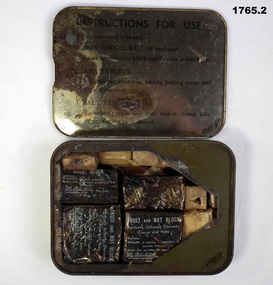
Accessory - RATION PACK, C.1939 - 45
... Emergency Ration pack issued to RAAF .1) Tin containing fruit and nut blocks, hot chocolate, salt tablets , tea tablets. .2) Lid for tin, inside is printed instructions for use. ...Refer Cat No 1760.4 Ration pack emergency RAAF accessory Emergency Ration pack issued to RAAF .1) Tin containing fruit and nut blocks, hot chocolate, salt tablets , tea tablets. .2) Lid for tin, inside is printed instructions for use. ...Item issued to Victor Henry Evans No 418655 RAAF. Refer Cat No 1760.4Emergency Ration pack issued to RAAF .1) Tin containing fruit and nut blocks, hot chocolate, salt tablets , tea tablets. .2) Lid for tin, inside is printed instructions for use. Remnants of sellotape on both items .1) and .2) Khaki colour.ration pack, emergency, raaf, accessory -
 Wodonga & District Historical Society Inc
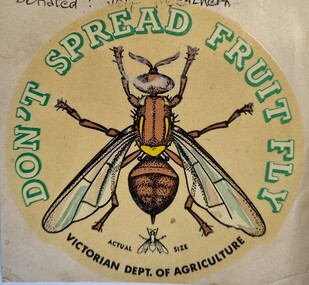
Document - Fruit Fly Border Express Pass, De Neefe Signs Pty. Ltd, c1960
... The permanent fruit fly road blocks in Victoria began in 1958. The first was set up on the Lincoln Causeway between Albury and Wodonga. ...The permanent fruit fly road blocks in Victoria began in 1958. The first was set up on the Lincoln Causeway between Albury and Wodonga. ...The permanent fruit fly road blocks in Victoria began in 1958. The first was set up on the Lincoln Causeway between Albury and Wodonga. The aim was to protect the Victorian fruit export industry, the largest in the country. Cars would be stopped and inspected when entering Victoria. At peaks periods, such as Easter and school holidays, there were up to 10 inspectors at the 24 hour checkpoint near the former butter factory on the Lincoln Causeway. Local residents could apply for a pass such as this one which would be displayed on their window, but were still subject to random checks. Hundreds of tonnes of fruit each week was confiscated and pulverised by Department of Agriculture staff. The road block was closed in 1980, partly due to the increased traffic flows and the cost of maintaining inspection points.This image reflects government measures taken to protect the fruit industry in Victoria.A transparent sticker designed to be applied to a car window for motorists to pass through Department of Agriculture fruit fly control points. Instructions for applying the sticker to the window are written on the back of the sticker. It features a large coloured image of a fruit fly as well as a smaller life sized representation of a fruit fly.Around the edge of the circle: "DON'T SPREAD FRUIT FLY/ VICTORIAN DEPT. OF AGRICULTURE? Beside small fruit fly image: "Actual Size"fruit fly control, department of agriculture, fruit fly pass -
 Wodonga & District Historical Society Inc
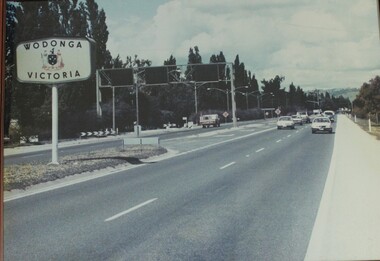
Photograph - Wodonga, Victoria sign and the Fruit Fly check point c1970s
... The permanent fruit fly road blocks in Victoria began in 1958. The first was set up on the Lincoln Causeway between Albury and Wodonga. ...The permanent fruit fly road blocks in Victoria began in 1958. The first was set up on the Lincoln Causeway between Albury and Wodonga. ...The permanent fruit fly road blocks in Victoria began in 1958. The first was set up on the Lincoln Causeway between Albury and Wodonga. The aim was to protect the Victorian fruit export industry, the largest in the country. Cars would be stopped and inspected when entering Victoria. At peaks periods, such as Easter and school holidays, there were up to 10 inspectors at the 24 hour checkpoint near the former butter factory on the Lincoln Causeway. Local residents could apply for a pass which would be displayed on their window, but were still subject to random checks. Hundreds of tonnes of fruit each week was confiscated and pulverised by Department of Agriculture staff. The road block was closed in 1980, partly due to the increased traffic flows and the cost of maintaining inspection points.This image reflects government measures taken to protect the fruit industry in Victoria.A large image of the LIncoln Causeway at the Victorian/NSW border at Wodonga. The southbound lanes on the right hand side feature overhead signals and traffic light signs to control traffic leading into the Fruit fly inspection checkpoint ahead. The photo is in a wooden frame.On right hand side: Border sign: Wodonga/Victoria and the Victorian State Coat of Arms.fruit fly control, victoria border, lincoln causeway wodonga -
 Red Cliffs Military Museum
Document, Obituary, 12:MMMM, 1976 (exact); Walter Thomas West passed away 4th December 1976 and his funeral was held 7th of December
... ./ He was an original soldier settler and developed/ his fruit block in Red Cliffs which is still/ operated by his son Tom. ..../ He was an original soldier settler and developed/ his fruit block in Red Cliffs which is still/ operated by his son Tom. ...Attached to his R.S.L. Membership Card along with the funeral notice, is a subsequent newspaper article written at the time of Walter West's death, which reads: Death of Pioneer Settler/ A pioneer settler of/ the Red Cliffs irigation/ district and one of the/ last men to be evacuated/ from Gallipoli, died sud/denly on Saturday night/ aged 84./ In 1922 Mr. Watler Thomas/ West came to Red Cliffs/ where he established Block/ 86 in the irrigation district./ He lived there until his/ death on Saturday after playing bowls at the Red/ Cliffs rinks on Saturday/ afternoon./ Mr. West was born in Jeparit and served with the/ 24th Battalion in Egypt and/ Gallipoli./ He was awarded the Mili/tary Medal in France in/ 1917 and the Military Cross/ in 1918 when he captured/ single handed an enemy/ machine gun post./ He settled at Red Cliffs/ on his return when the/ area was placed under irri-/gation./ For 25 years he operated/ a unique partnership with/ the late Mr. Martin Nippe, his adjoining property/ owner. The pair pooled their/ horticultural equipment for/ joint use./ Mr. West joined Mildura/ Legacy in 1942 and was an/ active member until his/ death./ The funeral will be held at the United Church, Red/ Cliffs this morning at 10.30Type written obituary, presumably used when Walter West,MC,MM, died.Walter West MC,MM/ Red Cliffs residents were saddened to learn of the sudden passing on Saturday last/ of Walter Thomas West MC,MM., a Pioneer/settler and well respected citizen./ "Wal" as he was affectionately known, was/ born at Dandenong some 84years ago./ He served with distinction in World War 1/ with 24th Battalion. He was an original ANZAC, and also saw service in/ Egypt and France. He received two awards for gallantry in the field - The Military/ Medal in France 1917 and the Military Cross in France/ in 1918 when he was responsible for the/ single handed capture of an enemy gun and crew./ He was an original soldier settler and developed/ his fruit block in Red Cliffs which is still/ operated by his son Tom. In 1922 he/ became an original Trustie of the Methodist/Church and was the last surviving original/ Trustie. He served on the Board of/ directors of the Red Cliffs Co-Operative Co.Ltd/ from 1954 to 1967, and was Chairman of Directors/ in 1963 and 1964. He showed a keen interest/ in youth activities and some excellent cricketers/ were produced as a result of his coaching of/ the Methodist Junior Cricket Team. He was an/ active and keen member of Mildura Legacy/ for 34 years, serving as President in 1947 and 1948./ He was secretary of the Cemetary Trust for many years, served on the Hospital Committee/ was a member of Memorial Lodge, a member of Red Cliffs Senior Citizens Club and a /member of Red Cliffs Sub-Branch R.S.L. since / it's inception./ He was a keen member of the Red Cliffs/ Bowling Club and took part in a club event on/ the day of his passing./ It was the pioneer settler and men with ability/ and initiative of Walter West that brought/ out the Community Spirit which resulted in/ the Red Cliffs we know today.1918, 1917, ww1, walter, thomas, west, mm, mc, 24th, battalion, aif, gallipoli, bullecourt -
 Flagstaff Hill Maritime Museum and Village
Tool - Wooden Bench Screw, 1900 Possibly made by the Grand Rapids Furniture Company in USA
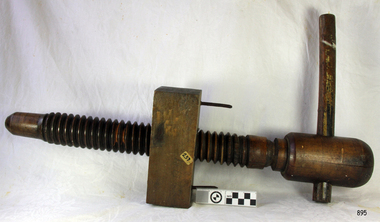
... fruit wood and used to hold an item to a bench or table used in the same way a clamp or vice would hold an item to stop it moving around while it was being worked upon or used. No information available however similar items were made by the Grand Rapids Furniture Company in America around the 1900s flagstaff hill warrnambool shipwrecked-coast flagstaff-hill flagstaff-hill-maritime-museum maritime-museum shipwreck-coast flagstaff-hill-maritime-village None Bench Screw, wooden, large with handle, with slip through handle and screw block. ...A vintage tool made of wood either Beech or fruit wood and used to hold an item to a bench or table used in the same way a clamp or vice would hold an item to stop it moving around while it was being worked upon or used.No information available however similar items were made by the Grand Rapids Furniture Company in America around the 1900sBench Screw, wooden, large with handle, with slip through handle and screw block.Noneflagstaff hill, warrnambool, shipwrecked-coast, flagstaff-hill, flagstaff-hill-maritime-museum, maritime-museum, shipwreck-coast, flagstaff-hill-maritime-village -
 City of Moorabbin Historical Society (Operating the Box Cottage Museum)
Document - Photocopy of Land Title 1881, c1881
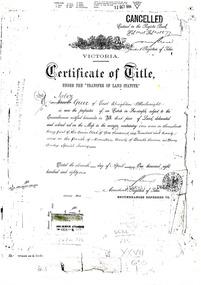
... block was purchased by William Henry George Box, a market gardener and relative of William and Elizabeth Box, who owned the land until 1926. The land was then purchased by Charles John Greenlaw Coates and remained with this family until 1971. All these Family names appear on Councils and Community Boards during the foundation and development of City of Moorabbin dendy henry dendy's special survey 1841 brighton moorabbin bentleigh market gardeners early settlers pioneers wheelwrights merchants fruit gardens markets smith robert box william henry george gurr jabez county of bourke victoria melbourne land statutes tucker road centre road box william box elizabeth box cottage museum Stamped CANCELLED 12 OCT 1994 (top Right) / Entered in the Register Book / Vol.1245 Fol. 248877/ signed Henry Crowe / Assistant Registrar of Titles / Coat of Arms / VICTORIA / Certificate of Title / UNDER THE ' TRANSFER OF AND STATUTE' /dated ' eleventh day of April one thousand eight / hundred and eighty one' / signed 'Henry Crowe' / Assistant Registrar of Titles/ ENCUMBRANCES REFERRED TO / circular Stamp 'OFFICE OF TITLES VICTORIA' / Drawn and shaded on the left side is the area of land in "Tucker's" Road 3331/3 links fro Centre Road, 150 links x 6662/3 links / The measurements are in links 3 photocopied pages of the Certificate of Title for approximately 1 acre of land near the corner of Centre Road and Tucker Road, Parish of Moorabbin, County of Bourke, Victoria that was part of the 5,120 acre Henry Dendy Special Survey in Brighton in 1841 and purchased in 1881 by Jabez Gurr. ...This is a Certificate of Title for an acre of land in 'Tucker's Road' purchased by Jabez Gurr in 1881, in the area that was part of the Crown Block known as Henry Dendy's Special Survey 1841, in the Parish of Moorabbin, County of Bourke, Victoria. Following the 'Transfer of Land Statute' allotments in the area of Henry Dendy's Special Survey of 1841 were sold to early settlers. This Certificate of Title shows the passage of history in Moorabbin Shire . Jabez Gurr, a wheelwright, of East Brighton, now Bentleigh East, purchased an acre of land in 'Tucker's Road' , near Centre Road, in 1881. In 1889 he sold to a produce merchant, Robert Smith, and in April 1916 this block was purchased by William Henry George Box, a market gardener and relative of William and Elizabeth Box, who owned the land until 1926. The land was then purchased by Charles John Greenlaw Coates and remained with this family until 1971. All these Family names appear on Councils and Community Boards during the foundation and development of City of Moorabbin3 photocopied pages of the Certificate of Title for approximately 1 acre of land near the corner of Centre Road and Tucker Road, Parish of Moorabbin, County of Bourke, Victoria that was part of the 5,120 acre Henry Dendy Special Survey in Brighton in 1841 and purchased in 1881 by Jabez Gurr. It records subsequent proprietors up to 1971Stamped CANCELLED 12 OCT 1994 (top Right) / Entered in the Register Book / Vol.1245 Fol. 248877/ signed Henry Crowe / Assistant Registrar of Titles / Coat of Arms / VICTORIA / Certificate of Title / UNDER THE ' TRANSFER OF AND STATUTE' /dated ' eleventh day of April one thousand eight / hundred and eighty one' / signed 'Henry Crowe' / Assistant Registrar of Titles/ ENCUMBRANCES REFERRED TO / circular Stamp 'OFFICE OF TITLES VICTORIA' / Drawn and shaded on the left side is the area of land in "Tucker's" Road 3331/3 links fro Centre Road, 150 links x 6662/3 links / The measurements are in linksdendy henry, dendy's special survey 1841, brighton, moorabbin, bentleigh, market gardeners, early settlers, pioneers, wheelwrights, merchants, fruit gardens, markets, smith robert, box william henry george, gurr jabez, county of bourke, victoria, melbourne, land statutes, tucker road, centre road, box william, box elizabeth, box cottage museum -
 Eltham District Historical Society Inc
Photograph - Digital Copy, Hughes Fruit shop and Milk Bar, Main Road, Eltham, c.1949
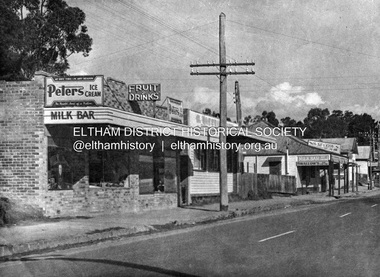
... Hughes Fruit Shop and Milk Bar, Main Road, Eltham, c.1949 promoting Peters Ice Cream Immediately to the right of the shop is a bootmaker factory that employed 15 people. It was situated on the corner of Pryor Street and is the site of the present-day Westpac Bank. Pryor Street is an unmade road. To the left of the shop are four vacant blocks...Hughes Fruit Shop and Milk Bar, Main Road, Eltham, c.1949 promoting Peters Ice Cream Immediately to the right of the shop is a bootmaker factory that employed 15 people. It was situated on the corner of Pryor Street and is the site of the present-day Westpac Bank. Pryor Street is an unmade road. To the left of the shop are four vacant blocks ...Hughes Fruit Shop and Milk Bar, Main Road, Eltham, c.1949 promoting Peters Ice Cream Immediately to the right of the shop is a bootmaker factory that employed 15 people. It was situated on the corner of Pryor Street and is the site of the present-day Westpac Bank. Pryor Street is an unmade road. To the left of the shop are four vacant blocks stretching to Luck Street where Mr and Mrs Britton had a house. On the other side of Pryor Street is the original Blue Gum Cafe and Milk Bar advertising Swallow's Ice Cream. At the time it was operated by Pop Warner. [We believe the fruit shop was built 1946-1948 based upon evidence of another photo (EDHS_02182) looking northeast from Staffs store circa October 1945 and an aerial photo of December 1945 which only shows the bootmaker factory.] Behind the shop is a tall Bluegum tree. This was the tree that the Bluegum Cafe was originally named after. Miss Barber's 'Blue Gum' Soda Fountain opened October 1922 and was the first shop on the eastern side of Main Road following Luther Haley's Bakery and General Store on the other side adjacent to the railway station in 1902. The Bluegum was felled in the early 1960s when Burge's Blue Gum Cafe and milkbar was sold and demolished in September 1960 to make way for a new store, Mr. J. Millet's Foodland. OLD LANDMARK GOES Perhaps the most famous landmark in Eltham's' business section disappeared last Wednesday when the towering blue gum in Pryor Street at the rear of Main Road shops was felled. The tree, stated to be more than 80 feet high, was the one for which the adjoining café was named, when that business was Eltham’s only provision store, long before the turn of the century. Mr. J. Millett, who now owns the property on which the tree stood, deeply regretted its removal, but was mindful of the need for expansion in the business area. The "Old Blue Gum" was removed by Mr. A. Wilson, expert tree feller, from Heidelberg. Its proportions might be assessed by these facts – it took a gang of experienced men two days to completely fell and clear the tree, and, falling sections being brought down by cable tipped electricity wires on the opposite side of Pryor Street. Images from the private collection of Mrs Noel Williams (nee Hughes) Noel’s parents, George Elgar Hughes and Jean Alice Hughes had a combined milk bar and fruit shop in Main Road, Eltham. Noel worked in the shop after leaving Eltham High School aged 15 (1950), until she married George Williams in 1956, whose grandparents, Violet and Will Williams, owned the Bellevue estate in Livingston Road, Eltham. Her father, then sold the property. George and Noel raised 3 children on their farm in Kangaroo Ground and Noel, who turned 90 years old in July 2025, is a life member of the Andrew Ross Museum.hughes fruit shop and milk bar, main road eltham, george elgar hughes, jean alice hughes, 1949, blue gum (eucalyptus globulus), blue gum milk bar (eltham), eltham shopping centre, eltham shops, fruit shop, green grocer, milk bar, peter's ice cream, pryor street, shoe factory., swallow's ice cream, bedford truck, pop warner, bootmaker's shop, newsagency, noel williams collection, shoe factory, telephone box -
 Bendigo Historical Society Inc.
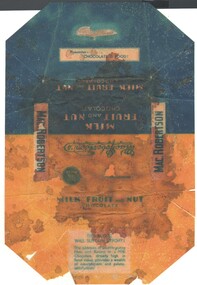
Ephemera - GERTRUDE PERRY COLLECTION: CHOCOLATE WRAPPER
... Wrapper from a block of Mac Robertson's Milk Fruit and Nut Chocolate. Blue and gold. ...INDUSTRIES confectionary Gertrude Perry Collection Chocolate Wrapper Mac Robertson's Milk Fruit and Nut Object. Wrapper from a block of Mac Robertson's Milk Fruit and Nut Chocolate. ...Object. Wrapper from a block of Mac Robertson's Milk Fruit and Nut Chocolate. Blue and gold. Written on wrapper: To My Sweetheart - Unreadableindustries, confectionary, gertrude perry collection, chocolate wrapper, mac robertson's milk fruit and nut -
 Eltham District Historical Society Inc
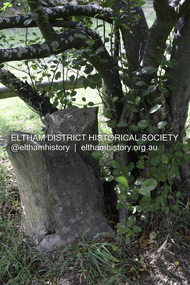
Photograph - Digital Photograph, Alan King, Heritage apple tree, 24 January 2008
... block is inscribed with the date 1841, when the tree was thought to have been planted. Known as Batman's Tree, this apple tree is on the bank of the Plenty River near Leischa Court, Greensborough. It is said that Melbourne Founder John Batman may have planted the tree and later signed his treaty here with the Aboriginal people. It still bears fruit...block is inscribed with the date 1841, when the tree was thought to have been planted. Known as Batman's Tree, this apple tree is on the bank of the Plenty River near Leischa Court, Greensborough. It is said that Melbourne Founder John Batman may have planted the tree and later signed his treaty here with the Aboriginal people. It still bears fruit ...This old apple tree situated beside the Plenty River Trail at Greensborough has been associated with Melbourne Founder John Batman. The concrete block is inscribed with the date 1841, when the tree was thought to have been planted. Known as Batman's Tree, this apple tree is on the bank of the Plenty River near Leischa Court, Greensborough. It is said that Melbourne Founder John Batman may have planted the tree and later signed his treaty here with the Aboriginal people. It still bears fruit and its recorded on the National Trust's Register of Significant Trees, as the oldest apple tree in Victoria. Published: Nillumbik Now and Then / Marguerite Marshall 2008; photographs Alan King with Marguerite Marshall.; p7This collection of almost 130 photos about places and people within the Shire of Nillumbik, an urban and rural municipality in Melbourne's north, contributes to an understanding of the history of the Shire. Published in 2008 immediately prior to the Black Saturday bushfires of February 7, 2009, it documents sites that were impacted, and in some cases destroyed by the fires. It includes photographs taken especially for the publication, creating a unique time capsule representing the Shire in the early 21st century. It remains the most recent comprehenesive publication devoted to the Shire's history connecting local residents to the past. nillumbik now and then (marshall-king) collection, greensborough, john batman tree, plenty river trail -
 Bendigo Historical Society Inc.
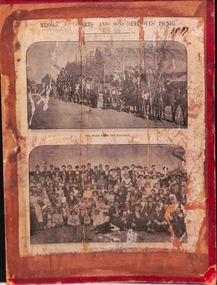
Photograph - Messrs A. Roberts and Sons Employees Picnic 1897, 1897
... fruit in his later years in Sandhurst (Bendigo). On 19 August 1841 he married Elizabeth Tonkin at the parish church at Paul, Cornwall. Roberts arrived on Bendigo in 1853 with his family and engaged in gold-prospecting, then about 1861 opened the United Iron Works, a small engineering shop in Williamson Street, making forge and hand tools. With expansion the business moved to Mitchell Street, until by 1880 it absorbed an entire block...fruit in his later years in Sandhurst (Bendigo). On 19 August 1841 he married Elizabeth Tonkin at the parish church at Paul, Cornwall. Roberts arrived on Bendigo in 1853 with his family and engaged in gold-prospecting, then about 1861 opened the United Iron Works, a small engineering shop in Williamson Street, making forge and hand tools. With expansion the business moved to Mitchell Street, until by 1880 it absorbed an entire block ...Abraham Roberts (1819-1897), ironfounder, was born on 13 July 1819 in Cornwall, England, son of Abraham Roberts, blacksmith, and his wife Mary, née Pentreath. Nothing is known of his education and early training but it is likely that he served an engineering apprenticeship and worked in engineering workshops in Cornwall. Undoubtedly he observed much machinery among the tin mines of Cornwall and absorbed the principles of sound engineering design and high-grade workmanship, which bore fruit in his later years in Sandhurst (Bendigo). On 19 August 1841 he married Elizabeth Tonkin at the parish church at Paul, Cornwall. Roberts arrived on Bendigo in 1853 with his family and engaged in gold-prospecting, then about 1861 opened the United Iron Works, a small engineering shop in Williamson Street, making forge and hand tools. With expansion the business moved to Mitchell Street, until by 1880 it absorbed an entire block covering three acres (1.2 ha) in the heart of the town and employed nearly two hundred men. Three of his sons, William, Abraham and Arthur, helped to run A. Roberts & Sons. As well as being a skilful and enterprising engineer, Roberts was a shrewd businessman, who anticipated that the market for machinery on the local goldfields would diminish, and widened the sphere of his activities accordingly. Though the requirements of the mining industry maintained the firm, no class of foundry work was ignored. Roberts secured orders for machinery for the two major Broken Hill mines and built steam winding engines for several Western Australian mines, as well as undertaking orders for machinery in South Africa and New Zealand. He introduced poppet-heads constructed of steel to the Bendigo goldfield and the 105-head stamp battery for Lansell's Big Blue mine was the largest quartz-crushing battery in Australia at that time. The pair of steam winding engines built by his works for the Hustler's Royal Reserve Co. were the largest on the Bendigo field. The company also carried out steamship repairs, bridgework and many important railway contracts and in 1891 supplied the largest outlet valves in Victoria at Laanecoorie weir.Two photographs in black and white of the picnic for employees of Messrs A. Roberts and Sons in 1897. Photographs are mounted on piece of red cardboard. A. Roberts and Sons owned a foundry that was established in 1865. The event was noted in the Bendigo Advertiser on 18 March 1901.'1897' in ink top right hand corner.bendigo, foundry, roberts and sons, picnic, 1897 -
 Sunshine and District Historical Society Incorporated
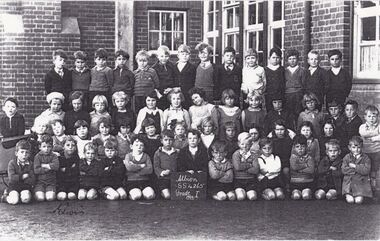
Photograph - Albion State School 1934 Class Photographs
... fruit tree orchard. As well as classroom groups, we have our learning teams, student house groups (siblings are allocated to the same house) and a Junior School Council. The school has four main buildings. All classrooms have air conditioning and interactive screens. Block ...The current school, Albion Primary School, No 4265 opened in 1926. It was built on a site once owned by John Fitzgerald (1850s). The land was later acquired by H. V. McKay who had transferred his Sunshine Harvester Works to the area in 1905 - 7. In 1920, the Albion railway station was moved nearer Ballarat Road at the request of Mr McKay. More people came to live in the area including soldier settlers.Albion Primary School's mission is to 'Aim High' in all we do so that our students grow to be socially capable, reach their full academic potential and become caring, respectful community minded people. Albion Primary School is located in a residential area in Albion, a small pocket of the local government area of Brimbank, approximately 10 kilometres west of Melbourne and was established in 1926. Our current enrolment is 199 students. We have a rich cultural diversity amongst our school community. The school is set around a courtyard with spacious playing areas including a grassed oval, running track, games courts, an adventure playground, sand pit, jumping pits, shady courtyard and garden areas, a vegetable garden and fruit tree orchard. As well as classroom groups, we have our learning teams, student house groups (siblings are allocated to the same house) and a Junior School Council. The school has four main buildings. All classrooms have air conditioning and interactive screens. Block A houses classrooms, staff areas and the administration offices. Our newest building has classrooms and some small group/office spaces. Block B includes our library, canteen and a multi-purpose room used for indoor physical education, Perceptual Motor Program, drama, visiting performers, and community activities. Block C houses classrooms and specialist rooms. We expect and receive the best from our students in terms of their learning and behaviour. The school’s dedicated and effective staff is strongly committed to helping students achieve personal, behavioural, social and academic success. In terms of learning, the highest priority is placed on the work in English and Mathematics. We also have a range of specialist and extra-curricular programs that we provide. Our specialist teacher-librarian is involved in reading extension programs that support development in literacy. All children are able to develop their artistic abilities through visual arts and music program. Our music program is supported by the Australian Children's Music Foundation. A specialist Physical Education teacher provides lessons for all children as well as the opportunity for students to participate in organised lunch time sporting competitions between the house groups. Auslan is the additional language all students learn at Albion. All children participate in a student wellbeing program that focuses on developing strong connections and a sense of belonging within the school. Our school student leaders participate in programs that help develop their leadership skills. 5100.01 - Albion State School 1934 Grade 1 5100.02 - Albion State School 1934 Grade 2 5100.04 - Albion State School 1934 Grade 4 5100.05 - Albion State School 1934 Grade 5 5100.06 - Albion State School 1934 Grade 6 albion state school, albion primary school, adelaide street, albion -
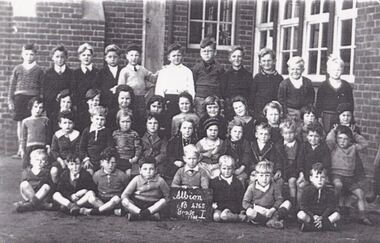 Sunshine and District Historical Society Incorporated
Photograph - Albion State School 1935 Class Photographs
... fruit tree orchard. As well as classroom groups, we have our learning teams, student house groups (siblings are allocated to the same house) and a Junior School Council. The school has four main buildings. All classrooms have air conditioning and interactive screens. Block ...The current school, Albion Primary School, No 4265 opened in 1926. It was built on a site once owned by John Fitzgerald (1850s). The land was later acquired by H. V. McKay who had transferred his Sunshine Harvester Works to the area in 1905 - 7. In 1920, the Albion railway station was moved nearer Ballarat Road at the request of Mr McKay. More people came to live in the area including soldier settlers.Albion Primary School's mission is to 'Aim High' in all we do so that our students grow to be socially capable, reach their full academic potential and become caring, respectful community minded people. Albion Primary School is located in a residential area in Albion, a small pocket of the local government area of Brimbank, approximately 10 kilometres west of Melbourne and was established in 1926. Our current enrolment is 199 students. We have a rich cultural diversity amongst our school community. The school is set around a courtyard with spacious playing areas including a grassed oval, running track, games courts, an adventure playground, sand pit, jumping pits, shady courtyard and garden areas, a vegetable garden and fruit tree orchard. As well as classroom groups, we have our learning teams, student house groups (siblings are allocated to the same house) and a Junior School Council. The school has four main buildings. All classrooms have air conditioning and interactive screens. Block A houses classrooms, staff areas and the administration offices. Our newest building has classrooms and some small group/office spaces. Block B includes our library, canteen and a multi-purpose room used for indoor physical education, Perceptual Motor Program, drama, visiting performers, and community activities. Block C houses classrooms and specialist rooms. We expect and receive the best from our students in terms of their learning and behaviour. The school’s dedicated and effective staff is strongly committed to helping students achieve personal, behavioural, social and academic success. In terms of learning, the highest priority is placed on the work in English and Mathematics. We also have a range of specialist and extra-curricular programs that we provide. Our specialist teacher-librarian is involved in reading extension programs that support development in literacy. All children are able to develop their artistic abilities through visual arts and music program. Our music program is supported by the Australian Children's Music Foundation. A specialist Physical Education teacher provides lessons for all children as well as the opportunity for students to participate in organised lunch time sporting competitions between the house groups. Auslan is the additional language all students learn at Albion. All children participate in a student wellbeing program that focuses on developing strong connections and a sense of belonging within the school. Our school student leaders participate in programs that help develop their leadership skills. 5101.01 - Albion State School 1935 Grade 1 5101.02 - Albion State School 1935 Grade 2 5101.04 - Albion State School 1935 Grade 4 5101.05 - Albion State School 1935 Grade 5 albion state school, albion primary school, adelaide street, albion -
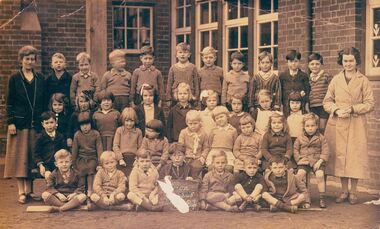 Sunshine and District Historical Society Incorporated
Photograph - Albion State School 1936 Class Photographs
... fruit tree orchard. As well as classroom groups, we have our learning teams, student house groups (siblings are allocated to the same house) and a Junior School Council. The school has four main buildings. All classrooms have air conditioning and interactive screens. Block ...The current school, Albion Primary School, No 4265 opened in 1926. It was built on a site once owned by John Fitzgerald (1850s). The land was later acquired by H. V. McKay who had transferred his Sunshine Harvester Works to the area in 1905 - 7. In 1920, the Albion railway station was moved nearer Ballarat Road at the request of Mr McKay. More people came to live in the area including soldier settlers.Albion Primary School's mission is to 'Aim High' in all we do so that our students grow to be socially capable, reach their full academic potential and become caring, respectful community minded people. Albion Primary School is located in a residential area in Albion, a small pocket of the local government area of Brimbank, approximately 10 kilometres west of Melbourne and was established in 1926. Our current enrolment is 199 students. We have a rich cultural diversity amongst our school community. The school is set around a courtyard with spacious playing areas including a grassed oval, running track, games courts, an adventure playground, sand pit, jumping pits, shady courtyard and garden areas, a vegetable garden and fruit tree orchard. As well as classroom groups, we have our learning teams, student house groups (siblings are allocated to the same house) and a Junior School Council. The school has four main buildings. All classrooms have air conditioning and interactive screens. Block A houses classrooms, staff areas and the administration offices. Our newest building has classrooms and some small group/office spaces. Block B includes our library, canteen and a multi-purpose room used for indoor physical education, Perceptual Motor Program, drama, visiting performers, and community activities. Block C houses classrooms and specialist rooms. We expect and receive the best from our students in terms of their learning and behaviour. The school’s dedicated and effective staff is strongly committed to helping students achieve personal, behavioural, social and academic success. In terms of learning, the highest priority is placed on the work in English and Mathematics. We also have a range of specialist and extra-curricular programs that we provide. Our specialist teacher-librarian is involved in reading extension programs that support development in literacy. All children are able to develop their artistic abilities through visual arts and music program. Our music program is supported by the Australian Children's Music Foundation. A specialist Physical Education teacher provides lessons for all children as well as the opportunity for students to participate in organised lunch time sporting competitions between the house groups. Auslan is the additional language all students learn at Albion. All children participate in a student wellbeing program that focuses on developing strong connections and a sense of belonging within the school. Our school student leaders participate in programs that help develop their leadership skills. 5102.01 - Albion State School 1936 Grade 1 and 2 5102.04 - Albion State School 1936 Grade 4 5102.05 - Albion State School 1936 Grade 5 and 6 5102.07 - Albion State School 1936 Prep 5102.07 - Albion State School 1936 Prep Names Back Row L2R Miss Catt Albert Powerlett Ron Masson Don Powerlett Keith Rarborough Unknown Unknown Geoff Affleck Unknown Eddie Penierici Alan Jenkins Miss White 2nd Row L2R Josie Gahan Elaine Wilson Vilma Hayes Unknown Joy Fisher Unknown Margaret Baker Evelyn Whitcombe Mavis Cameron 3rd Row L2R Bobby Hodge Pat Baker June Richards Unknown Pat Robinson Mary Hall Shirley Black Beryl Phillips George Thomas Front Row L2R Brian Allen Les Trickey Unknown Kevin James Albert Hayden Howard Stephens Syd Smith 5102.08 - Albion State School 1936 Staff 5102.08 - Albion State School 1936 Staff Names Rear L2R Mr Bern Hovenden Student Teacher PT Grade 3 Miss Molly Brink Grade 5 Mr Hee Wood Student Teacher PT Grade 3 Miss Nanny White Preps and Grade 1 Seated L2R Miss Holly North Infant Mistress Grade 2 Mr George Polson Head Teacher Grade 6 Miss Eileen Lennox Grade 4 albion state school, albion primary school, adelaide street, albion -
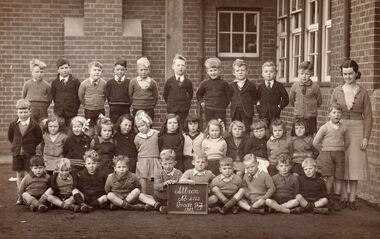 Sunshine and District Historical Society Incorporated
Photograph - Albion State School 1937 Class Photographs
... fruit tree orchard. As well as classroom groups, we have our learning teams, student house groups (siblings are allocated to the same house) and a Junior School Council. The school has four main buildings. All classrooms have air conditioning and interactive screens. Block ...The current school, Albion Primary School, No 4265 opened in 1926. It was built on a site once owned by John Fitzgerald (1850s). The land was later acquired by H. V. McKay who had transferred his Sunshine Harvester Works to the area in 1905 - 7. In 1920, the Albion railway station was moved nearer Ballarat Road at the request of Mr McKay. More people came to live in the area including soldier settlers.Albion Primary School's mission is to 'Aim High' in all we do so that our students grow to be socially capable, reach their full academic potential and become caring, respectful community minded people. Albion Primary School is located in a residential area in Albion, a small pocket of the local government area of Brimbank, approximately 10 kilometres west of Melbourne and was established in 1926. Our current enrolment is 199 students. We have a rich cultural diversity amongst our school community. The school is set around a courtyard with spacious playing areas including a grassed oval, running track, games courts, an adventure playground, sand pit, jumping pits, shady courtyard and garden areas, a vegetable garden and fruit tree orchard. As well as classroom groups, we have our learning teams, student house groups (siblings are allocated to the same house) and a Junior School Council. The school has four main buildings. All classrooms have air conditioning and interactive screens. Block A houses classrooms, staff areas and the administration offices. Our newest building has classrooms and some small group/office spaces. Block B includes our library, canteen and a multi-purpose room used for indoor physical education, Perceptual Motor Program, drama, visiting performers, and community activities. Block C houses classrooms and specialist rooms. We expect and receive the best from our students in terms of their learning and behaviour. The school’s dedicated and effective staff is strongly committed to helping students achieve personal, behavioural, social and academic success. In terms of learning, the highest priority is placed on the work in English and Mathematics. We also have a range of specialist and extra-curricular programs that we provide. Our specialist teacher-librarian is involved in reading extension programs that support development in literacy. All children are able to develop their artistic abilities through visual arts and music program. Our music program is supported by the Australian Children's Music Foundation. A specialist Physical Education teacher provides lessons for all children as well as the opportunity for students to participate in organised lunch time sporting competitions between the house groups. Auslan is the additional language all students learn at Albion. All children participate in a student wellbeing program that focuses on developing strong connections and a sense of belonging within the school. Our school student leaders participate in programs that help develop their leadership skills. 5103.01 - Albion State School 1937 Grade 1 and 2 5103.01 - Albion State School 1937 Grade 1 and 2 Names Back Row L2R Unknown George Unknown Bill Dickie Keith Narborough Wally Lawrence Kevin James John Hall Unknown Barry McKay Bertie Noble 2nd Row L2R Eddite Penterick Jean Duncan Josie Gahan Elaine Wilson Lorraine Brown Joy Fisher Beth Powell Vilma Hayes Mavis Cameron Albert Powerlett 3rd Row L2R Les Trickey Cynthia Strachan Beryl Phillips Joan Unknown Dorothy Long Margaret Baker Val Doherty Pat Robinson Brian Allen Front Row L2R Jan Mollison Alan Cockrane Syd Smith Ron Masson Alan Jenkins Graeme Lee Keith Reyland Unknown Unknown Alf Richer 5103.02 - Albion State School 1937 Grade 3 4 5103.03 - Albion State School 1937 Grade 5 6 5103.03 - Albion State School 1937 Grade 5 6 Names Back Row L2R Gordon Durham Harry Rhodes Ron Afflick Gordon Barnard Victor Weaver Ivan McBride Eric McKenzie Don Durham Eric Wegdon Jack McKay Jack Trickey 2nd Row L2R John Scott Cecelia Kellett Joan Montgomery Eileen Jenkins Lorraine Gorman Phyllis Mills Iris Hall Laura Narborough Marie Keogh Betty Shuffery Patricia Hayden Norma Close 3rd Row L2R May Schleebs Pat Mollison Mary Cockeraine Thelma Washington Doris Marchant Hilda Thomas Elizabeth Foxcroft Heather Gorman Shirley Hayes Marjory Thompson Dorothy Lowe Bonnie Dickie Mavis Judd Judith Powell Bernard Doherty 4th Row L2R Gordon Paton Sam Maloney Ken Barnard Austin Cairns Gerald Pemberton Billy Clark Bill Markham Maurice Canlishaver Bobby Dean Ivan Lowe Malcolm Cockrane Dexter Turner John Machin Front Row L2R Ken Pearce Don Jackson Ronny Stevens Jack Phelp Dick Hodge Keith Higgins Drummond Perkins Edwin MacMurray Ernie McBridge Keith Block Billy Lawson Brian Wright Peter Stuart Headmaster Mr Roach Teacher Miss Ashford 5103.04 - Albion State School 1937 Prep 5103.04 - Albion State School 1937 Prep Names Back Row L2R Ken Brown Les Heffer Ian Stephenson Geoff Afflick Unknown Unknown Jim Sutherland Unknown Ian McBean Doug Pyers Peter Buckingham Centre Row L2R Unknown Leila Heffer Celia Banks Unknown Unknown Mary Hall June Markham Heather Neish Bev Mollison June White Shirley Black Unknown Leila Heffer Bill Wilson Miss White Front Row L2R Roy Paton Ron Hill Laurie Mottin George Thomas Don Powlett Albert Hayden Unknown Max Richer Unknown Unknown 5103.05 - Albion State School 1937 Inspectors Report on Miss Catt albion state school, albion primary school, adelaide street, albion -
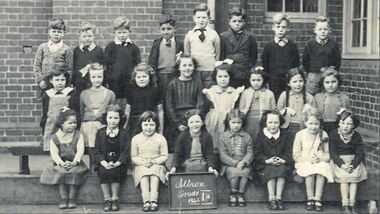 Sunshine and District Historical Society Incorporated
Photograph - Albion State School 1946 Class Photographs
... fruit tree orchard. As well as classroom groups, we have our learning teams, student house groups (siblings are allocated to the same house) and a Junior School Council. The school has four main buildings. All classrooms have air conditioning and interactive screens. Block ...The current school, Albion Primary School, No 4265 opened in 1926. It was built on a site once owned by John Fitzgerald (1850s). The land was later acquired by H. V. McKay who had transferred his Sunshine Harvester Works to the area in 1905 - 7. In 1920, the Albion railway station was moved nearer Ballarat Road at the request of Mr McKay. More people came to live in the area including soldier settlers.Albion Primary School's mission is to 'Aim High' in all we do so that our students grow to be socially capable, reach their full academic potential and become caring, respectful community minded people. Albion Primary School is located in a residential area in Albion, a small pocket of the local government area of Brimbank, approximately 10 kilometres west of Melbourne and was established in 1926. Our current enrolment is 199 students. We have a rich cultural diversity amongst our school community. The school is set around a courtyard with spacious playing areas including a grassed oval, running track, games courts, an adventure playground, sand pit, jumping pits, shady courtyard and garden areas, a vegetable garden and fruit tree orchard. As well as classroom groups, we have our learning teams, student house groups (siblings are allocated to the same house) and a Junior School Council. The school has four main buildings. All classrooms have air conditioning and interactive screens. Block A houses classrooms, staff areas and the administration offices. Our newest building has classrooms and some small group/office spaces. Block B includes our library, canteen and a multi-purpose room used for indoor physical education, Perceptual Motor Program, drama, visiting performers, and community activities. Block C houses classrooms and specialist rooms. We expect and receive the best from our students in terms of their learning and behaviour. The school’s dedicated and effective staff is strongly committed to helping students achieve personal, behavioural, social and academic success. In terms of learning, the highest priority is placed on the work in English and Mathematics. We also have a range of specialist and extra-curricular programs that we provide. Our specialist teacher-librarian is involved in reading extension programs that support development in literacy. All children are able to develop their artistic abilities through visual arts and music program. Our music program is supported by the Australian Children's Music Foundation. A specialist Physical Education teacher provides lessons for all children as well as the opportunity for students to participate in organised lunch time sporting competitions between the house groups. Auslan is the additional language all students learn at Albion. All children participate in a student wellbeing program that focuses on developing strong connections and a sense of belonging within the school. Our school student leaders participate in programs that help develop their leadership skills. 5104.01 - Albion State School 1946 Grade 1A 5104.02 - Albion State School 1946 Grade 3 4 5104.03 - Albion State School 1946 Grade 5 5104.04 - Albion State School 1946 Grade 6 5104.04 - Albion State School 1946 Grade 6 Names Back Row L2R Max Anderson Leon Clemson Reg Ayton George Baxter Ian Teague Bill Bonner Colin Phillips Allan Pearce 2nd Row L2R Judith Bonner Betty Montgomery Lena Brown Pam Carver Unknown Valerie Munro Dora Presser 3rd Row L2R Ann Clues Joan Boorer Pam Scrivener Valma Hawker Marjorie Lewis Front Row L2R Dick Duggan Ray Briggs Kevin James Ron Cameronalbion state school, albion primary school, adelaide street, albion -
 Sunshine and District Historical Society Incorporated
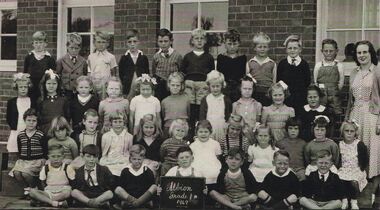
Photograph - Albion State School 1949 Class Photographs
... fruit tree orchard. As well as classroom groups, we have our learning teams, student house groups (siblings are allocated to the same house) and a Junior School Council. The school has four main buildings. All classrooms have air conditioning and interactive screens. Block ...The current school, Albion Primary School, No 4265 opened in 1926. It was built on a site once owned by John Fitzgerald (1850s). The land was later acquired by H. V. McKay who had transferred his Sunshine Harvester Works to the area in 1905 - 7. In 1920, the Albion railway station was moved nearer Ballarat Road at the request of Mr McKay. More people came to live in the area including soldier settlers.Albion Primary School's mission is to 'Aim High' in all we do so that our students grow to be socially capable, reach their full academic potential and become caring, respectful community minded people. Albion Primary School is located in a residential area in Albion, a small pocket of the local government area of Brimbank, approximately 10 kilometres west of Melbourne and was established in 1926. Our current enrolment is 199 students. We have a rich cultural diversity amongst our school community. The school is set around a courtyard with spacious playing areas including a grassed oval, running track, games courts, an adventure playground, sand pit, jumping pits, shady courtyard and garden areas, a vegetable garden and fruit tree orchard. As well as classroom groups, we have our learning teams, student house groups (siblings are allocated to the same house) and a Junior School Council. The school has four main buildings. All classrooms have air conditioning and interactive screens. Block A houses classrooms, staff areas and the administration offices. Our newest building has classrooms and some small group/office spaces. Block B includes our library, canteen and a multi-purpose room used for indoor physical education, Perceptual Motor Program, drama, visiting performers, and community activities. Block C houses classrooms and specialist rooms. We expect and receive the best from our students in terms of their learning and behaviour. The school’s dedicated and effective staff is strongly committed to helping students achieve personal, behavioural, social and academic success. In terms of learning, the highest priority is placed on the work in English and Mathematics. We also have a range of specialist and extra-curricular programs that we provide. Our specialist teacher-librarian is involved in reading extension programs that support development in literacy. All children are able to develop their artistic abilities through visual arts and music program. Our music program is supported by the Australian Children's Music Foundation. A specialist Physical Education teacher provides lessons for all children as well as the opportunity for students to participate in organised lunch time sporting competitions between the house groups. Auslan is the additional language all students learn at Albion. All children participate in a student wellbeing program that focuses on developing strong connections and a sense of belonging within the school. Our school student leaders participate in programs that help develop their leadership skills. 5106.01 - Albion State School 1949 Grade 1A 5106.01 - Albion State School 1949 Grade 1A Names Back Row L2R Tommy Roach Brian Davidson Frank Bruce Unknown Robert Laity Colin Kindred David Dolman Trevor Schmiot Neil McMahon Tom Clayton 2nd Row L2R Glenda Fletcher Sandra Barnes Barbara McKay Rebecca Unknown Faye Stephens Unknown Shirley Foster Linda Sexton Lorraine Sykes Jean Munro 3rd Row L2R Joy Miller Unknown Pat Madden Margaret Dern Unknown Unknown Alex Currie Rae Fenner Judith Short Lorraine Chin Unknown Carol Trickey Front Row L2R David Engellener Robert Skinner Geoff Hill Leslie OHanlon Warren Gamble Unknown Alan Thompson 5106.02 - Albion State School 1949 Grade 1B 5106.04 - Albion State School 1949 Grade 3 5106.05 - Albion State School 1949 Grade 4 5106.06 - Albion State School 1949 Grade 5 6albion state school, albion primary school, adelaide street, albion -
 Sunshine and District Historical Society Incorporated
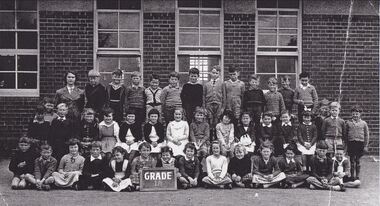
Photograph - Albion State School 1950 Class Photographs
... fruit tree orchard. As well as classroom groups, we have our learning teams, student house groups (siblings are allocated to the same house) and a Junior School Council. The school has four main buildings. All classrooms have air conditioning and interactive screens. Block ...The current school, Albion Primary School, No 4265 opened in 1926. It was built on a site once owned by John Fitzgerald (1850s). The land was later acquired by H. V. McKay who had transferred his Sunshine Harvester Works to the area in 1905 - 7. In 1920, the Albion railway station was moved nearer Ballarat Road at the request of Mr McKay. More people came to live in the area including soldier settlers.Albion Primary School's mission is to 'Aim High' in all we do so that our students grow to be socially capable, reach their full academic potential and become caring, respectful community minded people. Albion Primary School is located in a residential area in Albion, a small pocket of the local government area of Brimbank, approximately 10 kilometres west of Melbourne and was established in 1926. Our current enrolment is 199 students. We have a rich cultural diversity amongst our school community. The school is set around a courtyard with spacious playing areas including a grassed oval, running track, games courts, an adventure playground, sand pit, jumping pits, shady courtyard and garden areas, a vegetable garden and fruit tree orchard. As well as classroom groups, we have our learning teams, student house groups (siblings are allocated to the same house) and a Junior School Council. The school has four main buildings. All classrooms have air conditioning and interactive screens. Block A houses classrooms, staff areas and the administration offices. Our newest building has classrooms and some small group/office spaces. Block B includes our library, canteen and a multi-purpose room used for indoor physical education, Perceptual Motor Program, drama, visiting performers, and community activities. Block C houses classrooms and specialist rooms. We expect and receive the best from our students in terms of their learning and behaviour. The school’s dedicated and effective staff is strongly committed to helping students achieve personal, behavioural, social and academic success. In terms of learning, the highest priority is placed on the work in English and Mathematics. We also have a range of specialist and extra-curricular programs that we provide. Our specialist teacher-librarian is involved in reading extension programs that support development in literacy. All children are able to develop their artistic abilities through visual arts and music program. Our music program is supported by the Australian Children's Music Foundation. A specialist Physical Education teacher provides lessons for all children as well as the opportunity for students to participate in organised lunch time sporting competitions between the house groups. Auslan is the additional language all students learn at Albion. All children participate in a student wellbeing program that focuses on developing strong connections and a sense of belonging within the school. Our school student leaders participate in programs that help develop their leadership skills. 5107.01 - Albion State School 1950 Grade 1A 5107.02 - Albion State School 1950 Grade 2 5107.02 - Albion State School 1950 Grade 2 Names Back Row L2R Unknown Unknown Robert Laity Unknown David Dolman Unknown Colin Kindred Neil McMahon Unknown Trevor Schmidt Unknown Warren Gamble 2nd Row L2R Unknown Unknown Alex Currie Faye Stephens Margaret Dern Glenda Fletcher Shirley Foster Linda Sexton Unknown Lorraine Chin Jean Munro Unknown Unknown Unknown Front Row L2R Unknown Geoff Hill Alan Thompson Unknown Joy Miller Beverley Chin Pam Munro Unknown Unknown Sandra Barnes Judith Short Unknown Unknown Tom Clayton Teacher Miss Tierney 5107.03 - Albion State School 1950 Grade 2A 5107.04 - Albion State School 1950 Grade 2B 5107.05 - Albion State School 1950 Grade 3A 5107.06 - Albion State School 1950 Grade 5 5107.07 - Albion State School 1950 Grade 5A 5107.08 - Albion State School 1950 Grade 6 5107.09 - Albion State School 1950 Staffalbion state school, albion primary school, adelaide street, albion -
 Sunshine and District Historical Society Incorporated
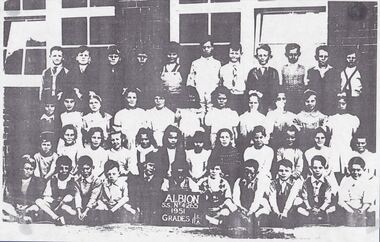
Photograph - Albion State School 1951 Class Photographs
... fruit tree orchard. As well as classroom groups, we have our learning teams, student house groups (siblings are allocated to the same house) and a Junior School Council. The school has four main buildings. All classrooms have air conditioning and interactive screens. Block ...The current school, Albion Primary School, No 4265 opened in 1926. It was built on a site once owned by John Fitzgerald (1850s). The land was later acquired by H. V. McKay who had transferred his Sunshine Harvester Works to the area in 1905 - 7. In 1920, the Albion railway station was moved nearer Ballarat Road at the request of Mr McKay. More people came to live in the area including soldier settlers.Albion Primary School's mission is to 'Aim High' in all we do so that our students grow to be socially capable, reach their full academic potential and become caring, respectful community minded people. Albion Primary School is located in a residential area in Albion, a small pocket of the local government area of Brimbank, approximately 10 kilometres west of Melbourne and was established in 1926. Our current enrolment is 199 students. We have a rich cultural diversity amongst our school community. The school is set around a courtyard with spacious playing areas including a grassed oval, running track, games courts, an adventure playground, sand pit, jumping pits, shady courtyard and garden areas, a vegetable garden and fruit tree orchard. As well as classroom groups, we have our learning teams, student house groups (siblings are allocated to the same house) and a Junior School Council. The school has four main buildings. All classrooms have air conditioning and interactive screens. Block A houses classrooms, staff areas and the administration offices. Our newest building has classrooms and some small group/office spaces. Block B includes our library, canteen and a multi-purpose room used for indoor physical education, Perceptual Motor Program, drama, visiting performers, and community activities. Block C houses classrooms and specialist rooms. We expect and receive the best from our students in terms of their learning and behaviour. The school’s dedicated and effective staff is strongly committed to helping students achieve personal, behavioural, social and academic success. In terms of learning, the highest priority is placed on the work in English and Mathematics. We also have a range of specialist and extra-curricular programs that we provide. Our specialist teacher-librarian is involved in reading extension programs that support development in literacy. All children are able to develop their artistic abilities through visual arts and music program. Our music program is supported by the Australian Children's Music Foundation. A specialist Physical Education teacher provides lessons for all children as well as the opportunity for students to participate in organised lunch time sporting competitions between the house groups. Auslan is the additional language all students learn at Albion. All children participate in a student wellbeing program that focuses on developing strong connections and a sense of belonging within the school. Our school student leaders participate in programs that help develop their leadership skills. 5108.01 - Albion State School 1951 Grade 1C 2A 5108.02 - Albion State School 1951 Grade 2B 5108.03 - Albion State School 1951 Grade 3 5108.03 - Albion State School 1951 Grade 3 Names Back Row L2R Trevor Schmidt Tom Clayton Ronald Bunton David Dolman Unknown Unknown Colin Kindred Neil McMahon Unknown David Patterson 2nd Row L2R Beverley Chin Unknown Linda Sexton Pam Munro Unknown Shirley Foster Unknown Glenda Fletcher Margaret Dern Unknown Sandra Barnes 3rd Row L2R Joy Miller Faye Stephens Jean Munro Carol Trickey Unknown Lorraine Chin Rae Fenner Alex Currie Judith Short Front Row L2R Allan Griggs Alan Thompson Brian Davidson Unknown Warren Gamble Tommy Roache David Engellener Peter Smith Geoff Hill Unknown 5108.05 - Albion State School 1951 Grade 5 5108.06 - Albion State School 1951 Grade 6B 5108.07 - Albion State School 1951 Grade Unknown 5108.08 - Albion State School 1951 Basketball Team SDSSA Runners Up 5108.09 - Albion State School 1951 Cricket Team SDSSA Runners Up 5108.10 - Albion State School 1951 Football Team SDSSA Runners Upalbion state school, albion primary school, adelaide street, albion -
 Sunshine and District Historical Society Incorporated
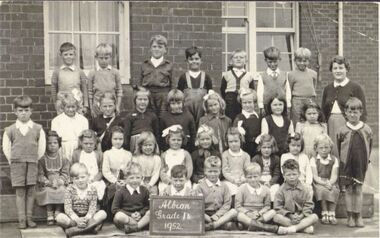
Photograph - Albion State School 1952 Class Photographs
... fruit tree orchard. As well as classroom groups, we have our learning teams, student house groups (siblings are allocated to the same house) and a Junior School Council. The school has four main buildings. All classrooms have air conditioning and interactive screens. Block ...The current school, Albion Primary School, No 4265 opened in 1926. It was built on a site once owned by John Fitzgerald (1850s). The land was later acquired by H. V. McKay who had transferred his Sunshine Harvester Works to the area in 1905 - 7. In 1920, the Albion railway station was moved nearer Ballarat Road at the request of Mr McKay. More people came to live in the area including soldier settlers.Albion Primary School's mission is to 'Aim High' in all we do so that our students grow to be socially capable, reach their full academic potential and become caring, respectful community minded people. Albion Primary School is located in a residential area in Albion, a small pocket of the local government area of Brimbank, approximately 10 kilometres west of Melbourne and was established in 1926. Our current enrolment is 199 students. We have a rich cultural diversity amongst our school community. The school is set around a courtyard with spacious playing areas including a grassed oval, running track, games courts, an adventure playground, sand pit, jumping pits, shady courtyard and garden areas, a vegetable garden and fruit tree orchard. As well as classroom groups, we have our learning teams, student house groups (siblings are allocated to the same house) and a Junior School Council. The school has four main buildings. All classrooms have air conditioning and interactive screens. Block A houses classrooms, staff areas and the administration offices. Our newest building has classrooms and some small group/office spaces. Block B includes our library, canteen and a multi-purpose room used for indoor physical education, Perceptual Motor Program, drama, visiting performers, and community activities. Block C houses classrooms and specialist rooms. We expect and receive the best from our students in terms of their learning and behaviour. The school’s dedicated and effective staff is strongly committed to helping students achieve personal, behavioural, social and academic success. In terms of learning, the highest priority is placed on the work in English and Mathematics. We also have a range of specialist and extra-curricular programs that we provide. Our specialist teacher-librarian is involved in reading extension programs that support development in literacy. All children are able to develop their artistic abilities through visual arts and music program. Our music program is supported by the Australian Children's Music Foundation. A specialist Physical Education teacher provides lessons for all children as well as the opportunity for students to participate in organised lunch time sporting competitions between the house groups. Auslan is the additional language all students learn at Albion. All children participate in a student wellbeing program that focuses on developing strong connections and a sense of belonging within the school. Our school student leaders participate in programs that help develop their leadership skills. 5109.01 - Albion State School 1952 Grade 1B 5109.02 - Albion State School 1952 Grade 1C 5109.03 - Albion State School 1952 Grade 1D 5109.03 - Albion State School 1952 Grade 3A 5109.04 - Albion State School 1952 Grade 3B 5109.05 - Albion State School 1952 Grade 4 5109.05 - Albion State School 1952 Grade 4 Names Back Row L2R Tommy Roache Peter Schmidt Unknown Unknown Kevin McMahon Wallace Bott Unknown Raymond Wild David Dolman Colin Kindred 2nd Row L2R Faye Stephens Helen Mott Valerie Smith Maria Mogilewska Paliga Gonshare Shirley Foster Linda Sexton Sandra Barnes Mara Kazins Rae Fenner Beverley Chin Unknown 3rd Row L2R Judith Short Paula Goncharow Valerie Smith Pam Munro Violet Smith Jean Munro Joy Miller Pam Madden Margaret Dern Carol Trickey Lorraine Chin Alex Currie Front Row L2R Unknown Brian Davidson Unknown Neil McMahon Gary Smith David Engellener Trevor Schmidt Tom Clayton Geoff Hill Robert Unknown Keith Perry Alan Griggs Alan Thompson Warren Gamble 5109.06 - Albion State School 1952 Grade 5 5109.07 - Albion State School 1952 Grade 6 5109.08 - Albion State School 1952 Kindergarten 5109.09 - Albion State School 1952 Reunion in 1985 5109.10 - Albion State School 1952 Class Reunion Newspaper Article 5109.11 - Albion State School 1952 Basketball Team Premiersalbion state school, albion primary school, adelaide street, albion -
 Sunshine and District Historical Society Incorporated
Photograph - Albion State School 1953 Class Photographs
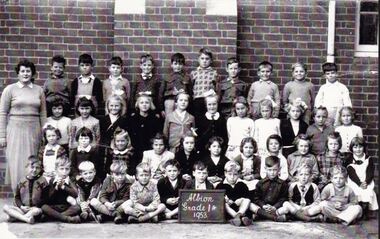
... fruit tree orchard. As well as classroom groups, we have our learning teams, student house groups (siblings are allocated to the same house) and a Junior School Council. The school has four main buildings. All classrooms have air conditioning and interactive screens. Block ...The current school, Albion Primary School, No 4265 opened in 1926. It was built on a site once owned by John Fitzgerald (1850s). The land was later acquired by H. V. McKay who had transferred his Sunshine Harvester Works to the area in 1905 - 7. In 1920, the Albion railway station was moved nearer Ballarat Road at the request of Mr McKay. More people came to live in the area including soldier settlers.Albion Primary School's mission is to 'Aim High' in all we do so that our students grow to be socially capable, reach their full academic potential and become caring, respectful community minded people. Albion Primary School is located in a residential area in Albion, a small pocket of the local government area of Brimbank, approximately 10 kilometres west of Melbourne and was established in 1926. Our current enrolment is 199 students. We have a rich cultural diversity amongst our school community. The school is set around a courtyard with spacious playing areas including a grassed oval, running track, games courts, an adventure playground, sand pit, jumping pits, shady courtyard and garden areas, a vegetable garden and fruit tree orchard. As well as classroom groups, we have our learning teams, student house groups (siblings are allocated to the same house) and a Junior School Council. The school has four main buildings. All classrooms have air conditioning and interactive screens. Block A houses classrooms, staff areas and the administration offices. Our newest building has classrooms and some small group/office spaces. Block B includes our library, canteen and a multi-purpose room used for indoor physical education, Perceptual Motor Program, drama, visiting performers, and community activities. Block C houses classrooms and specialist rooms. We expect and receive the best from our students in terms of their learning and behaviour. The school’s dedicated and effective staff is strongly committed to helping students achieve personal, behavioural, social and academic success. In terms of learning, the highest priority is placed on the work in English and Mathematics. We also have a range of specialist and extra-curricular programs that we provide. Our specialist teacher-librarian is involved in reading extension programs that support development in literacy. All children are able to develop their artistic abilities through visual arts and music program. Our music program is supported by the Australian Children's Music Foundation. A specialist Physical Education teacher provides lessons for all children as well as the opportunity for students to participate in organised lunch time sporting competitions between the house groups. Auslan is the additional language all students learn at Albion. All children participate in a student wellbeing program that focuses on developing strong connections and a sense of belonging within the school. Our school student leaders participate in programs that help develop their leadership skills. 5110.01 - Albion State School 1953 Grade 1A 5110.01 - Albion State School 1953 Grade 1A Names Back Row L2R Unknown John Maynard Unknown Unknown Unknown Unknown Graeme Cheeseman Unknown Unknown Unknown 2nd Row L2R Unknown Unknown Unknown Unknown Jennifer Leurny Lynette Alcorn Unknown Unknown Unknown Unknown 3rd Row L2R Unknown Dianne Higgins Olga Unknown Unknown Unknown Unknown Unknown Maureen Tibbles Unknown Unknown Unknown Front Row L2R Unknown Unknown Donald Cameron Unknown Murray Vague Unknown Fred Engellener Unknown Unknown Trevor Jury Leon Kinnersly Teacher Miss Shannon 5110.02 - Albion State School 1953 Grade 1B 5110.03 - Albion State School 1953 Grade 1C 5110.04 - Albion State School 1953 Grade 1D 5110.05 - Albion State School 1953 Grade 2 5110.06 - Albion State School 1953 Grade 3 5110.06 - Albion State School 1953 Grade 3 Names Back Row L2R Kerry Wilson Peter Stanick Christopher Tebble Unknown Charlie Miller Ian Bott Christopher Jones Trevor Allan Andrew Policheck 2nd Row L2R Carolyn Triswell Jean Short Denise Clayton Lynette Hodgson Ann Tierney Dorothy Frecknail Kay Wegner Denise Baines Janice Unknown Monica Stefarck Marilyn Allan Sitting L2R Carolyn Baldwin Pat Shinbel Aileen Anderson Maria Terenska Sencha Emblin Avril Fenner Vera Unknown Gwenda Chin Wendy Allan Pat Rees Gay Marsh Front Row L2R Janet Cox Jimmy Paterson John Waring John Beckwith John Prince Barry Short Ron Mannion Bill Hocking Dennis Gamble Graham Trainor Alan Holland John Kennedy Dennis Casey 5110.07 - Albion State School 1953 Grade 4B 5110.08 - Albion State School 1953 Grade 5 5110.08 - Albion State School 1953 Grade 5 Names Back Row L2R Unknown Neil McMahon Unknown Robert Skinner Raymond Wild Wallace Bott Unknown Unknown David Dolman Unknown 2nd Row L2R Pam Munro Unknown Unknown Valerie Smith Linda Sexton Unknown Shirley Foster Maria Mogilewska Helen Mott Unknown Unknown Beverley Chin Lorraine Chin 3rd Row L2R Judith Short Jean Munro Margaret Dern Carol Trickey Joy Miller Glenda Fletcher Sandra Barnes Faye Stephens Unknown Rae Fenner Barbara Robinson 4th Row L2R Alex Currie Tom Clayton Unknown Unknown Robert Laity Unknown Unknown Unknown Unknown Unknown Unknown Mara Kazins Front Row L2R Unknown Geoff Hill Unknown Unknown Unknown Gary Smith Trevor Schmidt Alan Thompson 5110.09 - Albion State School 1953 Grade 2Balbion state school, albion primary school, adelaide street, albion -
 Sunshine and District Historical Society Incorporated
Photograph - Albion State School 1955 Class Photographs
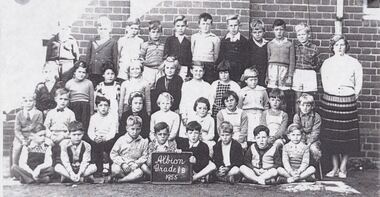
... fruit tree orchard. As well as classroom groups, we have our learning teams, student house groups (siblings are allocated to the same house) and a Junior School Council. The school has four main buildings. All classrooms have air conditioning and interactive screens. Block ...The current school, Albion Primary School, No 4265 opened in 1926. It was built on a site once owned by John Fitzgerald (1850s). The land was later acquired by H. V. McKay who had transferred his Sunshine Harvester Works to the area in 1905 - 7. In 1920, the Albion railway station was moved nearer Ballarat Road at the request of Mr McKay. More people came to live in the area including soldier settlers.Albion Primary School's mission is to 'Aim High' in all we do so that our students grow to be socially capable, reach their full academic potential and become caring, respectful community minded people. Albion Primary School is located in a residential area in Albion, a small pocket of the local government area of Brimbank, approximately 10 kilometres west of Melbourne and was established in 1926. Our current enrolment is 199 students. We have a rich cultural diversity amongst our school community. The school is set around a courtyard with spacious playing areas including a grassed oval, running track, games courts, an adventure playground, sand pit, jumping pits, shady courtyard and garden areas, a vegetable garden and fruit tree orchard. As well as classroom groups, we have our learning teams, student house groups (siblings are allocated to the same house) and a Junior School Council. The school has four main buildings. All classrooms have air conditioning and interactive screens. Block A houses classrooms, staff areas and the administration offices. Our newest building has classrooms and some small group/office spaces. Block B includes our library, canteen and a multi-purpose room used for indoor physical education, Perceptual Motor Program, drama, visiting performers, and community activities. Block C houses classrooms and specialist rooms. We expect and receive the best from our students in terms of their learning and behaviour. The school’s dedicated and effective staff is strongly committed to helping students achieve personal, behavioural, social and academic success. In terms of learning, the highest priority is placed on the work in English and Mathematics. We also have a range of specialist and extra-curricular programs that we provide. Our specialist teacher-librarian is involved in reading extension programs that support development in literacy. All children are able to develop their artistic abilities through visual arts and music program. Our music program is supported by the Australian Children's Music Foundation. A specialist Physical Education teacher provides lessons for all children as well as the opportunity for students to participate in organised lunch time sporting competitions between the house groups. Auslan is the additional language all students learn at Albion. All children participate in a student wellbeing program that focuses on developing strong connections and a sense of belonging within the school. Our school student leaders participate in programs that help develop their leadership skills. 5111.01 - Albion State School 1955 Grade 1B 5111.02 - Albion State School 1955 Grade 1D 5111.03 - Albion State School 1955 Grade 2A 5111.04 - Albion State School 1955 Grade 2B 5111.05 - Albion State School 1955 Grade 3A 5111.06 - Albion State School 1955 Grade 3B 5111.06 - Albion State School 1955 Grade 3B Names Back Row L2R Unknown Unknown Unknown Rod McCalman Paul Mychaily Schyn Steven Sherlock Unknown Unknown 2nd Row L2R Unknown Unknown Leonie Carrick Ann Bannerman Roslyn More Helen Sankey Vivian Hodgson Unknown Dianne Dixon Olga Unknown Unknown 3rd Row L2R Suzanne Lutge Verna Unknown Unknown Angelina Sachow Pamela Owens Janice Pengelly Unknown Constance Wilson Gail Rothwell Unknown Lynette Cardigan 4th Row L2R Unknown Brian Martin Donald Cameron Unknown Unknown Unknown Rodney Sexton Tony Buc Unknown Desmond Fry Unknown 5111.07 - Albion State School 1955 Grade 4A 5111.08 - Albion State School 1955 Grade 5 5111.09 - Albion State School 1955 Grade 6 5111.10 - Albion State School 1955 Grade 6Balbion state school, albion primary school, adelaide street, albion
