
Showing 245 items matching "geelong area"
-
 Ballarat Tramway Museum
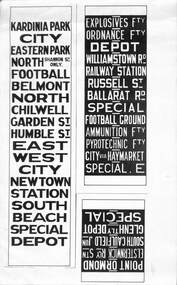
Sign - Sign - Destination Blinds, Tram Destination Blinds for various areas - Geelong and Melbourne
... ...geelong area...Geelong. The Maribyrnong blind shown was on the tram route that stopped at Explosives Factory, Ordnance Factory, Ammunition Factory and Pyrotechnic Factory. These trams carried local people and workers at the different factories. The last item listed SPECIAL.E was not to carry general passengers - workers only. Small example shows Caulfield area...Miniature blinds for Geelong area - white with black print and Melbourne area of Maribyrnong - black with white print....Tram Destination Blinds for various areas - Geelong and Melbourne Sign Sign - Destination Blinds ...Ron Bridger was an avid collector of items related to transport, predominately Trams. These items include newspaper cuttings, pamphlets, reports, timetables, fares prices plus special items relating to events. Items from Melbourne and regional Victoria, interstate - Adelaide and Sydney, plus overseas, make up this collection. Sheet showing examples of tram destination blinds in miniature. Geelong example is white with black print. Footscray/Melbourne examples are black with white print. Geelong blind starts with Kardinia Park going to the City, Eastern Park, Shannon Street, Belmont, Chilwell, Garden and Humble Streets, City, Newtown, Station, South Beach, Depot. This is one of the routes that provided tram travel for people in Geelong. The Maribyrnong blind shown was on the tram route that stopped at Explosives Factory, Ordnance Factory, Ammunition Factory and Pyrotechnic Factory. These trams carried local people and workers at the different factories. The last item listed SPECIAL.E was not to carry general passengers - workers only. Small example shows Caulfield area.Miniature blinds for Geelong area - white with black print and Melbourne area of Maribyrnong - black with white print.Names of stopping places listed for each routeas box 48a, destination blinds, geelong area, kardinia park, eastern park, football, belmont, chilwell, humble street, garden street, newtown, south beach, explosives factory, ordnance factory, williamstown road, russell street, football ground, ammunition factory, pyrotechnic factory, haymarket, special e, point ormond, south caulfield, elsternwick railway station, glenhuntly depot, special, ron bridger collection -
 Ballarat Tramway Museum
Document, Hector Bell Junior, "Street passenger transport system of Geelong Urban Area", 1949
... "Street passenger transport system of Geelong Urban Area"...Report by Hector H Bell Junior of the MMTB early 1949, titled "Street passenger transport system of Geelong Urban Area". Looks at the history of public transport in Geelong, tramway data, financial analysis, the Geelong bus system, buses servicing the North Shore industries - principally the Ford Works, the condition of the bus fleet, taxi and private car hire services, functions of a street transport authority, town planning, populations and traffic surveys, relative values of passenger vehicles, trolley buses, industry and recommendations. ..."Street passenger transport system of Geelong Urban Area" Document Hector Bell Junior ...Report by Hector H Bell Junior of the MMTB early 1949, titled "Street passenger transport system of Geelong Urban Area". Looks at the history of public transport in Geelong, tramway data, financial analysis, the Geelong bus system, buses servicing the North Shore industries - principally the Ford Works, the condition of the bus fleet, taxi and private car hire services, functions of a street transport authority, town planning, populations and traffic surveys, relative values of passenger vehicles, trolley buses, industry and recommendations. Said the tramway system was obsolete, should be a rail service between North and South Geelong, set up a street transport body, replan the Geelong railway station, additional roads to service the North Shore area. Refers to attachments. Has a list of people involved in the preparation of the report. See item 112 for the AETA response of April 1949 to this report.Yields information about the Geelong tram and bus services in 1948/49 and how it could be developed or reformed. Has a close association with Hector Bell Junior, the son of the then MMTB Chairman.Document - 18 foolscap sheets photocopied and stapled in three places along the side.tramways, secv, geelong, statistics, history, passenger services, reports, aeta -
 National Wool Museum
Photograph
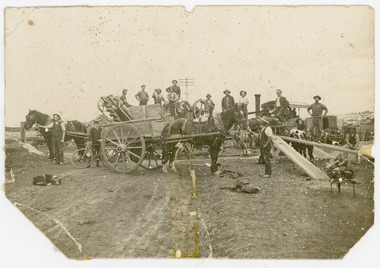
... It depicts workman surfacing a road in the Geelong area. The steam engine present is driving a belt to operate a crusher which is crushing rock to surface the road. ...Photograph, road surfacing in the Geelong area, c.1900-20....Road surfacing Photograph, road surfacing in the Geelong area, c.1900-20. Photograph Photograph ...Donor purchased this photograph from an op. shop. It depicts workman surfacing a road in the Geelong area. The steam engine present is driving a belt to operate a crusher which is crushing rock to surface the road. The drays are used to carry the crushed rock.Photograph, road surfacing in the Geelong area, c.1900-20.road surfacing -
 Allan Doney Collection, Bendigo Historical Society Inc.
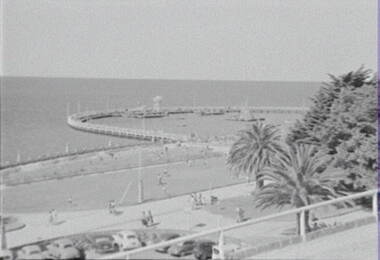
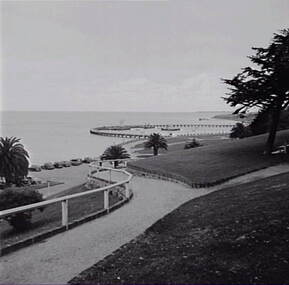
Negative - Geelong - Beach - Swimming Area, Allan Doney, 1950 -1970
... Geelong - Beach - Swimming Area...Negative Geelong - Beach - Swimming Area Allan Doney ...In the years of Allan Doney’s photography, landmark buildings succumbed to fire, neglect and redevelopment. He photographed the grey sand hills from Bendigo’s mining past, the streetscapes, poppet heads, miners’ cottages, gracious homes with ornate verandahs, trams and much more. Above all, his photographs show how much of the city has survived from the 19th century – and how much has not. Through two decades of great change, Allan Doney was there to capture ways people interacted with it. Although he travelled to many other places in Northern Victoria and beyond in search of subjects for his art, he seemed to always return to Bendigo for inspiration. -
 Allan Doney Collection, Bendigo Historical Society Inc.
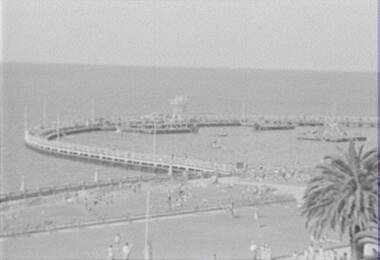
Negative - Geelong - Beach - Swimming Area, Allan Doney, 1950 -1970
... Geelong - Beach - Swimming Area...Negative Geelong - Beach - Swimming Area Allan Doney ...In the years of Allan Doney’s photography, landmark buildings succumbed to fire, neglect and redevelopment. He photographed the grey sand hills from Bendigo’s mining past, the streetscapes, poppet heads, miners’ cottages, gracious homes with ornate verandahs, trams and much more. Above all, his photographs show how much of the city has survived from the 19th century – and how much has not. Through two decades of great change, Allan Doney was there to capture ways people interacted with it. Although he travelled to many other places in Northern Victoria and beyond in search of subjects for his art, he seemed to always return to Bendigo for inspiration. -
 Allan Doney Collection, Bendigo Historical Society Inc.
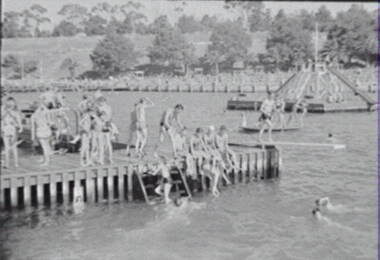
Negative - Geelong - Beach - Swimming Area, Allan Doney, 1950 -1970
... Geelong - Beach - Swimming Area...Negative Geelong - Beach - Swimming Area Allan Doney ...In the years of Allan Doney’s photography, landmark buildings succumbed to fire, neglect and redevelopment. He photographed the grey sand hills from Bendigo’s mining past, the streetscapes, poppet heads, miners’ cottages, gracious homes with ornate verandahs, trams and much more. Above all, his photographs show how much of the city has survived from the 19th century – and how much has not. Through two decades of great change, Allan Doney was there to capture ways people interacted with it. Although he travelled to many other places in Northern Victoria and beyond in search of subjects for his art, he seemed to always return to Bendigo for inspiration. -
 Allan Doney Collection, Bendigo Historical Society Inc.
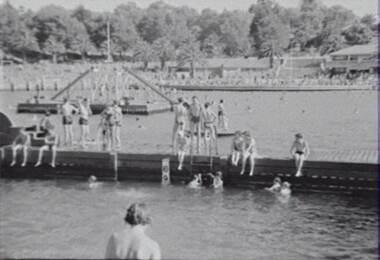
Negative - Geelong - Beach - Swimming Area, Allan Doney, 1950 -1970
... Geelong - Beach - Swimming Area...Negative Geelong - Beach - Swimming Area Allan Doney ...In the years of Allan Doney’s photography, landmark buildings succumbed to fire, neglect and redevelopment. He photographed the grey sand hills from Bendigo’s mining past, the streetscapes, poppet heads, miners’ cottages, gracious homes with ornate verandahs, trams and much more. Above all, his photographs show how much of the city has survived from the 19th century – and how much has not. Through two decades of great change, Allan Doney was there to capture ways people interacted with it. Although he travelled to many other places in Northern Victoria and beyond in search of subjects for his art, he seemed to always return to Bendigo for inspiration. -
 Allan Doney Collection, Bendigo Historical Society Inc.
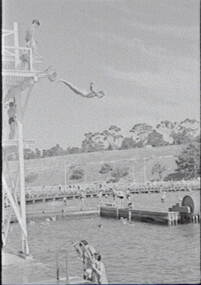
Negative - Geelong - Beach - Swimming Area, Allan Doney, 1950 -1970
... Geelong - Beach - Swimming Area...Negative Geelong - Beach - Swimming Area Allan Doney ...In the years of Allan Doney’s photography, landmark buildings succumbed to fire, neglect and redevelopment. He photographed the grey sand hills from Bendigo’s mining past, the streetscapes, poppet heads, miners’ cottages, gracious homes with ornate verandahs, trams and much more. Above all, his photographs show how much of the city has survived from the 19th century – and how much has not. Through two decades of great change, Allan Doney was there to capture ways people interacted with it. Although he travelled to many other places in Northern Victoria and beyond in search of subjects for his art, he seemed to always return to Bendigo for inspiration. -
 Allan Doney Collection, Bendigo Historical Society Inc.
Negative - Geelong - Beach - Swimming Area, Allan Doney, 1950 -1970
... Geelong - Beach - Swimming Area...Negative Geelong - Beach - Swimming Area Allan Doney ...In the years of Allan Doney’s photography, landmark buildings succumbed to fire, neglect and redevelopment. He photographed the grey sand hills from Bendigo’s mining past, the streetscapes, poppet heads, miners’ cottages, gracious homes with ornate verandahs, trams and much more. Above all, his photographs show how much of the city has survived from the 19th century – and how much has not. Through two decades of great change, Allan Doney was there to capture ways people interacted with it. Although he travelled to many other places in Northern Victoria and beyond in search of subjects for his art, he seemed to always return to Bendigo for inspiration. -
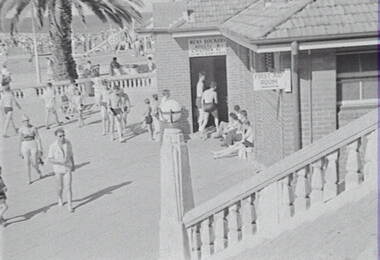 Allan Doney Collection, Bendigo Historical Society Inc.
Negative - Geelong - Beach - Swimming Area, Allan Doney, 1950 -1970
... Geelong - Beach - Swimming Area...Negative Geelong - Beach - Swimming Area Allan Doney ...In the years of Allan Doney’s photography, landmark buildings succumbed to fire, neglect and redevelopment. He photographed the grey sand hills from Bendigo’s mining past, the streetscapes, poppet heads, miners’ cottages, gracious homes with ornate verandahs, trams and much more. Above all, his photographs show how much of the city has survived from the 19th century – and how much has not. Through two decades of great change, Allan Doney was there to capture ways people interacted with it. Although he travelled to many other places in Northern Victoria and beyond in search of subjects for his art, he seemed to always return to Bendigo for inspiration. -
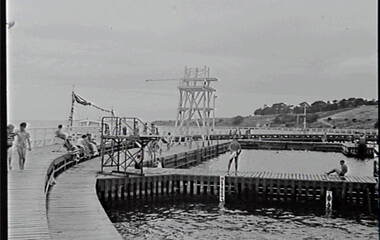 Allan Doney Collection, Bendigo Historical Society Inc.
Negative - Geelong - Beach - Swimming Area, Allan Doney, 1950 -1970
... Geelong - Beach - Swimming Area...Negative Geelong - Beach - Swimming Area Allan Doney ...In the years of Allan Doney’s photography, landmark buildings succumbed to fire, neglect and redevelopment. He photographed the grey sand hills from Bendigo’s mining past, the streetscapes, poppet heads, miners’ cottages, gracious homes with ornate verandahs, trams and much more. Above all, his photographs show how much of the city has survived from the 19th century – and how much has not. Through two decades of great change, Allan Doney was there to capture ways people interacted with it. Although he travelled to many other places in Northern Victoria and beyond in search of subjects for his art, he seemed to always return to Bendigo for inspiration. -
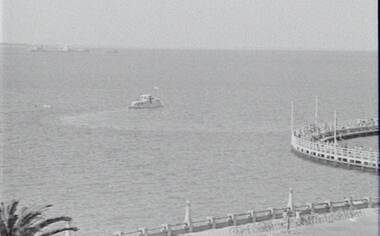 Allan Doney Collection, Bendigo Historical Society Inc.
Negative - Geelong - Ships - Ocean - Swimming Area, Allan Doney, 1950 -1970
... Geelong - Ships - Ocean - Swimming Area...Negative Geelong - Ships - Ocean - Swimming Area Allan Doney ...In the years of Allan Doney’s photography, landmark buildings succumbed to fire, neglect and redevelopment. He photographed the grey sand hills from Bendigo’s mining past, the streetscapes, poppet heads, miners’ cottages, gracious homes with ornate verandahs, trams and much more. Above all, his photographs show how much of the city has survived from the 19th century – and how much has not. Through two decades of great change, Allan Doney was there to capture ways people interacted with it. Although he travelled to many other places in Northern Victoria and beyond in search of subjects for his art, he seemed to always return to Bendigo for inspiration. -
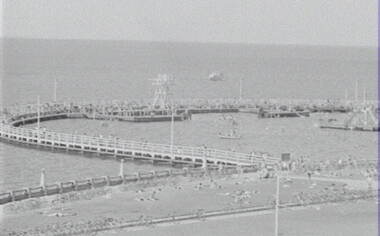 Allan Doney Collection, Bendigo Historical Society Inc.
Negative - Geelong - Ships - Ocean - Swimming Area, Allan Doney, 1950 -1970
... Geelong - Ships - Ocean - Swimming Area...Negative Geelong - Ships - Ocean - Swimming Area Allan Doney ...In the years of Allan Doney’s photography, landmark buildings succumbed to fire, neglect and redevelopment. He photographed the grey sand hills from Bendigo’s mining past, the streetscapes, poppet heads, miners’ cottages, gracious homes with ornate verandahs, trams and much more. Above all, his photographs show how much of the city has survived from the 19th century – and how much has not. Through two decades of great change, Allan Doney was there to capture ways people interacted with it. Although he travelled to many other places in Northern Victoria and beyond in search of subjects for his art, he seemed to always return to Bendigo for inspiration. -
 Buninyong Visitor Information Centre
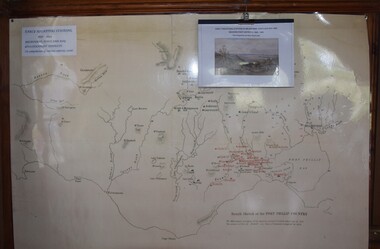
Map, Early Squatters Stations 1837-1838
... Reproduction of a coloured map shows pastoral stations around the Geelong area from 1837-1940. ...Pastoralism Stations Farming Settlement Squatters Reproduction of a coloured map shows pastoral stations around the Geelong area from 1837-1940. Early Squatters Stations 1837-1838 Map Map ...The map shows rivers and pastoral holdings from 1837 to 1838. Stations occupied around Geelong in 1837 are shown in red and those occupied in 1838 are shown in black. Reproduction of a coloured map shows pastoral stations around the Geelong area from 1837-1940. pastoralism, stations, farming, settlement, squatters -
 Ballarat Tramway Museum
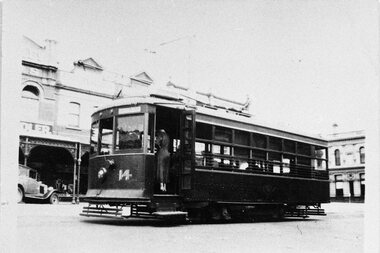
Photograph - Black & White Photograph/s, George Netherway, 1937
... Photo is Geelong Birney, No. 14 is central Geelong area in 1937. Caption on 587 is "Geelong Birney No. 14."...Photo is Geelong Birney, No. 14 is central Geelong area in 1937. Caption on 587 is "Geelong Birney No. 14." ...Copy photograph of a small photograph contained within item Reg. No. 587. Photo is Geelong Birney, No. 14 is central Geelong area in 1937. Caption on 587 is "Geelong Birney No. 14."trams, tramways, geelong, birney , tram 14 -
University of Melbourne, Burnley Campus Archives
geological survey - Map, Geological Survey of Victoria - Australia 1:63 360 - A. Geelong B. Portarlington, 1963
... Coloured geological survey map of Geelong area: showing sedimentary and igneous rock formations and contours. ...Coloured geological survey map of Geelong area: showing sedimentary and igneous rock formations and contours. ...A. Coloured geological survey map of Geelong area: showing sedimentary and igneous rock formations and contours. B. Coloured geological survey map of Portarlington, Victoria. By Dept. Of Mines, Melbourne. Scale 1 Mile to 1 inchgeelong, portarlington, victoria geological survey -
 Queenscliffe Maritime Museum
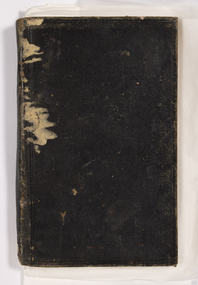
Document - Diary of John Clarke 1850 to 1883, John Clarke, Personal diary of John Clarke, 1850 to 1883
... A small leather bound black diary containing entries by John Clarke from 1843 to 1883, recording aspects of his life in Australia from the wreck of the Colombine as a child [approx 13 y.o.a.] to his experiences working in the gold fields and around the Geelong area. The diary is extensively damaged....John Clarke Barque Colombine Approaches to Port Phillip Ship Wrecks South coast A small leather bound black diary containing entries by John Clarke from 1843 to 1883, recording aspects of his life in Australia from the wreck of the Colombine as a child [approx 13 y.o.a.] to his experiences working in the gold fields and around the Geelong area. The diary is extensively damaged. ...The wreck site identified as the Columbine, a two masted brig built in 1839 in Aberdeen, Scotland and wrecked on the 1st April 1854 at Ocean Grove, Victoria, was formally reported to Heritage Victoria as located on the 15th January 2003 by Peter Ferrier and Don Love. As the site is over 75 years old it is automatically protected under the Commonwealth Historic Shipwrecks Act 1976. This diary is important as it outlines the eye witness account of the last moments of the Barque Columbine which is primarily of historic, technical, social and archaeological significance internationally and to the State of Victoria. It is a unique original account of that episode in early migrant history of Victoria and of Australia.A small leather bound black diary containing entries by John Clarke from 1843 to 1883, recording aspects of his life in Australia from the wreck of the Colombine as a child [approx 13 y.o.a.] to his experiences working in the gold fields and around the Geelong area. The diary is extensively damaged.john clarke, barque colombine, approaches to port phillip, ship wrecks, south coast -
 Lara RSL Sub Branch
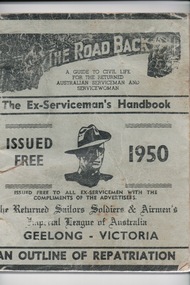
Handbook, W.A.Cooney, The Road Back, 1947/1950
... The handbook was distributed to all ex-servicemen on return from WW2 in the Geelong area and was a guide to civil life....The handbook was distributed to all ex-servicemen on return from WW2 in the Geelong area and was a guide to civil life. This booklet for returned service personnel from World War 2 living in the Geelong Region is og local district significance as a part of the history of Geelong. the road back the ex-serviceman's handbook world war 2 ww2 australian aif australian serviceman australian servicewoman rss&aila army navy air force returned sailor's, soldier's and airmen's imperial league of australia rsl The Road Back The Ex-Serviceman's Handbook Geelong. ...The handbook was distributed to all ex-servicemen on return from WW2 in the Geelong area and was a guide to civil life.This booklet for returned service personnel from World War 2 living in the Geelong Region is og local district significance as a part of the history of Geelong.The Road Back -two of The Ex-Serviceman's Handbooks,1947/ 1950 Geelong Issued Free.One is Light green in colour with black writingThe Road Back The Ex-Serviceman's Handbook Geelong.the road back, the ex-serviceman's handbook, world war 2, ww2, australian aif, australian serviceman, australian servicewoman, rss&aila, army, navy, air force, returned sailor's, soldier's and airmen's imperial league of australia, rsl -
 National Wool Museum
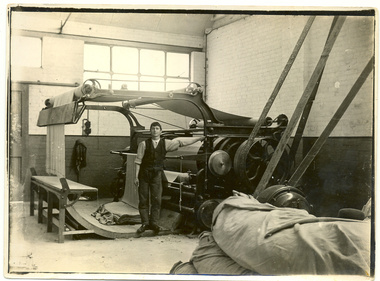
Photograph
... The photograph is of Joseph Williams who lived all his life in the Geelong area....The photograph is of Joseph Williams who lived all his life in the Geelong area. Textile Machinery Textile Mills Weaving Mills Textile Mills Collins Bros Mill Pty Ltd Tweedside Woollen Mills Yarra Falls Mill Murgatroyd Mr Fred Murgatroyd Mr James Williams Mr Joseph - Federal Woollen Mills Ltd Textile Machinery Textile Mills Weaving Mills F Murgatroyd Murgatroyd Photograph Collection Photograph ...Fred Murgatroyd worked as a loom tuner at Yarra Falls, Tweedside and Collins mills in Victoria as well as in Sydney, and studied at Leeds University. The photograph is of Joseph Williams who lived all his life in the Geelong area.Murgatroyd Photograph CollectionF Murgatroydtextile machinery textile mills weaving mills textile mills, collins bros mill pty ltd tweedside woollen mills yarra falls mill, murgatroyd, mr fred murgatroyd, mr james williams, mr joseph - federal woollen mills ltd, textile machinery, textile mills, weaving mills -
 National Wool Museum
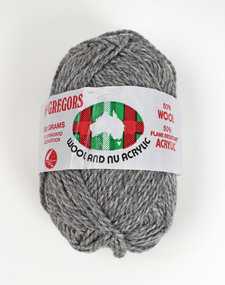
Textile - McGregors Yarn, J.L. McGregor Pty Ltd, c.1988
... The McGregor family still live in the Geelong area....The McGregor family still live in the Geelong area. wool j.l. mcgregor pty ltd yarn geelong wool geelong geelong woollen mills On Label: McGregors 50 Grams at standard condition 50% Wool 50% Flame resistant Acrylic Below Logo: Wool and Nu Acrylic A ball of grey yarn, 50% wool and 50% acrylic with a plastic label surrounding the wool with the product details. ...The yarn was made in Geelong in the late 1980's or early 1990's by local woolen manufacturer J.L. McGregor Pty Ltd. The company closed in the early 1990s. The McGregor family still live in the Geelong area.A ball of grey yarn, 50% wool and 50% acrylic with a plastic label surrounding the wool with the product details.On Label: McGregors 50 Grams at standard condition 50% Wool 50% Flame resistant Acrylic Below Logo: Wool and Nu Acrylicwool, j.l. mcgregor pty ltd, yarn, geelong wool, geelong, geelong woollen mills -
 Geelong Cycling Club
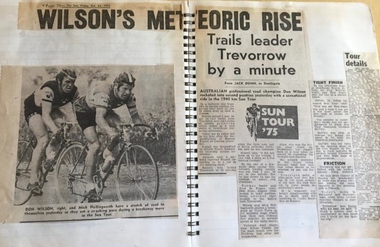
GWCC Club Records, 1977-85
... The 1977-1982 Newspaper articles and race results provide information on well known cycling identities in the Geelong area, some of whom achieved Australian and World championships in this sport. ...The 1977-1982 Newspaper articles and race results provide information on well known cycling identities in the Geelong area, some of whom achieved Australian and World championships in this sport. ...The 1977-1982 Newspaper articles and race results provide information on well known cycling identities in the Geelong area, some of whom achieved Australian and World championships in this sport. Also included are minutes of meetings and correspondence 1978-1985.Well known racing identities of the time and Geelong Cycling Club members - Don Wilson - who won the Australian national road race title in 1975 and 1977. He also competed in the individual road race and the team time trial events at the 1968 Summer Olympics in Mexico, and the Sun Tour during this period.Wilson won and set the fastest time in the amateur Goulburn to Sydney Classic in 1967 run in reverse direction from Milperra to Goulburn. and John Trevorrow - won the Australian national road race title in 1978, 1979 and 1980. He was also 3 time Sun Tour winner in 1975, 1977 and 1979.Newspaper articles and hard backed books with handwritten minutes and correspondence and race results for the period 1977-1982. -
 Bendigo Historical Society Inc.
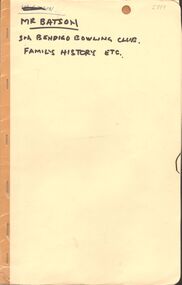
Document - FAMILY HISTORY: WILLIAM WARBOYS BATSON
... Family settled in Geelong area with children later at Nhill and Clifton Hill. ...Family settled in Geelong area with children later at Nhill and Clifton Hill. ...Family History - William Warboys BATSON 1815-1907. Mention in text of research being done at the Bendigo Library and cover of document has 'Mr Batson 9th? Bendigo Bowling Club; Family History etc.' handwritten. Otherwise, there appears to be no reference to Bendigo in the text of this document. Family settled in Geelong area with children later at Nhill and Clifton Hill. Account of journey to Australia in the 'Travancore' (1849) - one of three ships with immigrants settled by Dr. John Dunmore Lang. Location:person, individual, william warboys batson, william warboys batson. dr john dunmore lang. travancore. -
 Geelong Cycling Club
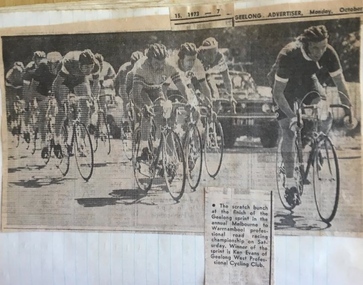
Cycling Track and Race Records
... The 1973-1979 Newspaper articles and race results provide information on well known cycling identities in the Geelong area, some of whom achieved Australian and World championships in this sport. ...The 1973-1979 Newspaper articles and race results provide information on well known cycling identities in the Geelong area, some of whom achieved Australian and World championships in this sport. ...The 1973-1979 Newspaper articles and race results provide information on well known cycling identities in the Geelong area, some of whom achieved Australian and World championships in this sport. The newspaper article shown is of Ken Evans - a Herald Sun Tour winner in 1972 and is shown in the photograph winning a sprint at the Melbourne to Warrnambool Road Race in 1973.Newspaper articles provide a great insight into the numerous competitions and esteem in which cycling events we held in the Geelong region.Newspaper Articles, GWCC Cycling Race Records and Results 1973-1979ken evans; herald sun tour; melbourne to warrnambool road race; -
 National Wool Museum
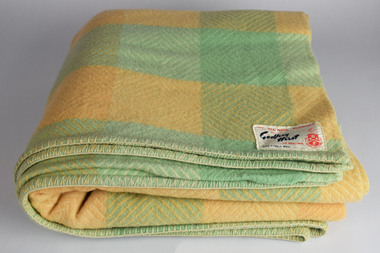
Textile - Blanket, Godfrey Hirst, 1950s
... Some of these were found in the Geelong area but one came back with me from an op shop road trip around Tasmania, another from the St Pauls op shop in Romsey. ...Some of these were found in the Geelong area but one came back with me from an op shop road trip around Tasmania, another from the St Pauls op shop in Romsey. ...Godfrey Hirst Diamond blankets from the mid-1950s are always delight to find. Some of these were found in the Geelong area but one came back with me from an op shop road trip around Tasmania, another from the St Pauls op shop in Romsey. I love this pattern and find the lemon and grey colourway particularly special. Note from collector- "For more than 100 years blankets were made all over Australia in over 100 woollen mills. My aim, is to preserve 100 examples of these wonderful pieces of history. Ten years ago I started collecting the iconic Onkaparinga travel rugs, so that on movie nights at home there would be plenty to go around. Everyone had their favourite; even the cat had his own – a small red tartan one. Keeping an eye out for those travel rugs at op-shops and markets, collectable stores and bazaars, led to noticing vintage blankets. I'd never really thought about them before or paid much attention though of course I had grown up with them at my grandmother's. When I discovered my first Laconia cream blanket with blue stripes, my eyes just went gaga. Well that was it, I was hooked and since then over 500 blankets have passed through my hands. These common, everyday items, found in all households for so many decades, were traditional engagement gifts. Pairs were prized wedding presents turning into family heirlooms. They were fashionable dressers of beds, givers of warmth, bestowers of security and reliability. The comfort found in these objects resonates with almost all of us; we grew up with them ourselves or fondly recall them in a grandparent’s home. There is no modern replacement with the integrity of these old blankets, many of them now older than most of us. They are romantic, sensible, special, familiar, nostalgic and nothing else feels so appropriate in so many situations. No offense to the great Aussie doona, but from hippie to hipster, at a music festival, picnic, campsite or couch, a vintage blanket is something coveted by all. This industry that employed tens of thousands and must have been such a huge contributor to the economy is almost completely lost now. Blanket Fever is an ode to everything that came before: the land, the sheep, the shearers, the hands, the mills, the weavers, the designers, the distributors, the department stores. To the grandparents that gave them, the people that received them, the families that kept them; thank you. I’m passionate about my collection of Australian blankets manufactured in mostly Victoria, South Australia and Tasmania from the 1930s to the end of the 1960s. The collection has blankets from each of these four decades representing the styles and fashions of their time and includes dated advertisements which help determine the eras the blankets are from." Diamond blanket, mint and lemon"An All Wool Blanket" /By Godfrey Hirst of Geelong/100% Virgin Woolwool, blanket, blanket fever, diamond blanket, godfrey hirst, geelong -
 Victorian Bands' League
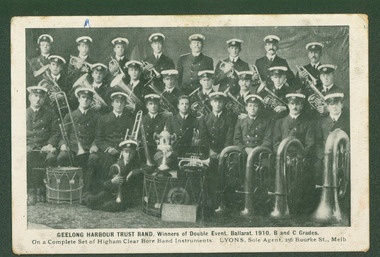
Postcard, Geelong Harbour Trust Band, Winners of Double Event, Ballarat, 1910, B and C Grades, ca: 1910
... The Geelong Harbour Trust Band was one of five brass bands existing in the Geelong area in the early 1900's. They were quite successful in competition under the direction of conductor Mr Harry Shugg. ...The Geelong Harbour Trust Band was one of five brass bands existing in the Geelong area in the early 1900's. They were quite successful in competition under the direction of conductor Mr Harry Shugg. ...The Geelong Harbour Trust Band was one of five brass bands existing in the Geelong area in the early 1900's. They were quite successful in competition under the direction of conductor Mr Harry Shugg. After their conductor, Harry Shugg left to conductor the Malvern Tramways Band in 1915, the band merged with the Geelong Municipal Band to become the Geelong City Band.This postcard is significant as it provides a historical window on this (former) brass band and their achievements. The postcard is also significant as it is part of a series of four in the VBL's collection which have Mr Harry Shugg (conductor) as a central figure.Rectangular black and white photograph printed on a postcard.Front: "GEELONG HARBOUR TRUST BAND, Winners of Double Event, Ballarat, 1910, B and C Grades On a Complete Set of Higham Clear Bore Band Instruments. LYONS, Sole Agend, 256 Bourke St., Melb.geelong harbour trust band, geelong, victoria, brass band, victorian bands' association, harry shugg, geelong city band, geelong municipal band, victorian bands' league -
 National Wool Museum
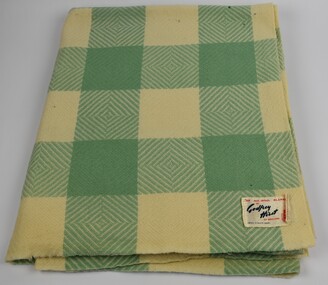
Textile - Blanket, Godfrey Hirst, 1950s
... Some of these were found in the Geelong area but one came back with me from an op shop road trip around Tasmania, another from the St Pauls op shop in Romsey. ...Some of these were found in the Geelong area but one came back with me from an op shop road trip around Tasmania, another from the St Pauls op shop in Romsey. ...Note from collector: Godfrey Hirst Diamond blankets from the mid-1950s are always delight to find. Some of these were found in the Geelong area but one came back with me from an op shop road trip around Tasmania, another from the St Pauls op shop in Romsey. I love this pattern and find the lemon and grey colourway particularly special. Note from collector- "For more than 100 years blankets were made all over Australia in over 100 woollen mills. My aim, is to preserve 100 examples of these wonderful pieces of history. Ten years ago I started collecting the iconic Onkaparinga travel rugs, so that on movie nights at home there would be plenty to go around. Everyone had their favourite; even the cat had his own – a small red tartan one. Keeping an eye out for those travel rugs at op-shops and markets, collectable stores and bazaars, led to noticing vintage blankets. I'd never really thought about them before or paid much attention though of course I had grown up with them at my grandmother's. When I discovered my first Laconia cream blanket with blue stripes, my eyes just went gaga. Well that was it, I was hooked and since then over 500 blankets have passed through my hands. These common, everyday items, found in all households for so many decades, were traditional engagement gifts. Pairs were prized wedding presents turning into family heirlooms. They were fashionable dressers of beds, givers of warmth, bestowers of security and reliability. The comfort found in these objects resonates with almost all of us; we grew up with them ourselves or fondly recall them in a grandparent’s home. There is no modern replacement with the integrity of these old blankets, many of them now older than most of us. They are romantic, sensible, special, familiar, nostalgic and nothing else feels so appropriate in so many situations. No offense to the great Aussie doona, but from hippie to hipster, at a music festival, picnic, campsite or couch, a vintage blanket is something coveted by all. This industry that employed tens of thousands and must have been such a huge contributor to the economy is almost completely lost now. Blanket Fever is an ode to everything that came before: the land, the sheep, the shearers, the hands, the mills, the weavers, the designers, the distributors, the department stores. To the grandparents that gave them, the people that received them, the families that kept them; thank you. I’m passionate about my collection of Australian blankets manufactured in mostly Victoria, South Australia and Tasmania from the 1930s to the end of the 1960s. The collection has blankets from each of these four decades representing the styles and fashions of their time and includes dated advertisements which help determine the eras the blankets are from." Double-sized mint and cream diamond blanketAn All Wool Blanket" /By Godfrey Hirst of Geelong/100% Virgin Woolwool, blanket, blanket fever, godfrey hirst, diamond blanket -
 National Wool Museum
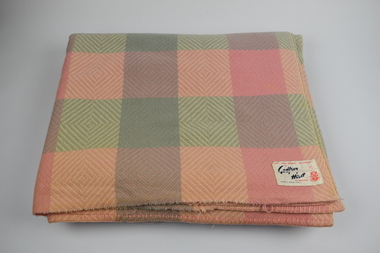
Textile - Blanket, 1950s
... Some of these were found in the Geelong area but one came back with me from an op shop road trip around Tasmania, another from the St Pauls op shop in Romsey. ...Some of these were found in the Geelong area but one came back with me from an op shop road trip around Tasmania, another from the St Pauls op shop in Romsey. ...Note from collector: Godfrey Hirst Diamond blankets from the mid-1950s are always delight to find. Some of these were found in the Geelong area but one came back with me from an op shop road trip around Tasmania, another from the St Pauls op shop in Romsey. I love this pattern and find the lemon and grey colourway particularly special.Note from collector- "For more than 100 years blankets were made all over Australia in over 100 woollen mills. My aim, is to preserve 100 examples of these wonderful pieces of history. Ten years ago I started collecting the iconic Onkaparinga travel rugs, so that on movie nights at home there would be plenty to go around. Everyone had their favourite; even the cat had his own – a small red tartan one. Keeping an eye out for those travel rugs at op-shops and markets, collectable stores and bazaars, led to noticing vintage blankets. I'd never really thought about them before or paid much attention though of course I had grown up with them at my grandmother's. When I discovered my first Laconia cream blanket with blue stripes, my eyes just went gaga. Well that was it, I was hooked and since then over 500 blankets have passed through my hands. These common, everyday items, found in all households for so many decades, were traditional engagement gifts. Pairs were prized wedding presents turning into family heirlooms. They were fashionable dressers of beds, givers of warmth, bestowers of security and reliability. The comfort found in these objects resonates with almost all of us; we grew up with them ourselves or fondly recall them in a grandparent’s home. There is no modern replacement with the integrity of these old blankets, many of them now older than most of us. They are romantic, sensible, special, familiar, nostalgic and nothing else feels so appropriate in so many situations. No offense to the great Aussie doona, but from hippie to hipster, at a music festival, picnic, campsite or couch, a vintage blanket is something coveted by all. This industry that employed tens of thousands and must have been such a huge contributor to the economy is almost completely lost now. Blanket Fever is an ode to everything that came before: the land, the sheep, the shearers, the hands, the mills, the weavers, the designers, the distributors, the department stores. To the grandparents that gave them, the people that received them, the families that kept them; thank you. I’m passionate about my collection of Australian blankets manufactured in mostly Victoria, South Australia and Tasmania from the 1930s to the end of the 1960s. The collection has blankets from each of these four decades representing the styles and fashions of their time and includes dated advertisements which help determine the eras the blankets are from." Double-sized, pink and mint diamond blanket"An All Wool Blanket" /By Godfrey Hirst of Geelong/100% Virgin Woolwool, blanket, blanket fever, godfrey hirst, diamond blanket, geelong -
 National Wool Museum
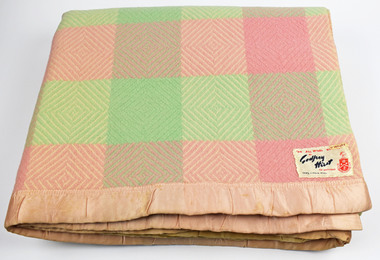
Textile - Blanket, Godfrey Hirst, 1950s
... Some of these were found in the Geelong area but one came back with me from an op shop road trip around Tasmania, another from the St Pauls op shop in Romsey. ...Some of these were found in the Geelong area but one came back with me from an op shop road trip around Tasmania, another from the St Pauls op shop in Romsey. ...Note from collector: Godfrey Hirst Diamond blankets from the mid-1950s are always delight to find. Some of these were found in the Geelong area but one came back with me from an op shop road trip around Tasmania, another from the St Pauls op shop in Romsey. I love this pattern and find the lemon and grey colourway particularly special.Note from collector- "For more than 100 years blankets were made all over Australia in over 100 woollen mills. My aim, is to preserve 100 examples of these wonderful pieces of history. Ten years ago I started collecting the iconic Onkaparinga travel rugs, so that on movie nights at home there would be plenty to go around. Everyone had their favourite; even the cat had his own – a small red tartan one. Keeping an eye out for those travel rugs at op-shops and markets, collectable stores and bazaars, led to noticing vintage blankets. I'd never really thought about them before or paid much attention though of course I had grown up with them at my grandmother's. When I discovered my first Laconia cream blanket with blue stripes, my eyes just went gaga. Well that was it, I was hooked and since then over 500 blankets have passed through my hands. These common, everyday items, found in all households for so many decades, were traditional engagement gifts. Pairs were prized wedding presents turning into family heirlooms. They were fashionable dressers of beds, givers of warmth, bestowers of security and reliability. The comfort found in these objects resonates with almost all of us; we grew up with them ourselves or fondly recall them in a grandparent’s home. There is no modern replacement with the integrity of these old blankets, many of them now older than most of us. They are romantic, sensible, special, familiar, nostalgic and nothing else feels so appropriate in so many situations. No offense to the great Aussie doona, but from hippie to hipster, at a music festival, picnic, campsite or couch, a vintage blanket is something coveted by all. This industry that employed tens of thousands and must have been such a huge contributor to the economy is almost completely lost now. Blanket Fever is an ode to everything that came before: the land, the sheep, the shearers, the hands, the mills, the weavers, the designers, the distributors, the department stores. To the grandparents that gave them, the people that received them, the families that kept them; thank you. I’m passionate about my collection of Australian blankets manufactured in mostly Victoria, South Australia and Tasmania from the 1930s to the end of the 1960s. The collection has blankets from each of these four decades representing the styles and fashions of their time and includes dated advertisements which help determine the eras the blankets are from." King-sized, pink and mint diamond blanket, ribbon edgedName tag 'O'Malley' sewn above label/"An All Wool Blanket" /By Godfrey Hirst of Geelong/100% Virgin Woolwool, blanket, blanket fever, diamond blanket, godfrey hirst, geelong -
 National Wool Museum
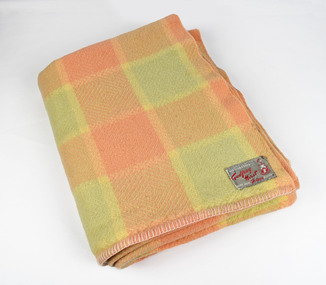
Textile - Blanket, Godfrey Hirst, 1950s
... Some of these were found in the Geelong area but one came back with me from an op shop road trip around Tasmania, another from the St Pauls op shop in Romsey. ...Some of these were found in the Geelong area but one came back with me from an op shop road trip around Tasmania, another from the St Pauls op shop in Romsey. ...Collector says: Godfrey Hirst Diamond blankets from the mid-1950s are always delight to find. Some of these were found in the Geelong area but one came back with me from an op shop road trip around Tasmania, another from the St Pauls op shop in Romsey. I love this pattern and find the lemon and grey colourway particularly special. Note from collector- "For more than 100 years blankets were made all over Australia in over 100 woollen mills. My aim, is to preserve 100 examples of these wonderful pieces of history. Ten years ago I started collecting the iconic Onkaparinga travel rugs, so that on movie nights at home there would be plenty to go around. Everyone had their favourite; even the cat had his own – a small red tartan one. Keeping an eye out for those travel rugs at op-shops and markets, collectable stores and bazaars, led to noticing vintage blankets. I'd never really thought about them before or paid much attention though of course I had grown up with them at my grandmother's. When I discovered my first Laconia cream blanket with blue stripes, my eyes just went gaga. Well that was it, I was hooked and since then over 500 blankets have passed through my hands. These common, everyday items, found in all households for so many decades, were traditional engagement gifts. Pairs were prized wedding presents turning into family heirlooms. They were fashionable dressers of beds, givers of warmth, bestowers of security and reliability. The comfort found in these objects resonates with almost all of us; we grew up with them ourselves or fondly recall them in a grandparent’s home. There is no modern replacement with the integrity of these old blankets, many of them now older than most of us. They are romantic, sensible, special, familiar, nostalgic and nothing else feels so appropriate in so many situations. No offense to the great Aussie doona, but from hippie to hipster, at a music festival, picnic, campsite or couch, a vintage blanket is something coveted by all. This industry that employed tens of thousands and must have been such a huge contributor to the economy is almost completely lost now. Blanket Fever is an ode to everything that came before: the land, the sheep, the shearers, the hands, the mills, the weavers, the designers, the distributors, the department stores. To the grandparents that gave them, the people that received them, the families that kept them; thank you. I’m passionate about my collection of Australian blankets manufactured in mostly Victoria, South Australia and Tasmania from the 1930s to the end of the 1960s. The collection has blankets from each of these four decades representing the styles and fashions of their time and includes dated advertisements which help determine the eras the blankets are from." King sized Diamond blanket, pink, mint and lemon Mothproofed/Godfrey Hirst/Pure Wool Pelage Blanketwool, blanket, blanket fever, diamond blanket, godfrey hirst, geelong -
 National Wool Museum
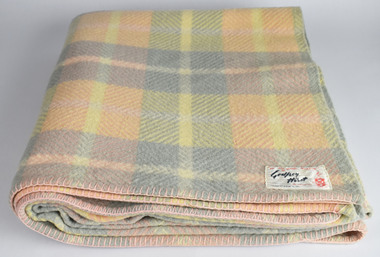
Textile - Blanket, Godfrey Hirst, 1950s
... Some of these were found in the Geelong area but one came back with me from an op shop road trip around Tasmania, another from the St Pauls op shop in Romsey. ...Some of these were found in the Geelong area but one came back with me from an op shop road trip around Tasmania, another from the St Pauls op shop in Romsey. ...Collector says: Godfrey Hirst Diamond blankets from the mid-1950s are always delight to find. Some of these were found in the Geelong area but one came back with me from an op shop road trip around Tasmania, another from the St Pauls op shop in Romsey. I love this pattern and find the lemon and grey colourway particularly special. Note from collector- "For more than 100 years blankets were made all over Australia in over 100 woollen mills. My aim, is to preserve 100 examples of these wonderful pieces of history. Ten years ago I started collecting the iconic Onkaparinga travel rugs, so that on movie nights at home there would be plenty to go around. Everyone had their favourite; even the cat had his own – a small red tartan one. Keeping an eye out for those travel rugs at op-shops and markets, collectable stores and bazaars, led to noticing vintage blankets. I'd never really thought about them before or paid much attention though of course I had grown up with them at my grandmother's. When I discovered my first Laconia cream blanket with blue stripes, my eyes just went gaga. Well that was it, I was hooked and since then over 500 blankets have passed through my hands. These common, everyday items, found in all households for so many decades, were traditional engagement gifts. Pairs were prized wedding presents turning into family heirlooms. They were fashionable dressers of beds, givers of warmth, bestowers of security and reliability. The comfort found in these objects resonates with almost all of us; we grew up with them ourselves or fondly recall them in a grandparent’s home. There is no modern replacement with the integrity of these old blankets, many of them now older than most of us. They are romantic, sensible, special, familiar, nostalgic and nothing else feels so appropriate in so many situations. No offense to the great Aussie doona, but from hippie to hipster, at a music festival, picnic, campsite or couch, a vintage blanket is something coveted by all. This industry that employed tens of thousands and must have been such a huge contributor to the economy is almost completely lost now. Blanket Fever is an ode to everything that came before: the land, the sheep, the shearers, the hands, the mills, the weavers, the designers, the distributors, the department stores. To the grandparents that gave them, the people that received them, the families that kept them; thank you. I’m passionate about my collection of Australian blankets manufactured in mostly Victoria, South Australia and Tasmania from the 1930s to the end of the 1960s. The collection has blankets from each of these four decades representing the styles and fashions of their time and includes dated advertisements which help determine the eras the blankets are from." Godfrey Hirst diamond blanket in pink, grey and lemon"An All Wool Blanket" /By Godfrey Hirst of Geelong/100% Virgin Woolwool, blanket, blanket fever, diamond blanket, godfrey hirst, geelong
