
Showing 19 items matching "german bible"
-
 Bendigo Historical Society Inc.
Book - German Bible
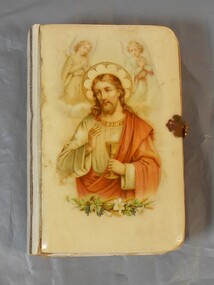
... German Bible...German...Bible...The back is plain and a creamy color. Book German Bible ...There was a large influx of German miners to the Bendigo gold fields and they mainly focussed on deep quartz mining. German enclaves existed at Diamond Hill, New Chum Gully, Victoria Hill, Ironbark and in the Whipstick area. The first Lutheran Church was built in 1865 and there were also two German schools. Small bible with hard cover, possibly bakelite/plastic. The cover has an image of Jesus with and angel above each of his shoulders and plants at the bottom of the image. Pages of bible have gold edging. There is a metal clasp to lock. The back is plain and a creamy color.german, bible, religion -
 Bendigo Military Museum
Book - BIBLE, GERMAN, 1940
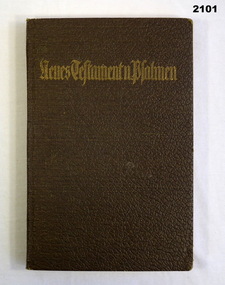
... BIBLE, GERMAN...German Bible medium size, hard cover, front has gold writing in German....Book BIBLE, GERMAN ...German Bible medium size, hard cover, front has gold writing in German.“Das New Testament, Berlin 1940”religion-christian, books-religion, german -
 Friends of Westgarthtown
Book - Bible, German, Die Bible', 1896
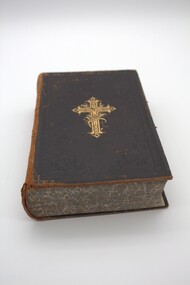
... Bible, German...bible...lutheran...german...Lutheran German Bible with black leather cover, embossed with gold leaf cross. ...book religion bible lutheran german thomastown old and new testament Lutheran German Bible with black leather cover, embossed with gold leaf cross. ...Lutheran German Bible with black leather cover, embossed with gold leaf cross. Embossed decoration on both covers. Marbled decoration on page edges.book, religion, bible, lutheran, german, thomastown, old and new testament -
 Murtoa & District Historical Society and Museum
Book, HUBBARD BROS, Holy Bible Die Heilige Bibel, 1874 (exact)
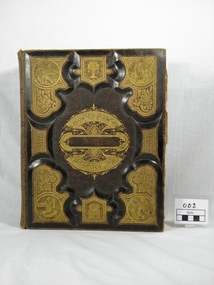
... ...german bible...Holy Bible leather bound gold embossed German bible . On front cover various persons praying .Printed 1860's BOOSEY & CO.'...holy bible leather bound gold embossed 1860 s printed german bible janetzke family bible janetzke 1881 1974 bilingual printed u s a Holy Bible leather bound gold embossed German bible . ...Holy Bible leather bound gold embossed German bible . On front cover various persons praying .Printed 1860's BOOSEY & CO.'S Fair condition . Old and New Testament holy bible, leather bound, gold embossed, 1860 s printed, german bible, janetzke family bible, janetzke, 1881 1974, bilingual, printed u s a -
 Doncaster Templestowe Historical Society
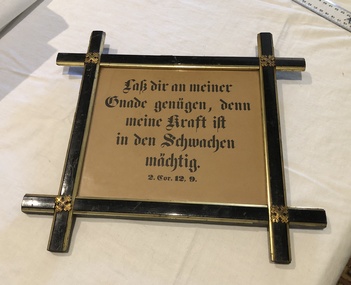
Sign, DJ0218 Wall Hanging, decorative, board, bible quotations in on both sides in German, 23/10/2025
... Bible...German...bible quotes. Able to be turned to alternate the displayed quotes. Used by German settlers in Doncaster area Bible German wall Laß dir an meiner Onnoe genigen, Dem meine fraft ift in Den Sicwnden micitig. 2. ...Wall hanging important bible quotes. Able to be turned to alternate the displayed quotes.Used by German settlers in Doncaster areaWall Hanging BoardLaß dir an meiner Onnoe genigen, Dem meine fraft ift in Den Sicwnden micitig. 2. Cor. 12, 9. Google Translate: Let my uncle be content with my uncle, for my uncle is in my sight. 2 Corinthians 12:9 Alle 2.1113 ي.0210د wetfet anf ailn, Dcum Er forget für cuc. 1. Wett. 5, 8. bible, german, wall -
 Friends of Westgarthtown
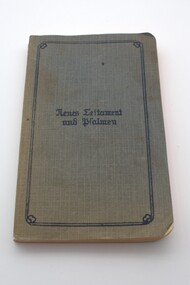
Book - Manuscript poetry book, Bible - Neues Testament, 1928
... 1928 German-language Bible printed in a small portable paperback format. ...1928 German-language Bible printed in a small portable paperback format. ...1928 German-language Bible printed in a small portable paperback format. The Bible formed part of a small group of German-language items inherited by Janet Hubbard from her grandfather, Henry Christian Ziebell (1911–1988). -
 The Bible Museum
Bible, Holy Bible - Salesman Edition, c.1870
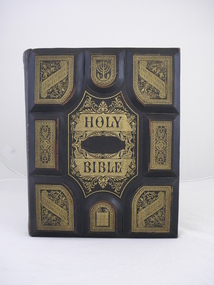
... Bi-lingual in English and German. Abridged Bible text, as it is a travelling saleman's copy. ...bible saleman travelling representative family history births deaths register gilt embossing Numerous family Births and Deaths noted, from 1850 to 1977. Various photos and tokens under the 'Family Portraits' pages at the rear. Leather bound book. The cover is sculpted cardboard with burgundy leather, heavily gilt embossed with pictures and text. The edges of the front and back covers are bevelled and gilt embossed. Silk endpapers at front with marbled endpapers at back. Numerous coloured illustrations, b/w illustrations. Bi-lingual in English and German ...Leather bound book. The cover is sculpted cardboard with burgundy leather, heavily gilt embossed with pictures and text. The edges of the front and back covers are bevelled and gilt embossed. Silk endpapers at front with marbled endpapers at back. Numerous coloured illustrations, b/w illustrations. Bi-lingual in English and German. Abridged Bible text, as it is a travelling saleman's copy. Some blank ruled pages for subscribers details.Numerous family Births and Deaths noted, from 1850 to 1977. Various photos and tokens under the 'Family Portraits' pages at the rear.bible, family bible, saleman, travelling representative, family history, births, deaths, register, gilt embossing -
 Wodonga & District Historical Society Inc
Book - Haeusler Collection Family Bible early 18th century, Sebastian Göbels, 1702
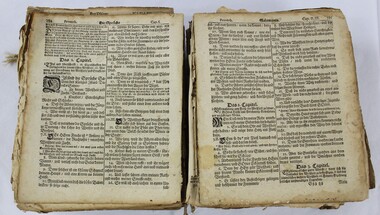
... bible...christianity...german...This object is a German bible printed in 1702. It was published by Sebastian Göbels at the town of Schleusingen in the Thüringian Forest, and has 1770 pages. ...A large bible printed in German and bound with brown leather. ...This object is a German bible printed in 1702. It was published by Sebastian Göbels at the town of Schleusingen in the Thüringian Forest, and has 1770 pages. ...The Wodonga Historical Society Haeusler Collection provides invaluable insight into life in late nineteenth and early twentieth century north east Victoria. The collection comprises manuscripts, personal artefacts used by the Haeusler family on their farm in Wodonga, and a set of glass negatives which offer a unique visual snapshot of the domestic and social lives of the Haeusler family and local Wodonga community. The Haeusler family migrated from Prussia (Germany) to South Australia in the 1840s and 1850s, before purchasing 100 acres of Crown Land made available under the Victorian Lands Act 1862 (also known as ‘Duffy’s Land Act’) in 1866 in what is now Wodonga West. The Haeusler family were one of several German families to migrate from South Australia to Wodonga in the 1860s. This object is a German bible printed in 1702. It was published by Sebastian Göbels at the town of Schleusingen in the Thüringian Forest, and has 1770 pages. The bible was brought to Australia by the Haeusler-Klinge family when they migrated to South Australia in 1846. Ferdinand Haeusler came to Wodonga with other German families in 1866, bringing the bible with him. This item significant due to its age and rarity. It has well documented provenance and a known owner. It forms part of a significant and representative historical Haeusler Collection, which reflects the local history of Wodonga. It contributes to our understanding of European colonisation and settlement in Wodonga and north east Victoria in the mid nineteenth-century. A large bible printed in German and bound with brown leather. bible, christianity, german, germany, immigration, 1800s, 1700s, prussia -
 Federation University Historical Collection
Book - Register, Ballarat School of Mines Library Register of Books, 1870-1896, 1870-1896
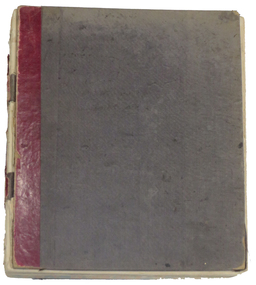
... Platur's Manual of Qual and Quan Analysis with the blowpipe, donated by Henry Sutton, May 1884 738. German Bible, donated by R. J. Litton, 21.05.1886 802. ...Platur's Manual of Qual and Quan Analysis with the blowpipe, donated by Henry Sutton, May 1884 738. German Bible, donated by R. J. Litton, 21.05.1886 802. ...The listing of books in the Ballarat School of Mines library begins with No 1 and ends at No 1465. This book is identical to Library Catalogue No 00007, but isonly numbered to No. 921. Redmond Barry, Robert Broigh Smyth, Ferdinandy Von Mueller, the Victorian Geolofical Survey and many local illuminaries donated to the Ballarat School of Mines. Black cloth covered exercise book with handwritten lists of books in the Ballarat School of Mines Library dating from 1870 to 1896. The pages have been divided into columns with the following headings: Reg. No; Title; Author; Vol.; Issue; Donor, Receipt. Some of the books are as follows: 1. Memoirs of Geological Survey of Great Britain, Vol 1., 1846, Donated by Her Majesty's Government, 16/03/1870 19. Prospectus of the School of Mines, 1869, Donated by Her Majesty's Government, 16/03/1870 44. The Steam Engine, Rankine, purchased, 09/03/1871 72. Melbourne University Calendar, 1859-1860, donated by Sir Redmond Barry, 14/04/1871 85. Maps of County of Anglesey, donated by Minister of Mines, 23/05/1871 107. Electric Telegraph, R. Sabine, purchased, June 1874 356. Organic Constituents of Plants and Vegetable Substances, Dr. G.C. Willstein, donated by Ferdinand Von Mueller 375. The native Plants of Victoria Succinctly Defined, Baron Von Mueller, purchased, 1879 569. Platur's Manual of Qual and Quan Analysis with the blowpipe, donated by Henry Sutton, May 1884 738. German Bible, donated by R. J. Litton, 21.05.1886 802. Essays of Addison, J.R. Green, 18/06/1887, donated by Bella Guerin 803. Rec De Planches Dur Les sciences Les Arts Liberaux et les Arts Mechaniques, Vol VI, 1875, Donated by Theo William, 01/07/1887 Excel spreadsheet attached (incomplete)ballarat school of mines, library, books, ballarat school of mines library, william laplau, dr bunce, james oddie, bella guerin, j.f. usher, r.m. sergeant, redmond barry, robert brough smyth, cosmo newbery, john noble wilson, joseph flude, commissioner of patents, henry sutton, w.n. wooster, theophilus taylor, rivett henry bland, ferdinand von mueller, c.c. shoppee, william luplau, ferdinand krause, william wooster -
 Friends of Westgarthtown
Book - Seeber Family Bible, 1871
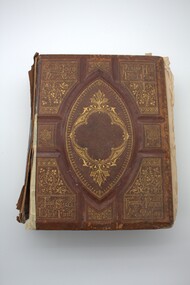
... Large leather-bound illustrated family Bible published in the United States c.1871 and printed in the German language. ...Large leather-bound illustrated family Bible published in the United States c.1871 and printed in the German language. ...Large leather-bound illustrated family Bible published in the United States c.1871 and printed in the German language. The Bible contains a family register section recording births and deaths, as well as a dedicated section for family photographs. The volume is richly illustrated throughout and reflects the importance of religion and family record keeping within German Lutheran communities of the nineteenth century. The Bible belonged to the Seeber family of Westgarthtown. The Seeber family lived in a house on High Street, opposite the present-day Lalor Railway Station, for almost one hundred years. Family patriarch John Seeber worked as a shoemaker and operated his business from the family home. Many members of the Seeber family are buried in the Westgarthtown Lutheran Cemetery. The Bible was retained within the Seeber family for generations and was donated to Ziebell's Farmhouse Museum by Helen Pearce, granddaughter of Agnes Seeber, the youngest child of John and Johanna Seeber. -
 Flagstaff Hill Maritime Museum and Village
Book - Reference Book/History, Henry Smith Williams, The Historians History of the World Vol 16 set 1 - Edited by Henry Smith Williams L.L.D. Published by “The Times” 1908, 1908
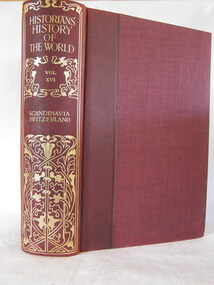
... German-speaking cantons, led by Zwingli. With the "Affair of the Sausages 1522," serving as the spark. During Lent, a group of citizens in Zurich intentionally broke the fast by eating sausages. Zwingli defended them, arguing that fasting was a man-made rule not found in the Bible...German-speaking cantons, led by Zwingli. With the "Affair of the Sausages 1522," serving as the spark. During Lent, a group of citizens in Zurich intentionally broke the fast by eating sausages. Zwingli defended them, arguing that fasting was a man-made rule not found in the Bible ...Henry Smith Williams’ “The Historians' History of the World” is a chronological and geographical "tapestry" of human events, these twenty five volumes occupy a very specific and prestigious place in historical research. The primary subjects of Volume 16 are Scandinavia (including the history of Norway, Sweden, and Denmark) and the history of Switzerland up to the year 1715.The Book is part of a 25 volume set with red cloth bindings and gold filigree design to rib.non-fictionHenry Smith Williams’ “The Historians' History of the World” is a chronological and geographical "tapestry" of human events, these twenty five volumes occupy a very specific and prestigious place in historical research. The primary subjects of Volume 16 are Scandinavia (including the history of Norway, Sweden, and Denmark) and the history of Switzerland up to the year 1715.flagstaff hill, warrnambool, shipwrecked-coast, flagstaff-hill, flagstaff-hill-maritime-museum, maritime-museum, shipwreck-coast, flagstaff-hill-maritime-village, book, the historians history of the world vol 16 set 1 -
 Flagstaff Hill Maritime Museum and Village
Artwork, other - Card, 1890s
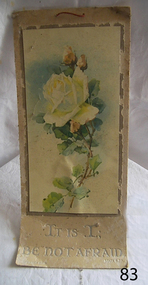
... bible studies at Sunday schools around the 1890s to teach religion. They were produced by various companies at this time and known as "Heidelberg cards" from the Heidelberger Druckmaschinen company in Germany that produces catalogues, calendars, posters, and labels to this day....bible studies at Sunday schools around the 1890s to teach religion. They were produced by various companies at this time and known as "Heidelberg cards" from the Heidelberger Druckmaschinen company in Germany that produces catalogues, calendars, posters, and labels to this day. ...Quote is from the Bible John 6:20, these cards were often sent as gifts or used in bible studies at Sunday schools around the 1890s to teach religion. They were produced by various companies at this time and known as "Heidelberg cards" from the Heidelberger Druckmaschinen company in Germany that produces catalogues, calendars, posters, and labels to this day.Item is significant as it shows an early example of religious teaching aid from the late Victorian era and gives a snapshot into social life of the time.Card with Bible quotation 'It Is I' Be Not Afraid' with a picture of a roseflagstaff hill, warrnambool, shipwrecked coast, flagstaff hill maritime museum, maritime museum, shipwreck coast, flagstaff hill maritime village, great ocean road, card, bible verse -
 Bendigo Historical Society Inc.
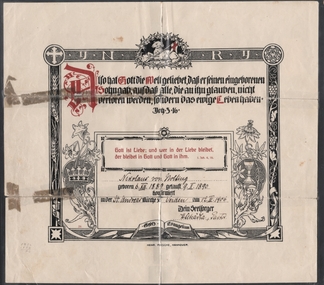
Certificate - Peter Ellis Collection - Confirmation Certificate, 12.4.1906
... German certificate has two quotations from the bible (untranslated). ...German certificate has two quotations from the bible (untranslated). ...Peter Ellis Collection - Confirmation Certificate in German for Nicholas Von Nolling, born 6/12/1889, baptised 9/2/1906, confirmed on 12/04/1906. German certificate has two quotations from the bible (untranslated). Connection to Peter Ellis unknown, signed by the German Pastor. Certificate has been folded three times, and taped together prior to being laminated. Red and black printing on cream coloured card.confirmation into church, certificate -
 Bendigo Historical Society Inc.
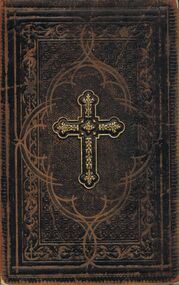
Book - GERMAN HERITAGE SOCIETY COLLECTION: BOLDT FAMILY BIBLE
... Bible. Large book with dark brown/black cover with pattern and a gold cross with leaves and flowers inside the cross, HIS in the centre. Edges of the pages are gold. Book printed Stuttgart 1892. Some family history written in the back. Book GERMAN ...Item 17. Boldt Family Bible. Large book with dark brown/black cover with pattern and a gold cross with leaves and flowers inside the cross, HIS in the centre. Edges of the pages are gold. Book printed Stuttgart 1892. Some family history written in the back.bendigo, clubs, bendigo heritage, german heritage society collection - boldt family bible, wilhelm august boldt, mr westacott, robert leonard thompson, albert edward boldt -
 Ithacan Historical Society
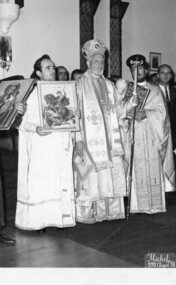
Photograph, Greek Bishop of Germany
... L- R: One priest is holding an icon, another a sceptre, and the third the Bible. Greek Bishop of Germany Photograph ...A black and white photograph with crimped edges of three priests standing in front of a group of men. L- R: One priest is holding an icon, another a sceptre, and the third the Bible."MICHE"/ 390 CHAPEL ST. -
 Uniting Church Archives - Synod of Victoria
BW photo, Undated
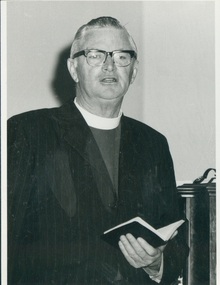
... Bible schools for village evangelists and sent suitable clergy overseas for further studies. He encouraged initiative in others, helped them to find and use their talents, and gave them his unstinted confidence and support. Fresh finance was required for new ventures. This led him to travel widely in Germany...Bible schools for village evangelists and sent suitable clergy overseas for further studies. He encouraged initiative in others, helped them to find and use their talents, and gave them his unstinted confidence and support. Fresh finance was required for new ventures. This led him to travel widely in Germany ...STANWAY, ALFRED (b. 9 Sept 1908; d. Melbourne, Vic, 27 June 1989). Anglican bishop, missionary. Stanway grew up in the Wimmera district of western Victoria, and left school when 14 years old. He found work in Melbourne, trained as an accountant, and at the age of 20, held a responsible position with a publishing company. This background, allied with an uncommon flair for figures and finance, was to stand him in good stead throughout his life. But he had little knowledge and no experience of the grace of God until 29 July 1928. At the Evening Service in the parish church of Fairfield on 29 July, he heard the Rev C H Nash (q.v.) preach a sermon which led to his conversion. Within two years he made up his mind to become a missionary and began night studies in order to matriculate. He entered Ridley College in March 1932 to prepare for ordination undertaking week-end duties as a catechist at Deer Park and St Albans. He joined the CMS League of Youth, became chairman, and gathered a fine band of young people many of whom were to become missionaries. He was closely involved with the Belgrave Heights Convention (then at Upwey) and established a League of Youth camp on the site. All his energies were thrown into the task of building up its members in personal holiness and vigorous evangelism. Stanway was ordained in St Paul's Cathedral, Melbourne on St Thomas Day 1934 and was placed in charge of the Old Mission Church of St James and St John, Melbourne. The duties were light enough to allow him to enrol in the Melbourne Teachers College and to complete the Diploma in Teaching. On 26 January 1937, he sailed for Africa to become a missionary in the Anglican Diocese of Mombasa, which at that time embraced the whole of Kenya. He was sent to the hot coastal town of Kaloleni as principal of a Secondary Boys School. Before he left Melbourne, he had become engaged to Marjory Harrison: she followed him to Africa and their marriage took place in Mombasa Cathedral in June 1939. He remained at Kaloleni until 1944 when he was transferred to the inland station of Maseno where all his gifts were to be deployed as rural dean of Nyanza. His oversight of some 500 village churches as well as a widespread primary school system was so efficient that in 1948 he was appointed archdeacon of Kenya with his home and office in Nairobi. As secretary of the African Church Council and of the African Education Board, he was responsible for all African work in the diocese. His contacts with government ministers and public servants were of first class significance at the time when the cry of Uhuru and the demand for independence was travelling throughout the colonial world. On 2 Feb 1951, Alfred Stanway was consecrated in Westminster Abbey as the third Anglican Bp of Central Tanganyika. This Diocese was the special sphere of the CMS Australia, and he already knew most of the missionary personnel. He brought with him the understanding and experience of one who had fully shared the lot and problems of a district missionary, but he came to the diocese at a time when it had yet to recover from its losses in personnel and finance as a result of the war. His immediate task was to provide the impetus of fresh leadership and a long-term overall policy. His aim from-the outset was to build up a strong autonomous church with its own indigenous pastorate. With the whole-hearted confidence of the home base, he was able to enlist the service of new missionaries. He saw a great increase in the number of African clergy and he encouraged village evangelists to open new fields of work. Simple structures were built as new churches at the rate of two a week, week in and week out, year by year. He worked hard to meet the need for Christian literature, bookshops, adult literacy and theological training. He opened Bible schools for village evangelists and sent suitable clergy overseas for further studies. He encouraged initiative in others, helped them to find and use their talents, and gave them his unstinted confidence and support. Fresh finance was required for new ventures. This led him to travel widely in Germany and America, where he raised large funds for these projects. Mackay House was built in Dodoma as the central administrative base for the diocese, hospitals such as those at Mvumi and Hombolo were modernised or established, schools were built and upgraded. In keeping with his vision for ultimate leadership by African personnel, he consecrated Yohana Omari in 1955 as his assistant, he was the first national to become a bp in East Africa. Bp Stanway then set on foot the long and complicated process for the division of his sprawling diocese. In 1963, the diocese of Victoria Nyanza came into being; in 1965, that of Morogoro; in 1966, that of Western Tanganyika. Yet in 1971, his own diocese of Central Tanganyika, though greatly reduced in size, had more churches and more clergy than in its undivided state in 195 l. Stanway then played a leading part in the formation of the Province of Tanzania in 1970, with an African abp as metropolitan. A year later, after 35 years in East Africa and 20 years as bishop of Central Tanganyika, he resigned. His leadership and achievements throughout those years had placed him in the front rank as a great missionary statesman. Stanway had returned to Melbourne at the time when his resignation took effect in August 1971. His early love for Ridley College reasserted itself and he went into residence as deputy principal under the Rev Dr Leon Morris. He was put in charge of chapel worship and the pastoral oversight of the students. All his gifts and experience were called into play as he sought to guide and encourage those who were on the threshold of their ministry. The whole bent of his heart was to foster the spiritual life and missionary calling of those whose hearts the Lord had touched. It was during those years that his life-long zeal for the spread of the gospel through Christian literature had its ultimate flowering. It had begun in his Nairobi days with a small church bookstall, this had developed into a major book-shop in the heart of the city. Then in Dodoma he had established the Central Tanganyika Press in order to promote the publication and distribution of Christian literature at all levels. He had marked out Kevin Engel, trained him, and launched him on the international scene. Hence it was natural that in Melbourne he and Kevin Engel should found the Australian Christian Literature Society. But his time at Ridley College was not to last. Unknown to him, the Rev J R W Stott had put his name forward as that of a person who could head a new school of theology in the United States to provide a sound training for evangelical ordinands. Such a task would have been formidable enough for a younger man who had grown up in America. How could an Australian who had spent half his life in Africa hope to succeed in a venture of that kind in America? How could one who had been a missionary, not a theologian, found a new school to train men for ordination? Nevertheless he rose to the challenge. In Sept 1975, he and Mrs Stanway left Melbourne for Sewickly, an outer suburb of Pittsburg, with the promise of three years' service. He had to start from scratch. He found a house to live in, but there was no land for the school, no funds in hand, no staff yet appointed, no students, and no buildings. His drive, his infections enthusiasm, and his flair for practical enterprise carried the day. One by one, obstacles were overcome and support grew in volume and strength. Twelve months after his arrival, in Sept 1976, the Trinity Episcopal School for Ministry was opened with three staff members, seventeen students, and the goodwill of the whole American Episcopal Church to win. During the next two years, the school took shape and was firmly established. Bp Stanway left an indelible stamp on every aspect of its life and work, its spiritual tone and ideals, its financial and administrative principles. He had inspired widespread support among evangelical episcopalians and had imparted a strong sense of divine guidance and purpose. The council would gladly have extended his term in office beyond three years, but at 75 years of age he knew that his health had begun to fail. When he finally relinquished his office in Nov 1978, he could look back on those three years as the crown of his ministry. It is not too much to say that his name was even more highly honoured and revered in the Trinity School of Ministry than in his own dearly loved Africa. His return to Melbourne led to quiet retirement at Mount Waverley where he settled down to a long battle with the ever worsening effects of Parkinson's Disease. The slow loss of physical capacity and the ultimate failure in powers of speech were a great trial, but he never complained. His faith was summed up in his brief reply when he was asked why he had not prayed for healing: 'What God allows, I accept'. That acceptance was without reserve; his testimony was never brighter. His mental powers were undiminished and his spiritual concerns were as wide as ever. He kept in touch with CMS, he went to church, he met with missionaries, he led Bible studies in his home as long as he was able. Africa was always in his heart, news from Sewickly always gave him great pleasure. He had left a mark for God on three great continents and his death left sad but thankful hearts in them all. It was the close of a life in which he had felt that he could never do enough for God who had done so much for him. One of Bp Stanway's sayings was 'when the Holy Spirit takes hold of you, anything can happen'. So it was in his case. He was very human, with his full share of human foibles and frailties. He had a great zest for life and an endless fund of stories drawn from his own experience. He was himself the subject of many stories, some true, others legendary. His vibrant personality always seemed to fill the house where he was, his presence could not be overlooked. His own home was one in which Mrs Stanway had a paramount influence. She was a trained teacher, a skilled artist, a born hostess and a first-class linguist. They had no children of their own, but were devoted Godparents and always deeply interested in the children of missionaries. Home life allowed him to relax in a serene and contented atmosphere and to exercise his gifts for friendship and hospitality. He was always on the watch for souls, a person-to-person evangelist par excellence. He was a man of faith and prayer who dared to believe in the God of the impossible. His love for Africa, his total dedication as a missionary; his gifts as a soulwinner; his genius for finance; his shrewd practical initiatives, and his statesmanlike vision were outstanding characteristics. But great or small, all his gifts were laid out in the service of the gospel, and that service marked him out as one of the most remarkable Australian missionaries of his generation. M L Loane, Men to Remember (Sydney, 1987) Rev. Alfred Stanway is standing with open book in hand, dressed in clerical garb.Bishop Alfred Stanwaybishop alfred stanway -
 Wangaratta RSL Sub Branch
Mixed media - Framed photograph and objects, Pte Sidney Spencer Plum
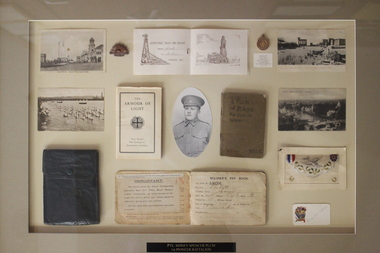
... bible prayer book sydney Front: Pte Sidney Spencer Plum, 1st Pioneer Battalion. Donated by Max & Hilary (Plum) Ryan and Sylvia Reed (Plum) of Wangarattaa Back: Wangaratta Picture Framers 9 Oct 2003. Also has messages from front postcards; Dear Mother, Just a few lines to let you know that I am alright hoping that you and all the rest is well too. We have had three fogs over here and it is very cold at night. I was picked in Cairo and they had some Turkey Officers an a German ...Collection of personal effects that belonged to Private SIdney Spencer Plum, 3431 1st Pioneer Battalion. SIdney was born on 3/1/1894 at Dockers Plains via Wangaratta. He attended both North Wangaratta and Dockers Plains schools. He was a Blacksmith aged 21 years when he enlisted on 12/6/1915 and embarked on 11/10/1915 on board HMAT Nestor. He was wounded three times and was discharged from the AIF on 16/3/1919. Items include oval photo of Sidney Plum in the centre surrounded by four post cards, one embroidered post card of a dove with an envelope in it's beak with the Union Jack and French flag, a Greetings From The Front" booklet, "The Armour of Light" bible, "A Form of Prayer for open air services" book, Soldier's Pay Book, a "To my dear Mother" card, a black leather pouch, a rising sun badge, round gold medallion. A framed montage of personal items belonging to Private Sydney Spencer PLUM compiled by his family to honour his memory and service. In addition to general military issue the remaining items were most likely purchased whilst on leave in France and England during the first world war. Postcards particularly embroidered postcards were sent home to loved ones and friends.Framed Collection of personal effects - Private Sidney Spencer Plum, 1st Pioneer Battalion. Includes oval photo of Sidney Plum in the centre surrounded by four post cards, one embroidered post card of a dove with an envelope in it's beak with the Union Jack and French flag, a Greetings From The Front" booklet, "The Armour of Light" bible, "A Form of Prayer for open air services" book, Soldier's Pay Book, a "To my dear Mother" card, a black leather pouch, a risen sun badge, round gold coloured medalion. Frame has a donation plaque.Front: Pte Sidney Spencer Plum, 1st Pioneer Battalion. Donated by Max & Hilary (Plum) Ryan and Sylvia Reed (Plum) of Wangarattaa Back: Wangaratta Picture Framers 9 Oct 2003. Also has messages from front postcards; Dear Mother, Just a few lines to let you know that I am alright hoping that you and all the rest is well too. We have had three fogs over here and it is very cold at night. I was picked in Cairo and they had some Turkey Officers an a German spy in gaol there. I wrote to Aunt Nelline. I got two letters from Alf. Maude Saxby hasnt wrote to me since I was up there on final leave. I get the letters quicker. I got Alf photos all right. I will be having Christmas in London. Well I think this is all this. I remain you son Sid. Tell Alf to send me over the Age so I can see how the war is going. I suppose Dad and the rest is busy harvesting now. Glad to hear that you got the photos all right. I think this is all this time from Sid same address as before. Dear Mother, Just a few lines to let you know that I am keeping well hoping that you and every body is the same. We have some great fogs over here, it rained all one night. We had a very good Christmas we got a billy issued to us and it had every thing in it. The Captain of our company gave me a Christmas pudding. All the same I wished I were back in Australia again. I think this is all this time. Yours truely son Sid, 25/12/15plum, sidney, world war 1, postcards, embroidered postcard, soldier's pay book, leather pouch, bible, prayer book, sydney -
 Friends of Westgarthtown
Book - Bible, "Confirmandenbuch", 1881
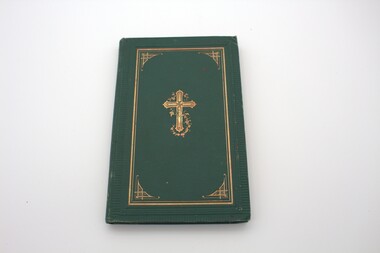
... Written in German with title "Confirmandenbuch". Author Hermann Thummel. 175 pages. "Confirmandenbuch" Book Bible Drud von D B & L Biemann ...? This bible was ?acquired by/?given to Charles Ziebell on 12 November 1882Small hard covered book with green cover and gold cross and decorations embossed. Written in German with title "Confirmandenbuch". Author Hermann Thummel. 175 pages.Written in fly leaf " Charles Ziebellbooks, religion, confirmation, methodist, prayer book, german text, charles ziebell, confirmandenbuch, hermann thummel. -
 Wodonga & District Historical Society Inc
Book - Haeusler Collection - Bible and Hymn books, c1890s
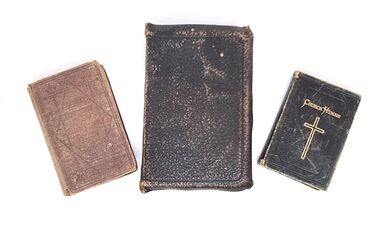
... The Haeusler family were one of several German families to migrate from South Australia to Wodonga in the 1860s. This Bible belonged to Louis Alfred Haeusler, son of Johann Heinrich Ferdinand Haeusler and Ernestine Wilhelmine nee Rogasch. ...The Haeusler family were one of several German families to migrate from South Australia to Wodonga in the 1860s. This Bible belonged to Louis Alfred Haeusler, son of Johann Heinrich Ferdinand Haeusler and Ernestine Wilhelmine nee Rogasch. ...The Wodonga Historical Society Haeusler Collection provides invaluable insight into life in late nineteenth and early twentieth century north east Victoria. The collection comprises manuscripts, personal artefacts used by the Haeusler family on their farm in Wodonga, and a set of glass negatives which offer a unique visual snapshot of the domestic and social lives of the Haeusler family and local Wodonga community. The Haeusler family migrated from Prussia (Germany) to South Australia in the 1840s and 1850s, before purchasing 100 acres of Crown Land made available under the Victorian Lands Act 1862 (also known as ‘Duffy’s Land Act’) in 1866 in what is now Wodonga West. The Haeusler family were one of several German families to migrate from South Australia to Wodonga in the 1860s. This Bible belonged to Louis Alfred Haeusler, son of Johann Heinrich Ferdinand Haeusler and Ernestine Wilhelmine nee Rogasch. Louis was born in Wodonga, Victoria on 23 December 1898 and died on 2 February 1960. The other 2 volumes belonged to Louis' sister Eleonora Lydia Haeusler (Nellie), born 14 October 1883 and died 25 November 1979. Louis was the father of John Alfred Lyell (Alf) Haeusler who bequeathed this collection to the Wodonga Historical Society. The Bible was published by Collins' Clear Type Press, a Scottish publishing company founded in 1892.The volume "Church Hymns" was published by the Society for Promoting Christian Knowledge, the oldest Anglican missionary organisation which was originally founded in 1698. This copy was published in London C1885. The Hymnal Companion to the Book of Common Prayer (2nd Edition) was published by Sampson Low, Marston and Company of London C1893.This item is unique and has well documented provenance and a known owner. It forms part of a significant and representative historical collection which reflects the local history of Wodonga. It is representative of the religious traditions adopted by this family in Wodonga. A collection of 3 religious books including a Bible, Hymn book and Hymn Book companion. They have different coloured leather covers. Handwritten inside front cover of Bible: L.A. Haeusler/ Wodonga, Vic. Handwritten inside front cover of Hymnal Companion: Eleonora L. Haeusler / St. Lukes, Wodonga Handwritten inside Church Hymns: To Nellie with love from Sister Tilly 20.8.02haeusler family, religious publications, society for promoting christian knowledge, sampson low, marston and company
