
Showing 41 items matching "german helmet"
-
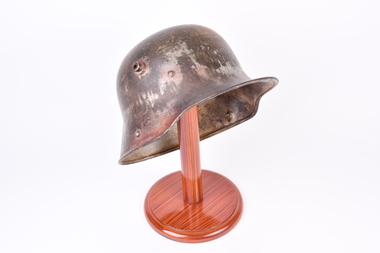 Chiltern Athenaeum Trust
WW2 German Combat Helmet, Circa 1940-1945
... WW2 German Combat Helmet...ww2 german helmet...Associated with WW2 german issue helmet for combat purposes. ...Manganese metal Combat Helmet used by German Troops WW2. Hard metal exterior. ...Associated with WW2 german issue helmet for combat purposes. Associated with WW2 German combat helmet issue. ...Associated with WW2 german issue helmet for combat purposes. Associated with WW2 German combat helmet issue. Once owned by Harry Dyson, Chiltern Resident. Manganese metal Combat Helmet used by German Troops WW2. Hard metal exterior. ww2 german helmet, german ww2 combat helmet -
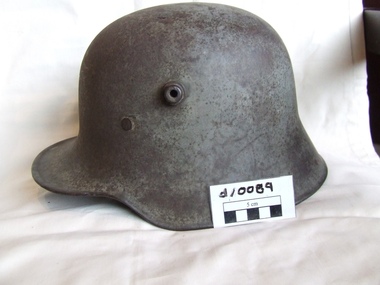 Waverley RSL Sub Branch
German Helmet
... German Helmet...Steel German helmet WWI ...nil Steel German helmet WWI German Helmet ...Steel German helmet WWI nil -
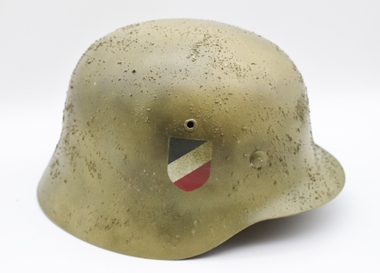 Montmorency–Eltham RSL Sub Branch
Memorabilia - Helmet, Steel, German M42
... Helmet, Steel, German M42 ...Germany...German helmet...Typical of German Steel Helmets from 1942 onward....Reproduction German M42 double decal Steel Helmet with 9 tongue leather liner and drawstring but missing its chinstrap. ...Typical of German Steel Helmets from 1942 onward. M42 Stahlhelm World War Two WW2 Second World War Nazi Germany German helmet tri-colour shield 57 61 Reproduction German M42 double decal Steel Helmet with 9 tongue leather liner and drawstring but missing its chinstrap. ...Typical of German Steel Helmets from 1942 onward.Reproduction German M42 double decal Steel Helmet with 9 tongue leather liner and drawstring but missing its chinstrap. It is painted to represent usage by the Africa Korps in North Africa 1941-1943.57 61m42, stahlhelm, world war two, ww2, second world war, nazi germany, german helmet, tri-colour shield -
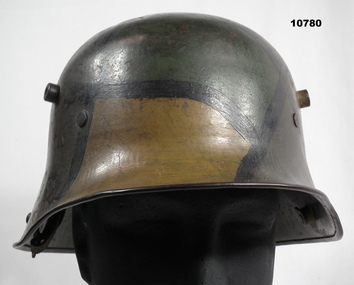 Bendigo Military Museum
Headwear - HELMET, GERMAN, WW2, 1914 -1918
... HELMET, GERMAN, WW2......German Helmet...An early model of a German steel helmet. The outer surface has been printed in camouflage colours of black, green and brown. ...Disch from AIF 29.12.19. WW1 German Helmet Headwear An early model of a German steel helmet. ...Collected by John Simmonds Regt No 10 (born England, enlist Bendigo) on 10.2.16 into HQ Section, 38th Bn. Age 29 Yrs 2 Mths. Embarked 20.6.16 for England. Embarked for France 22.11.16. Detached for duty with 10 Inf Bde HQ. To Hospital 26..2.18 Trench Fever. Rejoined unit 10.3.18. Prom. Cpl 1.3.19. Disch from AIF 29.12.19.An early model of a German steel helmet. The outer surface has been printed in camouflage colours of black, green and brown. The junction of the painted segment is covered with a 15mm black line, hand painted. Inside the helmet is a leather head band with (3) leather pouches. They are approx 112.5 cm long x 7.5 wide. In those leather pouches are dense cotton pads. The chin strap is leather and is intact. The helmet exterior has the classic "knobs" on either side of the forehead position. There are two slight dents on top RHS.ww1, german helmet, headwear -
 Shepparton RSL Sub Branch
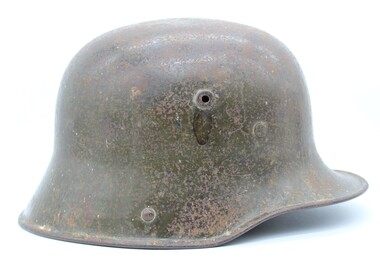
WW1 German M17 Helmet, 1917
... WW1 German M17 Helmet...Good clean example of German M17 Helmet...Good clean example of German M17 Helmet stamped to inside rim 1866 Rolled edged 3 pad 2 pads filled with straw/horse hair 1 pad empty original apple green paint to inside both air holes and chin strap holders intact WW1 German M17 Helmet ...Good clean example of German M17 HelmetRolled edged 3 pad 2 pads filled with straw/horse hair 1 pad empty original apple green paint to inside both air holes and chin strap holders intact stamped to inside rim 1866 -
 Bendigo Historical Society Inc.
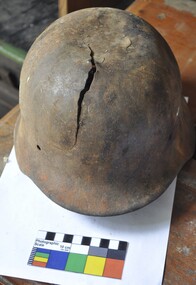
Uniform - GERMAN MILITARY ARMY HELMET
... GERMAN MILITARY ARMY HELMET... The World War II German steel combat helmet was manufactured in 3 different variations. ...German Military Army Helmet. Damaged. Cracked and holed in the crown. ...Uniform GERMAN MILITARY ARMY HELMET ...The World War II German steel combat helmet was manufactured in 3 different variations. The first model which appeared in 1935 (M35) was a sophisticated craftwork and the M40 was an improved version. The last model, the M42 was simplified to make it faster and easier to manufacture larger numbers of helmets to compensate the huge losses of helmets during the last years of the war. The number refers to the year e.g. M40 = 1940German Military Army Helmet. Damaged. Cracked and holed in the crown. No webbing or straps.world war ii, germany -
 Waverley RSL Sub Branch
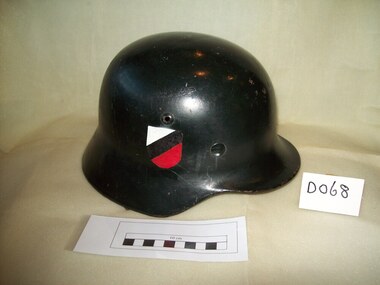
German Helmet
... German Helmet...H 15cm X W 21cm German Helmet ...Metal helmet.Colour of dark green with insignia on the sides. H 15cm X W 21cm -
 Ringwood RSL Sub-Branch
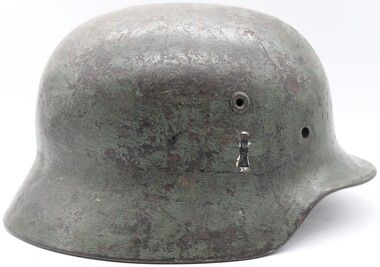
Uniform - German Helmet, WW2
... German Helmet...WW2 Uniform German Helmet ... -
 Dandenong/Cranbourne RSL Sub Branch
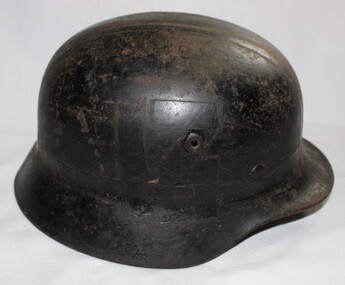
Equipment - German Helmet, 19FEB2016
... German Helmet...The helmet has been painted at some stage and has had what appears to be black electrical tape applied to it in a random pattern. Equipment German Helmet ...Black metal helmet with an adjustable leather inner which has perished a little and a leather chin strap with what appears to be an aluminium buckle and two aluminium studs. The helmet has been painted at some stage and has had what appears to be black electrical tape applied to it in a random pattern.The left hand side has the German eagle with swastika (Parteiadler) without the laurel leaves around the swastika. -
 Bendigo Military Museum
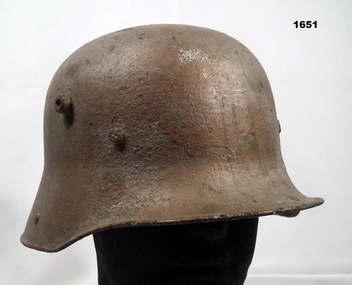
Headwear - HELMET - WW1 GERMAN, c. 1915
... HELMET - WW1 GERMAN...Helmet...German...World War One German Army steel helmet. The outer surface is painted. ...Hanna was wounded during the 1916 Battle of the Somme. Helmet German Army - WW1 Military equipment Uniforms - army Headwear World War One German Army steel helmet. ...The helmet was captured by William J Hanna, Royal Irish Fusiliers. Hanna was wounded during the 1916 Battle of the Somme.World War One German Army steel helmet. The outer surface is painted. Two lugs/ventilation holes are visible on each side. Rivets securing the missing headband are also visible. The front of the helmet has an extended visor whilst the back and sides also project to cover the nape of the neck and ears. Inside on each side are attachment points for a chin strap.helmet, german army - ww1, military equipment, uniforms - army, headwear -
 Dandenong/Cranbourne RSL Sub Branch
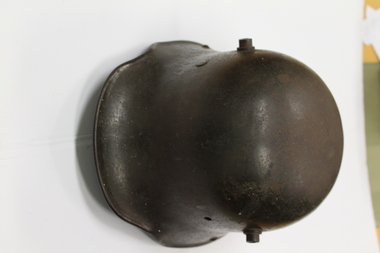
Equipment - Steel Helmet (German), Early 20th Century
... Steel Helmet (German)....German Army Helmet from WW1. First pattern M16 Steel Helmet WW1....Equipment Steel Helmet (German). ...WW1 historical significance.German Army Helmet from WW1. First pattern M16 Steel Helmet WW1. -
 Lilydale RSL Sub Branch
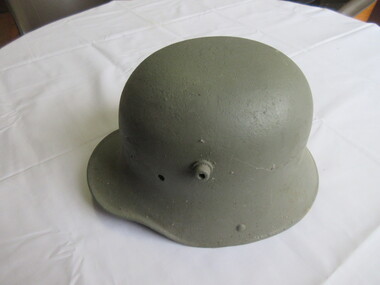
Uniform - Helmet (German WW2), 1942
... Helmet (German WW2)...German Army WW2 steel helmet (M42). Was...German Army WW2 steel helmet (M42). Was the last version of German helmet to be upgraded during the War. ...German Army WW2 steel helmet (M42). Was the last version of German helmet to be upgraded during the War.Steel helmet -
 Ringwood RSL Sub-Branch
Headwear
... WW2 German helmet...Eagle transfer WW2 German helmet Headwear ...WW2 German helmetEagle transfer -
Frankston RSL Sub Branch
Helmet, German WW1
... Helmet, German WW1...Helmet, German WW1 ... -
 Tatura Irrigation & Wartime Camps Museum
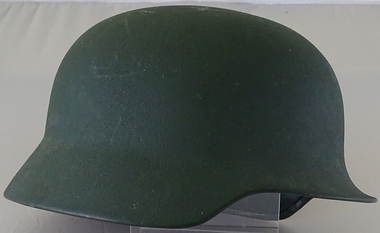
Uniform - Helmet - German
... Helmet - German...Lining attached to metal frame in helmet and drawn together centrally with a piece of cord, has a tan leather chin strap Uniform Helmet - German ...Possession of POW in Vic war campSolid metal Tan painted helmet with tan coloured leather lining. Lining attached to metal frame in helmet and drawn together centrally with a piece of cord, has a tan leather chin strapSwastika. 66tatura, uniforms, army -
 The Beechworth Burke Museum
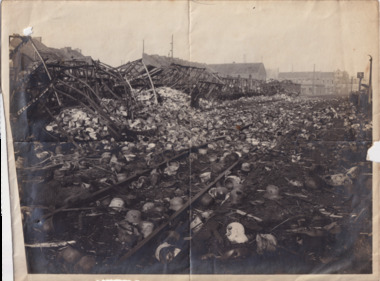
Photograph
... Reverse: 6530 / Destruction of train carrying / German helmets (?) to (?) prior to / his retreat at Charleroi /...The record may be a useful springboard for further investigation into this accident and its history. military album army war wwi world war i france charleroi train military wreckage europe belgium saint-michel-de-maurienne maurienne valley Reverse: 6530 / Destruction of train carrying / German helmets (?) to (?) prior to / his retreat at Charleroi / Black and white rectangular photograph printed on matte photographic paper. ...Taken some time between 1914-18 in France, the photograph depicts extensive wreckage of a railway train. There are collapsed buildings, debris, and helmets scattered all across the landscape. There is one unidentified soldier standing in the middle of the photograph. With research that is currently available, it can be inferred that the wreckage depicted in this photograph is from the tragic Saint-Michel-de-Maurienne derailment which occurred on December 12, 1917. The railway accident involved a troop train carrying almost 1,000 French soldiers on their way home for leave from the Italian Front in World War I. As the train descended into the Maurienne Valley, a sudden, uncontrollable acceleration caused a catastrophic crash and subsequent fire. 675 people died in the accident.The record is historically significant due to its connection to World War I. This conflict is integral to Australian culture as it was the single greatest loss of life and the greatest repatriation of casualties in the country's history. Australia’s involvement in the First World War began when the Australian government established the Australian Imperial Force (AIF) in August 1914. Immediately, men were recruited to serve the British Empire in the Middle East and on the Western Front. The record has strong research potential. This is due to the ongoing public and scholarly interest in war, history, and especially the ANZAC legend, which is commemorated annually on 25 April, known as ANZAC Day. Additionally, there is only limited information available about the Sant-Michel-de-Maurienne derailment. The record may be a useful springboard for further investigation into this accident and its history.Black and white rectangular photograph printed on matte photographic paper.Reverse: 6530 / Destruction of train carrying / German helmets (?) to (?) prior to / his retreat at Charleroi /military album, army, war, wwi, world war i, france, charleroi, train, military, wreckage, europe, belgium, saint-michel-de-maurienne, maurienne valley -
 Running Rabbits Military Museum operated by the Upwey Belgrave RSL Sub Branch
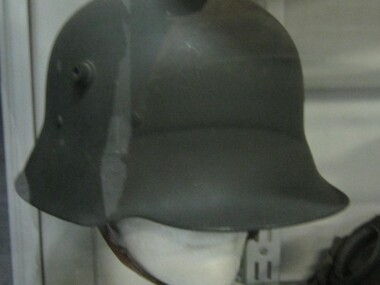
Helmet
... Replica WW1 German steel helmet, post 1916....Headgear WW1 Army Replica WW1 German steel helmet, post 1916. Helmet ...Replica WW1 German steel helmet, post 1916.headgear, ww1, army -
 Running Rabbits Military Museum operated by the Upwey Belgrave RSL Sub Branch
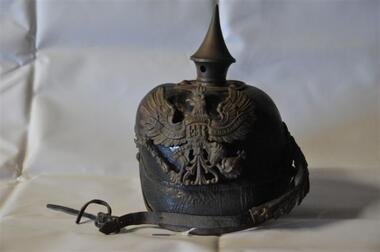
Helmet
... German 'Pikel Haube' Helmet...Headgear WW1 Army German 'Pikel Haube' Helmet Helmet ...German 'Pikel Haube' Helmetheadgear, ww1, army -
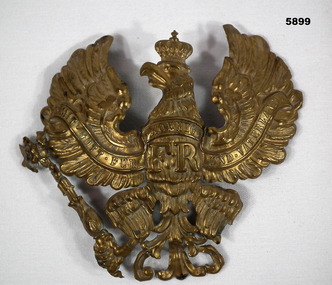 Bendigo Military Museum
Badge - BADGE, GERMAN WW1, C. WW1 or pre
... Item is curved to fit a German helmet....Item is curved to fit a German helmet. Badge BADGE, GERMAN WW1 ...Item in the collection re John D Gardiner No 2832, refer Cat No 5892.2 for his service details.Badge large pressed brass, comprises an eagle with outstretched wings and claw holding a type of staff. Through the centre on a scroll are raised lettering, on the rear are two lugs. Item is curved to fit a German helmet.On the face, " MIT. GOTT. FUR. KOENIG. UND. VATERLAND", Central are letters "F R". English translation meaning, "With God for King and Fatherland".badges, german, fatherland -
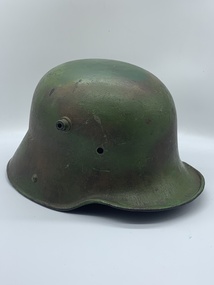 Montmorency–Eltham RSL Sub Branch
Headwear - Steel Helmet (Stahlhelm)
... Camouflage painted helmet; Model 1916 German helmet without liner, without chin strap. ...ET6 Camouflage painted helmet; Model 1916 German helmet without liner, without chin strap. ...Camouflage painted helmet; Model 1916 German helmet without liner, without chin strap. Side mounted external ventilator lugs were to support a steel brow plate for additional protection against enemy fire.ET6 -
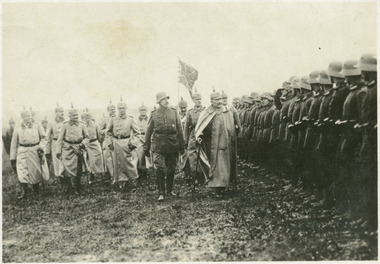 Magnet Galleries Melbourne Inc
Kaiser photograph WW1, alban pearce-27.tif, 1917
... the kaiser, somme, ww1, german, soldiers, pickelhaube, helmet, military, inspection, somme, 1917, world war 1, war...Of historical significance. the kaiser, somme, ww1, german, soldiers, pickelhaube, helmet, military, inspection, somme, 1917, world war 1, war On reverse is written: Ñ'oublions jamais! ...Kaiser inspecting the troops on the Somme 1917. The film that this print is from, was confiscated from a prisoner of war.Rare photograph of The Kaiser inspecting troops at the Somme. Of historical significance.Black & White photographic print.On reverse is written: Ñ'oublions jamais! ( "Never Forget") Somme 1917the kaiser, somme, ww1, german, soldiers, pickelhaube, helmet, military, inspection, somme, 1917, world war 1, war -
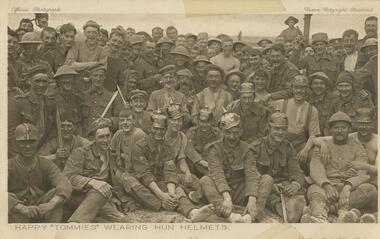 Bendigo Historical Society Inc.
Postcard - BLANCHE SLY POSTCARD COLLECTION, 1900 - 1920
... See 1403 B&W photo of about 60 smiling British soldiers in varying states of dress. 7 of them wearing captured German helmets. Caption beneath reads Happy 'Tommies' wearing Hun helmets. ...See 1403 B&W photo of about 60 smiling British soldiers in varying states of dress. 7 of them wearing captured German helmets. Caption beneath reads Happy 'Tommies' wearing Hun helmets. ...Postcard Album of Blanche Sly. Postcards stored in Folder 81 (49 postcards). 1403.1 - 1403.28 Grey linen look cover with picture of a small sailing boat pasted centre front pf cover. Partly torn sticker on lower LH corner. Blanche Victoria SLY Born: 11 Oct 1890, daughter of William and Hannah Sly Address: 1913; Loddon Vale Address: 1980; 100 Barnard Street Bendigo Died: Bendigo 12 June 1982, buried Bendigo G3 William Sly: Born: 1856 at Smythesdale, Victoria Married in Victoria in 1887; Hannah Theilman Died: Bendigo 1937, buried Bendigo G1 Hannah Sly Nee Theilman Born: 1866 Married in Victoria in 1887; William Sly Died: Bendigo 1948, buried Bendigo G3 See additional Research .Postcard Album of Blanche Sly containing 49 postcards. See 1403 B&W photo of about 60 smiling British soldiers in varying states of dress. 7 of them wearing captured German helmets. Caption beneath reads Happy 'Tommies' wearing Hun helmets. Daily Mail war pictures no. 27 Addressee - not given Sender - not given Undatedpostcard, collector, blanche sly -
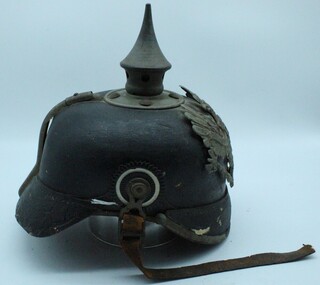 Ringwood RSL Sub-Branch
Headress German WW1, 1913
... ww1 German Pickle Haube leather helmet with metal fixtures leather chin strap...ww1 German Pickle Haube leather helmet with metal fixtures leather chin strap Headress German WW1 ...ww1 German Pickle Haube leather helmet with metal fixtures leather chin strap -
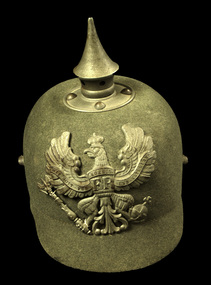 Frankston RSL Sub Branch
Helmet, Felt WW1
... German Pickelhaube helmet made of felt, spike on top of helmet possibly brass,badge on front with writing in german,nine fingered insert with broken string chinstrap held together by safety pins, some writing inside of back flap....Inside back flap is 2 letters possibly an H and N, there is a badge on front with an eagle and a german inscription when translated means "With God for King and Fatherland" German Pickelhaube helmet made of felt, spike on top of helmet possibly brass,badge on front with writing in german,nine fingered insert with broken string chinstrap held together by safety pins, some writing inside of back flap. ...German Pickelhaube helmet made of felt, spike on top of helmet possibly brass,badge on front with writing in german,nine fingered insert with broken string chinstrap held together by safety pins, some writing inside of back flap.Inside back flap is 2 letters possibly an H and N, there is a badge on front with an eagle and a german inscription when translated means "With God for King and Fatherland" -
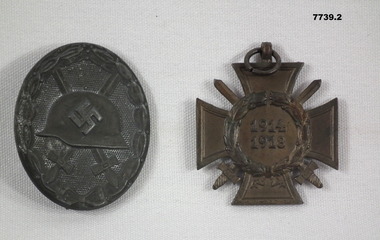 Bendigo Military Museum
Badge - BADGES, GERMAN, WW1
... In middle is a German Infantry helmet with a Swastika over two crossed swords. ...In middle is a German Infantry helmet with a Swastika over two crossed swords. ...1. Badge awarded to soldiers wounded in action during WW2. 2. Honour Cross or Hindenburg Cross created in 1934 to commemorate service of German people during WW1. Under Hitler was the only official service decoration to be worn.1. Original egg shaped WW2 wound badge. Edges have flower garland. In middle is a German Infantry helmet with a Swastika over two crossed swords. Dark grey metal and pin on back. 2. Replica of WW1 German Honour Cross. Brown metallic badge with two crossed swords over a cross (Hindenburg Cross). A ring on top to hang on a ribbon 1914-1918. In centre of Circle of flowers.1. Nil other than a Swastika on a hat. 2. "1914", "1918" on front. honour cross, wound badge, german, ww2/ww1 -
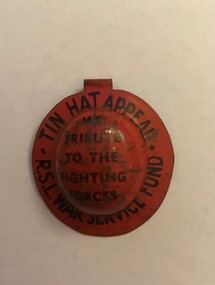 Surrey Hills Historical Society Collection
Badge - WW2 fundraising badge, Tin hat badge, 1940s
... Colloquially, it had many names including the shrapnel helmet, battle bowler, Tommy helmet, tin hat, dishpan hat, tin pan hat, washbasin, and in the United States the doughboy helmet. The German Army called it the Salatschüssel (salad bowl)....Colloquially, it had many names including the shrapnel helmet, battle bowler, Tommy helmet, tin hat, dishpan hat, tin pan hat, washbasin, and in the United States the doughboy helmet. The German Army called it the Salatschüssel (salad bowl). ...Tin Hat Day was established in 1922 after the end of WWI. It raised funds to benefit returned soldiers who had fallen on hard times after the war and during the Great Depression. It continued on during WW2 and into the 1950s. This badge is c1940. The tin hat badge was modelled on the British steel combat helmet known as the Brodie helmet, designed and patented in London in 1915 by John Leopold Brodie. Colloquially, it had many names including the shrapnel helmet, battle bowler, Tommy helmet, tin hat, dishpan hat, tin pan hat, washbasin, and in the United States the doughboy helmet. The German Army called it the Salatschüssel (salad bowl).Tin Hat Day was a significant annual event over several decades. Badges such as are not rare; they were sold in large numbers but as ephemeral items relatively few of those sold were retained.A round metal badge with a domed centre, mimicking a stylised tin hat. Red with black inscription. It has a tab on the upper centre edge. This would have enabled it to be pinned through a buttonhole or similar.Centre: MY / TRIBUTE / TO THE/ FIGHTING / FORCES Around the rim: TIN HAT APPEAL / RSL WAR SERVICE FUNDworld war 2, fundraising, commemorative badge, badge, tin hat badge -
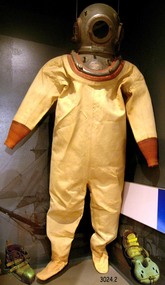 Flagstaff Hill Maritime Museum and Village
Functional object - Diving Suit, boots and weight, Early-to-mid 20th century
... helmet, boots and weight is part of the E. G.Ward collection, along with the diving compressor and a photograph of a diver in this equipment. Siebe Gorman & Company Ltd was a British company that developed diving equipment and breathing equipment and worked on commercial diving and marine salvage projects. The company advertised itself as 'Submarine Engineers'. It was founded by Augustus Siebe, a German...helmet, boots and weight is part of the E. G.Ward collection, along with the diving compressor and a photograph of a diver in this equipment. Siebe Gorman & Company Ltd was a British company that developed diving equipment and breathing equipment and worked on commercial diving and marine salvage projects. The company advertised itself as 'Submarine Engineers'. It was founded by Augustus Siebe, a German ...This diving suit with helmet, boots and weight is part of the E. G.Ward collection, along with the diving compressor and a photograph of a diver in this equipment. Siebe Gorman & Company Ltd was a British company that developed diving equipment and breathing equipment and worked on commercial diving and marine salvage projects. The company advertised itself as 'Submarine Engineers'. It was founded by Augustus Siebe, a German-born British engineer chiefly known for his contributions to diving equipment. Siebe Gorman traded as an engineering firm for over 180 years from 1819 to 1999. The early success of the business was due to its founder, the Prussian immigrant Christian 'Augustus' Siebe (1788-1872). For business reasons, he applied for and was granted British citizenship in 1856. He was a gifted engineer who was able to translate theoretical problems into practical, working products. During the industrial Victorian period, the business traded as 'A. Siebe' at 145 High Street Holborn London, but in 1828 new premises were acquired at 5 Denmark Street, Soho. The family firm produced a wide range of manufactured goods including paper-making machinery, measuring machinery, water pumps, refrigeration equipment and diving apparatus. Augustus Siebe specialised in submarine engineering early on and the company gained a reputation for the manufacture of safe, reliable diving apparatus. Augustus Siebe is best remembered for the development and manufacture of the ‘closed’ Diving Dress based on the ideas of Charles and John Deane, George Edwards and Charles Pasley. Apart from some small modifications to valves and diver communications, the basic 12-bolt ‘closed’ diving dress remained relatively unchanged after the 1870s. Later company successes were also based on innovation, with new products that could be successfully developed and manufactured to high standards. This was largely attributed to the inventive nature, foresight, engineering and entrepreneurial skills of Robert Henry Davis (1870-1965). In 1882, RH Davis joined the company of 'Siebe & Gorman' as a young 11-year-old office boy and he was to remain with the company until he died in 1965. Augustus Siebe retired in 1869 and handed over the company to a new partnership of Henry H. Siebe (1830-1885) and William A. O'Gorman (1834-1904). The new firm traded as 'Siebe & Gorman' (1870-1879) from premises in and around Mason Street, Westminster Bridge Road, Lambeth, London. The two partners soon recognised the potential of R.H. Davis and in 1894, aged 24, he became General Manager of Siebe & Gorman. Davis increasingly ran the company until the surviving partner (W.A. Gorman) died in 1904. The firm was disposed of to the Vickers (armaments) family and a new company 'Siebe Gorman & Co. Ltd.' (1905-1998) was formed. Under the chairmanship of Albert Vickers, R.H. Davis was kept on as Managing Director, and the company forged ahead. However, after WW1, the Great Depression caused manufacturing output and share prices to slump. In 1924 Robert Davis made a deal with the Vickers Board and acquired control of the company through majority shares. Under his leadership, the Siebe Gorman Company flourished and within time, four of his sons also joined the firm. The company gained a worldwide reputation for the manufacture of diving apparatus, decompression and observation chambers, and safety breathing apparatus of all types for use on the land, in the air and under the sea (including mine rescue, tunnelling, aircraft, diving, submarine escape and in other hazardous environments). Close research and development links with the MOD (especially the Admiralty), also provided a lucrative outlet for the company products. In 1932, Robert Davis was knighted by King George V, principally for his invention of the ‘Davis Submerged Escape Apparatus’ (D.S.E.A.). Siebe Gorman essentially remained a family firm from the beginning (under A.Siebe) until it became a public company for the first time in 1952. However, following WW2, British manufacturing stagnated through stifled investment and post-war austerity, and there was little innovation. Siebe Gorman fortunes began to decline as an ageing Sir Robert Davis failed to invest, or change the company business and management practices. In 1959, Siebe Gorman was acquired by the “Fairy Group” and the ailing Sir Robert was made Life President. Consequently, nothing changed and the slow decline continued until Sir Robert's death in March 1965. Around 1960, Siebe Gorman acquired the diving apparatus manufacturer C E Heinke, and for a brief period, it manufactured some diving equipment under the combined name of Siebe Heinke. Around 1964, Mr E. 'Barry' Stephens was appointed as the new Managing Director to modernise Siebe Gorman. Changes were made, including a move to a new factory in Wales in 1975. The new company concentrated on fire-fighting breathing apparatus and escape equipment, and the move coincided with the loss of many of the older, traditional craft skills. Between 1985 and 1998, Siebe expanded through acquisitions, and several other companies were acquired. The Siebe Gorman (diving apparatus) company has therefore traded as A. Siebe (1819-1870); Siebe & Gorman (1870-1879); Siebe Gorman & Co (1880-1904); Siebe Gorman & Co. Ltd (1905-1998).The diving suit, helmet, boots, and weights, along with associated equipment in the Flagstaff Hill collection, represent a highly significant snapshot of marine history. These items are particularly important in understanding the evolution of diving equipment, with a special focus on their use in salvage operations before and throughout the Second World War. Manufactured by a company renowned for its inventions, development, and innovation in marine engineering, the equipment demonstrates the progression of technology in deep-sea diving. Early helmets and related items produced by this company remain highly sought after by collectors worldwide, highlighting their historical and technological value. The presence of these items within the Flagstaff Hill Maritime Museum allows for a unique insight into the working conditions and methods employed by divers. It also illustrates the considerable dangers they faced while performing such essential and hazardous work, underscoring the critical role played by these professionals in maritime history.Diving suit including helmet, boots and a weight. Diving suit is made of canvas with knitted cuffs. The helmet is metal. The boots have a thick sole and thick leather upper that is held on with leather straps and buckles. The toe of the boot is heavy metal. The weight is worn next to the trunk of the diver and it has an inscription to mark the front. It is worn with straps and buckles holding it in place. Royal Navy Admiralty Pattern 6 bolt No 3 light Siebe Gorman light diving helmet circa 1960, used by the Royal Navy before and after World War 2. This equipment is part of the E. G. Ward Collection."Siebe Gorman & Co Ltd Marine Engineers London. Patent" with "E G Ward" on front and back plate. On weight "FRONT"flagstaff hill, warrnambool, diving suit, siebe gorman and co ltd., siebe gorman and co ltd marine engineers london, marine engineers, diving helmet, diving boots, diving weight, marine diving, maritimemuseum, maritime village, maritime history, marine technology, life saving, deep sea diving, maritime museum, siebe gorman and co ltd., siebe gorman and co ltd, london, deep-sea diving, e. g. ward, e g ward, e.g. ward, edward ward, ted ward -
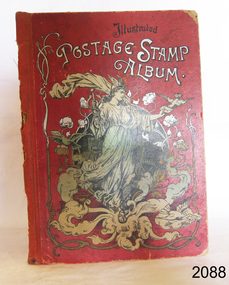 Flagstaff Hill Maritime Museum and Village
Book - Stamp Album, CF Lucke, publisher, Illustrated Postage Stamp Album, ca 1900
... Inscription: Edwin J Dale, May 13th 1901" Cover: "Illustrated POSTAGE STAMP ALBUM" Inage on cover: "within a floral border, a robed figure wearing a winged helmet, holding a staff with two snakes in one hand, and a sealed letter in the other." Fly: "Registered" "Schaubeks Postage Stamp Album" "Victoria" "Briefmarken"[German - stamps] "Pour Timbres-poste" [French - for postage Stamps] "Para Selloyde Correo" [Spanish - for postage stamps] "With 1070 reduced illustrations, 2200 blank cases for stamps" (also in German, French and Spanish) "Made in Germany"...It represents the hobbies and past times of the people of that era. flagstaff hill warrnambool shipwrecked-coast flagstaff-hill flagstaff-hill-maritime-museum maritime-museum shipwreck-coast flagstaff-hill-maritime-village illustrated postage stamp album postage stamp album stamp album book postage stamp stamp Edwin J Dale May 13th 1901 stamp collecting German stamp album Spottiswoode & Co Ltd Germany CF Lucke Leipzig CF Lucke Leipzig Inscription: Edwin J Dale, May 13th 1901" Cover: "Illustrated POSTAGE STAMP ALBUM" Inage on cover: "within a floral border, a robed figure wearing a winged helmet, holding a staff with two snakes in one hand, and a sealed letter in the other." ...The inscription in the book indicates that it once belonged to Edwin J Dale, who may have received it May 13th 1901, the date on the inscription. The album was made in Germany and has English, German, French and Spanish language on the fly page. It has 2000 pockets for holding stamps and is illustrated. The printer, Spottiswoode and Co., was established in 1738 by William Strahan, with premises in New Street Square, London. The growing firm advertised as Printers, Lithographers, Stationers, Electrotypers, Publishers, and Booksellers and by 1914 there were 1,000 employees.The stamp album is of Victorian vintage and shows that at the end of the 19th century people collected stamps. It represents the hobbies and past times of the people of that era.Illustrated Postage Stamp Album. Publisher: Lalso by CF Lucke, Leipzig, Germany Printer: Spottiswoode & Co Ltd, London Date: 1908 Red hardcover, illustrated with a robed figure image and text in English, German, French and Spanish. Book has information, advertising and pages divided into blank squares for attaching stamps. Some pages have cutouts where squares would have been, perhaps holding stamps. An inscription with the name Edwin J Dale, 13 May 1901 is on the first turned page..Inscription: Edwin J Dale, May 13th 1901" Cover: "Illustrated POSTAGE STAMP ALBUM" Inage on cover: "within a floral border, a robed figure wearing a winged helmet, holding a staff with two snakes in one hand, and a sealed letter in the other." Fly: "Registered" "Schaubeks Postage Stamp Album" "Victoria" "Briefmarken"[German - stamps] "Pour Timbres-poste" [French - for postage Stamps] "Para Selloyde Correo" [Spanish - for postage stamps] "With 1070 reduced illustrations, 2200 blank cases for stamps" (also in German, French and Spanish) "Made in Germany"flagstaff hill, warrnambool, shipwrecked-coast, flagstaff-hill, flagstaff-hill-maritime-museum, maritime-museum, shipwreck-coast, flagstaff-hill-maritime-village, illustrated postage stamp album, postage stamp album, stamp album, book, postage stamp, stamp, edwin j dale, may 13th 1901, stamp collecting, german stamp album, spottiswoode & co ltd, germany, cf lucke leipzig, cf lucke, leipzig -
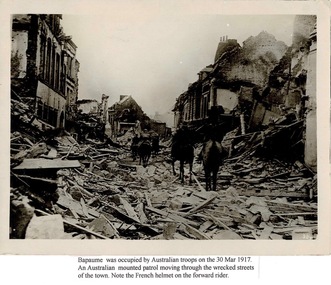 Lara RSL Sub Branch
Photograph, Photograph of Bapaume
... The Germans occupied the town in 1914 and in the final eighteen months of the war it changed hands three times. ww1, bapaume, french battlefields, lara r.s.l.world war one, australian army. Bapaume was occupied by Australian troops on the 30th Mar 1917. An Australian mounted patrol moving through the wrecked streets of the town. Note the French helmet ...Bapaume was a large German-held town almost within sight of the Australians’ trench lines throughout the winter months on the Somme. Suddenly, from 24 February 1917 it became evident that the enemy was retiring. The British advanced after them, and by the morning of 17 March Australian troops reached the outskirts of Bapaume. The soldiers’ heightened spirits were exemplified by the band of the 5th Australian Brigade playing amid the burning ruins as they marched into the old town square on the 19th. However booby traps and time bombs had been left behind; one exploded in the town hall a week later burying men and killing twenty-five.On the Western Front, Bapaume was a coveted position between the two strategically-important areas of Artois and Somme. The Germans occupied the town in 1914 and in the final eighteen months of the war it changed hands three times.Rectangular shaped Sepia photograph with an added note underneath.Bapaume was occupied by Australian troops on the 30th Mar 1917. An Australian mounted patrol moving through the wrecked streets of the town. Note the French helmet on the forward rider.ww1, bapaume, french battlefields, lara r.s.l.world war one, australian army. -
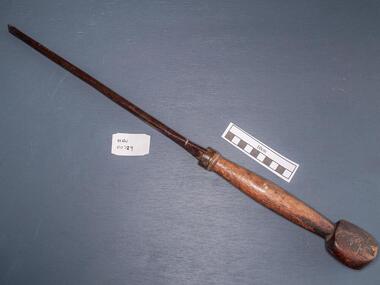 City of Moorabbin Historical Society (Operating the Box Cottage Museum)
Tools, Screwdriver large, c1900
... Screwdrivers were probably invented in the late 15th century, either in Germany or France when Screws were used to construct screw-cutting lathes, for securing breastplates, backplates, and helmets on medieval jousting armor—and eventually for multiple parts of the emerging firearms, particularly the matchlock. ...Screwdrivers were probably invented in the late 15th century, either in Germany or France when Screws were used to construct screw-cutting lathes, for securing breastplates, backplates, and helmets on medieval jousting armor—and eventually for multiple parts of the emerging firearms, particularly the matchlock. ...A screwdriver is a tool, manual or powered, for turning (driving or removing) screws. A typical simple screwdriver has a handle and a shaft, and a tip that the user inserts into the screw head to turn it. The shaft is usually made of tough steel to resist bending or twisting. The tip may be hardened to resist wear, treated with a dark tip coating for improved visual contrast between tip and screw—or ridged or treated for additional 'grip'. Handle are typically wood, metal, or plastic and usually hexagonal, square, or oval in cross-section to improve grip and prevent the tool from rolling when set down. The handle and shaft of screwdrivers have changed considerably over time. The "Perfect Pattern Handle’ screwdriver was first manufactured by HD Smith & Company, which operated from 1850 to 1900. Screwdrivers were probably invented in the late 15th century, either in Germany or France when Screws were used to construct screw-cutting lathes, for securing breastplates, backplates, and helmets on medieval jousting armor—and eventually for multiple parts of the emerging firearms, particularly the matchlock. The jaws that hold the pyrites inside medieval guns were secured with screws, and the need to constantly replace the pyrites resulted in considerable refinement of the screwdriver. The screwdriver depended entirely on the screw, and it took several advances to make the screw easy enough to produce to become popular and widespread Canadian P.L. Robertson, though he was not the first person to patent the idea of socket-head screws, was the first to successfully commercialize them, starting in 1908. In Portland, Oregon, Henry F. Phillips patented his own invention, an improved version of a deep socket with a cruciform slot, today known as the Phillips Screw. Phillips offered his screw to the American Screw Company, and after a successful trial on the 1936 Cadillac, it quickly swept through the American auto industry. A main attraction for the screw was that conventional slotted screwdrivers could also be used on them, which was not possible with the Robertson Screw. A large steel screwdriver with worn wooden handlepioneers, early settlers, market gardeners, moorabbin, bentleigh, cheltenham, brighton, tools, craftsman, carpenters, , blacksmiths, builders, farmers, metalwork, woodwork, screws, philllips head screwdrivers, h.d.smith & co usa, p.l. robertson, henry f.phillips , oregon, canada, american screw company,
