
Showing 46 items matching "german memorabilia"
-
 Bendigo Military Museum
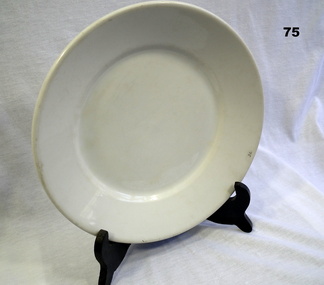
Accessory - GERMAN PLATE, Bauscher Weiden, 1940
... ...german memorabilia...WWII Germany, possibly used in German military installations military history german memorabilia souvenirs Stamped in black on underside: German Swastika surrounded by an eagle Makers mark in oval: Bauscher Weiden 1940 Circular white plate, stoneware with stamp on the base Accessory GERMAN PLATE Bauscher Weiden ...WWII Germany, possibly used in German military installationsCircular white plate, stoneware with stamp on the baseStamped in black on underside: German Swastika surrounded by an eagle Makers mark in oval: Bauscher Weiden 1940military history, german memorabilia, souvenirs -
 Whitehorse Historical Society Inc.
Article, The Pioneers, 17/06/1992 12:00:00 AM
... Item in the Nunawading Gazette publicising an exhibition of German memorabilia from early settlement of Doncaster and Nunawading is wrong in claiming that the Fankhauser family came from Germany instead of Austria according to Miss Norma Boyle....Fankhauser Claude Augustus Leopold Boyle Norma Pioneers Item in the Nunawading Gazette publicising an exhibition of German memorabilia from early settlement of Doncaster and Nunawading. ...Item in the Nunawading Gazette publicising an exhibition of German memorabilia from early settlement of Doncaster and Nunawading.Item in the Nunawading Gazette publicising an exhibition of German memorabilia from early settlement of Doncaster and Nunawading is wrong in claiming that the Fankhauser family came from Germany instead of Austria according to Miss Norma Boyle.Item in the Nunawading Gazette publicising an exhibition of German memorabilia from early settlement of Doncaster and Nunawading. fankhauser, claude augustus leopold, boyle, norma, pioneers -
 Federation University Historical Collection
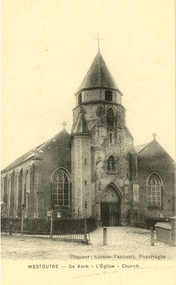
Postcard - black and white, Westoutre Church, France, c1917
... German graves.(http://www.ww1cemeteries.com/ww1cemeteries/westouterchurchyardandextension.htm, accessed 11/07/2014) The only Australian buried at the Westoutre churchyard and extension is Gunner J. GRANT (2420) 30/09/1917 Australian Heavy Artillery Australian II. F. 12. (http://www.ww1cemeteries.com/ww1cemeteries/westouterchurchyardandextension.htm, accessed 11/07/2014) A WW1 Australian soldier's memorabilia ...Westouter Churchyard and Extension is located 12 Kms south-west of Ieper town centre, on a road leading from the N375 Dikkebusseweg. The village of Westoutre (now Westouter) remained in Allied hands from the early months of the First World War to the Armistice, but in the summer of 1918, after the Battles of the Lys, it was within 2.4 Kms of the front line. The Churchyard and Extension was used by field ambulances and fighting units at intervals from November 1914 to September 1918. It contains 98 Commonwealth burials of the First World War and three German graves.(http://www.ww1cemeteries.com/ww1cemeteries/westouterchurchyardandextension.htm, accessed 11/07/2014) The only Australian buried at the Westoutre churchyard and extension is Gunner J. GRANT (2420) 30/09/1917 Australian Heavy Artillery Australian II. F. 12. (http://www.ww1cemeteries.com/ww1cemeteries/westouterchurchyardandextension.htm, accessed 11/07/2014)A WW1 Australian soldier's memorabiliaBlack and white postcard of a church at WestoutreUitgever: Sansen-Vannest, Poperinghe Westoutre - De Kerk - L'Eglise - Churchwestoutre, westouter, chatham-holmes family collection, france, church -
 Federation University Historical Collection
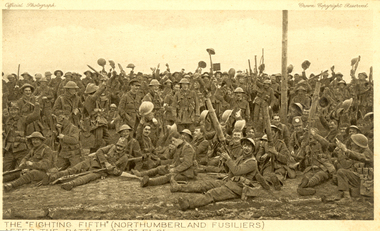
Postcard - Sepia, The "Fighting Fifth" after the Battle of St Eloi, c1916
... memorabilia. 06 Apr 1916 - The Battle of St Eloi Craters, Canadian Expeditionary Forces Major Operation. “… the British had been patiently tunnelling since August (1915) at nearby St Eloi, about three miles south of Ypres, and adjacent to the Canadian trenches. Throughout the winter, the tunnelling crept ever closer to a dominant German...memorabilia. 06 Apr 1916 - The Battle of St Eloi Craters, Canadian Expeditionary Forces Major Operation. “… the British had been patiently tunnelling since August (1915) at nearby St Eloi, about three miles south of Ypres, and adjacent to the Canadian trenches. Throughout the winter, the tunnelling crept ever closer to a dominant German ...Holmes Family WW1 memorabilia. 06 Apr 1916 - The Battle of St Eloi Craters, Canadian Expeditionary Forces Major Operation. “… the British had been patiently tunnelling since August (1915) at nearby St Eloi, about three miles south of Ypres, and adjacent to the Canadian trenches. Throughout the winter, the tunnelling crept ever closer to a dominant German-held feature dubbed “The Mound.” When the tunnels were completed in early March, tons of explosives were emplaced in six locations and on March 27, 1916, at 4:14 a.m. the charges were set off. Two German companies were wiped out and large sections of the German trenches were destroyed, but the British 9th Brigade’s attack faltered and became a bloody close-quarters slugging match, with the last bomb crater captured only on April 3.” (Zuehlke, Mark. Daniel, C. Stuart. The Canadian Military Atlas. The Nation’s Battlefields from the French and Indian Wars to Kosovo. Stoddart Publishing Co. Limited. Toronto. 2001 p. 125)A number of World War One soldiers, members of the Northumberland Fusiliers celebrate after the battle of St Eloi. Some or wear tin helmuts.The "Fighting Fifth" (Northumberland Fusiliers) after the battle of St Eloi"chatham-holmes family collection, fighting fifth, northumberland fusiliers, tunneling, explosion, crater, world war one, postcard -
 Federation University Historical Collection
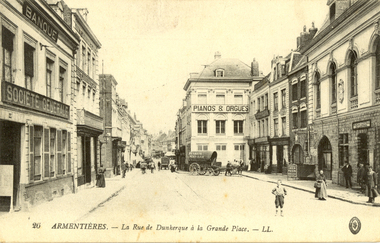
Postcard - Black and White, La Rue de Dunkerque a la grand Place, Armentiers, c1916, c1917
... Holmes Family WW1 memorabilia Chatham-Holmes Family Collection Armentieres World War One postcard Clunes France Verso: "Dear Willie, I promised to drop you a line, so he goes. Well at present I am in france having -a-go-at the Germans ...Holmes Family WW1 memorabiliaA number of people stand in a street surrounded by double storey architecture.Verso: "Dear Willie, I promised to drop you a line, so he goes. Well at present I am in france having -a-go-at the Germans, and so far out Battery is getting on alright. But I must say the Germans greet us know and again with a few shells, and I can assure you they are no friends of mine. I have just been out watching the German anti-aircraft Guns shelling our Aeroplanes. it is a very lucky shot that brings one down. i have seen a little bit of the World since I left australia, And I must say I like france better than egypt. The country at present is looking very nice, it being Spring time, The grass is about 6 foot high, and nothing on it to eat it as most of the people have cleared out from around here. I have not seen anything of Harry over this way as yet. Perhaps he is still in Egypt. Well Willie now about taking another cow to Clunes. Ay What. The name on the front of this card should be familiar to you in the War news. Well Willie Au revoir for present. remember me to all. Your fond cousin, Ron W." chatham-holmes family collection, armentieres, world war one, postcard, clunes, france -
 Federation University Historical Collection
Postcard - black and white, Kemmel, France, c1916, c1916
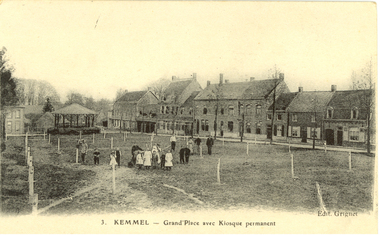
... memorabilia Kemmel village is around six miles south-west of Ypres. Located just to the north of the village centre is Kemmel Chateau Military Cemetery. The cemetery was established early in the war, in December 1914, taking its name from Kemmel Chateau which stood to the rear of the cemetery location. The chateau at certain stages in the war housed an Advanced Dressing Station (ADS), and the cemetery continued to be used until March 1918, when Kemmel was taken by the Germans...memorabilia Kemmel village is around six miles south-west of Ypres. Located just to the north of the village centre is Kemmel Chateau Military Cemetery. The cemetery was established early in the war, in December 1914, taking its name from Kemmel Chateau which stood to the rear of the cemetery location. The chateau at certain stages in the war housed an Advanced Dressing Station (ADS), and the cemetery continued to be used until March 1918, when Kemmel was taken by the Germans ...Holmes Family WW1 memorabilia Kemmel village is around six miles south-west of Ypres. Located just to the north of the village centre is Kemmel Chateau Military Cemetery. The cemetery was established early in the war, in December 1914, taking its name from Kemmel Chateau which stood to the rear of the cemetery location. The chateau at certain stages in the war housed an Advanced Dressing Station (ADS), and the cemetery continued to be used until March 1918, when Kemmel was taken by the Germans. Although it was retaken later on that year, both the cemetery and the chateau suffered from shelling with the chateau being destroyed. In total there are 1,135 First World War soldiers buried here, all but three being identified. In addition, located in a row on the left by the entrance are 21 Second World War burials. http://www.ww1battlefields.co.uk/flanders/kemmel.html, accessed 11/07/2014)Two black and white postcards showing Kemmel, France. .1) Grand'Place avec Kiosque permanent .2) Le Belvedere et le Moulinchatham-holmes family collection, kemmel, france, world war one, postcard -
 Royal Melbourne Yacht Squadron
Memorabilia - Wheel of HMAS Sydney, Early 20th Century
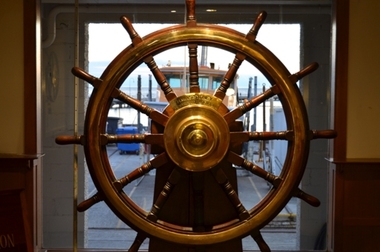
... (Bert) Ferris Extremely significant as part of Australia's Naval and Military history. ww1 sydney german hmas raider emden cocos keeling islands HMAS Sydney wheel Plaque notifying that wheel donated by Commodore Joe White 1930 Ships wheel, timber, mounted on a timber plinth, wheel of ship first HMAS Sydney. Memorabilia ...THE WHEEL OF HMAS SYDNEY COMMEMORATING AUSTRALIA’S FIRST NAVAL ENGAGEMENT The historic wheel of HMAS Sydney commemorates the Royal Australian Navy’s first ship- to- ship naval engagement. It was purchased early in 1930 and later presented to the Royal St Kilda Yacht Club (now Royal Melbourne Yacht Squadron) by then Commodore Joe White, following HMAS Sydney being broken up at Cockatoo Dock, Sydney. On 1 November 1914, led by the flagship SS Orvieto, a large convoy of 28 Australian and 10 New Zealand transports escorted by the Light Cruisers HMAS Melbourne, HMAS Sydney, HMS Minotaur and the Japanese ship Ibuki, departed King George Sound, Albany Western Australia with a large contingent of Australian and New Zealand troops bound for Egypt, to become the original Anzac’s. As the convoy steamed northwest across the Indian Ocean, leaving Cocos-Keeling Islands well to the westward, Captain Karl von Muller in the German Light Cruiser Emden of 3,600 tons, after having wrought much havoc to allied shipping in the Indian Ocean, ignorant of the convoys presence, had in mind to destroy the Cocos Island Cable Station on Direction Island. In the early hours of the morning of Monday the 9 November, he anchored “Emden” off Direction Island to send a landing party ashore, In the meantime the Cable Station had sent out a Morse Code message ‘Strange ship approaching’, this was followed soon after by a ‘S.O.S.’ These messages were picked up by ships in the convoy and at 7.00 a.m., Captain J.C. Glossop of the 5,400 ton HMAS Sydney was directed to leave the convoy and proceed at full speed for Cocos Islands. Two hours later Cocos Island was on the horizon. Captain von Muller, with the boarding party ashore to destroy the Cable station, steamed out to intercept the intruder. Captain Glossop decided to close in to 9,500 yards ( 8686.8m) before delivering his first salvo. Emden on the other hand, opened fire at 10,500 yards (9601m), its ten, 4.1 inch (104mm) guns firing 38 pound (17.24 kg ) shells, some of which scored near misses. Emden was hit repeatedly by HMAS Sydney’s eight, 6 inch (152.4mm) guns firing 100 pound (45.36kg ) shells. Within two hours Captain von Muller had decided to run the badly damaged Emden aground on North Keeling Island. Captain Glossop then broke off the engagement to speed off to intercept Emden’s collier, “Buresk”, seen lurking in the distance, soon to overtake her. A boarding party from HMAS Sydney was too late to prevent Buresk from being scuttled but able to rescue her crew. Returning to finish off Emden, HMAS Sydney was again met by heavy gunfire. Sydney scored a number of direct hits to Emden and only after having suffered 134 killed and 65 wounded, did Captain von Muller finally decide to lower his Naval Ensign. He was among those captured and was allowed to retain his Naval sword. In the engagements HMAS Sydney only suffered four direct hits, 4 killed and 12 wounded. J.H.(Bert) Ferris Extremely significant as part of Australia's Naval and Military history.Ships wheel, timber, mounted on a timber plinth, wheel of ship first HMAS Sydney.Plaque notifying that wheel donated by Commodore Joe White 1930ww1, sydney, german, hmas, raider, emden, cocos keeling, islands, hmas sydney, wheel -
 Ballarat Clarendon College
Memorial plaque
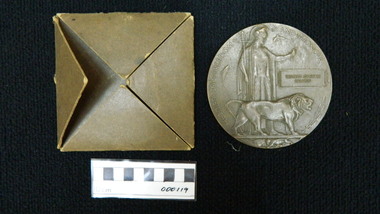
... Captain (then Lieut) Bob Salmon M.C. on one occasion worked for 7 nights straight in No Man's Land and is credited with rescuing nearly 300 of our wounded." wiff-salmon world-war-one death-penny king-george war-memorabilia ballarat-college royal-flying-corps 1912 wilfred-graham-salmon Inscribed around face of medallion: He died for freedom and honour A rectangular tablet cast on front of medallion inscribed 'Wilfred Graham Salmon'. Round disk cast in bronze gunmetal, which incorporates the following; an image of Britannia holding an oak spray with leaves and acorns, an imperial lion, two dolphins representing Britain's sea power, the emblem of Imperial Germany's eagle being torn to pieces by another lion. ...The WWI Death Plaque (Death Penny) was issued to the next of kin of servicemen/women who fell in the Great War 1914 -1918.The memorial plaque would be accompanied by a Memorial Scroll, a letter from Buckingham Palace and often a letter from the deceased's commanding officer. They would not usually arrive as a single package, but as a series of separate mailings. In this case we have the letter from Buckingham Palace. Wilfred (Wiff) Graham Salmon attended Ballarat College 1902 - 1910. He enlisted in 1915 and embarked as a driver with the 4th Field Artillery Brigade. He transferred to the Royal Flusing Corps in 1916. He was killed fighting raiders over the Thames Valley near London on 7 July 1917. 'Wiff' was reputedly the first person to die defending London from a foreign invader since the time of the Norman Conquest. His brother Robert Arthur Salmon was also an old collegian. Other possible family members who are old collegians include Nellie Florence Salmon (ent CPLC 1907; DB 1.8.1899), John Walter Salmon (ent BC 1898; DB 22.11.1889), Geoffrey Salmon (ent BC 1910; DB 3/11/1896). Wilfred's brother Robert (Bob) Salmon is mentioned in the school's 1964 history by Gordon Meins p.68..."Captain (then Lieut) Bob Salmon M.C. on one occasion worked for 7 nights straight in No Man's Land and is credited with rescuing nearly 300 of our wounded." Round disk cast in bronze gunmetal, which incorporates the following; an image of Britannia holding an oak spray with leaves and acorns, an imperial lion, two dolphins representing Britain's sea power, the emblem of Imperial Germany's eagle being torn to pieces by another lion. The medallion is incased in a heavy card envelope and is accompanied by a letter signed by King George Inscribed around face of medallion: He died for freedom and honour A rectangular tablet cast on front of medallion inscribed 'Wilfred Graham Salmon'.wiff-salmon, world-war-one, death-penny, king-george, war-memorabilia, ballarat-college, royal-flying-corps, 1912, wilfred-graham-salmon -
 Montmorency–Eltham RSL Sub Branch
Memorabilia - Helmet, Steel, German M42
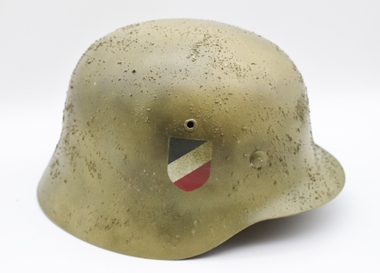
... M42 Stahlhelm World War Two WW2 Second World War Nazi Germany German helmet tri-colour shield 57 61 Reproduction German M42 double decal Steel Helmet with 9 tongue leather liner and drawstring but missing its chinstrap. It is painted to represent usage by the Africa Korps in North Africa 1941-1943. Memorabilia ...Typical of German Steel Helmets from 1942 onward.Reproduction German M42 double decal Steel Helmet with 9 tongue leather liner and drawstring but missing its chinstrap. It is painted to represent usage by the Africa Korps in North Africa 1941-1943.57 61m42, stahlhelm, world war two, ww2, second world war, nazi germany, german helmet, tri-colour shield -
Australian Commando Association - Victoria
Memorabilia - D Day Landing commemoration 50 pence coin
... Behind German Lines With the SAS France 1944 by Fraser McCluskey Memorabilia D Day Landing commemoration 50 pence coin ...Behind German Lines With the SAS France 1944 by Fraser McCluskey -
Australian Commando Association - Victoria
Memorabilia - Dog Tags of E Foulkes EX1803 – POW Crete 1942 German
... Recollections from 2/3rd Australian Independent Company/Commando Squadron Memorabilia Dog Tags of E Foulkes EX1803 – POW Crete 1942 German ...Recollections from 2/3rd Australian Independent Company/Commando Squadron -
 Bendigo Military Museum
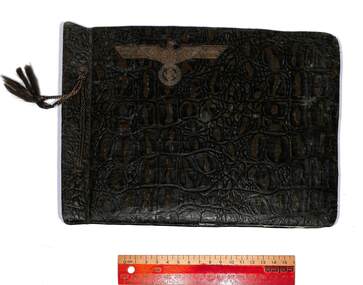
Album - PHOTOGRAPHIC ALBUM FROM THE THOMASON COLLECTION, Album of postcards and photographs of German and American subjects from WW2
... memorabilia. This album contains National Socialist and personal postcards, and also American news and officially sourced photographs. The album was likely taken as booty by an unknown American during the Italian campaign and added to later. Part of the collection of William (Bill) Thomason, refer catalogue number 3136P for more items. . Postcards WW1 WW2 Plastic covered A5 size phot album containing postcards from WW1 and WW2 periods. Includes personal correspondence postcards from WW1 era. Album of postcards and photographs of German ...Part of Thomason collection of militaria and memorabilia. This album contains National Socialist and personal postcards, and also American news and officially sourced photographs. The album was likely taken as booty by an unknown American during the Italian campaign and added to later. Part of the collection of William (Bill) Thomason, refer catalogue number 3136P for more items. . Plastic covered A5 size phot album containing postcards from WW1 and WW2 periods. Includes personal correspondence postcards from WW1 era.postcards, ww1, ww2 -
 Bendigo Military Museum
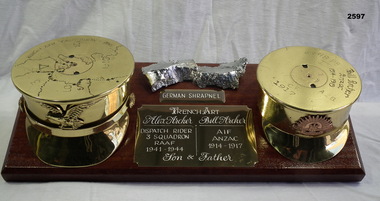
Memorabilia - TRENCH ART, WW1, WW2, Post 1945 (estimated); Made in WWI and WWII and assembled upon return
... Above the centre plaque is a piece of German shrapnel chrome plated Memorabilia TRENCH ART, WW1, WW2. ...William John ARCHER (Bill) No 321 (born Castlemaine, enlisted Castlemaine) in B Coy 21st Batt AIF on 18.1.15. Embarked for Eygpt 8.5.15. Hospital 9.9.15 with Influenza. Hospital 24.11.15 with Gastric Enteritis. Hospital 2.1.16 with Otitis Media. Transfers to the 57th Batt and embarks for France. Hospital with Trench Fever 4.10.16. Promoted to Cpl 28.4.17. Hospital 19.3.18 with Scabies. WIA 18.4.18 GSW's to chest and leg severe. Discharged from the AIF medically unfit 9.1.19. Alexander William ARCHER No 40637 (born Castlemaine, enlisted Melbourne) in the RAAF on 16.5.41 age 18 years 8 months. He wanted to be a Mess Steward and was taken in as he had worked in similar work line. He then has 5 postings before embarking for Egypt on 2.4.1942 and was posted to No 3 SQD RAAF on 20.5.1942. Re mustered as a Motor Cyclist he became a Dispatch Rider on 8.9.1942 between the RAAF and the Army. Alex served in the Middle East and Italy with 3 SQD. He embarked from Egypt diagnosed with Kyphosis and Scoliosis on 5.2.1944. In Australia he was re mustered as Office Orderly on 6.7.1944 and then discharged from the RAAF on 2.10.1944 Medically Unfit. Wooden base with brass shells either end resembling Officers caps,one being WWI, the other WWII, both inscribed. Centre plaque inscribed Alex Archer and Bill Archer, father and son. Above the centre plaque is a piece of German shrapnel chrome plated Map - "North Africa, 1940", on left hand side, "18-Pounder, 1917, Bill Archer-Anzac, 1914-1919", on right hand side, "German shrapnel"handcrafts - trench art, metal craft- brassware, arms - ammunition, military history - souvenirs -
 Bendigo Military Museum
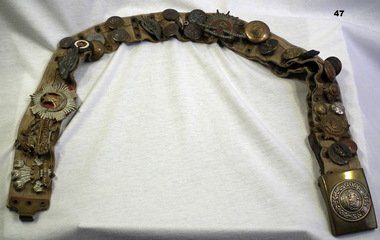
Memorabilia - BUTTONS AND BADGES, 1914 - 1918
... Refer 41 medals, 48.4P photos. military history uniforms souvenirs buttons costume accessories - haberdashery On belt buckle: Gott Mit Uns (God with us) German webbing belt bearing a souvenir collection of 29 various buttons and badges from assorted armies. Memorabilia ...29 various badges, buttons from assorted armies are attached to the German belt. The belt and assorted items were souvenired by John Stanley Howlett. Refer 41 medals, 48.4P photos. German webbing belt bearing a souvenir collection of 29 various buttons and badges from assorted armies.On belt buckle: Gott Mit Uns (God with us)military history, uniforms, souvenirs, buttons, costume accessories - haberdashery -
 Bendigo Military Museum
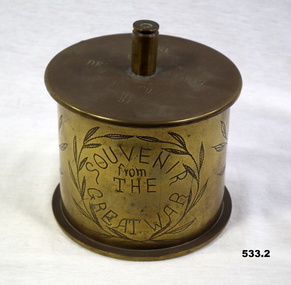
Memorabilia - TRENCH ART, BRASS CONTAINER, Post 1917
... KAMPER Duisberg Germany." .2) Lid, brass, round for .1) Lid is possibly a 3" shell with a small handle centre made from a round possible .303 size. Memorabilia ...Item belonged to William David Maher No 68, 8th LH Regt AIF. Refer 532 for main details. .1) Container, brass, round, made from possibly a 3" shell, engraved all around with depictions of small branches, leaves etc. Engraving is "Souvenir from the Great war " - "Made by G. KAMPER Duisberg Germany." .2) Lid, brass, round for .1) Lid is possibly a 3" shell with a small handle centre made from a round possible .303 size.,1) Marz, 1917. ST.G33,HL25 .2) DEZ 1917 ,ST, G,297 ,67,HL31arms - ammunition, brassware, engraving, trench art -
 Bendigo Military Museum
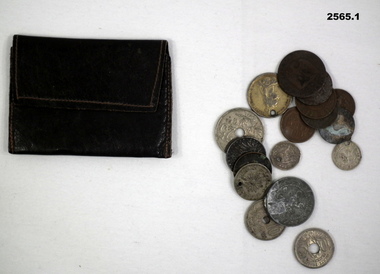
Memorabilia - PURSE & VARIOUS CONTENTS
... Refer 2325.2 for his service history. personal effects - money containers numismatics - coins - french / german costume accessories - male jewellery military history - trench art .1) Pouch, black leather containing 18 foreign coins. .2) & .3) Pair of metal cuff links. .4) Small key for winding a clock or machine. .5) Image of WWI digger fashioned from a 6d (sixpence) & brass set of bars. Memorabilia ...Items collected by Horace Eli Hambly No 794 AIF. Refer 2325.2 for his service history..1) Pouch, black leather containing 18 foreign coins. .2) & .3) Pair of metal cuff links. .4) Small key for winding a clock or machine. .5) Image of WWI digger fashioned from a 6d (sixpence) & brass set of bars.personal effects - money containers, numismatics - coins - french / german, costume accessories - male jewellery, military history - trench art -
 Bendigo Military Museum
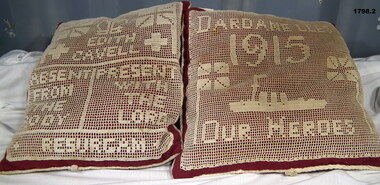
Memorabilia - CUSHIONS WW1, Post WW1
... She was arrested by the Germans and charged with Treason, found guilty by Court Martial and executed on 12.10.1915. military history - souvenirs manchester -furnishings handcrafts- crochetwork Cavell .1) "Edith/Cavell/Absent/From/The/Body/ Present/With/ The/ Lord/Resurgam." .2) "Dardenelles/ 1915/ our heroes .1) Commemorative cushions bearing Edith CAVELL's name .2) Crotchet commemorates the Dardanelle's campaign fallen 1915. Fillet crochet panels mounted on dark red plain cushion covers with white piping on edge Memorabilia ...Edith Louisa Cavell 1865 - 1915 was a British Nurse working in German occupied Belgium during the early years of WW1. She saved lives on both sides but she also helped some 200 Allied POW’s and Civilians escape Belgium to Britain. She was arrested by the Germans and charged with Treason, found guilty by Court Martial and executed on 12.10.1915. .1) Commemorative cushions bearing Edith CAVELL's name .2) Crotchet commemorates the Dardanelle's campaign fallen 1915. Fillet crochet panels mounted on dark red plain cushion covers with white piping on edge.1) "Edith/Cavell/Absent/From/The/Body/ Present/With/ The/ Lord/Resurgam." .2) "Dardenelles/ 1915/ our heroesmilitary history - souvenirs, manchester -furnishings, handcrafts- crochetwork, cavell -
 Monbulk RSL Sub Branch
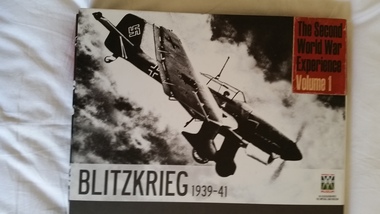
Book, Carlton, The Second World War experience v.1. Blitzkrieg 1939-1941, 2008
... Memorabilia includes: Order No 1 - the German order to invade Poland which led to the British declaration of war against Germany; The fake passport used by Sub-Lieutenant Heinz Kummer of the Graf Spee to flee back to Germany following the Battle of the River Plate; and, Montgomery's personal diary charting the events of the evacuation from Dunkirk; Roosevelt's handwritten notes for his 'day of infamy' speech which saw America's entry into the war; the order to McArthur to abandon the Philippines; Stalin's handwritten notes on his 'scorched earth' policy; and the letters home of a British officer in Africa telling of his harrowing involvement in the battles of Gazala and Tobruk; Montgomery's orders for El Alamein; Stalin's annotated proof of his famous 5 September 1942 order regarding partisan warfare; and diary kept by a German soldier on the North African front; Montgomery's hand-written D-Day notes; Eisenhower's draft 'in case of failure' message written before D-Day; and, diary of a sergeant in the Royal Hampshire regiment covering his involvement in the D-Day landings, battle for Normandy and Operation 'Market Garden' - the battle for Arnhem. ...Volume one of a four volume series featuring Blitzkrieg. A four-volume series, published in association with the Imperial War Museum, covering the whole six-year global conflagration. Each volume contains removable documents and memorabilia in pockets or pasted in, featuring personal accounts from British veterans and contemporary letters, diaries, maps and archival facsimile memoabilia from the Imperial War Museum. Memorabilia includes: Order No 1 - the German order to invade Poland which led to the British declaration of war against Germany; The fake passport used by Sub-Lieutenant Heinz Kummer of the Graf Spee to flee back to Germany following the Battle of the River Plate; and, Montgomery's personal diary charting the events of the evacuation from Dunkirk; Roosevelt's handwritten notes for his 'day of infamy' speech which saw America's entry into the war; the order to McArthur to abandon the Philippines; Stalin's handwritten notes on his 'scorched earth' policy; and the letters home of a British officer in Africa telling of his harrowing involvement in the battles of Gazala and Tobruk; Montgomery's orders for El Alamein; Stalin's annotated proof of his famous 5 September 1942 order regarding partisan warfare; and diary kept by a German soldier on the North African front; Montgomery's hand-written D-Day notes; Eisenhower's draft 'in case of failure' message written before D-Day; and, diary of a sergeant in the Royal Hampshire regiment covering his involvement in the D-Day landings, battle for Normandy and Operation 'Market Garden' - the battle for Arnhem.Index, ill, maps, facsims, sound disc, p.61.Volume one of a four volume series featuring Blitzkrieg. A four-volume series, published in association with the Imperial War Museum, covering the whole six-year global conflagration. Each volume contains removable documents and memorabilia in pockets or pasted in, featuring personal accounts from British veterans and contemporary letters, diaries, maps and archival facsimile memoabilia from the Imperial War Museum. Memorabilia includes: Order No 1 - the German order to invade Poland which led to the British declaration of war against Germany; The fake passport used by Sub-Lieutenant Heinz Kummer of the Graf Spee to flee back to Germany following the Battle of the River Plate; and, Montgomery's personal diary charting the events of the evacuation from Dunkirk; Roosevelt's handwritten notes for his 'day of infamy' speech which saw America's entry into the war; the order to McArthur to abandon the Philippines; Stalin's handwritten notes on his 'scorched earth' policy; and the letters home of a British officer in Africa telling of his harrowing involvement in the battles of Gazala and Tobruk; Montgomery's orders for El Alamein; Stalin's annotated proof of his famous 5 September 1942 order regarding partisan warfare; and diary kept by a German soldier on the North African front; Montgomery's hand-written D-Day notes; Eisenhower's draft 'in case of failure' message written before D-Day; and, diary of a sergeant in the Royal Hampshire regiment covering his involvement in the D-Day landings, battle for Normandy and Operation 'Market Garden' - the battle for Arnhem.world war 1939-1945 - history, world war 1939-1945 - pictorial works -
 Monbulk RSL Sub Branch
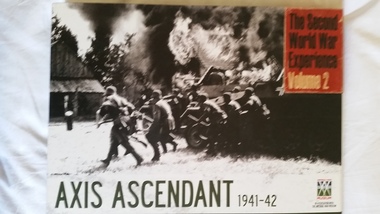
Book, Carlton, The Second World War experience v.2. Axis ascendant 1941-42, 2008
... Memorabilia includes: Order No 1 - the German order to invade Poland which led to the British declaration of war against Germany; The fake passport used by Sub-Lieutenant Heinz Kummer of the Graf Spee to flee back to Germany following the Battle of the River Plate; and, Montgomery's personal diary charting the events of the evacuation from Dunkirk; Roosevelt's handwritten notes for his 'day of infamy' speech which saw America's entry into the war; the order to McArthur to abandon the Philippines; Stalin's handwritten notes on his 'scorched earth' policy; and the letters home of a British officer in Africa telling of his harrowing involvement in the battles of Gazala and Tobruk; Montgomery's orders for El Alamein; Stalin's annotated proof of his famous 5 September 1942 order regarding partisan warfare; and diary kept by a German soldier on the North African front; Montgomery's hand-written D-Day notes; Eisenhower's draft 'in case of failure' message written before D-Day; and, diary of a sergeant in the Royal Hampshire regiment covering his involvement in the D-Day landings, battle for Normandy and Operation 'Market Garden' - the battle for Arnhem. ...Volume two of a four volume series featuring Axis ascendancy. A four-volume series, published in association with the Imperial War Museum, covering the whole six-year global conflagration. Each volume contains removable documents and memorabilia in pockets or pasted in, featuring personal accounts from British veterans and contemporary letters, diaries, maps and archival facsimile memoabilia from the Imperial War Museum. Memorabilia includes: Order No 1 - the German order to invade Poland which led to the British declaration of war against Germany; The fake passport used by Sub-Lieutenant Heinz Kummer of the Graf Spee to flee back to Germany following the Battle of the River Plate; and, Montgomery's personal diary charting the events of the evacuation from Dunkirk; Roosevelt's handwritten notes for his 'day of infamy' speech which saw America's entry into the war; the order to McArthur to abandon the Philippines; Stalin's handwritten notes on his 'scorched earth' policy; and the letters home of a British officer in Africa telling of his harrowing involvement in the battles of Gazala and Tobruk; Montgomery's orders for El Alamein; Stalin's annotated proof of his famous 5 September 1942 order regarding partisan warfare; and diary kept by a German soldier on the North African front; Montgomery's hand-written D-Day notes; Eisenhower's draft 'in case of failure' message written before D-Day; and, diary of a sergeant in the Royal Hampshire regiment covering his involvement in the D-Day landings, battle for Normandy and Operation 'Market Garden' - the battle for Arnhem.Index, ill, maps, facsims, sound disc, p.61.Volume two of a four volume series featuring Axis ascendancy. A four-volume series, published in association with the Imperial War Museum, covering the whole six-year global conflagration. Each volume contains removable documents and memorabilia in pockets or pasted in, featuring personal accounts from British veterans and contemporary letters, diaries, maps and archival facsimile memoabilia from the Imperial War Museum. Memorabilia includes: Order No 1 - the German order to invade Poland which led to the British declaration of war against Germany; The fake passport used by Sub-Lieutenant Heinz Kummer of the Graf Spee to flee back to Germany following the Battle of the River Plate; and, Montgomery's personal diary charting the events of the evacuation from Dunkirk; Roosevelt's handwritten notes for his 'day of infamy' speech which saw America's entry into the war; the order to McArthur to abandon the Philippines; Stalin's handwritten notes on his 'scorched earth' policy; and the letters home of a British officer in Africa telling of his harrowing involvement in the battles of Gazala and Tobruk; Montgomery's orders for El Alamein; Stalin's annotated proof of his famous 5 September 1942 order regarding partisan warfare; and diary kept by a German soldier on the North African front; Montgomery's hand-written D-Day notes; Eisenhower's draft 'in case of failure' message written before D-Day; and, diary of a sergeant in the Royal Hampshire regiment covering his involvement in the D-Day landings, battle for Normandy and Operation 'Market Garden' - the battle for Arnhem.world war 1939-1945 - history, world war 1939-1945 - pictorial works -
 Bendigo Historical Society Inc.
Newspaper - Fortuna Articles - "Time to Honour Pioneers", May 01 2009
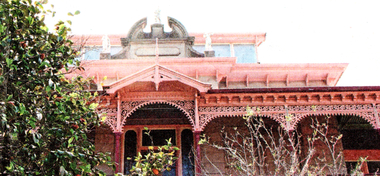
... The document advocates for greater recognition of German pioneers, suggesting Fortuna Villa as a venue for a museum or display to celebrate their legacy, inspired by the example of the Chinese Museum in Bendigo. The author urges the community to preserve and showcase the stories, artifacts, and memorabilia of all Bendigo’s pioneers, emphasizing the importance of remembering the city’s immigrant past. ...The document advocates for greater recognition of German pioneers, suggesting Fortuna Villa as a venue for a museum or display to celebrate their legacy, inspired by the example of the Chinese Museum in Bendigo. The author urges the community to preserve and showcase the stories, artifacts, and memorabilia of all Bendigo’s pioneers, emphasizing the importance of remembering the city’s immigrant past. ...Germans were the third largest ethnic group on the Bendigo goldfields in the mid-19th century, numbering 2,000–3,000 by 1860. Many were experienced miners from the Harz mountains and led the development of quartz mining at Sandhurst. Christopher Ballerstedt, a German miner, established a successful quartz mining operation and built Fortuna Villa, later sold to George Lansell. Other notable German names include Wittscheibe, Koch, Killian, Ketterer, Roeder, and Mueller, who contributed to mining and local society. German architects, especially William Vahland, played a major role in shaping Bendigo’s architecture, including work on Fortuna Villa. Germans contributed to Bendigo’s cultural life, with several daughters of German-born residents achieving international fame as opera singers. The community was active in commerce, wine production, trades, and professions (e.g., priests, chemists, mayors). Despite some families anglicizing their names during World War I, many German surnames remain prominent in Bendigo. The document advocates for greater recognition of German pioneers, suggesting Fortuna Villa as a venue for a museum or display to celebrate their legacy, inspired by the example of the Chinese Museum in Bendigo. The author urges the community to preserve and showcase the stories, artifacts, and memorabilia of all Bendigo’s pioneers, emphasizing the importance of remembering the city’s immigrant past. Beverley Carter is the author of the document and is introduced as a retired secondary school teacher, part-time journalist, reviewer, and editor. She is a member of Bendigo's Lansell family and is currently writing a comprehensive history of her family, covering their European and English origins and their role in Bendigo's development. Carter's 'Fortuna Glimpses' series focuses on the life of mining magnate George Lansell and his home, Fortuna Articles - "Time to Honour Pioneers" May 01 2009 The Bendigo Advertiser by Bevely Carter, picture by Julian Prowd This item contains the following: 11217.39a Colour Photo of Fortuna. 11217.39b Part of Page 17 - "Time to Honour Pioneers"non-fictionbendigo, fortuna, george lansell, beverley carter -
 Kyneton RSL Sub Branch
WWI CARTRIDGE, WWI 1914-18
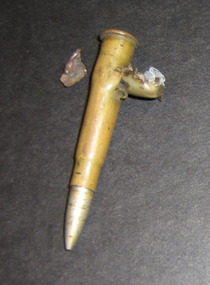
... German sniper caught him in the forehead, and shut his eyes forever. With difficulty his brother was restrained from rushing over the top for revenge. Evan survived the war, serving in France and Belgium. Some of his letters, together with other memorabilia...German sniper caught him in the forehead, and shut his eyes forever. With difficulty his brother was restrained from rushing over the top for revenge. Evan survived the war, serving in France and Belgium. Some of his letters, together with other memorabilia ...Pte Evan Edward Jones (No 276) and his younger brother Pte Edward Jones (No 1731) were both members of the 29 Infantry Battalion during World War 1. They enlisted in 1915 in Kyneton where they grew up. Edward enlisted after approval was given by his mother as he was not quite 21. He did not survive the war as he was killed by a sniper in France in 1916. It was Private Edward Jones’ love of adventure that cost him his life. In the trenches in France on 16 August 1916, beside his brother, Private Evan Edward, he raised his head and was caught by a German sniper. The brothers were side by side, and it was suggested to their sergeant that he should take a short rest; they had been 36 hours without sleep. The sergeant said “Oh no, I won’t leave you fellows.” Private Jones said “If I got a chance of a shut eye I’d take it.” He raised his head over the parapet and a German sniper caught him in the forehead, and shut his eyes forever. With difficulty his brother was restrained from rushing over the top for revenge. Evan survived the war, serving in France and Belgium. Some of his letters, together with other memorabilia, have been donated to the RSL by family members. One letter to his wife describes how a bullet hit a cartridge in his pouch but missed his body. Cartridges, the bullet and the piece of shrapnel are also included with the donated items. Part of one of Evan’s letters to his wife is re-printed here. “This bullet is the nearest thing as ever … since I have been in France. I wondered what struck me when it hit me, or rather hit the cartridge that was in my pouch. If it had been an inch or two higher it would have come through my body…the wish bone is from the fowl we had for supper last night, one of the boys bowled the fowl over with a stone so we got to work and cleaned and cooked it and it was just the thing. I got the wishbone so I thought it would be a good souvenir to send home…don’t forget to wish something nice with the wishbone.” Both boys had a strong sense of adventure and it was only natural that they fought and died for King and country. Original letters, photographs and documents have been copied for preservation. *Items donated by John and Phyllis Adams will form part of the World War One commemorative display at the Sub-Branch for Anzac Day 2015. The Jones boys grew up in the Kyneton area and enlisted in the AIF in Kyneton in 1915World War I cartridge damaged by another bullet. K15 VII on base of cartridge casingww1, pte evan jones, pte edward jones,, letters from the front -
 Ballarat Tramway Museum
Functional object - SECV pen with logo, Orthello Germany, SECV pen, c1980
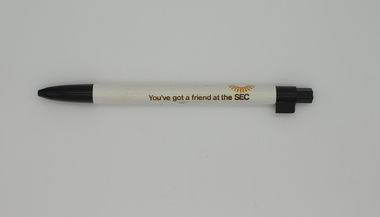
... SECV power supply pens souvenirs BTM Memorabilia Plastic biro or pen consisting of outside holder with button to engage with the metal ink container and spring and screwed base that contains the moveable part. Coloured externally black and white. Has the logo of the State Electricity Commission (1980's, 1990s"). Brass ink container marked with a swan, Orthello Germany ...Has the final SECV (1990's) "sun rays" logo and the statement "You've got a friend at the SEC". The reference gives information on the revival of the SECV as a State Government entity in 2023.Demonstrates SECV stationary and gifts.Plastic biro or pen consisting of outside holder with button to engage with the metal ink container and spring and screwed base that contains the moveable part. Coloured externally black and white. Has the logo of the State Electricity Commission (1980's, 1990s"). Brass ink container marked with a swan, Orthello Germany. Would have been made with a pocket clip, this has broken off.secv, power supply, pens, souvenirs, btm, memorabilia -
 St Kilda Historical Society
Memorabilia - Booklet, The Royal Visit Celebrations at the Opening of the First Parliament Commonwealth of Australia Melbourne May 1901, 1901
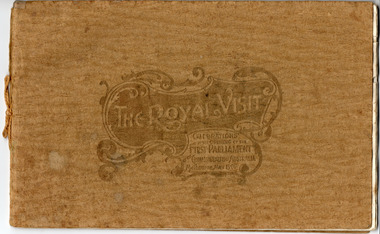
... Booklet contains photographs of: THH the Duke and Duchess of Cornwall and York; Earl of Hopetoun, Governor General, and Countess; Commonwealth Ministry; The Royal Party at Government House Melbourne; TRH the Duke and Duchess Landing at St Kilda Pier; The Mayor of Melbourne Welcoming His Royal Highness at the entrance to the City; Procession Passing down Bourke Street; Presentation of War Medals to Victorian Soldiers; The Duke of York and his Staff; St Kilda and Prahran Arch; City Arch; Procession passing Princes Bridge; Opening Ceremony at First Federal Parliament; Citizens' Arch; Queen Victoria Arch; Royal Yacht Ophir; Warships Gromoboi (Russian) and Brooklyn (USA); German Arch; Chinese Arch; State School Fete at Exhibition Building; The University Commencement; Group of Fijian Constabulary; Laying Foundation Stone, Soldiers' Memorial Ballarat; Visit to South Star Gold Mine, Ballarat; Illuminations at Princes Bridge and Flinders Street Station; Illuminations at Parliament House and Treasury; Illuminations at Town Hall and City Arch Duke and Duchess of Cornwall and York Royal visits 1901 Opening of Parliament Federation arch St Kilda and Prahran Arch City Arch German Arch Chinese Arch Handwritten inscription on title page: 'For the Boy from Grandfather in memory of a very happy time we spent together May 1901' Gold coloured paper cover embossed and tied with gold thread. Contains 16 pages of cream coloured paper printed in black, some with blue decorative margins. The Royal Visit Celebrations at the Opening of the First Parliament Commonwealth of Australia Melbourne May 1901 Memorabilia ...Booklet contains photographs of: THH the Duke and Duchess of Cornwall and York; Earl of Hopetoun, Governor General, and Countess; Commonwealth Ministry; The Royal Party at Government House Melbourne; TRH the Duke and Duchess Landing at St Kilda Pier; The Mayor of Melbourne Welcoming His Royal Highness at the entrance to the City; Procession Passing down Bourke Street; Presentation of War Medals to Victorian Soldiers; The Duke of York and his Staff; St Kilda and Prahran Arch; City Arch; Procession passing Princes Bridge; Opening Ceremony at First Federal Parliament; Citizens' Arch; Queen Victoria Arch; Royal Yacht Ophir; Warships Gromoboi (Russian) and Brooklyn (USA); German Arch; Chinese Arch; State School Fete at Exhibition Building; The University Commencement; Group of Fijian Constabulary; Laying Foundation Stone, Soldiers' Memorial Ballarat; Visit to South Star Gold Mine, Ballarat; Illuminations at Princes Bridge and Flinders Street Station; Illuminations at Parliament House and Treasury; Illuminations at Town Hall and City ArchGold coloured paper cover embossed and tied with gold thread. Contains 16 pages of cream coloured paper printed in black, some with blue decorative margins.Handwritten inscription on title page: 'For the Boy from Grandfather in memory of a very happy time we spent together May 1901'duke and duchess of cornwall and york, royal visits, 1901, opening of parliament, federation arch, st kilda and prahran arch, city arch, german arch, chinese arch -
Tatura Irrigation & Wartime Camps Museum
Folio Wartimes Camps, Singapore Group, c.2000
... Historic and personal memorabilia and recollections of those internees from their life in Singapore, their transportation on the "Queen Mary", and their time in Camp 3 Internment Camp, Tatura. Irreplaceable material and personal experiences of a group of internees from Singapore during World War 2. A number of these families were Jewish who had fled to Singapore from Germany ...Historic and personal memorabilia and recollections of those internees from their life in Singapore, their transportation on the "Queen Mary", and their time in Camp 3 Internment Camp, Tatura.Irreplaceable material and personal experiences of a group of internees from Singapore during World War 2. A number of these families were Jewish who had fled to Singapore from Germany and Austria.Black two ring folder containing printed matter and photos held in plastic sleeves. -
Tatura Irrigation & Wartime Camps Museum
Folio Wartimes Camps, German POW, C.2005
... memorabilia. Original material emanating from the time Camp 13 operated as a prisoner of war camp during WW2. Black two ring folder containing printed material, sketches and photos all contained in plastic sleeves. German ...Material from the WW2 prisoner of war Camp 13 at Murchison, official reports, letters and memorabilia. Original material emanating from the time Camp 13 operated as a prisoner of war camp during WW2.Black two ring folder containing printed material, sketches and photos all contained in plastic sleeves. -
Tatura Irrigation & Wartime Camps Museum
Photograph - copy, 1988
... For German POW's. Photographs taken at exhibition of camp memorabilia displayed at Templers Home for Aged, Bayswater, Victoria, in 1981...For German POW's. Photographs taken at exhibition of camp memorabilia displayed at Templers Home for Aged, Bayswater, Victoria, in 1981 german pow's tatura internment camps ww2 Colour photograph of a painting by Luise Katz. ...Tatura Internment camp built during WW2. For German POW's. Photographs taken at exhibition of camp memorabilia displayed at Templers Home for Aged, Bayswater, Victoria, in 1981Colour photograph of a painting by Luise Katz. Aerial view of Tatura Internment camp showing areas A, B, C and D. Negative no. 16.german pow's, tatura, internment camps, ww2 -
Tatura Irrigation & Wartime Camps Museum
Pamphlets, Photographs, Collection of memorabilia from Hans Blau
... German.| Photo 16-18. "Sergeant Snow White" program, 1943.| Photo 19. Sports Carnival Program.| Photo 20-22. Various programs of productions during time in 8th. Employment Coy.. photography photograph slides film Material borrowed for scanning. Collection of memorabilia ...All this material borrowed for scanning. Collection of memorabilia from Hans Blau, interned from Singapore and interned in Camp 3, and later in 8th. Employment Coy. All this material was made available for scanning.| Photo 1 & 2. Birthday card to Hans Blau drawn by E. Meilich, and signed on back by others.| Photos 3 & 4. Program for "Laugh & Forget" production by Hans Blau, Camp 3. |Photo 5. "Tatura Melody 1940" produced by Hans Blau. |Photo 6. "Sergeant Snowwhite" production by Hans Blau at Melbourne University Union Theatre, 1943. Hans Blau in civvies. |Photo 7. Hans Blau in camp 3.| Photo 8. Notice of internment in Singapore.| Photo 9. "Loyalty", song presumably written by Hans Blau, |Photo 10 & 11. The Viennese Orchestra program. |Photo 12. "Tatura Melody" program 1940. |Photo 13 & 14. Restriction of Travel Order issued after release.| Photo 15. Poem in German.| Photo 16-18. "Sergeant Snow White" program, 1943.| Photo 19. Sports Carnival Program.| Photo 20-22. Various programs of productions during time in 8th. Employment Coy..Material borrowed for scanning.photography, photograph, slides, film -
 Wangaratta RSL Sub Branch
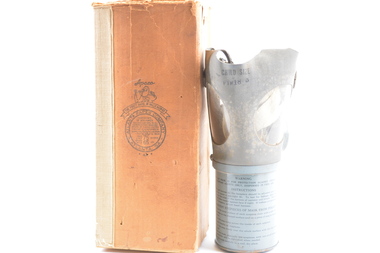
Memorabilia - Gas Mask, c1940
... Gas masks were distributed among the general population because of the fear of Japan, and even Germany, being able to reach the main land non-combatant child's gas mask ww2 Model MIA2-1-1 Cardboard box containing child size rubber and metal gas mask with green canvass bag Memorabilia Gas Mask ...The WWII US civilian gas mask for children was issued in a cardboard box. It came with a canvas carrying bag which had a shoulder strap sewn to the sides. This US Civilian home front item was issued during World War two. Gas masks were distributed among the general population because of the fear of Japan, and even Germany, being able to reach the main landCardboard box containing child size rubber and metal gas mask with green canvass bagModel MIA2-1-1non-combatant child's gas mask, ww2 -
Moorabbin Air Museum
Memorabilia (item) - includes Gannet crash 1936 war medal recipients german secret weapons, Various newspaper clippingsand articles of world aircraft mainly military
... Various newspaper clippingsand articles of world aircraft mainly military Memorabilia includes Gannet crash 1936 war medal recipients german secret weapons ... -
 Wodonga & District Historical Society Inc
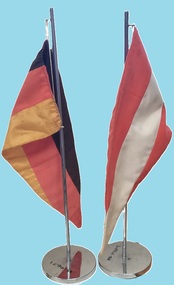
Memorabilia - German and Austrian miniature flags, Unknown
... German and Austrian miniature flags Memorabilia German and Austrian miniature flags ...Thousands of German migrants started a new life at Bonegilla, Victoria in the 1950s. Among them were five men who met each other in Wodonga, became friends and decided to form a German Austrian Club, where they could enjoy the company of likeminded individuals. They were Kurt Mueller, Willi Klimt, Toni Krischa and Erwin Klein from Germany and Manfred Teissl from Austria. On the 16th July 1960, after advertising in the Border Morning Mail, the German Austrian Club in Wodonga was born. Office bearers were Paul Peters as President. Gerhard Ziermann as Secretary and Günter Schmehl as Treasurer. Their aim was "To promote the upkeep of the German language in written and spoken form and to promote good German fellowship, while enjoying functions of a cultural and entertaining nature". By 1963 the Club boasted 40 members, holding meetings at the RSL Clubrooms and other suitable locations before they found a house in Hovell Street, Wodonga. It was used for meetings, Skat meetings, film nights and "Sonnabendschule” or Saturday school where children of members could continue to learn German. The Committee organised a wide range of activities and functions in their small rooms but dreamed of having a bigger home. This became reality in July 1979, when the Committee purchased land from the Albury Wodonga Development Corporation at 5 McFarland Road, Wodonga. The first brick was laid on the Club's land in May 1980, and the double-storey brick building was completed within 12 months voluntarily by Club members. At the same time members supported other organisations and charities in the Wodonga and wider community. The first Oktoberfest in Wodonga was held in 1975, drawing 4,000 attendees. The event was organized to promote German culture, and the profits from the first year were donated to the Wodonga District Hospital, raising $20,000. In 2001 the German Austrian Club was presented with the Certificate of Meritorious Service by the Government of Victoria for Community Works in Wodonga and district. The Club raised $23,000 for the Wodonga Hospital, had numerous fundraisers to assist in bushfires and drought situations and was involved in the Red Cross Calling campaign for many years. After much fundraising, hard work and making their way through extensive government red tape, the Club moved to its new premises in McFarland Road on 1st August 1981. The members continued to make necessary internal adjustments and sought an alcohol licence. The building was officially opened in May 1983. The Club prospered and had 300 members, making it necessary for new applicants to be put on a waiting list to be accepted as members. Interest groups consisted of Competition Air Rifle Shooting Group, a Skat (German Card game) Group, Folk Dancing Group, Ladies Group, Table Tennis Group, Darts Group, Chess Group and the Billiard Group. In later years, as so many Australians became members, the Club’s name was changed to the German Austrian Australian Club. Over recent years patronage and interest in the Club and its activities changed. Children of the original members had become “real Aussies” and did not always want to carry on traditions. Aging membership and lack of volunteers forced the Club to disband in 2025. The Club building has been gifted to the Albury Wodonga Theatre Company.These items are significant because they are representative of an important cultural organisation which operated in Wodonga for over 60 years.Two small flags of Germany and Austria attached to metal stands with string. Each stand has a metal circular base. "Lufthansa" is inscribed on the base.On base: Lufthansagerman austrian australian club, german austrian club
