
Showing 51 items matching "glider design"
-
 Moorabbin Air Museum
Book - Gliding, The Story of Gliding
... ...Glider design...Gliding Early days The Rhone England Up to now (1965) Glider design History of the development of gliding, circa 1965 The Story of Gliding Book Gliding ...History of the development of gliding, circa 1965non-fictionHistory of the development of gliding, circa 1965 early days, the rhone, england, up to now (1965), glider design -
 Australian Gliding Museum
Machine - Glider – Sailplane, 2015
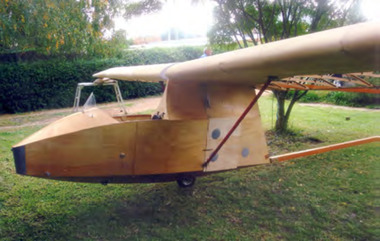
... The Salamandra is a Polish glider designed by Waclaw Czerwinski at the Military Glider Workshops in Krakow in 1936. ...The Salamandra is a Polish glider designed by Waclaw Czerwinski at the Military Glider Workshops in Krakow in 1936. ...The Salamandra is a Polish glider designed by Waclaw Czerwinski at the Military Glider Workshops in Krakow in 1936. This glider, designated “W.W.S.1”, was produced in substantial numbers prior to the second world war and used in Poland and some other eastern European countries for training pilots. Only one example survived the war, hidden away in the village of Goleszow in Silesia. In addition, no technical drawings could be found, so when the glider was discovered, the Gliding Institute being keen to re-establish gliding in Poland, used the glider to draw up new plans for construction. Five were built for the Institute in 1947 before production was resumed of the “Salamandra 48” at the SZD Jezow Workshops. Improvement were made by adding airbrakes and structural changes for the “Salamandra 49” and a windscreen and larger tailplane were changes adopted for the “Salamandra 53”. An export version designated “53A” was sold to and built under licence in China. Production of the Salamandra ceased in the early 1960s. Total production may have been in excess of 500. The glider was well regarded as a light weight trainer capable of soaring performance. The Museum’s replica was built by Ray Ash and may be may be classified as a “Salamandra 53”. However, he has added something of his own to the design by replacing the cable runs in the wings with control rods. The glider is substantially complete. The wings and tail / rudder surfaces have been covered with poly-fibre fabric. The fuselage woodwork is sealed with varnish. In addition to the finishing work (including painting) and rigging of the main components, the linkages for Ray’s control rod modification may need further engineering to make them operational. The Ray Ash Salamandra is the first of the type to appear in Australia. The Salamandra did not play any role in the development of gliding in Australia in the early years. However, it is an important exhibit in that it shows in tangible form a nacelle fuselage training glider in configuration and construction detail. As such it revisits the pioneering era of the 1930s and 1940s in Australia when wood, wire and fabric were the rule and the nacelle primary glider was generally the first step up for pilots who had mastered the basics in an open primary.Nacelled solo training glider of traditional wood and fabric construction. Construction incomplete.Noneaustralian gliding, sailplane, glider, salamandra, czerwinshi, poland, ash -
 Australian Gliding Museum
Machine - Glider – Sailplane, 1967
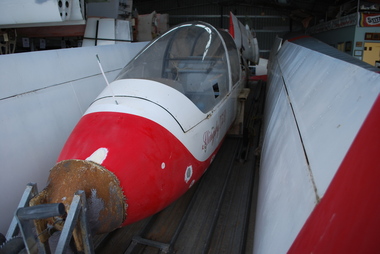
... The Slingsby T53 glider was designed by J. Sellars in the 1960s as an easily maintained two seat trainer suitable for RAF Air Training Corp use and for sale in the USA and Australian markets where wooden gliders were becoming less popular. ...The Slingsby T53 glider was designed by J. Sellars in the 1960s as an easily maintained two seat trainer suitable for RAF Air Training Corp use and for sale in the USA and Australian markets where wooden gliders were becoming less popular. ...The Slingsby T53 glider was designed by J. Sellars in the 1960s as an easily maintained two seat trainer suitable for RAF Air Training Corp use and for sale in the USA and Australian markets where wooden gliders were becoming less popular. The Slingsby T53 prototype first flew in 1967. The T53B version has a conventional fixed tailplane with elevator instead of the all-moving tailplane of the original type. The “B” version also has ailerons of narrower chord and lacks wing flaps. Further changes were made to the fin (extended above the tailplane) for the final “C” version. Production of the T53 at Slingsby was disrupted by a fire at the factory in 1968. As a consequence the contract to supply 40 of the type to the RAF was cancelled and only a relatively small number (possibly 27) were made by Slingsby before the project was discontinued. The rights were later sold to Yorkshire Sailplanes. It designated the glider as the YS53 Sovereign – only a few were produced (possibly 3). The Australian Gliding Museum’s example is a type “B” model. It bears serial number 1686 and was manufactured in 1967. It was registered in Australia as VH-GUB in name of Boonah Gliding Club, Boonah, which is about 90 kilometres south west of Brisbane in Queensland. Locally it was called “the Bomber”! This exhibit is a representative example of the Slingsby T53 sailplane type. It is a rarity in Australia.All metal twin seat glider / sailplane, painted white with red tips and markings.“Slingsby T53B” on each side of fuselage below cockpit opening; Registration VH-GUB on each side of fuselage at rear.australian gliding, glider, sailplane, slingsby, t53, sellars, boonah gliding club, slocombe, boyle -
 Australian Gliding Museum
Machine - Glider – Sailplane, 2001
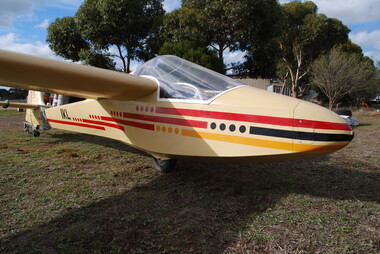
... This glider type was designed by Jim Maupin in United States in the 1970s. ...This glider type was designed by Jim Maupin in United States in the 1970s. ...This glider type was designed by Jim Maupin in United States in the 1970s. The prototype first flew in 1978. It is a design intended as suitable for amateur construction using wood (principally Douglas Fir and Birch plywood). It is understood that hundreds of sets of plans have been sold. It is not known how many Woodstocks have been built but there are at least 3 flyable examples in existence in Australia. Over time the design has been altered increasing the wingspan from 11.9 metres to 12.6 metres and then to 13.1 metres for Types 1, 2 and 3 respectively. Some builders of Woodstock gliders have also made their own changes to the Jim Maupin design. The construction of the Museum’s Woodstock (a “Woodstock 1”) was commenced by Ken Davies who, due to age related health difficulties, was unable to finish the project. The project was taken over by James Garay and was completed in 2001. It is registered with the Gliding Federation of Australia as GFA/HB123 and allocated letters VH-IKL. It is practically a new aircraft with very few flying hours logged. VH-IKL differs from the original Woodstock 1 design in one respect in that the rear fuselage has been modified to enable the tailplane to be removed for de-rigging. The Museum holds technical drawings prepared by Ken Davies in relation to this feature of the glider. James Garay kindly donated VH-IKL to the Australian Gliding Museum in March 2013. An example of a successful glider-sailplane design for amateur construction from the 1970s.Home built single seat sailplane of wooden construction finished in a light desert sand colour with aboriginal art theme markings.Marked with registration – VH-IKLaustralian gliding, glider, sailplane, woodstock, maupin, davies, garay, woody roo -
 Australian Gliding Museum
Machine - Glider / Sailplane
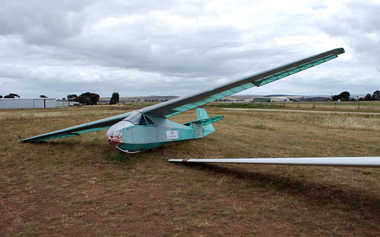
... The ES57 Kingfisher is a small to medium size single seat glider that was designed to have similar control responses to the successful two seat trainer, the ES 52 Kookaburra, thus providing for a smooth transition for solo rated pilots to advance to a single seat machine. ...The Exhibit is one of the Edmund Schneider Ltd gliders that was designed and built in Australia in the late 1950s. ...The exhibit is the prototype Kingfisher Mark 1 (serial number 23) built by Edmund Schneider Ltd and first flown on 8 July 1956. It was first registered as VH-GDH on 3 May 1957. The ES57 Kingfisher is a small to medium size single seat glider that was designed to have similar control responses to the successful two seat trainer, the ES 52 Kookaburra, thus providing for a smooth transition for solo rated pilots to advance to a single seat machine. Edmund Schneider Ltd built nine Kingfishers and supplied kits for two more for construction by others. Harold Bradley (South Australia) built a modified Kingfisher with shoulder mounted wings. Kingfisher serial number 23 was originally owned by the Waikerie Gliding Club (South Australia) (1956 – 1959). From 1959, it had a nomadic existence in the hands of a string of owners in New South Wales, Queensland, Northern Territory and finally Queensland, again. In the early 1990s the glider was deregistered and flown as an ultralight sailplane. After a change in ownership, the glider was moved to Hervey Bay, Qld and re-registered as VH-GKN. After very limited use, the glider was sold again and placed in storage at Hervey Bay. In January 2004, the owner, who by then had moved overseas, entrusted the glider to Ian Patching and Geoff Hearn who moved it to Melbourne. Ian Patching returned the glider to flying condition in February 2004. Since then, it has been stripped and recovered with new aircraft fabric and requires finishing work. The logged hours flown for the Kingfisher total approximately 190 hours from 549 flights. The glider was donated to the Australian Gliding Museum on 3 June 2014.The Exhibit is one of the Edmund Schneider Ltd gliders that was designed and built in Australia in the late 1950s. It is one of the four Kingfishers that are known to survive – the Bradley Kingfisher and two of the standard Kingfishers are known to have been destroyed – the fates of five are unknown. Single seat high wing wooden sailplane with plywood and fabric covering, in a partly restored condition. Serial number 23australian gliding, glider, sailplane, es 57, kingfisher, patching, schneider -
 Australian Gliding Museum
Machine - Glider – Sailplane
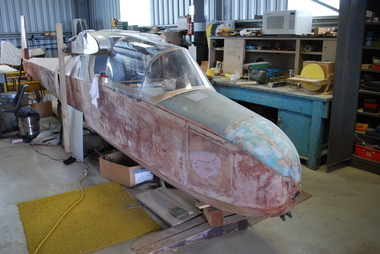
... The ES49 glider / sailplane was designed by Edmund Schneider in Germany before he migrated to Australia in the early 1950s. ...The ES49 glider / sailplane was designed by Edmund Schneider in Germany before he migrated to Australia in the early 1950s. ...The ES49 glider / sailplane was designed by Edmund Schneider in Germany before he migrated to Australia in the early 1950s. In Germany the ES49 was put into limited production by the Schleicher factory from 1951 to 1953 (8 produced). In Australia the ES49 is commonly referred to as the “Wallaby”; two were built by the Adelaide Soaring Club with assistance from Edmund Schneider Ltd and one independently from plans by Eric Hader and members of the Cooma Gliding Club. The Museum’s ES49 – serial number GFA-HB-36 - was built at Gawler from 1955 to 1958 and registered as VH-GLL on 15 January 1959. It was the second of the ES49s built by the Adelaide Soaring Club. Originally it had a rather distinctive appearance due to the use of a sleek P51 Mustang canopy to enclose the forward seating position of the cockpit. The glider, together with its sister VH-GDK, was used at the Gliding Federation of Australia National Gliding Schools at Gawler. In 1964 the glider was transferred to the Newcastle Gliding Club, Newcastle, in New South Wales and then in 1966 it went to the Albury and District Gliding Club, Albury, New South Wales. The Snowy Mountains Gliding Club, Khancoban, New South Wales acquired the glider in 1968 where it remained until 1974. In 1974 the glider transferred into private hands at Wodonga, Victoria, for two years and then to interests at Albury until 1985. At that stage the glider was acquired by a private owner at Bathurst, New South Wales, who undertook a restoration that included, amongst other work, the fitting of a more conventional cockpit canopy. The glider was at Warkworth, New South Wales in 1992 and became to be owned by Eric Oates who preserved it until he donated it to the Australian Gliding Museum. According to the logbook for VH-GLL held by the Museum, the glider was last flown in November 1990 and at that time had logged 2758 hours and 57 minutes from 15775 launches. The fuselage is currently under restoration at the Museum’s Dave Darbyshire workshop. The ES49 – VH-GLL – is an example of the state of wood and fabric dual place sailplane design in the late 1940s. The glider served the Adelaide Soaring Club and subsequent owners well as a training and general purpose sailplane over many years. It is a rare example of the type (one of 4 existing in the world). Tandem two seat high wing strut braced glider-sailplane finished in silver grey colour scheme.australian fliding, glider, sailplane, schneider, es 49, wallaby, oats, adelaide soaring club, hader, cooma gliding club, newcastle gliding club, albury & district gliding club, snowy mountains gliding club -
 Australian Gliding Museum
Machine - Glider – Sailplane, 1972
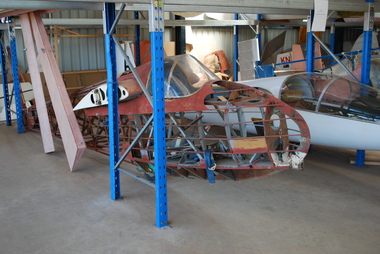
... The Hall Cherokee II glider is an American design for amateur construction from plans. ...The Hall Cherokee II glider is an American design for amateur construction from plans. ...The Hall Cherokee II glider is an American design for amateur construction from plans. The designer was Stan Hall (1915-2009), a professional engineer, who gained extensive experience in the United States aviation industry during World War 2 including the programs for military gliders. He continued to work as an engineer for aircraft manufacturers and as a consultant to the industry after the war. He was active in gliding and, in particular, the home built sailplane movement. The Cherokee II was one of about 10 glider designs that he produced: it came out in 1956. It is understood that over 100 Cherokee gliders have been built. In Australia the number is possibly 10 or 11. The Hall Cherokee VH-GVO was built by R.D Meares of Caringbah, New South Wales. The glider was registered as VH-GVO on 11 October 1973 and given serial number “GFA-HB-82” by the Gliding Federation of Australia. The Logbook for VH-GVO appears to be a complete record of the flying history; in aggregate 210 hours 40 minutes in the air from 331 flights. The first test hop occurred on 29 July 1972 at Camden, New South Wales. VH-GVO was last flown on 22 July 1986. Many of the flights recorded are of one or two hours duration. The glider was last inspected and certified as airworthy and in a reasonable condition at the Hunter Valley Gliding Club in July 1986. Since that time, until transferred to the Australian Gliding Museum, the glider was in storage. Structural restoration work has been completed on the fuselage and one wing. However, inspection of the other wing revealed extensive damage to the ribs and spars and consequently a decision was taken to make it a static exhibit. The exhibit is an example of home built construction of a type that has proved popular amongst amateur glider builders.The Hall Cherokee (formerly registered as VH-GVO) is a single seat wooden home built glider. The glider is constructed from wood, plywood, fabric and metal fittings, all commercial grade except for main wing fittings, pulleys, cables and bolts. The fuselage is simple with four main longerons and bulkheads with diagonal bracing. The wing has two identical solid spars which form a geodetic structure, hence the leading edge is non-structural. Registration VH-GVO – serial number GFA-HB-82 australian gliding, glider, sailplane, hall, cherokee, meares, hunter valley gliding club -
 Australian Gliding Museum
Machine - Glider – Sailplane, 1948
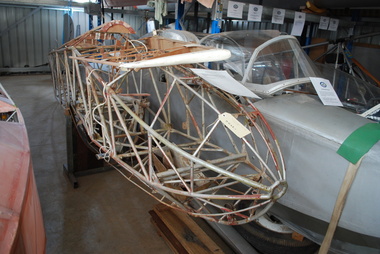
... The Schweizer SGS 2-12 or TG-3A as officially certificated is a glider that was designed in 1941-1942 and produced in United States of America from 1942 for training of military glider pilots. ...The Schweizer SGS 2-12 or TG-3A as officially certificated is a glider that was designed in 1941-1942 and produced in United States of America from 1942 for training of military glider pilots. ...The Schweizer SGS 2-12 or TG-3A as officially certificated is a glider that was designed in 1941-1942 and produced in United States of America from 1942 for training of military glider pilots. It is understood that over 100 TG-As were supplied to the USA military and at the end of the war many were sold off as surplus. Fred Hoinville imported the Museum’s TG-3A into Australia in August 1950. It is understood that it had been built in 1948 and given construction number G15. On arrival in Australia it was assembled at Bankstown aerodrome and delivered by aero-tow behind a DH Tiger Moth to Camden where Hoinville’s club, the Hinkler Soaring Club, was based. Hoinville’s TG-3A performed well at the Hinkler club in 1950-1951. Several altitude records (including a solo flight to 8000 feet by Grace Roberts – a national women’s record) were set and many soaring flight made over Camden. However, it was badly damaged in a crash landing on 15 April 1951. The glider was repaired after the crash at Camden. It is likely that modifications were made to the cockpit canopy at this time. There were three configuration tried at various times: the original dual cockpit canopy as was standard for TG3As; an unusual dual bubble canopy set up; and a single canopy over the forward seating position (in effect converting the glider to a single seater). When the glider was flown by Hoinville at the 1958 Australian Gliding Championships at Benalla, Victoria in January 1959 (refer The Age Newspaper, January 10, 1959 p.21) it had a single canopy. Records show that the glider was entered on the Australian register as VH-GDI on 6 May 1957. And the Logbook commencing in 1959 shows that ownership passed to the Port Augusta Gliding Club in South Australia on 16 August 1959. Inspections were carried out at that club and airworthiness certificates renewed in 1965. The logbook record indicates that VH-GDI had 1191 flights with an aggregate time in the air of 197 hours at the Wilmington Road Airstrip used by the Port Augusta Club. The glider was transferred to the Cooma Gliding Club, New South Wales. Flying at Cooma began in November 1966 and continued until August 1969: the glider was in the air a further 108 hours from 1067 flights. The last recorded technical inspection of the glider was conducted on 28 September 1968. The glider then passed on to Bill Riley on 20 March 1980 who stored the glider until March 2004 when it was collected by the Australian Gliding Museum. It is not clear whether the current poor state of the airframe is due to accident damage or the conditions under which it has been stored over many years or a combination of factors. Although in poor condition, this exhibit is the sole example of a TG3A ex-US military aircraft in Australia. Further the connection with the story of well-known power and glider pilot Fred Hoinville adds to its historical significance. Tubular metal framed fuselage (without covering and fittings), wooden rudder (no covering) and in damaged condition, wooden fuselage component (formers for fuselage top), Parts of control mechanism, Wooden stringers, Wooden wings without fabric covering and in damaged condition, Ailerons, Tailplane /Elevator without fabric covering, Perspex bubble canopies.australian gliding, glider, sailplane, schweizer, tg 3a, hoinville, roberts, hinkler soaring club, port augusta gliding club, cooma gliding club, riley -
Moorabbin Air Museum
Document (item) - Various aircraft photos and drawings see description, CAC Misc documents and design drawings of various aircraft
... xyz Various aircraft ,Kiowa, Bennet Airtruck, Fishermans Bend aerial view 1946, Hornet, Macchi, Mustang, Winjeel, Wamira, Sabre, Canberra instrument panel, early years of CAC operation, Wackett, Gloster, Gannet, Hector, Battle, Lysander, Magister, Beaufreighter, Canberra, Mirage, GAF Beaufighter fuel system instrument panel, 20mm gun feed, Turana, XP64, Allison gas turbine, Centaurus engine, Aspin, Esams, Tom Keeble, Kurt Lessing glider, Rover, Wasp, CA 15, Vampire, drop tanks, CAC Misc documents and design drawings of various aircraft Document Various aircraft photos and drawings see description ...xyz -
Moorabbin Air Museum
Photograph (Item) - Taylor Monoplane design , Twin Wasp C3 engine, De Havilland story, Retirement activities, Industrial relations, tool design data Lidcombe, Kingsford Smith, Southern Cross, Flying Finns, benalla, Gliders, Maatsuyker, ICAO, Concorde noise level, Bristol Beaufighter Whispering death, Boeing CH-47C Chinook, Cessna A-37B Dragonfly, Jim Knight, Saab J29, Harvard MkIIA, Wackett trainer, Rocket powered interceptor, YF-23, Henty house, DCA day, Gabo Island, Fokker F28, Transport Australia magazines, P-39 Aircobra, Civil Aviation in Australia, Construction of Melbourne airport, Technology in Australia, Computers, John Cock, Navy today, Vickers Viscount, Bantam 820, Orville Wright first fight telegram, Qantas history, Australias Aircraft industry, Beaufighters, Mustangs, Beauforts, Tudors, Mosquitos, Boomerangs, Dragons, Wacketts, Tiger Moths, ME109, Australian aviation history
... Australian aviation history Photograph Taylor Monoplane design , Twin Wasp C3 engine, De Havilland story, Retirement activities, Industrial relations, tool design data Lidcombe, Kingsford Smith, Southern Cross, Flying Finns, benalla, Gliders, Maatsuyker, ICAO, Concorde noise level, Bristol Beaufighter Whispering death, Boeing CH-47C Chinook, Cessna A-37B Dragonfly, Jim Knight, Saab J29, Harvard MkIIA, Wackett trainer, Rocket powered interceptor, YF-23, Henty house, DCA day, Gabo Island, Fokker F28, Transport Australia magazines, P-39 Aircobra, Civil Aviation in Australia, Construction of Melbourne airport, Technology in Australia, Computers, John Cock, Navy today, Vickers Viscount, Bantam 820, Orville Wright first fight telegram, Qantas history, Australias Aircraft industry, Beaufighters, Mustangs, Beauforts, Tudors, Mosquitos, Boomerangs, Dragons, Wacketts, Tiger Moths, ME109 ... -
Moorabbin Air Museum
Photograph (item) - John Wells Collection - see Description for details of photo collection
... Australian designed 1.) Drones Passenger Airraft, 2.)Troop Carrying Glider 1943/45 Photos DeHavilland Canada Aircraft. ...Australian designed 1.) Drones Passenger Airraft, 2.)Troop Carrying Glider 1943/45 Photos DeHavilland Canada Aircraft. ... -
 Warrnambool and District Historical Society Inc.
Book - Biography of George Mackenzie, Kevin O'Reilly, George Mackenzie of Pella, 2019
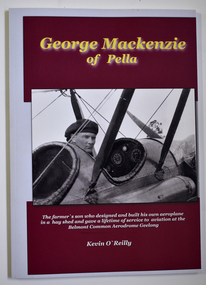
... designed and built his own aeroplane at Pella in 1920 and contributed to Australian aviation heritage through his involvement with the Pratt aviation company, Brown and Dureau Limited and Corio Air Engineers, all based at the Belmont Common Aerodrome in Geelong. This book is of interest because the subject of the biography, George Mackenzie, worked for ten years as the chief mechanic for the Pratt brothers aviation company in Geelong. This company was involved in the 1920s flights around the Warrnambool district that produced many important aerial photographs of our area. A glider ...Biographical details of George Mackenzie, a pioneer aviator in VictoriaThis is a book of 68 pages with a white cover with two black and white photographs set in a red background. The printing on the cover is yellow and white. The pages contain black and white photographs and printed text.non-fictionBiographical details of George Mackenzie, a pioneer aviator in Victoriageorge mackenzie pioneer aviator, belmont common aerodrome geelong, pratt aviation company geelong -
 Australian Gliding Museum
Machine - Glider, 1957
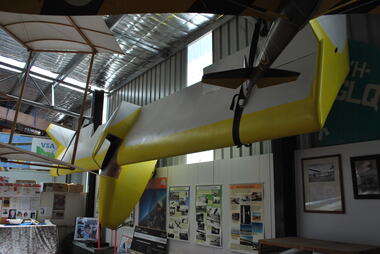
... glider and another held by the RAAF Association at Bull Creek in Western Australia. Unfortunately, no trace exists of the Flying Plank built by Glidair Sailplanes in Sydney and test flown by Fred Hoinville at Moorabbin in 1957. In addition, a larger two seat derivative (known as the Twin Plank) designed ...The aircraft was built in 1957 by Cliff Brown. It is an EPB 1, a 26 foot tailless sailplane designed in United States by Al Backstrom, Phil Easley and Jack Powell in 1954 as a simple, cheap, compact craft.A small number of single seat gliders of this type were built in Australia in the 1950s. As far as is presently known, the only surviving substantially complete EPB 1s are Cliff Brown’s glider and another held by the RAAF Association at Bull Creek in Western Australia. Unfortunately, no trace exists of the Flying Plank built by Glidair Sailplanes in Sydney and test flown by Fred Hoinville at Moorabbin in 1957. In addition, a larger two seat derivative (known as the Twin Plank) designed and built by Glidair Sailplanes (completed 1958) is held at the Power House Museum, Castlehill, in Sydney. Single seat tailless glider with wing tip rudders. The glider is of wood / fabric construction and has been restored for static display by recovering with new fabric and painting. Noneaustralian gliding, glider, flying wing, flying plank, home-built, cliff brown, al backstrom, fred hoinville, glidair sailplanes -
 Australian Gliding Museum
Machine - Glider - Sailplane, 2012
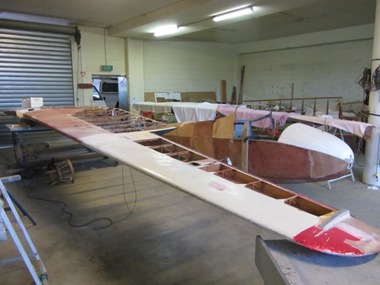
... The ES52 Kookaburra is a two seat high wing glider – sailplane of wooden construction designed by Harry Schneider and built Edmund Schneider Pty Ltd. ...The ES52 Kookaburra is a two seat high wing glider – sailplane of wooden construction designed by Harry Schneider and built Edmund Schneider Pty Ltd. ...The ES52 Kookaburra is a two seat high wing glider – sailplane of wooden construction designed by Harry Schneider and built Edmund Schneider Pty Ltd. It was first flown on 26 June 1954 and became the glider of choice for training new pilots of many gliding clubs around Australia in the 1950s, 1960s and 1970s. Several found there way to New Zealand. Further two kits were sent to Brazil and at least one of these was finished and flow successfully. The ES52 performed well with a glide ratio of about 22:1 and had soaring and cross-country capabilities. A notable feature of the ES52 design was the staggered side-by-side seating arrangement of the cockpit. This made for good in flight communication between instructor and trainee. Overall, thirty six were built by Edmund Schneider Pty Ltd. A longer wing version (the ES52B) was also introduced that had a better glide ratio (around 25:1). Five examples of this version were built. In Germany a modified ES52 was built incorporating a metal tube fuselage frame and with the addition of a engine driven propeller mounted on top of the wing which enabled the glider to be self launching. This museum collection item consists of the fuselage, tailplane, elevators, fin, rudder from the Mark I, ES 52 Kookaburra, formerly registered as VH-GFF and last owned by the Barcaldine and District Airsports Club of Queensland. The glider was in a damaged condition when it was acquired by the Museum. A decision was made by the Museum to repair the glider for display rather than endeavouring to restore it to an airworthy condition. The reconstruction of the wings is being undertaken by using parts of damaged ES 52 Kookaburra wings (as it happened from later ES 52 Marks). The Log Book for VH-GFF reveals operational life with a succession of gliding clubs around Australia. This exhibit will be of interest to gliding enthusiasts wishing to inspect the popular two seat club trainer of a by-gone era.This is a wood and fabric covered aircraft that is being rebuilt from the components of several aircraft as a non-flying exhibit.Fuselage marked with Edmund Schneider Pty Ltd Serial Number 9 and comes from the glider previously registered as VH-GFF.australian gliding, glider, sailplane, edmund schneider, es 52, kookaburra, barcaldine and district airsports club, victorian motorless flight group, alice springs gliding club, raaf richmond, raaf williamtown, gayndah gliding club, blackwater gliding club, southern downs aero and soaring club, charleville gliding club -
 Australian Gliding Museum
Machine - Glider – Sailplane
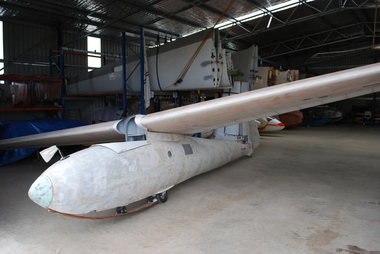
... design improvements). The Australian Gliding Museum’s Olympia is a Mark 2 (actually 2B according to the logbook) which can be distinguished by the built in main wheel and blown Perspex canopy. It was designated as serial number EON/O/34 by Elliotts. It was damaged badly at Bristol, UK, in 1949. The wreckage was acquired by a Melbourne based syndicate including Dave Darbyshire, and imported into Australia. Additional damage occurred in shipping due to the need to shorten the wings to fit them into a crate. The syndicate rebuilt the glider...design improvements). The Australian Gliding Museum’s Olympia is a Mark 2 (actually 2B according to the logbook) which can be distinguished by the built in main wheel and blown Perspex canopy. It was designated as serial number EON/O/34 by Elliotts. It was damaged badly at Bristol, UK, in 1949. The wreckage was acquired by a Melbourne based syndicate including Dave Darbyshire, and imported into Australia. Additional damage occurred in shipping due to the need to shorten the wings to fit them into a crate. The syndicate rebuilt the glider ...Prior to World War II an international competition was held for design of a standard sailplane for use in Olympic competition in 1940 in Finland. The design chosen was the “Meise” from DFS in Germany and its designer Hans Jacob. The 1940 Olympics were cancelled due to the outbreak of war and post war international gliding competition has been organized as World Championships, not as an Olympic event. After the war the Meise was manufactured by firms in Europe and a few were built by amateurs from plans. In 1945, a United Kingdom firm, Chilton Aircraft Limited, revised the plans for the DFS Meise Olympia keeping its aerodynamic shape and prepared new technical drawings for the production of the Chilton Olympia. It engaged Elliotts of Newbury (a firm with aircraft production experience during the war) to built a set of wings for its prototype. The wings were made by Elliotts but it apparently refused to let Chiltons have the jigs required to build more wings. The matter was resolved by Chiltons transferring its production rights and equipment to Elliotts. Elliotts produced several batches of Olympias (the “EON Olympia”) – probably about 150 in total from 1947 including Marks 1, 2 and 3 versions (featuring some structural changes and design improvements). The Australian Gliding Museum’s Olympia is a Mark 2 (actually 2B according to the logbook) which can be distinguished by the built in main wheel and blown Perspex canopy. It was designated as serial number EON/O/34 by Elliotts. It was damaged badly at Bristol, UK, in 1949. The wreckage was acquired by a Melbourne based syndicate including Dave Darbyshire, and imported into Australia. Additional damage occurred in shipping due to the need to shorten the wings to fit them into a crate. The syndicate rebuilt the glider and re-launched it in 1956 (registration number VH-GHR). It was flown by the syndicate and several gliding clubs in Victoria and South Australia until about 1972. A potentially airworthy example of a now rare sailplane of historical importanceSingle seat wooden sailplane, partly restored.australian gliding, glider, sailplane, dfs, hans jacob, meise, olympics, eon olympia, chilton aircraft, elliotts of newbury, dave darbyshire, great eastern gliding club, barossa valley gliding club, murray bridge gliding club -
 Australian Gliding Museum
Machine - Glider – Sailplane, 1940
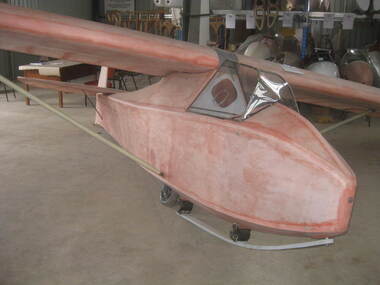
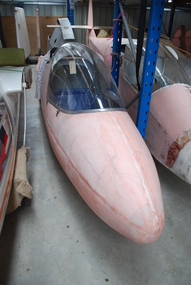
... This exhibit is a "one off" Australian designed and built glider similar in some respects to the Hutter H17. ...The “Coogee” is an intermediate single seat sailplane designed and built by Tom Proctor in 1940. Only one was built. It was first flown at Stuart Hill near Bendigo Victoria in January 1941 and was maintained in flying condition until 1967. The aircraft was flown extensively by the Victorian Motorless Flight Group (now the Melbourne Gliding Club) and Geelong Gliding Club and several subsequent owners. This exhibit is a "one off" Australian designed and built glider similar in some respects to the Hutter H17. Its usage is relevant to the history of gliding in Victoria in the post war years. Also the aircraft provides an insight into gliding technology in Australia in the 1940s. Wood and fabric single seat glider sailplane with strutted wings and strutted tailplane – features metal framed perspex canopy, central fuselage skid and wheel, small tail skid, instruments include airspeed, turn and bank indicator; variometer and altimeter. Metal parts include struts and fairing covering wing joint. All surfaces are pink doped – awaiting painting.australian gliding, glider, sailplane, coogee, tom proctor, victorian motorless flight group, geelong gliding club -
 Australian Gliding Museum
Machine - Glider – Sailplane, 1953
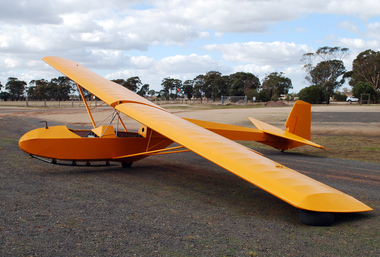
... It was designed by Schneider to comply with specifications laid down by the Gliding Federation of Australia for a basic two seat training glider*. ...It was designed by Schneider to comply with specifications laid down by the Gliding Federation of Australia for a basic two seat training glider*. ...The Schneider ES50 Club was built in 1953 and is the only one of its type. It was designed by Schneider to comply with specifications laid down by the Gliding Federation of Australia for a basic two seat training glider*. It was first flown on 10 May 1953 and delivered to the Renmark Gliding Club. The log book shows that it later passed to other gliding clubs, namely Millicent Gliding Club, Corangamite Soaring Club, Sydney Technical College Gliding Club. Overall, as at September 1967, the glider had logged over 5000 flights and a total airtime of 388 hours. The Museum volunteers have partly refurbished the ES50 to static display standard. [*Plans were also prepared for a single seat version which never eventuated] This glider is one of Edmund Schneider Pty Ltd earliest Australian designs. However, it was a later Schneider design, the ES 52 Kookaburra, which was accepted by many Australian gliding clubs for filling their need for a basic two seat training glider in the 1950s and 1960s. This is a two seat high wing aircraft of mainly wood and fabric construction. The cockpit area of the fuselage is fabric over tubular steel framing. Given serial number 3 by manufacturer and registered as VH-GHPaustralian gliding, glider, sailplane, schneider, es50, renmark gliding club, millicent gliding club, corangamite soaring club, sydney technical college gliding club -
 Australian Gliding Museum
Machine - Glider – Sailplane, 1955
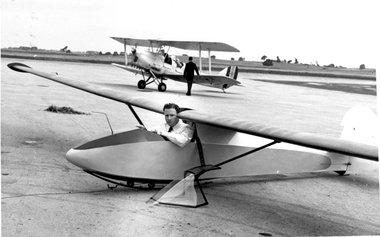
... The EP-1 "Spruce Goose" sailplane was designed and built by Ted Pascoe in 1955 as a smaller than average single seat sailplane that could be operated by two or three people. At times it was launched by auto-towing by Ted Pascoe and his wife without the aid of a third person at the wing tip. The glider...It was one of a small number of notable locally designed gliders of less than the usual 15 metre wing span from the 1950s and 1960s. australian gliding glider sailplane spruce goose ep 1 ted pascoe mt gambier gliding club mervyn gill balaklava gliding club Serial Number GFA/HB/24 Small, light weight, sailplane of wooden construction with fabric covering on wings (strutted), elevator and rudder. ...The EP-1 "Spruce Goose" sailplane was designed and built by Ted Pascoe in 1955 as a smaller than average single seat sailplane that could be operated by two or three people. At times it was launched by auto-towing by Ted Pascoe and his wife without the aid of a third person at the wing tip. The glider exhibited good soaring capability and was used for some cross country flights. For instance, in 1956 Ted Pascoe succeeded in a 36 mile goal flight during which he attained a maximum height of 4500 feet. It was flown at the Mt Gambier Gliding Club from 1956 until about 1961. The Log Book shows that it was flown at Everard in 1961 and at Everard, Waikerie, Gawler and Keith in 1962. There is a gap in flying record for this aircraft from 1962 until 1967. From 1967 to 1972 it was flown regularly at various places in South Australia including Whitwarta, Stonefield, Renmark, and Gawler. For many years it was owned and flown by Mervyn Gill of the Balaklava Gliding Club.The EP-1 glider is an example of a successful Australian home built design from the 1950s. It was one of a small number of notable locally designed gliders of less than the usual 15 metre wing span from the 1950s and 1960s.Small, light weight, sailplane of wooden construction with fabric covering on wings (strutted), elevator and rudder. Instruments have been removed and control column is not in place. Serial Number GFA/HB/24 australian gliding, glider, sailplane, spruce goose, ep 1, ted pascoe, mt gambier gliding club, mervyn gill, balaklava gliding club -
 Australian Gliding Museum
Functional object - Rudder from Geelong Gliding Club Primary Glider, 1929
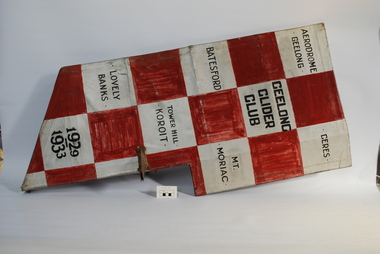
... The club built a Zogling (Primary Glider) based on plans obtained from Germany and flew it off nearby hills at Lovely Banks and other places in the Geelong region. The checked rudder design...Fabric covered wooden framed primary glider rudder with metal levers decorated with silver and dark red checkered design. ...glider. The logo and markings appear to be a more recent elaboration to the design. ...The Geelong Glider Club was formed in June 1929 at a meeting held at the Belmont Common hangar of Percy Pratt. The club built a Zogling (Primary Glider) based on plans obtained from Germany and flew it off nearby hills at Lovely Banks and other places in the Geelong region. The checked rudder design (without logo and markings) is evident in a picture of a Geelong Glider Club Zogling flying at Tower Hill near Warrambool, Victoria, at Easter 1931 and this lends support to the conclusion that the rudder was part of the Club’s first glider. The logo and markings appear to be a more recent elaboration to the design. Exhibit is a historical link to the earliest gliding activities of the Geelong Glider Club.Fabric covered wooden framed primary glider rudder with metal levers decorated with silver and dark red checkered design. The item has a cat logo on one side and markings on the other of places where the Geelong Gliding Club flew in its early years.On port side – Cat logo. On starboard side – Geelong Glider Club; and place names including Geelong Aerodrome, Batesford, Ceres, Lovely Banks, Tower Hill, Koroit, Mount Moriac; and years, 1929-1933 australian gliding, glider, zogling, primary glider, rudder, geelong gliding club, lovely banks, tower hill. koroit -
 Australian Gliding Museum
Machine - Glider – Sailplane, Construction completed 1952
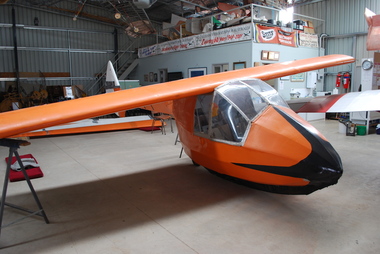
... design work can be attributed to Jock Barratt and Harold Bradley. The general layout adopted is similar to the Kite I and Kite II single seat sailplanes of Martin Warner and Allan Campbell. Having regard to this heritage, the glider...design work can be attributed to Jock Barratt and Harold Bradley. The general layout adopted is similar to the Kite I and Kite II single seat sailplanes of Martin Warner and Allan Campbell. Having regard to this heritage, the glider ...This unique aircraft was conceived in 1943 as a two seat trainer. A very large part of the design work can be attributed to Jock Barratt and Harold Bradley. The general layout adopted is similar to the Kite I and Kite II single seat sailplanes of Martin Warner and Allan Campbell. Having regard to this heritage, the glider was originally named Kite III but renamed Pelican 2, perhaps because it was the second two seat training glider built by the Waikerie Gliding Club – the first being the Pelican, a reconfigured Pratt Utility glider. Pelican 2 was first flown in 1952 and regularly since then, at least until about 1992. The Pelican 2’s performance was found to be very good for sailplanes of its era and was often used for more advanced flying in addition to training new pilots. Very few changes have been made to the Pelican 2 over the years. The undercarriage was modified after its initial testing to improve the placement of the wheels. The trailing edge of the rudder (originally straight) was rounded adding to the surface area. The twin shoulder tow line bridles were replaced with a belly hook when aviation design rules declared shoulder bridles dangerous and a nose hook has since been added to allow for aero-towing. A unique home grown sailplane design associated with Australian gliding pioneers Wooden 2 seat glider sailplane with fabric covering. Distinctive features include the pod and boom fuselage with side by side seating for pilot and a second person. The canopy of perspex supported by aluminum framing opens with port and starboard segments separately folding upwards and forward. The instrument panel includes altimeter, airspeed indicator, slip indicator and variometers. In addition to the usual controls, there is a trim operated by a small wheel mounted centrally, at head height, on the bulkhead at the rear of the cockpit. Incorporated in the skid under the fuselage pod are two wheels (one approximately midships and the other at the rear end). It has a three piece cantilever wing of approximately nearly 17 metres. The ailerons run almost full length of the outer wing segments. A Gottingen 426 section has been used changing to M6 at the tips. Outer wing segments are joined to the centre section to give about 300 mm of dihedral at the tips. The glider is equipped with airbrakes. The colour scheme consists of orange fuselage with black nose and skid. The tailplane / elevator and rudder are painted white. The wing is predominantly white with an orange leading edge. Registration VH-GFY On each side of rudder – “Pelican II” in black lettering on a rectangle of silver On each side of fuselage pod the letters ‘FY’ On each side of the fuselage, below the edge of the cockpit opening – “WAIKERIE” in black paint. australian gliding, glider, sailplane, kite, pelican, waikerie gliding club, jock barratt, harold bradley, martin warner, allan campbell -
 Australian Gliding Museum
Machine - Glider - Sailplane, 1958
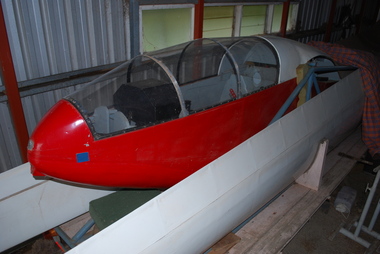
... Machine Glider - Sailplane The glider was designed by Ronald Hamilton (Ron) Adair who was joined by Clifford G (Cliff) Gurr and H. ...The Altair was built between January 1956 and November 1958 with first flight on 20 December 1958. After a few flights the cockpit was lengthened and the glider flown by Cliff Gurr and Ron Adair to complete their FAI Gold C badges. Cliff set an unofficial Australian record for an out and return flight (between Gawler and Renmark) of 230 miles (368 km) in 1961. The glider was flown by only Ron and Cliff until Mervyn Waghorn joined Ron to fly it in the National Championships at Waikerie in 1967. For a period of time the glider was left in the care of some members of the Geelong Gliding Club. Doug Vanstan of the Geelong Gliding Club fitted a new canopy and rebuilt the aileron bellcranks to improve their operation. Subsequently the Altair was flown in competitions and at vintage rallies until the mid 1980s. On 31 March 1987 Alan Patching of the Victorian Motorless Flight Group purchased the glider from Ron for the sum of one shilling and named the owners as himself, Doug Vanstan and Ian Patching. It has been stored at Bacchus Marsh airfield since then. The glider is the only 18 metre wing span machine to have been designed and built in Australia.The Altair glider is a single place 18 metre span cantilever wing glider constructed from spruce and aircraft plywood. The laminar flow wing is completely covered in plywood with a ply balsa sandwich for the leading edge and the airbrakes are unique being located in the trailing edge of the wings. All these features were done in an effort to retain laminar flow over the wing and achieve a high performance. The wings, empennage and top of the fuselage are painted white with the rest of the fuselage red. The word ‘Altair’ appears on both sides at the top of the fin.australian gliding, glider, sailplane, adair, gurr, waghorn, vanstan, rees, patching, altair, adelaide soaring club, gawler, geelong gliding club, vmfg, zechner -
 Australian Gliding Museum
Machine - Glider – Sailplane, 1956
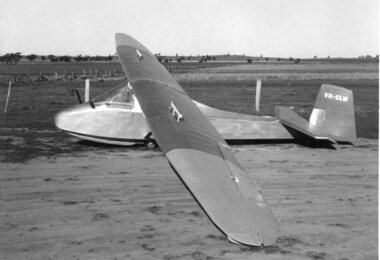
... This exhibit is a home built glider of a Grunau Baby 2 design modified by the addition of a fully enclosing Perspex canopy, spoilers, and a landing wheel. ...This exhibit is a home built glider of a Grunau Baby 2 design modified by the addition of a fully enclosing Perspex canopy, spoilers, and a landing wheel. ...This exhibit is a home built glider of a Grunau Baby 2 design modified by the addition of a fully enclosing Perspex canopy, spoilers, and a landing wheel. It was built by Alex Mackie and was originally owned by the Southern Cross Gliding Club at Camden, New South Wales. The first flight was on 19 May 1956. After about 10 years service with that club it passed through a series of owners, including the Forbes Soaring Club, Beaudesert Gliding Club and private operators. The last major inspection and overhaul of the glider was April 1972. It passed a further airworthy inspection in April 1975. At that time, questions were raised about the weight of the glider (found to be 400 lbs empty). In 1976 it had fallen into a non-airworthy condition and has not flown since. By that time the glider had flown 1161 hrs 11 minutes from 5228 launches. This exhibit is an example of a Grunau Baby 2 type incorporating some improvements as typical of post war built Grunau Baby gliders. Wooden – fabric covered glider – missing canopy perspex, Instrument panel has turn and bank only. Currently the glider features a predominately silver grey colour scheme. australian gliding, grunau, southern cross gliding club, forbes soaring club, beaudesert gliding club -
 Australian Gliding Museum
Machine - Glider – Sailplane, 1963
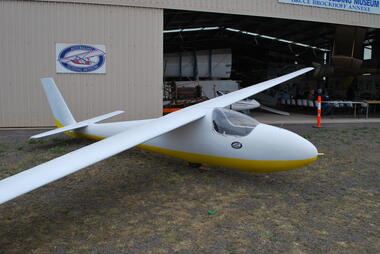
... glider stand at 2702 hours 53 minutes. It has been launched 4569 times. A good example of a Schneider ES59 sailplane from the 1960s. This type is of note because it was the first Australian designed and built sailplane to be used in a world gliding competition (Jack Iggulden in Argentina in 1963). australian gliding glider sailplane schneider es59 arrow darling downs soaring club wollongong gliding club ron geake Plate in cockpit with details of manufacturer states; manufactured by E. ...This aircraft is one of 9 single seat ES 59 advanced club sailplanes manufactured by Edmund Schneider Pty Ltd in the 1960s. It was first flown in August 1963 and delivered to the Darling Downs Soaring Club at Toowoomba Queensland. At that Club it had 2603 flights and recorded a total airtime of 1475 hours. In addition to many local circuits and soaring and cross country flying, it was used at gliding competitions, including Nationals at Benalla in December 1964, State Championships at Oakey in April 1965, at Warwick in April 1966, and at (Inverell?) in March 1967. On at least 15 occasions flight times in excess of 5 hours duration were achieved. On 5 October 1970, the glider had a new life when it was relocated to Wollongong in New South Wales. It recorded 1927 flights with a total airtime of 1179 hours at the club between October 1970 and June 1988. Competition appearances included the State Championships held at Forbes in January 1972. Places away from Wollongong where the glider was launched include Cootamundra, Wagga, Temora, Marulon, Narromine, Leeton, Nowra, Goulburn, Horsham, Greenthorpe. On 15 June 1988 it was transferred to Ron Geake who transported it to Warrego in Northern Territory (flown once at Alice Springs), and then to Gympie in Queensland where it was flown about 20 times by the end of 1995. It was also flown on a small number of occasions at Forbes in New South Wales in 1996 and 1997. During 1998 and 1999 the glider was sparsely used (9 flights) at locations that have not been recorded. From May 1999 until transfer to the Australian Gliding Museum in May 2011 it apparently was not flown. Aggregate airtime hours for the glider stand at 2702 hours 53 minutes. It has been launched 4569 times. A good example of a Schneider ES59 sailplane from the 1960s. This type is of note because it was the first Australian designed and built sailplane to be used in a world gliding competition (Jack Iggulden in Argentina in 1963). This Schneider ES59 Arrow is a single seat wooden sailplane with one piece wing. The instruments are not present except for altimeter. Fin and rudder are of swept back design. Colour scheme is white with lemon yellow fuselage underbelly. The aircraft came to the museum on an open trailer that had been designed to carry the one piece wing. Plate in cockpit with details of manufacturer states; manufactured by E. Schneider Ltd, Adelaide SA; Type ES 59; Serial Number 62; Date August 1963.australian gliding, glider, sailplane, schneider, es59, arrow, darling downs soaring club, wollongong gliding club, ron geake -
 Australian Gliding Museum
Machine - Glider – Sailplane, 1952-1953
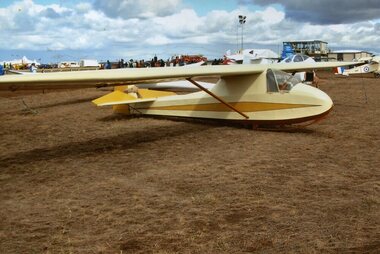
... This aircraft, the first glider built by Schneiders after they immigrated to Australia, was test flown on 3 January 1953 by Dave Darbyshire and Owen Lewis. It is the only machine of its type. It is essentially a Grunau Baby 2B with a Perspex enclosed cockpit, wing airbrakes and a landing wheel. However, the wing design...This aircraft, the first glider built by Schneiders after they immigrated to Australia, was test flown on 3 January 1953 by Dave Darbyshire and Owen Lewis. It is the only machine of its type. It is essentially a Grunau Baby 2B with a Perspex enclosed cockpit, wing airbrakes and a landing wheel. However, the wing design ...This aircraft, the first glider built by Schneiders after they immigrated to Australia, was test flown on 3 January 1953 by Dave Darbyshire and Owen Lewis. It is the only machine of its type. It is essentially a Grunau Baby 2B with a Perspex enclosed cockpit, wing airbrakes and a landing wheel. However, the wing design came from an existing Grunau 3 type that was being built in Germany. The glider has given extensive service for a number of owners – including the Gliding Club of Victoria, Sunraysia Gliding Club, Millicent Gliding Club, Max Bugler of Morwell and Garth Hudson of Brighton in Victoria. Prior to being donated to the Australian Gliding Museum in January 2001 the glider had logged over 2200 hours flying time from over 9000 flights. The glider is an improved Grunau Baby design that Edmund Schneider built after coming to Australia.Single seat glider of wood and fabric construction, with steel wing struts. Currently painted crème with yellow details. Underside of fuselage is painted orange.australian gliding, grunau, grunau baby, schneider, gliding club of victoria, sunraysia gliding club, millicent gliding club, darbyshire, lewis, bugler, hudson -
 Australian Gliding Museum
Machine - Glider – Sailplane, 1960s
... The design was a development of the M100 incorporating changes to fit the international rules for “Standard” class competition gliders: thus the designation “S”. ...Machine Glider – Sailplane Designed by Alberto and Piero Morelli, Built by Aeromere and Avionautica Rio ...The Morelli M-100S 15 metre Italian sailplane first flew in 1960 and over 220 were built in Italy and France. The design was a development of the M100 incorporating changes to fit the international rules for “Standard” class competition gliders: thus the designation “S”. The name applied to the M-100 gliders built in France was “Mesange” This example has undergone major restoration to display condition by Museum volunteers. In the main the airframe is made up of the glider serial number 69 formerly registered in Australia as VH-GUD. The restoration incorporated parts of another wrecked M100 (serial number 71). VH-GUD was previously owned by Darling Downs Soaring Club (from 28 October 1967) and Beaudesert Gliding Club (from 30 October 1971). It was test flown in Australia on 28 October 1967 and logged 1533 hours 41 minutes from 2731 launches until it crashed and was wrecked on 11 February 1978. When completely restored to display standard this exhibit will be a representative example of the Morelli M100 sailplane type Single seat sailplane of wooden construction with plywood and aircraft fabric covering.Serial Number 69australian gliding, glider, sailplane, morelli, m-100s, mesange, aeromere and avionautica rio, darling downs soaring club, beaudesert gliding club -
 Australian Gliding Museum
Machine - Glider – Sailplane, Circa 1971
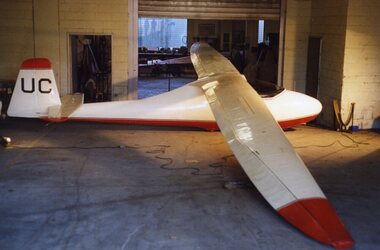
... Machine Glider – Sailplane Designed by Alfred Vogt and produced by the Wolf Hirth Company ...The Vogt LO150 is a sailplane first produced in 1954. Designed in Germany by Alfred Vogt, the LO150 is of wood construction. It has a two piece wing of 15 metre (49 feet) span and a fuselage of monocoque design. The first of the type to be imported into Australia arrived in late 1955. In January 1956 this aircraft type was used to create a world speed record of just under 75 km/h for speed around a 300 km triangle and went on to win the Australian National Gliding Championships. The Museum’s LO150 (VH-GUC) – serial number EB71 was imported from Germany in 1971 by the late Frank Erdmann and an ownership syndicate formed. Following Erdmann it has had a number of owners. Much of its usage was at Bacchus Marsh and Horsham with excusions elsewhere for competition. This Vogt LO150 was last flown on 3 January 1988. Overall, since arriving in Australia, it has flown 315 hours from 273 launches, which is a commendable average performance of over an hour per flight. VH-GUC was donated to the Museum by Warren Mayfield in 2002. Substantial glue deterioration was discovered in one wing and, as a result, a decision has been made not to restore the glider to an airworthy condition. In due course the glider will be repainted and further prepared for display. This exhibit is an example of the Vogt LO150 semi-aerobatic competition sailplane.Single seat competition sailplane of wood construction.Builder's serial number EB71australian gliding, glider, sailplane, vogt, lo-150, erdmann, mayfield, geelong gliding club -
 Australian Gliding Museum
Machine - Glider – Sailplane, 1949
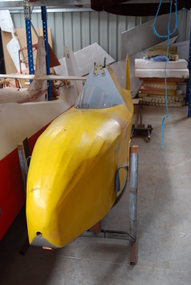
... The Hutter H17 is a small single seat glider with a wing span of 9.69 metres, designed in 1934 by Wolfgang Hutter, for flying in the Austrian Alps. ...This exhibit is an example of a 1930s small wood and fabric glider that was designed in Austria for hill soaring. ...The Hutter H17 is a small single seat glider with a wing span of 9.69 metres, designed in 1934 by Wolfgang Hutter, for flying in the Austrian Alps. Construction of the museum’s example, “Sweetwings” (now registered as VH-GQM), commenced in Perth in 1949. It is one of two Hutter H17 gliders built in Western Australia by N.J. Wynne and A.G. Milligan at the time – the other “Fleetwings” (formerly VH-HDQ and since re-registered as VH-GXV) is located at Millicent, South Australia. Ownership transferred to G.R. Reichelt of Tocumwal New South Wales and later to D.B. Hunt of Thornbury in Melbourne and later Mt Isa, Queensland. It was acquired by Bill Riley of Tocumwal who donated it to the Museum. The glider was last flown on 25 October 1979 at Tocumwal. This exhibit is an example of a 1930s small wood and fabric glider that was designed in Austria for hill soaring. It is a simple design that became a popular choice for home building in the post war years in Australia when gliding as a sport was in recovery. Some examples are still flying.Small single seat glider. Fuselage and wing struts are painted yellow. Wings, rudder and tailplane / elevator are primed with pink dope. It has an open cockpit with small clear Perspex wind screen. Instruments include airspeed indicator and altimeter tucked neatly under front edge of the cockpit rim.australian gliding, glider, sailplane, hutter, sweetwings, fleetwings, reichelt, riley, wynne, milligan -
 Australian Gliding Museum
Machine - Glider, 1974
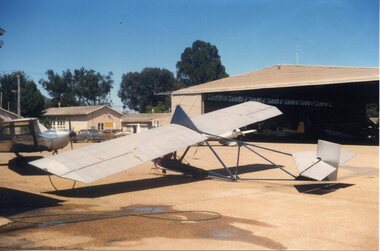
... The “Northrop” is an American copy of the “Zogling” which was designed in Germany in the 1920s as a training glider. Apparently, the Northrop primary glider takes its name from a Marvin Northrop of Minneapolis who imported a Zogling from Germany and from that glider had plans drawn and published in a magazine called Modern Mechanics in 1930. ...The “Northrop” is an American copy of the “Zogling” which was designed in Germany in the 1920s as a training glider. Apparently, the Northrop primary glider takes its name from a Marvin Northrop of Minneapolis who imported a Zogling from Germany and from that glider had plans drawn and published in a magazine called Modern Mechanics in 1930. ...The “Northrop” is an American copy of the “Zogling” which was designed in Germany in the 1920s as a training glider. Apparently, the Northrop primary glider takes its name from a Marvin Northrop of Minneapolis who imported a Zogling from Germany and from that glider had plans drawn and published in a magazine called Modern Mechanics in 1930. The Australia Gliding Museum’s Northrop was built over the period of 1970 to 1974. The project was conceived by a pioneer of Australian gliding, Ken Davies, about 1969, as a hobby project and to experience afresh gliding flight of the early years. By that time, few primary gliders, which performed a fundamental role for gliding clubs in the 1930s and 1940s, remained in Australia. Ken began construction and was helped to finish the project by two old time Gliding Club of Victoria members, Dave Darbyshire and Rudi Feil. The glider was test flown on 8 March 1975 at Benalla. The glider was stored at the Gliding Club of Victoria and flown on special occasions in the 1980s. Later it was damaged at the 1996 vintage glider rally at Ararat as a result of a heavy landing. Storage was then provided for the glider by the Victorian Motorless Flight Group at Bacchus Marsh until it was returned to Dave Darbyshire for restoration in 1998. Fully restored, the glider was donated by Iris Davies and Dave Darbyshire to the Australian Gliding Museum in April 2001. This exhibit is the type of machine that formed the basis of the sport of gliding from 1929 to about 1945. The glider consists of an open (uncovered) wooden framed fuselage (painted blue) with a brown vinyl covered seat, fabric covered wooden framed wings of constant chord (painted silver) with provision for attachment of semi-circular cane wing skids, and fabric covered wooden framed tailplane, elevators and rudder (painted silver). When assembled the airframe is wire braced.australian gliding, glider, northrop, zogling, davies, darbyshire, feil, gliding club of victoria, victorian motorless flight group -
 Australian Gliding Museum
Machine - Glider – Sailplane, 1967 to 1974
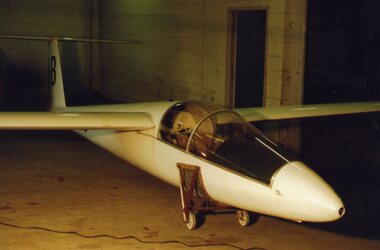
... design was marketed to home builders in kit form. The Museum’s Schreder HP14T (VH-GIB) first flew on 31 August 1974. It has recorded 280 hours in the air from 239 launches to 28 January 1989, the date of its last flight. It is understood that VH-GIB was partly constructed in North America and completed in South Australia by C.G.M. Coxon. Ownership passed to the Georgeson Syndicate of Rockhamption, Queensland and later to Warren Mayfield of Victoria. Warren Mayfield donated the glider...design was marketed to home builders in kit form. The Museum’s Schreder HP14T (VH-GIB) first flew on 31 August 1974. It has recorded 280 hours in the air from 239 launches to 28 January 1989, the date of its last flight. It is understood that VH-GIB was partly constructed in North America and completed in South Australia by C.G.M. Coxon. Ownership passed to the Georgeson Syndicate of Rockhamption, Queensland and later to Warren Mayfield of Victoria. Warren Mayfield donated the glider ...The Schreder HP 14T is a variant of an all metal single seat sailplane designed by Richard Schreder of USA in the 1960s. The HP14T featured a ‘T’ tail in place of ‘V’ tail of the HP14V. The design was marketed to home builders in kit form. The Museum’s Schreder HP14T (VH-GIB) first flew on 31 August 1974. It has recorded 280 hours in the air from 239 launches to 28 January 1989, the date of its last flight. It is understood that VH-GIB was partly constructed in North America and completed in South Australia by C.G.M. Coxon. Ownership passed to the Georgeson Syndicate of Rockhamption, Queensland and later to Warren Mayfield of Victoria. Warren Mayfield donated the glider to the Museum in April 2002. All metal single seat glider sailplaneRegistration lettering on rudder and fuselage sidesaustralian gliding, glider, sailplane, schreder, coxon, georgeson, mayfield, slingsby, bache, waikerie gliding club -
 Australian Gliding Museum
Machine - Glider – Sailplane, 1962
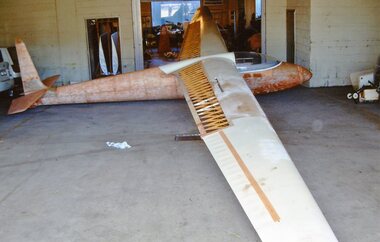
... designed by Rudolf Kaiser in Germany. They were quite successful in the Standard Class in the late 1950s and 1960s. Over 1400 were produced. The first owner of VH-GRW was the Victorian Motorless Flight Group which, at the time, was based at Berwick Airfield on the outskirts of Melbourne. On 22 April 1972, the ownership passed to a syndicate of members from the VMFG. It again changed ownership in July 1974. The new owners were another syndicate based at Campbelltown in New South Wales. The glider...designed by Rudolf Kaiser in Germany. They were quite successful in the Standard Class in the late 1950s and 1960s. Over 1400 were produced. The first owner of VH-GRW was the Victorian Motorless Flight Group which, at the time, was based at Berwick Airfield on the outskirts of Melbourne. On 22 April 1972, the ownership passed to a syndicate of members from the VMFG. It again changed ownership in July 1974. The new owners were another syndicate based at Campbelltown in New South Wales. The glider ...This ES Ka6 sailplane (VH-GRW, serial number 55) was built under licence from Alexander Schleicher in 1962 by Edmund Schneider Limited. It was one of 12 Ka6s, with minor variations from the Schleicher product, built by Schneiders in Australia. It was test flown at Parafield Aerodrome, Adelaide, on 8th September 1962. By way of background, the Schleicher KA 6 series of sailplanes were designed by Rudolf Kaiser in Germany. They were quite successful in the Standard Class in the late 1950s and 1960s. Over 1400 were produced. The first owner of VH-GRW was the Victorian Motorless Flight Group which, at the time, was based at Berwick Airfield on the outskirts of Melbourne. On 22 April 1972, the ownership passed to a syndicate of members from the VMFG. It again changed ownership in July 1974. The new owners were another syndicate based at Campbelltown in New South Wales. The glider went to a Tasmania syndicate in June 1976 and finally to the Soaring Club of Tasmania. In total VH-GRW recorded 3369 hours air time from 4952 launches. It was used very little after 1996. This exhibit is an example of the Scheicher Ka6 sailplane type that were built by Edmund Schneider in Australia.Plywood, spruce and fabric covered high wing single seat sailplane. The airframe has been restored to the point of repainting. Currently the fuselage, rudder and the wings aft of the main spar are coated with pink dope. The tailplane retains the white gloss finish of the glider prior to the restoration work. The cockpit to be refitted (with instruments etc). Serial number 55. The manufacture details are displayed on a metal plate fixed to the main bulkhead. australian gliding, glider, sailplane, schneider, schleicher, ka6, rhonsegler, victorian motorless flight group, soaring club of tasmania
