
Showing 25 items matching "good for nothing"
-
 Charlton Golden Grains Museum Inc
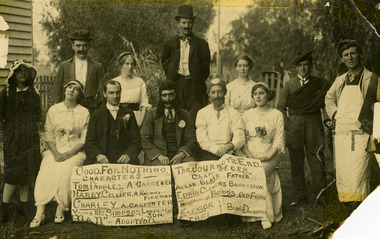
Photograph - Black and White Photo of Charlton Concert Group c1900
... ...Good For Nothing...Black and White Photo of Charlton Concert Group c1900 Two plays mentioned - 'Good For Nothing' and 'The Journey's End' A Caithness photo....'GOOD FOR NOTHING' CHARACTERS - TOM DIBBLES . A GARDENER, HARRY COLLIER . ...Concert Group c1900 Caithness Concert Group c 1900 Good For Nothing The Journey's End 'GOOD FOR NOTHING' CHARACTERS - TOM DIBBLES . ...Concert Group c1900Black and White Photo of Charlton Concert Group c1900 Two plays mentioned - 'Good For Nothing' and 'The Journey's End' A Caithness photo.'GOOD FOR NOTHING' CHARACTERS - TOM DIBBLES . A GARDENER, HARRY COLLIER . A RAILWAY FIREMAN, CHARLIE . A CARPENTER, YOUNG MR SIMPSON . LANDLORD'S SON, "NAN" . ADOPTED DAUGHTER. 'THE JOURNEY'S END' CHARACTERS - ALLAN BLAIR . FATHER, EDWIN CLEMENTS . BRIDEGROOM, THEOPHILUS BRIGGS . OLD FRIEND, ELEANOR & ETHEL . BLAIR'S DAUGHTERScaithness, concert group c 1900, good for nothing, the journey's end -
 Uniting Church Archives - Synod of Victoria
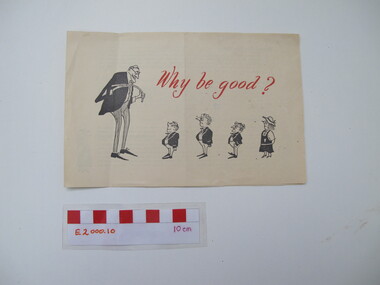
Pamphlet - Congregational Union, Victoria, Why be good?
... The pamphlet has the following headings: Good for nothing; Good for something; Why can't I do as I like?...The pamphlet has the following headings: Good for nothing; Good for something; Why can't I do as I like? ...Bi-fold paper pamphlet with black ink cartoons and red ink on the front. The pamphlet has the following headings: Good for nothing; Good for something; Why can't I do as I like?; A quality of personality; Good for someone; The joy of living. The final paragraph reads: "P.S. - READER! Are you thinking that you know why you should be good: but you don't know how? Then accept Christ, and personally trust Him. And say with St. Paul, "I can do all things in Christ, Who strengthens me." (Philippians 4/13.)spiritual campaign committee, congregational union, -
 Bendigo Historical Society Inc.
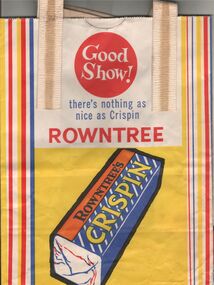
Ephemera - SHOWBAGS COLLECTION: ROWNTREE SHOWBAG
... On one side the words: Good show! there's nothing as nice as Crispin Rowntree, underneath a picture of the Rowntree's Crispin bar. ...On one side the words: Good show! there's nothing as nice as Crispin Rowntree, underneath a picture of the Rowntree's Crispin bar. ...Rowntree showbag. The bag design is in yellow, red, blue, orange, black and white colours. On one side the words: Good show! there's nothing as nice as Crispin Rowntree, underneath a picture of the Rowntree's Crispin bar. On the other side the words: have a break, have a Kit Kat Rowntree, underneath a picture of the Kit Kat bar.business, retail, advertising, business advertising usually found at agricultural shows and other promotional activities. -
 Flagstaff Hill Maritime Museum and Village
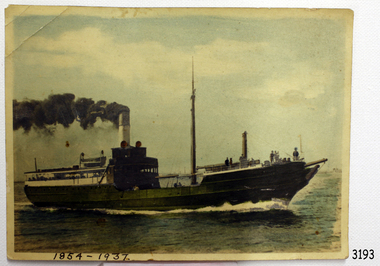
Photograph - Vessel, Steam Ship, Between 1890 - 19-12-1937
... good trip. How are you all keeping? Suppose you’ve moved back to Drummoyne [erettris?], expect you can let the house in Manly easily enough. Noticed they had a strike at Cockatoo [Cockatoo Island NSW]. don’t suppose they pulled the boys out. How is Jack doing? Has [Willie?] commenced training yet, or no! too young, isn’t she? Been a lot of “paper” talk about the “Edina” finishing but nothing...good trip. How are you all keeping? Suppose you’ve moved back to Drummoyne [erettris?], expect you can let the house in Manly easily enough. Noticed they had a strike at Cockatoo [Cockatoo Island NSW]. don’t suppose they pulled the boys out. How is Jack doing? Has [Willie?] commenced training yet, or no! too young, isn’t she? Been a lot of “paper” talk about the “Edina” finishing but nothing ...This photographic postcard of the SS Edina was taken after the 1890’s due to the style and configuration of the vessel. There is a black and white photograph of the same image also in our Collection (RN 3192). It is most likely that both of the photographs were donated by the same person because the people mentioned in the inscription on the black and white photograph’s reverse side connect with two of the people mentioned in the letter on the reverse of the coloured photograph. * RN 3192; Black & White photograph - inscription: - "Donated by Mrs. Nancy Mason, Bay View. Owned by Mac Fordham, Chief Engineer, 'Edina', then given to Mrs. Mason's father-in-law Arnold Mason (both Engineers W.W. I)" The “Arnie” to whom the letter was addressed is likely to be Arnold Mason, Engineer. The author of the letter, “Mac”, is likely to be Mac Fordham, Chief Engineer of SS Edina. The transcribed letter tells of two men who know each other well and have an interest in the Edina. “Mac” mentions that he may be “too old” to be at sea again; this would also support the idea that the older writer would give his photographs to the perhaps younger “Arnie”. * RN 3193 (this photograph) - Transcription of pen and ink script handwriting = = = = = = = = = = = = 19-12-37 No. 1 Flat, “Goodwood Lodge” 196 Lennox Street, Richmond [Victoria] Dear Arnie , Been meaning to write for long time but you know, it’s just the usual routine of the seamen within Bay trades. Had a good trip back from Sydney. Took our time, spent almost a week coming back, rather monotonous in parts in the hill country, too many darn curves, still was a good trip. How are you all keeping? Suppose you’ve moved back to Drummoyne [erettris?], expect you can let the house in Manly easily enough. Noticed they had a strike at Cockatoo [Cockatoo Island NSW]. don’t suppose they pulled the boys out. How is Jack doing? Has [Willie?] commenced training yet, or no! too young, isn’t she? Been a lot of “paper” talk about the “Edina” finishing but nothing official that I’m aware of, but it’s always on the cards I suppose, then I suppose it will be to sea again if I’m not too old. Easy Winter only 3 trips per week, running every day from today until further notice. Trust [Mary?] Is well & all’s well with you too. Best wishes from us both for Xmas & New Year. Cheerio Mac = = = = = = = = = = = = ABOUT THE SS EDINA The three masted iron screw steamer SS Edina was built in Glasgow, Scotland, in 1854 by Barclay and Curle. She was adorned with the figurehead of ‘fair maid of Judea’. The many years of service made SS Edina famous world-wide as the longest serving screw steamer. (The term screw steamer comes from being driven by a single propeller, sometimes called a screw, driven by a steam engine.) SS Edina’s interesting history includes English Chanel runs, serving in the Crimean Ware carrying ammunition, horses and stores to the Black Sea, and further service in the American Civil War and later, serving in the western district of Victoria as well as in Queensland and carried gold, currency and gold prospectors Australia to New Zealand. SS Edina had the privilege of being an escort vessel to H.R.H. the Duke of Edinburgh during his visit to Australia in 1867. In March 1863 SS Edina arrived in Port Phillip Bay, Melbourne and was bought by Stephen Henty, of Portland fame, to work the cargo and passenger run from Melbourne – Warrnambool – Port Fairy - Portland. After a short time of working the run from Australia to New Zealand, with passengers and cargo that included gold and currency, she returned to her Melbourne - Warrnambool – Port Fairy run, with cargo including bales of wool produced in the western district of Victoria. The Warrnambool Steam Packet Company purchased SS Edina in 1867; she was now commanded by Captain John Thompson and Chief Engineer John Davies. She survived several mishaps at sea, had a complete service and overhaul and several changes of commanders. In 1870 SS Edina was in Lady Bay, Warrnambool, when a gale sprung up and caused a collision with the iron screw steamer SS Dandenong. SS Edina’s figurehead was broken into pieces and it was not ever replaced. SS Edina was re-fitted in 1870 then was used as a coastal trader in Queensland for a period. She was then brought to Melbourne to carry cargo and passengers between Melbourne and Geelong and performed this service 1880-1938. During this time (1917) she was again refitted with a new mast, funnel, bridge and promenade deck, altering her appearance. In 1938, after more collisions, SS Edina was taken out of service. However she was later renamed Dinah and used as a ‘lighter’ (a vessel without engine or superstructure) to be towed and carry wool and general cargo between Melbourne and Geelong. In 1957, after 104 years, the SS Edina was broken up at Footscray, Melbourne. Remains of SS Edina’s hull can be found in the Maribyrnong River, Port Phillip Bay. This photographic postcard with the letter on the revers tell about the SS Edina and are significant for its association with the screw steamer SS Edina. The SS Edina is heritage listed on the Victorian Heritage Database VHR S199. She had endeared herself to the people of Port Phillip Bay as a passenger ferry, part of their history and culture. She played a significant role in the Crimean War, the American Civil War and the gold rush in New Zealand. She also served western Victoria for many years in her cargo and passenger runs. The SS Edina is famous for being the longest serving screw steamer in the world. After spending her first nine years overseas she arrived in Melbourne and her work included running the essential service of transporting cargo and passengers between Melbourne and the western Victoria ports of Warrnambool, Port Fairy and Portland. The SS Edina was purchased in the late 1860’s by local Warrnambool business, the Warrnambool Steam Packet Co. and continued trading from there as part of the local business community. The SS Edina’s original ‘fair maid of Judea’ figurehead was broken to pieces in a collision with another vessel (the SS Dandenong) in a gale off Warrnambool, Victoria, in 1870.Coloured (hand coloured) photographic postcard of SS Edina. Letter on reverse, hand written in pen and ink, from Mac to Arnie, dated 19-12-37 [1937]. The photograph shows the SS Edina moving under steam power, many people on both the bow and stern and a few people in the centre of the vessel. There are buildings on the shore in the background. The ship's configuration is dated post 1890.Hand written in pen on base of front “1854-1957” Hand written on back in blue pen and crossed out “REC 409” Hand written on back in pen ‘EDINA,’ “3173,” “086.2” Hand written letter dated 19-12-37, from Mac to Arnie. Script writing in pen and ink letter on reverse of photograph – see “Context” section for transcription. warrnambool, shipwrecked coast, flagstaff hill, flagstaff hill maritime museum, maritime museum, shipwreck coast, flagstaff hill maritime village, shipwrecked artefact, barclay & curle, figurehead 'fair maid of judea', centenary maritime exhibition 1934, a brief review of steam navigation in victoria, pleasure steamer edina, trade and travel late 19th and early 20th century, trade melbourne to geelong, screw steamer edina, coastal trader edina, lighter dinah, cargo carrying for cremean war, cargo carrying for american civil war, passenger and trade in western district of victoria, export gold and currency and gold diggers to new zealand, export vessel to h r h the duke of edinburgh, melbourne - warrnambool - port fairy - portland cargo run, warrnambool steam packet company, stephen henty, captain john thompson, chief engineer john davies, lady bay warrnambool, lighter edina, shipping victoria, port phillip bay steamers, steamship great britain, edina, vhr s199 victorian heritage database, photographic postcard of ss edina 1854-1957, letter by mac fordham chief engineer ss edina, letter to arnold mason, engineer -
 Federation University Historical Collection
Correspondence, Thomas Stephen Hart, Thomas Hart writes to Frederick Martell of the Ballarat School of Mines, 1891, 25/11/2015
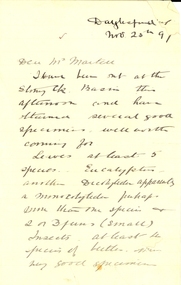
... At least 4 species of beetles [illegible} very good specimen insects other more doubtful [illegible] of insects - Also some plant stems layer that I had noticed before. I intend going out again tomorrow morning and getting more specimens. There is nothing...At least 4 species of beetles [illegible} very good specimen insects other more doubtful [illegible] of insects - Also some plant stems layer that I had noticed before. I intend going out again tomorrow morning and getting more specimens. There is nothing ...Thomas S. Hart was a member of the Ballarat Field Naturalists.Daylesford Nov 25th 91 Dear Mr Martell I have been out at the Stony ck Basin this afternoon and have obtained several good specimens well worth coming for. Leaves at least 5 species. Eucalyptus - another [Dicohptreter?) apparently a monocotyledon perhaps [illegible] than one species + 2 or 3 [illegible] (small) insects. At least 4 species of beetles [illegible} very good specimen insects other more doubtful [illegible] of insects - Also some plant stems layer that I had noticed before. I intend going out again tomorrow morning and getting more specimens. There is nothing of my subjects on till Saturday. I will be at the school first thing on Saturday. Thompson has, I think enough to keep him busy. I intend to exhibit the [illegible] at one one of the societies so as to have them recorded even if I cannot get a short [illegible] written for the meeting. Yours sincerely Thomas S. Hartfield naturalist, thomas hart, t.s. hart, daylesford -
 Federation University Historical Collection
Book - Book - Press Clippings, Ballarat University College/University of Ballarat School of Visual and Performing Arts, 1993 - 1999, 1993
... James Charters, Matt Molony, Antoninino Atzori, Joseph, Len Bauska, Joseph and the Amazing Technicolour Dreamcoat, Damian Muller, Bert Labonte, Once a Catholic, Peta Brady, Fiddler on the Roof, King Richard III, The Seagull, Mr Men .3) 1995 - Point of Departure, Stags and Hens, Hansel and Gretel, Rob Knowles, The Would Be Gentlemen, SOund of Music, Barry Breen, The Bundle, Karl Hutton, Much Ado About Nothing, Len Bauska, Hamlet, Pajama Game, Peter Tulloch .4) 1996 Melissa Casey, The Wizard of Oz, Peter Tulloch, Libby Tanner, Rooted, Erard Concert Grand Piano, Atlantis. The Visit, Stella Axarlis, Me and My Girl, Our Country's Good...James Charters, Matt Molony, Antoninino Atzori, Joseph, Len Bauska, Joseph and the Amazing Technicolour Dreamcoat, Damian Muller, Bert Labonte, Once a Catholic, Peta Brady, Fiddler on the Roof, King Richard III, The Seagull, Mr Men .3) 1995 - Point of Departure, Stags and Hens, Hansel and Gretel, Rob Knowles, The Would Be Gentlemen, SOund of Music, Barry Breen, The Bundle, Karl Hutton, Much Ado About Nothing, Len Bauska, Hamlet, Pajama Game, Peter Tulloch .4) 1996 Melissa Casey, The Wizard of Oz, Peter Tulloch, Libby Tanner, Rooted, Erard Concert Grand Piano, Atlantis. The Visit, Stella Axarlis, Me and My Girl, Our Country's Good ...Blue cover book of press clippings. .1) 1993 - briar rabbit, brer rabbit, Libby Tanner, Lorrae Desmond, Cherry Orchard .2) 1994 - Bruce Widdop, Eureka, Rebellion, Aiden Fennessy, Steel Magnolias, Rumpilstiltskin, Tale of Two Cities, Peter Tulloch, Ring Round the Moon, Grainery Lane, Barnstorm Theatre, Rivers of China, Lord Wedgewood, Rick Chandler. James Charters, Matt Molony, Antoninino Atzori, Joseph, Len Bauska, Joseph and the Amazing Technicolour Dreamcoat, Damian Muller, Bert Labonte, Once a Catholic, Peta Brady, Fiddler on the Roof, King Richard III, The Seagull, Mr Men .3) 1995 - Point of Departure, Stags and Hens, Hansel and Gretel, Rob Knowles, The Would Be Gentlemen, SOund of Music, Barry Breen, The Bundle, Karl Hutton, Much Ado About Nothing, Len Bauska, Hamlet, Pajama Game, Peter Tulloch .4) 1996 Melissa Casey, The Wizard of Oz, Peter Tulloch, Libby Tanner, Rooted, Erard Concert Grand Piano, Atlantis. The Visit, Stella Axarlis, Me and My Girl, Our Country's Good, Three Billy Goats Gruff, Hold the Mayo, The Crucible, Chris Dickins, Stuart Pursell, Arts Academy .5) 1997 - Tempest at Loch Ard Gorge, Maelstrom, Angela Coad, Damian Muller, West Side Story, The Importance of Being Ernest, Mark Gambino, Brett Edgington, Cosi, Damian Muller, Leonard Bauska, Matthew Heenan, Amanda Sandwith, Bacchae, Richard DiGregorio, Roger Woodward, Peter Tulloch, Gavin Fenech, Bruce Widdop, Lola Montez, Tim Haymes, Tina Ford, Ross Jones .6) 1989 - Graeme Bird, Leanne Lettieri, Ballarat Symphony Orchestra, Christopher White, David Addenbrooke, Bruce Widdop, Chris Betts, John Garland, Allan Mann, John Sharpham, David Forrest, Warwick Stengards, Jan Davis, Wendy Morrison, Equus, Scott Cameron, Bryan Trueman, Peter Blizzard, Andrew Burnham, Peter Pilven, Chalk Circle, Tsou Nan-Chien, Ten Little Indians, Doug Wright, Stellarc, Chris Betts, Eric Lovett, Bob Allan, Doug Wright, Kaspar, Bill Levis, The Removalists, Liz Poklar, Goldfields Print Award, Margaret Sulikowski, Kathy Gamble, Maria Froia-Crump, Ian Hemmingway, Geoff Wallis .7) 1989 - Shirley Randall, Fred Sulikowski Fargher, Richard Jeziorney, Shane Lee, Neville Philpott, Val Lehman, Bill Levis, Hamp, Peter Ford, Shane Lee, Richard Akers, Peter Blizzard, Debbie Fraser, Shane Lee, Away, Genevieve Lacey, Pauline Coutts, Tsou Nan-Chien, Petrus Spronk, Debbie Fraser, Chris Betts, David Addenbrooke, Alan Peascod, John Crump, Deb Rosser, Michael Cook, Bruce Widdop, Jenny Trickey, Jennifer Marshall, Stellarc, Carboni, Stuart Matteson, Peter Sargeant retirement, Lyn Conellan .8) 1990 - Micehelle Tuddenham, Pauline Coutts, Anthony Horton, Claire Dale, Kryal Castle, Howard Tostivan, Simon Buckle, Blitz, STelarc, Hitz of the Blitz, Doug Wright, Nerissa Heath, Mieke Glickson, Ruth Greenburg, Peter SParkman, Allan Mann, Rachel Appleton, Michelle Tuddenham, Romeo and Juliet, Jennifer Pacey, Felicity Hay, Kristen Boys, Shane Lee, Norm Strange, Demolition Job, Merran Lisette, Charlotte's Web, Merran Hedbury, Richard Akers, Felicity Hay, Disco, Peter Harbison, Peter Clinch, Jeff Crispin, Cynthia Treadwell, Anagama Kiln, Debbie Lord, Sue Quinlan, Hedder Gabler, , Christine Hateley, Marilyn Chestnut, Geoff Crispen, Petrus Spronk, Peter Ashman, Country Heat, Bruce Widdop, Andrew Seary, Len Bauska, Christopher Pendlebury, Doug Wright, Frank Hurley, Peter Tulloch. Liz Blizzard .9) 1991 - Goldilocks and the Three Bears, Yvonne James, Doll's House, Liz Blizzard, Peter Blizzard, Elizabeth Tanner, Amanda Davies, Kimba Jeffries, Black Comedy and Public Eye, Peter Pilven, Macbeth, Richard Sutherland, Bruce Widdop, The Little Prince, The Would-be Gentleman, The Crucible, Warren Muschialli, Janet Dale, .10) 1992 - Deanne Clapton, Anthony Marsh, Alice in Wonderland, Bruce Widdop, The Beard, Fiona Bennett, Warren Muschialli, Orphans, Peter Blizzard, Red Riding Hood, Circus In a Suitcase, Frank Zappla, The Twelfth Night, Peta Brady, Street Angels, Lawrence Price, Donna Brunt, Jessi Watson, Too Much Punch for Judy, Miranda Crellin, Lyle Quick, Trevor Harris, Howard Tostivan, John Daykin, Barry Breen, The Paradise, Hansel and Gretel, Sandra Moon, Rosalind Lawson, Jason Wasley, The Paradise and The Passion, Simon Buckle, Sam Trinder, Doug Wright, .11) 1998 - Barnum, Skins, Marqui De Sade, Kangaroo Pie, Comedy of Errors, Manhatten, Nicholas Nickleby, Great White Way, Peer Gynt, Boys from Syracuse, Cancerto, Miranda Crellin, Ron McLeod, Alexandra Meerbach, Nathan Firmin, Chris Dickins, Christine Ward, Judith Roberts, Tim Arundell, Dom Phelan, Paul Thomas, Rose Tonkovic, Jon Peck, Andrew Page, Luke Doxey .12) 1999 - Pirates of Penzance, Phil Horwood, Adrian Barnes, Dennis Olsen, Kate Gorman, Nathan Firmin, Margaret Whitlam, Nadine Collins, Liz Gutt, Sara Brett, Kate McLennan, Dom Phelon, Midsummer Night's Dream, Bruce Widdop, Nadia Andary, Amy Maiden, Sing For Your Supper, Tania Burn, Under Milkwood, A month of Sundays, Matt Heyward, Dane Carpenter, Peter Tulloch, phil Crompton, Tim Haymes, David Haymes, Jenny Haymes, Barry Wemyss, Heather Kent, Monty Farag, Sancho de Silva, Jose da Costa, Cameron Sweatman, Ways and Means, Matt Heywood, Rebecca McGuiness, Michelle Pitcher, Peter Tullochperforming arts, visual arts, ballarat academy of performing arts, peter tulloch, bapa -
 Ringwood and District Historical Society
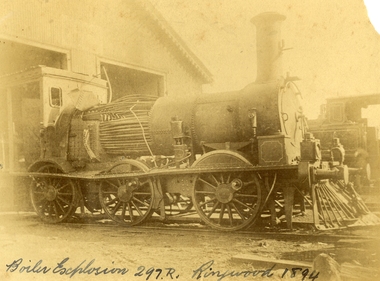
Photograph, Boiler explosion at Ringwood station 20th June 1894 for engine 297R. "Heard in Box Hill"
... nothing wrong, with either of them. If the engine was blowing off at all, it must have been very light. In your opinion, were they perfectly sober ? — Perfectly. In approaching the station, is there a down or an up grade? — A very slight down grade. How is the road from Healesville ? — Up and down all the way. It is down, grade for about 200 yards coming into Ringwood station. They shut off ; steam about a quarter of a mile away, and come in at a good...nothing wrong, with either of them. If the engine was blowing off at all, it must have been very light. In your opinion, were they perfectly sober ? — Perfectly. In approaching the station, is there a down or an up grade? — A very slight down grade. How is the road from Healesville ? — Up and down all the way. It is down, grade for about 200 yards coming into Ringwood station. They shut off ; steam about a quarter of a mile away, and come in at a good ...Black and white photographs - 2 copiesTyped below photograph, "Boiler explosion at Ringwood station 20/6/1894. Heard in Box Hill". Article from newspapers:- Weekly Times (Melbourne, Vic. : 1869 - 1954), Saturday 27 January 1894, page 21 Official enquiry. The Board of Enquiry appointed by the Railway Commissioners to enquire into the causes of the boiler explosion which shattered the locomotive at Ringwood on Saturday night, assembled at the Railway department on Wednesday to commence its deliberations, The board consisted of Mr R. Fulton, engineer, C. W. McLean; engineer to the Marine Board, and Mr Mephan Ferguson, iron-founder. There is some difficulty at the outset about the constitution of the board; It was suggested that the Apt of Parliament contemplated that boards of experts, after the manner of the present one, needed, to have their appointments confirmed by the Governor-in-Council. The point, however, was not considered sufficiently important to prevent the board from proceeding with evidence. Robert Greyford, stationmaster at Ringwood, was the first witness. He said he saw the explosion on Saturday night at about twenty minutes to 8. There was a rush to the engine to see what had happened, and the driver and fireman were both found on the platform of the engine. The driver seemed badly hurt, but the fireman, to all appearances, was not so badly injured. They were both attended to and sent up to Melbourne by the last suburban train. Witness had a look at the engine and found the dome and all the plates round the boiler blown clean, away. The springs were also blown clean away. The Chairman (Mr Fulton) : Did you measure the distance ? Witness: Yes; one of the plates was 209 yards away. A piece from the top of the boiler 15 pounds in weight he found driven into the hard beaten track 410 yards away. Several pieces of boiler plate were found scattered at various distances. The buildings roundabout were injured. The Chairman; Did you notice anything peculiar about either of the driver or the fireman ? — No ; nothing wrong, with either of them. If the engine was blowing off at all, it must have been very light. In your opinion, were they perfectly sober ? — Perfectly. In approaching the station, is there a down or an up grade? — A very slight down grade. How is the road from Healesville ? — Up and down all the way. It is down, grade for about 200 yards coming into Ringwood station. They shut off ; steam about a quarter of a mile away, and come in at a good pace. They generally put on 15 pounds of steam while they are in the station. Mr Ferguson : Had the driver the usual load on ? — Yes ; about the usual load. Witness added that he had known the driver personally for about 10 years, and he had always been a careful, steady, sober man. He did not know the fireman so well. John Palmer, porter at Ringwood station, also saw the explosion. He was attending to the train on its arrival. He was knocked down by the force of the explosion. When he got up he saw the engine driver being carried into the office covered in blood. He noticed nothing peculiar about the driver and fireman, nor about the engine. Mr McLean : How far were you from the engine when you were knocked down ? — From ten to fifteen yards. William Paul, the guard of the train to which the injured locomotive Was attached, said he was looking at the engine at the very moment the explosion occurred. It seemed to come from exactly under the dome. The force of it took him off his feet. He was about 15 yards from the tender. When he rose he tried to reach the engine, but could not do so on account of the steam and coal dust. He called out to know whether any of the passengers were injured, and got no response, so that he concluded they were all right. All the lamps but about half dozen were extinguished by the force of the explosion, although the glass was not broken. He could testify most distinctly that the driver and fireman were both sober. The driver was a man who never drank. The steam started to blow off about a minute and a half before the explosion took place. The last place at which the engine took water was Healesville. The Chairman : Do yon know anything of the quality of the water there ? Is it creek water ? — Yes ; it comes from the Graceburn River. You never heard of its quality ?— No. How long have you known this engine on the road— About 13 months. Hew long have you known the driver on this line ? — About six weeks. I have known the fireman several years. The driver was a strict teetotaller, and I never saw the fireman take anything to drink in his life. Mr T. H, Woodroffe, chief mechanical engineer of the Victorian Railways, produced a report he had written to the secretary, about this explosion. The document gave facts concerning the engine and the explosion. It stated that the rapture seemed to have occurred at the rim of the plates adjoining the fire box. The engine was built at the Phoenix Foundry, Ballarat, in 1883. It was repaired at various times, the last time being in July of last year when it was sent to the Port Melbourne shops, and was then tested to a cold water pressure of 195 and found all right. It was the custom to overhaul all locomotives about every five years. The Chairman : There were no very heavy repairs in July, 1893; were there? — Not to the boilers. The shop manager's report says that the plug and safety tap holes were repaired, five new copper studs put in firebox, ash-pan door repaired, tender cleaned and overhauled, and studs re-rivetted, and boiler tested to pressure of 195, cold water. Mr Woodroffe read the report of the repairs effected to the boiler in December, 1888. That would be the time the plate was put in the boiler. On that occasion three new plates were put in the bottom and the boiler tested up to 195. The Chairman: Do you keep a record of the water used ?— Yes, the water in this case, I think, came from the Maroondah scheme. Mr Woodroffe said boilers were examined front time to time in the running sheds. In his opinion every possible care had been taken to keep the engine in proper care. There might, however, be lessons learnt from this. The Chairman: No doubt. From his examination of the plates [the] witness did not think the state of them could have been detected from the outside. There were no signs of leakage or sweating or anything of that sort. The next witness- was Walter Stinton, workshop manager at Newport and he said that the injured engine had been repeatedly repaired under his charge. He gave a technical account of the repairs effected on various occasions. The testing of locomotives was under his special notice. They had a high pressure pipe running; round the works, and a pump set at 2001b. When the boiler was pumped full of water the pressure when applied up to 1951b. The board appointed by the department to inquire into the Ringwood locomotive boiler explosion sat again at Spencer street on 25th inst. Mr R. Fulton presided and the other members of the board were. Mr Mephan Ferguson and Mr C. W. McLean. Charles Grubb, foreman of the boiler-makers at the Newport workshops, said he had inspected the pieces of plate that had been blown out of the engine, and after examining them, pointed out to the Chief Mechanical Engineer the portion where the plate had started to burst. It was under the lap, on the right hand side of the boiler. The grooving might be accounted for by bad water. During the past twenty years he had examined all the boilers that came into the Williamstown workshops, and while some were hardly marked at all, others were very badly eaten away. The practice was to cut out the defective portions. In this case the boiler was repaired in a similar manner. The Chairman : Can you suggest any other way of repairing so as to prevent accident ? — No, unless by taking out a plate on one side from the joint, and carrying it further up so as to avoid the joints meeting, or by taking out the plate altogether. What would.be the cost .of putting in a new " plate I—Perhaps about double the price; but I wouldn't recommend that course. It would be putting a new plate against plates that have been in use ten years or so and that would not be advisable. I think the present system better. I consider the present system of repairing the best. This is the first we have had so bad like that, to my knowledge. You attributed this to bad water. Is there no other probable cause ? — Well; unless the iron be bad. This was Lowmoor iron. I think this accident was caused by the eating away of plates. This one was the worst I have seen, for the short time it had been running. We use three classes of iron — Lowmoor, Monkbridge and Bowling. By Mr Woodroffe (Chief Mechanical Engineer) ; There are engines still running that were repaired at the same time as this one, in 1888, and. in the same way. These are engines 339 and 333. They have been recently examined and are in splendid order. What in your experience, is the age of a boiler on the Victorian railways? — From 17 to 20 years our earlier boilers stood. The later boilers don't stand so well. How is that? — There is difference in construction, and the material is lighter. The old boilers had thicker plates. Have you been asked in any way to curtail boiler affairs? — No, sir; nor in any way. You have never hesitated to carry out any necessary repairs? — Never. Our orders have been to exercise every care in examining, repairing and renewing boilers. Witness said that his practice was when an engine came into the workshop to find out how long she had been running. If over five years, he informed the workshop manager, and they thought it necessary the tubes were taken nut. If everything was in good order witness reported to the manager. The cost of taking out the tubes and putting them in again was about L20. Mr Woodroffe : Have you ever hesitated to repair a boiler on the score of expense ? — No, never. Mr McLean : Hew do yon ascertain whether a boiler requires repairs?— I keep a record of every boiler examined. From every boiler that comes in I have the dome covers taken off, and when it is practical I get inside. l can almost tell from the top of a boiler what the bottom is like. If there is any doubt about it I have the tubes taken out. If I have suspicion of defective plate I cause to have bored a triangle in the plate at the point where there is the most wear. There is a travelling inspector who visits all the running sheds of the colony except Port Melbourne and tests the boilers. He reports to us and we note what he points out. Alfred Thompson, locomotive inspector of the eastern section, said he knew this engine, 297R. He read a list of her repairs. He heard of the accident on Saturday night and went up to Ringwood. The Chairman : Did you ever notice anything peculiar about the engine? — No, I considered her A1 and would not have hesitated to have put on 140lb pressure owing to the repairs she had undergone. Witness considered that the explosion was caused by the expansion and contraction of the plates ; and, no doubt, the plate had been eaten away through bad water. The other side of the boiler showed: signs of corrosion: By Mr Woodroffe ; Is every care taken with the boilers ? — Yes, every possible care is taken for the safety of boilers, Weekly Times (Melbourne, Vic. : 1869 - 1954), Saturday 27 January 1894, page 7 EXPLOSION OF A LOCOMOTIVE BOILER, NARROW ESACPE FROM FATALITIES. THE DAMAGED ENGINE. [See drawing of loco – saved in “Railways” folder] The explosion of a locomotive boiler at Ringwood on Saturday evening, formed the subject of much discussion in railway circles on Monday. The Minister arrived at the office at an unusually early hour and immediately entered into a consultation with the acting chairman, Mr Kibble, and Mr Commissioner Murray. As the result of the interview it was resolved to ask three gentlemen of acknowledged engineering experience to sib as a board with the . object of inquiring into the cause of the accident and furnishing a report. Mr Richardson and the Commissioners are tally seized of the importance of having a searching investigation into the accident, and, with Mr Murray, the former went to Ringwood to inspect the scene of the disaster. They will he accompanied by Mr Woodroffe. During the morning no official report had come to hand from the driver or fireman of the engine in reference to the accident, but that is thought to be due to the circumstance that they have not sufficiently recovered to be able to give a circumstantial account of what occurred. The engine was one of the old R's, and, Mr Kibble pronounced them to be about the best class of engines used. So far nothing can be said as to the probable cause of the accident, as the broken plating of the engine has not been submitted to the inspection of experts. Weekly Times (Melbourne, Vic. : 1869 - 1954), Saturday 27 January 1894, page 7 STATEMENT BY THE FIREMAN. This morning Thomas Miles, fireman on the engine the boiler of which exploded on Saturday night, is suffering from an injury to the spine, as well as a very severe shaking to the system. He states that he was fireman on the engine attached to the train which left Healesville on Saturday evening, at ten minutes to 8. Everything went all right until Ringwood was reached, when, .just as the train was about to continue its journey, a load explosion took place and Miles remembers nothing more until he was picked np on the platform ; and found himself suffering from a pain in the back, and an injury to his arm. He cannot think of any reason which could have caused the explosion, as there was plenty of water in the boiler, and everything seemed working all right. Mr R. Fulton, consulting engineer, of Queen street; Mr McLean, a member of the Marine Board ; and Mr Mephan Ferguson, engineer, have consented to act as a board to inquire into the cause of the engine boiler explosion at Ringwood on Saturday evening. The board has been appointed under section 117 of Act 1135, which provides that the Governor-in-Council may direct the taking of a such a step. Mr1 Fulton will act as chairman of the board, which met for the first time at the railway offices, Spencer street, this forenoon. Before separating the members of the Board paid a visit to the Prince's Bridge locomotive sheds in company with Mr Woodroffe, the chief mechanical engineer, for the purpose of inspecting the shattered boiler. It has been stated that the explosion is known to have been caused by a flaw in a plate which was put on the boiler about four years ago, but enquiries have tailed to elicit anything in support of that view. The engineers connected with the department are not inclined to say anything on the subject. Weekly Times (Melbourne, Vic. : 1869 - 1954), Saturday 14 April 1894, page 20 The Ringwood Boiler Explosion, The Minister of Railways has received the supplementary report of the board appointed by him to investigate the circumstances connected with the explosion of a locomotive boiler at Ringwood. In their first report the board did not attach blame to anyone. Mr Richardson felt satisfied that the responsibility of having the engines properly inspected and overhauled periodically could be fixed if the inquiry were extended. He therefore referred the matter again to the Board, who took further evidence. In the report now furnished, the Board hold Loco. Inspector Thompson blameable, but point out as a mitigating circumstance that he had not received "written instructions" respecting inspections and overhauls. Weekly Times (Melbourne, Vic. : 1869 - 1954), Saturday 7 July 1894, page 32 The Ringwood Boiler Explosion. The Minister of Railways takes exception to the tone of a paragraph appearing in a morning contemporary respecting the Ringwood boiler explosion. It makes it appear that Mr Richardson has referred the report of the board which considered the facts connected with the explosion to the Crown solicitor simply because he differed from the finding of the board. The Minister explains that when he received the report he found that the responsibility for having boilers properly inspected and overhauled had not been clearly fixed. He personally obtained farther evidence on that point, and arrived at a conclusion, from which the commissioners differed. As he did not like to take upon himself the responsibility of deciding upon the effect of the evidence, he submitted the matter to the Crown Solicitor, but that officer did not furnish him with the information sought. He has, therefore, referred the question to the Attorney-General, together with the draft of a regulation respecting boiler inspections and overhauls in the future. Mr Richardson says that his whole aim is to have the responsibility positively fixed. Weekly Times (Melbourne, Vic. : 1869 - 1954), Saturday 28 April 1894, page 23 The Minister of Railways has completed his consideration of the supplementary report received by him from the Ringwood Boiler Explosion Board. The report, it will be remembered, held Loco-Inspector Thompson blameable for the non-inspection of the boiler, but considered there was extenuating circumstances. There was a certain amount of doubt as to the absolute instructions given for overhauling engines periodically. Mr. Richardson is sending the report on to the Commissioners with instructions that the responsibility respecting inspection of boilers shall be made clear for the future. -
 Eltham District Historical Society Inc
Photograph - Digital Photograph, Joan Castledine, Opening Day, Guzman y Gomez - Eltham, 963 Main Road, 3 December 2025
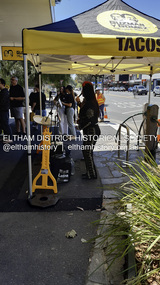
... Opening day for our new GYG Eltham restaurant was nothing short of incredible, and we want to extend a huge thank you to everyone who came down to celebrate. From $5 Burritos and Bowls to free coffee and lots of exclusive GYG merch, the good vibes rolled non-stop from early morning through to dinner!" ...Opening day for our new GYG Eltham restaurant was nothing short of incredible, and we want to extend a huge thank you to everyone who came down to celebrate. From $5 Burritos and Bowls to free coffee and lots of exclusive GYG merch, the good vibes rolled non-stop from early morning through to dinner!" ...The Guzman y Gomez Mexican fast-food chain opened their Eltham store at 963 Main Road on December 3, 2025 with fanfare and special promotions that attracted large crowds lining up to get a taste all day long. The appearance of the store in terms of the chain’s usual signage had to be toned down to some degree to comply with Eltham’s local planning requirements. Some excerpts from the Guzman y Gomez website post about the event: Eltham… You Absolutely Smashed It! Massive crowds, big energy and an unforgettable opening day. (2025, December 8). Retrieved from https://www.guzmanygomez.com.au/eltham-you-absolutely-smashed-it/ "Eltham, what a day! Opening day for our new GYG Eltham restaurant was nothing short of incredible, and we want to extend a huge thank you to everyone who came down to celebrate. From $5 Burritos and Bowls to free coffee and lots of exclusive GYG merch, the good vibes rolled non-stop from early morning through to dinner!" "The energy kicked off bright and early with the Mayor of Eltham [sic], John Dumaresq, arriving at 7am to officially cut the yellow ribbon and help launch the opening of GYG Eltham. It was an exciting way to open the doors and of course, the mayor enjoyed a delicious and clean GYG brekkie burrito!" "Behind GYG Eltham is Andre and Konrad Reich, a local father and son team who have a passion for great food, great people and making a real difference in the community. Opening a GYG has been a long-time dream for the pair, and they’ve been waiting years for this to happen!" "Thanks to the restaurant’s prime location right next to the train station, guests were hopping off public transport and walking straight into GYG for lunch and dinner. The after-school rush was huge, with local students and young people flooding in to take advantage of the $5 Burritos and Bowls." "In true GYG spirit, the opening of Eltham has created 50 new local jobs, with the team already growing fast. Andre and Konrad are passionate about building a fun, supportive crew who live and breathe GYG’s ‘Got Your Back’ value." "“As part of our opening, we’ve welcomed a number of local crew — for some, this will be their very first job. We’re proud to show them what GYG is all about while delivering incredible food and an outstanding guest experience. We’re still hiring and can’t wait to get involved with the community, fuelling local sports clubs with delicious GYG meals and epic merch,” added Konrad Reich."joan castledine collection, 963 main road, eltham shops, guzman y gomez - eltham, main road eltham, opening day, restaurants, john dumaresq, konrad reich, andre reich, youth employment, nillumbik shire mayor -
 Ararat & District Historical Society (operating the Langi Morgala Museum)
Photograph, c. late19thC
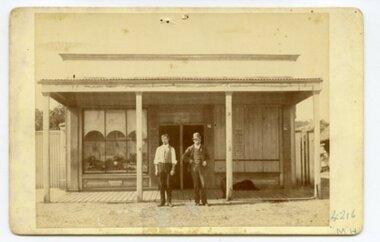
... There is now (in the year 2023) little or nothing left of the township of Watgania, north of Willaura, though there are still several inhabited properties in this area, which shelters close under the eastern face of the Grampians mountains. The figures in the photo add to its significance, since a good ...This was the first police station built in Watgania, and it was probably built during the goldrush era of late19C to early 20C.The photo is of local significance to Watgania and the Ararat district because of its rarity and because of its subject. There is now (in the year 2023) little or nothing left of the township of Watgania, north of Willaura, though there are still several inhabited properties in this area, which shelters close under the eastern face of the Grampians mountains. The figures in the photo add to its significance, since a good deal of information about the goldfields can be gleaned from their manner and their dress.Black and white photograph mounted on cardboard. Photo shows two men standing outside a building. The man on the right is dressed in a suit and is wearing a hat. The other man is dressed in suits pants and a vest. The window to the right of the front door of the building is boarded up.Inscription: on front: "4216 / MH". Stamped on back: "F.W HARGREAVES". Inscription: on back: 592P (this is its Osborne nbr, and corresponds to a photo-negative taken of the original photo).goldfields, police, watgania, ararat, gold rush, mount william, grampians, police station -
 Bendigo Historical Society Inc.
Document - BENDIGO BUSINESSES COLLECTION: MATTHEWS BROS
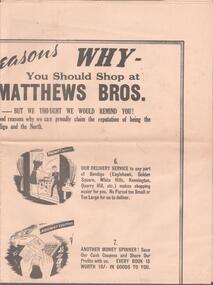
... Large advertising feature: 10 good reasons why you should shop at Matthews Bros. Nothing new but we thought we would remind you! ...BENDIGO Business matthews bros Large advertising feature: 10 good reasons why you should shop at Matthews Bros. Nothing new but we thought we would remind you! ...Large advertising feature: 10 good reasons why you should shop at Matthews Bros. Nothing new but we thought we would remind you! We present to you 10 good reasons why we can proudly claim the reputation of being the busiest drapers in Bendigo and the North. Blue, red and white small label: Matthews Bros. exact fit clothing. Blue, red and white label: Matthews Bros. Manchester specialists for sheets, towels, quilts and other goods.bendigo, business, matthews bros -
 Bendigo Historical Society Inc.
Document - GARDEN GULLY UNITED MINE - GARDEN GULLY UNITED FIRE
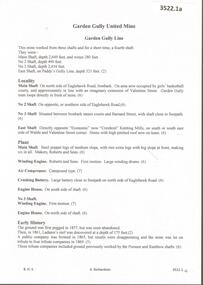
... nothing unusual, then later saw the reflection of fire in the engine house. Second report mentions hose stretched over Mt Korong Rd being run over by Chinese market gardeners and others making the leaky hose leak all the more. Cages only travelled a short distance after the ropes broke. Unemployment after air compressors ruined by the fire. Written on the back: Some Facts and Figures - The Bendigo Goldfield has had its good...nothing unusual, then later saw the reflection of fire in the engine house. Second report mentions hose stretched over Mt Korong Rd being run over by Chinese market gardeners and others making the leaky hose leak all the more. Cages only travelled a short distance after the ropes broke. Unemployment after air compressors ruined by the fire. Written on the back: Some Facts and Figures - The Bendigo Goldfield has had its good ...Hand written notes on the fire at the Garden Gully United Mine 29/3/1911. Two reports from the Bendigo Advertiser 29 and 30 March 1911. First report battery watchman John Davey saw nothing unusual, then later saw the reflection of fire in the engine house. Second report mentions hose stretched over Mt Korong Rd being run over by Chinese market gardeners and others making the leaky hose leak all the more. Cages only travelled a short distance after the ropes broke. Unemployment after air compressors ruined by the fire. Written on the back: Some Facts and Figures - The Bendigo Goldfield has had its good and bad years. Yields ranged from 475, 857 ozs in 1852 and 451,588 ozs in 1856 to 168,990 ozs in 1878 and 148,700 -mine, gold, garden gully united mine, garden gully united mine, garden gully united fire, bendigo advertiser 29-30/3/1911, john davey -
 Coal Creek Community Park & Museum
Box, cardboard, 1892 - present in Australia
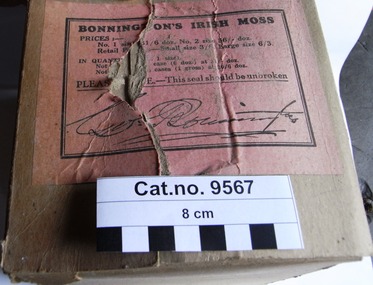
... Containing nothing injurious, there is not the least danger in giving it to children. If they are troubled at night with a hacking cough or any chest affection, one dose will relieve and ensure a good night's rest. ...Containing nothing injurious, there is not the least danger in giving it to children. If they are troubled at night with a hacking cough or any chest affection, one dose will relieve and ensure a good night's rest. ...TROVE : Bendigo Advertiser (Vic. : 1855 - 1918), Saturday 7 September 1901, page 2 BONNINGTON'S IRISH MOSS. Bonnington's Carrageen Irish Moss was first introduced into New Zealand 35 years ago, and it spread gradually until the sales now extend through the whole colony, and has been in constant demand ever since. Through the genuine merits of the widely known and popular remedy for coughs, colds, etc., and encouraged by this success in New Zealand, the proprietor (Mr. Geo. Bonnington) chemist of that colony, was induced to place his celebrated preparation on the Australian market. With that object in view, some eight or ten years ago, a factory for manufacturing purposes was established (under the style of Bonnington and Co.) at 179 Harris-street, Sydney. Since then, its sales have spread far and wide, and the proprietors are pleased to notify the public generally that Bonnington's Carrageen Irish Moss can now be obtained in all the states of Australia. Every year it is becoming more known, and when once tried is always appreciated by the people. Hundreds of testimonials have been received by the proprietors from all parts, testifying to the wonderful curative properties in allaying irritating coughs, bronchitis, colds, and affections of the vocal organs. For the cure of croup, whooping cough, etc., it has proved marvellously successful and is especially prized by mothers for their children, as it never fails to give relief and effect a speedy cure. Containing nothing injurious, there is not the least danger in giving it to children. If they are troubled at night with a hacking cough or any chest affection, one dose will relieve and ensure a good night's rest. The unparalleled which has attended the sale of Bonnington's Carrageen Irish Moss has led to many worthless imitations, and the public when purchasing are cautioned to be sure and ask for Bonnington's. TROVE : Gippsland Times (Vic. : 1861 - 1954), Thursday 1 October 1908, page 3 BONNINGTON'S IRISH MOSS Can be had from any chemist or store. It is the universal remedy for Influenza, Coughs and Colds. A safe and pleasant medicine for children as well as adults. Brown cardboard box with dark blue printed text on side and pink label with black text on top. Contains seven (7) unopened and one (1) opened tall grey boxes with printed white red and black labels. Each grey box containing a cork stoppered rectangular amber glass bottle, with a red, black and white printed label. Each bottle filled with a dark liquid.Outer square cardboard box in dark blue printed text within a decorative border : ' ONE DOZEN BONNINGTON'S Irish Moss for CUGHS, COLDS, INFLUENZA etc'. Pink label sealing paper on top of outer brown cardboard box with black printed text : 'BONNINGTON'S IRISH MOSS PRICES:- No.1 size 36/6 doz. No. 2 size 56/- doz. Retail Price :- Small size 3/6 Large size 6/3. IN QUANTITY Individual packaging boxes containing bottles : Paper labels on each bottle : Embossed on side of bottles in recessed cartouche ' BONNINGTON'S IRISH MOSS COUGHS & COLDS'. Embossed on base of bottles AGM logo and 'IS 804' (4 inverted) over '6'. croup, carrageen, coughs, influenza -
 National Wool Museum
Textile - walert walert, Tammy Gilson, 2025
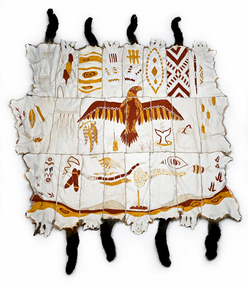
... Making them and sharing knowledge aims to strengthen our Culture and bring family together. There is nothing like a good yarn while sewing or weaving and this is what the Elders do, and my ancestors always did together, sitting around sharing their way and teaching. ...Making them and sharing knowledge aims to strengthen our Culture and bring family together. There is nothing like a good yarn while sewing or weaving and this is what the Elders do, and my ancestors always did together, sitting around sharing their way and teaching. possum skin cloak Wadawurrung First Peoples Culture Tammy Gilson identity tradition design walert walert Possum skin cloak consisting of twenty four pelts, stitched together with thread. ...My name is Tammy Gilson and I am a descendant of Wadawurrung people on Mums side, Marlene Gilson and my dear Nan, Rita Fagan from the Dalton line of our apical ancestor, John Robinson. For that I pay my respects and acknowledge my ancestors and all Elders. In Wadawurrung wurru, meaning language, the wurru name of a cloak walert walert signifies the reclaiming of language that hasn’t been spoken fluently since colonisation. Wadawurrung kinkinbil people relied on possum fur to create cloaks to wear for warmth, ceremony, adornments and medicine. Possum fur was used widely amongst neighbouring First Peoples particularly from colder parts of Victoria given the harshness of climate and particularly in Gordon where the elevation is 650m above sea level. The walert walert denotes a continuum of cultural practice and identity, can be viewed as secret and sacred and today viewed as contemporised practice of history acknowledging transfer of knowledge, practice and kinship. My experience of possum skin cloak revival was in 2014 through Traditional Ceremony, Tanderrum, where I was chosen to make several cloaks to be worn by the Elders including my Mum. This is where I learnt technique and design elements that remain present and relevant to lived experience. My work is an example of how culture and connection gives purpose and embeds a beautiful sense of belonging. Each design panel holds a visual voice, a narrative that speaks to identity and kinship. Symbols and line work are found on old artefacts that indicate belonging to Wadawurrung people. The water marks and mountain patterns were passed on to me from Mum and her grandma. Continuing this practice is for future generations as the walert walert holds significant healing properties. Making them and sharing knowledge aims to strengthen our Culture and bring family together. There is nothing like a good yarn while sewing or weaving and this is what the Elders do, and my ancestors always did together, sitting around sharing their way and teaching. Possum skin cloak consisting of twenty four pelts, stitched together with thread. Cloak features Wadawurrung designs in red, orange, white and black ochre.possum skin cloak, wadawurrung, first peoples, culture, tammy gilson, identity, tradition, design, walert walert -
 National Wool Museum
Film - walert walert, Tammy Gilson, 2026
... Making them and sharing knowledge aims to strengthen our Culture and bring family together. There is nothing like a good yarn while sewing or weaving and this is what the Elders do, and my ancestors always did together, sitting around sharing their way and teaching. ...Making them and sharing knowledge aims to strengthen our Culture and bring family together. There is nothing like a good yarn while sewing or weaving and this is what the Elders do, and my ancestors always did together, sitting around sharing their way and teaching. possum skin cloak Wadawurrung First Peoples Culture Tammy Gilson identity tradition design walert walert 9144.1 - Digital colour film featuring Wadawurrung woman Tammy Gilson speaking about the walert walert (possum skins cloak) she made for the National Wool Museum Collection, and the cultural practice of making cloaks. ...My name is Tammy Gilson and I am a descendant of Wadawurrung people on Mums side, Marlene Gilson and my dear Nan, Rita Fagan from the Dalton line of our apical ancestor, John Robinson. For that I pay my respects and acknowledge my ancestors and all Elders. In Wadawurrung wurru, meaning language, the wurru name of a cloak walert walert signifies the reclaiming of language that hasn’t been spoken fluently since colonisation. Wadawurrung kinkinbil people relied on possum fur to create cloaks to wear for warmth, ceremony, adornments and medicine. Possum fur was used widely amongst neighbouring First Peoples particularly from colder parts of Victoria given the harshness of climate and particularly in Gordon where the elevation is 650m above sea level. The walert walert denotes a continuum of cultural practice and identity, can be viewed as secret and sacred and today viewed as contemporised practice of history acknowledging transfer of knowledge, practice and kinship. My experience of possum skin cloak revival was in 2014 through Traditional Ceremony, Tanderrum, where I was chosen to make several cloaks to be worn by the Elders including my Mum. This is where I learnt technique and design elements that remain present and relevant to lived experience. My work is an example of how culture and connection gives purpose and embeds a beautiful sense of belonging. Each design panel holds a visual voice, a narrative that speaks to identity and kinship. Symbols and line work are found on old artefacts that indicate belonging to Wadawurrung people. The water marks and mountain patterns were passed on to me from Mum and her grandma. Continuing this practice is for future generations as the walert walert holds significant healing properties. Making them and sharing knowledge aims to strengthen our Culture and bring family together. There is nothing like a good yarn while sewing or weaving and this is what the Elders do, and my ancestors always did together, sitting around sharing their way and teaching. 9144.1 - Digital colour film featuring Wadawurrung woman Tammy Gilson speaking about the walert walert (possum skins cloak) she made for the National Wool Museum Collection, and the cultural practice of making cloaks. Film is 7 minutes and 3 seconds in length. 9144.2 - Digital colour film featuring Wadawurrung woman Tammy Gilson speaking about the designs which feature on the walert walert she made for the National Wool Museum Collection. Film is 14 minutes in length.possum skin cloak, wadawurrung, first peoples, culture, tammy gilson, identity, tradition, design, walert walert -
Clunes Museum
Book, NATIONAL TEMPERANCE PUBLICATION DEPOT, KIRTON'S TEMPERANCE TALES
... THE TRAMPELED CROSS - LONGFELLOW NO2 NOTHING BUT LEAVES.- THE CRESCENT THE CROSS GODS GOOD MAN....local history book religious books religion KIRTON'S TEMPERANCE TALES FOR THE PEOPLE THE TRAMPELED CROSS - LONGFELLOW NO2 NOTHING BUT LEAVES.- THE CRESCENT THE CROSS GODS GOOD MAN. RED DECORATED HARD COVER BOOK - KIRTON'S TEMPERANCE TALES FOR THE PEOPLE KIRTON'S TEMPERANCE TALES Book BOOK NATIONAL TEMPERANCE PUBLICATION DEPOT ...KIRTON'S TEMPERANCE TALES FOR THE PEOPLERED DECORATED HARD COVER BOOK - KIRTON'S TEMPERANCE TALES FOR THE PEOPLEKIRTON'S TEMPERANCE TALES FOR THE PEOPLElocal history, book, religious, books, religion -
 Melton City Libraries
Postcard, Postcards from Fred and Mattie Myers, 1909-1914
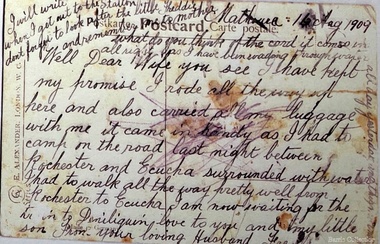
... good like a picnic. We had light rain on Monday as usual only half a day’s shearing in the shed so that is all we done this week, we took a vote 9 to 6 no shearing so nothing till to morrow morning Thursday so there is still a good fortnights shearing to do, will do nothing Saturday polling day as we have to go 13 miles is near Services where I was last year so we will want the full day 50 men to vote and some will probably have to walk to get there, all solid for Labour. ...good like a picnic. We had light rain on Monday as usual only half a day’s shearing in the shed so that is all we done this week, we took a vote 9 to 6 no shearing so nothing till to morrow morning Thursday so there is still a good fortnights shearing to do, will do nothing Saturday polling day as we have to go 13 miles is near Services where I was last year so we will want the full day 50 men to vote and some will probably have to walk to get there, all solid for Labour. ...Post Card: Melton Railway Station 1909 Mattie to Fred My Dear Fred I received your letter and the L2 10/- I was very pleased to hear that I could write again. You say you will come home after the last shead. I should think so. I had a letter from E Jenkins so I am going down to see her next week we call the baby Fernie now I hope you will agree. Dear Fern has got the whooping cough. Written on the side: I suppose you will be away four weeks yet. Love from Mattie will write on Sunday. This letter appears to be connected with the post card Barwonleigh Saturday October 1908 handwriting My Dear Mattie I received your letter and was sorry to hear of our dear little babys misfortune how did it happen do you know what was the cause of it Mrs Watts must be a blind old fool not to have known what it was when you took him to her the first time poor dear you must be worried to death with all this trouble tell me what the doctor thinks of the rupture. I do hope dear he will get over this all right you must be nearly dead going without sleep for so long I had a bit of misfortune myself on Thursday the machine locked and jumped out of my hand and stuck in my bone I kept on working but it was very painful as all the holding is done with the..next page ..knee the boss also has been chipping a good deal this week he says the next time he has occasion to speak to me I will have to go he is very particular. I would like to go through if possible even if I do a lot less. I have about sixteen hundred done up to now and would get another nine hundred if I was let alone but I suppose we will live lovie even if I go do you know if they are full handed at Eynesbury if I thought I could get a week there I would cut myself out here quick. Well dear lovie I am sending you a couple of pounds as I suppose you will want it to get a truss. I don’t think they are very expensive and hope things will find this better with you. Well my dear love I must close with fond love for you and baby from your loving Husband Fred Post Card: 16 Aug 1909 - Mathoura The card depicts a small sailing boat laden with blue flowers. Well Dear Wife you see I have kept my promise. I rode all the way up here and also carried all my luggage with me it came in handy as I had to camp on the road last night between Rochester and Echuca surrounded by water. I had to walk all the way pretty well from Rochester to Echuca. I am now waiting for the train to Deniliquin. Love to you and my little son Fred. From you loving Husband Fred Written along the top and side of the card. what do you think if the card comes in all right as I have been wading through water all day yesterday and this might be …? will write when I get to the Station, don’t forget to look after the little Freddie and remember me to mother. Post Card: 1909 - view across the Flat from the Creek looking to the Presbyterian Church in the distance with some small dwellings in the foreground. To Mr Fred Myers Wandook Stn Denniliquin NSW Dear Fred, received your letter I am sorry to hear you are having such wet weather I will write a letter tomorrow baby is better With Love from M Post Card: 1910 Postmark Stamp 1d Aug 12 1910 Moama NSW Melton postmark stamped Aug 25? Hare Street, looking south Echuca Mrs F Myers, Melton P O Vic Dear Mattie, Just a line to let you know I got here all right I go to Pericotta tonight and to Cobran to morrow best love to all from yours Fred Letter Cobran Stn Via Deniliquin N.S.W. Sunday 21st Aug extract I am having a good time here, a good cook and the best of everything no fires to light or kettles to boil just get up and wire in… plenty hard work the sheep are pretty tough but much better than Wandook. I am well among them here we had a little rain on Friday but not enough to stop us so we have got one full week in .. the weather is lovely. I have been basking in the sunshine mainly in the morning and feel strong and fit a as fiddle, they are a grand lot of men here I only knew one out of the lots but know them all pretty well now, we have a bit of a concert here every nights almost there are a few good singers here and we also had a phonograph up from the station with all the latest records we have two dancers among ourselves very boisterous affairs indeed thy do make the dust fly. I have not ventured to take part in it and don’t think I will either. I get enough dancing all day long and besides I have to furnish the music you ought to see them going when I rattle up the concertina. Letter Cobran Stn via Deniliquin Thursday Sept 1st 1910 [abbreviated] My Dear Mattie, I received your welcome letter today. I though I was never going to get one as it was Sunday fortnight when I wrote to you but we only the mail here twice a week so it takes a long time to write and get an answer. I also got a reply from Eynesbury and a favourable reply it starts on the 13th Oct. …. I have 800 sheep shorn up to date and am fifth among about 30 men. I am sending two more [Ls] this time which I drew on Saturday. I don’t like sending too much more this time as there is a chance of it going astray and it is not very easily earned…. Things must be humming in Melton with all them babies coming and people getting married… I suppose we will be having new neighbours soon. If Mr Watts is selling out he was getting more property then he could keep. I hope you will soon have rain…. you will have to watch our little boy the dear little rascal he must be getting very cute opening the gates he will be tumbling into the tank …. I love to think of the happy times we have had together and hope that we will love one another to the end .. the mail will not leave here until Monday Love to you dear wife and baby Fred Post Card: – I Cling to you like Ivy Cobran September 18th 1910 Fred awaits a letter from Mattie I still have three weeks here yet.. I am sending L2 tell if you got the other 1L 1911 Letters Fred to Mattie October Spring Plains Oct 1911 Mia Mia Post Office I had a great job to catch the train at Diggers Rest as after I turned off the Keilor Rd it was very way and muddy and I had to walk a lot of the way and got there just in time. I came right into Redesdale by the train and stopped there last night… they had heavy rain on thursday up here and a tremendous fall of hail which covered the ground over a foot deep. There are only 4 shearers here yet.. I saw some of the sheep they look very rough and big so there will be no big tallies done, the men are saying he is giving 2s per hundred extra, so that will help a little. We are going to start Cobran via Deniliquin. Post Card: three scenes of Mathoura 10/9/1914 EB on a photo copy 10/9/12 ? Mathoura Thursday Dear Mattie, Just a line to let you know I got up here all right. I rode the seat out of my trousers. I have done 100 miles on the bike. I met none of the old hands this time so will go out on my own… Your loving husband Fred, did Marjie miss me at all. Post Card: Cobran 15th Sept 1912 Hearts and intertwined flowers and little envelope he has written Marjorie …just a line to let you know I will cut out here Friday next in find, we have had two falls of rain since I wrote and it has bean blowing a hurricane for couple of days and may blow up again however if we are delayed I will send you a card Wednesday I am longing to see you and the two little kiddies again…. Fred Copy only Golf Hill Sep 26th Cut out 31 Oct Total 2332 1913 Post Card: Scene View Street, Bendigo August 1913 Mathoura Tuesday My Dear Mattie Just a line to let you know I got up here all right. Teddy Ginger and another couple of chaps on the way ……. Letter Cobran Sunday Aug 7th 1913 My Dear Mattie Just a line to let you know that weather permitting we will cut out here about Thursday morning….I have not got any more shearing here. I have not heard from the other place…. Expect me about Friday …. I suppose Freddie and Marjie will be glad to see me, Marjie will climb all over me. I will be glad to se you all again you will have a fortnight before Golf Hill starts. I see in the Express you sent that Annie McPherson of (Dunvegan) is engaged to Len Farrell, she appears to be going to take no risks with him she wont let him slip through her hands like the banker did…… Fred Post Card: 1914 Garland of roses Warrambeen Stn Shelford PO October 14th 1914 Birthday wishes. Post Card: Love’s Golden Chain Golf Hill Tuesday Oct 17 1914 Birthday wishes [ this one might be a different year] Letter Cobran Wed 2nd Sept 1914 My Dear Mattie, I received your welcome letter today and also the papers which were very acceptable as we don’t get many papers here we only get see one at odd times as we get none for the hut this year.. I have not seen a bit of butter since I left home as it is too dear for us for sinners here. Poor Marjie had a cold.. so the little kid wants to go to the war, she must think it is good like a picnic. We had light rain on Monday as usual only half a day’s shearing in the shed so that is all we done this week, we took a vote 9 to 6 no shearing so nothing till to morrow morning Thursday so there is still a good fortnights shearing to do, will do nothing Saturday polling day as we have to go 13 miles is near Services where I was last year so we will want the full day 50 men to vote and some will probably have to walk to get there, all solid for Labour. I have just had an interval for lunch, pudding, yeast buns and rock cakes… We are doing nothing but eating and sleeping this week. Fred I am sending L1 in this which will do you till I come back if I keep drawing up I will have none when I finish so make the most of it. Post Card: Two doves with violets 1915 Cobran Wed 18th Sept [could be 1912] Sorry to tell you we are delayed with rain so will not be home till next week… only 3 days of shearing to do…. expect me about the middle of next week….I wish I was with you now and the dear little ones Fred Post Card: Iris Flowers Barwonleigh Stn Tuesday Oct 14th 1918 Happy birthday greetings from Fred Post Card: Irrigation channel Swan Hill 5 Year not shown Swan Hill Tuesday night Just a few lines to let you know I got this far all right. I had to walk nearly all the way to Gisborne and got there last night and took the train here today. It has been raining all the way between Gisborne and here. Moulamein tomorrow. I think it will be another case of walking as it is wet here no metal roads all mud. best love to yourself and the little ones and also mother. will write Sunday Post Card: The White Man’s Burden.The writing on the back rubbed out Mattie has written, I was weighed and I am 8 stone 10 pounds. 14 Post Cards, some have the original dates, others have the date added later by Martha. Two envelopes, one with addressed to Melton postmark Moule, stamp torn off, the other Cards from my dear Fred. The letters and the notebooks can be cross checked according the their contents. Italics show the dates added by Mattie local identities -
Old Colonists' Association of Ballarat Inc.
Ceremonial object - Trowel, William Bennett, Silver Trowel, c1887
... good of their fellow man, and he hoped it would be successful, he hoped that the young people who came after them would appreciate what the Old Colonists had left them. He hoped they would all assist in making the institution one that would he worthy of the place. He would hand a small donation to the secretary, and hoped others would do the same. (Cheers.) The secretary, amid cheering, announced that the cheque handed over by Mr Murray was for £2O. Archdeacon Julius, who was asked to speak, said nothing...good of their fellow man, and he hoped it would be successful, he hoped that the young people who came after them would appreciate what the Old Colonists had left them. He hoped they would all assist in making the institution one that would he worthy of the place. He would hand a small donation to the secretary, and hoped others would do the same. (Cheers.) The secretary, amid cheering, announced that the cheque handed over by Mr Murray was for £2O. Archdeacon Julius, who was asked to speak, said nothing ...The silver trowel was used for the laying of the foundation stone of the Ballarat Old Colonists' Hall. It was donated to the Old Colonists' Associaiton in 1906. The Old Colonists' Association minutes noted 'Mrs Murray handed to the Secretary the silver trowel presented to the late President on the occasion of the laying of the foundation stone of the Hall.' The silver trowel was used for the laying of the foundation stone of the Ballarat Old Colonists' Hall. It was donated to the Old Colonists' Associaiton in 1906. The Old Colonists' Association minutes noted 'Mrs Murray handed to the Secretary the silver trowel presented to the late President on the occasion of the laying of the foundation stone of the Hall.' "THE OLD COLONISTS' HALL. The foundation-stone of the building to be erected by the Old Identities’ Association, in Lydiard street, was next laid with the usual ceremonies. This was immediately adjoining the foundation-stone of the Mining Exchange building. Mr J. Graham presented Mr Murray with a silver trowel, bearing the following inscription:—“ Queen Victoria’s Jubilee. Presented to J. P. Murray, Esq., president of the Old Colonists’ Association, on the occasion of his laying the foundation stone of their new hall, Ballarat, 21st June, 1887.” Mr Graham said he thought the pioneers of such a city were quite right in erecting a building that would be a home for them while they lived, and a memorial of them when they were no more. Mr J. Fraser, secretary, read the followin'- report:— “Mr Chairman, ladies, and gentlemen,—The bottle about to be deposited under this foundation contains documents in which are written particulars of the founding of the Old Colonists' Association at Ballarat; its financial and numerical position at the present time, the names of its officers and committee of management for the current term: a complete list of the names of its members, a copy of the rules and regulations of the association: copies of The Star, Evening Star, Courier, and Ballarat Advertiser newspapers, programme of to-day's proceedings as far as they relate to the laying of the foundation-stone, together with a brief summary of the aims and objects of this philanthropic institution. That the nature of these objects are considered worthy of encouragement and support is amply proved when we see on the Association's roll of membership the names of so many of our most prominent citizens and public men, "and from the fact that the Government of the colony have recognised the just claim of the old colonists'of Ballarat to be placed in possession of this valuable and central site, upon which to erect a building that will, be a credit to them and an ornament to the city, and which will enable them to still further extend the sphere of their benevolence and usefulness iu this district. The following is a copy of the signed and sealed memorial document:—*The foundation-stone of the hall of the Old Colonists’ Association of Ballarat; was laid on Her Majesty Queen Victoria's Jubilee Day,- Tuesday, 21st June, 1887, by John Paul Murray, Esq., J.P., president of the association. Under the foundation stone is deposited a copy of the constitution and rules of the association, the names of the officers, and a complete list of the names of ail the members to date; also a copy each of The Star, Courier, Evening Post, and the Advertiser, local newspapers. At this date the association numbers 319 members—accumulated funds, £203 10s 3d. The land upon which the hall is to he erected was granted by the Government to the association for that, purpose. (Signed) John P. Murray, President; W. B. Perry, Samuel Delpratt, Vice-presidents; Daniel Fern, Treasurer; John Fraser, Secretary. Committee—J. W. Graham, J. W. Lee, James M'Merkin, Andrew Lister, James Ward. Trustees—J. W. Graham, Wm. Irwin, John M'Cafferty ” Mr Murray said he was proud to lay the foundation stone of this building. The association was started in I883, and he might say they were a purely philanthropic institution. They formed an association whose creed was to assist one another in every shape and form. They had now 319 members, and were daily increasing in number.-. They were very fairly off as regarded their financial position. With respect to the objects of the association, they were to form a bond of brotherhood among those whose past experience in commercial or in mining pursuits so intimately associated them with the early history of the goldfields; men, to whose indomitable energy and perseverance Ballarat and other mining centres in the colony were so largely indebted for their development and commercial prosperity. Some of whose names were also closely identified with the memorable and sanguinary struggle 'for freedom and constitutional liberty in 1883. Their object was, further, to gather together within one fold those who survive those stirring times, to meet occasionally in friendly and social intercourse; to relieve their brethren who were overtaken by sickness or affliction; to provide the shelter of a home for those Pioneers of the goldfields whom the reverses of fortune had deprived of the means of procuring the comforts of life in their declining years; to assist the widow and succor the orphan; to mutually cheer and support each other in their temporary troubles and vicissitudes as they journeyed onward to the grave; and lastly, to tender a tribute of respect to the memory of a departed brother, by following his remains to their final resting place. Such were some of the principal objects of the “ Old Colonists' Association.” It was an institution for the good of their fellow man, and he hoped it would be successful, he hoped that the young people who came after them would appreciate what the Old Colonists had left them. He hoped they would all assist in making the institution one that would he worthy of the place. He would hand a small donation to the secretary, and hoped others would do the same. (Cheers.) The secretary, amid cheering, announced that the cheque handed over by Mr Murray was for £2O. Archdeacon Julius, who was asked to speak, said nothing could have been more fitting than the laying of the foundation-stone of the Old Identities’ Association on the Queen's Jubilee. They were a link between the past of 50 years gone by and today. Many of them remembered well enough perhaps the time when it took a man five and twenty minutes to light his pipe with tinder and steel, and when the small boys went, up the chimneys to sweep them. (Laughter.) They were building something now that people would look upon in years to come, and speak of in connection with the Old Colonists, if the young men were' half as good as their fathers they would be uncommon good fellows, and he did not think they would be. (Laughter, and interjection.) ''An old fellow said it was very true, and he knew it. (Laughter.) The Old Identities would agree with him to a man. (Laughter.) If the young men walked in their steps Ballarat in another 50 years would be 50 percent, better than it was now. There was not a man there that wished that more strongly, than 'he’ did. The Old Identities were laying this stone on the jubilee day of Her Majesty, and there never sat on the throne a worthier or nobler Queen than she who held her jubilee that day. There was not a man present, whatever his views of government may be, who did not say “God bless our Queen.” (Cheers.) The proceedings closed with the singing of the National Anthem and cheers for the Queen. (Ballarat Star, 23 June 1887)Silver trowel used during the laying of a foundation Stone for the Ballarat Old Colonists' Association building in Lydiard Street North, Ballarat.ballarat old colonists' association, ballarat old colonists' club, trowel, silver trowel, foundation stone, mrs j. murray, william bennett, j. fraser, john murray, w. lee, william irwin, john m'cafferty, john mccafferty -
 Ballarat Heritage Services
Photograph - War Memorial, Lisa Gervasoni, Dunolly War Memorial, 2025, 1921
... We have nothing to trouble us at all, so I will soon be just the thing again. When I got buried by a shell it shook me up a good deal. ...We have nothing to trouble us at all, so I will soon be just the thing again. When I got buried by a shell it shook me up a good deal. ...The Dunolly World War One Memorial Pillar, located in front of the Town Hall on Broadway Street, and was unveiled on November 18th 1921. The pillar is topped by an urn and rests on a square concrete plinth, which lists the names ninety-four locals who died serving during the First World War. On Friday afternoon the Premier, accompanied by Messrs. Pennington and Groves, M's.L.A., visited Dunolly, and unveiled a soldiers' memorial — a polished granite column on a square base, erected by the residents at a cost of £300. It bears the names of 94 district soldiers who were killed in action. The Premier, who is a native of Dunolly, referred to his early associations with the town and district. Speaking of the valiant service rendered by the Australian soldiers in the great war, he paid a tribute to those who enlisted from the country districts. He was not one of those who would withhold national memorials to the fallen because provision had not been made for all who had returned. It was right and proper to have these memorials as silent reminders of the great sacrifice made by the many as a lasting tribute to their memory. Messrs. Groves and Pennington and local clergymen also spoke. The school children sang O God, Our Help in Ages Past, and a bugler sounded the Last Post after the unveiling. The shire president entertained the visitors and committee at dinner. The Age (Melbourne), 19 November 1921. Colour photograph of the Dunolly War Memorial. Front Inscription "Erected by the Shire of Bet Bet and Dunolly Borough To the memory of the brave and noble men who fought and died for the Empire and our freedom in the Great War 1914 - 1918. Pass not this stone in sorrow but in pride, and may you live as nobly as they died." "Private L. Polinelli has written several letters to his mother at Dunolly, dated from from Tel el Kebir from January 13th till the 22nd. He had written every day or two, and this example, is a very fine one. He explains why there was an interval some weeks during which he sent no letters. This was just before the evacuation of Gallipoli, and no-one was permitted to send letters at such a critical time, as there were fears that carefully arranged plans might leak out in some way. Gallipoli had been evacuated on the 19th December, which happened to be Private Polinelli's 24th birthday, and he has cause, he says, to remember that birthday particularly, when this important movement, in which he participated, was so success-fully carried out. He was in the best of health. They had been on Lemnos Island for two weeks after leaving Galilipoli, and while there they got billeted and numerous gifts from Australia, which gave great delight. He (Private Polinelli) had got a big mail - 35 letters and a number of parcels. Both Norman Watson and himself were feeling well, although they had a pretty rough time at the front, but they were feeling better every day. Further letters speak of the arrival in Egypt and the Australian being encamped at Tel el Kebir, 40 miles from Cairo. He states that W. Lyndon had returned from England and was with them. He (W. Lyndon) looks splendid and had had a splendid time in England and Scotland. He saw Jack Lewis in England, and thinks he was to return to Australia. Reference is made to the Rev. Father Goidanich who was with their brigade, and who had been wounded at the front, but was all right again. Father Goidanich is well-known in this district. The letters were written in good spirits and many references were made to friends in Dunolly and district. A friend in Dunolly has received a letter from Private L. Polinelli, which is dated February 3rd, and written 'from the Arabian Desert.' This covers a vast extent of country, so that there is no use in speculating as to the locality, and portions of the letter which possibly would have given some indication have bean 'censored.' Private Polinelli wrote that Norman Watson and Himself were in the best of health and have stook the life well. They are right out of civilisation at time of writing. He referred to their Dtsojourns at Lemoos Island, where Christmas was spent, and where the billies and puddings assisted much in their enjoyment. But they were glad to leave Lemnos Island. After being in camp at Tel el E-bir for two weeks they were sent to where they were at the time of writing, all being in good xxxx and the open country suiting them well. He speaks with admiration of the desert work done by the camels so very largely used. The censoring was very strict so that he could not give much news. After alluding to the return to splendid health of W. Lyndon from England, he says he saw a lot of others from round Dunolly on returning to Egypt, including Tom Fishlock, R. Johnson, and J. Taylor, and some others from Betley, and all looked well. He had also seen Erie Williamson a few times, and he looked splendid. He concludes with remembrances to friends, and from himself and Norman Watson to the Loyal Prince Alfred Lodge." (Dunolly and Betbetshire Express and County of Gladstone Advertiser, Tue 14 Mar 1916) "SOLDIER'S LETTERS PRIVATE L. POLINELLI A friend in Dunolly has received another interesting letter from Private L Polinelli, son of Mrs J Davis, South Dunolly. It is from "Somewhere in France," and is dated July 23rd. He remarks with regret that a good deal of the soldiers' mail from Australia went down in the Arabia, and then goes on to say:- "Norman is back here with us again now and looking well. He had a splendid time over in England after he was able to get out of bed. It was two years on the 18th of this month (January) since Norman and I enlisted, and we celebrated the occasion by having a bit of an evening out. I am very pleased that he is back; we spend most of our time together. We are at present out of the line having a spell in a village, so we are not having a bad time just now but we will soon be going into the trenches again. I met Wally Bell a few days ago; they were going into the line to relieve our brigade. We did not have time to have a long talk. He looks rather thin, but he was always that way. He is feeling well, and wishes to be remembered to his friends in Dunolly. I also met C. Game the same day; he looked well but, as he was also going into the line, we could not have much of a talk J. Hughes and C. Atherton are also over here now; I often see them. W. Lyndon and T. Miles are well ; I was speaking to them yesterday. We are having very bad weather over here now ; it is either raining or snowing every day. The snow was about a fool deep a few days ago. When the rain comes after it, it makes things muddy, The mud is very bad over here; it takes us all our time to struggle through it in places. We will all be very glad when the winter is over. I was over in England on furlough last month, and had a splendid time. The people over there do all they can to give us a good time. I had several invitations to visit different people, and those that we did visit gave us a splendid time. At the place where I was staying they always had a guide waiting of a morning to show us any place of interest that we wanted to see. There was also always a supply of free tickets to the different theatres if we wanted them ; so you see that they go to some expense to give ns a good time. When they know yon are from France you are sure of a hearty welcome. was up in Scotland, and spent five days in Edinburgh. It is a very pretty place, especially when it is seen from Edinburgh Castle, which is on a high bill overlooking the place. We veil through the Castle; also Holyrood Palace. There are a lot of interesting things to be seen in the two places connected with the history of Scotland. It was snowing very heavily while v« were in Scotland, and we bad some fine snowballing with the Scotch people. I greatly enjoyed the trip to Scotland. It would take a very long time to see all round London. I saw a lot of the old historical places there, which were very interesting. The fogs are very bad in London. I had an experience of a London fog one day; it was the heaviest they experienced for a number of years. We could only see a few yards ahead of us. Nearly everyone carried torches; it looked very funny. . . . There are nearly always as many women drinking in the bars as men; it struck me as being very strange, a bit different to what we are used to in Australia, a trip through some parts of London is a real eye-opener to us. It is interesting to watch the traffic in some of the business parts of London it moves along in one big mass. It is a wonder that a lot more accidents do not happen. I saw Australia House, where the High Commissioner has his office, in the Strand. It is not yet finished. It looks a very fine place, and when completed will be 'some' place. Both Norman and I are well, and send remembrances to friends." (Since this letter was written we have had the sad news of the death from wounds of Privates Atherton and Hughes, and that Sergeant Miles and Corporal Norman Watson have been wounded.) (Dunolly and Betbetshire Express and County of Gladstone Advertiser , Friday 13 April 1917, page 2) "Private L Polinelli, from some of whose previous letters we have published interesting extracts, has written to a friend in Dunolly, the letter being from France, and dated April 28th. Private Polinelli says among other things, "I am pleased to say that, Norman (Watson), Les (Anderson) and myself are in the best of health. We now have been in France some time. It is a terrible place for rain ; It has been raining all the time we have been here. It has also been very cold, snowing at times, but it is starting to "fine up" now, and the last few days have been splendid. I hope it keeps like that for a while, as it makes things very miserable in the trenches when it is so wet. We get a few days spell out of the trenches every now and again; so things are not as bad here as they were at Gallipoli. It is not so lively here so far as it was over there either. I am sorry to say that Jack Sanderson, who had been Will Lyndon's mate since they joined the forces, got killed during a bombardment last night. He was terribly knocked about with a shell. I saw W. Lyndon to-day and he was telling me all about it. He seemed terribly cut up over it, and so am I, as I was with Jack a lot over at Gallipoli after Will got sent away sick. He was always bright and cheerful, always had a smile up whenever I met him. I feel very sad about it. We will do all we can to make the Germans pay for it. You will most likely know him, as be used to live in Dunolly before going to Bendigo. Will Lyndon had a narrow escape also, as he was not very far from where the shell burst. He escaped with a bit of a shock, otherwise he is in the best of health. We have a good time among the French people when we are out of the trenches. They do all they can to make us feel at home. I am getting quite expert at speaking French. They smile at us a treat trying to speak French, but we generally make ourselves understood and have a good time among them. It is very rarely we see a young Frenchman, they being all away fighting. The women do all the work on the farms themselves, and deserve every credit for it. . . . I was sorry to hear about the death of Nurse M'Mahon; she was a grand old nurse. I heard that her daughter Nelly was nurse in a hospital on Lemnos Island, and when we were there I went to two of the hospitals to try to see her, but she did not happen to be at either, and I had no time to visit any of the others, so I did not see her. I was also sorry to hear about Mrs Rokahr, as she has left so many little ones behind. (Reference is made to other happenings in Dunolly.) So far I am pleased to say Norman and I have had the luck not to have had a day's illness; I think we are very fortunate, as such a lot get sent to the hospital ill. We are also lucky to have escaped the bullets and shells so far. I hope that luck sticks to us. I am sorry that, owing to the censorship, I cannot give you any interesting news of our trip over to France and the places we have seen. I will have to keep that till I get back to Dunolly again. . . . I have just heard that the battalion that Teddy Game is in has arrived, so I am going to look him up first chance I get." (The letter concludes with remembrances to members of the Lodge and other friends.) (Dunolly and Betbetshire Express and County of Gladstone Advertiser, Tuesday 13 June 1916, page 3) "PRIVATE L POLINELLI Another very interesting letter has been received by a friend in Dunolly from Private L. Polinelli, from France dated May 4th, 1916- Private Polinelli says-" I was glad that you got the letter I wrote from the Arabian Desert. The Censor must have crossed a good deal of it out. They seem to cross out a lot more than is really necessary. We left out there all of a sudden, and in a very short while found ourselves over here. It does not take them very long to make a move. I was saying in the last letter that I was going to try and find " Teddy " Game. I met him a few days ago and had a good yarn with him; he looks real well. I also met S. Prew, and "Ted" Smyth and his son Ernie. They all looked splendid, and are in the same battalion. "Ted" Smyth sticks to it well, and looks better than he ever looked. They will be under fire for the first time in a few days. S. Prew was hit in the landing at Gallipoli, but be is quite well now. W. Smythe, who is in our brigade is well ; I see him very often. " Les " Peart is not with us now; he has joined a Pioneer battalion, and I have not seen him since he joined it. I gave all the Dunolly boys your best wishes and they all wish to be remembered to you— also the same remembrance from Dave Millar, who used to play football for Dunolly from Moliagul. He is in our battalion, having come over with reinforcements. I see him every day and he wished to be remembered to you. A brother of Mr A. J. Williamson, manager of the Bank of Victoria, Dunolly, is also in this battalion. He is a great friend of mine ; we often have a talk about Dunolly. He was not well a little while ago, having to go into a hospital, but is all right again and is back with me. Eric Williamson, son of Mr A. J. Williamson is over here ; Norman (Watson) saw him a few days ago and said he looked well. Norman has been a corporal for some time. I was also offered stripes lately, but preferred to remain a private. There is a lot of worry and running about when you are an N.C.O., so I think I will remain as I am. ... So football is about done this season. I don't think they should cut it right out. I suppose some of them have to stay at home, so they ought to have some amusement. I would very much like to have a game, but I think I would just about forget how to play now. It is very amusing for us to read some of the soldiers letters in the Australian papers. . . l told you in the last letter about xxx young "Jack "Sanderson ; I was terribly sorry about him." Private Polinelli mentions in a letter to his sister in Dunolly that he happened to be beach at Gallipoli where the late Lord Kitchener was xxxxx addressed the' soldiers and' xxxxxx to them the message from the King. Private Polinelli states that he was very proud to have been one of those addressed by the great man. He and Norman Watson have never been a day out of the lines since arriving first in Egypt. It is intended to grant special leave to all those who have been kept so close to their posts xxx three months, and they are looking forward to this relaxation with keen anticipation, hoping to visit England and Scotland. (Dunolly and Betbetshire Express and County of Gladstone Advertiser, Tue 27 Jun 1916) "SOLDIER'S LETTERS. CORPORAL L. POLINELLI. Two letters have been received by Mrs J. Davis, South Dunolly, from her son, Corporal L. Polinelli, both written subsequent to the time when he was wounded, as reported when word was received at the time. Corporal Polinelli writes from No. 12 General Hospital, Rouen, France, and his first letter is dated 7th May. He stated that he was in hospital, he having been wounded in the arm and shoulder on 3rd May. He continued— " It is not a bad wound, and will not take long to heal up, as it is a clean wound. I was very lucky to get out of the fight alive, as I was buried by a shell explosion about an hour before I was wounded. It was very rough, and the noise of all the shells was terrible. Four men were killed by the same shell that wounded me, so I was fortunate. I am feeling a bit " shook up," and my head is aching from the concussion of the shells, but after a few days' spell in bed here I will be feeling just the thing again. So you need not worry about me ; a week or two will see me quite right again. We are having very nice warm weather just now-pleasant change after all the bad weather we have had." The second letter is dated May 12, Corporal Polinelli saying— "I am getting along splendidly ; the wound is healing up fast, so it will not be very long before I am quite right. The doc-tor, the other day said it would be better not to take the piece of shell out of my shoulder yet, and that it would not interfere with me in any way ; so perhaps l will always carry it about with me. He feared lest taking it out at that time would interfere with an artery. Rouen, where the hospital is, is a very pretty city. They give us leave to visit all the places when we are well enough. It is a nice spell here, away from the firing line. We have nothing to trouble us at all, so I will soon be just the thing again. When I got buried by a shell it shook me up a good deal. I felt it far more than the wound I got after; but it has not done me any harm, as I feel hardly any effects now. My good luck sticks to me in getting out of it so lightly. I hope you are not worrying at all about me, as I am all right. We are having beautiful weather over here— sunny days just like the Australian spring. . . . The sisters in the hospital are very nice, and treat us well. They have a lot of work to do, as a good few men have been wounded lately. I would have liked to have been sent over to England, but they are not sending many over there now. They treat as many as they can in France on account of attacks on hospital ships. I would have been able to have a good time with Norman (Watson) had l got over. He was just about all right when I heard from him last." Corporal Polinelli sends kind remembrances to friends." (Dunolly and Betbetshire Express and County of Gladstone Advertiser, Friday 6 July 1917, page 2) "SOLDIERS' LETTERS. CORPORAL L. POLINELLI. The following letter, dated from London on December 27; has been received by a friend in Dunolly from Corporal L. Polinelli (son of Mrs J. Davis, South Donolly), who, at the time of writing, after long and hard service at the front, was on furlough in England. After an introduction he says:— I am having a very good time. I went over to Ireland for five days, spending the most of the time in Dublin. I like the place very much. War appearances are not so conspicuous in Ireland as in England. The hotels are open all day, and a good meal can be obtained anywhere, which is more than can be got in England. The war seems to be making things very bad in England. It is very hard to get a good meal in London ; everything is so restricted. The only way to get a good meal is to go into two places. The people have to line up outside the shops for hours to get sugar, tea, and butter, and then they sometimes fail to get any. So many of our boats getting sunk is the cause of it. If things continue to go on in this way I am afraid that there is a very hard time in store for the people in England. Several people that I have spoken to say that they are just beginning to feel the pinch now. I was in London while an air raid was on a few days ago; it caused a lot of excitement among the people. Ten were killed and 70 wounded in the raid. I was about half a mile from where the bombs fell, so I was pretty right. I thought I had left the war behind in France, but it seems to be on over here at times also. I spent Christmas day with a family at Grantham, a town between London and Newcastle; they were very nice people. I had a very enjoyable time with them. I went to a dance in the evening and enjoyed it very much. It was a bit strange for a start, as it is the first dance I have been to since Norman and I had the send off at Dunolly in January, 1915. They do the dances a bit different over here to what they are done in Australia, and that made it worse still. I went through Guinness's Brewery while I was in Dublin. It is a wonderful place, and covers 55 acres of ground. I got a great surprise when I was starting on my leave in France. We were taken to the station we had to start from in a motor lorry, and who should the driver of the lorry be but Syd. Richards (son of Mr W. Richards, South Dunolly), who used to work at the Post Office in Dunolly. I rode on the front with him, so we had a good yarn. I did not know that be had joined, so was surprised to see him. He has grown a lot since I saw him last, and is looking well. Norman and Bill Lyndon were both well when I left France. We had been having a good spell near Messines, in Flanders, but they will be in the trenches by now. We have been round about Ypres for this last four months, and had some pretty rough times there. dunolly, dunolly war memorial, l. polinelli, bet bet, world war one, world war two, j. deledio, b. battilana, c. fitzgerald, f.s. kendall, j.h. hogan, p. zampatti, louisa davis, louisa gervasoni, bill lyndon, norman lyndon, sydney lindsay -
Whitehorse Historical Society Inc.
Article, Nothing like a good read, 2012
... Nothing like a good read...Profile of author Hazel Edwards, Blackburn resident, in which she talks about her passion for writing and reading, and the desire to instill a similar passion in people no matter what their age. (photo) Nothing like a good read Article Article ...Profile of author Hazel Edwards, Blackburn resident.Profile of author Hazel Edwards, Blackburn resident, in which she talks about her passion for writing and reading, and the desire to instill a similar passion in people no matter what their age. (photo)Profile of author Hazel Edwards, Blackburn resident.edwards, hazel -
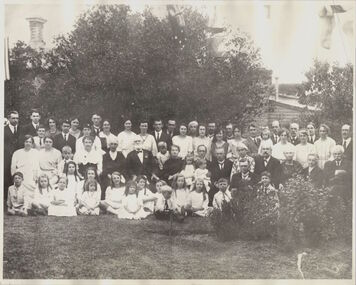 Kew Historical Society Inc
Photograph, James Venn Morgan's 100th Birthday, 1923
... good connection. Among his customers at that time Mr. Morgan recalls Mr. Justice A'Beckett and many leading men in law and medicine of the day. Then the news was flashed through Melbourne of the discovery of gold at Ballarat. Nothing...good connection. Among his customers at that time Mr. Morgan recalls Mr. Justice A'Beckett and many leading men in law and medicine of the day. Then the news was flashed through Melbourne of the discovery of gold at Ballarat. Nothing ...1823-1923.MR. JAMES VENN MORGAN. "FATHER OF" KEW."In a Village in Somersetshire in England on February 21, 1823, a son was born to George and Sarah Morgan. The child was so delicate that his parents feared that he would not live. How little ground the parents parents had for their fears may be judged from the fact that the boy, christened James Venn Morgan is still alive and hale. He is able to exhibit with pride the paper with its faded ink on which a clergyman wrote the certificate of his baptism almost 100 years ago. But for some slight infirmities of sight and hearing, Mr. Morgan, who is within six weeks of completing the 100th year of his life, is in good health, and is well able to attend to his business affairs. His immediate cause for regret is that he is not now able to do a day's work in his garden, as he was 12 months ago. After spending his early life in England, where he learned his trade as shoemaker, Mr Morgan came to Australia in April, 1851. He carried letters of introduction to Mr. Tripp, a solicitor, of Melbourne, who strongly recommended him to begin business as a shoemaker, and accordingly he opened a shop at the corner of Swanston and Bourke streets, where the Leviathan Stores now stand, and was not long in working up a good connection. Among his customers at that time Mr. Morgan recalls Mr. Justice A'Beckett and many leading men in law and medicine of the day. Then the news was flashed through Melbourne of the discovery of gold at Ballarat. Nothing can give a clearer idea of the excitement this news caused in Melbourne than that Mr. Morgan, who was a member of one of the first parties to leave for the diggings, left uncompleted in his workshop one of a pair of riding boots he was making for Mr. J. B. Weir. As the purchase of suitable clothing would have taken time, he set out to make his fortune wearing a top hat. At Ballarat he stayed for five or six weeks, and returned to Melbourne with 10oz. of gold. He remained in the city long enough to finish the second of the two riding boots, and then, with three companions, set out for Chewton, near Castlemaine. Here fortune smiled. The party tried their luck in an abandoned shaft, and in two weeks returned to Melbourne again after having won 35lb. weight of gold. How Kew Was Born. Mr Morgan was content with his success, and induced his partners to invest their money with him in land. After obtaining the advice of a friend, the party negotiated with Mr Samuel Watts, of Collngwood, who had recently purchased land from the Crown, and from him they took over at £15 an acre about 32 acres of land in the district that is now known as Kew. This land extended from where the Kew Post-office now stands to the locality of the Boroondara Cemetery. At that time there was not a house in the district, and there was a fairly large population of aborigines, but no white men. Here it was that Mr Morgan decided to settle, and, after having had the land surveyed, the partners apportioned it by drawing straws for the four sections into which it had been divided. One of them sold his holding later in the year for £100 an acre, and was sorry for it afterwards. In 1853 Mr. Morgan built the first house in Kew, and this house is the one in which he still resides. Here with his wife, he settled down to market gardening and dairying. He tells with a laugh how he was paid 1/ a lb for the first potatoes he grew, and 1/ a quart for milk. So successful was the new venture that he induced his father and other members of the family to come out to Australia to assist him. How different Kew of those days was from the Kew of to-day will be understood from Mr. Morgan's statement that for weeks at a time they never saw a a white face other than those of the family. The blacks, he says, although very noisy, were entirely friendly. Gradually the district became settled, Mr. Morgan parted with a portion of his holding, and subdivided and built on the remainder which he still retains. In 1884 he found himself in a position to retire from active business. Youth in Old Age. In Mr Morgan's garden, which is a large, one trees which he and his father planted more than 60 years ago are still bearing heavy crops of apples. Mr. Morgan has been a widower since 1915. He has three daughters all of whom are married, and numerous grandchildren and great-grandchildren. One of the great-grand children reccntly informed Mr. Morgan that he was about to be married. Perhaps the most striking characteristic of Mr. Morgan to-day is his activity. Not only does he move about with surprising alacrity, but is able to go into the streets and attend to his business affairs with but little fatigue The Argus, 17 January 1923, p.12.This work forms part of the collection assembled by the historian Dorothy Rogers, that was donated to the Kew Historical Society by her son John Rogers in 2015. The manuscripts, photographs, maps, and documents were sourced by her from both family and local collections or produced as references for her print publications. Many were directly used by Rogers in writing ‘Lovely Old Homes of Kew’ (1961) and 'A History of Kew' (1973), or the numerous articles on local history that she produced for suburban newspapers. Most of the photographs in the collection include detailed annotations in her hand. The Rogers Collection provides a comprehensive insight into the working habits of a historian in the 1960s and 1970s. Together it forms the largest privately-donated collection within the archives of the Kew Historical Society.A group portrait on the occasion of the 100th birthday of James Venn Morgan in 1923. Dorothy Rogers used this photograph in 'A History of Kew' (1973). It faces page 17. In the book, the caption reads "JAMES VENN MORGAN'S 100TH BIRTHDAY ANNIVERSARY. The party was held at 'Morganville'. Mr Morgan is shown with a group of descendants."James Morgans 100th Birthday Party. james venn morgan, kew, model dairy, dorothy rogers -
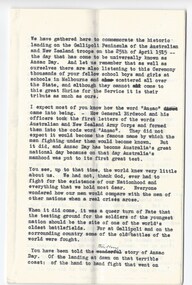 Melbourne Legacy
Document - Speech, ANZAC Commemoration Ceremony for Students
... nothing to dishonour it. If you get an order from one in authority, obey it, even if you do not understand it.A good solider always obeys his orders. ...nothing to dishonour it. If you get an order from one in authority, obey it, even if you do not understand it.A good solider always obeys his orders. ...A copy of an Anzac Day Address at the Anzac Commemoration Ceremony for Students, the year is unknown but it is presumably the address given by the President of Legacy. It seems to be one of the earlier ceremonies. It was stored with documents about the building of the Shrine and another speech from the 1939 service. The presenter had probably served in World War 1 so was very close to the events he was talking about. The ceremony provides a valuable opportunity for students to gain an appreciation of the Anzac spirit, the significance of the Shrine and the meaning of Anzac Day. The ceremony is usually attended by representatives from schools throughout the state and the Governor of Victoria. The text says: 'We have gathered here too commemorate the historic landing on the Gallipoli Peninsula of the Australian and New Zealand troops on the 25th of April 1915 - the day that has come to be universally known as Anzac Day. . . I expect most of you know how the word 'Anzac' came into being. How General Birdwood and his officers took the first letters of the words Australian and New Zealand Army Corps and formed them into the code word "Anzac". They did not expect it would become the famous name by which the men fighting under them would become known. But it did, and Anzac Day has become Australia's greatest national day because on that day Australia's manhood was put to its first great test. You see up to that that time, the world knew very little about us. We had not, thank God, ever had to fight for the existence of our Nationhood and everything we hold most dear. Everyone wondered how our men would compare with the men of other nations when a real crises arose. . . . You have been told there thrilling story of Anzac Day. Of the landing at dawn on that terrible coast: the hand to hand fighting that went on continuously all that day and through the days and nights that followed. How the Anzacs - outnumbered, exhausted and tortured by thirst held on, and how during the terrible nine months that ensued all the efforts of a brave enemy to dislodge them failed. Such was their gallantry that a British Officer described the Australian soldier as "The bravest thing God ever made". What a wonderful tribute that was; and how proud we should be of the men who earned it. . . . These men carried on all the traditions of the Anzacs and made a wonderful name for Australia and New Zealand in France, in Belgium, in Egypt and Palestine and in all the theatres of war in which they served. And this great Shrine was build by the people of Victoria, not in any boastful sense of Victory, not in any attempt to glorify war - which is a horrible, dreadful thing, but in memory of those thousands of Victorian sailors and soldiers who so loved their country that they laid down their lives in her service. . . All of them were brave, but do not think that a soldier who is brave need alway be a great warrior. I hope when you have passed through the Shrine you will go and see a little bronze statue near the road yonder. A statue of a man leading a donkey which carries a wounded comrade. You will see the soldier leading the donkey carries no weapons. Yet he was a hero indeed, for he saved the lives of scores of his comrades at Anzac by carrying wounded from the battle to safety and the hospital. And in the end he too gave his life for his friends. . . Let us all try to help each other in peace as they did in war. Instead of divisions, let us have unity. If we think of no one but ourselves we shall not achieve anything nor shall we deserve to. Let those of you who are strong help those who are not so strong - all through life - like John Simpson, the man with the donkey did. Be proud of your country and do nothing to dishonour it. If you get an order from one in authority, obey it, even if you do not understand it.A good solider always obeys his orders. If he did not, he may bring disaster and cause harm to his fellow soldiers. Remember that those thousands of men died so that we could still live here in freedom. A country is judged by its citizens. Let us be worthy of those great citizens who have left us the legacy of their fame and devotion to duty. And when you file through the Shrine and look down on the Rock of Remembrance, read the inscription on it, "Greater Love Hath No Man", remember those wonderful words written in the greatest book in the world nearly two thousand years ago, "Greater love hath no man than this, that a man lay down his life for his friend."A record of a ceremony at the Shrine for school students. The text of the speech is significant in that it was written by a man who had served in World War 1 and knew first hand what it meant to be part of the first Anzacs. White quarto paper x 4 pages with black type of a speech at one of the Annual Anzac Commemoration Service for Students.Handwritten in blue pen 'Shrine, Children's Service'anzac commemoration for students, wreath laying ceremony, speech -
 Wodonga & District Historical Society Inc
Album - Ringer's River by Des Martin - Plate 12 - A positive result from the customs duty
... Meantime back at Camoola "Top Or Nothing" Price, known to stockmen as "Old Stop At Nothing", and his shifty ex-jockey clerk Billy Matthews, have been stunned by the Victorian customs duty of 30 shillings per head on cattle, and 50 shillings per head on horses, suddenly promulgated just prior to a very important sale. Caught with a lot of cattle he cannot unload, and a property sale that has gone astray, Price accepts offers for both from O'Day, who thus sets himself up cheaply with a good holding that runs down Barmagulla's back boundary to the Murray River at the point where he often swims across....Meantime back at Camoola "Top Or Nothing" Price, known to stockmen as "Old Stop At Nothing", and his shifty ex-jockey clerk Billy Matthews, have been stunned by the Victorian customs duty of 30 shillings per head on cattle, and 50 shillings per head on horses, suddenly promulgated just prior to a very important sale. Caught with a lot of cattle he cannot unload, and a property sale that has gone astray, Price accepts offers for both from O'Day, who thus sets himself up cheaply with a good holding that runs down Barmagulla's back boundary to the Murray River at the point where he often swims across. ...Meantime back at Camoola "Top Or Nothing" Price, known to stockmen as "Old Stop At Nothing", and his shifty ex-jockey clerk Billy Matthews, have been stunned by the Victorian customs duty of 30 shillings per head on cattle, and 50 shillings per head on horses, suddenly promulgated just prior to a very important sale. Caught with a lot of cattle he cannot unload, and a property sale that has gone astray, Price accepts offers for both from O'Day, who thus sets himself up cheaply with a good holding that runs down Barmagulla's back boundary to the Murray River at the point where he often swims across.The album and images are significant because they document literature written by a prominent member of the Wodonga community. The presentation of this precis was supported by several significant district families and individuals.Ringer's River Album Coloured photo Plate 12des martin, many a mile, ringer's river, northeast victoria stories -
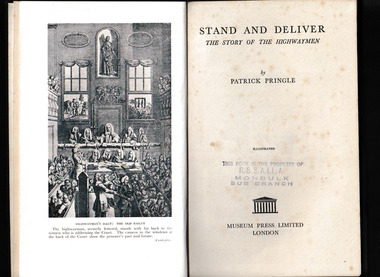 Mrs Aeneas Gunn Memorial Library
Book, Patrick Pringle, Stand and deliver : the story of the highwaymen, 1951
... We have added nothing--but we have taken away a good deal. We have tried to use our discretion in selection, and our judgment in discrimination between contradictory versions of the same events. ...he true story of the highwaymen has never been written, nor can it be. The chroniclers were slavishly faithful to their authorities--flatteringly so, in fact; for these authorities consisted of a lot of chapbooks, broadsheets, penny dreadfuls and twopenny bloods, "dying confessions" that had come in for a good deal of posthumous editing, and the contemporary gutter Press--which was even more unreliable then than it is today. Many of these 'authorities' were so contradictory that the truth-at-all-costs chroniclers left out some of the best bits of highway lore in their vain attempts to keep faithful to their ridiculous principles.Our own ambition is more modest. We have not sought the El Dorado of absolute truth. We have gone back to the same sources that the chroniclers used--and we have taken pains to ignore the latter gentlemen whenever contemporary reports are still extant. We have not moralized, like the chroniclers, nor have we embellished, like the novelists. We have added nothing--but we have taken away a good deal. We have tried to use our discretion in selection, and our judgment in discrimination between contradictory versions of the same events. Since it was impossible to be faithful to the letter, we have tried to recapture the spirit of the Age of Highwaymen. Collapse summaryIndex, ill, p.287.non-fictionhe true story of the highwaymen has never been written, nor can it be. The chroniclers were slavishly faithful to their authorities--flatteringly so, in fact; for these authorities consisted of a lot of chapbooks, broadsheets, penny dreadfuls and twopenny bloods, "dying confessions" that had come in for a good deal of posthumous editing, and the contemporary gutter Press--which was even more unreliable then than it is today. Many of these 'authorities' were so contradictory that the truth-at-all-costs chroniclers left out some of the best bits of highway lore in their vain attempts to keep faithful to their ridiculous principles.Our own ambition is more modest. We have not sought the El Dorado of absolute truth. We have gone back to the same sources that the chroniclers used--and we have taken pains to ignore the latter gentlemen whenever contemporary reports are still extant. We have not moralized, like the chroniclers, nor have we embellished, like the novelists. We have added nothing--but we have taken away a good deal. We have tried to use our discretion in selection, and our judgment in discrimination between contradictory versions of the same events. Since it was impossible to be faithful to the letter, we have tried to recapture the spirit of the Age of Highwaymen. Collapse summary brigands and robbers, highwaymen - history -
Peter MacCallum Cancer Centre
Book - Peter Mac 50th Anniversary Book, Peter Mac 50 Years of Service 1949-1999: Peter MacCallum Cancer Institute
... The rear cover includes the quote "Nothing but the best is good enough for the treatment of cancer" beside a black and white photo of Sir Peter MacCallum....The rear cover includes the quote "Nothing but the best is good enough for the treatment of cancer" beside a black and white photo of Sir Peter MacCallum. ...The book includes the following chapters: Introduction - 50 Years of Progress First Decade 1949-59 Second Decade 1960-69 Third Decade 1970-79 Fourth Decade 1980-89 Fifth Decade 1990-99 Board Chairman & Senior Staff listsA blue book just smaller than A5 with a large light blue 50 on the front cover and a smaller Years specific Peter Mac Logo on the bottom quarter of the cover. The rear cover includes the quote "Nothing but the best is good enough for the treatment of cancer" beside a black and white photo of Sir Peter MacCallum.non-fictionThe book includes the following chapters: Introduction - 50 Years of Progress First Decade 1949-59 Second Decade 1960-69 Third Decade 1970-79 Fourth Decade 1980-89 Fifth Decade 1990-99 Board Chairman & Senior Staff listshistory, medicine, sir peter maccallum, nursing, research, staff -
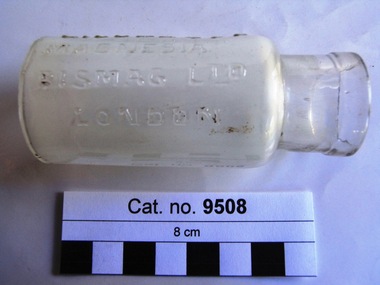 Coal Creek Community Park & Museum
Domestic object - Glass Bottle, Early 1900's
... good- old-fashioned meal with out fear of pain or distress to follow. That’s why Bisurated Magnesia is called “The Little Doctor for Dyspeptics.” . Go to the nearest chemist and get a packet of Bisurated Magnesia tablets to-day; he sells them in handy flasks at small cost, and with every one is included a. binding guarantee of satisfaction or refund of money. Thus, unless this “Little Doctor” gives you the benefit you desire, you pay him nothing...good- old-fashioned meal with out fear of pain or distress to follow. That’s why Bisurated Magnesia is called “The Little Doctor for Dyspeptics.” . Go to the nearest chemist and get a packet of Bisurated Magnesia tablets to-day; he sells them in handy flasks at small cost, and with every one is included a. binding guarantee of satisfaction or refund of money. Thus, unless this “Little Doctor” gives you the benefit you desire, you pay him nothing ...TROVE : The Ballarat Star (Vic. : 1865 - 1924) Wednesday 20 October 1920 p 7 Article 'A LITTLE DOCTOR FOR DYSPEPTICS If you want quick relief from the pains and distress of indigestion, dyspepsia, food fermentation and acidity, just take two or three little tablets of Bisurated Magnesia after eating or whenever pain is felt. Bisurnted Magnesia tablets are absolutely harmless, and enable the dyspeptic to enjoy a good- old-fashioned meal with out fear of pain or distress to follow. That’s why Bisurated Magnesia is called “The Little Doctor for Dyspeptics.” . Go to the nearest chemist and get a packet of Bisurated Magnesia tablets to-day; he sells them in handy flasks at small cost, and with every one is included a. binding guarantee of satisfaction or refund of money. Thus, unless this “Little Doctor” gives you the benefit you desire, you pay him nothing. Bisurated Magnesia is also obtainable in powder form. Beware of substitutes. Look for the maker’s name—Bismag. Ltd., which appears on every .genuine package'. Advertisement in 'The Illustrated London News' 22 July, 1916, page 117. '96 out of 100 dyspeptics have Acid stomachs'. BISMAG LTD, 212-214 Great Portland St., London W. Round clear glass bottle with wide neck and text embossed on side and base. 'BISATURATED MAGNESIA BISMAG LTD LONDON' on side. 'B' over 'I' on base.bisaturated magnesia, bismag, magnesia
