
Showing 30 items matching "grip mechanism"
-
 Melbourne Tram Museum
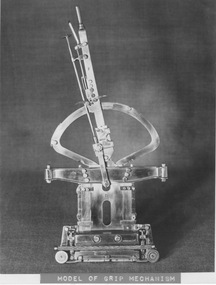
Photograph - Model of grip mechanism, unknown
... Model of grip mechanism......grip mechanism...Photograph shows a to scale model of the grip mechanism used on the Melbourne cable tram network....Below photograph is glued "Model of Grip mechanism".Typed on rear of photograph is words in German. ...Photograph Model of grip mechanism ...Photograph shows a to scale model of the grip mechanism used on the Melbourne cable tram network.Yields information about Melbourne's cable trams Black and white photograph with note below and on rear. Below photograph is glued "Model of Grip mechanism".Typed on rear of photograph is words in German. model, grip mechanism, grip -
 Melbourne Tram Museum
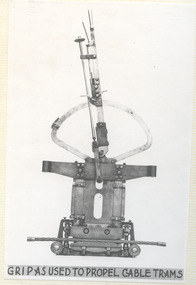
Photograph - Digital Image, Melbourne & Metropolitan Tramways Board (MMTB), grip mechanism as used in the Melbourne cable trams, 1920's?
... grip mechanism as used in the Melbourne cable trams...Digital Image of a grip mechanism as used in the Melbourne cable trams - with caption. ...Demonstrates a Melbourne cable tram grip mechanism. Trams tramways Cable Trams Cables Cable Grip Digital Image of a grip mechanism as used in the Melbourne cable trams - with caption. ...Has a portion of a cable in the mechanism. See also item 8338 for a similar photograph.Demonstrates a Melbourne cable tram grip mechanism.Digital Image of a grip mechanism as used in the Melbourne cable trams - with caption. Has a portion of a cable in the mechanism.trams, tramways, cable trams, cables, cable grip -
 Melbourne Tram Museum
Photograph - Cable grip mechanism, N Williams, 1920s
... Cable grip mechanism....Photograph Cable grip mechanism. N Williams ...Photograph shows a Melbourne cable tram grip with a section of cable in the jaws. See also item 3525 for a similar photo.Yields information about the Melbourne cable tram grip.Black and white photograph with notes on rear.In ink "26" and "K McC"tramcars, tramways, cable trams, cable grip -
 Melbourne Tram Museum
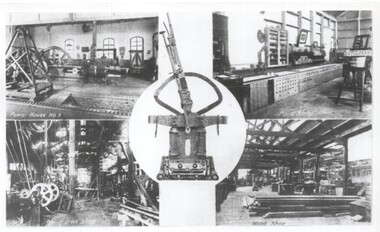
Photograph - Composite image of cable tram maintenance facilities and grip mecanism, 1910c
... Includes an image of the grip mechanism....Composite photograph of cable tram maintenance facilities and grip mechanism....Melbourne 1 – Power House No. 3 2 – Paint shop – Nicholson St W/S 3 – Grip Mechanism 4 – Iron Shop – Nicholson St W/S 5 – Wood Shop – Nicholson St W/S Copy neg Mark Plummer collections ex late John Alfred collection. ...Includes an image of the grip mechanism. Yields information about the cable tram workshops cable trams Melbourne grip workshops Nicholson St workshops power house Engine house Melbourne 1 – Power House No. 3 2 – Paint shop – Nicholson St W/S 3 – Grip Mechanism 4 – Iron Shop – Nicholson St W/S 5 – Wood Shop – Nicholson St W/S Copy neg Mark Plummer collections ex late John Alfred collection. ...Composite photograph from a journal showing five scenes of the equipment and operational facilities of the cable tram system - a power house, Nicholson St workshops paintshop, the iron shop and the wood shop. Includes an image of the grip mechanism.Yields information about the cable tram workshopsComposite photograph of cable tram maintenance facilities and grip mechanism.Melbourne 1 – Power House No. 3 2 – Paint shop – Nicholson St W/S 3 – Grip Mechanism 4 – Iron Shop – Nicholson St W/S 5 – Wood Shop – Nicholson St W/S Copy neg Mark Plummer collections ex late John Alfred collection. cable trams, melbourne, grip, workshops, nicholson st workshops, power house, engine house -
 Melbourne Tram Museum
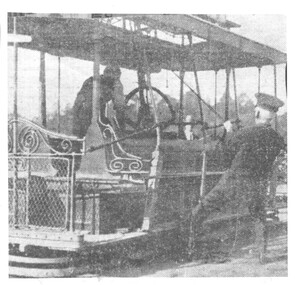
Photograph - Newspaper, Herald Sun, "The Steam roller won", 11/4/1923
... Photo shows a damaged grip car with bent staunchions and the grip mechanism being lifted with a block and tackle by a uniformed tramway man. ...Photo shows a damaged grip car with bent staunchions and the grip mechanism being lifted with a block and tackle by a uniformed tramway man. ...Photo shows a damaged grip car with bent staunchions and the grip mechanism being lifted with a block and tackle by a uniformed tramway man. The actual cutting notes that a lady's leg was injured in the incident.Yields information about damage to a grip car and lifting the grip out of position.Black and white print notes on the rear.On rear in ink "M&MTB Damaged cable tram grip car, result of an accident with a steam roller in Victoria St North Richmond, on 10/4/1923. Copy ex 'Sun' 11/4/23 in C Craig Collection. (15/7/71) and K S KIngs stamp with number '95-21'. "tramways, trams, cable trams, accidents, victoria st -
 Melbourne Tram Museum
Photograph - Queens Parade Clifton Hill - cable tram set, Frank Shennen, c1940
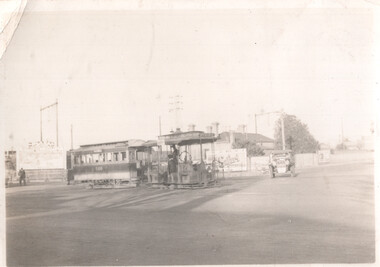
... Photograph shows car 586 in Queens Parade, Clifton Hill with the rail line and over bridge in the background. The grip mechanism has been lifted. The tram has the destination of Spencer St. ...Photograph shows car 586 in Queens Parade, Clifton Hill with the rail line and over bridge in the background. The grip mechanism has been lifted. The tram has the destination of Spencer St. ...Photograph shows car 586 in Queens Parade, Clifton Hill with the rail line and over bridge in the background. The grip mechanism has been lifted. The tram has the destination of Spencer St. Same handwriting as that of Frank Shennen though it may not be his photograph. Yields information about Clifton Hill cable tram depot and tram 586.Black and white photograph with notes on the rear.On rear in pencil "Car 586, possibly at Clifton Hill." Has the number "179" in pencil in top right-hand corner.tramways, cable trams, clifton hill, tram 586, clifton hill depot -
 Melbourne Tram Museum
Souvenir - Envelope, Australia Post, "Cable Tram Centenary", 1985
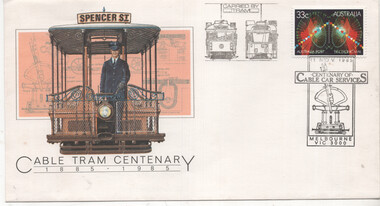
... Has two postal stamps of "carried by tram" featuring a W and Z class and a grip mechanism. On the rear has information about the cable trams. ...Has two postal stamps of "carried by tram" featuring a W and Z class and a grip mechanism. On the rear has information about the cable trams. ...Souvenir envelope printed for the "Cable Tram Centenary" 1985 featuring a MMTB gripman standing on the front of a grip or dummy with a infrastructure drawing behind. Has two postal stamps of "carried by tram" featuring a W and Z class and a grip mechanism. On the rear has information about the cable trams. Produced by Australia Post.Yields information about the centenary of cable trams exhibition and an item produced for it.Envelope with a 33c Australian stamp printed.cable trams, centenary, australia post, envelopes -
 Melbourne Tram Museum
Photograph - Black and White - cable cars parked at North Fitzroy depot, Melbourne & Metropolitan Tramways Board (MMTB), 1940
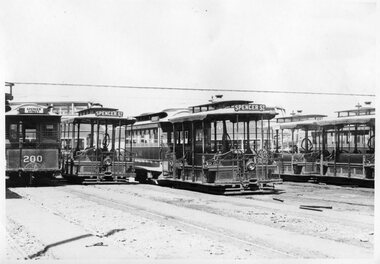
... The photograph shows a number of grip cars (dummies with their grip mechanisms lifted) and trailers (Nos. 200 and 512) stored or parked in the open at North Fitzroy depot at about the time of closure of the cable tram system on 26 Oct. 1940. ...The photograph shows a number of grip cars (dummies with their grip mechanisms lifted) and trailers (Nos. 200 and 512) stored or parked in the open at North Fitzroy depot at about the time of closure of the cable tram system on 26 Oct. 1940. ...The photograph shows a number of grip cars (dummies with their grip mechanisms lifted) and trailers (Nos. 200 and 512) stored or parked in the open at North Fitzroy depot at about the time of closure of the cable tram system on 26 Oct. 1940. At least three double decker buses are in the background. . This Photo is included in the poster - The Passing of the Melbourne Cable tramways - See Reg Item 6367Yields information about cable trams or cars.Photograph - Black and White - cable cars parked at North Fitzroy depottramways, trams, cable trams, north fitzroy, mmtb, buses, mmtb buses, north fitzroy depot, td5c class, double deck buses -
 Melbourne Tram Museum
Photograph - Black & White Photograph/s, c1900?
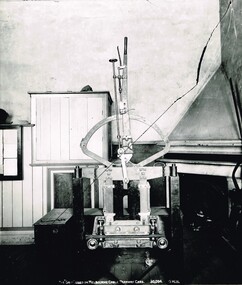
... Black and White Photograph of the cable tram Grip mechanism with a piece of cable on a stand in a workshop environment. ...Trams tramways Cable Trams Grip Tram Workshops Cables On rear in pencil "A 2199" Black and White Photograph of the cable tram Grip mechanism with a piece of cable on a stand in a workshop environment. ...Black and White Photograph of the cable tram Grip mechanism with a piece of cable on a stand in a workshop environment. Has a spanner on a wooden cabinet, that may have allowed a person to stand on and work or test the mechanism. Shows the trip in detail. Photographed onto a glass plate with the words "The 'Grip" used on Melbourne cable tramway cars 30,094 GWW" Printed on Ilford Paper.On rear in pencil "A 2199"trams, tramways, cable trams, grip tram, workshops, cables -
 Melbourne Tram Museum
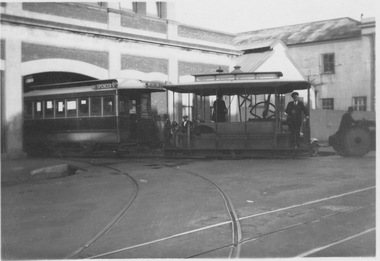
Photograph - Cable tram leaving the Nicholson Street car house, 1930s
... Cable tram sets were moved onto Nicholson Street from the car house using horses or tractors. The grip mechanism sat high on the dummy floor when in the car house and was only lowered into the cable tunnel only when the tram was on the street. ...Cable tram sets were moved onto Nicholson Street from the car house using horses or tractors. The grip mechanism sat high on the dummy floor when in the car house and was only lowered into the cable tunnel only when the tram was on the street. ...Cable tram sets were moved onto Nicholson Street from the car house using horses or tractors. The grip mechanism sat high on the dummy floor when in the car house and was only lowered into the cable tunnel only when the tram was on the street. Here the gripman and conductor are standing in the dummy in their M&MTB issued uniforms. The car house with upstairs offices has a brick facade. The double storey corruguted iron building in the background is the tram construction factory and workshop. Yields information about Nicholson Street car houseBlack and white photograph with no note on rearcable tram sets, car house, tractors, horses, the grip, dummy floor, gripman, conductor, m&mtb issued uniforms, brick facade, corruguted iron building, tram construction factory, workshop, nicholson street -
 Melbourne Tram Museum
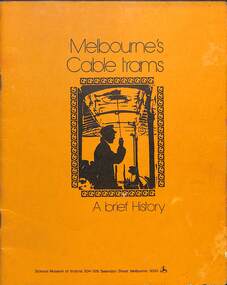
Book, Science Museum, "Melbourne's Cable Trams - A brief history", 1975
... Includes details of the engine houses, the cable, the grip mechanism, the ticket bell punch, and why "Mind the Curve". ...Includes details of the engine houses, the cable, the grip mechanism, the ticket bell punch, and why "Mind the Curve". ...Book produced by the Science Museum provides a brief history of the cable tram system, with photos. Includes details of the engine houses, the cable, the grip mechanism, the ticket bell punch, and why "Mind the Curve". Has a list of acknowledgments. Published shortly after or at the time of the launch of the tram in the enclosure in Russell St. The additional sheet with the book provides details for each route of route, the location of the city terminus, suburban terminus, running time, night light, route length, first and last car for each day of the week. Not known who compiled the sheet.Demonstrates the work of the Science Museum - now Scienceworks.Book - 16 pages + card cover +postcard of cable tram set No. 1 at the Science Museum 1975. Inside the book is a ruled sheet of paper with details of the cable tram routes, handmade with ink.tramways, cable trams, science museum, melbourne -
 Melbourne Tram Museum
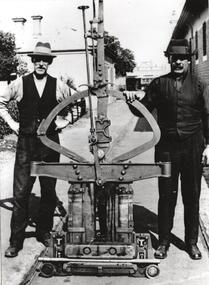
Photograph - Black & White Photograph/s, Melbourne Tramway & Omnibus Co. Limited, c1900?
... Black and white photograph of a cable tram grip mechanism showing the height of the item with two men alongside. ...Trams tramways Cable Trams Grip Tram gripmen Has Department of Infrastructure copy right stamp on rear and number "H 173" in ink on rear and "1-16" Black and white photograph of a cable tram grip mechanism showing the height of the item with two men alongside. ...Black and white photograph of a cable tram grip mechanism showing the height of the item with two men alongside. Shows the detail and has a section of cable in the jaw of the grip. Photo from the Collection of the Department of Infrastructure now with the Public Records Office - image number H173. Note: this photo is now out of copyright and was not an original VR photograph, but one copied from another source and collected as their Heritage series.Has Department of Infrastructure copy right stamp on rear and number "H 173" in ink on rear and "1-16"trams, tramways, cable trams, grip tram, gripmen -
 Melbourne Tram Museum
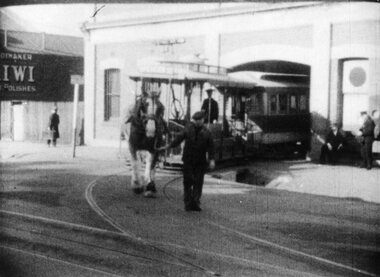
Photograph - Black & White Photograph/s, Tramway Museum Society of Victoria (TMSV), c1938
... Note the large drainage pit on the gutter and that the grip mechanism has been lifted out plus the Bundy clock on the depot wall. ...Note the large drainage pit on the gutter and that the grip mechanism has been lifted out plus the Bundy clock on the depot wall. ...Black & White Photograph by the TMSV Sales of a cable car set being hauled out of the North Fitzroy depot, Nicholson St, c1938 by a horse. Normally a tractor was used for this purpose. Note the large drainage pit on the gutter and that the grip mechanism has been lifted out plus the Bundy clock on the depot wall. Photo print was printed backwards - image i2 has been corrected. Image has been reproduced from a movie - Commuting by Cable?Has the TMSV Sales stamp on rear and "1938" on the rear in pencil.trams, tramways, cable trams, grip tram, nicholson st, north fitzroy, bundy clock -
 Melbourne Tram Museum
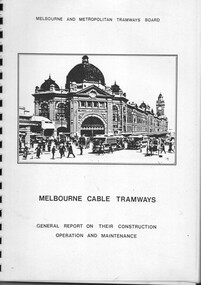
Document - Report, I. Macmeikan, Melbourne and Metropolitan Tramways Board, "Melbourne Cable Tramways - General Report on their Construction Operation and Maintenance", mid 1950's?
... Has details of the construction of the system, car depots, car workings and maintenance, power houses or winding houses or engine houses, route colours, parts for the trams, grip mechanisms and its operations including the actual calculations for their operation. ...Has details of the construction of the system, car depots, car workings and maintenance, power houses or winding houses or engine houses, route colours, parts for the trams, grip mechanisms and its operations including the actual calculations for their operation. ...Report - 114 pages, photocopied from an original, black comb bound with front clear plastic cover and rear mania cover titled "Melbourne Cable Tramways - General Report on their Construction Operation and Maintenance", prepared by I. Macmeikan - Assistant Superintendent Cable workshops 1920 - 1930 and Manager Preston Workshops 1951 - 1956. Has details of the construction of the system, car depots, car workings and maintenance, power houses or winding houses or engine houses, route colours, parts for the trams, grip mechanisms and its operations including the actual calculations for their operation. Published by the MMTB.trams, tramways, cable trams, mmtb, grip tram, winding houses, operations -
 Whitehorse Historical Society Inc.
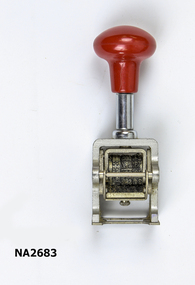
Equipment - Date Stamp, 1960 - 1970
... Steel parts with a red plastic grip. Push down mechanism to stamp date and to change numbers. ...Steel parts with a red plastic grip. Push down mechanism to stamp date and to change numbers. ...A mechanical date stamp made by VELOS. Steel parts with a red plastic grip. Push down mechanism to stamp date and to change numbers. Has a self inking pad.On side - 444 Velos and a trade mark|on base Made in Englandcommerce, office equipment / stationery -
 National Vietnam Veterans Museum (NVVM)
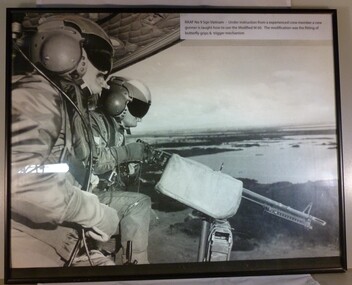
Photograph - A Framed Black and White Photograph of RAAF No 9 Sqn, Vietnam, 1966-1971
... The modification was the fitting of butterfly grips & trigger mechanism....The modification was the fitting of butterfly grips & trigger mechanism. Photograph A Framed Black and White Photograph of RAAF No 9 Sqn, Vietnam ...Black and white framed photograph showing two RAAF personal in a helicopter. The one of the left is looking towards the one of the right who is under instructions. There is a note top right corner which reads RAAF No 9 Sqn Vietnam - Under instruction from a experienced crew member a new gunner is taught how to use the Modified M 60. The modification was the fitting of butterfly grips & trigger mechanism.gunner, m60 machine gun, no 9 squadron, raaf -
 Flagstaff Hill Maritime Museum and Village
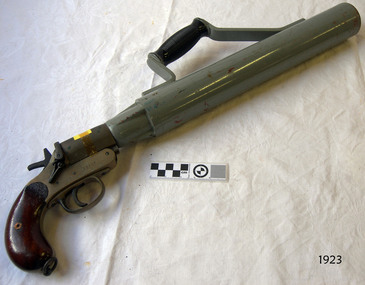
Equipment - Line throwing pistol, 1925-1945
... This line throwing pistol has a wooden pistol grip, brass trigger mechanism, and a long, wide, steel barrel with Bakelite handle attached to the top. ...This line throwing pistol has a wooden pistol grip, brass trigger mechanism, and a long, wide, steel barrel with Bakelite handle attached to the top. ...This is a SPRA, or Schermuly’s Pistol Rocket Apparatus. The large firearm type pistol would have been used to throw a line between ships, usually in the event of saving lives. The line throwing pistol consists of a long barrel with handle attached, a pistol grip and trigger, which fires a short blank cartridge. Accessories for the pistol included: flares, 12 gauge adaptor (to shoot 12 gauge flares), a wood plunger, and boxes of faked line. The stamp on the handle, Crown over "NP" is a Birmingham Proof House mark that dates the pistol between 1904 and 1954. However Schermuly's line throwing pistol was invented in the 192s and used on British Naval Ships from 1929. The serial number '22507' is only 806 numbers later than one on sale as a British Military WWII issue SRPA '21701'. This pistol appears to be made 125-1945. The apparatus was used as a life saving device for crew and passengers on vessels in distress that were only a few hundred metres from shore, often eliminating the need to launch a boat and risk lives to go out to the vessel in dangerous conditions. It could also be used from ship to ship rescue. The pistol would launch a line from shore to the vessel. The line would be attached to the vessel, then shore crew would send out equipment, including a breeches buoy, in which the stranded people could be pulled to shore. It has saved many lives at sea. The cartridge is loaded into the breech of the pistol and the rocket is inserted into the muzzle. On pulling the trigger, the gases generated by the fired cartridge eject the rocket on its correct line of flight, and at the same time, burst through the waterproof disc and ignite the propellant mixture, which carries the rocket and line on the remainder of the flight. The rocket consists of a weldless steel case filled with propellant mixture sealed in by a waterproof disc. Fixed to the rocket case is a direction bridle, to the end of which a short length of flexible steel wire is attached, this in turn being connected to the end of the line to be thrown. A complete rocket set, or line throwing kit. would include a wood carrying case, two coils of faked line in separate compartments, three rockets and a can of six cartridges. William Schermuly (1857 – 1929) - Founder of the Schermuly business. In 1897 he invented a trough-fired, line throwing apparatus. In 1920 he and his third son, Alfred James Schermuly, invented the pistol rocket apparatus and promoted this overseas during the 1920s. The system was approved by the British Navy in 1929 through an Act of Parliament, which made it compulsory for ships over 500 tons to carry this equipment. The company, Schermuly Pistol Rocket Apparatus Ltd., grew quickly during and after World War II but business eased off during the 1970s before it eventually closed in the 1990s. Saving lives in Warrnambool – The coastline of South West Victoria is the site of over 600 shipwrecks and many lost lives; even in Warrnambool’s Lady Bay there were around 16 known shipwrecks between 1850 and 1905, with eight lives lost. Victoria’s Government responded to the need for lifesaving equipment and, in 1858, the provision of rocket and mortar apparatus was approved for the lifeboat stations. In 1859 the first Government-built lifeboat arrived at Warrnambool Harbour and a shed was soon built for it on the Tramway Jetty, followed by a rocket house in 1864 to safely store the rocket rescue equipment. In 1878 the buildings were moved to the Breakwater (constructed from 1874-1890), and in 1910 the new Lifeboat Warrnambool arrived with its ‘self-righting’ design. For almost a hundred years the lifesaving and rescue crews, mostly local volunteers, trained regularly to rehearse and maintain their rescue skills. They were summoned when needed by alarms, gunshots, ringing bells and foghorns. In July 1873 a brass bell was erected at Flagstaff Hill specifically to call the rescue crew upon news of a shipwreck. Some crew members became local heroes but all served an important role. Rocket apparatus was used as recently as the 1950s. This line-throwing pistol is part of he Rocket Launching Equipment used to perform life-saving rescue at sea from the 1920s. It is significant for its connection with local history, maritime history and marine technology. Lifesaving has been an important part of the services performed from Warrnambool's very early days, supported by State and Local Government, and based on the methods and experience of Great Britain. Hundreds of shipwrecks along the coast are evidence of the rough weather and rugged coastline. Ordinary citizens, the Harbour employees, and the volunteer boat and rescue crew, saved lives in adverse circumstances. Some were recognised as heroes, others went unrecognised. In Lady Bay, Warrnambool, there were around 16 known shipwrecks between 1850 and 1905. Many lives were saved but tragically, eight lives were lost.Pistol, line-throwing, SPRA (Schermuly's Pistol Rocket Apparatus). This line throwing pistol has a wooden pistol grip, brass trigger mechanism, and a long, wide, steel barrel with Bakelite handle attached to the top. Inscriptions are stamped onto the pistol.Stamped on handle: "5" and "[symbol of a Crown] above NP" , "22507", "[within oval] SPRA" Stamped on barrel: "L22507".gun, pistol, flagstaff hill, warrnambool, shipwrecked coast, flagstaff hill maritime museum, maritime museum, flagstaff hill maritime village, great ocean road, line throwing, line throwing pistol, spra, schermuly's pistol rocket apparatus, sea rescue, pyrotechnicks, marine technology, schermuly pistol rocket apparatus ltd., william schermuly, alfred schermuly, pistol line thrower, flagstaff hill maritime museum and village, maritime village, lady bay, warrnambool harbour, port of warrnambool, shipwreck, life-saving, lifesaving, rescue crew, rescue, rocket rescue, rocket crew, beach rescue, line rescue, rescue equipment, rocket firing equipment, rocket rescue equipment, maritime accidents, shipwreck victim, rocket equipment, rescue boat, lifeboat, volunteer lifesavers, volunteer crew, life saving rescue crew, lifesaving rescue crew, rocket apparatus, rocket rescue method, shore to ship, rocket apparatus rescue, stranded vessel, line throwing mortar, rocket rescue apparatus, line thrower, lifeboat warrnambool, rocket machine, rocket head, rocket launcher, rocket line, beach rescue set, rocket set, schermuly, line-firing pistol, line throwing gun, pistol rocket apparatus, line throwing cartridge, line-throwing rocket, firearm, life saving, lsrc -
 Melbourne Tram Museum
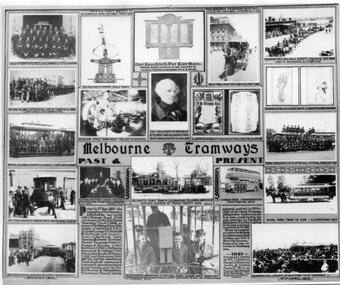
Photograph - Black and White, Melbourne & Metropolitan Tramways Board (MMTB), "Melbourne Tramways Past & Present", 1943
... "Melbourne Tramways Past & Present" - set of photos, drawings and notes of (Left to Right, Top to Bottom), Cable tram Richmond Depot employees 1909, Grip mechanism, Photo of the WW1 Honour Board, a horse cab carrying revenue to a bank, Transporting a cable by horse, installing cable to the Windsor line by T Warr & Co 1891, Nicholson St Power House interior, Chief Magistrate of Port Phillip settlement 1836 to 1939 who lived in a house now occupied by Head Office Building, illuminated address to F B Clapp, retirement 1916, drawings by Hal Gye & David Low of J G Roberts Cable Manager, Official & Clerical Staff at Clifton Hill - last line to operate, Depot Employees at Clifton Hill at Final Stage Oct 1940, No. 1 tram becomes Museum piece for National Museum, Australias First Conductresses Aug 1941, Instructor G S Boardman, Decorated peace tram in celebration following armistice 1919, Double deck bus with Conductresses, Royal Park Zoo tram, Openings of PMTT 1910, text box history of the bodies that formed the MMTB, Peter Henry ABC Broadcaster 3-7-1940 on a cable tram, and opening of HTT in 1916. ..."Melbourne Tramways Past & Present" - set of photos, drawings and notes of (Left to Right, Top to Bottom), Cable tram Richmond Depot employees 1909, Grip mechanism, Photo of the WW1 Honour Board, a horse cab carrying revenue to a bank, Transporting a cable by horse, installing cable to the Windsor line by T Warr & Co 1891, Nicholson St Power House interior, Chief Magistrate of Port Phillip settlement 1836 to 1939 who lived in a house now occupied by Head Office Building, illuminated address to F B Clapp, retirement 1916, drawings by Hal Gye & David Low of J G Roberts Cable Manager, Official & Clerical Staff at Clifton Hill - last line to operate, Depot Employees at Clifton Hill at Final Stage Oct 1940, No. 1 tram becomes Museum piece for National Museum, Australias First Conductresses Aug 1941, Instructor G S Boardman, Decorated peace tram in celebration following armistice 1919, Double deck bus with Conductresses, Royal Park Zoo tram, Openings of PMTT 1910, text box history of the bodies that formed the MMTB, Peter Henry ABC Broadcaster 3-7-1940 on a cable tram, and opening of HTT in 1916. ..."Melbourne Tramways Past & Present" - set of photos, drawings and notes of (Left to Right, Top to Bottom), Cable tram Richmond Depot employees 1909, Grip mechanism, Photo of the WW1 Honour Board, a horse cab carrying revenue to a bank, Transporting a cable by horse, installing cable to the Windsor line by T Warr & Co 1891, Nicholson St Power House interior, Chief Magistrate of Port Phillip settlement 1836 to 1939 who lived in a house now occupied by Head Office Building, illuminated address to F B Clapp, retirement 1916, drawings by Hal Gye & David Low of J G Roberts Cable Manager, Official & Clerical Staff at Clifton Hill - last line to operate, Depot Employees at Clifton Hill at Final Stage Oct 1940, No. 1 tram becomes Museum piece for National Museum, Australias First Conductresses Aug 1941, Instructor G S Boardman, Decorated peace tram in celebration following armistice 1919, Double deck bus with Conductresses, Royal Park Zoo tram, Openings of PMTT 1910, text box history of the bodies that formed the MMTB, Peter Henry ABC Broadcaster 3-7-1940 on a cable tram, and opening of HTT in 1916. Original poster prepared by the MMTB in 1943 See Reg Item 2854 for a framed photograph and 6367 for another poster of the time - Melbourne tramways past and present poster. See Reg Items 6358, 6122, 6121, 6354 and 6774 for individual photographs.Yields information about the Melbourne tram system and its history to 1943Photograph - of a MMTB Poster titled "Melbourne Tramways Past & Present"tramways, trams, cable trams, richmond, honour board, cash transport, cable ropes, clifton hill, nicholson st, winding house, f b clapp, conductresses, peace tram, double deck buses, zoo horse tram, pmtt, htt, abc -
 Federation University Historical Collection
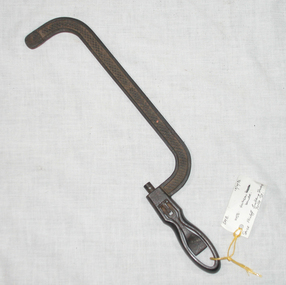
Hacksaw Frame
... Hand-held hacksaws consist of a metal arch with a handle, usually a pistol grip, and pins for attaching a narrow disposable blade. A screw or other mechanism is used to put the thin blade under tension. ...Hand-held hacksaws consist of a metal arch with a handle, usually a pistol grip, and pins for attaching a narrow disposable blade. A screw or other mechanism is used to put the thin blade under tension. ...A hacksaw is a fine-tooth saw with a blade held under tension by a frame. It is used for cutting materials such as metal or plastics. Hand-held hacksaws consist of a metal arch with a handle, usually a pistol grip, and pins for attaching a narrow disposable blade. A screw or other mechanism is used to put the thin blade under tension. The blade can be mounted with the teeth facing toward or away from the handle, resulting in cutting action on either the push or pull stroke. On the push stroke, the arch flexes slightly, decreasing the tension on the blade.Steel frame for blade. adjustment lever in handle.Dimpled feature on curved sectionhacksaw, tool, ballarat school of mines, trade, cutting, metal, plastics -
 Orbost & District Historical Society
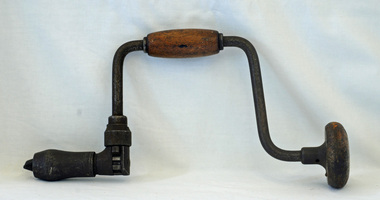
ratchet brace, first half 20th century
... A metal ratchet brace with a wooden handle grip. It has a hinged mechanism device which fits into the notches of the ratchet wheel - a pawl...mechanism - a hinged or pivoted device adapted to fit into a notch of a ratchet wheel to impart forward motion or prevent backward motion. This item would have been used on a rural property in constructing or maintaining infrastructure. This item is an example of a woodworking tool used in the first half of the 20th century prior to the widespread use of power tools. A metal ratchet brace with a wooden handle grip ...This carpenter's clamp would have been used in confined spaces where a full turn of the brace cannot be achieved. It is fitted with a pawl mechanism - a hinged or pivoted device adapted to fit into a notch of a ratchet wheel to impart forward motion or prevent backward motion. This item would have been used on a rural property in constructing or maintaining infrastructure. This item is an example of a woodworking tool used in the first half of the 20th century prior to the widespread use of power tools. A metal ratchet brace with a wooden handle grip. It has a hinged mechanism device which fits into the notches of the ratchet wheel - a pawl -
 Cheese World Museum
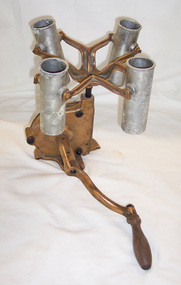
Centrifuge, manual, c1890
... mechanism to farmers. This test also provided a means for farmers to identify poor performing cows and upgrade the quality of their herd and subsequent milk supply to the factory. Allansford dairy farming dairy industry dairy processors Babcock test OFFICIAL BABCOCK TESTER Four tipping metal testing tubes which revolve on a brass base. A winding handle has a wooden grip ...The Uebergang family came from Silesia to Australia in 1848 and were early settlers in the Allansford area. The sons and other descendants also purchased farms in the area. The Percy Uebergang family lived at Tooram Park, Allansford from 1912 until 1992. Percy and Myrtle Uebergang's children were twins, Ray and Joyce born in 1926 who lived at Tooram Park until their deaths, Ray in 1986 and Joyce in 1992 after which the property was sold. Neither Ray nor Joyce married and following the death of her brother Joyce set up the Ray and Joyce Uebergang Foundation which supports the local community. The collection of items from their property was put into store for a number of years before being given into the care of the Cheese World Museum. The family often re-used, recycled and repaired items and examples can be seen in the museum. This Babcock tester is part of the collection of items given into the care of the Cheese World Museum. The Babcock tester was used to determine the butter fat content in milk. Prior to the use of the Babcock test farmers were paid on volume and milk was sometimes watered down to increase the supply to the factory. Once the Babcock test was introduced it provided a consistent means of paying farmers for milk supplied to the factory. The Babcock tester is significant as a scientific means of testing fat content of milk and the subsequent consistent payment mechanism to farmers. This test also provided a means for farmers to identify poor performing cows and upgrade the quality of their herd and subsequent milk supply to the factory.Four tipping metal testing tubes which revolve on a brass base. A winding handle has a wooden grip. The base and arms holding the metal tubes is painted red.OFFICIAL BABCOCK TESTERallansford, dairy farming, dairy industry, dairy processors, babcock test -
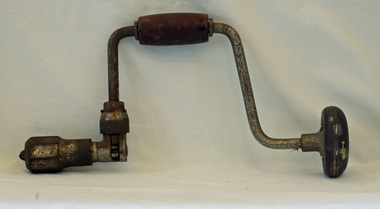 Orbost & District Historical Society
ratchet brace, first half 20th century
... A metal ratchet brace with a wooden handle grip. It has a hinged mechanism device which fits into the notches of the ratchet wheel - a pawl....mechanism - a hinged or pivoted device adapted to fit into a notch of a ratchet wheel to impart forward motion or prevent backward motion. This item would have been used on a rural property in constructing or maintaining infrastructure. This item is an example of a woodworking tool used in the first half of the 20th century prior to the widespread use of power tools. woodwork tools brace-ratchet A metal ratchet brace with a wooden handle grip. ...This carpenter's clamp would have been used in confined spaces where a full turn of the brace cannot be achieved. It is fitted with a pawl mechanism - a hinged or pivoted device adapted to fit into a notch of a ratchet wheel to impart forward motion or prevent backward motion. This item would have been used on a rural property in constructing or maintaining infrastructure.This item is an example of a woodworking tool used in the first half of the 20th century prior to the widespread use of power tools.A metal ratchet brace with a wooden handle grip. It has a hinged mechanism device which fits into the notches of the ratchet wheel - a pawl.woodwork tools brace-ratchet -
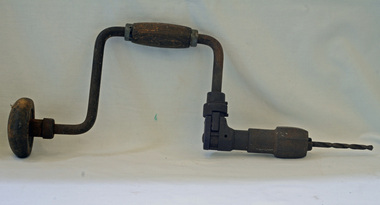 Orbost & District Historical Society
brace and bit, first half 20th century
... A metal ratchet brace with a wooden handle grip. It has a hinged mechanism device which fits into the notches of the ratchet wheel - a pawl. ...mechanism - a hinged or pivoted device adapted to fit into a notch of a ratchet wheel to impart forward motion or prevent backward motion. This item would have been used on a rural property in constructing or maintaining infrastructure. This item is an example of a woodworking tool used in the first half of the 20th century prior to the widespread use of power tools. woodworking tool brace-and-bit carpentry A metal ratchet brace with a wooden handle grip. ...This carpenter's clamp would have been used in confined spaces where a full turn of the brace cannot be achieved. It is fitted with a pawl mechanism - a hinged or pivoted device adapted to fit into a notch of a ratchet wheel to impart forward motion or prevent backward motion. This item would have been used on a rural property in constructing or maintaining infrastructure.This item is an example of a woodworking tool used in the first half of the 20th century prior to the widespread use of power tools.A metal ratchet brace with a wooden handle grip. It has a hinged mechanism device which fits into the notches of the ratchet wheel - a pawl. The drill bit is jammed and the chuck is rusted.woodworking tool brace-and-bit carpentry -
Kiewa Valley Historical Society
Camera Case for Box Brownie, Circa mid to late 1900s
... Though it may take more time for cities and larger towns to come to grips with a growing aged population, rural areas(because these will define more clearly any imbalance of population) present the first demonstrative change to Australia, and world wide, a population based phenomenon. camera case photography hobby personal equipment Pressed into the underbelly of the semicircular closing mechanism is"PAT. ...When this leather case was made it was the only material available that not only looked fashionable but also was able to absorb any small knocks or scratches which may happen to the mobile but still delicate camera. Digitalisation of photographic equipment for non professional use brought with it a reduction in camera size (pocket), increased portability and the dispensing of thick leather cases. With the increase of camera functions on mobile telephones, the need by tourists and the general public for a dedicated camera is rapidly diminishing. The protective leather wrapping for expensive, professional goods, especially electronics is very rare and foam padded aluminium bags and containers are the preferred mode for travel.This particular leather case has travelled to and from England via an ocean cruise by a now retired couple living in the Kiewa Valley. It is significant to this region because it underlines the slow transition from a purely farming, grazing, mining and tourist region to an area opening up to a specific socio-economical structure for retirees. This social and demographic shift by retirees will produce a greater need for changes in facilities required by an increasing aged population. Though it may take more time for cities and larger towns to come to grips with a growing aged population, rural areas(because these will define more clearly any imbalance of population) present the first demonstrative change to Australia, and world wide, a population based phenomenon.This item is a brown coloured leather camera case (Box Brownie Six-20) with an adjustable strap and associated buckle. The leather has been moulded to the shape of the camera and is slightly tapered as a closing flap fastened at the front with a lockable clasp. The end of the leather flap has a metal(tin) with a semi circular ring formed to allow it to be held as part of the clasp. Pressed into the underbelly of the semicircular closing mechanism is"PAT. APPLIED FOR" and underneath this"MADE IN ENGLAND" camera, case photography, hobby, personal equipment -
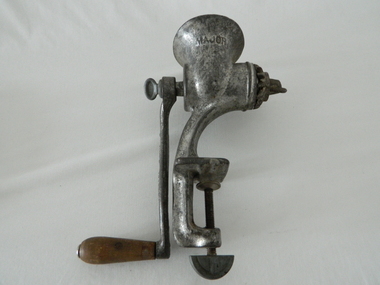 Kiewa Valley Historical Society
Mincer Meat, mid 1960's
... mechanism to mince and express solid pieces of meat at the other end. There is a clamp below the main structure which permits the fastening of the hand driven mincer to a table or solid ledge. The hand grip...mechanism to mince and express solid pieces of meat at the other end. There is a clamp below the main structure which permits the fastening of the hand driven mincer to a table or solid ledge. The hand grip ...This meat mincer was born in a period where hand operated mincing and blending machines were only available for household mincing meats and blending ingredients up to the 1960's. Electrical kitchen based whitegoods were rare in areas where the connection to electricity was intermittent or not at all.This kitchen aid is a very significant item in the Kiewa Valley before suitable electrically operated mincers became available and constant reliable electrical connections were installed. The Kiewa Hydro Electricity Scheme provide the stable supply of electricity which made most of the hand operated mincing machines obsolete. However large mincers for bulk supplies were still required eg. kitchens for SEC workers during the 50's and 60's.This heavy industrial type meat mincer(cast iron) has a top "rounded feeder cup" with a mincer screw blade at the bottom. A winder handle rotates the screw like mechanism to mince and express solid pieces of meat at the other end. There is a clamp below the main structure which permits the fastening of the hand driven mincer to a table or solid ledge. The hand grip of the handle is made from wood and fashioned like a clothes peg.On the rounded feeder bowl "MAJOR" and on the winder handle "A POPE PRODUCT"hand operated meat mincers, meat grinders, kitchen utensils -
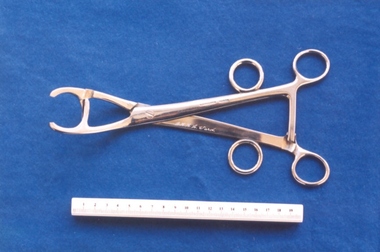 Royal Australian and New Zealand College of Obstetricians & Gynaecologists (RANZCOG)
Tool - Bonney's myomectomy clamp used by Box Hill Hospital labour ward, Down Bros., London
... Scissor type instrument with two sets of finger grips and a locking ratchet mechanism. The blades close to form two apertures which can be selectively decreased in size....Scissor type instrument with two sets of finger grips and a locking ratchet mechanism. The blades close to form two apertures which can be selectively decreased in size. ...Victor Bonney (1872- 1953) was a gifted and innovative surgeon. One of Bonney’s most notable achievements was his development of a successful procedure for myomectomy. After his wife developed fibroids and had her uterus removed early in their marriage, Bonney took a great interest in the practice of conservatism in surgery. Prior to Bonney, myomectomy “had fallen into disuse because of excessive blood loss during the operating and the infections that commonly followed” (Chamberlain, 'The master of myomectomy') , but Bonney saw an opportunity to revolutionise this practice. In his words: “I set myself to make myomectomy so feasible, successful and safe as to render it a fair alternative to hysterectomy in every case… Excepting only in a very few instances… I have succeeded, and now enter the operating theatre free of the trammels which at one time too often compelled my hand against my heart.” (Bonney, 'The fruits of conversatism') Bonney’s crucial innovation was the development of a new surgical clamp, an instrument which is now referred to as Bonney’s myomectomy clamp. The clamp was ingeniously designed to cut off blood supply to the uterus by compressing the uterine arteries, immediately reducing the excessive blood loss which had previously been associated with the procedure. Although technological advances mean that these are now seldom used, Bonney’s success with this procedure was such that his clamps were regularly used for myomectomy procedures for decades after his death. This instrument was included with other obstetric instruments, mostly destructive instruments, given to RANZCOG from Box Hill Hospital labour ward in February- March 1998. The maternity service at Box Hill Hospital combined with St George's Hospital in Kew to be known as Birralee Maternity Service. These instruments were collected by Julie Collette, Unit Manager, St George's Kew and given to RANZCOG Museum Curator, Susan Barnett. Stainless steel clamp. Scissor type instrument with two sets of finger grips and a locking ratchet mechanism. The blades close to form two apertures which can be selectively decreased in size."DOWN BROS LONDON STAINLESS" upper surface of RH handle; "B.H.H.L. WARD" inner surface of LH handle.surgery, obstetrics -
 Mont De Lancey
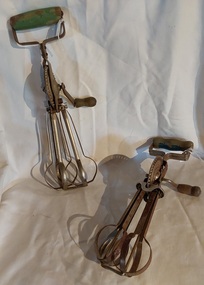
Domestic object - Hand Beaters, Propert Comany, c. 1940's
... grip at the top and a turning handle with a small green wooden knob. It has two rotating metal beaters which are attached with rivets to the handle. The medium one has a blue painted shaped wooden turned handle and a small chipped blue knob on the turning handle. It has two rotating metal beaters attached and it operates with a ball bearing mechanism...grip at the top and a turning handle with a small green wooden knob. It has two rotating metal beaters which are attached with rivets to the handle. The medium one has a blue painted shaped wooden turned handle and a small chipped blue knob on the turning handle. It has two rotating metal beaters attached and it operates with a ball bearing mechanism ...An eggbeater is a hand-held device with a crank on the side geared to one or more beaters. The user grips the handle with one hand and operates the crank with the other, creating the rotary action. A hand-turned rotary egg beater was patented by J.F. and E.P. Monroe in 1859 in the US. This egg beater patent was one of the earliest bought up by the Dover Stamping Company, whose Dover egg beaters became a classic American brand. Two hand beaters, one large, one medium. The large one has a green painted turned wooden handle to grip at the top and a turning handle with a small green wooden knob. It has two rotating metal beaters which are attached with rivets to the handle. The medium one has a blue painted shaped wooden turned handle and a small chipped blue knob on the turning handle. It has two rotating metal beaters attached and it operates with a ball bearing mechanism. They were used to mix food. An eggbeater is a hand-held device with a crank on the side geared to one or more beaters. The user grips the handle with one hand and operates the crank with the other, creating the rotary action. 1. Swift Whip. A propert product made in Australia. Patent ball Drive.' 2. 'Rapid. Made in Australia No.4'whisks, egg-beaters, kitchenware -
 Parks Victoria - Wilsons Promontory Lightstation
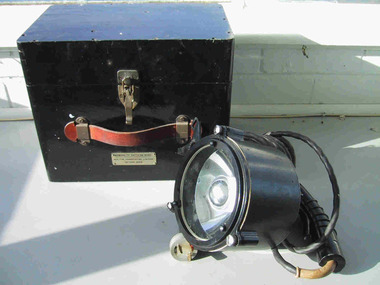
Lamp, Aldis
... mechanism and inner reflective disk used for optical communication via Morse code. The concave mirror is tilted to focus the light into pulse signals. Larger versions of the lamp are fixed on ships or pedestals and have shutters in front of the device that are opened and closed to transmit signals. Wilsons Promontory’s black metal Aldis lamp and attached electrical cord has a black painted wooden carrying case with metal clasp and leather hand grip...mechanism and inner reflective disk used for optical communication via Morse code. The concave mirror is tilted to focus the light into pulse signals. Larger versions of the lamp are fixed on ships or pedestals and have shutters in front of the device that are opened and closed to transmit signals. Wilsons Promontory’s black metal Aldis lamp and attached electrical cord has a black painted wooden carrying case with metal clasp and leather hand grip ...The lamps were pioneered by the British Navy in the late nineteenth century and introduced by the Royal Australian Navy after 1918, and continue to be used to the present day. Manufactured in 1960, the Wilsons Promontory lamp was provided to the lighthouse by the Department of Shipping for signalling ships but was also used for communicating with Cliffy Island, 18 nautical miles away. This type of lamp was renowned for its brilliant light, and lightkeepers from the two lightstations ‘used to practice their signalling with each other, as its effective use was reliant on precise positioning of the scope which is located on top of the lamp’. The inside of the case is imprinted with ‘RAN (Royal Australian Navy), and details on the lamp include a serial number, the date of 1960 and the initials of the Department of Transport, which at that time incorporated the Commonwealth Lighthouse Service. Another Aldis lamp and case with a date of 1960 is held at Cape Nelson and third lamp and case is at Point Hicks; (date unconfirmed but possibly 1943). A fourth lamp and case formerly at Cape Schanck disappeared from the collection sometime between 1995 and 2003.Aldis lamp and case (WPLS 0003.2; likely provenance) The lamps are not rare in museum collections however the Wilsons Promontory example has a confirmed provenance to the lightation and has first level contributory significance as a fine example of the Aldis lamps that were distributed to lightstations throughout Victoria and Australia.1. Handheld black signaling lantern with trigger mechanism. Glass front with inner reflective disc. Black electrical cord is attached with a two pronged plug at the end. 2. Black painted wooden box for transporting lantern. brass catch, leather handle. Grey electrical cord inside plus transformer. Hinged lid. The Aldis lamp is portable, hand held visual signalling lamp with trigger mechanism and inner reflective disk used for optical communication via Morse code. The concave mirror is tilted to focus the light into pulse signals. Larger versions of the lamp are fixed on ships or pedestals and have shutters in front of the device that are opened and closed to transmit signals. Wilsons Promontory’s black metal Aldis lamp and attached electrical cord has a black painted wooden carrying case with metal clasp and leather hand grip.1. On trigger;"AP16413" Around V shaped protrusion attached to lamp "AP197873 / AEI .LTD 59" Beneath screw on face;"AD16415" Inside lamp, under glass;"ADMIRALTY PATTERN 16409 / 5 INCH HAND SIGNALING LANTERN SERIAL No. 212 Year 1960 / AEI PTY LTD SYDNEY" •2. Box. On brass plate below handle."ADMIRALTY PATTERN 16409 / BOX FOR TRANSPORTING LANTERN / PATTERN 16409" Inside box on side of metal insert attached to inside of box;"EXTRA LOW VOLTAGE TRANSFORMER / MADE BY / M.Brodribb, Melbourne/ cat & APP / No v/QR / 1811A / 50 / 60 va / CONT. 55 c / RATIO 240, 12 V TAPS " Top of metal box on sticker;"C of A / D.O.T 143076 / 12 V 5A" On Bakelite plug on metal box;"EXTRA LOW VOLTAGE" -
 Wodonga & District Historical Society Inc
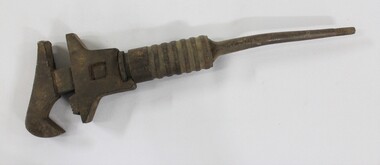
Tool - Shifter Wrench, North East Region Water Authority, Wodonga
... Large cast iron wrench with an adjustable grip and a circular turning mechanism at the top of a thin tapering handle. 2.6 cm thread on the end of the thin tapering handle. ...Large cast iron wrench with an adjustable grip and a circular turning mechanism at the top of a thin tapering handle. 2.6 cm thread on the end of the thin tapering handle. ...The Shifter Wrench was used by the Wodonga Waterworks Trust and Sewerage Authority, which were established in 1897, and had the responsibility for providing Wodonga's drinking water and managing the wastewater. In 1923 a Wodonga Waterworks Trust referendum to provide funding for new infrastructure to supply more water of better quality to Wodonga was passed. This included building the Wodonga Water Tower and it was completed in 1924. It supplied water to Wodonga until 1959, when it was drained and decommissioned after the No 1 Basin on Huon Hill was completed in 1958. In 1983 the Wodonga Waterworks Trust and the Wodonga Sewerage Authority became part of the Wodonga Council. And by 1989 a filtration plant at Huon Hill was completed, which provided filtered water of improved quality to Wodonga, in accordance with the World Health Organisation’s guidelines. In 1994 the Kiewa Murray Region Water Authority took over the Wodonga Council’s water and wastewater operations, and then in 1999 the Kiewa Murray Region Water Authority combined with the Ovens Region Water Authority and became the North East Region Water Authority or NERWA. NERWA then became known as North East Water. The shifter wrench has local significance due to its use by the Wodonga Waterworks Trust and Sewerage Authority, and donation from the North East Region Water Authority. It also has wider historical significance as an example of the equipment used in the early management of water in Victoria and Australia.Large cast iron wrench with an adjustable grip and a circular turning mechanism at the top of a thin tapering handle. 2.6 cm thread on the end of the thin tapering handle. "GSP 23/15" on one side of the thin tapering handle.north east region water authority, nerwa, wodonga sewerage authority, north east water, n.e. water, wodonga, shifter wrench, wodonga waterworks trust -
 Melbourne Tram Museum
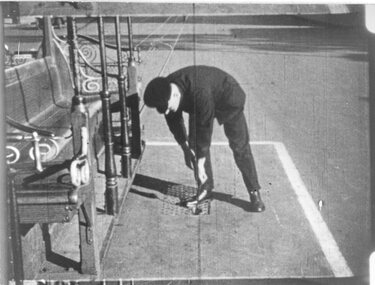
Photograph - Set of 5 Black & White Photograph/s, Cable tram operations
... grip car. Marked on rear as "Lonsdale St" .2 - worker in a cable pulley maintenance pit oiling the mechanism - note the other pits. ...grip car. Marked on rear as "Lonsdale St" .2 - worker in a cable pulley maintenance pit oiling the mechanism - note the other pits. ...1 - employee with a uniform cap - could be a shunter - lifting the cable into the adjacent grip car. Marked on rear as "Lonsdale St" .2 - worker in a cable pulley maintenance pit oiling the mechanism - note the other pits. Has put a "Danger" sing out on the roadway. Marked on rear "Bourke and Spring St 1938" Two copies held and one digital image from a scene shot. .3 - a worker watching the cable entering a winding house looking for damage - what a boring job! Marked on rear as "Checking cables 1938" .4 - communications pillar - or box - to communicate with the winding house .5 - photos shows the grip in the roadway Images have been reproduced from a movie - Commuting by Cable?Yields information of the cable tram operations c1938.Series of five Black & White Photographs by the TMSV Sales and one digital image from Commuting by Cable. Has the TMSV Sales stamp on rear with some notes in pencil on the rear as shown above.trams, tramways, cable trams, grip tram, cables, winding house
