
Showing 315 items matching "hardy> a."
-
 Phillip Island and District Historical Society Inc.
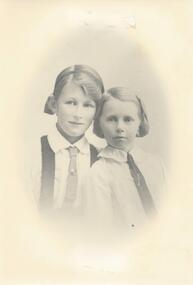
Photograph, McHaffie Family, Late 1800's / Early 1900's
... oonah & brenda hardy...Oonah (b 1906) and Brenda (b 1912) Hardy, both daughters of Douglas Hardy and Anna Frances McHaffie (daughter of John David McHaffie - first permanent European settler of Phillip Island). ...Black & White photograph of Oonah & Brenda Hardy in what looks like school uniforms....On back: Oonah and Brenda Hardy...One of 4 photos donated by Nancy McHaffie. oonah & brenda hardy n mchaffie mchaffie family On back: Oonah and Brenda Hardy Black & White photograph of Oonah & Brenda Hardy in what looks like school uniforms. ...Oonah (b 1906) and Brenda (b 1912) Hardy, both daughters of Douglas Hardy and Anna Frances McHaffie (daughter of John David McHaffie - first permanent European settler of Phillip Island). Oonah, the taller girl, is on the left. One of 4 photos donated by Nancy McHaffie.Black & White photograph of Oonah & Brenda Hardy in what looks like school uniforms.On back: Oonah and Brenda Hardyoonah & brenda hardy, n mchaffie, mchaffie family -
 Uniting Church Archives - Synod of Victoria
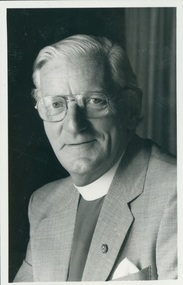
BW glossy photo, 1980
... Reverend Dr Graham Hardy; Scotland at Alyth Perthshire, Edinburgh Palmerston Place and St Stephen's NSW between 1967 and 1987,...Reverend Dr Graham Hardy was ordained in 1948 and served in Scotland at Alyth Perthshire, Edinburgh Palmerston Place and St Stephen's NSW between 1967 and 1987, ...Head and shoulders portrait of the Rev. Graham W. Hardy...Rev Graham W Hardy, Moderator, Uniting Church in Australia, NSW 1980-81; Parish minister St Stephen's Macquarie Street Sydney 1967-. ...Reverend Dr Graham Hardy was ordained in 1948 and served in Scotland at Alyth Perthshire, Edinburgh Palmerston Place and St Stephen's NSW between 1967 and 1987, Reverend Dr Graham Hardy; Scotland at Alyth Perthshire, Edinburgh Palmerston Place and St Stephen's NSW between 1967 and 1987, Rev Graham W Hardy, Moderator, Uniting Church in Australia, NSW 1980-81; Parish minister St Stephen's Macquarie Street Sydney 1967-. ...Reverend Dr Graham Hardy was ordained in 1948 and served in Scotland at Alyth Perthshire, Edinburgh Palmerston Place and St Stephen's NSW between 1967 and 1987, Head and shoulders portrait of the Rev. Graham W. HardyRev Graham W Hardy, Moderator, Uniting Church in Australia, NSW 1980-81; Parish minister St Stephen's Macquarie Street Sydney 1967-. Picture taken September 1980reverend dr graham hardy; scotland at alyth perthshire, edinburgh palmerston place and st stephen's nsw between 1967 and 1987, -
 Ballarat Heritage Services
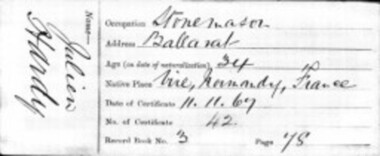
Document - Naturalisation certificate, Julien Hardy's Naturalisation Certificate
... Julien Hardy...Julien Hardy was the first discoverer of gold at Happy Valley. ...Image of a certificate belonging to Julien Hardy....Julien Hardy was the first discoverer of gold at Happy Valley. ...Julien Hardy was the first discoverer of gold at Happy Valley. Born in France he was naturalised in 1867.Image of a certificate belonging to Julien Hardy.julien hardy, happy valley, gold discovery, france, franco-australian -
 Box Hill Historical Society
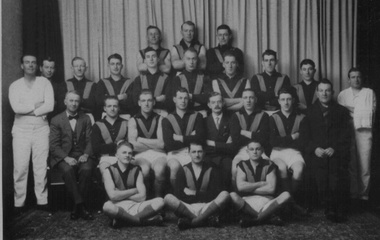
Photograph - Box Hill City Football Club team, Alfred Brown, 1929
... ...Hardy> A....Barnes, N. Boswell, A. Hardy, R. Edwards, R. Russell, S. Russell, D. ...King> D. Hardy> D. Morrison> F. Russell> J. Elliott> E. ...View of the Box Hill Box Hill City Football Club team for the 1929 season. They are identified as Back row: L. Woollard, A. Tilley, L. Morgan. Third row: G. Beale, V. Collier, A. Barnes, N. Boswell, A. Hardy, R. Edwards, R. Russell, S. Russell, D. King. Second row: R. Hardy, F. Morrison, J. Russell, E. Elliott, J. G. Penson, R. James, R. Cairnduff, R. Parsonage. Front row: T. Gough, F. O'Brien, L. Dummelow. B&w photoaustralian rules football, box hill city football club, woollard> l., tilley> a., morgan> l., beale> g., collier> v., barnes> a., boswell> n., hardy> a., edwards> r., russell> r., russell> s., king> d., hardy> d., morrison> f., russell> j., elliott> e., penson> j. g., james> r., cairnduff> r., parsonage> r., gough> t., o'brien> f., dummelow> l., sports and recreations -
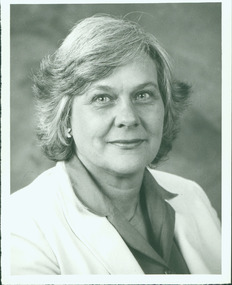 Glen Eira City Council History and Heritage Collection
Photograph, c. 1970
... B/w portrait photograph of Cr Joan Hardy wearing a white jacket and dark tone shirt....Handwritten on verso in blue ink pen: "Cr Joan Hardy"...Handwritten on verso in blue ink pen: "Cr Joan Hardy" B/w portrait photograph of Cr Joan Hardy wearing a white jacket and dark tone shirt. ...One of 11 similarly presented b/w half portrait photographs showing various councillors within Glen Eira City Council. Copyright for this image is unknown, although likely commissioned by Council. It has been digitised and published here for educational and research purposes. If you believe that you have copyright to this image and would like it removed from the site please contact us through the 'Leave a Comment' tab below. B/w portrait photograph of Cr Joan Hardy wearing a white jacket and dark tone shirt.Handwritten on verso in blue ink pen: "Cr Joan Hardy" -
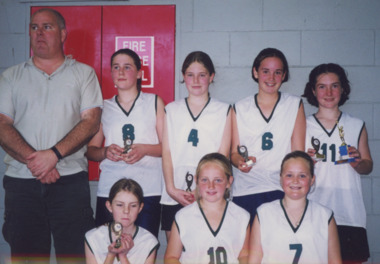 Lakes Entrance Historical Society
Photograph - Geoff Downing coach K Downing A Schaarschmidt M Hardy Paige Ellis S Rijs B Stuckey J Hardy, Lakes Post Newspaper, 1999c
... Geoff Downing coach K Downing A Schaarschmidt M Hardy Paige Ellis S Rijs B Stuckey J Hardy ...Under Sixteen Girls Basketball team Geoff Downing coach K Downing A Schaarschmidt M Hardy Paige Ellis S Rijs B Stuckey J Hardy runner up in Finals played in Recreation Hall Lakes Entrance Victoria...Colour photograph showing Under Sixteen Girls Basketball team Geoff Downing coach K Downing A Schaarschmidt M Hardy Paige Ellis S Rijs B Stuckey J Hardy runner up in Finals played in Recreation Hall Lakes Entrance Victoria...Under Sixteen Girls Basketball team Geoff Downing coach K Downing A Schaarschmidt M Hardy Paige Ellis S Rijs B Stuckey J Hardy runner up in Finals played in Recreation Hall Lakes Entrance Victoria Sports Basketball Clubs Recreation Colour photograph showing Under Sixteen Girls Basketball team Geoff Downing coach K Downing A Schaarschmidt M Hardy Paige Ellis S Rijs B Stuckey J Hardy runner up in Finals played in Recreation Hall Lakes Entrance Victoria Photograph Geoff Downing coach K Downing A Schaarschmidt M Hardy Paige Ellis S Rijs B Stuckey J Hardy Lakes Post Newspaper ...Under Sixteen Girls Basketball team Geoff Downing coach K Downing A Schaarschmidt M Hardy Paige Ellis S Rijs B Stuckey J Hardy runner up in Finals played in Recreation Hall Lakes Entrance VictoriaColour photograph showing Under Sixteen Girls Basketball team Geoff Downing coach K Downing A Schaarschmidt M Hardy Paige Ellis S Rijs B Stuckey J Hardy runner up in Finals played in Recreation Hall Lakes Entrance Victoriasports, basketball, clubs, recreation -
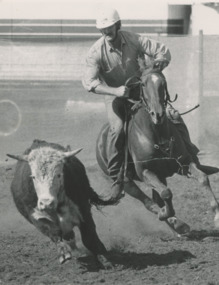 Lakes Entrance Historical Society
Photograph - Brian Hardy, Salt Creek Campdraft Johnsonville Victoria, Lakes Post Newspaper, 1/04/1994 12:00:00 AM
... Brian Hardy, Salt Creek Campdraft Johnsonville Victoria... Brian Hardy on Basher Bruce in action during the Salt Creek Campdraft Johnsonville Victoria...Black and white photograph showing Brian Hardy on Basher Bruce in action during the Salt Creek Campdraft Johnsonville Victoria...Brian Hardy on Basher Bruce in action during the Salt Creek Campdraft Johnsonville Victoria Sports Campdraft Black and white photograph showing Brian Hardy on Basher Bruce in action during the Salt Creek Campdraft Johnsonville Victoria Photograph Brian Hardy, Salt Creek Campdraft Johnsonville Victoria Lakes Post Newspaper ...Brian Hardy on Basher Bruce in action during the Salt Creek Campdraft Johnsonville VictoriaBlack and white photograph showing Brian Hardy on Basher Bruce in action during the Salt Creek Campdraft Johnsonville Victoriasports, campdraft -
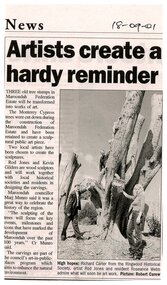 Croydon Conservation Society Inc.
Newspaper, Article 'Artists create a hardy reminder', News, 18 September
... Article 'Artists create a hardy reminder', News, 18 September...Handwritten inscription in black ink on top right hand side of the article: 18 - 09- 01 Black and white newspaper extract with photograph with handwritten inscription Article 'Artists create a hardy reminder', News, 18 September Newspaper ...Black and white newspaper extract with photograph with handwritten inscriptionHandwritten inscription in black ink on top right hand side of the article: 18 - 09- 01 -
 Federation University Historical Collection
Document, History of Durham Lead by J. Crombie, 1934, 1934
... John Charles Crombie was the son of James Andrew Crombie and Martha Houston and was born at Hardies Hill 1862. John Charles Crombie married in Victoria in Martha Crosier 1893. ...Crombie called 'History of Durham Lead, Hardies Hill, Garibaldi and Grenville'....Crombie called 'History of Durham Lead, Hardies Hill, Garibaldi and Grenville'. History of Durham Lead by J. ...John Charles Crombie was the son of James Andrew Crombie and Martha Houston and was born at Hardies Hill 1862. John Charles Crombie married in Victoria in Martha Crosier 1893. They were living at Durham Lead, Victoria for the birth of their children in the 1890s. John Charles Crombie died in 1937 at Oakleigh aged 74.A4 copy of an handwritten document by J. Crombie called 'History of Durham Lead, Hardies Hill, Garibaldi and Grenville'.j. crombie, durham lead, garibaldi, elaine, irish, scottish, cornish, john charles crombie, j.c. crombie -
 Bacchus Marsh & District Historical Society
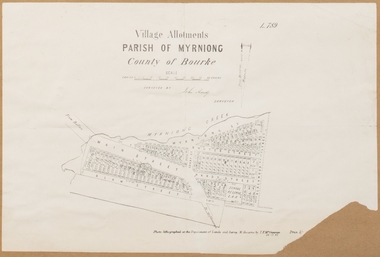
Map, Village allotments, Parish of Myrniong, County of Bourke
... An area marked as a reserve for a school can be seen between Hardy Street and Main Street....Surveyed by John Hardy, Surveyor ; photo-lithographed at the Department of Lands & Survey, Melbourne by T.F. ...An area marked as a reserve for a school can be seen between Hardy Street and Main Street. Myrniong Parish Plan Myrniong Parish Maps Surveyed by John Hardy, Surveyor ; photo-lithographed at the Department of Lands & Survey, Melbourne by T.F. ...Myrniong is a village 9 kilometers west of Bacchus Marsh. Prior to 1863 the area was known as Blow's Flat. This map which was produced in 1903 and according to the catalogue record of this map held at the State Library of Victoria was based on an earlier map created in 1861. The early layout of streets for the village of Myrniong can be seen on this map. The streets shown are, Main Street, Hardy Street, Blow Street, Myrniong Street, Shuter Street, and Blackwood Street. An area marked as a reserve for a school can be seen between Hardy Street and Main Street.A single page paper map. A cadastral parish map of Myrniong in Victoria, showing numbered land allotments. Photo-lithographed at the Department of Lands & Survey, Melbourne, in 1903. Based on an original map created in 1861. The map is pasted into a bound volume containing 76 maps or plans in total. High resolution digital image stored on BMDHS computer network. Surveyed by John Hardy, Surveyor ; photo-lithographed at the Department of Lands & Survey, Melbourne by T.F. McGauran, 24.12.03myrniong parish plan, myrniong parish maps -
Lakes Entrance Historical Society
Book, Adams John, The Tambo Shire Centenary History, 1981
... A history of the Shire of Tambo, East Gippsland, Victoria, including many aspects of settlement, development, industries, transport, and the hardy people who tamed this varied and often inhospitable region....A history of the Shire of Tambo, East Gippsland, Victoria, including many aspects of settlement, development, industries, transport, and the hardy people who tamed this varied and often inhospitable region....A history of the Shire of Tambo, East Gippsland, Victoria, including many aspects of settlement, development, industries, transport, and the hardy people who tamed this varied and often inhospitable region. ...A history of the Shire of Tambo, East Gippsland, Victoria, including many aspects of settlement, development, industries, transport, and the hardy people who tamed this varied and often inhospitable region.A history of the Shire of Tambo, East Gippsland, Victoria, including many aspects of settlement, development, industries, transport, and the hardy people who tamed this varied and often inhospitable region.land settlement, transport -
 Kiewa Valley Historical Society
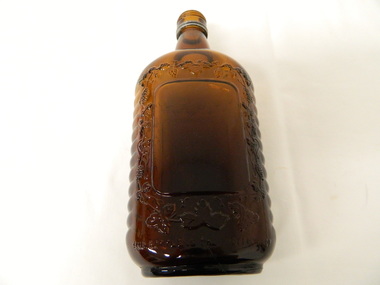
Bottle - Spirits, 1950's -1960's
... ...thomas hardy & sons pty. ltd...History of Thomas Hardy & Sons Pty Ltd....Base, front and back sides: 'This Bottle is the Property of / Thos Hardy & Sons Pty Ltd'...History of Thomas Hardy & Sons Pty Ltd. Historical: Change of bottles - shape, glass, embossing. ...Spirits came in bottles sold at licensed premises either locally or in larger cities visited during a shopping expedition. The shape of bottles varied and were re cycled remaining the property of the manufacturer who paid for their return. History of Thomas Hardy & Sons Pty Ltd.Historical: Change of bottles - shape, glass, embossing. Collected by bottle collectors. Aesthetic: Display showing embossing and shape. Clear dark brown glass bottle used for storing whisky or rum. the base is oval shaped. The sides are straight three quarters of the way up then tapers quickly to the neck and then a lip near the opening. the fort & back sides have smooth rectangular shapes bordered by heavy embossing of grapes. On the sides heavy embossing of horizontal ripples. embossed front and back print at bottom and at base. Strip of metal around the bottle at the top of the neck (remainder of the seal).Base, front and back sides: 'This Bottle is the Property of / Thos Hardy & Sons Pty Ltd'glass bottle, whisky, rum, spirits, thomas hardy & sons pty. ltd -
Whitehorse Historical Society Inc.
Article, Daze of our lives, 2013
... ...Hardy...In their show 'Hanging off the Hills Hoist', O'Neil stars with fellow comedians Glen Robbins and matt Hardy in a Carnival of Suburbia....In their show 'Hanging off the Hills Hoist', O'Neil stars with fellow comedians Glen Robbins and matt Hardy in a Carnival of Suburbia....In their show 'Hanging off the Hills Hoist', O'Neil stars with fellow comedians Glen Robbins and matt Hardy in a Carnival of Suburbia. O'Neil Dave Robbins Glen Hardy Matt Carnival of Suburbia Mitcham Dave O'Neil, raised in Mitcham, becomes nostalgic when paying tribute to the suburb where he grew up. ...Dave O'Neil, raised in Mitcham, becomes nostalgic when paying tribute to the suburb where he grew up.Dave O'Neil, raised in Mitcham, becomes nostalgic when paying tribute to the suburb where he grew up. In their show 'Hanging off the Hills Hoist', O'Neil stars with fellow comedians Glen Robbins and matt Hardy in a Carnival of Suburbia.Dave O'Neil, raised in Mitcham, becomes nostalgic when paying tribute to the suburb where he grew up. o'neil, dave, robbins, glen, hardy, matt, carnival of suburbia, mitcham -
University of Melbourne, Burnley Campus Archives
Slide - Glass slide, Hand coloured, 1891-1905
... Madame Hardy (Damask) (M. Hardy 1832) White or fresh pink.'...history of the rose flowers Madame Hardy (Damask) (M. Hardy 1832) White or fresh pink.' ...Madame Hardy (Damask) (M. Hardy 1832) White or fresh pink.'history of the rose, flowers -
 Flagstaff Hill Maritime Museum and Village
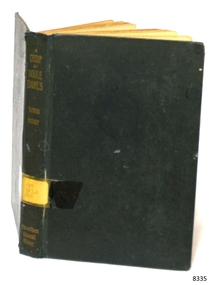
Book - Fictional Stories, Thomas Hardy, A Group of Noble Dames, 1894
... ...Thomas Hardy...Hardy set nearly all his major works in Wessex, a semi-fictionalized region of southwest England. ...A Group of Noble Dames Author: Thomas Hardy Publisher: Macmillan And Co Date: 1894 Further Information: Olive hardcover and spine with spine lettering in gold. ...Thomas Hardy...A Group of Noble Dames Book Fictional Stories Thomas Hardy Macmillan & Co. ...The subject novel A Group of Noble Dames is a collection of ten historical short stories bound together by a classic frame narrative. The premise is that to escape the boredom of a rainy day, ten male members of the "Wessex Field and Antiquarian Club" gather together. To pass the time, each member including a local historian, an old surgeon, a rural dean, and a churchwarden takes a turn telling a scandalous, tragic, or ironic tale about a high-born lady from the local aristocracy of the 17th and 18th centuries. Unlike Hardy's deeply somber major novels, he categorized these stories as "Romances and Fantasies." However, they still contain classic Hardyan cynicism.A Group of Noble Dames Author: Thomas Hardy Publisher: Macmillan And Co Date: 1894 Further Information: Olive hardcover and spine with spine lettering in gold. The spine has a Library label with inscription.non-fictionThe subject novel A Group of Noble Dames is a collection of ten historical short stories bound together by a classic frame narrative. The premise is that to escape the boredom of a rainy day, ten male members of the "Wessex Field and Antiquarian Club" gather together. To pass the time, each member including a local historian, an old surgeon, a rural dean, and a churchwarden takes a turn telling a scandalous, tragic, or ironic tale about a high-born lady from the local aristocracy of the 17th and 18th centuries. Unlike Hardy's deeply somber major novels, he categorized these stories as "Romances and Fantasies." However, they still contain classic Hardyan cynicism.flagstaff hill, warrnambool, shipwrecked coast, flagstaff hill maritime museum, maritime museum, shipwreck coast, flagstaff hill maritime village, great ocean road, book, pattison collection, warrnambool library, warrnambool mechanics’ institute, ralph eric pattison, corangamite regional library service, warrnambool city librarian, mechanics’ institute library, victorian library board, warrnambool books and records, warrnambool children’s library, a group of noble dames, thomas hardy -
Federation University Historical Collection
Document, Ballarat's Irish Lawyers, c2000
... ...John Hardy...Folder of research notes on early Ballarat Lawyers of Irish origin, including Woods Point, Philip D. Hardy, Hardy Brothers, Joseph Hardy, John Hardy, Leonard Hardy, Richard Ford, Agar Lynn, Adam Loftus Lynn, Richard O'Cock, Ballarat Volunteer Rifle Regiment...Hardy, Hardy Brothers, Joseph Hardy, John Hardy, Leonard Hardy, Richard Ford, Agar Lynn, Adam Loftus Lynn, Richard O'Cock, Ballarat Volunteer Rifle Regiment Ballarat's Irish Lawyers Document ...22188Folder of research notes on early Ballarat Lawyers of Irish origin, including Woods Point, Philip D. Hardy, Hardy Brothers, Joseph Hardy, John Hardy, Leonard Hardy, Richard Ford, Agar Lynn, Adam Loftus Lynn, Richard O'Cock, Ballarat Volunteer Rifle Regimentdianne campbell goldfields lawyers collection, lawyers, ballarat, legal, woods point, philip d. hardy, hardy brothers, joseph hardy, john hardy, leonard hardy, richard ford, agar lynn, adam loftus lynn, richard o'cock, ballarat volunteer rifle regiment -
 Federation University Historical Collection
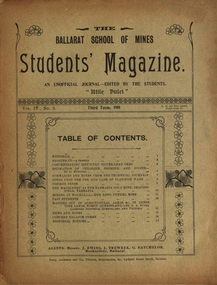
Booklet, Ballarat School of Mines, Student Magazine, Third Term, 1901, 1901
... ...hardy...Licensed surveyor, Queensland and Victoria), News and notes, Concert balance sheet, Editorial notices. silver-lead ores estimation of chlorine bromine and iodine (by d.runting) platinum ware tasmania gold mine beaconsfield, tasmania mining at walhalla long tunnel mine vine lands, north queensland r. a. suter photography class boer war alumni thomas vincent basil sawyer o. e. jager a. s. burdekin t. phillipson glen macpherson tom uthwatt marcus marks r. j. allen cecil eales cecil wakley adam morton e.p. lewers harry leggo jack hill berk nickolls h. burrows percy osborne j. brangan chris evans adamson alford r. evans arthur "thomas" atkins charles campbell hardy a. basil reid h. l. krause k. grant m. gray a.b. reid h. alston playford j. a. reid s. b. vial f. a. marriott f. lush c. whyte karl moore r. robin w. j. lakeland e. trend h. l. giles r. mccracken k. bryron moore Soft covered magazine of 16 pages. ...Articles include: Concentrating difficult silver-lead ores, Estimation of chlorine, bromine and iodine (by D.Runting. Summaries and notes from the technical journals, Notes upon the use and care of platinum ware, Common sense, The machinery at the Tasmania gold mine, Beacons-Field, Tasmanina, Mining at Walhalla - The long tunnel mine, Past students, Mapping out of agricultural areas &c., in dense vine lands, North Queensland (by R. A. Suter. Licensed surveyor, Queensland and Victoria), News and notes, Concert balance sheet, Editorial notices.Soft covered magazine of 16 pages. silver-lead ores, estimation of chlorine, bromine and iodine (by d.runting), platinum ware, tasmania gold mine, beaconsfield, tasmania, mining at walhalla, long tunnel mine, vine lands, north queensland, r. a. suter, photography class, boer war, alumni, thomas vincent, basil sawyer, o. e. jager, a. s. burdekin, t. phillipson, glen macpherson, tom uthwatt, marcus marks, r. j. allen, cecil eales, cecil wakley, adam morton, e.p. lewers, harry leggo, jack hill, berk, nickolls, h. burrows, percy osborne, j. brangan, chris evans, adamson, alford, r. evans, arthur "thomas" atkins, charles campbell, hardy, a. basil reid, h. l. krause, k. grant, m. gray, a.b. reid, h. alston, playford, j. a. reid, s. b. vial, f. a. marriott, f. lush, c. whyte, karl moore, r. robin, w. j. lakeland, e. trend, h. l. giles, r. mccracken, k. bryron moore -
 Bendigo Historical Society Inc.
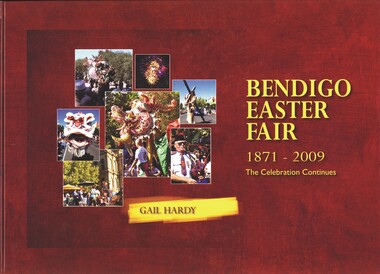
Book - BENDIGO EASTER FAIR 1871 - 2009, 2010
... Gail Hardy...BENDIGO History easter fair Bendigo History Easter Fair Parades. Gail Hardy Bendigo Easter Fair 1871 - 2009 The Celebration Continues, hard cover 127 pages with colour, black & white photographs & comments by local identities. ...Bendigo Easter Fair 1871 - 2009 The Celebration Continues, hard cover 127 pages with colour, black & white photographs & comments by local identities. First edition 55 of 200 signed by author, published by Bendigo Easter Fair Society, printed by Richard Cambridge PrintersGail Hardybendigo, history, easter fair, bendigo history, easter fair, parades. -
![Book, Chappell, Jenny, Mignonne : or Miss Patricia's Pet, [n.d.] [1900?]](/media/collectors/641920217f0478323d8a47a8/items/64802deb89348327e2fa3e9a/item-media/648d405f6c3d32c0a9b143f0/item-fit-380x285.jpg?cb=6) Linton Mechanics Institute and Free Library Collection
Linton Mechanics Institute and Free Library CollectionBook, Chappell, Jenny, Mignonne : or Miss Patricia's Pet, [n.d.] [1900?]
... . : ill. (21 illustrations by Paul Hardy).... : ill. (21 illustrations by Paul Hardy) Mignonne : or Miss Patricia's Pet Book Chappell, Jenny Blackie & Son ...208 p. : ill. (21 illustrations by Paul Hardy)fictionchildren's fiction, jenny chappell -
 Wodonga & District Historical Society Inc
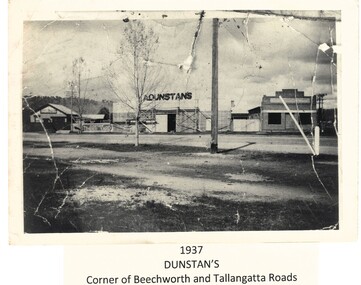
Photograph - Dunstan & Son, Wodonga
... Processing fell to 1000-1200 tonnes of pine a month by 1992 and Hardy’s, by then part of Pacific Dunlop, finally closed operations in that year with the loss of the remaining 27 jobs. ...On shopfront: DUNSTAN A & SONS HARDWARE JOINERY & TIMBER MERCHANTS RICKSHAW MAGICOLOR We stock and recommend HARDIES FIBROLITE SHERWIN WILLIAMS PAINT FINISHES...Processing fell to 1000-1200 tonnes of pine a month by 1992 and Hardy’s, by then part of Pacific Dunlop, finally closed operations in that year with the loss of the remaining 27 jobs. ...Mr Arthur Dunstan established a sawmill at Glen Wills in 1931 which operated for about 16 years. A larger and more modern sawmill with drying kilns was erected at Eskdale in 1947. He was contracted to build Wodonga’s municipal saleyards in 1935, followed by the Wangaratta saleyards which created so many forward orders that he bought a large block of land on the corner of Beechworth and Tallangatta Roads and opened a timber mill and hardware store. In 1974 other sawmills opened in Tallangatta Road near Chapple Street to cope with the expanding business. A large proportion of the company’s timber output was processed at the Wodonga yards into flooring, weatherboards, mouldings, and practically the whole output was distributed locally and throughout the Riverina and eastern freeboard of New South Wales, and Canberra. At its peak Dunstan’s was one of the biggest sawmilling businesses in Victoria and in Wodonga employed 150 people and milled 16,000,000 super feet of timber annually. Arthur Dunstan died in 1963 and the business was carried on by his sons Arthur Jr, Jack and Les, together with Reg McDermott and Neil Carr. Dunstan’s timber yards in Wodonga were sold to Ezard Industries in 1987 with the retail section being bought by BBC Hardware. Hardy’s took over the timber yard in 1989 and staff was gradually reduced to 51 by 1991. Processing fell to 1000-1200 tonnes of pine a month by 1992 and Hardy’s, by then part of Pacific Dunlop, finally closed operations in that year with the loss of the remaining 27 jobs. The area where Dunstan’s was located is now known as Southside.A black and white photo of a retail buildinga and workshopOn shopfront: DUNSTAN A & SONS HARDWARE JOINERY & TIMBER MERCHANTS RICKSHAW MAGICOLOR We stock and recommend HARDIES FIBROLITE SHERWIN WILLIAMS PAINT FINISHESdunstan's hardware wodonga, wodonga businesses, dunstan's timber -
 Flagstaff Hill Maritime Museum and Village
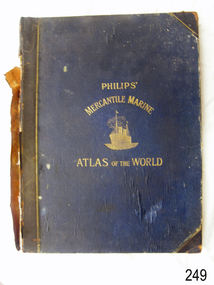
Book - Atlas, George Philip & Son Ltd, The London Geographical Institute, Philips' Mercantile Marine Atlas, 1904
... "Please - - - / HARDY GILLARD / - - / - - LONDON"...Flagstaff hill Warrnambool Flagstaff Hill Maritime Museum and Village Shipwreck Coast Great Ocean Road Atlas Marine atlas Philip's Mercantile Marine Atlas Ports Flags Consulates ocean travellers shipppers merchants 1904 "Please - - - / HARDY GILLARD / - - / - - LONDON" "Philips' Mercantile Marine Atlas of the World". ...Philips' Mercantile Marine Atlas of the World contains a series of 30 plates containing over 100 charts and plans, with tables of over 8,600 distances between ports, national and house flags, lists of British & United States Consulates and a complete index of 20,000 ports. Specially designed for merchant shippers, exporters and ocean travellers, and for general use. The atlas is significant as a record of the status of world statistics in 1904, of interest to travelers, merchants, and world traders. "Philips' Mercantile Marine Atlas of the World". Dark blue hardcover, gold embossing and trim. Edited by George Philip, F.R.G.S. Second edition. Published in London by George Philip & Son, London, Date: 1904 Inscription on a purple stamp on the fly page."Please - - - / HARDY GILLARD / - - / - - LONDON"flagstaff hill, warrnambool, flagstaff hill maritime museum and village, shipwreck coast, great ocean road, atlas, marine atlas, philip's mercantile marine atlas, ports, flags, consulates, ocean travellers, shipppers, merchants, 1904 -
 Tennis Australia
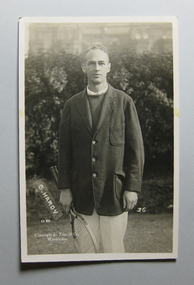
Photographic print, Circa 1912
... Photo featuring S. Hardy Materials: Paper, Photographic emulsion...Tennis Photo featuring S. Hardy Materials: Paper, Photographic emulsion Photographic print ...Photo featuring S. Hardy Materials: Paper, Photographic emulsiontennis -
 Lakes Entrance Historical Society
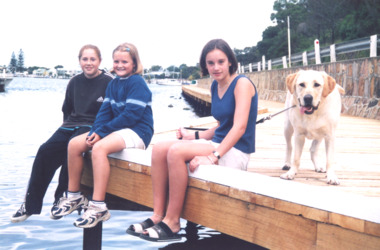
Photograph, Lakes Post Newspaper, Boardwalk Metung Victoria, 1/04/1999 12:00:00 AM
... Colour photograph of three girls, Angela Taylor 11 years, Jane Hardy 11 years, Meg Hardy 13 years and Labrador Towbar on the new Boardwalk beside the lake at Metung Victoria...Boats and Boating Vegetation Waterways Colour photograph of three girls, Angela Taylor 11 years, Jane Hardy 11 years, Meg Hardy 13 years and Labrador Towbar on the new Boardwalk beside the lake at Metung Victoria Boardwalk Metung Victoria Photograph Lakes Post Newspaper ...Colour photograph of three girls, Angela Taylor 11 years, Jane Hardy 11 years, Meg Hardy 13 years and Labrador Towbar on the new Boardwalk beside the lake at Metung Victoriaboats and boating, vegetation, waterways -
Canterbury History Group
Document - Logan Street Canterbury 1911-1952, Hardy, John, 1/04/2010 12:00:00 AM
... ... Hardy Family...From a talk by John Hardy to the Canterbury History Group April 2010...Hardy, John...From a talk by John Hardy to the Canterbury History Group April 2010 Document Logan Street Canterbury 1911-1952 Hardy, John ...Notes on the Hardy Family who lived in Logan Street Canterbury from 1911- 1952, and some of the occupants of Logan Street during that period. From a talk by John Hardy to the Canterbury History Group April 2010canterbury, logan street, hardy family, elmbrae, canterbury bowling club, canterbury primary school, transport, maling road -
 Phillip Island and District Historical Society Inc.
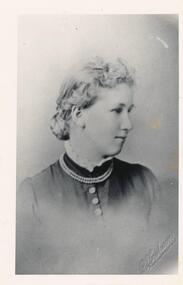
Photograph, McHaffie Children, Late 1800's or early 1900's
... On back: "Anne McHaffie now Mrs Hardy"...Donated by Bass Valley Historical Society mchaffie family anne mchaffie phillip island bass valley historical society On back: "Anne McHaffie now Mrs Hardy" Black & White Portrait of Anne McHaffie as a young woman in high necked dress wearing 2 strands of pearls. ...Donated by Bass Valley Historical SocietyBlack & White Portrait of Anne McHaffie as a young woman in high necked dress wearing 2 strands of pearls.On back: "Anne McHaffie now Mrs Hardy"mchaffie family, anne mchaffie, phillip island, bass valley historical society -
 Ringwood and District Historical Society
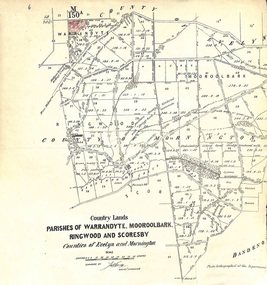
Map - Plan of Survey, Country Lands, Parishes of Warrandyte, Mooroolbark, Ringwood and Scoresby, Counties of Evelyn and Mornington - circa 1855
... Surveyed by (signature of J. Hardy) - Assistant Surveyor....Surveyed by (signature of J. Hardy) - Assistant Surveyor. Clipped section of larger survey map including descriptions of treed areas and topographical features. ...Clipped section of larger survey map including descriptions of treed areas and topographical features. Surveyed by (signature of J. Hardy) - Assistant Surveyor. -
 Narre Warren and District Family History Group
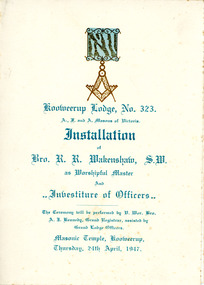
Programme, Installation of Bro. R. R. Wakenshaw Koo Wee Rup Lodge No. 323
... ...R D Hardy...R R Wakenshaw R J Aitkin R Attenborough A A Backman W J Bart W Bellingham G Benham J Blackwood B L Broadbent F Brooke C Buchanan R J Butler H A Carrol E Child L J Cochrane K Cole P Colvin S R Colliver K A Day B Darlington W L Dick J R Dusting H R Edwards A Ellett C Fraser H E Gill A J Gilcrest W J Gilcrest F P Goepel C Graham M G hardy R D Hardy T A Hatty A B Hewitt V W Hibbert E J Holley F Honeychurch C E Hubbard W Hubbard A Humphries E Johnson W Johnson J A Kappler A J Kevan D L Kinsella L Laidlaw R J Lees R Levey S Levey S E Lewis G Light T Light G H Lucas T McClure R McGregor K McInnes C S McLeod J C Mackin F J Marsh N Maughan R Maughan H Mills W Mills A Nicholson W K Paterson A M Perry J D Pollock B Ridgeon H E Ridgway J Robertson H Scott J Scott L Seddon W C Smith H St Clair J H Storey L Vick E V Wadsley J H Walsh P C Wildes A R White E R Williams W G Winters This is a booklet made up of two pages folded to make 8 pages. ...This is a booklet made up of two pages folded to make 8 pages. The outer page is made of thickened cream paper. On the front is to symbol of the Masonic Lodge printed in Gold and Teal Blue with the writing printed in different Fonts and sizes in the Teal Blue. The middle page is printed on white paper again in the Teal Blue colour with different Fonts and sizes used.r r wakenshaw, r j aitkin, r attenborough, a a backman, w j bart, w bellingham, g benham, j blackwood, b l broadbent, f brooke, c buchanan, r j butler, h a carrol, e child, l j cochrane, k cole, p colvin, s r colliver, k a day, b darlington, w l dick, j r dusting, h r edwards, a ellett, c fraser, h e gill, a j gilcrest, w j gilcrest, f p goepel, c graham, m g hardy, r d hardy, t a hatty, a b hewitt, v w hibbert, e j holley, f honeychurch, c e hubbard, w hubbard, a humphries, e johnson, w johnson, j a kappler, a j kevan, d l kinsella, l laidlaw, r j lees, r levey, s levey, s e lewis, g light, t light, g h lucas, t mcclure, r mcgregor, k mcinnes, c s mcleod, j c mackin, f j marsh, n maughan, r maughan, h mills, w mills, a nicholson, w k paterson, a m perry, j d pollock, b ridgeon, h e ridgway, j robertson, h scott, j scott, l seddon, w c smith, h st clair, j h storey, l vick, e v wadsley, j h walsh, p c wildes, a r white, e r williams, w g winters -
 Flagstaff Hill Maritime Museum and Village
Book, Lifes Little Ironies
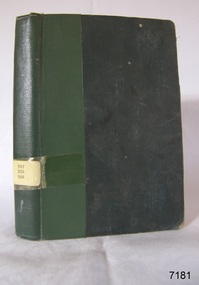
... ...thomas hardy...Lifes Little Ironies Author: Thomas Hardy Publisher: MacMillan & Co Date: 1894 ...The Warrnambool Mechanics' Institute’s publication collection is of both local and state significance. shipwrecked-coast flagstaff-hill flagstaff-hill-maritime-museum warrnambool maritime-museum shipwreck-coast flagstaff-hill-maritime-village shipwrecked-artefact book pattison collection warrnambool library warrnambool mechanics’ institute ralph eric pattison corangamite regional library service warrnambool city librarian mechanics’ institute library victorian library board warrnambool books and records warrnambool children’s library great ocean road lifes little ironies thomas hardy The label on the spine with the typed text PAT 824 HAR Pastedown front endpaper has a sticker from Warrnambool Mechanics Institute and Free Library covered by a sticker from Corangamite Regional Library Service Front loose endpaper has a stamp from Corangamite Regional Library Service Lifes Little Ironies Author: Thomas Hardy Publisher: MacMillan & Co Date: 1894 Lifes Little Ironies Book ...Pattison Collection This item is from the ‘Pattison Collection’, a collection of books and records that was originally owned by the Warrnambool Mechanics’ Institute, which was founded in Warrnambool in 1853. By 1886 the Warrnambool Mechanics’ Institute (WMI) had grown to have a Library, Museum and Fine Arts Gallery, with a collection of “… choice productions of art, and valuable specimens in almost every branch and many wonderful national curiosities are now to be seen there, including historic relics of the town and district.” It later included a School of Design. Although it was very well patronised, the lack of financial support led the WMI in 1911 to ask the City Council to take it over. In 1935 Ralph Pattison was appointed as City Librarian to establish and organise the Warrnambool Library as it was then called. When the WMI building was pulled down in 1963 a new civic building was erected on the site and the new Warrnambool Library, on behalf of the City Council, took over all the holdings of the WMI. At this time some of the items were separated and identified as the ‘Pattison Collection’, named after Ralph Pattison. Eventually the components of the WMI were distributed from the Warrnambool Library to various places, including the Art Gallery, Historical Society and Flagstaff Hill. Later some were even distributed to other regional branches of Corangamite Regional Library and passed to and fro. It is difficult now to trace just where all of the items have ended up. The books at Flagstaff Hill Maritime Village generally display stamps and markings from Pattison as well as a variety of other institutions including the Mechanics’ Institute itself. RALPH ERIC PATTISON Ralph Eric Pattison was born in Rockhampton, Queensland, in 1891. He married Maude Swan from Warrnambool in 1920 and they set up home in Warrnambool. In 1935 Pattison accepted a position as City Librarian for the Warrnambool City Council. His huge challenge was to make a functional library within two rooms of the Mechanics’ Institute. He tirelessly cleaned, cleared and sorted a disarrayed collection of old books, jars of preserved specimens and other items reserved for exhibition in the city’s museum. He developed and updated the library with a wide variety of books for all tastes, including reference books for students; a difficult task to fulfil during the years following the Depression. He converted all of the lower area of the building into a library, reference room and reading room for members and the public. The books were sorted and stored using a cataloguing and card index system that he had developed himself. He also prepared the upper floor of the building and established the Art Gallery and later the Museum, a place to exhibit the many old relics that had been stored for years for this purpose. One of the treasures he found was a beautiful ancient clock, which he repaired, restored and enjoyed using in his office during the years of his service there. Ralph Pattison was described as “a meticulous gentleman whose punctuality, floorless courtesy and distinctive neat dress were hallmarks of his character, and ‘his’ clock controlled his daily routine, and his opening and closing of the library’s large heavy doors to the minute.” Pattison took leave during 1942 to 1942 to serve in the Royal Australian Navy, Volunteer Reserve as Lieutenant. A few years later he converted one of the Museum’s rooms into a Children’s Library, stocking it with suitable books for the younger generation. This was an instant success. In the 1950’s he had the honour of being appointed to the Victorian Library Board and received more inspiration from the monthly conferences in Melbourne. He was sadly retired in 1959 after over 23 years of service, due to the fact that he had gone over the working age of council officers. However he continued to take a very keen interest in the continual development of the Library until his death in 1969. WARRNAMBOOL MECHANICS’ INSTITUTE Warrnambool's Mechanics' Institute (or Institution as it was sometimes called) was one of the earliest in Victoria. On 17th October 1853, a meeting was held where it was resolved to request the Lieutenant Governor of the Colony to grant land for the erection of a Mechanics' Institutes building. A committee was formed at the meeting and Richard Osburne chaired the first meeting of this committee. The land on the North West corner of Banyan and Merri Streets was granted but there were no funds to erect the building. The Formal Rights of the Warrnambool Mechanics' Institute's encompassed its aims and these were officially adopted in1859; "This Institution has for its object the diffusion of literary, scientific, and other useful knowledge amongst its members, excluding all controversial subjects, religious or political. These objects are sought to be obtained by means of a circulating library, a reading room, the establishment of classes, debates, and the occasional delivery of lectures on natural and experimental philosophy, mechanics, astronomy, chemistry, natural history, literature, and the useful and ornamental arts, particularly those which have a more immediate reference to the colony." The Warrnambool Mechanics' Institute opened its first reading room in November 1884 in the National School building at the corner of Banyan and Timor Streets. The Institute was funded by member subscription, payable on a quarterly, half-yearly or yearly basis. Samuel Hannaford, the Manager of the Warrnambool Bank of Australasia, was the first Honorary Secretary of the Mechanics' Institutes, and an early President and Vice-President. He also gave several of the early lectures in the Reading Room. Another early Secretary, Librarian and lecturer was Marmaduke Fisher, the teacher at the National School. Lecture topics included The Poets and Poetry of Ireland', 'The Birth and Development of the Earth', 'The Vertebrae - with Remarks on the pleasures resulting from the study of Natural History' and 'Architecture'. In 1856 the Reading Room was moved to James Hider's shop in Timor Street, and by 1864 it was located in the bookshop of Davies and Read. In the 1860's the Mechanics' Institute struggled as membership waned but in 1866, after a series of fundraising efforts, the committee was able to purchase land in Liebig Street, on a site then called Market Square, between the weighbridge and the fire station. A Mechanics' Institute building was opened at this site in August 1871. The following year four more rooms were added to the main Reading Room and in 1873 the Artisan School of Design was incorporated into the Institute. The same year Joseph Archibald established a Museum; however, it deteriorated when he was transferred to Bendigo in 1877. In 1880, with Archibald's return to Warrnambool, the Museum was re-established, and in 1885 a new building was built at the back of the Institute to accommodate the re-created School of Design, the Art Gallery and the Museum. In 1887 the Museum section was moved to the former courthouse in Timor Street (for some time the walls of the building formed part of the TAFE cafeteria but all is now demolished)). In 1911 the Museum was transferred back to the original building and the management of the Mechanics' Institute was handed over to the Warrnambool City Council. The Museum and Art Gallery became one and housed many fine works of art, and the Library continued to grow. The building was well patronised, with records showing that at the beginning of the 20th century there were between 500 and 800 visitors. During World War One the monthly figures were in the thousands, with 3,400 people visiting in January 1915. The Museum was a much - loved Institution in Warrnambool until the contents of the Museum and Art Gallery were removed to make room for the Warrnambool City Council Engineers' Department. The contents were stored but many of the items were scattered or lost. When the original building was demolished the site became occupied by the Civic Centre, which included the new City Library. (The library was temporarily located in the old Palais building in Koroit Street.) In the process of reorganisation the Collection was distributed amongst the community groups: -The new City Library took some of the historical books and some important documents, historic photographs and newspapers. -The Art Gallery kept the 19th Century art collection and some of the artefacts from the museum. -The Historical Society has some items -The State Museum has some items -Some items were destroyed -Flagstaff Hill Maritime Village has old newspapers, Government Gazettes, most of the Mechanics' Institute Library, ledgers and documents connected to the Mechanics' Institute Library, some framed and unframed artworks and some photographs. The Warrnambool Mechanics' Institute Library book collection is deemed to be of great importance because it is one of the few collections in an almost intact state, and many of the books are now very rare and of great value. The Pattison Collection, along with other items at Flagstaff Hill Maritime Village, was originally part of the Warrnambool Mechanics' Institute’s collection. The Warrnambool Mechanics’ Institute Collection is primarily significant in its totality, rather than for the individual objects it contains. Its contents are highly representative of the development of Mechanics' Institute libraries across Australia, particularly Victoria. A diversity of publications and themes has been amassed, and these provide clues to our understanding of the nature of and changes in the reading habits of Victorians from the 1850s to the middle of the 20th century. The collection also highlights the Warrnambool community’s commitment to the Mechanics’ Institute, reading, literacy and learning in the regions, and proves that access to knowledge was not impeded by distance. These items help to provide a more complete picture of our community’s ideals and aspirations. The Warrnambool Mechanics Institute book collection has historical and social significance for its strong association with the Mechanics Institute movement and the important role it played in the intellectual, cultural and social development of people throughout the latter part of the nineteenth century and the early twentieth century. The collection of books is a rare example of an early lending library and its significance is enhanced by the survival of an original collection of many volumes. The Warrnambool Mechanics' Institute’s publication collection is of both local and state significance. Lifes Little Ironies Author: Thomas Hardy Publisher: MacMillan & Co Date: 1894 The label on the spine with the typed text PAT 824 HAR Pastedown front endpaper has a sticker from Warrnambool Mechanics Institute and Free Library covered by a sticker from Corangamite Regional Library Service Front loose endpaper has a stamp from Corangamite Regional Library Service shipwrecked-coast, flagstaff-hill, flagstaff-hill-maritime-museum, warrnambool, maritime-museum, shipwreck-coast, flagstaff-hill-maritime-village, shipwrecked-artefact, book, pattison collection, warrnambool library, warrnambool mechanics’ institute, ralph eric pattison, corangamite regional library service, warrnambool city librarian, mechanics’ institute library, victorian library board, warrnambool books and records, warrnambool children’s library, great ocean road, lifes little ironies, thomas hardy -
Donald History and Natural History Group operating the Donald Court House Museum
Great Wall of China Stone
... Presented by Cecil Hardy from Great Wall of China 1990....Presented by Cecil Hardy from Great Wall of China 1990. Great Wall of China Stone ...Triangular piece of stone. Presented by Cecil Hardy from Great Wall of China 1990.stone, georgie ah ling, great wall of china stone, donald, vic. -
 Flagstaff Hill Maritime Museum and Village
Book, A Laodicean
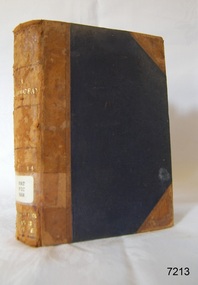
... ...thomas hardy...A Laodicean Author: Thomas Hardy Publisher: Sampson Low Marston Searle and Rivington Date: 1882 ...The Warrnambool Mechanics' Institute’s publication collection is of both local and state significance. shipwrecked-coast flagstaff-hill flagstaff-hill-maritime-museum warrnambool maritime-museum shipwreck-coast flagstaff-hill-maritime-village shipwrecked-artefact book pattison collection warrnambool library warrnambool mechanics’ institute ralph eric pattison corangamite regional library service warrnambool city librarian mechanics’ institute library victorian library board warrnambool books and records warrnambool children’s library great ocean road a laodicean thomas hardy The label on the spine with the typed text PAT FIC HAR Pastedown front endpaper has a sticker from Warrnambool Mechanics Institute and Free Library covered by a sticker from Corangamite Regional Library Service Front loose endpaper has a stamp from Warrnambool Mechanics Institute A Laodicean Author: Thomas Hardy Publisher: Sampson Low Marston Searle and Rivington Date: 1882 A Laodicean Book ...Pattison Collection This item is from the ‘Pattison Collection’, a collection of books and records that was originally owned by the Warrnambool Mechanics’ Institute, which was founded in Warrnambool in 1853. By 1886 the Warrnambool Mechanics’ Institute (WMI) had grown to have a Library, Museum and Fine Arts Gallery, with a collection of “… choice productions of art, and valuable specimens in almost every branch and many wonderful national curiosities are now to be seen there, including historic relics of the town and district.” It later included a School of Design. Although it was very well patronised, the lack of financial support led the WMI in 1911 to ask the City Council to take it over. In 1935 Ralph Pattison was appointed as City Librarian to establish and organise the Warrnambool Library as it was then called. When the WMI building was pulled down in 1963 a new civic building was erected on the site and the new Warrnambool Library, on behalf of the City Council, took over all the holdings of the WMI. At this time some of the items were separated and identified as the ‘Pattison Collection’, named after Ralph Pattison. Eventually the components of the WMI were distributed from the Warrnambool Library to various places, including the Art Gallery, Historical Society and Flagstaff Hill. Later some were even distributed to other regional branches of Corangamite Regional Library and passed to and fro. It is difficult now to trace just where all of the items have ended up. The books at Flagstaff Hill Maritime Village generally display stamps and markings from Pattison as well as a variety of other institutions including the Mechanics’ Institute itself. RALPH ERIC PATTISON Ralph Eric Pattison was born in Rockhampton, Queensland, in 1891. He married Maude Swan from Warrnambool in 1920 and they set up home in Warrnambool. In 1935 Pattison accepted a position as City Librarian for the Warrnambool City Council. His huge challenge was to make a functional library within two rooms of the Mechanics’ Institute. He tirelessly cleaned, cleared and sorted a disarrayed collection of old books, jars of preserved specimens and other items reserved for exhibition in the city’s museum. He developed and updated the library with a wide variety of books for all tastes, including reference books for students; a difficult task to fulfil during the years following the Depression. He converted all of the lower area of the building into a library, reference room and reading room for members and the public. The books were sorted and stored using a cataloguing and card index system that he had developed himself. He also prepared the upper floor of the building and established the Art Gallery and later the Museum, a place to exhibit the many old relics that had been stored for years for this purpose. One of the treasures he found was a beautiful ancient clock, which he repaired, restored and enjoyed using in his office during the years of his service there. Ralph Pattison was described as “a meticulous gentleman whose punctuality, floorless courtesy and distinctive neat dress were hallmarks of his character, and ‘his’ clock controlled his daily routine, and his opening and closing of the library’s large heavy doors to the minute.” Pattison took leave during 1942 to 1942 to serve in the Royal Australian Navy, Volunteer Reserve as Lieutenant. A few years later he converted one of the Museum’s rooms into a Children’s Library, stocking it with suitable books for the younger generation. This was an instant success. In the 1950’s he had the honour of being appointed to the Victorian Library Board and received more inspiration from the monthly conferences in Melbourne. He was sadly retired in 1959 after over 23 years of service, due to the fact that he had gone over the working age of council officers. However he continued to take a very keen interest in the continual development of the Library until his death in 1969. WARRNAMBOOL MECHANICS’ INSTITUTE Warrnambool's Mechanics' Institute (or Institution as it was sometimes called) was one of the earliest in Victoria. On 17th October 1853, a meeting was held where it was resolved to request the Lieutenant Governor of the Colony to grant land for the erection of a Mechanics' Institutes building. A committee was formed at the meeting and Richard Osburne chaired the first meeting of this committee. The land on the North West corner of Banyan and Merri Streets was granted but there were no funds to erect the building. The Formal Rights of the Warrnambool Mechanics' Institute's encompassed its aims and these were officially adopted in1859; "This Institution has for its object the diffusion of literary, scientific, and other useful knowledge amongst its members, excluding all controversial subjects, religious or political. These objects are sought to be obtained by means of a circulating library, a reading room, the establishment of classes, debates, and the occasional delivery of lectures on natural and experimental philosophy, mechanics, astronomy, chemistry, natural history, literature, and the useful and ornamental arts, particularly those which have a more immediate reference to the colony." The Warrnambool Mechanics' Institute opened its first reading room in November 1884 in the National School building at the corner of Banyan and Timor Streets. The Institute was funded by member subscription, payable on a quarterly, half-yearly or yearly basis. Samuel Hannaford, the Manager of the Warrnambool Bank of Australasia, was the first Honorary Secretary of the Mechanics' Institutes, and an early President and Vice-President. He also gave several of the early lectures in the Reading Room. Another early Secretary, Librarian and lecturer was Marmaduke Fisher, the teacher at the National School. Lecture topics included The Poets and Poetry of Ireland', 'The Birth and Development of the Earth', 'The Vertebrae - with Remarks on the pleasures resulting from the study of Natural History' and 'Architecture'. In 1856 the Reading Room was moved to James Hider's shop in Timor Street, and by 1864 it was located in the bookshop of Davies and Read. In the 1860's the Mechanics' Institute struggled as membership waned but in 1866, after a series of fundraising efforts, the committee was able to purchase land in Liebig Street, on a site then called Market Square, between the weighbridge and the fire station. A Mechanics' Institute building was opened at this site in August 1871. The following year four more rooms were added to the main Reading Room and in 1873 the Artisan School of Design was incorporated into the Institute. The same year Joseph Archibald established a Museum; however, it deteriorated when he was transferred to Bendigo in 1877. In 1880, with Archibald's return to Warrnambool, the Museum was re-established, and in 1885 a new building was built at the back of the Institute to accommodate the re-created School of Design, the Art Gallery and the Museum. In 1887 the Museum section was moved to the former courthouse in Timor Street (for some time the walls of the building formed part of the TAFE cafeteria but all is now demolished)). In 1911 the Museum was transferred back to the original building and the management of the Mechanics' Institute was handed over to the Warrnambool City Council. The Museum and Art Gallery became one and housed many fine works of art, and the Library continued to grow. The building was well patronised, with records showing that at the beginning of the 20th century there were between 500 and 800 visitors. During World War One the monthly figures were in the thousands, with 3,400 people visiting in January 1915. The Museum was a much - loved Institution in Warrnambool until the contents of the Museum and Art Gallery were removed to make room for the Warrnambool City Council Engineers' Department. The contents were stored but many of the items were scattered or lost. When the original building was demolished the site became occupied by the Civic Centre, which included the new City Library. (The library was temporarily located in the old Palais building in Koroit Street.) In the process of reorganisation the Collection was distributed amongst the community groups: -The new City Library took some of the historical books and some important documents, historic photographs and newspapers. -The Art Gallery kept the 19th Century art collection and some of the artefacts from the museum. -The Historical Society has some items -The State Museum has some items -Some items were destroyed -Flagstaff Hill Maritime Village has old newspapers, Government Gazettes, most of the Mechanics' Institute Library, ledgers and documents connected to the Mechanics' Institute Library, some framed and unframed artworks and some photographs. The Warrnambool Mechanics' Institute Library book collection is deemed to be of great importance because it is one of the few collections in an almost intact state, and many of the books are now very rare and of great value. The Pattison Collection, along with other items at Flagstaff Hill Maritime Village, was originally part of the Warrnambool Mechanics' Institute’s collection. The Warrnambool Mechanics’ Institute Collection is primarily significant in its totality, rather than for the individual objects it contains. Its contents are highly representative of the development of Mechanics' Institute libraries across Australia, particularly Victoria. A diversity of publications and themes has been amassed, and these provide clues to our understanding of the nature of and changes in the reading habits of Victorians from the 1850s to the middle of the 20th century. The collection also highlights the Warrnambool community’s commitment to the Mechanics’ Institute, reading, literacy and learning in the regions, and proves that access to knowledge was not impeded by distance. These items help to provide a more complete picture of our community’s ideals and aspirations. The Warrnambool Mechanics Institute book collection has historical and social significance for its strong association with the Mechanics Institute movement and the important role it played in the intellectual, cultural and social development of people throughout the latter part of the nineteenth century and the early twentieth century. The collection of books is a rare example of an early lending library and its significance is enhanced by the survival of an original collection of many volumes. The Warrnambool Mechanics' Institute’s publication collection is of both local and state significance. A Laodicean Author: Thomas Hardy Publisher: Sampson Low Marston Searle and Rivington Date: 1882 The label on the spine with the typed text PAT FIC HAR Pastedown front endpaper has a sticker from Warrnambool Mechanics Institute and Free Library covered by a sticker from Corangamite Regional Library Service Front loose endpaper has a stamp from Warrnambool Mechanics Institute shipwrecked-coast, flagstaff-hill, flagstaff-hill-maritime-museum, warrnambool, maritime-museum, shipwreck-coast, flagstaff-hill-maritime-village, shipwrecked-artefact, book, pattison collection, warrnambool library, warrnambool mechanics’ institute, ralph eric pattison, corangamite regional library service, warrnambool city librarian, mechanics’ institute library, victorian library board, warrnambool books and records, warrnambool children’s library, great ocean road, a laodicean, thomas hardy
