
Showing 71 items matching "heavy coats"
-
 Melbourne Tram Museum
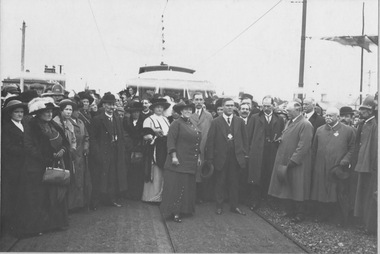
Photograph - Official opening of Malvern to Kew PMTT line, 30 May 1913
... ...heavy coats...Crowds of adults and children dressed in heavy coats and hats stand behind and in front of barriers. ...Crowds of adults and children dressed in heavy coats and hats stand behind and in front of barriers. ...One photograph shows a line of many decorated north-bound single truck tramcars with drivers at controls stopped behind a ceremonial ribbon as a woman reaches upward to cut it. Crowds of adults and children dressed in heavy coats and hats stand behind and in front of barriers. To the right in a lighter coloured overcoat is the chairman of the Prahran and Malvern Tramways Trust (PMTT), Mr Alexander Cameron. The Malvern Town Hall is shown at left with its clock showing 2.30pm on Friday 30 May 1913, the day before the federal election in which the Labor government was defeated by the Liberal Party by one seat. Federal Parliament sat in Melbourne until 1927. This ceremony officially opened the new double track electric line along Glenferrie Road from the Town Hall at High Street, Malvern to Cotham Road, Kew. Negotiations between the three municipalities had taken much effort to reach an agreement. At Cotham Road, the track branched west to the Kew Post Office at High Street and east to Burke Road. Services were then provided from both these termini to St Kilda Beach via Glenferrie Road, Hawthorn Road and Balaclava Road. Two further ceremonies occurred at Gardeners Creek and Barkers Road, the boundaries between three municipalities. A second photograph shows the same convoy of tram cars stationary for an additional event at Burwood Road adjacent to the Hawthorn Town Hall (out of shot to the left). A large crowd is gathered as a photographer captures a Lady Mayoress at the driver's controls. A third photograph shows a larger crowd at the corner of Glenferrie Road and Cotham Road, Kew in front of and hanging from an electric tramcar stationary on double track. The 400 guests in fine attire included state government ministers, spouses, local municipal mayors and councillors. Also present were the Prahran and Malvern Tramways Trust (PMTT) Board, including Chairman Alexander Cameron, at right in a lighter coloured overcoat. The well dressed woman out front may be Councillor Mrs Wood, the Mayoress of Hawthorn. Yields information about early Glenferrie Road electric line to Kew and PMTT.Three black and white photographs, some mounted on cardboard with no notes attachedglenferrie road, electric trams, ceremonial ribbon, heavy coats, chairman, pmtt, malvern town hall, 30 may 1913, cotham road, kew, kew post office, burke road, st kilda beach, balaclava road, federal election, hawthorn road, alexander cameron, mayoress of hawthorn, gardeners creek, barkers road, prahran and malvern tramways trust, burwood road, hawthorn town hall -
 Whitehorse Historical Society Inc.
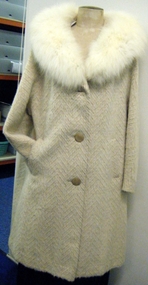
Clothing - Coat, 1968
... Jean Gorsuch loved fur and fur trimming - she loved this coat and always felt very smart in it. It is very heavy....Straight style - long sleeves. It is a very heavy coat....Straight style - long sleeves. It is a very heavy coat. Clothing Coat ...Coat was purchased & worn by Judith's Mother, Jean Gorsuch, in 1968 as her best coat. Jean Gorsuch loved fur and fur trimming - she loved this coat and always felt very smart in it. It is very heavy.Beige wool coat with cream fur collar (coat has a self zig-zag pattern in the wool). Straight style - long sleeves. It is a very heavy coat.Bonwear Clothing Melbourne.costume, female -
 Bendigo Military Museum
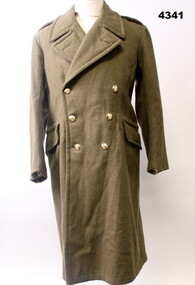
Uniform - GREAT COAT, Reti Clothing, 1966
... heavy Army great coat, double-breasted, khaki, brass buttons, broad collar....Refer to. catalogue No. 4340 for more items. great coat intelligence corp PRPrinted Label:”DvD” Handwritten on label: “B. TIMBERLAKE. 3791718” heavy Army great coat, double-breasted, khaki, brass buttons, broad collar. ...Belonged to TIMBERLAKE.BRIAN. 3791718, Australian Intelligence Corp, Vietnam 10.12.68 -25.6.69. Refer to. catalogue No. 4340 for more items.heavy Army great coat, double-breasted, khaki, brass buttons, broad collar.PRPrinted Label:”DvD” Handwritten on label: “B. TIMBERLAKE. 3791718”great coat, intelligence corp -
 Charlton RSL Sub Branch
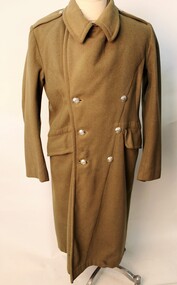
Uniform - trench coat, Heavy Army olive green trench coat
... Heavy Army olive green trench coat...Heavy Australian Army trench coat with silver buttons...on label.1957 Size 7 Heavy Australian Army trench coat with silver buttons Heavy Army olive green trench coat Uniform trench coat ...Heavy Australian Army trench coat with silver buttonsTempalton (?) 3/643(?) on label.1957 Size 7 -
 Bendigo Historical Society Inc.
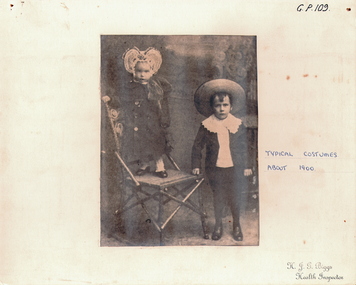
Photograph - TWO SMALL CHILDREN DRESSED IN 1900 COSTUMES, c.1900
... Little girl standing on cane chair wearing large, decorated headpiece, heavy coat with buttons, knitted leggings and court shoes. ...Little girl standing on cane chair wearing large, decorated headpiece, heavy coat with buttons, knitted leggings and court shoes. ...Reproduction of black and white photograph of two small children in formal clothing. Little girl standing on cane chair wearing large, decorated headpiece, heavy coat with buttons, knitted leggings and court shoes. A muff if on her shoulder. Boy wears large straw hat, white shirt with large lace collar, dark jacket and trousers, long socks and shoes. Inscriptions: on front - 'typical costumes about 1900', 'JG Biggs, Health Inspector'.person, group, children -
 Victoria Police Museum
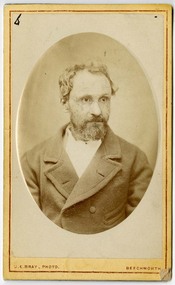
Carte de Visite (Francis Harty), J.E. Bray, 18/1/1879
... Photograph is in an oval frame and shows a man with a short bushy beard wearing a heavy winter coat (double breasted), facing right...Photograph is in an oval frame and shows a man with a short bushy beard wearing a heavy winter coat (double breasted), facing right Carte de Visite (Francis Harty) J.E. ...Black and white photograph of Francis Harty a sympathiser of the Kelly Gang. Photograph is in an oval frame and shows a man with a short bushy beard wearing a heavy winter coat (double breasted), facing rightfrancis harty, kelly sympathiser, kelly gang, edward kelly, ned kelly -
 Whitehorse Historical Society Inc.
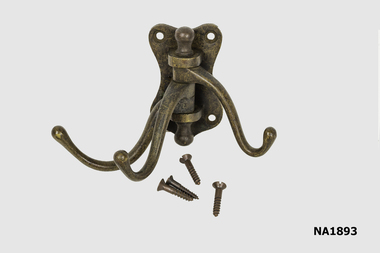
Functional object - Coat Hook
... Heavy metal three pronged coat hook. Hooks are curved at ends and swivel from centre piece....BUILDINGS Fittings Heavy metal three pronged coat hook. Hooks are curved at ends and swivel from centre piece. ...Heavy metal three pronged coat hook. Hooks are curved at ends and swivel from centre piece.buildings, fittings -
 Glenelg Shire Council Cultural Collection
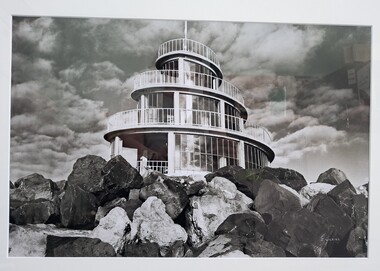
Photograph, John Wilkins, Photographer, Corkscrew, n.d
... The corkscrew has been constructed using mild steel, heavily coated in marine grade paint (similar to what is used on ships). ...The corkscrew has been constructed using mild steel, heavily coated in marine grade paint (similar to what is used on ships). ...From the Port of Portland website: The original corkscrew was built as a gift to the Portland Harbour Trust by the contractors who constructed the port. It was designed in 1960 and fabricated shortly after the completion of the Main Breakwater. The corkscrew was built as an observatory, with the observation deck approximately 13 metres above sea level. Its original design life was less than 25 years. The original structure was dilapidated, extremely unsafe and in danger of collapse. Understanding the historical and community importance of the original structure, in 2016 Port of Portland began the process of designing and building a replacement. The new corkscrew is a similar size and has been based on the same spiral shape of the original structure. The corkscrew has been constructed using mild steel, heavily coated in marine grade paint (similar to what is used on ships). Heavy duty plastic has been used for the walkway section which will withstand the harsh elements of the marine environment.Photograph of the Portland Corkscrew in the 1980s. Image is in black and white. The corkscrew is in front of a sky which is dotted with fluffy clouds. To the front of the Corkscrew are large rocks. The building is a spiral with glass windows. There is a white metal fence around it and a white pole at the top which reaches to the top of the image.Bottom right: J WILKINSportland, seafront, maritime, portland landmark, corkscrew, port of portland, portland photography, photography -
 Bendigo Historical Society Inc.
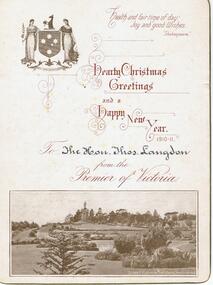
Document - THOMAS LANGDON COLLECTION: CHRISTMAS CARD, 1910
... Paper mounted on heavy card. Victorian Coat of Arms and Illustration of Queen Victorian Gardens on front of card....Paper mounted on heavy card. Victorian Coat of Arms and Illustration of Queen Victorian Gardens on front of card. ...Document. Single sided Christmas card from the Premier of Victoria to the Hon. Thos. Langdon 1910-1911. Paper mounted on heavy card. Victorian Coat of Arms and Illustration of Queen Victorian Gardens on front of card.document, memo, christmas card. -
 Warrnambool RSL Sub Branch
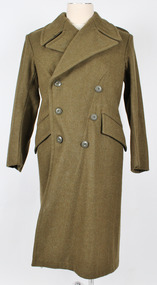
Great Coat, Kindred Manufacturing
... Long khaki coloured heavy coat. Thick, sharp angled collars. Each collar has a split half way down and a small metallic hoop attached to the lower middle section of the high parts of the collars. ...Long khaki coloured heavy coat. Thick, sharp angled collars. Each collar has a split half way down and a small metallic hoop attached to the lower middle section of the high parts of the collars. ...Long khaki coloured heavy coat. Thick, sharp angled collars. Each collar has a split half way down and a small metallic hoop attached to the lower middle section of the high parts of the collars. Each shoulder has a lapel that is fastened with a plastic button. The coat is double breasted. There are three grey buttons for use on the right and three grey buttons for show on the left. There is also a spare button on the inside left front section near the breast area. There are two pockets on the front that are angled with the highest point near the centre and the lowest point near the hips. There is a small section of spare fabric attached with two small plastic buttons to the inner left of the jacket near the breast. The arms, underarm and upper back section contains an inside khaki coloured lining of thinner, most likely cotton fabric. Attached to this at the base of the neck is a satin or synthetic fabric label with inscriptions in black ink. Above this there is a thin strip of fabric attached at either short end to use for hanging the coat on a hook. At the back of the coat there is a single pleat stretching from the base of the neck to the base of the coat. Approximately half way down the pleat there is a split in the fabric that is fastened with two plastic buttons. At the waist there are two fabric flaps that fasten together at the back with three buttons.The label attached on the inside at the base of the neck reads: “KINDRED MANUFACTURING / PTY LTD. / QLD / 1083” There is then a broad arrow followed by: “B406-66-093-1812 / SIZE 109 / TO FIT CHEST 100cm / NAME.................../ SERVICE No......................” -
 Warrnambool RSL Sub Branch
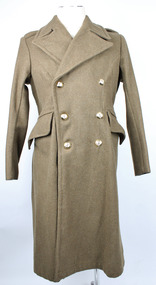
Great Coat, Bradley's Industries N.S.W, 1951
... Long khaki coloured heavy coat. Thick, sharp angled collars. Right collar has a hook and eye attached in the lapel split. ..../1951" Handwritten on label, "M J Davis" Long khaki coloured heavy coat. Thick, sharp angled collars. Right collar has a hook and eye attached in the lapel split. ...Long khaki coloured heavy coat. Thick, sharp angled collars. Right collar has a hook and eye attached in the lapel split. Collar has zig zag stitching and two plastic buttons on each the left and right sides. Each shoulder has a lapel that is fastened with a plastic button. The coat is double breasted. Three buttons on the right side, held in place by metal loops on the interior rather than stiches; mirrored on the left side. Left interior has oval shaped fabric buttoned to the interior with two brown (possibly bakelite) buttons. A larger brown button sits atop the smaller as a means of closing the jacket from the inside. There are two pockets on the front that are angled with the highest point near the centre and the lowest point near the hips. The arms, underarm and upper back section contains an inside khaki coloured lining of thinner, most likely cotton fabric. Above this there is a thin strip of fabric attached at either short end to use for hanging the coat on a hook. At the back of the coat there is a single pleat stretching from the base of the neck to the base of the coat. Approximately half way down the pleat there is a split in the fabric that is fastened with two plastic buttons. At the waist there are two fabric flaps that fasten together at the back with three buttons, also held in place with metal loops on the reverse.Label on interior back lining reads "REGIMENTAL No./NAME" Label on interior of the right "GREATCOATS. G.S. 1946 Patt/SIZE 1/HEIGHT 5'3"/CHEST 34"-36"/BRADLEY'S INDUSTRIES N.S.W./1951" Handwritten on label, "M J Davis"post war, army uniform, great coat, inter war, uniform, military uniform, wool, greatcoats, bradley's industries -
 Bendigo Historical Society Inc.
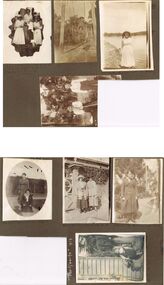
Photograph - HILDA HILL COLLECTION: BLACK AND WHITE PHOTOS, 1918-1919
... Two Ladies wearing heavy coats on rope swing Botanical gardens Bendigo June Year Unknown Cation On photo Illegible, Mo. ...Two Ladies wearing heavy coats on rope swing Botanical gardens Bendigo June Year Unknown Cation On photo Illegible, Mo. ...7 Complete Black & White Photographs: Maisie and Bess One standing wearing a light coloured dress and one kneeling wearing Dark suit with white blouse on pathway, background is large hedge, right background is a corner of a lawn area, oval photo, S.H.L.C. 24 September 1918. House in Bendigo With Pillared Gate & Picket Fence, Tess & Dorothy Out The Front 21/10/1918. Claire wearing a dark coloured coat dress standing in a garden setting, light post to her left, hose laying on the path to her left, small flat roofed shed near light post 'The Ranche' 23/10/1918. Nancy wearing a tunic style dress and white blouse standing next to a wall with a pot plant at front, 'The Ranche' 1919. Group Photo Three Ladies wearing all white outfits and two with white hats, two standing one sitting, at front is small case and Thermos flask, grubby but happy the end of a perfect day Axedale Hibernian Picnic 13/11/1918. Two Ladies wearing heavy coats on rope swing Botanical gardens Bendigo June Year Unknown Cation On photo Illegible, Mo. Smith Lady standing on shore at Reservoir No. 7 Kangaroo Flat 09/011919. two boys standing in bush scene wearing white shirts and dark trouser held up with braces, boy on left holding long stick with both hands. Part of this photo has been cut off in the process of taking a photo from the other side.Hilda Hill Personal Collectionaustralia, history, post war life -
 Bendigo Historical Society Inc.
Memorabilia - DIETZ LANTERN LABEL
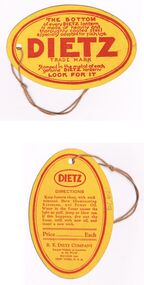
... The label reads *The bottom of every Dietz lantern is made of heavily and thoroughly coated steel especially adapted for such use. ...The label reads *The bottom of every Dietz lantern is made of heavily and thoroughly coated steel especially adapted for such use. ...See Items 7545 & 7544Dietz Lantern Label: Orange label oval in shape with a pink cotton thread through a small hole for attaching. Red print with red border line around the label. The label reads *The bottom of every Dietz lantern is made of heavily and thoroughly coated steel especially adapted for such use. DIETZ. Trade Mark. Stamped in the metal of each genuine DIETZ lantern. Look for it. On the back DIETZ with a red oval border and how to care for the lantern. Box 625R. E. Dietz Company. Largest makers of Lanterns in the World. Founded 1840 New York. U.S.A.business, retail -
 Shepparton RSL Sub Branch
Uniform, Great Coat, C. 1951
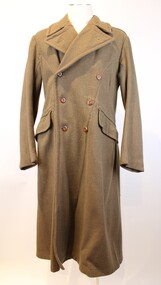
... Shin length long sleeved heavy woollen coat in khaki-green with double breasted fastening via three bakelite brown buttons. ...COAT G.S. 1966 PATT/1951/[two lines of text overwritten with “83A” stamp]/A LANDAU VIC 1951”. Interior right pocket reads “11556/ROBERTSON/203 111051”. Shoulder lining has three stamps reading “83A” and one handwritten “83A”. Buttons read “AUSTRALIAN MILITARY FORCES”. Shoulder flashes read “ROYAL AUSTRALIAN/REGIMENT” Shin length long sleeved heavy ...Shin length long sleeved heavy woollen coat in khaki-green with double breasted fastening via three bakelite brown buttons. Two angled hip height pockets on the left and right hips with exterior flap, lined with cotton. Two red curved shoulder flashes on each shoulder embroidered with the words “ROYAL AUSTRALIAN/REGIMENT” in a cream thread with a cream border. Collar has two small buttons either side on the exterior and a hook and eye which fastens under the chin. Fabric epaulette on either shoulder with brown button to secure. Lower back of coat is secured by two buttons and a belt which attaches to left and right seam line and fastens via three buttons. Interior shoulder area is lined with short cotton lining which sits under the arms; sleeves lined in cotton. Pockets are cotton on interior with inscriptions; two labels on interior lower right. Labels reads “REGIMENTAL NO. 3/400922/NAME ROBINSON/GREAT COAT G.S. 1966 PATT/1951/[two lines of text overwritten with “83A” stamp]/A LANDAU VIC 1951”. Interior right pocket reads “11556/ROBERTSON/203 111051”. Shoulder lining has three stamps reading “83A” and one handwritten “83A”. Buttons read “AUSTRALIAN MILITARY FORCES”. Shoulder flashes read “ROYAL AUSTRALIAN/REGIMENT”robinson, robertson, world war ii, second world war, wwii, winter, uniform, military -
 Flagstaff Hill Maritime Museum and Village
Uniform - Jacket, 19th-20th Century
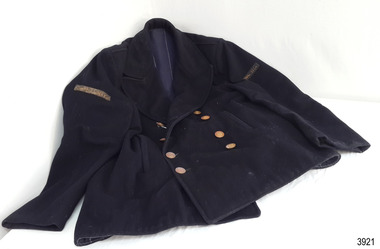
... Uniform jacket or coat, maritime. Heavy duty navy-coloured woollen jacket lined with light-weight woollen lining coloured blue with thin white stripe. ...Flagstaff Hill Warrnambool Maritime Village Maritime Museum Flagstaff Hill Maritime Museum & Village Shipwreck coast Great Ocean Road meritime uniform men's jacket woollen jacket double-breasted jacket merchant navy maritime uniform jacket anchor and chain buttons Embroidered sleeve labels "WARRNAMBOOL" Embossed on eight buttons, symbol [chain joined to top of anchor and entwined around it, with text on anchor's crossbar] Uniform jacket or coat, maritime. Heavy duty navy-coloured woollen jacket lined with light-weight woollen lining coloured blue with thin white stripe. ...This jacket appears to be part of the uniform, connected to Warrnambool through its sleeve labels, and to the sea, through its anchor and chain buttons. It may have been worn in the merchant navy by a senior seaman, due to the good quality of fabric and the double-breasted design, or to life saving at sea, such as a member of the Life Saving Rescue Crew, or even a Harbour Master. This jacket has been used for display on the ketch 'Reginald M', built in 1922 in South Australia and spending the final years of its life at Flagstaff Hill Maritime Village from 1975-2016. The vessel spent much of its working life as a coastal trader along the south-eastern coast of Australia.This maritime jacket is significant for its connection with Warrnambool and to maritime service. Its high quality wool suggests that it was made for a senior ranking person. This jacket could have been used by a seaman in the merchant navy, which provided the essential service of transportation of goods and passengers between the ports of south-eastern Australia, including the Port of Warrnambool.Uniform jacket or coat, maritime. Heavy duty navy-coloured woollen jacket lined with light-weight woollen lining coloured blue with thin white stripe. Double-breasted front with eight buttons with the motif of anchor and chain. Two waist pockets on the outside, two breast pockets on the inside, closed with composition buttons on the lap, plus one spare button. Dark felt fabric labels were stitched to each sleeve just below the shoulder, with gold embroidered letters. Embroidered sleeve labels "WARRNAMBOOL" Embossed on eight buttons, symbol [chain joined to top of anchor and entwined around it, with text on anchor's crossbar]flagstaff hill, warrnambool, maritime village, maritime museum, flagstaff hill maritime museum & village, shipwreck coast, great ocean road, meritime uniform, men's jacket, woollen jacket, double-breasted jacket, merchant navy, maritime uniform jacket, anchor and chain buttons -
 Flagstaff Hill Maritime Museum and Village
Textile - Twine, 20th century
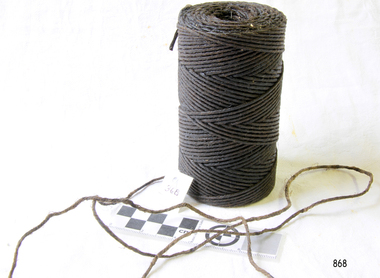
... coated and ready to use. The twine is made from strands of fibres that are plied together. The wax waterproofs the twine and smooths out the fine hairs of the fibres, making it easier to work with. The waxed twine helps prevent the ends of the rope work from fraying. Sailmakers use twine and needles to sew sails and many other canvas items such as bags and covers. Special tools, equipment, benches and seats are needed to work with the large heavy...coated and ready to use. The twine is made from strands of fibres that are plied together. The wax waterproofs the twine and smooths out the fine hairs of the fibres, making it easier to work with. The waxed twine helps prevent the ends of the rope work from fraying. Sailmakers use twine and needles to sew sails and many other canvas items such as bags and covers. Special tools, equipment, benches and seats are needed to work with the large heavy ...Sailmaker's twine is usually stored on a reel. It is wax coated and ready to use. The twine is made from strands of fibres that are plied together. The wax waterproofs the twine and smooths out the fine hairs of the fibres, making it easier to work with. The waxed twine helps prevent the ends of the rope work from fraying. Sailmakers use twine and needles to sew sails and many other canvas items such as bags and covers. Special tools, equipment, benches and seats are needed to work with the large heavy and thick pieces of canvas. Sometimes the sailmaker with have special-purpose tools made for his unique work. The place of work on shore is often called a sailmaker's loft. However, sailmakers also work on the job, on sailing ships and boats. This twine is an example imperative equipment for sailmakers. Sailmaking was an essential trade in the shipping industry of the 17th to 19th and early 20th centuries. Sailmakers were often part of a ship's crew, making repairs as needed and using their skills for other work such as net making.Twine; reel of brown waxed sailmaker's twine.warrnambool, shipwreck coast, flagstaff hill, flagstaff hill maritime museum, flagstaff hill maritime village, twine, waxed twine, sailmaker's twine, sailmaker's equipment, sailmaking, canvas work -
 City of Moorabbin Historical Society (Operating the Box Cottage Museum)
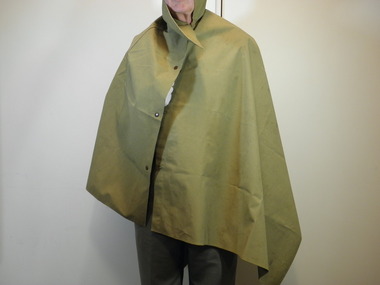
Uniform - Armed Services, Cape/groundsheet, 20th century
... coated cotton – During the Malayan Emergency of the 1950s, Australian troops were issued with hooded ponchos. Unlike the WWII US pattern ponchos which always had a hole in the dead centre of the poncho sheet, the Australian-issue hooded ponchos made an effective shelter – especially when two where clipped together. The problem of course is that the rubberized canvas ponchos were far too heavy...coated cotton – During the Malayan Emergency of the 1950s, Australian troops were issued with hooded ponchos. Unlike the WWII US pattern ponchos which always had a hole in the dead centre of the poncho sheet, the Australian-issue hooded ponchos made an effective shelter – especially when two where clipped together. The problem of course is that the rubberized canvas ponchos were far too heavy ...Rain cape, also used as a groundsheet, issued Australian servicemen. Purchased for the donor from an "Army Surplus" store and re-purposed for camps as a Scout in the late 1960s. The MK VII Groundsheet (Rain Cape / Poncho) was introduced in October 1917 during WW1. They were made from dyed cotton, proofed with a rubber compound, "well vulcanized" on one side. Weight 3lb. 8oz;. 78 inches long by 36 inches wide and made by the Victoria Rubber Co. Edinburgh. They were used again during WWII 1939-45 Today the Army uses the hootchie - a sheet of 70D nylon or PU-coated cotton with various press snaps and webbing tape loops attached around the outside which allow it to be used in a variety of configuration. During WWII Australian forces fighting the Japanese in the Islands had an urgent requirement for a decent individual shelter. The rubberized canvas groundsheets and rain capes continued to be used, but these were less than effective in the tropics. Towards the end of the war in the Pacific Australia began issuing its troops a lighter weight version of the groundsheet manufactured from polyurethane-coated cotton – During the Malayan Emergency of the 1950s, Australian troops were issued with hooded ponchos. Unlike the WWII US pattern ponchos which always had a hole in the dead centre of the poncho sheet, the Australian-issue hooded ponchos made an effective shelter – especially when two where clipped together. The problem of course is that the rubberized canvas ponchos were far too heavy for jungle use. 1960s Australian units in Borneo were issued with the first pattern lightweight hootchies. 1 Kg. 1970 the Vietnam War, a second pattern lightweight hootchie was issued made from nylon, but retaining the hardware and loops. This lightweight hootchie weighed a mere 680 grams, still heavy, but suitable for tropical use. Currently the hootchie is made from AUSCAM nylon material . Historic significance; representative of the type believed to have been issued to Australian servicemen in World War II, possibly in World War I.Waterproofed Canvas rain cape, also used as a groundsheet in the Australian Army, press studs to close as a cape, collar to cover neck.NILuniforms, australian army, world war ii, army surplus, scouts australia, bentleigh, moorabbin, world war 1, hooded ponchos, borneo, auscam nylon material, hootchies, malayan emergency, vietnam war, groundsheets -
 Glenelg Shire Council Cultural Collection
Administrative record - Booklet - Portland Town Council, Report to Ratepayers, 1969 - 70, 1969-1970
... Heavy white card, royal blue print, Town of Portland coat of arms and photo of Portland library, on front cover. 8 pages...Heavy white card, royal blue print, Town of Portland coat of arms and photo of Portland library, on front cover. 8 pages Administrative record Booklet - Portland Town Council, Report to Ratepayers, 1969 - 70 ...Booklet produced by Portland Town Council, Report to Ratepayers, 1969 - 70. Heavy white card, royal blue print, Town of Portland coat of arms and photo of Portland library, on front cover. 8 pages -
Ringwood and District Historical Society
Metal Stamps, City of Ringwood and Borough of Ringwood metal stamps, 1924
... Two heavy metal square blocks with the City of Ringwood coat of arms imprinted on the surface - to be used as a stamp.; 1. ...City of Ringwood 1960 Two heavy metal square blocks with the City of Ringwood coat of arms imprinted on the surface - to be used as a stamp.; 1. ...Two heavy metal square blocks with the City of Ringwood coat of arms imprinted on the surface - to be used as a stamp.; 1. Borough of Ringwood 1924; 2. City of Ringwood 19601. Borough of Ringwood 1924; 2. City of Ringwood 1960 -
 City of Moorabbin Historical Society (Operating the Box Cottage Museum)
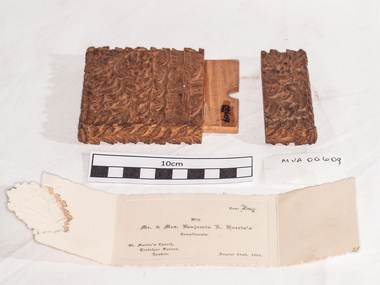
Craftwork, heavily carved calling card case, c1900
... coats of arms. However, the standard form visiting card in the 19th century in the United Kingdom was a plain card with nothing more than the bearer's name on it. Sometimes the name of a gentlemen's club might be added, but addresses were not otherwise included. If a card was left with a turned corner it indicated that the card had been left in person rather than by a servant. Visiting cards were kept in highly decorated card cases. craftwork woodwork visiting cards early settlers moorabbin bentleigh cheltenham market gardeners A timber calling card case, heavily ...A visiting card, also known as a calling card, is a small paper card with one's name printed on it, and often bearing an artistic design. Visiting cards became an indispensable tool of etiquette, with sophisticated rules governing their use. The essential convention was that one person would not expect to see another person in his own home (unless invited or introduced) without first leaving his visiting card for the person at his home. Upon leaving the card, he would not expect to be admitted at first, but might receive a card at his own home in response. This would serve as a signal that a personal visit and meeting at home would be welcome. On the other hand, if no card were forthcoming, or if a card were sent in an envelope, a personal visit was thereby discouraged. As an adoption from French and English etiquette, visiting cards became common amongst the aristocracy of Europe, and also in the United States. The whole procedure depended upon there being servants to open the door and receive the cards and it was, therefore, confined to the social classes which employed servants. Some visiting cards included refined engraved ornaments, embossed lettering, and fantastic coats of arms. However, the standard form visiting card in the 19th century in the United Kingdom was a plain card with nothing more than the bearer's name on it. Sometimes the name of a gentlemen's club might be added, but addresses were not otherwise included. If a card was left with a turned corner it indicated that the card had been left in person rather than by a servant. Visiting cards were kept in highly decorated card cases.A timber calling card case, heavily carved with flowers, leaves and huts.craftwork, woodwork, visiting cards, early settlers, moorabbin, bentleigh, cheltenham, market gardeners -
Glenelg Shire Council Cultural Collection
Booklet - Booklet - Your Council and Community, 1967-1968
... Heavy white paper, royal blue print. Town of Portland coat of arms and picture of Infant Welfare Centre on cover. 12 pages....Heavy white paper, royal blue print. Town of Portland coat of arms and picture of Infant Welfare Centre on cover. 12 pages. ...Booklet published by P.T.C. to assist residents of town to become familiar with some of the activities of Council. Heavy white paper, royal blue print. Town of Portland coat of arms and picture of Infant Welfare Centre on cover. 12 pages. -
 Glen Eira Historical Society
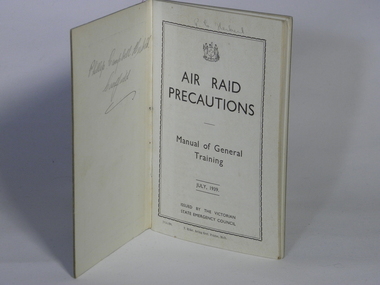
Booklet, Handbook, Victorian State Emergency Council, Air Raid Precautions - Manual of General Training - July 1939, July 1939
... coat of arms, stamped with 'Caulfield Historical Society' in top right hand corner, handwritten in pen '64' and in pencil 'Box 4/1'. Also includes number '7155/39' On inside cover, in pencil, 'Phillip Campbell Hubert' and on first page, in pencil, 'P.C.Hubert' Printed handbook has 66 pages bound in soft cover of heavy weight buff colour with red spine. ...Air Raid Precautions organisations were established in each state in Australia during World War 2. Air Raid Precautions in Victoria were run by Civil Defense organisation. This handbook, one of a series of handbooks, used in Caulfield during World War 2.Represents the importance of air raid wardens to civilian defence to handle the threat posed thus officials issued instructions on what to do in case of an air raid. This handbook was used for the Air Raid Precautions in Caulfield during World War 2.Printed handbook has 66 pages bound in soft cover of heavy weight buff colour with red spine.On front cover contains Victoria coat of arms, stamped with 'Caulfield Historical Society' in top right hand corner, handwritten in pen '64' and in pencil 'Box 4/1'. Also includes number '7155/39' On inside cover, in pencil, 'Phillip Campbell Hubert' and on first page, in pencil, 'P.C.Hubert' air raid precautions, general training, july 1939 -
 Bendigo Military Museum
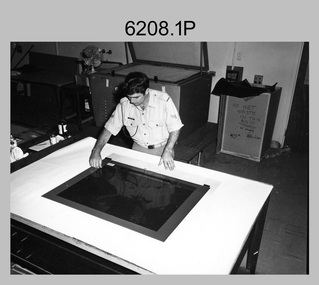
Photograph - Print Troop Equipment and Personnel, Lithographic Squadron – Army Survey Regiment, Fortuna, Bendigo, c1970s
... The photographs were scanned at 300 dpi. .1) - Photo, black & white, c1970s, Preparing printing plate, SGT Alvan Howard. .2) to.3) - Photo, black & white, c1970s, Preparing printing plate, unidentified technician. .4) - Photo, black & white, 1979, Planeta Polygraph Printing Press., L to R: SPR Peter Breukel, CPL Lance Strudwick. .5) - Photo, black & white, c1970s, Ultra-MAN-III Printing Press. .6) and .7) - Photo, black & white, c1970s, Ultra-MAN-III Printing Press, unidentified technician. .8) - Photo, black & white, c1970s, Newkoni Komori Printing Press, unidentified technician. .9) - Photo, black & white, c1970s, Original Heidelberg Printing Press, unidentified technician. .10) - Photo, black & white, c1970s, MANN flatbed proof press, unidentified technician. .11) to .14) - Photo, black & white, c1970s, applying dye to a whirl-on proof, unidentified technician. .15) and .16) - Photo, black & white, c1970s, applying diazo coat to a scribe sheet, CPL Colin Hardisty. .17) - Photo, black & white, c1970s, Krause Wohlenberg heavy-duty paper guillotine, George Austen....The photographs were scanned at 300 dpi. .1) - Photo, black & white, c1970s, Preparing printing plate, SGT Alvan Howard. .2) to.3) - Photo, black & white, c1970s, Preparing printing plate, unidentified technician. .4) - Photo, black & white, 1979, Planeta Polygraph Printing Press., L to R: SPR Peter Breukel, CPL Lance Strudwick. .5) - Photo, black & white, c1970s, Ultra-MAN-III Printing Press. .6) and .7) - Photo, black & white, c1970s, Ultra-MAN-III Printing Press, unidentified technician. .8) - Photo, black & white, c1970s, Newkoni Komori Printing Press, unidentified technician. .9) - Photo, black & white, c1970s, Original Heidelberg Printing Press, unidentified technician. .10) - Photo, black & white, c1970s, MANN flatbed proof press, unidentified technician. .11) to .14) - Photo, black & white, c1970s, applying dye to a whirl-on proof, unidentified technician. .15) and .16) - Photo, black & white, c1970s, applying diazo coat to a scribe sheet, CPL Colin Hardisty. .17) - Photo, black & white, c1970s, Krause Wohlenberg heavy-duty paper guillotine, George Austen. ...This collection of 17 photos was most likely taken in Lithographic Squadron, Army Survey Regiment, Fortuna, Bendigo, c1970s. Although these photos are not annotated most personnel are positively identified. Some photos are cropped enlargements of previous photos. See item 6060.8P for more information and photos of platemaking. There is more information on the Ultra-MAN-III, Komoni and Planeta Printing Presses on pages 71 and 120 of Valerie Lovejoy’s book 'Mapmakers of Fortuna – A history of the Army Survey Regiment’ ISBN: 0-646-42120-4. For additional photos, refer to item 6062.4P for the Heidelberg press, item 6063.5P for the Komori press, item 6064.9P for the Planeta press and item 6065.10P for Ultra-MAN-III presses. In photos .11P to .14P the technician is applying a UV-sensitive pigmented dye emulating one of the map print colours to a white opaque polyester sheet mounted on a rotating table in a whirler. .12P and .14P are enlargements of previous photos. See item 6059.4P for more information and photos on the map proof making process. The Krause Wohlenberg operated by George Austen in photo .17P was a heavy-duty guillotine to trim bulk printed map stock in the c1970s and c1980s. See item 6069.6P for more information and photos of guillotine equipment.This is a set of 17 photographs of Print Troop personnel and equipment from Lithographic Squadron at the Army Survey Regiment, Fortuna, Bendigo, c1970s. The photographs were printed on photographic paper and are part of the Army Survey Regiment’s Collection. The photographs were scanned at 300 dpi. .1) - Photo, black & white, c1970s, Preparing printing plate, SGT Alvan Howard. .2) to.3) - Photo, black & white, c1970s, Preparing printing plate, unidentified technician. .4) - Photo, black & white, 1979, Planeta Polygraph Printing Press., L to R: SPR Peter Breukel, CPL Lance Strudwick. .5) - Photo, black & white, c1970s, Ultra-MAN-III Printing Press. .6) and .7) - Photo, black & white, c1970s, Ultra-MAN-III Printing Press, unidentified technician. .8) - Photo, black & white, c1970s, Newkoni Komori Printing Press, unidentified technician. .9) - Photo, black & white, c1970s, Original Heidelberg Printing Press, unidentified technician. .10) - Photo, black & white, c1970s, MANN flatbed proof press, unidentified technician. .11) to .14) - Photo, black & white, c1970s, applying dye to a whirl-on proof, unidentified technician. .15) and .16) - Photo, black & white, c1970s, applying diazo coat to a scribe sheet, CPL Colin Hardisty. .17) - Photo, black & white, c1970s, Krause Wohlenberg heavy-duty paper guillotine, George Austen.No personnel are annotated. .2P annotated ‘completed development on a negative working plate.’ .3P annotated ‘a wipe-on plate.’ .4P annotated ‘1979’. .12P annotated ‘Re-coating a proof with the next wanted colour on the vertical whirler.’ .13P annotated ‘has hardened (retained) area required. Done on a vertical whirler.’ .15P and .16P annotated ‘Preparing a sheet of scribe material with a Diazo (light sensitive) coating.’royal australian survey corps, rasvy, army survey regiment, army svy regt, fortuna, printing, litho -
 Bendigo Military Museum
Letter - LETTERS, WW2, July 1940 - Jan 41
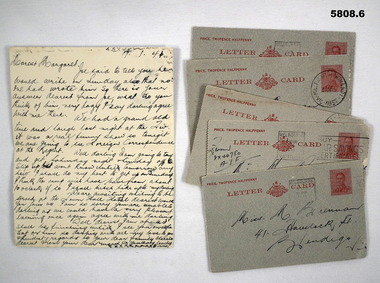
... Letter ( Australian Coat of Arms) Card” Addressed to “Miss. M. Brennan” various addresses in Victoria. Handwritten letter cards, grey heavy paper with red printing and red stamp folded to form an envelope. ...Item/s in collection re B. J. Ruler VX40780 refer Cat No 5790 for his service details.Handwritten letter cards, grey heavy paper with red printing and red stamp folded to form an envelope. The letter tells of current activities and when they will be on leave.Printed on front “ Price, Twopence halfpenny “. Letter ( Australian Coat of Arms) Card” Addressed to “Miss. M. Brennan” various addresses in Victoria.letter cards, letters, ww2 -
 Bendigo Military Museum
Certificate - CERTIFICATE, 50th ANNIVERSARY, 1995
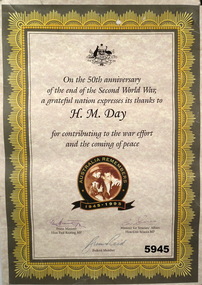
... Certificate - heavy paper. Original document. Black print with Australian Coat of Arms at top and "AUSTRALIA REMEMBERS/ 1945 - 1995" emblem below print. ...Certificate - heavy paper. Original document. Black print with Australian Coat of Arms at top and "AUSTRALIA REMEMBERS/ 1945 - 1995" emblem below print. ...Certificate awarded to H.M. Day.Certificate - heavy paper. Original document. Black print with Australian Coat of Arms at top and "AUSTRALIA REMEMBERS/ 1945 - 1995" emblem below print. Signed by Prime Minister, Minister for Veteran Affairs and Federal Member. Print on beige background with decorative edge and emblem in green and gold colours.On certificate - On the 50th Anniversary/ of the end of the Second World War/ a grateful nation expresses it's thanks to/ H.M. Day/ for contributing to the war effort and the coming peace.certificate, ww2, anniversary -
 Bendigo Military Museum
Clothing - GREAT COAT, 1967
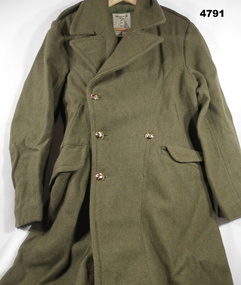
... Army issue Great Coat khaki colour, outer lining heavy duty with green light inner lining, all gold colour buttons intact and have a crown and crossed rifles on, plastic brown buttons under collar one missing, large white label sewn in on with maker, date & personal details, white card label on LH side with coat size....Army issue Great Coat khaki colour, outer lining heavy duty with green light inner lining, all gold colour buttons intact and have a crown and crossed rifles on, plastic brown buttons under collar one missing, large white label sewn in on with maker, date & personal details, white card label on LH side with coat size. ...Peter Ball collection, refer Cat No 4704Army issue Great Coat khaki colour, outer lining heavy duty with green light inner lining, all gold colour buttons intact and have a crown and crossed rifles on, plastic brown buttons under collar one missing, large white label sewn in on with maker, date & personal details, white card label on LH side with coat size.On collar label in black print, “David Klein PTY LTD Victoria 1967 (arrow up) Size 7 Class 8405 - 66 - 012 - 0495”, hand written on in black, “3796117 BALL PC”.clothing, great coat, army issue -
 Bendigo Military Museum
Album - PHOTOGRAPHS OF TWO WORLD WARS, Board of management Australian War memorial, The Changing of the Gaurd, 1944
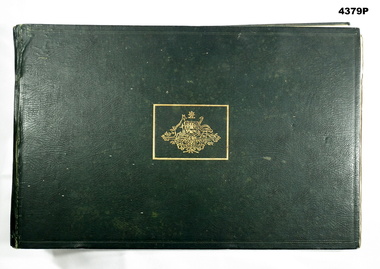
... Album, hard cover, dark green buckram, front cover has Coat of Arms of Australia in gold print, fly leaf front, back and end papers grey embossed heavy weight paper, 104 pages, plain mottled grey colour, illustrated B & W photographs on Matt photo paper....A collection of “Photographs of our Fighting Forces are mainly the work of the Official photographers attached to various services” Albums military History Photograhy Album, hard cover, dark green buckram, front cover has Coat of Arms of Australia in gold print, fly leaf front, back and end papers grey embossed heavy weight paper, 104 pages, plain mottled grey colour, illustrated B & W photographs on Matt photo paper. ...A collection of “Photographs of our Fighting Forces are mainly the work of the Official photographers attached to various services”Album, hard cover, dark green buckram, front cover has Coat of Arms of Australia in gold print, fly leaf front, back and end papers grey embossed heavy weight paper, 104 pages, plain mottled grey colour, illustrated B & W photographs on Matt photo paper.albums military, history, photograhy, -
 Bendigo Military Museum
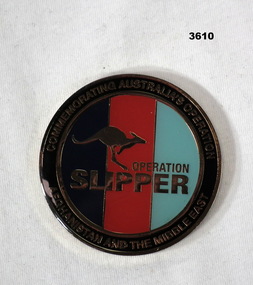
Memorabilia - COMMEMORATION MEDALLION, Post 2014
... Heavy metal & enamel, circular medallion. Centre has 3 coloured stripes, dark blue / red / light blue. Rear is embossed with Australian Coat of Arms, black on gold....Heavy metal & enamel, circular medallion. Centre has 3 coloured stripes, dark blue / red / light blue. Rear is embossed with Australian Coat of Arms, black on gold. ...Heavy metal & enamel, circular medallion. Centre has 3 coloured stripes, dark blue / red / light blue. Rear is embossed with Australian Coat of Arms, black on gold.In centre over stripes: A kangaroo with words “OPERATION SLIPPER” Circumference: COMMEMORATING AUSTRALIAN OPERATION - AFGHANISTAN AND THE MIDDLE EAST” Rear: “OPERATION SLIPPER AUSTRALIA 2001 - 2014” medallion, slipper, operation, commemoration -
 Queenscliffe Maritime Museum
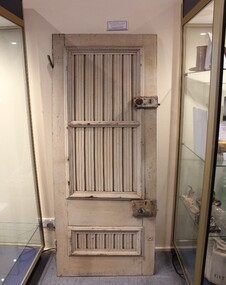
Functional object - Door, cabin
... heavy rain squalls. Reaching the pilot ground Captain Kerr fired rockets and burned blue lights to attract attention, but met with no response. Sighting the Cape Shank lighthouse he sailed towards it, then wore the Victoria Tower onto a port tack in a westerly direction. No soundings nor observations were taken, as Captain Kerr was confident he was on a safe course and knew his position tolerably well. door cabin victoria tower shipwrecks Patent disk on top lock, W2 SR on either side of coat of arms. ...The Victoria Tower made landfall after a voyage of 85 days from Liverpool, and headed towards the Port Phillip Heads pilot boarding ground. It had been an uneventful voyage despite some contrary headwinds (causing the long voyage) and problems with the compasses, that could not be relied upon. The weather was hazy, with gale force winds and heavy rain squalls. Reaching the pilot ground Captain Kerr fired rockets and burned blue lights to attract attention, but met with no response. Sighting the Cape Shank lighthouse he sailed towards it, then wore the Victoria Tower onto a port tack in a westerly direction. No soundings nor observations were taken, as Captain Kerr was confident he was on a safe course and knew his position tolerably well. Slatted wooden cabin door with 2 locksPatent disk on top lock, W2 SR on either side of coat of arms. Number 60 in the middle and 1A carpenter patentee underneathdoor, cabin, victoria tower, shipwrecks -
 Bendigo Military Museum
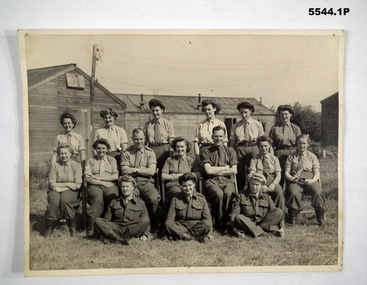
Photograph - PHOTOGRAPHS OF BRITISH ARMY
... Black and white photo, same location as photo 1, mix of men and women in uniform and some women in white coats. 3. Black and white photo, heavily creased of 6 women in uniform in a field in front of a fighter plane....Black and white photo, same location as photo 1, mix of men and women in uniform and some women in white coats. 3. Black and white photo, heavily creased of 6 women in uniform in a field in front of a fighter plane. ...1. Taken 1944 at Liverpool base with a mix of men and women including "Beryl Scrimshaw" (Morrel) from British Army. 2. Aug 1944, Liverpool base, formal photo of men and women in uniform and some women in white coats at same location. 3. Women in uniform in WW2 in front of a British Fighter plane. Refer Cat no. 304P & 315.1. Black and white photo, 14 women and 2 men in British uniforms in formal photo in front of buildings. 2. Black and white photo, same location as photo 1, mix of men and women in uniform and some women in white coats. 3. Black and white photo, heavily creased of 6 women in uniform in a field in front of a fighter plane.1. & 2. Both have the stamp of photographer on back and a note saying photo taken in Liverpool Aug 1944. 3. Identification notes written on back and identification of Unit - faded and hard to read.british army, liverpool, uk, ww2
