
Showing 73 items matching "henty road"
-
 Eltham District Historical Society Inc
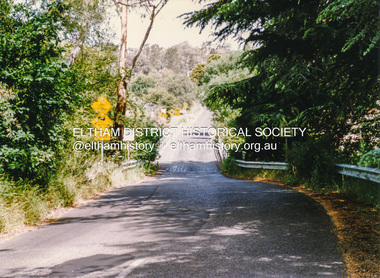
Photograph, Doug Orford, Bridge, Henty Road, Lower Plenty, 1991, 1991
... Bridge, Henty Road, Lower Plenty, 1991......henty road...From a collection of 35 photos taken by Doug Orford at 35 specific locations along the exact boundary of the then Shire of Eltham. bridges henty road lower plenty Colour photograph Bridge, Henty Road, Lower Plenty, 1991 Photograph Photograph Doug Orford ...From a collection of 35 photos taken by Doug Orford at 35 specific locations along the exact boundary of the then Shire of Eltham.Colour photographbridges, henty road, lower plenty -
 Glenelg Shire Council Cultural Collection
Print - Contact Prints - Cape Nelson Road; Henty Street, 1960-1979
... Contact Prints - Cape Nelson Road; Henty Street...Top: Cape Nelson Road looking toward Bentinck Street. Bottom: Henty Street looking towards sea, All Saints on left....Print Contact Prints - Cape Nelson Road; Henty Street ...Sheet of 2 black and white contact prints from glass plate negatives. Top: Cape Nelson Road looking toward Bentinck Street. Bottom: Henty Street looking towards sea, All Saints on left. -
Kew Historical Society Inc
Archive (Sub-series) - Subject File, Field Place (Kew), 1981
... henty...field place - studley park road - henty court (kew)...Archive file containing photographs, a newspaper article/clipping, correspondence and a report by the Society to the Historic Buildings Preservation Council (HBPC) into the classification or otherwise of Field Place, the home of Francis Henty in Studley Park Road, and now entered via Henty Court. ...Typically files will contain primary and secondary sources. kew (vic) - history francis henty field place - studley park road - henty court (kew) Archive file containing photographs, a newspaper article/clipping, correspondence and a report by the Society to the Historic Buildings Preservation Council (HBPC) into the classification or otherwise of Field Place, the home of Francis Henty in Studley Park Road, and now entered via Henty Court. ...Various partiesReference, Research, InformationSecondary Values (KHS Imposed Order)Subject file containing photographs, a newspaper article/clipping, correspondence and a report by the Society to the Historic Buildings Preservation Council (HBPC) into the classification or otherwise of Field Place, the home of Francis Henty in Studley Park Road, and now entered via Henty Court. The HBPC file contains a letter from the current owner expressing what he considers to be its heritage significance. kew (vic) - history, francis henty, field place - studley park road - henty court (kew)kew (vic) - history, francis henty, field place - studley park road - henty court (kew) -
 Ruyton Girls' School
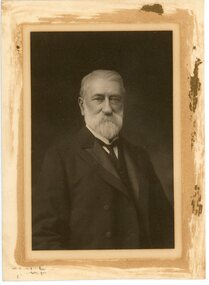
Photograph - Studio Portrait, [Henry Henty], c.1890
... Henty...Selbourne Road...Henry Henty Tarring Marion Henty Selbourne Road Kew (Vic) Ruyton Girls' School businessman politician 1890s Half-length, sepia-toned studio portrait of Mr Henry Henty (b.1833-d.1912). ...Henry Henty (b.1833-d.1912) was a successful businessman, and briefly a MLA for the seat of Grenville, Victoria in 1866. He was one of three sons of James Henty, and nephew of Edward Henty who is considered to be the first permanent European colonist to take up residence in Victoria. Henry Henty and his wife Marion Ann Henty (nee McKellar) had ‘Tarring’, Kew built for their family in 1872. The Henty family resided at ‘Tarring’ until the death of Marion Henty in 1919. ‘Tarring’ was then sold to Ruyton Girls’ School, and the School moved to the site, (now 12 Selbourne Rd, Kew) in 1920. ‘Tarring’ was renamed ‘Henty House’ in honour of its original owners. Half-length, sepia-toned studio portrait of Mr Henry Henty (b.1833-d.1912). Mr Henty wears a dark suit and tie. His body is one quarter turned to his left, while he looks straight towards the camera. The background behind him is plain and dark. Photograph is mounted on cream card.henry henty, tarring, marion henty, selbourne road, kew (vic), ruyton girls' school, businessman, politician, 1890s -
 Ruyton Girls' School
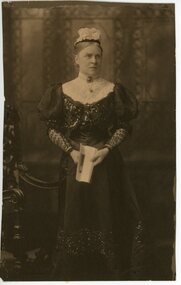
Photograph - Studio Portrait, [Marion Henty], c.1890
... henty...tarring...selbourne road...‘Tarring’ was renamed ‘Henty House’ in honour of its original owners. marion henty henry henty tarring selbourne road marion mckellar Ruyton Girls' School Kew (Vic) woman book cameo studio portrait 1890s Full length, sepia toned studio portrait of Mrs Marion Henty (b.1838-d.1919). ...Marion Anne McKellar, the daughter of William Gilbert McKellar and Maria Jones was born in 1838. She married Henry Henty in 1859 and they had 9 children. She died in June 1919. Henry Henty and his wife Marion had ‘Tarring’, Kew built for their family in 1872. The Henty family resided at ‘Tarring’ until the death of Marion Henty in 1919. ‘Tarring’ was then sold to Ruyton Girls’ School, and the School moved to the site, (now 12 Selbourne Rd, Kew) in 1920. ‘Tarring’ was renamed ‘Henty House’ in honour of its original owners. Full length, sepia toned studio portrait of Mrs Marion Henty (b.1838-d.1919). Mrs Henty is standing, hold holds a book in front of her while looking to her left. She is wearing a lace cap on her head and has a cameo broach around her neck.marion henty, henry henty, tarring, selbourne road, marion mckellar, ruyton girls' school, kew (vic), woman, book, cameo, studio portrait, 1890s -
 Ruyton Girls' School
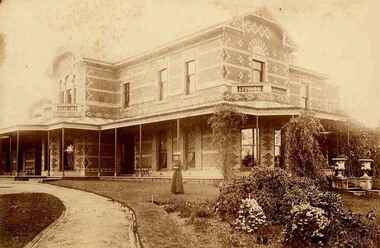
Photograph, [Miss Beatrice Henty in the Garden of Tarring], 1904
... henty house...selbourne road...Sepia toned photograph Miss Beatrice Henty in the garden of her family home Tarring, Selbourne Road, Kew. The north east and south facades of the two story brick house are visible in the photo. ...The photograph is dated c.1904. ruyton girls' school kew beatrice henty henry henty marion henty tarring henty house selbourne road beatrice blandy Kew (Vic) 1900s 1904 Sepia toned photograph Miss Beatrice Henty in the garden of her family home Tarring, Selbourne Road, Kew. ...Beatrice Charlotte Henty was born 25 December 1867, married Graham Frederick Blandy in 1927 and died on 5 March 1950 in Toorak. She did not have any children. Miss Beatrice Henty was the daughter of Henry and Marion Henty. Mr Henry Henty and his wife Mrs Marion Anne Henty (nee McKellar) had ‘Tarring’, Kew built for their family in 1872, and resided there until the death of Marion Henty in 1919. ‘Tarring’ was then sold to Ruyton Girls’ School, and the School moved to the site, (now 12 Selbourne Rd, Kew) in 1920. ‘Tarring’ was renamed ‘Henty House’ by Ruyton Girls' School in honour of its original owners. Ruyton Girls' School was founded in 1878, Miss Beatrice Henty attended the School before 1888. The photograph is dated c.1904. Sepia toned photograph Miss Beatrice Henty in the garden of her family home Tarring, Selbourne Road, Kew. The north east and south facades of the two story brick house are visible in the photo. Beatrice Henty is standing in the garden wearing a long gown and a large hat. A gravel path curves across the lower left corner of the photograph. The photograph is mounted on card.ruyton girls' school, kew, beatrice henty, henry henty, marion henty, tarring, henty house, selbourne road, beatrice blandy, kew (vic), 1900s, 1904 -
Glenelg Shire Council Cultural Collection
Postcard - Postcard - Portland Victoria Landmarks, NUCOLORVUE PRODUCTIONS PTY LTD, n.d
... Coloured postcard, consists of 4 small photographs separated by white border, wavy edges. Edward Henty cottage, Ridge Road Olinda - top left photo, store and cottage, top right. ...'Love from Nita' in blue biro Coloured postcard, consists of 4 small photographs separated by white border, wavy edges. Edward Henty cottage, Ridge Road Olinda - top left photo, store and cottage, top right. ...Coloured postcard, consists of 4 small photographs separated by white border, wavy edges. Edward Henty cottage, Ridge Road Olinda - top left photo, store and cottage, top right. Cottage kitchen bottom left, cottage at bottom rightBack: Information about Edward Henty. 'Love from Nita' in blue biro -
Glenelg Shire Council Cultural Collection
Photograph - Contact Print - Portland, 1970s
... Middle 2, slightly different views of back of bathing boxes and road, Henty Beach. Bottom 2, left image Henty Beach looking towards Fisherman's Breakwater. ...Middle 2, slightly different views of back of bathing boxes and road, Henty Beach. Bottom 2, left image Henty Beach looking towards Fisherman's Breakwater. ...Sheets of 6 black and white contact prints from glass plate negative. Top 2, slightly different views of Old London Inn, Cr Julia and Bentinck Streets. Middle 2, slightly different views of back of bathing boxes and road, Henty Beach. Bottom 2, left image Henty Beach looking towards Fisherman's Breakwater. Right 1, image Old Town Hall.portland, julia street, portland town centre, seafront -
 Flagstaff Hill Maritime Museum and Village
Weapon - Cannon, circa 1825
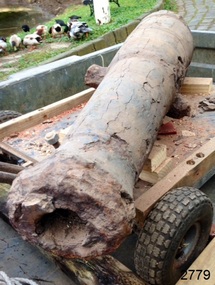
... Road...Shipwreck Coast...shipwreck artefact...Children...barque...three-masted...Liverpool...Childer’s Cove...Port Campbell...1839 shipwreck...1939 wreck...James Henty...Henty settlement. Flagstaff Hill Flagstaff Hill Maritime Museum and Village Warrnambool Maritime Museum Maritime Village Great Ocean Road Shipwreck Coast shipwreck artefact Children barque three-masted Liverpool Childer’s Cove Port Campbell 1839 shipwreck 1939 wreck James Henty and Co Henty Brothers Captain H. ...In an article dated 26 March 1963, the Warrnambool Standard reported: “A cannon which has lain on the ocean floor since the barque, Children, was wrecked at Childer’s Cove on January 15, 1839, was raised by three Warrnambool skindivers at the weekend … The cannon, weighing about 750 lb. and 4-ft. 6-in. in length … is in excellent order considering the length of time it has remained underwater”. No conservation measures were taken at that time, other than chipping off the marine growth with hammers and cold chisels. The minutes for the 4 February 1974 meeting of the Flagstaff Hill Planning Board recorded that “a cannon recovered some time ago was lying in the garden of [one of the three original divers] and that it could be picked up at any time”. Peter Ronald, past Manager and Diver for Flagstaff Hill, notes that the CHILDREN cannon would have been recovered by the other divers around 1964. When the cannon came into care of Flagstaff Hill, it was given basic conservation relevant to the time. (At the same meeting, the Board was advised of the recovery of an anchor from the wreck of the CHILDREN by Flagstaff Hill divers (Peter Ronald, Colin Goodall and Gary Hayden, and Hank Howey and Andrew Coffee), and its interim relocation in the sea at the end of the Warrnambool Breakwater while awaiting conservation). About the ship CHILDREN 1825-1839: The sailing ship Children was a wooden, three-masted barque constructed of pitch pine in 1825 at Liverpool. It was felt sheathed and was coppered during an upgrade in 1837. The ship was only 29 metres long and 254 tons in weight; it had two decks and a square stern. The James Henty & Co., a pioneering family from Portland, Victoria, purchased the Children in 1837 for use as a coastal trader. The Children, under the command of Captain H. Browne, was on a voyage from Launceston to Adelaide when it foundered in rough conditions at Childers Cove, west of Peterborough, on 14 January 1839. On board were 14 crew members and 24 passengers, including 9 children. The ship’s cargo was awkwardly balanced: it carried 1500 sheep, 8 bullocks, 7 horses, 5000 London house bricks, 6 whaling boats with associated gear, and general trade goods including beef, pork, tobacco, tipe, butter, lime juice, horse hair, curtains, lead shot, beer and spirits. The hurricane-force winds drove the Children into the limestone stack at the entrance to the cove. The seas smashed it into pieces within twenty minutes. The bodies of sixteen of those who had lost their lives were spread across the shore, along with wreckage from the ship and the cargo of animals. Those who survived suffered injuries; they were rescued and taken by horse and cart to Campbell’s farm, near the whaling station at Port Fairy. They arrived at Portland eleven days after the wreck. The wrecking of the Children is one of colonial Victoria’s earliest and most significant maritime disasters. Little is left to mark the tragedy, apart from some house bricks intended for the Henty family’s Portland Bay settlement. Artefacts recovered in the 1960s to early 1970s include this signal cannon, an anchor, the bottom half of her ship’s bell, and two portions of a ship’s fitting, at one time thought to be a brass porthole frame, London housing bricks and timber flooring. Despite its poor condition, the CHILDREN’s signal cannon remains an important and interpretable record of its demise. From 2015, the CHILDREN cannon has been undergoing the first stages of further conservation.The signal cannon recovered from the Children's wreck is significant as part of the original fittings of the early 19th-century barque. It is an example of maritime defence in the early to mid-19th century. The 1839 wreck and recovered artefacts are examples of the construction methods and materials used in that era and can be used to study the evolution of shipbuilding methods and principles. The wreck of the Children is of state significance as one of colonial Victoria’s earliest and most significant maritime disasters, and one of the first vessels lost in the Western District. This is recognised by its inclusion on the Victorian Heritage Register, VHR No. S116. Little is left on the seabed to mark the tragedy, apart from some of the house bricks intended for the Henty settlement. Signal cannon: a 1.3 metre iron 6pdr cannon recovered from the wreck of the CHILDREN. The shape of the cannon tapers from a thick round breech to a flared muzzle, with an 8-centimetre bore, and two side trunnions for pivoting on a wooden gun carriage. It was recovered from the shipwreck site of the CHILDREN by local divers in 1963. This small muzzle-loading signal cannon is in poor and unrestored condition. The cannon’s upper profile of smooth grey metal casing has corroded off, leaving an extensively oxidised rough red surface of crumbling iron. The bottom half of the cannon remains intact, although the outer smooth casing also appears to be separating from the iron core of the barrel. The original grey casting is also missing from the breech and muzzle ends of the cannon. Corrosion and spalling of the upper surface layer of the cannon have removed the maker’s marks and specificationsflagstaff hill, flagstaff hill maritime museum and village, warrnambool, maritime museum, maritime village, great ocean road, shipwreck coast, shipwreck artefact, children, barque, three-masted, liverpool, childer’s cove, port campbell, 1839 shipwreck, 1939 wreck, james henty and co, henty brothers, captain h. browne, first mate t. gay, second mate w. wentworth, portland, portland bay, 1939, ship’s cannon, signal cannon, conservation of marine artefacts, 6pdr small bore cannon, defence -
 Flagstaff Hill Maritime Museum and Village
Functional object - Ship's Fitting, circa 1825
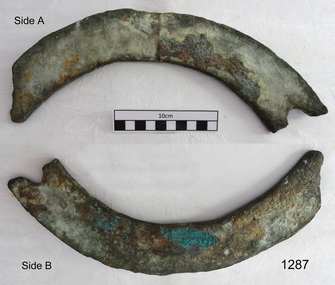
... Road...Shipwreck Coast...shipwreck artefact...Children...Childer’s Cove...Port Campbell...1839 shipwreck...James Henty...Henty settlement. Flagstaff Hill Flagstaff Hill Maritime Museum and Village Warrnambool Maritime Museum Maritime Village Great Ocean Road Shipwreck Coast shipwreck artefact Children Childer’s Cove Port Campbell 1839 shipwreck James Henty and Co Henty Brothers Captain H. ...This attractively patinated artefact was raised from the wreck site of the CHILDREN and was quite reasonably catalogued as a portion of a ship's porthole. This identification is unlikely, however, because the CHILDREN was built at Liverpool in 1824, and round portholes were not in common use until the 1850s. The catalogue identification has since been changed to "Ship's Fitting" Before the appearance of round portholes in the middle of the nineteenth century, the function of introducing light to lower decks was performed by square half-glassed ‘ports’ in the side of the hull (known as a port-sash), or ground-glass ‘bullseyes’ inserted in the deck (scuttles). In historical terms, ports were always square, cut into the timber originally to allow the firing of a ship's guns, and were closed in weather by a tight-fitting square hatch. Flagstaff Hill Shipwreck Museum has three portholes on display that illustrate the gradual development and adoption of circular brass portholes. First in sequence is a small 12.5cm diameter window (with a deep frame for thick wooden hulls) from the 1855 wreck of SCHOMBERG. The second and third are larger 25cm diameter windows (with a shallower frame for thinner iron hulls) from the 1892 wreck of the NEWFIELD and the 1908 wreck of the FALLS OF HALLADALE. Once the apparently obvious use of the brass object is discounted, an accurate and reliable alternative classification is difficult to specify. One artefact register notes it was ‘found in about the centre of the wreck site’. This would mitigate against the possibilities of (1) ‘horseshoe frame’ joining pieces of the keel and hull at the bow of the vessel, or (2) ‘deckseat’ for a binnacle at the stern. It may support the idea of a ‘head frame’ on a cooped companionway or a ‘deckseat’ for a mainmast pump. But this is only speculation. The actual identification is not known. The sip's fitting recovered from the Children's wreck is significant as part of the original fittings of the early 19th-century barque. The 1839 wreck and recovered artefacts are examples of the construction methods and materials used in that era and can be used to study the evolution of shipbuilding methods and principles. The wreck of the Children is of state significance as one of colonial Victoria’s earliest and most significant maritime disasters, and one of the first vessels lost in the Western District. This is recognised by its inclusion on the Victorian Heritage Register, VHR No. S116. Little is left on the seabed to mark the tragedy, apart from some of the house bricks intended for the Henty settlement. Ship's fitting, of heavy gauge brass circle, previously classified as a section of the ship's fitting, which was raised from the wreck of the Children. One end is broken off at an original bolt hole, and the other is severed or cut at an acute angle from the inner rim. The artefact is 6cm across and 1cm deep, indicating strength and function as a substantial and finished item of moulded metal. The upper face bears sedimentary accretion stained red/brown. The rear face has been gouged by hard or corrosive materials and bears brilliant blue/green oxidation.flagstaff hill, flagstaff hill maritime museum and village, warrnambool, maritime museum, maritime village, great ocean road, shipwreck coast, shipwreck artefact, children, childer’s cove, port campbell, 1839 shipwreck, james henty and co, henty brothers, captain h. browne, portland, portland bay, brass flange, brass rim, ship’s fitting -
 Flagstaff Hill Maritime Museum and Village
Equipment - Anchor, Before 1831
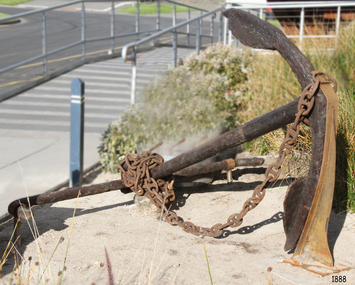
... Road...Shipwreck Coast...shipwreck artefact...Children...barque...three-masted...Liverpool...Childer’s Cove...Port Campbell...1839 shipwreck...1939 wreck...James Henty...Henty settlement. Flagstaff Hill Flagstaff Hill Maritime Museum and Village Warrnambool Maritime Museum Maritime Village Great Ocean Road Shipwreck Coast shipwreck artefact Children barque three-masted Liverpool Childer’s Cove Port Campbell 1839 shipwreck 1939 wreck James Henty and Co Henty Brothers Captain H. ...The anchor is from the wooden sailing ship CHILDREN, which was wrecked at Childers Cove east of Warrnambool on the 14th of January 1839 with the loss of 16 lives. The Children anchor was raised from the wreck site by Flagstaff Hill Divers: Peter Ronald, Garry Hayden (Terang, still), Tim Goodall (now Warrnambool), and Colin Goodall (now Warrnambool), on Sunday, 3rd January 1974. A week or so later, it was dragged up the cliffs and taken to Warrnambool. It is now on display near the entrance to the Maritime Museum and Village. It appears to be a Pering’s Improved Anchor, developed at Portsmouth after 1813. The addition of broad curvature to the anchor arms provided a stronger purchase than the pre-existing Admiralty Old Pattern Long Shanked Anchor with straight arms. However, the evidence of hammer-welding of the separate pieces of the arms and palms to the central shank, peaked crown and flat palms, suggests the manufacture is before the 1831 Rodger’s Anchor design, which cast both arms and their flukes as one piece that was then attached to the shank by a bolt through the crown. This identification seems consistent with the date of the CHILDREN’s construction in 1824. The CHILDREN was a three-masted barque with a wooden hull built at Liverpool in England. The vessel was bought by the Henty family of Portland (Australia Felix) in 1837 for regular coastal trading between Van Diemens Land (now Tasmania), the Port Phillip District of New South Wales and South Australia. Only 255 tons burden (92 feet in length, with a beam of 25 feet and depth of 17 feet), it sailed from Launceston bound for Adelaide in late December 1838, on its first Australian voyage and under the English master who had brought the barque out, Captain H. Browne. On board the CHILDREN were 24 passengers, including 9 children, the captain and 14 crew; livestock of 1500 sheep, 8 bullocks and 7 horses; general cargo of beef, pork, tobacco, tripe, butter, limejuice, horse hair, currants, lead shot, beer and spirits; 5,000 house bricks from London; and six whaling boats with associated whaling gear. The vessel was battered by gale-force north-westerly winds shortly after setting out from Launceston on 11 January 1839, and adverse sailing conditions persisted for the next four days. At 11 pm on the 14th of January 1839, and many miles north and east of the captain’s navigated position, the CHILDREN struck the Pinnacle, a limestone stack off what is now called Childers Cove. Within half an hour, the ship was destroyed. As well as the loss of livestock and cargo, 16 passengers and crew perished, including the captain, six men, one woman and nine children. In 1931, shifting sands at Childers Cove uncovered the skeleton of an adult male. In 1951, another two skeletons were exposed by storms, an adult male and a child. In 1963, some district scuba divers retrieved a small signal cannon from the site. And in 1974, Flagstaff Hill recovered the anchor and some house bricks. The anchor recovered from the Children's wreck is significant as part of the equipment of the early 19th-century barque. The 1839 wreck and recovered artefacts are examples of the construction methods and materials used in that era and can be used to study the evolution of shipbuilding methods and principles. The wreck of the Children is of state significance as one of colonial Victoria’s earliest and most significant maritime disasters, and one of the first vessels lost in the Western District. This is recognised by its inclusion on the Victorian Heritage Register, VHR No. S116. Little is left on the seabed to mark the tragedy, apart from some of the house bricks intended for the Henty settlement. A large forged, wrought iron anchor from the wreck of the CHILDREN. Flat hammer-welded flukes on opposing curved arms and a peaked crown. It has a metal, elbowed stock or cross-bar and a heavy-duty pinned, flat-ring shackle for the anchor chain. It is in fair condition but extensively corroded after 135 years on the seabed. flagstaff hill, flagstaff hill maritime museum and village, warrnambool, maritime museum, maritime village, great ocean road, shipwreck coast, shipwreck artefact, children, barque, three-masted, liverpool, childer’s cove, port campbell, 1839 shipwreck, 1939 wreck, james henty and co, henty brothers, captain h. browne, first mate t. gay, second mate w. wentworth, portland, portland bay, anchor, ship’s anchor, peter ronald, garry hayden, tim goodall, colin goodall, pering’s improved anchor -
 Flagstaff Hill Maritime Museum and Village
Functional object - Wood sample
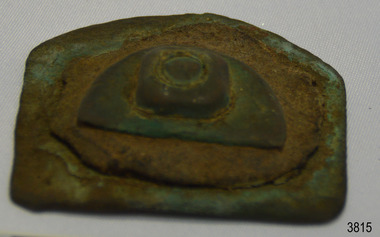
... road...west coast trader...apollo bay...mid-19th century shipwreck...the grange...scottish barque...little henty...The Grange is an example of a mid-19th century vessel that carried a weapon of defence onboard. flagstaff hill warrnambool flagstaff hill maritime museum maritime museum shipwreck coast flagstaff hill maritime village great ocean road west coast trader apollo bay mid-19th century shipwreck the grange scottish barque little henty reef captain a alexander underwater explorers club of victoria 1840s carronade vhr 5297 coastal trader wooden shipwreck john chance wood sample wooden ship oak timber ship fitting Wood sample, oak wood fixed between plates and secured by a washer and bolt. ...This oak wood sample is part of the wooden barque, the Grange, built in 1840. The wood sample was recovered from the shipwreck of the Grange in around 1968, 110 years after the Grange was wrecked (see below for further details on the Grange). It is part of the John Chance Collection. THE GRANGE, 1840-1858- The wooden barque ’Grange’ was a three-masted ship built in Scotland in 1840 for international and coastal trade. On March 22, 1858, the Grange set sail from Melbourne under Captain A. Alexander, carrying a cargo of ballast. The barque had left the Heads of Phillip Bay and was heading west along the Victorian coast towards Cape Otway. The ship struck Little Haley’s Reef at Apollo Bay due to a navigational error and was stuck on the rocks. The crew left the ship carrying whatever they could onto the beach. Eventually, the remains of the hull, sails and fittings were salvaged before the wreck of the Grange broke up about a month later. About 110 years later, in 1968, the wreck of the Grange was found by divers from the Underwater Explorers Club of Victoria. They were amazed to find a unique, six to nine pound carronade (type of small cannon) and a cannonball on the site. There have been no other similar carronades recorded. In that same year the anchor of the Grange was recovered by diver John Chance and Mal Brown. The wood sample is significant historically as an example of hardware used when building wooden ships in the early to mid-19th century. The sample is historically significant as an example of the work and trade of blacksmith. The sample is also has significant as it was recovered by John Chance, a diver from the wreck of the Grange in the 1968. Items that come from several wrecks along Victoria's coast have since been donated to the Flagstaff Hill Maritime Village’s museum collection by his family, illustrating this item’s level of historical value. The sample is historically significant for its association with the 1840s wooden barque, the Grange. The Grange is an historical example of a Scottish built vessel used for international and coastal trader of both cargo and passengers in the mid-19th century. The Grange is an example of an early ship, designed with a wooden hull. It is significant as a ship still available to divers along the south coast of Victoria, for research and education purposes. The Grange is an example of a mid-19th century vessel that carried a weapon of defence onboard. Wood sample, oak wood fixed between plates and secured by a washer and bolt. There are five layers, each decreasing in size from base to the top. The bottom is a five-sided copper plate, above it is the oak sample that is crumbling and fragile, then a half-disc metal plate, then a square metal washer, then a round metal bolt head. The metal plate has unequal sides, the longest is parallel to the strait side of the half disc. flagstaff hill, warrnambool, flagstaff hill maritime museum, maritime museum, shipwreck coast, flagstaff hill maritime village, great ocean road, west coast trader, apollo bay, mid-19th century shipwreck, the grange, scottish barque, little henty reef, captain a alexander, underwater explorers club of victoria, 1840s carronade, vhr 5297, coastal trader, wooden shipwreck, john chance, wood sample, wooden ship, oak timber, ship fitting -
 Flagstaff Hill Maritime Museum and Village
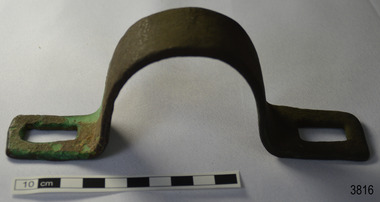
Functional object - Bracket
... road...west coast trader...apollo bay...mid-19th century shipwreck...the grange...scottish barque...little henty...The Grange is an example of a mid-19th century vessel that carried a weapon of defence onboard. flagstaff hill warrnambool flagstaff hill maritime museum maritime museum shipwreck coast flagstaff hill maritime village great ocean road west coast trader apollo bay mid-19th century shipwreck the grange scottish barque little henty reef captain a alexander underwater explorers club of victoria 1840s carronade vhr 5297 coastal trader wooden shipwreck john chance wooden ship ship fitting bracket Bracket, brass, U shaped with rectangular flat ends. ...This metal bracket is part of the wooden barque, the Grange, built in 1840. The bracket was recovered from the shipwreck of the Grange in around 1968, 110 years after the Grange was wrecked (see below for further details on the Grange). It is part of the John Chance Collection. THE GRANGE, 1840-1858- The wooden barque ’Grange’ was a three-masted ship built in Scotland in 1840 for international and coastal trade. On March 22, 1858, the Grange set sail from Melbourne under Captain A. Alexander, carrying a cargo of ballast. The barque had left the Heads of Phillip Bay and was heading west along the Victorian coast towards Cape Otway. The ship struck Little Haley’s Reef at Apollo Bay due to a navigational error and was stuck on the rocks. The crew left the ship carrying whatever they could onto the beach. Eventually, the remains of the hull, sails and fittings were salvaged before the wreck of the Grange broke up about a month later. About 110 years later, in 1968, the wreck of the Grange was found by divers from the Underwater Explorers Club of Victoria. They were amazed to find a unique, six to nine pound carronade (type of small cannon) and a cannonball on the site. There have been no other similar carronades recorded. In that same year the anchor of the Grange was recovered by diver John Chance and Mal Brown. The bracket is significant historically as an example of hardware used when building wooden ships in the early to mid-19th century. The bracket is historically significant as an example of the work and trade of blacksmith. The bracket also has significant as it was recovered by John Chance, a diver from the wreck of the Grange in the 1968. Items that come from several wrecks along Victoria's coast have since been donated to the Flagstaff Hill Maritime Village’s museum collection by his family, illustrating this item’s level of historical value. The bracket is historically significant for its association with the 1840s wooden barque, the Grange. The Grange is an historical example of a Scottish built vessel used for international and coastal trader of both cargo and passengers in the mid-19th century. The Grange is an example of an early ship, designed with a wooden hull. It is significant as a ship still available to divers along the south coast of Victoria, for research and education purposes. The Grange is an example of a mid-19th century vessel that carried a weapon of defence onboard.Bracket, brass, U shaped with rectangular flat ends. Both ends have a formed rectangular hole in them; the hole has rounded corners. The metal has corroded in places and has green concretion.flagstaff hill, warrnambool, flagstaff hill maritime museum, maritime museum, shipwreck coast, flagstaff hill maritime village, great ocean road, west coast trader, apollo bay, mid-19th century shipwreck, the grange, scottish barque, little henty reef, captain a alexander, underwater explorers club of victoria, 1840s carronade, vhr 5297, coastal trader, wooden shipwreck, john chance, wooden ship, ship fitting, bracket -
 Flagstaff Hill Maritime Museum and Village
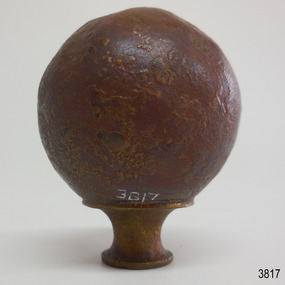
Decorative object - Sphere
... road...west coast trader...apollo bay...mid-19th century shipwreck...the grange...scottish barque...little henty...The Grange is an example of a mid-19th century vessel that carried a weapon of defence onboard. flagstaff hill warrnambool flagstaff hill maritime museum maritime museum shipwreck coast flagstaff hill maritime village great ocean road west coast trader apollo bay mid-19th century shipwreck the grange scottish barque little henty reef captain a alexander underwater explorers club of victoria 1840s carronade vhr 5297 coastal trader wooden shipwreck john chance wooden ship ship fitting sphere knob bed knob post decoration Sphere; thin hollow copper, various shades of brown, dimpled or hammered surface with a sheen, no joins. ...This metal sphere is part of the wooden barque, the Grange, built in 1840. The sphere was recovered from the shipwreck of the Grange in around 1968, 110 years after the Grange was wrecked (see below for further details on the Grange). It is part of the John Chance Collection. THE GRANGE, 1840-1858- The wooden barque ’Grange’ was a three-masted ship built in Scotland in 1840 for international and coastal trade. On March 22, 1858, the Grange set sail from Melbourne under Captain A. Alexander, carrying a cargo of ballast. The barque had left the Heads of Phillip Bay and was heading west along the Victorian coast towards Cape Otway. The ship struck Little Haley’s Reef at Apollo Bay due to a navigational error and was stuck on the rocks. The crew left the ship carrying whatever they could onto the beach. Eventually, the remains of the hull, sails and fittings were salvaged before the wreck of the Grange broke up about a month later. About 110 years later, in 1968, the wreck of the Grange was found by divers from the Underwater Explorers Club of Victoria. They were amazed to find a unique, six to nine pound carronade (type of small cannon) and a cannonball on the site. There have been no other similar carronades recorded. In that same year the anchor of the Grange was recovered by diver John Chance and Mal Brown. The sphere is significant historically as an example of hardware used when building wooden ships in the early to mid-19th century. The sphere is historically significant as an example of the work and trade of blacksmith. The sphere also has significant as it was recovered by John Chance, a diver from the wreck of the Grange in the 1968. Items that come from several wrecks along Victoria's coast have since been donated to the Flagstaff Hill Maritime Village’s museum collection by his family, illustrating this item’s level of historical value. The sphere is historically significant for its association with the 1840s wooden barque, the Grange. The Grange is an historical example of a Scottish built vessel used for international and coastal trader of both cargo and passengers in the mid-19th century. The Grange is an example of an early ship, designed with a wooden hull. It is significant as a ship still available to divers along the south coast of Victoria, for research and education purposes. The Grange is an example of a mid-19th century vessel that carried a weapon of defence onboard. Sphere; thin hollow copper, various shades of brown, dimpled or hammered surface with a sheen, no joins. Base has a small hole and is fitted with a hollow, cylindrical brass collar. The collar had a rim on top, inward curving sides and a narrower rim on the bottom. The sphere looks similar to a bed post knob.flagstaff hill, warrnambool, flagstaff hill maritime museum, maritime museum, shipwreck coast, flagstaff hill maritime village, great ocean road, west coast trader, apollo bay, mid-19th century shipwreck, the grange, scottish barque, little henty reef, captain a alexander, underwater explorers club of victoria, 1840s carronade, vhr 5297, coastal trader, wooden shipwreck, john chance, wooden ship, ship fitting, sphere, knob, bed knob, post decoration -
 Flagstaff Hill Maritime Museum and Village
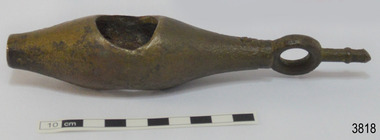
Instrument - Ship Log
... road...west coast trader...apollo bay...mid-19th century shipwreck...the grange...scottish barque...little henty...The Grange is an example of a mid-19th century vessel that carried a weapon of defence onboard. flagstaff hill warrnambool flagstaff hill maritime museum maritime museum shipwreck coast flagstaff hill maritime village great ocean road west coast trader apollo bay mid-19th century shipwreck the grange scottish barque little henty reef captain a alexander underwater explorers club of victoria vhr 5297 coastal trader wooden shipwreck john chance wooden ship taffrail log marine instrument marine technology navigation nautical instrument mechanical log nautical navigation navigation equipment scientific instrument ship log ship log register ship speed taff rail log patent log towed log taffrail log fish edward massey thomas walker Ship log fitting, called a fish; part of a brass navigational instrument, likely to be from a taffrail log. ...The ship's log part, called a fish, is likely to be from a mechanical taffrail log system. It was recovered from the wreck site of the barque, the 1840-1852 Grange. There are no marks on the fish to identify its maker or model. It is part of the John Chance Collection. This ‘fish’ is part of an early to mid-1800s ship's log. It would likely have been part of a taffrail log connected to a rotor (also called propeller, spinner) by a strong line, and the other end connected by a line to a dial mounted on the taffrail, or stern rail, at the stern of the vessel. As the propeller rotated through the water it would spin the log, which in turn would cause a number to register on the dial, showing the current speed in knots; one knot equals one nautical mile per hour. TAFFRAIL LOGS A taffrail log is a nautical instrument used for measuring the speed of a vessel, providing vital navigational information to be calculated, such as location and direction. A log has been used to measure the speed of a vessel since the 1500s. A simple piece of wood was tied to a long line and thrown into sea at the back of the vessel. The rope was knotted all along at equal distances apart. On a given signal the log line was pulled back into the vessels, the knots counted until the log came up, then the figures were calculated by a navigator In 1802 the first successful mechanical log available for general use was invented by Edward Massey. It had a rotor 'V' section connected to a recording mechanism. The water’s movement rotated the rotor, which intern sent the movement to the recorder. There are examples of this invention available to see in some of the maritime museums. Thomas Walker, nephew of Edward Massey, improved on Massey’s design, and Walker and his son took out a patent on the A1 Harpoon Log. In 1861. Both Massey and Walker continued to improve the designs of the taffrail log. New designs were still being introduced, even up to the 1950s. THE GRANGE, 1840-1858- The wooden barque ’Grange’ was a three-masted ship built in Scotland in 1840 for international and coastal trade. On March 22, 1858, the Grange set sail from Melbourne under Captain A. Alexander, carrying a cargo of ballast. The barque had left the Heads of Phillip Bay and was heading west along the Victorian coast towards Cape Otway. The ship struck Little Haley’s Reef at Apollo Bay due to a navigational error and was stuck on the rocks. The crew left the ship carrying whatever they could onto the beach. Eventually, the remains of the hull, sails and fittings were salvaged before the wreck of the Grange broke up about a month later. About 110 years later, in 1968, the wreck of the Grange was found by divers from the Underwater Explorers Club of Victoria. They were amazed to find a unique, six to nine pound carronade (type of small cannon) and a cannonball on the site. There have been no other similar carronades recorded. In that same year the anchor of the Grange was recovered by diver John Chance and Mal Brown. The ship’s log is significant historically as an example of hardware used when building wooden ships in the early to mid-19th century. The ship’s log is historically significant as an example of the work and trade of blacksmith. The ship’s log also has significant as it was recovered by John Chance, a diver from the wreck of the Grange in the 1968. Items that come from several wrecks along Victoria's coast have since been donated to the Flagstaff Hill Maritime Village’s museum collection by his family, illustrating this item’s level of historical value. The ship’s log is historically significant for its association with the 1840s wooden barque, the Grange. The Grange is an historical example of a Scottish built vessel used for international and coastal trader of both cargo and passengers in the mid-19th century. The Grange is an example of an early ship, designed with a wooden hull. It is significant as a ship still available to divers along the south coast of Victoria, for research and education purposes. The Grange is an example of a mid-19th century vessel that carried a weapon of defence onboard. Ship log fitting, called a fish; part of a brass navigational instrument, likely to be from a taffrail log. The metal is a tan colour and has rough surface with a sheen, and discolouration in places. Its basic shape is a hollow cylinder with ends tapering to a smaller size. In the centre there are opposing openings cut out, showing a rough texture inside. One end on the cylinder is closed with a ring and shank installed, fixed by an embedded screw through the end of the cylinder. There are no inscriptions.flagstaff hill, warrnambool, flagstaff hill maritime museum, maritime museum, shipwreck coast, flagstaff hill maritime village, great ocean road, west coast trader, apollo bay, mid-19th century shipwreck, the grange, scottish barque, little henty reef, captain a alexander, underwater explorers club of victoria, vhr 5297, coastal trader, wooden shipwreck, john chance, wooden ship, taffrail log, marine instrument, marine technology, navigation, nautical instrument, mechanical log, nautical navigation, navigation equipment, scientific instrument, ship log, ship log register, ship speed, taff rail log, patent log, towed log, taffrail log fish, edward massey, thomas walker -
 Flagstaff Hill Maritime Museum and Village
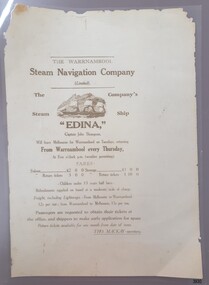
Document - Poster, Warrnambool Steam Navigation Co, ca.1938
... henty...captain john Thompson...chief engineer John Davies...lady bay...lighter Edina...port phillip bay steamers...vhr s199...dinah...warrnambool steam navigation company...advertising poster...shipping agent...flier...Maritime Village...Flagstaff Hill Maritime Museum & Village...Great Ocean Road...The Edina is listed on the Victorian Heritage Database VHR S199. warrnambool shipwreck coast flagstaff hill flagstaff hill maritime museum maritime museum fair maid of judea steam navigation pleasure steamer ss Edina a trade 19th century travel 19th century Warrnambool to Melbourne Warrnambool to Geelong Warrnambool to Port Fairy Warrnambool to Portland screw steamer coastal trader Crimean war American civil war gold export h r h duke of Edinburgh Warrnambool steam packet company stephen henty captain john Thompson chief engineer John Davies lady bay lighter Edina port phillip bay steamers vhr s199 dinah warrnambool steam navigation company advertising poster shipping agent flier Maritime Village Flagstaff Hill Maritime Museum & Village Great Ocean Road block printing woodblock printing relief printing Moorabool St Wharf western steam navigation company Tho. ...This poster is typical of posters displayed by steam packet companies of the mid-19th to early 20th centuries. It advertises the passage and freight available on a local coastal trader. The steamships operated between the major ports along the western coast of Victoria between Melbourne and Portland. The traveller was not guaranteed the passage times due to possible weather changes. Discounts were offered for return trips within a month of the ticket's issue. The price of freight included 'lighterage', which was the service of a smaller vessel called a 'lighter' expressly designed to transport goods between ship and shore. This particular poster has been recreated; it advertises the services of the screw steamer SS Edina. The information on the poster applies to the years between 1871 and 1873. During that period the Master of the Edina was Captain John Thompson, the Edina was owned by the Warrnambool Steam Navigation Company and the secretary of the firm was Thos. Mackay. The passenger fares are in line with fares from that period, as seen in a display advertisement published in the Hamilton Spectator on January 17th, 1872. The 1853 Glasgow-built Screw Ship Edina had a long life. The ship served in both the Crimean War and the American Civil War. The Edina also traded in UK and European waters. The Henty family of Portland, Victoria, purchased Edina in 1863 for use as a coastal trader. The Edina had several owners and spent many years of service along the South West Coast of Victoria between Melbourne and Portland. The vessel transported passengers and freight in Port Phillip Bay, between Melbourne and Geelong, between 1880 and 1938. After 84 years of service, the Edina was renamed ‘Dinah’ and was stripped down for use as a lighter. The vessel was broken up in 1957 at Footscray, Melbourne. The remains of Edina’s hull can be found in the Maribyrnong River, Port Phillip Bay. The poster was owned by the donor's grandfather, Bruce Duff (1922-2003) who was an avid sailor and a lover of nautical history. He and his wife Mona (1924-2014) were buried in Portarlington Cemetery, Victoria. Duff would have been about 13 years old when the Edina was finally retired from service in 1938. His interest in the Edina could have come from a trip on the vessel or from watching it in operation in the ports along the coast. Duff has collected this poster as a memento of the Edina and is likely to have preserved it at a much later date when the lamination process was readily available. [Flagstaff Hill's collection includes a photograph of the Edina at the Moorabool Street Wharf, Geelong, which was in Duff's locality. The References for this poster include a link to Museum Victoria's photograph of two boys watching the Edina from a jetty.] Flagstaff Hill's Village has its own 'Examiner' Office where volunteers demonstrate the historic printing press in that building. They use original letter-type to create posters, print labels onto lolly bags and designs on fabrics. One of the volunteer printers has produced a poster closely resembling the donated poster. His replication includes a woodcut of the ship, which he skilfully crafted himself.This poster advertises the sailing of the steamer SS Edina and the information has local and State significance for its association with the trading ports of the Edina, and the associated names on the poster; Warrnambool Steam Navigation Company, Captain John Thompson and Thos. Mackay. This poster's message has a strong connection to the history of the businesses and community of Warrnambool and the people of Port Phillip Bay, where it was a passenger ferry for many years. The poster is an example of advertising used by shipping agents in the mid-19th to early 20th centuries. Its information includes the accurate costs to passengers and freighters and the type of timetable the vessels were likely to follow. The poster's connection with the Screw Steamship Edina is historically significant, as the vessel was the longest serving screw steamer in the world. The ship spent its first nine years overseas then arrived in Melbourne. The vessel's work included running the essential service of transporting cargo and passengers between Melbourne and the western Victoria ports of Warrnambool, Port Fairy and Portland. The Edina is listed on the Victorian Heritage Database VHR S199. Poster, A3 size, brown text on cream paper, laminated. Re-created poster of the Warrnambool Steam Navigation Company (Limited) advertising passage and freight on its Screw Steamship, SS Edina. It states days, times and fees for passage and freight from Warrnambool to Melbourne, and return. It names the ship's Master, Captain John Thompson and the Company's Secretary, Tho. Mackay. It displays a line drawing of a 3-masted ship with full sails.Printed image [side profile of a 3 masted vessel, bow facing left] Printed text includes "The Warrnambool Steam Navigation Company (Limited). The Company's Steam Ship "EDINA", Captain John Thompson, Will leave Melbourne for Warrnambool on Tuesdays, returning from Warrnambool every Thursday, At Five o'clock p.m. (weather permitting). FARES: Saloon £2 0 0 Steerage £1 0 0 Saloon return £3 0 0 Saloon return £1 10 00 - Children under 13 years half fares - Refreshments supplied onboard at a moderate scale of charge. Freight, including lighterage, - From Melbourne to Warrnambool - 12s per ton; from Warrnambool to Melbourne, 15s per ton. Passengers are requested to obtain their tickets at the offers, and shippers to make early application for space. Return tickets available for one month from date of issue. - THO. MACKAY, secretary. "warrnambool, shipwreck coast, flagstaff hill, flagstaff hill maritime museum, maritime museum, fair maid of judea, steam navigation, pleasure steamer, ss edina a, trade 19th century, travel 19th century, warrnambool to melbourne, warrnambool to geelong, warrnambool to port fairy, warrnambool to portland, screw steamer, coastal trader, crimean war, american civil war, gold export, h r h duke of edinburgh, warrnambool steam packet company, stephen henty, captain john thompson, chief engineer john davies, lady bay, lighter edina, port phillip bay steamers, vhr s199, dinah, warrnambool steam navigation company, advertising poster, shipping agent, flier, maritime village, flagstaff hill maritime museum & village, great ocean road, block printing, woodblock printing, relief printing, moorabool st wharf, western steam navigation company, tho. mackay, re-created poster -
 Flagstaff Hill Maritime Museum and Village
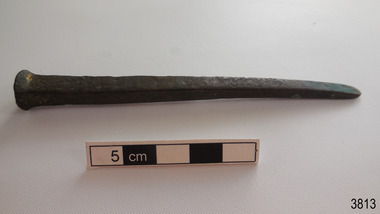
Functional object - Nail
... road...west coast trader...apollo bay...mid-19th century shipwreck...the grange...scottish barque...little henty...The Grange is an example of a mid-19th century vessel that carried a weapon of defence onboard. flagstaff hill warrnambool flagstaff hill maritime museum maritime museum shipwreck coast flagstaff hill maritime village great ocean road west coast trader apollo bay mid-19th century shipwreck the grange scottish barque little henty reef captain a alexander underwater explorers club of victoria 1840s carronade vhr 5297 coastal trader wooden shipwreck john chance fastener nail square nail machine cut mail blacksmith historic nail bronze nail carronade mal brown Nail, bronze, round head, four-sided shank, tip flattened to a rounded wedge shape. ...This historic bronze nail dates back to 1840s when the ship Grange was built. Nails such as this one were used for boat building, as deck fasteners and many other uses. This nail was made at a time when the shanks of nails were usually machine cut but the heads were hand formed by blacksmiths. The nail was recovered from the shipwreck of the Grange in around 1968, 110 years after the Grange was wrecked (see below for further details on the Grange). It is part of the John Chance Collection. THE GRANGE, 1840-1858- The wooden barque ’Grange’ was a three-masted ship built in Scotland in 1840 for international and coastal trade. On March 22, 1858, the Grange set sail from Melbourne under Captain A. Alexander, carrying a cargo of ballast. The barque had left the Heads of Phillip Bay and was heading west along the Victorian coast towards Cape Otway. The ship struck Little Haley’s Reef at Apollo Bay due to a navigational error and was stuck on the rocks. The crew left the ship carrying whatever they could onto the beach. Eventually, the remains of the hull, sails and fittings were salvaged before the wreck of the Grange broke up about a month later. About 110 years later, in 1968, the wreck of the Grange was found by divers from the Underwater Explorers Club of Victoria. They were amazed to find a unique, six to nine pound carronade (type of small cannon) and a cannonball on the site. There have been no other similar carronades recorded. In that same year the anchor of the Grange was recovered by diver John Chance and Mal Brown.The nail is significant historically as an example of hardware used when building wooden ships in the early to mid-19th century. The nail is historically significant as an example of the work and trade of blacksmith. The nail also has significant as it was recovered by John Chance, a diver from the wreck of the Grange in the 1968. Items that come from several wrecks along Victoria's coast have since been donated to the Flagstaff Hill Maritime Village’s museum collection by his family, illustrating this item’s level of historical value. The nail is historically significant for its association with the 1840s wooden barque, the Grange. The Grange is an historical example of a Scottish built vessel used for international and coastal trader of both cargo and passengers in the mid-19th century. The Grange is an example of an early ship, designed with a wooden hull. It is significant as a ship still available to divers along the south coast of Victoria, for research and education purposes. The Grange is an example of a mid-19th century vessel that carried a weapon of defence onboard.Nail, bronze, round head, four-sided shank, tip flattened to a rounded wedge shape. The surface is pitted and rough. There is orange and blue concretion on the shank. The nail is bent. flagstaff hill, warrnambool, flagstaff hill maritime museum, maritime museum, shipwreck coast, flagstaff hill maritime village, great ocean road, west coast trader, apollo bay, mid-19th century shipwreck, the grange, scottish barque, little henty reef, captain a alexander, underwater explorers club of victoria, 1840s carronade, vhr 5297, coastal trader, wooden shipwreck, john chance, fastener, nail, square nail, machine cut mail, blacksmith, historic nail, bronze nail, carronade, mal brown -
 Flagstaff Hill Maritime Museum and Village
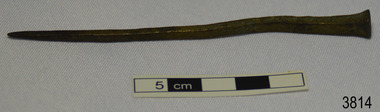
Functional object - Nail
... road...west coast trader...apollo bay...mid-19th century shipwreck...the grange...scottish barque...little henty...The Grange is an example of a mid-19th century vessel that carried a weapon of defence onboard. flagstaff hill warrnambool flagstaff hill maritime museum maritime museum shipwreck coast flagstaff hill maritime village great ocean road west coast trader apollo bay mid-19th century shipwreck the grange scottish barque little henty reef captain a alexander underwater explorers club of victoria 1840s carronade vhr 5297 coastal trader wooden shipwreck john chance fastener nail square nail machine cut mail blacksmith historic nail bronze nail carronade mal brown Nail, bronze, oval head, four-sided shank, tip flattened to a rounded wedge shape. ...This historic bronze nail dates back to 1840s when the ship Grange was built. Nails such as this one were used for boat building, as deck fasteners and many other uses. This nail was made at a time when the shanks of nails were usually machine cut but the heads were hand formed by blacksmiths. The nail was recovered from the shipwreck of the Grange in around 1968, 110 years after the Grange was wrecked (see below for further details on the Grange). It is part of the John Chance Collection. THE GRANGE, 1840-1858- The wooden barque ’Grange’ was a three-masted ship built in Scotland in 1840 for international and coastal trade. On March 22, 1858, the Grange set sail from Melbourne under Captain A. Alexander, carrying a cargo of ballast. The barque had left the Heads of Phillip Bay and was heading west along the Victorian coast towards Cape Otway. The ship struck Little Haley’s Reef at Apollo Bay due to a navigational error and was stuck on the rocks. The crew left the ship carrying whatever they could onto the beach. Eventually, the remains of the hull, sails and fittings were salvaged before the wreck of the Grange broke up about a month later. About 110 years later, in 1968, the wreck of the Grange was found by divers from the Underwater Explorers Club of Victoria. They were amazed to find a unique, six to nine pound carronade (type of small cannon) and a cannonball on the site. There have been no other similar carronades recorded. In that same year the anchor of the Grange was recovered by diver John Chance and Mal Brown. The nail is significant historically as an example of hardware used when building wooden ships in the early to mid-19th century. The nail is historically significant as an example of the work and trade of blacksmith. The nail also has significant as it was recovered by John Chance, a diver from the wreck of the Grange in the 1968. Items that come from several wrecks along Victoria's coast have since been donated to the Flagstaff Hill Maritime Village’s museum collection by his family, illustrating this item’s level of historical value. The nail is historically significant for its association with the 1840s wooden barque, the Grange. The Grange is an historical example of a Scottish built vessel used for international and coastal trader of both cargo and passengers in the mid-19th century. The Grange is an example of an early ship, designed with a wooden hull. It is significant as a ship still available to divers along the south coast of Victoria, for research and education purposes. The Grange is an example of a mid-19th century vessel that carried a weapon of defence onboard.Nail, bronze, oval head, four-sided shank, tip flattened to a rounded wedge shape. The surface is pitted and rough. There is orange and blue concretion on the shank. The nail is bent. flagstaff hill, warrnambool, flagstaff hill maritime museum, maritime museum, shipwreck coast, flagstaff hill maritime village, great ocean road, west coast trader, apollo bay, mid-19th century shipwreck, the grange, scottish barque, little henty reef, captain a alexander, underwater explorers club of victoria, 1840s carronade, vhr 5297, coastal trader, wooden shipwreck, john chance, fastener, nail, square nail, machine cut mail, blacksmith, historic nail, bronze nail, carronade, mal brown -
Glenelg Shire Council Cultural Collection
Photograph - Copy Of Photograph - Henty Wool Store, 1859
... Road in foreground, footpath with several men standing around. 3 two-storey blue stone buildings, with diffrent roof levels. Between building on left and middle buiding, is a horse and cart. Photograph Copy Of Photograph - Henty ...Vern Mc Callum CollectionDigital copy of a monochrome photo. Taken in Portland in 1859. Road in foreground, footpath with several men standing around. 3 two-storey blue stone buildings, with diffrent roof levels. Between building on left and middle buiding, is a horse and cart. -
Glenelg Shire Council Cultural Collection
Photograph - Photograph reprint scan of Photograph - Henty Street Casterton 1920, Victoria, n.d
... Image of Henty Street. Casterton c.1920. Road not surfaced. Horse and cart on right, another one making it's way along street. ...Image of Henty Street. Casterton c.1920. Road not surfaced. Horse and cart on right, another one making it's way along street. ...Vern McCallum CollectionReprint of scan of black and white photo. Image of Henty Street. Casterton c.1920. Road not surfaced. Horse and cart on right, another one making it's way along street. Car at left curb. Print is mounted on white archival mountboard. Frame. -
Glenelg Shire Council Cultural Collection
Award - Cloth Badges - Henty Division Brownies 1990, c. 1990
... Identifying numbers 8835 a,b 2 cloth badges, Henty Division Brownies, 16 Sept 1990 activity day at home of Joy Rundell, Flacks Road Heywood. ...16 Sept 1990 activity day at home of Joy Rundell, Flacks Road Heywood Victoria. Identifying numbers 8835 a,b 2 cloth badges, Henty Division Brownies, 16 Sept 1990 activity day at home of Joy Rundell, Flacks Road Heywood. ...16 Sept 1990 activity day at home of Joy Rundell, Flacks Road Heywood Victoria.Identifying numbers 8835 a,b 2 cloth badges, Henty Division Brownies, 16 Sept 1990 activity day at home of Joy Rundell, Flacks Road Heywood. Light brown woven fabric, black print and symbols depicting activities. -
Glenelg Shire Council Cultural Collection
Photograph - Photograph - View of Portland and foreshore, 21/03/1972
... Henty park, industrial estate along Canal court. Facilities block, No.6 berth, silos and grain storage G.E.B. Commencement of Cape Nelson Road overpass....Henty park, industrial estate along Canal court. Facilities block, No.6 berth, silos and grain storage G.E.B. Commencement of Cape Nelson Road overpass. ...Port of Portland Authority archives.Front: (no inscriptions) Back: (no inscriptions)port of portland archives, portland harbour, henty park, industrial estate, canal court -
Glenelg Shire Council Cultural Collection
Photograph - Photograph - Henty Street, Casterton Victoria, n.d
... Henty St. Casterton looking east. Casterton Hotel on right; vintage cars parked either side of road...Henty St. Casterton looking east. Casterton Hotel on right; vintage cars parked either side of road Photograph Photograph - Henty Street, Casterton Victoria ...Black and white photo. Henty St. Casterton looking east. Casterton Hotel on right; vintage cars parked either side of road -
Glenelg Shire Council Cultural Collection
Booklet - Brochure - Promoting Portland, Victoria, Victorian Railways Print, Oct-38
... roads marked in orange. Black and white photos of harbour, Dutton Beach, Gardens cottage, Henty Beach, 'Burswood', Henty Memorial, plus printed information about Portland and district....roads marked in orange. Black and white photos of harbour, Dutton Beach, Gardens cottage, Henty Beach, 'Burswood', Henty Memorial, plus printed information about Portland and district. ...Brochure promoting Portland, folds out to A3 printed on light card. Front cover, white and blue stylised sky with sea and a seabird. 'PORTLAND, VICTORIA, AUSTRALIA' -printed in red. Back cover, black line map with roads marked in orange. Black and white photos of harbour, Dutton Beach, Gardens cottage, Henty Beach, 'Burswood', Henty Memorial, plus printed information about Portland and district.portland -
 Glenelg Shire Council Cultural Collection
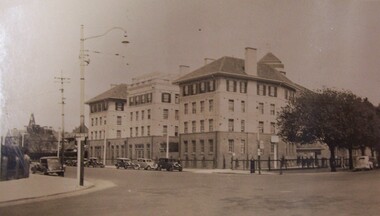
Photograph - Photograph - St Kilda Road, Melbourne, Esther Winifred Hall, 1934
... Esther Winifred Hall Henty 1934 Front: (no inscriptions) Back: Chevron corner St. Kilda and Commercial Roads Nov: 1934 V. ...Photographs taken by Esther Winifred Hall (nee Smallpage) - great grand-daughter of Stephen George Henty. Taken in 1934 Centenary Celebrations in Portland.Black and white sepia photograph of four-storey building at street intersection. Street sign on left "St. Kilda Rd".Front: (no inscriptions) Back: Chevron corner St. Kilda and Commercial Roads Nov: 1934 V. Hursthouse (?)esther winifred hall, henty, 1934 -
Glenelg Shire Council Cultural Collection
Photograph - Sheet of 12 contact prints - Various Portland and local surrounds buildings and landmarks, c. 1970
... Sheet of 12 contact prints of rephotographed photographs: Identifying numbers 5721 a, b, c, d, e, f, g, h, i, j, k, l (a) Fishing party, flat rocks Bridgewater (b) Dutton Way (c) Julia Street (d) Steam train (e) Bentinck Street corner (f) Bridge across Salt Creek 'Kingsley' in background (g) Bentinck Street railway station from Customs House (h) Yankee Doodle corner (i) Picnic on banks of river (j) Henty Bay (k) Man holding two bikes Wellington Road/Bentinck Street (l) same as (h) - Bentinck Street railway station from Customs House...Sheet of 12 contact prints of rephotographed photographs: Identifying numbers 5721 a, b, c, d, e, f, g, h, i, j, k, l (a) Fishing party, flat rocks Bridgewater (b) Dutton Way (c) Julia Street (d) Steam train (e) Bentinck Street corner (f) Bridge across Salt Creek 'Kingsley' in background (g) Bentinck Street railway station from Customs House (h) Yankee Doodle corner (i) Picnic on banks of river (j) Henty Bay (k) Man holding two bikes Wellington Road/Bentinck Street (l) same as (h) - Bentinck Street railway station from Customs House Photograph Sheet of 12 contact prints - Various Portland and local surrounds buildings and landmarks ...Sheet of 12 contact prints of rephotographed photographs: Identifying numbers 5721 a, b, c, d, e, f, g, h, i, j, k, l (a) Fishing party, flat rocks Bridgewater (b) Dutton Way (c) Julia Street (d) Steam train (e) Bentinck Street corner (f) Bridge across Salt Creek 'Kingsley' in background (g) Bentinck Street railway station from Customs House (h) Yankee Doodle corner (i) Picnic on banks of river (j) Henty Bay (k) Man holding two bikes Wellington Road/Bentinck Street (l) same as (h) - Bentinck Street railway station from Customs House -
Glenelg Shire Council Cultural Collection
Photograph - Photograph - aerial view of Portland, n.d
... Black & white aerial photograph showing Portland harbour, aquatic centre, Henty Park, lawn tennis courts, canal and harbour road....Port of Portland Authority Archives Port of Portland Archives aerial photography Portland Harbour Henty Park canal Back: Harbour - pencil Black & white aerial photograph showing Portland harbour, aquatic centre, Henty Park, lawn tennis courts, canal and harbour road. Photograph Photograph - aerial view of Portland ...Port of Portland Authority ArchivesBack: Harbour - pencilport of portland archives, aerial photography, portland harbour, henty park, canal -
Glenelg Shire Council Cultural Collection
Photograph - Photograph - View of Port of Portland, 21/03/1972
... Road... canal... railway... Canal Court... Henty...Cape Nelson Road overpass preparations, canal realignment, railway sidings, canal court industrial estate, Henty Park....Port of Portland Archives Portland Harbour Cape Nelson Road canal railway Canal Court Henty Park Front: (no inscriptions) Back: 21/3/1972 Unframed, aerial, black and white photograph. ...Port of Portland Authority archives.Front: (no inscriptions) Back: 21/3/1972port of portland archives, portland harbour, cape nelson road, canal, railway, canal court, henty park -
Glenelg Shire Council Cultural Collection
Film - Film - Harbour Construction 1950s-1960s, n.d
... Various films: **Euclids carrying stone and rubble to the beginnings of the Main Breakwater *Diving gear Diver (wearing helmet and canvas suit) ready to dive from near the slipway or Fishermen's Breakwater Diver with air tanks near Fishermen's Breakwater or trawler berth Dredging around near Fishermen's Breakwater - Henty Groyne Cape Grant temporary crusher (jumpy in places) Lewis Dredging/wash boring Levelling railway approach Fawthrop Lagoon Quarry Road - Quarry gates *denotes footage of interest...Various films: **Euclids carrying stone and rubble to the beginnings of the Main Breakwater *Diving gear Diver (wearing helmet and canvas suit) ready to dive from near the slipway or Fishermen's Breakwater Diver with air tanks near Fishermen's Breakwater or trawler berth Dredging around near Fishermen's Breakwater - Henty Groyne Cape Grant temporary crusher (jumpy in places) Lewis Dredging/wash boring Levelling railway approach Fawthrop Lagoon Quarry Road - Quarry gates *denotes footage of interest Film Film - Harbour Construction 1950s-1960s ...Port of Portland AuthorityFront: Harbour Construction/ Portland (B & W) (blue pen and white sticky tape, top of reel)port of portland archives, film -
Glenelg Shire Council Cultural Collection
Photograph - Photograph - Portland Harbour, n.d
... Black & white aerial photo of Portland Harbour, also showing Henty Park, canal, railway line & freight wagons, ring road....Port of Portland Authority Archives Port of Portland Archives Portland Harbour Black & white aerial photo of Portland Harbour, also showing Henty Park, canal, railway line & freight wagons, ring road. Photograph Photograph - Portland Harbour ...Port of Portland Authority Archivesport of portland archives, portland harbour
