Showing 22 items matching "hospitals-south australia-history"
-
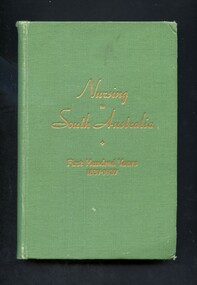
Alfred Hospital Nurses League - Nursing History CollectionBook - Illustrated book, The South Australian Trained Nurses' Centenary Committee, Nursing in South Australia: First Hundred Years 1837-1937, 1939
... ...Hospitals-south Australia-History...Of significance to the AHNL as there are similarities with the history of nursing in Victoria Nursing-South Australia-History Nurses-South Australi-History Hospitals-south Australia-History A history of nursing in South Australia from 1837-1937. ...A history of nursing in South Australia from 1837-1937.Illustrated book with light green cover, title embossed in gold colour on frontnon-fictionA history of nursing in South Australia from 1837-1937.nursing-south australia-history, nurses-south australi-history, hospitals-south australia-history -

Warrnambool and District Historical Society Inc.Medal - Badge, Australian Red Cross Appeal 1918, 1918
... south of Merri St) Warrnambool great-ocean-road These badges were sold in Australia to aid the Red Cross war effort in World War One. The Australian Red Cross was founded as a branch of the British Red Cross in Melbourne in 1914. The organization was chiefly concerned with the welfare of Australian service personnel, sending comfort parcels, working in hospitals and canteens etc. These badges have no known local provenance but are retained as examples of the badges produced to aid the Australia Red Cross war effort in World War One. Australian Red Cross World War One History ...These badges were sold in Australia to aid the Red Cross war effort in World War One. The Australian Red Cross was founded as a branch of the British Red Cross in Melbourne in 1914. The organization was chiefly concerned with the welfare of Australian service personnel, sending comfort parcels, working in hospitals and canteens etc.These badges have no known local provenance but are retained as examples of the badges produced to aid the Australia Red Cross war effort in World War One. .1 A circular metal badge with edging in white and red and a white flag with a red cross in the centre set in a light-brown background. Under the flag is printing in red. The back has a metal clip. .2 and .3 As above Australian Red Cross Appeal 1918australian red cross, world war one, history of warrnambool -
Warrnambool and District Historical Society Inc.Document, Docket Dr Bright's Phosphodyne, Mid 19th century
... south of Merri St) Warrnambool great-ocean-road This label accompanied a bottle of Dr Bright’s Phosphodyne. It was a form of medicine also known as ozonic oxygen which was developed and patented in 1869 by Dr Charles Bright, a 19th century Resident Surgeon at St Mary’s Hospital London, The medicine claimed to ease ‘indigestion, liver complaints, nervous debility, female complaints, premature decline, local weakness and spermatorrhea’. It was widely sold by chemists throughout Australia in the 19th century and in this case was supplied by the Warrnambool chemist, James Astley Bromfield. He was a significant person in Warrnambool’s history ...This label accompanied a bottle of Dr Bright’s Phosphodyne. It was a form of medicine also known as ozonic oxygen which was developed and patented in 1869 by Dr Charles Bright, a 19th century Resident Surgeon at St Mary’s Hospital London, The medicine claimed to ease ‘indigestion, liver complaints, nervous debility, female complaints, premature decline, local weakness and spermatorrhea’. It was widely sold by chemists throughout Australia in the 19th century and in this case was supplied by the Warrnambool chemist, James Astley Bromfield. He was a significant person in Warrnambool’s history as he produced the 1856 map of the Warrnambool district showing all the original landholders, a seminal resource for historians today. Bromfield had a chemist shop in Warrnambool from 1854 to the late 1880s, initially in Timor Street and then in Liebig Street (number 80 and later number 78). Bromfield was very active in local community affairs. This label is of considerable interest as it shows the use in the 19th century of medicine that today would be labelled ‘quack’. It is of particular interest as it was supplied by James Astley Bromfield’s chemist shop and he is an important early identity in Warrnambool, involved in many activities in the town. He was a Justice of the Peace, a Trustee of the Savings Bank, Chairman of the Western Steam Navigation Company, a Director of the Gasworks and on the committees of the Harbour Committee, the Fire Brigade and the Anglers Protection Society. He was a Warrnambool Councillor (1858-60; 1865-1870) and a Shire Councillor (1875-1883). This is a sheet of paper that accompanied a bottle of Dr Brights’ Phosphodyne medicine. It is buff-coloured with black printed material. It is in two pieces and dog-eared at the edges.warrnambool, dr bright's phosphodyne, james bromfield chemist, warrnambool chemists -
Warrnambool and District Historical Society Inc.Book, Helen Penrose, Seeds of Hope St John of God Hospital Warrnambool 1939-2014, 2014
... Warrnambool and District Historical Society Inc. 2 Gilles Street (south of Merri St) Warrnambool great-ocean-road This book tells the story of the foundation of the Warrnambool St John of God Hospital in 1939 and its ensuing history up to 2014. The text is in three parts – from 1938 to 1961, from 1962 to 1994 and from 1994 to 2014. The Congregation of the Sisters of St John of God was founded in Ireland in 1871 and the Sisters first arrived in Australia ...History of St John of God Hospital, Warrnambool 1939-2014This is a book of 78 pages with a stiffened cardboard cover. The cover is greyish-white with a colour photograph of the hospital and background blurred images of St John of God nuns on the front cover. The book contains printed material, maps, tables, black and white and colour photographs and illustrations.non-fictionHistory of St John of God Hospital, Warrnambool 1939-2014st john of god warrnambool hospital, glenrye, healthcare, warrnambool -
4th/19th Prince of Wales's Light Horse Regiment Unit History RoomPhoto Album, Cultana Camp 1999, 2003 (estimated)
... 4th/19th Prince of Wales's Light Horse Regiment Unit History Room 4/19 PWLH Regiment, Building 78 Simpson Barracks Macleod melbourne a photos ceremonial training squadron 4th 19th prince of wales s light horse cultana camps austin hospital catafalque vietnam veterans Contains 203 photos of A Squadron 4/19 Prince of Wales's Light Horse Regiment 1999 camp at Cultana, South Australia; and 12 photos of catafalque party at Austin & Repatriation Hospital on Vietnam Veterans' Day 15 August 2003 Cultana Camp 1999 Photo Album ...Contains 203 photos of A Squadron 4/19 Prince of Wales's Light Horse Regiment 1999 camp at Cultana, South Australia; and 12 photos of catafalque party at Austin & Repatriation Hospital on Vietnam Veterans' Day 15 August 2003 a, photos, ceremonial, training, squadron 4th 19th prince of wales s light horse, cultana, camps, austin hospital, catafalque, vietnam veterans -
Bendigo Historical Society Inc.Document - The Reynolds Family Records Collection (Folder 3 of 4) Death Certificate of Margaret Alice Hinde, 1926
... history documents and photos of the descendants of Eleanor Hinde. This item contains the following document: Death Certificate of Margaret Alice Hinde, wife of William Robert Hinde, Railway Clerk, in Norwood Mental hospital, Parkside, South Australia on April 17th 1926...history documents and photos of the descendants of Eleanor Hinde. This item contains the following document: Death Certificate of Margaret Alice Hinde, wife of William Robert Hinde, Railway Clerk, in Norwood Mental hospital, Parkside, South Australia on April 17th 1926 Document The Reynolds Family Records Collection (Folder 3 of 4) Death Certificate of Margaret Alice Hinde ...Eleanor Hinde (1842-1902) was born in Lancashire England. In 1858, Eleanor married Richard Reynold in the Forest St Wesleyn Methodist Church in Sandhurst. They both gave their address as Sailors Gully Goldfields. They had seven children together. Richard was a skilled tradesman and after he died in 1872 from lung disease, Eleanor married Arculus Opie. Eleanor owned a property on the corner of Gladstone and Stanley Streets which later became an electrical substation. She sold poultry and eggs and preserves. One of Eleanor's sons, William John, married Anna (Annie) Jorgensen, and one of her daughters. Amelia, married Anna's brother Thomas Joynes Jorgensen. The Jorgensens founded and managed Jorgensen and Sons foundry and engineering works. Peter Jorgensen (1849-1914), was a mining contractor, he lived at, "Bro," Russell street, Quarry Hill. His firm was Jorgensen and Sons, mining contractors. He was a native of the Island of Alsen, Denmark. He left Denmark in the year 1861, embarking at Hamburg in a small sailing Ship. The four folders contain family history documents and photos of the descendants of Eleanor Hinde. This item contains the following document: Death Certificate of Margaret Alice Hinde, wife of William Robert Hinde, Railway Clerk, in Norwood Mental hospital, Parkside, South Australia on April 17th 1926bendigo, sandhurst, peter jorgensen, eleanor hinde, eleanor reynolds, eleanor opie, reynolds collection, margaret alice hinde -
Returned Nurses RSL Sub-branchMagazine - Magazine clipping, Vetaffairs, WWI nurse turns 100, September 1989
... Australian Army Nursing Corps (AANC) in 1917 and sailed for Suez and Salonika. Ruby's daughter, Elizabeth Milne, who has written a history of her mother's war-time experiences, says her mother has never been willing to talk about her two years in Salonika, but has described the hospital as looking like a concentration camp, with high barbed wire fencing and night patrols by armed guards with dogs. World War One WW1 Kalima Private Nursing Home Malvern Victoria Ruby Vivian Carmichael Stoney Creek South ...Former Army nurse, Ruby Campbell, who served two years in Salonika, Greece, in World War 1, celebrated her 100th birthday on August 6. Ruby enlisted in the Australian Army Nursing Corps (AANC) in 1917 and sailed for Suez and Salonika. Ruby's daughter, Elizabeth Milne, who has written a history of her mother's war-time experiences, says her mother has never been willing to talk about her two years in Salonika, but has described the hospital as looking like a concentration camp, with high barbed wire fencing and night patrols by armed guards with dogs.A magazine page with two vertical stories, the relevant story consists of two columns of text beneath the title, and two black and white photos. The top photo depicts two young women with a man and the bottom photo depicts four older women standing at the bedside of a fifth older woman.world war one, ww1, kalima private nursing home, malvern, victoria, ruby vivian carmichael, stoney creek, south gippsland, mooltan, canadian regiment, canada, melbourne -
Tatura Irrigation & Wartime Camps MuseumArtwork, other - Carl von Brandenstein Collection, Tatura Camp 1A
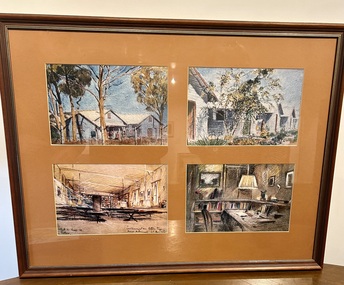
... history of religion at Berlin University (1928-1934) and Leipzig (1938-1939). His doctoral thesis was a dissertation on the iconography of Hittite gods. He was arrested in Persia in 1941 and sent to Australia where he was interned at Loveday Camp South Australia and in Camp 1 Tatura from January 1945 until his release in August 1946. Camp 1 Tatura Carl von Brandenstein Internment camp Loveday Waranga Hospital ...Dr Carl von Brandenstein was born in 1909 in Hanover, Germany. He studied oriental languages and the history of religion at Berlin University (1928-1934) and Leipzig (1938-1939). His doctoral thesis was a dissertation on the iconography of Hittite gods. He was arrested in Persia in 1941 and sent to Australia where he was interned at Loveday Camp South Australia and in Camp 1 Tatura from January 1945 until his release in August 1946.Four artworks in a dark wood frame with terracotta coloured matte. Item 1: Hospital Waranga. Tall gum trees in foreground, blue sky . Staff standing under the veranda and a red cross vehicle parked in front. A barbed wire fence surrounds the hospital. Item 2: Inside the Library. Item 3: Camp Barracks. Four huts in a row . A tree and garden in front. Item 4: Reading Room. A table in centre of the room with a single chair. Books and stationery items on the table. A lamp hangs from the ceiling. Bookshelves along the walls and paintings on the wall. Item 2: "am letzten Tage deiner Internierung dem lieben Hans Wulff fur Errinnerung an gemeinsam gebautes" (English Translation: On the last day of your internment to dear Hans Wiulff for remembrance of what we built together. camp 1, tatura, carl von brandenstein, internment camp loveday, waranga hospital, library, hans wulff -
Geoffrey Kaye Museum of Anaesthetic HistoryHeadwear - Academic Bonnet
... History ANZCA House 630 St Kilda Road Melbourne melbourne This academic bonnet belonged to Dr Mary Burnell. Mary Taylor Burnell was born on 21 February 1907, in Norwood, South Australia. She graduated with her MBBS in 1931. In 1932, Burnell served as a resident medical officer at Adelaide Children’s Hospital ...This academic bonnet belonged to Dr Mary Burnell. Mary Taylor Burnell was born on 21 February 1907, in Norwood, South Australia. She graduated with her MBBS in 1931. In 1932, Burnell served as a resident medical officer at Adelaide Children’s Hospital. By 1934 she was their Honorary Anaesthetist. It was also during this period that Burnell became the first female member of the Australian Society of Anaesthetists. One year later, in 1935, she worked as Secretary for the South Australian Section of the Society. Although resigning from her position at the Children’s Hospital in 1937, Burnell returned in 1942. The outbreak of World War II meant hospital staff and resources were drained. During her work, Burnell lobbied for a Department of Anaesthetics in the Children’s Hospital. Through working at both hospitals, she became aware of the great differences between administering anaesthesia to children and administering it to adults. In 1953 she was elected President of the Australian Society of Anaesthetists. She was the first female to be elected to this position. Two years later in 1955, Burnell was elected as a member of the Board of Faculty of Anaesthetists, Royal Australasian College of Surgeons. In 1966 she was elected Dean of the Faculty of Anaesthetists. Again, she was the first female to be elected to this position. Burnell worked tirelessly to promote the importance of anaesthetics in Australia. Burnell’s contributions to anaesthetics were recognised with Honorary Fellowships to both the Australian Faculty of Anaesthetists and Royal College of Surgeons. Navy blue velvet cloth bonnet with stiffened brim covered in same fabric as bonnet. Around the hat is tied a gold cord with tassels.burnell, mary, academic bonnet, australian society of anaesthetists, faculty of anaesthetists, royal australasian college of surgeons, royal college of surgeons, fellowship -
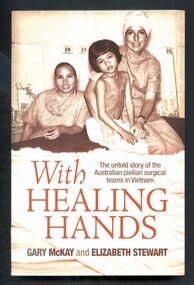
Alfred Hospital Nurses League - Nursing History CollectionBook - Illustrated book, Gary McKay et al, With healing hands: the untold stories of the Australian civilian nursing teams in Vietnam, 2009
... Alfred Hospital Nurses League - Nursing History Collection Ground Floor, Building 10 Caulfield Hospital 260 Kooyong Road Caulfield melbourne Early in the Vietnam War the South Vietnamese government appealed to The United States and its allies, including Australia, for desperately need medical help. ...From October 1964 until the end of 1972, over 450 surgeons, nurses and other medical specialists from Australian hospitals volunteered to work in South Vietnam. In the towns of Long Xuyen, Bien Hoa, Vung Tau and Ba Ria they brought expert medical and surgical care, comfort and support to a war-weary and traumatised civilian population. The extraordinary story of these Australian civilians at war is told here, based on interviews with many of those who served in the teams, The book includes two appendices: one lists the dates of service of the teams, the other lists the members of the teams.Illustrated book, Fronts cover has a photograph of two women in operating theatre dress with a young child (Vietnamese anaesthetic technician Tran Thi Dung, theatre nurse Cathy Blackmore and a young patient in an operating theatre at Bien Hoa Hospital, in early 1972). Below this on a background photo of bandages title and authors names are printed in shades of brown. Abbreviated title (light brown ink) and authors names (dark brown ink) are also printed on the spine along with the publisher's mark. A summary of the book, along with information about the authors, is [rinted on the back cover. non-fictionFrom October 1964 until the end of 1972, over 450 surgeons, nurses and other medical specialists from Australian hospitals volunteered to work in South Vietnam. In the towns of Long Xuyen, Bien Hoa, Vung Tau and Ba Ria they brought expert medical and surgical care, comfort and support to a war-weary and traumatised civilian population. The extraordinary story of these Australian civilians at war is told here, based on interviews with many of those who served in the teams, The book includes two appendices: one lists the dates of service of the teams, the other lists the members of the teams.vietnam war 1961-1975-medical care, vietnam war 1961-1975-participation-australia, vietnam war 1961-1975-personal narratives-australian, volunteer workers in medical car-vietnam-history, alfred hospital -
Alfred Hospital Nurses League - Nursing History CollectionBook, Commonwealth Department of Veteran Affairs, The nominal roll of Vietnam veterans, 1996
... Alfred Hospital Nurses League - Nursing History Collection Ground Floor, Building 10 Caulfield Hospital 260 Kooyong Road Caulfield melbourne Includes civilians, War correspondents; SEATO (South East Asia Treaty Organisation)Surgical and medical aid, hospital rebuilding; merchant seamen; entertainers; and other civilians. Of significance to the AHNL as members of the Alfred Hospital surgical teams are listed Vietnam War 1061-1975-Nominal Roll-Australia ...The Nominal Roll of Vietnam Veterans honours and commemorates approximately 61,000 people who served in Australia's defence forces during the period 23 May 1962 to 29 April 1975 either in Vietnam or in the waters adjacent to Vietnam.Book with black cover, title printed in white on front and spine, and in grey on back cover. Front cover also has a photograph of a memorial (Australian Vietnam Forces National Memorial, Canberra) The back cover has a small photograph of a person with witting in the background (Australian Vietnam Forces National Memorial, Canberra).non-fictionThe Nominal Roll of Vietnam Veterans honours and commemorates approximately 61,000 people who served in Australia's defence forces during the period 23 May 1962 to 29 April 1975 either in Vietnam or in the waters adjacent to Vietnam.vietnam war 1061-1975-nominal roll-australia, vietnam war 1961-1975-paticipation-australian, australia-armed forces-registers, vietnam war 1961-1975-registers -
Alfred Hospital Nurses League - Nursing History CollectionBook - Illustrated book, Deborah Burrows 1959, Nurses of Australia: The illustrated story, 2018
... Alfred Hospital Nurses League - Nursing History Collection Ground Floor, Building 10 Caulfield Hospital 260 Kooyong Road Caulfield melbourne Of significance to the AHNL as it is an important reference of the history of nursing in Australia Nurses-Australia-History Nursing-Australia-History From the First Nation caregivers who healed, birthed and nursed for millennia to the untrained and ill-equipped convict men and women who cared for the sick in the fledgling colony of New South Wales, nursing has been practised in Australia since the beginning. ...From the First Nation caregivers who healed, birthed and nursed for millennia to the untrained and ill-equipped convict men and women who cared for the sick in the fledgling colony of New South Wales, nursing has been practised in Australia since the beginning. It would take the arrival of a group of dedicated Irish nuns, followed by Florence Nightingale-trained nurses - and decades of constant and continuing campaigning - to transform nursing into what it is today: the most trusted profession in Australia. Nurses will recognise their own lived experience in stories about training days, nurses' quarters, changing uniforms, changing roles, the arrival of male nurses and current pathways to nursing. Produced in collaboration with the Australian College of Nursing and the Congress of Aboriginal and Torres Strait Islander Nurses and Midwives, with additional information provided by the Australian Nursing and Midwifery Federation, this is the story of nursing in Australia.Illustrated book. Title and authors name printed on front cover and spine (red ink on front and white ink on red background on spine) Background of front cover has three photographs: black and white photograph of a group of nurses (Malaya 1941 group portrait of Australian Army Nursing Service nurses of the 2/4th Casualty Clearing Station), colour photo of a nurse looking over her shoulder, and a coloured photo of an Indigenous nurse. The back cover has a summary of the book along with four coloured photographs: Portrait of a nun with constitution and quill (Sister Mary Augustine Aikenhead by Nicholas Joseph Cowley), A nurse in uniform with veil (Vivian Bull winkel 1941), an indigenous woman (Lois O'Donoghue) an enrolled nurse (Samuel Yenui)non-fictionFrom the First Nation caregivers who healed, birthed and nursed for millennia to the untrained and ill-equipped convict men and women who cared for the sick in the fledgling colony of New South Wales, nursing has been practised in Australia since the beginning. It would take the arrival of a group of dedicated Irish nuns, followed by Florence Nightingale-trained nurses - and decades of constant and continuing campaigning - to transform nursing into what it is today: the most trusted profession in Australia. Nurses will recognise their own lived experience in stories about training days, nurses' quarters, changing uniforms, changing roles, the arrival of male nurses and current pathways to nursing. Produced in collaboration with the Australian College of Nursing and the Congress of Aboriginal and Torres Strait Islander Nurses and Midwives, with additional information provided by the Australian Nursing and Midwifery Federation, this is the story of nursing in Australia.nurses-australia-history, nursing-australia-history -
Alfred Hospital Nurses League - Nursing History CollectionBook, John Milner 1822-1927 et al, The cruise of H. M. S. Galatea, 1869
... Alfred Hospital Nurses League - Nursing History Collection Ground Floor, Building 10 Caulfield Hospital 260 Kooyong Road Caulfield melbourne The assassination attempt lead to the naming of two hospitals: Prince Alfred Hospital, Sydney and the Alfred Hospital Melbourne Of significance to the AHNL as the Alfred Hospital was named after Prince Alfred after the assassination attempt in Sydney HRH Prince Alfred Duke of Edinburgh Voyages around the world Australia - description - travel 1860's South Africa - description - travel -1860's In 1867, Prince Alfred, Queen Victoria's second son, commissioned the Galatea for a voyage around the world which would include the first royal visit to Australia. ...In 1867, Prince Alfred, Queen Victoria's second son, commissioned the Galatea for a voyage around the world which would include the first royal visit to Australia. Stopping along the way in Rio de Janeiro and Cape Town, Alfred was received with great ceremony at each port of call. These visits provided the ship's chaplain John Milner (1822-97) and the artist Oswald Brierly (1817-94) with ample material for this chronicle, published in 1869, which gives background details of each region alongside scenes from the tour, enhanced by illustrations based on Brierly's sketches. The authors drew on various recollections and writings, including a letter from Alfred to his brother describing an elephant hunt in South Africa. The tour was abruptly curtailed in Sydney when a Fenian sympathiser attempted to assassinate the prince, an act which boosted support for the British royal family. More »Illustrated book with blue cloth cover, gilt stamped decorations on front and spinenon-fictionIn 1867, Prince Alfred, Queen Victoria's second son, commissioned the Galatea for a voyage around the world which would include the first royal visit to Australia. Stopping along the way in Rio de Janeiro and Cape Town, Alfred was received with great ceremony at each port of call. These visits provided the ship's chaplain John Milner (1822-97) and the artist Oswald Brierly (1817-94) with ample material for this chronicle, published in 1869, which gives background details of each region alongside scenes from the tour, enhanced by illustrations based on Brierly's sketches. The authors drew on various recollections and writings, including a letter from Alfred to his brother describing an elephant hunt in South Africa. The tour was abruptly curtailed in Sydney when a Fenian sympathiser attempted to assassinate the prince, an act which boosted support for the British royal family. More »hrh prince alfred duke of edinburgh, voyages around the world, australia - description - travel 1860's, south africa - description - travel -1860's -
Alfred Hospital Nurses League - Nursing History CollectionBook - Illustrated book, Rigby Limited, The first royal tour 1867-1868, 1970
... Alfred Hospital Nurses League - Nursing History Collection Ground Floor, Building 10 Caulfield Hospital 260 Kooyong Road Caulfield melbourne After the assassination attempt two hospitals were named after Prince Alfred: Prince Alfred Hospital, Sydney and the Alfred Hospital Melbourne Of significance to the AHNL as the Alfred Hospital was named after Prince Alfred after the assassination attempt in Sydney HRH Prince Alfred Duke of Edinburgh Australia - description - travel 1860's South Africa - description - travel -1860's Voyages around the world In July, 1867, the Australian colonies were electrified by the news that they were to be visited by royalty. ...In July, 1867, the Australian colonies were electrified by the news that they were to be visited by royalty. Prince Alfred, Duke of Edinburgh, second son of Queen Victoria and commander of H.M.S. Galatea, was en route from Europe. He landed in South Australia on a blazing November day, and he was welcomed with an exuberant Colonial loyalty which, as one of his equerries sniffly remarked "seemed ignorant of protocol." During his visits to South Australia, Victoria, Tasmania, New South Wales, and Queensland, the Prince was swept along on a tide of frenzied enthusiasm. Each State tried to outdo the others in the splendour of its receptions and the garishness of its decorations. In Melbourne, a Free Banquet in honour of the Prince turned into a drunken fiasco. On the goldfields, he lunched down a mine and "helped himself rather liberally from a selection of nuggets. He was cheered by convicts in Tasmania, wrangled over by Queensland politicians and bombarded with bouquets, Declarations of Loyalty, and innumerable speeches. Surrounded by city fathers, Bishops, brass bands, fireworks and uproarious multitudes, he went from one triumph to another. Finally, he was shot in Sydney, and his recovery was accompanied by even more passionate demonstrations of loyalty. These were inflamed by revulsion against the would-be assassin, who was hurried to the gallows as the Prince sailed for home. His departure closed a colourful chapter in Australian history, of which the author writes with humour and gustoIllustrated book with dustjacket. Book has a blue cloth binding with title, author and publisher's name stamped in gilt on spine. Dustjacket has an orange and black print of the assassination attempt on Prince Alfred, Duke of Edinburgh in Sydney 1868. Title and author's name overprinted in white on front and spinenon-fictionIn July, 1867, the Australian colonies were electrified by the news that they were to be visited by royalty. Prince Alfred, Duke of Edinburgh, second son of Queen Victoria and commander of H.M.S. Galatea, was en route from Europe. He landed in South Australia on a blazing November day, and he was welcomed with an exuberant Colonial loyalty which, as one of his equerries sniffly remarked "seemed ignorant of protocol." During his visits to South Australia, Victoria, Tasmania, New South Wales, and Queensland, the Prince was swept along on a tide of frenzied enthusiasm. Each State tried to outdo the others in the splendour of its receptions and the garishness of its decorations. In Melbourne, a Free Banquet in honour of the Prince turned into a drunken fiasco. On the goldfields, he lunched down a mine and "helped himself rather liberally from a selection of nuggets. He was cheered by convicts in Tasmania, wrangled over by Queensland politicians and bombarded with bouquets, Declarations of Loyalty, and innumerable speeches. Surrounded by city fathers, Bishops, brass bands, fireworks and uproarious multitudes, he went from one triumph to another. Finally, he was shot in Sydney, and his recovery was accompanied by even more passionate demonstrations of loyalty. These were inflamed by revulsion against the would-be assassin, who was hurried to the gallows as the Prince sailed for home. His departure closed a colourful chapter in Australian history, of which the author writes with humour and gustohrh prince alfred duke of edinburgh, australia - description - travel 1860's, south africa - description - travel -1860's, voyages around the world -
Alfred Hospital Nurses League - Nursing History CollectionBook - Illustrated book, Maureen K. Minchin, Revolutions and rosewater: the evolution of nurse registration in Victoria 1923-1973, 1977
... Alfred Hospital Nurses League - Nursing History Collection Ground Floor, Building 10 Caulfield Hospital 260 Kooyong Road Caulfield melbourne Victoria was the third state to pass legislation to make nursing a registered profession in 1923. South Australia ...The evolution of nurse registration in Victoria 1923-1973.Illustrated book bound in dark blue with title printed in gold ink on spine.non-fictionThe evolution of nurse registration in Victoria 1923-1973.nurses, nursing, nursing registraiotn -victoria-history -
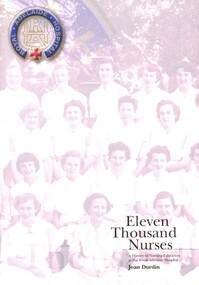
Alfred Hospital Nurses League - Nursing History CollectionBook - Illustrated Book, Joan Durdin, Eleven thousand nurses: a history of nursing at the Royal Adelaide Hospital; a history of nursing education at the Royal Adelaide Hospital 1889-1993, 1999
... Hospital-History...Nursing...Nurses...Nursing-study and teaching-South Australia-history...Alfred Hospital Nurses League - Nursing History Collection Ground Floor, Building 10 Caulfield Hospital 260 Kooyong Road Caulfield melbourne Publication of book was supported by the RAH Nurses' Education Fund and the Royal Adelaide Hospital. Of significance to the AHNL as it is the history of nurse education at another Australian hospital, with many similarities to the Alfred. Royal Adelaide Hospital-History Nursing Nurses Nursing-study and teaching-South ...The story of nursing and nursing education at the Royal Adelaide Hospital.Illustrated book, Sepia photograph of 1952 finalist group on cover. Title and authors name printed in black ink on front and spine. Hospital badge (in colour) top left of front cover. Hospital crest (in colour) at the base of spine.non-fictionThe story of nursing and nursing education at the Royal Adelaide Hospital.royal adelaide hospital-history, nursing, nurses, nursing-study and teaching-south australia-history -
Alfred Hospital Nurses League - Nursing History CollectionBook - Illustrated Book, Joan Durdin, They became nurses: a history of nursing in South Australia 1836-1980, 1991
... Alfred Hospital Nurses League - Nursing History Collection Ground Floor, Building 10 Caulfield Hospital 260 Kooyong Road Caulfield melbourne Of significance to the AHNL as there are many similarities with the history of nursing in Victoria. Nursing-South Australia ...Comprehensive history of nursing in South Australia over 150 years, exploring the changes in nursing practice, education and the work of nursing associations.Illustrated book with white cover. Full title and author's name printed in navy and black ink on front cover, abbreviated title and author's name printed in black ink on spine. Also on front cover is a collage of four black and white photos of nurses, five assorted nursing related badges all resting on a red nurses cape. On the back cover is a summary of the book.non-fictionComprehensive history of nursing in South Australia over 150 years, exploring the changes in nursing practice, education and the work of nursing associations.nursing-south australia-history, nurses-south australi-history -
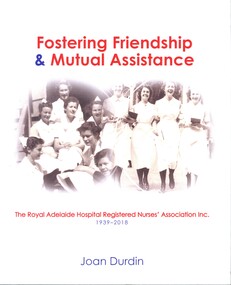
Alfred Hospital Nurses League - Nursing History CollectionBook - Illustrated Book, Joan Durdin, Fostering friendship & mutual assistance: the Royal Adelaide Hospital Registered Nurses' Association Inc. 1939-2018, 2018
... Hospital-History...Royal Adelaide Hospital Registered Nurses Association-History...Nurses...Nursing...Nursing-study and teaching-South Australia...Alfred Hospital Nurses League - Nursing History Collection Ground Floor, Building 10 Caulfield Hospital 260 Kooyong Road Caulfield melbourne Of significance to the AHNL as it is the history of a similar organization. Royal Adelaide Hospital-History Royal Adelaide Hospital Registered Nurses Association-History Nurses Nursing Nursing-study and teaching-South Australia-history A history of the Royal Adelaide Hospital Registered Nurses Association Inc., from its foundation in 1939 (by Lucy Daw, Adelaide Hospital Matron) until 1918. ...A history of the Royal Adelaide Hospital Registered Nurses Association Inc., from its foundation in 1939 (by Lucy Daw, Adelaide Hospital Matron) until 1918. Its motto "fostering friendship and mutual assistance' underlines its role in providing a social and helpful organization for RAH nurses.Illustrated book. Full title (red and navy-blue ink) and author's name (navy-blue ink) are printed on the front cover. Abbreviated title (red ink) and author's name (navy-blue ink) are printed on spine. Also on front cover are two black and white photos of groups of nurses. On the back cover are two black and white photos: one is of the Frome Road frontage of the Margaret Graham Nurses Home; the other is of three nurses walking. Also on the back cover is a coloured photo of the Royal Adelaide Hospital nurses' badge.non-fictionA history of the Royal Adelaide Hospital Registered Nurses Association Inc., from its foundation in 1939 (by Lucy Daw, Adelaide Hospital Matron) until 1918. Its motto "fostering friendship and mutual assistance' underlines its role in providing a social and helpful organization for RAH nurses.royal adelaide hospital-history, royal adelaide hospital registered nurses association-history, nurses, nursing, nursing-study and teaching-south australia-history -
Alfred Hospital Nurses League - Nursing History CollectionBook - Illustrated book, Robert L Wallace 1912, The Australians at the Boer War, 1976
... Alfred Hospital Nurses League - Nursing History Collection Ground Floor, Building 10 Caulfield Hospital 260 Kooyong Road Caulfield melbourne it is generally thought that 16000 Australians fought in the Boer War Of significance to the AHNL as several Alfred graduates worked in the military hospitals there Boer War-Australian involvement South African War 1899-1902 The history of the Australian in the Boer War between 1899 and 1902 At the bottom right of the front end-page is a printed black and white donation sticker: black Maltese cross in circle, "This book was donated to Alfred Archival Association Nursing Division by" AHNL (handwritten in black ink) Also previous catalogue number handwritten in black ink on this sticker Illustrated book with pale orange cover, title and authors name embossed in silver on spine The Australians at the Boer War Book Illustrated book Robert L Wallace 1912- The Australian War Memorial Australian Government Publishing Service John Sands Pty Ltd. ...The history of the Australian in the Boer War between 1899 and 1902Illustrated book with pale orange cover, title and authors name embossed in silver on spinenon-fictionThe history of the Australian in the Boer War between 1899 and 1902boer war-australian involvement, south african war 1899-1902 -
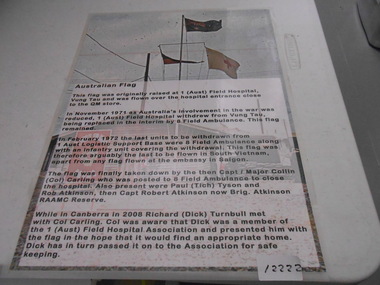
National Vietnam Veterans Museum (NVVM)Photograph
... Australian flag flying over the 1(AUST) Field Hospital. The document outlines the history of the flag. The flag was believed to be the last flown in South Vietnam apart from the Embassy in Saigion....National Vietnam Veterans Museum (NVVM) 25 Veterans Drive Newhaven phillip-island-and-the-bass-coast Australian Flag 1 (AUST) Field Hospital Laminated Photograph of three flags including the Australian flag flying over the 1(AUST) Field Hospital. The document outlines the history of the flag. The flag was believed to be the last flown in South ...Laminated Photograph of three flags including the Australian flag flying over the 1(AUST) Field Hospital. The document outlines the history of the flag. The flag was believed to be the last flown in South Vietnam apart from the Embassy in Saigion.australian flag 1 (aust) field hospital -
Clunes MuseumWork on paper - FAMILY HISTORY BENJAMIN WHITE
... SOUTH AUSTRALIA ON THE NORTHUMBERLAND. THE MANNING INDEX OF SOUTH AUSTRALIAN HISTORY REC9ORDS THAT BENJAMIN WHITE WAS RESPONSIBLE FOR "CREATING" THE ALLEN CREEK VILLAGE 5 KM NORTHWEST OF KAPUNDA C. 1849. CERTAINLY AT ONE STAGE BENJAMIN HAD A CONSIDERABLE LAND HOLDING ADJACENT TO ALLEN'S CREEK VAL LAWRENCE SUGGESTS THAT THE WHITE FAMILY TRAVELLED BY SEA FROM SA TO VICTORIA, NOT OVERLAND AS SUGESTED BY DESMA NICHOLSON IN "SOUTH AUSTRALIANS 1836-1885 ACCORDING TO CRSWICK HOSPITAL RECORDS BENJAMIN WHITE WAS ADMITTED JUNE 27 1873 (AGE 49 MARRIED, GRAVEDIGGER AT CRESWICK, BORN IN ENGLAND, WESLEYAN) AND LEFT HOSPITAL JULY 14 1873. ...SOUTH AUSTRALIA ON THE NORTHUMBERLAND. THE MANNING INDEX OF SOUTH AUSTRALIAN HISTORY REC9ORDS THAT BENJAMIN WHITE WAS RESPONSIBLE FOR "CREATING" THE ALLEN CREEK VILLAGE 5 KM NORTHWEST OF KAPUNDA C. 1849. CERTAINLY AT ONE STAGE BENJAMIN HAD A CONSIDERABLE LAND HOLDING ADJACENT TO ALLEN'S CREEK VAL LAWRENCE SUGGESTS THAT THE WHITE FAMILY TRAVELLED BY SEA FROM SA TO VICTORIA, NOT OVERLAND AS SUGESTED BY DESMA NICHOLSON IN "SOUTH AUSTRALIANS 1836-1885 ACCORDING TO CRSWICK HOSPITAL RECORDS BENJAMIN WHITE WAS ADMITTED JUNE 27 1873 (AGE 49 MARRIED, GRAVEDIGGER AT CRESWICK, BORN IN ENGLAND, WESLEYAN) AND LEFT HOSPITAL JULY 14 1873. ...BENJAMIN AND SARAH WHITE ARE RECORDED IN "SOUTH AUSTRALIANS 1836-1885" BOOK TWO.DESMA FAY NICHOLSON OF 160 FRANCIS ST RICHMOND NSW PROVIDED THE INFORMATION FOR THE BOOK. DESMA IS A DESCENDENT OF JOHN WHITE, FIFTH AND YOUNGEST SON OF BENJAMIN WHITE BENJAMIN WHITE PARENTS BENJAMIN AND JANE (NEE LOWDEN- SHOULD BE SOWDEN) BORN 1819 CAMBORNE, CORNWALL DIED JAN 1874 VICTORIA, BURIED IN CRESWICK ARRIVED SA 29/10/1847 FROM ENGLAND ON DUCHESS OF NORTHUMBERLAND DEPARTED SA C. 1852 FOR VICTORIA OVERLAND OCCUPATION MINER AND SECTON RESIDENCE: KAPUNDA ALLENS CREEK SA RELIGION: WESLEYAN HE MARRIED SARAH (SALLY) BAILEY ON 02/08/1845 IN CAMBORNE ENGLAND, SHE DIED 12/08/1891 IN CRESWICK CHILDREN: SARAH ANNE WILLIAMS 07/09/1845 TO 18/06/1890 ELIZABETH ORRINGE 22/02/1847 TO 16/10/1920 BENJAMIN 22/04/1849 TO 19/02/1889 HARRIET 29/08/1850 TO 15/05/1851 WILLIAM BAILEY 22/10/1851 TO 14/03/1916 JOSEPH 20/11/1853 TO 17/05/1910 THOMAS HENRY 15/05/1855 TO 15/08/1917 JOHN 14/04/1857 TO 27/02/1935 HARRIET 17/01/1860 TO 14/06/1863 DECIMA JANE CHEGWYN 04/01/1862 TO 28/02/1940 EMILY WILSON 07/03/1864 TO 19/08/1937 BENJAMIN WHITE MARRIED SARAH BAILEY IN CORNWALL IN SEPTEMBER 1845, JUST ONE MONTH BEFORE THE BIRTH OF THEIR FIRST CHILD SARAH ANN. SECOND CHILD ELIZABETH WAS BORN IN MARCH 1847 JUST SIX MONTHS BEFORE THE FAMILY SAILED FOR SOUTH AUSTRALIA ON THE NORTHUMBERLAND. THE MANNING INDEX OF SOUTH AUSTRALIAN HISTORY REC9ORDS THAT BENJAMIN WHITE WAS RESPONSIBLE FOR "CREATING" THE ALLEN CREEK VILLAGE 5 KM NORTHWEST OF KAPUNDA C. 1849. CERTAINLY AT ONE STAGE BENJAMIN HAD A CONSIDERABLE LAND HOLDING ADJACENT TO ALLEN'S CREEK VAL LAWRENCE SUGGESTS THAT THE WHITE FAMILY TRAVELLED BY SEA FROM SA TO VICTORIA, NOT OVERLAND AS SUGESTED BY DESMA NICHOLSON IN "SOUTH AUSTRALIANS 1836-1885 ACCORDING TO CRSWICK HOSPITAL RECORDS BENJAMIN WHITE WAS ADMITTED JUNE 27 1873 (AGE 49 MARRIED, GRAVEDIGGER AT CRESWICK, BORN IN ENGLAND, WESLEYAN) AND LEFT HOSPITAL JULY 14 1873. A CHRONICALLY ILL CONDITION WAS RELIEVED. BENJAMIN WHITE DIED DECEMBER 22, 1873. A SPECIAL CHURCH SERMON WAS CARRIED OUT ON SUNDAY JANUARY 43 1874benjamin white, sarah white, sarah bailey -
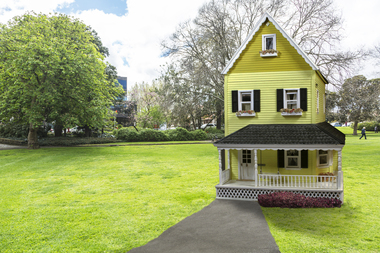
Whitehorse Historical Society Inc.Leisure object - Dolls House, Yvonne Fitzmaurice, 1974
... Australia in 1965 as "£10 poms" (Yvonne's words) she worked in casualty at the Box Hill hospital. Initially the family lived at Blackburn South before moving to Mitcham in 1968. To help establish a new life with her family in Australia, Yvonne worked in many different positions from nursing, machine knitting for a Prahran shop, making Christmas Cards and as a commercial traveller. As a hobby she also sold a number of pastel paintings. Following the publishing of her first family history ...THE DOLL HOUSE _ Yvonne Fitzmaurice The ten room fully furnished American farmhouse was created from an idea by former Mitcham resident, Yvonne Fitzmaurice and was constructed between 1976 and 1978 as a birthday present for her daughter, Susan. The house is a unique interpretation of early American architecture and inferior design. It is also a representation of one woman's ability to create and complete a details snapshot of a lifestyle long gone and give pleasure to family, friends and now the community. Yvonne has had an interesting and full life, born in New Zealand where was a State Registered Nurse and she specialised in hospital theatre work. Later her curiosity bought her to Australia where she worked at the Sydney hospital and with the Australia Flying Doctors service flying in and out of Wilcannia, western New South Wales. On returning to New Zealand Yvonne acted as part of a Medical cover team for the different armed services. one session in the Nary involved pursuing submarines which she described as being very exciting. In 1958 she travelled by sea through the Suez Canal to England and as a member of British Services served in the post WWII Germany for three year in the QARANC and also worked at The London Clinic with some high-profile specialists. Yvonne was introduced to her husband-to-be at a tennis party and they lived in Cambridge, UK, where their two children, Alastair and Susan, were born. On coming to Australia in 1965 as "£10 poms" (Yvonne's words) she worked in casualty at the Box Hill hospital. Initially the family lived at Blackburn South before moving to Mitcham in 1968. To help establish a new life with her family in Australia, Yvonne worked in many different positions from nursing, machine knitting for a Prahran shop, making Christmas Cards and as a commercial traveller. As a hobby she also sold a number of pastel paintings. Following the publishing of her first family history in 1994, Yvonne became a member and volunteer at the Whitehorse Historical Society where she has contributed in producing local history publication, articles for the Newsletter and has improved access to the files by creating the detailed "green files". Her interests include art, crafts and writing. Yvonne has a great philosophy, 'each day I must achieve something - no matter how small'.Hand-made child's doll's house. Built by Mrs Yvonne Fitzmaurice and finished in 1979. This house was built as a 1:12 scale and is a model of a Californian house called Peppercorn farm. House was built by Yvonne and her family and took a period of three years. A lot of the furniture is handmade and the rest is collected from various shops. "Susan Fitzmaurice" name on front of building. Date on plaque on top of front wall.na5059, na5061, na5063, na5065, na5068, na5071, na5073, na5075, na5077, na5079, na5081, na5083