
Showing 17 items matching "household fittings"
-
 Emerald Museum & Nobelius Heritage Park
Domestic object - Lamp, 1930 approx
... ...Household fittings...Emerald Victoria Australia Lamps Household fittings with loose label "Green Painted Hurricane Lamp. ...Green painted kerosene lamp. Metalwith loose label "Green Painted Hurricane Lamp. Donated by P. Trevaskis"emerald, victoria, australia, lamps, household fittings -
Emerald Museum & Nobelius Heritage Park
Domestic object - Lamp, 1925 approx
... ...Household fittings...Emerald Victoria Australia Household fittings Lamps Child's small kerosene glass & metal lamp. ...Child's small kerosene glass & metal lamp. Glass missing. Metal|Glassemerald, victoria, australia, household fittings, lamps -
Emerald Museum & Nobelius Heritage Park
Domestic object - Wall lamp, 1920 approx
... ...Household fittings...Emerald Victoria Australia Lamps Household fittings Wall kerosene lamp. Blue-green metal base. ...Wall kerosene lamp. Blue-green metal base. White reflector. Intact lamp glass. Metal|Glassemerald, victoria, australia, lamps, household fittings -
Emerald Museum & Nobelius Heritage Park
Container - Bottle cover, 1900s
... ...Household fittings...Emerald Victoria Australia food preparation kitchenware Household fittings Mrs Pearey Chestnut Gardens White crocheted bottle cover with bottle Container Bottle cover. ...White crocheted bottle cover with bottleemerald, victoria, australia, food preparation, kitchenware, household fittings, mrs pearey, chestnut gardens -
 Flagstaff Hill Maritime Museum and Village
Functional object - Cow Bell, Circa 1878
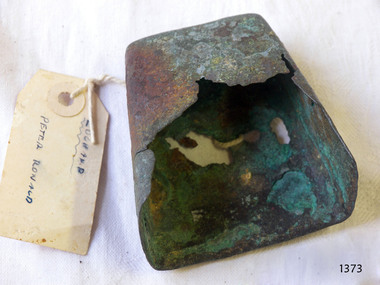
... fittings, pocket knives, toys, crystal chandeliers, beer mugs, cutlery, candles sticks, wick scissors, cow bells, and sauce bottles.” From this array of objects on the ocean floor emerged the humble brass cow bell. Cow bells were common to colonial agriculture and transport, used wherever animals were turned out to graze overnight and had to be rounded up again next morning. Bells were fastened around the necks of household...fittings, pocket knives, toys, crystal chandeliers, beer mugs, cutlery, candles sticks, wick scissors, cow bells, and sauce bottles.” From this array of objects on the ocean floor emerged the humble brass cow bell. Cow bells were common to colonial agriculture and transport, used wherever animals were turned out to graze overnight and had to be rounded up again next morning. Bells were fastened around the necks of household ...The artefact is a damaged brass cow bell recovered from the 1878 shipwreck of the LOCH ARD near Port Campbell. It was raised by Flagstaff Hill divers in 1973 and is in storage at the Maritime Village. The LOCH ARD was constructed on the Clyde in 1873 for the prestigious Loch Line of colonial clipper ships, designed for the Australian run. She sailed from England on 1 March 1878 carrying 37 crew, 17 passengers and a diverse general cargo ranging from luxury items to bulk railway iron. On 1 June 1878, emerging from fog and hearing too late the sound of breakers against the tall limestone cliffs, the vessel struck the southern foot of Mutton Bird Island and sank in 23 metres of water. Of the fifty-four people on board only two survived, one young male crewman and one young female passenger. A century later, despite the pounding seas and the efforts of looters, the wreck site continued to provide ample evidence of the extraordinary range of goods being imported into the Colony of Victoria in the post-Gold Rush era. Flagstaff Hill divers in the 1970s reported finds of “Bottles of champagne, window panes, rolls of zinc, barrels of cement, iron rails, clocks, lead shot, corrugated iron, lead, marble, salad oil bottles, ink bottles, copper wire, gin bottles, rolls of carpet, floor tiles, copper rivets, gas light fittings, pocket knives, toys, crystal chandeliers, beer mugs, cutlery, candles sticks, wick scissors, cow bells, and sauce bottles.” From this array of objects on the ocean floor emerged the humble brass cow bell. Cow bells were common to colonial agriculture and transport, used wherever animals were turned out to graze overnight and had to be rounded up again next morning. Bells were fastened around the necks of household milking cows, domestic goats, bullock teams, horse teams, and camel teams, to help find them in the pre-dawn light. Station shepherds and cattle drovers also used them to warn of any disturbances to their flocks and herds overnight. The bells were a necessary item in a largely unfenced continent. So important, that Anthony Mongon began making his pot-bells at Yackandandah from 1861, August Menneke produced the “Wagga Pot” from 1867, and Samuel Jones started manufacturing his distinctively shaped “Condamine Bell” in 1868. However, these deeply resonant Australian bells were made from iron — Mongon and Jones were blacksmiths who simply beat old pitsaw blades into shape. Few genuinely brass cow bells were made here, the vast majority being imported from Britain where the industry of brass founding was already well established. (Some bells were also imported from the United States, but these too were nearly all of iron).This bell is historically significant as typical of a cow bell used by farmers and herdsmen in Colonial Victoria. Its significance is increased by being one of a collection of artefact recovered by the Flagstaff Hill Divers from the wreck of the Loch Ard in the early 1970s. Items that come from several wrecks along Victoria's coast have also been recovered for Flagstaff Hill Maritime Village’s museum collection under Government permit, illustrating this item’s level of historical value. The cow bell is also significant for being part of Flagstaff Hill’s collection of artefacts from LOCH ARD, which is significant for being one of the largest collections of artefacts from this shipwreck in Victoria. It is significant for its association with the shipwreck, which is on the Victorian Heritage Register (VHR S417). The collection is significant because of the relationship between the objects, as together they have a high potential to interpret the story of the LOCH ARD. The LOCH ARD collection is archaeologically significant as the remains of a large international passenger and cargo ship. The LOCH ARD collection is historically significant for representing aspects of Victoria’s shipping history and its potential to interpret sub-theme 1.5 of Victoria’s Framework of Historical Themes (living with natural processes). The collection is also historically significant for its association with the LOCH ARD, which was one of the worst and best known shipwrecks in Victoria’s history.A small brass cow bell, in poor condition. It is blunt-wedge shaped. The sides expand outwards from the smaller rectangular roof of the bell to a larger open rectangle or bell mouth. A handwritten label is attached to the bel. Recovered from the wreck of the Loch Ard.Label text "["10/6/73, Brass Cow Bell, LOCH ARD, Found in the sandy hole in the centre of the wreck site. Cow bells were part of the cargo" - "10/6/73, LOCH ARD, small brass cow bell salvaged by FHMV divers"]. "LOCH ARD / PETER RONALD"flagstaff hill, warrnambool, shipwrecked coast, flagstaff hill maritime museum, maritime museum, shipwreck coast, flagstaff hill maritime village, great ocean road, loch line, loch ard, eva carmichael, mutton bird island, loch ard gorge, brass cow bell, colonial cow bells, 1878 shipwreck, shipwreck artefact, flagstaff hill divers -
 Flagstaff Hill Maritime Museum and Village
Functional object - Lamp, circa 1878
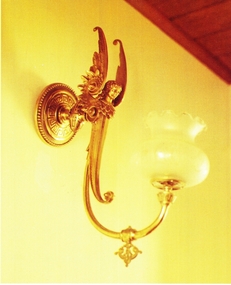
... fitting...shipwreck artifact...1878...shipwreck cargo...household...The collection is also historically significant for its association with the LOCH ARD, which was one of the worst and best known shipwrecks in Victoria’s history. flagstaff hill warrnambool shipwrecked coast flagstaff hill maritime museum maritime museum shipwreck coast flagstaff hill maritime village great ocean road loch line loch ard captain gibbs eva carmichael tom pearce glenample station mutton bird island loch ard gorge lamp fitting shipwreck artifact 1878 shipwreck cargo household effects 19th century lighting angel lamp loch ard lamp angelic lamp lighting at sea marine technology ship's lighting flying angel gas lamp maritime archaeology port campbell None Gas lamp, brass, single burner, wall-mounting bracket, delicately crafted. ...This Flying Angel lamp bracket was recovered from the wreck site of the steam sailing ship, "Loch Ard", which sank near Port Campbell, Victoria in 1878. It formed part of the ship's cargo. The 'flying angel' lamp was, for a time, displayed in the St Nicholas Seamen's Church at Flagstaff Hill. The design was very appropriate to the Missions to Seamen, being associated with the emblem of the 'flying angel' on the Missions' to Seamen's flag. Brief history of the Loch Ard: The vessel Loch Ard was constructed on the Clyde River in Scotland in 1873 for the prestigious Loch Line of colonial clipper ships, designed for the Australian run. She sailed from England on 1 March 1878 carrying 37 crew, 17 passengers and a diverse general cargo ranging from luxury items to bulk railway iron. On 1 June 1878, emerging from fog and hearing too late the sound of breakers against the tall limestone cliffs, the vessel struck the southern foot of Mutton Bird Island and sank in 23 metres of water. Of the fifty-four people on board only two survived, one young male crewman, Tom Pearce, and one young female passenger, Eva Carmichael. A century later, despite the pounding seas and the efforts of looters, the wreck site continued to provide ample evidence of the extraordinary range of goods being imported into the Colony of Victoria in the post-Gold Rush era. Flagstaff Hill divers in the 1970s reported finds of “Bottles of champagne, window panes, rolls of zinc, barrels of cement, iron rails, clocks, lead shot, corrugated iron, lead, marble, salad oil bottles, ink bottles, copper wire, gin bottles, rolls of carpet, floor tiles, copper rivets, gas light fittings, pocket knives, toys, crystal chandeliers, beer mugs, cutlery, candles sticks, wick scissors, cow bells, and sauce bottles.” The lamp bracket is significant for its connection with the wreck of the sailing ship, Loch Ard, in 1878. Flagstaff Hill’s collection of artefacts from LOCH ARD is significant for being one of the largest collections of artefacts from this shipwreck in Victoria. It is significant for its association with the shipwreck, which is on the Victorian Heritage Register (VHR S417). The collection is significant because of the relationship between the objects, as together they have a high potential to interpret the story of the LOCH ARD. The LOCH ARD collection is archaeologically significant as the remains of a large international passenger and cargo ship. The LOCH ARD collection is historically significant for representing aspects of Victoria’s shipping history and its potential to interpret sub-theme 1.5 of Victoria’s Framework of Historical Themes (living with natural processes). The collection is also historically significant for its association with the LOCH ARD, which was one of the worst and best known shipwrecks in Victoria’s history. Gas lamp, brass, single burner, wall-mounting bracket, delicately crafted. Ornate decoration features bust of an angel with up-swept wings, or 'flying angel'. Recovered from the wreck of the Loch Ard.Noneflagstaff hill, warrnambool, shipwrecked coast, flagstaff hill maritime museum, maritime museum, shipwreck coast, flagstaff hill maritime village, great ocean road, loch line, loch ard, captain gibbs, eva carmichael, tom pearce, glenample station, mutton bird island, loch ard gorge, lamp fitting, shipwreck artifact, 1878, shipwreck cargo, household effects, 19th century lighting, angel lamp, loch ard lamp, angelic lamp, lighting at sea, marine technology, ship's lighting, flying angel, gas lamp, maritime archaeology, port campbell -
 Federation University Historical Collection
Book - Book - Prospectus, The Working Men's College Melbourne, Prospectus,1900, 1900
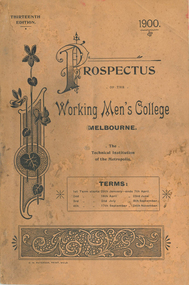
... household economy...department of agriculture and rural industries...woodworking...carpentry and joinery...turning and fitting...The majority of classes were at night and on Saturdays. working men's college melbourne rmit w.c. kernot w.h. embling ormond statue f. ormond electricity surveying architecture photography assaying dressmaking veterinary science plumbing letterpress printing w. ison h.d. evans library denton hat mills literary and commercial department typewriting department languages telegraphy department of music department of mathematics department of engineering 'department of architecture department of art and applied art department of mining and metallurgy department of chemistry department of household economy department of agriculture and rural industries woodworking carpentry and joinery turning and fitting coachbuilding and carriagedrafting Tan soft covered book of 112 pages. ...The Working Men’s College was founded in 1881 by a prominent grazier and philanthropist, The Hon. Francis Ormond, who donated £5000 towards the establishment of the college. The Council of the Melbourne Trades Hall then matched Ormond's initial donation by rallying its members. On 4 June 1887, the college opened in its purpose-built building on the corners of Bowen Street and La Trobe Street in Melbourne, with a gala ceremony. It became the third official provider of higher education in the new Colony of Victoria (the Melbourne Athenaeum was founded in 1839 and the University of Melbourne in 1853). The college was the predecessor to the current-day Royal Melbourne Institute of Technology (RMIT University). Adjoining the college in the 1890s were the Supreme Court of Victoria (later the Melbourne Magistrates' Court) and the Melbourne Gaol - both which are now part of RMIT today. A list of Scholarship Governors and Life Governors is included. The former have donated 250 Pounds Sterling and upwards, the later have donated 20 Pounds and over but less than 250 Pounds Sterling. The Patron of The Working Men's College was His Excellency The Right Honourable Lord Brassey. The President of the Council was Professor W C Kernot. The majority of classes were at night and on Saturdays. Tan soft covered book of 112 pages. The thirteenth edition of the Working Men's College (later Royal Melbourne Institute of Technology [RMIT]). It inlcudes the following photographic images: Main Building, Assaying, 1899 council (W.C. Kernot, W.H. Embling, Thomas smith, F.H. Bromley, John Reid, R.H. Solly, E. Findley, D. McIvor, James Robb, John Hancock, C.E. Oliver, A.J. Arnot, James Smith, Joseph Nixon, R.L.Jellery. C.S. Paterson), UNveiling the Ormond Statue, Victorian Lead and Shot Works, Francis Ormond, Telegraphy room, Lecture Theatre, photography, painting class, wool sorting, plumbing, Remington typewriter, W. Ison, H.D. Evans, library, Verdon prize, Denton Hat Mills. working men's college melbourne, rmit, w.c. kernot, w.h. embling, ormond statue, f. ormond, electricity, surveying, architecture, photography, assaying, dressmaking, veterinary science, plumbing, letterpress printing, w. ison, h.d. evans, library, denton hat mills, literary and commercial department, typewriting department, languages, telegraphy, department of music, department of mathematics, department of engineering, 'department of architecture, department of art and applied art, department of mining and metallurgy, department of chemistry, department of household economy, department of agriculture and rural industries, woodworking, carpentry and joinery, turning and fitting, coachbuilding and carriagedrafting -
 Flagstaff Hill Maritime Museum and Village
Functional object - Cow Bell, Circa 1878
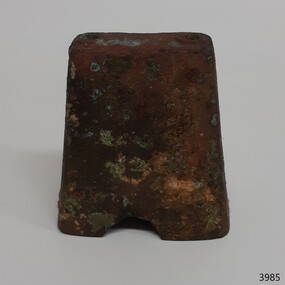
... fittings, pocket knives, toys, crystal chandeliers, beer mugs, cutlery, candles sticks, wick scissors, cow bells, and sauce bottles.” From this array of objects on the ocean floor emerged the humble brass cow bell. Cow bells were common to colonial agriculture and transport, used wherever animals were turned out to graze overnight and had to be rounded up again next morning. Bells were fastened around the necks of household...fittings, pocket knives, toys, crystal chandeliers, beer mugs, cutlery, candles sticks, wick scissors, cow bells, and sauce bottles.” From this array of objects on the ocean floor emerged the humble brass cow bell. Cow bells were common to colonial agriculture and transport, used wherever animals were turned out to graze overnight and had to be rounded up again next morning. Bells were fastened around the necks of household ...The artefact is a damaged brass cow bell recovered from the 1878 shipwreck of the LOCH ARD near Port Campbell. It was raised by Flagstaff Hill divers in 1973 and is in storage at the Maritime Village. The LOCH ARD was constructed on the Clyde in 1873 for the prestigious Loch Line of colonial clipper ships, designed for the Australian run. She sailed from England on 1 March 1878 carrying 37 crew, 17 passengers and a diverse general cargo ranging from luxury items to bulk railway iron. On 1 June 1878, emerging from fog and hearing too late the sound of breakers against the tall limestone cliffs, the vessel struck the southern foot of Mutton Bird Island and sank in 23 metres of water. Of the fifty-four people on board only two survived, one young male crewman and one young female passenger. A century later, despite the pounding seas and the efforts of looters, the wreck site continued to provide ample evidence of the extraordinary range of goods being imported into the Colony of Victoria in the post-Gold Rush era. Flagstaff Hill divers in the 1970s reported finds of “Bottles of champagne, window panes, rolls of zinc, barrels of cement, iron rails, clocks, lead shot, corrugated iron, lead, marble, salad oil bottles, ink bottles, copper wire, gin bottles, rolls of carpet, floor tiles, copper rivets, gas light fittings, pocket knives, toys, crystal chandeliers, beer mugs, cutlery, candles sticks, wick scissors, cow bells, and sauce bottles.” From this array of objects on the ocean floor emerged the humble brass cow bell. Cow bells were common to colonial agriculture and transport, used wherever animals were turned out to graze overnight and had to be rounded up again next morning. Bells were fastened around the necks of household milking cows, domestic goats, bullock teams, horse teams, and camel teams, to help find them in the pre-dawn light. Station shepherds and cattle drovers also used them to warn of any disturbances to their flocks and herds overnight. The bells were a necessary item in a largely unfenced continent. So important, that Anthony Mongon began making his pot-bells at Yackandandah from 1861, August Menneke produced the “Wagga Pot” from 1867, and Samuel Jones started manufacturing his distinctively shaped “Condamine Bell” in 1868. However, these deeply resonant Australian bells were made from iron — Mongon and Jones were blacksmiths who simply beat old pitsaw blades into shape. Few genuinely brass cow bells were made here, the vast majority being imported from Britain where the industry of brass founding was already well established. (Some bells were also imported from the United States, but these too were nearly all of iron).This bell is historically significant as typical of a cow bell used by farmers and herdsmen in Colonial Victoria. It was included in the cargo of the Loch Ard. Its significance is increased by being one of a collection of artefacts recovered by the Flagstaff Hill Divers from the wreck of the Loch Ard in the early 1970s. Items that come from several wrecks along Victoria's coast have also been recovered for Flagstaff Hill Maritime Village’s museum collection under a Government permit, illustrating this item’s level of historical value. The cow bell is also significant for being part of Flagstaff Hill’s collection of artefacts from LOCH ARD, which is significant for being one of the largest collections of artefacts from this shipwreck in Victoria. It is significant for its association with the shipwreck, which is on the Victorian Heritage Register (VHR S417). The collection is significant because of the relationship between the objects, as together they have a high potential to interpret the story of the LOCH ARD. The LOCH ARD collection is archaeologically significant as the remains of a large international passenger and cargo ship. The LOCH ARD collection is historically significant for representing aspects of Victoria’s shipping history and its potential to interpret sub-theme 1.5 of Victoria’s Framework of Historical Themes (living with natural processes). The collection is also historically significant for its association with the LOCH ARD, which was one of the worst and best-known shipwrecks in Victoria’s history.Cow bell; a small brass bell, blunt-wedge shaped. The sides expand outwards from the smaller rectangular roof of the bell to a larger open rectangle or bell mouth. The handle, now missing, was fixed in two places at the top. A neat half-circle piece has been cut from the base on a long edge. Recovered from the wreck of the Loch Ard.flagstaff hill, warrnambool, shipwrecked coast, flagstaff hill maritime museum, maritime museum, shipwreck coast, flagstaff hill maritime village, great ocean road, loch line, loch ard, eva carmichael, mutton bird island, loch ard gorge, brass cow bell, colonial cow bells, 1878 shipwreck, shipwreck artefact, flagstaff hill divers, cow bell -
 Orbost & District Historical Society
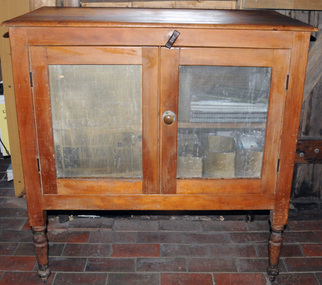
cabinet
... This was a normal household item before iceboxes came into regular use. furniture-domestic cabinet food-safe A wooden cabinet / safe. It has two doors and zinc mesh insets on the sides and front. Inside are two shelves. The back and top are closed. The knob fittings ...Food safes / cabinets are used principally to keep food safe (from flies and other pests), clean and cool. They have been used to store perishable foodstuffs for centuries, and are still made and used today. They are usually placed in a well ventilated area to allow for air flow, thus ensuring the produce is kept cool. This was a normal household item before iceboxes came into regular use.This was a normal household item before iceboxes came into regular use.A wooden cabinet / safe. It has two doors and zinc mesh insets on the sides and front. Inside are two shelves. The back and top are closed. The knob fittings are brass. It has four turned wooden legs and the doors are hinged.furniture-domestic cabinet food-safe -
 Flagstaff Hill Maritime Museum and Village
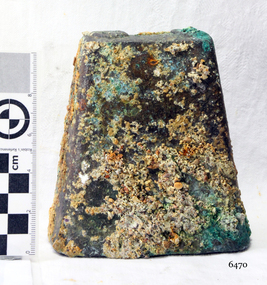
Functional object - Cow Bell, Circa 1878
... fittings, pocket knives, toys, crystal chandeliers, beer mugs, cutlery, candles sticks, wick scissors, cow bells, and sauce bottles.” From this array of objects on the ocean floor emerged the humble brass cow bell. Cow bells were common to colonial agriculture and transport, used wherever animals were turned out to graze overnight and had to be rounded up again next morning. Bells were fastened around the necks of household...fittings, pocket knives, toys, crystal chandeliers, beer mugs, cutlery, candles sticks, wick scissors, cow bells, and sauce bottles.” From this array of objects on the ocean floor emerged the humble brass cow bell. Cow bells were common to colonial agriculture and transport, used wherever animals were turned out to graze overnight and had to be rounded up again next morning. Bells were fastened around the necks of household ...The artefact is a brass cow bell recovered from the 1878 shipwreck of the LOCH ARD near Port Campbell. It was raised by Flagstaff Hill divers in 1973 and is in storage at the Maritime Village. The LOCH ARD was constructed on the Clyde in 1873 for the prestigious Loch Line of colonial clipper ships, designed for the Australian run. She sailed from England on 1 March 1878 carrying 37 crew, 17 passengers and a diverse general cargo ranging from luxury items to bulk railway iron. On 1 June 1878, emerging from fog and hearing too late the sound of breakers against the tall limestone cliffs, the vessel struck the southern foot of Mutton Bird Island and sank in 23 metres of water. Of the fifty-four people on board only two survived, one young male crewman, Tom Pearce, and one young female passenger, Eva Carmichael. A century later, despite the pounding seas and the efforts of looters, the wreck site continued to provide ample evidence of the extraordinary range of goods being imported into the Colony of Victoria in the post-Gold Rush era. Flagstaff Hill divers in the 1970s reported finds of “Bottles of champagne, window panes, rolls of zinc, barrels of cement, iron rails, clocks, lead shot, corrugated iron, lead, marble, salad oil bottles, ink bottles, copper wire, gin bottles, rolls of carpet, floor tiles, copper rivets, gas light fittings, pocket knives, toys, crystal chandeliers, beer mugs, cutlery, candles sticks, wick scissors, cow bells, and sauce bottles.” From this array of objects on the ocean floor emerged the humble brass cow bell. Cow bells were common to colonial agriculture and transport, used wherever animals were turned out to graze overnight and had to be rounded up again next morning. Bells were fastened around the necks of household milking cows, domestic goats, bullock teams, horse teams, and camel teams, to help find them in the pre-dawn light. Station shepherds and cattle drovers also used them to warn of any disturbances to their flocks and herds overnight. The bells were a necessary item in a largely unfenced continent. So important, that Anthony Mongon began making his pot-bells at Yackandandah from 1861, August Menneke produced the “Wagga Pot” from 1867, and Samuel Jones started manufacturing his distinctively shaped “Condamine Bell” in 1868. However, these deeply resonant Australian bells were made from iron — Mongon and Jones were blacksmiths who simply beat old pitsaw blades into shape. Few genuinely brass cow bells were made here, the vast majority being imported from Britain where the industry of brass founding was already well established. (Some bells were also imported from the United States, but these too were nearly all of iron). This bell is historically significant as typical of a cow bell used by farmers and herdsmen in Colonial Victoria. Its significance is increased by being one of a collection of artefact recovered by the Flagstaff Hill Divers from the wreck of the Loch Ard in the early 1970s. Items that come from several wrecks along Victoria's coast have also been recovered for Flagstaff Hill Maritime Village’s museum collection under Government permit, illustrating this item’s level of historical value. The cow bell is also significant for being part of Flagstaff Hill’s collection of artefacts from LOCH ARD, which is significant for being one of the largest collections of artefacts from this shipwreck in Victoria. It is significant for its association with the shipwreck, which is on the Victorian Heritage Register (VHR S417). The collection is significant because of the relationship between the objects, as together they have a high potential to interpret the story of the LOCH ARD. The LOCH ARD collection is archaeologically significant as the remains of a large international passenger and cargo ship. The LOCH ARD collection is historically significant for representing aspects of Victoria’s shipping history and its potential to interpret sub-theme 1.5 of Victoria’s Framework of Historical Themes (living with natural processes). The collection is also historically significant for its association with the LOCH ARD, which was one of the worst and best known shipwrecks in Victoria’s history. Brass cow bell, flat-top pyramid shape, rectangular head, shoulders flare out to a rectangular mouth. The hanging yoke is missing. Noneflagstaff hill, warrnambool, shipwrecked-coast, flagstaff-hill, flagstaff-hill-maritime-museum, maritime-museum, shipwreck-coast, flagstaff-hill-maritime-village, loch ard, cowbell, great ocean road, loch line, captain gibbs, eva carmichael, tom pearce, glenample station, mutton bird island, loch ard gorge, cow bell, brass cow bell, shipwreck artefact, flagstaff hill divers, horse bell, bell smith, vintage bell, farmer, shepherd, drover, stock bell, brass bell -
 Flagstaff Hill Maritime Museum and Village
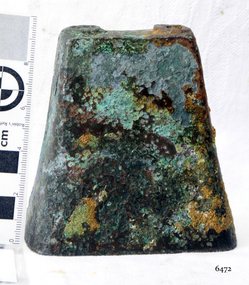
Functional object - Cow Bell, circa 1878
... fittings, pocket knives, toys, crystal chandeliers, beer mugs, cutlery, candles sticks, wick scissors, cow bells, and sauce bottles.” From this array of objects on the ocean floor emerged the humble brass cow bell. Cow bells were common to colonial agriculture and transport, used wherever animals were turned out to graze overnight and had to be rounded up again next morning. Bells were fastened around the necks of household...fittings, pocket knives, toys, crystal chandeliers, beer mugs, cutlery, candles sticks, wick scissors, cow bells, and sauce bottles.” From this array of objects on the ocean floor emerged the humble brass cow bell. Cow bells were common to colonial agriculture and transport, used wherever animals were turned out to graze overnight and had to be rounded up again next morning. Bells were fastened around the necks of household ...The artefact is a brass cow bell recovered from the 1878 shipwreck of the LOCH ARD near Port Campbell. It was raised by Flagstaff Hill divers in 1973 and is in storage at the Maritime Village. The LOCH ARD was constructed on the Clyde in 1873 for the prestigious Loch Line of colonial clipper ships, designed for the Australian run. She sailed from England on 1 March 1878 carrying 37 crew, 17 passengers and a diverse general cargo ranging from luxury items to bulk railway iron. On 1 June 1878, emerging from fog and hearing too late the sound of breakers against the tall limestone cliffs, the vessel struck the southern foot of Mutton Bird Island and sank in 23 metres of water. Of the fifty-four people on board only two survived, one young male crewman, Tom Pearce, and one young female passenger, Eva Carmichael. A century later, despite the pounding seas and the efforts of looters, the wreck site continued to provide ample evidence of the extraordinary range of goods being imported into the Colony of Victoria in the post-Gold Rush era. Flagstaff Hill divers in the 1970s reported finds of “Bottles of champagne, window panes, rolls of zinc, barrels of cement, iron rails, clocks, lead shot, corrugated iron, lead, marble, salad oil bottles, ink bottles, copper wire, gin bottles, rolls of carpet, floor tiles, copper rivets, gas light fittings, pocket knives, toys, crystal chandeliers, beer mugs, cutlery, candles sticks, wick scissors, cow bells, and sauce bottles.” From this array of objects on the ocean floor emerged the humble brass cow bell. Cow bells were common to colonial agriculture and transport, used wherever animals were turned out to graze overnight and had to be rounded up again next morning. Bells were fastened around the necks of household milking cows, domestic goats, bullock teams, horse teams, and camel teams, to help find them in the pre-dawn light. Station shepherds and cattle drovers also used them to warn of any disturbances to their flocks and herds overnight. The bells were a necessary item in a largely unfenced continent. So important, that Anthony Mongon began making his pot-bells at Yackandandah from 1861, August Menneke produced the “Wagga Pot” from 1867, and Samuel Jones started manufacturing his distinctively shaped “Condamine Bell” in 1868. However, these deeply resonant Australian bells were made from iron — Mongon and Jones were blacksmiths who simply beat old pitsaw blades into shape. Few genuinely brass cow bells were made here, the vast majority being imported from Britain where the industry of brass founding was already well established. (Some bells were also imported from the United States, but these too were nearly all of iron). This bell is historically significant as typical of a cow bell used by farmers and herdsmen in Colonial Victoria. Flagstaff Hill’s collection of artefacts from LOCH ARD is significant for being one of the largest collections of artefacts from this shipwreck in Victoria. It is significant for its association with the shipwreck, which is on the Victorian Heritage Register (VHR S417). The collection is significant because of the relationship between the objects, as together they have a high potential to interpret the story of the LOCH ARD. The LOCH ARD collection is archaeologically significant as the remains of a large international passenger and cargo ship. The LOCH ARD collection is historically significant for representing aspects of Victoria’s shipping history and its potential to interpret sub-theme 1.5 of Victoria’s Framework of Historical Themes (living with natural processes). The collection is also historically significant for its association with the LOCH ARD, which was one of the worst and best known shipwrecks in Victoria’s history. Cow bell, brass, covered in encrustation, handle missing from the top.flagstaff hill, warrnambool, shipwreck coast, flagstaff hill maritime museum, flagstaff hill maritime village, maritime museum, great ocean road, shipwreck artefact, loch ard, mutton bird island, glenample, eva carmichael, tom pearce, flagstaff hill divers, cow bell, horse bell, bell smith, vintage bell, farmer, shepherd, drover, stock bell, brass bell -
 Warrnambool and District Historical Society Inc.
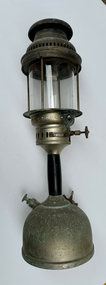
Functional object - Petromax lantern, Ehrich and Graetz, Berlin, Germany, c. 1920
... The Petromax lantern was developed in 1910 by Max Graetz of the firm of Ehrich and Graetz of Berlin, Germany (petro= petroleum, max=Max Graetz).The Petromax lantern is still produced today This lantern is of antiquarian interest as an example of household lighting100 years ago. vintage lighting Petromax lanterns PETROMAX No. 886 MADE IN GERMANY This is a lantern with a metal base, a wooden stem painted black, a metal body holding a piece of circular glass and a metal top with perforations acting as a chimney. The base has a hand pump and a removable screw cap to enable the base to be filled with paraffin. The main body has a screw holder to control the lighting and a pre-lighting mechanism and a mantle fitting ...This is a vintage lighting mechanism probably dating from the 1920s. It would have been used in a household or business to provide lighting for a room. It is quite heavy so would have mostly rested on a table or ledge. It is a Petromax lantern, a brand name for a type of pressurised paraffin lamp that uses a mantle. The Petromax lantern was developed in 1910 by Max Graetz of the firm of Ehrich and Graetz of Berlin, Germany (petro= petroleum, max=Max Graetz).The Petromax lantern is still produced todayThis lantern is of antiquarian interest as an example of household lighting100 years ago.This is a lantern with a metal base, a wooden stem painted black, a metal body holding a piece of circular glass and a metal top with perforations acting as a chimney. The base has a hand pump and a removable screw cap to enable the base to be filled with paraffin. The main body has a screw holder to control the lighting and a pre-lighting mechanism and a mantle fitting inside the glass. The mantle is missing.PETROMAX No. 886 MADE IN GERMANYvintage lighting, petromax lanterns -
 Warrnambool and District Historical Society Inc.
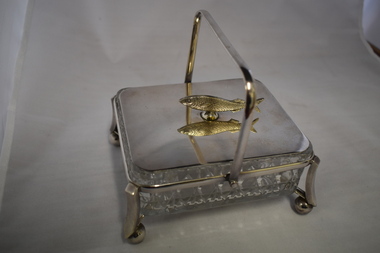
Serving dish, Fish Dish, Early 20th century
... It will be useful for display. household items history of warrnambool ‘E P N S 62’ This fish dish has an electro-plated nickel silver holder with two curved pieces of metal joined at the centre to form a base. There are four round metal balls at each end of the curved metal to stabilise the stand. Four curved metal pieces are attached to the base and hold a rectangular-shaped piece of metal and a handle. Fitting ...This fish dish is an attractive household item which would have been used in the early to mid 20th century when the more affluent families in society were entertaining. It is not a common item and most likely would not be seen in households today. This dish has no known local provenance but is of considerable interest as a household item not seen today. It will be useful for display.This fish dish has an electro-plated nickel silver holder with two curved pieces of metal joined at the centre to form a base. There are four round metal balls at each end of the curved metal to stabilise the stand. Four curved metal pieces are attached to the base and hold a rectangular-shaped piece of metal and a handle. Fitting into this piece of metal is a cut glass container which is heavily patterned on the sides and base. The lid of this container is rectangular with rounded edges and silver-plated. The top of the lid has a silver-coloured free-standing fish model attached to the lid by a metal stud. The fish is a little loose on its stand. The handle can be folded down. ‘E P N S 62’ household items, history of warrnambool -
 Warrnambool and District Historical Society Inc.
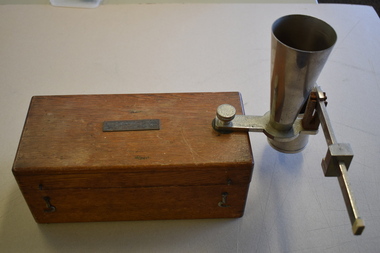
Household, Scales - Grain tester, Early 20th century
... Part of it is rusty. .3 This is small metal cylinder with a lid. .4 This is a metal bar with measurements, a hook at the top and a slide or weight fitting on to the bar. .5 This is a small metal screw. Scales - Grain tester Household Australasian Scale Company ...This grain scale tester was used to work out the percentage weight of a sack of grain after the grain husk, dust and dirt were removed, thereby allowing for the calculation of the true value of the sack. The parts were attached to the box via the screw on top of the box and the cleaned grain went into the funnel to measure a fixed grain amount, before being released from the bottom of the funnel into the barrel which was then hung on the end of the scale. The weight was then slid down the graduated ruler until the scale balanced. Grain scale testers would have been used in farming in the Western District in the past and similar objects may still be in use. This grain scale tester is retained as a good example of an agricultural item from the past.This is a grain tester scale in a wooden box. .1 The wooden box has two metal hinges and wooden inserts inside with blue felt on the tops of the inserts. The box has a metal plaque on the lid and a round metal hole section for inserting a piece of equipment. .2 This is a metal flask on a stand. Part of it is rusty. .3 This is small metal cylinder with a lid. .4 This is a metal bar with measurements, a hook at the top and a slide or weight fitting on to the bar. .5 This is a small metal screw. ‘Lbs per bushel’ ‘Australian Manufacture by Australasian Scale Co. Ltd., Thomas Street, Sydney N.S.W.’ agricultural instruments, history of warrnambool, grain scale tester -
 Warrnambool and District Historical Society Inc.
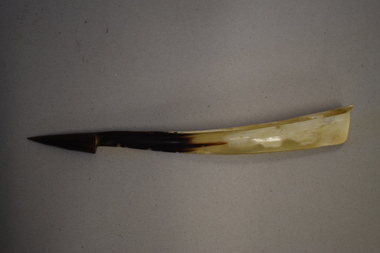
Domestic Object - Shoe horn, Early 20th century
... fitting shoes or boots. Animal horn was the original material used to make such an item – hence the name ‘shoe horn’. Today shoe horns are still used but they are usually made of plastic or metal. This item is retained as an example of a shoe horn made from animal bone, a relic of the past. household ...The bone from this shoe horn probably comes from the horn of a cow. It has been adapted for use in putting on tight-fitting shoes or boots. Animal horn was the original material used to make such an item – hence the name ‘shoe horn’. Today shoe horns are still used but they are usually made of plastic or metal. This item is retained as an example of a shoe horn made from animal bone, a relic of the past.This is an animal bone horn tapering to an end that has been shaped to a point to form a handle. The horn is brown and cream-coloured. The horn is chipped on the sides and slightly gouged out at the top. household items, shoehorn, shoe horn, shoespooner -
 Warrnambool and District Historical Society Inc.
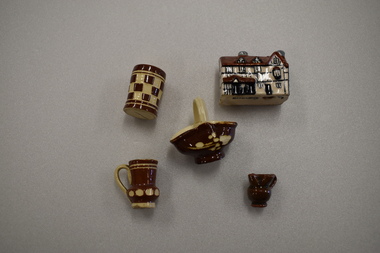
Miniature China Pieces (5), Mid 20th century
... fittings are not bought or sold today as much as in the past. These china miniatures have no known local provenance but are retained for display purposes. Warrnambool Antiquarian household ...Miniatures such as these are still made today as collection pieces and can be seen on display in some houses. Some of these items might also be used as furnishing pieces in dolls houses though dolls houses with quality fittings are not bought or sold today as much as in the past. These china miniatures have no known local provenance but are retained for display purposes.These five items are miniature china pieces, used in a doll’s house or as collection pieces for display in a home. .1 Miniature house in red and cream colouring .2 Miniature basket in brown and cream colouring .3 Miniature jug or pot in brown and cream colouring (handle broken off) .4 Miniature jug in brown and cream colouring .5 Miniature brown urn .1 Englandwarrnambool, antiquarian household items, history of warrnambool -
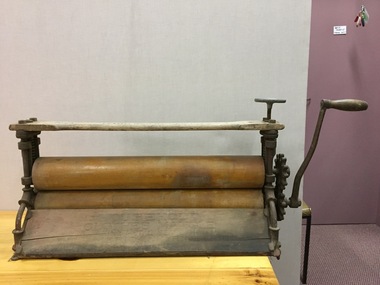 Kew Historical Society Inc
Functional object - Laundry Equipment, American Wringer, Household Clothes Mangle, Twentieth Century
... Large mechanical hand cranked household laundry mangle with hardwood rolls and metal fittings. Information about the equipment is stamped/incised on both the metal and wooden frame....Later devices were typically electrified. laundry equipment household mangle wringer Household Clothes Mangle /American Wringer No 120 / Inc Metal Bearings / / Hardwood Rolls Large mechanical hand cranked household laundry mangle with hardwood rolls and metal fittings. Information about the equipment is stamped/incised on both the metal and wooden frame. ...A large device for drying laundry consisting of two rollers between which the wet laundry is squeezed (or wrung); a mangle. American English uses the term 'Wringer' whereas UK English uses the term 'mangle'. Later devices were typically electrified.Large mechanical hand cranked household laundry mangle with hardwood rolls and metal fittings. Information about the equipment is stamped/incised on both the metal and wooden frame.Household Clothes Mangle /American Wringer No 120 / Inc Metal Bearings / / Hardwood Rollslaundry equipment, household mangle, wringer
