
Showing 23 items matching "including sporting teams"
-
 Dandenong & District Historical Society
Booklet, A History of the Dandenong High School 1919-1968, 27 May 2026
... ...Including Sporting Teams...Everything from House Captains Including Sporting Teams Orchestra Sporting Teams and Teachers A History of the school from inception 1919 until 1968. ...A History of the school from inception 1919 until 1968. Photos and text re principals, pupils and activities including Orchestra, Sport and Staff and Students2 Paper Back copies and one Hard cover copy. 64pp Text and pictures.non-fictionA History of the school from inception 1919 until 1968. Photos and text re principals, pupils and activities including Orchestra, Sport and Staff and Studentseverything from house captains, including sporting teams, orchestra, sporting teams and teachers -
 Camberwell Girls Grammar School
Digital images, McGlashan Image Collection, 1943-1950
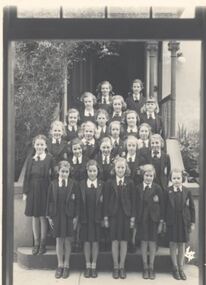
... Twenty-three black & white images of class groups and sporting teams including tennis and softball....Camberwell Girls Grammar School 2 Torrington Street Canterbury melbourne Twenty-three black & white images of class groups and sporting teams including tennis and softball. McGlashan Image Collection Digital images ...Twenty-three black & white images of class groups and sporting teams including tennis and softball. -
Sunshine and District Historical Society Incorporated
Mixed media (collection) - A.G. Spaldings Collection
... . - The factory provided employees with many social activities, including Christmas parties, sporting teams, 25th years of service club, social club. - In the early 1990s, the factory was demolished and replaced by the first Bunnings Hardware store in Victoria, marking a shift in local land use. .... - The factory provided employees with many social activities, including Christmas parties, sporting teams, 25th years of service club, social club. - In the early 1990s, the factory was demolished and replaced by the first Bunnings Hardware store in Victoria, marking a shift in local land use. ...Large collection of A.G. Spaldings documents, photographs and objects. This collection has been split into separate catalog numbers and is stored in various different location as per the individual catalog numbersspaldingsspaldings -
 Warrnambool and District Historical Society Inc.
Badge, K.G.Luke, Nestles Cricket Club, 1966
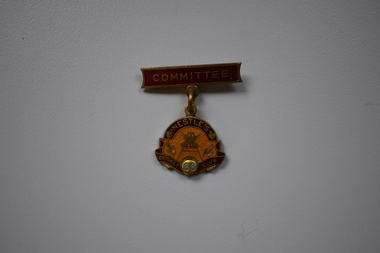
... sporting clubs, including the Nestles Cricket Club and the Nestles Rowing Club. The Nestles Cricket Club commenced in 1944 and has been a part of the Warrnambool and District Cricket Association competition since that time. It still operates today under the same name and includes a women’s team...sporting clubs, including the Nestles Cricket Club and the Nestles Rowing Club. The Nestles Cricket Club commenced in 1944 and has been a part of the Warrnambool and District Cricket Association competition since that time. It still operates today under the same name and includes a women’s team ...This badge was issued in 1966 to a member of the committee of the Nestles Cricket Club in Dennington (Warrnambool). The Nestles Milk Factory was established at Dennington in 1911, being one of the few Nestles factories at the time to be opened outside of Europe. During World War One and the 1920s the Dennington Nestles Factory was the world’s largest milk condensery and at its peak in the 1960s and 70s was employing 800 people. It produced the drink, Milo and the coffee, Nescafe (this latter ceasing in 2000). In 2005 the Nestles Factory was taken over by the New Zealand firm, Fonterra and it is due to cease business entirely late in 2019. The Nestles Factory encouraged and sponsored several social and sporting clubs, including the Nestles Cricket Club and the Nestles Rowing Club. The Nestles Cricket Club commenced in 1944 and has been a part of the Warrnambool and District Cricket Association competition since that time. It still operates today under the same name and includes a women’s team. This item is of interest as a memento of Nestles Cricket Club, a prominent cricket team in Warrnambool today.This is a shield-shaped metal badge with a red and gold background, an image in yellow of cricket bats and stumps and two decorative patterns and gold-coloured printing. A circular number has been attached to the lower part of the badge. This is detachable. A bar with gold-coloured edging and a red background and gold-coloured printing is attached to the badge by a metal ring. The back of the bar has a metal clip.Committee Nestles Cricket Club 66 K.G.Luke Melb. nestles milk factory, dennington, nestles cricket club, history of warrnambool -
 Emerald Museum & Nobelius Heritage Park
Plaque - Opening Plaque of Emerald Recreation Reserve Pavilion, 1965
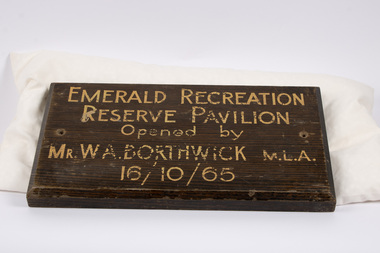
... teams including the Emerald Cricket Club. The 1965 pavilion was replaced in 2021. This plaque commemorates a now-renovated building playing an important role in facilitating sporting and recreation in the local community over more than five decades. ...This plaque commemorated the October 16th, 1965 opening of a new pavilion at Emerald Recreation Reserve (now known as Worrell Reserve). The pavilion was opened by Mr William Archibald Borthwick, at that time a member of the Victorian Legislative Assembly representing the electorate of Scoresby. It was built to serve the needs of local sports teams including the Emerald Cricket Club. The 1965 pavilion was replaced in 2021.This plaque commemorates a now-renovated building playing an important role in facilitating sporting and recreation in the local community over more than five decades.A rectangular wooden plaque, with partially faded text painted on one side in a landscape orientation. There are two holes through the display side of the plaque near the middle of each short edge, previously used to affix the plaque to a surface. There is a small taper between the rear side and display side such that the display side is slightly smaller.Painted on wood: "EMERALD RECREATION / RESERVE PAVILION / Opened by / MR. W A. BORTHWICK M.L.A. / 16/10/65"emerald cricket club, worrell reserve -
 Kastellorizian Association of Victoria
Award, A N Bisas Memorial Shield, 1963
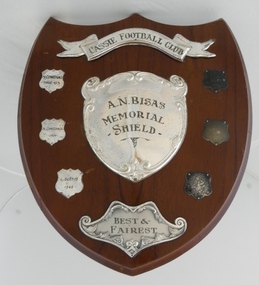
... sporting teams becoming a key focus of social events. This trophy also symbolises the assimilation of the Castellorizians in Australia in fielding teams in the typical Australian sports of Australian Rules Football and cricket. shield football trophy Australian Greeks in sport Six silver engravings including one across the top "CASSIE FOOTBALL CLUB," another across the bottom "BEST & FAIREST," and on the three smaller shields to the left, for the top one "N CONSTANCE 1962-1963," on the middle one "N CONSTANCE 1964" and on the bottom shield "L SCOTIS 1965." ...The Cassie Football Club was part of the Young Men's Castellorizian Club (YMCS), 1962 - 1965, an organisation established within the Castellorizian Association of Victoria to cater for the sporting, social and leisure pursuits of the second and third generations of the Castellorizian youth in Melbourne. Whilst the football team was the main focus for both players and supporters, the YMCS also fielded cricket and debating teams. This football trophy was awarded to the Best & Fairest for the 3 years of the club's duration - N Constance 1963, N Constance 1964 and L Scotis 1965. This item is of social significance as it represents the hey day of the club, with both an active ladies and men's group supporting the youth. Membership was at its peak across the organisation and the generations, with the sporting teams becoming a key focus of social events. This trophy also symbolises the assimilation of the Castellorizians in Australia in fielding teams in the typical Australian sports of Australian Rules Football and cricket.Wooden Shield with 9 silver stirling plaques attached, including a ribbon across the top and the bottom, a central shield, and 3 small shields either side of the central shield. Six silver engravings including one across the top "CASSIE FOOTBALL CLUB," another across the bottom "BEST & FAIREST," and on the three smaller shields to the left, for the top one "N CONSTANCE 1962-1963," on the middle one "N CONSTANCE 1964" and on the bottom shield "L SCOTIS 1965." On the back of the shield price marked as 6 pounds, 6 shillings shield, football trophy, australian greeks in sport -
 City of Melbourne Libraries
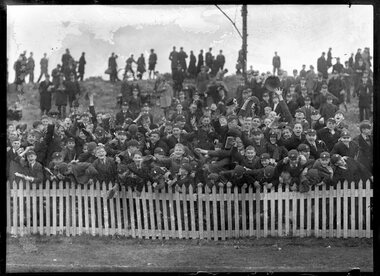
Photograph, Bull, Hugh Jones, 1897-1993, Scotch College v. Xavier College football match
... team-mate, as it was going through goal Grammar would have been beaten.” Final score - Melbourne Grammar 13.7 (85 points) defeated Xavier College 12.9 (81 points). Ladder for the 1934 Season- Melbourne Grammar-5 wins Wesley College- 4 wins Scotch College- 3 wins Xavier College- 2 wins Geelong Grammar- 1 win Geelong College- 0 wins The Associated Public Schools of Victoria (APS) exists today where eleven member (private) schools, including co-educational schools, participate in 21 sporting competitions throughout the year. ...team-mate, as it was going through goal Grammar would have been beaten.” Final score - Melbourne Grammar 13.7 (85 points) defeated Xavier College 12.9 (81 points). Ladder for the 1934 Season- Melbourne Grammar-5 wins Wesley College- 4 wins Scotch College- 3 wins Xavier College- 2 wins Geelong Grammar- 1 win Geelong College- 0 wins The Associated Public Schools of Victoria (APS) exists today where eleven member (private) schools, including co-educational schools, participate in 21 sporting competitions throughout the year. ...Published: 29 June 1934 Published title: PUBLIC SCHOOLS FOOTBALL BEGINS WITH SCOTCH--XAVIER MATCH. Published caption: “The Public Schools 1934 Football season began yesterday when Scotch met Xavier on the Olympic Park ground, and after a wonderful recovery in the third term, Scotch registered a narrow win. Pictured above is the crowd of Scotch boys who congregated behind the goal after the addition of another goal to their score.” Description: Scotch College pupils exuberantly cheer their team’s goal at the first football match of the Public Schools Premiership and Championship for 1934 between Scotch College and Xavier College at Olympic Park, Melbourne (where AAMI Park is now). Research by project volunteer, Fiona Collyer: The Public Schools Premiership and Championship was an Australian Rules football tournament held every winter, over five weeks between six schools- Scotch College, Xavier College, Melbourne Grammar, Wesley College and traditional rivals Geelong Grammar and Geelong College. The school that won the most games out of the five played, won the competition. As the 1933 Premiers, Xavier College had the honour of playing the opening match of the season on 28 June against runners-up Scotch College at Olympic Park (where AAMI Park is now). The Public Schools Premiership matches were widely reported in Melbourne’s daily newspapers with photographs and commentary of every game. Weekly society magazine “Table Talk” featured reports and seven photographs of the first games of the season. Australian Broadcasting Commission (ABC) wireless station 3AR interspersed their afternoon program of reproduced music with detailed descriptions of the matches. Also reporting the matches was “Forty-Years-On”, presumably a student in the 1890s, whose regular column in The Herald newspaper “Activities In The Public Schools” published all the latest news on Victoria’s public (private) schools. In his column for The Australasian 7 July 1934, “Old Boy” writes about the Scotch versus Xavier match- “For more than half the game last week, Scotch was outplayed, but took the lead early in the last term and kept it. Scotch surprised even its own supporters by its dash in the last 25 minutes. Xavier, who became over confident by the prospects of victory, could not withstand the final onslaught. In the last quarter Scotch was the better side and won by seven points.” The final score was Scotch 11.11 (77 points) and Xavier 10.10 (70 points). At the end of this exciting match the overjoyed Scotch boys swarmed over the Olympic Park fences to chair their captain, Stanley Steele and carry him shoulder high, to the pavilion. The first documented game of a variation of Australian Rules football was played at Richmond Paddock (now Yarra Park) from 7 August 1858. Australian Rules football writer Hugh Buggy of The Argus 16 April 1952 explains- “It began when boys and masters of Scotch College and Melbourne Grammar School decided to play a 40-a-side game, with the first team to score two goals to be the winner. Goal posts were pitched more than a mile apart, one set on the Jolimont Hill and the other at Punt road Richmond. Nobody defined the boundary, and the play swung over the broad acres of the park and around the gum trees. It went on and on like a Test match, from noon till dusk. After 15 hours of play on three Saturdays the score was one goal all, and the game was abandoned for that season.” Rules of the game hadn’t been decided at this time - the earliest known rules were codified a year later in 1859. A sculpture and plaque located outside the Melbourne Cricket Ground (MCG), created by sculptor Louis Laumen in 2001, commemorates this game. It depicts two school boys chasing a ball along with umpire Tom Wills, a co-writer of the rules and promoter of Australian Rules football. A medley of Gaelic football, an Aboriginal game called marngrook as well as football played in English public (that is private) schools have been cited as inspiration for Australian Rules football. The word “Marngrook” meaning “game ball”, comes from the language of the Gunditjmara, First Nations people of southwestern Victoria. Marngrook was played at gatherings and celebrations and involved players competing to jump and catch the ball after it is kicked high into the air. The player that catches the ball then gets to kick it. The ball was made from possum skin, filled with pounded charcoal and tied with kangaroo sinews. Protector of Aborigines in Victoria, William Thomas (1794-1867) observed in 1841- “The men and boys joyfully assemble when this game is to be played. One makes a ball of possum skin, somewhat elastic, but firm and strong… The players of this game do not throw the ball as a white man might do, but drop it and at the same time kick it with their feet, using the instep for that purpose. The tallest men have the best chances in this game. Some of them will leap as high as five feet from the ground to catch the ball. The person who secures the ball kicks it. This continues for hours and the natives never seem to tire of the exercise.” The Victorian Football League (VFL), was founded in 1897 with eight teams playing Australian Rules football and held its first Grand Final at the MCG in 1902. From the start the games attracted large enthusiastic crowds, which included women. “Viva” writing in the Supplement to The Weekly Times-3 July 1886- LADIES COLUMN (By Viva) FOOTBALL. A Social Sketch. “…Of the popularity of football and footballers among women, there can be no doubt. Young, soft hearted girls, who would not “tread upon a worm," avow that football matches are "awfully jolly," and seem to regard accidents as a necessary part of the amusement…a great proportion of the spectators were ladies.” “Minetta” writing for Punch Magazine - “Ladies Letter, Holmby House, Toorak” 22 June 1905 “The "Football Girl" is a feminine genus at present much to the fore in Melbourne. Not that she plays football—at least not beyond a kick in the backyard or paddock—oh, dear, no! Her interest in the game is purely from a spectacular point of view. "Football Girls" usually hunt in couples, with two male barrackers attached. They know all about So-and-So's form, and whether he is a trier or has been bought. They go to each match of their particular club, and watch the play intently, their faces wearing a decidedly strained expression when their club is getting the worst of it. They are not ashamed to barrack either, when matters are progressing successfully… Yours ever, MINETTA.” The Herald 2 July 1909 published a cartoon by Ambrose Dyson depicting women football fans, which asked- “THE QUESTION OF THE DAY. Should Girls Go To Football Matches? Should they? The sex made up their mind about the matter very early on.” The resounding answer was- “Well, I’d like to see the man that would stop me!” At the final match of the 1934 tournament on August 2, Melbourne Grammar finished the season unbeaten, winning their tenth Public Schools premiership in 16 years. The Weekly Times 11 August 1934 reported-“Melbourne Grammar…had a rather lucky escape against Xavier…Had a Xavier player not touched a shot, kicked by a team-mate, as it was going through goal Grammar would have been beaten.” Final score - Melbourne Grammar 13.7 (85 points) defeated Xavier College 12.9 (81 points). Ladder for the 1934 Season- Melbourne Grammar-5 wins Wesley College- 4 wins Scotch College- 3 wins Xavier College- 2 wins Geelong Grammar- 1 win Geelong College- 0 wins The Associated Public Schools of Victoria (APS) exists today where eleven member (private) schools, including co-educational schools, participate in 21 sporting competitions throughout the year. (The descriptor “Public School” references the historical usage of the term and the model of the British public school). PUBLIC SCHOOLS FOOTBALL BEGINS WITH SCOTCH--XAVIER MATCH. (1934, June 29). The Age (Melbourne, Vic. : 1854 - 1954), p. 11. Retrieved June 18, 2025, from http://nla.gov.au/nla.news-article204824484 PUBLIC SCHOOLS FOOTBALL AT OLYMPIC PARK (1934, July 5). Table Talk (Melbourne, Vic. : 1885 - 1939), p. 5. Retrieved June 18, 2025, from http://nla.gov.au/nla.news-article149682433 PUBLIC SCHOOLS. (1934, June 29). The Age (Melbourne, Vic. : 1854 - 1954), p. 5. Retrieved June 3, 2025, from http://nla.gov.au/nla.news-article204824486 PUBLIC SCHOOLS FOOTBALL. (1936, July 3). The Argus (Melbourne, Vic. : 1848 - 1957), p. 18. Retrieved August 6, 2025, from http://nla.gov.au/nla.news-article11888301 https://en.m.wikipedia.org/wiki/History_of_Australian_rules_football COLLEGE SPORTS (1934, July 7). The Australasian (Melbourne, Vic. : 1864 - 1946), p. 48 (METROPOLITAN EDITION). Retrieved May 30, 2025, from http://nla.gov.au/nla.news-article145238393 GRAMMAR CHAMPIONS (1934, August 11). Weekly Times (Melbourne, Vic. : 1869 - 1954), p. 72. Retrieved June 1, 2025, from http://nla.gov.au/nla.news-article224562842 LETS LOOK AT FOOTBALL with HUGH BUGGY (1952, April 16). The Argus (Melbourne, Vic. : 1848 - 1957), p. 9. Retrieved June 15, 2025, from http://nla.gov.au/nla.news-article23174340 FOR YOUNG PEOPLE AMONG THE SCHOOLS. (1934, August 7). The Age (Melbourne, Vic. : 1854 - 1954), p. 4. Retrieved June 14, 2025, from http://nla.gov.au/nla.news-article205521661 https://www.nma.gov.au/defining-moments/resources/australian-rules-football#:~:text=In%20the%20winter%20of%201858,games%20of%20Australian%20Rules%20football. https://apssport.org.au/about/ http://lindsaymagazine.co/from-marngrook-to-australian-rules-football/ https://collection.australiansportsmuseum.org.au/objects/70993/possum-skin-ball FOOTBALL. (1886, July 3). Weekly Times (Melbourne, Vic. : 1869 - 1954), p. 6 (SUPPLEMENT TO THE STORY TELLER). Retrieved September 7, 2025, from http://nla.gov.au/nla.news-article221741193 Ladies' Letter. (1905, June 22). Punch (Melbourne, Vic. : 1900 - 1918; 1925), p. 28. Retrieved September 11, 2025, from http://nla.gov.au/nla.news-article175410975 THE QUESTION OF THE DAY. (1909, July 2). The Herald (Melbourne, Vic. : 1861 - 1954), p. 9. Retrieved September 17, 2025, from http://nla.gov.au/nla.news-article242062970 Photographer notations on slide: "Scotch v Xavier - Olympic Park B42".schools, football -
 City of Melbourne Libraries
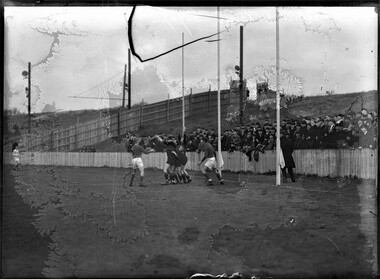
Photograph, Bull, Hugh Jones, 1897-1993, Photograph, Scotch College v. Xavier College football match, 1934
... team-mate, as it was going through goal Grammar would have been beaten.” Final score - Melbourne Grammar 13.7 (85 points) defeated Xavier College 12.9 (81 points). Ladder for the 1934 Season- Melbourne Grammar-5 wins Wesley College- 4 wins Scotch College- 3 wins Xavier College- 2 wins Geelong Grammar- 1 win Geelong College- 0 wins The Associated Public Schools of Victoria (APS) exists today where eleven member (private) schools, including co-educational schools, participate in 21 sporting competitions throughout the year. ...team-mate, as it was going through goal Grammar would have been beaten.” Final score - Melbourne Grammar 13.7 (85 points) defeated Xavier College 12.9 (81 points). Ladder for the 1934 Season- Melbourne Grammar-5 wins Wesley College- 4 wins Scotch College- 3 wins Xavier College- 2 wins Geelong Grammar- 1 win Geelong College- 0 wins The Associated Public Schools of Victoria (APS) exists today where eleven member (private) schools, including co-educational schools, participate in 21 sporting competitions throughout the year. ...At the first match of the 1934 Public Schools Premiership and Championships at Olympic Park (where AAMI Park is now) between Scotch College (white shorts) and Xavier College, (black shorts) a mark is missed by Xavier players and then taken by a Scotch player. Research by project volunteer, Fiona Collyer: A crowd of schoolboys standing behind a picket fence, watch with anticipation as two teams contest a football at the goalposts. The Public Schools Premiership and Championship was an Australian Rules football tournament held every winter over five weeks between six schools- Scotch College, Xavier College, Melbourne Grammar, Wesley College and traditional rivals Geelong Grammar and Geelong College. The school that won the most games out of the five played, won the competition. As the 1933 Premiers, Xavier College had the honour of playing the opening match of the season on 28 June against runners-up Scotch College at Olympic Park (where AAMI Park is now). The Public Schools Premiership matches were widely reported in Melbourne’s daily newspapers with photographs and commentary of every game. Weekly society magazine “Table Talk” featured reports and seven photographs of the first games of the season. Australian Broadcasting Commission (ABC) wireless station 3AR interspersed their afternoon program of reproduced music with detailed descriptions of the matches. Also reporting the matches was “Forty-Years-On”, presumably a student in the 1890s, whose regular column in The Herald newspaper “Activities In The Public Schools” published all the latest news on Victoria’s public (private) schools. In his column for The Australasian 7 July 1934, “Old Boy” writes about the Scotch versus Xavier match: “For more than half the game last week, Scotch was outplayed, but took the lead early in the last term and kept it. Scotch surprised even its own supporters by its dash in the last 25 minutes. Xavier, who became over confident by the prospects of victory, could not withstand the final onslaught. In the last quarter Scotch was the better side and won by seven points.” The final score was Scotch 11.11 (77 points) and Xavier 10.10 (70 points). At the end of this exciting match the overjoyed Scotch boys swarmed over the Olympic Park fences to chair their captain, Stanley Steele and carry him shoulder high, to the pavilion. The first documented game of a variation of Australian Rules football was played at Richmond Paddock (now Yarra Park) from 7 August 1858. Australian Rules football writer Hugh Buggy of The Argus 16 April 1952 explains: “It began when boys and masters of Scotch College and Melbourne Grammar School decided to play a 40-a-side game, with the first team to score two goals to be the winner. Goal posts were pitched more than a mile apart, one set on the Jolimont Hill and the other at Punt road Richmond. Nobody defined the boundary, and the play swung over the broad acres of the park and around the gum trees. It went on and on like a Test match, from noon till dusk. After 15 hours of play on three Saturdays the score was one goal all, and the game was abandoned for that season.” Rules of the game hadn’t been decided at this time - the earliest known rules were codified a year later in 1859. A sculpture and plaque located outside the Melbourne Cricket Ground (MCG), created by sculptor Louis Laumen in 2001, commemorates this game. It depicts two school boys chasing a ball along with umpire Tom Wills, a co-writer of the rules and promoter of Australian Rules football. A medley of Gaelic football, an Aboriginal game called marngrook as well as football played in English public (that is private) schools have been cited as inspiration for Australian Rules football. The word “Marngrook” meaning “game ball”, comes from the language of the Gunditjmara, First Nations people of southwestern Victoria. Marngrook was played at gatherings and celebrations and involved players competing to jump and catch the ball after it was kicked high into the air. The player that catches the ball then gets to kick it. The ball was made from possum skin, filled with pounded charcoal and tied with kangaroo sinews. Protector of Aborigines in Victoria, William Thomas (1794-1867) observed in 1841- “The men and boys joyfully assemble when this game is to be played. One makes a ball of possum skin, somewhat elastic, but firm and strong… The players of this game do not throw the ball as a white man might do, but drop it and at the same time kick it with their feet, using the instep for that purpose. The tallest men have the best chances in this game. Some of them will leap as high as five feet from the ground to catch the ball. The person who secures the ball kicks it. This continues for hours and the natives never seem to tire of the exercise.” The Victorian Football League (VFL), was founded in 1897 with eight teams playing Australian Rules football and held its first Grand Final at the MCG in 1902. From the start the games attracted large enthusiastic crowds, which included women. “Viva” writing in the Supplement to The Weekly Times - 3 July 1886 LADIES COLUMN (By Viva) FOOTBALL. A Social Sketch. “…Of the popularity of football and footballers among women, there can be no doubt. Young, soft hearted girls, who would not “tread upon a worm," avow that football matches are "awfully jolly," and seem to regard accidents as a necessary part of the amusement…a great proportion of the spectators were ladies.” “Minetta” writing for Punch Magazine - “Ladies Letter, Holmby House, Toorak” 22 June 1905 “The "Football Girl" is a feminine genus at present much to the fore in Melbourne. Not that she plays football—at least not beyond a kick in the backyard or paddock—oh, dear, no! Her interest in the game is purely from a spectacular point of view. "Football Girls" usually hunt in couples, with two male barrackers attached. They know all about So-and-So's form, and whether he is a trier or has been bought. They go to each match of their particular club, and watch the play intently, their faces wearing a decidedly strained expression when their club is getting the worst of it. They are not ashamed to barrack either, when matters are progressing successfully… Yours ever, MINETTA.” The Herald 2 July 1909 published a cartoon by Ambrose Dyson depicting women football fans, which asked- “THE QUESTION OF THE DAY. Should Girls Go To Football Matches? Should they? The sex made up their mind about the matter very early on.” The resounding answer was- “Well, I’d like to see the man that would stop me!” At the final match of the 1934 tournament on August 2, Melbourne Grammar finished the season unbeaten, winning their tenth Public Schools premiership in 16 years. The Weekly Times 11 August 1934 reported-“Melbourne Grammar…had a rather lucky escape against Xavier…Had a Xavier player not touched a shot, kicked by a team-mate, as it was going through goal Grammar would have been beaten.” Final score - Melbourne Grammar 13.7 (85 points) defeated Xavier College 12.9 (81 points). Ladder for the 1934 Season- Melbourne Grammar-5 wins Wesley College- 4 wins Scotch College- 3 wins Xavier College- 2 wins Geelong Grammar- 1 win Geelong College- 0 wins The Associated Public Schools of Victoria (APS) exists today where eleven member (private) schools, including co-educational schools, participate in 21 sporting competitions throughout the year. (The descriptor “Public School” references the historical usage of the term and the model of the British public). PUBLIC SCHOOLS FOOTBALL BEGINS WITH SCOTCH--XAVIER MATCH. (1934, June 29). The Age (Melbourne, Vic. : 1854 - 1954), p. 11. Retrieved June 23, 2025, from http://nla.gov.au/nla.news-article204824484 PUBLIC SCHOOLS FOOTBALL AT OLYMPIC PARK (1934, July 5). Table Talk (Melbourne, Vic. : 1885 - 1939), p. 5. Retrieved May 30, 2025, from http://nla.gov.au/nla.news-article149682433 PUBLIC SCHOOLS FOOTBALL. (1936, July 3). The Argus (Melbourne, Vic. : 1848 - 1957), p. 18. Retrieved May 30, 2025, from http://nla.gov.au/nla.news-article11888301 PUBLIC SCHOOLS. (1934, June 29). The Age (Melbourne, Vic. : 1854 - 1954), p. 5. Retrieved August 6, 2025, from http://nla.gov.au/nla.news-article204824486 https://en.m.wikipedia.org/wiki/History_of_Australian_rules_football COLLEGE SPORTS (1934, July 7). The Australasian (Melbourne, Vic. : 1864 - 1946), p. 48 (METROPOLITAN EDITION). Retrieved August 6, 2025, from http://nla.gov.au/nla.news-article145238393 GRAMMAR CHAMPIONS (1934, August 11). Weekly Times (Melbourne, Vic. : 1869 - 1954), p. 72. Retrieved August 6, 2025, from http://nla.gov.au/nla.news-article224562842 LETS LOOK AT FOOTBALL with HUGH BUGGY (1952, April 16). The Argus (Melbourne, Vic. : 1848 - 1957), p. 9. Retrieved August 6, 2025, from http://nla.gov.au/nla.news-article23174340 FOR YOUNG PEOPLE AMONG THE SCHOOLS. (1934, August 7). The Age (Melbourne, Vic. : 1854 - 1954), p. 4. Retrieved August 6, 2025, from http://nla.gov.au/nla.news-article205521661 https://www.nma.gov.au/defining-moments/resources/australian-rules-football#:~:text=In%20the%20winter%20of%201858,games%20of%20Australian%20Rules%20football. https://apssport.org.au/about/ http://lindsaymagazine.co/from-marngrook-to-australian-rules-football/ https://collection.australiansportsmuseum.org.au/objects/70993/possum-skin-ball FOOTBALL. (1886, July 3). Weekly Times (Melbourne, Vic. : 1869 - 1954), p. 6 (SUPPLEMENT TO THE STORY TELLER). Retrieved September 7, 2025, from http://nla.gov.au/nla.news-article221741193 Ladies' Letter. (1905, June 22). Punch (Melbourne, Vic. : 1900 - 1918; 1925), p. 28. Retrieved September 22, 2025, from http://nla.gov.au/nla.news-article175410975 THE QUESTION OF THE DAY. (1909, July 2). The Herald (Melbourne, Vic. : 1861 - 1954), p. 9. Retrieved September 22, 2025, from http://nla.gov.au/nla.news-article242062970Photographer notations on slide: "Scotch v. Xavier - Olympic Park B42".football, schools -
 Falls Creek Historical Society
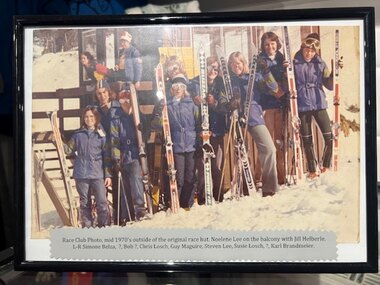
Photograph - Falls Creek Ski School Race Club
... Teams at World Championship events. This photograph is significant because it includes early members Falls Creek Race Club, some of whom progressed to become representatives in international sporting events including World Championships and Winter Olympics. ...The Falls Creek Race Club was started in the late 60's by Rodney Moss assisted by Bob Howe from Albury Ski Club and Geoff Henke from Moloney's. The club ran races on the summit every weekend and later started the training squad. Its aim is to promote all the skills of skiing and snowboarding and to improve the safety and enjoyment of the sport for all age groups. As an athlete's skills Improve so they can begin to train and race at Children's level races and move on to Junior and Senior levels, possibly aspiring to the Masters Circuit or State and National Teams. Hundreds of children have been involved over the past four decades and the program has produced a number of skiers who have been successful at national and international levels. Falls Creek has produced Olympians Ross and Malcolm Mine, Joanne Henke, Jenny Altermatt, Steven Lee in Alpine skiing. Dick Walpole and Chris Heberle in Cross Country, Britteny Cox, Paul and Adrian Costa in Freestyle Moguls. Many others have represented in National Teams at World Championship events.This photograph is significant because it includes early members Falls Creek Race Club, some of whom progressed to become representatives in international sporting events including World Championships and Winter Olympics.A framed colour photograph of members of the Falls Creek Race Club standing outside the Club buiding.Beneath Image Race Club Photo, mid 1970's outside of the original race hut. Noelene Lee on the balcony with Jill Helberle. L-R Simone Belza, ?, Bob ?, Chris Losch, Guy Maguire, Steven Lee, Susie Losch, ?, Karl Brandmeier.falls creek race club, falls creek olympians -
 Sunshine and District Historical Society Incorporated
Archive - Sporting Clubs & Community / Service Groups - Sunshine history - collection of articles 1989-1999, Various, 1989 -1999
... teams and service clubs. Part of E. Wegener's collection of historically significant articles from various of local papers of the Sunshine district. Including article from the Brimbank Independent and The Advocate also includes The Age and Herald Sun. Archive Sporting ...See itemssunshine, history -
 Westbourne Grammar Heritage Collection
Uniform - BPSA Cricket Cap
... In search of regular sports competition, Westbourne joined a number of sporting associations, including the Ballarat Public Schools Association (BPSA). Participation in sports teams, often with Saturday morning fixtures requiring overnight billeting in various towns, became compulsory for all students in 1986. ...Westbourne Grammar Heritage Collection Williamstown and Truganina, Victoria melbourne In search of regular sports competition, Westbourne joined a number of sporting associations, including the Ballarat Public Schools Association (BPSA). Participation in sports teams, often with Saturday morning fixtures requiring overnight billeting in various towns, became compulsory for all students in 1986. ...In search of regular sports competition, Westbourne joined a number of sporting associations, including the Ballarat Public Schools Association (BPSA). Participation in sports teams, often with Saturday morning fixtures requiring overnight billeting in various towns, became compulsory for all students in 1986. In 1997 Principal Geoffrey Ryan was involved in the foundation and implementation of a new Association of Co-educational Schools (ACS) that would streamline sports competition for Westbourne. Other foundation schools were Eltham College, Loyola College, St Leonards College and St Michael’s Grammar School. Based on principles of inclusiveness, equal sporting opportunities for boys and girls, participation, commitment and competitiveness, the major advantage of the new ACS competition was that ‘all fixtures will be completed after school during the week in time for students to catch late buses home’ (Geoffrey Ryan, Principal’s Newsletter, December 1997). Felted wool cap in alternating black and yellow segments with a black peak and the letters 'B.P.S.A' appliqued on the front yellow segment.sport, interschool sport, physical education -
Dandenong & District Historical Society
Newspaper - The Journal, Peter Simcock - Editor, 140 years Celebrating another milestone, 290 Aug 2005
... Various subjects including people old buildings "Redlegs" sporting team...Various subjects including people old buildings "Redlegs" sporting team 140 years of The Journal Newspaper, pictures and articles from beginning with stories of the history. ...140 years of The Journal Newspaper, pictures and articles from beginning with stories of the history.Anniversary Edition 140 years non-fiction140 years of The Journal Newspaper, pictures and articles from beginning with stories of the history.various subjects including people old buildings "redlegs" sporting team -
Dandenong & District Historical Society
Newspaper - The Journal - 29 August 2005, The Journal 140 years. 3 copies approx. in own box, 29 August 2005
... Various subjects including people old buildings "Redlegs" sporting team...Dandenong & District Historical Society 1st Floor, 39 Clow Street Dandenong melbourne Celebrating another Milestone (140 years) Various subjects including people old buildings "Redlegs" sporting team Newspaper articles of the times and previous 140 years Cover Advertising 140 years of the Journal front cover, Back Cover advertisements for Automobiles Dandenong 4 Colour Process The Journal 140 years. 3 copies approx. in own box Newspaper The Journal - 29 August 2005 Various Journalists, Artists, Photographers ...Newspaper articles of the times and previous 140 years4 Colour Process non-fictionNewspaper articles of the times and previous 140 yearsvarious subjects including people old buildings "redlegs" sporting team -
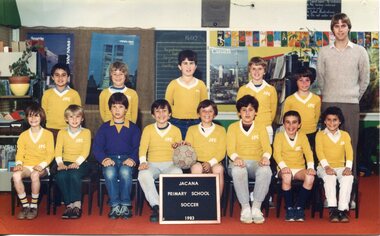 Broadmeadows Historical Society & Museum
Photograph - Team Photograph, Jacana Primary School: Soccer Team 1983
... including newly arrived migrants, contributing to a rich and diverse social fabric. By the early 1980s, schools like Jacana Primary were not only centres of education but also vital community hubs. Sporting activities, particularly team...including newly arrived migrants, contributing to a rich and diverse social fabric. By the early 1980s, schools like Jacana Primary were not only centres of education but also vital community hubs. Sporting activities, particularly team ...Jacana Primary School was established in 1959 during a period of rapid suburban development in Melbourne’s northern suburbs. The post-war era saw significant investment in public infrastructure, including schools, to support growing communities shaped by migration and housing expansion. Jacana, located near Broadmeadows, became home to many working-class families, including newly arrived migrants, contributing to a rich and diverse social fabric. By the early 1980s, schools like Jacana Primary were not only centres of education but also vital community hubs. Sporting activities, particularly team sports like soccer, played a central role in student life. They promoted physical health, teamwork, and social inclusion, while also reflecting broader cultural influences—especially as soccer gained popularity among migrant communities. The 1983 soccer team photograph captures this dynamic period, showcasing the importance of extracurricular activities in fostering school spirit and community engagement. It also reflects the values of public education at the time: equity, participation, and the celebration of diversity. Such images serve as enduring records of how schools contributed to shaping local identity and cohesion during a transformative era in Melbourne’s suburban history. This 1983 colour photograph of Jacana Primary School’s soccer team captures the energy and camaraderie of a school that served as a cornerstone of its community from 1959 until its closure in the early 2000s. More than a simple team portrait, the image reflects the vibrant sporting culture that was integral to student life and community engagement during the early 1980s. The photograph preserves cherished memories of teamwork, school pride, and youthful enthusiasm, offering insight into the social dynamics and extracurricular values of the time. It stands as a visual testament to the role of sport in fostering inclusion, resilience, and a sense of belonging among students—qualities that defined Jacana Primary’s enduring legacy in Melbourne’s northern suburbs.A colour photograph of a school Soccer team on satin finish photo paper.PH-4465 (white label) Top Left Corner PH-5431(blue label) Top Right Corner Manufactures mark; Fujicolor/ Paperjacana primary school, photograph, school photograph, education, soccer team, 1983 -
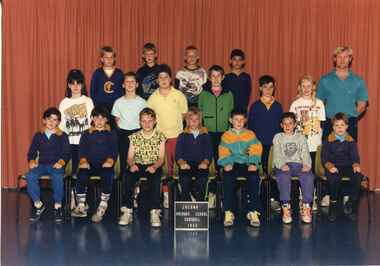 Broadmeadows Historical Society & Museum
Photograph - Football Team, Jacana Primary School Football 1990, 1990
... It preserves treasured memories, showcasing the school’s dynamic sports culture and reflecting the social atmosphere of the mid-1980s This 1990 colour photograph of Jacana Primary School’s football team is a valuable cultural artifact that encapsulates the spirit and identity of a school that played a central role in its community from 1959 until its closure in the early 2000s. The image not only documents the school’s vibrant sporting culture but also reflects broader social dynamics of the mid-1980s, including community engagement, youth development, and local pride. ...This colour photograph of Jacana Primary School’s football team from 1990 captures the essence of a school that served as a vital community hub from its founding in 1959 until its closure in the early 2000s. It preserves treasured memories, showcasing the school’s dynamic sports culture and reflecting the social atmosphere of the mid-1980s This 1990 colour photograph of Jacana Primary School’s football team is a valuable cultural artifact that encapsulates the spirit and identity of a school that played a central role in its community from 1959 until its closure in the early 2000s. The image not only documents the school’s vibrant sporting culture but also reflects broader social dynamics of the mid-1980s, including community engagement, youth development, and local pride. As a visual record, it preserves cherished memories and contributes to the collective history of Jacana, offering insight into the educational and social fabric of the time.A colour photograph of a school football team on paper.PH-5338 (blue label) This Paper/ Manufactured / by Kodakfootball, jacana primary school, photograph, school photograph, education, 1990, jacana, football team -
 Wodonga & District Historical Society Inc
Award - Darts Trophy - A.W.D.D.A Winter '93 - A-Grade
... including competitive darts, both through its own competition and as part of the Albury-Wodonga District Darts Association. The remains of the building were demolished in 1999. This is a trophy for the Albury-Wodonga District Darts Association won by the team "Terminus Goers' in 1993. The Terminus Hotel was an important meeting place in Wodonga for more than 100 years. This item is representative of one of the social and sporting ...The Terminus Hotel was one of the earliest hotels in Wodonga, with clear links to the establishment of the railway line. It was an important business and meeting place from the original construction in 1873 until 1st June 1998 the Terminus Hotel when it was destroyed by fire. It provided a popular venue for social activities, including competitive darts, both through its own competition and as part of the Albury-Wodonga District Darts Association. The remains of the building were demolished in 1999. This is a trophy for the Albury-Wodonga District Darts Association won by the team "Terminus Goers' in 1993.The Terminus Hotel was an important meeting place in Wodonga for more than 100 years. This item is representative of one of the social and sporting activities it provided for members of the local community.A trophy made from timber and metal with a representation of a dart on the top.On plaque lower front "A.W.D.D.A WINTER '93/A GRADE PREMIERS TERMINUS GOERS" In vertical list "B. TINGWELL (C) S. GRIFFITHS J. DE KRUIFF A. GARDNER R. GARDNER L. SIMS W. KILPATRICK B. SNEDDONterminus hotel, terminus hotel darts, sport and recreation wodonga -
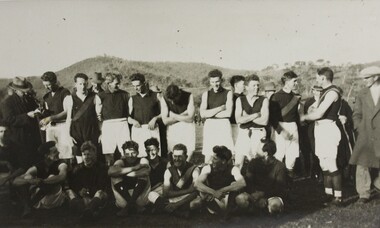 Wodonga & District Historical Society Inc
Photograph - Hamilton-Smith Collection Talgarno Football Club Group Portrait early - mid 1900s
... It contributes to our understanding of social and family life in early twentieth century Wodonga, as well as providing interpretative capacity for themes including local, social, and sporting history. hamilton-smith collection hamilton-smith ellwood wodonga talgarno football afl football club game sport photograph photography Handwritten inscription on reverse: "TALGARNO FOOTBALL CLUB/Donated by: Merrilyn Hamilton-Smith". A black and white group portrait photograph of the Talgarno Football club team ...The Hamilton-Smith collection was donated by the children of Grace Mary Hamilton-Smith nee Ellwood (1911-2004) and John Hamilton-Smith (1909-1984) who settled in Wodonga in the 1940s. The Ellwood family had lived in north-east Victoria since the late 1800s. Grace’s mother, Rosina Ellwood nee Smale, was the first teacher at Baranduda in 1888, and a foundation member of the C.W.A. Rosina and her husband Mark retired to Wodonga in 1934. Grace and John married at St. David’s Church, Albury in 1941. John was a grazier, and actively involved in Agricultural Societies. The collection contains significant items which reflect the local history of Wodonga, including handmade needlework, books, photographs, a wedding dress, maps, and material relating to the world wars. This item has well documented provenance and a known owner. It forms part of a significant and representative historical collection which reflects the local history of Wodonga. It contributes to our understanding of social and family life in early twentieth century Wodonga, as well as providing interpretative capacity for themes including local, social, and sporting history. A black and white group portrait photograph of the Talgarno Football club team in football uniformHandwritten inscription on reverse: "TALGARNO FOOTBALL CLUB/Donated by: Merrilyn Hamilton-Smith".hamilton-smith collection, hamilton-smith, ellwood, wodonga, talgarno, football, afl, football club, game, sport, photograph, photography -
 Camberwell Girls Grammar School
Digital images, Dean Image Collection, 1954-1958
... Sixteen black and white images recording the holiday to Orpheus Island in 1955 including a copy of the menu from the Orpheus Island Lodge restaurant. Also included are images of School sporting teams and groups of girls in the School grounds and an undated reunion of the 1958 leavers. ...Camberwell Girls Grammar School 2 Torrington Street Canterbury melbourne Images of the back of some photos included with names and dates Sixteen black and white images recording the holiday to Orpheus Island in 1955 including a copy of the menu from the Orpheus Island Lodge restaurant. Also included are images of School sporting teams and groups of girls in the School grounds and an undated reunion of the 1958 leavers. ...Sixteen black and white images recording the holiday to Orpheus Island in 1955 including a copy of the menu from the Orpheus Island Lodge restaurant. Also included are images of School sporting teams and groups of girls in the School grounds and an undated reunion of the 1958 leavers. Extract from the Marcian is included to provide background on the trip.Images of the back of some photos included with names and dates -
 Camberwell Girls Grammar School
Photograph Album, Kodak Australia
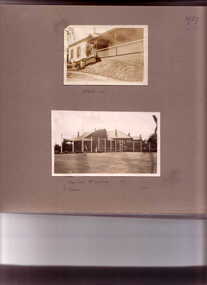
... Locations include the now School site with the original house "Torrington" with early images of classes amd students in 1927; 1931-1932 Scenes in the School grounds including Kindergarten classes; forms and sporting teams. Pageants held in 1932 include the Shakespearean Pageant held 23rd April and the Pageant of all Nations. ...Locations include the now School site with the original house "Torrington" with early images of classes amd students in 1927; 1931-1932 Scenes in the School grounds including Kindergarten classes; forms and sporting teams. Pageants held in 1932 include the Shakespearean Pageant held 23rd April and the Pageant of all Nations. ...The album contains early images of the School at the new site in Torrington Street, Canterbury. The photographs have extensive captions that date and document key events in the School's development. Grey cardboard album made up of twenty-four pages held together by blue cords and a dark blue ribbon. Pages are loosley in date order [note incomplete years] document a range of school activities, at Camberwell Girls Grammar School orginally known as St Mark's School, Camberwell from 1927- 1959. Locations include the now School site with the original house "Torrington" with early images of classes amd students in 1927; 1931-1932 Scenes in the School grounds including Kindergarten classes; forms and sporting teams. Pageants held in 1932 include the Shakespearean Pageant held 23rd April and the Pageant of all Nations. Formal team and class photographs taken by the photogrpaher Stuart Tompkins, Camberwell are included in 1933 and 1935. 1932 snapshots taken in 1932 Kindergarten with English children sent to Australian for safety with teacher Miss Nancy White. Sports Day and Combined Sports Day from the 1950s and a School holiday tour of Heron Island and a Coronation pageant both in 1953. Dedication of the Secondary block 10th March 1956; Kindergarten at St Hilary's with Mrs Kilgour in 1957. The last page shows an image of Principal Mrs AR Mace [former name Miss Louisa Stafford Taylor] with her husband Canon Mace at a School Sports Day 1959. -
Dandenong & District Historical Society
Newspaper, Dandenong Journal Newspaper Cuttings 2023
... Various subjects including people old buildings "Redlegs" sporting team...Newspaper articles of importance to the week Various subjects including people old buildings "Redlegs" sporting team Newspaper Articles Dandenong Journal Newspaper Cuttings 2023 Newspaper ...Newspaper Articlesnon-fictionNewspaper Articlesvarious subjects including people old buildings "redlegs" sporting team -
 Sunshine and District Historical Society Incorporated
Photograph - St. Albans Youth Club Football Team, Joseph "Joe" Ribarow
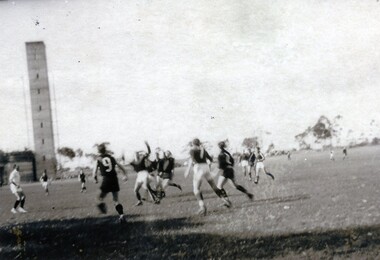
... team refers to the junior football competition that grew out of the St. Albans Community Youth Club in the 1950s–60s. It was not a formal senior club like St. Albans Saints (soccer) or St. Albans Football Club (AFL), but a local youth sporting program that helped launch organised junior football in the suburb. The clearest historical reference comes from Les Cameron’s account of growing up in St. Albans in the 1950s–60s. He states that the St. Albans Community Youth Club was central to community life and it "Nurtured a variety of other groups, including...The club supported many different groups, including the junior football, judo, table tennis, gymnasium, scouts, guides, playgroups, etc. These photographs are a rare example of the club's early sporting history. St. Albans Youth Club Football Team ...The St Albans Youth Club football team refers to the junior football competition that grew out of the St. Albans Community Youth Club in the 1950s–60s. It was not a formal senior club like St. Albans Saints (soccer) or St. Albans Football Club (AFL), but a local youth sporting program that helped launch organised junior football in the suburb. The clearest historical reference comes from Les Cameron’s account of growing up in St. Albans in the 1950s–60s. He states that the St. Albans Community Youth Club was central to community life and it "Nurtured a variety of other groups, including the junior football competition.”The St. Albans Community Youth Club was central to community life in St. Albans from the post‑war population boom of 1950's and onwards. The club supported many different groups, including the junior football, judo, table tennis, gymnasium, scouts, guides, playgroups, etc. These photographs are a rare example of the club's early sporting history.5886.01 - St. Albans Youth Club Football Team 1955.jpg 5886.02 - St. Albans Youth Club Football Team 1956.jpg 5886.03 - St. Albans Youth Club Football Team 1956.jpg 5886.04 - St. Albans Youth Club Football Team 1958.jpgst. albans youth club football team, football, st. albans community youth club -
 Ringwood and District Historical Society
Magazine, Ringwood High School Magazine 1964 - Yakkity Hi
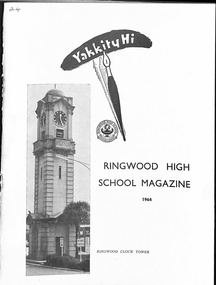
... Photos of school groups and clubs feature, including AFS (American Field Service Exchange Scholarships), cadets, photos of all Form 1 classes, photos of Form Captains and short essays about said classes, many sporting team photos and reports of the progress of the four school houses. ...Photos of school groups and clubs feature, including AFS (American Field Service Exchange Scholarships), cadets, photos of all Form 1 classes, photos of Form Captains and short essays about said classes, many sporting team photos and reports of the progress of the four school houses. ...Bifold light pale green/beige cardboard cover with 72 page insert, with a photograph of the Ringwood clock-tower in the old location on the corner of Warrandyte Road and Maroondah Highway. The cover also has the RHS logo and a stylised drawing of the title, ie Yakkity Hi, and a drawing of three writing implementsMagazine includes a message from Headmaster, G.S. Ormandy, a list and a photo of staff, the Editorial, a photo and a list of prefects. Many contributions from students are included, encompassing essays, cartoons, comedy pieces, opinions on current affairs, sketches, poems. Photos of school groups and clubs feature, including AFS (American Field Service Exchange Scholarships), cadets, photos of all Form 1 classes, photos of Form Captains and short essays about said classes, many sporting team photos and reports of the progress of the four school houses. The contents of Yakkity Hi ends with the results from 1963, both sporting and academic. -
Dandenong & District Historical Society
School Magazine, Dandenong High School Magazine "The Gate" 1941, 13 May 2026
... including Form Notes, House Notes, Sport, Ex Student and Examination successes during the year. Sport during 2nd World War must have been very difficult, Football, Athletics, Tennis, Basketball, Swimming, Hockey all represented Item on the First Term concert List of Ex Pupils enlisted and died in War Service Pictures of various Sporting teams. ...School Magazine 1941 including Class photos and activities of the whole school during 1941Dandenong High School Magazine. 4pp Cover 40pp Text. Cover printed Navy Blue & Gold Tett printed Black. non-fictionSchool Magazine 1941 including Class photos and activities of the whole school during 1941item on the first term concert list of ex pupils enlisted and died in war service, pictures of various sporting teams.
