
Showing 54 items matching "indian ink"
-
 Whitehorse Historical Society Inc.
Container - Bottle, Indian Ink
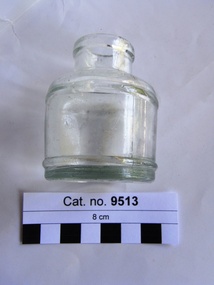
... Bottle, Indian Ink...Round bottle of Indian Ink. Screw top lid made of bakelite type material....Reeves Indian Ink|Reeves & Sons Ltd Enfield...domestic items writing equipment Reeves Indian Ink|Reeves & Sons Ltd Enfield Round bottle of Indian Ink. ...Round bottle of Indian Ink. Screw top lid made of bakelite type material.Reeves Indian Ink|Reeves & Sons Ltd Enfielddomestic items, writing equipment -
 Embroiderers Guild, Victoria
Textile - Five Indian Ink Sketches, Illustrations and Poems
... Five Indian Ink Sketches, Illustrations and Poems...Five Indian ink sketches, illustrations and poems on fine cotton. 1. ...Fairies and Girl and Stork. Textile Five Indian Ink Sketches, Illustrations and Poems ...Five Indian ink sketches, illustrations and poems on fine cotton. 1. Hilaire Belloc verse with 2 illustrations. 2. 'My Darling Dolly' poem with illustrations. 3. Girl on beach with crab and insects on see-saw. 4. Goose and witch and Birds and Fairies. 5. Fairies and Girl and Stork.By Courtesy of Miss M Bostock (Foundation member of the EGV. )cotton lawn, drawings -
 Surrey Hills Historical Society Collection
Digital photo, Original indian ink sketch of Rotunda by Alan J Holt at Surrey Hills garden
... Original indian ink sketch of Rotunda by Alan J Holt at Surrey Hills garden...Original indian ink sketch of Rotunda by Alan J Holt at Surrey Hills garden Digital photo ... -
 Embroiderers Guild, Victoria
Drawing - Indian Ink Sketches
... Indian Ink Sketches...Collection of Indian ink sketches on Fine white linen. 1. 2 drawings with verse by Hilaire Belloc - (linen 50 cm x 29 cm) 1. ...Found in Drawer 1 Linen Pictures Drawings Poetry Reverse of #1 - 'By courtesy of Miss M Bostock' Collection of Indian ink sketches on Fine white linen. 1. 2 drawings with verse by Hilaire Belloc - (linen 50 cm x 29 cm) 1. ...Found in Drawer 1Collection of Indian ink sketches on Fine white linen. 1. 2 drawings with verse by Hilaire Belloc - (linen 50 cm x 29 cm) 1. There Was A Man - 4 verse poem with 2 illustrations of young couple and rural scenery. 2.2 drawings - (linen 45 cm x 28 cm) 1. My Darling Dolly poem - 4 verses with illustrations and 2 shields 'Aquarius' & 'Taurus'. 3.2 drawings - (linen 34 cm x 12 cm) -1. Girl on beach with crab "Sir Crab where are you going?" 2. Grasshopper & butterfly on mushroom "See-saw". 4.2 drawings - (linen 34.5 cm x 14. 5 cm) 1. Flying goose pulling witch on broomstick. 2. Framed picture of owl and bird sheltering fairies 'Cold night'. 5. 2 drawings - (linen 32 cm x 14 cm) - 1. 3 fairies - 2 as students at a desk. 2.Girl & stork looking at their feet ' "They are entirely different from mine anyhow" said the stork.' Reverse of #1 - 'By courtesy of Miss M Bostock'linen, pictures, drawings, poetry -
 Federation University Historical Collection
Document - Invoices, Invoices directed to the Ballarat School of Mines in 1900, 1900
... ...Indian Ink...Ewins Frederick Martell Indian Ink Cumming SMith and Co. letterhead Henry Markwald Borax C.C. ...Five Invoices directed to the Ballarat School of Mines in 1900ballarat school of mines, ballarat courier, invoices, robert clark, j. ewins, frederick martell, indian ink, cumming, smith and co., letterhead, henry markwald, borax, c.c. shoppee's crytal palace, daniel walker, john slater and co. -
 Federation University Historical Collection
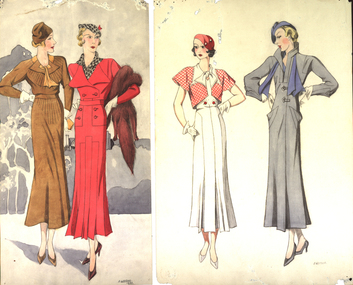
Work on paper - Fashion Illustration and Commercial Art, Alice Watson, Ballarat Technical Art School folio of Alice Watson, 1931,1932 and 1933
... ...indian ink...Alice Watson died in Ballarat, aged 95, having conserved her beautiful student folio, which was generously gifted to the Federation University permanent Historical Collection by the Watson family. alice watson ballarat technical art school art drawing figure drawing alumni costume drawing fashion drawing ticket writing 1930's fashion indian ink edith alice watson figure construction advertising commercial art .37) Paper is embossed with 'Windsor & Newtons Bristol Board' stamp. ...Edith (Alice) WATSON (1914–2010) Murtoa | Australia Alice Watson studied at the Ballarat Technical Art School (at the School of Mines, Ballarat) from 1930 until 1933. These works include commercial art, advertising and catalogue illustrations as well as figure construction and fashion-plate designs. Watson sat several departmental exams, including drawing and painting plant forms from nature, lettering, Composition of Form and Colour and advanced General Design, as well as dressmaking and embossed leatherwork. Her folio applies many Australian native floral elements to design. Upon graduating, Watson taught at the Murtoa High School, living with her parents until their deaths in 1972 and 1988 when she was 74 years old. Alice Watson died in Ballarat, aged 95, having conserved her beautiful student folio, which was generously gifted to the Federation University permanent Historical Collection by the Watson family. Commercial artA folio of Fashion Drawing by Edith Alice Watson of the Ballarat Technical Art School. .1) Two women dressed in fashionable clothing- lhs tan ensemble and hat; rhs fuschia ensemble with black and white accessories plus fur stole. Signed lrs A.Watson. 1933. .26) The image with three women wearing a hats. This appears to be an example of ticket writing. Signed lrs "A Watson- 2nd term. 1932." .35) The image with a woman wearing a hat appears to be an example of ticket writing. Signed lrs "A Watson--11th-7-32." .23) female figure drawing. Signed lrs A.Watson. 1st Term. 1932 .21) female figure drawing. Signed lrs A.Watson. 2nd Term. 1932 .17) drawing of lips, side view. Signed lrs A. Watson. 1931 .18) drawing of lips,three-quarter view. Signed lrs A. Watson .37) Paper is embossed with 'Windsor & Newtons Bristol Board' stamp.(Griffin depicted in centre)alice watson, ballarat technical art school, art, drawing, figure drawing, alumni, costume drawing, fashion drawing, ticket writing, 1930's fashion, indian ink, edith alice watson, figure construction, advertising, commercial art -
 Embroiderers Guild, Victoria
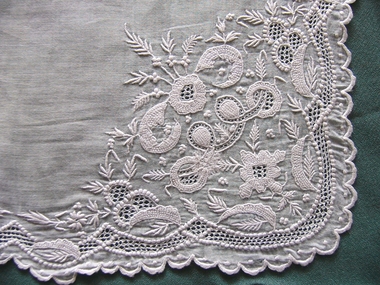
Accessory - 19th C Whitework Handkerchief, Mid 19th century
... An indistinct Indian ink name....Embroidery Ayrshire Handkerchief Mid 20th Century Scotland An indistinct Indian ink name. Fine white cotton with bold flower displays and decorative pulled bands around the edge. ...Fine white cotton with bold flower displays and decorative pulled bands around the edge. Edged with buttonholed scallops and rounded corners,.An indistinct Indian ink name.embroidery, ayrshire, handkerchief, mid 20th century, scotland -
 Bendigo Historical Society Inc.
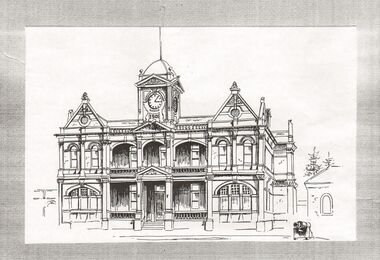
Drawing - HARRY BIGGS COLLECTION: TOWN HALL AND STONE COTTAGE, 19901
... Eaglehawk Town Hall, an Indian ink sketch. b, Stone Cottage, James St, Harvey Town. ...Eaglehawk Town Hall, an Indian ink sketch. b, Stone Cottage, James St, Harvey Town. ...Two sketches back to back one sheet in a cardboard frame a. Eaglehawk Town Hall, an Indian ink sketch. b, Stone Cottage, James St, Harvey Town. Indian ink sketch of a cottage with a stone fence in front and steps leading up to the front door.drawing, ink, building, eaglehawk town hall, stone cottage, james street, harvey town -
 Embroiderers Guild, Victoria
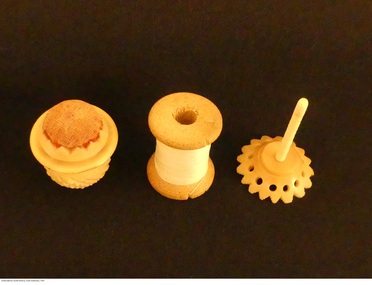
Tool - Vegetable ivory combined cotton reel holder and pin cushion, 1830-1870
... Base of cotton reel in indian ink: "Gina Pipe, May 15th, 1863"...Reel Vegetable ivory Base of cotton reel in indian ink: "Gina Pipe, May 15th, 1863" Standing thistle shaped carved vegetable ivory combined cotton reel holder and pincushion with bone spindle and worn red velvet pincushion. ...Vegetable ivory became a popular substance to use for needlework tools c 1860, it was very suitable for lathe turning and cheaper than ivory. Combining the cotton reel with a pincushion created a convenient tool to display and use. Presence of the wooden cotton reel dated 1863 tells of an early cotton reel, and that the piece was used.Vegetable ivory was a substitute for elephant ivory, this standing compendium was an useful item for display. Unusual to have a wooden cotton reel with a name and date. Standing thistle shaped carved vegetable ivory combined cotton reel holder and pincushion with bone spindle and worn red velvet pincushion. Cotton reel on it is a replacement and has cotton on it. Base of cotton reel in indian ink: "Gina Pipe, May 15th, 1863"reel, vegetable ivory -
 Emerald Museum & Nobelius Heritage Park
Equipment - Ink Bottle, Angus & Co, 1940s-1950s
... Obverse: ANGUS & CO. / PTY. LTD. / INDIAN INK / SUPERIOR WATERPROO / DRAWING IN /...The item is significant for the insights it provides into the development of writing technologies generally and the application of these to writing practices used by schools and businesses and offices in Emerald and the surrounding region, including the commercial and economic practices required to support these activities. 1930s and 1940s 1950s Ink ink bottle Writing equipment writing Schools Businesses office equipment Obverse: ANGUS & CO. / PTY. LTD. / INDIAN INK / SUPERIOR WATERPROO / DRAWING IN / Round flat-bottomed clear glass bottle with a metal lid and an ink-manufacturer's label adhered to the outward-facing surface. ...This item is an ink bottle used to store a quantity of ink ready for writing at a desk or table. The bottle is thought to date from the mid-period of the Twentieth Century, and is likely to have been purchased full of ink rather than filled and refilled from a bulk bottle of household ink. Similarly, in this time period, the ink is likely to have been used to refill a fountain pen with an internal storage reservoir via an eye-dropper or converter mechanism rather than used by a writer who dipped their pen in the ink frequently as they wrote. Ink bottles were typically designed to have a broad, stable base that decreased the likelihood of the article tipping when a pen or converter was dipped into the ink. Bottles were produced in a wide variety of shapes and colours, primarily dictated by product differentiation and aesthetic appeal in the growing retail market that emerged due to improvements in fountain pen design which made access to convenient writing implements cheaper but also more portable. Prior to innovations in fountain pen nibs and filling systems that made them cleaner and more reliable to use, writing may have been conducted at a writing desk which held an inkwell which was refilled from a larger bottle or (prior to the beginning of the Nineteenth Century) filled with ink reconstituted from powder form or dissolved from a tablet or cake of dry ink. Angus & Co. were a Melbourne-based company established in 1896 which manufactured ink, gums and pastes for domestic and industrial purposes, including manufacturing the bottles in which their products were sold. The business was initially located at 112 King Street, Melbourne, after Joseph Armstrong Angus and his wife Emma moved to Melbourne. The company shifted location several times, occupying sites in North Fitzroy and Northcote, including the ink manufacturing plant and bottle works.The item is significant for the insights it provides into the development of writing technologies generally and the application of these to writing practices used by schools and businesses and offices in Emerald and the surrounding region, including the commercial and economic practices required to support these activities.Round flat-bottomed clear glass bottle with a metal lid and an ink-manufacturer's label adhered to the outward-facing surface. The bottle is partially filled with black or dark blue ink. This item is an ink bottle used to store a quantity of ink ready for writing at a desk or table. The bottle is thought to date from the mid-period of the Twentieth Century and is likely to have been used to refill a fountain pen with an internal storage reservoir via an eye-dropper or converter mechanism rather than used by a writer who dipped their pen in the ink frequently as they wrote. The bottle is thought to date from the mid-period of the Twentieth Century, and is likely to have been purchased full of ink rather than filled and refilled from a bulk bottle of household ink. Similarly, in this time period, the ink is likely to have been used to refill a fountain pen with an internal storage reservoir via an eye-dropper or converter mechanism rather than used by a writer who dipped their pen in the ink frequently as they wrote.Obverse: ANGUS & CO. / PTY. LTD. / INDIAN INK / SUPERIOR WATERPROO / DRAWING IN /1930s and 1940s, 1950s, ink, ink bottle, writing equipment, writing, schools, businesses, office equipment -
 Whitehorse Historical Society Inc.
Newspaper - Newspaper cutting, St Lukes Anglican Church, between 1935 - 1958. Newspaper cutting 1952
... Original drawing was Indian ink on paper by Alfred George Reynolds (1906-1996) who was Vicar of St Lukes Vermont from 1947-1952. ...Original drawing was Indian ink on paper by Alfred George Reynolds (1906-1996) who was Vicar of St Lukes Vermont from 1947-1952. ...Original drawing was Indian ink on paper by Alfred George Reynolds (1906-1996) who was Vicar of St Lukes Vermont from 1947-1952. Alfred George Reynolds was a noted Australian artist in the mediums of oil painting, etching and pen and ink drawing.Black and white cutting from a newspaper of St. Lukes Anglican Church, VermontA G Reynoldsst. lukes anglican church, vermont -
 Coal Creek Community Park & Museum
Domestic object - Glass Bottle, c. 1940
... . : 1868 - 1954) Thursday 12 January 1939 p 31 Advertising ANGUS & CO PTY LTD MANUFACTURERS OF CLAG THE BEST HOME AND OFFICE PASTE AND WRITING INKS SHOWCARD COLOURS INDIAN INKS RUBBER STAMP PAD INKS MUCILAGE, GUMS, ETC. .... : 1868 - 1954) Thursday 12 January 1939 p 31 Advertising ANGUS & CO PTY LTD MANUFACTURERS OF CLAG THE BEST HOME AND OFFICE PASTE AND WRITING INKS SHOWCARD COLOURS INDIAN INKS RUBBER STAMP PAD INKS MUCILAGE, GUMS, ETC. ...The Advocate (Melbourne, Vic. : 1868 - 1954) Thursday 12 January 1939 p 31 Advertising ANGUS & CO PTY LTD MANUFACTURERS OF CLAG THE BEST HOME AND OFFICE PASTE AND WRITING INKS SHOWCARD COLOURS INDIAN INKS RUBBER STAMP PAD INKS MUCILAGE, GUMS, ETC. ANGUS & CO. PTY. LTD. MELBOURNE AND SYDNEY. Round thick clear glass ink bottle with text and monogram embossed on base.'154', 'ANGUS & CO PTY LTD', '3M'. Monogram 'A' with flat top enclosing 'G' over 'M'.ink bottle -
 Bendigo Historical Society Inc.
Photograph - BENDIGO WOMEN'S SEWING CIRCLE, c1900
... Inscriptions: GP12 at top corners in Indian ink. In blue/black ink, on top front of board. ...Inscriptions: GP12 at top corners in Indian ink. In blue/black ink, on top front of board. ...Black and white photograph of Women's Sewing Group manufacturing clothing for Boer War Military (Australian). Packages, sewing machines, chairs in foreground, ladies in middle ground, materials against panelled walls in background. Mounted on fawn board. Inscriptions: GP12 at top corners in Indian ink. In blue/black ink, on top front of board. 'Bendigo Women's Sewing Circle During the Boer War'. On back - stamped in green ink, in circle 'Royal Historical Society of Victoria, Bendigo Branch'. In Indian ink '1137'. In grey lead 'Boer War', 'Bendigo Women Making clothing for Boer Australian contingent'.person, group, women -
 Bendigo Historical Society Inc.
Photograph - BENDIGO HOSPITAL STAFF
... Inscriptions: on front - in top corners in Indian ink 'GPI'. On back - stamped in circle in ink 'Royal Historical society of Victoria, Bendigo Branch'....Inscriptions: on front - in top corners in Indian ink 'GPI'. On back - stamped in circle in ink 'Royal Historical society of Victoria, Bendigo Branch'. ...Sepia photographs showing thirteen nurses, matron? (in centre), six males on mats on lawn with building in background. Mounted on fawn board. Inscriptions: on front - in top corners in Indian ink 'GPI'. On back - stamped in circle in ink 'Royal Historical society of Victoria, Bendigo Branch'.cottage, miners -
 Ballarat Tramway Museum
Photograph - Framed Photographs, 1927
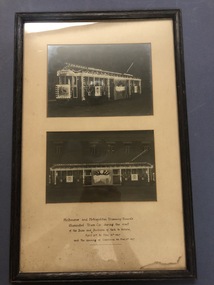
... In Indian ink "Melbourne and Metropolitan Tramway Board's / illuminated Tram Car, during the visit / of the Duke and Duchess of York to Victoria, / April 21st to May 12th 1927 / and the opening of Canberra on May 9th 1927"....Trams tramways Illuminated Trams Decorated Trams Royal Visit Melbourne Duke of York Preston Workshops W1 class In Indian ink "Melbourne and Metropolitan Tramway Board's / illuminated Tram Car, during the visit / of the Duke and Duchess of York to Victoria, / April 21st to May 12th 1927 / and the opening of Canberra on May 9th 1927". ...Framed set of photographs of Melbourne W1 421decorated as an "illuminated" tramcar for the visit of the Duke and Duchess of York to Victoria April 21 to May 12, 1927 and the opening of Canberra on May 9, 1927. Tram identified in the 4th edition of Destination City. Note Tasmania is missing from the map on the side of the tram. Two photographs of the tram, a three quarter front on view and a side on view have been framed within a black wooden frame, protected by a glass sheet, with an off white cardboard sheet cut out for the photographs to frame them, cardboard backing sheets with an ink inscription under the two photographs. The rear backing sheet has been tacked onto the wooden frame. Images show the overall object, the two photographs, the text and the rear of the object. Images i2 and i3 updated for scan of the actual negs. Page 43 of Destination City 4th EditionIn Indian ink "Melbourne and Metropolitan Tramway Board's / illuminated Tram Car, during the visit / of the Duke and Duchess of York to Victoria, / April 21st to May 12th 1927 / and the opening of Canberra on May 9th 1927".trams, tramways, illuminated trams, decorated trams, royal visit, melbourne, duke of york, preston workshops, w1 class -
 Embroiderers Guild, Victoria
Book - 1848 Sewing and Knitting Samplers Book, Alice Rule, Mid 19th century
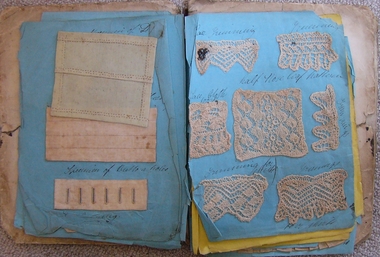
... A 19th C exercise book which consists of a number of blue sheets on which have been mounted plain needlework samples and knitting samples. Labelled in Indian ink in cursive writing. An exercise for an examination for the profession of pupil teacher, which she was confirmed on the 1851 UK Census....Embroidery Knitting Plain sewing Samplers Mid 19th Century England "Alice Rule My dear Mamma worked the half of this book & I Mary Pyott Miss Alice Rule worked the half of book & the other was worked by Mary Pyott" Specimen of Folding Hems by Alice Rule at Mrs Gilly's School for Girls on the Examination A 19th C exercise book which consists of a number of blue sheets on which have been mounted plain needlework samples and knitting samples. Labelled in Indian ink in cursive writing. An exercise for an examination for the profession of pupil teacher, which she was confirmed on the 1851 UK Census. ...According to the accompanying letter the book was prepared by Alice Rule of Norham, Northumberland in c 1848 on the occasion of an examination for the profession of pupil teacher. Alice Rule married James Pyott, A Scottish Watch Maker and Chrono Maker, on 18th June 1859 in London. She died 12 Mar 1885 at 74 West-India-Rd, Limehouse. Her second daughter, Mary Eadington Rule Pyott was born in 1862 and met and married Master Mariner Herman Ström in England in 1886. The couple migrated to Australia shortly after their wedding, settling in Victoria and later living at "Netherlands" in Rydalmere, New South Wales . Mary died 30th May 1950 in NSW. Mary's second daughter was Christine Erica Ström (2 August 1892 - 10 March 1984, born in Ascot Vale, Victoria), and served overseas with the Australian Army Nursing Service (AANS) in Egypt and Salonika during World War I. Her diary is at the Australian War Memorial and available to read on line. An historic example of a young woman's needlework which enabled her to have an occupation.A 19th C exercise book which consists of a number of blue sheets on which have been mounted plain needlework samples and knitting samples. Labelled in Indian ink in cursive writing. An exercise for an examination for the profession of pupil teacher, which she was confirmed on the 1851 UK Census."Alice Rule My dear Mamma worked the half of this book & I Mary Pyott Miss Alice Rule worked the half of book & the other was worked by Mary Pyott" Specimen of Folding Hems by Alice Rule at Mrs Gilly's School for Girls on the Examination embroidery, knitting, plain sewing, samplers, mid 19th century, england -
 Whitehorse Historical Society Inc.
Photograph - Black and white negative - Whitehorse Road Mitcham c. 1949, Harold Ernest Millane, Whitehorse Road Mitcham, Vic. c. 1949, circa. 1949
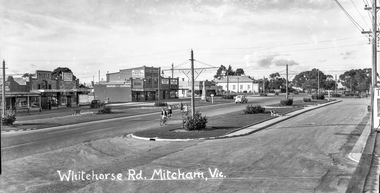
... Mary Millane, Harold's wife, printed captions on each negative with Indian ink. The series includes a variety of views of Mitcham, Vermont, Nunawading, Park Orchards and Doncaster East. ...Mary Millane, Harold's wife, printed captions on each negative with Indian ink. The series includes a variety of views of Mitcham, Vermont, Nunawading, Park Orchards and Doncaster East. ...This image was one of a series taken by Harold Millane in the late 1940's. They were printed onto post cards. Mary Millane, Harold's wife, printed captions on each negative with Indian ink. The series includes a variety of views of Mitcham, Vermont, Nunawading, Park Orchards and Doncaster East. The post cards were sold as souvenirs in the Millane shop on the N-E corner of Station Street and Whitehorse Road, Mitcham (originally the Mitcham Post Office).Clear photograph showing details of shops, vehicles, streetscape, lighting.Celluloid half plate B + W negative.Whitehorse Road Mitcham, Vic. hardy scott, h. s .beckwith, richards drapers, d. g. williamson, r. gracie, s. kelly, cenotaph, mitcham memorial hall -
 Bendigo Historical Society Inc.
Photograph - CHRIST CHURCH, SWAN HILL, 3rd May, 1882
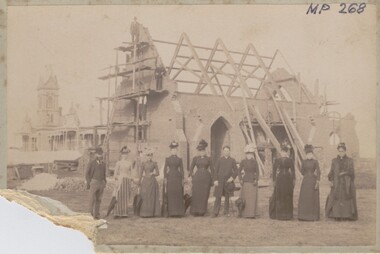
... On back: stamped in circle 'Royal Hiostorical Society of Victoria, Bendigo Branch', Indian ink: 'Church, Swan Hill, May 3rd, 1892. ...On back: stamped in circle 'Royal Hiostorical Society of Victoria, Bendigo Branch', Indian ink: 'Church, Swan Hill, May 3rd, 1892. ...Sepia photograph of Christ Church, Swan Hill showing construction materials. Group of eight women, two men, two men on scaffold. Larger building in background. On back: stamped in circle 'Royal Hiostorical Society of Victoria, Bendigo Branch', Indian ink: 'Church, Swan Hill, May 3rd, 1892. IG Alexandra Harris Incumbent'. Black ink' 'MP 268'. Previous Acc. No. 'MP 268'buildings, church, christ church, swan hill -
 Bendigo Historical Society Inc.
Photograph - HERCULES AND ENERGETIC MINE, 1939
... On back MNc4 ( in indian ink ) ? Hercules and Energetic ( in ball point pen ) RHSV of Vic. ...On back MNc4 ( in indian ink ) ? Hercules and Energetic ( in ball point pen ) RHSV of Vic. ...black and white photo of underground mining, showing 8 miners in a stope with their Bendigo bucket carbide lights. A large quartz spur formation is visible in the foreground. A wooden ladder gives a good scale in relation to the stope size. Photograph taken in the Central Nell Gwynne at the 265 m. level C 1939. On back MNc4 ( in indian ink ) ? Hercules and Energetic ( in ball point pen ) RHSV of Vic. Stamp.organization, business, hercules and energetic mine -
 Bendigo Historical Society Inc.
Photograph - ST LUKE'S ANGLICAN VICARAGE AND CHURCH, WHITE HILLS, c.1920
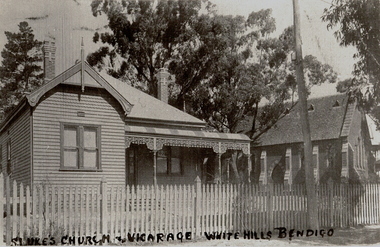
... Inscriptions: on front in Indian ink written across bottom of image 'St Luke's Church and vicarage, White Hills Bendigo'....Inscriptions: on front in Indian ink written across bottom of image 'St Luke's Church and vicarage, White Hills Bendigo'. ...Copy of black and white photograph showing view of weatherboard double-fronted house, decorative ? Boards, verandah lacework, decorative brick chimneys ??. Roof, double-hung windows. Brick church adjacent, vented slate roof, buttressed walls, Gothic windows. Picket fence along footpath. SEC? pole. Trees in background. Inscriptions: on front in Indian ink written across bottom of image 'St Luke's Church and vicarage, White Hills Bendigo'.buildings, church, st lukes, white hills -
 Bendigo Historical Society Inc.
Painting - 180 MINE BATTERY
... This is a watercolour and indian ink sketch on card. Yellow card attached with painting states: ' George Lansell Exhibit No 4. ...This is a watercolour and indian ink sketch on card. Yellow card attached with painting states: ' George Lansell Exhibit No 4. ...The remains of the 180 mine battery as painted by Alfred Perry in 1959. This is a watercolour and indian ink sketch on card. Yellow card attached with painting states: ' George Lansell Exhibit No 4. The remains of the 180 mine battery as painted by Alfred Perry in 1959. It was from the 180 that George Lansell laid the foundations of his fortune and indeed the fortunes of the district. With his capital behind the field mining flourished for nearly one hundred years and ensured employment for the many miners in the district.'Alfred Perryartwork, print, mining heritage, alfred perry, mining battery, 180 mine, victoria hill -
 Nillumbik Shire Council
Mixed media: Liz NETTLETON, Liz Nettleton, Respite and Repose, 2010
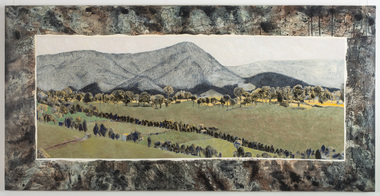
... Mixed media (acrylic paint, acrylic ink and indian ink) on board / Landscape painting of Mount Sugarloaf and green pastures after the 2009 Black Saturday bushfires / Mount Sugarloaf is depicted in an indigo haze in the background / A line of trees bathed in light border the mountain's edge / Lines of trees parallel to each other jut out diagonally in the foreground / Framing this view of the landscape is a pattern (topographical maps of the Nillumbik area), which suggest the vast extent of the devastated area of landscape. ...This work is by a local contemporary artist and encompasses themes dealing with the 2009 Black Saturday bushfires. nettleton respite and repose landscape painting mixed media black saturday mount sugarloaf In black marker 'LIZ NETTLETON' + artist signature '2011' on back - middle right side Mixed media (acrylic paint, acrylic ink and indian ink) on board / Landscape painting of Mount Sugarloaf and green pastures after the 2009 Black Saturday bushfires / Mount Sugarloaf is depicted in an indigo haze in the background / A line of trees bathed in light border the mountain's edge / Lines of trees parallel to each other jut out diagonally in the foreground / Framing this view of the landscape is a pattern (topographical maps of the Nillumbik area), which suggest the vast extent of the devastated area of landscape. ...Nettleton creates an image of peace and tranquility after the violence felt from the 2009 Black Saturday bush fires / At the Arthurs Creek cemetery Nettleton found the grave of Reg Evans and Angela Brunton, friends who had perished in the fires / Nettleton sat on the edge of their joint grave and photographed their view / It was only after examining the photos more closely that she realized Mount Sugarloaf had burnt almost to the valley / Sugarloaf is always in an indigo haze. This work is by a local contemporary artist and encompasses themes dealing with the 2009 Black Saturday bushfires. Mixed media (acrylic paint, acrylic ink and indian ink) on board / Landscape painting of Mount Sugarloaf and green pastures after the 2009 Black Saturday bushfires / Mount Sugarloaf is depicted in an indigo haze in the background / A line of trees bathed in light border the mountain's edge / Lines of trees parallel to each other jut out diagonally in the foreground / Framing this view of the landscape is a pattern (topographical maps of the Nillumbik area), which suggest the vast extent of the devastated area of landscape. In black marker 'LIZ NETTLETON' + artist signature '2011' on back - middle right side nettleton, respite and repose, landscape, painting, mixed media, black saturday, mount sugarloaf -
 Bendigo Historical Society Inc.
Map - CONTOUR PLAN OF THE GOVERNMENT CAMP SANDHURST 1854, 1994
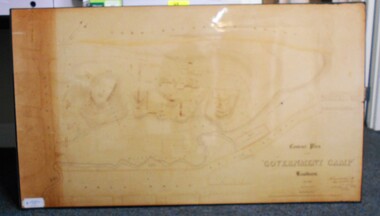
... Wooden buildings tinted in Indian Ink. Tents and other temporary structures tinted in Burnt Sienna.' ...Wooden buildings tinted in Indian Ink. Tents and other temporary structures tinted in Burnt Sienna.' ...Contour map (copy) of the Government Camp Sandhurst, 1854. Map is mounted on coreflute and laminated. Written in bottom righthand corner 'Contour Plan of the Government Camp, Sandhurst. Dec 1854. Signed by Richard Larritt, Assistant Surveyor, 11th December 1854.' Shown on map: Pall Mall, Bendigo Creek, Commissioner's Gully, View Place (now View Street), Post Office, Bank of Victoria, District Surgeon, Sandhurst Fire Brigade, Police Hospital, Flagstaff, Gold Office, License Shed, Military Barracks, Stables, Commissioner's Buildings, Police Office. Old Cemetery, Garden. Reference on righthand side: 'Stone or brick buildings are tinted in crimson. Wooden buildings tinted in Indian Ink. Tents and other temporary structures tinted in Burnt Sienna.' Scale of Chains, on bottom of map. Sticker on bottom left hand corner and back of map ' Presented by Survey and Mapping, Victoria, 7th Octber, 1994'.map, bendigo, government camp, pall mall, bendigo creek, commissioner's gully, view place (now view street), post office, bank of victoria, district surgeon, sandhurst fire brigade, police hospital, flagstaff, gold office, license shed, military barracks, stables, commissioner's buildings, police office. old cemetery, garden. , survey and mapping victoria. sandhurst, bendigo. -
 Bendigo Historical Society Inc.
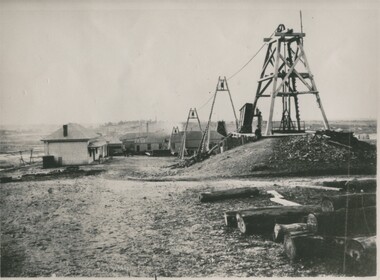
Photograph - GREAT EXTENDED HUSTLERS MINE, 1875
... On face of photo in indian ink: area of 24 acres, has 6 shafts, equals 4000 feet of sinking. ...On face of photo in indian ink: area of 24 acres, has 6 shafts, equals 4000 feet of sinking. ...black and white photograph of the Great Extended Hustlers Quartz Mining claim. Photograph shows five weatherboard clad buildings with corrugated iron roofing. Poppet legs and cable support trestles. Bush logs in foregound at right. Office at left, battery house centre background. Main shaft right. Copy of original photo. On face of photo in indian ink: area of 24 acres, has 6 shafts, equals 4000 feet of sinking. No less than 13 levels and 16 x cuts making a total of 12000 feet. Amount spent in labour 228,000 ( pounds stg. ) Quartz raised 144,5000 tons and yields to date 188,000 ozs of gold. Dividends 585,000 ( pounts st.) nearly 20/-/ a share. Employment to nearly 200 men. It is stated this rich mine changed hands the early days for only 30/-/-. On back in black ink ' Gr. Extended Hustlers. Bottom right corner : A. Richardson/29 Harrison Street/Bendigo.N.J. Caireorganization, business, great extended hustlers mine -
 Duldig Studio museum + sculpture garden
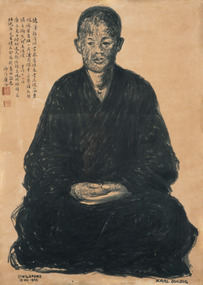
Drawing, Karl Duldig, The Buddhist Monk, Guangqia by Karl Duldig 1940, 1940
... The portraits were drawn using a Chinese brush and Indian ink. Surviving sketches in the Studio’s collection indicate that Karl thought about creating a life-size sculpture later on, but this was not realised. ...The portraits were drawn using a Chinese brush and Indian ink. Surviving sketches in the Studio’s collection indicate that Karl thought about creating a life-size sculpture later on, but this was not realised. ...The Buddhist monk Guangqia visited Karl Duldig’s studio on two consecutive days, in the company of the noted Chinese writer, Professor Yu Dafu, a friend of Karl’s. Karl made two portraits of the monk, the first depicting him sitting, and the second in a standing pose. The portraits were drawn using a Chinese brush and Indian ink. Surviving sketches in the Studio’s collection indicate that Karl thought about creating a life-size sculpture later on, but this was not realised. Guangqia added inscriptions in his own hand to both drawings and stamped them with a red seal. The seated drawing has an inscription in which he quoted from a Buddhist poem, ‘A Contented Mind’ by the scholar Lingfeng of Mt Tiantai. In the summer I went to visit the Austrian sculptor Duldig with Professor Yu Da Fu. My virtue is slight – I cannot accept your offerings and gifts; I am amply rewarded by the clouds and springs. Rather than a table laden with pearl-like rice, I prefer the wind and leaves falling on my bed. Sitting quietly on my meditation cushion Is sweeter than the wheat offered by a thousand families. The pity is that I am gradually growing old; My bitter journey is not worthy of your offerings. The second drawing has a quote from a Buddhist poem on the study of Chán (Zen) Buddhism, by the famed Chán master, Dàjiàn Huìnéng (638–713): The portrait, with its figure positioned on a scroll-like ground and inscription is reminiscent of traditional Zen Buddhist portraiture. In this school of portraiture, which stretched back to at least the thirteenth century, monks were depicted sitting or standing facing the viewer, and typically the monk added an autographic inscription to the portrait. The portraits were often passed from master to disciple, continuing the disciples’ journey of spiritual enlightenment and were revered for their association with remarkable or holy priests. The Buddhist monk, Guangqai who added his inscription and stamp to the drawings would most certainly have been aware of this tradition. It is likely that Karl was aware of this tradition, one of the points where the studio’s collections of art works from Singapore intersect with the earlier Viennese collections can be found in the Library where a catalogue of an exhibition, 'Ausstellung Ostasiatischer Malerie und Graphik' is held. The Viennese Friends of Asian Art and Culture and the Albertina Museum staged this exhibition of East Asian painting and graphic works in 1932. Such was the internationalism of Duldig’s education in Vienna, that adaption to a new environment and culture in the Straits Settlement was swift, and he was able to interpret the artistic traditions of the place, and make them his own. It is part of the strength of the collection, that in many cases contemporary supporting documentation for the works of art is available. In this case there is a photograph of the Monk with Yu Ta-fu, and Karl and Eva Duldig, outside the studio at the time the drawings were made. Ann Carew 2016The portraits of Guangqai have national and international aesthetic significance. The works of art demonstrate the artist’s skill in capturing the physical appearance and demeanour of his subject, and his ability to adapt his working methods to incorporate traditional Asian materials and cultural practices. The portrait is one of few examples in Melbourne of a central European modernist artists working in, and engaging with Asia, during this period and it is culturally and aesthetically significant for this reason. The portraits are also historically interesting in documenting the life and experiences of Karl Duldig in the Straits Settlement (Singapore). Ann Carew 2016Brush drawing in chinese ink on paper. Seated Buddhist Monk. Chinese calligraphy hand written in black ink. Two red stamps under calligraphy.Signed Karl Duldig in l.r. corner. Dated Singapore 1940 in l.l. corner. -
 Federation University Historical Collection
Photograph - Photograph - Black and White, Indian Scout Motorbike, 1924, 1/1/1924
... Written in ink on back - My Indian Scout. Taken in front of "laura Villa", Smeaton. 1/1/24...The Frank Wright Medal at the Royal South Street competition is awarded to an individual recognized as making an outstanding contribution to brass music in Australia. frank wright cornet conductor ballarat laura villa smeaton indian motorbike motorbike motorcycle transport Written in ink on back - My Indian Scout. ...Frank Wright was a renown resident of Smeaton, where he was born. He lived at Laura Villa, and attended Smeaton State School. His father William was a gold miner and his mother's name was Sarah. Their family won many singing and instrumental awards. Frank was tutored by Percy Code and was awarded a gold medal for the highest marks in the ALCM examinations in the British Colonies at the age of seventeen years. He became the Australian Open Cornet Champion by the age of eighteen. A year later, Frank conducted the City of Ballarat Band, and later the Ballarat Soldiers’ Memorial Band. He formed the Frank Wright Frisco Band and Frank Wright and his Coliseum Orchestra. These bands won many South Street awards, and Frank as conductor won many awards in the Australian Band Championship contest. In 1933 Frank Wright sailed to England to conduct the famous St Hilda’s Band and was later appointed Musical Director of the London County Council, where he organized many amazing concerts in parks, in and around the London district. He was made Professor of Brass and Military Band Scoring and conducted at the Guildhall of Music and Drama. Frank was often invited to adjudicate Brass Band Championships around Europe, in Australia, including South Street and in New Zealand. The Frank Wright Medal at the Royal South Street competition is awarded to an individual recognized as making an outstanding contribution to brass music in Australia.Black and white photograph of a motorbike standing on the grass outside a picket fence. The bike belonged to Frank Wright and the place was "Laura Villa".Written in ink on back - My Indian Scout. Taken in front of "laura Villa", Smeaton. 1/1/24frank wright, cornet, conductor, ballarat, laura villa, smeaton, indian motorbike, motorbike, motorcycle, transport -
 Mission to Seafarers Victoria
Album - Stamps album
... Indian, and Pacific Oceans. This album reveals the passion for the Sea and ships. samuel stanley laurie (1921-2015) royal navy ww2 stan laurie Written in black ink inside: The stamps in this Stamp Album were collected by Commander Stan Laurie R.N. and donated in 2022 by his family. ...Commander Samuel Stanley Laurie served with the British Royal Navy in five different air squadrons flying from nine different ships and airfields. He saw action in the Mediterranean, Red, and Arabian Seas as well as in the Atlantic, Arctic, Indian, and Pacific Oceans.This album reveals the passion for the Sea and ships.Large stamps album with purple cover and stamps decoration.Written in black ink inside: The stamps in this Stamp Album were collected by Commander Stan Laurie R.N. and donated in 2022 by his family.samuel stanley laurie (1921-2015), royal navy, ww2, stan laurie -
 Flagstaff Hill Maritime Museum and Village
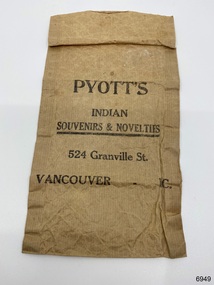
Container - Pyott's Paper Shopping Bag, c. early 20th-century
... Indian Souvenirs & Novelies. 524 Granville St, Vancouver- B.C. On the reverse side in handwriting: 'Red + dark red beads A brown paper shopping bag with a printed logo and store information in black ink Container Pyott's Paper Shopping Bag ...Pyott's Ltd., was an merchant and novelty shop in Vancouver, Canada during the early-20th century. An advertisement for the shop was published on February 9, 1922 in the Ubyssey News (issued Weekly by the Publications Board of the University of British Columbia. It reads: 'We carry one of the largest lines of Indian Burnt Leather Goods, Moccasins and Baskets in the city; also Beads, Purses and Hand Bags; View Books, Post Cards and Novelties of all kinds. Your inspection invited, 524 Granville St. Vancouver B.C'. History of shopping bags: Before the late 1800s, shopping bags didn’t exist. Shoppers would either carry their goods home in baskets, or have the merchant deliver them to people's homes, until 1852 when Francis Wolle, a schoolteacher in Pennsylvania, invented a machine to produce paper shopping bags. This invention would allow customers to carry items home in disposable paper bags. Soon after, owners of department stores and retailers began to realise that paper shopping bags could be used to help market their brands, and as such custom shopping bags with printed logos became common place. Carrying a shopping bag from certain shops became a type of status symbol for consumers, providing evidence that one was well-off, had good taste, or both. The paper shopping bag is a rare survival of ephemera related to a retail store that existed in Vancouver, Canada during the early-20th century. The arrival of waves of more than ten million migrants by boat is one of the major themes in Australia’s history. The paper shopping bag is representative of personal items purchased for migrant journeys as markers of domesticity, warmth and making oneself at home in a new land that speaks of the transnational lives embedded in threads of migration. A brown paper shopping bag with a printed logo and store information in black inkPyott's, Indian Souvenirs & Novelies. 524 Granville St, Vancouver- B.C. On the reverse side in handwriting: 'Red + dark red beadsshopping bag, marketing, ephemera, pyott's, vancouver, canada, migration, flagstaff hill, merchant -
 Orbost & District Historical Society
booklet, Hiawatha, 1949
... ink - E. Lambert. Two small 12 pp cream coloured books with brown print and the head of an American Indian chief in head-dress on the cover. ...This is a souvenir program made for the musical event, Hiawatha, presented by Orbost Rotary Club on November 28,29 1949. Miss Elsie Lambert was a teacher at Orbost State School for 25 year.This is representative of the entertainment popular in Orbost in the 1940's-1950's.Two small 12 pp cream coloured books with brown print and the head of an American Indian chief in head-dress on the cover. It is titled"Hiawatha" prod. and directed by F.C. Herbert. a musical event presented in Orbost 1949, performed and sponsored by the Orbost Rotary Club. This was a souvenir program.On the back cover 657.1 in ink - E. Lambert.souvenir-program hiawatha musical orbost-rotary -
Mission to Seafarers Victoria
Letter - Correspondence, 16/07/1952
... Indian girl, received a gold star award. Quinn Collection letters-from-abroad allan quinn alette andersen london 1952 vera south musical 'south pacific' mary martin pat and barry hannon covent garden margot fonteyn frank sedgman A pale blue self-folding letter (0901.a1) headed 8 Gloucester Walk, London W 8 and dated 16/07/52. Letter is written in green ink ...Allan has finished his photography course and passed the exams.. Eleven of his photos were exhibited in the end of year exhibition and one of them, a portrait of an Indian girl, received a gold star award. Quinn CollectionA pale blue self-folding letter (0901.a1) headed 8 Gloucester Walk, London W 8 and dated 16/07/52. Letter is written in green ink. It is addressed to Mrs K Hayes, 14 Fitzroy Street, St Kilda, Victoria, Australia. It is postmarked Paddington W 2. Return address is Allan Quinn, 8 Gloucester Walk, London W 8. letters-from-abroad, allan quinn, alette andersen, london 1952, vera south, musical 'south pacific', mary martin, pat and barry hannon, covent garden, margot fonteyn, frank sedgman
