
Showing 68 items matching "indicating systems"
-
 Moorabbin Air Museum
Manual (Item) - Autosyn Indicating systems - overhaul instructions
... Autosyn Indicating systems - overhaul instructions...Autosyn Indicating systems - overhaul instructions...Autosyn Indicating systems - overhaul instructions Manual Autosyn Indicating systems - overhaul instructions ... -
Moorabbin Air Museum
Manual - Boeing 747 APU, GTCP 660-4 747 APU
... ...Indicating systems...Boeing 747 APU Installation & specifications Basic function & construction Lubrication system Fuel system components Bleed air system Control electrical/electronic turbine systems Control system operation Indicating systems Trouble shooting Installation & maintenance of Boeing 747 GTCP 660-4 auxiliary power unit ( APU ) , circa 1970 Loose pages stapled top left hand corner GTCP 660-4 747 APU Manual Boeing 747 APU ...Installation & maintenance of Boeing 747 GTCP 660-4 auxiliary power unit ( APU ) , circa 1970Loose pages stapled top left hand cornernon-fictionInstallation & maintenance of Boeing 747 GTCP 660-4 auxiliary power unit ( APU ) , circa 1970installation & specifications, basic function & construction, lubrication system, fuel system components, bleed air system, control electrical/electronic turbine systems, control system operation, indicating systems, trouble shooting -
Moorabbin Air Museum
Book - Gas turbine engines, Gas Turbine Powerplants and their Maintenance on Aircraft
... ...Indicating systems...Gas turbine engines Fundamental principles General constructional & operating features Performance parameters Compressors Combustion chambers Turbines Fuel control Water injection Starting & ignition Indicating systems Lubrication system Bleed air system Turbojet & turbofan powerplants Turboprop & turboshaft powerplants Auxiliary Power Units. ...Text for gas turbine engine maintainers , circa 1987non-fictionText for gas turbine engine maintainers , circa 1987fundamental principles, general constructional & operating features, performance parameters, compressors, combustion chambers, turbines, fuel control, water injection, starting & ignition, indicating systems, lubrication system, bleed air system, turbojet & turbofan powerplants, turboprop & turboshaft powerplants, auxiliary power units., gas turbine powerplant performance, line maintenance, heavy maintenance & repair, ground running, troubleshooting -
Moorabbin Air Museum
Manual - Lockheed Hercules technical training, Customer Training Fuel
... systems...Components...Indicating...Lockheed Hercules technical training Turbine engines - combustion process & fuels Fuel system Wing & fuel tank structure Main fuel tanks Fuel plumbing Fittings & vent systems Components Indicating & warning systems Fuel tank maintenance Technical overview of Hercules fuel systems, circa 1976 Torn front cover & title page Customer Training Fuel Manual Lockheed Hercules technical training ...Technical overview of Hercules fuel systems, circa 1976Torn front cover & title pagenon-fictionTechnical overview of Hercules fuel systems, circa 1976turbine engines - combustion process & fuels, fuel system, wing & fuel tank structure, main fuel tanks, fuel plumbing, fittings & vent systems, components, indicating & warning systems, fuel tank maintenance -
 Flagstaff Hill Maritime Museum and Village
Functional object - Jug, Between 1910 -1936
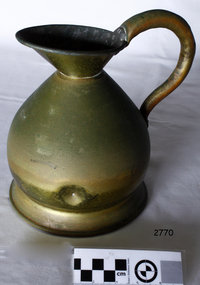
... system. The container has social significance as an item used in Victoria as a legal standard measure to ensure that goods sold in Victoria were correct. flagstaff hill warrnambool shipwrecked-coast flagstaff-hill flagstaff-hill-maritime-museum maritime-museum shipwreck-coast flagstaff-hill-maritime-village Inscription at base of handle top of jug stamped 61 GVR SM. These marks signify that the measure complied with the Victorian Government capacity liquid standard measurement. Item made during the reign of George V (1910-1936 (GVR).Other marks indicate ...The beginning of standardised weights and measures began In Victoria when the Melbourne Observatory received sets of standard weights and measures, which had been tested in Britain against the then British Imperial standards. These included the primary standard yard and pound for the Colony of Victoria. Other standards of weights and measure held by shires and the administrative body's within the colony could then be compared to these primary standards. A Weights and Measures Act was passed in Victoria in 1862, establishing local inspectors throughout the colony. By the 1870s each local council and shire in Victoria held a set of standards that were used to test scales, weights and dry measures used by wholesalers, factories and shops. Every ten years the councils’ standards would themselves need to be rechecked against the Victorian Standards. The checking was done by the Victorian Customs Department in the 19th century, but with the transfer of responsibility for customs to the Federal Government in 1901, weights and measures function was retained by the Victorian Government and was shifted to the Melbourne Observatory. In 1904, a new building was erected at the south end of the Great Melbourne Telescope House, where the standard weights and measures and testing equipment was installed. This room had a large whirling apparatus for testing air meters and became known as the Whirling Room. When the Melbourne Observatory closed in 1944, the Weights and Measures Branch was formed to continue and this branch remained at the Observatory site unit until 1995.An example of a brass measuring jug made specifically to maintain government standard liquid measurements that were sold to the public. The probability is that this artefact was made sometime between George V reign (1910-1936) and gives us today a snapshot of how imperial weights and measures were checked by Government departments prior to decimalisation and how a standard for the various types of measurement was developed in Australian based on the Imperial British measurement system. The container has social significance as an item used in Victoria as a legal standard measure to ensure that goods sold in Victoria were correct. Jug brass haystack form with a deep lip and pouring spout, small neck and broad base. It displays a curved pistol handle. Inscription at base of handle top of jug stamped 61 GVR SM. These marks signify that the measure complied with the Victorian Government capacity liquid standard measurement. Item made during the reign of George V (1910-1936 (GVR).Other marks indicate model number (61) & SM possible could be either small measure, the maker, or Standards Melbourne.flagstaff hill, warrnambool, shipwrecked-coast, flagstaff-hill, flagstaff-hill-maritime-museum, maritime-museum, shipwreck-coast, flagstaff-hill-maritime-village -
 Flagstaff Hill Maritime Museum and Village
Domestic object - Washboard, 1900-1920s
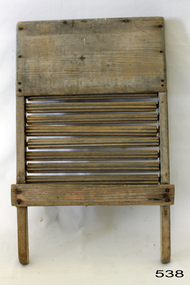
... This washboard with horizontal fulted rollers appears to be a variation on the patented Hubbard Roller Washboard system, which had rollers with vertical flutes. The rollers appear to be maple wood, which indicates an American manufacturer. ...This washboard with horizontal fulted rollers appears to be a variation on the patented Hubbard Roller Washboard system, which had rollers with vertical flutes. The rollers appear to be maple wood, which indicates an American manufacturer. ...This washboard with horizontal fulted rollers appears to be a variation on the patented Hubbard Roller Washboard system, which had rollers with vertical flutes. The rollers appear to be maple wood, which indicates an American manufacturer. The Mother Hubbard Roller Washboard was very popular in America in the early 1900s. The patented design, sold door-to-door, featured threaded maple rollers that rolled in opposite directions. It required only a light touch from the launderer, as the rollers did the work. It was awarded the Good Housekeeping Seal of Approval. The first roller washboard was made by the Hubbard brothers in Dover, Illinois, where they were born. As sales increased, they moved their large sawmill to Lamoille in 1904 for better shipping facilities. In 1916, they moved their sawmill to Mendota, Illinois. In addition to the washboards, the plant specialised in sawing walnut logs and forming them into roughs for gun stocks. Throughout the 1920s, the Mother Hubbard Washboard factory was busy, but production ceased after 1935, once the electric washing machine became popular. An unusual washboard with horizontal fluted rollers, different to the patented Hubbard Brothers washboards with vertical fluted rollers. It makes the item rare and possibly made in Australia in the early 1900s. The washboard gives insight into how various companies tried to improve or get around other manufacturers' patented designs. The washboard is also significant in the evolution of household laundry equipment designed to reduce labour. Washboard: a rectangular wooden frame with two legs enclosing horizontal, rotating rollers with flutes. flagstaff hill, flagstaff hill maritime museum and village, warrnambool, maritime museum, maritime village, great ocean road, shipwreck coast, washboard, laundry, clothes washing, clothes cleaning, washing, household item, washing equipment, laundering equipment, laundering, roller washboard, hubbard brothers, domestic laundry, mother hubbard washboard, rollers with horizontal flutes -
Frankston RSL Sub Branch
Helmet, Australian M1, circa 1960's
... indicate that it was made in USA. The chin strap and liner are both complete and fully operable. These helmets were first issued in 1941 to the United States Armed Forces. They were adopted after the Korean War by the Australian Defence Force. In the 1990s they were replaced by the Kevlar based Personnel Armour System...indicate that it was made in USA. The chin strap and liner are both complete and fully operable. These helmets were first issued in 1941 to the United States Armed Forces. They were adopted after the Korean War by the Australian Defence Force. In the 1990s they were replaced by the Kevlar based Personnel Armour System ...Standard issue United States M1 pattern steel helmet, olive drab in colou, stretch cotton cargo type net, with fibreglass liner. On the inside of a strap in the liner '8415-153-6671' is printed in black ink. This number would appear to be the "Federal Stock Number (FSN)" which was used 1949 to 1975 when ti was replaced by "National Stock Number (NSN)' by additional of 00 after the first 4 numbers. this would indicate that it was made in USA. The chin strap and liner are both complete and fully operable. These helmets were first issued in 1941 to the United States Armed Forces. They were adopted after the Korean War by the Australian Defence Force. In the 1990s they were replaced by the Kevlar based Personnel Armour System-Ground Troop (PASGT) type helmet. However, as evidenced by this helmet, some M1 Steel helmets were not replaced in-service by the PASGT helmet and survived into the early 21st Century. Used by Royal Australian Army in Vietnam in areas where mines were significnat, such as Long Hai's mountains (together with US flak jackets), and also by Royal Australain Navy.An example of an Australian Army issue M1 steel battle helmet complete with fibreglass liner. This helmet type was issued to Australian defence personnel during the Vietnam conflict. The inner line has a transfer on the front " Australian Military Forces" with rising sun badge. The steel outer has an olive green elastic cover (similiar to cargo net) to hold camouflage material. The M1 is two "one-size-fits-all" helmets: an outer shell made of metal and a hard hat-type liner that is nestled inside the shell and contains the suspension system that would be adjusted to fit the wearer's head. Helmet covers and netting would be applied by covering the steel shell with the extra material tucked inside the shell and secured by inserting the liner. The helmet is 7 inches in height, width is 9.5 inches and length is 11 inches. The weight of a World War II era M1 is approximately 2.85 pounds including the liner and chinstrap. (From Wikipepedia) the inner line has a transfer on the front " Australian Military Forces" with rising sun badge.steel helmet -
 Lara RSL Sub Branch
Coloured Print, Colour Patches of the Australian Military Forces World War Two
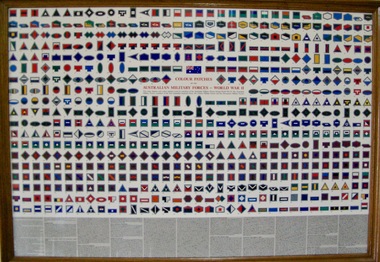
... The Chart displays unit colour patches worn by members of the Australian military forces during world war 2. the Australian Military forces consisted of the 2nd Australian Imperial Forces and the Permanent Military Forces During the world wars and the years in between, Australian soldiers wore cloth patches of various shapes and colours on their upper sleeves to indicate to which unit or formation they belonged. The use of colour patches was discontinued in 1949 when the British system of embroidered shoulder titles, formation signs and lanyards was adopted. ...The Chart displays unit colour patches worn by members of the Australian military forces during world war 2. the Australian Military forces consisted of the 2nd Australian Imperial Forces and the Permanent Military ForcesDuring the world wars and the years in between, Australian soldiers wore cloth patches of various shapes and colours on their upper sleeves to indicate to which unit or formation they belonged. The use of colour patches was discontinued in 1949 when the British system of embroidered shoulder titles, formation signs and lanyards was adopted. In July 1987 colour patches were reintroduced in order to foster the Army’s heritage and are now worn on the right side of the puggaree on the slouch hat. Coloured Print of Colour Patches of the Australian Military Forces World War TwoNumbered Colour Patches and descriptions of each patch 1 to 630 -
 Flagstaff Hill Maritime Museum and Village
Functional object - Navigation Side Lamp, early 20th century
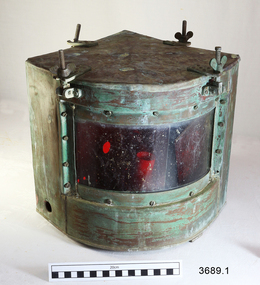
... Navigation lamps are used to indicate a vessel’s position and direction of travel to other vessels nearby. This system of coloured lamps is standardised throughout the world for all marine vessels, red is for port and green for starboard, (red is for the boats right hand side). ...Navigation lamps are used to indicate a vessel’s position and direction of travel to other vessels nearby. This system of coloured lamps is standardised throughout the world for all marine vessels, red is for port and green for starboard, (red is for the boats right hand side). ...This pair of navigational lamps or lights was fitted to the vessel S.S. Rowitta when it was renovated to become a display passenger ferry at Flagstaff Hill Maritime Village from 1976-2015. Navigation lamps are used to indicate a vessel’s position and direction of travel to other vessels nearby. This system of coloured lamps is standardised throughout the world for all marine vessels, red is for port and green for starboard, (red is for the boats right hand side). These navigation lamps were not the original fittings for this vessel but had come from a similar vessel of the same era of the early 1900’s. The history of the lamp fittings at this time is unknown. SS ROWITTA: - The 1909 steam ferry, SS Rowitta, was installed as an exhibit at Flagstaff Hill in 1975 and was enjoyed by many visitors for 40 years. Rowitta was a timber steam ferry built in Hobart in 1909 using planks of Huon and Karri wood. She was a favourite of sightseeing passengers along Tasmania’s Tamar and Derwent rivers for 30 years. Rowitta was also known as Tarkarri and Sorrento and had worked as a coastal trading vessel between Devonport and Melbourne, and Melbourne Queenscliff and Sorrento. In 1974 Rowitta was purchased by Flagstaff Hilt to convert into a representation of the Speculant, a historic and locally significant sailing ship listed on the Victorian Heritage Database. (The Speculant was built in Scotland in 1895 and traded timber between the United Kingdom and Russia. Warrnambool’s P J McGennan & Co. then bought the vessel to trade pine timber from New Zealand to Victorian ports and cargo to Melbourne. She was the largest ship registered with Warrnambool as her home port, playing a key role in the early 1900s in the Port of Warrnambool. In 1911, on her way to Melbourne, she was wrecked near Cape Otway. None of the nine crew lost their lives.) The promised funds for converting Rowitta into the Speculant were no longer available, so she was restored back to her original configuration. She represented the importance of coastal traders to transport, trade and communication in Australia times before rail and motor vehicles. Sadly, in 2015 the time had come to demolish the Rowitta due to her excessive deterioration and the high cost of on-going repairs. She had given over 100 years of service and pleasure to those who knew her. These lamps are an historical example of navigational equipment used in the early 20th century, adhering to a navigational standard that is worldwide, and a design similar to what is still being used today. They were used on the display vessel at Flagstaff Hill Maritime Village as an aid to maritime education. The Rowitta represents the importance of coastal traders to transport, trade and communication along the coast of Victoria, between states, and in Australia before rail and motor vehicles. The vessel was an example of a ferry built in the early 20th century that served many different roles over its lifetime of over 100 years. Two side navigation ship's lamps, quarter circle shaped metal boxes with glass window and removable lid. The lid attaches to the box using four brackets, wingnuts and screws that swing down out of the way. The window of double-thickness glass is inserted on the curved side of the box and attached by screws around the frame. The inner glass panel is coloured according to the lamp’s use; port is red and starboard green. The port lamp has a round hole cut into each of the two straight sides and an electrical fitting inside. The starboard lamp also has a hole in each straight side (one with a threaded fitting). Its lid has an additional cross bar on top that has a circular space in the centre, nuts and screws fit through holes in the ends and a folding handle is attached across the centre space. The lamps were once fitted onto the vessel Rowitta. The starboard lamp has an inscription stamped into the metal. Impressed on 3689.2; “STARBOARD PATT 8025” flagstaff hill, warrnambool, flagstaff hill maritime museum, maritime museum, flagstaff hill maritime village, navigation lamp, navigation light, navigation equipment, starboard patt 8025, ship’s fitting, rowitta, tarkarri, speculant, purdon & featherstone of hobart, passenger ferry 1909, vessel, display rowitta, display passenger ferry, sorrento -
 Flagstaff Hill Maritime Museum and Village
Equipment - Ship's Telegraph section, Chadburn & Sons, 1875-1898
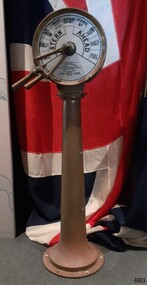
... system called an Engine Order Telegraph (E.O.T.) or ship’s telegraph. The equipment has two parts, the Bridge Section and the Engine Room Section. The Bridge Section was usually mounted onto a pedestal, and the Engine Room Section was attached to a vertical surface. The standard marine commands were printed or stamped around the face of the dial and indicated...system called an Engine Order Telegraph (E.O.T.) or ship’s telegraph. The equipment has two parts, the Bridge Section and the Engine Room Section. The Bridge Section was usually mounted onto a pedestal, and the Engine Room Section was attached to a vertical surface. The standard marine commands were printed or stamped around the face of the dial and indicated ...The ship’s telegraph section was once part of the navigational equipment of the famous paddle steamer, PS Hygeia, and was later installed on Flagstaff Hill’s exhibit, the steamer Rowitta. This is the Bridge Section of a ship’s telegraph, a Duplex Gong model, made by Chadburn & Son of Liverpool. The gong sounded two signals whenever the navigational commands to change the speed or direction were given by the ship’s pilot. Communication between the ship’s pilot and the engine room in the late 19th to the mid-20th centuries was made with a system called an Engine Order Telegraph (E.O.T.) or ship’s telegraph. The equipment has two parts, the Bridge Section and the Engine Room Section. The Bridge Section was usually mounted onto a pedestal, and the Engine Room Section was attached to a vertical surface. The standard marine commands were printed or stamped around the face of the dial and indicated by a pointer or arrow that was usually moved by a rotating brass section or handle. The ship’s pilot stationed on the Bridge of a vessel sends his Orders for speed and direction to the Engine Room with the E.O.T. He moves the lever or levers, depending on the number of engines the ship has, to change the indicator on the Bridge Section’s dial to point in the new direction and speed of travel. This change causes the Orders to be duplicated on the Engine Room Section’s dial and a bell or bells to signal the change at the same time. The engineer then adjusts the ship’s engines and steering equipment to follow the pilot’s Order. CHADBURN & SON, Liverpool- Chadburn Brothers, William and C.H., were joint inventors and well-established makers of optical and scientific instruments and marine gauges. The firm was granted the Prince Albert Royal Warrant in the late 19th century. In 1870, William Chadburn applied for a patent for his navigational communication device for use on ships. By 1875, Chadburn & Son was producing the brass Engine Order Telegraph in its plant at 71 Lord Street, Liverpool. In 1911, the ship, RMS Titanic, was launched, fitted with Chadburn & Sons E.O.T. The Chadburn Ship Telegraph Company Limited was registered in 1898 to take over Chadburn & Sons. In 1903, a large factory at Bootle, near Liverpool, and its products were being sold overseas. In 1920, electric-powered telegraphs were developed. In 1944, the name changed to Chadburn’s (Liverpool) Limited. In 1968, the company became Chadburn Bloctube Ltd. In 2000, the company, now Bloctube Marine Limited, was still manufacturing ship telegraphs. The P.S. HYGEIA 1890-1932: - This ship’s telegraph was installed on the new paddle steamer, PS Hygeia, one of three iconic pleasure steamers famous for providing regular services in Port Phillip Bay, Victoria, to thousands of passengers between the ports of Queenscliff, Sorrento, Portsea, Dromana, Rosebud, Rye, and Mornington. It joined the Ozone and the Weeroona, all three described as being glamorous, powerful and fast. Its ticket office was on the pier itself. The P.S. Hygeia was built in Yorker, Scotland, in 1890, by Napier, Sharks & Bell. It was registered in Melbourne, Australia, by Hubbart, Parker & Co. in 1891. The steel ship was 92 metres long, able to travel at 22 knots, and licensed to carry over 1600 passengers in luxury, with even a barber shop on board. The regular service between the ports in Port Phillip Bay, Victoria, continued for over 40 years. With the decline in passenger demand, the service wound down. The Hygeia was sold to H.M. Morris in 1931 for demolition and breaking up. Equipment, fittings, and even lifebuoys were sold, with many items purchased by people who had some connection to the Hygeia. On August 25th, 1931, what was left of the vessel departed Port Melbourne and eventually, in June 1932, it was laid to rest at the ships’ graveyard outside Port Phillip Heads. The SS ROWITTA 1909-2015: - The ship’s telegraph was originally installed on the PS Hygeia. It was purchased when the Hygeia was broken up in 1931 and later installed, in 1975, on Flagstaff Hill’s SS Rowitta, an exhibit greatly enjoyed by the public until it was demolished in 2015. The ferry “SS Rowitta” was built in 1909 in Hobart, Tasmania. The timber steam ferry was built using planks of Huon and Karri wood. It was a favourite with sightseeing passengers steaming along Tasmania’s Tamar and Derwent rivers for 30 years. Rowitta was also known as Tarkarri and Sorrento and had worked as a coastal trading vessel between Devonport and Melbourne, and Melbourne, Queenscliff and Sorrento. The vessel had given over 100 years of service and pleasure. This Bridge section of a ship’s Engine Order Telegraph, used with an Engine Room section, represents late-19th-century change and progress in communication and navigation at sea. This type of equipment was still in use in the mid-20th century. It is significant for its association with its maker, Chadburn & Son, of Liverpool, a well-known marine instrument maker whose work was recognised by English Royalty, and whose products were selected to supply similar equipment for use on the RMS Titanic. The ship’s telegraph is also significant for its association with the paddle steamer PS Hygeia, one of three iconic steamers that transported thousands of passengers from port to port within Port Phillip Bay, Victoria, for over 40 years from the 1890s to the 1930s. Queenscliff Borough remembers the Hygeia by naming a road near the pier Hygeia Drive. The Hygeia is registered on the Victorian Heritage Database as a vessel of significance, VHR S329. In 1901, Hygeia had the privilege of carrying their Royal Highnesses, the Duke and Duchess of York, from Mornington to St Kilda Pier, Melbourne, during their Royal visit celebrating the Federation of Australia. The ship’s telegraph is also important for its connection with the Rowitta, a large exhibit on display at Flagstaff Hill Maritime Village, aiding maritime education for over 40 years. It represented the importance of coastal traders to transport, trade and communication along the coast of Victoria, and before the availability of rail and motor vehicles, serving many roles. Bridge section of a Ship’s Telegraph or Engine Order Telegraph (E.O.T.). The round, double-sided, painted glass dial is inside a brass case behind glass. It is fitted onto an outward tapering brass pedestal with a round base. The brass indicator arrows between the handles point simultaneously to both sides of the dial when moved. An oval brass maker’s plate is attached to the top of the case. The dial’s faces have inscriptions that indicate speed and direction, and the front face and plate include the maker’s details. A serial number is stamped on the collar where the dial is fitted to the pedestal. The ship’s telegraph is a Duplex Gong model, made by Chadburn & Son of Liverpool. It was originally part of the navigational fittings on the paddle steamer, PS Hygeia.Dial, maker’s details: “PATENT “DUPLEX GONG” TELEGRAPH / CHADBURN & SON / TELEGRAPH WORKS / PATENTEES & MANUFACTURERS / 11 WATERLOO ROAD / LIVERPOOL” LONDON / 105 FENCHURCH STREET” “NEWCASTLE / 85 QUAY + SIDE” “GLASGOW / 69 ANDERSON QUAY” “PATENT” Dial instructions: “FULL / HALF/ SLOW / FINISHED WITH ENGINES / STOP STAND BY / SLOW / HALF / FULL / ASTERN / AHEAD” Maker’s plate: “CHADBURN / & SON / PATENT / LIVERPOOL” Serial number: “22073”flagstaff hill, warrnambool, maritime village, maritime museum, shipwreck coast, great ocean road, engine order telegraph, e.o.t., navigational instrument, communication device, ship’s telegraph, engine room section, bridge section, rms titanic, chadburn & son, chadburn brothers, william chadburn, chadburn ship telegraph company, chadburns, duplex gong, liverpool, ss rowitta, navigation, marine technology, pilot’s orders, steam power, hobart, tasmania, devonport, tasmanian-built, ferry, steam ferry, steamer, 1909, early 20th century vessel, passenger vessel, tamar trading company, launceston, george town, sorrento, tarkarri, speculant, peter mcgennan, p j mcgennan & co. port phillip ferries pty ltd, melbourne, coastal trader, timber steamer, huon, karri, freighter, supply ship, charter ferry, floating restaurant, prawn boat, lakes entrance, ps hygeia, paddle steamer, pleasure steamer, port phillip bay, queenscliff, portsea, dromana, rosebud, rye, mornington, hubbart parker & co, 1890, 1903, h.m. morris, hygeia -
 Orbost & District Historical Society
passport, 1919
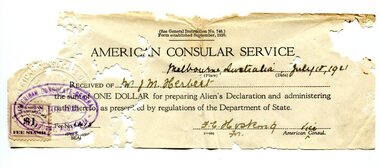
... system Australians had tolerated during the war because they believed it was temporary. Passports issued by Australia were issued only to "British subjects" and were described as "British Passports". This wasn't changed until 1949. An entry indicates...system Australians had tolerated during the war because they believed it was temporary. Passports issued by Australia were issued only to "British subjects" and were described as "British Passports". This wasn't changed until 1949. An entry indicates ...During WW1 passports had been temporary - War Precaution. The War Precautions Act 1914 required all persons over 16 years of age, on leaving Australia, to possess some passport. The Passports Act of 1920 made permanent a passport system Australians had tolerated during the war because they believed it was temporary. Passports issued by Australia were issued only to "British subjects" and were described as "British Passports". This wasn't changed until 1949. An entry indicates that he probably visited the U.S.A. James Massey Herbert was born in 1891 and died in 1971. He was the son of Lancelot Herbert and Martha Rawling. He was married to Alma Young and his sons were Graham and Eric Herbert. ( info. from John Phillips). These passport documents for James Massey Herbert are from 1921 when he did an overseas trip. The Herberts were early settlers in Orbost. James Massey Herbert was an Orbost Shire councillor for 1 term (1943-1945). A small blue passport with paper inside that opens up to show I D photo of James Massey Herbert. passport-herbert-james-massey -
 Ringwood and District Historical Society
Photograph, Coach and Horses Hotel, Ringwood circa 1940
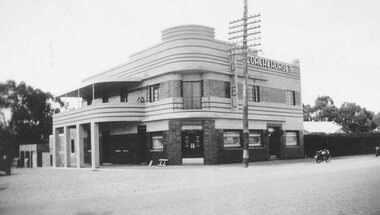
... system. Black and white photograph of Coach and Horses Hotel in Maroondah Highway, west of New Street, now adjacent to Eastlink Freeway, on northern side. There are two duplicate photos. Certainly the photo was taken post-1940 as the previous Coach & Horses Hotel, on the south side, burnt down in 1940. The telephone pole indicates ...Black and white photograph of Coach and Horses Hotel in Maroondah Highway, west of New Street, now adjacent to Eastlink Freeway, on northern side. There are two duplicate photos. Certainly the photo was taken post-1940 as the previous Coach & Horses Hotel, on the south side, burnt down in 1940. The telephone pole indicates that era, with limited lines. The style of the building was Art Deco that generally existed in the 1920s-1930s but did continued in Australia in the 1940s. The building has the appearance of being newly-built. Was H4, in the old cataloguing system. -
 Warrnambool and District Historical Society Inc.
Book, Second Reading Book, 1876
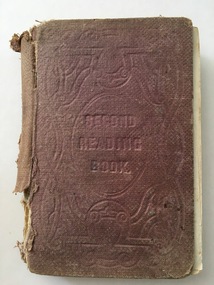
... System after 1872. Readers produced in Victoria for Australian children did not become prominent until the 20th century (School Papers 1898 and Victorian Readers 1928). The signature of Hugh Adams in this book indicates...System after 1872. Readers produced in Victoria for Australian children did not become prominent until the 20th century (School Papers 1898 and Victorian Readers 1928). The signature of Hugh Adams in this book indicates ...This is a Reading Book of the Irish National Board of Education adapted for use in schools in Victoria, Australia. Irish School Readers were used in Victoria under the National School System in the 1850s and continued to be used in the 1860s and 70s under the Common School System and the introduction of the State School System after 1872. Readers produced in Victoria for Australian children did not become prominent until the 20th century (School Papers 1898 and Victorian Readers 1928). The signature of Hugh Adams in this book indicates that the book may have come from one of the Adams families farming in the Wangoom area near Warrnambool. There were several boys in these families named Hugh and it is unclear which one owned this book. This book is of interest as an early school reader used in the Warrnambool area and as a book belonging to a member of a local Adams family in the 19th century.This is a hard cover book of 285 pages. It has a brown cover with the title and ornamentation etched into the cover. The book contains prose extracts and poetry with the extracts headed by the derivation and pronunciation of some of the words in the text. There are a few illustrations and sketches. Some of the illustrations have been coloured and scribbled on. The book has been bound with string and glue with the lower portion of the spine cover missing. The book is very tattered. ‘Hugh Adams’ (back pages and on page 279) school readers, education in warrnambool, hugh adams -
 Eltham District Historical Society Inc
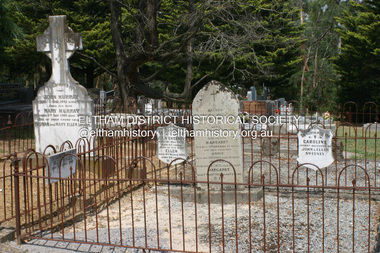
Photograph - Digital Photograph, Alan King, Graves of Thomas Sweeney and family, Eltham Cemetery, Victoria, 27 January 2008
... system. In 1861 the cemetery included Church of England, Presbyterian, Roman Catholic and Wesleyans (later Methodist) sites. Graves also indicated...system. In 1861 the cemetery included Church of England, Presbyterian, Roman Catholic and Wesleyans (later Methodist) sites. Graves also indicated ...The grave of Thomas Sweeney, former convict turned respectable citizen. The Murray and Sweeney families were both early settlers of the Eltham district and connected by marriage. Their family plots are located side by side in the Catholic section of the Eltham Cemetery. Irish-born Thomas Sweeney is regarded as the first settler in Eltham. He was transported to Sydney in 1823 after being convicted of arson. He was granted his freedom in 1838 and married Margaret Meehan in the same year. They moved to Melbourne and in 1842 Thomas purchased 110 acres beside the Yarra River in the vicinity of present-day Sweeneys Lane. He called the property ‘Culla Hill’ and built a small slab hut (reputedly with Wurundjeri help; Margaret is said to have run an informal hospital for them in return). This was followed in 1846 by more substantial buildings consisting of a three-roomed Irish-style ‘longhouse’ and a barn made of stone and handmade bricks, with doors large enough to accommodate a fully loaded wagon. When the gold rush came, Thomas prospered by selling meat and potatoes to the prospectors, enabling him to purchase a further 308 acres in 1856. He promoted the construction of a bridge over the Plenty River and the establishment of a school at Eltham. Roman Catholic Church services were held at Culla Hill in the early years. When he died in 1867, he was regarded as a respected member of the community. Thomas and Margaret are buried in Eltham Cemetery with many of their descendants. Their first son John continued to farm Culla Hill until his death in 1909. Culla Hill passed out of the Sweeneys' possession in 1939. The house and barn remain today, though lesser outbuildings have gone. The facade of the house is much the same as it was in the 1840s. Sacred To the memory of Thomas Sweeney Who died Sep 6th 1867 Aged 65 years May his soul res in peace Also his wife Margaret Died Oct 3rd 1884 aged 73 years And their daughters Annie Died Aug 22nd 1860 aged 21 years Johanna Died Aug 19th 1872 aged 22 years Margaret Died 7th Sep 1913 aged 72 years R.I.P. Also In Memory Of John Sweeney Died 24th May 1909 Aged 65 years Also of his wife Ellen Died 8th March 1910 Aged 64 years R.I.P Also In Memory Of Caroline Infant daughter of John & Ellen Sweeney Published: Nillumbik Now and Then / Marguerite Marshall 2008; photographs Alan King with Marguerite Marshall.; p55 From the piety and poverty of 19th century Eltham, 20th century artists and environmentalists, to today’s comfortable middle class, Eltham Cemetery records it all — and more. A visit to Eltham Cemetery reveals an important social record since its beginnings in 1858. The cemetery was situated on about six acres (2.4ha) (now around 4.8ha) at the corner of Mount Pleasant and Metery Roads.1* It is thought that Metery Road was originally called Cemetery Road, but in the early 1940s, a resident, possibly a councillor, objected to the name resulting in the change.2 Much can be gleaned about the developing Eltham community from burial styles and the names of former local residents. Originally the cemetery was divided into Christian denominations, like others of that time, following the United Kingdom burial system. In 1861 the cemetery included Church of England, Presbyterian, Roman Catholic and Wesleyans (later Methodist) sites. Graves also indicated social class. Some had grand tombstones, perhaps fenced with ornamental cast iron railing, but most in the 1860s and 1870s were constructed of modest stone slabs.3 This indicated the poverty of the district, which was largely inhabited by farmers on small landholdings. A poignant reminder of the high rates of infant mortality of those times, are the many infants and young children recorded on the headstones. Major changes occurred in the cemetery in the late 20th century as Christian adherence weakened and society became more egalitarian and informal. In the early 1970s a non-denominational lawn section for burials was established. Since then all new areas have been non-denominational to accommodate the more diverse local community. Now, instead of large ornamental headstones, some mourners have chosen boulders, reflecting the natural Eltham style, while others choose graves in the lawn areas or niches in walls. In the late 1970s, the University Donor Section was established north-west of Candlebark Lawn for those who donated their bodies for The University of Melbourne medical research. In the early 1980s the natural Australian garden style, popular in Eltham, was mirrored in a new section called Ashes Walk. Local landscape architect Gordon Ford, who had popularised this style, designed the Walk using boulders shaded by native plants beside curved pathways. Landscape architect Robert Boyle later redesigned Ashes Walk and developed other parts of the cemetery in keeping with this style.4 Appropriately Ford, who died in 1999, was interred in the Native Garden Section in a cluster of sites shaded by a large eucalyptus tree.5 By 2007, about 6400 interments were recorded in the Eltham Cemetery. Close inspection reveals notable names in the district’s history. The grave of Thomas Sweeney, a former convict who became a respected citizen, can be found in the Roman Catholic section near the path. Eltham Primary School’s first headmaster, David Clark, is buried in a modest grave in the Church of England section to the east of the path from the main entrance. Sir William Irvine, Victorian Premier from 1900 to 1902, whose grave is in the north-east Presbyterian section was at various times Victoria’s Chief Justice, Deputy Governor and Treasurer.6 Further south is the grave of social reformer Bertram Wainer, born in Scotland in 1928 and died in 1987. He campaigned to legalise abortion and exposed police corruption in allowing illegal ‘backyard’ abortions. Other prominent local residents interred in the cemetery include: Justus Jörgensen, who founded Montsalvat; Alistair Knox, the mud-brick housing pioneer and Eltham Shire Councillor from 1971 to 1975 and President in 1975; Clem and Nina Christensen, who had a major influence on the literary development of post World War Two Australia. Others were: composer Dorian Le Gallienne; artist Peter Glass; Stephen Dattner, a prominent Melbourne furrier; ALP parliamentarian for Greensborough, Pauline Toner and political scientist and commentator, Professor William Macmahon Ball.This collection of almost 130 photos about places and people within the Shire of Nillumbik, an urban and rural municipality in Melbourne's north, contributes to an understanding of the history of the Shire. Published in 2008 immediately prior to the Black Saturday bushfires of February 7, 2009, it documents sites that were impacted, and in some cases destroyed by the fires. It includes photographs taken especially for the publication, creating a unique time capsule representing the Shire in the early 21st century. It remains the most recent comprehenesive publication devoted to the Shire's history connecting local residents to the past. nillumbik now and then (marshall-king) collection, annie sweeney, caroline sweeney, ellen sweeney, eltham cemetery, graves, gravestones, johanna sweeney, john murray, john sweeney, margaret sweeney, mary ellen drain, mary murray, thomas murray, thomas sweeney -
 Queenscliffe Maritime Museum
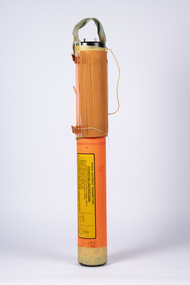
Equipment - Marine rescue
... An emergency position-indicating radio beacon (EPIRB) is a type of emergency locator beacon, a portable, battery-powered radio transmitter used in emergencies to locate airplanes, vessels, and persons in distress and in need of immediate rescue. Since the inception of Cospas-Sarsat in 1982, distress radio beacons have assisted in the rescue of over 28,000 people in more than 7,000 distress situations. In 2010 alone, the system ...An emergency position-indicating radio beacon (EPIRB) is a type of emergency locator beacon, a portable, battery-powered radio transmitter used in emergencies to locate airplanes, vessels, and persons in distress and in need of immediate rescue.Since the inception of Cospas-Sarsat in 1982, distress radio beacons have assisted in the rescue of over 28,000 people in more than 7,000 distress situations. In 2010 alone, the system provided information used to rescue 2,388 persons in 641 distress situations. Two battery operated emergency distress beacons EPIRB [Emergency Position Indicating Radio Beacon] in orange containers with attached line in yellow canvas bags.I'm going sailing, I'm coming back; B900; radio distress transmitter operating instructions; made by Don Osborne & associates, box 69 052 Aukland 8 New Zealand.iepirb, rescue, emergency beacon -
 Warrnambool and District Historical Society Inc.
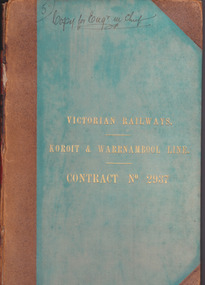
Document - Victorian Railways. Koroit & Warrnambool Line. Contract No. 2937, Circa 1888
... system expand to nearly 3000 miles. By 1931 every town with a population over 500 had its own railway station. Early Victorian railway maps indicate that the extension from Colac to Warrnambool and then onwards to Koroit, occurred in the period of the 1880’s when the act known as the Octopus act saw a rapid expansion of lines. ...system expand to nearly 3000 miles. By 1931 every town with a population over 500 had its own railway station. Early Victorian railway maps indicate that the extension from Colac to Warrnambool and then onwards to Koroit, occurred in the period of the 1880’s when the act known as the Octopus act saw a rapid expansion of lines. ...The Victorian Railways began in 1854 and in the first 14 years up to 1868 had managed to complete about 250 miles of track. The next 60 years saw the system expand to nearly 3000 miles. By 1931 every town with a population over 500 had its own railway station. Early Victorian railway maps indicate that the extension from Colac to Warrnambool and then onwards to Koroit, occurred in the period of the 1880’s when the act known as the Octopus act saw a rapid expansion of lines. At the time there was much debate over where the expansion of the lines should take place, with one of the prime considerations for Warrnambool was the impact it would have on its port.The building of the railway to Warrnambool and onward to Koroit was a significant event for the town. Green cloth cover with tan suede corner points and spine. Title printed in gold on front cover. Title printed in gold on red on spine. 92 pages. The contract is printed and includes handwritten entries with specifications.Handwritten on front cover and inside front cover ” Copy for Engr in Chief” .On Page 2 transferred to Allan Reid * 24/1/88 Co Briscoe & Co Little Collins Street, Melbourne.warrnambool, railways, warrnambool to koroit railway, victorian railways contract no 2937 -
 Eltham District Historical Society Inc
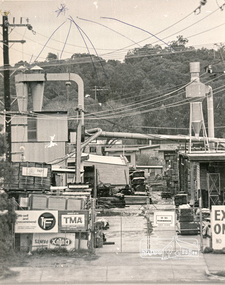
Photograph, N. J. Tillings Timber Factory, 15 June, 1975, 15/06/1975
... system installed to facilitate milling operations. Sound intensified due to position of mill in valley. Valley acts as a natural sound bowl. Eltham Council were warned of this some years ago." Includes diagram of residences in relation to mill and statement that tooter blast at least ten times per day. "#Note Residences in close proximity to sound source. Pen marks on front of photograph indicating...system installed to facilitate milling operations. Sound intensified due to position of mill in valley. Valley acts as a natural sound bowl. Eltham Council were warned of this some years ago." Includes diagram of residences in relation to mill and statement that tooter blast at least ten times per day. "#Note Residences in close proximity to sound source. Pen marks on front of photograph indicating ...N. J. Tillings Timber Factory was part of the Brougham Street, Light industrial area, Eltham. This is one of 7 B/W 8x10 inch photos with notes on obverse by Dick Crichton. Accompanying letter from Florence Chrichton 2013 : "Originally sent to Shire of Eltham Engineer, Mr. McDonald. [These photographs were part of their campaign to the Shire of Eltham in 1975] claiming that the zoning regulations were being breached by the occupants of various factories in the nearby light industrial zone [Brougham Street, Eltham] - to the detriment of those living in adjoining residential zones, and that, despite .. earlier objections and complaints, nothing was done about it." Wire gate and fencing in foreground of photo displays signs relating to timber products and Dulux Paints. "The Tilling Group was established in November 1963 and began as a small factory in Eltham Victoria. The company now has large, modern offices and warehouses in most major cities across Australia" - http://www.tilling.com.au/about-us1 black and white photograph printed with white borderInscribed on back: "Front entrance to N,J. Tillings timber yard showing part of extractor fan system installed to facilitate milling operations. Sound intensified due to position of mill in valley. Valley acts as a natural sound bowl. Eltham Council were warned of this some years ago." Includes diagram of residences in relation to mill and statement that tooter blast at least ten times per day. "#Note Residences in close proximity to sound source. Pen marks on front of photograph indicating points of interest.industrial estate, brougham street, eltham, 1975, bolton street, dick crichton, n.j. tillings, timber factory, shire of eltham, milling, fan -
 Warrnambool and District Historical Society Inc.
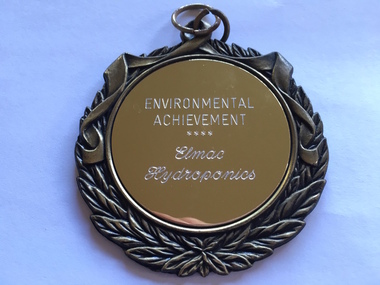
Medallion, Trophy Environmental achievement, 2000
... system of growing plants without soil, using a nutrient solution. Elmac Hydroponics had a 2,000 square metre greenhouse with 10,000 growing points. This is a significant medallion, showing the award given to a small business in the Warrnambool area and indicating its achievements in the environmental area. ...This is a medallion awarded in 2000 by Powercor Warrnambool to Elmac Hydroponics. Powercor Australia, founded in 1994, is an electrical distribution company operating in the Western District of Victoria and the western suburbs of Melbourne. Powercor Warrnambool, like other Powercor organizations, is involved in giving Business Excellence Awards annually to businesses in its area of supply. In 2014 there were 15 awards for Business Excellence. Elmac Hydroponics was a business growing and supplying organically-produced tomatoes from 1997 to 2004. It was situated at Mount Pleasant, Princes Highway, Allansford, Victoria. The business was operated by Graeme and Barbara McLeod and Keith and Leonie Ellerton. Hydroponics is a system of growing plants without soil, using a nutrient solution. Elmac Hydroponics had a 2,000 square metre greenhouse with 10,000 growing points. This is a significant medallion, showing the award given to a small business in the Warrnambool area and indicating its achievements in the environmental area. Elmac was an industry leader in in implementing an ‘Autopot’ hydroponic system which is aimed at reducing nutrient and waste water to zero. Elmac was also a finalist in the Ericsson 2002 Innovation Awards.This is a gilt metal medallion, oval-shaped, with an ornamental edging and a shield-shaped design on one side and a circular design on the other. The top has two metal rings for attachment to a chain or wall hook. On one side: ‘Environmental Achievement, Elmac Hydroponics’ On obverse side: ‘Powercor Warrnambool Region Business Achievement Awards, 2000’ elmac hydroponics, powercor business awards, warrnambool -
 Geoffrey Kaye Museum of Anaesthetic History
Equipment - Renton circle valve absorber, sectioned, Dr Douglas Renton, 1931
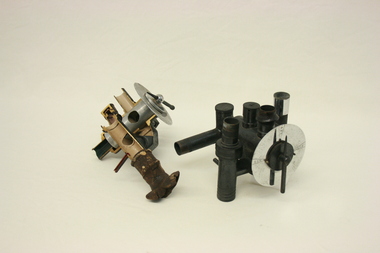
... A larger silver metal valve runs through the centre, and to it attaches a flat, reflective silver metal disc as a dial indicating "EXH", "ABS", and "REB", with a black needle. The system includes tubes and valves for oxygen entry, gas expiration, connection to soda lime cannister, rotary valve, and rebreather bag, with a broken, deteriorated segment of the bag still attached....A larger silver metal valve runs through the centre, and to it attaches a flat, reflective silver metal disc as a dial indicating "EXH", "ABS", and "REB", with a black needle. The system includes tubes and valves for oxygen entry, gas expiration, connection to soda lime cannister, rotary valve, and rebreather bag, with a broken, deteriorated segment of the bag still attached. ...The Renton circle valve absorber has been sectioned to show the valve connection points. The inside is a creamy brown colour, encased in black on the outside. A larger silver metal valve runs through the centre, and to it attaches a flat, reflective silver metal disc as a dial indicating "EXH", "ABS", and "REB", with a black needle. The system includes tubes and valves for oxygen entry, gas expiration, connection to soda lime cannister, rotary valve, and rebreather bag, with a broken, deteriorated segment of the bag still attached.valve, anaesthesia, soda lime, rebreathing -
 Bendigo Historical Society Inc.
Document - ''THE BENDIGO TRAMWAYS: A HISTORY''
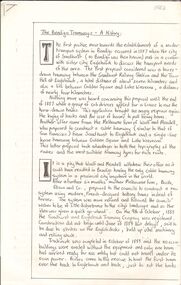
... indicates that writer was 17 years of age). Eight handwritten pages; 4 pages of photo reproductions; loose sheet - broad description of 'Bendigo''; loose sheet showing ''S.E.C. Bendigo Tramways Track Diagram as at closure of system...indicates that writer was 17 years of age). Eight handwritten pages; 4 pages of photo reproductions; loose sheet - broad description of 'Bendigo''; loose sheet showing ''S.E.C. Bendigo Tramways Track Diagram as at closure of system ...''The Bendigo Tramways - A History'' (author, not named, but last page indicates that writer was 17 years of age). Eight handwritten pages; 4 pages of photo reproductions; loose sheet - broad description of 'Bendigo''; loose sheet showing ''S.E.C. Bendigo Tramways Track Diagram as at closure of system, April 1972''. Early moves to have tramway system in 1880s; battery trams operation; steam tram motors; Bendigo Tramway Company; Electric Supply Company; Route maps (''in the appendices at the end of this report'' ???); State Electricity Commission of Victoria; list of the major purchases made by the SEC from the MMB to add to the Bendigo fleet (1930 -1960) closure of tramways; Bendigo 'talking' tourist tram (Dec. 1972); Writer's notes - acknowledgementtramways, history, bendigotramway history., bendigo tramways, electric supply company, talking tourist tram. tramsways track diagram. battery trams, ellsen and co., the sandhurst and eaglehawke tramways company. mollison street. arnold street. -
 Bendigo Historical Society Inc.
Document - STATE RIVERS AND WATER COMMISSION : COLIBAN DISTRICT WATER DISTRIBUTION ACRE FEET
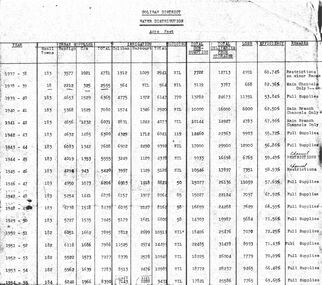
... System. A table titled Coliban District Water Distribution Acre Feet. The dates indicated cover the period 1937-1957. ...A table titled Coliban District Water Distribution Acre Feet. The dates indicated cover the period 1937-1957. Main column headings: Urban Supplies, Irrigation, Sluicing, Total Consumption, Total Deliveries from Storages, Loss, Efficiency, and Remarks. Years and figures are typed in red columns with some figures totalled in pencil at the bottom of the last column.state infrastructure, water supply, coliban system, state rivers and water supply commission. coliban system. -
 Bendigo Historical Society Inc.
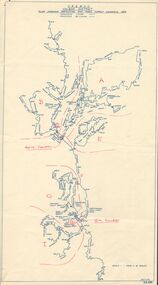
Map - STATE RIVERS AND WATER SUPPLY COMMISSION : COLIBAN DISTRICT MAP 1956, 30/11/1956
... System. State Rivers and Water Supply Commission Coliban District map. Titled: S.R. & W.S.C. Coliban District Plan showing Irrigation and Town Supply Channels 1956. Scale: 1 inch = 4 miles. Indicates ...State Rivers and Water Supply Commission Coliban District map. Titled: S.R. & W.S.C. Coliban District Plan showing Irrigation and Town Supply Channels 1956. Scale: 1 inch = 4 miles. Indicates concrete lining and concrete re-lining channels. Printed in blue ink and information added in red. The map is dated at the bottom - 30/11/'56. There is a number, 25,491, in the bottom right corner.state infrastructure, water supply, coliban system, state rivers and water supply commission. coliban system. -
 National Vietnam Veterans Museum (NVVM)
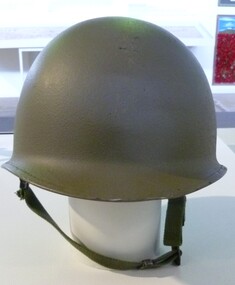
Headwear, Helmet
... System-Ground Troop (PASGT) type helmet. However, as evidenced by this helmet, some M1 Steel helmets were not replaced in-service by the PASGT helmet and survived into the early 21st Century. Interestingly, the Nato Stock Number (NSN) printed on the inside of the helmet liner indicates...System-Ground Troop (PASGT) type helmet. However, as evidenced by this helmet, some M1 Steel helmets were not replaced in-service by the PASGT helmet and survived into the early 21st Century. Interestingly, the Nato Stock Number (NSN) printed on the inside of the helmet liner indicates ...M1 Steel helmet used onboard HMAS Kanimbla. These M1Steel helmets were first issued in 1941 to the United States Armed Forces. They were adopted after the Korean War by the Australian Defence Force. In the 1990s they were replaced by the Kevlar based Personnel Armour System-Ground Troop (PASGT) type helmet. However, as evidenced by this helmet, some M1 Steel helmets were not replaced in-service by the PASGT helmet and survived into the early 21st Century. Interestingly, the Nato Stock Number (NSN) printed on the inside of the helmet liner indicates that this helmet was made for a Bulgarian contract, as evidenced by the NSN National code of 50 in the second group of numbers in the stock number. HMAS Kanimbla (LPA-51) was built for the United States Navy as USS Saginaw and was launched on 7 February 1970. Kanimbla was commissioned into the Royal Australian Navy in August 1994. Kanimbla was heavily involved in Operation Slipper conducting a variety of tasks such as patrol, mine recovery. During Operation Slipper, Kanimbla also conducted 27 compliant boardings and 23 non-compliant boardings in the Persian Gulf in 2001-2.Standard issue United States M1 pattern steel helmet, olive drab in colour with liner. On the inside of the liner '8415-50-753-5792' is printed in ink. The chin strap is made of webbing and has its metal claps attached for doing it it.8415-50-753-5792helmet, vietnam, protective helmet -
 Ballarat Tramway Museum
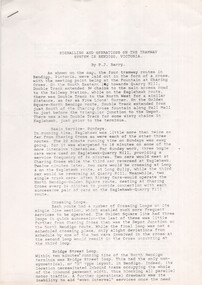
Document - Manuscript, Peter J Barry, "Signalling and Operations on the Tramway System in Bendigo", April 1990
... system and tramcar operations in Bendigo. Looks at the basic services, crossing loops, signalling, following movements (Bendigo used a white disc on the tram to indicate a following tram, Ballarat did not use this system), short workings, reversals, observations of actual workings. ...system and tramcar operations in Bendigo. Looks at the basic services, crossing loops, signalling, following movements (Bendigo used a white disc on the tram to indicate a following tram, Ballarat did not use this system), short workings, reversals, observations of actual workings. ...Draft of an article with notes/additions by Keith Kiings on the signalling system and tramcar operations in Bendigo. Looks at the basic services, crossing loops, signalling, following movements (Bendigo used a white disc on the tram to indicate a following tram, Ballarat did not use this system), short workings, reversals, observations of actual workings. Includes a map drawn by Keith Kings in 1972. Published in the September 1990 issue of Somersault, by the Signalling Record Society of Victoria.Yields information about the operation of the Bendigo tramway system using the Forest City Signalling system.Six A4 pages of a draft of an article by Peter Barry and correspondence to Keith Kings re "Signalling and Operations on the Tramway System in Bendigo, April 1990.tramways, trams, bendigo, signalling, forest city, operations, crossing loops, srsv -
 Ballarat Tramway Museum
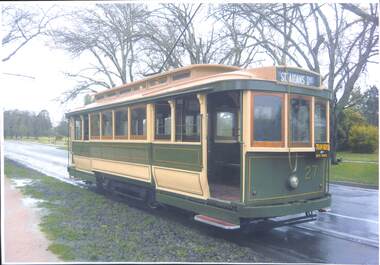
Photograph - Photograph - coloured, Tram No.27 - Single truck - drop ends, modified California combination
... Fares are Adults $4 and Children $2. tram no 27 hawthorn tramways trust 1916 electric supply company esc ballarat tramway system one-man operation sec 1971 ballarat tramway museum california combination fares Green and cream tram with No 27 on each end. St Aidens Dve in destination window. Board indicating ...The tram was originally built for the Hawthorn Tramways Trust in 1916. It was sold to the Electric Supply Co. of Victoria for use on the Ballarat tramway system and converted to an early form of one-man operation in 1930. It continued in service until 1971 when the SEC operated system closed. The tram was transferred to the ownership of the Museum. The tram is a single truck with drop ends, built as an open California combination. It is painted in the 1930 SEC colour scheme. Fares are Adults $4 and Children $2.Large colour photograph, laminated.Green and cream tram with No 27 on each end. St Aidens Dve in destination window. Board indicating Tram Rides and fares.tram no 27, hawthorn tramways trust, 1916, electric supply company, esc, ballarat tramway system, one-man operation, sec, 1971, ballarat tramway museum, california combination, fares -
 Ballarat Tramway Museum
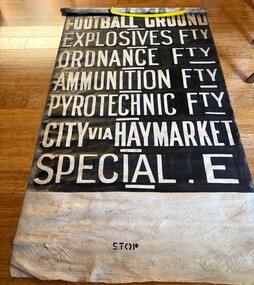
Functional object - Destination Roll, Melbourne and Metropolitan Tramways Board (MMTB), "Footscray Depot", 1940s
... The Special E destination was used to indicate to passengers that it was a special tram to the Explosives Factory during WW2 and not tell "spys" exactly where it was going. The Footscray system...The Special E destination was used to indicate to passengers that it was a special tram to the Explosives Factory during WW2 and not tell "spys" exactly where it was going. The Footscray system ...Used by the MMTB at the Footscray Depot on X1 class tram No. 465. Destinations in order from top are: DEPOT; WILLIAMSTOWN RD; RAILWAY STATION; RUSSELL ST; BALLARAT RD; SPECIAL; FOOTBALL GROUND; EXPLOSIVES FACTORY; ORDANCE FTY; AMMUNITION FACTORY; PYROTECHNIC FACTORY; CITY VIA HAYMARKE; SPECIAL E. The Special E destination was used to indicate to passengers that it was a special tram to the Explosives Factory during WW2 and not tell "spys" exactly where it was going. The Footscray system except for route 82 closed in 1962. See item 1746 for another example, though without the Special E destination.Demonstrates a Footscray Tram Depot destination roll.Destination roll - white lettering on black background, painted on bookbinder's cloth or fabric. Has unpainted sections at either end.In ink at the bottom "465"tramways, footscray depot, destination roll, trams -
 Ballarat Tramway Museum
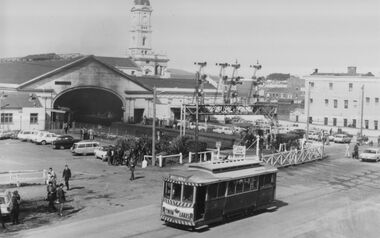
Photograph - Digital image, c1971
... system. Trams tramways Railway Station Lydiard St Nth Level Crossings tram 12 On rear is the Marc Dahlstrom stamp. Digital image from a black and white print of tram 12 north bound in Lydiard St North after crossing the level crossing - has Ballarat Railway Station in the background. A large number of people in the photograph indicating ...Yields information about Ballarat streetscape and its trams in the closing days of the SEC tramway system.Digital image from a black and white print of tram 12 north bound in Lydiard St North after crossing the level crossing - has Ballarat Railway Station in the background. A large number of people in the photograph indicating a possible rail tour. Photo taken from the balcony of the Victoria Guest House. Photo by Marc Dahlstrom c1971.On rear is the Marc Dahlstrom stamp.trams, tramways, railway station, lydiard st nth, level crossings, tram 12 -
 Ballarat Tramway Museum
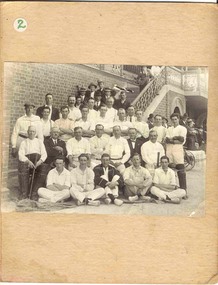
Photograph - Black and White photograph/s - mounted - set of 4, 1920's
... Dimensions 196H x 145W The numbers indicate that possibly the photographs have been published and are the printers / publisher numbering system....Dimensions 196H x 145W The numbers indicate that possibly the photographs have been published and are the printers / publisher numbering system. ...Has a strong association with a Ballarat Tramway Inspector and his activities - cricket.Series of three photographs, mounted, featuring Ballarat Cricket teams that included H.P. James, a Ballarat, tramway inspector. .1 - Photograph of a Ballarat cricket team photographed with a grandstand in the background. Mounted in a red coloured cardboard folder, plain on inside. Photograph imprinted with "Vincent Kelly Bendigo" impression. Top left hand corner of folder has been marked with word "James", has pencil sketches of a persons face on it and other words. The photograph itself has cracking and crinkles in it. On the top of the photograph in a white label is number "2". Outside of cover has part of the red printed paper along the spine. Also has remnant cotton stitching through the spine. Dimensions 277H x 216D 2. - Photograph of a youthful cricket team, in front of a wooden grandstand. Mounted onto a grey impressed backing with a off white back. Photograph by H. Owen, Dana Street Ballarat. Left hand part of the mount has been broken off. Photo partially curled. On the rear, top left hand corner of the photograph in a white label is number "4". Dimensions - 245H x 262W .3 - Photograph of a cricket team, on a wooden grandstand. Mounted on to a brown coloured, embossed, and printed dark brown lines. Marked in ink on lower edge "1926 - Ballarat Hairdressers and tobacconists vs Sth .Melbourne do". On the rear, top left hand corner of the photograph in a white label is number "4". Also a pencil sketch by James of a person. Dimensions 198H x 250W .4 - Sheet of paper with details of five photographs, written to Neville Gower from Zaza Dann On rear gives her address. Dimensions 196H x 145W The numbers indicate that possibly the photographs have been published and are the printers / publisher numbering system.trams, tramways, esco, cricket -
 Ballarat Tramway Museum
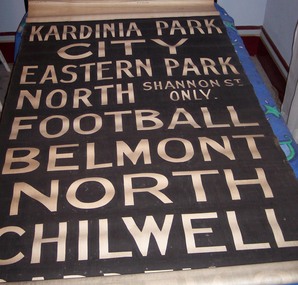
Functional object - Destination Roll, State Electricity Commission of Victoria (SECV), " Geelong" (black background), 1952
... indicate to passengers the destination or route of the tram. At night the roll was back lit by two light bulbs fitted to the destination box on the tram. Item used in Geelong until 1956. Based on the hand written marking, used on bogie tram 39. See Reg Item 2906 and 9619 for a smaller side destination roll and 9618 for a roll fitted to a Pengelley-type tramcar. Yields information and demonstrates aspects about Geelong's destination rolls used in trams up to 1956 when the system ...Destination roll used to indicate to passengers the destination or route of the tram. At night the roll was back lit by two light bulbs fitted to the destination box on the tram. Item used in Geelong until 1956. Based on the hand written marking, used on bogie tram 39. See Reg Item 2906 and 9619 for a smaller side destination roll and 9618 for a roll fitted to a Pengelley-type tramcar.Yields information and demonstrates aspects about Geelong's destination rolls used in trams up to 1956 when the system closed.Destination roll - white lettering on black background - using black paint leaving the lettering transparent at night. Uses a book binders cloth. Top edge “R.E. Fluck” stamped in black ink – twice In pencil words “Dulux” – has been crossed out Alongside “B.A.L.M. Flat Black 18-3-52” and a set of initials “Off No. 39” all in pencil Bottom edge; Initials “R E F” in black pencil? – along outside of roll. tram, trams, geelong, destination roll, tram 39 -
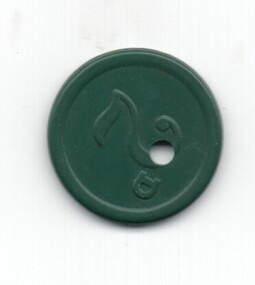 Ballarat Tramway Museum
Functional object - Fare Token/s, Electric Supply Co. of Vic (ESCo), 1913
... indicating token had a value of two pence. For details of use see Reg. Item 1794 and Reg. item 1801.1, 1802. For 2d tokens, see Reg. Item 1943.1 See Reg. Item 2514 for H.P. James notes on the token system...system at the time of the one man trams, tokens which could be pre purchased by travellers and save time when boarding trams. See notes on file re these eg Reg Item 1801. Trams tramways Tickets Tokens ESCo One Man Trams Fare tokens - 2d - 21mm diameter - green celluloid - with "B.E.T." in large capitals on front centre of token and words "Ballarat Electric Tramways 1913" on circumference. On reverse in large font "2" and a small font "D" at top of the right - indicating ...Demonstrates aspects of the Ballarat Tramways fare system at the time of the one man trams, tokens which could be pre purchased by travellers and save time when boarding trams. See notes on file re these eg Reg Item 1801. Fare tokens - 2d - 21mm diameter - green celluloid - with "B.E.T." in large capitals on front centre of token and words "Ballarat Electric Tramways 1913" on circumference. On reverse in large font "2" and a small font "D" at top of the right - indicating token had a value of two pence. For details of use see Reg. Item 1794 and Reg. item 1801.1, 1802. For 2d tokens, see Reg. Item 1943.1 See Reg. Item 2514 for H.P. James notes on the token system and See Reg. Item 1794 Another copy from donation of Jan Truscott added 2-12-2018. trams, tramways, tickets, tokens, esco, one man trams
