
Showing 61 items matching "infant life"
-
 Bendigo Historical Society Inc.
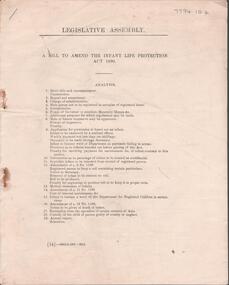
Document - JAMES LERK COLLECTION: DOCUMENT. LEGISLATIVE ASSEMBLY, 1890
... ...Infant Life...A Bill to Amend the infant Life protection Act 1890...Legislative Assembly Victoria Infant Life Victoria Government Legislative Assembly. ...Legislative Assembly. A Bill to Amend the infant Life protection Act 1890legislative assembly victoria, infant life, victoria government -
 Kew Historical Society Inc
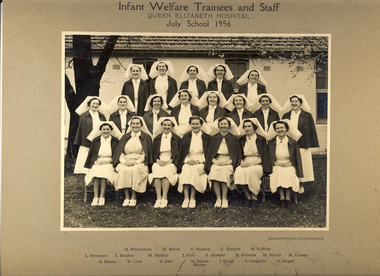
Photograph, Infant Welfare Trainees and Staff, Queen Elizabeth Hospital, 1956
... The Children's Welfare Department used the Carlton Home as a maternity home for wards, a foster home for infant wards, and for children requiring placements under the infant life protection provisions of the Children's Welfare Act. ...The Children's Welfare Department used the Carlton Home as a maternity home for wards, a foster home for infant wards, and for children requiring placements under the infant life protection provisions of the Children's Welfare Act. ...Carlton Refuge/Carlton Home was established in 1857 in Madeline Street, Carlton (relocating in 1890 to Keppel Street, Carlton). The Carlton Home provided maternity care for married and unmarried mothers, and residential care for infants and toddlers unable to be at home with their mother. It also operated a day-care centre for children. Most of the residents were mothers or children on private placements. The Children's Welfare Department used the Carlton Home as a maternity home for wards, a foster home for infant wards, and for children requiring placements under the infant life protection provisions of the Children's Welfare Act. By the late 1940s, the home was in a bad state of repair and it closed in 1949. In 1951, the facility reopened as the Queen Elizabeth Maternal and Child Health Centre that also operated as an Infant Welfare and Mothercraft Training School. The Centre provided after-care for nursing mothers and babies transferring from maternity hospitals, and specialised care for babies referred by private practitioners and the Social Welfare Department – babies who were premature, frail or had feeding or similar problems. (Source: DHHS)The photograph is a valuable primary resource relating to training for maternal and infant welfare centres in Kew, Victoria. It has a strong provenance through inscriptions linking it to the Denmark Street Maternal and Child Health Centre.Photograph, mounted on card of Infant Welfare Trainees and Staff, Queen Elizabeth Hospital, 1956. The photograph lists the names of the individuals below the photograph. They include: Back Row {L-R] M Whittenbury, M Bolton, E Haebich, G Barnard, M Griffiths / Middle Row [L-R] L Stevenson, T Boucher, M Madden, J Price, A Glowrey, R Helmore, M Murfet, M Lindsay / Front Row [L-R] R Buxton, W Crick, G Stott, M Buxton Matron, J Keogh, B Longmuir, E Borgelt.Obverse: Infant Welfare Trainees and Staff, Queen Elizabeth Hospital, July School 1956 Reverse: "Presented to Kew Historical Soc by Dr Darbyshire following a 50 year birthday display at the Denmark Street Maternal and Child Health Centre [Kew] in May 1980. [Illegible]."denmark street maternal and child health centre, baby health centres --- kew (vic), queen elizabeth hospital, infant welfare -
 Department of Health and Human Services
Photograph, Berry Street Kindergarten
... The home's infant life-protection work was seen as a critical agency function, particularly where family illness was putting pressure on mothers and Berry Street was able to provide respite and support. ...The home's infant life-protection work was seen as a critical agency function, particularly where family illness was putting pressure on mothers and Berry Street was able to provide respite and support. ...In 1877 the Victorian Infant Asylum was founded in Kew. In 1881, the asylum relocated to Berry Street in East Melbourne. By 1908, it was called the Foundling Hospital and Infants Home. It was non-denominational and controlled by a committee of management. By 1956, Berry Street consisted of a Mothercraft Training Centre and two main residential units: Berry Street for infants aged zero to 18 months, and Vale Street for toddlers aged zero to two years old. In August 1956, Berry Street was declared an approved category 2 Children's Home. In 1960, Vale Street was converted to an adult nursing home. In 1964, the name was changed to Berry Street Babies Home and Hospital. Berry Street was also an approved adoption agency. By 1968, Berry Street comprised the Training School for Mothercraft Nurses, the adoption agency, an infant life-protection house, a long-stay home for children to three years of age (the toddlers’ wing) and a small house for unmarried mothers. The home's infant life-protection work was seen as a critical agency function, particularly where family illness was putting pressure on mothers and Berry Street was able to provide respite and support. By the late 1960s, 30–40 adoptions annually were being arranged from Berry Street. By 1974 the home's orientation had shifted. Four family group homes had been established (two in Burwood, one in Ashburton and one in St Kilda), the mothercraft training function had been phased out, the toddlers wing converted to day care, and the main building (containing the nursery, administration, kitchen, dining room and single mothers accommodation) was demolished in favour of four home units, which housed 24 children, supervised by cottage parents. Berry Street provided short term, emergency and residential care for 'protection of infant' cases and state wards. Two flats were also established for short-term family accommodation. The nurses’ home was converted to house the home’s administration function and a social work service. The social work service coordinated family aid and family counselling services, and a neighbourhood house. In 1975 Berry Street also provided short-term care for 42 Vietnamese children brought to Australia in the official government-sponsored airlift. In 1976 Berry Street made application to change its category 2 Children's Home classification to category 1, as it was now catering for a wider range of children. It had ceased to be a babies’ home and hospital, and had started providing child and family care, including residential care. In 1977 Berry Street to established a family group home in Richmond to house children affected by the closure of St Cuthbert's Children's Home in Colac. Berry Street changed its name to Berry Street Child and Family Care in 1977. In 1978, the range of services provided by Berry Street Child and Family Care consisted of a social work counselling service, a financial aide, a family aide program using volunteers, two temporary accommodation units each housing eight children, an information and referral service, a neighbourhood house in Richmond, a day care centre for 36 children, and four family group homes. In 1980–81 the family group homes in Burwood were sold and the resources moved to the Richmond area. In 1994, Sutherland Youth and Family Services Inc. amalgamated into Berry Street Inc. During the 1990s, Berry Street combined with the Sutherland Community Resource Centre in Watsonia in Melbourne’s northern region. The agency operates today as Berry Street Victoria and has service centres across metropolitan and country Victoria. https://www.findingrecords.dhhs.vic.gov.au/CollectionResultsPage/BerryStreet -
 Flagstaff Hill Maritime Museum and Village
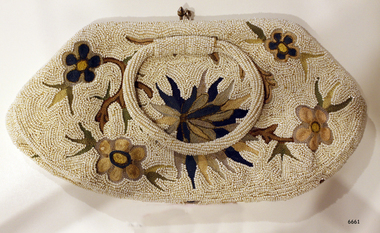
Accessory - Bag, 1930's
... The purpose of the Clinic is to the saving of infant's life. Many mothers attended the Clinic in the former location. ...The purpose of the Clinic is to the saving of infant's life. Many mothers attended the Clinic in the former location. ...In the words of Donor, Betty Stone, "Owned by my aunt Mrs Elsie Mary (nee Dale) Towers, born 24 December 1895, daughter of Ellis and Ann Dale, of Latrigg, Wangoom, Warrnambool. This beaded bag was a personal gift from Miss Lake to Elsie Dale sometime in the early 1930s. Miss Lake was a member of a leading Warrnambool family whose property Lyndoch was situated by the banks of the Hopkins River. After completing her nursing course at Warrnambool Hospital and working there for a time, Elsie Dale was appointed Sister-in-Charge of the newly formed Baby Health Centre, which initially operated in temporary accommodation at or near the Council Chambers. In 1928 the Centre moved into new brick premises on Liebig Street. The building comprised of five rooms, a back yard and a front veranda where mothers parked their prams. The Warrnambool Standard reported in February 1928. The purpose of the Clinic is to the saving of infant's life. Many mothers attended the Clinic in the former location. They were able to acquire valuable knowledge from Sister Dale who is in charge of the Clinic and also have their infants weighed and measured each week. During the early days of the Centre Miss Lake, as a patron, took a keen interest in all aspects of the Centre and co-operated very closely with Sister Dale. Miss Lake would often call in at the centre while her uniformed chauffeur would wait beside her limousine parked in the street outside the Baby Heath Centre. I also recall my aunt driving to Lyndoch to discuss matters concerning the Centre with Miss Lake. Miss Lake purchased this evening bag in England, and upon her return from her overseas tour in the early 1930s, presented it to Sister Dale as a token of appreciation. Dedicated to her vocation, Sister Dale gave unstintingly of her effort, time and resources to create an attractive venue for mothers to visit. Her contribution to the welfare of all mothers and babies in the Warrnambool area, particularly during the Depression years, was considerable. Sister Dale, who drove a Dodge Tourer car, visited mothers in their homes when necessary and regularly visited the indigenous settlement at Framlingham. Amongst my early childhood memories are those of accompanying my aunt when she drove to the Nestles factory at Dennington to purchase large tins of dried milk baby food which she then delivered to the mothers who lived at the Framlingham settlement. Sister Elsie Dale retired in 1949 and moved to Mooroopna after her marriage to Solomon Towers. (Died aged 75 years 27 July 1971) (Note: For additional information please refer to Betty Stone’s book “Pioneers and Places - A History of three Warrnambool Pioneering Families” ie. Chamberlain, Dale and Lees Families)This item is associated with the families of Chamberlain, Dale and Lees. These families are listed in the "Pioneers' Register" for Warrnambool Township and the Shire, 1835-1900, published by A.I.G.S. Warrnambool Branch. Elsie Dale was the first Sister to work in the newly established Baby Health Centre in Warrnambool.Beaded evening bag or clutch purse. The bag was a gift to Elsie Dale from friend Miss Lake, purchased in England early 1930's. The fabric is covered in tiny white beads and features a floral design in browns and greens. The bag has two bead-covered handles and the lining includes a small pocket. Part of the 'Chamberlain Dale Lees Collection'.flagstaff hill, warrnambool, shipwrecked coast, flagstaff hill maritime museum, maritime museum, shipwreck coast, flagstaff hill maritime village, great ocean road, chamberlain, dale, lees, stone, betty stone, warrnambool pioneers, elsie dale, miss lake, lyndoch, handbag, purse, evening bag, beaded handbag, beaded purse, ladies' accessory, clutch purse, warrnambool baby health centre, infant welfare centre -
 Flagstaff Hill Maritime Museum and Village
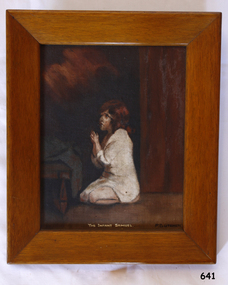
Painting - Religious Portrait, P Butcher, artist, The Infant Samuel, ca. 1943
... life of people at sea, their dangers and hardships, and their need for physical, financial, spiritual and moral support. Flagstaff Hill Maritime Museum and Village Flagstaff Hill Warrnambool Maritime Museum Maritime Village Shipwreck Coast Great Ocean Road Religion Religious service St Nicholas Seamen’s Church Williamstown Missions to Seamen Victoria painting oil painting religious painting infant samuel P Butcher religious worship worship service Mission to Seafarers St Nicholas Missions to Seamen’s Church Williamstown Missions to Seamen St Nicholas Missions to Seamen’s Church Flagstaff Hill 139 Nelson Place Williamstown Anglican church church furnishings religious furnishings Painted at centre bottom edge "THE INFANT SAMUEL.", and right bottom edge "B. ...This painting was part of the original furnishings of the St Nicholas' Mission to Seamen's Church at 139 Nelson Place, Williamstown, Victoria. The Church was operated by the Mission to Seamen organisation. It was donated to the Church by the Williamstown Lightkeepers' Auxiliary. THE MISSIONS TO SEAMEN (Brief History: for more, see our Reg. No. 611, Set of Pews) The Missions to Seamen was an Anglican charity that served seafarers of the world since 1856 in Great Britain. It symbol is a Flying Angel, inspired by a Bible verse. Today there are centres in over 200 ports worldwide where seamen of all backgrounds are offered a warm welcome and provided with a wide range of facilities. In Victoria, the organisation began in Williamstown in 1857 as a Sailors’ Church, also known as ‘Bethel’ or the ‘Floating Church’ in an old hulk floating in Hobson’s Bay, Port of Melbourne. It soon became part of the Missions to Seamen, Victoria. In the year 2000 the organisation, now named Mission to Seafarers, still operated locally in Melbourne, Portland, Geelong and Hastings. The Ladies’ Harbour Lights Guild was formed in 1906 to support the Missions to Seamen in Melbourne and other centres such as Williamstown. Two of the most significant ladies of the Guild were founder Ethel Augusta Godfrey and foundation member Alice Sibthorpe Tracy (who established a branch of the Guild in Warrnambool in 1920). The Guild continued its work until the 1960s. In 1943 a former Williamstown bank was purchased for the Missions to Seaman Club. The chapel was named St Nicholas’ Seamen’s Church and was supported by the Ladies’ Harbour Lights Guild, the Williamstown Lightkeepers’ Auxiliary and the League of Soldiers’ and Sailors’ Friends. It ceased operation in 1966. A Missions to Seamen Chapel and Recreation Room was a significant feature of ports during the late 1800s and into the 1900s. It seemed appropriate for Flagstaff Hill to include such a representation within the new Maritime Village, so the Melbourne Board of Management of Missions to Seamen Victoria gave its permission on 21st May 1979 for the entire furnishings of the Williamstown chapel to be transferred to Flagstaff Hill. The St Nicholas Seamen’s Church was officially opened on October 11, 1981, and closely resembles the Williamstown chapel. This painting is significant historically for its origin in the St Nicholas Mission to Seamen's Church in Williamstown, established in 1857 to cater for the physical, social, and spiritual needs of seafarers. It originated in Bristol, England when a Seamen's Mission was formed in 1837. The painting is historically significant for its connection to the Williamstown Lightkeepers’ Auxiliary, an organisation of women, formed to support seafarers. The connection of this painting to the Mission to Seamen and to the Ladies Lightkeepers’ Auxiliary highlights the strong community awareness of the life of people at sea, their dangers and hardships, and their need for physical, financial, spiritual and moral support. Painting, oil on board, behind glass framed with wood. Portrait of a child dressed in white, kneeling in prayer, within a dark room. The artist, P Butcher, titled the picture "The Infant Samuel". This object is part of the St Nicholas Seamen's Church Collection.Painted at centre bottom edge "THE INFANT SAMUEL.", and right bottom edge "B. BUTCHER"flagstaff hill maritime museum and village, flagstaff hill, warrnambool, maritime museum, maritime village, shipwreck coast, great ocean road, religion, religious service, st nicholas seamen’s church, williamstown, missions to seamen victoria, painting, oil painting, religious painting, infant samuel, p butcher, religious worship, worship service, mission to seafarers, st nicholas missions to seamen’s church williamstown, missions to seamen, st nicholas missions to seamen’s church flagstaff hill, 139 nelson place williamstown, anglican church, church furnishings, religious furnishings -
 Federation University Historical Collection
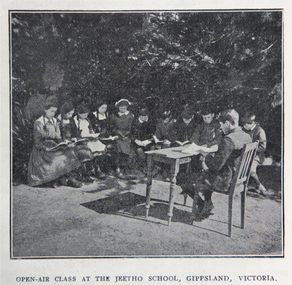
Book, Victoria Education Gazette and Teachers' Aid, 1911-1919, 1910-1919
... Black hard covered book with red spine, holding Victorian Education Gazettes for one calendar year. .1) 1910 .2) 1912 .3) 1911 .4) 1914 .5) 1918 Images: Open Air Classroom Black Rock; Open Air Classroom, Jeetho, Gippsland; Open Air Nurses bedroom, Mildura; Gym at Canterbury School ; Babies and Nurses at Melbourne Foundling Hospital; Camp at Portland; Alexander Peacock Opens a Melbourne School; Unveiling Major Mitchell Memorial at Mt Arapiles; Agricultural Plot; School Interior; Swimming Drill; Graham Dux Prize Board; Bathing Place; Classroom with blackboard and pictures; Major Mitchell's Map; Melbourne, Derbyshire; Market Place Melbourne; The Blackwood; World War One Send-off at The Athenaeum; Scarsdale Old Boy's logo; Sloyd articles for the Field Hospital; World War One; Gifts for Transport to the Wharf; soldiers; ANZAC Day; ANZAC Day Medalion .5) 1915: Education Department's War Relief Fund, William Park obituary, Closer Settlement Act 1912, Agriculture, needlework, Swimming and Life Saving, explorers, Gregory Blaxland, Matthew Flinders, Composition, Geography, potatoes, onions, gardens, Needlework for Infants, Iona and Staffa, Trained Primary Teacher's Course, Electricity, Electrical Technology, hygiene, Arbour Day, Horticulture, Wattle Day, Bird Day, Technical Schools, Landing at Gaba Tepe, Evils of Alcohol, Old Boys of Scarsdale, Belgium, Teachers' College Images: The British at War, The Sonnet, History and Patriotism, Male Swimming Teachers Summer School at Geelong, Women Swimming Teachers at Port Fairy, Buln Buln State School, Burwood East State School, needlework plans, methods of Rescue and Resucitation. plan of the journey of Gregory Blaxland, Macquarie House, teachers killed (William Ross Hoggart, Stanley Robert Close, William Roy Hodgson, Campbell McDiarmid Peter, William Henry Dawkins, William Hugh Hamilton, Frederick McRae Neal, Vernon Brookes, Frank J. ...Bailey Black hard covered book with red spine, holding Victorian Education Gazettes for one calendar year. .1) 1910 .2) 1912 .3) 1911 .4) 1914 .5) 1918 Images: Open Air Classroom Black Rock; Open Air Classroom, Jeetho, Gippsland; Open Air Nurses bedroom, Mildura; Gym at Canterbury School ; Babies and Nurses at Melbourne Foundling Hospital; Camp at Portland; Alexander Peacock Opens a Melbourne School; Unveiling Major Mitchell Memorial at Mt Arapiles; Agricultural Plot; School Interior; Swimming Drill; Graham Dux Prize Board; Bathing Place; Classroom with blackboard and pictures; Major Mitchell's Map; Melbourne, Derbyshire; Market Place Melbourne; The Blackwood; World War One Send-off at The Athenaeum; Scarsdale Old Boy's logo; Sloyd articles for the Field Hospital; World War One; Gifts for Transport to the Wharf; soldiers; ANZAC Day; ANZAC Day Medalion .5) 1915: Education Department's War Relief Fund, William Park obituary, Closer Settlement Act 1912, Agriculture, needlework, Swimming and Life Saving, explorers, Gregory Blaxland, Matthew Flinders, Composition, Geography, potatoes, onions, gardens, Needlework for Infants, Iona and Staffa, Trained Primary Teacher's Course, Electricity, Electrical Technology, hygiene, Arbour Day, Horticulture, Wattle Day, Bird Day, Technical Schools, Landing at Gaba Tepe, Evils of Alcohol, Old Boys of Scarsdale, Belgium, Teachers' College Images: The British at War, The Sonnet, History and Patriotism, Male Swimming Teachers Summer School at Geelong, Women Swimming Teachers at Port Fairy, Buln Buln State School, Burwood East State School, needlework plans, methods of Rescue and Resucitation. plan of the journey of Gregory Blaxland, Macquarie House, teachers killed (William Ross Hoggart, Stanley Robert Close, William Roy Hodgson, Campbell McDiarmid Peter, William Henry Dawkins, William Hugh Hamilton, Frederick McRae Neal, Vernon Brookes, Frank J. ...Black hard covered book with red spine, holding Victorian Education Gazettes for one calendar year. .1) 1910 .2) 1912 .3) 1911 .4) 1914 .5) 1918 Images: Open Air Classroom Black Rock; Open Air Classroom, Jeetho, Gippsland; Open Air Nurses bedroom, Mildura; Gym at Canterbury School ; Babies and Nurses at Melbourne Foundling Hospital; Camp at Portland; Alexander Peacock Opens a Melbourne School; Unveiling Major Mitchell Memorial at Mt Arapiles; Agricultural Plot; School Interior; Swimming Drill; Graham Dux Prize Board; Bathing Place; Classroom with blackboard and pictures; Major Mitchell's Map; Melbourne, Derbyshire; Market Place Melbourne; The Blackwood; World War One Send-off at The Athenaeum; Scarsdale Old Boy's logo; Sloyd articles for the Field Hospital; World War One; Gifts for Transport to the Wharf; soldiers; ANZAC Day; ANZAC Day Medalion .5) 1915: Education Department's War Relief Fund, William Park obituary, Closer Settlement Act 1912, Agriculture, needlework, Swimming and Life Saving, explorers, Gregory Blaxland, Matthew Flinders, Composition, Geography, potatoes, onions, gardens, Needlework for Infants, Iona and Staffa, Trained Primary Teacher's Course, Electricity, Electrical Technology, hygiene, Arbour Day, Horticulture, Wattle Day, Bird Day, Technical Schools, Landing at Gaba Tepe, Evils of Alcohol, Old Boys of Scarsdale, Belgium, Teachers' College Images: The British at War, The Sonnet, History and Patriotism, Male Swimming Teachers Summer School at Geelong, Women Swimming Teachers at Port Fairy, Buln Buln State School, Burwood East State School, needlework plans, methods of Rescue and Resucitation. plan of the journey of Gregory Blaxland, Macquarie House, teachers killed (William Ross Hoggart, Stanley Robert Close, William Roy Hodgson, Campbell McDiarmid Peter, William Henry Dawkins, William Hugh Hamilton, Frederick McRae Neal, Vernon Brookes, Frank J. Olle, Alfred J. Collins, Ernest R. Fairlie, William J. McLaren, A.E. Smith, Thomas Patton, Francis W. Kemp, Frederick G. Hall, Rupert O. Hepburn, Woolston J. Govan), Frederick Harold Tubb VC, Botanic Gardens Red Gum, Shelter Pavillions, Head of Wheat, Australian Commonwealth Flag, Iona Cathedral, Drawing exercises, ANZAC Madallion, School Rolls of Honor .6) 1916 - Nature Study, war relief, school gardening, horticulture, singing class, geography of the war, School Rolls of Honour, Ponsonby Carew-Smyth, Astronomy, ANZAC Day, Empire Day, Arbor Day, "Some Suul of Goodness in Things Evil" by Frank Tate, War Relief Gardeners' League, ANZAC Day medallion, Solar System, Abolition of German Schools in Victoria, ANZAC Avenues, avenues of honour, Geography of the War: The West, War relief and handwork, Victorian State Schools Horticultural Society, Patrick Maloney obituary, formalin lamps, Victoria League of Victoria, Wonwondah East Roll of Honor Images - Teachers killed (John Clarke, A.C.H. Jackson, Alexander Robertson, Noel Gambetta, Ralp E. Leyland, Laurance J. Woodruff, Walter E. Cass, Percy D. Moncur, Thomas M. Carmichael, Edward G. Brain, Reginald N.F. Woods, George E. James, William Colvin, David Dobson, Stanley L. Robinson, Charles Allen, G.E. James, H.F. Curnow, Franl L. Cousins, James R. Thompson, Henry H. Campbell, George E. Read, Ernest D. Morshead, Wilfred S. Merlin, Henry R. Wright, George B. Webb, Noel Nicholas, David H. Thomas, Charles A. Levens, Thomas R. Fenner, John M. Daniell, P.J. Larkin, Ralph Smith, Philip Ormsby), school rolls of honour, Swimming Instructors at Queenscliff, The Southern Sky, Map of the North Sea and its Littorals, Easter School of Horticulture at Oakleigh, Map of the Eastern Front, Map of Mesopotamia, Map of the War Area in the Egyptian Campaign, leeches for the Melbourne Hospital .7) 1917 - Swimming and Life-Saving, Childre's FLower Day, Education Department's War Relief Fund, State War Council, Horticulture, Bird Day, Swimming, Growing Chicory at Cowes Images - Teachers killed during World War One (G.M. Nicholas, William C.W. Spencer, J.W.C. Profitt, Ivon C. Bromilow, John Colwell, Robert W. Campbell, Arthur P. Bourchier, Francid G. Houston, Claude N. Harrison, Edgar Williams, Leslie A. Stevens, Charles E. W. Chester, Stanley R. Green, Walter Baker, Arthur G. Scott, Harry L. Swinburne, Horace W. Brown, Arnold Bretherton, Edward W. Jenkins Aubrey Liddelow, Ewen A. Cameron, Edmund R. Lyall, John H. Martin, Harry Bell, Frank L. Nicholls, Melville R. Hughes, Edwin W. Hauser, Walter S. Filmer, Walter G. Barlow, Henry A. Donaldson, Edward H. Jones, Walter W. Raw, Alfred W. Dean, Wiliam Lea, Frederick G. Drury, J.T. Richards, Norman G. Pelton, Lance-Corporal Doran, Kenneth F. McKenzie, William F. Robertson, Wiliam Jarrott, Norman Graham, George G. Paul, Victor Green, Arthur William Rennie, Alfred J. Glendinning, Robert B. Liston, Eward P. Toll, George Jones, Errol E. Rodda, Christian P. Christensen, Charles F. Sydes, H.G. Clements, Norman C. Fricker, J.M. Romeo. Eric N. Lear, Thomas J. Bartley, Norval Birrell, Frederick H. Tubb. J.T. Hamilton Aram, Arthur Wilcock, William M. Conroy, Alex. H. Miller, Patrick J. Cunningham, Charles S. Mitchell, John R. Maddern, James Roadknight, Harry Arundel, Jack C. McKellar, duncan M. McKellar, George S. Manfield, Edgar C. Holmes, George A. Young, Raymond A. Gardiner, William B. Bell, William Opie, George R. Scott, Richard V.B. Vine, Herbery S. Marshall, Hugh St Omer Dentry, George B. Fullerton, Harry Oulton, Iva F. Morieson), School Honor Books, Drawing, Presentation of 30,000 pounds to the British Red Cross at Melbourne Town Hall .8) 1918 .9) 1919 - Photographs of World War One soldiers from the Education Department, Margaret Montgomery Memorial, 1918 Act relating to State School Teachers, State Scolarships, Victorian State Schools' Horticultural Society, Pneumonic Influenza, Spanish Flu, epedemic, swimming and life savinfJunior cadet training, vacancies in Fiji, School Committees, Arbor Day, Arbour Day, Henry Harding of Yinnar, Planting Trees and Shrubs, Juvenile Crime, The use of 'Get', Soldier-Teachers from Overseas in Congress London, Australia's Effort in the War, Military, Working Bees, Tree Planting, fence building, Welcoming Home a Returned Soldier, Avenue of Honour planting, Discipline, Unveiling an Honor Board, School gymnasium, school tennis court, E. E. Crogger grave at Aldershot, The School Honor Book. War Relief Fund, Commonwealth War Record, Caulfield Military Hosptial, ANZAC Day Pilgrimage, Jimmie Panikin, Donald Fraser, Arthur Mee, Card Sun Dial, Balboa Day in Honolulu, William Hamilton, Alfred Jackson, The Backward Child, Flies, Language Teaching and Learning, Spelling, The Education of the Adolescent, victorian education gazette, education gazette and teachers' aid, sloyd, william a. cavanagh, james i froebel, school, education, world war one, memorials, alfred williams, exploration and settlement, cadets, australian naval college, bernard o;dowd, birds, swimming, drawingempire league, eucalypts, paper in history, forestry, arbor day, identification of trees, forestrey museums, fiji, gravel hill school band, horticulture, hygiene, gould league of bird lovers, life saving, la perouse, bandin, j. holland, w. hamilton, charles sturt, principles of archimedes, james holland, william hamilton, scarsdale old boys' reunion, foundling home melbourne, montessori education, open air schools, james hughes, marie corelli, flinders sydney harbour, major mitchell's map, tooth brushing, r.h.s. bailey -
 Marysville & District Historical Society
THE TRIANGLE NEWS-VOL 4 NO 15-1 JUNE 1979
... infant welfare centre & preschool association...casserole luncheon...dancing lessons...thanks-shelley & pixie...to let...wirreanda meeting...perfection painting quotes...community care centre...for sale...royal life...marysville victoria australia indoor bowls marysville and district football club senior citizens red cross marysville infant welfare centre & preschool association casserole luncheon dancing lessons thanks-shelley & pixie to let wirreanda meeting perfection painting quotes community care centre for sale royal life saving society recipient hospital visits new faces-births THE TRIANGLE NEWS-VOL 4 NO 15-1 JUNE 1979 ...marysville, victoria, australia, indoor bowls, marysville and district football club, senior citizens, red cross, marysville infant welfare centre & preschool association, casserole luncheon, dancing lessons, thanks-shelley & pixie, to let, wirreanda meeting, perfection painting quotes, community care centre, for sale, royal life saving society recipient, hospital visits, new faces-births -
Marysville & District Historical Society
THE TRIANGLE NEWS-VOL 5 NOV 34-OCTOBER 31 1980
... infant welfare stall...thank you...wanted to sell...christ church marysville...wirreanda festivities...happy birthday...black spur hotel narbethong...marysville swimming & life...marysville victoria australia photographer boyles wirrianda appaloosa stud marysville garage licenced plumber pumpernickel restaurant procession bush whackers ball chariot races community care centre independent living display chiropody clinic engagement newsagency wirreanda floral carpet kinder roster kinder & infant welfare stall thank you wanted to sell christ church marysville wirreanda festivities happy birthday black spur hotel narbethong marysville swimming & life saving club wanted footy club cricket THE TRIANGLE NEWS-VOL 5 NOV 34-OCTOBER 31 1980 ...marysville, victoria, australia, photographer, boyles, wirrianda appaloosa stud, marysville garage, licenced plumber, pumpernickel restaurant, procession, bush whackers ball, chariot races, community care centre, independent living display, chiropody clinic, engagement, newsagency, wirreanda floral carpet, kinder roster, kinder & infant welfare stall, thank you, wanted to sell, christ church marysville, wirreanda festivities, happy birthday, black spur hotel narbethong, marysville swimming & life saving club, wanted, footy club, cricket -
 City of Moorabbin Historical Society (Operating the Box Cottage Museum)
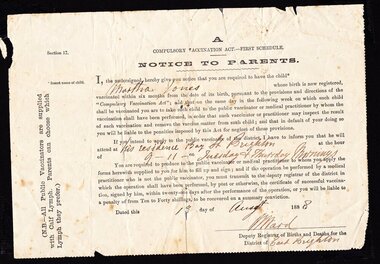
Document - Medical Health, vaccination notice, Martha Jones, c1888
... The loss of life from infectious diseases such as Typhoid in the pioneer settlements of Australia, was very high Hence the free, compulsory vaccination of infants within 6 months of their birth. ...The loss of life from infectious diseases such as Typhoid in the pioneer settlements of Australia, was very high Hence the free, compulsory vaccination of infants within 6 months of their birth. ...The loss of life from infectious diseases such as Typhoid in the pioneer settlements of Australia, was very high Hence the free, compulsory vaccination of infants within 6 months of their birth. This Notice To Parents was sent by the Deputy Registrar of Births and Deaths in District of East Brighton , now known as Bentleigh. The notice states that all Public Vaccinators ‘ are supplied with Calf lymph. Parents can chose which Lymph they prefer”James Jones and Mary Ann Moore were born in Brighton c1857 and c 1859 into pioneer market gardener families in the area of the Dendy Special Survey of 1841. They married in 1883 and raised their family in East Brighton, now Bentleigh. Sadly infectious diseases took the lives of many infants throughout the Colony of Victoria due to the poor state of water supply and sewerage disposal and locally the swamps of the Elster Creek were a constant breeding ground. An original paper Notice To Parents for the Compulsory Vaccination Act , First Schedule, 13th August 1888 following the registration of the birth of Martha Jones to James and Mary Ann Jones in Brighton Victoria.A / COMPULSORY VACCINATION ACT – FIRST SCHEDULE / Section 17 / NOTICE TO PARENTS. Typed along left side “ (N.B. All Public Vaccinators are supplied with Calf Lymph. Parents can chose which Lymph they prefer)” This paper notice naming the child Martha Jones is signed and dated by the Deputy Registrar of Births and Deaths of the District of East Brighton , W. Ward, on 13th August 1888, and gives the dates and times he will be in attendance ‘ at his residence’ for the said vaccination. vaccination, pioneers, early settlers, typhoid, brighton, moorabbin, bentleigh, market gardeners, fruit gardens, jones james, jones mary ann, jones martha, dendy henry, dendys special survey 1841, infectious diseases, water supply, elster creek, melbourne -
 Greensborough Historical Society
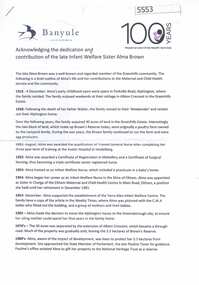
Article, Acknowledging the dedication and contribution of the late Infant Welfare Sister Alma Brown, 1916o
... Chronology of Alama Brown's life, work in maternal and child health in the Diamond Valley area and conservation, memorialised by Brown's Reserve in Greenhills. Also a celebration of 100 years of Maternal and Child Health. alma brown infant welfare 4p. col. documents, photographs Acknowledging the dedication and contribution of the late Infant Welfare Sister Alma Brown Article Banyule City Council ...Chronology of Alama Brown's life, work in maternal and child health in the Diamond Valley area and conservation, memorialised by Brown's Reserve in Greenhills. Also a celebration of 100 years of Maternal and Child Health.4p. col. documents, photographsalma brown, infant welfare -
 Ringwood and District Historical Society
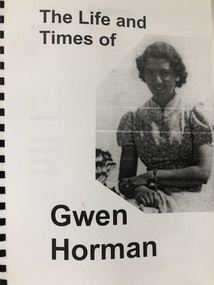
Book, The Life and Times of Gwen Horman with photos and family trees, 25-Sep-98
... Gwen was a foundation member and President of the Ringwood East Infant Welfare Centre, helped fund raise for the Maroondah Hospital and was a founding member of the Ringwood East CWA in 1949. She traveled extensively and there are many diary notes of these trips included in the history. Life ...Gwen Horman was a prominent figure in Ringwood History. Her husband , Robert, was the Mayor of the Ringwood Borough in 1954 and again in 1961 and played a large part in the move for Ringwood to become a city. Gwen was a foundation member and President of the Ringwood East Infant Welfare Centre, helped fund raise for the Maroondah Hospital and was a founding member of the Ringwood East CWA in 1949. She traveled extensively and there are many diary notes of these trips included in the history.Transparent front cover and buff coloured back cover, black spiral binding contains 38 pages of printed notes and photos, some hand written amendments. Printed 25-Sep-1998. +Additional Keywords: Horman, GwenLife and times of Gwen Horman -
 Ringwood and District Historical Society
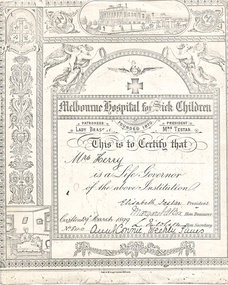
Document, Packet: Ringwood Infant Welfare Centre Printed Matters, Reports etc. Circa 1920's onwards
... Packet includes the following: . 3882a- Report to the Honorable- the Minister of Health, on the Welfare of Women and Children in New Zealand and Victoria. (1927). . 3882b- Life Governor Certificate of Melbourne Hospital for Sick Children, awarded to Mrs Herry on 29th March,1899. . 3882c- Application by Sister Dora McCartney for the position of Sister-in-Charge of the Ringwood Infant Welfare Centre. ...Packet includes the following: . 3882a- Report to the Honorable- the Minister of Health, on the Welfare of Women and Children in New Zealand and Victoria. (1927). . 3882b- Life Governor Certificate of Melbourne Hospital for Sick Children, awarded to Mrs Herry on 29th March,1899. . 3882c- Application by Sister Dora McCartney for the position of Sister-in-Charge of the Ringwood Infant Welfare Centre. ...Packet includes the following: . 3882a- Report to the Honorable- the Minister of Health, on the Welfare of Women and Children in New Zealand and Victoria. (1927). . 3882b- Life Governor Certificate of Melbourne Hospital for Sick Children, awarded to Mrs Herry on 29th March,1899. . 3882c- Application by Sister Dora McCartney for the position of Sister-in-Charge of the Ringwood Infant Welfare Centre. Dated 1928. Includes copies of several references for Sister MacCarthy. . 3882d- Miscellaneous correspondence and documents re the establishment in 1929 and subsequent operation of the first Ringwood Baby Health Centre. . 3882e- Correspondence re Opening of new Infant Welfare Centre, Ringwood- May 10th, 1967. . 3882f- Miscellaneous documents from the Victorian Public Health Department for the establishment of Infant Welfare Centres. -
 Eltham District Historical Society Inc
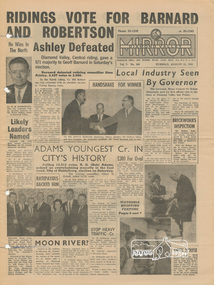
Newspaper, Diamond Valley Mirror, Tuesday, August 31, 1965
... life. A memorial plaque to Mrs Lyon was unveiled by foundation members Mr N. Kerr. Facilities. An infant...life. A memorial plaque to Mrs Lyon was unveiled by foundation members Mr N. Kerr. Facilities. An infant ...Includes Newspaper article on page three "Living Memorial Is Trust's Gift To A Shire" a second clipping of which is also attached to cardboard for display purposes. Article includes text and photographs. Living Memorial is Trust's Gift To A Shire Bathed in bright sunshine and now at its best, the Memorial Garden of the Eltham War Memorial provided a perfect setting for the handing over of the Memorial to the people of Eltham last Saturday afternoon. Speaking for the War Memorial Trust, Mr E. P. Harmer, chairman paid tribute to the unselfishh service given by its members , some for more than 20 years. Special tribute was paid to the late Mrs Ada Lyon, a foundation member who, Mr Harmer said, made the Trust her life. A memorial plaque to Mrs Lyon was unveiled by foundation members Mr N. Kerr. Facilities. An infant welfare centre, a pre-school cente and a children's library are built within the memorial. Funds for the buildings were raised by the Trust and theh women's auxiliary. Accepting the Memorial on behalf of the people of the Shire, the Shire President, Cr. L. C. Docksey, assessed the value at beyond £50,000. To make the transaction legal, Cr. Docksey paid the sum of £1 to the Trust. Many foundation members of the Trust and councillors of the Shire were among the official guests. The Shire of Eltham Brass Band provided suitable background music for the ceremony and at. (remaining part of article is missing) Photo: Mrs C RAINS signs the agreement on behalf of the Eltham War Memorial Trust, transferring the Memorial to the Shire of Eltham, as Mr L. Virgo, secretary of the Trust, affixes the seal and Mr. E. P. Harmer, chairman, accepts payment of £1 from Cr. L. C. Docksey, Shire President. In the background are Mrs Harmer, Cr. T. Collins and Mr S. Addison. Accepting the Memorial on behalf of the people of the Shire was Cr. Docksey's last official duty as President. Separate article on the clipping includes the heading: President Rests in Comfort with a photograph and text: A Tribute to Cr. A. K.Lines, first President of the Shire of Diamond Valley, was paid by fellow councilors last Tuesday night. Acting on behalf of all members of the council, Cr. George Upton, in presenting Cr Lines with an armchair, expressed gratitude for his guidance and assistance to the new shire. Newspaper, 12 pages with four holes punched through near centre margin.eltham war memorial building,eltham war memorial trust,eltham pre-school,e. p. harmer,mrs ada lyon,mrs n. kerr,cr. l. c. docksey,shire of eltham brass band,cr. a. k. lines,diamond valley mirror,1965,cr t. collins,mr. s. addison -
 Eltham District Historical Society Inc
Film - Video (VHS), IMP Productions, The Shire of Etham - The Evergreen Shire (Series 69, Item 4), c.1985
... infant welfare centre...john cohen...kangaroo ground...local history centre...montmorency...montsalvat...mudbrick...parks and gardens...peck's dam...pigeon bank...police residence...river of life...life provided. Also the Living and Learning Centre, St Andrews Markets and other local markets, the Eltham Leisure Centre, cricket and horse riding at Eltham Lower Park, the Infant Welfare Centre (part of the Eltham War Memorial), how residents are mindful of protecting their historical heritage, the CBA bank and Allwood House at Hurstbridge, Tracey Naughton about the Eltham "As we are" Community Banner project and the “River of Life banner”, the Parks and Gardens office in the former Police Residence building (now the Local History Centre), Alistair Knox Park, road planning and types of roads, tree canopy, Peck's Dam, green carparks, road drainage, Gordon Ford's garden and natural landscapes, and Were Street shops in Montmorency. ...life provided. Also the Living and Learning Centre, St Andrews Markets and other local markets, the Eltham Leisure Centre, cricket and horse riding at Eltham Lower Park, the Infant Welfare Centre (part of the Eltham War Memorial), how residents are mindful of protecting their historical heritage, the CBA bank and Allwood House at Hurstbridge, Tracey Naughton about the Eltham "As we are" Community Banner project and the “River of Life banner”, the Parks and Gardens office in the former Police Residence building (now the Local History Centre), Alistair Knox Park, road planning and types of roads, tree canopy, Peck's Dam, green carparks, road drainage, Gordon Ford's garden and natural landscapes, and Were Street shops in Montmorency. ...Shire of Eltham Archives: Series 69, Item 4 This video was produced for the Shire of Eltham by IMP Productions and provides a description of the shire, 277 square km on a north/northeast axis, some 25 km northeast of the centre of Melbourne with a population of around 40,000. Scenes include Yarra River, rural settings and urban settings, housing estates, Shillinglaw Cottage, Pigeon Bank at Kangaroo Ground, the Eltham Railway Trestle Bridge with reference to the fight by locals in the 1970s to save it from replacement, Montsalvat, mudbrick making and its use as a building material, the use of mudbrick in the Eltham Community Centre blending harmoniously with the environment. Emphasises people living in the area due to the qualities of life provided. Also the Living and Learning Centre, St Andrews Markets and other local markets, the Eltham Leisure Centre, cricket and horse riding at Eltham Lower Park, the Infant Welfare Centre (part of the Eltham War Memorial), how residents are mindful of protecting their historical heritage, the CBA bank and Allwood House at Hurstbridge, Tracey Naughton about the Eltham "As we are" Community Banner project and the “River of Life banner”, the Parks and Gardens office in the former Police Residence building (now the Local History Centre), Alistair Knox Park, road planning and types of roads, tree canopy, Peck's Dam, green carparks, road drainage, Gordon Ford's garden and natural landscapes, and Were Street shops in Montmorency. Planning for shopping facilities and carparks with a population of 40,000 growing to 55,000, Arthur Street Mall and carpark, local village feel in the shopping centre. Councillors and Council staff featured include Mary Grant, Bob Manuell, Rodney Roschellor, John Cohen, Alan Baker. Also scenes of Commercial Place, Diamond Valley Railway, Eltham Galley, Riverclay and canoeing on the Yarra intermingled with images of the shire from the Shire of Eltham Pioneers Photograph collection.VHS Video cassette Converted to MP4 file format 00:11:56; 79MBshire of eltham, video recording, shire of eltham archives, alistair knox park, allwood house, arthur street, arthur street mall, bob manuell, canoeing, carparks, cba bank, commercial place, council staff, councillors, cr. mary grant, cricket, diamond valley railway, eltham community banner project, eltham community centre, eltham galley, eltham leisure centre, eltham living and learning centre, eltham lower park, eltham railway trestle bridge, eltham war memorial, gordon ford garden, horse riding, housing estates, hurstbridge, infant welfare centre, john cohen, kangaroo ground, local history centre, montmorency, montsalvat, mudbrick, parks and gardens, peck's dam, pigeon bank, police residence, river of life banner, riverclay, road drainage, road planning, rodney roschellor, shillinglaw cottage, shire of eltham pioneers photograph collection, st andrews market, tracey naughton, tree canopy, were street, yarra river, alan baker -
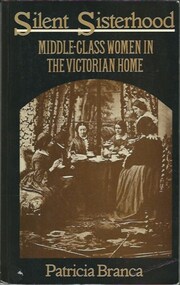 Warrnambool and District Historical Society Inc.
Book, Printed in England by Redwood Burn Ltd, Trowbridge and Esher. ISBN 0-85664-698-9, Silent Sisterhood. Middle-class Women in the Victorian Home. Author Patricia Branca, Printed 1977
... life and purpose of middle-class Victorian Women. It is divided into main sections of 1. The Outer Woman. 2. The Inner Woman. 3.Conclusions. It contains tables of reference and an extensive bibliography. Silent Sisterhood is a study of the issues which faced women of the Victorian Era. It examines health and domestic matters such as budgeting, child rearing, infant ...Study of the place and life of middle-class Victorian era women.Black paperback with gold text. Front cover depicts Sepia toned photograph of six women having tea. Back cover is black with recommendations and information about contents of the book.non-fictionStudy of the place and life of middle-class Victorian era women.victorian, middle-class, women, nineteenth century, women’s health education, modernization, warrnambool -
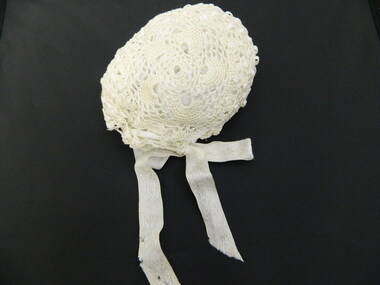 Kiewa Valley Historical Society
Baby's Bonnet
... life in the early 1900s. It is hand made possibly by the mother of the child being christened. The bonnet was probably worn at a christening in one of the Kiewa Valley churches (denomination unknown). The importance of the event to family and friends is shown by the quality of the garment. These style Christening items were often worn buy several children of the one family , both boys and girls. Other items that match this outfit are KVHS 0235. infant ...This bonnet could have been part of a Christening outfit which matches the same style of "KVHS 0235" The quality of the garment and the fashion style it represents is both historical, and is of the fashion in that era. It has Christian religious implications and values of the time frame of regional life in the early 1900s. It is hand made possibly by the mother of the child being christened. The bonnet was probably worn at a christening in one of the Kiewa Valley churches (denomination unknown). The importance of the event to family and friends is shown by the quality of the garment. These style Christening items were often worn buy several children of the one family , both boys and girls. Other items that match this outfit are KVHS 0235. White crocheted baby's bonnet threaded with white ribbon. (Possibly for christening.) infant. baby. bonnet. crochet. christening. -
St Vincent's Hospital Melbourne Archives
Pamphlet - Whooping Cough pamphlet published and distributed by Colonial Mutual Life Assurance Society Ltd for the benefit of its policyholders
... The pamphlet would have been on display and available at doctors' surgeries and infant welfare centres. Colonial Mutual Life Assurance Society Limited Whooping Cough Contagious Disease Printed information B5 size folded pamphlet in blue typing and border with a striking orange circle heading "Whooping Cough". ...Published information about Whooping Cough is written over 3 pages, with headings Whooping Cough, Prevention, Symptoms and Treatment. Underlined is the statement reflecting infection control standards in the 1930's - "Whooping Cough is a highly contagious and dangerous disease". "Do not allow the patient to mix with other children" is underlined. The pamphlet would have been on display and available at doctors' surgeries and infant welfare centres. colonial mutual life assurance society limited, whooping cough, contagious disease -
St Vincent's Hospital Melbourne Archives
Pamphlet - Facts about Measles published by Colonial and Mutual Life Assurance Society for the benefit of its policy holders and the general public
... infant welfare centres. The Measles Vaccine was not introduced in Australia until the 1960's. Colonial and Mutual Life Assurance Society Measles Contagious Disease Pamphlet has the heading "Facts about Measles" and is illustrated in green typing with a sketch of young children playing in a family garden setting. ...Information pamphlet for mothers stating that "Measles is a highly contagious and serious fever. Far too many people consider Measles to be a trifling kind of illness about which there is not much need to worry. This is a great mistake". Detailed are the headings "How one catches Measles, signs of Measles, how to take care of a child with Measles, after- effects and general remarks". "Send for the doctor at once" is highlighted in bold print. The information pamphlet may have been available at the reception desk at doctors’ surgeries or at infant welfare centres. The Measles Vaccine was not introduced in Australia until the 1960's. colonial and mutual life assurance society, measles, contagious disease -
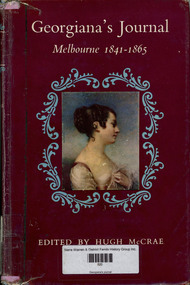 Narre Warren and District Family History Group
Book, Hugh McCrae, Georgiana's journal, 1992
... Her journal is not only a fascinating personal document but an invaluable reflection of the social life and history of the infant settlement. As well as being an artist of considerable talent—even genius (she had been a favourite pupil of the water-colourist John Varley), Georgiana had been an indefatigable diarist since she was a little girl; and to this cultivated and therefore perhaps lonely young woman in the embryo town that was Melbourne her journal was her confidant and companion. ...Melbourne 1841-1865 Georgiana McCrae was the grandmother of the poet Hugh McCrae and one of the most graceful of Australia's early diarists. In 1841, only six years after Melbourne was founded, she arrived in the Port Phillip district where she was to spend forty-nine of her eighty-seven years. Her journal is not only a fascinating personal document but an invaluable reflection of the social life and history of the infant settlement. As well as being an artist of considerable talent—even genius (she had been a favourite pupil of the water-colourist John Varley), Georgiana had been an indefatigable diarist since she was a little girl; and to this cultivated and therefore perhaps lonely young woman in the embryo town that was Melbourne her journal was her confidant and companion. Whether she is telling how Bishop Broughton "exonerated the Popish party from the blame in the Gunpowder Plot", or how her son was within an inch of treading on a snake which I killed with the stick of my parasol", whether she is spring cleaning, combating a grasshopper plague, or making a velvet bonnet for her daughter, she is always perceptive and arresting in recording her daily life and the affairs of the colony.non-fictionMelbourne 1841-1865 Georgiana McCrae was the grandmother of the poet Hugh McCrae and one of the most graceful of Australia's early diarists. In 1841, only six years after Melbourne was founded, she arrived in the Port Phillip district where she was to spend forty-nine of her eighty-seven years. Her journal is not only a fascinating personal document but an invaluable reflection of the social life and history of the infant settlement. As well as being an artist of considerable talent—even genius (she had been a favourite pupil of the water-colourist John Varley), Georgiana had been an indefatigable diarist since she was a little girl; and to this cultivated and therefore perhaps lonely young woman in the embryo town that was Melbourne her journal was her confidant and companion. Whether she is telling how Bishop Broughton "exonerated the Popish party from the blame in the Gunpowder Plot", or how her son was within an inch of treading on a snake which I killed with the stick of my parasol", whether she is spring cleaning, combating a grasshopper plague, or making a velvet bonnet for her daughter, she is always perceptive and arresting in recording her daily life and the affairs of the colony.georgiana mccrae, melbourne (vic.) -
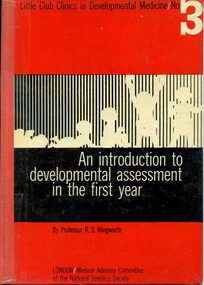 Alfred Hospital Nurses League - Nursing History Collection
Book - Illustrated Booklet, Ronald Stanley Illingworth 1909-1990, An introduction to developmental assessment in the first year, 1962
... Author was a paediatrician Insight into paediatric practice in the 1960's neonatal reflexes paediatric medicine infant development infant examination Vintage textbook focusing on clinical guidelines for assessing infants during their first year of life Inside front cover at base is a green sticker with white print [bookseller]. ...Vintage textbook focusing on clinical guidelines for assessing infants during their first year of lifeIllustrated book with red binding. On front cover series name at top in black print '3' in white print Title is printed in white on a black rectangle, Above this is another rectangle of wertical balack and white stripes on which is superimposed 5 white figures of a baby progressing from lying to standing indepentanly. Author and publisher printed in blsck underneath these rectanglesnon-fictionVintage textbook focusing on clinical guidelines for assessing infants during their first year of lifeneonatal reflexes, paediatric medicine, infant development, infant examination -
 Sunshine and District Historical Society Incorporated
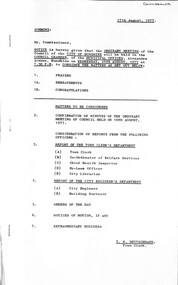
Administrative record - City of Sunshine - Commissioner Mr Alexander Alex George Gillon Collection 1976 - 1982 - Notice of ordinary meeting of the council of the City of Sunshine to be held on 24th August 1977, City of Sunshine, 17th August 1977
... Notice of Ordinary Meeting of the Council of the City of Sunshine to be held on 24th August 1977 Report of the Town Clerk's Department Report of the Town Clerk Superannuation Municipal Officer's Association Central Methodist Mission Home for the Frail / Aged Lease of land Darnley Street Land Adjacent to More Park in Ballarat Road Deer Park Hall Committee of Management Sunshine Swimming and Life Saving Club Infant Welfare Centres Pavilion Albion Tennis Club Tennis Courts Sunshine North Tennis Club Hulett Street Private Street Scheme Use of Council Land Survey Committee of Officers Land Transfer 43 Furlong Road Limits of Overdrafts Proposed Purchase of New Sunshine Tip Site Supplementary Valuations Report of the Co-Ordinator Welfare Services Committee of Management 43 Furlong Road Child Care Centre Emergency Accommodation Midway Hostel Report of the Chief Health Inspector Weights & Measures Report for the Two Months Ending 31st July 1977 Report of the Inspector Weights & Measures Sanitary Contract Licences Discharge to Council Controlled Drains Fees for Analyses Health Act 1958 Amusement Machines in Shops in Close Proximity to Schools Report of the City Librarian Library Statistics Seminar At Monash University The Economic Approach To Public Library Development Report of the City Engineer Land Use Permit Quinn Estate for the Purpose of Erecting Detached Houses Council Policy Land Use Permit Industrial Estate Lots 32 to 36 Fourth Avenue Land Use Permit Application Storing of Motor Vehicles Lot 18 Green Street for Nick's Boby Works Pty Ltd at Judge Street Enforcement of Melbourne Metropolitan Planning Scheme Use of Lot 271 Beela Court as a Transport Depot Land Use Permit Application Sale and Distribution of Floor Coverings, Builders Hardware, Electrical Domestic Appliances and Furniture Land Bounded by Halstead Street and Ashley Street Land Use Permit Application Milk Bar Addition to Existing House 53 King Edward Avenue Land Use Permit Application Advertising Hoarding Lot 26 & 27 Anderson Road Land Use Permit Sunshine Golf Club Pavilion Ralph Street Land Use Permit Application Detached House Lot 121 Lewin Street Land Use Permit Application Advertising Hoarding Lot 1 Ballarat Road South West Corner Summerhill Road Land Use Permit Application Access to Main Road for Lot 15 Geelong Road Land Use Permit Application Four Floodlights 186 - 190 Mitchell Street North East Corner Ashley Street Land Use Permit Application Storage and Wrecking of Old Cars for Scrap and Sale Lots 14. 15 & 16 Bunnett Street Land Use Permit Application Service Premises and Caretaker's Dwelling 461 Ballarat Road Land Use Permit Application 3 Display Homes Aycliffe Drive and Land Use Permit Application Car Parking to Serve Display Home Centre North East Corner Aycliffe Drive and Reston Court Deer Park Land Use Permit Application Italo - Australian Social Club (Italo - Australian Co-Operative Social Club Ltd) Place of Assembly Furlong Road Land Use Permit Application Reprocessing of Scrap Metals Lot 3 Geelong Road Land Use Permit Application Extension to Existing Work Shop For Mentally Retarded Children Day Training Centre Council Reserve Bounded by Churchill Avenue, Darnley Street & Ravenhall Street Land Use Permit Application Service Premises Addition to Existing Bakery 119 McIntyre Road Land Use Permit Application Home Occupation 43 Bloomfield Avenue Plan of Subdivision Stage 3 Furlong Road Estate Strata Subdivision 437 Ballarat Road Westerngate Estate Stage 2 Plan of Subdivision Neale Road and Station Road Plan of Consolidation Rothray Avenues and Arvona Avenue Width of Robinsons Road Westerngate Robinsons Road Parking Area Tallintyre road Housing Commission of Victoria Contract Supply & Maintenance of Vehicles Concrete Reinstatements Quotations Garfield Street Scheme Construction Proposed Traffic Signals Main Road West, Main Road East, St. ...Albans Maribyrnong River Mitchell Street Hampton Avenue Moria Street Wright Street Thyra Street Percy Street Ensign Street Delacey Street Northumberland Road Sunshine Library McCracken Street The Hub Sun Crescent Hampshire Road Brooklyn Pre-School Centr Cypress Avenue Ainsworth Reserve Vernon Street Sunshine Indoor Swimming Pool Hall Street Notice of Ordinary Meeting of the Council of the City of Sunshine to be held on 24th August 1977 Report of the Town Clerk's Department Report of the Town Clerk Superannuation Municipal Officer's Association Central Methodist Mission Home for the Frail / Aged Lease of land Darnley Street Land Adjacent to More Park in Ballarat Road Deer Park Hall Committee of Management Sunshine Swimming and Life Saving Club Infant Welfare Centres Pavilion Albion Tennis Club Tennis Courts Sunshine North Tennis Club Hulett Street Private Street Scheme Use of Council Land Survey Committee of Officers Land Transfer 43 Furlong Road Limits of Overdrafts Proposed Purchase of New Sunshine Tip Site Supplementary Valuations Report of the Co-Ordinator Welfare Services Committee of Management 43 Furlong Road Child Care Centre Emergency Accommodation Midway Hostel Report of the Chief Health Inspector Weights & Measures Report for the Two Months Ending 31st July 1977 Report of the Inspector Weights & Measures Sanitary Contract Licences Discharge to Council Controlled Drains Fees for Analyses Health Act 1958 Amusement Machines in Shops in Close Proximity to Schools Report of the City Librarian Library Statistics Seminar At Monash University The Economic Approach To Public Library Development Report of the City Engineer Land Use Permit Quinn Estate for the Purpose of Erecting Detached Houses Council Policy Land Use Permit Industrial Estate Lots 32 to 36 Fourth Avenue Land Use Permit Application Storing of Motor Vehicles Lot 18 Green Street for Nick's Boby Works Pty Ltd at Judge Street Enforcement of Melbourne Metropolitan Planning Scheme Use of Lot 271 Beela Court as a Transport Depot Land Use Permit Application Sale and Distribution of Floor Coverings, Builders Hardware, Electrical Domestic Appliances and Furniture Land Bounded by Halstead Street and Ashley Street Land Use Permit Application Milk Bar Addition to Existing House 53 King Edward Avenue Land Use Permit Application Advertising Hoarding Lot 26 & 27 Anderson Road Land Use Permit Sunshine Golf Club Pavilion Ralph Street Land Use Permit Application Detached House Lot 121 Lewin Street Land Use Permit Application Advertising Hoarding Lot 1 Ballarat Road South West Corner Summerhill Road Land Use Permit Application Access to Main Road for Lot 15 Geelong Road Land Use Permit Application Four Floodlights 186 - 190 Mitchell Street North East Corner Ashley Street Land Use Permit Application Storage and Wrecking of Old Cars for Scrap and Sale Lots 14. 15 & 16 Bunnett Street Land Use Permit Application Service Premises and Caretaker's Dwelling 461 Ballarat Road Land Use Permit Application 3 Display Homes Aycliffe Drive and Land Use Permit Application Car Parking to Serve Display Home Centre North East Corner Aycliffe Drive and Reston Court Deer Park Land Use Permit Application Italo - Australian Social Club (Italo - Australian Co-Operative Social Club Ltd) Place of Assembly Furlong Road Land Use Permit Application Reprocessing of Scrap Metals Lot 3 Geelong Road Land Use Permit Application Extension to Existing Work Shop For Mentally Retarded Children Day Training Centre Council Reserve Bounded by Churchill Avenue, Darnley Street & Ravenhall Street Land Use Permit Application Service Premises Addition to Existing Bakery 119 McIntyre Road Land Use Permit Application Home Occupation 43 Bloomfield Avenue Plan of Subdivision Stage 3 Furlong Road Estate Strata Subdivision 437 Ballarat Road Westerngate Estate Stage 2 Plan of Subdivision Neale Road and Station Road Plan of Consolidation Rothray Avenues and Arvona Avenue Width of Robinsons Road Westerngate Robinsons Road Parking Area Tallintyre road Housing Commission of Victoria Contract Supply & Maintenance of Vehicles Concrete Reinstatements Quotations Garfield Street Scheme Construction Proposed Traffic Signals Main Road West, Main Road East, St. ...Notice of Ordinary Meeting of the Council of the City of Sunshine to be held on 24th August 1977 Report of the Town Clerk's Department Report of the Town Clerk Superannuation Municipal Officer's Association Central Methodist Mission Home for the Frail / Aged Lease of land Darnley Street Land Adjacent to More Park in Ballarat Road Deer Park Hall Committee of Management Sunshine Swimming and Life Saving Club Infant Welfare Centres Pavilion Albion Tennis Club Tennis Courts Sunshine North Tennis Club Hulett Street Private Street Scheme Use of Council Land Survey Committee of Officers Land Transfer 43 Furlong Road Limits of Overdrafts Proposed Purchase of New Sunshine Tip Site Supplementary Valuations Report of the Co-Ordinator Welfare Services Committee of Management 43 Furlong Road Child Care Centre Emergency Accommodation Midway Hostel Report of the Chief Health Inspector Weights & Measures Report for the Two Months Ending 31st July 1977 Report of the Inspector Weights & Measures Sanitary Contract Licences Discharge to Council Controlled Drains Fees for Analyses Health Act 1958 Amusement Machines in Shops in Close Proximity to Schools Report of the City Librarian Library Statistics Seminar At Monash University The Economic Approach To Public Library Development Report of the City Engineer Land Use Permit Quinn Estate for the Purpose of Erecting Detached Houses Council Policy Land Use Permit Industrial Estate Lots 32 to 36 Fourth Avenue Land Use Permit Application Storing of Motor Vehicles Lot 18 Green Street for Nick's Boby Works Pty Ltd at Judge Street Enforcement of Melbourne Metropolitan Planning Scheme Use of Lot 271 Beela Court as a Transport Depot Land Use Permit Application Sale and Distribution of Floor Coverings, Builders Hardware, Electrical Domestic Appliances and Furniture Land Bounded by Halstead Street and Ashley Street Land Use Permit Application Milk Bar Addition to Existing House 53 King Edward Avenue Land Use Permit Application Advertising Hoarding Lot 26 & 27 Anderson Road Land Use Permit Sunshine Golf Club Pavilion Ralph Street Land Use Permit Application Detached House Lot 121 Lewin Street Land Use Permit Application Advertising Hoarding Lot 1 Ballarat Road South West Corner Summerhill Road Land Use Permit Application Access to Main Road for Lot 15 Geelong Road Land Use Permit Application Four Floodlights 186 - 190 Mitchell Street North East Corner Ashley Street Land Use Permit Application Storage and Wrecking of Old Cars for Scrap and Sale Lots 14. 15 & 16 Bunnett Street Land Use Permit Application Service Premises and Caretaker's Dwelling 461 Ballarat Road Land Use Permit Application 3 Display Homes Aycliffe Drive and Land Use Permit Application Car Parking to Serve Display Home Centre North East Corner Aycliffe Drive and Reston Court Deer Park Land Use Permit Application Italo - Australian Social Club (Italo - Australian Co-Operative Social Club Ltd) Place of Assembly Furlong Road Land Use Permit Application Reprocessing of Scrap Metals Lot 3 Geelong Road Land Use Permit Application Extension to Existing Work Shop For Mentally Retarded Children Day Training Centre Council Reserve Bounded by Churchill Avenue, Darnley Street & Ravenhall Street Land Use Permit Application Service Premises Addition to Existing Bakery 119 McIntyre Road Land Use Permit Application Home Occupation 43 Bloomfield Avenue Plan of Subdivision Stage 3 Furlong Road Estate Strata Subdivision 437 Ballarat Road Westerngate Estate Stage 2 Plan of Subdivision Neale Road and Station Road Plan of Consolidation Rothray Avenues and Arvona Avenue Width of Robinsons Road Westerngate Robinsons Road Parking Area Tallintyre road Housing Commission of Victoria Contract Supply & Maintenance of Vehicles Concrete Reinstatements Quotations Garfield Street Scheme Construction Proposed Traffic Signals Main Road West, Main Road East, St. Albans Road & East Esplanade Speed Reduction Sign Western Highway Deer Park Tender for Surplus Equipment Maribyrnong River Speed Limit M.M.B.W. Easement Drainage Lot 4 Mitchell Street Maidstone Certificate of Completion Hampton Avenue Group Private Street Scheme Proposed Open Space Land in Moria Street, Wright Street & Thyra Street Sunshine Bus Shelter Subsidy from Transport Funds of the Transport Regulation Board Report of the Building Surveyor Building & Development Approval Committee Report Extension of Permit 10 Percy Street St. Albans Extension of House 4 Ensign Street Maribyrnong Undersize Allotment Lot 2 Delacey Street Maidstone Location of Open Garage 81 Northumberland Road Sunshine North Renovation Central Library McCracken Street Alterations The Hub W.C. block Hampshire Road Brooklyn Pre-School Centre Child Care Centre / Pavilion Ainsworth Reserve Sunshine Indoor Swimming Pool Orders of the Day Westerngate Estate Robinsons Road Fencing 83 Hall Street Sunshine West city of sunshine, alexander "alex" george gillon, central methodist mission, darnley street, braybrook, more park, ardeer, deer park hall committee of management, albion tennis club, sunshine north tennis club, esmond street, station road, deer park, sunshine swimming and life saving club, furlong road, sunshine tip, furlong road child care centre, midway hostel, williamson road, maribyrnong, fourth avenue, sunshine, green street, judge street, beela court, sunshine west, halstead street, ashley street, maidstone, king edward avenue, albion, sunshine golf club, ralph street, lewin street, summerhill road, geelong road, brooklyn, bunnett street, sunshine north, ballarat road, aycliffe drive, reston court, italo - australian social club, italo - australian co-operative social club ltd, churchill avenue, ravenhall street, mcintyre road, bloomfield avenue, neale road, rothray avenue, arvona avenue, robinsons road, garfield street, st. albans, maribyrnong river, mitchell street, hampton avenue, moria street, wright street, thyra street, percy street, ensign street, delacey street, northumberland road, sunshine library, mccracken street, the hub, sun crescent, hampshire road, brooklyn pre-school centr, cypress avenue, ainsworth reserve, vernon street, sunshine indoor swimming pool, hall street -
 Sunshine and District Historical Society Incorporated
Administrative record - City of Sunshine - Commissioner Mr Alexander Alex George Gillon Collection 1976 - 1982 - Minutes of the ordinary meeting of council held on 24th August 1977, City of Sunshine, 24th August 1977
... Minutes of the Ordinary Meeting of Council held on 24th August 1977 Report of the Town Clerk's Department Report of the Town Clerk Superannuation Municipal Officer's Association Central Methodist Mission Home for the Frail / Aged Lease of land Darnley Street Land Adjacent to More Park in Ballarat Road Deer Park Hall Committee of Management Sunshine Swimming and Life Saving Club Infant Welfare Centres Pavilion Albion Tennis Club Tennis Courts Sunshine North Tennis Club Hulett Street Private Street Scheme Use of Council Land Survey Committee of Officers Land Transfer 43 Furlong Road Limits of Overdrafts Proposed Purchase of New Sunshine Tip Site Supplementary Valuations Report of the Co-Ordinator Welfare Services Committee of Management 43 Furlong Road Child Care Centre Emergency Accommodation Midway Hostel Report of the Chief Health Inspector Weights & Measures Report for the Two Months Ending 31st July 1977 Report of the Inspector Weights & Measures Sanitary Contract Licences Discharge to Council Controlled Drains Fees for Analyses Health Act 1958 Amusement Machines in Shops in Close Proximity to Schools Report of the City Librarian Library Statistics Seminar At Monash University The Economic Approach To Public Library Development Report of the City Engineer Land Use Permit Quinn Estate for the Purpose of Erecting Detached Houses Council Policy Land Use Permit Industrial Estate Lots 32 to 36 Fourth Avenue Land Use Permit Application Storing of Motor Vehicles Lot 18 Green Street for Nick's Boby Works Pty Ltd at Judge Street Enforcement of Melbourne Metropolitan Planning Scheme Use of Lot 271 Beela Court as a Transport Depot Land Use Permit Application Sale and Distribution of Floor Coverings, Builders Hardware, Electrical Domestic Appliances and Furniture Land Bounded by Halstead Street and Ashley Street Land Use Permit Application Milk Bar Addition to Existing House 53 King Edward Avenue Land Use Permit Application Advertising Hoarding Lot 26 & 27 Anderson Road Land Use Permit Sunshine Golf Club Pavilion Ralph Street Land Use Permit Application Detached House Lot 121 Lewin Street Land Use Permit Application Advertising Hoarding Lot 1 Ballarat Road South West Corner Summerhill Road Land Use Permit Application Access to Main Road for Lot 15 Geelong Road Land Use Permit Application Four Floodlights 186 - 190 Mitchell Street North East Corner Ashley Street Land Use Permit Application Storage and Wrecking of Old Cars for Scrap and Sale Lots 14. 15 & 16 Bunnett Street Land Use Permit Application Service Premises and Caretaker's Dwelling 461 Ballarat Road Land Use Permit Application 3 Display Homes Aycliffe Drive and Land Use Permit Application Car Parking to Serve Display Home Centre North East Corner Aycliffe Drive and Reston Court Deer Park Land Use Permit Application Italo - Australian Social Club (Italo - Australian Co-Operative Social Club Ltd) Place of Assembly Furlong Road Land Use Permit Application Reprocessing of Scrap Metals Lot 3 Geelong Road Land Use Permit Application Extension to Existing Work Shop For Mentally Retarded Children Day Training Centre Council Reserve Bounded by Churchill Avenue, Darnley Street & Ravenhall Street Land Use Permit Application Service Premises Addition to Existing Bakery 119 McIntyre Road Land Use Permit Application Home Occupation 43 Bloomfield Avenue Plan of Subdivision Stage 3 Furlong Road Estate Strata Subdivision 437 Ballarat Road Westerngate Estate Stage 2 Plan of Subdivision Neale Road and Station Road Plan of Consolidation Rothray Avenues and Arvona Avenue Width of Robinsons Road Westerngate Robinsons Road Parking Area Tallintyre road Housing Commission of Victoria Contract Supply & Maintenance of Vehicles Concrete Reinstatements Quotations Garfield Street Scheme Construction Proposed Traffic Signals Main Road West, Main Road East, St. ...Albans Road East Esplanade Western Highway Hampton Avenue Moria Street Wright Street Thyra Street Percy Street Ensign Street Delacey Street Northumberland Road Sunshine Library McCracken Street The Hub Sun Crescent Hampshire Road Brooklyn Pre-School Centre Cypress Avenue Ainsworth Reserve Vernon Street Hall Street Minutes of the Ordinary Meeting of Council held on 24th August 1977 Report of the Town Clerk's Department Report of the Town Clerk Superannuation Municipal Officer's Association Central Methodist Mission Home for the Frail / Aged Lease of land Darnley Street Land Adjacent to More Park in Ballarat Road Deer Park Hall Committee of Management Sunshine Swimming and Life Saving Club Infant Welfare Centres Pavilion Albion Tennis Club Tennis Courts Sunshine North Tennis Club Hulett Street Private Street Scheme Use of Council Land Survey Committee of Officers Land Transfer 43 Furlong Road Limits of Overdrafts Proposed Purchase of New Sunshine Tip Site Supplementary Valuations Report of the Co-Ordinator Welfare Services Committee of Management 43 Furlong Road Child Care Centre Emergency Accommodation Midway Hostel Report of the Chief Health Inspector Weights & Measures Report for the Two Months Ending 31st July 1977 Report of the Inspector Weights & Measures Sanitary Contract Licences Discharge to Council Controlled Drains Fees for Analyses Health Act 1958 Amusement Machines in Shops in Close Proximity to Schools Report of the City Librarian Library Statistics Seminar At Monash University The Economic Approach To Public Library Development Report of the City Engineer Land Use Permit Quinn Estate for the Purpose of Erecting Detached Houses Council Policy Land Use Permit Industrial Estate Lots 32 to 36 Fourth Avenue Land Use Permit Application Storing of Motor Vehicles Lot 18 Green Street for Nick's Boby Works Pty Ltd at Judge Street Enforcement of Melbourne Metropolitan Planning Scheme Use of Lot 271 Beela Court as a Transport Depot Land Use Permit Application Sale and Distribution of Floor Coverings, Builders Hardware, Electrical Domestic Appliances and Furniture Land Bounded by Halstead Street and Ashley Street Land Use Permit Application Milk Bar Addition to Existing House 53 King Edward Avenue Land Use Permit Application Advertising Hoarding Lot 26 & 27 Anderson Road Land Use Permit Sunshine Golf Club Pavilion Ralph Street Land Use Permit Application Detached House Lot 121 Lewin Street Land Use Permit Application Advertising Hoarding Lot 1 Ballarat Road South West Corner Summerhill Road Land Use Permit Application Access to Main Road for Lot 15 Geelong Road Land Use Permit Application Four Floodlights 186 - 190 Mitchell Street North East Corner Ashley Street Land Use Permit Application Storage and Wrecking of Old Cars for Scrap and Sale Lots 14. 15 & 16 Bunnett Street Land Use Permit Application Service Premises and Caretaker's Dwelling 461 Ballarat Road Land Use Permit Application 3 Display Homes Aycliffe Drive and Land Use Permit Application Car Parking to Serve Display Home Centre North East Corner Aycliffe Drive and Reston Court Deer Park Land Use Permit Application Italo - Australian Social Club (Italo - Australian Co-Operative Social Club Ltd) Place of Assembly Furlong Road Land Use Permit Application Reprocessing of Scrap Metals Lot 3 Geelong Road Land Use Permit Application Extension to Existing Work Shop For Mentally Retarded Children Day Training Centre Council Reserve Bounded by Churchill Avenue, Darnley Street & Ravenhall Street Land Use Permit Application Service Premises Addition to Existing Bakery 119 McIntyre Road Land Use Permit Application Home Occupation 43 Bloomfield Avenue Plan of Subdivision Stage 3 Furlong Road Estate Strata Subdivision 437 Ballarat Road Westerngate Estate Stage 2 Plan of Subdivision Neale Road and Station Road Plan of Consolidation Rothray Avenues and Arvona Avenue Width of Robinsons Road Westerngate Robinsons Road Parking Area Tallintyre road Housing Commission of Victoria Contract Supply & Maintenance of Vehicles Concrete Reinstatements Quotations Garfield Street Scheme Construction Proposed Traffic Signals Main Road West, Main Road East, St. ...Minutes of the Ordinary Meeting of Council held on 24th August 1977 Report of the Town Clerk's Department Report of the Town Clerk Superannuation Municipal Officer's Association Central Methodist Mission Home for the Frail / Aged Lease of land Darnley Street Land Adjacent to More Park in Ballarat Road Deer Park Hall Committee of Management Sunshine Swimming and Life Saving Club Infant Welfare Centres Pavilion Albion Tennis Club Tennis Courts Sunshine North Tennis Club Hulett Street Private Street Scheme Use of Council Land Survey Committee of Officers Land Transfer 43 Furlong Road Limits of Overdrafts Proposed Purchase of New Sunshine Tip Site Supplementary Valuations Report of the Co-Ordinator Welfare Services Committee of Management 43 Furlong Road Child Care Centre Emergency Accommodation Midway Hostel Report of the Chief Health Inspector Weights & Measures Report for the Two Months Ending 31st July 1977 Report of the Inspector Weights & Measures Sanitary Contract Licences Discharge to Council Controlled Drains Fees for Analyses Health Act 1958 Amusement Machines in Shops in Close Proximity to Schools Report of the City Librarian Library Statistics Seminar At Monash University The Economic Approach To Public Library Development Report of the City Engineer Land Use Permit Quinn Estate for the Purpose of Erecting Detached Houses Council Policy Land Use Permit Industrial Estate Lots 32 to 36 Fourth Avenue Land Use Permit Application Storing of Motor Vehicles Lot 18 Green Street for Nick's Boby Works Pty Ltd at Judge Street Enforcement of Melbourne Metropolitan Planning Scheme Use of Lot 271 Beela Court as a Transport Depot Land Use Permit Application Sale and Distribution of Floor Coverings, Builders Hardware, Electrical Domestic Appliances and Furniture Land Bounded by Halstead Street and Ashley Street Land Use Permit Application Milk Bar Addition to Existing House 53 King Edward Avenue Land Use Permit Application Advertising Hoarding Lot 26 & 27 Anderson Road Land Use Permit Sunshine Golf Club Pavilion Ralph Street Land Use Permit Application Detached House Lot 121 Lewin Street Land Use Permit Application Advertising Hoarding Lot 1 Ballarat Road South West Corner Summerhill Road Land Use Permit Application Access to Main Road for Lot 15 Geelong Road Land Use Permit Application Four Floodlights 186 - 190 Mitchell Street North East Corner Ashley Street Land Use Permit Application Storage and Wrecking of Old Cars for Scrap and Sale Lots 14. 15 & 16 Bunnett Street Land Use Permit Application Service Premises and Caretaker's Dwelling 461 Ballarat Road Land Use Permit Application 3 Display Homes Aycliffe Drive and Land Use Permit Application Car Parking to Serve Display Home Centre North East Corner Aycliffe Drive and Reston Court Deer Park Land Use Permit Application Italo - Australian Social Club (Italo - Australian Co-Operative Social Club Ltd) Place of Assembly Furlong Road Land Use Permit Application Reprocessing of Scrap Metals Lot 3 Geelong Road Land Use Permit Application Extension to Existing Work Shop For Mentally Retarded Children Day Training Centre Council Reserve Bounded by Churchill Avenue, Darnley Street & Ravenhall Street Land Use Permit Application Service Premises Addition to Existing Bakery 119 McIntyre Road Land Use Permit Application Home Occupation 43 Bloomfield Avenue Plan of Subdivision Stage 3 Furlong Road Estate Strata Subdivision 437 Ballarat Road Westerngate Estate Stage 2 Plan of Subdivision Neale Road and Station Road Plan of Consolidation Rothray Avenues and Arvona Avenue Width of Robinsons Road Westerngate Robinsons Road Parking Area Tallintyre road Housing Commission of Victoria Contract Supply & Maintenance of Vehicles Concrete Reinstatements Quotations Garfield Street Scheme Construction Proposed Traffic Signals Main Road West, Main Road East, St. Albans Road & East Esplanade Speed Reduction Sign Western Highway Deer Park Tender for Surplus Equipment Maribyrnong River Speed Limit M.M.B.W. Easement Drainage Lot 4 Mitchell Street Maidstone Certificate of Completion Hampton Avenue Group Private Street Scheme Proposed Open Space Land in Moria Street, Wright Street & Thyra Street Sunshine Bus Shelter Subsidy from Transport Funds of the Transport Regulation Board Report of the Building Surveyor Building & Development Approval Committee Report Extension of Permit 10 Percy Street St. Albans Extension of House 4 Ensign Street Maribyrnong Undersize Allotment Lot 2 Delacey Street Maidstone Location of Open Garage 81 Northumberland Road Sunshine North Renovation Central Library McCracken Street Alterations The Hub W.C. block Hampshire Road Brooklyn Pre-School Centre Child Care Centre / Pavilion Ainsworth Reserve Sunshine Indoor Swimming Pool Orders of the Day Westerngate Estate Robinsons Road Fencing 83 Hall Street Sunshine West city of sunshine, alexander "alex" george gillon, central methodist mission, darnley street, braybrook, more park, ardeer, deer park hall committee of management, albion tennis club, sunshine north tennis club, hulett street, albion, sunshine swimming and life saving club, furlong road, st. albans, sunshine north, sunshine tip, furlong road child care centre, midway hostel, williamson road, maribyrnong, fourth avenue, green street, judge street, halstead street, ashley street, maidstone, king edward avenue, anderson road, sunshine golf club, ralph street, sunshine west, lewin street, deer park, ballarat road, summerhill road, geelong road, brooklyn, mitchell street, bunnett street, aycliffe drive, reston court, italo - australian social club, italo - australian co-operative social club ltd, churchill avenue, ravenhall street, bloomfield avenue, neale road, station road, rothray avenues, arvona avenue, robinsons road, main road west, main road east, st. albans road, east esplanade, western highway, hampton avenue, moria street, wright street, thyra street, percy street, ensign street, delacey street, northumberland road, sunshine library, mccracken street, the hub, sun crescent, hampshire road, brooklyn pre-school centre, cypress avenue, ainsworth reserve, vernon street, hall street -
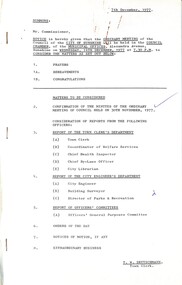 Sunshine and District Historical Society Incorporated
Administrative record - City of Sunshine - Commissioner Mr Alexander Alex George Gillon Collection 1976 - 1982 - Notice of ordinary meeting of the council of the City of Sunshine to be held on 14th December 1977, City of Sunshine, 7th December 1977
... Life Saving Club...Anderson Road...Sunshine Tip...Sunshine Beautification Committee...Consolidated Bearing Company...Self Service Wholesalers...Mitchell Street...Maidstone...Ardeer South Infant...Evans Hall Churchill Avenue Braybrook Sunshine Swimming Pool Sunshine Swimming Club Kennedy Street Sunshine Chaplin Reserve Sunshine & Life Saving Club Anderson Road Sunshine Tip Sunshine Beautification Committee Consolidated Bearing Company Self Service Wholesalers Mitchell Street Maidstone Ardeer South Infant Welfare & PreSchool Ridgeway Parade Ardeer Sunshine Golf Club Ralph Street Dover Street Station Road Deer Park King Edward Avenue Adelaide Street Ballarat Road Albion Sydney Street Albion Quarry Hulett Street Quinn Street St. ...Notice of Ordinary Meeting of the Council of the City of Sunshine to be held on 14th December 1977 Report of the Town Clerk's Department Report of Town Clerk Ainsworth Reserve Committee of Management D. J. Evans Hall Financial Statement Research Into the Staggering of Hours, Use of Flex-Time, Financial Assistance for Study Proposed Swimming Club Rooms Sunshine & Life Saving Club Request for Lease Provision of Flood Lights Chaplin Reserve Road Accidents Suggestions for Reduction Subsidies Pre-School Centres Special Use Zone 7 Proposed Rezoning Land Transfer Nickson Estate Proposal to Rezone Zone 7 and other Adjoining Lands Agreements Re Disposal of Trade Waste Sunshine Tip James Hardie & Co Pty Ltd, South Melbourne City Council, Collins & Davey Pty Ltd, Melbourne Harbour Trust Commissioners, E. A. Watts Pty Ltd & M. Keogh Beautification Group Prize Money Etc by Sunshine Beautification Committee Library Service to the Shire of Melton Surrender and Creation of Easement Consolidated Bearing Company & Self Service Wholesalers Mitchell Street Proposed Purchase of Land Ardeer South for Infant Welfare and Pre-School Centre Lots 1058 & 1059 Ridgeway Parade Meals On Wheels Ground Allocation Strategy Plan for Public Swimming Pools in Melbourne Metropolitan Region Report of the Co-Ordinator of Welfare Services Visiting Kindergarten Teacher Grant Family & Community Services Programme Accommodation for Adolescents Report of the Chief Health Inspector Application for the Installation of a Package Sewerage Treatment Plant Sunshine Golf Club Ralph Street Gas Fired Toilets and Biological septic Tank Systems Health Act Registrations for 1978 Mantoux Testing for School Children (Test for exposure to tuberculosis "TB") Symposium on Municipal Refuse Composting Report of the Chief By-Laws Officer Court Proceedings Parking Infringements Report of City Librarian Library Statistics Bookmobile Report of City Engineer Processing of Applications for Planning Permits Land Use Permit Application Sign Albanvale Residents Association Dover Street and Lot 119 Station Road Land Use Permit Application Extensions to Existing Service Premises (Milk bar) King Edward Avenue Corner Adelaide Street Massage Parlours Amendment 70 to the Melbourne Metropolitan Planning Scheme Submission from S. Custance & Associates on Behalf of Amusement Machine Operators Association Land Use Permit Application Service Premises and Caretaker's Residence 461A Ballarat Road Land Use Permit Application Store Additon to Two Existing Shops and Dwellings 59 Sydney Street Proposed Municipal Tip Disused Albion Quarry Hulett Street Sunshine Tip Land Use Permit Application Sign 250 Ballarat Road Braybrook Land Use Permit Application Detached House Lot 545 Quinn Street Land Use Permit Application Additional of Two Portable Classrooms St. Bernadette's Primary School 59 Westmoreland Road bounded by Suffolk Road, Rufford Street & Willey Street Sunshine North Land Use Permit Application Sign 25 Wright Street Land Use Permit Application Extension to Highpoint West Shopping Centre Land Use Permit Application Subdivision and Detached Houses Westerngate Estate Stage 4A Land Use Permit Application Youth Welfare Service 331 Main Road East Land Use Permit Application Panel Beating Factory Lot 4 McIntyre Road Land Use Permit Application Sign 193 Hampshire Road Enforcement Under the Town and Country Planning Act 1961 Land Use Permit Application Furniture and Carpet Sales, Warehouse and Light Industry 2 - 4 Burton Crescent Land Use Permit Application Child Minding Centre 36 Sydney Street Land Use Permit Application Greyhound Training Establishment North Street Ardeer Land Use Permit Application Four Warehouses and One Factory Berkshire Road and Ayton Street Land Use Permit Application Flats Lot 88 Chifley Drive Land Use Permit Application Apartment House and Caretaker's Residence 16 Ridley Street Parking Area Tallintyre Road Housing Commission of Victoria Subdivision Plan of Subdivision Carter Street & Henry Street Strata Subdivision Fabian Court Consolidation of Title Corner McIntyre Road and Balwin Avenue Consolidation of Title Lots 52 & 53 Cromer Avenue Consolidation of Title Corner of St. Albans Road and Princess Street Plan of Subdivision Ballarat Road, Hampshire Road and Anderson Road Contract Supply and Maintenance of Vehicles Anderson Road Contract Western Highway Street Lighting Proposed 75kM/Hr Buffer Zone Western Highway Deer Park Station Road outfall Drain Through Commonwealth Property Metcon Second Phase Replacement of Mayoral Car Tender Berkshire Road Tender Gooding Street Tender Tennis Courts Dempster Park Tender New Sunshine Tip Dispute over F19 eastern Freeway and Freeways in General City of Collingwood Geelong Road Service Road Burgess Road to Paw Paw Road Objections to Hulett Street Private Street Scheme Report of the Building Surveyor Fencing Lot 343 Anley Place Sunshine West Local Government Act 569H Refund 15 Bardsley Street Sunshine West Undersize Allotment 100 Ballarat Road Maidstone Application Ruinous Fence 2 Norma Street Sunshine Application Outbuilding 77 Anderson Road Sunshine Application Liquids Store M.M.W.B. Western Regional Depot St. Albans Road Albion Application Undersized Allotment 8 Victoria Street Sunshine Application Outbuilding 32 Killara Street Sunshine West Application Outbuilding 171 Main Road West Deer Park Pre-School Station Road Deer Park Alteration to Grandstand Skinner Reserve Churchill Avenue Cricket Pavilion Dempster Park Sunshine North Report of Officer's General-Purpose Committee Information Posters city of sunshine, alexander "alex" george gillon, ainsworth reserve, vernon street, sunshine west, d. j. evans hall, churchill avenue, braybrook, sunshine swimming pool, sunshine swimming club, kennedy street, sunshine, chaplin reserve, sunshine & life saving club, anderson road, sunshine tip, sunshine beautification committee, consolidated bearing company, self service wholesalers, mitchell street, maidstone, ardeer south infant welfare & preschool, ridgeway parade, ardeer, sunshine golf club, ralph street, dover street, station road, deer park, king edward avenue, adelaide street, ballarat road, albion, sydney street, albion quarry, hulett street, quinn street, st. bernadette's primary school, westmoreland road, suffolk road, rufford street, willey street, wright street, highpoint west shopping centre, rosamond road, maribyrnong, main road east, st. albans, mcintyre road, hampshire road, burton crescent, north street, chifley drive, ridley street, tallintyre road, carter street, henry street, fabian court, balwin avenue, cromer avenue, st. albans road, princess street, western highway, berkshire road, gooding street, dempster park, phoenix street, geelong road service road, paw paw road, anley place, bardsley street, norma street, victoria street, killara street -
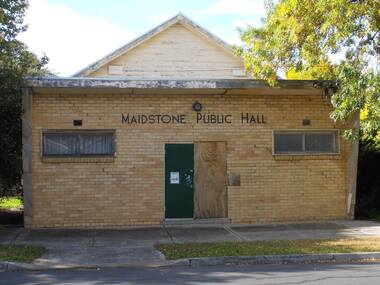 Sunshine and District Historical Society Incorporated
Photograph - Thomson St Maidstone - Maidstone Public Hall
... Key functions of the hall include: - Social life hub for Maidstone for more than 100 years - Infant Welfare Centre for the district - Meals on Wheels distribution point - Community events, meetings, and local gatherings The hall was demolished in 2014. ...Key functions of the hall include: - Social life hub for Maidstone for more than 100 years - Infant Welfare Centre for the district - Meals on Wheels distribution point - Community events, meetings, and local gatherings The hall was demolished in 2014. ...The Maidstone Public Hall was a central community venue built in the 1910s, serving as a social, civic, and welfare hub for over a century. Key functions of the hall include: - Social life hub for Maidstone for more than 100 years - Infant Welfare Centre for the district - Meals on Wheels distribution point - Community events, meetings, and local gatherings The hall was demolished in 2014. This photograph records the former Maidstone Public that is now demolished.5675 - Thomson St Maidstone - Maidstone Public Hall Photograph.jpgthomson street, maidstone, maidstone public hall -
 Damascus College
Artwork, other - Kathleen Meagan Memorial Window
... Kathleen Meagan was placed in the Ballarat Convent of Mercy as an infant. She remained there throughout her life until she died at age 34. ...Kathleen Meagan was placed in the Ballarat Convent of Mercy as an infant. She remained there throughout her life until she died at age 34. ...Kathleen Meagan was placed in the Ballarat Convent of Mercy as an infant. She remained there throughout her life until she died at age 34. Her friendly, cheerful personality in the face of ill health meant that she was cherished by all who knew her. Her talents on the violin, harp, piano and cello were outstanding, and she was beloved by the Sisters of Mercy and the students of Sacred Heart College. This memorial window depicting Saint Cecilia at the organ was commissioned upon her passing in 1925, and was installed in the SHC chapel and blessed by the Bishop in 1926.Stained glass window constructed in 1926 To the memory of Kathleen Blanche Meagan RIPsisters of mercy, ballarat musicians, herr goll -
 Melton City Libraries
Photograph, Edna Barrie, 1920, 1924, 1933 and 1940
... Edna and Bon carried on with this from their home in Ferris Rd when the threat of invasion had ceased Community life Community life in Melton revolved around fund raising events for the Melton Mechanics Institute for the War effort and keeping up with maintenance for the Hall. In 1944 the Minister for Health gave approval for the Shire of Melton to open and Infant Welfare Centre inviting Edna to form part of the Committee with seven other women. ...Edna and Bon carried on with this from their home in Ferris Rd when the threat of invasion had ceased Community life Community life in Melton revolved around fund raising events for the Melton Mechanics Institute for the War effort and keeping up with maintenance for the Hall. In 1944 the Minister for Health gave approval for the Shire of Melton to open and Infant Welfare Centre inviting Edna to form part of the Committee with seven other women. ...SUMMARY - Edna (Myers) Barrie, 1918 – 2018, Profile Early Life Edna was born at Melton and delivered by Hannah Watts. Her mother Martha walked in the dark at night with her basket under her arm to the bridge over the Toolern Creek Bridge and into Sherwin Street to the corner of Yuille Street to Hannah’s house Lynch Cottage. Martha’s husband was away shearing and eventually heard the news of the birth of their blue eyed third child and second daughter. She was born into a family that was surrounded by music; her father played the “squeeze box” and mother the mouth organ. From an early age the family were aware of the great composers, a framed picture of Beethoven, Chopin, Schubert and Wagner hung above the door to the lounge room of their 4 roomed cottage, the room where the piano stood. Her life on stage started as a singer aged 6 years at the Melton Mechanics Institute Hall. Edna was born with a natural ear for music learning piano and singing from her older sister Marjorie who became an accomplished pianist and soloist and renowned music teacher in Melton and district. In the 1920s and 1930s concerts at the Melton Mechanics Institute were regular events were the local talent was fostered. The Myers children, like other children of Melton and Rockbank, studied singing, piano and elocution, sat examinations, entered in competitions in South Street Ballarat, Footscray and Melbourne. In 1929 a Sacred Concert was broadcast by 3AR from the Hall as part of the Back to Melton Celebrations. Marjorie Myers performed two of the items on the piano. Edna attended Melton State School 430 from 1924 – 1933. Her father Fred had also attended the same school. In 1924 the School staged Cinderella at the Melton Mechanics Institute Hall with a cast of 33 students. After completing her education a Melton she boarded in South Melbourne and attending Melbourne Girls High School (MacRobertson Girls High School), a school which recognized her musical attributes. She travelled home on the train on the weekends, sometimes getting off at Rockbank to save a few pennies in fares. Working life The early 1930s the Depression was a difficult time for a young woman to find work. Jobs were often menial and given to the youngest and therefore cheapest applicant. She worked as sales assistant at Polonskis and Myer in the city, and Irvines Modes in Footscray. Working to 1pm on Saturday, and when held up by a customer meant missing the train home. While at Myer Department store she lived at home and rode her bike to the Melton railway station. On one occasion she had a nasty fall when a part of her bicycle came loose causing the bike to crash rendering her concussed and injuring her nose. During the 1930s she was given a camera “a little snap” by Mrs Kelly her landlady. This began her interest in photography documenting family life at their “Burnbank” home. Musically, while at Myers she participated in annual performances held at The Kings Hall and the Myer Mural Hall. Working in the basement at Myers she was often embarrassed when her name was called, customers assuming she belonged to the Myer Family. Ken Myer worked in the basement at the same time handling the ‘Wheeler’, a wicker basket used for moving goods around the store. The family philosophy was for the children to start at the bottom and work their way up. Social life Social life in her teenage years was connected also with Scots Presbyterian Church. She attended Sunday School classes and received book prizes for attendance. She loved to read and welcomed the times when she received new book. She took part in the Sunday School Anniversaries and was presented with a Bible from the Superintendent, Henry Robinson for her assistance with the music. Marriage and War years In 1941 Edna married Ernest “Bonnie” Barrie. War in the Pacific was soon to break out. While in Sydney on their honeymoon they met up with Jim Barrie who was on his way to Canada via Hawaii just missing Pearl Harbour by two days. Jim became a Spitfire Pilot and joined the RAF and was based in England. He returned to Australia later in RAAF to fight the Japanese off the coast of New Guinea. The three eldest Barrie brothers were farmers and food producers and were thus except from military service. Edna and Bon were members of the VAOC- Volunteer Air Observers Corp entailing being rostered on duty as plane spotters. The women took shifts during the day and the men at night which involved staying overnight in the Shire Offices. Later the spotting tower was built in the plantation opposite the Post Office. Edna and Bon carried on with this from their home in Ferris Rd when the threat of invasion had ceased Community life Community life in Melton revolved around fund raising events for the Melton Mechanics Institute for the War effort and keeping up with maintenance for the Hall. In 1944 the Minister for Health gave approval for the Shire of Melton to open and Infant Welfare Centre inviting Edna to form part of the Committee with seven other women. In 1948 she was President of Melton Branch of the Victorian Health Centres Association. She volunteered this use of her car driving the person in charge, Sister Smith to visit mothers and their babies. In 1963, along with Betty Jones and Isabel Snell, Edna was instrumental in forming the 1st Melton Cub Pack and later supported the formation of the 1st Melton Scouts. During 1963 – 1968 she completed the Australian Boy Scout Association Cub Pack Preliminary Training and achieved her Wood Badge. Country Women’s Association In 1944-1996 she was a member of the Melton Branch Country Women’s Association (CWA), Melton Branch, Secretary of the Branch in 1945 – 1946 and Branch International Secretary 1970-1971. She worked with choir, music and drama interest groups within the branch attaining both first and second place in 1959, second place in 1952 Exhibition and second in Music in 1960 in the state. She was involved in their handicraft craft events, fund raising and musical events and singing competitions. During the 1950s she trained Trios and Quartets in part singing for the CWA competitions in Ballarat and Melbourne. It was at this time that she developed her skill as a conductor and trainer of choirs. She later auditioned for the Victorian Choir for alto parts believing she would stand a better chance of being chosen, because of her ability to sing in natural harmony. In 1962 she participated in the Tenth Australian Country Women of the World (ACWW) Triennial Conference “Australia Presents: CWA Massed Choir” in the Melbourne Town Hall. This event was recorded by Super Sound Spotlight on 45 extended play vinyl record. The songs were Australian music and words, for example The Silver Stars are in the Sky, The Graceful Swaying Wattle and Kookaburra. Edna continued with her interest in the Victorian Choir regularly meeting at the CWA Headquarters in Toorak for rehearsals. In 1974 she took part in the Australian Choir at the fourteenth Triennial conference of the ACWW Interfaith Service held at the Perth Concert Hall on the 13th of October. Arts and Culture Edna was also in the Choir of 3KZ Carols by Candlelight at the Myer Music Bowl in 1963 and 1964. Melton Choral Society. Edna was Director and Conductor in the 1970s performing at many community events such as Carols by Candle Light, Church Services, Easter and Palm Sunday services, Mothers Union and the 1976 Community Services Week Combined Church Service. The October – November 1978 Program covered the following: songs from the Musicals, Choral and Solo with Narratives, Guest Instrumental Item, Recitation Negro Spirituals and Australian Songs. Her involvement with church choirs included the Scots Presbyterian Church Choir Easter and Christmas performances and the 1967 Centenary Service. In 1980s the Melton Uniting Church Sacred Music Performances included The Crucifixion by Stainer, The Olivet to Calvary and other church Hymns. Edna was Musical Director of the Melton Amateur Theatrical Society and worked on performances in collaboration with Mabel Rogers on script and musical interpretation. Melton and District Historical Society Annual Art and Craft Show. First held in Melton Mechanics Institute Hall in 1973, it later took place in the in the Melton Community Hall. The Art Show was also run in conjunction with other community organizations such as Rotary and Girl Guides. Community history and research Melton streetscape and society Over 20 years commencing in the 1970s, Edna undertook extensive photographing of the changing streetscape of Melton’s High Street. She anticipated the impact of change on the community during the time of Melton’s rapid transition from a small farming district to a large urban community and this led to her extensively document and photograph many of the structures and landscape features of the township that have since been lost. She also meticulously recorded much of the contemporary life of the town and has left a significant legacy of archival material. Melton State School 100 Years Celebration, October 1970 Co-author with Mabel Rogers “The First 100 Years, 1870 – 1970” Assembled a collection of School Class Photograph and identified and compiled lists of names for future school history. She also assembled a photographic display for the 125th anniversary in 1995. Melton and District Historical Society (M&DHS) Foundation Member, 1968 Held President and Secretary positions from its inception Research associated with the classification of Heritage buildings Christ Church Classification C Scots’ Presbyterian Church Classification D Set up the storage and Catalogue system in the Office at the Willows Organised society visits to Heritage sites in and beyond the Shire of Melton, including Stathtulloh, Eynesbury, Deanside, ToolernVale sites including Merrywood (now demolished) Staughton Vale, Chirnside, Point Cook, Shwerkolts Cottage. 1970 – 1983 Melton and District Historical Society Letterhead. Staughton Memorial Light from early newspaper cutting in its location before restoration to present location. Sketch by Wendy Barrie. Designing and printing pamphlets, stationery, and other sale items with Willows title. M&DHS street naming research for new housing developments (1970 – 2000). Collaborated with Mary Tolhurst to research the names of early landowners and pioneer families connected to the first settlers. Researched Aboriginal names for inclusion on lists submitted to developers. An early example is the naming of Kuranjang and the street names associated with the McPherson family. Plains of Promise (Shire of Melton history) by Joan Starr (1985). Edna assisted with Historical Society materials and contributed her own research and photographs. Contacted and organised for Hubert Opperman to launch the book. (She was also present at his last bike ride at Rochester in 1995.) Western Metropolitan Groups of Historical Societies. Member attending meetings and representing Melton, also hosted the Group at Melton The Willows Member of the Committee of Management for the restoration of the “Willows” house the establishment of The Willows Park 1982 March - Official Opening of the Willows Park- Preparation and planning for the event. Involved in the collecting of items in the furnishing of the display rooms in the Willows house. Donated items and furniture from the Myers and Daley family houses. (19th century) Machinery Shed Establishment. Involved with Jeff Robinson in the construction and collection of machinery display Other significant sites Championed and participated in the restoration and preservation significant sites in Melton, including: restoration of the Staughton Memorial Light and its return to its present site restoration of the Pykes Grave (using EW Barrie earthmoving equipment) restoration and reconstruction of Dunvegan restoration and reconstruction of Macs Cottage, the management and Caretakers residence Melton State School War Memorial Gates removed from Unitt Street entrance and relocated to the Willows Park Donated the Barrie family single furrow plough which was standing at the Court House Plaza. It removed and to Council Depot and later missing. The plaque was taken to the Willows. Jimmy Melrose (aviator) cairn restoration at crash site in Melton South Donald Mackintosh (Olympic gold medallist marksman) grave site at the Melton Cemetery (Historical items held by the Myers family collection.) Houdini first flight at Diggers Rest. Edna’s father was shearing at Diggers Rest at the time and witnessed the flight. She attended the 90 year anniversary of the event at the site in 2000. Radio and electronics Edna’s husband Bon interest in wireless communication dates in the 1920s with the building of a crystal set in the early days of public broadcasting. At the Back to Melton Celebrations in 1929, 3AR broadcast a concert from the Melton Mechanics Institute on the 20th February at 8pm featuring Footscray City Band, James Hill baritone, Vera Carew Soprano, James Foran Tenor, Marjorie Myers Piano, and James Williamson Entertainer. Accompanists: Miss Agnes Ross and Mrs James Hill. The Myers children had recordings of their piano playing made onto the aluminium records, Martha Myers’ voice can be heard introducing an item. These were made in a studio in Melbourne. Marjorie was given a upright Gramophone by Donald Mackintosh in recognition of her talent and her contribution to the cultural life of Melton. The family were then able to listen to 78rpm recordings of the famous classical recordings. The turntable was hand wound metal stylus needles had to be regularly replaced. The aluminium disk needed a bamboo needle to prevent damage to the surface. Before electricity was introduced to Melton in 1939 the Mechanics Hall relied on generators to produce electricity. Bon Barrie, being mechanically minded, built a public address system for be used a community functions at the Hall and Recreational Park. By 1939 this was up and running and used for over three decades. A large Collection of 78rpm records provided music for dances, marching, parades and any public event needing music and microphones. The early system was portable and worked on batteries. CFA Radio Communication In the 1950s with the introduction two-way HF and later VHF very high frequency radio sets. Melton Rural Fire Brigade was part of the Bacchus Marsh Group. Radio sets where located in the Melton Fire Truck, and in the house of the Barrie family at Ferris Road. This was an ideal location to observe a 360 degree view in all directions when smoke appeared on the horizon. An antenna was erected beside the house. The set OX 7 was located in the kitchen and monitored 24 hours by the family. When an electrical fire occurred at the junction of the electricity to the house there was time to radio the fire station and summons the men working in the paddocks, thus saving the house from possible destruction. With the introduction of UHF – ultra high frequency Vinten Radios the signal was clearer and static and interference lessened and radio traffic became easier to read, and reduced noise levels in the household. VL3 LY Radio Base became the Group Headquarters was established in 1967. By 1970 the Brigades were: Melton, Rockbank, Sydenham, Toolern Vale, Diggers Rest, Truganina, and Werribee. In 1974 when the family moved to First Avenue, another antenna and a small building were erected adjacent to the residence and used to house the equipment, maps. Radio traffic consisted of regular schedule times and communication with adjoining groups of brigades such as Bacchus Marsh, Mt Macedon and Little River Groups. Many of the brigade and group base radios were situated in private residences and operated primarily by fire fighters wives who held the position of Communications Officer, either registered as a brigade member or informally. Edna was never registered as an operational brigade member but operated informally as an assistant to her husband Bon. She was however a member of the Melton Fire Brigade Ladies Auxiliary from its inception in 1968, a non-operational position. Edna kept up to date with radio procedure following the 1967 handbook; preparing maps, plotting compass points and taking notes on weather forecasts from the SA Border and Western District. Daily notes were taken in anticipation of fire warnings. These log books and daily radio traffic were incidental to the regular radio schedules. Emergency turnouts noted, burning off times and predicted location of smoke. In the summer fire season all TBF (total fire ban days were recorded.) In times of emergency the Barrie family assisted Bon the base radio operator to plot the position and location of fire trucks and to help clarify garbled radio traffic, keep notes and make telephone calls. These log books are held in the EE and EW Family Archive. Melton Uniting Church Edna founded the Church Opportunity with Maisie Robinson in 1975 in the Melton South Methodist Church building. Methodist and Presbyterian Churches of Melton had combined severing their long held connection with Bacchus Marsh. A Manse had been recently built for the Melton Minister. At a Parish Committee meeting at the Melton South Church it was suggested to use the building as an Opportunity Shop. It opened in July 1975, and it raised $1,600 contribution to the church budget in 1976. In 1977 The Uniting Church in Australia was formed and the Melton South Uniting Church Opportunity shop continued to go from strength to strength expanding the buildings providing the welfare needs of the community. Archive Set up by Edna Catalogued items dating from 1857 Minute Book and set ongoing system and storage of items of heritage. Melton Un Awards and recognition of service to the Melton community Rotary Award for Community Service, 1980 Victoria 150th Anniversary Celebrations contributions, 1985 Life Membership of the Melton and District Historical Society (M&DHS), 1989 Extra-Ordinary Contribution for years of service to M&DHS, 1992 Long Service for Exceptional Service MD&HS, 1993 Royal Historical Society of Victoria Award of Merit, 1997 Shire of Melton Certificate of Appreciation for continued support and dedication as a member of MD&HS to the preservation of Melton’s History, 1998 Centenary of Federation Peoplescape (Canberra) Melton Shire nomination, 2001 Uniting Church Melton Life Membership of the Opportunity Shop Uniting Church in Australia Commission for Mission for 30 years of hard work and dedications to the Uniting Church, 2007 Uniting Church Adult Fellowship Certificate appreciation in recognition of valuable support through the “Sammy” Stamp Fund Neighbourhood Watch 5 year award Photographs of Edna at different ageslocal identities -
 Surrey Hills Historical Society Collection
Photograph, John Gray Memorial Rotunda in Surrey gardens, Union Road, Surrey Hills, c 1925, c 1925
... infant welfare centre until the Progress Association built a dedicated facility for these purposes. The rotunda was demolished in 1972. Clarence Montgomery, carpenter, was living in Sunbury Crescent in 1914. By 1916 he had moved to 83 Croydon Road where he lived for the rest of his life...infant welfare centre until the Progress Association built a dedicated facility for these purposes. The rotunda was demolished in 1972. Clarence Montgomery, carpenter, was living in Sunbury Crescent in 1914. By 1916 he had moved to 83 Croydon Road where he lived for the rest of his life ...The rotunda was built in 1912 by Clarence Montgomery for the Surrey Hills Progress Association and the local community and dedicated to John Gray, "a highly respected and revered citizen". Surrey Hills Brass Band regularly gave concerts in the rotunda, provided music for regular 'loyal' celebrations and also for silent films held in the gardens. The rotunda was quite elevated off the ground due to the slope of the gardens and the bioscope was stored in the room underneath. This was later used as the infant welfare centre until the Progress Association built a dedicated facility for these purposes. The rotunda was demolished in 1972. Clarence Montgomery, carpenter, was living in Sunbury Crescent in 1914. By 1916 he had moved to 83 Croydon Road where he lived for the rest of his life. Clarence was born in 1869 in Taradale, son of John Montgomery and Jane Ford. He married Sarah Ann Ingram in Echuca in 1894. Their children were: 1. Annie (Mrs P Paynter) born Echuca in 1895 2. William Henry born Echuca in 1897 3. Christina Mary (Mrs F Meyers) born Echuca in 1898 4. Violet (Mrs G Ewing) born Echuca in 1902 5. Clarence George Ingram born Echuca in 1906 and died aged 7 months. Violet became a tailoress and Christina a dressmaker. William became a carpenter like his father. Sarah Ann Montgomery died at their home in June 1932 aged 62 years. Clarence died in August 1946 aged 77 years. They are buried in Box Hill Cemetery (P-EB-0020). John Gray was "actively associated with all movements for the benefit of neighbours and fellow citizens". [Quote from the official tribute on his death in 1909.] He was very active in the Surrey Hills Progress Association in the early 1900's. The rotunda built in the Surrey Gardens by the Progress Association in 1912 was dedicated to him. John Gray was born in 1861 in Eldorado. He died on 7 December 1909 in Surrey Hills and is buried in Box Hill Cemetery (M0472). He married Emma Beckett in 1888 at 'Guildford Villa' in Essex Road, the Beckett home. They are listed in both the 1903 and 1906 electoral rolls in Arundel Crescent; his occupation is given as bootmaker. The Alan Holt property register identifies this as 24 Arundel Crescent, known as 'Tumberumba'. John and Emma had a large family: (Gunner) John Robert Gray (1888, Surrey Hills - 21 June 1917, France) Benjamin Walter Gray (1890, Surrey Hills - 1949, Heidelberg) Herbert Harry Gray (1892, Surrey Hills - 1959, Queensland) William Beckett Gray (1897, Surrey Hills - 1899, Surrey Hills) Norman Douglas Gray (1901, Surrey Hills - 1947, Sydney) Evelyn Lizzie Gray (1906, Surrey Hills - 1983) Evelyn married Reginald Roberts and donated a number of photos to the collection. The donor Violet Ewing (nee Montgomery) was Clarence's daughter. She married George Isaac Henry Ewing (blacksmith) in 1934. They inherited the family home at 83 Croydon Road. Although constructed 5 years after their opening, this rotunda was a central feature of the Surrey Gardens which was planted to a design adapted from one suggested by the renowned landscape gardener and botanist William Robert Guilfoyle (1840-1912). Rotundas were a key feature of many late nineteenth and early twentieth century public parks. This particular rotunda was notable for the Chinoiserie influence reflected in its roof. Surrey Gardens are now regarded as one of the City of Boroondara's heritage gardens and this image is significant as evidence of the design of the rotunda which is no longer extant. It is also significant as evidence of the extent of the role of the Surrey Hills Progress Association in the provision of public facilities. A black and white photo of an octagonal rotunda situated within Surrey Gardens taken from the perspective of the main entrance. It is a largely wooden structure with a domed chinoiserie-style roof. The rotunda is enclosed by established gardens. There are 4 people in the photo, with 2 women standing on the steps at the rotunda's entrance. A man and a young person are seated within the rotunda. It has 8 support pillars, which are open with balustrades to 7 sides.rotundas, surrey gardens, union road, surrey hills progress association, surrey hills brass band, parks and reserves, 1925, john gray, clarence montgomery, box hill cemetery, cinema, john gray memorial rotunda, bandstands -
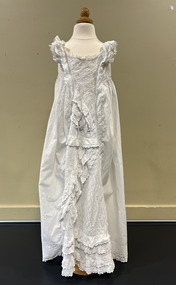 Kew Historical Society Inc
Clothing - Christening Gown, 1899-1910
... infant's and children's clothing of the period. Christening gowns Ceremonial clothing children's wear baptismal clothing victorian historical themes — 8.6 marking the phases of life Nil Long, white cotton christening gown. ...In the early 19th century, infant gowns were modelled on dresses worn by adult women. Gowns were typically made of fine white linen or cotton, and often trimmed with tucks, lace, whitework embroidery, and other handwork. The Kew Historical Society's collection includes over twenty-five gowns dating from the 19th and 20th centuries. This christening gown was worn by one or more of the Weir children.This is one of ten items of clothing, worn by infants in the Weir family of Broken Hill between 1899 and 1910. They are part of the larger Weir Family collection of clothing, documents and photographs gifted to the Kew Historical Society by their descendants. Due to their known provenence, the gowns are historically and aesthetically significant in that they can be accurately dated to an 11-year-period, allowing other comparable items of infant's and children's clothing to be dated to an earlier, silmilar or later period. They also exemplify the styles and decorative techniques used for christening gowns, infant's and children's clothing of the period.Long, white cotton christening gown. The high-necked, short-sleeved bodice has a number of decorative elements. This includes an extesive use of lace in diagonal panels at the front above four horizontal layers of the same lace. There are two layers of lace forming the sleeves. Nilchristening gowns, ceremonial clothing, children's wear, baptismal clothing, victorian historical themes — 8.6 marking the phases of life -
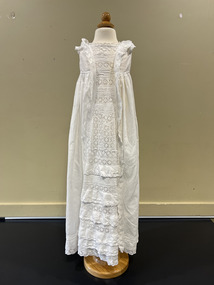 Kew Historical Society Inc
Clothing - Christening Gown, 1891-1910
... infant's and children's clothing of the period. Christening gowns Ceremonial clothing children's wear baptismal clothing victorian historical themes — 8.6 marking the phases of life Nil Long, white cotton christening gown. ...In the early 19th century, infant gowns were modelled on dresses worn by adult women. Gowns were typically made of fine white linen or cotton, and often trimmed with tucks, lace, whitework embroidery, and other handwork. The Kew Historical Society's collection includes over twenty-five gowns dating from the 19th and 20th centuries. This christening gown was worn by one or more of the Weir children.This is one of ten items of clothing, worn by infants in the Weir family of Broken Hill between 1899 and 1910. They are part of the larger Weir Family collection of clothing, documents and photographs gifted to the Kew Historical Society by their descendants. Due to their known provenence, the gowns are historically and aesthetically significant in that they can be accurately dated to an 11-year-period, allowing other comparable items of infant's and children's clothing to be dated to an earlier, silmilar or later period. They also exemplify the styles and decorative techniques used for christening gowns, infant's and children's clothing of the period.Long, white cotton christening gown. The high-necked, short-sleeved bodice has a number of decorative elements. These include an extesive use of lace in horizontal and triangular panels of various styles at the front. Two long bands of lace frame this central panel.Nilchristening gowns, ceremonial clothing, children's wear, baptismal clothing, victorian historical themes — 8.6 marking the phases of life -
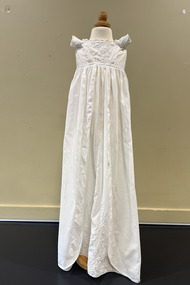 Kew Historical Society Inc
Clothing - Christening Gown, 1891-1910
... infant's and children's clothing of the period. Ceremonial clothing children's wear baptismal clothing victorian historical themes — 8.6 marking the phases of life christening gown Nil Long, fine white cotton christening gown. ...In the early 19th century, infant gowns were modelled on dresses worn by adult women. Gowns were typically made of fine white linen or cotton, and often trimmed with tucks, lace, whitework embroidery, and other handwork. The Kew Historical Society's collection includes over twenty-five gowns dating from the 19th and 20th centuries. This christening gown was worn by one or more of the Weir children.This is one of ten items of clothing, worn by infants in the Weir family of Broken Hill between 1891 and 1910. They are part of the larger Weir Family collection of clothing, documents and photographs gifted to the Kew Historical Society by their descendants. Due to their known provenence, the gowns are historically and aesthetically significant in that they can be accurately dated to an 19-year-period, allowing other comparable items of infant's and children's clothing to be dated to an earlier, silmilar or later period. They also exemplify the styles and decorative techniques used for christening gowns, infant's and children's clothing of the period.Long, fine white cotton christening gown. The high-necked, short-sleeved bodice has a number of decorative elements. These include an extesive use of white work on the sleeves, bodice and gown. Tight ruching at the waist allows a central panel of white work to be framed by the larger panel which acts as a polonnaise. This contains the finest workmanship of the christening gowns and infants clothing in the Weir Collection and may date to 1891.Nilceremonial clothing, children's wear, baptismal clothing, victorian historical themes — 8.6 marking the phases of life, christening gown
