
Showing 21 items matching "injured person"
-
 National Vietnam Veterans Museum (NVVM)
Photograph
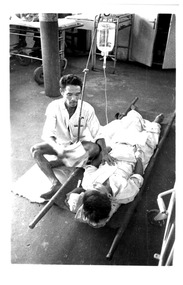
... Injured person...A black and white photo of an injured person on a stretcher on the ground. The patient is being fanned by a person kneeling down. ...The photograph provided by Rosalind Marshall (nee Hardman) whilst a volunteer radiographer in Bien Hoa South Vietnam who worked as a civilian in a medical facility. Injured person Marshall Bien Hoa Volunteer Radiographer A black and white photo of an injured person on a stretcher on the ground. ...The photograph provided by Rosalind Marshall (nee Hardman) whilst a volunteer radiographer in Bien Hoa South Vietnam who worked as a civilian in a medical facility.A black and white photo of an injured person on a stretcher on the ground. The patient is being fanned by a person kneeling down. The patient has a drip injured person, marshall, bien hoa, volunteer, radiographer -
 National Vietnam Veterans Museum (NVVM)
Document - Advice on the Rehabilitation of a Soldier for Pte Gregory William Reid, 1968-69
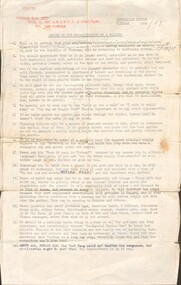
... ...Injured person...Pte Gregory William Reid 2796776 Royal Australian Infantry Corps Australian National Serviceman 4th Battalion The Royal Australian Regiment Australian Forces Vietnam Injured person Rehabilitation Nui Dat Advice on the Rehabilitation of a Soldier for Pte Gregory William Reid. ...This item was donated by Pte Gregory William Reid (2786776) who was with the Royal Australian Infantry Corps. He was a National Service personal and he served in Vietnam with the 4th Battalion, The Royal Australian Regiment from May 1968 to March 1969.Advice on the Rehabilitation of a Soldier for Pte Gregory William Reid. This is a typed list of fourteen things that families and friends may observe in the behaviour of their family/friend upon returning from fighting in Vietnam. This was put out by Australian Forces Vietnam in 1968. See media file for more information.pte gregory william reid, 2796776, royal australian infantry corps, australian national serviceman, 4th battalion, the royal australian regiment, australian forces vietnam, injured person, rehabilitation, nui dat -
 Flagstaff Hill Maritime Museum and Village
Equipment - Stretcher, 1965 to 1999
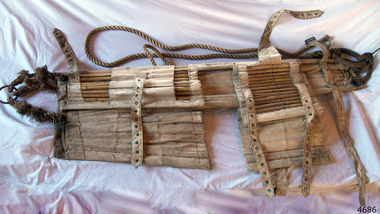
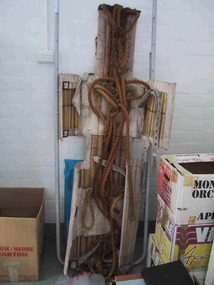
... Used for lifting an injured person vertically. The stretcher is made from stout canvas reinforced with bamboo slats. ...Used for lifting an injured person vertically. The stretcher is made from stout canvas reinforced with bamboo slats. ...A Neil Robinson stretcher is a lightweight carrying device modelled on Japanese bamboo litters, the Neil Robertson rescue stretcher was developed in the early 1900s by John Neil Robertson. Used for lifting an injured person vertically. The stretcher is made from stout canvas reinforced with bamboo slats. The stretcher is designed for removing an injured person from spaces wherein access, doors or hatches are too small to permit the use of regular stretchers. Spaces such as ship engine room spaces, cargo holds, pump rooms, boiler rooms etc. are a few examples of such compact spaces.An item designed to transport injured personnel from tight places, either at sea or on land.A rescue stretcher made from white canvas reinforced with bamboo slats and adjustable canvas straps. The canvas straps are secured with metal buckles and there is a metal ring attached to lengths of ropes at both ends. Noneflagstaff hill, warrnambool, flagstaff hill maritime museum, maritime museum, shipwreck coast, flagstaff hill maritime village, great ocean road, stretcher, neil robertson, neil robertson rescue stretcher, rescue equipment -
 Kiewa Valley Historical Society
Stretcher - ARP
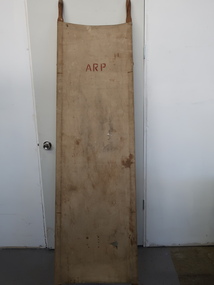
... This stretcher is for carrying an injured or sick person to another location for treatment or it may have been used as an extra bed. ...This stretcher is for carrying an injured or sick person to another location for treatment or it may have been used as an extra bed. ...This stretcher is for carrying an injured or sick person to another location for treatment or it may have been used as an extra bed. Two people would be able to do the carrying. This stretcher is not able to be folded so was probably not used for eg. a camping trip.Used in the Kiewa Valley.4 wooden rounded handles on each corner. Heavy (strong) material is pulled over both of the long sides and fastened with nails. Just in from each end is a steel rod across the stretcher to maintain the width and allow the stretcher to be put down onto the ground to rest on each of the 4 legs. The legs are steel and curved for extra strength."ARP" stamped in red on the material.stretcher, arp, first aid -
 Parks Victoria - Wilsons Promontory Lightstation
Stretcher
... Made of canvas and bamboo slats with hemp ropes, adjustable canvas straps and metal buckles and rings, the rescue stretcher was used for carrying an injured person. According to the Powerhouse Museum, the stretcher and was ‘designed to support and carry an injured person in circumstances where the person has to be lifted vertically’. ...Made of canvas and bamboo slats with hemp ropes, adjustable canvas straps and metal buckles and rings, the rescue stretcher was used for carrying an injured person. According to the Powerhouse Museum, the stretcher and was ‘designed to support and carry an injured person in circumstances where the person has to be lifted vertically’. ...Made of canvas and bamboo slats with hemp ropes, adjustable canvas straps and metal buckles and rings, the rescue stretcher was used for carrying an injured person. According to the Powerhouse Museum, the stretcher and was ‘designed to support and carry an injured person in circumstances where the person has to be lifted vertically’. Known as the ‘Neil Robertson stretcher’, it was developed in the early 1900s by John Neil Robertson as a lightweight rescue device and was modelled on Japanese bamboo litters. An identical stretcher is held in Sydney’s Powerhouse Museum and is thought to date between c.1967 and 1999. The museum’s statement of significance for the unique stretcher elaborates on its cultural values: The canvas is wrapped around the patient and secured with strong canvas straps. A lifting rope is attached to a ring above the patient's head, while a guideline is tied near the ankles and used to stop the stretcher swaying as it is hoisted up. This style of stretcher was specifically designed for use on ships, where casualties might have to be lifted from engine-room spaces, holds and other compartments with access hatches too small for ordinary stretchers. The original name of the Neil Robertson stretcher was 'Hammock for hoisting wounded men from stokeholds and for use in ships whose ash hoists are 2 ft. 6 in. diameter'. Since those times the Neil Robertson stretcher has also been used in factories and mines and for other emergency rescue situations. It is still possible to buy this type of stretcher although the slats are now more likely to be made of wood. The example in the Powerhouse collection was amongst several items of obsolete first aid and rescue equipment donated by the electricity generation company Delta Electricity. It would have been used - or at least been on stand-by - at the company's Munmorah Power Station or the associated coal mine on the Central Coast of New South Wales. Industrial sites and mines are extremely dangerous work places. Throughout the 20th century to the present there has been a drive, especially in developed countries like Australia, to improve workplace safety. Measures taken to reduce injuries and deaths have included safer industrial equipment, safer work practices, staff training, and the ready availability of accident and emergency equipment.It was also used throughout WWI and WWII. There are two other examples of the stretcher are known in Parks Victoria heritage collections. Canvas and bamboo stretcher with straps and buckles. Hemp ropes are attached to the stretcher. -
 Bendigo Historical Society Inc.
Award - James Marshall Collection: Gold Medal Bravery Award, The Royal Humane Society of Australasia, 23.02.1887
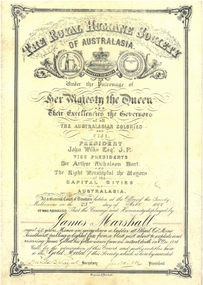
... It also provides assistance to persons injured as a result of their bravery, or to their next of kin if they perished in the attempt. ...It also provides assistance to persons injured as a result of their bravery, or to their next of kin if they perished in the attempt. ...The Royal Humane Society of Australasia (RHSA), formerly the Victorian Humane Society, is an Australian charity dedicated to the recognition of those who risk their own lives in saving or attempting to save the lives of others. It also provides assistance to persons injured as a result of their bravery, or to their next of kin if they perished in the attempt. (https://en.wikipedia.org/wiki/Royal_Humane_Society_of_Australasia) Further information may be found at website below. https://www.rhsa.org.au/about-us.html THE BENDIGO ADVERTISER (PUBLISHED DAILY.) PROGRESSION, OUR RIGHTS, AND OUR RESOURCES. SANDHURST, THURSDAY, DEO. 16, 1886 Article - Bendigo Advertiser (Vic. : 1855 - 1918)Thursday 16 December 1886 - Page 2Original Certificate from The Royal Humane Society of Australasia awarded to James Marshall. Dated 23rd February 1887. Printed in black ink on cream coloured parchment paper. Script surrounded by a black border with decorative emblems on each corner. The Certificate was stored in a brown leather roll lined with white paper with a gold geometric pattern. Printed in gold lettering " THE ROYAL HUMANE SOCIETY OF AUSTRALASIA"It was Resolved "" That the Courage and Humanity displayed by James Marshall aged 42 years, Miner in going down a ladder at Pearl Co's Mine, Sandhurst, pulling a lighted fuse from a blast just about to explode and rescuing James Gilbert his fellow miner from an instant death on 6th Dec. 1886, Call for the admiration of this Court and justly entitles him to the Gold Medal of this Society which is hereby awarded".bendigo, mining, james marshall rescue, mining accident, rescue, james gilbert -
 Flagstaff Hill Maritime Museum and Village
Photograph - Photograph and Negative, 1952
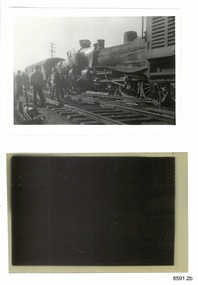
... INJURED IN VIC. RAIL CRASH MELBOURNE, Saturday. — A woman was killed and seven persons were seriously injured when two passenger trains collided head-on at Moriac (59 miles south of Melbourne), near Geelong, at 8.15 tonight. ...INJURED IN VIC. RAIL CRASH MELBOURNE, Saturday. — A woman was killed and seven persons were seriously injured when two passenger trains collided head-on at Moriac (59 miles south of Melbourne), near Geelong, at 8.15 tonight. ...'Moriac, 1952 On 13 April 1952, a woman was killed and seven people were seriously injured when two passenger trains collided. A Melbourne-bound train collided with a Warrnambool-bound train, which was still shunting into siding at the station to allow the Melbourne-bound train to pass it on the single track. Both engines were derailed. The victim was in the first carriage of the Melbourne-bound train, which was telescoped after being forced into the tender of the locomotive. https://en.wikipedia.org/wiki/Railway_accidents_in_Victoria' 'April 12th 1952 7.52 p.m. Two passenger trains collided head on, on Warrnambool line near Moriac just out of Geelong. One killed four injured.' https://trove.nla.gov.au/newspaper/article/244373869?searchTerm=1952%20rail%20accident%20warrnambool ONE DEAD, MANY INJURED IN VIC. RAIL CRASH MELBOURNE, Saturday. — A woman was killed and seven persons were seriously injured when two passenger trains collided head-on at Moriac (59 miles south of Melbourne), near Geelong, at 8.15 tonight. Both engines were derailed, and the first carriage of the Geelong-bound train was telescoped by the coal tender. The dead woman was in this carriage. The trains involved were the 3.25 p.m. passenger train from Port Fairy to Geelong, and the 5.50 p.m. train from Melbourne to Warrnambool, which passed through Geelong at 7.05 p.m. ONE SHUNTING The Warrnambool-bound train had stopped at Moriac and was shunting into a siding to allow the other train to pass along the single track when the crash occurred. The impact hurled the Warrnambool-bound train backwards and the two engines, badly wrecked, came to rest 30ft apart. One engine hung at an acute angle on its side and the crew« were badly scalded by escaping steam. The crash was heard several miles away and hundreds of people rushed to the scene. Two ambulances were called from Geelong, and ambulance men joined railwaymen and volunteers in freeing the injured from badly damaged carriages. MANY SHOCKED Many other passengers were slightly hurt or badly affected by shock. They were treated on the spot. Mr. T. Mather, newsagent and postmaster at Moriac, said the noise of the crash startled him and he was on the scene in a matter of minutes. "There was great confusion," he said. "People on the trains were calling out for help. Many feared a fire would break out. However, we soon got relief gangs together and set to work to free those trapped in the wrecked carriage. One woman was dead, and a man seemed to be dead or dying." Special buses were chartered by the Railway Department to convey the passengers to their destinations. The line was blocked, but repair gangs were soon at work clearing the debris. https://trove.nla.gov.au/newspaper/article/18490332# This photograph and negative belonged to Dr. William Roy Angus. It was donated to Flagstaff Hill Maritime Village by his daughter, Bernice McDade. It is part of the “W.R. Angus Collection” includes historical medical equipment, surgical instruments and material once belonging to Dr Edward Ryan and Dr Thomas Francis Ryan, (both of Nhill, Victoria) as well as Dr Angus’ own belongings. The Collection’s history spans the medical practices of the two Doctors Ryan, from 1885-1926 plus that of Dr Angus, up until 1969. ABOUT THE “W.R.ANGUS COLLECTION” Doctor William Roy Angus M.B., B.S., Adel., 1923, F.R.C.S. Edin.,1928 (also known as Dr Roy Angus) was born in Murrumbeena, Victoria in 1901 and lived until 1970. He qualified as a doctor in 1923 at University of Adelaide, was Resident Medical Officer at the Royal Adelaide Hospital in 1924 and for a period was house surgeon to Sir (then Mr.) Henry Simpson Newland. Dr Angus was briefly an Assistant to Dr Riddell of Kapunda, then commenced private practice at Curramulka, Yorke Peninsula, SA, where he was physician, surgeon and chemist. In 1926, he was appointed as new Medical Assistant to Dr Thomas Francis Ryan (T.F. Ryan, or Tom), in Nhill, Victoria, where his experiences included radiology and pharmacy. In 1927 he was Acting House Surgeon in Dr Tom Ryan’s absence. Dr Angus had become engaged to Gladys Forsyth and they decided he further his studies overseas in the UK in 1927. He studied at London University College Hospital and at Edinburgh Royal Infirmary and in 1928, was awarded FRCS (Fellow from the Royal College of Surgeons), Edinburgh. He worked his passage back to Australia as a Ship’s Surgeon on the on the Australian Commonwealth Line’s T.S.S. Largs Bay. Dr Angus married Gladys in 1929, in Ballarat. (They went on to have one son (Graham 1932, born in SA) and two daughters (Helen (died 12/07/1996) and Berenice (Berry), both born at Mira, Nhill ) According to Berry, her mother Gladys made a lot of their clothes. She was very talented and did some lovely embroidery including lingerie for her trousseau and beautifully handmade baby clothes. Dr Angus was a ‘flying doctor’ for the A.I.M. (Australian Inland Ministry) Aerial Medical Service in 1928 . Its first station was in the remote town of Oodnadatta, where Dr Angus was stationed. He was locum tenens there on North-South Railway at 21 Mile Camp. He took up this ‘flying doctor’ position in response to a call from Dr John Flynn; the organisation was later known as the Flying Doctor Service, then the Royal Flying Doctor Service. A lot of his work during this time involved dental surgery also. Between 1928-1932 he was surgeon at the Curramulka Hospital, Yorke Peninsula, South Australia. In 1933 Dr Angus returned to Nhill and purchased a share of the Nelson Street practice and Mira hospital (a 2 bed ward at the Nelson Street Practice) from Dr Les Middleton one of the Middleton Brothers, the current owners of what previously once Dr Tom Ryan’s practice. Dr Tom and his brother had worked as surgeons included eye surgery. Dr Tom Ryan performed many of his operations in the Mira private hospital on his premises. He had been House Surgeon at the Nhill Hospital 1902-1926. Dr Tom Ryan had one of the only two pieces of radiology equipment in Victoria during his practicing years – The Royal Melbourne Hospital had the other one. Over the years Dr Tom Ryan had gradually set up what was effectively a training school for country general-practitioner-surgeons. Each patient was carefully examined, including using the X-ray machine, and any surgery was discussed and planned with Dr Ryan’s assistants several days in advance. Dr Angus gained experience in using the X-ray machine there during his time as assistant to Dr Ryan. When Dr Angus bought into the Nelson Street premises in Nhill he was also appointed as the Nhill Hospital’s Honorary House Surgeon 1933-1938. His practitioner’s plate from his Nhill surgery is now mounted on the doorway to the Port Medical Office at Flagstaff Hill Maritime Village, Warrnambool. When Dr Angus took up practice in the Dr Edward and Dr Tom Ryan’s old premises he obtained their extensive collection of historical medical equipment and materials spanning 1884-1926. A large part of this collection is now on display at the Port Medical Office at Flagstaff Hill Maritime Village in Warrnambool. In 1939 Dr Angus and his family moved to Warrnambool where he purchased “Birchwood,” the 1852 home and medical practice of Dr John Hunter Henderson, at 214 Koroit Street. (This property was sold in1965 to the State Government and is now the site of the Warrnambool Police Station. and an ALDI sore is on the land that was once their tennis court). The Angus family was able to afford gardeners, cooks and maids; their home was a popular place for visiting dignitaries to stay whilst visiting Warrnambool. Dr Angus had his own silk worm farm at home in a Mulberry tree. His young daughter used his centrifuge for spinning the silk. Dr Angus was appointed on a part-time basis as Port Medical Officer (Health Officer) in Warrnambool and held this position until the 1940’s when the government no longer required the service of a Port Medical Officer in Warrnambool; he was thus Warrnambool’s last serving Port Medical Officer. (Masters of immigrant ships arriving in port reported incidents of diseases, illness and death and the Port Medical Officer made a decision on whether the ship required Quarantine and for how long, in this way preventing contagious illness from spreading from new immigrants to the residents already in the colony.) Dr Angus was a member of the Australian Medical Association, for 35 years and surgeon at the Warrnambool Base Hospital 1939-1942, He served as a Surgeon Captain during WWII1942-45, in Ballarat, Victoria, and in Bonegilla, N.S.W., completing his service just before the end of the war due to suffering from a heart attack. During his convalescence he carved an intricate and ‘most artistic’ chess set from the material that dentures were made from. He then studied ophthalmology at the Royal Melbourne Eye and Ear Hospital and created cosmetically superior artificial eyes by pioneering using the intrascleral cartilage. Angus received accolades from the Ophthalmological Society of Australasia for this work. He returned to Warrnambool to commence practice as an ophthalmologist, pioneering in artificial eye improvements. He was Honorary Consultant Ophthalmologist to Warrnambool Base Hospital for 31 years. He made monthly visits to Portland as a visiting surgeon, to perform eye surgery. He represented the Victorian South-West subdivision of the Australian Medical Association as its secretary between 1949 and 1956 and as chairman from 1956 to 1958. In 1968 Dr Angus was elected member of Spain’s Barraquer Institute of Barcelona after his research work in Intrasclearal cartilage grafting, becoming one of the few Australian ophthalmologists to receive this honour, and in the following year presented his final paper on Living Intrasclearal Cartilage Implants at the Inaugural Meeting of the Australian College of Ophthalmologists in Melbourne In his personal life Dr Angus was a Presbyterian and treated Sunday as a Sabbath, a day of rest. He would visit 3 or 4 country patients on a Sunday, taking his children along ‘for the ride’ and to visit with him. Sunday evenings he would play the pianola and sing Scottish songs to his family. One of Dr Angus’ patients was Margaret MacKenzie, author of a book on local shipwrecks that she’d seen as an eye witness from the late 1880’s in Peterborough, Victoria. In the early 1950’s Dr Angus, painted a picture of a shipwreck for the cover jacket of Margaret’s book, Shipwrecks and More Shipwrecks. She was blind in later life and her daughter wrote the actual book for her. Dr Angus and his wife Gladys were very involved in Warrnambool’s society with a strong interest in civic affairs. He had an interest in people and the community They were both involved in the creation of Flagstaff Hill, including the layout of the gardens. After his death (28th March 1970) his family requested his practitioner’s plate, medical instruments and some personal belongings be displayed in the Port Medical Office surgery at Flagstaff Hill Maritime Village, and be called the “W. R. Angus Collection”. All rail accidents are serious, especially those involving fatalities.Photograph and negative showing two steam locomotives that appear to have collided head on. Also a newspaper article about the collision. From the W.R. Angus Collection.1139 on the back of the photograph together with multiple 'Ilford' brand marks.flagstaff hill maritime museum and village, great ocean road, shipwreck coast, rail accident, moriac, 1952, fatality, dr w r angus -
 City of Whittlesea
Sign (item) - Shire of Whittlesea Notice, Reservoir Printing Works, Notice given to stop carting on roadway
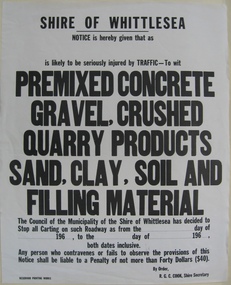
... Shire of Whittlesea / Notice is hereby given that as / is likely to be seriously injured by traffic - to wit / soil, clay, sand or stone carting / The Council of the Municipality of the Shire of Whittlesea has decided to / stop all carting on such roadway as from the - day of / - 196 - , to the - day of - 196 - , / both dates inclusive / Any person who contravenes or fails to observe the provisions of this / notice shall be liable to a penalty of not more than forty dollars ($40) / By order / R G C Cook, Shire Secretary / Reservoir Printing Works...public notices Shire of Whittlesea / Notice is hereby given that as / is likely to be seriously injured by traffic - to wit / soil, clay, sand or stone carting / The Council of the Municipality of the Shire of Whittlesea has decided to / stop all carting on such roadway as from the - day of / - 196 - , to the - day of - 196 - , / both dates inclusive / Any person who contravenes or fails to observe the provisions of this / notice shall be liable to a penalty of not more than forty dollars ($40) / By order / R G C Cook, Shire Secretary / Reservoir Printing Works Linen with black print Notice given to stop carting on roadway Sign Shire of Whittlesea Notice Reservoir Printing Works ...Shire of Whittlesea / Notice is hereby given that as / is likely to be seriously injured by traffic - to wit / soil, clay, sand or stone carting / The Council of the Municipality of the Shire of Whittlesea has decided to / stop all carting on such roadway as from the - day of / - 196 - , to the - day of - 196 - , / both dates inclusive / Any person who contravenes or fails to observe the provisions of this / notice shall be liable to a penalty of not more than forty dollars ($40) / By order / R G C Cook, Shire Secretary / Reservoir Printing Workspublic notices -
 City of Whittlesea
Sign (item) - Shire of Whittlesea Notice, Notice given to stop carting on roadway - sand
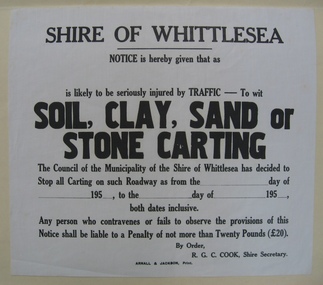
... Shire of Whittlesea / Notice is hereby given that as / is likely to be seriously injured by traffic - to wit / soil, clay, sand or stone carting / The Council of the Municipality of the Shire of Whittlesea has decided to / stop all carting on such roadway as from the - day of / - 195 - , to the - day of - 195 - , / both dates inclusive / Any person who contravenes or fails to observe the provisions of this / notice shall be liable to a penalty of not more than twenty pounds (20) / By order / R G C Cook, Shire Secretary / Arnall & Jackson, Print...public notices Shire of Whittlesea / Notice is hereby given that as / is likely to be seriously injured by traffic - to wit / soil, clay, sand or stone carting / The Council of the Municipality of the Shire of Whittlesea has decided to / stop all carting on such roadway as from the - day of / - 195 - , to the - day of - 195 - , / both dates inclusive / Any person who contravenes or fails to observe the provisions of this / notice shall be liable to a penalty of not more than twenty pounds (20) / By order / R G C Cook, Shire Secretary / Arnall & Jackson, Print Notice printed on drafting linen, black text. ...Shire of Whittlesea / Notice is hereby given that as / is likely to be seriously injured by traffic - to wit / soil, clay, sand or stone carting / The Council of the Municipality of the Shire of Whittlesea has decided to / stop all carting on such roadway as from the - day of / - 195 - , to the - day of - 195 - , / both dates inclusive / Any person who contravenes or fails to observe the provisions of this / notice shall be liable to a penalty of not more than twenty pounds (20) / By order / R G C Cook, Shire Secretary / Arnall & Jackson, Printpublic notices -
 Alfred Hospital Nurses League - Nursing History Collection
Book - Illustrated textbook, St John Ambulance Association, Home nursing, 1941
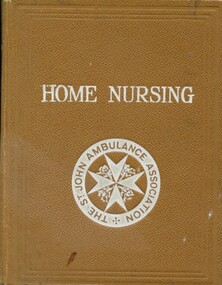
... The St John Ambulance Association was established in 1877, first edion of this book was published in the late 1800's Gives insight into first aid practice in the 1930's First aid St John Ambulance Vintage book designed to teach individuals how to nurse an invalid or injured person in their home when professional help might not be immediately available On front endpage there is a handwritten name [?] ...Vintage book designed to teach individuals how to nurse an invalid or injured person in their home when professional help might not be immediately availableIllustrated textbook with light brown leather binding. Front cover has an embossed border, white print detailing title and the emblem of the St John Ambulance Association. Title, edition and 'S.J.A.A.' are printed in white on spine.non-fictionVintage book designed to teach individuals how to nurse an invalid or injured person in their home when professional help might not be immediately availablefirst aid, st john ambulance -
 Ballarat Tramway Museum
Document - Photocopy, Alan Bradley, "Man Injured", Apr. 2005
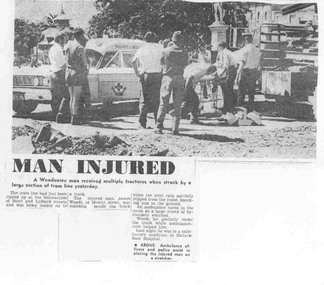
... person. Trams tramways Closure Demolition Track Removal Sturt St Photocopy of an article in The Courier, 10-2-1972, titled "Man Injured", regarding the injury of James Wood of Wendouree, when a rail partially slipped from the crane and trapping him during the removal of the rails at the intersection of Sturt and Lydiard St corner the previous day. ...Yields information about the removal of the tram track and consequences of poor practices that led to the injury of a person.Photocopy of an article in The Courier, 10-2-1972, titled "Man Injured", regarding the injury of James Wood of Wendouree, when a rail partially slipped from the crane and trapping him during the removal of the rails at the intersection of Sturt and Lydiard St corner the previous day. Has a photo of the ambulance vehicle and people looking on..trams, tramways, closure, demolition, track removal, sturt st -
 Sunshine and District Historical Society Incorporated
Archive - Sunshine Railway Disaster
... |Typed Timetable Victorian Railways December 1865|Typed Booklet The Sunshine Railway Disaster by John Buckland Easter Monday 20 April 1908|Newspaper Article Move on disaser Advocate 27 March 2001|Typed Poem In Memory of the Sunshine Railwa Disaster composed and written by Patrick Hassett|Newspaper Article The Age 21 April 1908 Terrible Railway Disaster|Newsletter Newsrail June 1998 Sunshine Station Disaster Memorial|Newspaper Article Brimbank Messenger 8 September 1998 Technology signaling new rail era|Brochure St Albans to Sydenham Rail Electrification Project Bulletin 3 December 2001|Map Railway Map of Victoria 1908|Newspaper Article Brimbank Independent 10 November 1998 Memorial to mark rail crash disaster|Newspaper Article Brimbank Messenger 21 April 1998 Horror Smash recalled|Newspaper Article The Advocate 18 November 1998 Moving tribute|Newspaper Article The Advocate 20 March 2001 Crash tragedy haunts station|Typed Report Sunshine Rail Disaster 20 April 1908 List of Person killed and injured. Addresses included. Research by Jan Withers 1990|Typed Report Sunshine Rail Disaster Commemoration Service Monday 10:30pm 20 April 1998 90th Anniversary program Compiled by Tom Rigg|Typed Report of Names of People Killed in the Sunshine Accident Easter Monday 20 April 1908 and where they are buried|Photocopy Death certicates of the 44 people killed in the Sunshine Rail Disaster on Easter Monday 20 April 1908|Artwork of Newspaper Article Terrible Railway disaster|Flyer Official unveiling of a plaque laid in memory of 44 people who died in the Sunshine Rail Disaster Easter Monday 20 April 1908 occurring Suunday 15 November 1998|Photocopy of Report of Coroners Inquest 18 May 1908|Book The Sunshine Railway Disaster...|Typed Timetable Victorian Railways December 1865|Typed Booklet The Sunshine Railway Disaster by John Buckland Easter Monday 20 April 1908|Newspaper Article Move on disaser Advocate 27 March 2001|Typed Poem In Memory of the Sunshine Railwa Disaster composed and written by Patrick Hassett|Newspaper Article The Age 21 April 1908 Terrible Railway Disaster|Newsletter Newsrail June 1998 Sunshine Station Disaster Memorial|Newspaper Article Brimbank Messenger 8 September 1998 Technology signaling new rail era|Brochure St Albans to Sydenham Rail Electrification Project Bulletin 3 December 2001|Map Railway Map of Victoria 1908|Newspaper Article Brimbank Independent 10 November 1998 Memorial to mark rail crash disaster|Newspaper Article Brimbank Messenger 21 April 1998 Horror Smash recalled|Newspaper Article The Advocate 18 November 1998 Moving tribute|Newspaper Article The Advocate 20 March 2001 Crash tragedy haunts station|Typed Report Sunshine Rail Disaster 20 April 1908 List of Person killed and injured. Addresses included. Research by Jan Withers 1990|Typed Report Sunshine Rail Disaster Commemoration Service Monday 10:30pm 20 April 1998 90th Anniversary program Compiled by Tom Rigg|Typed Report of Names of People Killed in the Sunshine Accident Easter Monday 20 April 1908 and where they are buried|Photocopy Death certicates of the 44 people killed in the Sunshine Rail Disaster on Easter Monday 20 April 1908|Artwork of Newspaper Article Terrible Railway disaster|Flyer Official unveiling of a plaque laid in memory of 44 people who died in the Sunshine Rail Disaster Easter Monday 20 April 1908 occurring Suunday 15 November 1998|Photocopy of Report of Coroners Inquest 18 May 1908|Book The Sunshine Railway Disaster Large collection of documents & reports relating to the Sunshine Railway Disaster Archive Sunshine Railway Disaster ...Typed Report on the Sunshine Station Smash Inquest began 4 May 1908|Typed Report The Sunshine Station Smash Easter Monday 20th April 1908|Typed Report Sunshine Railway Station Part 3 Railway Disaster by Tom Rigg|Typed Report Sunshine Railway Disaster by Tom Rigg|Typed Report Sunshine Railway Disaster 20th April 1908 Some Highlights|Typed Report The Sunshine Station Smash|Typed Report Names of People killed in the Sunshine Accident Easter Monday 20th April 1908|Photocopy of An Act to authorize the construction of certain lines of Railway by the State 29 December 1880. Fifteenth Schedule Footscray to Bacchus Marsh Railway Construction.|Typed Tender for Railway Works Report of the Professional Board appointed to examine and compare the tenders submitted for the Proposed Raiilway Works|Handwritten notes Melbourne to St Albans construction|Continuous paper Report Staff at Sunshine Railway Station Historical|Photograph of Mural at Tin Shed St Albans taken by thomastowns leading photographer Hans Jobe Roysted 20 April 2000|Typed Report Taken from the Secretary for Railways Correspondence Books Series 422|Typed Report Sunshine Rail Disaster Unveiling of the Plaque Sunshine Station 15 November 1998 10:00am|Typed Report Press Release by Tom Rigg 20 April Sunshine Historical Society placed a Wreath on the plaque on the Melbourne side of the Sunshine Railway Platform. It is now 95 years since the accident.|Typed Timetable Victorian Railways December 1865|Typed Booklet The Sunshine Railway Disaster by John Buckland Easter Monday 20 April 1908|Newspaper Article Move on disaser Advocate 27 March 2001|Typed Poem In Memory of the Sunshine Railwa Disaster composed and written by Patrick Hassett|Newspaper Article The Age 21 April 1908 Terrible Railway Disaster|Newsletter Newsrail June 1998 Sunshine Station Disaster Memorial|Newspaper Article Brimbank Messenger 8 September 1998 Technology signaling new rail era|Brochure St Albans to Sydenham Rail Electrification Project Bulletin 3 December 2001|Map Railway Map of Victoria 1908|Newspaper Article Brimbank Independent 10 November 1998 Memorial to mark rail crash disaster|Newspaper Article Brimbank Messenger 21 April 1998 Horror Smash recalled|Newspaper Article The Advocate 18 November 1998 Moving tribute|Newspaper Article The Advocate 20 March 2001 Crash tragedy haunts station|Typed Report Sunshine Rail Disaster 20 April 1908 List of Person killed and injured. Addresses included. Research by Jan Withers 1990|Typed Report Sunshine Rail Disaster Commemoration Service Monday 10:30pm 20 April 1998 90th Anniversary program Compiled by Tom Rigg|Typed Report of Names of People Killed in the Sunshine Accident Easter Monday 20 April 1908 and where they are buried|Photocopy Death certicates of the 44 people killed in the Sunshine Rail Disaster on Easter Monday 20 April 1908|Artwork of Newspaper Article Terrible Railway disaster|Flyer Official unveiling of a plaque laid in memory of 44 people who died in the Sunshine Rail Disaster Easter Monday 20 April 1908 occurring Suunday 15 November 1998|Photocopy of Report of Coroners Inquest 18 May 1908|Book The Sunshine Railway Disastersunshine railway disaster, sunshine railway station, railway, sunshine -
 Clunes Museum
Medal - MEDALS
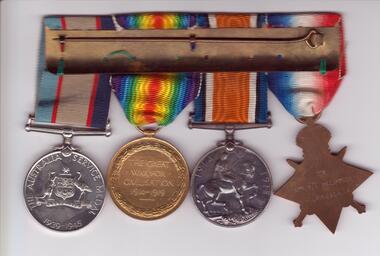
... injured during duty and had continual problems with his knee. He was returned to Australia on 10/9/1917 following several appearances before the Medical Board of the Australian Military Offices of London and Kent in the United Kingdom. The termination of his appointment was effected on 4/3/1918 and he was medically discharged from the AIF. L-R .4 The Australia Service Medal 1939-1945 was instituted in 1949 to recognise the service of members of the Australian Armed Forces and the Australian Mercantile Marine during World War II. .3 The Victory Medal was awarded to prescribed classes of persons...injured during duty and had continual problems with his knee. He was returned to Australia on 10/9/1917 following several appearances before the Medical Board of the Australian Military Offices of London and Kent in the United Kingdom. The termination of his appointment was effected on 4/3/1918 and he was medically discharged from the AIF. L-R .4 The Australia Service Medal 1939-1945 was instituted in 1949 to recognise the service of members of the Australian Armed Forces and the Australian Mercantile Marine during World War II. .3 The Victory Medal was awarded to prescribed classes of persons ...Milton Arthur Williamson was born in Clunes, Victoria and enlisted at 22 years and 5 months on 29/3/1915. He embarked for Alexandria on 30/8/1915. He was injured during duty and had continual problems with his knee. He was returned to Australia on 10/9/1917 following several appearances before the Medical Board of the Australian Military Offices of London and Kent in the United Kingdom. The termination of his appointment was effected on 4/3/1918 and he was medically discharged from the AIF. L-R .4 The Australia Service Medal 1939-1945 was instituted in 1949 to recognise the service of members of the Australian Armed Forces and the Australian Mercantile Marine during World War II. .3 The Victory Medal was awarded to prescribed classes of persons who entered a theatre of war on duty between 5 August 1914 and 11 November 1918. .2 The British War Medal instituted by King George V in 1919 to mark the end of World War I and record the service given. *PTE SS WILLIAMSON 1 The 1914–15 Star was authorised in 1918 and was awarded for service in specified theatres of war between 5 August 1914 and 31 December 1915.4 MEDALS : L-R WITH RIBBONS .1 BRONZE : STAR SHAPED MEDAL 1914-1915 ON BANNER. BACK 1112 SPR M A WILLIAMSON 2/ DIV SIG COY AIF .2 PEWTER - ROUND MEDAL FACE OF GEORGE V 0 BACK 1914-1918 NUDE MAN ON HORSE WITH 2 FEET OFF GROUND. RIM : 636 PTE SS WILLIAMSON 8 BN AIF .3 ROUND MEDAL ANGEL IS HOLDING A PALM BRANCH. BACK : ENCIRCLED BY WREATH - THE GREAT WAR FOR CIVILISATION 1914-1919 .4 ROUND SILVER MEDAL PROFILE OF GEORGE VI. BACK : AUSTRALIAN COAT OF ARMS ENCIRCLED BY THE AUSTRALIAN SERVICE MEDAL 1939-1945 RIM : W 71800 A M WILLIAMSON RIBBON NAVY, RED, BEIGE, SKY BLUElocal history, numismatics, medals, military -
 Ballarat Heritage Services
Document - Newspaper article, Death Reveals Secret, 1880s
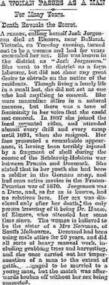
... injured by a fragment of shell during the course of the Schlewig-Holstein war between Prussia and Denmark. She stated that in her youth she had been a soldier in the german army, and had seen active service in the Franco-Prussian war of 1870. Jorgensen was a Dane and so far as is known had no relative here. Her sex was disclosed only after her death, the only person...injured by a fragment of shell during the course of the Schlewig-Holstein war between Prussia and Denmark. She stated that in her youth she had been a soldier in the german army, and had seen active service in the Franco-Prussian war of 1870. Jorgensen was a Dane and so far as is known had no relative here. Her sex was disclosed only after her death, the only person ...A person calling herself Jack Jorgenson died at Elmore near Ballarat, Victoria on Tuesday evening, turned out to be a woman and had for years concealed her sex. She was known in the district as "Jack Jorgenson". she went to the district as a farm labourer but did not show any great desire to obtrude on the notice of the residents. Though living a lonely life in a small hut, she did not act as one who had anything to conceal. She wore masculine attire in a natural manner, but thee was a tone of femininity in her voice that she could not conceal. In 1887 she joined the local mounted rifles, and attended almost every drill and every camp until 1891, when she resigned. Her face presented a remarkable appearance, it having been terribly injured by a fragment of shell during the course of the Schlewig-Holstein war between Prussia and Denmark. She stated that in her youth she had been a soldier in the german army, and had seen active service in the Franco-Prussian war of 1870. Jorgensen was a Dane and so far as is known had no relative here. Her sex was disclosed only after her death, the only person knowing of it being Dr H..se of Elmore, who attended her some time since. The woman is believed to be the sister of a Mrs Newman of South Melbourne. Deceased had been using male attire for 20 years, and did all sorts of heavy manual work, including grubbing trees and harvesting and she once ...Newspaper clippingjack jorgenson, elmore, dane, cross dressing -
 Unions Ballarat
Workers' inferno: The untold story of the Esso workers 20 years after the explosion, 2018
... injured. The fire burned for two days. Gas supply to most customers (apart from essential services) was cut off for a significant period of time. A Royal Commission was subsequently established, during which Esso sought to minimise its own responsibility for the incident and cast blame upon the individual operators. The book is principally a story of and from the those persons...injured. The fire burned for two days. Gas supply to most customers (apart from essential services) was cut off for a significant period of time. A Royal Commission was subsequently established, during which Esso sought to minimise its own responsibility for the incident and cast blame upon the individual operators. The book is principally a story of and from the those persons ...This book an exposition of a workplace tragedy at an Esso operation (a subsidiary of Exxon Corporation) at Longford, Victoria in 1998. A piece of processing equipment exploded and caught fire. Two workers were killed and many others were injured. The fire burned for two days. Gas supply to most customers (apart from essential services) was cut off for a significant period of time. A Royal Commission was subsequently established, during which Esso sought to minimise its own responsibility for the incident and cast blame upon the individual operators. The book is principally a story of and from the those persons who were impacted by the Longford incident.Workplace health and safety. Biographical interest.Book with bookmark; 199 pages. Cover: blue background; white, yellow and black lettering; author's name and title. btlc, ballarat trades hall, ballarat trades and labour council, biography, local history, occupational health and safety, workplace safety, esso, exxon corporation, gas, royal commissions -
 Royal District Nursing Service (now known as Bolton Clarke)
Photograph - Photograph, black and white, c.1905
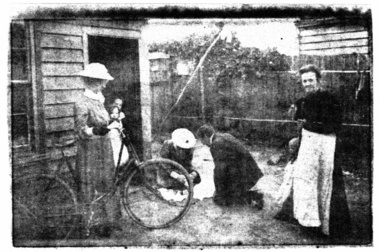
... The Nurses gave medications as ordered by a Doctor, dressed wounds e.g. to the injured, and surgical cases, and to those with leg ulcers; attended to patients with ‘surgical ailments’ such as ‘hip disease’; gave care to those with acute illnesses such as bronchitis, pleurisy, pneumonia, measles, and scarlet fever, as well as those with chronic illnesses such as consumption (tuberculosis), heart disease, arthritis, cancer, debility, neuritis and paralysis. The Nurses liaised with the person's ...This photograph shows Melbourne District Nursing Society (MDNS) Trained Nurses (known as 'Nurse' in those days) attending to a family in the early 1900s. It also shows their uniform which had a red Maltese cross in the centre of the pith helmet. The bicycle seen is the first mode of transport purchased by MDNS in 1903. The Nurse's bag is seen strapped to the handles of the bicycle. In February 1885, 50 years after Melbourne was founded, it was recognized that nursing care was needed for the sick poor in inner Melbourne. The Melbourne District Nursing Society (MDNS), the first District Nursing Society in Australia, was founded and the decision was made to only employ fully qualified nurses who had trained in a Hospital. In those days they were known as 'Nurse'. One Trained nurse, was employed in March, and a second employed six months later. They worked in the now CBD, ie from Spencer Street to Spring Street and from Victoria Parade to Flinders Street. From its inception the Society was at the forefront of health care and only attended patients seen by a Doctor. They provided high quality nursing care; educated their patients in the curing and prevention of disease; teaching the importance of cleanliness, ventilation and good nutrition, both by verbal instruction and demonstration, even supplying soup and milk when needed. At that time they walked the streets and lane ways amid the slums of inner Melbourne carrying their nursing bag containing lotion, ointments, powders, liniment, bandages, dressings, a case of spirits, and the Nurse's own clean apron, soap and small towel. They supplied equipment on loan, such as earthenware hot water bottles, splints, urinals, bed pans, bed cradles, feeding mugs, and air-cushions as well as providing blankets and clean bed linen, and nightdresses as necessary. Trained midwives began home births in late 1893 taking midwifery bundles and providing clothes for the babe and mother as needed. This was arduous work, particularly in the heat of summer. Permission to use bicycles was given to the Nurses in 1898 and the Society decided to purchase their own in 1903. A business man offered ‘new free wheel’ bicycles at £13 each which included maintenance for one year. Bells and wooden frames were added, at a cost of £5 per frame, so the Nurses could carry extra equipment. Nurses’ bags were strapped to the handlebars. Soup was made for those in need 2-3 times a week and if patients could not arrange to have it collected the soup was delivered by the Nurses on their bicycles. The use of bicycles caused a change in uniform, with white pith helmets, and veils covering them and tied under their chin, now being used. Over the years the Nurses complained their veils became wet in the rain and asked for a change of uniform but this did not occur until 1921. Bicycles continued to be used in inner areas until 1945. The Nurses provided high quality nursing care to a range of people often in destitute situations, some lying on rags on the floor as they had no bed, others with just a bed and maybe a thin blanket, a chair and nothing else. Their ages ranged from babes, children, adults to the elderly. The Nurses gave medications as ordered by a Doctor, dressed wounds e.g. to the injured, and surgical cases, and to those with leg ulcers; attended to patients with ‘surgical ailments’ such as ‘hip disease’; gave care to those with acute illnesses such as bronchitis, pleurisy, pneumonia, measles, and scarlet fever, as well as those with chronic illnesses such as consumption (tuberculosis), heart disease, arthritis, cancer, debility, neuritis and paralysis. The Nurses liaised with the person's Doctor. They educated their patients, and their Carers, in the curing and prevention of disease; teaching the importance of hygiene, cleanliness, ventilation and good nutrition. They taught them, by verbal instruction and demonstration, how to make poultices, to make and apply bandages, apply medical appliances such as splints; and the Nurses supplied milk, beef tea and cooked soup when needed. As the work increased a third Nurse was employed but this was arduous work, particularly in the heat of summer and many Nurses only remained with the Society for several months. Black and white photograph of two Melbourne District Nursing Society (MDNS) Trained nurses, 'Nurse', wearing their full length grey uniforms, with white collar, cuffs and belt, and white pith helmets with a Maltese cross applied. One Nurse is standing and holding her bicycle, while the other is kneeling and holding a small child. They are in the garden behind a horizontal weatherboard house. A man dressed in dark clothes is also kneeling beside the child. There is a child, dressed in white, in the doorway of the home, and a lady, dressed in a full length black dress and a white apron, is standing in front of the wooden fence in the garden. The bicycle has two large wire spoked wheels at either end of the black V shape bicycle frame; a rubber tyre runs around the outside of each wheel. The metal handlebars are a horizontal configuration and are attached with a central column into a black vertical column at the front of the V shape bicycle frame which has ‘fork shaped’ thin metal pierces running down either side of the wheel attaching the frame to the central hub of the wheel. The rear wheel is attached the same way to a central column at the rear of the frame which runs up to V shape solid seat. At the bottom of the V of the frame a pedal is attached with a rotating arm on either side of the bicycle and on the right side the rotating arm is attached to a sprocket which has a chain running around it back to a smaller sprocket on the hub of the back wheel. The chain has a thin metal guard over it. There are narrow thin metal mud guards running a short distance above the top of each wheel.melbourne district nursing society, mdns, mdns uniforms, mdns transport, rdns, royal district nursing service -
 Falls Creek Historical Society
Equipment - Ski Patrol Akja
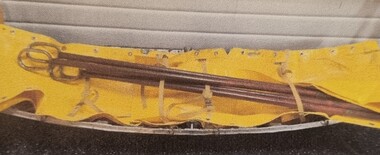
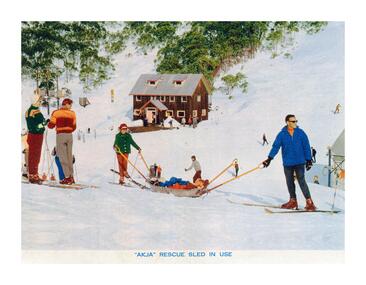
... These sleds were designed in Finland for transporting a person or goods on snowy or icy surfaces. At Falls Creek they were used by the Ski Patrol to evacuate an injured skier or snowboarder to the medical centre. ...These sleds were designed in Finland for transporting a person or goods on snowy or icy surfaces. At Falls Creek they were used by the Ski Patrol to evacuate an injured skier or snowboarder to the medical centre. ..."AKJA" sled. These sleds were designed in Finland for transporting a person or goods on snowy or icy surfaces. At Falls Creek they were used by the Ski Patrol to evacuate an injured skier or snowboarder to the medical centre. They could be attached to the back of a snowmobile or pulled by two patrollers holding the attached metal arms.A stretcher used in mountain rescue. It is shaped like an elongated boat-like pan, usually made of aluminum or fiberglass with vaulted ends. Each end can be attached to forked extending handles allowing it to be easily pulled across the snow.falls creek ski patrol, ski rescue -
 Falls Creek Historical Society
Postcard - "AKJA" Sled in use, Falls Creek
... These sleds were designed in Finland for transporting a person or goods on snowy or icy surfaces. At Falls Creek they were used by the Ski Patrol to evacuate an injured skier or snowboarder. ...These sleds were designed in Finland for transporting a person or goods on snowy or icy surfaces. At Falls Creek they were used by the Ski Patrol to evacuate an injured skier or snowboarder. ...These photographs were taken in and around Falls Creek by Samuel Keith Pearce and printed for him as a foldout postcard by NuColor Vue. The postcards state they were printed for S. K. Pearce Pty. Ltd of Tawonga and Mount Beauty. Samuel Keith Pearce was born on 24 June 1917 in Armadale, Victoria. By the late 1940s he owned the Mt Beauty Supermarket, Newsagency, Drapery and Hardware store at Mount Beauty and also a store at Tawonga in partnership with his brother Gordon Cathew Pearce. For some time, they operated as Pearce Brothers. In the early 1960s Keith also opened a mini mart In Falls Creek. As well as being a keen photographer and an astute businessman, Keith Pearce was a well-known identity in the Kiewa Valley, making many contributions to the development of the area over a long period. This included serving as a member of the Bright Shire Council for many years. He worked hard to promote the interests of the Upper Kiewa Valley. As a sign of recognition and appreciation for his contribution to the community, the park opposite the grocery store in Mount Beauty was named the SK Pearce Gardens in his honour. Samuel Keith Pearce died on 7 July 1994 in Mount Beauty, VictoriaThis collection of postcards and image is significant because they were commissioned by a highly successful business in Falls Creek, Victoria.A postcard featuring two skiers guiding an "AKJA" sled. These sleds were designed in Finland for transporting a person or goods on snowy or icy surfaces. At Falls Creek they were used by the Ski Patrol to evacuate an injured skier or snowboarder. astra falls creek, falls creek accommodation, falls creek businesses -
 Alfred Hospital Nurses League - Nursing History Collection
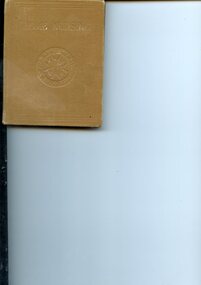
Book - Illustrated textbook, St John Ambulance Association, Home nursing, 1939
... The St John Ambulance Association was established in 1877, first edion of this book was published in the late 1800's Gives insight into first aid practice in the 1930's First aid St John Ambulance Vintage book designed to teach individuals how to nurse an invalid or injured person in their home when professional help might not be immediately available On front endpage there is a handwritten name [F Bennett] Illustrated textbook with light brown clothbinding. ...Vintage book designed to teach individuals how to nurse an invalid or injured person in their home when professional help might not be immediately availableIllustrated textbook with light brown clothbinding. Front cover has an embossed border, title and the emblem of the St John Ambulance Association, some traces of white ink remain. non-fictionVintage book designed to teach individuals how to nurse an invalid or injured person in their home when professional help might not be immediately availablefirst aid, st john ambulance -
 Alfred Hospital Nurses League - Nursing History Collection
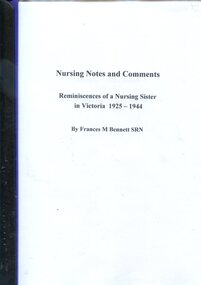
Booklet - Illustrated Booklet, Frances M Bennett, Nursing notes and comments - reminiscences of a nursing sister in Victoria 1925-1944, 2021
... Additonal background information (author unknown) and photographs have been included Gives insight into nursing training at the Alfred Hospital in the 1920's Nursing Alfred Hospital Frances Bennett Vintage book designed to teach individuals how to nurse an invalid or injured person in their home when professional help might not be immediately available Photogrraphs have handwritten annontaions [black ink} Illustrated booklet, black print on white paper. ...Frances M Bennett (known to her family as May) was born in 1901. She completed her general nursing training at the Alfred Hospital, Melbourne in 1925. Frances gained further qualifications in Midwifery and Infant Welfare. After qualification she worked in private hospitals and Infant Welfare Centres, before retiring from nursing upon her marriage in 1945. Frances wrote these notes in 1945 detailing various aspects of her nusing career. Additonal background information (author unknown) and photographs have been includedGives insight into nursing training at the Alfred Hospital in the 1920'sIllustrated booklet, black print on white paper. Booklet has been bound in a plastic folder - clear front cover black back cover and spinenon-fictionPhotogrraphs have handwritten annontaions [black ink}nursing, alfred hospital, frances bennett -
 Bendigo Historical Society Inc.
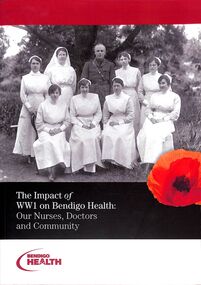
Book - "The Impact of WW1 on Bendigo Health: Our nurses, Doctors and Community.", 1914
... persons enlisted to serve in World War One out of a population of 5 million. The Australian Government recorded 215,585 casualties during the war. Over 80% of those casualties occurred on the Western Front, in Belgium and France. The weapons used in trench warfare created horrendous injuries for both sides in the war. In the Australian Imperial Force (AIF), for example, most wounds were the result of flying metal. During their service, many of the 331,781 AIF troops and medical staff were injured...persons enlisted to serve in World War One out of a population of 5 million. The Australian Government recorded 215,585 casualties during the war. Over 80% of those casualties occurred on the Western Front, in Belgium and France. The weapons used in trench warfare created horrendous injuries for both sides in the war. In the Australian Imperial Force (AIF), for example, most wounds were the result of flying metal. During their service, many of the 331,781 AIF troops and medical staff were injured ...Over 4000 Bendigo residents enlisted to serve in W.W. 1. Much is known about their contributions to the war effort, but less is known about the contributions made by the medical staff who provided care at the front lines or otherwise supported care. People enlisted for many reasons - patriotism, duty and adventure being just a few. Over 416,000 persons enlisted to serve in World War One out of a population of 5 million. The Australian Government recorded 215,585 casualties during the war. Over 80% of those casualties occurred on the Western Front, in Belgium and France. The weapons used in trench warfare created horrendous injuries for both sides in the war. In the Australian Imperial Force (AIF), for example, most wounds were the result of flying metal. During their service, many of the 331,781 AIF troops and medical staff were injured more than once: over 50% were hit by shell fragments or shrapnel bullets from artillery fire 40% were hit by high-velocity bullets from rifles or machine guns 12% were affected by chlorine or mustard gas 2% were hit by bombs or grenades only 0.3% suffered bayonet wounds Many health risks also developed into large-scale problems on the front. Those who served lived and work in crowded spaces, which helped to spread bacterial, viral and parasitic infections. Unhealthy living conditions for soldiers (and sailors) included: poor diet lack of sleep exposure to cold contact with mice, rats, fleas, lice and other parasites. Soft cover. 41pp. Black and white image of nurses on front cover, along with red poppy. Tile written in white to bottom third of front cover on black background. Bendigo Health logo to bottom of front cover. Back cover has image of signage for the 'Old Mortuary' of Bendigo Hospital, with burgundy, black and white stipes above and below image. Contains black and white and color images. soldiers, world war one, british empire, doctors, nurses, bendigo hospital
