
Showing 32 items matching "john mccrae"
-
![John F. McCrae, Mayor [of Kew] 1910-11](/media/collectors/550653872162f11fb04854aa/items/59229159d0cf110e040be34a/item-media/5c1db9ec21eaad0dec95cb15/item-fit-380x285.jpg?cb=6) Kew Historical Society Inc
Kew Historical Society IncPhotograph, J E Barnes, John F. McCrae, Mayor [of Kew] 1910-11, 1910
... John F. McCrae, Mayor [of Kew] 1910-11......cr. john f. mccrae...Framed portrait of Cr. John F. McCrae, Mayor of Kew 1910-11. The mounting and framing of the photograph follows a typical layout or style in that each is framed in dark wood, glazed, and laid down on an inscribed board. ...[Inscription] "John F. McCrae, Mayor 1910-11" [Photographer] "J.E. ...McCrae, Mayor 1910-11" [Photographer] "J.E. Barnes / Kew" Framed portrait of Cr. John F. ...Kew achieved independence from the Boroondara Roads Board in 1860. As a new municipality, its first three leaders were designated as chairmen. On becoming a borough in 1863, its leaders were identified as mayors. The earliest photographs date from ca.1906, when the Town of Kew commissioned the noted local photographer Josiah E Barnes to produce standardised portraits of former mayors to be displayed in the Mayoral Chamber of the Town Hall. The collection also includes photographs by other well-known photographic studios such as Burlington Studios, Melba – Melbourne, Stuart Tompkins, Spencer Shier and Talma & Co. The majority of mounts identify the photographer. Eighty photographs are housed in their original frames.This portrait is one of a series of mounted and framed photographic portraits of mayors and town clerks of the former Borough, Town and City of Kew. The portraits were transferred by the City of Kew to the Kew Historical Society in March 1989. A Significance Assessment in 2018, funded by the National Library of Australia confirmed the historic, and often artistic significance of the series.Framed portrait of Cr. John F. McCrae, Mayor of Kew 1910-11. The mounting and framing of the photograph follows a typical layout or style in that each is framed in dark wood, glazed, and laid down on an inscribed board. The inscription identifies the name of the mayor and the year/s that he/she served.[Inscription] "John F. McCrae, Mayor 1910-11" [Photographer] "J.E. Barnes / Kew"mayors of kew (vic), cr. john f. mccrae, australian photographers - josiah earl barnes, kew (vic.) — municipal collection -
 Returned Nurses RSL Sub-branch
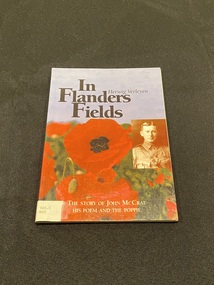
Book - Illustrated paperback book, Herwig Verleyen, In Flanders Fields: the story of John McCrae his poem and the poppie, unknown
... In Flanders Fields: the story of John McCrae his poem and the poppie.......John McCrae...WW1 WWI First World War John McCrae Flanders war poem poppy This is the life story of John McCrae, the writer of the famous First World War poem, 'In Flanders Fields'. ...This is the life story of John McCrae, the writer of the famous First World War poem, 'In Flanders Fields'. It also describes how the poem became famous throughout the world and as a result, how the poppy flower became universally recognised as a symbol of peace and sacrifice.Blue paperback book. Image of red poppies across the lower half wraps around entire cover. White spine label at base of spine attached with tape. Title printed in white along spine. Top half of the front cover has title and author printed in black ink. On the centre right side is a sepia image of a man in uniform.non-fictionThis is the life story of John McCrae, the writer of the famous First World War poem, 'In Flanders Fields'. It also describes how the poem became famous throughout the world and as a result, how the poppy flower became universally recognised as a symbol of peace and sacrifice.ww1, wwi, first world war, john mccrae, flanders, war poem, poppy -
 Bendigo Military Museum
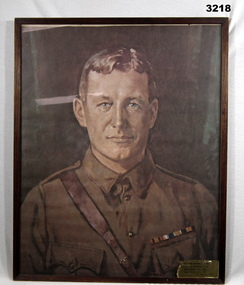
Painting - PORTRAIT, FRAMED, post WW1
... Lt Col John McCRAE BA MD Born Guelph, Ontario, Canada 1872. ...Head & shoulders colour portrait of Lt Col John McCRAE in jacket with Sam Brown strap & colour bar over LH pocket. ...Lt Col John McCRAE BA MD Born Guelph, Ontario, Canada 1872. ...Lt Col John McCRAE BA MD Born Guelph, Ontario, Canada 1872. Died France OAS 1918.Head & shoulders colour portrait of Lt Col John McCRAE in jacket with Sam Brown strap & colour bar over LH pocket. No head gear. In brown wooden frame with glass front. Brown paper & cardboard backing.passchendaele barracks trust, framed, painting -
 Melbourne Legacy
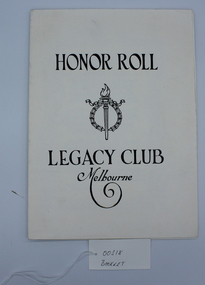
Booklet, HONOR ROLL, LEGACY CLUB MELBOURNE
... "The Torch"; Legacy logo by Col. John McCrae. KIA Flanders 1916. (The Badge of Legacy) LEGACY CLUB Page 2, "The Spirit of Legacy" MELBOURNE..."The Torch"; Legacy logo by Col. John McCrae. KIA Flanders 1916. (The Badge of Legacy) LEGACY CLUB Page 2, "The Spirit of Legacy" MELBOURNE Booklet of white cardboard and white pages with black type and Legacy logo printed in black. ...This booklet is used as a template for the Honor Roll book on display at Legacy House, refer to item 00312. It contains a copy of 'In Flanders Field', with an explanation of symbolism of The Torch and The Spirit of Legacy. The Honour Roll is a record, made in honour of deceased Legatees, who have given service to the cause of Legacy. Significant in that this template is used for the Honor Roll books of deceased Legatees.Booklet of white cardboard and white pages with black type and Legacy logo printed in black.Front cover, HONOR ROLL Page 1, Poem. "In Flanders Fields" Page 2, Poem. "The Torch"; Legacy logo by Col. John McCrae. KIA Flanders 1916. (The Badge of Legacy) LEGACY CLUB Page 2, "The Spirit of Legacy" MELBOURNEhonour roll, legatees -
 Ringwood and District Historical Society
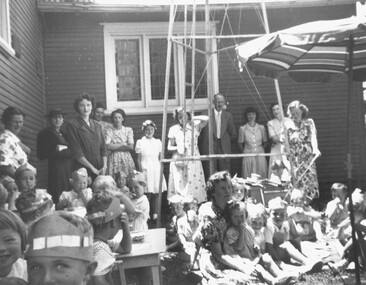
Photograph, 1950 Parish Hall Xmas Party, Church of England, Ringwood Street, Ringwood
... G. Williams, Mr. John McCrae, Mrs. M. McCall, Mrs. McWilliam, Mrs. ...G. Williams, Mr. John McCrae, Mrs. M. McCall, Mrs. McWilliam, Mrs. ...Black anbd white photographTyped below photograph: "1950 - Parish Hall Xmas Party. Mrs. Caughey, Mrs. McCrae Senr. Mr. and Mrs. G. Williams, Mr. John McCrae, Mrs. M. McCall, Mrs. McWilliam, Mrs. Dedman, Mrs. Win Leslie, Director." -
 Melbourne Legacy
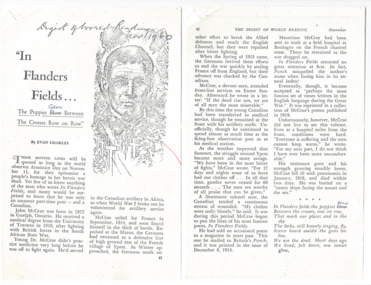
Document - Document, article, In Flanders Fields - Digest of World Reading Nov 1960 (H25), 1960
... An interesting article from the Digest of World Reading about Canadian John McCrae and his famous poem "In Flanders Field". ...An interesting article from the Digest of World Reading about Canadian John McCrae and his famous poem "In Flanders Field". ...An interesting article from the Digest of World Reading about Canadian John McCrae and his famous poem "In Flanders Field". It tells of his war service and how the poem was published in Punch on 8 December 1915. He was in the medical service when he succumbed to pneumonia in January 1918. The journal article was sent to the Legacy Co-Ordinating Council who sent it to the archive. The notation H25 in red pen shows that it was part of the archive project that was trying to capture the history of Legacy. Collected by an earlier archive committee which shows the poem was important to the Legatees. The poem was the inspiration for the torch emblem of Legacy.White A4 photocopy x 3 pages of an article published in 1960 and a letter on Legacy Co-ordinating Council letterhead from 1969.Handwritten H25 in red pen. Letter signed PW Danby, Hon. Secretary of the Legacy Co-Ordinating Council.history, world war one, poem -
 Melbourne Legacy
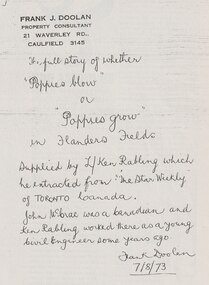
Document, About In Flanders Fields and the man who wrote it
... The article was from 'The Star Weekly' of Toronto about the John McCrae poem. The poem is significant for legacy as the final verse mentions the torch that is used in the Legacy logo. ...The article was from 'The Star Weekly' of Toronto about the John McCrae poem. The poem is significant for legacy as the final verse mentions the torch that is used in the Legacy logo. ...A memo from Legatee Frank Doolan about the poem In Flanders Field and the discussion about the correct wording. There was some discussion about whether it was 'poppies blow' or 'poppies grow'. The article was from 'The Star Weekly' of Toronto about the John McCrae poem. The poem is significant for legacy as the final verse mentions the torch that is used in the Legacy logo. The article was part of an album of past presidents from 1965 to 1989. The folder included biographical details and obituaries, eulogies and death notices of prominent Legatees. The items have been catalogued separately.Details about the poem that inspires the torch symbol of Legacy. The information was collected to record the lives of prominent legatees in a folder.Photocopy of an article in 'The Star Weekly' of Toronto and a memo dated 7/8/1973 from Legatee Frank Doolan about the article.poems, torch -
 Melbourne Legacy
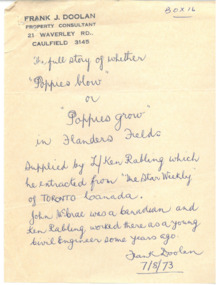
Document, Legatee Frank Doolan notes on the Flanders Field poem, 1970s
... The article discusses the controversy surrounding the wording of the first and penultimate lines and claims that poet John McCrae originally originally wrote 'grow' but changed it to 'blow' when asked to by the editors of 'Punch'. ...The article discusses the controversy surrounding the wording of the first and penultimate lines and claims that poet John McCrae originally originally wrote 'grow' but changed it to 'blow' when asked to by the editors of 'Punch'. ...Photocopy of an article in the 'You asked us' section about 'Flanders Fields, and the man who wrote it' published in The Toronto Star 13 November 1971. The article discusses the controversy surrounding the wording of the first and penultimate lines and claims that poet John McCrae originally originally wrote 'grow' but changed it to 'blow' when asked to by the editors of 'Punch'. The photocopy of the article was supplied by Legatee Ken Rabling. Legatee Frank Doolan signed the note he wrote to accompany the photocopy and dated it 7/8/73. An item from Legatee Frank Doolan, who was on the archive committee and made attempts to collate the history of Legacy. An example of the ongoing controversy surrounding the disputed wording. The poem 'In Flanders Field' was the inspiration for the torch of the Legacy Badge with McCrae's call to the reader to take up The Torch, as the organisation did by looking after the widows and families of fallen soldiers.01302.1 Handwritten signed note in blue ball point, address stamped in black. 01302.2 Photocopy of a page from 'The Star Weekly', Toronto, Canada dated 13 November 1971.01302.1 Top right hand side 'Box 16'poem, history -
 Orbost & District Historical Society
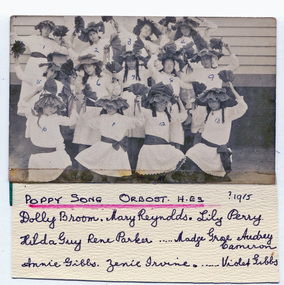
black and white photograph, 1915 ?
... This is probably the song connected with a poem called “In Flanders Fields” written by Major John McCrae, a Canadian surgeon attached to the 1st Field Artillery Brigade and stationed at Ypres salient, Belgium, in the spring of 1915. ...This is probably the song connected with a poem called “In Flanders Fields” written by Major John McCrae, a Canadian surgeon attached to the 1st Field Artillery Brigade and stationed at Ypres salient, Belgium, in the spring of 1915. ...This is a photograph of a group of students of the Orbost Higher Elementary School dressed in costume performing "The Poppy Song:" on a stage. In the photograph are: Dolly Broome; Mary Reynolds; Lily Perry; Hilda Guy; Rene Parker; Madge Grose; Audrey Cameron; Annie Gibbs, Zenie Irvine and Violet Gibbs. This is probably the song connected with a poem called “In Flanders Fields” written by Major John McCrae, a Canadian surgeon attached to the 1st Field Artillery Brigade and stationed at Ypres salient, Belgium, in the spring of 1915. During 1910-11 the first approaches were made to the Department for the establishment of a HES in Orbost and this became a reality in 1912. Orbost HES supplied post-primary education in the district until a high school was built in 1948. Orbost High School / Orbost Secondary College has played a significant part in the education of senior students in the Orbost district . It is the sole senior educational institution. This item is representative of its history.A black / white photograph with a label attached. It is of a group of students in costume on a stage. Each figure has been numbered 1 - 13.on label attached to bottom - "POPPY SONG ORBOST HES ?1915" with a list of names.education-orbost orbost-higher-elementary-school poppy-song -
 Bendigo Historical Society Inc.
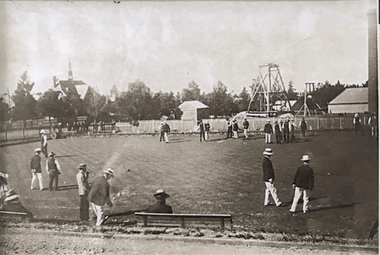
Photograph - SOUTH BENDIGO BOWLING CLUB 1906
... Shareholders 1870: Robert Taylor, Ellen Taylor, Henry Hattam, Michael Cock, Robert Carr, William H. Casey, John McCrae, Joseph Millin, William Moran, Morton Hansen, George W. ...Shareholders 1870: Robert Taylor, Ellen Taylor, Henry Hattam, Michael Cock, Robert Carr, William H. Casey, John McCrae, Joseph Millin, William Moran, Morton Hansen, George W. ...Copy of black and white photograph, South Bendigo Bowling Club 1906. Men on bowling green, dressed in white trousers, dark blazers, straw bowler hats. The spire on LH side is the Congregational church, later a school in Olinda Street, Quarry Hill. Poppet head in background, RH side, is the Cosmopolitan and Summer Hill United Gold Mining company ( registered) on 2nd September 1870. Brick chimney on extreme RH side of photo. Mine not in image, but close by was the Palmerston. The mine was on the Sophia Reef, Manager George Wilsn Froggatt. Shareholders 1870: Robert Taylor, Ellen Taylor, Henry Hattam, Michael Cock, Robert Carr, William H. Casey, John McCrae, Joseph Millin, William Moran, Morton Hansen, George W. Froggatt, John A. Woodward, Robert Moorhead, William Nicholls.bendigo, mining, cosmopolitan anfd summer hil united -
 Melbourne Legacy
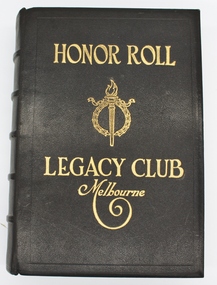
Book, Honor Roll Legacy Club Melbourne
... Pages 4-5 three poems "In Flanders Fields" by Col. John McCrae, KIA Flanders 1916. "The Torch" (The Badge of Legacy). ...Pages 4-5 three poems "In Flanders Fields" by Col. John McCrae, KIA Flanders 1916. "The Torch" (The Badge of Legacy). ...This book is a record, made in honour of deceased Legatees, who have given service to the cause of Legacy. This is labeled Book 3. There are two similar books on display at Legacy House Melbourne.This is a record of Legatees who have given up their spare time to assist the families of deceased service personnel.Black hardcover book, white pages with floral border. Back cover has some scuff marks at the top. Inside front and back cover is decorated with a coloured pattern.Front cover, title and Legacy logo embossed in gold, thin indented rectangular border. Spine has 5 raised horizontal bars set at equal distance down the spine. The raised bars have an indented, horizontal thin line along the top centre and bottom of each bar. These raised bars are interspersed with an indented floral arrangement. At the top and bottom of the spine are two horizontal indented thin lines (2mm apart). Back cover has a thin indented rectangle line as a border. Inside front and back cover, gold embossed border. Pages 4-5 three poems "In Flanders Fields" by Col. John McCrae, KIA Flanders 1916. "The Torch" (The Badge of Legacy). "The Spirit of Legacy". Honor Roll consists of fifty eight pages of deceased Legatees names written boldly, and date of death, in black ink. Thirty two pages pencilled in names of deceased Legatees, waiting to be inked. Remainder of Honor Roll is blank. All pages have a coloured floral border in red with the Legacy logo at the top, centre of the border. honour roll, legatees -
 Federation University Historical Collection
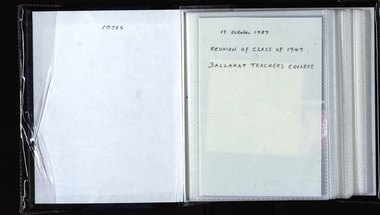
Album - Photo Album, Ballarat Teachers' College Class of 1949 Reunion, 1989, 15/10/1989
... john blackie...wal wall...peter fryar...len mccrae...Ballarat Teachers' College in 1949 was conducted at the Dana Street Primary School jack gervasoni john hogan gervasoni jack dridan jim lannen graham fithall bob lewis max bidges max davies archie campbell ron neville keith lampard pam hudson joan cook neil tippett glad whie maureen fithall john blackie wal wall peter fryar len mccrae ian ryan ian mcintyre Small, blue photo album with photographs taken by Kathleen Gervasoni at the 1989 Ballarat Teachers' College. ...Ballarat Teachers' College in 1949 was conducted at the Dana Street Primary SchoolSmall, blue photo album with photographs taken by Kathleen Gervasoni at the 1989 Ballarat Teachers' College.jack gervasoni, john hogan gervasoni, jack dridan, jim lannen, graham fithall, bob lewis, max bidges, max davies, archie campbell, ron neville, keith lampard, pam hudson, joan cook, neil tippett, glad whie, maureen fithall, john blackie, wal wall, peter fryar, len mccrae, ian ryan, ian mcintyre -
 Flagstaff Hill Maritime Museum and Village
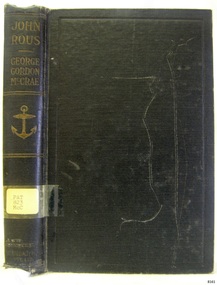
Book, John Rous
... john rous...george gordon mccrae...John Rous Author: George Gordon McCrae Publisher: The Speciality Press Pty Ltd Date: 1918 ...The Warrnambool Mechanics' Institute’s publication collection is of both local and state significance. flagstaff hill warrnambool shipwrecked coast flagstaff hill maritime museum maritime museum shipwreck coast flagstaff hill maritime village great ocean road book pattison collection warrnambool library warrnambool mechanics’ institute ralph eric pattison corangamite regional library service warrnambool city librarian mechanics’ institute library victorian library board warrnambool books and records warrnambool children’s library john rous george gordon mccrae The label on spine cover with typed text PAT 823 McC Pastedown front endpaper has a sticker from Warrnambool Mechanics Institute and Free Library Front loose endpaper has a sticker from Corangamite Regional Library Service Front loose endpaper has a stamp from Corangamite Regional Library Service John Rous Author: George Gordon McCrae Publisher: The Speciality Press Pty Ltd Date: 1918 John Rous Book ...This book was part of a large group of books referred to as the Pattison Collection, which belonged to the Warrnambool Public Library, part of the Warrnambool Mechanics’ Institute. About RALPH ERIC PATTISON and the ‘PATTISON COLLECTION’ The ‘Pattison Collection’ is a collection of books and records that was originally owned by the Warrnambool Mechanics’ Institute, founded in Warrnambool in 1853. By 1886 the Warrnambool Mechanics’ Institute (WMI) had grown to have a Library, Museum and Fine Arts Gallery, with a collection of “… choice productions of art, and valuable specimens in almost every branch and many wonderful national curiosities are now to be seen there, including historic relics of the town and district.” It later included a School of Design. Although it was very well patronised, the WMI was led to ask the City Council to take it over in 1911 due to lack of financial support. In 1935 Ralph Pattison was appointed as City Librarian to establish and organise the Warrnambool Public Library as it was then called. Ralph Eric Pattison was born in Rockhampton, Queensland, in 1891. He married Maude Swan from Warrnambool in 1920 and they set up home in Warrnambool. In 1935 when Pattison accepted the position as City Librarian for the Warrnambool City Council his huge challenge was to make a functional library within two rooms of the Mechanics’ Institute. He tirelessly cleaned, cleared and sorted a disarrayed collection of old books, jars of preserved specimens and other items reserved for exhibition in the city’s museum. He developed and updated the library with a wide variety of books for all tastes, including reference books for students; a difficult task to fulfil during the years following the Depression. He converted all of the lower areas of the building into a library, reference room and reading room for members and the public. The books were sorted and stored using a cataloguing and card index system that he had developed himself. He also prepared the upper floor of the building and established the Art Gallery and later the Museum, a place to exhibit the many old relics that had been stored for years for this purpose. One of the treasures he found was a beautiful ancient clock, which he repaired, restored and enjoyed using in his office during the years of his service there. Ralph Pattison was described as “a meticulous gentleman whose punctuality, floorless courtesy and distinctive neat dress were hallmarks of his character, and ‘his’ clock controlled his daily routine, and his opening and closing of the library’s large heavy doors to the minute.” Pattison took leave from 1942 to 1945 to serve in the Royal Australian Navy, Volunteer Reserve as Lieutenant. A few years later he converted one of the Museum’s rooms into a Children’s Library, stocking it with suitable books for the younger generation. This was an instant success. In the 1950’s he had the honour of being appointed to the Victorian Library Board and received more inspiration from the monthly conferences in Melbourne. He was sadly retired in 1959 after over 23 years of service, due to the fact that he had gone over the working age of council officers. However he continued to take a very keen interest in the continual development of the Library until his death in 1969. THE NEW WARRNAMBOOL LIBRARY When the WMI building was pulled down in 1963 a new civic building was erected on the site and the new Warrnambool Library, on behalf of the City Council, took over all the holdings of the WMI. At this time some of the items were separated and identified as the ‘Pattison Collection’, named after Pattison. Eventually the components of the WMI were distributed from the Warrnambool Library to various places, including the Art Gallery, Historical Society and Flagstaff Hill. Later some were even distributed to other regional branches of Corangamite Regional Library and passed to and fro. It is difficult now to trace just where all of the items have ended up. The books at Flagstaff Hill Maritime Village generally display stamps and markings from Pattison as well as a variety of other institutions including the Mechanics’ Institute itself. WARRNAMBOOL'S MECHANICS' INSTITUTE Warrnambool's Mechanics' Institute (or Institution as it was sometimes called) was one of the earliest in Victoria. On 17th October 1853 a meeting was held where it was resolved to request the Lieutenant Governor of the Colony to grant land for the erection of a Mechanics' Institutes building. A committee was formed at the meeting and Richard Osburne chaired the first meeting of this committee. The land on the North West corner of Banyan and Merri Streets was granted but there were no funds to erect the building. The Formal Rights of the Warrnambool Mechanics' Institute's encompassed its aims and these were officially adopted in1859; "This Institution has for its object the diffusion of literary, scientific, and other useful knowledge amongst its members, excluding all controversial subjects, religious or political. These objects are sought to be obtained by means of a circulating library, a reading room, the establishment of classes, debates, and the occasional delivery of lectures on natural and experimental philosophy, mechanics, astronomy, chemistry, natural history, literature, and the useful and ornamental arts, particularly those which have a more immediate reference to the colony." The Warrnambool Mechanics' Institute opened its first reading room in November1884 in the National School building at the corner of Banyan and Timor Streets. The Institute was funded by member subscription, payable on a quarterly, half yearly or yearly basis. Samuel Hannaford, the Manager of the Warrnambool Bank of Australasia, was the first Honorary Secretary of the Mechanics' Institutes, and an early President and Vice-President. He also gave several of the early lectures in the Reading Room. Another early Secretary, Librarian and lecturer was Marmaduke Fisher, the teacher at the National School. Lecture topics included The Poets and Poetry of Ireland', 'The Birth and Development of the Earth', 'The Vertebrae - with Remarks on the pleasures resulting from the study of Natural History' and 'Architecture'. In 1856 the Reading Room was moved to James Hider's shop in Timor Street, and by 1864 it was located in the bookshop of Davies and Read. In the 1860's the Mechanics' Institute struggled as membership waned but in 1866, after a series of fund raising efforts, the committee was able to purchase land in Liebig Street, on a site then called Market Square, between the weighbridge and the fire station. A Mechanics' Institute building was opened at this site in August 1871. The following year four more rooms were added to the main Reading Room and in 1873 the Artisan School of Design was incorporated into the Institute. The same year Joseph Archibald established a Museum; however it deteriorated when he was transferred to Bendigo in 1877. In 1880, with Archibald's return to Warrnambool, the Museum was re-established, and in 1885 a new building was built at the back of the Institute to accommodate the re-created School of Design, the Art Gallery and the Museum. In 1887 the Museum section was moved to the former court house in Timor Street (for some time the walls of the building formed part of the TAFE cafeteria but all is now demolished)). In 1911 the Museum was transferred back to the original building and the management of the Mechanics' Institute was handed over to the Warrnambool City Council. The Museum and Art Gallery became one and housed many fine works of art, and the Library continued to grow. The building was well patronised, with records showing that at the beginning of the 20th century there were between 500 and 800 visitors. During World War One the monthly figures were in the thousands, with 3,400 people visiting in January 1915. The Museum was a much loved Institution in Warrnambool until the contents of the Museum and Art Gallery were removed to make room for the Warrnambool City Council Engineers' Department. The contents were stored but many of the items were scattered or lost. When the original building was demolished the site became occupied by the Civic Centre, which included the new City Library. (The library was temporarily located in the old Palais building in Koroit Street.) In the process of reorganisation the Collection was distributed amongst the community groups: -The new City Library took some of the historic books and some important documents, historic photographs and newspapers. -The Art Gallery kept the 19th Century art collection and some of the artefacts from the museum. -The Historic Society has some items -The State Museum has some items -Some items were destroyed -Flagstaff Hill Maritime Village has old newspapers, Government Gazettes, most of the Mechanics' Institute Library, ledgers and documents connected to the Mechanics' Institute Library, some framed and unframed art works and some photographs. The Warrnambool Mechanics' Institute Library book collection is deemed to be of great importance because it is one of the few collections in an almost intact state, and many of the books are now very rare and of great value. The Pattison Collection, along with other items at Flagstaff Hill Maritime Village, was originally part of the Warrnambool Mechanics' Institute’s collection. The Warrnambool Mechanics’ Institute Collection is primarily significant in its totality, rather than for the individual objects it contains. Its contents are highly representative of the development of Mechanics' Institute libraries across Australia, particularly Victoria. A diversity of publications and themes has been amassed, and these provide clues to our understanding of the nature of and changes in the reading habits of Victorians from the 1850s to the middle of the 20th century. The collection also highlights the Warrnambool community’s commitment to the Mechanics’ Institute, reading, literacy and learning in the regions, and proves that access to knowledge was not impeded by distance. These items help to provide a more complete picture of our community’s ideals and aspirations. The Warrnambool Mechanics Institute book collection has historical and social significance for its strong association with the Mechanics Institute movement and the important role it played in the intellectual, cultural and social development of people throughout the latter part of the nineteenth century and the early twentieth century. The collection of books is a rare example of an early lending library and its significance is enhanced by the survival of an original collection of many volumes. The Warrnambool Mechanics' Institute’s publication collection is of both local and state significance. John Rous Author: George Gordon McCrae Publisher: The Speciality Press Pty Ltd Date: 1918 The label on spine cover with typed text PAT 823 McC Pastedown front endpaper has a sticker from Warrnambool Mechanics Institute and Free Library Front loose endpaper has a sticker from Corangamite Regional Library Service Front loose endpaper has a stamp from Corangamite Regional Library Service flagstaff hill, warrnambool, shipwrecked coast, flagstaff hill maritime museum, maritime museum, shipwreck coast, flagstaff hill maritime village, great ocean road, book, pattison collection, warrnambool library, warrnambool mechanics’ institute, ralph eric pattison, corangamite regional library service, warrnambool city librarian, mechanics’ institute library, victorian library board, warrnambool books and records, warrnambool children’s library, john rous, george gordon mccrae -
 Bendigo Historical Society Inc.
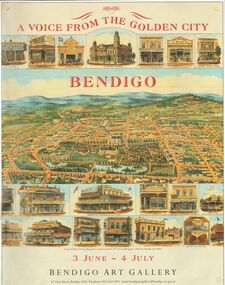
Document - BENDIGO ART GALLERY A VOICE FROM THE GOLDEN CITY EXHIBITION 2001, 1877
... Edwards Watchmakers, John Ingram Hatter and Lyceum Mutual Store & Co; High Street icons T.J. Connelly & Co. Ironmongers; McCrae Street icons Rea & Co Locksmiths and Gun Makers; Williamson Street icons Albert Bush Groicer and Tea Merchant; Bridge Street icons Cohn Brothers Soft Drink and Confectionery; Mitchell Street icons, MA Palk & Co Mourning Attire....Edwards Watchmakers, John Ingram Hatter and Lyceum Mutual Store & Co; High Street icons T.J. Connelly & Co. Ironmongers; McCrae Street icons Rea & Co Locksmiths and Gun Makers; Williamson Street icons Albert Bush Groicer and Tea Merchant; Bridge Street icons Cohn Brothers Soft Drink and Confectionery; Mitchell Street icons, MA Palk & Co Mourning Attire. ...Chromolithograph Sandhurst in detail 1877 by Francis Williams Niven. View Point icons including George S. Bissett Draper, Clothing & Millinery, Manning & Co. Drapers, Milliners and Tailors; Pall Mall icons Bent Photographers, W. Lunn Painter and Decorator, J.B. Edwards Watchmakers, John Ingram Hatter and Lyceum Mutual Store & Co; High Street icons T.J. Connelly & Co. Ironmongers; McCrae Street icons Rea & Co Locksmiths and Gun Makers; Williamson Street icons Albert Bush Groicer and Tea Merchant; Bridge Street icons Cohn Brothers Soft Drink and Confectionery; Mitchell Street icons, MA Palk & Co Mourning Attire.Francis Williams Niven, Sandhurst.bendigo, history, mid to late 19th century bendigo -
 Bendigo Historical Society Inc.
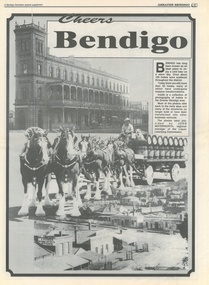
Newspaper - Cheers Bendigo - A Bendigo Advertiser special supplement
... John Waterworth, regional manager of the Liquor Licensing Commission. The hotels are: 1) Caledonian hotel in Golden Square 2) Cumberland hotel Williamson Street 3) Terminus hotel Mitchell Street 4) Bendigo hotel corner Bridge St. and Park Rd 5) View point hotel in View point 6) Commercial hotel, Goornong 7) Eastman's Goornong hotel 8) Ramblers, Bridge St. 9) Campbells Forest hotel 10) Lightning Hill hotel, Whipstick Rd. 11) Limerick hotel, McIvor rd. 12) Prince Patrick hotel, Eaglehawk 13) Reservoir hotel, Kennington 14) Acotts hotel, McIvor Hwy, Axedale 15) Shamrock hotel, Bendigo 16) Niagra hotel corner McCrae and Mundy St. 17) Bath hotel, Charing Cross 18) Blue Bell hotel, corner Don and high St. 19) Pioneer hotel, Sailors Gully Rd. ...John Waterworth, regional manager of the Liquor Licensing Commission. The hotels are: 1) Caledonian hotel in Golden Square 2) Cumberland hotel Williamson Street 3) Terminus hotel Mitchell Street 4) Bendigo hotel corner Bridge St. and Park Rd 5) View point hotel in View point 6) Commercial hotel, Goornong 7) Eastman's Goornong hotel 8) Ramblers, Bridge St. 9) Campbells Forest hotel 10) Lightning Hill hotel, Whipstick Rd. 11) Limerick hotel, McIvor rd. 12) Prince Patrick hotel, Eaglehawk 13) Reservoir hotel, Kennington 14) Acotts hotel, McIvor Hwy, Axedale 15) Shamrock hotel, Bendigo 16) Niagra hotel corner McCrae and Mundy St. 17) Bath hotel, Charing Cross 18) Blue Bell hotel, corner Don and high St. 19) Pioneer hotel, Sailors Gully Rd. ...A eight pages Bendigo Advertiser supplement titled "Cheers Bendigo." Inside a collection of photographs of hotels in the Greater Bendigo area. The photos were provided by John Waterworth, regional manager of the Liquor Licensing Commission. The hotels are: 1) Caledonian hotel in Golden Square 2) Cumberland hotel Williamson Street 3) Terminus hotel Mitchell Street 4) Bendigo hotel corner Bridge St. and Park Rd 5) View point hotel in View point 6) Commercial hotel, Goornong 7) Eastman's Goornong hotel 8) Ramblers, Bridge St. 9) Campbells Forest hotel 10) Lightning Hill hotel, Whipstick Rd. 11) Limerick hotel, McIvor rd. 12) Prince Patrick hotel, Eaglehawk 13) Reservoir hotel, Kennington 14) Acotts hotel, McIvor Hwy, Axedale 15) Shamrock hotel, Bendigo 16) Niagra hotel corner McCrae and Mundy St. 17) Bath hotel, Charing Cross 18) Blue Bell hotel, corner Don and high St. 19) Pioneer hotel, Sailors Gully Rd. Eaglehawk 20) brougham Arms hotel, Bendigo 21) Junction hotel, Mandurang 22) Tyson reef hotel, Weeroona Ave. 23) Hopetoun hotel, corner Mitchell and wills St. 24) Queen's Head, Lockwood 25) Blomquists Wine Hall, Bendigo-Fosterville Rd. 26) Metropolitan hotel, corner Hargreaves and Bull Streets 27) European hotel, High St. Bendigo 28) Royal hotel, Millers flat rd. Whipstick 29) unicorn hotel, Forest St. 30) Camp hotel, corner Victoria and High streets Eaglehawk There is no date on the paperbendigo advertiser, bendigo hotels -
 Bendigo Historical Society Inc.
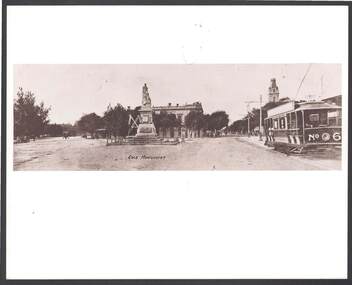
Photograph - JOHN JONES COLLECTION: GOLD MONUMENT
... BENDIGO Streetscape general street views John Jones Collection - Gold Monument Black Swan Hotel Photo with a brown tinge of the Gold Monument next to the Black Swan Hotel in McCrae Street. ...Photo with a brown tinge of the Gold Monument next to the Black Swan Hotel in McCrae Street. Street surface looks like gravel. There are horse drawn vehicles in the picture and on the right side of the photo is a tram with No. 6 painted on the back. Behind the statue is a poppet leg structure and a row of trees around the Hotel.bendigo, streetscape, general street views, john jones collection - gold monument, black swan hotel -
 Bendigo Historical Society Inc.
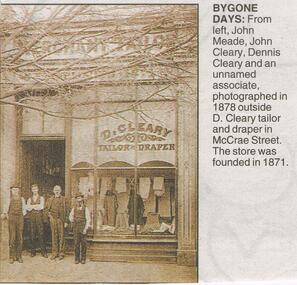
Newspaper - JENNY FOLEY COLLECTION: BYGONE DAYS
... Bygone days: from left: John Meade, John Cleary, Dennis Cleary and an unnamed associate, photographed in 1878 outside D. Cleary tailor in McCrae Street. ...Bygone days: from left: John Meade, John Cleary, Dennis Cleary and an unnamed associate, photographed in 1878 outside D. Cleary tailor in McCrae Street. ...Bendigo Advertiser "The way we were" from Wednesday, May 5, 2004. Bygone days: from left: John Meade, John Cleary, Dennis Cleary and an unnamed associate, photographed in 1878 outside D. Cleary tailor in McCrae Street. The store was founded in 1871.newspaper, bendigo advertiser, the way we were -
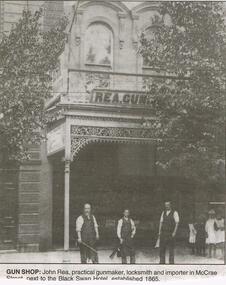 Bendigo Historical Society Inc.
Newspaper - JENNY FOLEY COLLECTION: GUN SHOP
... Gun shop: John Rea, practical gunmaker, locksmith and importer in McCrae Street, nextto the Black Swan Hotel established 1865....Gun shop: John Rea, practical gunmaker, locksmith and importer in McCrae Street, nextto the Black Swan Hotel established 1865. ...Bendigo Advertiser "The way we were" from 1999. Gun shop: John Rea, practical gunmaker, locksmith and importer in McCrae Street, nextto the Black Swan Hotel established 1865.newspaper, bendigo advertiser, the way we were -
 Bendigo Historical Society Inc.
Postcard - PORTRAIT 2 YOUNG CHILDEN, 1926
... For Aunty Kate 1926. McCrae, The Saunders Studio, John St., Singleton....McCrae, The Saunders Studio, John St., Singleton....PHOTO Group 2 young girls Photograph postcard portrait two young girls photo taken 1926. McCrae, The Saunders Studio, John St., Singleton. Postcard, sepia portrait of 2 young children. ...Postcard, sepia portrait of 2 young children. The first child, being the taller of the two has straight, dark hair in a bob haircut, wearing a crochet top over her clothes, and wearing a braclet on her upper arm and holding something in her left hand. The second child is shorter and younger with fair curly hair, wearing a crochet top over her clothes. Written on back of postcard, Ilma 4 yrs and Dorothy 2 yrs 3 mths. For Aunty Kate 1926. McCrae, The Saunders Studio, John St., Singleton.McCrae, The Saunders Studio, John St., Singleton.photo, group, 2 young girls, photograph, postcard, portrait two young girls, photo taken 1926. -
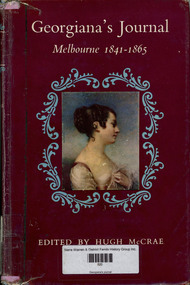 Narre Warren and District Family History Group
Book, Hugh McCrae, Georgiana's journal, 1992
... McCrae and one of the most graceful of Australia's early diarists. In 1841, only six years after Melbourne was founded, she arrived in the Port Phillip district where she was to spend forty-nine of her eighty-seven years. Her journal is not only a fascinating personal document but an invaluable reflection of the social life and history of the infant settlement. As well as being an artist of considerable talent—even genius (she had been a favourite pupil of the water-colourist John ...Melbourne 1841-1865 Georgiana McCrae was the grandmother of the poet Hugh McCrae and one of the most graceful of Australia's early diarists. In 1841, only six years after Melbourne was founded, she arrived in the Port Phillip district where she was to spend forty-nine of her eighty-seven years. Her journal is not only a fascinating personal document but an invaluable reflection of the social life and history of the infant settlement. As well as being an artist of considerable talent—even genius (she had been a favourite pupil of the water-colourist John Varley), Georgiana had been an indefatigable diarist since she was a little girl; and to this cultivated and therefore perhaps lonely young woman in the embryo town that was Melbourne her journal was her confidant and companion. Whether she is telling how Bishop Broughton "exonerated the Popish party from the blame in the Gunpowder Plot", or how her son was within an inch of treading on a snake which I killed with the stick of my parasol", whether she is spring cleaning, combating a grasshopper plague, or making a velvet bonnet for her daughter, she is always perceptive and arresting in recording her daily life and the affairs of the colony.non-fictionMelbourne 1841-1865 Georgiana McCrae was the grandmother of the poet Hugh McCrae and one of the most graceful of Australia's early diarists. In 1841, only six years after Melbourne was founded, she arrived in the Port Phillip district where she was to spend forty-nine of her eighty-seven years. Her journal is not only a fascinating personal document but an invaluable reflection of the social life and history of the infant settlement. As well as being an artist of considerable talent—even genius (she had been a favourite pupil of the water-colourist John Varley), Georgiana had been an indefatigable diarist since she was a little girl; and to this cultivated and therefore perhaps lonely young woman in the embryo town that was Melbourne her journal was her confidant and companion. Whether she is telling how Bishop Broughton "exonerated the Popish party from the blame in the Gunpowder Plot", or how her son was within an inch of treading on a snake which I killed with the stick of my parasol", whether she is spring cleaning, combating a grasshopper plague, or making a velvet bonnet for her daughter, she is always perceptive and arresting in recording her daily life and the affairs of the colony.georgiana mccrae, melbourne (vic.) -
Glen Eira Historical Society
Book - Glen Huntly State School No.3703 Grange Road
... McCrae... School rolls... Le Brocq John...John Arthurs Violet Grace Browning Leslie George Carroll Eric Harry Dobson Keith George Evans George W.M. Eyres Annie May Hogg Lillian Hunt Alfred W.M. Johnson Henry Jones Dorothy Minnie Love Helvic Agnes Lyons Gordon Lyons Vera Parsons Eric Robert Dickens Gordon Percy Smith Elva Beatrice Harry David Westcott Harold Norton Westcott Ormond Chs. Bremner Marie Entertainers Williamson Alex McCrae ...A 190 page book called The Story So Far 1914-2009 – The History of Glen Huntly Primary School No.3703, by Shirley A. Mirams. The book gives a very detailed history of the school’s early history. It includes head teachers/principals and the school’s progress through each decade to 2009. The remaining chapters give 2009 student roll call, citizenship awards, house competition awards, music awards, sporting awards, encouragement, swimming and musical productions, notable past students and teachers, bibliography and sponsors. There are many photos and school plans as well.glen huntly, glen huntly primary school, glenhuntly primary school, mirams shirley a., glenhuntly printing works, printing industry, from the earth fruit and veg., glenhuntly state school, greengrocers, king stephen, king design, alessi libby, principals, mcgowan keith, radio broadcasting, hunt sydney, forbes c., ramsay m., primary schools, glenhuntly state school, jenkin william, bryant a., orames mr, morrison r., christensen t., doggett j., rogers a., fink r., terrill f., mitchell j., cravine e., mcrae w., cooper l., chernside c., silva a.j., dolphin w., crampton colin, wilson wendy mrs, glenhuntly road, glen huntly, clerk's estate, subdivisions, glen huntly clerk's settlement, carnegie school no. 2897, world war 1914-1918, gardens, mothers clubs, world war 1939-1945, poliomylitis, rural training school, traffic signals, films, 'slow bike race', parents and friends association, after school program, fires, 'links' magazine, choirs, disadvantaged schools program, school plays, 'germs', 'garden folk', festivals and celebrations, japanese internship program, 'kids in space', 'dragon girl', 'fish 'n' ships', murals, wendy wilson music award, fetes, lord reserve, carnegie, australian natives association, congregational chuch sunday school hall, martell e miss, garden avenue, grange road, salvation army halls, halls, glenhuntly road, wanalta road, williamson alex, williamson jean, williamson gordon mccrae, school rolls, le brocq john, cockfield douglas r., grogan allen, mathiesson edward, johnston ronald frank, harris george, money neil robert, fraser eric, munro john, hyland hector thos., gibson wilfred john, eliason francis, scarles john robert, wallace andrew, henning george frederick, maryson sydney, petherbridge c., whitfield j., edward lee, queen alexander, carnegie state school, madden frank sir, parliamentary representatives, bank of new south wales, charles ernest, wallace andrew james, hunt chas. hogarth, williams stanley f., tester thomas george, henstridge john, henstridge reginald, johnston travis andrew, nixon alexander, lewis victor, dalton john, arthurs violet grace, browning leslie george, carroll eric harry, dobson keith george, evans george w.m., eyres annie may, hogg lillian, hunt alfred w.m., johnson henry, jones dorothy minnie, love helvic agnes, lyons gordon, lyons vera, parsons eric robert, dickens gordon percy, smith elva beatrice, harry david, westcott harold norton, westcott ormond chs., bremner marie, entertainers, williamson alex mccrae, ransay albert, caulfield town hall, green ethel, hawthorn alice, reynolds emma a., potter thelma, potter phyllis, anderson elsie m., girdwood stella, bastin may, murphy dorothy g., southern mary, mcleod gwen, ezard gladys m., hood emily vera, thorne eileen isobel, robinson noel, monckton marjorie, mrs hannigan's tuckshop, foley children, lord mr., bladin francis, tomlinson jean, jenkins vern, williamson jean, forty alan, rhinefield mr, bennett mary, brabham laurel, swain george, reynolds mille, gill harry, williamson g., cockfield winifred, baird beth, king elsie, challman miss, glen huntly 'drum and file' school band, larkin aircraft supply company, sugarworks swamp, lemans swamp, lyons streets, morgan streets, miller street, lizars linda, brown allan sir, hurie gladys, simpson peggy, royal ave., garden ave., tennis courts, lander h.j., castledine f.r., henning a.s., glen huntly progress association, harboard joan, mullins mr, pountney dorothy, daley beryl, marching clubs, findlay joyce, green lionel, charles ern, bennett mary, shelter sheds, blanchfield mr bakers, donoald mr grocers, walburn rhoda, harris shirley, treyvaud mr, hale maxwell, painter ken, allan mr ('fatty'), proven mr, ross mrs, nye margaret, nally ware beaker, monuments and memorials, graham bruce, 'bulldog drummond', learmonth mary, bullock margaret, o'shea annie, tattersall dawn, jenkins betty, lighton robert, bruce peter, love grace, love family, judd margery, gardiner elsie, gardiner sadie, glen eira dairy, vanston dorothy, barton cynthia, tipping mr, drummond mr, hambly chrissy, shrives kathleen, hutton beverly, miller kenneth deering, callender mr bakers, cook miss, nunn john athlete, andrews ailsa (nee mcgregor), fraser wally, vickers madeline, vickers john, scanlon mr, malcolm miss, brown barbara (nee holland), pepper miss, burns miss, mclaren miss, beadman jim athletics, robinson noel, crompton neal sportsperson, wilkinson graham, neilson ray, byers barry, bryant tony referee, murray bob, burton pam, pappas george, burke b. mrs, neville street, smith harvey, o'donnell mrs, kivlighon mr, grierson wendy, evans yvonne, squires doreen, squires kathy, jenvey stewart, baxter john, coenen eddie maintenance workers, byrne carol, williams pamela, zari austin (nee coenen), furney janet, dodds mrs, mitchell j., bell r., forsyth e. miss, mitchell neil, radio broadcasting, burke m., boatman r., garfield d., harris e. mrs, sherman m. mrs, carolan e., gunthorp b., barnes john, barnes joan, ellis christine, kossatz mr, black miss, lader mrs, franghis peter, parnell dennis, revens ester, young vivian, mclean bernice, tattersal lorna, geddes rae, hocking malcolm, cusworth peter, christie glenn, watt richard, conway gred, hand graham, mcgowan e., parnell j., mcguire n, hare john, prest margaret, forrester david, mitchell eric, cordingley mrs, waterworth mr, cohen mr, rankin fiona, christiansen mr, boatman mr, dougan mrs milkbars, dougan barry, suttie richard, parnell bruce, silverman judy, king jenny, saxon sally, king nicolette, maxwell heather, saxon jill, vincent russell, saxon rosemary, murray bob, saxon david, miller bill, hill sally-ann, hesline sandra, raspberger cynthia, nightingale mrs district remedial centre, smith mrs, district language consultant, robertson gabrielle, mclennan matthew, goloub kin lyn, jarrett mavis, schafer dianne, commerford pip, mcdougall carlene, anderson jack, hawthorne russell, callahan evelyn, zagami maria, bremner elizabeth, braun tiki, berman claudine, briggs margaret, brady sue, shaw melissa, henham ravena, cooper tania, de abrev connie, brodie joanne, macdonald leighan, mccallum margaret, beddoe john, mcdonald mr council employee, clift andrew, ash steven, lowndes nerida, wysocki b., drough h., grossbard j., locke j., cox l., morey l., clifton p., short b., herszberg n., clift debbie, fuk michael, theodosopoulos haria, shrives jean (nee tomlison), forty alan, geiger irit, roach sally, hillis rachael, roache donna, dixon wendy, bayliss curtis, pregnall joy mrs, slocum mrs, nelson glenda, rubinstein morrie, lurkey dianne, mcminn michael, arneil barbara, mick rose, mell and alice, brayton andrea, moorhead k. rev, brownhill e., lolas heather mrs, regan bernie cleaner, hopkins a. mrs, dewar leon, school crossings, darak diana, eddey diana, pregnall max, eppinger rosy, stacy paul, douvitsas chris, maycock kelly, bunyan liza, johansen eva, siaosi jackie, don kerrie, smyth ruth, bruce julie, mcgregor lorraine, mcallister peter, nelson g., knight sue, mackey s., mackinnon julie, mccallum margaret, johannsen j., herzberg n., hall k, jarrett m., johns w., beddoe john, wilson w., dayble l., thomas helen, ogura etsuko, coxon diane, guttman emmy, garg sangeeto, kennedy robyn, coleman heidi, thompson vic, currie sioux, arnold eve mrs, beddoe mr, mckay sara, skilney tamara, zent mandy, sassos eugenia, manvel bill, lewis pam, rothstadt kaye, clerehan jane, watson simon, daw josie, strong helen, craig caroline, devasagayam kenny, bell peter, palanarezuk fiona, suttie mitchell, mirians shirley, prest marg, condon gabrielle, pitkin sigrid, wilson heather, don paul, thursfield william, footballers, ormond junior football club, rothstadt david, bruce julie, fallu jackie, patterson denise, trantor debbie, nakamura nozomi, christensen tanya, james-clark spencer, eppinger rosy, matsumoto minako, osborne cheryle, john beddoe meritorious sporting student award, sunderland pippa, schleiger emma, paulusz chris, hollingworth kyle, griffiths david, cooper cameron, jewel andrew, nannegaril (nick) abhishek, marshall joel, hodden leigh, meyer tony, te hennepe michael, zimbachs trent, chavili praveen, listmangof mark, sampson tim, sayfer daniel, mest jack, crampton colin, crampton andrew, hemming beth, dean deirdre, wong melissa, arneil christopher, friedman adam, sonnberger leonie, mackey suzanne, clarke heather, fernando gyan, horvath eva, horvath melissa, horvath natalie, rowe rebecca, taylor yani, robinson tess, nolan rebecca, hollingworth mamie, trigellis-smith anna, zhou cindy, jenvey olivia, smith yasminka, hemming caitlin, gale elke, johnson christopher, dalton lyndsay, perish james, seddon anna, webster teagan, stratford sachi, zhuang yvette, taylor katherine, tettennepe simon, hu kevin, thursfield oliver, beycher sonny, gavland angelene, fotopoulos daisy, mcclelland letty, king sierra, sargeant kolly, hodden melissa, picking kate, brasic lisa, mcclelland cassie, cummins alexandra, jamieson laura, cashen lanaya, rowe angela, georgiou jonathon, pejovic maja, luv aileen, hoskin yumika, bishop amy, tweed jacqueline, corrales mariana, williams kendall, jewell bethany, friedman sara, golden phoebe, mellios lauren, sayfer charlene, bell daniel, glagovski anton, ring hannah, aldred jasmin, sisson laura, king janine, allen robbie, taylor xavier, trigellis-smith colin, italia paula, tamura naoko, eddy diane, paterson denise, clarke heather, hemming beth, wilson wendy, wallace gaye, moore denis, plumb rochellee, schmauder debra, taylor kathrine, gale elke, taylor yani, sisson laura, fotopoulos daisy, zuccala lyn, smith phyllis, katz lily, sonnberger leonie, quail janine, prest margaret, zhang karen, indukuri gita, prest duncan, prest julieann, dureau sally, hopkins anna, baligod imelda, fallon kerry, bjelanovic danijela, james-clark laura, magnani lisa, phillips kathy, bell hilary, bakshi jasmeet, james-clark spencer, james-clark mason, james-clark stella, fitzgerald kerrie, krawze kamila, czech jon, lee maria, boell jacqueline, schmauder debra, georgiou martha, randles yvonne, smyth ruth, florrimell sean, ryan patrick, rossjohn sian, eppinger rosy, melenhurst bradley, melenhurst ashley, melenhurst christopher, silva katie, richards michael, garner jenny, bucher peter, gleitzman morris author, zhou jun, cook andrew, memorial services, funerals, wendy wilson hall, rossjohn jamie, earls tom, nicholls stephanie, vagner natasha, anderson pam, hall aileen, grose jenny, dalton sue, bejers maya, paterson denise, witte david, lath natalie, dalmau jessica, darras irene, miljus max, moritmitsu ran, zhou yida, barns sue, varbaro bianco, howell alan, lath miss, jacobs john, tinetti amy, maloney matthew, petrovic vida, bruce julie, bonner angie, porter ros, hill andrea, hocking hazel, jozsa zara, wishart jan, guyer noeline, powell bruce, hopkinson judy, mccrae glenys, mccrae beverly, james margot, barns tony, barns joan, ryan ann artist, jenek alex, jozsa olivia, woods caitlin, ledda daniel, cook andrew, rossjohn bevan, aunavarapu ashray, loveas paul, beiers mariel, allan gemma, squires rhoda, squires garry, squires terry, squires lesley, squires rhonda, squires doreen, squires peter, squires kathy, king sierra, king tynan, king mackenzie, king harrison, king shuyler, allen robbie, allen jessica, allen samantha, dale sheridan, dale caroline, dale elliot, dale taylor, dale clark, woodards carnegie auctioneers, roberts ruth, mckenzie's ward, glenhuntly fruit supply, ceudet and kubeyde, subway glenhuntly, alessi libby mrs, manuel bill mr, bruce julie ms, jacobs john mr, paterson denise mrs, thompson vic mr, sonnberger leonie mrs, sassos eugenia mrs, witte david mr, krauze maila ms, tinetti amy ms, bower jessica mrs, fitzgerald kerrie mrs, eppinger rosie mrs, vagner natasha mrs, zent mandy mrs, james-clark laura mrs, fallon kerry mrs, grose jenny mrs, bonner angie mrs, miriams shirley mrs, petrovic vida mrs, maloney matthew mr, bakshi jameet mr, smyth-kinyua ruth mrs, fitzpatrick tom mr, watson scott mr, theodore kate ms, porter ros ms, hill andrea ms, howell alan mr, schauder emma mrs, jozsa george mr, bitmead claire mrs, bader linda ms, jacobs john mr, bhuteja raza, rossjohn bevan, christensen lara, dale clark, chong aldwin, barns-dunne genevieve, guy cleo, georgiou demetrius, allen gemma, arunachalam elanthendral thiruavani, chau samantha, foldvari miro, gade saathvika, ghafari mohid, jones alvin, korres johnny, margaritis evan, pickering finley, schauder daniel, shah hisha, shermis-fox dalvin, thorat sahil, zhong emma, arunkumar mitali, baxi vaasu, bhadra rushil, chevalier stefanie, bitmead rose, cooper brittany, jozsa zara, croes sonny, gil harnoor, koika akito, gitein iris, matthews benjamin, moses lior, gupta anushka, nematy keanu, jaiswal sanjana, makwana yash max milius, o'donoghue romy, patel vishesh, nalamati anushka, paul aaron, obsioma jarred, pavlich nicola, rizk taran, schauder ben, shah vansh, stuart isobel, yadavalli sriprada, sharma shreya, tut nyajania, zhao max, abeyesekerea gail, attanayake nikeesha, behl shaurya, desai noopur ankoor, espinosa daphne, kansara kesha, kantheti sai rithvik, malakar ishan, manion freya, mohammed zoheb, morimitsu ran, moshe sarit, peri varsha, reutskiy yael, ryan harrison, shah jahanvi, wallis hannah, woods liam, bhuteja raza, belyuga lachlan, chen linda, bikovsky alexander, das sanchali, bitmead william, ghafari malaika, cherukuihota ritish, jenek alex, chintala aditi, lvovsky jeremy, dumnounkan nicky, mazzocchi ashleigh, el shorbagy hanna, mohammed zeeshan, foldvari phoebe, nekkadapu prava, gill armann, obsioma joseph, harper tyler, pickering jasper, kanapathippillai noah, pronina anja, kat jemma, pudikova veronika, king schuyler, reutskiy nicole, nikitin daniel, rossjohn bevan, o'connor finnian, schauder hannah, parsons zoe, shaked natalie, shang alexander, sharmila ajit aaditya arya, shulz david, siah sunny, singh gab, woods caitlin, wallis eliza, yang jee, zhong michelle, zhang alan, zhou stella, zhang betty, arjuna vicknan, arunachalam thirumagal, bahambhani yog, christensen lara, dale clark, hoenig tess, jozsa olivia, knelle louise, kwon minchol, lin angelina, milyus sophie, modi dhriti, morimitsu rin, moses nikol, noh yuhan, raghav devrath, rule darcy, tran cindy, trivedi namit, vayenas christina, vaz adonis, vortman david, allan liam, annavarapu ashrey, attanayake akeshi, capicchiano rose, chilakamarri nikhil, davis oliver, forti kate, guo maggie, guy cleo, james zoe, jenek ada, kalra pravav, king harrison, lin angelo, lin anita, melenhorst bradley, melenhorst christopher, metzler jessica, moses tomer, perelman michael, ryan patrick, wheatley nathaniel, allen gemma, bailey crystal-lee, gan tina, georgiou demetrius, ghafari kainat, grigorian nick, hackshaw chris, howell benjamin, kuznetsov ilya, luo eileen, luo elaine, margaritis mary-anne, melenhorst ashley, morimitsu rui, omer-cooper james, ozgur batuhan, salathiel matthew, vayenas paulina, wang qi wei, ward monica, arabena. brittany, bader-mcdowell alexander, barns-dunne genevieve, beiers mariel, chilcott rose, chong aldwin, cook andrew, dale taylor, dalton eamon, durant demeke, horn jade, iker korkhan, kat mariana, kwon so hyun, ledda daniel, loucas paul, panchal rajvi, ragozin vadim, reyer emma, song alex, varbara sovan, zhou james, robertson angela, henkul roland, hannagan cassie, rice elizabeth, ryan tammy, stacey paul, mason rebecca, ammendola marcella, moore m., copey n., priesner m., cotterell d., cohn adam, don paul, don kerrie, hanley alison, mckechnie brian, gowland rebecca, te hennepe daniel, schleiger emma, zimbachs trent, rowe rebecca, taylor katherine, beycher sonny, halliburton andrew, dureau thomas, dureau nicole, thursfield alexandra, allen courtney, willis isabelle, zhou jun, james-clark stella, melky michelle, willis ruby, earls tom, srinivasan lakshmi, zhou yida, te hennepe daniel, meyer tony, leiken nikita, thompson alex, te hennepe simon, johnson christopher, vassilopoulos michael, irwin christopher, asaturov gary, rossjohn sian, sangangum watsana, varbaro bianca, mitchell, hume, batman, brown robyn, maxwell jennifer, mclean jill, culpin howard, jones dennis, archer ?, lester phillip, taylor jennifer, anderson judith, ? bronwyn, hall robyn, powlett john, clark ross, taylor christine, booth peter, turner ian, porter larry, turner diane, anderson diane, scott megan, mclean david, christie donald, wishart philip, mottrim joan, christie coleen, travis bicki, watt elizabeth, richards michael, peet marily, sutherland fiona, ziegenbien kay, lester judith, kostamarkis con, yeoman keith, hastings ronald, ? mark, coenen zari, young vivian, young carolyn, weber elizabeth, child gary, cooper stephen, robertson james, ross dean, ? eve, cooper anne, saunders bruce, yeaman peter, wilkinson dawn, armstrong jeffrey, hill gregory, morris steven, suttie richard, silverman judy, king jenny, silverman sharon, broadmore janine, martin dean, smith robert, frommer ruth, saxon rosemary, justus heidi, o'keefe sue-ellen, robertson angela, young natalia, pigounis anthony, brodie anthony, henkul roland, duncan neil, cooper tania, brodie joanne, meerkin naomi, henham rowena, moulds adam, butterworth richard, kellis nick, tapai michael, goodwin sonia, clift debbie, hannagan shannon, marley kara, ceki tibor, ellis shaun, charleworth stewart, can bergeijk richard, schroor briony, leticq jeanette, davidson angela, kakos vicki, collins darren, mcfarlane matthew, adley hassan, agar james, rakonjac mileva, lowndes nereida, grimster jane, ? laurenne, mcdonell terry, clift andrew, perry timothy, rice martin, weir lisa, devasagayam briony, chatila nancy, melland alice, rakonjac nik, mcdonald brett, collins michael, rose darren, ryan tammy, rice elizabeth, hannagan cassie, mason rebecca, douvitasa chris, chivers scott, siaosi jack, stacey paul, moore matthew, coles lisa, diggins sebastian, barboussas costa, moulds johanna, brett travis, mcminn johanna, soloma tim, copey nicole, kakos peter, rontoyannis evan, mcdonald scott, pregnell ian, lowndes jared, kapetanos diane, ivkov srdjan, palamarczuk rosemary, cotterell diane, tonta amelia, craig caroline, yeun joseph, yusuf alham, quon kane, fiek peter, pitkin meryl, yarovsky julie, mckay sara, koger saskia, slocum tom, meyer sean, dunn nathan, vickers anthony, don paul, mason lulu, stanton bronwyn, hanley alison, don kerrie, kennedy chad, callaghan matthew, ghosh suvro, teteira jay, sargent kelly, hollingworth marnie, lack orry, wheeler ashley, trigellis-smith anna, hoskin tim, barda david, nolan rebecca, kulikov simon, kirkpatrick ryan, schleiger rudi, becker thomas, de lisle justin, taylor katherine, gale elke, te hennepe simon, ring hannah, stratford sachi, taylor yani, parish james, aldred jasmin, sisson laura, thursfield oliver, fotopoulos daisy, hoskin yumika, trigellis-smith colin, corrales mariana, soyfer charlene, moore vanessa, halliburton andrew, glagovski anton, johnson christopher, wheeler joel, taylor xavier, chapman jessica, ledda alexander, rowe angela, jewell bethany, goluguri pradeepthi, bell daniel, golightly callum, graham emily, mckechnie ellen, james-cark spencer, byrne david, parker natalie-lee, loucas david, pappas michael, gamble laurence, dureau thomas, loriot christina, drinozcky chloe, ring caitlin, robertson mitchell, pleysier yvonne, boghikian emie, sisson matthew, sanchez zanetta, rowe daniel, saunders john, cox josh, barda nick, dureau nicole, lenkiewicz justine, jamieson emily, mclaughlan kate, carpenter tess, vassilopoulos michael, jewell clare, gavnoudias james, matthews laura, georgiou costa, dale caroline, gamble kate, beiers hannah, james-clark mason, richardson zoe, thursfield alexandra, hosking kenta-neville, dounias theodore, annavaparu ramya, sinclair chloe, nolan megan, king tynan, tomlinson michael, allen courtnay, florrimell sean, ong kenny, foley patrick, gale emily, saunders alice, rowe michelle, willis isabelle, vassilopoulos alexandra, johnson bradley, borley genevieve, irwin christopher, earls thomas, matthews jessica, mudumbi venkatesh, lenkiewicz alice, king mackenzie, dounias christopher, beiers maya, dick alastair, levy matthew, srinivasan lakshmi, adams joshua, singh mia, borley natalie, varbaro bianca, christensen jade, willis ruby, sinclair emma, allen samantha, rossjohn sian, borley morgan, bader-mcdowell jeremy, chettimadda gopala kr yashas, anguswamy manoj, nekkadapu sankeerth, dalton kieran, allan tristan, gandham anoohya, arabena brittany, melenhorst ashley, vayenas paulina, dale taylor, bader-mcdowell alexander, omer-cooper james, reyer emma, kuznetsov ilya, metzler jessica, beiers mariel, forti kate, james zoe, annavarapu ashrey, ryan patrick, davis oliver, ilker korkhan, mcgowan keith, thursfield william, gribbin andrew, walsh-howling damien, scanlon alan, mitchell neil, brown allan, bruce peter, murray robert (bob), christensen tanya, de kretser jan, bremner marie, bayliss curtis, wheeler reece, symons red, de zilwa nick, byers gary, crompton neil, wilkinson graham, nilsson ray, bryant tony -
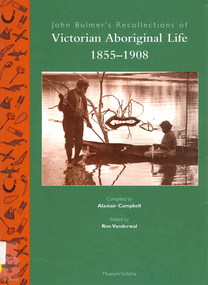 Victorian Aboriginal Corporation for Languages
Book, Ron Vanderwal, John Bulmer's recollections of Victorian Aboriginal life, 1855-1908
... McCrae...Nellie Blair...John...Gunai Kurnai Gippsland Lake Tyers Lakes Entrance King Charley Snowy River Ellen Hood Sarah Moffat Lance McDougall Kassie McDougall Tom Foster Alec McCrae Nellie Blair John Bulmer Victorian history Indigenous social life kinship religion and mythology bush foods maps, b&w photograph, word lists, tables John Bulmer spent forty years of his life as missionary to Aboriginal people in Victoria, in 1855 devoting his activities to communities on the Murray, but most of his life was spent at Lake Tyers where he established a Church of England mission in 1862, In his later years he wrote a series of thirteen papers in which he recorded his observations on the life and times of the people to whom he ministered. ...John Bulmer spent forty years of his life as missionary to Aboriginal people in Victoria, in 1855 devoting his activities to communities on the Murray, but most of his life was spent at Lake Tyers where he established a Church of England mission in 1862, In his later years he wrote a series of thirteen papers in which he recorded his observations on the life and times of the people to whom he ministered. Over a period of several years Alistair Campbell transliterated the manuscripts, altering a little but retaining the flavour of the original text.maps, b&w photograph, word lists, tablesgunai kurnai, gippsland, lake tyers, lakes entrance, king charley, snowy river, ellen hood, sarah moffat, lance mcdougall, kassie mcdougall, tom foster, alec mccrae, nellie blair, john bulmer, victorian history, indigenous social life, kinship, religion and mythology, bush foods -
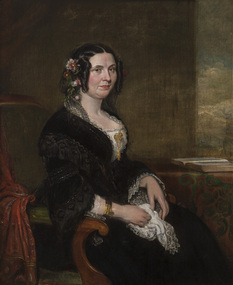 Bayside Gallery - Bayside City Council Art & Heritage Collection
Painting - oil on canvas on board, John Irvine, Mrs G.W. Cole, c. 1858
... john irvine...thomasina anne mccrae...mrs g. w. cole george ward cole st ninian's portrait female john irvine thomasina anne mccrae thomasina cole brighton oil on canvas on board Mrs G.W. ...John Irvine, Mrs G.W. Cole c. 1858, oil on canvas on board, 110 x 90 cm. Bayside City Council Art and Heritage Collection.oil on canvas on boardmrs g. w. cole, george ward cole, st ninian's, portrait, female, john irvine, thomasina anne mccrae, thomasina cole, brighton -
 Vision Australia
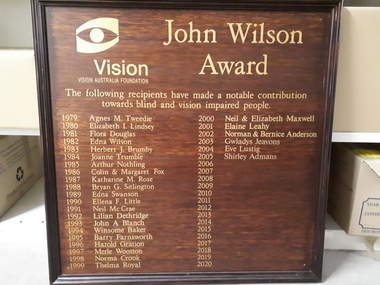
Photograph - Image, John Wilson Award
... Little, 1991 Neil McCrae, 1992 Lillian Dethridge, 1993 John A. Blanch, 1994 Winsome Baker, 1995 Barry Farnsworth, 1996 Harold Gration, 1997 Merle Wootten, 1998 Norma Crook, 1999 Thelma Royal, 2000 Neil & Elizabeth Maxwell, 2001 Elaine Leahy, 2002 Norman & Bernice Anderson, 2003 Gwladys Jeavons, 2004 Eve Lustig, 2005 Shirley Admans....Little, 1991 Neil McCrae, 1992 Lillian Dethridge, 1993 John A. Blanch, 1994 Winsome Baker, 1995 Barry Farnsworth, 1996 Harold Gration, 1997 Merle Wootten, 1998 Norma Crook, 1999 Thelma Royal, 2000 Neil & Elizabeth Maxwell, 2001 Elaine Leahy, 2002 Norman & Bernice Anderson, 2003 Gwladys Jeavons, 2004 Eve Lustig, 2005 Shirley Admans. ...From 1979, the John Wilson Award was awarded to individuals who made a significant difference to the lives of those around them. To publicly acknowledge this, a signboard was established and hung at the Kooyong Centre. The top of the board was inscribed with the words 'Vision Australia Foundation' and the eye logo is located in the top left-hand corner. Below this is written: "The following recipients have made a notable contribution towards blind and vision impaired people. 1979 Agnes M. Tweedie, 1980 Elizabeth I. Lindsay, 1981 Flora Douglas, 1982 Edna Wilson, 1983 Herbert J. Brumby, 1984 Joanne Trumble, 1985 Arthur Nothling, 1986 Colin & Margaret Fox, 1987 Katharine M. Rose, 1988 Bryan G. Sitlington, 1989 Edna Swanson, 1990 Ellena F. Little, 1991 Neil McCrae, 1992 Lillian Dethridge, 1993 John A. Blanch, 1994 Winsome Baker, 1995 Barry Farnsworth, 1996 Harold Gration, 1997 Merle Wootten, 1998 Norma Crook, 1999 Thelma Royal, 2000 Neil & Elizabeth Maxwell, 2001 Elaine Leahy, 2002 Norman & Bernice Anderson, 2003 Gwladys Jeavons, 2004 Eve Lustig, 2005 Shirley Admans.Wooden board with frame and gold letteringawards, vision australia foundation, association for the blind -
Kew Historical Society Inc
Archive (series) - Subject File, Artists II (Kew), 1958
... Index - ‘The Artists of Kew’ (Mackie E, 1981): Louis Abrahams, Edith Alsop, William Nichols Anderson, Louis Anquetin, Dorothy Baker, Alice [Marion Emily] Bale, Kaye Ballard, Stan Ballard, George Bell, Leila Bell, Charles Bennett, A Bolam, Shirley Bourne, Arthur Boyd, John Brack, Louis Buvelot, Donald Cameron, Robert Camm, Sir Hugh Casson, S Cochrane, Alexander Colquhoun, Amalie Colquhoun, Archibald D Colquhoun, Beatrice Colquhoun, Elizabeth Colquhoun, George Colville, Charles Conder, Colin Coulihan, Noel Counihan, David Cox, Sir William Dargie, Isobel Davies, Miss De Mole, L Dunn, Frank Emery, Albert Enes, Alma Figuerola, W H Fitchett, Paul Fitzgerald, George Frederick Folingsby, E Phillips Fox, William Frater, John Frith, Miss Fullwood, Alistair Cameron Gray, Harley Griffiths, Gilda Gude, Nornie Gude, Dora Hake, Elsie Bernard Hall, Robert Hannaford, John Hassell, Carl Hempel, Harold Herbert, June Hobart, Kenneth Jack, Jean Jeffery, Cliff Judge, Lois Kahan, William Kearney, Percy Leason, Bastien Le Page, J Lewis, Norman Lindsay, Percy Lindsay, Sir John Longstaff, John Loxton, Arthur Loureiro, Gordon McCrae, Frederick McCubbin, Herchfield Mack, Alan Martin, Karlis Mednis, Max Meldrum, Bertha Merfield, Anne Montgomery, David Moore, Lillian Morrison, Carl Nelson, Sydney Nolan, Ambrose Patterson, Lawrence Scott Pendelbury, John Percival, John Perry, W Pinderson, Marie Pinschoff, John Piper, J Reverdy, Tom Roberts, James Robertson, John Russell, Jan Hendrik Scheltema, Arnold Shore, Joseph Simpson, Joy Stewart, Sir Arthur Streeton, Jane Sutherland, Ruth Sutherland, Evelyn Syme, Eric Thake, Isobel Thorn, Albert Tucker, Tudor St George Tucker, Isobel Tweddle. ...Index - ‘The Artists of Kew’ (Mackie E, 1981): Louis Abrahams, Edith Alsop, William Nichols Anderson, Louis Anquetin, Dorothy Baker, Alice [Marion Emily] Bale, Kaye Ballard, Stan Ballard, George Bell, Leila Bell, Charles Bennett, A Bolam, Shirley Bourne, Arthur Boyd, John Brack, Louis Buvelot, Donald Cameron, Robert Camm, Sir Hugh Casson, S Cochrane, Alexander Colquhoun, Amalie Colquhoun, Archibald D Colquhoun, Beatrice Colquhoun, Elizabeth Colquhoun, George Colville, Charles Conder, Colin Coulihan, Noel Counihan, David Cox, Sir William Dargie, Isobel Davies, Miss De Mole, L Dunn, Frank Emery, Albert Enes, Alma Figuerola, W H Fitchett, Paul Fitzgerald, George Frederick Folingsby, E Phillips Fox, William Frater, John Frith, Miss Fullwood, Alistair Cameron Gray, Harley Griffiths, Gilda Gude, Nornie Gude, Dora Hake, Elsie Bernard Hall, Robert Hannaford, John Hassell, Carl Hempel, Harold Herbert, June Hobart, Kenneth Jack, Jean Jeffery, Cliff Judge, Lois Kahan, William Kearney, Percy Leason, Bastien Le Page, J Lewis, Norman Lindsay, Percy Lindsay, Sir John Longstaff, John Loxton, Arthur Loureiro, Gordon McCrae, Frederick McCubbin, Herchfield Mack, Alan Martin, Karlis Mednis, Max Meldrum, Bertha Merfield, Anne Montgomery, David Moore, Lillian Morrison, Carl Nelson, Sydney Nolan, Ambrose Patterson, Lawrence Scott Pendelbury, John Percival, John Perry, W Pinderson, Marie Pinschoff, John Piper, J Reverdy, Tom Roberts, James Robertson, John Russell, Jan Hendrik Scheltema, Arnold Shore, Joseph Simpson, Joy Stewart, Sir Arthur Streeton, Jane Sutherland, Ruth Sutherland, Evelyn Syme, Eric Thake, Isobel Thorn, Albert Tucker, Tudor St George Tucker, Isobel Tweddle. ...Various partiesReference, Research, InformationKHS OrderThe second of two reference files on artists in Kew, this file including research and printed copies of a publication by Elizabeth Mackie, ‘The Artists of Kew’ (self-published 1981 - ISBN 0 9594081 0 X). The publication is attached to this record as a PDF file, but it should be noted that copyright is still held by the descendants of the author, but may be used and quoted for research purposes. One of the copies in the file of the publication is an ex-library copy and includes an index. The other unpublished material/research is held in copyright by the Kew Historical Society Inc. The files include descriptions, addresses and or dates relating to artists mentioned in the file. Within the file, there is also detailed correspondence and notes from and relating to Gwen Walker, Marguerete Mahood, Stanley Ballard, and Kathlyn Margaret Ballard. Index - ‘The Artists of Kew’ (Mackie E, 1981): Louis Abrahams, Edith Alsop, William Nichols Anderson, Louis Anquetin, Dorothy Baker, Alice [Marion Emily] Bale, Kaye Ballard, Stan Ballard, George Bell, Leila Bell, Charles Bennett, A Bolam, Shirley Bourne, Arthur Boyd, John Brack, Louis Buvelot, Donald Cameron, Robert Camm, Sir Hugh Casson, S Cochrane, Alexander Colquhoun, Amalie Colquhoun, Archibald D Colquhoun, Beatrice Colquhoun, Elizabeth Colquhoun, George Colville, Charles Conder, Colin Coulihan, Noel Counihan, David Cox, Sir William Dargie, Isobel Davies, Miss De Mole, L Dunn, Frank Emery, Albert Enes, Alma Figuerola, W H Fitchett, Paul Fitzgerald, George Frederick Folingsby, E Phillips Fox, William Frater, John Frith, Miss Fullwood, Alistair Cameron Gray, Harley Griffiths, Gilda Gude, Nornie Gude, Dora Hake, Elsie Bernard Hall, Robert Hannaford, John Hassell, Carl Hempel, Harold Herbert, June Hobart, Kenneth Jack, Jean Jeffery, Cliff Judge, Lois Kahan, William Kearney, Percy Leason, Bastien Le Page, J Lewis, Norman Lindsay, Percy Lindsay, Sir John Longstaff, John Loxton, Arthur Loureiro, Gordon McCrae, Frederick McCubbin, Herchfield Mack, Alan Martin, Karlis Mednis, Max Meldrum, Bertha Merfield, Anne Montgomery, David Moore, Lillian Morrison, Carl Nelson, Sydney Nolan, Ambrose Patterson, Lawrence Scott Pendelbury, John Percival, John Perry, W Pinderson, Marie Pinschoff, John Piper, J Reverdy, Tom Roberts, James Robertson, John Russell, Jan Hendrik Scheltema, Arnold Shore, Joseph Simpson, Joy Stewart, Sir Arthur Streeton, Jane Sutherland, Ruth Sutherland, Evelyn Syme, Eric Thake, Isobel Thorn, Albert Tucker, Tudor St George Tucker, Isobel Tweddle. Other artists noted in file include: Marguerete Mahood, Leopoldine Mimovich, Julius Wentscher, Tina Wentscher, Sigismonde Zacutti, Napier Waller, Percy Gair, Stuart Warmington, Len Annois, Margaret Baskerville, Clara Southern, Andre Maszaros, Michael Maszaros, Walter Withers, Edith Ussher, Arthur Wills, Douglas Annand, and Gwen Walker.artists - kew (vic)artists - kew (vic) -
 Ballarat Heritage Services
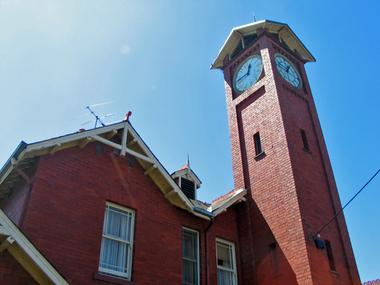
Photograph - Digital photographs, L.J. Gervasoni, Boroondara General Cemetery Gatehouse, c2005-2015
... Burials within the cemetery include the Henty family, artists Louis Buvelot and Charles Nuttall, businessmen John Halfey and publisher David Syme, artist and diarist Georgiana McCrae, actress Nellie Stewart and architect and designer of the Boroondara and Melbourne General Cemeteries, Albert Purchas. ...The Boroondara General Cemetery is registerd by Heritage VictoriaBoroondara Cemetery in kew was established in 1858. It has an unusual triangular reserve bounded by High Street, Park Hill Road and Victoria Park, Kew. The caretaker's lodge and administrative office (1860 designed by Charles Vickers, additions, 1866-1899 by Albert Purchas) form a picturesque two-storey brick structure with a slate roof and clock tower. A rotunda or shelter (1890, Albert Purchas) is located in the centre of the cemetery: this has an octagonal hipped roof with fish scale slates and a decorative brick base with a tessellated floor and timber seating. The cemetery is surrounded by a 2.7 metre high ornamental red brick wall (1895-96, Albert Purchas) with some sections of vertical iron palisades between brick pillars. Albert Purchas was a prominent Melbourne architect who was the Secretary of the Melbourne General Cemetery from 1852 to 1907 and Chairman of the Boroondara Cemetery Board of Trustees from 1867 to 1909. He made a significant contribution to the design of the Boroondara Cemetery Boroondara Cemetery is an outstanding example of the Victorian Garden Cemetery movement in Victoria, retaining key elements of the style, despite overdevelopment which has obscured some of the paths and driveways. Elements of the style represented at Boroondara include an ornamental boundary fence, a system of curving paths which are kerbed and follow the site's natural contours, defined views, recreational facilities such as the rotunda, a landscaped park like setting, sectarian divisions for burials, impressive monuments, wrought and cast iron grave surrounds and exotic symbolic plantings. In the 1850s cemeteries were located on the periphery of populated areas because of concerns about diseases like cholera. They were designed to be attractive places for mourners and visitors to walk and contemplate. Typically cemeteries were arranged to keep religions separated and this tended to maintain links to places of origin, reflecting a migrant society. Other developments included cast iron entrance gates, built in 1889 to a design by Albert Purchas; a cemetery shelter or rotunda, built in 1890, which is a replica of one constructed in the Melbourne General Cemetery in the same year; an ornamental brick fence erected in 1896-99(?); the construction and operation of a terminus for a horse tram at the cemetery gates during 1887-1915; and the Springthorpe Memorial built between 1897 and 1907. A brick cremation wall and a memorial rose garden were constructed near the entrance in the mid- twentieth century(c.1955-57) and a mausoleum completed in 2001.The maintenance shed/depot close to High Street was constructed in 1987. The original entrance was altered in 2000 and the original cast iron gates moved to the eastern entrance of the Mausoleum. Some notable memorials include The Springthorpe Memorial (VHR 522), The Syme Memorial (1908), The Cussen Memorial (VHR 2036). Burials within the cemetery include the Henty family, artists Louis Buvelot and Charles Nuttall, businessmen John Halfey and publisher David Syme, artist and diarist Georgiana McCrae, actress Nellie Stewart and architect and designer of the Boroondara and Melbourne General Cemeteries, Albert Purchas. The Boroondara Cemetery features many plants, mostly conifers and shrubs of funerary symbolism, which line the boundaries, road and pathways, and frame the cemetery monuments or are planted on graves. The major plantings include an impressive row of Bhutan Cypress (Cupressus torulosa), interplanted with Sweet Pittosporum (Pittosporum undulatum), and a few Pittosporum crassifolium, along the High Street and Parkhill Street, where the planting is dominated by Sweet Pittosporum. Planting within the cemetery includes rows and specimen trees of Bhutan Cypress and Italian Cypress (Cupressus sempervirens), including a row with alternate plantings of both species. The planting includes an unusual "squat" form of an Italian Cypress. More of these trees probably lined the cemetery roads and paths. Also dominating the cemetery landscape near the Rotunda is a stand of 3 Canary Island Pines (Pinus canariensis), a Bunya Bunya Pine (Araucaria bidwillii) and a Weeping Elm (Ulmus glabra 'Camperdownii'). Amongst the planting are the following notable conifers: a towering Bunya Bunya Pine (Araucaria bidwillii), a Coast Redwood (Sequoia sempervirens), a rare Golden Funeral Cypress (Chamaecyparis funebris 'Aurea'), two large Funeral Cypress (Chamaecyparis funebris), and the only known Queensland Kauri (Agathis robusta) in a cemetery in Victoria. The Cemetery records, including historical plans of the cemetery from 1859, are held by the administration and their retention enhances the historical significance of the Cemetery. Digital images of a red brick gatehouse at Boroondara General Cemetery in Kew.cemetery, boroondara, kew, gatehouse, clock, tower, clocktower, heritage, memorial -
 Ballarat Heritage Services
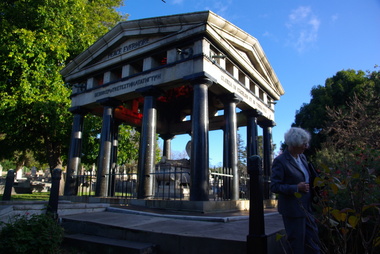
Photograph - Digital photographs, L.J. Gervasoni, Boroondara General Cemetery Springthorpe Memorial, c2005-2015
... They include the Henty family, artists Louis Buvelot and Charles Nuttall, businessmen John Halfey and publisher David Syme, artist and diarist Georgiana McCrae, actress Nellie Stewart and architect and designer of the Boroondara and Melbourne General Cemeteries, Albert Purchas. cemetery boroondara kew gatehouse clock tower clocktower heritage memorial Springthorpe Memorial Digital image of the Springthorpe Memorial in the Boroondara General Cemetery Boroondara General Cemetery Springthorpe Memorial Photograph Digital photographs L.J. ...The Boroondara General Cemetery is registerd by Heritage VictoriaFrom Heritage Victoria Statement of Significance Last updated on - December 15, 2005 What is significant? Boroondara Cemetery, established in 1858, is within an unusual triangular reserve bounded by High Street, Park Hill Road and Victoria Park, Kew. The caretaker's lodge and administrative office (1860 designed by Charles Vickers, additions, 1866-1899 by Albert Purchas) form a picturesque two-storey brick structure with a slate roof and clock tower. A rotunda or shelter (1890, Albert Purchas) is located in the centre of the cemetery: this has an octagonal hipped roof with fish scale slates and a decorative brick base with a tessellated floor and timber seating. The cemetery is surrounded by a 2.7 metre high ornamental red brick wall (1895-96, Albert Purchas) with some sections of vertical iron palisades between brick pillars. Albert Purchas was a prominent Melbourne architect who was the Secretary of the Melbourne General Cemetery from 1852 to 1907 and Chairman of the Boroondara Cemetery Board of Trustees from 1867 to 1909. He made a significant contribution to the design of the Boroondara Cemetery Boroondara Cemetery is an outstanding example of the Victorian Garden Cemetery movement in Victoria, retaining key elements of the style, despite overdevelopment which has obscured some of the paths and driveways. Elements of the style represented at Boroondara include an ornamental boundary fence, a system of curving paths which are kerbed and follow the site's natural contours, defined views, recreational facilities such as the rotunda, a landscaped park like setting, sectarian divisions for burials, impressive monuments, wrought and cast iron grave surrounds and exotic symbolic plantings. In the 1850s cemeteries were located on the periphery of populated areas because of concerns about diseases like cholera. They were designed to be attractive places for mourners and visitors to walk and contemplate. Typically cemeteries were arranged to keep religions separated and this tended to maintain links to places of origin, reflecting a migrant society. Other developments included cast iron entrance gates, built in 1889 to a design by Albert Purchas; a cemetery shelter or rotunda, built in 1890, which is a replica of one constructed in the Melbourne General Cemetery in the same year; an ornamental brick fence erected in 1896-99(?); the construction and operation of a terminus for a horse tram at the cemetery gates during 1887-1915; and the Springthorpe Memorial built between 1897 and 1907. A brick cremation wall and a memorial rose garden were constructed near the entrance in the mid- twentieth century(c.1955-57) and a mausoleum completed in 2001.The maintenance shed/depot close to High Street was constructed in 1987. The original entrance was altered in 2000 and the original cast iron gates moved to the eastern entrance of the Mausoleum. The Springthorpe Memorial (VHR 522) set at the entrance to the burial ground commemorates Annie Springthorpe, and was erected between 1897 and 1907 by her husband Dr John Springthorpe. It was the work of the sculptor Bertram Mackennal, architect Harold Desbrowe Annear, landscape designer and Director of the Melbourne Bortanic Gardens, W.R. Guilfoyle, with considerable input from Dr Springthorpe The memorial is in the form of a small temple in a primitive Doric style. It was designed by Harold Desbrowe Annear and includes Bertram Mackennal sculptures in Carrara marble. Twelve columns of deep green granite from Scotland support a Harcourt granite superstructure. The roof by Brooks Robinson is a coloured glass dome, which sits within the rectangular form and behind the pediments. The sculptural group raised on a dais, consists of the deceased woman lying on a sarcophagus with an attending angel and mourner. The figure of Grief crouches at the foot of the bier and an angel places a wreath over Annie's head, symbolising the triumph of immortal life over death. The body of the deceased was placed in a vault below. The bronze work is by Marriots of Melbourne. Professor Tucker of the University of Melbourne composed appropriate inscriptions in English and archaic Greek lettering.. The floor is a geometric mosaic and the glass dome roof is of Tiffany style lead lighting in hues of reds and pinks in a radiating pattern. The memorial originally stood in a landscape triangular garden of about one acre near the entrance to the cemetery. However, after Dr Springthorpe's death in 1933 it was found that transactions for the land had not been fully completed so most of it was regained by the cemetery. A sundial and seat remain. The building is almost completely intact. The only alteration has been the removal of a glass canopy over the statuary and missing chains between posts. The Argus (26 March 1933) considered the memorial to be the most beautiful work of its kind in Australia. No comparable buildings are known. The Syme Memorial (1908) is a memorial to David Syme, political economist and publisher of the Melbourne Age newspaper. The Egyptian memorial designed by architect Arthur Peck is one of the most finely designed and executed pieces of monumental design in Melbourne. It has a temple like form with each column having a different capital detail. These support a cornice that curves both inwards and outwards. The tomb also has balustradings set between granite piers which create porch spaces leading to the entrance ways. Two variegated Port Jackson Figs are planted at either end. The Cussen Memorial (VHR 2036) was constructed in 1912-13 by Sir Leo Cussen in memory of his young son Hubert. Sir Leo Finn Bernard Cussen (1859-1933), judge and member of the Victorian Supreme Court in 1906. was buried here. The family memorial is one of the larger and more impressive memorials in the cemetery and is an interesting example of the 1930s Gothic Revival style architecture. It takes the form of a small chapel with carvings, diamond shaped roof tiles and decorated ridge embellishing the exterior. By the 1890s, the Boroondara Cemetery was a popular destination for visitors and locals admiring the beauty of the grounds and the splendid monuments. The edge of suburban settlement had reached the cemetery in the previous decade. Its Victorian garden design with sweeping curved drives, hill top views and high maintenance made it attractive. In its Victorian Garden Cemetery design, Boroondara was following an international trend. The picturesque Romanticism of the Pere la Chaise garden cemetery established in Paris in 1804 provided a prototype for great metropolitan cemeteries such as Kensal Green (1883) and Highgate (1839) in London and the Glasgow Necropolis (1831). Boroondara Cemetery was important in establishing this trend in Australia. The cemetery's beauty peaked with the progressive completion of the spectacular Springthorpe Memorial between 1899 and 1907. From about the turn of the century, the trustees encroached on the original design, having repeatedly failed in attempts to gain more land. The wide plantations around road boundaries, grassy verges around clusters of graves in each denomination, and most of the landscaped surround to the Springthorpe memorial are now gone. Some of the original road and path space were resumed for burial purposes. The post war period saw an increased use of the Cemetery by newer migrant groups. The mid- to late- twentieth century monuments were often placed on the grassed edges of the various sections and encroached on the roadways as the cemetery had reached the potential foreseen by its design. These were well tended in comparison with Victorian monuments which have generally been left to fall into a state of neglect. The Boroondara Cemetery features many plants, mostly conifers and shrubs of funerary symbolism, which line the boundaries, road and pathways, and frame the cemetery monuments or are planted on graves. The major plantings include an impressive row of Bhutan Cypress (Cupressus torulosa), interplanted with Sweet Pittosporum (Pittosporum undulatum), and a few Pittosporum crassifolium, along the High Street and Parkhill Street, where the planting is dominated by Sweet Pittosporum. Planting within the cemetery includes rows and specimen trees of Bhutan Cypress and Italian Cypress (Cupressus sempervirens), including a row with alternate plantings of both species. The planting includes an unusual "squat" form of an Italian Cypress. More of these trees probably lined the cemetery roads and paths. Also dominating the cemetery landscape near the Rotunda is a stand of 3 Canary Island Pines (Pinus canariensis), a Bunya Bunya Pine (Araucaria bidwillii) and a Weeping Elm (Ulmus glabra 'Camperdownii') Amongst the planting are the following notable conifers: a towering Bunya Bunya Pine (Araucaria bidwillii), a Coast Redwood (Sequoia sempervirens), a rare Golden Funeral Cypress (Chamaecyparis funebris 'Aurea'), two large Funeral Cypress (Chamaecyparis funebris), and the only known Queensland Kauri (Agathis robusta) in a cemetery in Victoria. The Cemetery records, including historical plans of the cemetery from 1859, are held by the administration and their retention enhances the historical significance of the Cemetery. How is it significant? Boroondara Cemetery is of aesthetic, architectural, scientific (botanical) and historical significance to the State of Victoria. Why is it significant? The Boroondara Cemetery is of historical and aesthetic significance as an outstanding example of a Victorian garden cemetery. The Boroondara Cemetery is of historical significance as a record of Victorian life from the 1850s, and the early settlement of Kew. It is also significant for its ability to demonstrate, through the design and location of the cemetery, attitudes towards burial, health concerns and the importance placed on religion, at the time of its establishment. The Boroondara Cemetery is of architectural significance for the design of the gatehouse or sexton's lodge and cemetery office (built in stages from 1860 to 1899), the ornamental brick perimeter fence and elegant cemetery shelter to the design of prominent Melbourne architects, Charles Vickers (for the original 1860 cottage) and Albert Purchas, cemetery architect and secretary from 1864 to his death in 1907. The Boroondara Cemetery has considerable aesthetic significance which is principally derived from its tranquil, picturesque setting; its impressive memorials and monuments; its landmark features such as the prominent clocktower of the sexton's lodge and office, the mature exotic plantings, the decorative brick fence and the entrance gates; its defined views; and its curving paths. The Springthorpe Memorial (VHR 522), the Syme Memorial and the Cussen Memorial (VHR 2036), all contained within the Boroondara Cemetery, are of aesthetic and architectural significance for their creative and artistic achievement. The Boroondara Cemetery is of scientific (botanical) significance for its collection of rare mature exotic plantings. The Golden Funeral Cypress, (Chamaecyparis funebris 'Aurea') is the only known example in Victoria. The Boroondara Cemetery is of historical significance for the graves, monuments and epitaphs of a number of individuals whose activities have played a major part in Australia's history. They include the Henty family, artists Louis Buvelot and Charles Nuttall, businessmen John Halfey and publisher David Syme, artist and diarist Georgiana McCrae, actress Nellie Stewart and architect and designer of the Boroondara and Melbourne General Cemeteries, Albert Purchas.Digital image of the Springthorpe Memorial in the Boroondara General Cemeterycemetery, boroondara, kew, gatehouse, clock, tower, clocktower, heritage, memorial, springthorpe memorial -
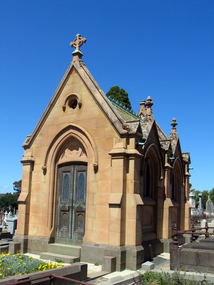 Ballarat Heritage Services
Photograph - Digital photographs, Cussen Memorial in the Boroondara General Cemetery, Kew, Victoria, c2005-2015
... They include the Henty family, artists Louis Buvelot and Charles Nuttall, businessmen John Halfey and publisher David Syme, artist and diarist Georgiana McCrae, actress Nellie Stewart and architect and designer of the Boroondara and Melbourne General Cemeteries, Albert Purchas. cemetery boroondara kew gatehouse clock tower clocktower heritage memorial cussen Digital images Cussen Memorial in the Boroondara General Cemetery, Kew, Victoria Photograph Digital photographs L.J. ...The Boroondara General Cemetery is registerd by Heritage VictoriaFrom Heritage Victoria Statement of Significance Last updated on - December 15, 2005 What is significant? Boroondara Cemetery, established in 1858, is within an unusual triangular reserve bounded by High Street, Park Hill Road and Victoria Park, Kew. The caretaker's lodge and administrative office (1860 designed by Charles Vickers, additions, 1866-1899 by Albert Purchas) form a picturesque two-storey brick structure with a slate roof and clock tower. A rotunda or shelter (1890, Albert Purchas) is located in the centre of the cemetery: this has an octagonal hipped roof with fish scale slates and a decorative brick base with a tessellated floor and timber seating. The cemetery is surrounded by a 2.7 metre high ornamental red brick wall (1895-96, Albert Purchas) with some sections of vertical iron palisades between brick pillars. Albert Purchas was a prominent Melbourne architect who was the Secretary of the Melbourne General Cemetery from 1852 to 1907 and Chairman of the Boroondara Cemetery Board of Trustees from 1867 to 1909. He made a significant contribution to the design of the Boroondara Cemetery Boroondara Cemetery is an outstanding example of the Victorian Garden Cemetery movement in Victoria, retaining key elements of the style, despite overdevelopment which has obscured some of the paths and driveways. Elements of the style represented at Boroondara include an ornamental boundary fence, a system of curving paths which are kerbed and follow the site's natural contours, defined views, recreational facilities such as the rotunda, a landscaped park like setting, sectarian divisions for burials, impressive monuments, wrought and cast iron grave surrounds and exotic symbolic plantings. In the 1850s cemeteries were located on the periphery of populated areas because of concerns about diseases like cholera. They were designed to be attractive places for mourners and visitors to walk and contemplate. Typically cemeteries were arranged to keep religions separated and this tended to maintain links to places of origin, reflecting a migrant society. Other developments included cast iron entrance gates, built in 1889 to a design by Albert Purchas; a cemetery shelter or rotunda, built in 1890, which is a replica of one constructed in the Melbourne General Cemetery in the same year; an ornamental brick fence erected in 1896-99(?); the construction and operation of a terminus for a horse tram at the cemetery gates during 1887-1915; and the Springthorpe Memorial built between 1897 and 1907. A brick cremation wall and a memorial rose garden were constructed near the entrance in the mid- twentieth century(c.1955-57) and a mausoleum completed in 2001.The maintenance shed/depot close to High Street was constructed in 1987. The original entrance was altered in 2000 and the original cast iron gates moved to the eastern entrance of the Mausoleum. The Springthorpe Memorial (VHR 522) set at the entrance to the burial ground commemorates Annie Springthorpe, and was erected between 1897 and 1907 by her husband Dr John Springthorpe. It was the work of the sculptor Bertram Mackennal, architect Harold Desbrowe Annear, landscape designer and Director of the Melbourne Bortanic Gardens, W.R. Guilfoyle, with considerable input from Dr Springthorpe The memorial is in the form of a small temple in a primitive Doric style. It was designed by Harold Desbrowe Annear and includes Bertram Mackennal sculptures in Carrara marble. Twelve columns of deep green granite from Scotland support a Harcourt granite superstructure. The roof by Brooks Robinson is a coloured glass dome, which sits within the rectangular form and behind the pediments. The sculptural group raised on a dais, consists of the deceased woman lying on a sarcophagus with an attending angel and mourner. The figure of Grief crouches at the foot of the bier and an angel places a wreath over Annie's head, symbolising the triumph of immortal life over death. The body of the deceased was placed in a vault below. The bronze work is by Marriots of Melbourne. Professor Tucker of the University of Melbourne composed appropriate inscriptions in English and archaic Greek lettering.. The floor is a geometric mosaic and the glass dome roof is of Tiffany style lead lighting in hues of reds and pinks in a radiating pattern. The memorial originally stood in a landscape triangular garden of about one acre near the entrance to the cemetery. However, after Dr Springthorpe's death in 1933 it was found that transactions for the land had not been fully completed so most of it was regained by the cemetery. A sundial and seat remain. The building is almost completely intact. The only alteration has been the removal of a glass canopy over the statuary and missing chains between posts. The Argus (26 March 1933) considered the memorial to be the most beautiful work of its kind in Australia. No comparable buildings are known. The Syme Memorial (1908) is a memorial to David Syme, political economist and publisher of the Melbourne Age newspaper. The Egyptian memorial designed by architect Arthur Peck is one of the most finely designed and executed pieces of monumental design in Melbourne. It has a temple like form with each column having a different capital detail. These support a cornice that curves both inwards and outwards. The tomb also has balustradings set between granite piers which create porch spaces leading to the entrance ways. Two variegated Port Jackson Figs are planted at either end. The Cussen Memorial (VHR 2036) was constructed in 1912-13 by Sir Leo Cussen in memory of his young son Hubert. Sir Leo Finn Bernard Cussen (1859-1933), judge and member of the Victorian Supreme Court in 1906. was buried here. The family memorial is one of the larger and more impressive memorials in the cemetery and is an interesting example of the 1930s Gothic Revival style architecture. It takes the form of a small chapel with carvings, diamond shaped roof tiles and decorated ridge embellishing the exterior. By the 1890s, the Boroondara Cemetery was a popular destination for visitors and locals admiring the beauty of the grounds and the splendid monuments. The edge of suburban settlement had reached the cemetery in the previous decade. Its Victorian garden design with sweeping curved drives, hill top views and high maintenance made it attractive. In its Victorian Garden Cemetery design, Boroondara was following an international trend. The picturesque Romanticism of the Pere la Chaise garden cemetery established in Paris in 1804 provided a prototype for great metropolitan cemeteries such as Kensal Green (1883) and Highgate (1839) in London and the Glasgow Necropolis (1831). Boroondara Cemetery was important in establishing this trend in Australia. The cemetery's beauty peaked with the progressive completion of the spectacular Springthorpe Memorial between 1899 and 1907. From about the turn of the century, the trustees encroached on the original design, having repeatedly failed in attempts to gain more land. The wide plantations around road boundaries, grassy verges around clusters of graves in each denomination, and most of the landscaped surround to the Springthorpe memorial are now gone. Some of the original road and path space were resumed for burial purposes. The post war period saw an increased use of the Cemetery by newer migrant groups. The mid- to late- twentieth century monuments were often placed on the grassed edges of the various sections and encroached on the roadways as the cemetery had reached the potential foreseen by its design. These were well tended in comparison with Victorian monuments which have generally been left to fall into a state of neglect. The Boroondara Cemetery features many plants, mostly conifers and shrubs of funerary symbolism, which line the boundaries, road and pathways, and frame the cemetery monuments or are planted on graves. The major plantings include an impressive row of Bhutan Cypress (Cupressus torulosa), interplanted with Sweet Pittosporum (Pittosporum undulatum), and a few Pittosporum crassifolium, along the High Street and Parkhill Street, where the planting is dominated by Sweet Pittosporum. Planting within the cemetery includes rows and specimen trees of Bhutan Cypress and Italian Cypress (Cupressus sempervirens), including a row with alternate plantings of both species. The planting includes an unusual "squat" form of an Italian Cypress. More of these trees probably lined the cemetery roads and paths. Also dominating the cemetery landscape near the Rotunda is a stand of 3 Canary Island Pines (Pinus canariensis), a Bunya Bunya Pine (Araucaria bidwillii) and a Weeping Elm (Ulmus glabra 'Camperdownii') Amongst the planting are the following notable conifers: a towering Bunya Bunya Pine (Araucaria bidwillii), a Coast Redwood (Sequoia sempervirens), a rare Golden Funeral Cypress (Chamaecyparis funebris 'Aurea'), two large Funeral Cypress (Chamaecyparis funebris), and the only known Queensland Kauri (Agathis robusta) in a cemetery in Victoria. The Cemetery records, including historical plans of the cemetery from 1859, are held by the administration and their retention enhances the historical significance of the Cemetery. How is it significant? Boroondara Cemetery is of aesthetic, architectural, scientific (botanical) and historical significance to the State of Victoria. Why is it significant? The Boroondara Cemetery is of historical and aesthetic significance as an outstanding example of a Victorian garden cemetery. The Boroondara Cemetery is of historical significance as a record of Victorian life from the 1850s, and the early settlement of Kew. It is also significant for its ability to demonstrate, through the design and location of the cemetery, attitudes towards burial, health concerns and the importance placed on religion, at the time of its establishment. The Boroondara Cemetery is of architectural significance for the design of the gatehouse or sexton's lodge and cemetery office (built in stages from 1860 to 1899), the ornamental brick perimeter fence and elegant cemetery shelter to the design of prominent Melbourne architects, Charles Vickers (for the original 1860 cottage) and Albert Purchas, cemetery architect and secretary from 1864 to his death in 1907. The Boroondara Cemetery has considerable aesthetic significance which is principally derived from its tranquil, picturesque setting; its impressive memorials and monuments; its landmark features such as the prominent clocktower of the sexton's lodge and office, the mature exotic plantings, the decorative brick fence and the entrance gates; its defined views; and its curving paths. The Springthorpe Memorial (VHR 522), the Syme Memorial and the Cussen Memorial (VHR 2036), all contained within the Boroondara Cemetery, are of aesthetic and architectural significance for their creative and artistic achievement. The Boroondara Cemetery is of scientific (botanical) significance for its collection of rare mature exotic plantings. The Golden Funeral Cypress, (Chamaecyparis funebris 'Aurea') is the only known example in Victoria. The Boroondara Cemetery is of historical significance for the graves, monuments and epitaphs of a number of individuals whose activities have played a major part in Australia's history. They include the Henty family, artists Louis Buvelot and Charles Nuttall, businessmen John Halfey and publisher David Syme, artist and diarist Georgiana McCrae, actress Nellie Stewart and architect and designer of the Boroondara and Melbourne General Cemeteries, Albert Purchas.Digital imagescemetery, boroondara, kew, gatehouse, clock, tower, clocktower, heritage, memorial, cussen -
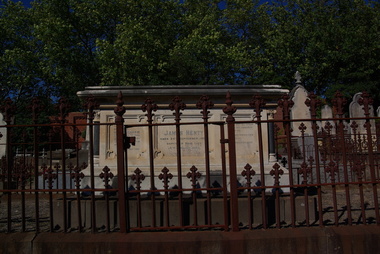 Ballarat Heritage Services
Photograph - Digital photographs, L.J. Gervasoni, Henty Memorial in Boroondara General Cemetery, c2005-2015
... They include the Henty family, artists Louis Buvelot and Charles Nuttall, businessmen John Halfey and publisher David Syme, artist and diarist Georgiana McCrae, actress Nellie Stewart and architect and designer of the Boroondara and Melbourne General Cemeteries, Albert Purchas. cemetery boroondara kew gatehouse clock tower clocktower heritage memorial henty James Henty Digital images Henty Memorial in Boroondara General Cemetery Photograph Digital photographs L.J. ...The Boroondara General Cemetery is registered by Heritage Victoria. The Henty's were some of the earliest settlers in Victoria.From Heritage Victoria Statement of Significance Last updated on - December 15, 2005 What is significant? Boroondara Cemetery, established in 1858, is within an unusual triangular reserve bounded by High Street, Park Hill Road and Victoria Park, Kew. The caretaker's lodge and administrative office (1860 designed by Charles Vickers, additions, 1866-1899 by Albert Purchas) form a picturesque two-storey brick structure with a slate roof and clock tower. A rotunda or shelter (1890, Albert Purchas) is located in the centre of the cemetery: this has an octagonal hipped roof with fish scale slates and a decorative brick base with a tessellated floor and timber seating. The cemetery is surrounded by a 2.7 metre high ornamental red brick wall (1895-96, Albert Purchas) with some sections of vertical iron palisades between brick pillars. Albert Purchas was a prominent Melbourne architect who was the Secretary of the Melbourne General Cemetery from 1852 to 1907 and Chairman of the Boroondara Cemetery Board of Trustees from 1867 to 1909. He made a significant contribution to the design of the Boroondara Cemetery Boroondara Cemetery is an outstanding example of the Victorian Garden Cemetery movement in Victoria, retaining key elements of the style, despite overdevelopment which has obscured some of the paths and driveways. Elements of the style represented at Boroondara include an ornamental boundary fence, a system of curving paths which are kerbed and follow the site's natural contours, defined views, recreational facilities such as the rotunda, a landscaped park like setting, sectarian divisions for burials, impressive monuments, wrought and cast iron grave surrounds and exotic symbolic plantings. In the 1850s cemeteries were located on the periphery of populated areas because of concerns about diseases like cholera. They were designed to be attractive places for mourners and visitors to walk and contemplate. Typically cemeteries were arranged to keep religions separated and this tended to maintain links to places of origin, reflecting a migrant society. Other developments included cast iron entrance gates, built in 1889 to a design by Albert Purchas; a cemetery shelter or rotunda, built in 1890, which is a replica of one constructed in the Melbourne General Cemetery in the same year; an ornamental brick fence erected in 1896-99(?); the construction and operation of a terminus for a horse tram at the cemetery gates during 1887-1915; and the Springthorpe Memorial built between 1897 and 1907. A brick cremation wall and a memorial rose garden were constructed near the entrance in the mid- twentieth century(c.1955-57) and a mausoleum completed in 2001.The maintenance shed/depot close to High Street was constructed in 1987. The original entrance was altered in 2000 and the original cast iron gates moved to the eastern entrance of the Mausoleum. The Springthorpe Memorial (VHR 522) set at the entrance to the burial ground commemorates Annie Springthorpe, and was erected between 1897 and 1907 by her husband Dr John Springthorpe. It was the work of the sculptor Bertram Mackennal, architect Harold Desbrowe Annear, landscape designer and Director of the Melbourne Bortanic Gardens, W.R. Guilfoyle, with considerable input from Dr Springthorpe The memorial is in the form of a small temple in a primitive Doric style. It was designed by Harold Desbrowe Annear and includes Bertram Mackennal sculptures in Carrara marble. Twelve columns of deep green granite from Scotland support a Harcourt granite superstructure. The roof by Brooks Robinson is a coloured glass dome, which sits within the rectangular form and behind the pediments. The sculptural group raised on a dais, consists of the deceased woman lying on a sarcophagus with an attending angel and mourner. The figure of Grief crouches at the foot of the bier and an angel places a wreath over Annie's head, symbolising the triumph of immortal life over death. The body of the deceased was placed in a vault below. The bronze work is by Marriots of Melbourne. Professor Tucker of the University of Melbourne composed appropriate inscriptions in English and archaic Greek lettering.. The floor is a geometric mosaic and the glass dome roof is of Tiffany style lead lighting in hues of reds and pinks in a radiating pattern. The memorial originally stood in a landscape triangular garden of about one acre near the entrance to the cemetery. However, after Dr Springthorpe's death in 1933 it was found that transactions for the land had not been fully completed so most of it was regained by the cemetery. A sundial and seat remain. The building is almost completely intact. The only alteration has been the removal of a glass canopy over the statuary and missing chains between posts. The Argus (26 March 1933) considered the memorial to be the most beautiful work of its kind in Australia. No comparable buildings are known. The Syme Memorial (1908) is a memorial to David Syme, political economist and publisher of the Melbourne Age newspaper. The Egyptian memorial designed by architect Arthur Peck is one of the most finely designed and executed pieces of monumental design in Melbourne. It has a temple like form with each column having a different capital detail. These support a cornice that curves both inwards and outwards. The tomb also has balustradings set between granite piers which create porch spaces leading to the entrance ways. Two variegated Port Jackson Figs are planted at either end. The Cussen Memorial (VHR 2036) was constructed in 1912-13 by Sir Leo Cussen in memory of his young son Hubert. Sir Leo Finn Bernard Cussen (1859-1933), judge and member of the Victorian Supreme Court in 1906. was buried here. The family memorial is one of the larger and more impressive memorials in the cemetery and is an interesting example of the 1930s Gothic Revival style architecture. It takes the form of a small chapel with carvings, diamond shaped roof tiles and decorated ridge embellishing the exterior. By the 1890s, the Boroondara Cemetery was a popular destination for visitors and locals admiring the beauty of the grounds and the splendid monuments. The edge of suburban settlement had reached the cemetery in the previous decade. Its Victorian garden design with sweeping curved drives, hill top views and high maintenance made it attractive. In its Victorian Garden Cemetery design, Boroondara was following an international trend. The picturesque Romanticism of the Pere la Chaise garden cemetery established in Paris in 1804 provided a prototype for great metropolitan cemeteries such as Kensal Green (1883) and Highgate (1839) in London and the Glasgow Necropolis (1831). Boroondara Cemetery was important in establishing this trend in Australia. The cemetery's beauty peaked with the progressive completion of the spectacular Springthorpe Memorial between 1899 and 1907. From about the turn of the century, the trustees encroached on the original design, having repeatedly failed in attempts to gain more land. The wide plantations around road boundaries, grassy verges around clusters of graves in each denomination, and most of the landscaped surround to the Springthorpe memorial are now gone. Some of the original road and path space were resumed for burial purposes. The post war period saw an increased use of the Cemetery by newer migrant groups. The mid- to late- twentieth century monuments were often placed on the grassed edges of the various sections and encroached on the roadways as the cemetery had reached the potential foreseen by its design. These were well tended in comparison with Victorian monuments which have generally been left to fall into a state of neglect. The Boroondara Cemetery features many plants, mostly conifers and shrubs of funerary symbolism, which line the boundaries, road and pathways, and frame the cemetery monuments or are planted on graves. The major plantings include an impressive row of Bhutan Cypress (Cupressus torulosa), interplanted with Sweet Pittosporum (Pittosporum undulatum), and a few Pittosporum crassifolium, along the High Street and Parkhill Street, where the planting is dominated by Sweet Pittosporum. Planting within the cemetery includes rows and specimen trees of Bhutan Cypress and Italian Cypress (Cupressus sempervirens), including a row with alternate plantings of both species. The planting includes an unusual "squat" form of an Italian Cypress. More of these trees probably lined the cemetery roads and paths. Also dominating the cemetery landscape near the Rotunda is a stand of 3 Canary Island Pines (Pinus canariensis), a Bunya Bunya Pine (Araucaria bidwillii) and a Weeping Elm (Ulmus glabra 'Camperdownii') Amongst the planting are the following notable conifers: a towering Bunya Bunya Pine (Araucaria bidwillii), a Coast Redwood (Sequoia sempervirens), a rare Golden Funeral Cypress (Chamaecyparis funebris 'Aurea'), two large Funeral Cypress (Chamaecyparis funebris), and the only known Queensland Kauri (Agathis robusta) in a cemetery in Victoria. The Cemetery records, including historical plans of the cemetery from 1859, are held by the administration and their retention enhances the historical significance of the Cemetery. How is it significant? Boroondara Cemetery is of aesthetic, architectural, scientific (botanical) and historical significance to the State of Victoria. Why is it significant? The Boroondara Cemetery is of historical and aesthetic significance as an outstanding example of a Victorian garden cemetery. The Boroondara Cemetery is of historical significance as a record of Victorian life from the 1850s, and the early settlement of Kew. It is also significant for its ability to demonstrate, through the design and location of the cemetery, attitudes towards burial, health concerns and the importance placed on religion, at the time of its establishment. The Boroondara Cemetery is of architectural significance for the design of the gatehouse or sexton's lodge and cemetery office (built in stages from 1860 to 1899), the ornamental brick perimeter fence and elegant cemetery shelter to the design of prominent Melbourne architects, Charles Vickers (for the original 1860 cottage) and Albert Purchas, cemetery architect and secretary from 1864 to his death in 1907. The Boroondara Cemetery has considerable aesthetic significance which is principally derived from its tranquil, picturesque setting; its impressive memorials and monuments; its landmark features such as the prominent clocktower of the sexton's lodge and office, the mature exotic plantings, the decorative brick fence and the entrance gates; its defined views; and its curving paths. The Springthorpe Memorial (VHR 522), the Syme Memorial and the Cussen Memorial (VHR 2036), all contained within the Boroondara Cemetery, are of aesthetic and architectural significance for their creative and artistic achievement. The Boroondara Cemetery is of scientific (botanical) significance for its collection of rare mature exotic plantings. The Golden Funeral Cypress, (Chamaecyparis funebris 'Aurea') is the only known example in Victoria. The Boroondara Cemetery is of historical significance for the graves, monuments and epitaphs of a number of individuals whose activities have played a major part in Australia's history. They include the Henty family, artists Louis Buvelot and Charles Nuttall, businessmen John Halfey and publisher David Syme, artist and diarist Georgiana McCrae, actress Nellie Stewart and architect and designer of the Boroondara and Melbourne General Cemeteries, Albert Purchas.Digital imagescemetery, boroondara, kew, gatehouse, clock, tower, clocktower, heritage, memorial, henty, james henty -
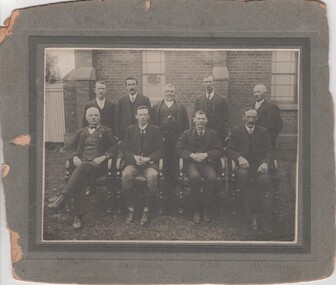 Rutherglen Historical Society
Photograph - Image
... McCrae, J. Briggs, P. Sheridan, W. Gill". At bottom, identifying front row: "M. Martin, G.W.C. Venebales, F. Gill, H. Jackson". On back, identified more fully: "Shire Councillors. Back Row L to R - Walter McRae, John...rutherglen shire councillors walter mcrae john briggs p sheridan w gill thomas drenen m martin g w c venables f gill h jackson At top of cardboard mount, identifying men in back row: "W. McCrae ...Black & white photograph, mounted on cardboard, of Rutherglen Shire Councillors - year unknownAt top of cardboard mount, identifying men in back row: "W. McCrae, J. Briggs, P. Sheridan, W. Gill". At bottom, identifying front row: "M. Martin, G.W.C. Venebales, F. Gill, H. Jackson". On back, identified more fully: "Shire Councillors. Back Row L to R - Walter McRae, John Briggs, P Sheridan, W. Gill & Thomas Drenen (Press). Front Row L to R - M. Martin, G.W.C. Venables, F. Gill & H. Jackson".rutherglen shire councillors, walter mcrae, john briggs, p sheridan, w gill, thomas drenen, m martin, g w c venables, f gill, h jackson
