
Showing 154 items matching "kew junction – kew (vic.)"
-
 Kew Historical Society Inc
Album - Scrapbook, Eva Grant, Historic Buildings, Kew, 1958-78, 1970s
... kew...country roads board - denmark street - kew...dorothy rogers reserve - studley park road - kew...field place - 3 henty court - kew (vic)...ellsmere (also ellesmere/ellsmore) - princess street - kew...fernhurst - 13 fernhurst grove - kew (vic)...kew civic centre - civic drive - kew (vic)...kew junction...Buildings included in the scrapbook include: Billy Hughes' house - 167 Cotham Road Congregational Church - Walpole Street (c.1978) Country Roads Board - Denmark Street (1960) Dorothy Rogers Reserve - Studley Park Road Ellsmere (also Ellesmere/Ellsmore) - Princess Street Field Place - 3 Henty Court Fernhurst - 13 Fernhurst Grove Kew Civic Centre (1959) Kew Junction (1958) Kew Railway Station (1902, 1959) Kew Recreation Hall - Wellington Street (1960) Neama (Hall) - Studley Park Road Southesk (formerly Ordsall) - Cotham Road (c.1960) St Anthony's Home for Babies (formerly Madford) - 43 Wellington Street (c.1976) Studley House - Nolan Avenue The scrapbook contains historically significant, rare and sometimes unique images of significant heritage buildings in Kew, including their erection and demolition. eva grant billy hughes' house - 167 cotham road congregational church - walpole street - kew country roads board - denmark street - kew dorothy rogers reserve - studley park road - kew field place - 3 henty court - kew (vic) ellsmere (also ellesmere/ellsmore) - princess street - kew fernhurst - 13 fernhurst grove - kew (vic) kew civic centre - civic drive - kew (vic) kew junction - kew (vic) kew railway station - denmark street - kew (vic) recreation hall - wellington street - kew neama - hall - studley park road - kew (vic) southesk - ordsall - cotham road- kew (vic) st anthony's home for babies - madford - 43 wellington street (vic) studley house - nolan avenue - kew (vic) Includes letter from donor 11-page scrapbook of photographs and newspaper clippings with annotations by Eva Grant, a past member of the Kew Historical Society. ...One of three scrapbooks of photographs and newspaper cuttings taken and or collected by Eva Grant, a past member of the Kew Historical Society, which were donated by her niece, Julie Thomson. The albums include many photographs of Kew from the 1950s to the 1970s. Buildings included in the scrapbook include: Billy Hughes' house - 167 Cotham Road Congregational Church - Walpole Street (c.1978) Country Roads Board - Denmark Street (1960) Dorothy Rogers Reserve - Studley Park Road Ellsmere (also Ellesmere/Ellsmore) - Princess Street Field Place - 3 Henty Court Fernhurst - 13 Fernhurst Grove Kew Civic Centre (1959) Kew Junction (1958) Kew Railway Station (1902, 1959) Kew Recreation Hall - Wellington Street (1960) Neama (Hall) - Studley Park Road Southesk (formerly Ordsall) - Cotham Road (c.1960) St Anthony's Home for Babies (formerly Madford) - 43 Wellington Street (c.1976) Studley House - Nolan AvenueThe scrapbook contains historically significant, rare and sometimes unique images of significant heritage buildings in Kew, including their erection and demolition. 11-page scrapbook of photographs and newspaper clippings with annotations by Eva Grant, a past member of the Kew Historical Society. The pages of the album can be viewed in the image carousel above. Based on the text and known dates of demolition of a number of the buildings, the scrapbook was assembled over a twenty year period between c.1958-c.1978.Includes letter from donoreva grant, billy hughes' house - 167 cotham road, congregational church - walpole street - kew, country roads board - denmark street - kew, dorothy rogers reserve - studley park road - kew, field place - 3 henty court - kew (vic), ellsmere (also ellesmere/ellsmore) - princess street - kew, fernhurst - 13 fernhurst grove - kew (vic), kew civic centre - civic drive - kew (vic), kew junction - kew (vic), kew railway station - denmark street - kew (vic), recreation hall - wellington street - kew, neama - hall - studley park road - kew (vic), southesk - ordsall - cotham road- kew (vic), st anthony's home for babies - madford - 43 wellington street (vic), studley house - nolan avenue - kew (vic) -
 Kew Historical Society Inc
Archive (Series) - WALLENBERG, Raoul
... Kew (Vic.)...Frank Vajda – Kew (Vic.)...Memorials – Kew (Vic.)...Kew Junction...Kew (Vic.) Frank Vajda – Kew (Vic.) Memorials – Kew (Vic.) Kew Junction – Kew (Vic.) ...Various PartiesReference, Research, InformationArranged by Secondary Values (value of records to users)Raoul Wallenberg was a Swedish diplomat who is renowned for using his power as an envoy to Budapest during World War 2 to issue passports that protected and allowed for the escape of Jews in Hungary from the Nazis. He is believed to have saved upwards of one-hundred-thousand lives, before being detained by the Soviet Union and disappearing, with the date and cause of his death still being disputed. Raoul’s legacy in Kew exists due to the migration of those he saved, notably Professor Frank Vajda. After Wallenberg saved him, and his family, from being executed, Vajda would migrate to Kew and would became the driving force behind the memorial that now sits at Kew Junction designed by Karl Duldig. The memorial, erected in 1985, was the first one dedicated to Wallenberg outside of Budapest, and has been credited with raising local awareness of his life and work. The file includes: Multiple newspaper articles about Wallenberg and the memorial, a notice from the Kew Library on a talk from Frank Vajda, a written address from Eva de Jong-Duldig given at the memorial, a document related to the naming ceremony, as well as a letter between the Kew Historical Society and the Department of Crown Lands & Survey.raoul wallenberg – kew (vic.), frank vajda – kew (vic.), memorials – kew (vic.), kew junction – kew (vic.), karl duldig – kew (vic.)raoul wallenberg – kew (vic.), frank vajda – kew (vic.), memorials – kew (vic.), kew junction – kew (vic.), karl duldig – kew (vic.) -
Kew Historical Society Inc
Archive (Series) - Kew Post Office
... Kew Post Office Building – Kew (Vic.)...QPO – Kew (Vic.)...Postmaster Hotel – Kew (Vic.)...Kew Junction...Kew Post Office Building – Kew (Vic.) QPO – Kew (Vic.) Postmaster Hotel – Kew (Vic.) Kew Junction – Kew (Vic.) ...Various PartiesReference, Research, InformationArranged by Secondary Values (value of records to users)The Kew Post office was built in 1887 and persisted in its role until 1992, when the building would become home to both QPO, a staple restaurant, and the Postmaster Hotel. The building was registered as a heritage landmark in 1991. The file includes: Newspaper articles regarding the building, letters regarding the designation of the building as a heritage site, and the plans for the building.kew post office building – kew (vic.), qpo – kew (vic.), postmaster hotel – kew (vic.), kew junction – kew (vic.)kew post office building – kew (vic.), qpo – kew (vic.), postmaster hotel – kew (vic.), kew junction – kew (vic.) -
 Kew Historical Society Inc
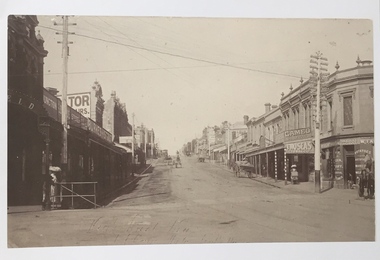
Photograph, High Street, Kew, 1891
... kew...kew junction...streets -- kew (Vic)...Early photograph of High Street, Kew, looking east from Kew Junction. high street, kew kew junction streets -- kew (Vic) High Street, Kew, circa 1891. ...Early photograph of High Street, Kew, looking east from Kew Junction.High Street, Kew, circa 1891.high street, kew, kew junction, streets -- kew (vic) -
Kew Historical Society Inc
Newspaper - Newspaper photograph, The Age, Modern Melbourne #72. Play misty for me: Kew Junction, 2013, 2013
... kew junction...newspaper photos -- kew (vic.)...kew junction newspaper photos -- kew (vic.) Modern Melbourne #72. Play misty for me: Kew Junction looks spookily like a city in America's Deep South on a foggy Winter morning / Photo: Eddie Jim. ...Modern Melbourne #72. Play misty for me: Kew Junction looks spookily like a city in America's Deep South on a foggy Winter morning / Photo: Eddie Jim. Published in The Age, August 25, 2013, page 16. In copyright until 2088. Not to be copied or published without permission.kew junction, newspaper photos -- kew (vic.) -
 Kew Historical Society Inc
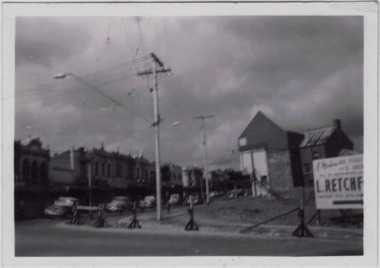
Photograph - Kew Junction during road widening, December 1958
... kew junction...denmark street -- kew (vic.)...major roadworks -- kew...Kew Junction is the intersection of five major roads - Denmark Street, High Street, High Street South, Studley Park Road and Princess Street. The original widening of High Street in the 1930s expanded that street by removing shops on the south side of the street from Cotham Road to Denmark Street. Further widening in 1958 removed shops at the west end of High Street to allow for increased traffic using Princes Street and Denmark Street. kew junction denmark street -- kew (vic ...Kew Junction is the intersection of five major roads - Denmark Street, High Street, High Street South, Studley Park Road and Princess Street. The original widening of High Street in the 1930s expanded that street by removing shops on the south side of the street from Cotham Road to Denmark Street. Further widening in 1958 removed shops at the west end of High Street to allow for increased traffic using Princes Street and Denmark Street.Original, black and white positive of Kew Junction, including the corner with Denmark Street during road widening in the 1958.Inscribed verso: "Kew Junction Dec 1958 / When the road was being widened by the removal of a number of shops / Notice saying Retchford's Estate agency's temporary office is at the top end of Denmark Street, Kew"kew junction, denmark street -- kew (vic.), major roadworks -- kew (vic.) -
 Kew Historical Society Inc
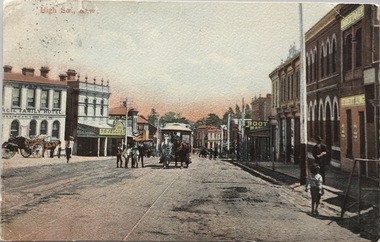
Postcard, High Str., Kew, c.1906
... Kew (vic.) postcards -- kew (vic.) horse tram -- kew (Vic.) Reverse - (to) Miss __. J. Thompson, "Dry Lake", Kerang (from) Very sorry indeed to hear of your Mother's illness. Sincerely hope all quite well ere this. Still going about very tired waiting __ being away. Love to all M.B.L. Polychrome postcard of High Street, Kew looking west towards Kew Junction ...The Kew Historical Society's postcard collection includes views of Kew, Melbourne and Greater Melbourne as well as those including overseas scenes sent or received from Europe or the Middle East. They date from the 1890s to the 2000s. These postcards may or may not include the name of the publisher or printer. A number of the cards were published as parts of popular series. A way of dating early postcards is to identify whether the reverse was divided by a central line which became the norm after 1902 in the United Kingdom. However, other postcards produced after this date do not always conform to this print layout.Polychrome postcard of High Street, Kew looking west towards Kew Junction. The photograph was also printed in monochrome format by the publishers, with different names and additions.Reverse - (to) Miss __. J. Thompson, "Dry Lake", Kerang (from) Very sorry indeed to hear of your Mother's illness. Sincerely hope all quite well ere this. Still going about very tired waiting __ being away. Love to all M.B.L.high street -- kew (vic.), postcards -- kew (vic.), horse tram -- kew (vic.) -
 Kew Historical Society Inc
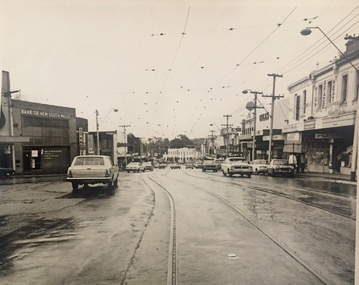
Photograph, J E & B L Rogers, High Street, Looking to Junction, 1960s
... Kew’ (1961) and 'A History of Kew' (1973), or the numerous articles on local history that she produced for suburban newspapers. Most of the photographs in the collection include detailed annotations in her hand. The Rogers Collection provides a comprehensive insight into the working habits of a historian in the 1960s and 1970s. Together it forms the largest privately-donated collection within the archives of the Kew Historical Society. high street -- kew (vic.) shopping strips -- melbourne "High St / Looking towards Junction ...This work forms part of the collection assembled by the historian Dorothy Rogers, that was donated to the Kew Historical Society by her son John Rogers in 2015. The manuscripts, photographs, maps, and documents were sourced by her from both family and local collections or produced as references for her print publications. Many were directly used by Rogers in writing ‘Lovely Old Homes of Kew’ (1961) and 'A History of Kew' (1973), or the numerous articles on local history that she produced for suburban newspapers. Most of the photographs in the collection include detailed annotations in her hand.The Rogers Collection provides a comprehensive insight into the working habits of a historian in the 1960s and 1970s. Together it forms the largest privately-donated collection within the archives of the Kew Historical Society.Small, black and white photo of High Street, Kew, looking west towards Kew Junction."High St / Looking towards Junction / Jim's / 4high street -- kew (vic.), shopping strips -- melbourne -
 Kew Historical Society Inc
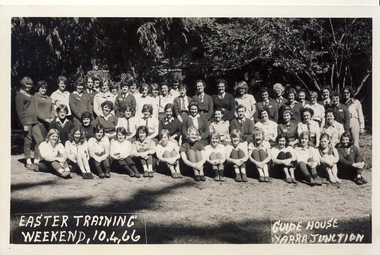
Photograph - Digital Image, Easter Training Weekend, Guides House, Yarra Junction, 1966, 2020
... Digital copy of a photograph in an album belonging to Judith Scurfield, which includes images of 6th Kew Guides guides - kew (Vic) 6th kew guides See Reverse of image for names Group photograph of participants in an Easter Training Weekend, Guides House, Yarra Junction, 1966 Easter Training Weekend, Guides House, Yarra Junction, 1966 Photograph Digital Image ...Digital copy of a photograph in an album belonging to Judith Scurfield, which includes images of 6th Kew GuidesGroup photograph of participants in an Easter Training Weekend, Guides House, Yarra Junction, 1966See Reverse of image for namesguides - kew (vic), 6th kew guides -
 Kew Historical Society Inc
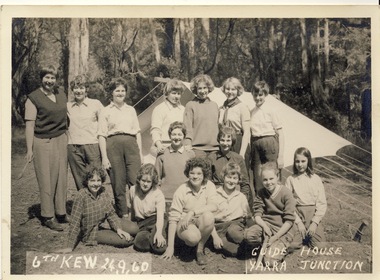
Photograph - Digital Image, 6th Kew, Guide House, Yarra Junction, 1960, 1960
... Digital copy of a photograph from a personal album belonging to Judith Scurfield which includes a number of photographs of the 6th Kew Guides. 6th kew guides girl guides - kew (vic) Group photograph of 6th Kew Guides at the Guide House, Yarra Junction in 1960. 6th Kew, Guide House, Yarra Junction, 1960 Photograph Digital Image ...Digital copy of a photograph from a personal album belonging to Judith Scurfield which includes a number of photographs of the 6th Kew Guides.Group photograph of 6th Kew Guides at the Guide House, Yarra Junction in 1960.6th kew guides, girl guides - kew (vic) -
 Kew Historical Society Inc
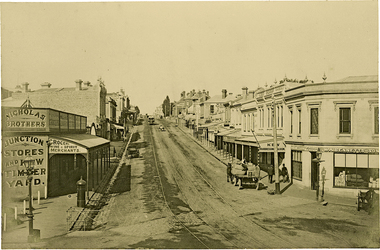
Photograph, J F C Farquhar, High Street, Kew, 1891
... Kew. The individual images have proved essential in identifying buildings and places of heritage value in the district. kew illustrated kew where we live photographic books henry kellett high street - kew (vic) High Street, Kew In 1891, High Street was the centre of commercial activity in the Borough of Kew. It was unpaved and edged with deep bluestone gutters, which were designed to channel the significant flow of storm water down the hill to and beyond the Junction ...At the beginning of the 1890s, the Kew businessman and Town Councillor, Henry Kellett, commissioned J.F.C. Farquhar to photograph scenes of Kew. These scenes included panoramas as well as pastoral scenes. The resulting set of twelve photographs was assembled in an album, Kew Where We Live, from which customers could select images for purchase.The preamble to the album describes that the photographs used the ‘argentic bromide’ process, now more commonly known as the gelatine silver process. This form of dry plate photography allowed for the negatives to be kept for weeks before processing, hence its value in landscape photography. The resulting images were considered to be finely grained and everlasting. Evidence of the success of Henry Kellett’s venture can be seen today, in that some of the photographs are held in national collections.It is believed that the Kew Historical Society’s copy of the Kellett album is unique and that the photographs in the book were the first copies taken from the original plates. It is the first and most important series of images produced about Kew. The individual images have proved essential in identifying buildings and places of heritage value in the district.In 1891, High Street was the centre of commercial activity in the Borough of Kew. It was unpaved and edged with deep bluestone gutters, which were designed to channel the significant flow of storm water down the hill to and beyond the Junction. On either side of the entrance to the shopping strip are two cast iron gas lamps that provided the only public street lighting before the Post Office was reached. Most shops, including the Nicholas Brothers’ Junction Store featured cast iron verandas. Further up the hill, Dougherty’s Greyhound Hotel was by this stage a local institution. Apart from the horse-drawn tram, the main form of personal and commercial transport in this period remained the horse, horse and cart, or buggy.The panoramic view predates the widening of High Street in the 20th century, and thus includes the original alignment of buildings on the south side. These included Henry Kellett’s shop.High Street, Kewkew illustrated, kew where we live, photographic books, henry kellett, high street - kew (vic) -
Kew Historical Society Inc
Archive (Sub-series) - Subject File, Kew Historical Society, Hotels, 1958
... kew - history...hotels - kew (vic)...prospect hill hotel...clifton hotel - kew junction...Since its foundation in 1958, members of the Kew Historical Society have been compiling and storing information about subjects relating to the history of Kew and its environs, of which this file is an example. Typically files will contain primary and secondary sources. kew - history hotels - kew (vic) prospect hill hotel clifton hotel - kew junction greyhound hotel woodman inn harp of erin hotel kew hotel, e s clementson pty ltd architects - melbourne robert mcintyre - architect Vertical file containing primary and secondary sources relating to each hotel in Kew, including the Woodman Inn, Clifton Hotel, Greyhound Hotel, Princess Hotel, Harp of Erin, Kew Hotel, and the Council Family Hotel. ...Various partiesReference, Research, InformationSecondary Values (KHS Imposed Order)Subject file containing primary and secondary sources relating to each hotel in Kew, including the Woodman Inn, Clifton Hotel, Greyhound Hotel, Princess Hotel, Harp of Erin, Kew Hotel, and the Council Family Hotel. Each file includes correspondence, histories, etc. The general section of the archive file includes a copy of McWilliam, Gwen, ‘Hotels, Vineyards and Licenses in Boroondara & neighbourhood in the Nineteenth Century (revised 1998) [21 pages]. The earliest original document is an original bound contract with costings, provided by E S Clementson Pty Ltd (1956) to Robert H McIntyre & Associates for rebuilding the Harp of Erin Hotel.kew - history, hotels - kew (vic), prospect hill hotel, clifton hotel - kew junction, greyhound hotel, woodman inn, harp of erin hotel, kew hotel,, e s clementson pty ltd, architects - melbourne, robert mcintyre - architectkew - history, hotels - kew (vic), prospect hill hotel, clifton hotel - kew junction, greyhound hotel, woodman inn, harp of erin hotel, kew hotel,, e s clementson pty ltd, architects - melbourne, robert mcintyre - architect -
![High Street, East Kew [looking west], 1977](/media/collectors/550653872162f11fb04854aa/items/586f8bbfd0ce0e07f06d22ed/item-media/586f8c3ad0ce0e07f06d44cc/item-fit-380x285.jpg?cb=6) Kew Historical Society Inc
Kew Historical Society IncPhotograph, High Street, East Kew, 1977
... Kew's Civic Collection while others are the work of amateur and professional photographers. Most of the images in the collection depict people, places and objects within the suburbs of Kew and Kew East. Other photographs depict other locations in Melbourne and Victoria. A number of the photographs are of statewide and/or national significance. high street -- kew (vic.) streetscapes -- kew (vic.) Inscription reverse: "KH-72. View from junction ...The Kew Historical Society's Pictures Collection is comprised of photographs and original works of art. The photographs include original (mainly) images dating from the 1870s to the present. A number of these photographs derive from the former City of Kew's Civic Collection while others are the work of amateur and professional photographers. Most of the images in the collection depict people, places and objects within the suburbs of Kew and Kew East. Other photographs depict other locations in Melbourne and Victoria. A number of the photographs are of statewide and/or national significance.View from junction of High and Strathalbyn Sts., Kew East, looking approximately west toward Cemetery, October 1977. Inscription reverse: "KH-72. View from junction of High St. & Strathalbyn Sts, Kew E. Looking approx. west, towards Cemetery. October 1977."high street -- kew (vic.), streetscapes -- kew (vic.) -
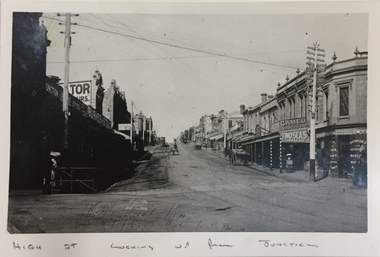 Kew Historical Society Inc
Photograph, High Street (Kew), circa 1900, c. 1900
... high street - kew (vic) bulleen road - kew (vic) "High Street Looking Up From Kew Junction" Small inscribed (later) copy of High Street from Kew Junction High Street (Kew), circa 1900 Photograph Photograph ...Small inscribed (later) copy of High Street from Kew Junction"High Street Looking Up From Kew Junction"high street - kew (vic), bulleen road - kew (vic) -
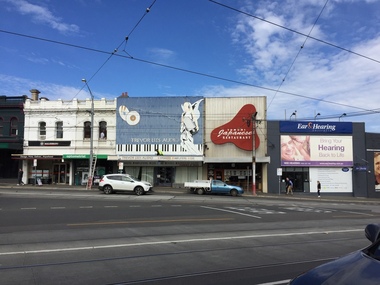 Kew Historical Society Inc
Photograph, Robert Baker, Kew Junction Streetscape, 2017, 01/09/2017
... the block - cotham road - kew (vic) cotham road - kew (vic) Photograph of the junction of Cotham Road and High Street, Kew. ...Photograph of the junction of Cotham Road and High Street, Kew. the block - cotham road - kew (vic), cotham road - kew (vic) -
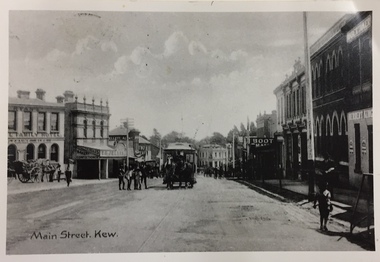 Kew Historical Society Inc
Postcard, Main Street, Kew
... kew...clifton hotel - kew junction...ryan's council family hotel kew...horse tram - kew (vic...Businesses identified in the photograph include the Ryan's Council Family Hotel, the Greyhound Hotel, the Clifton Hotel, the ES&A Bank and Jellis' Bakery. horse tram kew clifton hotel - kew junction ryan's council family hotel kew horse tram - kew (vic) kew junction Reverse - "High St Kew looking down from Post Office to Kew Junction" Black & white photograph of a postcard showing Main [High] Street, Kew looking south west showing horse drawn tram centre. ...Image copied from older postcard (c.1890-1900) showing horse drawn vehicles and a horse tram. Since then, the southern side of the street has been widened. Businesses identified in the photograph include the Ryan's Council Family Hotel, the Greyhound Hotel, the Clifton Hotel, the ES&A Bank and Jellis' Bakery. Black & white photograph of a postcard showing Main [High] Street, Kew looking south west showing horse drawn tram centre.Reverse - "High St Kew looking down from Post Office to Kew Junction"horse tram kew, clifton hotel - kew junction, ryan's council family hotel kew, horse tram - kew (vic), kew junction -
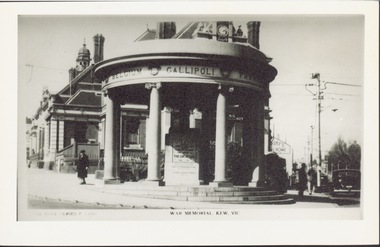 Kew Historical Society Inc
Postcard, War Memorial, Kew, Vic, 1925-30
... Kew War Memorial THE ROSE SERIES P 13051 Kew War Memorial, unveiled 30 August 1925. Located at junction of Cotham Road and High Street Kew. War Memorial, Kew, Vic ...Print copy of an original sourced from the Latrobe Library in 1976 for exhibition purposes. The State Library copy (H32492/7884), which is out of copyright, is taken from a glass negative, allowing for finer definition).Kew War Memorial, unveiled 30 August 1925. Located at junction of Cotham Road and High Street Kew.THE ROSE SERIES P 13051kew war memorial -
 Kew Historical Society Inc
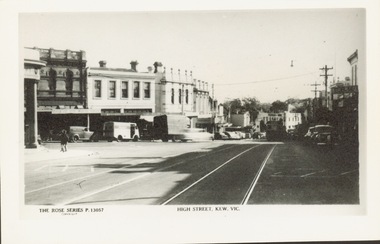
Postcard, High Street, Kew, Vic
... Kew (Vic.) THE ROSE SERIES P 13057 High Street Kew looking towards Kew Junction High Street, Kew, Vic Postcard ...Print copy of an original sourced from the Latrobe Library in 1976 for exhibition purposes.High Street Kew looking towards Kew JunctionTHE ROSE SERIES P 13057high street -- kew (vic.) -
 Kew Historical Society Inc
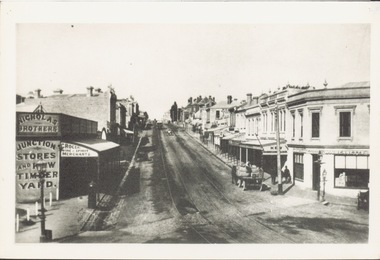
Postcard, High Street, Kew
... High Street -- Kew (Vic.) High Street, Kew, looking west from Kew Junction High Street, Kew Postcard ...Print copy of an original sourced from the Latrobe Library in 1976 for exhibition purposes.High Street, Kew, looking west from Kew Junctionhigh street -- kew (vic.) -
 Kew Historical Society Inc
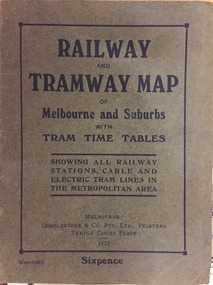
Map, Osboldstone & Co Pty Ltd, Railway and Tramway Map of Melbourne and Suburbs With Tram Timetables, 1917
... Kew tram along High Street in 1917 ended at the Harp Junction. The Kew Spur Line is also marked on the map. The Railway and Tramway Map of Melbourne and Suburbs With Tram Timetables is historically significant as it captures at a point in time, 1917, the development of public transport infrastructure in Melbourne. As such it illustrrates the theme: Connecting Victorians by transport and communications. railway maps -- melbourne (vic ...The Railway and Tramway Map of Melbourne and Suburbs With Tram Timetables lists existing Cable Tram Services before the entire network was electrified. By 1917 the tramways system was divided into regions including: the Melbourne Cable Tram Service; Prahran - Malvern Electric Trams; Hawthorn Electric Trams; Melbourne, Brunswick and Coburg Electric Trams; and Brighton Beach Electric Trams. The old Outer Circle railway line is marked as ending in Deepdene, with the remainder of the line to Fairfield marked as 'Unused'. The Kew tram along High Street in 1917 ended at the Harp Junction. The Kew Spur Line is also marked on the map.The Railway and Tramway Map of Melbourne and Suburbs With Tram Timetables is historically significant as it captures at a point in time, 1917, the development of public transport infrastructure in Melbourne. As such it illustrrates the theme: Connecting Victorians by transport and communications.Printed card-covered pocket sized map that folds out with three horizontal and vertical folds. Colour map, with scale, of the rail and tram networks on one side and sixteen sections of black and white printed text and timetable information on the reverse.railway maps -- melbourne (vic.), tramways maps -- melbourne (vic.), public transport -- melbourne (vic.) -- 1910-1920, cartography -
 Kew Historical Society Inc
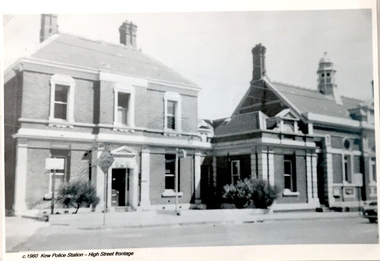
Postcard, Kew Police Station, c.1960
... Kew Historical Society raised over $5000,000 as a contribution to the restoration. kew court house -- high street -- kew (vic.) kew police station -- high street -- kew (vic.) public offices -- kew (vic) queen ann revival -- architectural style "c.1960. Kew Police Station. High Street Frontage" Kew Police Station at left and Kew Court House at right. Monochrome (copied) postcard showing two buildings which are part of a larger complex (once including a post office) built by the Government of Victoria in 1888. The buildings are located at the junction ...In c.1960, when the photograph was taken on which the postcard is based, both buildings were still owned by the Victorian Government and were a functioning police station and court house. In 1900, ownership of the post office had been transferred to the new Commonwealth Government. In the first decade of the twenty-first century, the police station and court house were offered for sale. They were subsequently purchased and renovated by the City of Boroondara. The Kew Historical Society raised over $5000,000 as a contribution to the restoration.Kew Police Station at left and Kew Court House at right. Monochrome (copied) postcard showing two buildings which are part of a larger complex (once including a post office) built by the Government of Victoria in 1888. The buildings are located at the junction of High Street and Cotham Roads in Kew. The frontages shown face High Street. "c.1960. Kew Police Station. High Street Frontage"kew court house -- high street -- kew (vic.), kew police station -- high street -- kew (vic.), public offices -- kew (vic), queen ann revival -- architectural style -
 Kew Historical Society Inc
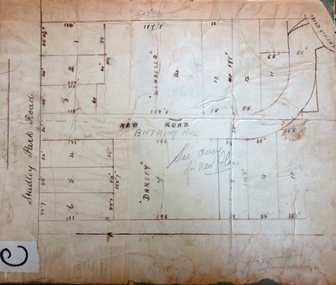
Plan - Subdivision Plan, Windella-Darnley Subdivision, Studley Park, 1920s
... kew, studley park Windella Darnley Studley Park Road -- Kew (Vic.) Merrion Place -- Kew (Vic.) Merrion Grove -- Kew (Vic.) Highbury Grove -- Kew (Vic.) "Antrim Avenue. See over for new plan" Version 1 of two subdivision plans (the later one is MAP.0027) for the section of Studley Park Road near the Junction on the south side. ...Subdivision plans are historically important documents used as evidence of the growth of suburbs in Australia. They frequently provide information about when the land was sold on which a built structure was subsequently constructed as well as evidence relating to surveyors and real estate and financial agents. The numerous subdivision plans in the Kew Historical Society's collection represent working documents, ranging from the initial sketches made in planning a subdivision to printed plans on which auctioneers or agents listed the prices for which individual lots were sold. In a number of cases, the reverse of a subdivision plan in the collection includes a photograph of a house that was also for sale by the agent. These photographs provide significant heritage information relating house design and decoration, fencing and household gardens.Version 1 of two subdivision plans (the later one is MAP.0027) for the section of Studley Park Road near the Junction on the south side. Named in the subdivision are the mansions of Darley and Windella (now demolished). Before the subdivision of Darley and Windella, both houses fronted Studley Park Road. Both houses appear to be advertised as lots in the subdivision. Bisecting the subdivision is a street, Antrim Avenue that was never constructed. A street, which was subsequently constructed in this vicinity, was Merrion Place, which now runs between Studley Park Road and Highfield Grove. There are 14 proposed lots in this subdivision."Antrim Avenue. See over for new plan"subdivision plans - kew, studley park, windella, darnley, studley park road -- kew (vic.), merrion place -- kew (vic.), merrion grove -- kew (vic.), highbury grove -- kew (vic.) -
 Kew Historical Society Inc
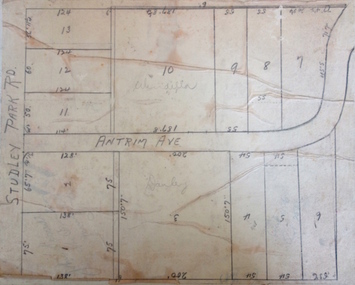
Plan - Subdivision Plan, Windella-Darnley Subdivision, Studley Park, 1920s
... kew, studley park Windella Darnley Antrim Avenue -- Kew (Vic.) Studley Park Road -- Kew (Vic.) Merrion Place -- Kew (Vic.) Merrion Grove -- Kew (Vic.) Highbury Grove -- Kew (Vic.) Version 2 of two subdivision plans (the earlier is 2016.0305.1) for the section of Studley Park Road near the Junction on the south side. ...Subdivision plans are historically important documents used as evidence of the growth of suburbs in Australia. They frequently provide information about when the land was sold on which a built structure was subsequently constructed as well as evidence relating to surveyors and real estate and financial agents. The numerous subdivision plans in the Kew Historical Society's collection represent working documents, ranging from the initial sketches made in planning a subdivision to printed plans on which auctioneers or agents listed the prices for which individual lots were sold. In a number of cases, the reverse of a subdivision plan in the collection includes a photograph of a house that was also for sale by the agent. These photographs provide significant heritage information relating house design and decoration, fencing and household gardens.Version 2 of two subdivision plans (the earlier is 2016.0305.1) for the section of Studley Park Road near the Junction on the south side. Named in the subdivision are the mansions of Darley and Windella (now demolished). Before the subdivision of Darley and Windella, both houses fronted Studley Park Road. Both houses appear to be advertised as lots in the subdivision. Bisecting the subdivision is a street, Antrim Avenue that was never constructed. A street, which was subsequently constructed in this vicinity, was Merrion Place, which now runs between Studley Park Road and Highfield Grove. There are 13 proposed lots in this subdivision in contrast to the earlier plan. This resulted from larger lots being proposed for Studley Park Road.subdivision plans - kew, studley park, windella, darnley, antrim avenue -- kew (vic.), studley park road -- kew (vic.), merrion place -- kew (vic.), merrion grove -- kew (vic.), highbury grove -- kew (vic.) -
![Cr. F.K. White, Mayor [of Kew] 1932-'33, 1945-'46](/media/collectors/550653872162f11fb04854aa/items/5922bd43d0cde3131ca1dc07/item-media/5c1b849e21ea7118c068468b/item-fit-380x285.jpg?cb=6) Kew Historical Society Inc
Kew Historical Society IncPhotograph, C Stuart Tompkins, Cr. F.K. White, Mayor [of Kew] 1932-'33, 1945-'46, 1932
... kew (vic)...australian photographers - c. stuart tompkins - junction - camberwell...cr. f.k. white...Kew...Kew. The portraits were transferred by the City of Kew to the Kew Historical Society in March 1989. A Significance Assessment in 2018, funded by the National Library of Australia confirmed the historic, and often artistic significance of the series. mayors of kew (vic) australian photographers - c. stuart tompkins - junction - camberwell cr. f.k. white Kew (Vic.) — municipal collection Cr. ...Kew achieved independence from the Boroondara Roads Board in 1860. As a new municipality, its first three leaders were designated as chairmen. On becoming a borough in 1863, its leaders were identified as mayors. The earliest photographs date from ca.1906, when the Town of Kew commissioned the noted local photographer Josiah E Barnes to produce standardised portraits of former mayors to be displayed in the Mayoral Chamber of the Town Hall. The collection also includes photographs by other well-known photographic studios such as Burlington Studios, Melba – Melbourne, Stuart Tompkins, Spencer Shier and Talma & Co. The majority of mounts identify the photographer. Eighty photographs are housed in their original frames.This portrait is one of a series of mounted and framed photographic portraits of mayors and town clerks of the former Borough, Town and City of Kew. The portraits were transferred by the City of Kew to the Kew Historical Society in March 1989. A Significance Assessment in 2018, funded by the National Library of Australia confirmed the historic, and often artistic significance of the series.Framed portrait of Cr. F.K. White, Mayor of Kew 1932-33, 1945-46. The mounting and framing of the photograph follows a typical layout or style in that each is framed in dark wood, glazed, and laid down on an inscribed board. The inscription identifies the name of the mayor and the year/s that he/she served.Cr. F.K. White / Mayor 1932-'33, 1945-'46 C. Stuart Tompkins / Junction / Camberwellmayors of kew (vic), australian photographers - c. stuart tompkins - junction - camberwell, cr. f.k. white, kew (vic.) — municipal collection -
![Cr. J.T. Gazzard, Mayor [of Kew] 1938-39, 1957-58](/media/collectors/550653872162f11fb04854aa/items/5922bdc8d0cde3131ca234e2/item-media/5c1b7d8321ea6d18c0f0ab00/item-fit-380x285.jpg?cb=6) Kew Historical Society Inc
Kew Historical Society IncPhotograph, Cr. J.T. Gazzard, Mayor [of Kew] 1938-39, 1957-58, 1938
... kew (vic)...australian photographers - stuart tompkins - junction - camberwell (vic)...Kew...Kew. The portraits were transferred by the City of Kew to the Kew Historical Society in March 1989. A Significance Assessment in 2018, funded by the National Library of Australia confirmed the historic, and often artistic significance of the series. mayors of kew (vic) australian photographers - stuart tompkins - junction - camberwell (vic) Kew (Vic.) — municipal collection Cr. ...Kew achieved independence from the Boroondara Roads Board in 1860. As a new municipality, its first three leaders were designated as chairmen. On becoming a borough in 1863, its leaders were identified as mayors. The earliest photographs date from ca.1906, when the Town of Kew commissioned the noted local photographer Josiah E Barnes to produce standardised portraits of former mayors to be displayed in the Mayoral Chamber of the Town Hall. The collection also includes photographs by other well-known photographic studios such as Burlington Studios, Melba – Melbourne, Stuart Tompkins, Spencer Shier and Talma & Co. The majority of mounts identify the photographer. Eighty photographs are housed in their original frames.This portrait is one of a series of mounted and framed photographic portraits of mayors and town clerks of the former Borough, Town and City of Kew. The portraits were transferred by the City of Kew to the Kew Historical Society in March 1989. A Significance Assessment in 2018, funded by the National Library of Australia confirmed the historic, and often artistic significance of the series.Framed portrait of Cr. J.T. Gazzard, Mayor of Kew 1938-39, 1957-58. The mounting and framing of the photograph follows a typical layout or style in that each is framed in dark wood, glazed, and laid down on an inscribed board. The inscription identifies the name of the mayor and the year/s that he/she served.Cr. J.T. Gazzard / Mayor 1938-39, 1957-58 C Stuart Tompkins / Junction / Camberwellmayors of kew (vic), australian photographers - stuart tompkins - junction - camberwell (vic), kew (vic.) — municipal collection -
Kew Historical Society Inc
Journal, Kewriosity : August 1992
... kew (vic.) kewriosity council newsletters community newsletters Kew Traffic School / p1. New Mayor for Kew [Cr Roger Streeton] / p1. Kindergarten open days / p1. Chief Executive's Column [Changes happening in Kew; Waste Management Strategy; Pakington Street Kindergarten and Maternal & Child Health Centre; New tennis and scout facility; Harp Junction works / Outer Circle Rail Reserve; Construction of new postal sorting facility for Kew] / Malcolm Hutchinson p2&3. ...Kew Traffic School / p1. New Mayor for Kew [Cr Roger Streeton] / p1. Kindergarten open days / p1. Chief Executive's Column [Changes happening in Kew; Waste Management Strategy; Pakington Street Kindergarten and Maternal & Child Health Centre; New tennis and scout facility; Harp Junction works / Outer Circle Rail Reserve; Construction of new postal sorting facility for Kew] / Malcolm Hutchinson p2&3. Mayor's Comment / Cr Roger Streeton] / p3. Diary dates for August/Septemvber [1992] / p4. Young Achiever Awards / p4. Concerned about possums / p5. Medicine / p5. Music for children / p6. Cinders! [Track Players Children's Workshop] / p5. In Brief [Community radio for a 'tuned-in' community; Camberwell Music Society; Kew Philharmonic Society; Mega mushroom; Have you got a parking permit?; Free legal advice; Kew Croquet Club's 60th Birthday year; Do you worry about the air you breather?; Kew East Primary School Centenary celebrations / p7. Pictures of Kew [New Trinity Grammar classrooms; North kew Tennis Club and Scout Hall; Mrs Helen Telford, Head of Carey Grammar Junior School; North Kew Maternal & Child Health Centre] / p8. Be in the movies / p8.Kewriosity was a local newsletter combining Kew Council and community news. It was published between November 1983 and June 1994, replacing an earlier Kewriosity [broad] Sheet (1979-84). In producing Kewriosity, Council aimed to provide a range of interesting and informative articles covering its deliberations and decision making, together with items of general interest and importance to the Kew community and information not generally available through daily media outlets.non-fictionKew Traffic School / p1. New Mayor for Kew [Cr Roger Streeton] / p1. Kindergarten open days / p1. Chief Executive's Column [Changes happening in Kew; Waste Management Strategy; Pakington Street Kindergarten and Maternal & Child Health Centre; New tennis and scout facility; Harp Junction works / Outer Circle Rail Reserve; Construction of new postal sorting facility for Kew] / Malcolm Hutchinson p2&3. Mayor's Comment / Cr Roger Streeton] / p3. Diary dates for August/Septemvber [1992] / p4. Young Achiever Awards / p4. Concerned about possums / p5. Medicine / p5. Music for children / p6. Cinders! [Track Players Children's Workshop] / p5. In Brief [Community radio for a 'tuned-in' community; Camberwell Music Society; Kew Philharmonic Society; Mega mushroom; Have you got a parking permit?; Free legal advice; Kew Croquet Club's 60th Birthday year; Do you worry about the air you breather?; Kew East Primary School Centenary celebrations / p7. Pictures of Kew [New Trinity Grammar classrooms; North kew Tennis Club and Scout Hall; Mrs Helen Telford, Head of Carey Grammar Junior School; North Kew Maternal & Child Health Centre] / p8. Be in the movies / p8.publications -- city of kew (vic.), kewriosity, council newsletters, community newsletters -
Kew Historical Society Inc
Journal, Kewriosity : July 1992
... publications -- city of kew (vic.) kewriosity council newsletters community newsletters City of Kew Ward boundaries [map] / p1. Council election Saturday 1st August, 1992 Prospect Ward / p1. Letter from resident 'waste management' / Katrine Keuneman p2. Kew Junction ...City of Kew Ward boundaries [map] / p1. Council election Saturday 1st August, 1992 Prospect Ward / p1. Letter from resident 'waste management' / Katrine Keuneman p2. Kew Junction Commercial Centre Precinct 8 / p2. Kew and Hawthorn a place for cyclists / p2. Mayor's Comment / Cr Daryl Oldaker p3. Come rain, hail or sunshine [school crossings] / p3 Kew Lioness Club / p3. Diary Dates for July/August pp.4-5. In Brief [Sold Kew Post Office; Help your postie deliver your mail; Carnsworth Nursing Home volunteers] / p4. In Brief continued [Kew Bowling Club; The Asthma Foundation of Victoria; Work at home as a family day caregiver; Kew Band; Kew Senior Citizens: Lions Club Opportunity Shop] / p5. My feelings on Kew / Chris Howlett p6. Youth homelessness / p6. Kew Festival / p6. Victorian Disabled Skiers' Assoc./ p7. Midwifery commemoration / p7. Vaccination against Haemophilus Influenzae Type B Disease / p7. Quit Quiz / p7. Our [Four Seasons] window [by Alan Sumner, in Kew Library] / p7. Pictures of Kew Kew High School students; Dedication of Burke Hall oval to past Mayor of Kew, the late Jack Gervasoni; Volunteers Reception; Bryan Berry] p8.Kewriosity was a local newsletter combining Kew Council and community news. It was published between November 1983 and June 1994, replacing an earlier Kewriosity [broad] Sheet (1979-84). In producing Kewriosity, Council aimed to provide a range of interesting and informative articles covering its deliberations and decision making, together with items of general interest and importance to the Kew community and information not generally available through daily media outlets.non-fictionCity of Kew Ward boundaries [map] / p1. Council election Saturday 1st August, 1992 Prospect Ward / p1. Letter from resident 'waste management' / Katrine Keuneman p2. Kew Junction Commercial Centre Precinct 8 / p2. Kew and Hawthorn a place for cyclists / p2. Mayor's Comment / Cr Daryl Oldaker p3. Come rain, hail or sunshine [school crossings] / p3 Kew Lioness Club / p3. Diary Dates for July/August pp.4-5. In Brief [Sold Kew Post Office; Help your postie deliver your mail; Carnsworth Nursing Home volunteers] / p4. In Brief continued [Kew Bowling Club; The Asthma Foundation of Victoria; Work at home as a family day caregiver; Kew Band; Kew Senior Citizens: Lions Club Opportunity Shop] / p5. My feelings on Kew / Chris Howlett p6. Youth homelessness / p6. Kew Festival / p6. Victorian Disabled Skiers' Assoc./ p7. Midwifery commemoration / p7. Vaccination against Haemophilus Influenzae Type B Disease / p7. Quit Quiz / p7. Our [Four Seasons] window [by Alan Sumner, in Kew Library] / p7. Pictures of Kew Kew High School students; Dedication of Burke Hall oval to past Mayor of Kew, the late Jack Gervasoni; Volunteers Reception; Bryan Berry] p8.publications -- city of kew (vic.), kewriosity, council newsletters, community newsletters -
Kew Historical Society Inc
Journal, Kewriosity : June 1992
... publications -- city of kew (vic.) kewriosity council newsletters community newsletters Mountain bikes for Kew Police / p1. Kew Junction ...Mountain bikes for Kew Police / p1. Kew Junction Commercial Area Urban Design Options Precincts 1&2 / p1. Responsible dog ownership / p1. Waste Management Strategy / Cr Daryl Oldaker, Malcolm Hutchinson p2&3. Home care for Kew residents / p3. Diary Dates for June/July / p4. Community tree planting day / p5. Friends of Kew Library / p5. Sharps disposal containers/ p5. In Brief [Recycling garden pots; Recycling kerbside collection; Outdated phone books recycled; Kew Pre-school Association; Australian Orthodoxy; Adult literacy classes; Football news; Women at midlife] / p6.Passive smoking - How much does it affect you? / p7. Don't Litter [and fines] / p7. Pictures of Kew [winner of decorated hat exhibition]; Flying start holiday camp [at Carey]; Kew High school teacher and student; James W Waters Award] / p8.Kewriosity was a local newsletter combining Kew Council and community news. It was published between November 1983 and June 1994, replacing an earlier Kewriosity [broad] Sheet (1979-84). In producing Kewriosity, Council aimed to provide a range of interesting and informative articles covering its deliberations and decision making, together with items of general interest and importance to the Kew community and information not generally available through daily media outlets.non-fictionMountain bikes for Kew Police / p1. Kew Junction Commercial Area Urban Design Options Precincts 1&2 / p1. Responsible dog ownership / p1. Waste Management Strategy / Cr Daryl Oldaker, Malcolm Hutchinson p2&3. Home care for Kew residents / p3. Diary Dates for June/July / p4. Community tree planting day / p5. Friends of Kew Library / p5. Sharps disposal containers/ p5. In Brief [Recycling garden pots; Recycling kerbside collection; Outdated phone books recycled; Kew Pre-school Association; Australian Orthodoxy; Adult literacy classes; Football news; Women at midlife] / p6.Passive smoking - How much does it affect you? / p7. Don't Litter [and fines] / p7. Pictures of Kew [winner of decorated hat exhibition]; Flying start holiday camp [at Carey]; Kew High school teacher and student; James W Waters Award] / p8. publications -- city of kew (vic.), kewriosity, council newsletters, community newsletters -
Kew Historical Society Inc
Journal, Kewriosity : November 1991
... publications -- city of kew (vic.) kewriosity council newsletters community newsletters The Horse Tram returns to Kew [Kew Depot Open Day] / p1. Chief Executive's Comment [Kew Junction ...The Horse Tram returns to Kew [Kew Depot Open Day] / p1. Chief Executive's Comment [Kew Junction] / Malcolm Hutchinson p2. Mayor's Comment [Kew Junction Strategy Plan] / Cr Daryl Oldaker p3. Diary Dates for November / p4. Diary Dates for December / p5. The Lioness Club of Kew / p5. Market [Kew Community House] / p5. Invitation to Lawn Bowls [Auburn Heights Bowling Club] / p5. Leader Sports Challenge Camp / p6. New face [Heather Crichton] / p7. New Way Theatre [Company][Kew Cottages] / p7. Safe disposal of chemicals around the home [Disposal options - Waste type by location] / p8. Insects / Marlowe p9. Bothered by pests? [Improved and cheap pest control for Kew residents] / p9. Kewriosity advertising rates / p10. City of Kew Waste Disposal Services for 1991/92 / Malcolm Hutchinson p11. New mum presentation [Nursing Mothers' Association; St George's Hospital] / p12. Kew Auxiliary - Royal Women's Hospital / p12. L.Bear [Library Bear] / p13. Arthritis self help / p14. Mural [by Bill Wood] / p14. Old Trams [request for photos] / p14. Kew Info Youth / p15. Local Artist [Mary McQueen] / p15. Golden putter golf [Studley Park Golf Course] / p15. City of Kew Residential Policies Review Committee [update] / p16. Apology [Kew Community House program] / p16.Kewriosity was a local newsletter combining Kew Council and community news. It was published between November 1983 and June 1994, replacing an earlier Kewriosity [broad] Sheet (1979-84). In producing Kewriosity, Council aimed to provide a range of interesting and informative articles covering its deliberations and decision making, together with items of general interest and importance to the Kew community and information not generally available through daily media outlets.non-fictionThe Horse Tram returns to Kew [Kew Depot Open Day] / p1. Chief Executive's Comment [Kew Junction] / Malcolm Hutchinson p2. Mayor's Comment [Kew Junction Strategy Plan] / Cr Daryl Oldaker p3. Diary Dates for November / p4. Diary Dates for December / p5. The Lioness Club of Kew / p5. Market [Kew Community House] / p5. Invitation to Lawn Bowls [Auburn Heights Bowling Club] / p5. Leader Sports Challenge Camp / p6. New face [Heather Crichton] / p7. New Way Theatre [Company][Kew Cottages] / p7. Safe disposal of chemicals around the home [Disposal options - Waste type by location] / p8. Insects / Marlowe p9. Bothered by pests? [Improved and cheap pest control for Kew residents] / p9. Kewriosity advertising rates / p10. City of Kew Waste Disposal Services for 1991/92 / Malcolm Hutchinson p11. New mum presentation [Nursing Mothers' Association; St George's Hospital] / p12. Kew Auxiliary - Royal Women's Hospital / p12. L.Bear [Library Bear] / p13. Arthritis self help / p14. Mural [by Bill Wood] / p14. Old Trams [request for photos] / p14. Kew Info Youth / p15. Local Artist [Mary McQueen] / p15. Golden putter golf [Studley Park Golf Course] / p15. City of Kew Residential Policies Review Committee [update] / p16. Apology [Kew Community House program] / p16.publications -- city of kew (vic.), kewriosity, council newsletters, community newsletters -
Kew Historical Society Inc
Journal, Kewriosity : October 1991
... publications -- city of kew (vic.) kewriosity council newsletters community newsletters Upgrading of Harp Junction [VicRoads, Kew Council] / p1. ...Upgrading of Harp Junction [VicRoads, Kew Council] / p1. Proposed roundabout at Valerie Street, Asquith Road [and] Belford Road / p1. Chief Executive's Comment [Rates and charges for 1991/92] / Malcolm Hutchinson p2. Croquet - New season starts / p2. Kew Band / p2. Mayor's Comment [Council's Budget for 1991/92] / Cr Daryl Oldaker / p3. Diary Dates for October / p4. Diary dates for November / p5. Family Day Care [Kew/Hawthorn Family Day Care Scheme seminars] / p5. St George's [Midwifery School] / p5. Kew Youth Card / p6. Breastfeeding right from the start / p6. The future of Kew Junction / p7. 111 years of Kew bowling [Kew Bowling Club] / p7. The Adult Video-cassette collection [Kew Library] / p8. Invitation to 'Traffic in Melbourne' Community Workshop / p8. Community Planting Day / p8. Float a boat [Rotary Club of Kew fundraising to support disability access] / p8.Kewriosity was a local newsletter combining Kew Council and community news. It was published between November 1983 and June 1994, replacing an earlier Kewriosity [broad] Sheet (1979-84). In producing Kewriosity, Council aimed to provide a range of interesting and informative articles covering its deliberations and decision making, together with items of general interest and importance to the Kew community and information not generally available through daily media outlets.non-fictionUpgrading of Harp Junction [VicRoads, Kew Council] / p1. Proposed roundabout at Valerie Street, Asquith Road [and] Belford Road / p1. Chief Executive's Comment [Rates and charges for 1991/92] / Malcolm Hutchinson p2. Croquet - New season starts / p2. Kew Band / p2. Mayor's Comment [Council's Budget for 1991/92] / Cr Daryl Oldaker / p3. Diary Dates for October / p4. Diary dates for November / p5. Family Day Care [Kew/Hawthorn Family Day Care Scheme seminars] / p5. St George's [Midwifery School] / p5. Kew Youth Card / p6. Breastfeeding right from the start / p6. The future of Kew Junction / p7. 111 years of Kew bowling [Kew Bowling Club] / p7. The Adult Video-cassette collection [Kew Library] / p8. Invitation to 'Traffic in Melbourne' Community Workshop / p8. Community Planting Day / p8. Float a boat [Rotary Club of Kew fundraising to support disability access] / p8. publications -- city of kew (vic.), kewriosity, council newsletters, community newsletters
