
Showing 23 items matching "ladies red dress"
-
 Whitehorse Historical Society Inc.
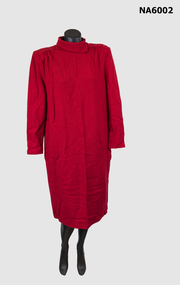
Clothing - Ladies dress, Stitches Plus, Late 1960's
... Ladies red dress...Red dress - worn Christmas, Church and Birthday parties - mid calf Possibly bought from Myers Ladies red dress Stitches Plus - Gold Label - 14 - Pure New Wool - Red wool crepe - Crew collar - 4 buttons on left shoulder - Mid calf length - Shoulder pads - Buttons on wrist Clothing Ladies dress Stitches Plus ...Red dress - worn Christmas, Church and Birthday parties - mid calf Possibly bought from Myers- Red wool crepe - Crew collar - 4 buttons on left shoulder - Mid calf length - Shoulder pads - Buttons on wristStitches Plus - Gold Label - 14 - Pure New Woolladies red dress -
 Orbost & District Historical Society
black and white photograph, W C RICE, 1914 -1918
... A black / white photograph / postcard of four ladies and one little girl dressed in Red Cross outfits standing in front of a cart loaded with patriotic goods for sale. ...It reflects the involvement of Orbost, a small town, in the efforts of the Australian Red Cross Society to provide comforts to soldiers during World war 1. orbost-red-cross ww1 on back is a list of names A black / white photograph / postcard of four ladies and one little girl dressed in Red Cross outfits standing in front of a cart loaded with patriotic goods for sale. ...Patriotic Fund Raising days were held in order to raise money and support for the soldiers fighting overseas. In the photograph are L to R: Marion Gilbert; Annie Nixon; Jean Cameron; Hattie Nixon and Grace Cameron' The Australian Red Cross Society (ARCS) was formed just after the outbreak of the First World War in August 1914, originally as a branch of the British Red Cross. It came into being as a branch of the British Red Cross Society on August 13th 1914 to succour the wounded in the First World War.This is a contemporary record of a significant event in Orbost. It reflects the involvement of Orbost, a small town, in the efforts of the Australian Red Cross Society to provide comforts to soldiers during World war 1.A black / white photograph / postcard of four ladies and one little girl dressed in Red Cross outfits standing in front of a cart loaded with patriotic goods for sale. A sign on the cart has ":SOLDIERS' COMFORTS" on iton back is a list of namesorbost-red-cross ww1 -
 Eltham District Historical Society Inc
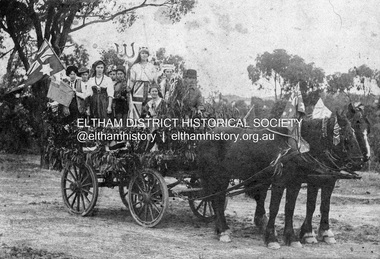
Photograph, Gala Day, Panton Hill, 1916. Mr. W. Smith and Horse Float. Passengers include: Beatrice and Ruby Cracknell, Lily Harris, Rose Smith
... Red Cross Carnival in aid of local Patriotic Funds' held on the Panton Hill Recreation Reserve on Easter Saturday, sand instant, proved a gratifying success, so much so that £70 was netted on the occasion…. The fancy dress procession, although not as lengthy as the previous one for the Belgium Carnival, lost nothing of its effectiveness, and those who helped In this part of the entertainment de: serve the very best thanks. The prize for the best decorated vehicle (which was kindly provided by Mr. Wm. Smith) was awarded to Miss Goldman's bevy of young ladies...Red Cross Carnival in aid of local Patriotic Funds' held on the Panton Hill Recreation Reserve on Easter Saturday, sand instant, proved a gratifying success, so much so that £70 was netted on the occasion…. The fancy dress procession, although not as lengthy as the previous one for the Belgium Carnival, lost nothing of its effectiveness, and those who helped In this part of the entertainment de: serve the very best thanks. The prize for the best decorated vehicle (which was kindly provided by Mr. Wm. Smith) was awarded to Miss Goldman's bevy of young ladies ...Three horses with cart decorated with passengers for Gala Day. Mr. W. Smith & horse float, passengers include Beatrice and Ruby Cracknell, Lily Harris and Rose Smith. The Evelyn Observer and Bourke East Record reported on April 28, 1916 on the Red Cross Carnival at Panton Hill. “The Red Cross Carnival in aid of local Patriotic Funds' held on the Panton Hill Recreation Reserve on Easter Saturday, sand instant, proved a gratifying success, so much so that £70 was netted on the occasion…. The fancy dress procession, although not as lengthy as the previous one for the Belgium Carnival, lost nothing of its effectiveness, and those who helped In this part of the entertainment de: serve the very best thanks. The prize for the best decorated vehicle (which was kindly provided by Mr. Wm. Smith) was awarded to Miss Goldman's bevy of young ladies representing the "Allies." Arbor Day was once a big celebration, especially celebrated in schools usually acknowledged on the last Friday of April. Wikipedia reports that the first Gala Day was held on November 3, 1916, to raise money for the Red Cross Society at the height of World War I in Geelong. Reference: RED CROSS CARNIVAL AT PANTON HILL. (1916, April 28). Evelyn Observer and Bourke East Record (Vic. : 1902 - 1917), , p. 3 (MORNING.). Retrieved April 3, 2016, from http://nla.gov.au/nla.news-article60664371 https://en.wikipedia.org/wiki/Gala_Day This photo forms part of a collection of photographs gathered by the Shire of Eltham for their centenary project book, "Pioneers and Painters: 100 years of the Shire of Eltham" by Alan Marshall (1971). The collection of over 500 images is held in partnership between Eltham District Historical Society and Yarra Plenty Regional Library (Eltham Library) and is now formally known as 'The Shire of Eltham Pioneers Photograph Collection'. It is significant in being the first community sourced collection representing the places and people of the Shire's first one hundred years.Digital imagesepp, shire of eltham pioneers photograph collection, panton hill, beatrice cracknell, lily harris, rose smith, ruby cracknell, w. smith, carnival, float, red cross, easter, decorated vehicle, ww1, world war 1914-1918, parade float -
 Kiewa Valley Historical Society
Sewing Machine Accessories
... Ladies made the family's clothes and sewed for the Annual Church and School fetes. eg. children's clothes and dolls' clothes. They bought dozens of dolls and made 'fairy' dresses for them using coloured netting. singer manufacturing co.. clothes. fetes. domestic. sewing. Dark green box with red ...This sewing machine and its accessories was bought by Alex Craig's dad in 1942 for his wife whom he married in 1943. Alex's mother used it and the accessories in 1942. Historical: Type of machine used by S.E.C.V. wives living in Mt Beauty in the 1940's, 1950's and 1960's. Ladies made the family's clothes and sewed for the Annual Church and School fetes. eg. children's clothes and dolls' clothes. They bought dozens of dolls and made 'fairy' dresses for them using coloured netting.Dark green box with red & white inscription on top. Inside are 7 metal (silver coloured) attachments for Singer Sewing Machine including one for sewing zips, ruffling foot, rolled hemming foot .singer manufacturing co.. clothes. fetes. domestic. sewing. -
 Bendigo Historical Society Inc.
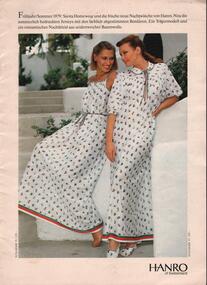
Magazine - HANRO COLLECTION: HANRO ADVERTISING BROCHURE FOR NIGHTWEAR SUMMER 1979, 1979
... dress has a thin belt at the waist. The long nightie on the right has three quarter sleeves with a peter pan collar, yoke gathered top and a tie front, she is also wearing slippers with matching material. Both night gowns have a white background with red and yellow flowers with green leaves. The gown is trimmed with green, red and white stripes on the collar and bottom of the garments. Both ladies...dress has a thin belt at the waist. The long nightie on the right has three quarter sleeves with a peter pan collar, yoke gathered top and a tie front, she is also wearing slippers with matching material. Both night gowns have a white background with red and yellow flowers with green leaves. The gown is trimmed with green, red and white stripes on the collar and bottom of the garments. Both ladies ...BHS CollectionHanro Advertising Brochure for Night ware Summer 1979. 8 page brochure on a white back ground with a coloured photo of two models wearing nightwear, pyjamas and dressing gowns. The front page is of two models, on the left the model is wearing a long sleeveless night dress with thin straps and gathered across the chest, the night dress has a thin belt at the waist. The long nightie on the right has three quarter sleeves with a peter pan collar, yoke gathered top and a tie front, she is also wearing slippers with matching material. Both night gowns have a white background with red and yellow flowers with green leaves. The gown is trimmed with green, red and white stripes on the collar and bottom of the garments. Both ladies are leaning against a white cement wall. At bottom left is the number 3676/68468 Fr. 129.-. Bottom right the number is 3676/68488 Fr. 169.-. Bottom right in black print is 'Hanro of Switzerland. At the top of each page is writing in Swedish. Each page shows different styles and colours of the garments together with their item number and Hanro of Switzerland at the bottom of each page. Box 116AHanro AG, CH-4410 Liestal, Schweiz - Printed in Switzerland 79/1hanro, clothing, women's apparel -
 Bendigo Historical Society Inc.
Photograph - BERT GRAHAM COLLECTION: GROUP PHOTO, 1953-54
... Race.1953-54.Most of the ladies are wearing summer dresses and cardigans. On the back are the names of all, and in red ink Graham....Race.1953-54.Most of the ladies are wearing summer dresses and cardigans. On the back are the names of all, and in red ink Graham. ...Black & white photograph, Bert Graham Collection, a group of women sitting and standing at a picnic with the Bendigo East Swimming Club, are as from left to right; Bev Nelson,Joan Nelson, Lorraine Nelson, Nan Graham, Mrs. Charles, Mrs. Masters, ? , Mrs. Robinson, Mrs. Race.1953-54.Most of the ladies are wearing summer dresses and cardigans. On the back are the names of all, and in red ink Graham.bendigo, clubs, bendigo east swimming club -
 Bendigo Historical Society Inc.
Photograph - FOSTER AND WILSON COLLECTION: PHOTOGRAPH
... ladies, one holding a little brown dog, standing in front of a yellow shop door with the number 52 on the front. The older lady is wearing a deep blue dress and shoes, a long necklace and brooch. The younger lady is wearing a multi coloured top and black trousers. The shop is called Nefertiti Video. There is notice with Jackson at the top in the window. There are curtains inside the window. There are red...ladies, one holding a little brown dog, standing in front of a yellow shop door with the number 52 on the front. The older lady is wearing a deep blue dress and shoes, a long necklace and brooch. The younger lady is wearing a multi coloured top and black trousers. The shop is called Nefertiti Video. There is notice with Jackson at the top in the window. There are curtains inside the window. There are red ...Coloured photograph of two ladies, one holding a little brown dog, standing in front of a yellow shop door with the number 52 on the front. The older lady is wearing a deep blue dress and shoes, a long necklace and brooch. The younger lady is wearing a multi coloured top and black trousers. The shop is called Nefertiti Video. There is notice with Jackson at the top in the window. There are curtains inside the window. There are red & white Coca-Cola advertisements on both sides of the door.photograph, portrait, female group, foster & wilson collection, photograph -
 Bendigo Historical Society Inc.
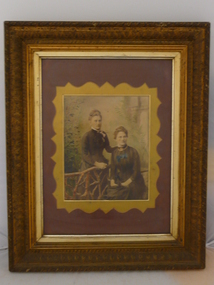
Photograph - PHOTO OF TWO YOUNG LADIES, 1890
... ladies. 1. Lady standing in long brown dress, white lace collar, pink bow, gold broch, blue eyes, fair hair clipped up in bun with red leaf in hair. 2. ...ladies. 1. Lady standing in long brown dress, white lace collar, pink bow, gold broch, blue eyes, fair hair clipped up in bun with red leaf in hair. 2. ...Hand coloured photo of two young ladies. 1. Lady standing in long brown dress, white lace collar, pink bow, gold broch, blue eyes, fair hair clipped up in bun with red leaf in hair. 2. Lady sitting, in long brown dress, white lace collar, orange neck band, orange broach, blue bow. Green bush and ferns in background.Alans Studio. 318 Smith street. Collingwood. All kinds of photography excuted in best style.person, group, portrait -
 Bendigo Historical Society Inc.
Clothing - LADIES STRIPED''SHIRT MAKER'' LONG SLEEVED DRESS, 1950's
... A ''shirt-maker'' styled ladies long-sleeved dress, with 4 mm, red/navy striped fabric. ...COSTUME Female ladies shirtmaker dress Clothing. A ''shirt-maker'' styled ladies long-sleeved dress, with 4 mm, red/navy striped fabric. ...Clothing. A ''shirt-maker'' styled ladies long-sleeved dress, with 4 mm, red/navy striped fabric. The ''straight-through'' dress has a tie-belt, 2cm wide if desired. Long 3/4 set-in sleeves are gathered into a ''turn-back'' cuff 6.5 cms wide, and fastened by two x 1.5 cm covered buttons,and two false stitched button holes. Five covered buttons and machine-stitched burtton holes in the front, from below the revere collar to below the waist. Underarm to edge of cuff 41.5 cms; Length of front opening neck edge to lower edge 49.5 cms.costume, female, ladies shirtmaker dress -
 Bendigo Historical Society Inc.
Slide - BENDIGO EASTER PARADE, May 1963
... Two ladies dressed in white on a red and white decorated float....Two ladies dressed in white on a red and white decorated float. ...Slide.Bendigo Easter Parade. Two ladies dressed in white on a red and white decorated float.slide, bendigo, bendigo easter parade., bendigo easter parade. -
 Alfred Hospital Nurses League - Nursing History Collection
Book, Freda MacDonnell, Miss Nightingale's Young Ladies: the story of Lucy Osburn and Sydney Hospital, 1970
... red background. Front cover has an oval photograph of a woman in Victorian dress (Lucy Osburn). This photo has a grey frame with swirls. Also, on the front, the title is printed in white and the author's name in black. Title (in white) and author's surname (in black) are also printed on the spine. Miss Nightingale's Young Ladies ...This book is a historical account of the early days of nursing in Australia, specifically focusing on the Sydney Hospital and Lucy Osburn, who arrived in Sydney in March 1868.Illustrated book with dust jacket that has been covered with a clear protective film. Dustjacket has a red background. Front cover has an oval photograph of a woman in Victorian dress (Lucy Osburn). This photo has a grey frame with swirls. Also, on the front, the title is printed in white and the author's name in black. Title (in white) and author's surname (in black) are also printed on the spine.non-fictionThis book is a historical account of the early days of nursing in Australia, specifically focusing on the Sydney Hospital and Lucy Osburn, who arrived in Sydney in March 1868.lucy osburn, sydney hospital-history, nursing-australia-history, alfred hospital nurses -
 National Wool Museum
Booklet - How to Wash Physician Blankets, Collins Bros Mill Pty Ltd
... . / .... to you / MANUFACTURERS OF / "PHYSICIAN" / BLANKETS AND FLANNELS / ALSO MANUFACTURERS OF THE FAMOUS / UNSHRINKABLE PHYSICIAN BABY SAXONY FLANNEL / AND CRIMEAN SHIRTING / LADIES' DYED DRESS MATERIALS / SLIPPER AND FURNISHING FELTS Four page folded card featuring black text and graphics. Front shows green, red ...Booklet describing how to care for and wash physician blankets. Physician blankets were manufactured by Collins Bros Pty Ltd, established 1874.Four page folded card featuring black text and graphics. Front shows green, red, white and black image of a factory exterior with a car and people in the foreground.Printed: HOW TO WASH "PHYSICIAN" BLANKETS / from Collins Bros. Pty. Ltd. / .... to you / MANUFACTURERS OF / "PHYSICIAN" / BLANKETS AND FLANNELS / ALSO MANUFACTURERS OF THE FAMOUS / UNSHRINKABLE PHYSICIAN BABY SAXONY FLANNEL / AND CRIMEAN SHIRTING / LADIES' DYED DRESS MATERIALS / SLIPPER AND FURNISHING FELTSblankets, physician, collins bros mill pty ltd, manufacturing, geelong, wool, advertising -
 Ballarat Tramway Museum
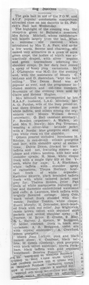
Newspaper - cutting, The Courier Ballarat, "Big Success" & "Conductressess' fund", August 1944
... ladies dresses along with other details. Demonstrates newspaper reporting re the Sylvia Mitchell fund raising. Most Popular Conductress Sylvia Mitchell tramways SEC Red Cross Set of 2 newspaper cuttings pasted onto a sheet of card with a small folded section at the base of the first item. ...The two cuttings report on the Gala Ball, late August 1944, the attendees and positions, the ladies dresses along with other details.Demonstrates newspaper reporting re the Sylvia Mitchell fund raising.Set of 2 newspaper cuttings pasted onto a sheet of card with a small folded section at the base of the first item.most popular conductress, sylvia mitchell, tramways, sec, red cross -
 Ballarat Tramway Museum
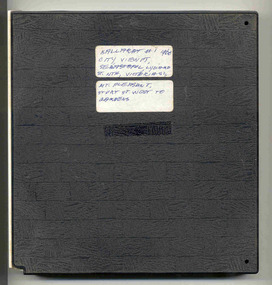
Film - Movie Film & Box, Kodak, 1960
... Mid morning scene. 11:39 39 inbound, Albert St south, approaches camera and then passes and the crosses over Albert St. 12:16 41 outbound in Albert St passes the camera, and pulls into the terminus with the conductor getting out on the back bumper to pull the pole down as the tram stops and a passenger walks into the Royal Hotel. 12:39 Title “The Lydiard Street North Line” 12:44 Filmed from the Hotel balcony, 21 inbound in Lydiard St Nth passes over Mair St, stops while 33 passes in the other direction. 13:18 With the red light showing on the Seymour St loop signal, 33 inbound for Sebastopol stops and picks up many passengers, passes the camera and runs past the VRI building in the background and through the loop. Possibly filmed on a Sunday given the ladies dresses...Mid morning scene. 11:39 39 inbound, Albert St south, approaches camera and then passes and the crosses over Albert St. 12:16 41 outbound in Albert St passes the camera, and pulls into the terminus with the conductor getting out on the back bumper to pull the pole down as the tram stops and a passenger walks into the Royal Hotel. 12:39 Title “The Lydiard Street North Line” 12:44 Filmed from the Hotel balcony, 21 inbound in Lydiard St Nth passes over Mair St, stops while 33 passes in the other direction. 13:18 With the red light showing on the Seymour St loop signal, 33 inbound for Sebastopol stops and picks up many passengers, passes the camera and runs past the VRI building in the background and through the loop. Possibly filmed on a Sunday given the ladies dresses ...Yields information in movie film format of Ballarat trams in 1960, how the system operated and was used by people., Yields information in movie film format of Ballarat trams in 1960, how the system operated and was used by people.Movie film - 8mm, approx. 30mins, with leader strip on a plastic reel, within a black and white plastic box, titled "Ballarat No. 1. 1960". Has been transferred to DVD - see Reg item 4100 as Segment No. 2. Made by Ben Parle. Also transferred to DVD by Rod Cook Oct. 2015, via Roger Greenwood for use in his DVD, "The City of Ballarat Trams, Gardens & Gold" of 2016. See Reg Item 6883. Synopsis: based on time. 0:00 View of typed introduction, noting that this is a pictorial record of Ballarat. 0:10 Title “The Tramways of Ballarat 1960, Part 1” 0:16 13, showing “View Point” at Stones Corner, Bridge St, east end, with trolley pole being turned, while another single trucker heads out towards Mt Pleasant. 0:25 13 leaving Stones Corner, short approach and then longer trailing shot of the tram going towards the City in Bridge St. 0:44 View out of front of tram in Bridge St heading towards the City, with cars in the photo, then passing through city Loop, no trams in the loop and running up to Lydiard St Nth and crossing the road. 1:22 Running up Sturt St from Armstrong St, passes over Dawson St X-over and up to the next intersection, Lyons St. 1:54 Title “The View Point Line” 1:59 19 inbound, in Ripon St, from crossing Mair St, towards camera and then passing away and turning into Sturt St. 2:49 View of a “Warning Oncoming Trams” sign 2:52 19 in Ripon St, going to View Point, crossing Webster St towards camera, then going away through the disconnected Victoria Ave loop, pass the “Warning Oncoming Trams” sign. Note very windy scene with people running across roads. 3:17 19 in Wendouree Parade, in bound, though showing destination View Point, going away from the camera, past the View Point Hotel. 3:39 19 coming towards camera near Excerpt or Devon St and then going away towards the terminus. 4:04 19 at the terminus, stationary, with a single trucker 3?, passing from Macarthur St into Wendouree Parade, behind 19. 4:20 33 coming towards camera in Wendouree Parade from St Aidans Drive, stopping to pick up passenger at Forest St and then going away towards the City, photographed from near the depot, on a wet and windy day. 4:54 35 in Wendouree Parade, coming towards the Camera from St Aidans Drive and then going away with the Gardens Loop area in the background. Tram stops at stop to let a passenger off. 5:28 21 leaving Gardens Loop for the City via the Depot, green light in signal can be seen. 5:43 28?, closely followed by 26 turn from Drummond St South into Sturt St. 6:18 Scene opens with shot of “Sebastopol” destination on a bogie tram. 6:21 Title “The Sebastopol Line” 6:24 21 turning from Sturt St into Drummond St Sth with destination of Bell St and then going away from the camera. 6:55 38 in Drummond St Sth, coming towards the camera and then passing the camera with Sturt St just in the view. 7:10 21, showing Gregory St, in Drummond St Sth, approaching and then going away, entering the Urquhart St Loop, 7:39 34 in Drummond St Sth (location check required (Latrobe?)), approaches camera, picks up passengers and the goes away. 8:09 39 at ? Street, turns from Drummond St Sth into Skipton St, after picking up and setting down passengers, bound for Sebastopol 8:55 35 inbound in Skipton St passes through the Bell Street Loop, and then goes away from the camera. 9:33 42 outbound in Skipton St, approaches the camera, passes and then crosses over the half the road into Albert St. 10:00 39 inbound in Albert St – location? 10:31 34 outbound for Sebastopol, approaches camera and just starts to pass by. 10:36 34 in Grey St crossing loop, crosses 42 inbound. 10:59 39 outbound in Albert St, with shopping centre in bound, approaches camera, passes and then crosses over Albert St. Mid morning scene. 11:39 39 inbound, Albert St south, approaches camera and then passes and the crosses over Albert St. 12:16 41 outbound in Albert St passes the camera, and pulls into the terminus with the conductor getting out on the back bumper to pull the pole down as the tram stops and a passenger walks into the Royal Hotel. 12:39 Title “The Lydiard Street North Line” 12:44 Filmed from the Hotel balcony, 21 inbound in Lydiard St Nth passes over Mair St, stops while 33 passes in the other direction. 13:18 With the red light showing on the Seymour St loop signal, 33 inbound for Sebastopol stops and picks up many passengers, passes the camera and runs past the VRI building in the background and through the loop. Possibly filmed on a Sunday given the ladies dresses and quieter streets. 14:01 30 outbound, passes the camera and stops at Macarthur St. Filmed alongside the brick wall of the cutting. 14:28 30 inbound arrives, passes through the Gregory St loop and then proceeds past the camera, making a stop to pick up passengers. 15:14 28 in Lydiard St Nth – location?, approaches and goes away from the camera, north of Gregory St. 15:34 28 ditto location? 15:53 21 arrives at the terminus with passengers getting on and off. 16:11 View of the a vertical positioned “End of Section” sign on a pole at the terminus and then lifting the camera to see the timetable board and the stop sign. 16:33 31 in Bridge St passing Morseheads and then turning into Sturt St, stops at the Grenville St stop, while another single trucker comes down to the stop from the City. 16:58 31 outbound in Bridge St, with destination of Victoria St. 17:14 Title “The Victoria Street Line” 17:18 31 outbound to Victoria St from Stones Corner. Starts with an overhead shot, shows clock at the Caltex service station,. 17:37 31 inbound approaching Bakery Hill and then descending to the junction after it passes camera. 18:09 25 climbing outbound in Victoria St, passing the camera, to then pass through the King St loop. 18:47 25 inbound in Victoria St, passing the camera, then pass through the King St loop, with St Alypius Church in the background. 19:36 14 approaching the rail bridge in Victoria St and stopping at the 2nd last stop to left of passengers. 20:01 14 leaving the terminus and approaching the camera and the a short sequence going away, to the next stop to pick up quite a few passengers. 20:14 “Trams Stop Here” sign, metal wrap around on a steel pole. 20:16 Title “The Mount Pleasant Line” 20:21 11 inbound in Main St, with a passenger leaping off the tramcar and another getting off just before the junction. 20:45 11 passes the junction and then proceeds away from the camera in Bridge St. 21:04 30 outbound in Main St, then turns into Barkly St, a bus (Eclipse Motors) passes in Main St just before the sequence ends. 21:31 30 inbound near Steinfield St. (exact location?) 21:49 25 approaches the camera, then proceeds away and passes through the Grant St. loop. 22:29 25 inbound, windy day, between Grant and Cobden, (exact location?), with a horse drawn bread van in the view and the breadman walking behind the tram as it passes. 23:02 11 outbound in Barkly St, (exact location?) 23:37 11 inbound in Barkly St (exact location?) 23:44 Mt Pleasant terminus signage 23:50 30 approaches the terminus and then stops with the conductor alighting turning the pole, passengers getting on and off and the driver appearing at the other end. 24:32 Title “The Gardens Via Sturt St. West Line” 24:35 21 outbound in Sturt St near Raglan St, approaches and passes the Camera. 25:09 12, showing City Oval, approaches and passes the camera, outbound near Windermere St. 25:33 13 showing View Point, goes away from the camera – location? 25:44 12 comes from St. West, inbound passes the camera and then stop as the next stop next Talbot St? 26:21 Short sequence of a “Warning Oncoming Trams” sign 26:28 42 inbound in Sturt St West, just before Ripon St, view coming towards camera and then going away to cross Ripon St. 27:10 34 passes through the Parker St loop 27:25 35 or 39 inbound past the college in Sturt St West 28:04 41 outbound at the Russell St curve, passes away from the camera. 28:11 35? inbound passes away from the camera through the Victoria Park or Morrison St loop, swinging out into the roadway. 28:29 View of timetable sign at Hamilton Ave. 28:37 35 turning from Sturt St West into Hamilton Ave, can see the conductor changing over the barrier rails. 29:11 42 inbound, crosses another bogie tram (35?) at Carlton St loop then passes the camera and goes past the Olympic rings monument. 29:42 12 approaches the Carlton St gates. 30:07 12 outbound, crosses a bogie tram in the loop with both trams then leaving the loop. 30:20 Title “End of Part One” Written labels giving title information on outside of box.trams, tramways, ballarat, sebastopol, lydiard st north, victoria st, mt pleasant, sturt st west -
 Tatura Irrigation & Wartime Camps Museum
Clothing - Dress, Plaid dress, 1940
... Ladies Frock - tartan Part Pleated Frock with buttons. Hand sewn with collar, short sleeves, buttoned, slightly pleated skirt. Woven clothe is a Tartan Pattern, mainly green/red. Plaid dress ...Sewn by Internee Emma Aberle in Camp 3b from cloth woven in the camp by Franz Laumen, Krefeld, Germany, an internee from England.Ladies Frock - tartan Part Pleated Frock with buttons. Hand sewn with collar, short sleeves, buttoned, slightly pleated skirt. Woven clothe is a Tartan Pattern, mainly green/red.ww 2 camp 3 -
 Hume City Civic Collection
Clothing - stockings - ladies, Golden Opportunity
... The stockings are seamed and have a heel and toe shaping. myer hosiery nylon stockings clothing and dress footwear accessories george evans collection GOLDEN OPPORTUNITY / 60 DENIER / SELECTED MEDIUMS / NO 2 NYLON 10 A coffee coloured pair of 60 denier nylon stockings Size 10. The 'Myer' price tag is on the inside of the leg and shows the department (26), the size (10) and the price (9/9). There is a band of red around the top of the ribbing. Golden Opportunity Clothing stockings - ladies ...The stocking were worn with corsets or a suspender belt and were fastened to the foundation garments with suspenders. 60 denier stocking were not the finest knit stocking. The stockings are seamed and have a heel and toe shaping.A coffee coloured pair of 60 denier nylon stockings Size 10. The 'Myer' price tag is on the inside of the leg and shows the department (26), the size (10) and the price (9/9). There is a band of red around the top of the ribbing.GOLDEN OPPORTUNITY / 60 DENIER / SELECTED MEDIUMS / NO 2 NYLON 10myer, hosiery, nylon stockings, clothing and dress, footwear accessories, george evans collection -
 Hume City Civic Collection
Photograph
... world war 1 soldiers rupertswood red cross tolra f. w. uniforms clothing and dress george evans collection Typewritten on front: SOLDIERS BEING ENTERTAINED AT RUPERTSWOOD 1915 Handwritten on back: GROUP OF SOLDIERS BROUGHT TO RUPERTSWOOD BY RED CROSS 1 DAY Stamped on back: FROM / F. W. TOLRA / 79 GLEN EIRA ROAD / RIPPON LEA A sepia photograph of some ladies ...A sepia photograph of some ladies standing behind soldiers seated at a table.Typewritten on front: SOLDIERS BEING ENTERTAINED AT RUPERTSWOOD 1915 Handwritten on back: GROUP OF SOLDIERS BROUGHT TO RUPERTSWOOD BY RED CROSS 1 DAY Stamped on back: FROM / F. W. TOLRA / 79 GLEN EIRA ROAD / RIPPON LEAworld war 1, soldiers, rupertswood, red cross, tolra, f. w., uniforms, clothing and dress, george evans collection -
 Melbourne Legacy
Photograph, Widows activities, 02/09/1991
... ladies when it was time to leave: "You are never dressed until you are wearing a smile". The reference number from the photographic studio 910902B/8 could mean 2 September 1991. Legacy provided the opportunity for many gatherings of widows to enjoy social interaction and companionship. widows concert answer Eddie jowett Label on the back from Keesing Photographic with Reference No: 910902B/8 and 40% in red pen. ...A Legacy widow, Beryl Tucker and Legatee Eddie Jowett posing as if they were dancing, for a professional photographer. The photo was featured in the 30 September 1991 issue of the Widows' Newsletter. The article mentions that Legatee Jowett coordinates a month concert at Legacy House on the first Monday of the month. The concerts are free to Legacy widows and the artist are first class professionals. Around 180 widows attend regularly. Legatee Jowett had a regular saying, almost a commandment to the ladies when it was time to leave: "You are never dressed until you are wearing a smile". The reference number from the photographic studio 910902B/8 could mean 2 September 1991.Legacy provided the opportunity for many gatherings of widows to enjoy social interaction and companionship.Black and white photo of Legatee Eddie Jowett and Beryl Tucker, a Legacy widow.Label on the back from Keesing Photographic with Reference No: 910902B/8 and 40% in red pen.widows, concert, answer, eddie jowett -
 Wodonga & District Historical Society Inc
Ephemera - Decorative Signs, 1920s
... dress, maps, and material relating to the world wars. Grace and John married at St. David’s Church, Albury in 1941. John was a grazier, and actively involved in Agricultural Societies and the Belvoir Wodonga Rotary Club. Grace was an active member of several organisations including the CWA, Red Cross, the Wodonga Show Ladies...dress, maps, and material relating to the world wars. Grace and John married at St. David’s Church, Albury in 1941. John was a grazier, and actively involved in Agricultural Societies and the Belvoir Wodonga Rotary Club. Grace was an active member of several organisations including the CWA, Red Cross, the Wodonga Show Ladies ...The Hamilton-Smith collection was donated by the children of Grace Mary Hamilton-Smith nee Ellwood (1911-2004) and John Hamilton-Smith (1909-1984) who settled in Wodonga in the 1940s. The Ellwood family had lived in north-east Victoria since the late 1800s. Grace’s mother, Rosina Ellwood nee Smale, was the first teacher at Baranduda in 1888, and a foundation member of the C.W.A. Rosina and her husband Mark retired to Wodonga in 1934. The collection contains significant items which reflect the local history of Wodonga, including handmade needlework, books, photographs, a wedding dress, maps, and material relating to the world wars. Grace and John married at St. David’s Church, Albury in 1941. John was a grazier, and actively involved in Agricultural Societies and the Belvoir Wodonga Rotary Club. Grace was an active member of several organisations including the CWA, Red Cross, the Wodonga Show Ladies' Auxiliary and the Victorian Agricultural Societies Association. These small decorative items were used as decorations in the family home, often displayed on mantlepieces or dressing tables to show life teachings or inspirational messages.This item has well documented provenance and a known owner. It is part of a significant collection from the Hamilton-Smith family of Wodonga Three small decorative designs, handpainted and mounted on thick card. They have a stand attached for display purposes.hamilton-smith collection, decorative arts -
 Northern District School of Nursing. Managed by Bendigo Historical Society Inc.
Education kit - St Johns Ambulance Brigade Miniature Doll, Nursing Though the Ages
... Ladies were pledged to the service on mankind. Ther Emblem the eight pointed white cross is still worn by members of the St John Ambulance Brigade. Nursing History Nursing Uniforms Northern District School of Nursing Miniature Dopll Dame of Order of St John Miniature 30cm doll dresses on blue gown and long matching blue cape. Red ...St John Ambulance Brigade in 1099 the Order of St John of Jerusalem began. Both men and women nursed on a large scale. Both the Knights and Ladies were pledged to the service on mankind. Ther Emblem the eight pointed white cross is still worn by members of the St John Ambulance Brigade. Miniature 30cm doll dresses on blue gown and long matching blue cape. Red insignia front of dress.Dame of Order of St Johnnursing history, nursing uniforms, northern district school of nursing, miniature dopll -
 Royal District Nursing Service (now known as Bolton Clarke)
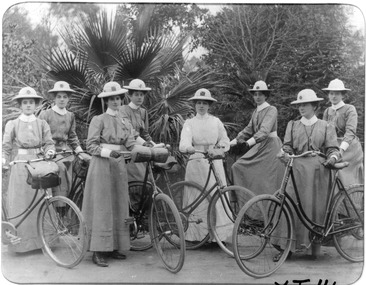
Photograph - Photograph, sepia, 1907
... dress with white collar, cuffs and belt and their was a red Maltese cross on their pith helmets. They gave nursing care to the poor in the inner Melbourne and close surrounding areas (districts). On the 17th of February 1885, just 50 years after Melbourne was founded, a preliminary meeting of ladies ...This photograph depicts the Sister-in-charge with a group of Melbourne District Nursing Society (MDNS,) Trained nurses, 'Nurses", with their bicycles, which were the first mode of transport purchased by MDNS in 1903. The bicycles enabled their Nurses to visit more patients over a wider area. They are identified as: L-R back row: Trained Nurses Taylor, Steele, Francis, Young. L-R front row: Isobel Curnow, Annie Roberts, Isabel Hawkes (Sister in Charge), Becker. Their uniforms were a grey cotton dress with white collar, cuffs and belt and their was a red Maltese cross on their pith helmets. They gave nursing care to the poor in the inner Melbourne and close surrounding areas (districts). On the 17th of February 1885, just 50 years after Melbourne was founded, a preliminary meeting of ladies and gentlemen who were anxious to form a society to provide "skilled nursing" for the sick poor in their own homes was held in Mrs William McCulloch’s home at Spring Street, Melbourne. At this meeting it was decided “that the association would be called the Melbourne District Nursing Society”, the first Society of its kind in Australia, and “that the special object of the Society shall be to secure skilled nursing for the sick poor in their own homes”. On the 16th of March a Committee was formed to “arrange for engaging one "duly qualified nurse”. On the 1st of May 1885 a Nurse, Mrs. Ferguson, was employed at £100 per annum, and a second Nurse, Mrs. Joanne Cannon, commenced six months later. In that era the term ‘Nurse’ was used even though they were ‘qualified’ i.e. ‘trained’ nurses. They worked in the now CBD, ie from Spencer Street to Spring Street and from Victoria Parade to Flinders Street. From its inception the Society was at the forefront of health care. They provided high quality Trained nursing care; educated their patients in the curing and prevention of disease; teaching the importance of cleanliness, fresh air and good nutrition, both by verbal instruction and demonstration, even supplying soup and milk when needed, as well as providing wood and coal in the winter. At that time they walked the streets and lane ways amid the slums of inner Melbourne carrying their nursing bag containing lotion, ointments, powders, liniment, bandages, dressings, a case of spirits, and the Nurse's own clean apron, soap and small towel. They supplied equipment on loan, such as earthenware hot water bottles, splints, urinals, bed pans, bed cradles, feeding mugs, and air-cushions as well as providing blankets and clean bed linen, and nightdresses as necessary. Trained midwives began home births in late 1893 taking midwifery bundles and providing clothes for the babe and mother as needed. As the work increased a third Trained nurse was employed but this was arduous work, particularly in the heat of summer and many Nurses only remained with the Society for several months. Permission to use bicycles was given to the Nurses in 1898 and the Society decided to purchase their own in 1903. A business man offered ‘new free wheel’ bicycles at £13 each which included maintenance for one year. Bells and wooden frames were added, at a cost of £5 per frame, so the Nurses could carry extra equipment. Nurses’ bags were strapped to the handlebars. Soup was made for those in need 2-3 times a week and if patients could not arrange to have it collected the soup was delivered by the Nurses on their bicycles. The use of bicycles caused a change in uniform, with white pith helmets, and veils covering them and tied under their chin, now being used. They provided high quality nursing care to a range of people, often in destitute situations, some lying on rags on the floor as they had no bed, others with just a bed and maybe a thin blanket, a chair and nothing else. Their ages ranged from babes, children, adults to the elderly. The Nurses gave medications as ordered by a Doctor, dressed wounds e.g. to the injured, and surgical cases, and to those with leg ulcers; attended to patients with ‘surgical ailments’ such as ‘hip disease’; gave care to those with acute illnesses such as bronchitis, pleurisy, pneumonia, measles, and scarlet fever, as well as those with chronic illnesses such as consumption (tuberculosis), heart disease, arthritis, cancer, debility, neuritis and paralysis. In 1913 a Nurse had her Board and residence, uniforms, bicycles and laundry expensive provided and was paid £50 a year for her first six months. At the end of a year her salary is increased by £5, and later she earns £60 a year. Over the years the nurses complained that their veils became wet in the rain and asked for a change of uniform but this did not occur until 1921. Bicycles continued to be used in inner areas until 1945. Sepia photograph of eight Melbourne District Nursing Society Trained nurses posing with their bicycles in a park; some are partly hidden. Nurse's uniforms consist of long grey dresses with white belts, cuffs and collars and white pith helmets with a Maltese cross in the centre. Oblong leather nursing bags of varying sizes are strapped to five of the bicycles. In the centre is Sister-in-charge – Mrs Hawkes (in white); to her left are 4 Nurses and to her right 3. L-R – Front row – Trained Nurses Curnow, Roberts, (Hawkes) and Becker. Back row – Nurses Taylor, Steele, Francis and Young. Trees and a palm are in the background. The bicycles have two large wire spoked wheels at either end of the black V shape bicycle frame; a rubber tyre runs around the outside of each wheel. The metal handlebars are a horizontal configuration and are attached with a central column into a black vertical column at the front of the V shape bicycle frame which has ‘fork shaped’ thin metal pierces running down either side of the wheel attaching the frame to the central hub of the wheel. The rear wheel is attached the same way to a central column at the rear of the frame which runs up to V shape solid seat. At the bottom of the V of the frame a pedal is attached with a rotating arm on either side of the bicycle and on the right side the rotating arm is attached to a sprocket which has a chain running around it back to a smaller sprocket on the hub of the back wheel. The chain has a thin metal guard over it. There are narrow thin metal mud guards running a short distance above the top of each wheel. melbourne district nursing society (1885-1957), bicycles, nurses, uniforms, mdns, mdns transport, rdns, royal district nursing service, trained nurse annie roberts, sister-in-charge isabel hawkes, trained nurse taylor, trained nurse steele, trained nurse francis, trained nurse young, trained nurse becker, trained nurse isobel curnow -
 Royal District Nursing Service (now known as Bolton Clarke)
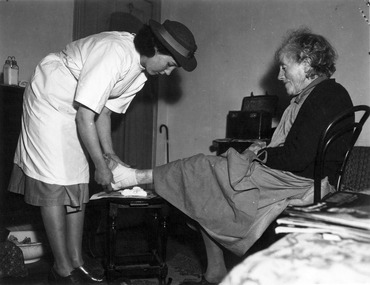
Photograph - Photograph, black and white:, 1952
... dressed a wound on the ladies ankle and is applying a blue-line bandage. The photograph is taken in the lady's home. The MDNS uniform at that time was a grey frock, and stiffened brimmed grey felt hat with a light grey band and a red Maltese cross in the centre of the band. ...dressed a wound on the ladies ankle and is applying a blue-line bandage. The photograph is taken in the lady's home. The MDNS uniform at that time was a grey frock, and stiffened brimmed grey felt hat with a light grey band and a red Maltese cross in the centre of the band. ...Sister J. Faust has dressed a wound on the ladies ankle and is applying a blue-line bandage. The photograph is taken in the lady's home. The MDNS uniform at that time was a grey frock, and stiffened brimmed grey felt hat with a light grey band and a red Maltese cross in the centre of the band. The Trained nurses (Nurses) of the Melbourne District Nursing Society (MDNS), from its inception in 1885, provided wound care to their patients, who ranged in age from the very young to the elderly. As research developed better products and dressing materials the methods and medication applied to wounds changed. MDNS received Royal patronage in 1966 and as Royal District Nursing Service (RDNS), the Education department developed programs, such as the Leg Ulcer Management Program, to provide their Trained nurses (Sisters) with methods of best quality care. The Sisters liaised with the patient’s Doctors and hospitals to provide information on the progress of patient’s wounds and to receive any change of wound care from the Doctors. RDNS introduced a Wound Care Specialist program and these Sisters did assessments and provided advice and support to the District Sisters working in the field. Black and white photograph of Melbourne District Nursing Society (MDNS) visiting Sister J. Faust, who is wearing a white gown and a grey brimmed hat over her dark curled hair. Part of her grey uniform frock is seen below the gown. She is applying a light coloured bandage to the right ankle of an elderly female patient. The lady, who has dark curled hair, and is wearing a grey frock, apron, and black cardigan is seen seated side on, on a wooden chair to the right of the Sister. She has her right leg extended and resting on a small low table, her left leg is bent to the floor.. The Sisters open case is seen on a small table to the rear of the lady and a walking stick is to the left against the door frame. A dark curtain hangs in the doorway. A large white wash bowl is seen in the lower left of the photograph. A glass jar with scissor blades into a liquid can be seen on a cabinet to the left of.Sister Faust. To the right of the photograph a partial white covered bed can be seen with a table over it with papers and a magnifying glass. Name of Sister on rear of photograph.wound care, melbourne district nursing society, royal district nursing service, rdns, mdns, sister j. faust -
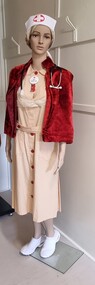 Wodonga & District Historical Society Inc
Uniform - Hamilton-Smith Collection - Red Cross Uniform
... dress, maps, and material relating to the world wars. Grace and John married at St. David’s Church, Albury in 1941. John was a grazier, and actively involved in Agricultural Societies and the Belvoir Wodonga Rotary Club. Grace was an active member of several organisations including the CWA, Red Cross, the Wodonga Show Ladies...dress, maps, and material relating to the world wars. Grace and John married at St. David’s Church, Albury in 1941. John was a grazier, and actively involved in Agricultural Societies and the Belvoir Wodonga Rotary Club. Grace was an active member of several organisations including the CWA, Red Cross, the Wodonga Show Ladies ...The Hamilton-Smith collection was donated by the children of Grace Mary Hamilton-Smith nee Ellwood (1911-2004) and John Hamilton-Smith (1909-1984) who settled in Wodonga in the 1940s. The Ellwood family had lived in north-east Victoria since the late 1800s. Grace’s mother, Rosina Ellwood nee Smale, was the first teacher at Baranduda in 1888, and a foundation member of the C.W.A. Rosina and her husband Mark retired to Wodonga in 1934. The collection contains significant items which reflect the local history of Wodonga, including handmade needlework, books, photographs, a wedding dress, maps, and material relating to the world wars. Grace and John married at St. David’s Church, Albury in 1941. John was a grazier, and actively involved in Agricultural Societies and the Belvoir Wodonga Rotary Club. Grace was an active member of several organisations including the CWA, Red Cross, the Wodonga Show Ladies' Auxiliary and the Victorian Agricultural Societies Association. This uniform was owned by Grace Hamilton-Smith. She achieved recognition for more 20 years of service to the Red Cross.This item has well documented provenance and a known owner. It is part of a significant collection from the Hamilton-Smith family of Wodonga and reflects important aspects of social history including the roles of women and their contribution to the community. A tan coloured Red Cross uniform and badges worn C1940sred cross australia, hamilton-smith collection, wodonga red cross
