
Showing 130 items matching "late arrival"
-
 University of Melbourne, Burnley Campus Archives
Administration, Department of Agriculture, Staff Time Books, 1955-1972
... ...late arrival...Register with columns for name, arrival time, explanation for late arrival or early departure, departure time. 1. 22.02.1955-12.06.1956. 2. 28.10.1959-15.06.1962 also roneod copy of advertisement for a male horticultural assistant. 3. 26.04.1963-07.12.1965. 4. 28.04.1971-28.11.1972...staff arrival time departure time late arrival early departure administration Register with columns for name, arrival time, explanation for late arrival or early departure, departure time. 1. 22.02.1955-12.06.1956. 2. 28.10.1959-15.06.1962 also roneod copy of advertisement for a male horticultural assistant. 3. 26.04.1963-07.12.1965. 4. 28.04.1971-28.11.1972 Staff Time Books Administration Department of Agriculture ...staff, arrival time, departure time, late arrival, early departure, administration -
 Nhill Aviation Heritage Centre
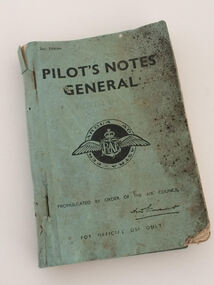
Memorabilia - Collection items from Howard Bertram's father f/s HNL Bertram 458 Squadron RAAF
... Book, Pilots Notes General. Late Arrivals Club certificate (copy only). Goldfish Club certificate (copy only). 132 pages...Late Arrivals Club certificate (copy only). Goldfish Club certificate (copy only). 132 pages Memorabilia Collection items from Howard Bertram's father f/s HNL Bertram 458 Squadron RAAF ...Book, Pilots Notes General. Late Arrivals Club certificate (copy only). Goldfish Club certificate (copy only). 132 pagesPilots Notes General promulgated by order of the Air Council (British) for official usepilots notes, book, general aircraft operating instructions, certificate, goldfish club, late arrivals club, award -
University of Melbourne, Burnley Campus Archives
Book - Register, Staff Time Book, 1959-1976
... Registers recording arrival and departure times of staff with reasons for late arrival. (1)" 28th Sept. 1957 to Oct 27th - 1959." (2) "16th June, 1962 - 8th Feb 1965." (3) "9th Feb - 1965 -14th Oct 1967." (4) "17 -2 - 76 to 12 - 10 - 76." ...University of Melbourne, Burnley Campus Archives 500 Yarra Boulevard Richmond melbourne register staff Registers recording arrival and departure times of staff with reasons for late arrival. (1)" 28th Sept. 1957 to Oct 27th - 1959." (2) "16th June, 1962 - 8th Feb 1965." (3) "9th Feb - 1965 -14th Oct 1967." (4) "17 -2 - 76 to 12 - 10 - 76." ...Registers recording arrival and departure times of staff with reasons for late arrival. (1)" 28th Sept. 1957 to Oct 27th - 1959." (2) "16th June, 1962 - 8th Feb 1965." (3) "9th Feb - 1965 -14th Oct 1967." (4) "17 -2 - 76 to 12 - 10 - 76." register, staff -
 Bendigo Military Museum
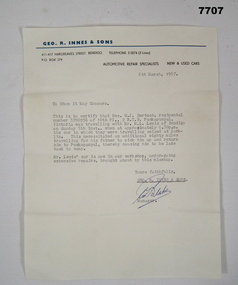
Letter - CORRESPONDENCE, "Automotive Repair Specialists - GEO. R. INNES & SONS", 1967
... Bertuch, supporting his late arrival at camp after leave....Bertuch, supporting his late arrival at camp after leave. Letter CORRESPONDENCE "Automotive Repair Specialists - GEO. ..."W.J. BERTUCH" - Service details - Refer Cat No. 1664.2Letter - beige colour paper with black and blue print business letterhead, black ink type written letter and blue ink pen, handwritten signature. Letter has been folded. This is a "To Whom it May Concern" letter written on behalf of W.J. Bertuch, supporting his late arrival at camp after leave.Letterhead with black and blue print. "GEO. R. INNES & SONS/ 411-417 HARGREAVES STREET, BENDIGO TELEPHONE 3 0574 (3 lines) P.O. BOX 74/ AUTOMOTIVE REPAIR SPECIALISTS NEW & USED CARS" Signature in blue ink pen "C.T. Blake" .correspondence, letter, w j bertuch -
University of Melbourne, Burnley Campus Archives
Book - Register, Timebook 1947 - student attendance, 1947-1948
... Cardboard bound register with columns for Arrival and Departure times and Explanations for late arrival or early departure. Dated 3rd May 1947 to 20 - 8 - 1948. ...Departmental official printed Attendence register.Fully utilised between 3/5/1947 and 20/8/1948. arrival departure students attendance Front cover TIMEBOOK 1947 Cardboard bound register with columns for Arrival and Departure times and Explanations for late arrival or early departure. Dated 3rd May 1947 to 20 - 8 - 1948. ...Departmental official printed Attendence register.Fully utilised between 3/5/1947 and 20/8/1948.Cardboard bound register with columns for Arrival and Departure times and Explanations for late arrival or early departure. Dated 3rd May 1947 to 20 - 8 - 1948. Each student had to sign in upon arrival and give an explanation about late or early. Then sign out upon departure with a signature. Read by teacher and red ink added with more details. eg sick leave train strikeFront cover TIMEBOOK 1947arrival, departure, students attendance -
 Warrnambool and District Historical Society Inc.
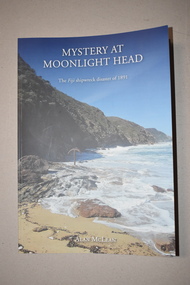
Book, Bart n Print Pty Ltd, Mystery at Moonlight Head, 2018
... Residents of Warrnambool and district had some connection to the wreck as Joseph Jordan, a Warrnambool photographer, took photographs of the wreck scene and was involved in a controversy regarding the late arrival of rescue equipment and residents from the Warrnambool area were charged with stealing some of the wrecked cargo....Residents of Warrnambool and district had some connection to the wreck as Joseph Jordan, a Warrnambool photographer, took photographs of the wreck scene and was involved in a controversy regarding the late arrival of rescue equipment and residents from the Warrnambool area were charged with stealing some of the wrecked cargo. ...This book written by Alan McLean records the historical details concerning the wreck of the Fiji at Moonlight Head, Victoria in 1891. The ship was travelling from Hamburg and bound for Melbourne when it was wrecked at Moonlight Head. Twelve lives were lost and a subsequent enquiry found the captain to be guilty of negligence. Residents of Warrnambool and district had some connection to the wreck as Joseph Jordan, a Warrnambool photographer, took photographs of the wreck scene and was involved in a controversy regarding the late arrival of rescue equipment and residents from the Warrnambool area were charged with stealing some of the wrecked cargo.This book is of considerable local interest as the wreck of the Fiji was connected with Warrnambool and district and affected many local residents.This is a soft cover book of 176 pages. It has a cover with a blue background, some printed material and two colour photographs. The book contains an acknowledgement, an introduction, 21 chapters and appendices. It also contains black and white and colour illustrations, maps and other images. To Warrnambool and District Historical Society With Best Wishes Alan McLeanwreck of the fiji, history of warrnambool, alan mclean, warrnambool photographer -
 Eltham District Historical Society Inc
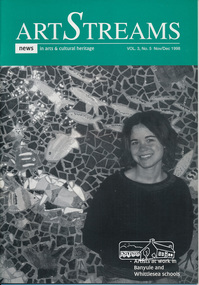
Journal, Peter Doughtery, ArtStreams: News in arts and cultural heritage; Vol. 3, No. 5, Nov-Dec 1998, 1998
... Vol. 3, No. 5, Nov-Dec 1998 CONTENTS RECIPES AND RULES Peter Wegner talks about life and painting 3 A MUSICAL JOURNEY Helen Lucas travels bush tracks to interview two talented musicians 6 THEATRE WITH CAROLYN PICKETT 7 EXHIBITION Peter Glass at Eltham Library 9 PROJECT Banyule arts take part in schools program 10 SHORT STORY Flying the Ditch by Kristina Ekman 12 RESTAURANTS Sigmund Jorgensen dines at Mercer's 14 ELTHAM FESTIVAL Local artists open their studios 16 CD REVIEWS 19, 25 BOOK REVIEWS 20 EXHIBITION - STROLLING AT HEIDE 25 CD REVIEWS A glance at some late arrivals 29 WINING, DINING, ENTERTAINING 30 COMMUNITY SERVICES 31 THEATRE Some new developments 32 ...Eltham District Historical Society Inc 728 Main Rd Eltham melbourne Vol. 3, No. 5, Nov-Dec 1998 CONTENTS RECIPES AND RULES Peter Wegner talks about life and painting 3 A MUSICAL JOURNEY Helen Lucas travels bush tracks to interview two talented musicians 6 THEATRE WITH CAROLYN PICKETT 7 EXHIBITION Peter Glass at Eltham Library 9 PROJECT Banyule arts take part in schools program 10 SHORT STORY Flying the Ditch by Kristina Ekman 12 RESTAURANTS Sigmund Jorgensen dines at Mercer's 14 ELTHAM FESTIVAL Local artists open their studios 16 CD REVIEWS 19, 25 BOOK REVIEWS 20 EXHIBITION - STROLLING AT HEIDE 25 CD REVIEWS A glance at some late arrivals 29 WINING, DINING, ENTERTAINING 30 COMMUNITY SERVICES 31 THEATRE Some new developments 32 "Peter Dougherty has been involved in the local art scene for many years. ...Vol. 3, No. 5, Nov-Dec 1998 CONTENTS RECIPES AND RULES Peter Wegner talks about life and painting 3 A MUSICAL JOURNEY Helen Lucas travels bush tracks to interview two talented musicians 6 THEATRE WITH CAROLYN PICKETT 7 EXHIBITION Peter Glass at Eltham Library 9 PROJECT Banyule arts take part in schools program 10 SHORT STORY Flying the Ditch by Kristina Ekman 12 RESTAURANTS Sigmund Jorgensen dines at Mercer's 14 ELTHAM FESTIVAL Local artists open their studios 16 CD REVIEWS 19, 25 BOOK REVIEWS 20 EXHIBITION - STROLLING AT HEIDE 25 CD REVIEWS A glance at some late arrivals 29 WINING, DINING, ENTERTAINING 30 COMMUNITY SERVICES 31 THEATRE Some new developments 32 "Peter Dougherty has been involved in the local art scene for many years. As publisher and editor of the arts magazine Artstreams, his comments on the various branches of the arts are widely respected. His "The Arts" column in the Diamond Valley Leader presents a brief summary for a much wider cross section of the local community. Peter also operates his own gallery and the Artstreams Cafe at the St Andrews market. Peter has a wealth of knowledge about present day and historical aspects of local art and artists." - Eltham District Historical Society Newsletter No. 161, March 2005Colour front and back cover with feature articles and literary pieces with photographs and advertisements printed in black and white. 36 pages, 30 cm. Vol. 1, no. 1 (Nov. 1996) - Vol. 10, no. 5 (summer ed. 2005/06) art streams, mia bulleen, dymocks booksellers, ceramics, peter wegner, fleur de feliss florist, adams of north riding, monty deli & catering services, victorian artists supplies, elham wiregrass gallery, helen lucas, cate bailey, kate adam, carolyn pickett, peter glass, aphids events inc., artists in schools program, kristina ekman, sigmund jorgensen, mercer's restaurant, stephen mercer, artists open studios program, peter accadia, dave bradley, jules christian burns, john fitzgerald, damian fitzgerald, jill forrest, ona henderson, syd tunn, denise keele bedford, annie kiel-taggart, jenni mitchell, grace mitchell, mervyn hannan, mary lou pittard, chris pittard, alan martin, elizabeth vercoe, nel ten wolde, montsalvat, yarra valley country club, pool & spa care centre, la piazza restaurant bar & cafe, frank jones, inga clendinnen, gwen ford, rose zwi, michelle lonsdale, christopher heathcote, roger palmer, jane messer, sandy jeffs, rodney waterman, doug de vries, recherche speciality picture framing, llobex image wizards, museum of modern art at heide, callam morton, maz delaney, shauna mcmullen, carlton courthouse theartre, ariel valent, kate adam, david brown, cate bailey, tony o'rourke, andy baylor, bulleen art & garden centre, dynamic vegies, volumes -
 Ballarat Tramway Museum
document - Correspondence, Electric Supply Co. of Vic (ESCo), "Australasian Tramway Conference", 1929 - 1930
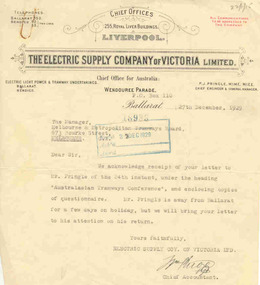
... Cole, Resident Engineer and Local Manager of ESCo Bendigo office - forwarding the questionnaire to the TB and apologising for the late arrival. On letterhead of the ESCo Bendigo office - see image 1972i1 for image of letter. ...Cole, Resident Engineer and Local Manager of ESCo Bendigo office - forwarding the questionnaire to the TB and apologising for the late arrival. On letterhead of the ESCo Bendigo office - see image 1972i1 for image of letter. ...Set of four letters between the Manager TB and Geelong, Ballarat and Bendigo tramways between the period of 27 Dec. 1929 and 30 July 1930 regarding the "Australasian Tramway Conference. See image files for details of the letterhead of the various company offices. 1972.1 - Letter from the Engineer and Manager of the Melbourne Electric Supply Company Limited, Melbourne office advising Mr. A. D. Murdoch, Manager of the Melbourne and Metropolitan Tramways Board that he had forwarded the questionnaire to their Geelong Engineer for completion. Dated 30/12/1929. Stamped as being received by the TB as 31/12/1929. See image 1972i1 for image of letter. 1972.2 - Letter from the Chief Accountant of ESCo Ballarat, to the Manager TB acknowledging receipt of the letter dated 24/12/1929 regarding the questionnaire and saying Mr. Pringle is on holidays and will be attended to on his return. Dated 27/12/1929 and stamped as being received by the TB as 28/12/1929. See image 1972i2 for image of letter. 1972.3 - Carbon copy of a letter on pink paper from Manager TB to Mr. G.F. Cole, Resident Engineer and Local Manager of ESCo ( Ballarat) regarding the questionnaire - too late to be included. Dated 9/7/1930. 1972.4 - Letter from Mr. G.F. Cole, Resident Engineer and Local Manager of ESCo Bendigo office - forwarding the questionnaire to the TB and apologising for the late arrival. On letterhead of the ESCo Bendigo office - see image 1972i1 for image of letter. Dated 5 July 1930, and received by TB on 7/7/1930. Questionnaire (attached to 1972.4) details sections and fares, section lengths, holiday fares, workmen's fares, scholars' fares (no concessions) details of concession fares, postmen fares, health nurses, employees, periodical tickets, prepaid tickets. On top of the sheets written in pencil is the file number "22/1/15"tram, trams, australasian tramway conference, fares, sections, letterhead, mmtb, mesco, esco -
 Stawell Historical Society Inc
Photograph, Grampians Sunrise over the Saw Mills 1866
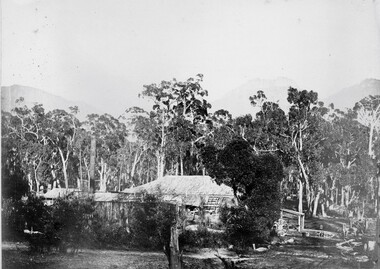
... Owing to the lateness of arrival at the summit they had to spend a very cold and miserable night. ...Owing to the lateness of arrival at the summit they had to spend a very cold and miserable night. ...Grampians (Sunrise over the Saw Mills). Part of a collection of Photographs by Mr. O.G. Armstrong as commissioned by the Shire of Stawell for the Inter-colonial and Paris Exhibition in Melbourne in 1866. The Grampians were first sighted by Major Thomas Mitchell on the 11th of July 1836. Four days later he and a small party climbed its highest peak and named it Mount William. Owing to the lateness of arrival at the summit they had to spend a very cold and miserable night. Whilst in the Grampians, which he so named because of their likeness to his native Scotland. He collected about 150 plants and sent them to the Professor of Botany, John Lindley at the University of London. It is now known there about 900 different flowering plants in the Grampians, over one third of all those growing in Victoria. stawell industry -
 Ballarat Tramway Museum
Photograph - Tram 41, Mt Pleasant, mid to late 1950s
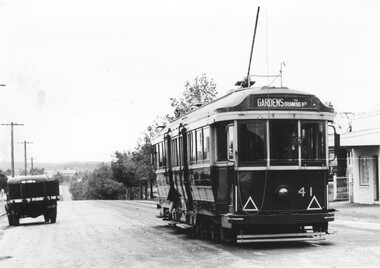
... It has been fitted with taillight and large reflective triangles, indicating a photo taken during the mid to late 1950s after its arrival from Geelong....It has been fitted with taillight and large reflective triangles, indicating a photo taken during the mid to late 1950s after its arrival from Geelong. Yields information about tram 41 during the mid to late 1950s after its arrival from Geelong in 1956. tramcars tramways tram 41 Mt Pleasant Black and white photograph with a plain back. ...Photograph of SECV Ballarat 41, at the Mt Pleasant terminus looking north. A lady can be seen boarding the tram. The tram has the destination of Gardens via Drummond St North. It has been fitted with taillight and large reflective triangles, indicating a photo taken during the mid to late 1950s after its arrival from Geelong.Yields information about tram 41 during the mid to late 1950s after its arrival from Geelong in 1956.Black and white photograph with a plain back.tramcars, tramways, tram 41, mt pleasant -
 Frankston RSL Sub Branch
Plaque, Memorial, c. 1919
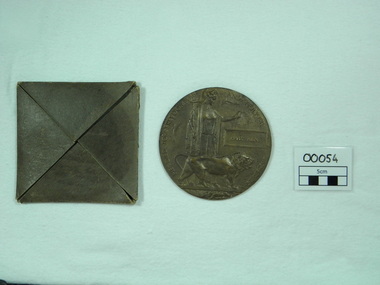
... Because of the late arrival in Australia of the plaques many scrolls were sent out separately. ...Because of the late arrival in Australia of the plaques many scrolls were sent out separately. ...Originally would have been issued with a scroll & letter from the King but neither with plaque. 1914-1918 Memorial Plaque In early 1920 it was announced that the next-of-kin of all Australian servicemen and women whose deaths were attributable to the First World War would receive a memorial plaque and scroll "as a solace for bereavement and as a memento". The memorial plaques were not uniquely Australian. In fact they were designed and produced in Britain and issued to commemorate all those who died as a result of war service from within the British Commonwealth. The idea for the plaques was originally conceived mid-way through the war. In 1917 a competition was announced to obtain a suitable design and 800 entries were eventually received. The winner, Mr. E. Carter Preston of Liverpool, England, was chosen in 1918. He was awarded a prize of 250 pounds. Mr Manning Pike directed the manufacture of the memorial plaques at the Memorial Plaque Factory set up at Acton, London. Some later plaques were also made at the Woolwich Arsenal. The cost of manufacturing so many plaques must have been considerable. Each plaque had the name of the soldier commemorated individually embossed (some were engraved) as part of the design. The full name was given without any indication of rank or honours to show the equality of sacrifice of all those who had lost their lives. The scroll designed to accompany the plaques was of thick paper, headed by the royal coat-of-arms, and bore the following message: "He whom this scroll commemorates was numbered among those who, at the call of King and Country, left all that was dear to them, endured hardness, faced danger, and finally passed out of the sight of men by the path of duty and self-sacrifice, giving up their own lives that others might live in freedom. Let those that come after see that his name is not forgotten". Underneath the message the serviceman or woman’s name, rank, honours and unit were written by hand in red ink. Because of the late arrival in Australia of the plaques many scrolls were sent out separately. A message from the King, "I join with my grateful people in sending you this memorial of a brave life given for others in the Great War", was included with the scroll. The first plaques were distributed in Australia in 1922. Each plaque was sent out from Base Records Office at Victoria Barracks in Melbourne by second-class mail. Approximately 60,000 plaques were issued in Australia. Families of deceased members of the Royal Australian Navy and the Australian Army Nursing Service also received plaques and scrolls Bronze Memorial Plaque 1914-1918 for 4876 Pte. Harry Milne , 46 Battalion KIA 10/5/1918, In a cardboard square envelope. http://www.awm.gov.au/research/people/roll_of_honour/person.asp?p=493414Embossed around edge of plaque "HE DIED FOR FREEDOM AND HONOVR" Name of serviceman embossed on plaque right of centre "HARRY MILNE"ww1, dead mans penny, kings penny, memorial plaque -
Frankston RSL Sub Branch
Plaque, Memorial
... Because of the late arrival in Australia of the plaques many scrolls were sent out separately. ...Because of the late arrival in Australia of the plaques many scrolls were sent out separately. ...1914-1918 Memorial Plaque In early 1920 it was announced that the next-of-kin of all Australian servicemen and women whose deaths were attributable to the First World War would receive a memorial plaque and scroll "as a solace for bereavement and as a memento". The memorial plaques were not uniquely Australian. In fact they were designed and produced in Britain and issued to commemorate all those who died as a result of war service from within the British Commonwealth. The idea for the plaques was originally conceived mid-way through the war. In 1917 a competition was announced to obtain a suitable design and 800 entries were eventually received. The winner, Mr. E. Carter Preston of Liverpool, England, was chosen in 1918. He was awarded a prize of 250 pounds. Mr Manning Pike directed the manufacture of the memorial plaques at the Memorial Plaque Factory set up at Acton, London. Some later plaques were also made at the Woolwich Arsenal. The cost of manufacturing so many plaques must have been considerable. Each plaque had the name of the soldier commemorated individually embossed (some were engraved) as part of the design. The full name was given without any indication of rank or honours to show the equality of sacrifice of all those who had lost their lives. The scroll designed to accompany the plaques was of thick paper, headed by the royal coat-of-arms, and bore the following message: "He whom this scroll commemorates was numbered among those who, at the call of King and Country, left all that was dear to them, endured hardness, faced danger, and finally passed out of the sight of men by the path of duty and self-sacrifice, giving up their own lives that others might live in freedom. Let those that come after see that his name is not forgotten". Underneath the message the serviceman or woman’s name, rank, honours and unit were written by hand in red ink. Because of the late arrival in Australia of the plaques many scrolls were sent out separately. A message from the King, "I join with my grateful people in sending you this memorial of a brave life given for others in the Great War", was included with the scroll. The first plaques were distributed in Australia in 1922. Each plaque was sent out from Base Records Office at Victoria Barracks in Melbourne by second-class mail. Approximately 60,000 plaques were issued in Australia. Families of deceased members of the Royal Australian Navy and the Australian Army Nursing Service also received plaques and scrolls First World War Memorial Plaque, bronze, in recognition of Private Sydney Frederick TURNER, from C Company, 9 Battalion who was KIA at Pozieres on 25 July, 1916. it is housed in a wooden surround with pattern embossed in the margins with a liking of the rising sun at the top. He is recorded on the Villers-Bretonneux Memorial and is listed with an Australian Red Cross Society Wounded and Missing Enquiry Bureau File, a copy of which is attached.Embossed around the edge of the plaque "HE DIED FOR FREEDOM AND HONOVR". The name of the serviceman is embossed on the plaque, right of centre, SYDNEY FREDERICK TURNER -
Frankston RSL Sub Branch
Collection, A. E. Bolger
... Because of the late arrival in Australia of the plaques many scrolls were sent out separately. ...Because of the late arrival in Australia of the plaques many scrolls were sent out separately. ...1914-1918 Memorial Plaque In early 1920 it was announced that the next-of-kin of all Australian servicemen and women whose deaths were attributable to the First World War would receive a memorial plaque and scroll "as a solace for bereavement and as a memento". The memorial plaques were not uniquely Australian. In fact they were designed and produced in Britain and issued to commemorate all those who died as a result of war service from within the British Commonwealth. The idea for the plaques was originally conceived mid-way through the war. In 1917 a competition was announced to obtain a suitable design and 800 entries were eventually received. The winner, Mr. E. Carter Preston of Liverpool, England, was chosen in 1918. He was awarded a prize of 250 pounds. Mr Manning Pike directed the manufacture of the memorial plaques at the Memorial Plaque Factory set up at Acton, London. Some later plaques were also made at the Woolwich Arsenal. The cost of manufacturing so many plaques must have been considerable. Each plaque had the name of the soldier commemorated individually embossed (some were engraved) as part of the design. The full name was given without any indication of rank or honours to show the equality of sacrifice of all those who had lost their lives. The scroll designed to accompany the plaques was of thick paper, headed by the royal coat-of-arms, and bore the following message: "He whom this scroll commemorates was numbered among those who, at the call of King and Country, left all that was dear to them, endured hardness, faced danger, and finally passed out of the sight of men by the path of duty and self-sacrifice, giving up their own lives that others might live in freedom. Let those that come after see that his name is not forgotten". Underneath the message the serviceman or woman’s name, rank, honours and unit were written by hand in red ink. Because of the late arrival in Australia of the plaques many scrolls were sent out separately. A message from the King, "I join with my grateful people in sending you this memorial of a brave life given for others in the Great War", was included with the scroll. The first plaques were distributed in Australia in 1922. Each plaque was sent out from Base Records Office at Victoria Barracks in Melbourne by second-class mail. Approximately 60,000 plaques were issued in Australia. Families of deceased members of the Royal Australian Navy and the Australian Army Nursing Service also received plaques and scrolls Collection of items relating to the death of Private Arthur Ernest Bolger, service number 01338, 14th Battalion, Australian Imperial Forces, who was killed in action at Gallipoli on 27th April, 1915. Private Bolger was from Victoria and was recorded as being the first Frankston serviceman to be killed in the ANZAC landing at Gallipoli. For more information refer: < > see items 00014.1 and 00014.2 -
Frankston RSL Sub Branch
Plaque, Memorial, 1914-1918 Memorial Plaque, 1920 (estimated); Issued from 1920
... Because of the late arrival in Australia of the plaques many scrolls were sent out separately. ...Because of the late arrival in Australia of the plaques many scrolls were sent out separately. ...This round, bronze memorial plaque was presented to the family of Private Richard Evans Harkness, service number 3426, of the 37th Battalion, (8th Reinforcements) who was killed in action at Villers-Bretonneux on 12th August, 1918. Colloquially known as 'Dead Man's Penny' or 'King's Penny', this plaque was given to the next of kin of service personnel who died on active service in WW1. 1914-1918 Memorial Plaque In early 1920 it was announced that the next-of-kin of all Australian servicemen and women whose deaths were attributable to the First World War would receive a memorial plaque and scroll "as a solace for bereavement and as a memento". The memorial plaques were not uniquely Australian. In fact they were designed and produced in Britain and issued to commemorate all those who died as a result of war service from within the British Commonwealth. The idea for the plaques was originally conceived mid-way through the war. In 1917 a competition was announced to obtain a suitable design and 800 entries were eventually received. The winner, Mr. E. Carter Preston of Liverpool, England, was chosen in 1918. He was awarded a prize of 250 pounds. Mr Manning Pike directed the manufacture of the memorial plaques at the Memorial Plaque Factory set up at Acton, London. Some later plaques were also made at the Woolwich Arsenal. The cost of manufacturing so many plaques must have been considerable. Each plaque had the name of the soldier commemorated individually embossed (some were engraved) as part of the design. The full name was given without any indication of rank or honours to show the equality of sacrifice of all those who had lost their lives. The scroll designed to accompany the plaques was of thick paper, headed by the royal coat-of-arms, and bore the following message: "He whom this scroll commemorates was numbered among those who, at the call of King and Country, left all that was dear to them, endured hardness, faced danger, and finally passed out of the sight of men by the path of duty and self-sacrifice, giving up their own lives that others might live in freedom. Let those that come after see that his name is not forgotten". Underneath the message the serviceman or woman’s name, rank, honours and unit were written by hand in red ink. Because of the late arrival in Australia of the plaques many scrolls were sent out separately. A message from the King, "I join with my grateful people in sending you this memorial of a brave life given for others in the Great War", was included with the scroll. The first plaques were distributed in Australia in 1922. Each plaque was sent out from Base Records Office at Victoria Barracks in Melbourne by second-class mail. Approximately 60,000 plaques were issued in Australia. Families of deceased members of the Royal Australian Navy and the Australian Army Nursing Service also received plaques and scrolls This plaque is significant because it commemorates the death of an Australian soldier on active service in World War 1. It is representative of some 60,000 issued to next of kin of soldiers killed in World War 1. Although Richard Harness was living at 52 Victoria Street, Abbotsford when enlisted, together with a scroll from the King, it was donated by a Frankston Family.This round, bronze memorial plaque was presented to the family of Australian Army private Richard Evans Harkness, service number 03426, of the 37th battalion, 8th re-inforcement. Harkness was killed in action on 12th August, 1918, near the French village of Proyart, during the 3rd Division's advance along the Somme Valley. further details can be found here: https://www.awm.gov.au/collection/U51477 Colloquially known as 'Dead Man's Penny' or 'King's Penny', these plaques were awarded to the next of kin of service personnel who died on active service during WW1. refer to link for further information : http://www.awm.gov.au/encyclopedia/memorial_scroll/plaque.aspAround the edge are the words 'HE DIED FOR FREEDOM AND HONOUR' On the righthand side of the plaque is the name of the soldier, in this case Richard Evans Harkness.commemorative, memorial, plaque, dead, man s, penny, king s, richard, evans, harkness -
 Sunshine and District Historical Society Incorporated
Photograph - Gordon William Doak, 1973
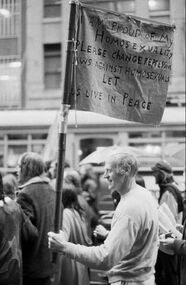
... Soon after his 1973 'coming out', he sold up and purchased a property in Moor St, Fitzroy, digging underground and setting up his own personal gym under the house for himself and his friends, Most people remember, even decades later, was the arrival of Gordon Doak at the Gay demonstration in the City Square, Melbourne. ...Soon after his 1973 'coming out', he sold up and purchased a property in Moor St, Fitzroy, digging underground and setting up his own personal gym under the house for himself and his friends, Most people remember, even decades later, was the arrival of Gordon Doak at the Gay demonstration in the City Square, Melbourne. ...Gordon William Doak, was one of Sunshine's early known gay activist. He was a linesman, a builder and a Glengala Road Sunshine West resident. He built his two-story home himself including a gymnasium. Soon after his 1973 'coming out', he sold up and purchased a property in Moor St, Fitzroy, digging underground and setting up his own personal gym under the house for himself and his friends, Most people remember, even decades later, was the arrival of Gordon Doak at the Gay demonstration in the City Square, Melbourne. He decided, on hearing about the demonstration, that he wanted to be there. But not for him anything as mundane as catching a train. Rather he decided to run in to the city, and to carry a banner that he made for himself – 2 foot square, black letters on green canvas that read 'I am proud of my homosexuality. Please change the repression against homosexuals and let us live in peace'. As he ran the eight miles through the streets of Sunshine, Tottenham and Footscray, he was cheered on and waved at by pedestrians and jeered at only twice!In 2019, the City of Melbourne Council installed this historic 1973 photo of Gordon in the “Yes” room in the Melbourne Town Hall for his historic role in campaigning for LGBTI acceptance.gordon william doak, lgbtqia+, glengala road, sunshine west, st. marks amateur athletic club -
 Federation University Art Collection
Photograph, Frank Golding, 'Three-quarter Time' - by Frank Golding, 2001
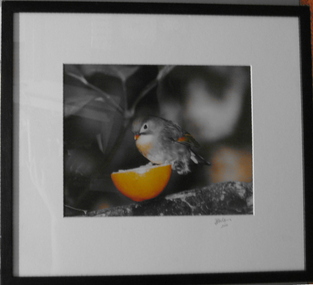
... Frank Golding was employed as Principal at three schools including a multi-site English language centre for refugees and other new arrivals. Later he taught in and managed curriculum and equity programs in education departments and universities. ...Frank Golding was employed as Principal at three schools including a multi-site English language centre for refugees and other new arrivals. Later he taught in and managed curriculum and equity programs in education departments and universities. ...Frank Patrick Golding (1938 - ) This item is part of the Federation University Art Collection. The Art Collection features over 1000 works and was listed as a 'Ballarat Treasure' in 2007. Frank Golding is an author, researcher, historian, consultant: Honorary Senior Research Fellow at Federation University in Victoria, Australia. His formal qualifications are TPTC (Ballarat), BA (Melb), BEd (Melb), Dip MT (UNE), MA (Hons) (London). He has taught English and History in several schools. Frank Golding was employed as Principal at three schools including a multi-site English language centre for refugees and other new arrivals. Later he taught in and managed curriculum and equity programs in education departments and universities. Finally he is the author of 12 published books including a memoir, An Orphan’s Escape: Memories of a Lost Childhood (Lothian, 2005) which describes his childhood as a Ward of the State of Victoria in the ‘care’ of three foster mothers and three institutions. Golding lived in the Ballarat Orphanage from 1943 to 1953. It is his childhood experiences that underpin Golding's active involvement in ‘care’ leaver issues as an advocate and lobbyist. Golding is a Life Member of CLAN (Care Leavers of Australasia Network) the peak body of Care Leavers for Care leavers run by Care Leavers.Image of bird on 1/2 orange citrus fruit - a play on childhood memory of oranges at 3/4 timeSignature on label on backart, artwork, frank golding, bird, federation college, photography, colour photography, alumni -
 Department of Energy, Environment and Climate Action
Equipment - Criterion Survey Laser
... There had been timber assessments in Victorian State forests since the late 1920s, coinciding with arrival of the three Norwegian foresters. ...Department of Energy, Environment and Climate Action 71-79 Kyle Road Altona North There had been timber assessments in Victorian State forests since the late 1920s, coinciding with arrival of the three Norwegian foresters. ...There had been timber assessments in Victorian State forests since the late 1920s, coinciding with arrival of the three Norwegian foresters. The program was accelerated during the post-war housing boom. It was driven by the push eastwards away from the Central Highlands to find timber resources after the 1939 bushfire salvage was completed. Spending time in the field with assessment branch was a “rite of passage” for many young forestry graduates leaving Creswick. The work was arduous, and measurements were taken with simple and robust equipment like Gunters chains, prismatic compass, Abney levels, barometers and clinometers. Data was recorded by hand onto waterproof paper. The Statewide Forest Resource Inventory (SFRI) project began in 1993 and followed a few years after the release Timber industry Strategy. The aim was to bolster the existing 1:25000 scale mapping and improve the accuracy of the volume and growth estimates for the forest estate. This scary looking gadget looks like a speed radar used by the cops. The LTI Criterion Survey Laser and Rangefinder was a powerful instrument that could measure and record tree height, diameter at any visible point up the tree and branch take-off points. It was used to identify and map tree faults such as branches, scars and knots and to calculate tree taper functions. When used correctly, it has an accuracy of better than 1% for height and diameter. It could also measure survey information such as asmuth, distance and elevation. It was expensive back in the day (more than $20,000) - this one was manufactured in 1996 - and heavy. This item was donated to the Beechworth museum by Peter Black in 2015 and is now at Altona and recorded in Victorian Collections Criterion Survey Laser with box and batteryLaser Technology Inc, Englewood, Colorado, USAsurveying, forest measurement -
 Warrnambool and District Historical Society Inc.
Household, Jellie Souvenir Glass
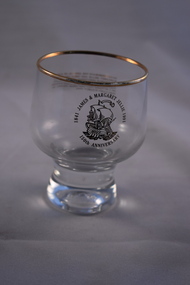
... arrival in Australia from Ireland of James and Margaret Jellie . They were early settlers in the Warrnambool district, settling first at Port Fairy and then acquiring property along the Merri River in the Warrnambool area. Their children and families were prominent in the 19th and 20th centuries in the Warrnambool district as pastoralists, particularly in the Grasmere area. One son, James had an auctioneering firm in Warrnambool in the late...arrival in Australia from Ireland of James and Margaret Jellie . They were early settlers in the Warrnambool district, settling first at Port Fairy and then acquiring property along the Merri River in the Warrnambool area. Their children and families were prominent in the 19th and 20th centuries in the Warrnambool district as pastoralists, particularly in the Grasmere area. One son, James had an auctioneering firm in Warrnambool in the late ...souvenir glass was produced to commemorate the 1841 arrival in Australia from Ireland of James and Margaret Jellie . They were early settlers in the Warrnambool district, settling first at Port Fairy and then acquiring property along the Merri River in the Warrnambool area. Their children and families were prominent in the 19th and 20th centuries in the Warrnambool district as pastoralists, particularly in the Grasmere area. One son, James had an auctioneering firm in Warrnambool in the late 19th century and two of James’ and Margaret’s granddaughters, Mary and Dorcas. were well-known as teachers at the Warrnambool State School in the 20th century. This glass is of interest as a memento of the Jellie families who have been so prominent in the history of Warrnambool and district.This is a glass tumbler with a rounded base and a rounded body with a gilt rim around the top of the glass. An image of a ship and gold lettering have been impressed on both sides of the glass. ‘James & Margaret Jellie 1841-1991 150th Anniversary’ ‘To commemorate the arrival of James & Margaret Jellie and their children on the Thomas Arbuthnot at Hobson’s Bay, Port Phillip District of New South Wales on 2 October 1841 and their journey to Port Fairy in early 1842’ jellie families, warrnambool, history of warrnambool -
 Warrnambool and District Historical Society Inc.
book - Books, Eagle Press, Mitchell's Three Expeditions into Eastern Australia, 1996
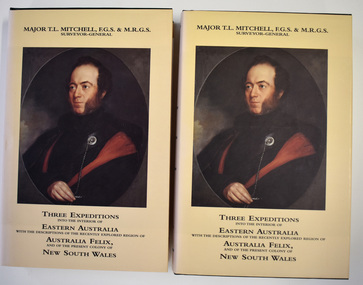
... late 1830s and early 1840s. These volumes are of considerable interest as Major Mitchell's 1836 expedition led to the arrival of the squatters in the Western District and the subsequent settlement of Warrnambool Major Mitchell Australia Felix Squatting Period Major Thomas Mitchell historical writing. ...Major Thomas Mitchell historical writing.This is set number 223 of two facsimile volumes of an historical work. The covers are green with gold printing and the dust covers are cream with black printing and two colour illustrations. The pages contain printed text and illustrations, both black and white and coloured. There are two inserts, one a map and the other showing a New South Wales natural feature. The two volumes are contained in a hardcover green folder.non-fictionMajor Thomas Mitchell historical writing.major mitchell, australia felix squatting period -
 Warrnambool and District Historical Society Inc.
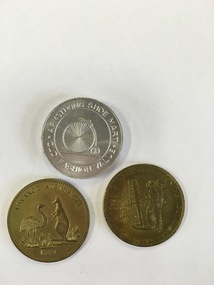
Token x 3, Tokens: Armstrong shoes, Circa 1968 -1987
... later purchase. The practice of using tokens was prevalent in the early settlement of Australia when shop owners issued tokens as a form of currency. These are three of a number of tokens issued by Armstrong shoes which was established by Max Armstrong who once lived in Warrnambool and helped to run the family shoe business here. He was an excellent rower and on his arrival...later purchase. The practice of using tokens was prevalent in the early settlement of Australia when shop owners issued tokens as a form of currency. These are three of a number of tokens issued by Armstrong shoes which was established by Max Armstrong who once lived in Warrnambool and helped to run the family shoe business here. He was an excellent rower and on his arrival ...These tokens are customer reward tokens which can be redeemed for a discount when making a later purchase. The practice of using tokens was prevalent in the early settlement of Australia when shop owners issued tokens as a form of currency. These are three of a number of tokens issued by Armstrong shoes which was established by Max Armstrong who once lived in Warrnambool and helped to run the family shoe business here. He was an excellent rower and on his arrival in Warrnambool worked towards reviving the Warrnambool Rowing Club.Interesting items with social and historical significance.001047.1 Round white metal token with penny farthing enclosed in circle on one side and lady’s button up boot. Surrounded by text. Edge plain. 001047.2 Round yellow metal with diagram of astronaut on front surrounded by text. Back has text in centre surrounded by larger text. 001047.3Round yellow metal. Emu and kangaroo with text above and date below. The back image of man surrounded by text. 001047.1 Armstrong shoe mart old fashion value on front with maker’s name Stokes below penny-farthing. On reverse Armstrong boot and shoe warehouse estab. Four generations Stokes Melb. 001047.2Armstrong’s shoes first on the moon. Armstrong shoe mart Frankston. On the reverse text in centre reads “This $1 token gains $1 each year from 1987 till year 2000 AD when worth $14 off next pair of shoes at Armstrong shoe mart 70 Wells St Frankston. Around rim,” Armstrong inflation proof dollar. Edition limited to 5000. 001047.3 On front Advance Australia 1987. On back Armstrong shoe mart shoex 70 Wells St Frankston Look at you shoes others do. Ian M L Armstrong 1984 armstrong shoe token, dollar token, warrnambool, frankston shoe mart, -
 Warrnambool and District Historical Society Inc.
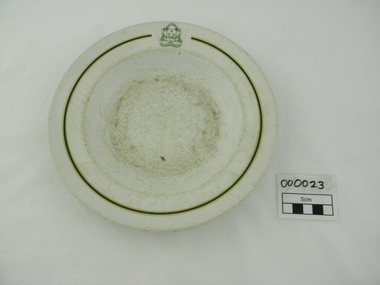
Domestic object - China bowl, Gibsons and Paterson Limited, St Ann's College, Mid 20th Century
... arrival in May 1872 of a group of nuns from Ireland. They were the third group of Sisters of Mercy to come to Victoria. The Warrnambool nuns worked hard to establish a school and orphanage for the socially disadvantaged children of the district. They purchased Wyton from Captain Ardlie that year and also Amhurst later...arrival in May 1872 of a group of nuns from Ireland. They were the third group of Sisters of Mercy to come to Victoria. The Warrnambool nuns worked hard to establish a school and orphanage for the socially disadvantaged children of the district. They purchased Wyton from Captain Ardlie that year and also Amhurst later ...St. Anns College had its beginnings in the arrival in May 1872 of a group of nuns from Ireland. They were the third group of Sisters of Mercy to come to Victoria. The Warrnambool nuns worked hard to establish a school and orphanage for the socially disadvantaged children of the district. They purchased Wyton from Captain Ardlie that year and also Amhurst later on. The Nazareth sisters of Ballarat took over the orphanage in the late 1880's and moved the children to Ballarat but the school continued to develop an expanding curriculum. A chapel was built in 1887 and a school wing in 1906. They survived on tuition fees and the generosity of benefactors though the early and middle part of the 20th century including a large bequest by Mrs Vera Kenna in the 1960's. Boarders were a regular part of convent life until the 1970's which is probably the source of this plate. St Ann's College was combined with St Joseph's CBC college as Emmanuel College and operates today as the largest Catholic college in the district.This has significance as it is associated with one of the longest running schools in the district and hence would have a connection to many Warrnambool people as well as district people who boarded at the college.White bowl, with green and yellow stripe around edge and emblem. Surface is quite scratched on front and bottom of bowl.Inscription on emblem. " St. Anns Warrnambool around edge of logo with Omnia Vincit Labor on banner through the middle with four stars in the background. Printed in green. Inscription on base Grindley Hotel Ware England . Vitrified . Gibson and Paterson Limited New Zealand. CIR stamped into china on base.secondary school, catholic, warrnambool, st ann's college, sisters of mercy, education, emmanuel college -
 Warrnambool and District Historical Society Inc.
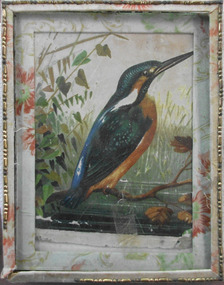
Print, Relic from St John’s Fire, Pre 1920
... Later framed by Grandma. St. John’s Presbyterian Church was built in 1875 and was burned down July 21st 1920. A volunteer fireman Mr T Spicer discovered the fire and despite the prompt arrival of the fire brigade, after an hour only the walls and tower remained. ...A small card at the back of the picture reads,’ This Picture was a teaching aid used in St. John’s Kinderg S.S and was found in the Church Ruins after the fire in July 1920 by Nancy McC(Absalom). Later framed by Grandma. St. John’s Presbyterian Church was built in 1875 and was burned down July 21st 1920. A volunteer fireman Mr T Spicer discovered the fire and despite the prompt arrival of the fire brigade, after an hour only the walls and tower remained. Some items were salvaged including vestry furnishings and church register. A bible which had been given to the Church in 1895 was rescued by an unknown young man whose identity remained a mystery until1976 when a Mr Stan Williams of Ballarat told his story. The Church was rebuilt in 1922. The event of this fire remains one of the most significant in the history of Warrnambool. Framed print of kookaburra on branch in natural setting. The bird is coloured blue, green and tan. Background is in muted greens. The light wooden frame is covered in fabric in pinks and green. A patterned metal edge sits atop the fabric. On back of picture, ‘ From Grandmother to Nancy on her 5th Birthday, Aug 20th 1920. This is a relic of the burning of St John’s Church July 21st 1920. Picked up by Nancy and framed by E Black.” warrnambool, st.john's presbyterian church, st john's fire warrnambool, st john's fire relic -
 Warrnambool and District Historical Society Inc.
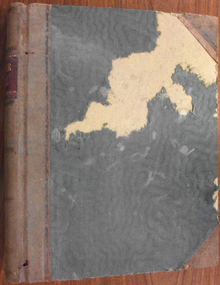
Legal record - Letter Book, G.S. Mackay, Circa 1920
... later to Warrnambool in 1893. He served as a Warrnambool City Councillor and also held a number of important positions within the Presbyterian Church. He was one of the earliest and strongest supporters of the Warrnambool High School. Many of the letters within this book are to his daughter who studied medicine in Glasgow in the early 1900’s. G. S Mackay was prominent in legal, civic and religious life in Warrnambool almost from the time of his arrival ...This book contains private letters which G. S. Mackay wrote to his daughter, Meta? and his aunt in the 1920’s. G. S. Mackay was born in Sutherlandshire Scotland in 1850. He qualified as a solicitor and came to Australia in 1884 and later to Warrnambool in 1893. He served as a Warrnambool City Councillor and also held a number of important positions within the Presbyterian Church. He was one of the earliest and strongest supporters of the Warrnambool High School. Many of the letters within this book are to his daughter who studied medicine in Glasgow in the early 1900’s. G. S Mackay was prominent in legal, civic and religious life in Warrnambool almost from the time of his arrival in 1893 until his death in 1926. Many of these letters are of a religious nature and as such display that aspect and personal thoughts of Mr Mackay’s personal life. Dark green fabric cover with light brown suede spine and cover edges. Hard cover. Green patterned paper inside front and back covers. Alphabetical index at front. Pale fine yellow pages numbered up to 502. L. ****Queen Douglas, Newpark West Calder, MidLothian 14 miles from Edin’h Ry Stn Newpark. Meta Selby The Calouda(?) Club 35 St Georges Square London S.W.1 warrnambool, g.s. mackay letter book, solicitor, g. s mackay councillor. -
Eltham District Historical Society Inc
Document - Folder, Partington family
... Both Partington boys died soon after the family arrived at Greensborough but later two daughters were born, Prudina and Maria, and five sons, including William . On arrival Charles Partington began work for Mr Flintoff at Black Hills and was later toll keeper on what is now Watsonia Road. ...Both Partington boys died soon after the family arrived at Greensborough but later two daughters were born, Prudina and Maria, and five sons, including William . On arrival Charles Partington began work for Mr Flintoff at Black Hills and was later toll keeper on what is now Watsonia Road. ...Charles Partington married Ellen Whatmough; they and their children, Robert and James, came to Australia in 1857 because Ellen's brother, Robert Whatmough, had come here in 1841. Whatmough was Melbourne's first lamplighter while also working in John Batman's Spencer Street orchard; he moved in 1842 to establish an orchard in Greensborough. Both Partington boys died soon after the family arrived at Greensborough but later two daughters were born, Prudina and Maria, and five sons, including William . On arrival Charles Partington began work for Mr Flintoff at Black Hills and was later toll keeper on what is now Watsonia Road. He was later a successful orchardist. William Partington married Annie-May Medhurst, daughter of David Medhurst and Martha Ruston, daughter of Peter Ruston who had settled in Greensborough in the 1850s after working for Mr Hooper in Darebin Creek, then moved to Panton Hill in 1866 working as a carrier. The Rustons had six children, including Martha and James. Martha married David Medhurst in 1882 who was the son of David Medhurst and Charity Jane Pink. After David's death, Charity Jane married George Wescott. David and Martha Medhurst had eight children, including Annie May. They bought land in Main Street, Greensborough and set up as a greengrocer. William and Annie-May Partington's family home, Willis Vale, purchased from Mr Meagher by William's father, Charles; it was built by Meagher in 1839 but destroyed by vandals in 1966 after being compulsory purchased for parkland now called Partington's Flat. Their children were Eva, Grace, Alan, Jessie, and Jack. They attended Greensborough Primary School. Alan married Wyn. Contents Newspaper article: "Link with the past", Diamond Valley News, 21 February 1984. Alan Partington's research on Robert Whatmough, early settler in Greensborough, and his brother-in-law Charles Partington. Newspaper article: "How early families linked up", Diamond Valley News, 28 February 1984. Alan Partington's research into the Ruston and Medhurst families. Newspaper article: "Old days recalled", Diamond Valley News, 13 March 1984. Alan Partington's research in the Partington family.Newspaper clippings, A4 photocopies, etcalan partington, robert whatmough, watmough park greensborough, robert partington, james partington, elen partington nee whatmough, road tolls watsonia road, prudina partington, maria partington, william partington, willis vale, partington's flat greensborugh, mr meagher of greensborough, apollo parkways estate, charles partington, annie-may partington nee medhurst, david medhurst, martha medhurst (nee ruston), jack medhurst, peter ruston, hooper of darebin creek, greensborough hotel, james ruston, charity jane medhurst (nee pink), main street greensborough, eva partington, grace partington, jessie partington, jack partington, orchards in plenty river area, greensborough primary school, wyn partington, flintoff of black hills -
 Eltham District Historical Society Inc
Albert Jones, 'Golden Glen', home of photographer, Albert Jones
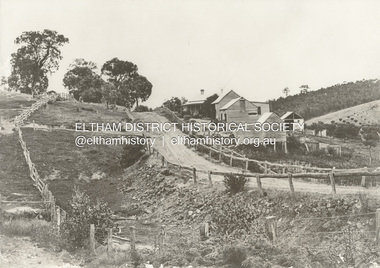
... later Sir Arthur), Tom Roberts and Charles Conder, among others, photography was relatively new. Yet Albert Jones used the new medium to compile a weighty album of pioneers at work, at home, at sport and on holidays. He was at the first Yarra Glen race meeting, early Diamond Valley football matches and photographed soldiers from the district leaving for war. He photographed early gold mines, men with horses laying the Diamond Creek-Hurstbridge rail track and the arrival...later Sir Arthur), Tom Roberts and Charles Conder, among others, photography was relatively new. Yet Albert Jones used the new medium to compile a weighty album of pioneers at work, at home, at sport and on holidays. He was at the first Yarra Glen race meeting, early Diamond Valley football matches and photographed soldiers from the district leaving for war. He photographed early gold mines, men with horses laying the Diamond Creek-Hurstbridge rail track and the arrival ...At the right of the photo is an apple orchard over the other side of Watery Gully creek. The house at the far end and middle building in the photo remain as of 2024, located at 205 Kangaroo Ground-Wattle Glen Rd, Kangaroo Ground between Pretty Hill Lane and Millers Road. https://maps.app.goo.gl/riyy56LsfEMz4w5W6 Reproduced in The Diamond Valley Story, Dianne H Edwards, The Shire of Diamond Valley 1979, p138 "Golden Glen, the home at Wattle Glen of photographer and orchardist Albert Jones. It was in one of these outbuildings that the hundreds of glass negatives of the Spark/Jones Collection werer found. Phot: Spark/Jones Collection" See Ref: EDHS_03112 A WINDOW ON THE PAST by Roger Sanders, The Sun, Wednesday, Auguist 11, 1976, pp 38-39 A fascinating window has been opened on the early life of the Eltham district. It is a rare collection of 3,000 perfectly preserved glass plate photograph negatives. The collection is the work of the late Albert Jones, a Diamond Creek orchardist and amateur photographer. About 500 of the negatives have been printed and 100 are on display at Gallery 4, Eltham, as part of the Eltham Festival," which started on Friday. They capture in fine detail rural and village life around Eltham, Hurstbridge, Kangaroo Ground, Yarra Glen and Diamond Valley from 1900 to 1930. While the natural beauty of the district was painted in this period by Arthur Streeton (later Sir Arthur), Tom Roberts and Charles Conder, among others, photography was relatively new. Yet Albert Jones used the new medium to compile a weighty album of pioneers at work, at home, at sport and on holidays. He was at the first Yarra Glen race meeting, early Diamond Valley football matches and photographed soldiers from the district leaving for war. He photographed early gold mines, men with horses laying the Diamond Creek-Hurstbridge rail track and the arrival of the first steam train at Hurstbridge. He took his cameras on holiday around Victoria and the collection includes scenes from St. Kilda and Portsea and many country towns. The Jones collection of negatives was found by Mr A. J. "Ned" Spark, of Balwyn, under a house he bought from Mr Jones' widow. The plates almost went to the tip with a pile of rubbish before Mr Spark realised their potential value. Mr Spark, who is retired, will continue the identification and recording of the photographs when he returns from holidays. The exhibition of the Jones' photographs is open each afternoon until August 21 at Gallery 4, 1016 Main Rd., Eltham. Photographs included in article: • The priceless collection of glass plate negatives were found under this house in Eltham [actually Wattle Glen], home of Albert Jones and his wife. • A quiet country pub - Panton Hills Hotel. • Teams of draught horses were used in the building of the Diamond Creek-Hursbridge railway in 1910. • Chinaman Jimmy using a gold cradle in Wattle Glen Gully. • The photographer and orchardist Albert Jones. His work is on show as part of the Eltham Festival • St Kilda Pier – several of the houses are still standing, but the waterfront has changed dramatically since this was taken before 1920. • A picnic was a dressy affair at the start of the century – the women in this family group are decked in lace and pearls.Stamped in purple ink on reverse within border "A.J. SPARK COLLECTION PHOTOS 1900 - 1930 PHOTOGHRAPHER LATE ALBERT JONES DIAMOND VALLEY. TEL: 83-3561"a.j. spark collection, albert jones, golden glen, shops, wattle glen -
 Eltham District Historical Society Inc
Audio - Audio Recording, Katherine Sheedy, Interview: Russell Yeoman, 25 March 2024
... later as a Town Planner with the former Shire of Eltham. Following Council amalgamation and the establishment of the new Shire of Nillumbik (December 1994), Russell carried over to Nillumbik for a brief period. Russell was a founding member of the Shire of Eltham Historical Society in 1967 which following Council amalgamation was renamed the Eltham District Historical Society. Russell is the Society Secretary and has held that volunteer position for more than 55 years. Russell discussed his arrival...later as a Town Planner with the former Shire of Eltham. Following Council amalgamation and the establishment of the new Shire of Nillumbik (December 1994), Russell carried over to Nillumbik for a brief period. Russell was a founding member of the Shire of Eltham Historical Society in 1967 which following Council amalgamation was renamed the Eltham District Historical Society. Russell is the Society Secretary and has held that volunteer position for more than 55 years. Russell discussed his arrival ...NILLUMBIK SHIRE COUNCIL ORAL HISTORY PROJECT Interview: Russell Yeoman Date: Monday 25 March 2024 Place of Interview: Russell’s home in Eltham Interviewer: Katherine Sheedy; Way Back When Consulting Historians In 2023 Nillumbik Shire Council agreed to support two Oral History projects associated with local history groups within the shire. One project was training sessions for group members on undertaking oral history recordings, which occurred in November 2023. The other project involved a professional historian recording two selected history group members, which occurred in March 2024. The interviews were undertaken by Katherine Sheedy of Way Back When Consulting Historians. Russell Yeoman, a life member of the Eltham District Historical Society, first came to Eltham in 1964 when he was employed in Engineering and later as a Town Planner with the former Shire of Eltham. Following Council amalgamation and the establishment of the new Shire of Nillumbik (December 1994), Russell carried over to Nillumbik for a brief period. Russell was a founding member of the Shire of Eltham Historical Society in 1967 which following Council amalgamation was renamed the Eltham District Historical Society. Russell is the Society Secretary and has held that volunteer position for more than 55 years. Russell discussed his arrival in Eltham in the 1960s, working as an engineering and then town planner for the shire, changes in Eltham over time including from a town planning perspective, the unique character of Eltham and challenges this led to, the book Pioneers & Painters, forming the Shire of Eltham Historical Society, the Local History Centre, and what is unique about Eltham.audio recording, eltham, eltham district historical society, oral history, russell yeoman -
Glen Eira Historical Society
Document - Howitt family
... arrival in Melbourne with his family, the house he lived in in Collins Street before moving to Caulfield, and his other family members. Includes details of his professional life. 2/Newspaper reprinted article from ‘News’ Shepparton, dated 19/07/1960 on the centenary of the start if Burke and Wills’ expedition mentioned the journey made by author William Howitt and his two sons, and about his book he wrote ‘Land, Labour and Gold’, and about son Alfred who became a scientist and later brought the remains of Burke and Wills back to Melbourne. 3/A 15-page booklet written by family member Gwen Webb on the life and work of Alfred William Howitt, explorer, scientist and public servant. ...arrival in Melbourne with his family, the house he lived in in Collins Street before moving to Caulfield, and his other family members. Includes details of his professional life. 2/Newspaper reprinted article from ‘News’ Shepparton, dated 19/07/1960 on the centenary of the start if Burke and Wills’ expedition mentioned the journey made by author William Howitt and his two sons, and about his book he wrote ‘Land, Labour and Gold’, and about son Alfred who became a scientist and later brought the remains of Burke and Wills back to Melbourne. 3/A 15-page booklet written by family member Gwen Webb on the life and work of Alfred William Howitt, explorer, scientist and public servant. ...3 items about the Howitt family in the 1800s to early 1900s: 1/Twelve photocopied pages from ‘The Educational Magazine’ August 1955. The article is about Dr. Godfrey Howitt, his arrival in Melbourne with his family, the house he lived in in Collins Street before moving to Caulfield, and his other family members. Includes details of his professional life. 2/Newspaper reprinted article from ‘News’ Shepparton, dated 19/07/1960 on the centenary of the start if Burke and Wills’ expedition mentioned the journey made by author William Howitt and his two sons, and about his book he wrote ‘Land, Labour and Gold’, and about son Alfred who became a scientist and later brought the remains of Burke and Wills back to Melbourne. 3/A 15-page booklet written by family member Gwen Webb on the life and work of Alfred William Howitt, explorer, scientist and public servant. Booklet covers prospecting, Burke and Wills, East Gippsland, Bairnsdale, science, public service, and a chronology and his honours and distinctions, printed in 1980, titled ‘A. W. Howitt 1830-1908’howitt godfrey dr., howitt richard, botanists, naturalists, howitt alfred, cussen dr., howard mr., were mr., howitt mary, howitt lane, howitt william, gold rush, writers, ‘grosvenor chambers’, balaclava road, kooyong road, caulfield, howitt william godfrey dr., surgeon, ‘harvard house’, howitt edith mary, anderson edith mary, howitt edward, howitt charles ernest, howitt charlton, scientists, explorers, howitt mrs., webb gwen, howitt a. w., howitt walker mary, howitt alfred william, farms, boothby liney, howitt liney mrs. -
 Eltham District Historical Society Inc
Photograph - Digital Photograph, Alan King, Former Police Residence, 728 Main Road, Eltham, 28 December 2007
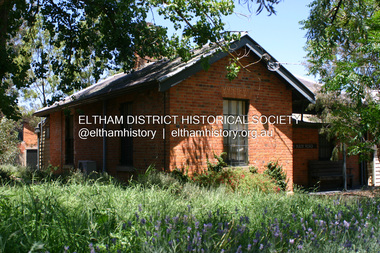
... With the arrival of the railway in 1902 the town centre gradually shifted towards the railway station. The Police Station and operations were moved into the town centre in 1961 to a renovated house in Pryor Street, which was later replaced by the current Police Station. ...With the arrival of the railway in 1902 the town centre gradually shifted towards the railway station. The Police Station and operations were moved into the town centre in 1961 to a renovated house in Pryor Street, which was later replaced by the current Police Station. ...The institutions of law and order in Colonial Victoria included the police, courts and prisons. The 1852 report of the Snodgrass Select Committee appointed to "identify the policing needs of the colony” noted there existed seven independent police forces that did not co-operate or regularly communicate. Following the committee's report all these police entities were merged into the Victoria Police, founded on 8 January 1853, to implement law and order responsibilities throughout the Colony of Victoria. The Eltham Courthouse (1860) and adjacent Police Residence (1859) formed a justice precinct established in the immediate aftermath of the 1852 police inquiry and the effects of the gold rush. The physical presence of these buildings, in the centre of the early Eltham township, defined centralised control over law and order. In the early days the Police Constable in charge would conduct his duties travelling around the district by horse; a stable was located at the rear of the residence. At times the horse would be grazed on the paddocks across the road. Horseshoes were forged by the blacksmith beside the Courthouse on the high side of “Policeman’s Hill”. Along with the stable, there was a two-cell bluestone lockup where prisoners were held awaiting trial in the adjacent Courthouse. Their meals were usually provided by the policeman’s wife or from the hotel just up the road. With the arrival of the railway in 1902 the town centre gradually shifted towards the railway station. The Police Station and operations were moved into the town centre in 1961 to a renovated house in Pryor Street, which was later replaced by the current Police Station. From 1961-1981 the residence was occupied by the Vermin and Noxious Weeds Destruction Section of the Department of Crown Lands and Survey. Prior to August 1967 the former Police Station was dragged to the rear of Police Residence to make way for the construction of a driveway and access from Main Road. The building was placed on the site of a former Scullery and modified for Lands Department use. In 1981 the Shire of Eltham took over management of the former Police Residence in Eltham. It remained unoccupied for a period whilst its future was discussed in Council. It was then used for a community job creation scheme until 1985. In 1985 the Shire of Eltham Parks and Environment occupied the residence. Council improved the driveway but later added a second rear access from Brougham Street due to the dangerous nature of the Main Road entrance. Additionally, a rear toilet facility between the Police Residence and the relocated former Police Station, which was doubling up as a lunchroom. Council also commenced discussions to re-establish a replica Police Station. Around November 1986 the former Police Station was demolished; believed to have been suffering termite damage. About 1989, after some years of discussion, a replica Police Station was built, based on photographs, to act as a lunchroom and meeting room for the Parks and Environment staff and volunteers doing community service. In 1996 Eltham District Historical Society held discussions with Nillumbik Shire Council commissioners throughout the year regarding a home for the Society. A proposal was put forward by the Society in October to occupy the former Police Residence. In March 1997 Eltham District Historical Society gained access to former Police Residence and on July 12, 1998, moved into its Local History Centre. In July 2018, Eltham District Historical Society gained access to the replica Police Station (which had been used as a music library and storage for the Eltham Concert Band) for use as part of regular heritage tours for schools and community-based groups. Covered under Heritage Overlay, Nillumbik Planning Scheme. Published: Nillumbik Now and Then / Marguerite Marshall 2008; photographs Alan King with Marguerite Marshall.; p65This collection of almost 130 photos about places and people within the Shire of Nillumbik, an urban and rural municipality in Melbourne's north, contributes to an understanding of the history of the Shire. Published in 2008 immediately prior to the Black Saturday bushfires of February 7, 2009, it documents sites that were impacted, and in some cases destroyed by the fires. It includes photographs taken especially for the publication, creating a unique time capsule representing the Shire in the early 21st century. It remains the most recent comprehenesive publication devoted to the Shire's history connecting local residents to the past. nillumbik now and then (marshall-king) collection, eltham, main road, eltham district historical society, eltham justice precinct, little eltham, local history centre, police residence, police station -
Glen Eira Historical Society
Document - SADLEIR, JOHN
... His arrival in Victoria, subsequent postings with his employment and his final retirement in Elsternwick and later death at “Orwell” in Kooyong Road, Author and date unknown. ...His arrival in Victoria, subsequent postings with his employment and his final retirement in Elsternwick and later death at “Orwell” in Kooyong Road, Author and date unknown. ...This file contains two items. A printed page of Police Superintendent John Sadleir. His arrival in Victoria, subsequent postings with his employment and his final retirement in Elsternwick and later death at “Orwell” in Kooyong Road, Author and date unknown. Includes references. A photocopied print of John Sadleir, from his book Recollections August, 1913.sadleir john, police officers, orwell, kooyong road, elsternwick, sadleir isabella, crofton isabella, sadleir ernest, sadleir frederick, sadleir ralph, sadleir john, sadleir melesina, sadleir mary, sadleir grace, sadleir dora, sadleir george, sadleir henry, victorian historical society -
 Mission to Seafarers Victoria
Letter - Printed circular or letter, The Victorian Seamen's Mission, c. 1902
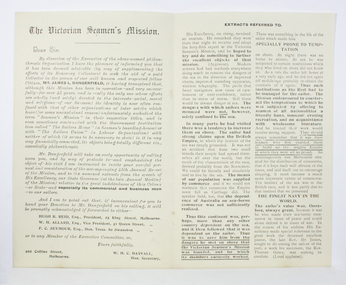
... late 1901 early 1902. A former solicitor Darvall and the Mission Committee are concerned it seems at the 'appropriation' by other organisations of donations or funds usually promised to the VMTS. The seamen's home was being built or about to be on the site of the World Trade centre on Siddeley St. as at 2020. This letter was sent out at a pivotal period in the Mission story soon after the sudden death of Rev James after 20 constant years service, with the proposed arrival ...Composed and signed by WHC Darvall on the executive of the Victorian Mission to Seamen also with reference to three other officers: Mr Reid-President, Mr Allard Vice President, Mr Seymour Hon Treasurer. Darvall returned to Melbourne late 1901 early 1902. A former solicitor Darvall and the Mission Committee are concerned it seems at the 'appropriation' by other organisations of donations or funds usually promised to the VMTS. The seamen's home was being built or about to be on the site of the World Trade centre on Siddeley St. as at 2020. This letter was sent out at a pivotal period in the Mission story soon after the sudden death of Rev James after 20 constant years service, with the proposed arrival of a Seamen's home on Siddeley St to a location close by to one long sought by the Victorian Mission for their first Central Mission and just a few years before arrival of the London Mission to Seamen representative Rev A Gurney-Goldsmith. The ladies Committee of the Mission and volunteers had prior to appointment of a paid collector had done most of the collecting of donations.A 2 page printed circular or letter addressed to Dear Sir alerting the recipient to the new appointment of a paid Collector, Mr L Dangerfield, visiting supporters authorised to collect donations and subscriptions and not to be confused with other similarly named groups such as the Seamen's home. The pamphlet also includes extracts from a speech by "His Excellency the Governor" reminding the recipient of the authentic goals of the Mission which also, as ever, were essential to business interests in supporting seafarers.paid collector, mr l. dangerfield, whc darvall, rev james, rev geary
