
Showing 29 items matching "lathe made"
-
 Embroiderers Guild, Victoria
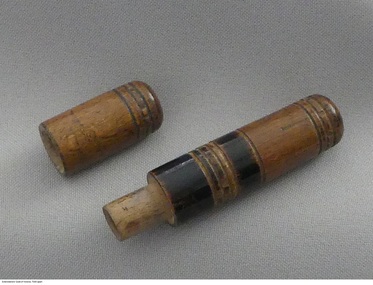
Tool - Needle case, Wooden needle case, ?1920's
... ...Lathe made...Utilitarian needle case Utilitarian needle case needle case Lathe made Cylindrical polished wood needle case which separates near the middle. ...Utilitarian needle case Utilitarian needle caseCylindrical polished wood needle case which separates near the middle. Circular grooves at top and bottom. Lower section has a black band with four circular grooves cut in.needle case, lathe made -
 Puffing Billy Railway
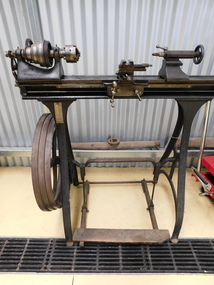
Treadle Lathe
... Treadle Lathe made of Steel and wrought iron...Industrial Treadle Lathe Possibly a Star Treadle Lathe Historical - Industrial Treadle Lathe treadle lathe puffing billy Treadle Lathe made of Steel and wrought iron Treadle Lathe ...Industrial Treadle Lathe Possibly a Star Treadle LatheHistorical - Industrial Treadle Lathe Treadle Lathe made of Steel and wrought irontreadle lathe, puffing billy -
 Tatura Irrigation & Wartime Camps Museum
Lathe (Model)
... Wooden model of a lathe made and used at Camp 3. Triangular upright frame with a hollow drive wheel, driven by a piece of wire with a handle on one end. ...I used screws in the model, but in reality bolts were used, which were bought as well as the framing timber" lathe model beilharz k camp 3 tatura ww2 camp 3 handcrafts models Wooden model of a lathe made and used at Camp 3. Triangular upright frame with a hollow drive wheel, driven by a piece of wire with a handle on one end. ..."This is a rough model of the woodturning lathe Kurt Beilharz built from scrap as a 17 year old in Camp 3, Tatura. The drive wheel was a hollow redgum block from the firewood supply. The shaft was a 1/2" water pipe, the bearings of the spindle were 3/4" water pipe with tooth paste tubes melted into and honed out for the spindle. They had holes for oiling. The drive belt came from my Mother's sewing machine. I used screws in the model, but in reality bolts were used, which were bought as well as the framing timber"Wooden model of a lathe made and used at Camp 3. Triangular upright frame with a hollow drive wheel, driven by a piece of wire with a handle on one end. Drive belt is a piece of fine cord.lathe, model, beilharz, k, camp 3, tatura, ww2 camp 3, handcrafts, models -
Tatura Irrigation & Wartime Camps Museum
Plan - Diagram/Plan, Lathe
... Plan of a wood turning lathe made by internee at camp 3. ...Plan of a wood turning lathe made by internee at camp 3. lathe plans lathe diagram rudy hoefer woodworking equipment diagram and description of each piece in the plan to make a wood turning lathe. ...Plan of a wood turning lathe made by internee at camp 3. diagram and description of each piece in the plan to make a wood turning lathe. Has been laminated.lathe plans, lathe diagram, rudy hoefer, woodworking equipment -
Tatura Irrigation & Wartime Camps Museum
Wood Plane, 140's
... The handle turned on a pedal lathe, also made in Camp. All from materials found in camp surrounds...The handle turned on a pedal lathe, also made in Camp. All from materials found in camp surrounds Wood Plane ...Handmade by internee at Camp 3Wood plane, camp coins used as washers. One imprinted "Internment Camp". The handle turned on a pedal lathe, also made in Camp. All from materials found in camp surroundsOn coins - "One penny Internment Camp"plane, wood, hoffmann k, hoffmann e, camp 3, tatura, ww2 camp 3, handcrafts, woodwork, trades, tools -
 Tatura Irrigation & Wartime Camps Museum
Tools, 1940's
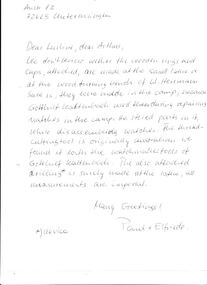
... Drilling device, made of metal and possibly made on lathe (no. 7955).|3. Metal thread cutting tool (originally Australian)....Drilling device, made of metal and possibly made on lathe (no. 7955).|3. Metal thread cutting tool (originally Australian). ...Sent from Germany by Elfriede & Paul Faig.Tools belonging to W. Hermann / G. Kaltenbach - 1. Small metal handle|2. Drilling device, made of metal and possibly made on lathe (no. 7955).|3. Metal thread cutting tool (originally Australian).tatura, camp 3, faig, p, kaltenbach, g, hermann, w, trades, metalworking, handcrafts, woodturning -
 Sunshine and District Historical Society Incorporated
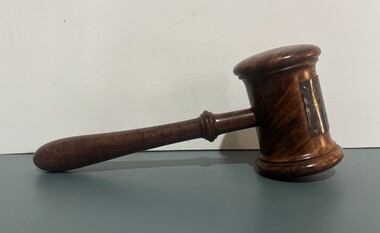
Ceremonial object - St. Albans Soldiers Memorial Hall Wooden Gavel
... T.K Merritt MLC & his wife made this Gavel Presentation at an official function - 15th June 1918 Materials: Timber (unknown) Production Method: Turned in wood lathe & assembled. ...T.K Merritt MLC & his wife made this Gavel Presentation at an official function - 15th June 1918 Materials: Timber (unknown) Production Method: Turned in wood lathe & assembled. ...Ater 1st World War many structures as Memorials were erected. A Hall in St Albans was one such building. The Hon. T.K Merritt MLC & his wife made this Gavel Presentation at an official function - 15th June 1918 Materials: Timber (unknown) Production Method: Turned in wood lathe & assembled. Date made: 1918 When used: 15th June, 1918 Made in Australia, Victoria Used in Australia, St Albans, VictoriaThis Gavel was made of Timber (unknown) for a presentation by Hon F.K. Merritt M.L.C. 15th June 1918Silver plate attached to head of Gavel: Inscriptions on plate attached "ST. ALBANS" "SOLDIERS MEMORIAL HALL" "Hon. T K MERRITT M.L.C." "AND" "MRS MERRITT" "15 JUNE 1918"gavel, merritt -
 Puffing Billy Railway
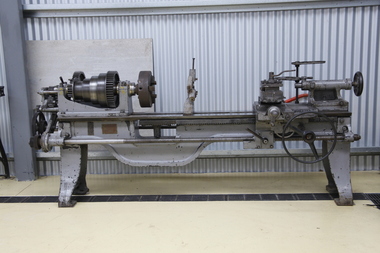
Lathe - Gap Bed, early 1900s
... Early Sebastian 13-inch lathe Typical of the Centre or "Engine" lathe made by many manufacturers from the late 1800s until the late 1930s, the basic flat-belt drive Sebastian, with separate countershaft, was eventually relegated to the economy end of the Company's range by the introduction of geared headstocks and self-contained motor-drive systems....Early Sebastian 13-inch lathe Typical of the Centre or "Engine" lathe made by many manufacturers from the late 1800s until the late 1930s, the basic flat-belt drive Sebastian, with separate countershaft, was eventually relegated to the economy end of the Company's range by the introduction of geared headstocks and self-contained motor-drive systems. ...Possibly ex Victorian Railways Newport workshops Supplied by Bevan & Edwards Machinery Merchants, Melbourne Sebastian Lathes Described by its makers as the Utility School, Garage and Repair-shop Lathe, the machine immediately below, a Sebastian 15" (circa 1910 - 1926) was the Company's cheapest offering and, in its basic form, lacked a compound slide rest, the tailstock did not set over for taper turning and the bed lacked a gap. However, a friction-type countershaft unit was included in the price as well as a tool post, faceplate, drive plate, changewheels for screwcutting and a small tool kit. As with modern cars (especially BMW) everything worthwhile was on the options' list and by spending more it was possible to specify all those small but important extras. Although in its lowest-cost form this model was reduced to the fundamentals required for a useable, screwcutting centre (engine) lathe it was still reasonably specified and would certainly have fulfilled many requirements when installed in a school or training workshop. The true swing was 15.25", it was properly backgeared and screwcutting was through a conventional tumble-reverse mechanism that allowed both left and right-hand powered movement to the carriage by altering the position of just one lever. As standard it accepted 40" between centres, but any capacity could be ordered, in foot intervals, up to a maximum of 88" - when it is hoped that a central bed support might have been included …… The spindle, which ran in white-metal bearings, had a useful 15/8" hole and a No. 3 Morse taper centre. Some models appear to have had the leadscrew clasp-nut lever on the right-hand side of the apron, while on others it was positioned to the left.. Early Sebastian 13-inch lathe Typical of the Centre or "Engine" lathe made by many manufacturers from the late 1800s until the late 1930s, the basic flat-belt drive Sebastian, with separate countershaft, was eventually relegated to the economy end of the Company's range by the introduction of geared headstocks and self-contained motor-drive systems.Historic - Industrial Machinery - Gap Bed Lathe - Possibly ex Victorian Railways Newport workshops - Purchased and supplied from Bevan & Edwards Gap Bed Lathe - Grey with raw steel parts and a timber cupboard with gears and tools. Bevan & Edwards PTY,LTD Machinery Merchants Melbourne (possible government tag) 365bevan & edwards pty,ltd machinery merchants melbourne, puffing billy -
 Sunshine and District Historical Society Incorporated
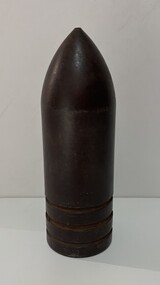
Weapon - Projectile (Reject) Armour Piercing
... Materials: Steel Production Method: Shell Lathe & Heat Treatment When made: 1943 When used: 1943 - 45 Where made: Australia, Victoria, Sunshine Where used: Australia, Victoria, War zones...Materials: Steel Production Method: Shell Lathe & Heat Treatment When made: 1943 When used: 1943 - 45 Where made: Australia, Victoria, Sunshine Where used: Australia, Victoria, War zones Projectile H.V. ...2nd World War - Various industries through Defense Department set up manufacturing facilities for Armaments - McKAY MASSEY HARRIS had one such facility. Corner Hertford & Hampshire Rds, for manufacture of Armour Piercing Shells. Materials: Steel Production Method: Shell Lathe & Heat Treatment When made: 1943 When used: 1943 - 45 Where made: Australia, Victoria, Sunshine Where used: Australia, Victoria, War zonesProjectile (Reject) Armour Piercingprojectile, h.v. mckays massey harris, sunshine harvester works, manufacturing -
 Flagstaff Hill Maritime Museum and Village
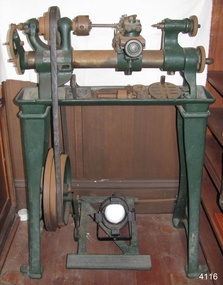
Machine - Treadle Lathe, 1920-1923
... During 1963 the two largest multi-tool lathes ever made in the UK were installed in Ambrose Shardlow’s works in Sheffield for handling cranks up to 14 foot long. ...Lathe, round bed, treadle powered lathe, Drummond Type A, Serial number and maker's inscription. 1920-1923, Made by Drummond Brothers in Guildford, Surrey, England. ...During 1963 the two largest multi-tool lathes ever made in the UK were installed in Ambrose Shardlow’s works in Sheffield for handling cranks up to 14 foot long. ...The lathe-making business incorporated in 1902 as Drummond Bros Ltd originated in the fertile mind of Mr Arthur Drummond, said to have been living at that time at Pinks Hill, on the southern edge of Broad Street Common, west of Guildford. Mr Drummond, whose accomplishments included several pictures hung in the Royal Academy, was unable to find a lathe suitable for use in model engineering. In 1896 he designed for himself a ‘small centre lathe … which had a compound slide rest with feed-screws and adjustable slides’. He also designed and built ‘lathes of 4.5 inch and 5 inch centre height, which had beds of a special form whereby the use of a gap piece was eliminated but the advantages of a gap-bed lathe were retained’. Assisted by his brother, Mr Frank Drummond, who had served an apprenticeship to an engineering firm at Tunbridge Wells, the first lathes were made in a workshop adjoining Arthur Drummond’s house. The demand that speedily built up led to the decision to form a company and manufacture the lathes for sale commercially. Land was acquired nearby, at Rydes Hill, and the first factory built. The enterprise was a success, and the company quickly established ‘a high reputation in this country and abroad for multi-tool and copying lathes, and gear-cutting machines’. Other lathes were added to the range, including the first of the ’round bed’ machines for which the firm became widely known. A Drummond 3.5 inch lathe was among the equipment of Captain Scott’s 1912 expedition to the South Pole, and large numbers of 3.5 inch and 4 inch designs were exported to Australia, Canada and India. By the outbreak of war in 1914, 5 inch, 6 inch and 7 inch screw cutting lathes, arranged for power drive, were on sale. Large orders were received from the government for 3.5 inch lathes, for use in destroyers and submarines, and 5 inch lathes for the mechanised section of the Army Service Corps. The latter were used in mobile workshops. The factory worked night and day to supply the forces’ needs, until production was disrupted by a fire which destroyed a large part of the works in May 1915. As soon as rebuilding was complete work restarted. At the end of the war the entire production was being taken by the Government departments, a special feature being a precision screw lathe, bought by the Ministry of Munitions in 1918. Between the wars Drummond Bros Ltd introduced new machines for the motor vehicle, and later the aircraft industry, and the works were extended on many occasions to fulfill the increasing orders. The Maxicut multi-tool lathe (1925), designed for high-production turning operations, was one of the first machines of this type to be built in England. It was followed (1928) by an hydraulic version for turning gear blanks, and similar work. Further developments provided machines which, during the Second World War, turned all the crankshafts and propeller shafts for Bristol engines. Others, ordered by the Ministry of Supply were employed in turning shells, and many other specific needs of vehicle and aircraft manufacture were catered for by new types of Drummond lathes. Production of the small centre lathes ceased during the war when the company needed to concentrate on building multi-tool lathes and gear shapers. After the war a completely new Maxicut range was introduced, replacing the older versions, and fully automatic. The types were continually developed, and new versions manufactured until the end of the company’s life in 1980. The disappearance from the scene of Mr Arthur Drummond in 1946, and the end of the company’s autonomous existence in 1953 when the company was acquired by William Asquith Ltd, which was in turn bought by Staveley in 1966, meant that the factory at Rydes Hill became one – albeit very effective – part of a large national engineering company. Achievements at the Guildford works during its last years included the development of automated Maxicut gear-shapers in what was ‘probably the most fully automated gear shop in the country’, while a machine from Guildford was sent to the Osaka Fair in 1962. In 1963 an agreement was signed with Hindustan Machine Tools for the manufacture of Maxicut gear-shapers in state owned factories in Bangalore and Chandigarh. During 1963 the two largest multi-tool lathes ever made in the UK were installed in Ambrose Shardlow’s works in Sheffield for handling cranks up to 14 foot long. In 1976 Drummond lathes were included in Staveley’s £14,000,000 installation in Moscow of an automated production line for Zil motor cars. Up to the end invention continued at Guildford: a new Drummond Multi-turn memory-controlled machine was shown at the International Machine Tool Exhibition in 1977. This could not save the works from the pressures of the late 1970s, and Staveley Industries closed its Guildford site in 1980.An early example of a lathe that was designed primarily for the hobbyist model maker. It is in good condition and sought today by collectors as many of it's attributes were innovative at the time and lead to further development and incorporation of some of its features into more industrial models of production machinery. Lathe, round bed, treadle powered lathe, Drummond Type A, Serial number and maker's inscription. 1920-1923, Made by Drummond Brothers in Guildford, Surrey, England. Lathe is complete with Chuck, Tool post and Tail Stock in situ (30 extra parts)"MADE BY DRUMMOND BROTHERS LIMITED - PATENT TEES - RYDE'S HILL n GUILDFORD SURREY", "Serial Number 01470," "L44" or "L45 " flagstaff hill, warrnambool, shipwrecked coast, flagstaff hill maritime museum, maritime museum, shipwreck coast, flagstaff hill maritime village, great ocean road, lathe 1920-1923, round bed lathe, treadle lathe, drummond type a, guildford surrey, drummond brothers guildford surrey england, tread'e -
 Flagstaff Hill Maritime Museum and Village
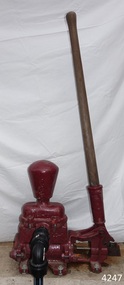
Equipment - Pump, circa 1930's - 1940's
... McPherson’s went on to establish branches in Sydney (1911), Adelaide (1921) and Perth (1930) 1917 - McPherson’s supplied ‘dog spikes’ for the transcontinental railway, running from Eastern to Western Australia. 1918 – A tool works set up in Kensington, Melbourne, manufacturing Macson lathes and made machine tools that previously had to be imported. 1924 – The Bolt Works was transferred to a new building in Melbourne. ...McPherson’s went on to establish branches in Sydney (1911), Adelaide (1921) and Perth (1930) 1917 - McPherson’s supplied ‘dog spikes’ for the transcontinental railway, running from Eastern to Western Australia. 1918 – A tool works set up in Kensington, Melbourne, manufacturing Macson lathes and made machine tools that previously had to be imported. 1924 – The Bolt Works was transferred to a new building in Melbourne. ...This pump is an Ajax Type L2 Series A model, made and sold by McPherson’s Pty Ltd of Melbourne circa 1930’s to 1940’s, is a mechanical, hand operated, constant flow pressure pump. It would have been used to pump fluids from one area to another, for example from a dam to a tank or used as a bilge pump on a small vessel, mounted on the vessel’s bulkhead, floor or deck. This type of hand pump is sometimes called a ‘Reciprocating Suction Pump’. It has a mechanical pumping action of the lever moves the piston inside the pump up and down. The water is lifted from below the pump through the inlet pipe and into the pump’s cylinder. This action causes the lower valve to close and the piston’s valve opens and the pressure within the pump forces the water out of the pump through the exit pipe. The limitation of this type of pump is that it can only raise the water a maximum of about 7 metres from beneath the ground and yields 24-26 Litres per minute. This type of pump could be used for many purposes such as pumping water or fuel. McPherson’s 1940’s advertisement proclaims “For all jobs on the land – irrigation, spraying, tank, plumbing, fire-fighting – there’s a suitable “Ajax” pump. Send us the details of you pumping problem. Our Expert’s advice will help you choose the right pump – the one that will give you most years of PROFITABLE PUMPING.” (The Australasian (Melbourne) Sat. 26th October 1940.) McPherson’s Pty Ltd, the manufacturer, advertised a similar pump to this one in The Australasian (Melbourne) in 1936, calling it the Ajax Double Acting Hand Pump. In 1942 another advertisement advised that a representative for a fire-fighting equipment supplier was visiting the western district of Victoria. The company could now supply double-action two-spray Ajax pumps at lower prices than similar pumps the district had recently purchased from Adelaide. McPHERSON’S FOUNDER and COMPANY TIMELINE 1860 – Thomas McPherson, a Scottish immigrant (c. 1853 ), founded McPherson’s in Melbourne, supplying pig iron (lead ingots imported as ballast in ships) to local manufacturers. 1882 – Thomas McPherson established a warehouse in Collins St Melbourne and included tools, steam fittings and machinery in his wares. The business expanded to include steam saw mills and became known as Thomas McPherson and Sons (William Murray and Edward). 1888 – Thomas passed away and his sons inherited the business. In 1896 William Murray became the sole proprietor after his brother Edward’s death. 1900 – The firm expanded, establishing Acme Bolt Company to manufacture nuts and bolts. 1912 – McPhersons Pty Ltd established a machinery warehouse and showroom in 554-556 Collins St Melbourne. McPherson’s went on to establish branches in Sydney (1911), Adelaide (1921) and Perth (1930) 1917 - McPherson’s supplied ‘dog spikes’ for the transcontinental railway, running from Eastern to Western Australia. 1918 – A tool works set up in Kensington, Melbourne, manufacturing Macson lathes and made machine tools that previously had to be imported. 1924 – The Bolt Works was transferred to a new building in Melbourne. McPhersons began making pumps. 1929 – McPherson retired. His son (Sir) William Edward McPherson (known as ‘WE’), was born in Hawthorne, Melbourne, in 1898. After his education he began work in his father’s Melbourne hardware and machinery business He took over as governing director when his father retired. 1929-1932 – McPherson’s supplied thousands of tons of rivets from its Richmond (Melbourne) Bolt Works for the construction of the Sydney Harbour Bridge. 1936 – McPherson’s Pty Ltd is advertising Ajax Pumps in newspapers 1934 – McPhersons purchased the property adjoining the warehouse in Collins Street, and during 1935-1936 built a new office and showrooms on the site of 546-445 Collins St. 1939 - McPherson’s acquired the Tool Equipment Co. Pty. Ltd and Associated Machine Tools Australia Pty Ltd was formed to separate McPherson’s machine-tool manufacturing and merchandising interests. 1939 – Ajax Pump Works, a foundry and pump manufacturing plant, was established in Tottenham, Melbourne, and the Ajax Bolt and Rivet Co Pty Ltd began manufacturing in New Zealand. 1944 - McPherson’s became a public company, McPherson’s Ltd. 1948 - The Ajax Pump Foundry opened at Kyneton, Victoria and in the post war years it grew to became a large manufacturer. 1980’s – Ajax Pumps brochure lists the address as 6 Buckhurst St, South Melbourne, Vic 3205 with the Telephone number 03 669 3588 1988 - Ajax Pumps acquired the Forrers Company, which was established in 1921. Manufacturing in Ipswich, Queensland, specialising in submersible sewage pumps. 1991 – KSB Ajax was formed, bringing together the companies KSB and Ajax Pumps 1993 – Manufacturing was moved to state-of-the-art premises in Tottenham, Victoria 2001 - The Forrers facility was moved to Tottenham. 2007 - Company name KSB Ajax Pumps was changed to KSB Australia Pty Ltd. 2009 - KSB Australia opened a branch in Townsville, Queensland. 2011 - KSB Australia moved to its dedicated Water and Waste Water Competence Centre in Bundamba, Queensland. DISPLAY OF THIS AJAX PUMP This pump was installed at Flagstaff Hill Maritime Village as part of a working display in the village by the Friends of Flagstaff Hill, in acknowledgement of the dedicated involvement of one of its long serving members, Bob Crossman. The display was officially opened 31st March 2018 and incorporates a restored Furphy Tank and Water Pipe Stand. The pump is used to draw water from the lake, through the water stand pipe and into the reconditioned Furphy Tank. This Ajax pump made by McPherson’s Pty Ltd is significant for its association with McPherson’s, a prominent manufacturer of hardware in Victoria. McPherson’s is famous for supplying ‘dog-spikes’ for the transcontinental railway (eastern to western Australia, 1917) and rivets for the Sydney Harbour Bridge (1929-1932). The Ajax pump is also of significance because of its association with McPherson’s Governing Director (Sir) William McPherson, former premier and treasurer in Victoria 1928-1929. The former McPherson’s Pty Ltd building in Collins Street Melbourne is now on the Victorian Heritage Register VHR H0942 This pump is representative of mechanical pumps popular in the early to mid-1900’s and still used today. Hand operated pressure pump, double acting. Cast metal case, painted red, with steel hose attachments and long metal lever. Pump is bolted to wooden plank. Model of pump is AJAX, Type L2, Series A pump. Embossed on lower section of pump "L2 - 10", "L2 - -1", "AJAX" “(?) –2-1” Embossed on lower handle “3-7” “L – 4” Embossed on attached plate “FOR SPARE PARTS / TYPE L2 / SERIES A / PUMP ASSEMBLED BY T R” Manufactured by McPherson’s Pty Ltd of Melbourne circa 1930’s - 1940’s.flagstaff hill, warrnambool, flagstaff hill maritime museum, shipwreck coast, flagstaff hill maritime village, great ocean road, ajax pump works tottenham melbourne, ajax pump factory kyneton, william edward mcpherson, thomas mcpherson of melbourne, mcpherson’s pty ltd melbourne, acme bolt company, tool equipment co. pty. ltd, associated machine tools australia pty ltd, ajax bolt and rivet co. pty ltd new zealand, forrers company ipswich queensland, ksb ajax pumps, ksb australia pty ltd, macson lathes, tool manufacturer early to mid- 20th century, ajax double acting hand pump, ajax type l2 series a pump, qisjax pumps, water pump 1940’s, fuel pump 1940’s, hand operated constant flow pressure pump, reciprocating suction pump, agricultural hand pump, plumber’s hand pump, portable hand pump -
 Flagstaff Hill Maritime Museum and Village
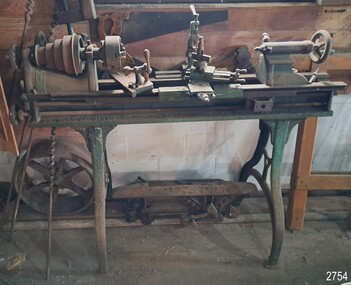
Machine - Lathe, W F & John Barnes, early 1900s
... The lathe was donated by Briggs Marine, Melbourne: In Flagstaff Hill’s formative years, 1972-1975, Briggs Marine, Melbourne (Briggs Brass Foundry), donated equipment and objects used or made at their premises. ...The lathe was donated by Briggs Marine, Melbourne: In Flagstaff Hill’s formative years, 1972-1975, Briggs Marine, Melbourne (Briggs Brass Foundry), donated equipment and objects used or made at their premises. ...This woodworking lathe, connected to both a pulley and a flywheel, demonstrates its historical operation with a steam engine. Such a configuration reflects manufacturing practices from the late 1800s and early 1900s, when steam power was the predominant source for driving workshop and factory machinery. Large machine shops often utilised a single power source, distributing power via roof-mounted belts and pulleys to operate several machines simultaneously. Over time, petrol-driven motors were introduced, and eventually, electricity became the standard power source. Conversion kits were made available in the late 19th and early 20th centuries to adapt older lathes to these newer, cleaner fuels. Manufacturer's History: W.F. & J. Barnes was a renowned maker of hand- and foot-powered treadle woodworking and metalworking machinery, established in 1869. The partnership between William F. Barnes and John Barnes was formalised in 1872, and the firm was incorporated in 1884. Their machines were used for both ‘farm’ applications and professional engineering. By 1881, the company began producing electrically powered machinery. By 1937, W.F. & J. Barnes expanded into manufacturing machinery for automotive assembly. The business closed in 1983, and in 1998, LeBlond Ltd. of Ohio acquired the firm. The lathe was donated by Briggs Marine, Melbourne: In Flagstaff Hill’s formative years, 1972-1975, Briggs Marine, Melbourne (Briggs Brass Foundry), donated equipment and objects used or made at their premises. The foundry was established in 1912 by Herbert Harrison Briggs. In 1965, the firm was owned by partners Cyril Briggs and Frank Lee: Cyril died in 1967, and Frank died in 1971, so the foundry was then run by his son and daughter-in-law, Les and Eva Lee. Briggs Marine’s Warrnambool Branch closed in 1972 after the death of Frank Lee in 1971. Flagstaff Hill’s founding director, John Lindsay, recalled that Briggs Marine’s family members gave personal assistance in setting up the displays in the original village shops, particularly the ‘Brass Foundry’ building, around the time the Maritime Museum opened in 1975. Briggs Marine still exists today, but the Briggs family is no longer involved. This early 1900s lathe marks a significant stage in the evolution of machinery, positioned between the era of hand-operated machines and the advent of electrically powered equipment. Its presence exemplifies the progression of industrial technology and craftsmanship during this period. The lathe is particularly notable for its association with the Briggs Brass Foundry. The foundry was known for developing a specialised brass alloy composed of non-ferrous metals, a formulation that resulted in durable products built to withstand the demanding conditions of marine environments. This focus on resilience and longevity made Briggs Brass Foundry’s goods highly sought after within the maritime sector. Briggs Maine, a long-established business, utilised the foundry’s capabilities to create cast goods tailored to the needs of the marine industry. The facility was equipped to deliver both custom-designed and mass-produced items, ensuring versatility in meeting various requirements. Many of Briggs Foundry’s products found their place on sailing and steam vessels throughout Victoria’s coastline, including in the port town of Warrnambool, where there was once a brancy of Briggs Marine. In addition to general marine fittings, Briggs Marine earned recognition for its expertise in bell-founding. The foundry’s reputation is closely linked to the restoration of the Schomberg Bell at Flagstaff Hill, a small but historically significant bell from a luxury migrant vessel dating back to the mid-19th century. The successful restoration of the Schomberg Bell demonstrates Briggs Brass Foundry’s commitment to preserving craftsmanship and maritime heritage.The lathe is a green, bench-type, steam-powered woodworking machine. Its bench is supported by decorative posts at each end, with each post dividing into arched legs. The lathe is mechanically connected to both a pulley and a flywheel, designed to be operated in conjunction with a steam engine. Included with the lathe is a range of accessories. Across the front of the machine, an inscription is cast, and a stamped, metal lathe pulley guide is attached to the drive mechanism. The lathe was manufactured by W. F. and J. Barnes, Rockford, Illinois, USA, during the 1900s.“W F and J Barnes, Rockford, USA” "1820" "1887"flagstaff hill, flagstaff hill maritime museum and village, warrnambool, maritime museum, maritime village, great ocean road, shipwreck coast, lathe, steam-operated lathe, steam-operated pulley, steam power, steam engine, machine, steam operated machine, metal work, foundry work, metal working trade, tool, pulley driven, metalworking, woodworking, barnes lathe, briggs marine, belt driven, wordworking lathe, free standing lathe, bench lathe, steam powered, vintage lathe, woodturning lathe, w. f. and j. barnes, illanois, early 20th century, briggs, briggs brass foundry, briggs marine foundry, briggs marine products, herbert harrison briggs, george edward briggs, cyril falkiner mckinnon briggs, collingwood, moorabbin, frank lee, les lee, eva lee, briggs marine warrnambool, non-ferrous founders, bell specialists, ship bell specialists, sand cast, marine equipment, marine fittings, foundry, brass foundry, founders -
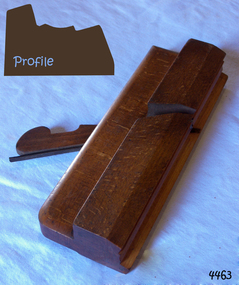 Flagstaff Hill Maritime Museum and Village
Tool - Plane, 1819-1901
... The firm specialized in lathes for ornamental turning but also made a name for its high-quality edge and boring tools. ...The firm specialized in lathes for ornamental turning but also made a name for its high-quality edge and boring tools. ...A moulding plane is a specialised plane used for making the complex shapes found in wooden mouldings that are used to decorate furniture or other wooden objects. Traditionally, moulding planes were blocks of wear-resistant hardwood, often beech or maple, which were worked to the shape of the intended moulding. The blade or iron was likewise formed to the intended moulding profile and secured in the body of the plane with a wooden wedge. A traditional cabinetmakers shop might have many, perhaps hundreds, of moulding planes for the full range of work to be performed. Large crown mouldings required planes of six or more inches in width, which demanded great strength to push and often had additional peg handles on the sides, allowing the craftsman's apprentice or other workers to pull the plane ahead of the master who guided it. Company History: The Holtzapffel dynasty of tool and lathe makers was founded in Long Acre, London by a Strasbourg-born turner, Jean-Jacques Holtzapffel, in 1794. The firm specialized in lathes for ornamental turning but also made a name for its high-quality edge and boring tools. Moving to London from Alsace in 1792, Jean-Jacques worked initially in the workshop of the scientific-instrument maker Jesse Ramsden, Anglicizing his name to John Jacob Holtzapffel. In 1794 he set up a tool-making partnership in Long Acre with Francis Rousset and they began trading under the name of John Holtzapffel. From 1804 he was in partnership with the Mannheim-born Johann Georg Deyerlein until the latter died in 1826, trading under the name Holtzapffel & Deyerlein. Holtzapffel sold his first lathe in June 1795, for £25-4s-10d, an enormous price at the time. All of Holtzapffel's lathes were numbered and by the time he died in 1835, about 1,600 had been sold. The business was located at 64 Charing Cross, London from 1819 until 1901 when the site was required "for building purposes". The firm then moved to 13 and 14 New Bond Street and was in premises in the Haymarket from 1907 to 1930. John's son, Charles Holtzapffel (1806–1847) joined the firm in 1827, at around which time the firm became known as Holtzapffel & Co. Charles continued to run the business after his father's death. He wrote a 2,750-page treatise entitled Turning and Mechanical Manipulation, published in 1843 which came to be regarded as the bible of ornamental turning. The final two volumes were completed and published after his death by his son, John Jacob Holtzapffel (1836–1897). When Charles Holtzapffel died in 1847 his wife Amelia ran the business until 1853. John Jacob II, the son of Charles and Amelia, was head of the firm from 1867 until 1896. A nephew of John Jacob II, George William Budd (1857–1924) became head of the firm in 1896. His son John George Holtzapffel Budd (1888–1968) later ran the business. By the early twentieth century, ornamental turning was going out of fashion, and the firm sold its last lathe in 1928. A vintage tool made by a well-known firm made for firms and individuals that worked in wood. The tool was used before routers and spindle moulders came into use after World War ll, a time when to produce a decorative moulding for a piece of furniture or other items this had to be accomplished by hand using one of these types of planes. A significant item from the mid to late 19th century that today is quite rare and sought after by collectors. It gives us a snapshot of how furniture was made predominately by hand and with tools that were themselves hand made shows the craftsmanship used to make such a unique item. Moulding Plane Holtzaffel 64 Charing & Owner J Heath 9/16" marked opposite endflagstaff hill, warrnambool, shipwrecked-coast, flagstaff-hill, flagstaff-hill-maritime-museum, maritime-museum, shipwreck-coast, flagstaff-hill-maritime-village, plane moulding, plane, j heath -
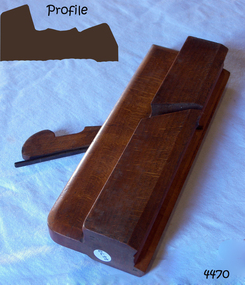 Flagstaff Hill Maritime Museum and Village
Tool - Plane, 1819-1901
... The firm specialized in lathes for ornamental turning but also made a name for its high-quality edge and boring tools. ...The firm specialized in lathes for ornamental turning but also made a name for its high-quality edge and boring tools. ...A moulding plane is a specialised plane used for making the complex shapes found in wooden mouldings that are used to decorate furniture or other wooden objects. Traditionally, moulding planes were blocks of wear-resistant hardwood, often beech or maple, which were worked to the shape of the intended moulding. The blade or iron was likewise formed to the intended moulding profile and secured in the body of the plane with a wooden wedge. A traditional cabinetmakers shop might have many, perhaps hundreds, of moulding planes for the full range of work to be performed. Large crown mouldings required planes of six or more inches in width, which demanded great strength to push and often had additional peg handles on the sides, allowing the craftsman's apprentice or other workers to pull the plane ahead of the master who guided it. Company History: The Holtzapffel dynasty of tool and lathe makers was founded in Long Acre, London by a Strasbourg-born turner, Jean-Jacques Holtzapffel, in 1794. The firm specialized in lathes for ornamental turning but also made a name for its high-quality edge and boring tools. Moving to London from Alsace in 1792, Jean-Jacques worked initially in the workshop of the scientific-instrument maker Jesse Ramsden, Anglicizing his name to John Jacob Holtzapffel. In 1794 he set up a tool-making partnership in Long Acre with Francis Rousset and they began trading under the name of John Holtzapffel. From 1804 he was in partnership with the Mannheim-born Johann Georg Deyerlein until the latter died in 1826, trading under the name Holtzapffel & Deyerlein. Holtzapffel sold his first lathe in June 1795, for £25-4s-10d, an enormous price at the time. All of Holtzapffel's lathes were numbered and by the time he died in 1835, about 1,600 had been sold. The business was located at 64 Charing Cross, London from 1819 until 1901 when the site was required "for building purposes". The firm then moved to 13 and 14 New Bond Street and was in premises in the Haymarket from 1907 to 1930. John's son, Charles Holtzapffel (1806–1847) joined the firm in 1827, at around which time the firm became known as Holtzapffel & Co. Charles continued to run the business after his father's death. He wrote a 2,750-page treatise entitled Turning and Mechanical Manipulation, published in 1843 which came to be regarded as the bible of ornamental turning. The final two volumes were completed and published after his death by his son, John Jacob Holtzapffel (1836–1897). When Charles Holtzapffel died in 1847 his wife Amelia ran the business until 1853. John Jacob II, the son of Charles and Amelia, was head of the firm from 1867 until 1896. A nephew of John Jacob II, George William Budd (1857–1924) became head of the firm in 1896. His son John George Holtzapffel Budd (1888–1968) later ran the business. By the early twentieth century, ornamental turning was going out of fashion, and the firm sold its last lathe in 1928. A vintage tool made by a well-known firm made for firms and individuals that worked in wood. The tool was used before routers and spindle moulders came into use after World War ll, a time when to produce a decorative moulding for a piece of furniture or other items this had to be accomplished by hand using one of these types of planes. A significant item from the mid to late 19th century that today is quite rare and sought after by collectors. It gives us a snapshot of how furniture was made predominately by hand and with tools that were themselves hand made shows the craftsmanship used to make such a unique item. Moulding Plane Holtzaffel 64 Charing & Owner J Heath 9/16" marked opposite endflagstaff hill, warrnambool, shipwrecked-coast, flagstaff-hill, flagstaff-hill-maritime-museum, maritime-museum, shipwreck-coast, flagstaff-hill-maritime-village, plane moulding, plane, j heath -
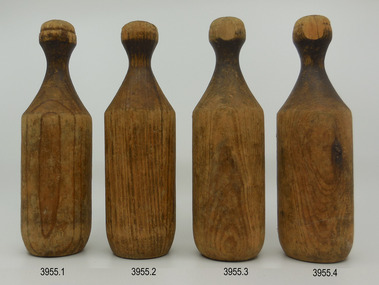 Flagstaff Hill Maritime Museum and Village
Leisure object - Set of skittles, 20th century
... The skittles have a hole in the top, indicating that they were made on a wood lathe. The game of skittles is played indoors and outdoors. ...The skittles have a hole in the top, indicating that they were made on a wood lathe. The game of skittles is played indoors and outdoors. ...These handmade skittles in this set appear to have had a lot of use as the surfaces of the skittles are well worn. The skittles have a hole in the top, indicating that they were made on a wood lathe. The game of skittles is played indoors and outdoors. It is a traditional target game or sport and the forerunner of the sport of bowling. A standard skittle set has nine skittles and one or two balls. The skittles would be arranged in a diagonal square pattern and a ball would be bowled towards them, for a given distance away. The object is to knock down as many skittles as possible. These skittles are representative of the traditional games played by children and adults over the centuries.Set of four wooden skittles, cylindrical body tapering inwards to form a narrow keck with a knob on top. Knob has two flat surfaces. The bodies and knob tops of the skittles sow remnants of wood stain but the bodies' surfaces are worn. The tops have a scored line around their circumference. The bases are rounded, with the edges off the floor. The top and base of the skittles have a hole in the centre. flagstaff hill, warrnambool, maritime village, maritime museum, shipwreck coast, great ocean road, skittles, pins, game, children's game, traditional game, bowling, toy -
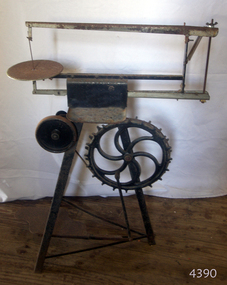 Flagstaff Hill Maritime Museum and Village
Tool - Treadle Scroll Saw, Hobbies Ltd, Manufactured by Hobbies in England from 1928- 1965
... Lathes, Picture Framing Outfits, Tools, etc. In 1947 the company had expanded and was still making tools and materials for the amateur craftsman in wood. They had acquired a reputation as manufacturers of quality Fretwork Outfits, Tools, Treadle Machines, Model Maker's Tool Kits. The company also publishers of ‘Hobbies Weekly magazine’ and also sold plans for fretwork, model making and wooden toys. In 1961 they were still manufacturers and retailers of craft tools and materials, timber merchants, light engineers and Government contractors with around 500 employees. A vintage tool made ...Since 1895, Hobbies Ltd have been supplying model makers and enthusiasts throughout the world with a wide range of quality model kits, accessories, tools, components and handbooks. The Hobbies Company began life in Dereham, Norfolk in 1881 with a London Office opened later (1922) at 65 New Oxford Street, WC1. In 1895 Hobbies began supplying model makers with their products and in 1897 were incorporated into a Public company. In 1922 at a British Industries Fair the company had a stand advertising their products as "The All-British Firm with a World reputation". Fretwork Outfits. Fretwork Machines. Carpentry Outfits. Strip work Outfits. Also manufactures of Fretwork Tools and Benches, Wood, Circular Saws, Lathes, Picture Framing Outfits, Tools, etc. In 1947 the company had expanded and was still making tools and materials for the amateur craftsman in wood. They had acquired a reputation as manufacturers of quality Fretwork Outfits, Tools, Treadle Machines, Model Maker's Tool Kits. The company also publishers of ‘Hobbies Weekly magazine’ and also sold plans for fretwork, model making and wooden toys. In 1961 they were still manufacturers and retailers of craft tools and materials, timber merchants, light engineers and Government contractors with around 500 employees. A vintage tool made for hobbyists and distributed throughout the world by a British company that is still in existence today. The item is significant as it catalogues the manufactures history at a specific time in the company's development.Foot operated treadle Fret saw called "GEM" subject item is a short saw , the stand in the background is the base for a Delta Q3 model scroll saw. Gem inscription cast into the cast iron frameworkflagstaff hill, warrnambool, flagstaff hill maritime museum, maritime museum, shipwreck coast, flagstaff hill maritime village, great ocean road, saw, treadle saw, fret saw, pedal saw, the gem, tool, hobbies ltd, treadle, foot operated -
 NMIT (Northern Melbourne Institute of TAFE)
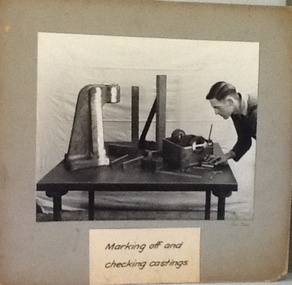
Photographs - Collingwood Technical School, Allan Studios, Mounted photographs of Trade School CTS, circa 1940, Early 1940s
... Examples of other machine parts, etc., being made in Youth Employment classes in engineering machine shop. 3. Cutting the traversing screw for a 5 ¼ inch lathe. 4. ...Examples of other machine parts, etc., being made in Youth Employment classes in engineering machine shop. 3. Cutting the traversing screw for a 5 ¼ inch lathe. 4. ...Collingwood Technical School trained apprentices in many trades. These photographs depict some of the machines and machine parts built in class. Captions : 1. Marking off and checking castings 2. Examples of other machine parts, etc., being made in Youth Employment classes in engineering machine shop. 3. Cutting the traversing screw for a 5 ¼ inch lathe. 4. Grinding lathe spindle. 5. Cutting helical flutes in a shell end mill. 6. Arbor Press. Another valuable machine produced by Youth Employment and senior technical evening students. 7. Milling angular slides of lathe saddle. 8. 5 ¼ inch lathe product of Collingwood Technical School. These are high quality professional photographs taken circa 1940. 8 black and white photographs mounted on brown card. Photographs depict various aspects of lathe work.Each photograph has a hand written caption on the front. Also handwritten in black pen "Allan Studios".collingwood technical school, cts, apprentices, students, lathes, machinery, machine parts, nmit, -
 NMIT (Northern Melbourne Institute of TAFE)
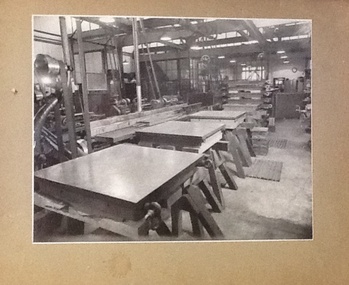
Photographs - CTS 1940-1943, Collingwood Technical School. Defence Training Scheme, 1940-1943
... Lathe bodies in foreground, with machined / parts of lathes in middle distance, and milling / cutters, gauges and bearings in background. 3. Frames of glass splitting machines, thread / rectifying machines, and two types of milling / machine vises made in technical schools. 4.View of engineering machine shop. ...Carbon dioxide / freezing box in foreground, and stack of / surface plates for RAAF in middle / distance. 5.Fan geared lathes, 6 inch centres, with / self-contained motor drives, made for / cartridge factory. ...Collingwood Technical School trained apprentices in many trades. CTS was also invlved in Training Schemes during the late 1930s and during World War II. These photographs depict some of the machines and machine parts built in class. These are high quality professional photographs taken circa 1940-1943. At this time , CTS was part of the Defence Training scheme. These photographs are a visual record of this scheme.6 black and white photographs mounted on brown card. Photographs depict various aspects of lathe work undertaken during the Defence Training Scheme, 1940-43. Also a smaller photograph of a Moultar Thread Milling Machine 1941.Each photograph has a hand written caption on the back. Captions: 1. Finished surface plates for R.A.A.F. / standing on trestle after scraping. Stack of / others in background waiting for scraping. 2. Lathe bodies in foreground, with machined / parts of lathes in middle distance, and milling / cutters, gauges and bearings in background. 3. Frames of glass splitting machines, thread / rectifying machines, and two types of milling / machine vises made in technical schools. 4.View of engineering machine shop. Carbon dioxide / freezing box in foreground, and stack of / surface plates for RAAF in middle / distance. 5.Fan geared lathes, 6 inch centres, with / self-contained motor drives, made for / cartridge factory. To be used for making / this 6.Freezing of cast iron surface plates / in layers of solid carbon dioxide / blocks. Smaller photograph has a handwritten note on the reverse: 'this photograph shows how, with the aid of a 3ft. extension mounted in front of the tool box, on which Mr. Grubb sen. is seated, these large milling machine bases ... machinists at Collingwood Technical School. A Strang, Principal 21.4.1941'. collingwood technical school, cts, apprentices, students, defence training scheme, lathes, machinery, machine parts, nmit, -
The Ed Muirhead Physics Museum
Resistance Ratio Bridge, J.L. William
... Machine-made/cut, appears to be lathe turned. Electroplated, no apparent decorative elements. 14 rotatable, removable nuts. ...Machine-made/cut, appears to be lathe turned. Electroplated, no apparent decorative elements. 14 rotatable, removable nuts. ...Machine-made/cut, appears to be lathe turned. Electroplated, no apparent decorative elements. 14 rotatable, removable nuts. Surface finish: Brushed metal. “Ratio Resistance’ Handwritten pen on paper adhered with sticky tape on top circular face. Medallion screwed to top circular face: “J.L. WILLIAM/SCIENTIFIC INSTRUMENTS/ SERIAL NO. TYPE/ MELBOURNE - AUSTRALIA.” Machine-made manufacturer’s label, enamel on brass plate (unconfirmed) screw fixed, “Resistance/between/the knobs/as shown/Resistances (+0.05 at most). Handwritten pen on aged paper label attached with coated twine. -
 Wangaratta Historical Society
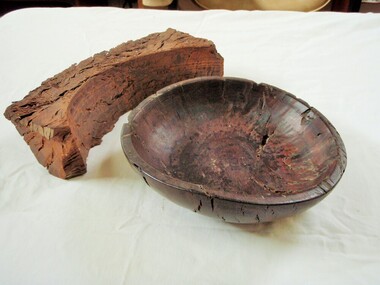
Wooden Fruit Bowl, Red Gum Bowl
... 000016 Wooden Fruit Bowl The timber this fruit bowl was made from was a red gum tree taken from the Ovens river at Tarrawingee (12 km from Wangaratta)where it had been submerged for years. It was made on a lathe by Ken Hill. The bowl warped and cracked shortly after being turned. ...Red River Gum wooden bowl Wangaratta Historical Society 000016 Wooden Fruit Bowl The timber this fruit bowl was made from was a red gum tree taken from the Ovens river at Tarrawingee (12 km from Wangaratta)where it had been submerged for years. It was made on a lathe by Ken Hill. The bowl warped and cracked shortly after being turned. ...This wood is made from Red River Gum tree wood, these trees live for between 500 to 1,000 years of age. The wood in this bowl has been carbon dated in the USA to be 4,500 years old.This bowl is significant because of the age of the wood it is made from. 000016 Wooden Fruit Bowl The timber this fruit bowl was made from was a red gum tree taken from the Ovens river at Tarrawingee (12 km from Wangaratta)where it had been submerged for years. It was made on a lathe by Ken Hill. The bowl warped and cracked shortly after being turned. A piece of the wood was taken to the USA by a visitor where it was carbon dated to be 4500 years old Measurements: Diameter: 22cm Height: 6cm Colour: Dark red brown Photographed beside a piece of natural red gum Tarrawingee is 12 Km North East of Wangaratta on the Great Alpine Road Significance: 4500 year old red gum wood is rare in this area. red river gum wooden bowl wangaratta historical society -
 Sunshine and District Historical Society Incorporated
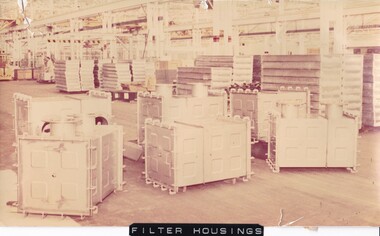
Photograph - John 'Jack' Horace Jackson Collection - Australia Defence Industries Photographs
... made today. The flow forming machine uses a former mounted in a lathe chuck then a sheet of metal [usually aluminium or copper] is placed against the former. ...made today. The flow forming machine uses a former mounted in a lathe chuck then a sheet of metal [usually aluminium or copper] is placed against the former. ...All these products were manufactured at the Ordnance Factory Wests Road Maribyrnong. The practice bombs were used instead of live bombs [explosives filled bombs]. They were cheaper and could be used closer to population centres thus saying in transit times and fuel. They are still made today. The flow forming machine uses a former mounted in a lathe chuck then a sheet of metal [usually aluminium or copper] is placed against the former. The forming tool is mover up and as the metal sheet turns the forming tool starts to form the sheet to the shape of the former. This process is quicker than pressing the shapes. Form shapes are usually round to allow rotation in the machine. The flow forming machine show in the picture was manually operated, this would be in the 1970’s and 1980’s when they were making rocket nose cones and similar objects.John 'Jack' Horace Jackson Collection - Australia Defence Industries Photographs - L.A.W. Warhead John 'Jack' Horace Jackson Collection - Australia Defence Industries Photographs - Filter Housing John 'Jack' Horace Jackson Collection - Australia Defence Industries Photographs - Flow forming Machine John 'Jack' Horace Jackson Collection - Australia Defence Industries Photographs - Flow forming Machine John 'Jack' Horace Jackson Collection - Australia Defence Industries Photographs - 5KG PRAC Bomb Fitted To Carrier John 'Jack' Horace Jackson Collection - Australia Defence Industries Photographs - 11.5LB PRAC Bomb Components Parts John 'Jack' Horace Jackson Collection - Australia Defence Industries Photographs - Comparison 11.5LB & 5KG PRAC Bombsjohn "jack" horace jackson -
 Tatura Irrigation & Wartime Camps Museum
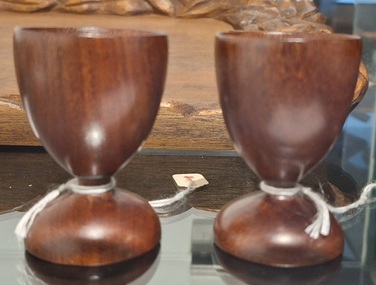
Egg Cups, c1940
... Two wooden egg cups made of redgum turned on lathe...handcrafts Two wooden egg cups made of redgum turned on lathe Egg Cups ...made in camp 3 by Rudolf Hoefer, an interneeTwo wooden egg cups made of redgum turned on latheegg cups, camp 3, hoefer, rudolf, woodcarving, katzenwadel, gerda, tatura, !, handcrafts -
 Tatura Irrigation & Wartime Camps Museum
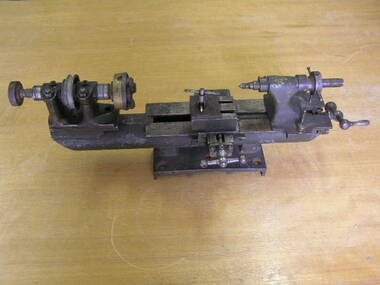
Tool - Lathe, Metal Lathe
... Handmade metal turning lathe, 600mls long and weighing 16 kg. Made at a forge site outside the camp perimeter. ... metalworking Paul Faig Gotthilf Kaltenbach Manuel Kaltenbach Handmade metal turning lathe, 600mls long and weighing 16 kg. Made at a forge site outside the camp perimeter. ...Made at a forge outside the camp 3 perimeter by Gotthilf Kaltenbach & Manuel Kaltenbach. It is made from British Army scrap metal. Used for fine metal turning. The Witworth gauges were not used in Central Europe after 1918. The motor that was on it was a small electric sewing machine motor which was discarded about ten years ago in Germany. Sent from Germany by Elfriede & Paul Faig.Handmade metal turning lathe, 600mls long and weighing 16 kg. Made at a forge site outside the camp perimeter. All dimensions are in imperial inches, all threads are Witworth gauges. Painted in British Army colours.tatura, camp 3, lathe, metalworking, paul faig, gotthilf kaltenbach, manuel kaltenbach -
 Tatura Irrigation & Wartime Camps Museum
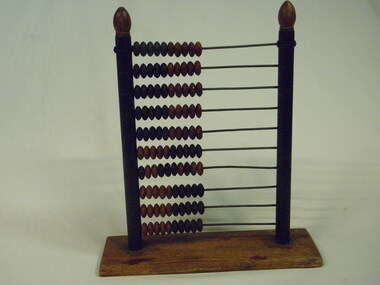
Abacus, Between 1939-1945
... It was made from scrap materials found in and around the camp & the beads & other wooden parts of the abacus were turned on a lathe also constructed by the internees. ...It was made from scrap materials found in and around the camp & the beads & other wooden parts of the abacus were turned on a lathe also constructed by the internees. camp 3 tatura internment camps civilian internees Wood & metal abacus with wooden base, sides & beads (100), & metal rails. ...Camp 3 was one of the Tatura Group of civilian & prisoner of war internment camps during World War 2. Camp 3 was a civilian 'family' camp. The abacus was made by a German internee, for his son in the camp. It was made from scrap materials found in and around the camp & the beads & other wooden parts of the abacus were turned on a lathe also constructed by the internees. Wood & metal abacus with wooden base, sides & beads (100), & metal rails. Wood painted red & black. camp 3, tatura, internment camps, civilian internees -
 Tatura Irrigation & Wartime Camps Museum
Rings - Wooden, 1940's
... 2 light coloured wooden rings made on small lathe (no. 2955) or wood turning bench....Sent from Germany by Elfriede & Paul Faig. tatura camp 3 lathe faig p kaltenbach handcrafts woodwork 2 light coloured wooden rings made on small lathe (no. 2955) or wood turning bench. ...Sent from Germany by Elfriede & Paul Faig.2 light coloured wooden rings made on small lathe (no. 2955) or wood turning bench.tatura, camp 3, lathe, faig, p, kaltenbach, handcrafts, woodwork -
 Tatura Irrigation & Wartime Camps Museum
Cups - Wooden, 1940's
... 2 solid dark wood cups made on the small lathe (no. 2955) or wood turning bench....Sent from Germany by Elfriede & Paul Faig. tatura camp 3 lathe faig p kaltenbach g hermann w handcrafts woodwork 2 solid dark wood cups made on the small lathe (no. 2955) or wood turning bench. ...Sent from Germany by Elfriede & Paul Faig.2 solid dark wood cups made on the small lathe (no. 2955) or wood turning bench.tatura, camp 3, lathe, faig, p, kaltenbach, g, hermann, w, handcrafts, woodwork -
Tatura Irrigation & Wartime Camps Museum
Spinning top, 1940's
... Wooden spinning top with groves for cord. Made on a lathe...Made by internee at Camp 3 top - spinning wood beck h camp 3 tatura ww2 camp 3 tops general Wooden spinning top with groves for cord. Made on a lathe Spinning top Spinning top ...Made by internee at Camp 3Wooden spinning top with groves for cord. Made on a lathetop - spinning, wood, beck h, camp 3, tatura, ww2 camp 3, tops, general -
 Mont De Lancey
apple parer, slicer, corer, Goodell Co, Circa 1885
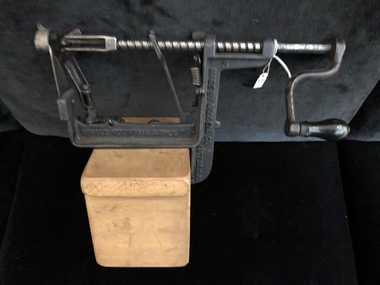
... Lathe apple parer, slicer and corer made from cast iron with wooden knob on handle. ...apple peelers Apple corers Fruit slicers White Mountain Apple 3 Made by Goodell Co Antrim N. H. USA Lathe apple parer, slicer and corer made from cast iron with wooden knob on handle. ...Lathe apple parer, slicer and corer made from cast iron with wooden knob on handle. Mounted on a wooden base. C1885White Mountain Apple 3 Made by Goodell Co Antrim N. H. USAapple peelers, apple corers, fruit slicers -
 Bacchus Marsh & District Historical Society
Decorative object, Wooden bowl made from Osage Orange tree timber
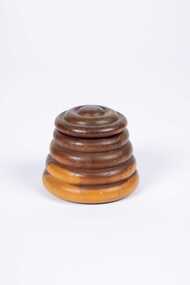
... made and donated to the Ladies' Guild by Mr. Walter Simon, of Bacchus Marsh. A local osage orange tree furnished the wood for the bowl, which was one of many articles that Mr. Simon's lathe...made and donated to the Ladies' Guild by Mr. Walter Simon, of Bacchus Marsh. A local osage orange tree furnished the wood for the bowl, which was one of many articles that Mr. Simon's lathe ...This small bowl was won by Alex Todd for marksmanship at the Holy Trinity Anglican Church Bazaar in Bacchus Marsh in 1935. It was described in the Bacchus Marsh Express newspaper as a piece of Local Objet d'Art. The Express noted that it was 'made and donated to the Ladies' Guild by Mr. Walter Simon, of Bacchus Marsh. A local osage orange tree furnished the wood for the bowl, which was one of many articles that Mr. Simon's lathe has shaped from time to time, the grain of the osage timber being especially suitable for such work', Express, 25 May, 1935, p.2. A small polished wood bowl with unattached wooden lid. woodworking
