
Showing 46 items matching "latin names"
-
 University of Melbourne, Burnley Campus Archives
Book - Register, List of Shrubs, c.1917-1958
... ...latin names...Burnley School of Primary Agriculture and Horticulture table of shrubs with Latin name, common name, brief description, height and position in Gardens in alphabetical order. ...burnley school of primary agriculture and horticulture bspah shrubs latin names common names description gardens t.h. kneen Burnley School of Primary Agriculture and Horticulture table of shrubs with Latin name, common name, brief description, height and position in Gardens in alphabetical order. ...Burnley School of Primary Agriculture and Horticulture table of shrubs with Latin name, common name, brief description, height and position in Gardens in alphabetical order. From T.H. Kneen file marked: May.burnley school of primary agriculture and horticulture, bspah, shrubs, latin names, common names, description, gardens, t.h. kneen -
University of Melbourne, Burnley Campus Archives
Document - Plant List, Dept. of Sustainability and Environment, Advisory List of Rare or Threatened Plants in Victoria 2005, 2005
... Listed with Common Name, Latin Name and Conservation Status....Listed with Common Name, Latin Name and Conservation Status. Advisory List of Rare or Threatened Plants in Victoria 2005 Document Plant List Dept. of Sustainability and Environment ...plants, plant list, victoria, endangered plants, conservation -
University of Melbourne, Burnley Campus Archives
Book - Register, Register of Shrubs and Trees at Burnley Gardens, unknown
... Plants listed alphabetically under latin name with a comment and alphanumeric code system eg 10 N . ...Plants listed alphabetically under latin name with a comment and alphanumeric code system eg 10 N . ...No title or date in this register. Handwritten. Code of number and letter - a map of Burnley gardens with the quadrants would give the location.Bound alphabetical index register of shrubs and trees handwritten in black and red ink. Plants listed alphabetically under latin name with a comment and alphanumeric code system eg 10 N . Includes newspaper cutting.register, shrubs, trees, plants, gardens, position, index -
University of Melbourne, Burnley Campus Archives
Document - Laminated pages, Plants, UInknown
... 18 laminated pages tied together in top left hand corner with plastic tie. One side - Latin name and Common name, other side - one or two coloured photographs of the plant. ...plants plant identification teaching material 18 laminated pages tied together in top left hand corner with plastic tie. One side - Latin name and Common name, other side - one or two coloured photographs of the plant. ...plants, plant identification, teaching material -
 Wodonga & District Historical Society Inc
Functional object - Apothecary Storage Jars
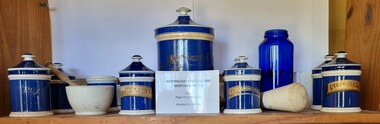
... A set of 9 blue and white lidded apothecary jars with gilt lettering depicting latin names of the contents. Also a mortar and and two pestles. ...Apothecary jars Pharmacies Wodonga Pope Pharmacy McSwiney Chemist A set of 9 blue and white lidded apothecary jars with gilt lettering depicting latin names of the contents. Also a mortar and and two pestles. ...J. R. Pope officially began operating his pharmacy at 102 High Street, Wodonga on 1 October 1967. The pharmacy was purchased from John T. McSwiney who had operated his business from the same site from 1901. Mr. McSwiney was born in Chiltern in 1875 and qualified as a pharmacist in 1896 when he was apprenticed to David James McEwen, father of future Prime Minister Sir John McEwen. By October 1901 Mr. McSwiney was running his own business in High Street where he practised until he sold the business to J. R. Pope exactly 66 years later. Although he went into semi-retirement John McSwiney was still working at the age of 92 and was considered to be Victoria’s – if not Australia’s oldest practising chemist. These jars were part of the transfer of the pharmacy and its equipment in 1967 but date back to the earlier years of John McSwiney’s pharmacy in the early 1900s. These jars come from a Wodonga business which operated for over 70 years.A set of 9 blue and white lidded apothecary jars with gilt lettering depicting latin names of the contents. Also a mortar and and two pestles. The mortar has a groove on the side for the smaller pestle to rest. There is also a blue glass jar.apothecary jars, pharmacies wodonga, pope pharmacy, mcswiney chemist -
 University of Melbourne, Burnley Campus Archives
Slide - Colour glass slides, Vickie, Digitising Centre, Glass Slides, 1966
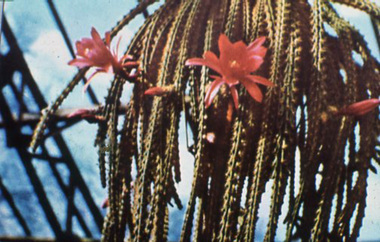
... All slides labelled with handwritten Latin name....All slides labelled with handwritten Latin name. 2 boxes of slides (38) made from 2 layers of glass about the same size as 35 mm slides but not in a frame. ...2 boxes of slides (38) made from 2 layers of glass about the same size as 35 mm slides but not in a frame. Photographs of cacti and succulents. Label with handwritten description pasted on to slide.Both boxes labelled, "Agfacolor Dia Rahmen für Aufnahmen 24x36 mm." 1 box labelled, "23-11-66" with 23 slides. 1 box labelled, 18/10/66 W. Nicholls," with 15 slides. All slides labelled with handwritten Latin name.w. nicholls, bill nicholls, cacti, succulents, glass slides -
University of Melbourne, Burnley Campus Archives
Book - Register, Burnley College: Plant Inventory with Planting Dates, c.1958-1983
... No date of compilation printed. Latin name, Common name, Date planted, Origin. ...No date of compilation printed. Latin name, Common name, Date planted, Origin. ...Photocopy of the book "Trees and plants: Lists" - Department of Agriculture. No date of compilation printed. Latin name, Common name, Date planted, Origin. All trees planted 1850 - 1900. It is not printed that this is a list of Burnley Trees - however handwritten on front sheet " Burnley College Plant inventory with planting dates". 9 x A4 pages. There is no indication when this list was compiled or if the trees still exist in the garden.trees, plants, department of agriculture, burnley trees -
Glenelg Shire Council Cultural Collection
Clothing - Top Hat, n.d
... Maker's stamp inside crown 'Extra Quality London' and Latin inscription Name tag 'ENT HENRY'...Maker's stamp inside crown 'Extra Quality London' and Latin inscription Name tag 'ENT HENRY' Black top hat. ...Black top hat. High crowned, narrow brim with slightly rolled sides, edged with grosgrain ribbon, brushed surface. Leather headband, hat lined with cream silk. Small air hole in top of crown.Front: On headband inside hat ' 'English Manufacture' stamped in leather. Maker's stamp inside crown 'Extra Quality London' and Latin inscription Name tag 'ENT HENRY' -
University of Melbourne, Burnley Campus Archives
Booklet - Register, Lists of Trees and Plants, 1850-1918
... (1a) Original (1) Typed photocopied list of trees, when planted, Latin and common name, country or state of origin, 1850-1900. ...trees peter esdale pears cross fertilization mr. wallis flowers dahlias burnley school of horticulture (1a) Original (1) Typed photocopied list of trees, when planted, Latin and common name, country or state of origin, 1850-1900. ...(1a) Original (1) Typed photocopied list of trees, when planted, Latin and common name, country or state of origin, 1850-1900. "Copied from Original" 30 August 1990 by Peter Esdale. (2) School of Horticulture, Burnley, 1 November 1918 List of Pears for Cross Fertilization. Revised List. Mr. Wallis. (3) List of Good Dahlias. (4) Dahlias. Burnley School of Horticulture. 25 November 1918.trees, peter esdale, pears, cross fertilization, mr. wallis, flowers, dahlias, burnley school of horticulture -
 Flagstaff Hill Maritime Museum and Village
Planisphere, Early 20th Century
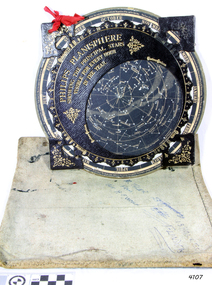
... Latin planisphaerium) was originally used in the second century by Claudius Ptolemy to describe the representation of a spherical Earth by a map drawn in the plane. This usage continued into the Renaissance: for example Gerardus Mercator described his 1569 world map as a Planisphere. The word describes the representation of the star-filled celestial sphere on the plane. The first star chart to have the name...Latin planisphaerium) was originally used in the second century by Claudius Ptolemy to describe the representation of a spherical Earth by a map drawn in the plane. This usage continued into the Renaissance: for example Gerardus Mercator described his 1569 world map as a Planisphere. The word describes the representation of the star-filled celestial sphere on the plane. The first star chart to have the name ...The word Planisphere (Latin planisphaerium) was originally used in the second century by Claudius Ptolemy to describe the representation of a spherical Earth by a map drawn in the plane. This usage continued into the Renaissance: for example Gerardus Mercator described his 1569 world map as a Planisphere. The word describes the representation of the star-filled celestial sphere on the plane. The first star chart to have the name "Planisphere" was made in 1624 by Jacob Bartsch. Bartsch was the son-in-law of Johannes Kepler, discoverer of Kepler's laws of planetary motion. A significant item of celestial mapping used by marine navigators This particular item was made and used in the first quarter to half of the 20th centuryPlanisphere of northern hemisphere, with canvas bag. Planisphere consists of a circular star chart attached at its centre to an opaque circular overlay that has a clear elliptical window or hole so that only a portion of the sky map will be visible in the window or hole area at any given time. The chart and overlay are mounted so that they are free to rotate about a common pivot point at their centres. The star chart contains the brightest stars, constellations and (possibly) deep-sky objects visible from a particular latitude on Earth. The night sky that one sees from the Earth depends on whether the observer is in the northern or southern hemispheres and the latitude. A Planisphere window is designed for a particular latitude and will be accurate enough for a certain band either side of that. Planisphere makers will usually offer them in a number of versions for different latitudes. Planispheres only show the stars visible from the observer's latitude; stars below the horizon are not included. A complete twenty-four-hour time cycle is marked on the rim of the overlay. A full twelve months of calendar dates are marked on the rim of the starchart. The window is marked to show the direction of the eastern and western horizons. The disc and overlay are adjusted so that the observer's local time of day on the overlay corresponds to that day's date on the star chart disc. The portion of the star chart visible in the window then represents (with a distortion because it is a flat surface representing a spherical volume) the distribution of stars in the sky at that moment for the Planispheres designed location. Users hold the Planisphere above their head with the eastern and western horizons correctly aligned to match the chart to actual star positions. "Made in Germany for GEORGE PHILIP & SONS Ltd. Geographical and Educational Depot, 32 Fleet Street, London" Canvas bag has "Capt. H (Howard) Tyler from Captain H. F. Woolf" "Tyler 22 ? St East Brighton" also "13 Halls St Flinders"flagstaff hill, warrnambool, shipwrecked-coast, flagstaff-hill, flagstaff-hill-maritime-museum, maritime-museum, shipwreck-coast, flagstaff-hill-maritime-village, planisphere, star map, marine navigation, maps, george philip & sons -
 Flagstaff Hill Maritime Museum and Village
Planisphere, Early 20th Century
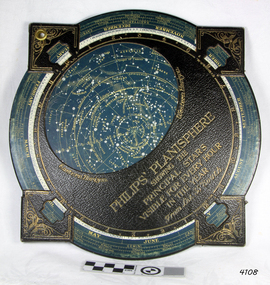
... Latin planisphaerium) was originally used in the second century by Claudius Ptolemy to describe the representation of a spherical Earth by a map drawn in the plane. This usage continued into the Renaissance: for example Gerardus Mercator described his 1569 world map as a Planisphere. The word describes the representation of the star-filled celestial sphere on the plane. The first star chart to have the name...Latin planisphaerium) was originally used in the second century by Claudius Ptolemy to describe the representation of a spherical Earth by a map drawn in the plane. This usage continued into the Renaissance: for example Gerardus Mercator described his 1569 world map as a Planisphere. The word describes the representation of the star-filled celestial sphere on the plane. The first star chart to have the name ...The word Planisphere (Latin planisphaerium) was originally used in the second century by Claudius Ptolemy to describe the representation of a spherical Earth by a map drawn in the plane. This usage continued into the Renaissance: for example Gerardus Mercator described his 1569 world map as a Planisphere. The word describes the representation of the star-filled celestial sphere on the plane. The first star chart to have the name "Planisphere" was made in 1624 by Jacob Bartsch. Bartsch was the son-in-law of Johannes Kepler, discoverer of Kepler's laws of planetary motionA significant item of celestial mapping used by marine navigators This particular item was made and used in the first quarter to half of the 20th century.Planisphere consists of a circular star chart attached at its centre to an opaque circular overlay that has a clear elliptical window or hole so that only a portion of the sky map will be visible in the window or hole area at any given time. The chart and overlay are mounted so that they are free to rotate about a common pivot point at their centers. The star chart contains the brightest stars, constellations and (possibly) deep-sky objects visible from a particular latitude on Earth. The night sky that one sees from the Earth depends on whether the observer is in the northern or southern hemispheres and the latitude. A Planisphere window is designed for a particular latitude and will be accurate enough for a certain band either side of that. Planisphere makers will usually offer them in a number of versions for different latitudes. Planispheres only show the stars visible from the observer's latitude; stars below the horizon are not included. A complete twenty-four-hour time cycle is marked on the rim of the overlay. A full twelve months of calendar dates are marked on the rim of the star chart. The window is marked to show the direction of the eastern and western horizons. The disc and overlay are adjusted so that the observer's local time of day on the overlay corresponds to that day's date on the star chart disc. The portion of the star chart visible in the window then represents (with a distortion because it is a flat surface representing a spherical volume) the distribution of stars in the sky at that moment for the Planispheres designed location. Users hold the Planisphere above their head with the eastern and western horizons correctly aligned to match the chart to actual star positions. "Sold by J DONNE & SON, Booksellers & Stationers, 349 Post Office Place Melbourne 349. Admiralty Chart Agents" and " Made in Germany for George Philip & Son Ltd" England . Signature "Capt E. B. ?..id, 22 Baund St"flagstaff hill, warrnambool, shipwrecked-coast, flagstaff-hill, flagstaff-hill-maritime-museum, maritime-museum, shipwreck-coast, flagstaff-hill-maritime-village, star map, marine navigation, maps, george philip & sons -
 Flagstaff Hill Maritime Museum and Village
Instrument - Octant, mid 1800's
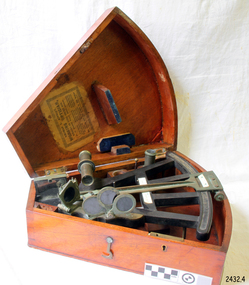
... An Octant is a doubly reflecting navigation instrument used primarily by sailors to measure the angular distance between two visible objects and was a forerunner of the sextant. The name comes from the Latin octo, or "one-eighth of a circle," for the Octan'ts arc which spans 45°, or one-eighth of a circle. ...An Octant is a doubly reflecting navigation instrument used primarily by sailors to measure the angular distance between two visible objects and was a forerunner of the sextant. The name comes from the Latin octo, or "one-eighth of a circle," for the Octan'ts arc which spans 45°, or one-eighth of a circle. ...An Octant is a doubly reflecting navigation instrument used primarily by sailors to measure the angular distance between two visible objects and was a forerunner of the sextant. The name comes from the Latin octo, or "one-eighth of a circle," for the Octan'ts arc which spans 45°, or one-eighth of a circle. The primary use of an Octant is to measure the angle between an astronomical object and the horizon for celestial navigation. The estimation of this angle, is known as sighting or shooting the object, or taking a sight. The angle, and the time when it was measured, can be used to calculate a position line on a nautical chart (latitude), for example, sighting the Sun at noon or Polaris at night (in the Northern Hemisphere) gives an angle by which the latitude can then be estimated. Sighting the height of a landmark on land can also give a measure of distance. This fine octant once belonged to Captain Farquhar Chisholm and was donated by his granddaughter, Margaret Ruth Greer (nee Chisholm, born 1914). The label inside the Octant's box reads “Thomas L. Ainsley, Instrument Maker … etc”. Farquhar Chisholm was born in 1832 in Inverness, Scotland. He regularly sailed on perilous voyages between Quebec, Canada and the Baltic ports of Europe. In 1854 he migrated to Australia during the Gold Rush, to a place called Fiery Creek (near Beaufort Victoria) where he was fairly successful in his quest for gold. In the years of the Great Gold Rush, it was said that there were over 40,000 diggers in the goldfields of the Beaufort area! In 1857 having made sufficient money, he hired another crew and returned to Clachnacuddin, Inverness shire, Scotland and in that same year, he studied and obtained his Master Mariner Certificate (which would have included the use of an octant for navigation). He was appointed to Mr George (or James) Walker, as commander of his sailing ship, the 3-masted ELIZABETH, built 1859 and known as “The Walker barque”. In 1870 he married, then in 1887 returned to Australia with his wife and children (Kenneth Chisholm (1871), Mary Bremner Chisholm (1873), Margaret Hood Chisholm (1874), Farquhar Chisholm (1878)). They arrived in Port Melbourne, Victoria and sadly, only six weeks after landing, his wife Caroline passed away (in Geelong,1888). In 1900 Capt. Chisholm lived in Camperdown (Victoria) and not long after this his daughter Margaret died of consumption. In his later years, he went to live in the manse of St. Paul’s Presbyterian Church, Wangaratta, with his son, Rev. Farquhar Chisholm. He died there on Sat, 23rd March 1912, 80 years old. He was known as “… quiet, unobtrusive and competent, respected by all with whom he came in contact”. Some other members of Captain Chisholm’s family are; his older son Kenneth Chisholm, who was a contractor in Camperdown; a nephew Donald Macintosh (of 23 Douglas Row, Inverness); a grandson Brian Jones (son of Caroline Belle-Jones nee Chisholm, who lived in Camperdown in the earlier part of her life).The octant, the forerunner of the sextant, was a significant step in providing accuracy of a sailors latitude position at sea & his vessels distance from land when taking sightings of land-based landmarks.Octant, once belonging to Captain Farquhar Chisholm. Wedge shape (the size of an eighth of a circle), made of wood, glass and metal. Used in the 1880s. Maker’s name across centre “L. SIMON - - - SHIELDS”. Three (3) light filtering, coloured glass shades. Two (2) eyepieces. Scale attached for measuring angles. Label inside the fitted, wedge-shaped case "Thomas L. Ainsley, Optician"Label inside case "Thomas L. Ainsley, Optician" Maker’s name across centre “L. SIMON - - - SHIELDS”.flagstaff hill, warrnambool, shipwrecked-coast, flagstaff-hill, flagstaff-hill-maritime-museum, maritime-museum, shipwreck-coast, flagstaff-hill-maritime-village, maritime navigation, navigation instrument, migration, captain chisholm, farquhar chisholm, sailing ship, the elizabeths, thomas l. ainsley, l. simons, shields england, octant, john hadley, chisholm -
 Flagstaff Hill Maritime Museum and Village
Instrument - Navigational Sextant, 1882-1890
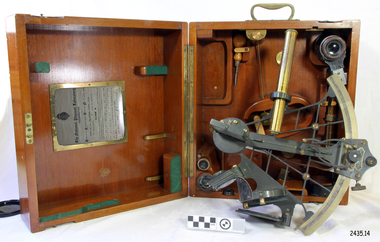
... It is a doubly reflecting navigation instrument and used mainly by sailors to measure the angular distance between two visible objects. The name comes from the Latin sextans, or “sixth part of a unit,” because the sextant’s arc can be 60° or 120° of a circle depending on the model used. ...It is a doubly reflecting navigation instrument and used mainly by sailors to measure the angular distance between two visible objects. The name comes from the Latin sextans, or “sixth part of a unit,” because the sextant’s arc can be 60° or 120° of a circle depending on the model used. ...A sextant is an astronomical instrument used to determine latitude and longitude at sea by measuring angular distances, especially the altitudes of the sun, moon, and stars. It is a doubly reflecting navigation instrument and used mainly by sailors to measure the angular distance between two visible objects. The name comes from the Latin sextans, or “sixth part of a unit,” because the sextant’s arc can be 60° or 120° of a circle depending on the model used. The primary use was to measure the angle between an astronomical object and the horizon for the purposes of celestial navigation. The estimation of this angle is known as sighting or shooting the object, or taking a sight. This angle and the time when it was measured is used in order to determine Greenwich Mean Time and hence longitude. Sighting the height of a landmark on land can also give a measure of distance from that object. History: The development of the sextant was as an improvement over the octant, an instrument designed to measure one's latitude. The octant was first implemented around 1731-present but can only measure angles up to 45°. As larger angles were needed to allow the measurement of lunar objects - moon, stars and the sun - at higher angles, the octant was superseded by the sextant. The sextant is a similar instrument but better made and allows larger angles from 60° to 120°. This improvement allows distances to be accurately calculated thereby giving longitude when used with a chronometer. The sextant was derived from the octant in 1757, eventually making all previous instruments used for navigational positioning obsolete. The sextant had been attributed to by John Hadley (1682–1744) and Thomas Godfrey (1704–1749), but reference to the sextant was also found later in the unpublished writings of Isaac Newton (1643–1727). Earlier links can be found to Bartholomew Gosnold (1571–1607) indicating that the use of a sextant for nautical navigation predates Hadley's implementation. In 1922, the sextant was modified for aeronautical navigation by Portuguese navigator and naval officer Gago Coutinho. It should be noted that the octant and quadrant are in the same family as they were, and all are, regarded as sextants. The sextant is representative of it's type and although not fully complete it demonstrates how 18th,19th and 20th century mariners determined their latitude and longitudinal to determine their position on a chart, allowing them to navigate there way across the world's oceans. It also demonstrates the skill and workmanship of the early instrument makers that operated scientific instrument businesses from London and other areas of England to provide most of the navigational instrumentation used by commercial and military navies of the time.Sextant with square, fitted box of polished wood, "Hezzanith" brand. Box contains many parts for the sextants use. On certificate "Heath & Co, London. Sextant Number Y 822". Catch on lid "DEFIANT LEVER" and "PATENT NUMBER 187.10". Maker's certificate is attached to the inside of the box.flagstaff hill, warrnambool, shipwrecked-coast, flagstaff-hill, flagstaff-hill-maritime-museum, maritime-museum, shipwreck-coast, flagstaff-hill-maritime-village, sextant box, sextant, hezzanith, heath & co, navigational instrument, george wilson heath, astronomical instrument, instrument manufacturers, scientific instrument, navigation, celestial navigation, octant, quadrant, lunar navigation -
 Flagstaff Hill Maritime Museum and Village
Octant, Late 18th to mid-19th century
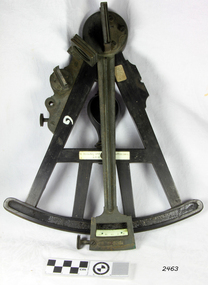
... An Octant is a doubly reflecting navigation instrument used primarily by sailors to measure the angular distance between two visible objects and was a forerunner of the sextant. The name comes from the Latin octo, or “one-eighth of a circle,” for the Octant’s arc which spans 45°, or one-eighth of a circle. ...An Octant is a doubly reflecting navigation instrument used primarily by sailors to measure the angular distance between two visible objects and was a forerunner of the sextant. The name comes from the Latin octo, or “one-eighth of a circle,” for the Octant’s arc which spans 45°, or one-eighth of a circle. ...An Octant is a doubly reflecting navigation instrument used primarily by sailors to measure the angular distance between two visible objects and was a forerunner of the sextant. The name comes from the Latin octo, or “one-eighth of a circle,” for the Octant’s arc which spans 45°, or one-eighth of a circle. The primary use of an Octant is to measure the angle between an astronomical object and the horizon for the purposes of celestial navigation. The estimation of this angle is known as sighting or shooting the object, or taking a sight. The angle, and the time when it was measured, can be used to calculate a position line on a nautical chart (latitude), for example, sighting the Sun at noon or Polaris at night (in the Northern Hemisphere) gives an angle by which the latitude can then be estimated. Sighting the height of a landmark on land can also give a measure of distance. History: The principle of the Octant as an instrument to measure ones latitude was first implemented around 1742-present but was superseded by the improvement of the octant to a sextant, a very similar instrument, better made and able to measure bigger angles 120°, allowing the measurement of Luna distances to give longitude when used with an accurate chronometer. The sextant started to appear around 1730 and had been attributed to by John Hadley (1682–1744) and Thomas Godfrey (1704–1749), but reference to the sextant was also found later in the unpublished writings of Isaac Newton (1643–1727). Earlier links can be found to Bartholomew Gosnold (1571–1607) indicating that the use of a Sextant for nautical navigation predates Hadley's implementation. In 1922, the sextant was modified for aeronautical navigation by Portuguese navigator and naval officer Gago Coutinho. Henry Hemsley was a lesser-known instrument maker and optician working in London in the late 17th and early 18th century. However, it should be noted that there were two Henry Hemsley opticians and instrument makers around this period. (Henry Hemsley 1, 1786-89, who had premises at 85 Fleet St London and Henry Hemsley 2, 1828-56), whose workshop was at 135-138 Radcliff Highway London. Therefore, based on the inscribed workshop address Henry Hemsley 2 is responsible for making this example.The octant is representative of its type and although not fully complete it demonstrates how 18th and 19th-century mariners determined their latitude on a chart to navigate their way across the world's oceans in the 18th and 19th century. It also demonstrates the skill and workmanship of the early instrument makers that operated from London at this time and provided most of the navigational instrumentation use by commercial and military navies of the time.Octant, ebony wooden frame and handle. Scale is missing from recess in frame. "H. Hemsley 135-138 Ratliff Highway, London", no box"H. Hemsley 135-138 Ratcliff Highway, London"flagstaff hill, warrnambool, shipwrecked-coast, flagstaff-hill, flagstaff-hill-maritime-museum, maritime-museum, shipwreck-coast, flagstaff-hill-maritime-village, navigation, navigational instrument, instrument used for navigation, sextant, henry hemsley, instrument maker, london, octant -
 Federation University Historical Collection
Booklet - Annual Report, Grenville College Annual Report, 1907-8, 1908
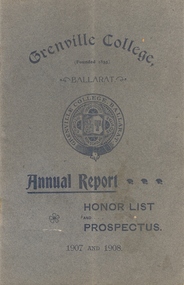
... name was changed to Grenville College in 1869. In 1908 Grenville College was situated in Mair Street, Ballarat, and the Principal was A.A. Buley. Pupils were educated for either commercial life or for the University. Those who intended to matriculate were advised to take the following subjects: - English, History, and Geography; Arithmetic, Algebra, Euclid, and Trigonometry; and either French and German, or Latin and Greek....name was changed to Grenville College in 1869. In 1908 Grenville College was situated in Mair Street, Ballarat, and the Principal was A.A. Buley. Pupils were educated for either commercial life or for the University. Those who intended to matriculate were advised to take the following subjects: - English, History, and Geography; Arithmetic, Algebra, Euclid, and Trigonometry; and either French and German, or Latin and Greek. grenville college cyril callister frank g. menzies william morcom sydney r. curnow william h. collyer revill tinworth c. brokenshire george p. merz alfred h. barrett anthony jenkin alexander sutherland wilford whittle owen peters john la gerche mary delahunty lily evans henry japp edith forster j. sutherland a.m. lilburne eustace coltman james g. leadbeater Fourteen page soft covered Annual Roport, Honor List and Prospectus Grenville College Annual Report, 1907-8 Booklet Annual Report ...Grenville College was founded in 1855 by W. Stellard as Ballarat Grammar School. The school was amalgamated by Mr Victor are Ballarat Grammar School in 1867 as the Ballarat Collegiate and Grammar School. Its name was changed to Grenville College in 1869. In 1908 Grenville College was situated in Mair Street, Ballarat, and the Principal was A.A. Buley. Pupils were educated for either commercial life or for the University. Those who intended to matriculate were advised to take the following subjects: - English, History, and Geography; Arithmetic, Algebra, Euclid, and Trigonometry; and either French and German, or Latin and Greek.Fourteen page soft covered Annual Roport, Honor List and Prospectusgrenville college, cyril callister, frank g. menzies, william morcom, sydney r. curnow, william h. collyer, revill tinworth, c. brokenshire, george p. merz, alfred h. barrett, anthony jenkin, alexander sutherland, wilford whittle, owen peters, john la gerche, mary delahunty, lily evans, henry japp, edith forster, j. sutherland, a.m. lilburne, eustace coltman, james g. leadbeater -
 The Beechworth Burke Museum
Geological specimen - Cerussite, Unknown c.1890s
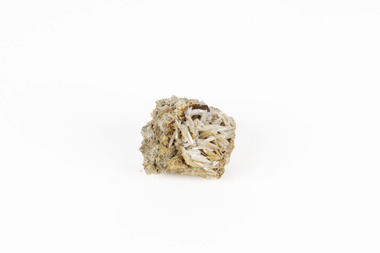
... Named in 1845 by Wilhelm Karl von Haidinger cerussite takes its name from the Latin cerussa, meaning 'white lead'. ...Named in 1845 by Wilhelm Karl von Haidinger cerussite takes its name from the Latin cerussa, meaning 'white lead'. ...Named in 1845 by Wilhelm Karl von Haidinger cerussite takes its name from the Latin cerussa, meaning 'white lead'. When viewed under certain lighting conditions cerussite gives of fire and rainbow-like colours (due to its high dispersion) and it is quite sought after by geological collectors for this very reason. Cerussite is usually found in the oxidised zone of lead ore deposits. It is a very common weathering product of galena and other lead ore minerals. It is a secondary mineral, meaning it forms as a result of the alteration of pre-existing minerals in the Earth’s crust. The presence of lead in cerussite makes it potentially toxic. Historically, it has been an important source of lead, which has numerous industrial applications, including in batteries, construction materials, and radiation shielding. Cerussite has a crystal structure that belongs to the orthorhombic crystal system. Its crystal structure is characterized by a three-dimensional arrangement of atoms in a repeating pattern. The crystal lattice of cerussite consists of interconnected lead (Pb) and carbonate (CO3) ions. This crystal structure is visible in the specimen. This specimen was found in Dundas (formerly Mount Dundas), a historical mining locality, mineral field and railway located on the western foothills of the West Coast Range in Western Tasmania. During the 1890s Dundas swelled in numbers however it is now lost in a temperate rainforest and its population is now 2. The present Dundas Extended mine, about 1.5 km east of Dundas is presently worked for specimen material.Faceted cerussite gems are considered rare and valuable, given the softness of the mineral. This item is not a faceted gem however its historical and scientific research potential give it significance; mined in an Australian township, this cerussite could shed light on the now lost history of Dundas and the mining that occurred there. Additionally, the uses of this mineral in historical industrial processes give it scientific significance. Such knowledge can add to understandings of the geographical and geological nature of Western Tasmania and allow for further study of Australian geological specimens. A small lead carbonite mineral with shades of cream, white and brown throughout, flaky shards of white at base. CERUSSITE / (lead carbonite) / Locality: Dundas, W. Tasmaniadundas, tasmania, cerussite, lead, orthorhombic, geology, minerals, mining -
 The Beechworth Burke Museum
Animal specimen - Common Buzzard, Trustees of the Australian Museum, 1860-1880
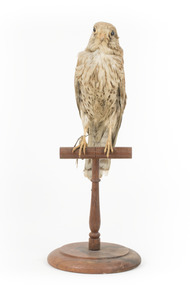
... The Common Buzzard is part of the buteo genus (Latin for buzzard or hawk) which indicates it is part of the raptor group whose features include a medium to large build, a strong body and larger wings. The family includes birds of prey such as hawks and buzzards. Like their name...The Common Buzzard is part of the buteo genus (Latin for buzzard or hawk) which indicates it is part of the raptor group whose features include a medium to large build, a strong body and larger wings. The family includes birds of prey such as hawks and buzzards. Like their name ...The Common Buzzard is part of the buteo genus (Latin for buzzard or hawk) which indicates it is part of the raptor group whose features include a medium to large build, a strong body and larger wings. The family includes birds of prey such as hawks and buzzards. Like their name suggests, Common Buzzards are very ‘common’ in the UK but can also be found in other parts of Europe, Africa and Asia. The birds’ habitat consists of woodland, shrubland, forest, wetlands and countryside, and they can live in cold, tropical and temperate climate zones. Similar to other raptor species, Common Buzzards make their nests in tree branches or tree forks. With finely tuned hearing, they are able to detect small marsupials, and their diet consists of small amphibians, birds and mammals. Normally solitary, these raptors can occasionally be seen with others. Common Buzzards are classified as of ‘Least Concern’ on the IUCN Red List. While there is some noticeable fading of this particular taxidermy specimen’s plumage, it is relatively well presented. The completely black eyes and string through the nose of the specimen seem to be taxidermy/curatorial choices, as this is not something that is normally found on living versions today, and the eyes of Common Buzzards are normally golden eyes with black pupils. It is interesting to note, when considering the selected artificial eyes, that the original swing tag labeled this specimen as Saleo tinnunculus Lina, a form of kestrel (known to have complete black eyes), which perhaps explains this taxidermist choice. As a Common Buzzard, this particular specimen could have had its frame and breast area bulked out a little more, as birds within the buteo genus are generally recognised to be of medium to large build. Overall however, this is a fairly reasonable and accurate representation of the species. This specimen is part of a collection of almost 200 animal specimens that were originally acquired as skins from various institutions across Australia, including the Australian Museum in Sydney and the National Museum of Victoria (known as Museums Victoria since 1983), as well as individuals such as amateur anthropologist Reynell Eveleigh Johns between 1860-1880. These skins were then mounted by members of the Burke Museum Committee and put-on display in the formal space of the Museum’s original exhibition hall where they continue to be on display. This display of taxidermy mounts initially served to instruct visitors to the Burke Museum of the natural world around them, today it serves as an insight into the collecting habits of the 19th century.This specimen is part of a significant and rare taxidermy mount collection in the Burke Museum. This collection is scientifically and culturally important for reminding us of how science continues to shape our understanding of the modern world. They demonstrate a capacity to hold evidence of how Australia’s fauna history existed in the past and are potentially important for future environmental research. This collection continues to be on display in the Museum and has become a key part to interpreting the collecting habits of the 19th century.With similar colourings and features to a range of raptor species, the Common Buzzard can often be mistaken for other varieties of buteo and raptor. The bird’s plumage generally varies by location, but normally includes a variety of shades of brown, commonly with darker brown on its back and lighter coloured feathers on its breast, underbelly areas and face. These birds normally have fine bands on their tail and darker tipped wings. Common Buzzards have smaller heads with a band of yellow around the base of their small curved beaks and golden yellow eyes. This particular specimen’s feathers have faded and he stands upon a wooden perch with an identifying tag hanging from its right leg.Swing Tag: Swing tag obverse seems to read: ‘…io [? First few symbols aren’t clear]/ Saleo /tinnunculus/ Lina [there is also another illegible symbol on the tag in the centre on the second line] Swing tag reverse: illegible sections of text and the beginning of a number ‘403…[?]. Metal tag: 1032[?]taxidermy mount, taxidermy, animalia, burke museum, beechworth, australian museum, skin, reynell eveleigh johns, bird, common buzzard, buteo, hawks, raptors, birds of prey, buzzards -
 The Beechworth Burke Museum
Geological specimen - Ilvaite
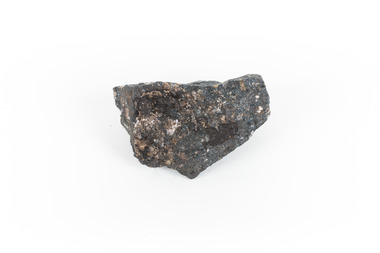
... Ilvaite has acquired its name from Ilva (Latin for Elba) Island, Greece, where Ilvaite is most commonly found. ...A solid hand-sized ferrous iron analogue mineral with of black with shades of beige Ilvaite is a brittle, opaque rock formation that has acquired its name from Ilva (Latin for Elba) Island, Greece, where Ilvaite is most commonly found. ...Ilvaite has acquired its name from Ilva (Latin for Elba) Island, Greece, where Ilvaite is most commonly found. ...Ilvaite has acquired its name from Ilva (Latin for Elba) Island, Greece, where Ilvaite is most commonly found. The geological setting in which Ilvaite occurs is through contact with magnetite, zinc and copper ore deposits, along with contact metamorphic deposits and zeolite zones. llvaite crystallizes in the form of black prismatic crystals and columns . This specimen was retrieved from Broken hill, known as the world's richest and largest zinc-lead ore deposit. Because of Ilvaite's often unaesthetic crystal formations compared to other minerals, Ilvaite is uncommon in most rock collections, particularly specimens that are not well formed, such as this one. Ilvaite is also a member of the Sorosilicate subclass of the silicate minerals, which have an unusual basic unit of Si2O7, making Ilvaite a unique mineral. Given that Ilvaite is not commonly found in Australia, it marks a unique contribution to an Australian collection of minerals. This specimen is part of a larger collection of geological and mineral specimens collected from around Australia (and some parts of the world) and donated to the Burke Museum between 1868-1880. A large percentage of these specimens were collected in Victoria as part of the Geological Survey of Victoria that begun in 1852 (in response to the Gold Rush) to study and map the geology of Victoria. Collecting geological specimens was an important part of mapping and understanding the scientific makeup of the earth. Many of these specimens were sent to research and collecting organisations across Australia, including the Burke Museum, to educate and encourage further study.A solid hand-sized ferrous iron analogue mineral with of black with shades of beige Ilvaite is a brittle, opaque rock formation that has acquired its name from Ilva (Latin for Elba) Island, Greece, where Ilvaite is most commonly found. The geological setting in which Ilvaite occurs is through contact with magnetite, zinc and copper ore deposits, along with contact metamorphic deposits and zeolite zones. llvaite crystallizes in the form of black prismatic crystals and columns rock, mineral, ilvaite, ilvaite specimen -
 Federation University Historical Collection
Drawing - Artwork - Drawing, Jeff Zilles, ZILLES COLLECTION: City of Ballarat Coat of Arms, c1975
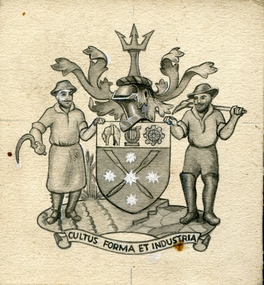
... At the time of Council amalgamations, May 1994, Ballarat became the name of the new Council. The Latin motto: Cultus: cultivation, care, worship Formar: form, shape, appearance Industria: diligence, activity, industry Zilles Printers was begun by Lewis Zilles in the early 1930s. ...At the time of Council amalgamations, May 1994, Ballarat became the name of the new Council. The Latin motto: Cultus: cultivation, care, worship Formar: form, shape, appearance Industria: diligence, activity, industry Zilles Printers was begun by Lewis Zilles in the early 1930s. ...The following research was undertaken for the Coat of Arms in the foyer of Ballarat Civic Hall, painted by Angus Henderson. The Ballarat arms were granted on 10 May 1956. The shield is supported by a farmer and a miner and topped by a trident (referring to Britannia and aquatic sports) with sprigs of wattle and begonias either side. The crossed oars against the Eureka flag refer to rowing events in the 1956 Olympic Games. The importance of farming and industry are shown by the sheep and cogwheel while the lyre reflects the City’s commitment to the arts and Royal South Street Society, which contributed to the design of the Civic Hall. The name Ballaarat came from two Aboriginal words: balla and arat, meaning ‘resting place’. At the time of Council amalgamations, May 1994, Ballarat became the name of the new Council. The Latin motto: Cultus: cultivation, care, worship Formar: form, shape, appearance Industria: diligence, activity, industry Zilles Printers was begun by Lewis Zilles in the early 1930s. It was in McKenzie Street Ballarat. His son Jeffrey also became a printer - letterpress, offset and screen printer. The business became Zilles Printers/Graphics and was in Armstrong Street and later Bell Street Ballarat.Small Ballarat coat of armscity of ballarat coat of arms, crest, zilles printers -
![Book, The Poetical works of Thomas Hood, [n.d.]](/media/collectors/4f729f6897f83e0308601719/items/51edfa4c2162ef1c60697cf8/item-media/51ee078b2162ef1c60699599/item-fit-380x285.jpg?cb=6) Ballarat Clarendon College
Ballarat Clarendon CollegeBook, The Poetical works of Thomas Hood, [n.d.]
... Latin and Class work. Margaret was one of the first enrolments to Clarendon Ladies' College at the age of 12. Margaret's father, Samuel, and mother, were personal friends of the Reverand Robert and Mrs. Kennedy. Margaret attended school in the same class as the Kennedy's eldest son Tom who was 11 at the time. Margaret's sister Edith was the 2nd enrolment to the college. Margaret resided at 15 Royal Terrace Webster Street, Ballarat. Her parents were employed as Carrier and forwarding agents. Margaret's married name...Latin and Class work. Margaret was one of the first enrolments to Clarendon Ladies' College at the age of 12. Margaret's father, Samuel, and mother, were personal friends of the Reverand Robert and Mrs. Kennedy. Margaret attended school in the same class as the Kennedy's eldest son Tom who was 11 at the time. Margaret's sister Edith was the 2nd enrolment to the college. Margaret resided at 15 Royal Terrace Webster Street, Ballarat. Her parents were employed as Carrier and forwarding agents. Margaret's married name ...This book The Poetical Works of Thomas Hood was awarded to Margaret Jane McGowan as second prize for Latin and Class work. Margaret was one of the first enrolments to Clarendon Ladies' College at the age of 12. Margaret's father, Samuel, and mother, were personal friends of the Reverand Robert and Mrs. Kennedy. Margaret attended school in the same class as the Kennedy's eldest son Tom who was 11 at the time. Margaret's sister Edith was the 2nd enrolment to the college. Margaret resided at 15 Royal Terrace Webster Street, Ballarat. Her parents were employed as Carrier and forwarding agents. Margaret's married name became Steele. Archives also hold a second book prize awarded to Margaret (000126). Socially significant due to connection with first prize-giving ceremony for Clarendon Ladies' College. Blue and gold decorative cloth cover, corners and edges rubbed, page edges gilt, gold lettering on front cover and spine; embossed border on back cover; two black and white plates; 414 p. Book plate inside front cover: CLARENDON LADIES' COLLEGE/BALLARAT/Second PRIZE/ Latin and Class work/AWARDED TO/J McGowan/R KENNEDY PRINCIPAL/18TH December, 1879 Hand-written inscription on flyleaf: This book was a Prize/at the first Prize-giving/of the College/The College having been/ established/in 1878. margaret-j-mcgowan, elizabeth-kennedy, robert-kennedy, tom-kennedy, clarendon-ladies-college, latin-and-class-work, book-prize -
 Ballarat Clarendon College
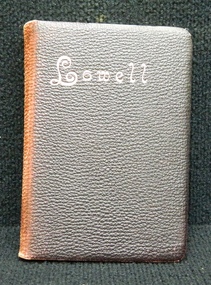
Book, W. P. Nimmo, Hay, & Mitchell, The poetical works of James Russell Lowell, Prior to the book prize given on December, 1898
... Latin. May entered Clarendon Ladies' College in 1891. On the original register father's name is listed as William and the residence as Neil St, Ballarat....Latin. May entered Clarendon Ladies' College in 1891. On the original register father's name is listed as William and the residence as Neil St, Ballarat. ...This book was awarded to May Adelaide Anstis in 1898 for first prize in Latin. May entered Clarendon Ladies' College in 1891. On the original register father's name is listed as William and the residence as Neil St, Ballarat.Presbyterian educators placed great value on a classical education matched with diligence in study. Book prizes were highly regarded and academic success admired. In the school’s early years prizes were ordered direct from London and had the school crest embossed in gold on the front or back cover. Many of the prizes given in early years were returned to the school to equip the Weatherly Library when it opened in 1936.Bound in brown padded calf with red/gilt edges. Floral end papers, several black and white illustrations, slight spine detachment. Some discolouring of pages, 519 p.Book plate inside front cover: Clarendon Ladies' College,/ BALLARAT./ First PRIZE./ Latin-Class I./ AWARDED TO/ May Adelaide Anstis/ R. Kennedy,/ PRINCIPAL./ December, 1894. "Clarendon Presbyterian ladies' college" stamped on fly leaf. Book plate on fly leaf: Clarendon Presyterian/ Ladies' College/ Ballarat/ college crest/ Presented by:/ Miss Kimberly/ Date: 30/11/61may-adelaide-anstis, book-prize, 1898, clarendon-ladies'-college, william. -
 Flagstaff Hill Maritime Museum and Village
Currency - Guinea Coin, The Royal Mint, 1793 George III Spade Guinea, 1793
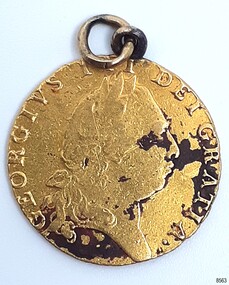
... name or initials. Some have scalloped edges, some have dates that are different to the original dates of issue, and some even have text in Latin that translates as something very different to the original coin....name or initials. Some have scalloped edges, some have dates that are different to the original dates of issue, and some even have text in Latin that translates as something very different to the original coin. ...The coin was discovered by Julie Wilkins, a Victorian scuba diver who had already experienced more than 500 dives in Australia and overseas. She was holidaying in Peterborough, Victoria, and looking forward to discovering more about the famous Loch Ard ship, wrecked in June 1878 at Mutton Bird Island. The fast Glasgow-built clipper ship was only five years old when the tragedy occurred. There were 54 people on board the vessel and only two survived Julie's holiday photograph of Boat Bay reminds her of her most memorable dive. Submerged in the calm, flat sea, she was carefully scanning around the remains of the old wreck when, to her amazement, a gold coin and a small gold cross suddenly came up towards her. She excitedly cupped them in her hands, then stowed the treasures safely in her wetsuit and continued her dive. She soon discovered a group of brass carriage clock parts and some bottles of champagne. It was a day full of surprises. The items were easily recognisable, without any build-up of encrustations or concretion. Julie secretly enjoyed her treasures for twenty-four years then packed them up for the early morning train trip to Warrnambool. After a short walk to Flagstaff Hill Maritime Museum and Village, her photograph was taken as she handed over her precious find. She told her story to a local newspaper reporter, lunched a café in town then took the late afternoon train home. Her generous donation is now part of a vast collection of Loch Ard shipwreck artefacts, including the gold watch and the Minton Majolica model peacock. The coin is a British 1793 George III Gold Spade Guinea. It was already 83 years old when the Loch Ard had set sail. The loop and ring have been added, perhaps as a pendant, pocket watch accessory or similar purpose. It may have been worn for ‘good luck’ on the long journey to Australia, where ships had to carefully navigate the treacherous Bass’s Strait before arriving at their destination of Melbourne. Sadly, many met their fate on that short stretch of ocean aptly named the Shipwreck Coast. The coin is very recognisable even though it was exposed to the wrecking of the ship, its consequent movement, and the sea's turbulence. Its bent, scratched, buckled, split, dinted and worn condition is part of its story. The red-brown-black discolouration is similar to that found on other gold coins, sometimes called the ‘corrosion phenomena’. Studies suggest the possible cause is contaminants in the minting process reacting to the coins’ environment. The GEORGE III GOLD SPADE GUINEA: - The British Guinea was introduced in 1663 and was circulated until 1814. It was made of 22 carat gold, was 25 to 26 cm in diameter and weighed 8.35 grams. It had a value of 21 British shillings. The guinea coin ceased circulation after 1816 and was replaced by the one-pound note. However, the term ‘guinea’ continued to represent 21 shillings. King George (1738-1820) had six gold guinea designs minted during his reign from 1760 and 1820. Each of the six had different obverse portraits, all facing the right. There were three different reverse sides. The Spade Guinea was the fifth issue of the coin, introduced in 1787 and produced until 1799. The reverse shows a royal crown over a flat-topped shield with the Royal Arms of Great Britain, used in Scotland between 1714 and 1800. The shield images are, from left to right, top to bottom, the Arms of England and Scotland, the Arms of France, the Arms of Ireland, and the Arms of the House of Hanover. The Gold Guinea is also part of Australia’s history. It was the first coin mentioned in the announcement of Governor King of New South Wales his Australian Proclamation of a limited variety and denomination of coins accepted for use in the Australian Colony. The historic and decorative George III Spade Guinea has been reproduced for special collections of coins. However, replicas and imitations have also been made as souvenirs for tourists, as gaming tokens and chips for gamblers, and as ‘fake’ coins for profit. These coins differ in many ways; they may be only half the weight of the genuine coin. Often have a small stamp on the obverse with “COPY” or the manufacturer’s name or initials. Some have scalloped edges, some have dates that are different to the original dates of issue, and some even have text in Latin that translates as something very different to the original coin.The King George III Guinea was only produced from 1663 to 1814 and was the first English coin to be mechanically minted. The coin is the fifth edition of the King George III Guinea, the Spade Guinea, was only produced between 1787 and 1799. It is the only edition with this portrait of King George and the only one with the Royal Coat of Arms of Great Britain in Scotland on the reverse side. This edition was also the last guinea in circulation, because the sixth edition was reserved as the Military guinea. This edition of the Guinea is unique; This coin is the only guinea in our collection. It was minted in 1793, so it is now over 230 years old. The Gold Guinea is part of Australia’s history; it was the first coin in the list of coins for use in the Australian Colonies, mentioned by Governor King of New South Wales in his Australian Proclamation speech of 1800. The George III Spade Guinea was included in the Limited Edition Sherwood 12 Coin Collection of Notable Coinage of Australia. This coin is the only known guinea coin recovered from the wreck of the Loch Ard. It was already 85 years old when the ship was wrecked.Gold coin; British. 1793, King George III of the United Kingdom of Great Britain and Ireland (1760-1820), Spade Guinea. Yellow gold coin with gold metal loop mount and a gold ring through the loop. The design is the fifth issue of the George III Gold Guinea. The obverse relief is a portrait of George III facing right. Reverse relief is a crown above the Coats of Arms (1801-1816) of flat top spade-shaped shield divided into four quadrants that depict crowned lions, fleur de lies, a harp. These images are identified as, from left to right, top to bottom, England and Scotland, France, Ireland and Hanover. Inscriptions are minted around the rims of each side. The coin is dated 1793. Its surface has dark areas on both sides and the reed edge and surfaces are well worn. The loop mount is bent and the ring is buckled. The coin was recovered from the wreck of the ship Loch Ard.Obverse text; 'GEORGIVS III DEI GRATIA' (translates to George the Third, by the Grace of God) Obverse relief; (King George III bust, facing right, laurel wreath on head) Reverse text; 'M.B.E.ET.H.REX.F. D.B.ET.L.D. S.R.I.A.T.ET.E' '1793' (translates to: King of Great Britain, France and Ireland, Defender of the Faith, Duke of Brunswick and Lüneburg, Arch-Treasurer and Elector of the Holy Roman Empire) Reverse relief; a spade-shaped image i.e. (Crown with fleer de lies, above Shield with crowned lions in different postures, a harp, and other details)flagstaff hill maritime museum and village, warrnambool, great ocean road, shipwreck coast, royal mint, british coin, currency, guinea, military guinea, australian currency, british guinea, gold coin, spade guinea, king george iii, george iii, fifth portrait, arms of england and scotland, arms of france, arms of ireland, arms of the house of hanover, coins, gold coins, gold medallion, georgian era, 1793, numismatics, contamination phenomena, gold corrosion, good luck, lucky charm, pendant, lucky coin, trade, loch ard, wreck of the loch ard, 1878, mutton bird island, peterborough, scuba diver, 1980s, guinea coin, gold guinea, shipwreck artefact, relic, julie wilkins -
 Flagstaff Hill Maritime Museum and Village
Book - Reference Book Victorian Flora, Ferdinand Mueller, The Plants Indigenous To The Colony of Victoria Vol 2, 1864-1865
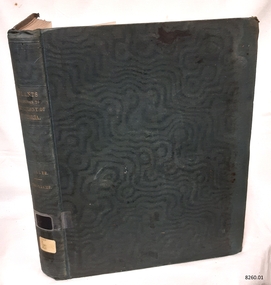
... Mueller catalogued, named, and provided comprehensive Latin and English descriptions of these native Victorian plants. ...Mueller catalogued, named, and provided comprehensive Latin and English descriptions of these native Victorian plants. ...The Plants Indigenous to the Colony of Victoria is a landmark botanical work by Australia’s prominent colonial botanist, Baron Ferdinand von Mueller. However, there is a common point of confusion in Australian botanical bibliography regarding the "volumes" of this specific work. To understand what Volume 1 and the other three volumes are about, and how they differ from each other in the four-book set, it helps to look at exactly how Mueller’s project was published. Volume 1 represents Mueller's highly detailed, beautifully illustrated standalone success covering the Thalamiflorae. It differs from the subsequent "volumes" because Volume 2 was abandoned as a rare, 40-page unfinished fragment, and Volumes 3 and 4 were never written, as Mueller pivoted to assist with the broader Flora Australiensis.The Plants Indigenous To The Colony of Victoria Vol 2 Author: Ferdinand Mueller Publisher: John Ferres Government Printer Melbourne Date: 1864-1865 Further Information: Blue patterned front cover and spine with gilt lettering to spine and Library labels non-fictionThe Plants Indigenous to the Colony of Victoria is a landmark botanical work by Australia’s prominent colonial botanist, Baron Ferdinand von Mueller. However, there is a common point of confusion in Australian botanical bibliography regarding the "volumes" of this specific work. To understand what Volume 1 and the other three volumes are about, and how they differ from each other in the four-book set, it helps to look at exactly how Mueller’s project was published. Volume 1 represents Mueller's highly detailed, beautifully illustrated standalone success covering the Thalamiflorae. It differs from the subsequent "volumes" because Volume 2 was abandoned as a rare, 40-page unfinished fragment, and Volumes 3 and 4 were never written, as Mueller pivoted to assist with the broader Flora Australiensis.flagstaff hill, warrnambool, shipwrecked coast, flagstaff hill maritime museum, maritime museum, shipwreck coast, flagstaff hill maritime village, great ocean road, book, pattison collection, warrnambool library, warrnambool mechanics’ institute, ralph eric pattison, corangamite regional library service, warrnambool city librarian, mechanics’ institute library, victorian library board, warrnambool books and records, warrnambool children’s library -
 Flagstaff Hill Maritime Museum and Village
Book - Reference Book Dictionary, William Smith et al, Latin-English Dictionary, 1871
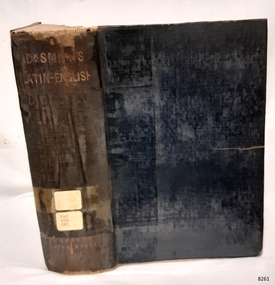
... By 1871, the John Murray name carried strong prestige in serious non-fiction and scholarly publishing. This work is significant, though mainly within classical scholarship and Latin instruction rather than general literature. ...This 1871 English-Latin dictionary by William Smith and Theophilus D. Hall is a reference work for translating English words and phrases into Latin, with definitions, usage notes and classical examples to guide correct classical Latin style. It is not a narrative book; it is a scholarly language tool designed for students, teachers and translators.Latin-English Dictionary Author: William Smith Publisher: John Murray Date: 1871 Further Information: Black front cover and brown Spine with gilt lettering and library reference label. non-fictionThis 1871 English-Latin dictionary by William Smith and Theophilus D. Hall is a reference work for translating English words and phrases into Latin, with definitions, usage notes and classical examples to guide correct classical Latin style. It is not a narrative book; it is a scholarly language tool designed for students, teachers and translators.flagstaff hill, warrnambool, shipwrecked coast, flagstaff hill maritime museum, maritime museum, shipwreck coast, flagstaff hill maritime village, great ocean road, book, pattison collection, warrnambool library, warrnambool mechanics’ institute, ralph eric pattison, corangamite regional library service, warrnambool city librarian, mechanics’ institute library, victorian library board, warrnambool books and records, warrnambool children’s library, latin-english dictionary, william smith -
 Flagstaff Hill Maritime Museum and Village
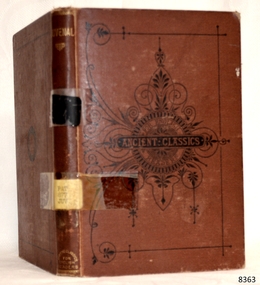
Book - Reference Book / Classics, Rev. W. Lucas Collins, Juvenal, 1872
... named Edward Walford, M.A. The book is an introduction to Juvenal (Decimus Iunius Iuvenalis), a famous Roman poet active in the late 1st and early 2nd centuries AD. Juvenal is renowned for his Satires, which fiercely attacked the corruption, decadence, vice, and hypocrisy of Roman society under the Empire. In line with the rest of the series, this volume provides a translated, summarized, and curated overview of Juvenal's work. Because Juvenal's raw, unedited Latin ...The subject book is a specific volume from a highly popular Victorian series called "Ancient Classics for English Readers." While Rev. W. Lucas Collins was the overarching editor of the entire 28-volume series (which explains why his name is prominently attached to it), the specific volume on Juvenal published in 1872 was actually written by a scholar named Edward Walford, M.A. The book is an introduction to Juvenal (Decimus Iunius Iuvenalis), a famous Roman poet active in the late 1st and early 2nd centuries AD. Juvenal is renowned for his Satires, which fiercely attacked the corruption, decadence, vice, and hypocrisy of Roman society under the Empire. In line with the rest of the series, this volume provides a translated, summarized, and curated overview of Juvenal's work. Because Juvenal's raw, unedited Latin can be incredibly explicit and vulgar, the Victorian authors heavily sanitized ("bowdlerized") the text, smoothing over the more scandalous elements to make his brilliant satire safe for a general English audience.Juvenal Author: Edward Walford, M.A. Editor:Rev. W. Lucas Collins Publisher: William Blackwood & Sons Date: 1872non-fictionThe subject book is a specific volume from a highly popular Victorian series called "Ancient Classics for English Readers." While Rev. W. Lucas Collins was the overarching editor of the entire 28-volume series (which explains why his name is prominently attached to it), the specific volume on Juvenal published in 1872 was actually written by a scholar named Edward Walford, M.A. The book is an introduction to Juvenal (Decimus Iunius Iuvenalis), a famous Roman poet active in the late 1st and early 2nd centuries AD. Juvenal is renowned for his Satires, which fiercely attacked the corruption, decadence, vice, and hypocrisy of Roman society under the Empire. In line with the rest of the series, this volume provides a translated, summarized, and curated overview of Juvenal's work. Because Juvenal's raw, unedited Latin can be incredibly explicit and vulgar, the Victorian authors heavily sanitized ("bowdlerized") the text, smoothing over the more scandalous elements to make his brilliant satire safe for a general English audience.flagstaff hil, warrnambool, flagstaff hill maritime museum, maritime museum, shipwreck coast, flagstaff hill maritime village, great ocean road, book, pattison collection, warrnambool library, warrnambool mechanics’ institute, ralph eric pattison, corangamite regional library service, warrnambool city librarian, mechanics’ institute library, victorian library board, warrnambool books and records, warrnambool children’s library, juvenal, lucas collins -
 Flagstaff Hill Maritime Museum and Village
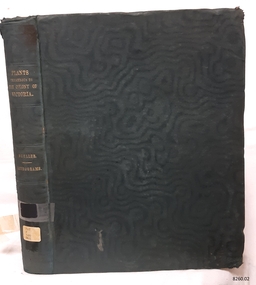
Book - Reference Book Victorian Flora, Ferdinand Mueller, The Plants Indigenous To The Colony of Victoria Vol 1, 1864-1865
... Mueller catalogued, named, and provided comprehensive Latin and English descriptions of these native Victorian plants. ...Mueller catalogued, named, and provided comprehensive Latin and English descriptions of these native Victorian plants. ...The Plants Indigenous to the Colony of Victoria is a landmark botanical work by Australia’s prominent colonial botanist, Baron Ferdinand von Mueller. However, there is a common point of confusion in Australian botanical bibliography regarding the "volumes" of this specific work. To understand what Volume 1 and the other three volumes are about, and how they differ from each other in the four-book set, it helps to look at exactly how Mueller’s project was published. Volume 1 represents Mueller's highly detailed, beautifully illustrated standalone success covering the Thalamiflorae. It differs from the subsequent "volumes" because Volume 2 was abandoned as a rare, 40-page unfinished fragment, and Volumes 3 and 4 were never written, as Mueller pivoted to assist with the broader Flora Australiensis.The Plants Indigenous To The Colony of Victoria Vol 1 Author: Ferdinand Mueller Publisher: John Ferres Government Printer Melbourne Date: 1864-1865 Further Information: Blue patterned front cover and spine with gilt lettering to spine and Library labels non-fictionThe Plants Indigenous to the Colony of Victoria is a landmark botanical work by Australia’s prominent colonial botanist, Baron Ferdinand von Mueller. However, there is a common point of confusion in Australian botanical bibliography regarding the "volumes" of this specific work. To understand what Volume 1 and the other three volumes are about, and how they differ from each other in the four-book set, it helps to look at exactly how Mueller’s project was published. Volume 1 represents Mueller's highly detailed, beautifully illustrated standalone success covering the Thalamiflorae. It differs from the subsequent "volumes" because Volume 2 was abandoned as a rare, 40-page unfinished fragment, and Volumes 3 and 4 were never written, as Mueller pivoted to assist with the broader Flora Australiensis.flagstaff hill, warrnambool, shipwrecked coast, flagstaff hill maritime museum, maritime museum, shipwreck coast, flagstaff hill maritime village, great ocean road, book, pattison collection, warrnambool library, warrnambool mechanics’ institute, ralph eric pattison, corangamite regional library service, warrnambool city librarian, mechanics’ institute library, victorian library board, warrnambool books and records, warrnambool children’s library -
 Flagstaff Hill Maritime Museum and Village
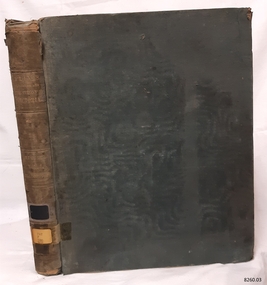
Book - Reference Book Victorian Flora, Ferdinand Mueller, The Plants Indigenous To The Colony of Victoria Vol 3, 1864-1865
... Mueller catalogued, named, and provided comprehensive Latin and English descriptions of these native Victorian plants. ...Mueller catalogued, named, and provided comprehensive Latin and English descriptions of these native Victorian plants. ...The Plants Indigenous to the Colony of Victoria is a landmark botanical work by Australia’s prominent colonial botanist, Baron Ferdinand von Mueller. However, there is a common point of confusion in Australian botanical bibliography regarding the "volumes" of this specific work. To understand what Volume 1 and the other three volumes are about, and how they differ from each other in the four-book set, it helps to look at exactly how Mueller’s project was published. Volume 1 represents Mueller's highly detailed, beautifully illustrated standalone success covering the Thalamiflorae. It differs from the subsequent "volumes" because Volume 2 was abandoned as a rare, 40-page unfinished fragment, and Volumes 3 and 4 were never written, as Mueller pivoted to assist with the broader Flora Australiensis.The Plants Indigenous To The Colony of Victoria Vol 1 Author: Ferdinand Mueller Publisher: John Ferres Government Printer Melbourne Date: 1864-1865 Further Information: Blue patterned front cover and spine with gilt lettering to spine and Library labels non-fictionThe Plants Indigenous to the Colony of Victoria is a landmark botanical work by Australia’s prominent colonial botanist, Baron Ferdinand von Mueller. However, there is a common point of confusion in Australian botanical bibliography regarding the "volumes" of this specific work. To understand what Volume 1 and the other three volumes are about, and how they differ from each other in the four-book set, it helps to look at exactly how Mueller’s project was published. Volume 1 represents Mueller's highly detailed, beautifully illustrated standalone success covering the Thalamiflorae. It differs from the subsequent "volumes" because Volume 2 was abandoned as a rare, 40-page unfinished fragment, and Volumes 3 and 4 were never written, as Mueller pivoted to assist with the broader Flora Australiensis.flagstaff hill, warrnambool, shipwrecked coast, flagstaff hill maritime museum, maritime museum, shipwreck coast, flagstaff hill maritime village, great ocean road, book, pattison collection, warrnambool library, warrnambool mechanics’ institute, ralph eric pattison, corangamite regional library service, warrnambool city librarian, mechanics’ institute library, victorian library board, warrnambool books and records, warrnambool children’s library -
 Flagstaff Hill Maritime Museum and Village
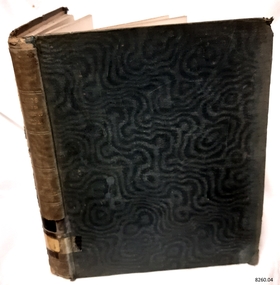
Book - Reference Book Victorian Flora, Ferdinand Mueller, The Plants Indigenous To The Colony of Victoria Vol 4, 1864-1865
... Mueller catalogued, named, and provided comprehensive Latin and English descriptions of these native Victorian plants. ...Mueller catalogued, named, and provided comprehensive Latin and English descriptions of these native Victorian plants. ...The Plants Indigenous to the Colony of Victoria is a landmark botanical work by Australia’s prominent colonial botanist, Baron Ferdinand von Mueller. However, there is a common point of confusion in Australian botanical bibliography regarding the "volumes" of this specific work. To understand what Volume 1 and the other three volumes are about, and how they differ from each other in the four-book set, it helps to look at exactly how Mueller’s project was published. Volume 1 represents Mueller's highly detailed, beautifully illustrated standalone success covering the Thalamiflorae. It differs from the subsequent "volumes" because Volume 2 was abandoned as a rare, 40-page unfinished fragment, and Volumes 3 and 4 were never written, as Mueller pivoted to assist with the broader Flora Australiensis.The Plants Indigenous To The Colony of Victoria Vol 1 Author: Ferdinand Mueller Publisher: John Ferres Government Printer Melbourne Date: 1864-1865 Further Information: Blue patterned front cover and spine with gilt lettering to spine and Library labels non-fictionThe Plants Indigenous to the Colony of Victoria is a landmark botanical work by Australia’s prominent colonial botanist, Baron Ferdinand von Mueller. However, there is a common point of confusion in Australian botanical bibliography regarding the "volumes" of this specific work. To understand what Volume 1 and the other three volumes are about, and how they differ from each other in the four-book set, it helps to look at exactly how Mueller’s project was published. Volume 1 represents Mueller's highly detailed, beautifully illustrated standalone success covering the Thalamiflorae. It differs from the subsequent "volumes" because Volume 2 was abandoned as a rare, 40-page unfinished fragment, and Volumes 3 and 4 were never written, as Mueller pivoted to assist with the broader Flora Australiensis.flagstaff hill, warrnambool, shipwrecked coast, flagstaff hill maritime museum, maritime museum, shipwreck coast, flagstaff hill maritime village, great ocean road, book, pattison collection, warrnambool library, warrnambool mechanics’ institute, ralph eric pattison, corangamite regional library service, warrnambool city librarian, mechanics’ institute library, victorian library board, warrnambool books and records, warrnambool children’s library -
Ringwood and District Historical Society
Diary, Charles Letts & Co. Diary House, Charles Letts Schoolboys Diary 1936 unused and no name, 1936
... Schoolboy's 1936 diary containing tables of Latin and French verbs, logarithms, trigonometry,university and school records, as well as the calendars, dates and other useful information. +Additional Keywords: Letts, Charles Charles Letts Schoolboys Diary 1936 unused and no name, Diary Charles Letts & Co. ...Schoolboy's 1936 diary containing tables of Latin and French verbs, logarithms, trigonometry,university and school records, as well as the calendars, dates and other useful information.Black covered diary with white lettering. Schoolboy's 1936 diary containing tables of Latin and French verbs, logarithms, trigonometry,university and school records, as well as the calendars, dates and other useful information. +Additional Keywords: Letts, Charles -
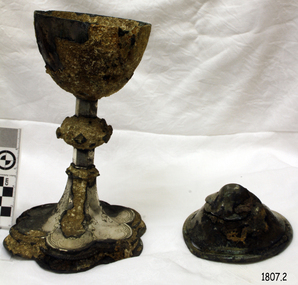 Flagstaff Hill Maritime Museum and Village
Ceremonial object - Ciborium and Lid, Before 1855
... In medieval Latin, and in English, "Ciborium" more commonly refers to a covered container used in Roman Catholic, Anglican, Lutheran and related churches to store the consecrated hosts of the sacrament of Holy Communion. It resembles the shape of a chalice but its bowl is more round than conical and takes its name...In medieval Latin, and in English, "Ciborium" more commonly refers to a covered container used in Roman Catholic, Anglican, Lutheran and related churches to store the consecrated hosts of the sacrament of Holy Communion. It resembles the shape of a chalice but its bowl is more round than conical and takes its name ...Ciborium is the ancient Greek word for the cup-shaped seed vessel of the Egyptian water lily "nelumbium speciosum" and came to describe a drinking cup made from that seed casing. These vessels were particularly common in ancient Egypt and the Greek East. The word "'ciborium'" was also used in classical Latin to describe such cups. In medieval Latin, and in English, "Ciborium" more commonly refers to a covered container used in Roman Catholic, Anglican, Lutheran and related churches to store the consecrated hosts of the sacrament of Holy Communion. It resembles the shape of a chalice but its bowl is more round than conical and takes its name from its cover, surmounted by a cross or other sacred design. This ciborium is part of a Communion Set that was recovered from the wreck of the Schomberg in 1975 after 120 years in the sea. Five years later during the cleaning of the ciborium, a diamond ring was found secreted in the underside of the ciborium's lid. This ring has since come to be called the Schomberg Diamond and is also on display as part of the Flagstaff Hill Museums Schomberg collection. In 1975, divers from Flagstaff Hill (Peter Ronald, former Director of Flagstaff Hill, Colin Goodall and Gary Hayden), found an ornate communion set at the Schomberg wreck site. The set comprised a jug, the ciborium, a chalice and a plate. The ciborium remained untouched for a number of years before restoration began and the marine growth was removed. In 1980 a piece of the lid broke off, revealing a glint of gold. As museum staff carefully examined the lid and removed marine growth, they found a diamond ring, which is currently on display in the Great Circle Gallery at Flagstaff Hill. The collection also holds ship fittings and equipment, personal effects, a lithograph, tickets as well as photographs from the Schomberg. ABOUT THE SCHOMBERG (October 6 to December 27, 1855)- When the ship Schomberg was launched in 1855, she was considered the most perfect clipper ship ever to be built. James Baine’s Black Ball Line had commissioned her for their fleet of passenger liners. The Aberdeen builders designed her to sail faster than the clippers designed the three-masted wooden clipper ship to be fast. The timber used for the diagonal planking was British oak with layers of Scottish larch. This luxury emigrant vessel was designed for superior comfort. She had ventilation ducts to provide air to the lower decks and a dining saloon, smoking room, library and bathrooms for the first-class passengers. The master for Schomberg’s maiden voyage was Captain ‘Bully’ Forbes. He drunkenly predicted at her launch that he would make the journey between Liverpool and Melbourne in 60 days. Schomberg departed Liverpool on 6 October 1855 with 430 passengers and 3000 tons of cargo including iron rails and equipment intended the build the Geelong Railway and a bridge over the Yarra from Melbourne to Hawthorn. The poor winds slowed Schomberg’s sail across the equator. She was 78 days out of Liverpool when she ran aground on a sand spit near Peterborough, Victoria, on 27 December; the sand spit and currents were not marked on Forbes’s map. The ship’s Chief Officer spotted the coastal steamer SS Queen at dawn and sent a signal. The master of the SS Queen approached the stranded vessel and all of Schomberg’s passengers safely disembarked.This ciborium is significant as an example of an item in common use in the mid-19th century that is still in use today. It is also important for it relationship with the famous Schomberg Diamond that was discovered by accident, hidden inside it. The ciborium is particularly significant in that along with other items from the wreck helped in part to have the legislation changed to protect shipwrecks, with far tighter controls being employed to oversee the salvaging of wreck sites around our coast. This salvaged item forms part of the Schomberg collection at Flagstaff Hill maritime museum. The collection as a whole is of historical and archaeological significance at a State level. Flagstaff Hill’s collection of artefacts from the Schomberg is also significant for its association with the Victorian Heritage Registered Schomberg shipwreck (VHR S 612). The collection is of additional significance because of the relationship between the objects salvaged, as together they help us to interpret the story of the Schomberg. The collection as a whole is historically significant for representing aspects of Victoria's maritime history and its potential to interpret social and historical themes from society at the time of the wreck.Silver engraved Ciborium or chalice with lid, part of the five-piece Communion Set. The chalice is a round cup with a long stem and a floral-shaped base with embossed decoration. It has a matching round lid that comes to a rounded apex on top. Engravings on chalice feature flowers and a Fleur-de-lis pattern.flagstaff hill, flagstaff hill maritime museum and village, warrnambool, maritime museum, maritime village, great ocean road, shipwreck coast, schomberg, 1855, clipper ship, james baines & co, black ball line, luxury ship, emigrant ship, captain forbes, bully forbes, ss queen, peterborough shipwreck, communion set, religious service, communion service, ceremonial service, mass, ciborium, chalice, schomberg diamond
