
Showing 69 items matching "letters patent"
-
 Supreme Court of Victoria Library
Letters Patent Parchment, Letters patent parchment for the knighthood of Sir William a'Beckett, 1853
... Letters Patent Parchment...Letters patent parchment for the knighthood of Sir William a'Beckett...Letters patent for Sir William a'Beckett, the granting of his knighthood...Letters patent for Sir William a'Beckett, the granting of his knighthood Parchment, black ink with illustrations, plus large wax seal with female figure Letters patent parchment for the knighthood of Sir William a'Beckett Letters Patent Parchment ...Parchment, black ink with illustrations, plus large wax seal with female figureLetters patent for Sir William a'Beckett, the granting of his knighthood -
 Glen Eira City Council History and Heritage Collection
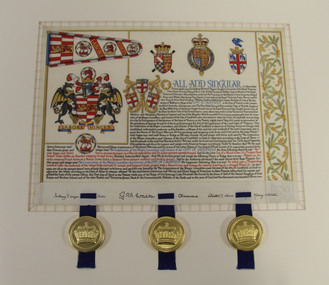
Letters Patent, Letters Patent for the Grant of Arms to the City of Caulfield presented on 1st May, 1977, 01/05/1977
... Letters Patent...Letters Patent for the Grant of Arms to the City of Caulfield presented on 1st May, 1977...The Council paid an additional sum to have a standard painted on the Letters Patent and the municipality's new coat of arms was drawn up in June 1975. ...Mounted Letters Patent illuminated document for the Grant of Arms to the City of Caulfield presented on 1st May, 1977. ...The Council paid an additional sum to have a standard painted on the Letters Patent and the municipality's new coat of arms was drawn up in June 1975. ...Glen Eira has a long history of association with various heraldic forms. From its early years the municipality of Caulfield had used the armorial bearings of the Caulfield Family (the Charlemonts of Castle Caulfield) to represent the roads board and later the town and city. In 1969 Caulfield City Council began planning to apply for an official coat of arms for the City. In 1974 Horace Hall, a Balwyn North resident and member of the Heraldry Society in London advised Council that the current usage was illegal, and that the Houston family, current owners of the Caulfield Arms could take legal action against Council for 'usurping their arms'. Mr Hall was commissioned to develop new heraldry for the City, and in conjunction with J. P. Brooke Little at the College of Arms, London, he prepared an acceptable design for Caulfield's Coat of Arms. The Council paid an additional sum to have a standard painted on the Letters Patent and the municipality's new coat of arms was drawn up in June 1975. The Coat of Arms retains a number of heraldic elements from the original Caulfield family insignia, including the dragons, the colours and the elements of the shield. The newly registered coat of arms and Letters Patent document for the granting of arms was presented at a civic service to mark the granting of armorial ensigns and the city banner to the City of Caulfield on the 1st May 1977. Significant elements of the coat of arms granted by these Letters Patent are as follows: The motto 'Labore Vinces' translates to 'By our labours we will conquer'. The helmet represents the rank of the owner. Public authorities are granted an esquire's helmet. The brickwork on the crest is a recognised emblem of local government. The Letters Patent also display a banner and a badge, both official symbols of the City of Caulfield. The badge, which is displayed on the banner as well as on its own, features a bridled horse. This represents the importance of racing, the Caulfield racecourse and the Caulfield cup to the municipality. These letters patent officially proclaim the granting of the coat of arms to the City of Caulfield. They are highly significant to the City of Glen Eira as they are the primary document that signifies the official and ceremonial heraldic powers of the Coat of Arms of the City of Caulfield. Mounted Letters Patent illuminated document for the Grant of Arms to the City of Caulfield presented on 1st May, 1977. Hand written and hand painted on cream coloured parchment using different coloured inks, mainly black, blue, red and gouache and gold paint. The bottom edge is folded up over itself approx. 45mm revealing the flesh side of the parchment, which displays black ink signatures and three sets of two horizontal slits that hold three blue ribbon. The ribbons support three wax seals in round, gold coloured metal cases held by the wax through slots in the casing. Although covered by the cap top, each wax seal within displays a different flag emblem with a crown on top, surrounded by a ring of text (difficult to read), noted when the cases were opened during conservation treatment. See attached transcription.arms, symbol, heraldry, glen eira, council, caulfield -
 Federation University Historical Collection
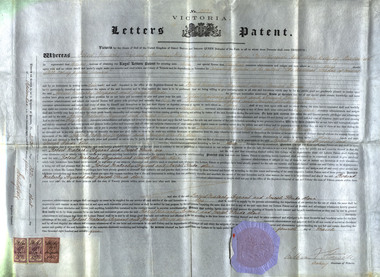
Document, Letters Patent for an Invention for Roasting Pyrites, 1875, 1875
... Letters Patent for an Invention for Roasting Pyrites, 1875...Letters Patent for an Invention for Roasting Pyrites to be called 'the Ballarat School of Mines Self-Acting Pyrites Furnace' to Robert Malachy Serjeant and Joseph Flude. ...Written on verso:
"Date of Patent 4th March 1875
No 2031
Letters Patent
for
An invention for roasting pyrities to be called "The Ballarat School of Mines Self-acting Pyrities Furnace"
to
Robert Malachy Serjeant
and Joseph Flude
Melbourne, Victoria...The document is signed by Acting-Governor William Stawell. Letters Patent for an Invention for Roasting Pyrites, 1875 Document ...R.M. Serjeant was listed as a mining manager and Joseph Flude as a metallurgist. In 1875 they were both living in Ballarat. The patent number is A.D.1875, 4th March. No 2031. According to the patent the hearth of the furnace is in the form of a cone revolving horizontally. The feed is supplied to the apex of the cone by an archimedian screw. The crown of the furnace comprises a double covering or roof with an intermediate chamber for receiving heated air. The inner covering is pierced to admit of the heated air being brought into contact with the pyrites on the face of the revolving hearth. The discharge of the roasted substance is affected by means of a scraper at the base of the cone. It was claimed that this was a new mode of introducing heated air, and the exclusion of flame during the operation of roasting pyrites. The self-acting charge and discharge of the furnace and the peculiar construction of the hot air chambers, and the use of perforated bricks through which the supply of air is affected were also new. (http://patentsvictoria.net/002031.html) From the Goulburn Herald, 14 September 1878 "A feature connected with the school of mines is the yet unfinished pyrites works. The extraction of the gold from pyrites and the utilization for commercial purposes of other substances connected with pyrites are peculiarly important to Ballarat, because were a simple and inexpensive method devised there are millions and millions of tons of quartz that would then be made remunerative. With this thought in their minds two scientific gentlemen invented the school of mines self-acting rotatory furnace. This, for lack of funds, has not been completed as yet, but the amount in hand for the purpose is daily increasing, and it will eventually be an accomplished fact. It is in contemplation also to erect machinery shops in connection with the school, and it is purposed to con struct a steam-engine to do at once the work of the pyrites treatment and the ma chine room. A model shaft and mine too are being prepared for on the reserve, so that practical mining of the most thorough character may be taught on the ground.'Letters Patent for an Invention for Roasting Pyrites to be called 'the Ballarat School of Mines Self-Acting Pyrites Furnace' to Robert Malachy Serjeant and Joseph Flude. The large document is on a vellum type paper complete with stamps and seal. The document is signed by Acting-Governor William Stawell.Written on verso: "Date of Patent 4th March 1875 No 2031 Letters Patent for An invention for roasting pyrities to be called "The Ballarat School of Mines Self-acting Pyrities Furnace" to Robert Malachy Serjeant and Joseph Flude Melbourne, Victoriaballarat school of mines, serjeant, r.m. serjeant, robert m. serjeant, flude, joseph flude, richard gibbs, stawell, william stawell, pyrities furnace, philately, statute stamp, seal (victoria), ballarat school of mines self-acting pyrities furnace, ballarat school of mines self-acting pyrites furnace -
 Federation University Historical Collection
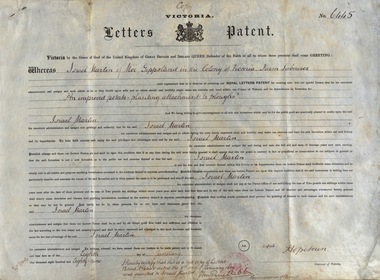
Document, Letters Patent, No 6445, to Israel Martin in 1889, 1889
... Letters Patent, No 6445, to Israel Martin in 1889......letters patent...Information filled in by hand Letters Patent, No 6445, to Israel Martin in 1889 Document Document ...Israel Martin of Moe Gippsland, farm labourer was wishing to patent an improved potato-planting attachment to ploughsThick cream coloured paper. Information filled in by handSigned: Hopetoun - Governor of Victoria. Also by the Commissioner of Patentsisrael martin, letters patent, moe, gippsland, farm labourer, potato planting attachment, hopetoun, governor of victoria, agriculture -
 Geelong RSL Sub Branch
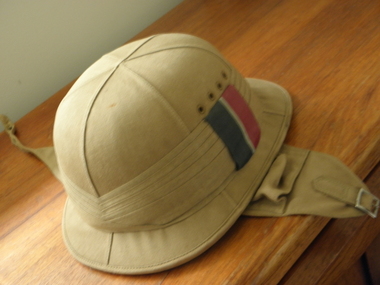
Pith Helmet, Early 20th Century
... Owen's Comfortilet Fitting Royal Letters Patent N0207475...Pith Helmet Owen's Comfortilet Fitting Royal Letters Patent N0207475 ...The helmet was used by Sgt Cane A. E.Royal Australian Air Force Pith Helmet WW2.Khaki pith helmet with khaki puggaree which has 5 pleats. One the pugaree is an oblong colour patch blue white red colours. The Pith Helmet has a cloth khaki band around the brim and 4 ventilation holes on each side of the helmet. This helmet has chin straps that also have ear protection when done up. On the back band of the helmet is a leather loop with a press stud.Inside the helmet handwritten numbers R18098 and 13745 name Cane A. E.khaki pith helmet field sgt a.e.cane -
 Flagstaff Hill Maritime Museum and Village
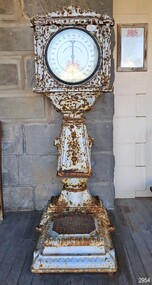
Instrument - Scale, Weighing Machine, G. Salter & Co, 1884-1909
... ...Letters Patent...Ltd was a large supplier of weighing scales in Australia and held the Royal Letters patent for their machines, distributing them in prominent locations. ...PTY LTD" Base of face, in red: "[Royal Coat of Arms of Britain]" with words, below in red: "BY ROYAL LETTERS PATENT" Around the face, in black: "[numbers 0 to 125, in increments 5, and makes between the numbers for each 500g]" "kg" Below the face, moulded letters within a shield: "AUSTRALASIAN AUTOMATIC WEIGHING MACHINES CO. ...British Royal Coat of Arms Royal Letters Patent Letters Patent health ending machine coin-operated machine Percival Everett Weighing Machine Co. ...This ornate, Victorian-era automatic weighing machine was made in England around 1884-1909, by George Salter and Co. of West Bromwich, UK, makers of scales since 1760. It is protected by Queen Victoria’s Royal Letters Patent, signed in 1900. The scale stood outside the Warrnambool Post Office in Timor Street from around 1909 to 1966, as shown on postcards and photographs held at the State Library of Victoria. The scale is identified by the Serial Number '665', and was installed by the distributors, the Australasian Automatic Weighing Machine Co. Ltd.. The scale’s weight measurements were in Imperial stones and pounds up to 20 stone (127 kg). The scale’s face included charts of average weights, for men, women, boys and girls, by various heights, in feet and inches. The coin slot and its face were converted to metric measurements by the Eastern Scale Company Pty. Ltd; that firm was registered on October 2, 1974. The Australasian Automatic Weighing Machine Co. Ltd was a large supplier of weighing scales in Australia and held the Royal Letters patent for their machines, distributing them in prominent locations. In 1902, the firm was listed under the Import Entries Passed at His Majesty’s Customs, importing into Sydney, NSW, eight cases of scales. In 1911, the company asked permission from the Port Pirie Corporation to install a machine in Alexander Street. In 1913, the company applied to the City of Sydney to install machines around the city, including at the tram depot. One application mentions “… three machines in three places for three pounds per year”. In 1923, the firm tendered for the right to place Automatic Weighing Machines on railway and tram premises throughout New South Wales, subsequently for five-year terms, in return for a fixed payment per machine and a portion of the revenue to the NSW Government. In 1928, the Sydney Harbour Trust gave the firm the right to place the weighing machines on various ferry jetties. The firm was still operating in 1941, advertising for two boys aged 14-16 for the workshop and messages, at the Rialto building, 497 Collins St., Melbourne. On December 21, 1946, the Commonwealth government invited offers to tender for the right to place automatic weighing machines on postal premises throughout the six states; the successful company then made arrangements with the federal Postmaster General's Department to place machines outside post offices across the country. A few years later, on September 11, 1950, the firm's Adelaide branch ceased trading. From 11th July 1950, the Australian and Eastern Engineering Company Pty. Ltd took over at the same premises, at 179 Pirie Street, Adelaide. The Perth branch ceased business in WA on July 6th, 1950. Percival Everitt invented and patented the automatic, coin-operated personal scale design. Everitt was a Norfolk-born engineer and regarded as the father of the coin-operated industry. As a young man in 1877, he invented a hay and corn pitcher, a turnip thinner in 1878 and an Automatic Travelling Anchor in 1880. But his fame came in 1883 with the first postcard-vending machine, over a hundred of which he distributed around London. In 1884, he patented one of his many inventions, the coin-operated scales for use in public places; for many people, it was their first exposure to coin-operated machines. His success prompted the formation of the Weighing Machine Company in 1885. Further inventions followed: a blow tester in 1887, the machine for testing a person's grip in 1888, and in 1889, the dispensing machine for hiring out opera glasses, and a device for shutting down the coin entry slot if the machine was empty. In 1890, he invented a fortune-telling machine. Everitt sadly did not make his fortune; he died suddenly in February 1893, in his late forties, with £71 to his name. George Salter & Co., West Bromwich, England, produced automatic weighing scale machines from Everitt’s patented design, and advertised them as suitable for hotels, pleasure gardens, theatres, exhibition halls, clubs, baths and places of public resort. The company was established in 1760 by brothers Richard and William Salter, and manufactured springs and pocket steelyards (spring balances). After several generations, the company was taken over in 1855 by a nephew, George, and renamed George Salter & Co. In 1884, Salter registered the trademark of a Staffordshire knot pierced by an arrow. The company's expanded range of products included the first coin-operated public weighing machines in the 1880s and, in 1895, the first English-made typewriter. In 1915, Salter became a limited company, Geo. Salter & Co. Ltd. When the last George Salter died in 1917, the company passed into the hands of other relatives, but continued to grow before being bought out by Staveley Industries in 1973. Despite several subsequent mergers, the Salter name continues to be seen on household products such as digital scales. This patented, coin-operated weight machine is significant for its association with Percival Everitt, the inventor of the world’s first slot machine, with the renowned maker of scales, G. Salter & Co., which began operating in 1760, and also with the Australasian Automatic Weighing Scale Co., which imported and widely distributed the scales throughout Australia from the early-to-mid 20th century. It is a rare example of an early vending machine used in public places from the late 19th through to the mid-20th century. These machines were the early step in the evolution of coin-in-the-slot machines, which are still used today. The scales give a glimpse into our history; they became quickly popular with the public, which, until then, had little access to weight scales apart from those at medical services. They also provided inexpensive entertainment for families, especially while waiting for trains or visiting the post office. The machines were also attractive and lucrative to the distributors; once installed, they required very little maintenance, and their low cost to customers kept the money coming in. This automatic weighing machine is also significant for its decades of service to the local and regional community of Warrnambool, for personal and commercial purposes. A public coin-operated weighing scale, also called a penny scale. It is a large, silver-painted cast metal stand with a square top on a pedestal that flares outwards to join a rectangular platform base with posts on the side and corners that may have had fitted wheels. The round, white face on top has red and black measurements and inscriptions. A slim indicator with a point at one end and an arc at the other is attached to the face’s centre. The coin slot is above the face, on the left, and the scale’s identification number is engraved on an oval plate on the right. Moulded motifs decorate the pedestal’s front and are repeated on its sides; they depict a tall, narrow urn with a bowl on top and fancy scrolls on either side. There is a decorative panel across the front top of the stand. The top of the pedestal has a small keyhole. The size of the coin slot fitted a penny coin, and the weight measurements on the face were in Imperial stones and pounds. Quite some time after 1966, when Australia introduced new decimal weights, measurements and currency, the scale was updated; the coin slot size was changed, and a new face with metric measurements was installed. The scale now accepts a $1 coin (one dollar) and the scale measures weight in kilograms and grams, from 0 to 125 kg.. The rear of the scale has a small, rectangular metal plate with printed text. The scale was made by G Salter & Co. of West Bromwich, UK, distributed by the Australasian Automatic Weighing Platform Co., and updated to metric measurements by Eastern Scale Co. Pty Ltd. It was previously installed at the Warrnambool Post Office. Engraved on an oval plate on the right: "665" Top centre of the face, in red: "$1 coin" Top of face: "EASTERN SCALE CO. PTY LTD" Base of face, in red: "[Royal Coat of Arms of Britain]" with words, below in red: "BY ROYAL LETTERS PATENT" Around the face, in black: "[numbers 0 to 125, in increments 5, and makes between the numbers for each 500g]" "kg" Below the face, moulded letters within a shield: "AUSTRALASIAN AUTOMATIC WEIGHING MACHINES CO. LTD." At the back of the weighing platform: "G SALTER & CO. / WEST BROMWICH", remnants of logo “[Staffordshire knot pierced by an arrow]” Plate on rear: THIS SCALE REMAINS THE PROPERTY OF EASTERN SCALE CO. PTY. LTD., 8 GEORGE COURT, GREENSBOROUGH, VIC, 3088. PHONE (03 ) _ 34 _ _ 33” (434 9333 ?_flagstaff hill, warrnambool, maritime village, maritime museum, flagstaff hill maritime museum and village, shipwreck coast, great ocean road, scale, weighing scale, salter, australasian, 1 dollar, $1 coin, 1p, 1 penny coin, penny scale, coin in slot scale, eastern scale co. pty. ltd., british royal coat of arms, royal letters patent, letters patent, health, ending machine, coin-operated machine, percival everett, weighing machine co., george salter & co., g salter & co, west bromwich, vending machine, weights & balances, measurements, slot machine, coin operated machine, penny-in-the-slot, coin fed, coin op scale, weights & measures, australasian automatic weighing machine co. ltd., warrnambool post office, machine 665, no. 665, blalnce technology, scales and weights, weights and measures, penny weight scales, vintage, weighing machine, coin in the slot, coin operated, public scale, public weighing machine, penny-weighing machines, penny weighing machines, penny scales, coin operated weighing machine, scale weighing machine -
 Bayside Gallery - Bayside City Council Art & Heritage Collection
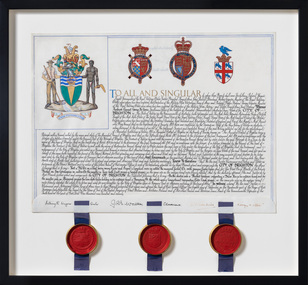
Document - Certificate, College of Arms, City of Brighton Coat of Arms, 1970
... ...Letters Patent...Coat of arms certificate City of Brighton College of Arms Market Gardener Aboriginal Wax seal Elster Creek Lymphad Fructu Noscitur Letters Patent Armorial Bearings Heraldry Seal Ink and gouache on parchment with wax seals. ...The Coat of Arms, represents Brighton City Council's "growing awareness of the importance of formality and correct symbolism in local government". It replaced the council's crest of a pier and yachting scene and was used as council's seal, and emblem on its flag and letterhead. The new Coat of Arms, drawn up by the College of Arms in England, depicts the progression from a seaside gardening community to a modern residential city. The prominent forms are on the shield-like coat of arms include waves and a Lymphad (a ship, symbolic of the sea); a market gardener; an aboriginal man; two horns plenty with abundant fruit and vegetables (the wealth and plenty) and Elster Creek. It is underscored by the motto 'By their fruits, ye shall know them'. Brighton was first incorporated as a borough on 18 January 1859, it became a town on 18 March 1887 and was proclaimed a city on 12 March 1919.Ink and gouache on parchment with wax seals. Allocates a Coat of Arms to the City of Brighton, by the College of Arms in London on 08/09/1970. The Coat of Arms is located on the upper left quadrant and has the following parts: the crest, the wreath, the helmet and mantle, the shield, the supporters, the compartment and the motto. The crest is two cornucopias with fruits and vegetables, above which sits a seagull. The mantle above the helmet is in green and gold. The shield is also green and gold with a lymphad (ship), and blue and white waves, representing the sea. The market gardener, holding a hoe, and Aboriginal figure, bearing a boomerang, support the shield and stand upon the compartment which is soil with a representation of Elster Creek. A ribbon below contains the motto in 'FRUCTU NOSCITUR'. The certificate text explains the origins of Brighton and the parts of the coat of arms. At the bottom of the folded parchment are three signatures and titles, below which three red wax seals in gold tin containers hang from blue ribbons.coat of arms, certificate, city of brighton, college of arms, market gardener, aboriginal, wax seal, elster creek, lymphad, fructu noscitur, letters patent, armorial bearings, heraldry, seal -
 Learmonth and District Historical Society Inc.
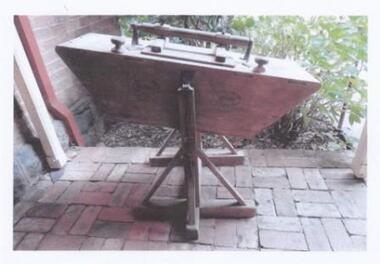
Washing Machine, Circa 1876
... F.WOLTER & ECHBERG"S PATENT WASHING MACHINE .NO 2955. 6 RUSSELL STREET MELBOURNE.ROYAL LETTERS PATENT GRANTED 1876....This is an early example of a mechanical device for washing of clothes. washing machine 1876.household appliance F.WOLTER & ECHBERG"S PATENT WASHING MACHINE .NO 2955. 6 RUSSELL STREET MELBOURNE.ROYAL LETTERS PATENT GRANTED 1876. This Washing Machine is made of wood and the main barrel part is a rectangular shaped box with slopping sides.On the top is the lid and a handle.It is set on a stand which allowes it to be used with a rocking motion. ...This is an early example of a mechanical device for the washing of clothes.It worked on a rocking motion making the chore of washday easier for the housewife.This is an early example of a mechanical device for washing of clothes.This Washing Machine is made of wood and the main barrel part is a rectangular shaped box with slopping sides.On the top is the lid and a handle.It is set on a stand which allowes it to be used with a rocking motion.F.WOLTER & ECHBERG"S PATENT WASHING MACHINE .NO 2955. 6 RUSSELL STREET MELBOURNE.ROYAL LETTERS PATENT GRANTED 1876.washing machine 1876.household appliance -
 Flagstaff Hill Maritime Museum and Village
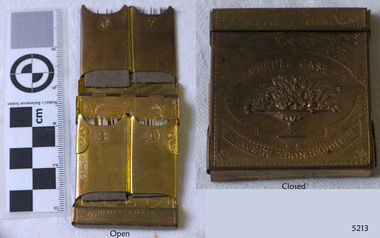
Needle Case
... Inscribed on Needle Case W.Avery & Son Redditch. By Royal letters patent, The Louise Needle Case. With floral embossing on case....Inscribed on Needle Case W.Avery & Son Redditch. By Royal letters patent, The Louise Needle Case. With floral embossing on case. ...Needle Case, brass with 4 different needle sections - size 6,7,8 and 9. Inscribed on Needle Case W.Avery & Son Redditch. By Royal letters patent, The Louise Needle Case. With floral embossing on case.flagstaff hill, warrnambool, shipwrecked-coast, flagstaff-hill, flagstaff-hill-maritime-museum, maritime-museum, shipwreck-coast, flagstaff-hill-maritime-village, needle case, brass needle case, the louise needle case -
 Mission to Seafarers Victoria
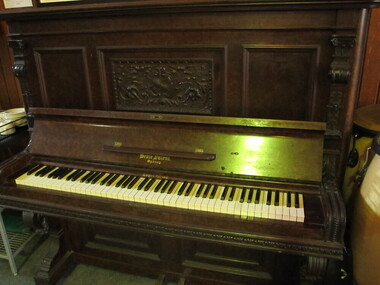
Instrument - Piano, Upright, c.1905
... Lid Royal letters patent coat of arms; inside workings stamped plaque: " The/ Beale-Vader / Steel-wirest-plank / patented / throughout / the world"...The piano was used it for entertainments and concerts including accompaniment of silent films in the 1920s. 21st century visiting seafarers whilst on shore at the Mission, still regularly play pieces such as popular tunes and classics. piano royal grand piano beale beale-vader music entertainment concerts lady northcote siddeley street seamen's mission alice northcote nee stephen reverend alfred gurney goldsmith Lid Royal letters patent coat of arms; inside workings stamped plaque: " The/ Beale-Vader / Steel-wirest-plank / patented / throughout / the world" A walnut case, full iron framed Upright Piano . ...The piano (Beale-Vader patented model) was donated on Thursday 19 December 1907 by Lady Northcote (Alice, wife of the Governor General of Australia) for the Siddeley Street Institute. The article in The Age dating Friday 20 December 1907: "Shortly after noon yesterday the Rey. A. Gurney Goldsmith, chaplain to the Victorian Missions to Seamen, who has just taken up residence at his quarters in the new Seamen's' Institute on the Yarra-bank, which was recently opened by his Excellence the Governor-General, was surprised at the receipt of a case of large dimensions. On opening it he found a grand piano, accompanied by a card, "With Lady Northcote's compliments." The pianoforte is one of Beale's make, and its presentation is another illustration of the determination of the vice-regal representatives in Australia to encourage local manufactures. It will be remembered that on the occasion of the opening of the institute an appeal was made to the public for a pianoforte and a billiard table. Lady Northcote has responded with the former, and it will be most useful in connection with the concerts which are given once a week to the, sailors of vessels coming up tho river. The question now arises as to who will provide the billiard table for the use of "Jack ashore," as one of the inducements for him, to visit the institute instead of' spending his spare time in the public house. "Governor Northcote and his wife had laid the foundation Stones of the first Central Institute on Siddeley street. The piano was used it for entertainments and concerts including accompaniment of silent films in the 1920s. 21st century visiting seafarers whilst on shore at the Mission, still regularly play pieces such as popular tunes and classics. A walnut case, full iron framed Upright Piano . See image details; decorative trims throughout, and identification plate inside. Screw holes indicate missing candle brackets or sconces on the two front panels.Lid Royal letters patent coat of arms; inside workings stamped plaque: " The/ Beale-Vader / Steel-wirest-plank / patented / throughout / the world"piano, royal grand piano, beale, beale-vader, music, entertainment, concerts, lady northcote, siddeley street, seamen's mission, alice northcote nee stephen, reverend alfred gurney goldsmith -
 Mont De Lancey
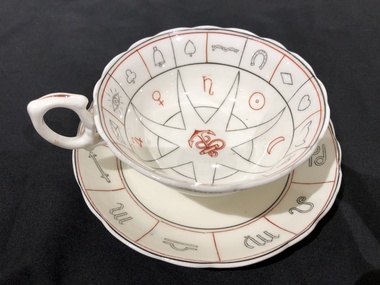
Cup & Saucer
... On cup - Would'st learn the future with thy tea this magic cup will show it thee On saucer - The "Nelros" Cup of Fortune Rd No 442928 By Royal Letters Patent...Used for reading people's fortunes tableware On cup - Would'st learn the future with thy tea this magic cup will show it thee On saucer - The "Nelros" Cup of Fortune Rd No 442928 By Royal Letters Patent Magic cup and saucer for reading people's fortunes, white china with red and grey symbols. ...Used for reading people's fortunesMagic cup and saucer for reading people's fortunes, white china with red and grey symbols.On cup - Would'st learn the future with thy tea this magic cup will show it thee On saucer - The "Nelros" Cup of Fortune Rd No 442928 By Royal Letters Patenttableware -
 Wodonga & District Historical Society Inc
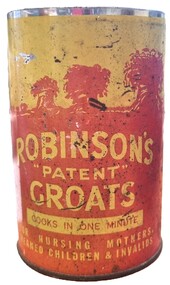
Domestic object - 'Robinson's (Patent) Groats', Reckitt & Colman (Australia) Ltd, 1930s - 1950s
... On front of container:- ROBINSON'S PATENT GROATS COOKS IN ONE MINUTE FOR NURSING MOTHERS WEANED CHILDREN & INVALIDS On Base 88 ROBINSON'S "PATENT" BARLEY AND "PATENT GROATS LETTERS PATENT GRANTED 1823 NOW EXPIRED 3 ...On front of container:- ROBINSON'S PATENT GROATS COOKS IN ONE MINUTE FOR NURSING MOTHERS WEANED CHILDREN & INVALIDS On Base 88 ROBINSON'S "PATENT" BARLEY AND "PATENT GROATS LETTERS PATENT GRANTED 1823 NOW EXPIRED 3 The packaging for this cereal is a red and yellow cardboard cylinder with a metal base and lid. ...Robinson's Patent Groats were a type of cereal product consisting of the hulled and crushed kernels of grains, likely oats or a similar cereal. They were marketed as a nutritious food, particularly for invalids, infants, and children. They were widely used throughout the 1930s until the 1950s. This container was produced after 1938 when the name "Reckitt & Colman Ltd" was adopted. Reckitt & Sons, a British manufacturer of household products, opened its first overseas business in Australia in 1886. In 1938, the British parent company, Reckitt & Sons, merged with J. & J. Colman (a mustard and food products business) to form Reckitt & Colman Ltd. This company then operated in Australia as Reckitt & Colman Australia Ltd. They traded as Colman-Keen (Australasia) Ltd, Australia in New Zealand until 1940. In 1995 the Colman’s brand was demerged from R & C and sold off to Unilever (UK) Ltd, then in 1999 the company merged with Benckiser NV to become Reckitt Benckiser which is now the largest supplier of cleaning products worldwide. This item is significant because it was used widely throughout Australia by mothers to improve nutrition of their children.The packaging for this cereal is a red and yellow cardboard cylinder with a metal base and lid. The label does not list specific ingredients. The 'Directions for use' give instructions on how to prepare gruel and porridge from the groats.On front of container:- ROBINSON'S PATENT GROATS COOKS IN ONE MINUTE FOR NURSING MOTHERS WEANED CHILDREN & INVALIDS On Base 88 ROBINSON'S "PATENT" BARLEY AND "PATENT GROATS LETTERS PATENT GRANTED 1823 NOW EXPIRED 3 reckitt & colman australia ltd. -
 Federation University Historical Collection
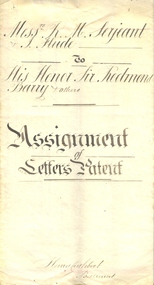
Document, Indenture Between Robert M. Serjeant, Joseph Flude and the Trustees of the Ballarat School of Mines regarding Letters of Patents for the Benefit of the Ballarat School of Mines, 1877, 04/03/1875
... Letters Patent for an Invention for Roasting Pyrites to be called 'the Ballarat School of Mines self-Acting Pyrites Furnace" to Robery Malachy Serjeant and Joseph Flude. ...patent for the benefit of the Ballarat School of Mines. Indenture Between Robert M. Serjeant, Joseph Flude and the Trustees of the Ballarat School of Mines regarding Letters of Patents for the Benefit of the Ballarat School of Mines, 1877 Document Document ...R.M. Serjeant was listed as a mining manager and Joseph Flude as a metallurgist. In 1875 they were both living in Ballarat. The patent number is A.D.1875, 4th March. No 2031. According to the patent the hearth of the furnace is in the form of a cone revolving horizontally. The feed is supplied to the apex of the cone by an archimedian screw. The crown of the furnace comprises a double covering or roof with an intermediate chamber for receiving heated air. The inner covering is pierced to admit of the heated air being brought into contact with the pyrites on the face of the revolving hearth. The discharge of the roasted substance is affected by means of a scraper at the base of the cone. It was claimed that this was a new mode of introducing heated air, and the exclusion of flame during the operation of roasting pyrites. The self-acting charge and discharge of the furnace and the peculiar construction of the hot air chambers, and the use of perforated bricks through which the supply of air is affected were also new. (http://patentsvictoria.net/002031.html) From the Goulburn Herald, 14 September 1878 "A feature connected with the school of mines is the yet unfinished pyrites works. The extraction of the gold from pyrites and the utilization for commercial purposes of other substances connected with pyrites are peculiarly important to Ballarat, because were a simple and inexpensive method devised there are millions and millions of tons of quartz that would then be made remunerative. With this thought in their minds two scientific gentlemen invented the school of mines self-acting rotatory furnace. This, for lack of funds, has not been completed as yet, but the amount in hand for the purpose is daily increasing, and it will eventually be an accomplished fact. It is in contemplation also to erect machinery shops in connection with the school, and it is purposed to con struct a steam-engine to do at once the work of the pyrites treatment and the ma chine room. A model shaft and mine too are being prepared for on the reserve, so that practical mining of the most thorough character may be taught on the ground.'Large indenture on red bordered vellum. The indenture was regarding a patent for the benefit of the Ballarat School of Mines. Letters Patent for an Invention for Roasting Pyrites to be called 'the Ballarat School of Mines self-Acting Pyrites Furnace" to Robery Malachy Serjeant and Joseph Flude. The large document is on a vellum type paper complete with stamps and seal. The document is signed by Acting-Governor William Stawell. Inscriptions and Markings Written on verso: "Date of Patent 4th March 1875 No 2031 Letters Patent for An invention for roasting pyrities to be called "The Ballarat School of Mines Self-acting Pyrities Furnace" to Robert Malachy Serjeant and Joseph Flude Melbourne, Victoriaballarat school of mines, serjeant, r.m. serjeant, robert m. serjeant, flude, joseph flude, patent, barry, redmond barry, rogers, judge rogers, bland, rivett henry bland, john airy, warrington rogers, establishment, indenture, legal, cuthbert, ballarat school of mines trustees, william stawell, john warrington rogers -
 Bendigo Historical Society Inc.
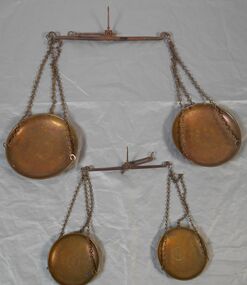
Equipment - Gold Scales
... 1 set gold scales small - complete - trays have ROYAL -His Majestys Letters Patent - 2 trays hanging off14cm top arm with balance needle at top- 2nd set of gold scales hang on a 23cm top arm with 2 trays suspended no marking on top or bottom. ...Gold Equipment Gold Scales Gold Mining History R175 written on top arm of big scales 1 set gold scales small - complete - trays have ROYAL -His Majestys Letters Patent - 2 trays hanging off14cm top arm with balance needle at top- 2nd set of gold scales hang on a 23cm top arm with 2 trays suspended no marking on top or bottom. ...1 set gold scales small - complete - trays have ROYAL -His Majestys Letters Patent - 2 trays hanging off14cm top arm with balance needle at top- 2nd set of gold scales hang on a 23cm top arm with 2 trays suspended no marking on top or bottom. Chains connect both sets of trays to top arms. Both appear to be brassR175 written on top arm of big scalesgold equipment, gold scales, gold mining history -
 Whitehorse Historical Society Inc.
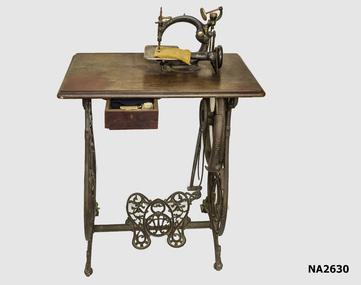
Machine - Sewing Machine, c1860s
... |En France|Eten Delgique|Under Royal Letters|Patent|James Willcox|July 4 - 71 [1871]...|En France|Eten Delgique|Under Royal Letters|Patent|James Willcox|July 4 - 71 [1871] Upright sewing machine. ...Willcox and Gibbs: Serial No. 158679.|The Willcox& Gibbs Sewing Machine Company was founded in 1857 by James E. A. Gibbs and James Willcox and opened its London Office in 1859 at 135 Regent Street . By 1871 the Company's Chief Office for Europe was at 150 Cheapside, London, this office was later moved (post 1885) to 94 - 96 Wigmore Street, then 37 & 39 Moorgate Street (by 1891 to post 1907) and later 20 Fore Street, London .Right from the initial production the manufacturing of the Company's single thread, chain stitch machine was undertaken by Brown & Sharpe, Rhode Island and this continued up until 1948.|A special hand crank mechanism was produced in England for the European market, but the general design of the Willcox& Gibbs remained essentially the same throughout its production. The only major improvement was in 1875 when the glass tension discs were replaced with an automatic tension device which ensured the machine could not get out of adjustment.|In addition to the domestic hand and treadle machines the company produced a wide range of industrial models.|The Company finally closed in 1973.|This Willcox& Gibbs came complete with its wooden carry case. The machine was made in America in the late 1860's but it has the ornate hand crank produced at Coalbrookdale near Telford, England which was, in Victorian times, renown for producing high quality ornate iron castings. This machine has the glass tension discs which were used on domestic models until 1875. The Willcox& Gibbs badge is located on the rear of the base casting and it also has a deep wooden base.|The cloth plate has various American patent dates, four dating between 1857 & 1860 relating to J. E. A. Gibbs, three dating between 1860 & 1864 relating to Chas H. Willcox (son of James Willcox), the machine was also licensed under five other patents including the infamous Elias Howe patent of 1846.|There are only two English patents one for J. E. A Gibbs and the other for James Willcox.Upright sewing machine. Machine is quite small and set on wooden table. Ornate metal sides and treadle feet. One drawer. Brass name medallion on back.Willcox & Gibb Sewing Machine co, New York.|Other inscriptions are :-|London, Paris|Measures|Thread type|Needle 12 stitches to inch|Brevettees G.D.G.|En France|Eten Delgique|Under Royal Letters|Patent|James Willcox|July 4 - 71 [1871]handcrafts, equipment -
 Tennis Australia
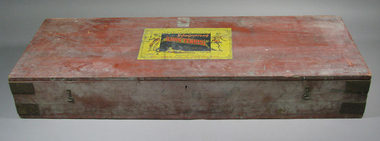
Chest, Lithograph, 1874
... Inscription across a lithographic print, featuring three Grecian maidens, adhered to the top of the lid, in English and Greek: BY/ROYAL LETTERS PATENT/SFAIRISTIKE/OR/LAWN TENNIS/PRICE TEN GUINEAS/CASH/INVENTOR'S AGENTS;/MESSRS. ...Inscription across a lithographic print, featuring three Grecian maidens, adhered to the top of the lid, in English and Greek: BY/ROYAL LETTERS PATENT/SFAIRISTIKE/OR/LAWN TENNIS/PRICE TEN GUINEAS/CASH/INVENTOR'S AGENTS;/MESSRS. ...An empty chest, with unhinged lid. Inscription across a lithographic print, featuring three Grecian maidens, adhered to the top of the lid, in English and Greek: BY/ROYAL LETTERS PATENT/SFAIRISTIKE/OR/LAWN TENNIS/PRICE TEN GUINEAS/CASH/INVENTOR'S AGENTS;/MESSRS. FRENCH & CO., 46 CHURTON STREET, LONDON. Printed sheet adhered to inside of lid provides price ranges. Materials: Wood, Metal, Ink, Glue, Paint, Papertennis -
 Flagstaff Hill Maritime Museum and Village
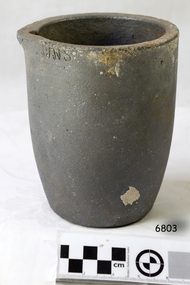
Functional object - Crucible, The Patent Plumbago Crucible Company, circa 1878
... The number “6” which is framed in a square. The letters “THE PATENT PLUMBAGO CRUCIBLE COMPANY” and “BATTERSEA WORKS COMPANY”. ...The shipwreck of the LOCH ARD is of State significance ― Victorian Heritage Register S417 flagstaff hill warrnambool shipwrecked-coast flagstaff-hill flagstaff-hill-maritime-museum maritime-museum shipwreck-coast flagstaff-hill-maritime-village graphite crucible plumbago crucible morgan's crucible company loch ard crucible fluxing pot The number “6” which is framed in a square. The letters “THE PATENT PLUMBAGO CRUCIBLE COMPANY” and “BATTERSEA WORKS COMPANY”. ...This crucible was raised from the wreck of the LOCH ARD. It is one of six similar relics, in a range of sizes, now in the Flagstaff Hill collection. All bear markings to indicate their manufacture by the Morgan brothers of Battersea, trading as the Patent Plumbago Crucible Co. A crucible is a container used for purifying and melting metals so that they can be cast in a mould to a predetermined shape and use. They must withstand extremely high temperatures, abrupt cooling, and shed their contents with minimal adherence. The addition of graphite to the traditional firing clays greatly enhanced the durability of industrial crucibles in mid-Victorian Britain, a significant technological advance at a time of great activity and expansion in foundries and demand for refined metals. The Morgans first noticed the advantages of graphite crucibles at the Great Exhibition held in London in 1851. Initially they contracted to be sole selling agents for the American-made products of Joseph Dixon and Co. from New Jersey, but in 1856 they obtained that firm’s manufacturing rights and began producing their own graphite crucibles from the South London site. The Morgans imported crystalline graphite in 4-5 cwt casks from the British colony of Ceylon (now Sri Lanka) and mixed it with conventional English (Stourbridge) clays to be fired in kilns. Their products were purchased by the Royal Mints in London and India, and exported to official mints in France and Germany. They were successful exhibitors of their crucibles and furnaces at the London Exhibition held in 1861 (Class 1, Mining, quarrying, metallurgy and mineral products, Exhibit 265, Patent Plumbago Crucible Co). The range of sizes represented by the six crucibles retrieved from the LOCH ARD, suggest they may have been part of a sample shipment intended for similar promotion in the Australian colonies ― at Melbourne’s International Exhibition to be held in 1880. A summary of the LOCH ARD cargo manifest, by Don Charlwood in ‘Wrecks and Reputations’ does not mention any crucibles, implying that they were not part of a larger consignment of uniform items. A newspaper account of an 1864 tour of the Morgan brothers’ ‘Black Potteries’ at Battersea indicates: “All the pots were numbered according to their contents, each number standing for one kilogram, or a little over two pounds; a No. 2 crucible contains two kilogrammes; a No. 3, three kilogrammes, and so on.” These numbers are obscured by marine sediment on three of the crucibles in the Flagstaff Hill collection, but those legible on the remaining three are 5, 6, and 8. None of the six are of the same size from a visual appraisal. The shipwreck of the LOCH ARD is of State significance ― Victorian Heritage Register S417A No. 6 size Morgan’s graphite crucible (i.e. 6kgs capacity). The crucible rises in a slight curve from a smaller flat base up to a wider top with a (chipped) pouring lip. It was recovered from the wreck of the LOCH ARD. The artefact is largely accretion free despite its long period of submersion at the wreck site. It has a number of visible maker’s markings which identify the manufacturer and the smelting capacity of the pot. The graphite crucible is in fair and stable condition. The number “6” which is framed in a square. The letters “THE PATENT PLUMBAGO CRUCIBLE COMPANY” and “BATTERSEA WORKS COMPANY”. Below rim "... GNS"flagstaff hill, warrnambool, shipwrecked-coast, flagstaff-hill, flagstaff-hill-maritime-museum, maritime-museum, shipwreck-coast, flagstaff-hill-maritime-village, graphite crucible, plumbago crucible, morgan's crucible company, loch ard, crucible, fluxing pot -
Federation University Historical Collection
Book, Royal Commission into National Natural Disaster Arrangements, 2020
... The Royal Commission was formally established on 20 February 2020 when the Governor-General, His Excellency General the Honourable David Hurley AC DSC (Retd) issued Letters Patent formally appointing the Royal Commission and outlining the terms of reference for its inquiry....The Royal Commission was formally established on 20 February 2020 when the Governor-General, His Excellency General the Honourable David Hurley AC DSC (Retd) issued Letters Patent formally appointing the Royal Commission and outlining the terms of reference for its inquiry. royal commission natural disaster bushfire mark binskin natural hazards australian defence force aerial aircraft evacuation planning emergency information abc air quality health wildlife heritage indigenous land management bushfire hazard reduction fuel management volunteers disaster recovery blue shield dja dja wurrung clans aboriginal corporation victorian farmers federation black summer Two volume report into National Natural Disaster Arrangements, including a volume of attachments. ...Two volume report into National Natural Disaster Arrangements, including a volume of attachments. This report is also known as the Bushfires Royal Commision. non-fictionroyal commission, natural disaster, bushfire, mark binskin, natural hazards, australian defence force, aerial, aircraft, evacuation planning, emergency information, abc, air quality, health, wildlife, heritage, indigenous land management, bushfire hazard reduction, fuel management, volunteers, disaster recovery, blue shield, dja dja wurrung clans aboriginal corporation, victorian farmers federation, black summer -
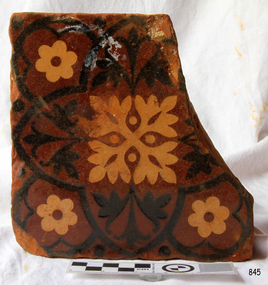 Flagstaff Hill Maritime Museum and Village
Ceramic - Tile, circa 1878
... On the back, or base, of the tile is inscribed the number “46” and the letters “Minton & Co Patent Stoke upon Trent”....The collection is also historically significant for its association with the LOCH ARD, which was one of the worst and best-known shipwrecks in Victoria’s history. flagstaff hill warrnambool shipwrecked coast flagstaff hill maritime museum maritime museum shipwreck coast flagstaff hill maritime village great ocean road loch line loch ard captain gibbs eva carmichael tom pearce glenample station mutton bird island loch ard gorge encaustic tile melbourne international exhibition floor tile Minton floor tile On the back, or base, of the tile is inscribed the number “46” and the letters “Minton & Co Patent Stoke upon Trent”. A square Minton floor tile with a black and apricot pattern against a chocolate brown background. ...This Minton floor tile is from the wreck of the LOCH ARD along with other examples of this manufacture recovered from the wreck site and form part of the collection at Flagstaff Hill. The iron-hulled clipper ship from the Loch Line was heading for Port Phillip from London when it ran into the cliffs of Mutton Bird Island near Port Campbell and was wrecked on June 1st, 1878. The LOCH ARD was laden with high-value cargo including luxury goods intended for display at the Melbourne International Exhibition in 1880. One notable survivor from the ship’s freight manifest was the well-packed Minton porcelain peacock, a two-metre-high ceramic masterpiece of vivid glazed colours. The almost total loss of life and property from the LOCH ARD registered as a shocking tragedy for the Colony of Victoria, at a time when social confidence and economic optimism were otherwise high. The wealth generated from Gold and Wool was increasingly being spent on grandiose private residences and imposing public buildings. The demand for quality furnishings and fittings was therefore strong. Among the products consigned to burgeoning colonial markets by the Milton Pottery at Stoke upon Trent, were their new range of colourfully patterned but very durable floor tiles – ideal for the high-traffic spaces in the large civic buildings then being constructed in Australia and America. These new floor tiles were “encaustic”, meaning that their designs and colours were encased “within” the depth of the tile. Rather than their decorative patterns being glazed onto the surface of the tile, their inlaid designs were created during the manufacturing process, as “coloured slips” (or liquid clay) were poured into a deep pre-moulded casting. When fired, the resulting tile was colour-fast and design-fast. A brief history of the Loch Ard (1873-1878): - The sailing ship Loch Ard was one of the famous Loch Line ships that sailed from England to Australia. Barclay, Curdle and Co. built the three-masted iron vessel in Glasgow in 1873. It had sailed three trips to Australia and one trip to Calcutta before its fateful voyage. Loch Ard left England on March 2, 1878, under the command of recently married, 29-year-old Captain Gibbs. It was bound for Melbourne with a crew of 37, plus 17 passengers. The general cargo reflected the affluence of Melbourne at the time. Onboard were straw hats, umbrellas, perfumes, clay pipes, pianos, clocks, confectionery, linen and candles, and a heavier load of railway irons, cement, lead and copper. Other cargo included items intended for display in the Melbourne International Exhibition of 1880. The Loch Ard had been sailing for three months and was close to its destination on June 1, 1878. Captain Gibbs had expected to see land at about 3 am but the Loch Ard ran into a fog that greatly reduced visibility and there was no sign of land or the Cape Otway lighthouse. The fog lifted at 4 am and the sheer cliffs of Victoria's west coast were much closer to them than Captain Gibbs expected. He tried to manage the vessel but failed and the ship struck a reef at the base of Mutton Bird Island, near Port Campbell. The top deck loosened from the hull, and the masts and rigging crashed down, knocking passengers and crew overboard. The lifeboat was launched by Tom Pearce but crashed into the side of Loch Ard and capsized. He clung onto its overturned hull and sheltered under it. He drifted out to sea and the tide brought him back to what is now called Loch Ard Gorge. He swam to shore and found a cave for shelter. A passenger, Eva Carmichael, had raced onto the deck to find out what was happening and was confronted by towering cliffs above the ship. She was soon swept off the ship by a huge wave. Eva saw Tom Pearce on a small rocky beach and yelled to attract his attention. He swam out and dragged her to the shelter of the cave. He revived her with a bottle of brandy from a case that had washed up on the beach. Tom scaled a cliff in search of help and followed some horse hoof prints. He came from two men from Glenample Station, three and a half miles away. He told the men of the tragedy and then returned to the gorge while the two men rode back to the station to get help. They reached Loch Ard Gorge and took the two shipwreck survivors to Glenample Station to recover. Eva stayed at the station for six weeks before returning to Ireland by steamship. In Melbourne, Tom Pearce received a hero's welcome and was presented with a medal and some money. Of the 54 crew members and passengers on board, only two survived: the apprentice, Tom Pearce and the young woman passenger, Eva Carmichael, who lost her family in the tragedy. One of the most unlikely pieces of cargo to have survived the shipwreck was a Minton porcelain peacock - one of only nine in the world. The peacock was destined for the Melbourne International Exhibition in 1880. It had been well packed, which gave it adequate protection during the violent storm. Today, the Minton peacock can be seen at the Flagstaff Hill Maritime Museum in Warrnambool. From Australia's most dramatic shipwreck, it has now become Australia's most valuable shipwreck artefact and is one of very few 'objects' on the Victorian State Heritage Register. The Minton floor tile is significant for its hard-wearing yet attractive design. The shipwreck of the LOCH ARD is of State significance. Victorian Heritage Register S417. Flagstaff Hill’s collection of artefacts from LOCH ARD is significant for being one of the largest collections of artefacts from this shipwreck in Victoria. It is significant for its association with the shipwreck, which is on the Victorian Heritage Register (VHR S417). The collection is significant because of the relationship between the objects, as together they have a high potential to interpret the story of the LOCH ARD. The LOCH ARD collection is archaeologically significant as the remains of a large international passenger and cargo ship. The LOCH ARD collection is historically significant for representing aspects of Victoria’s shipping history and its potential to interpret sub-theme 1.5 of Victoria’s Framework of Historical Themes (living with natural processes). The collection is also historically significant for its association with the LOCH ARD, which was one of the worst and best-known shipwrecks in Victoria’s history. A square Minton floor tile with a black and apricot pattern against a chocolate brown background. There is a large chip missing. This decorative floor tile was recovered from the shipwreck of the LOCH ARD. On the back, or base, of the tile is inscribed the number “46” and the letters “Minton & Co Patent Stoke upon Trent”.flagstaff hill, warrnambool, shipwrecked coast, flagstaff hill maritime museum, maritime museum, shipwreck coast, flagstaff hill maritime village, great ocean road, loch line, loch ard, captain gibbs, eva carmichael, tom pearce, glenample station, mutton bird island, loch ard gorge, encaustic tile, melbourne international exhibition, floor tile, minton floor tile -
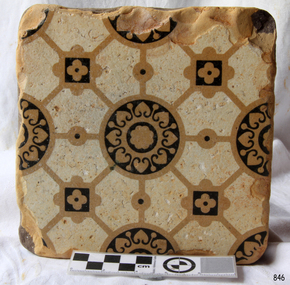 Flagstaff Hill Maritime Museum and Village
Ceramic - Tile, circa 1878
... On the back, or base, of the tile is inscribed the number “46” and the letters “Minton & Co Patent Stoke upon Trent”....The collection is also historically significant for its association with the LOCH ARD, which was one of the worst and best-known shipwrecks in Victoria’s history. flagstaff hill warrnambool shipwrecked coast flagstaff hill maritime museum maritime museum shipwreck coast flagstaff hill maritime village great ocean road loch line loch ard mutton bird island loch ard gorge minton floor tile encaustic tile melbourne international exhibition floor tile On the back, or base, of the tile is inscribed the number “46” and the letters “Minton & Co Patent Stoke upon Trent”. A square Minton floor tile with a black and beige pattern against a white base. ...This Minton floor tile is from the wreck of the LOCH ARD. Other examples of this manufacture have been recovered from the wreck site and form part of the collection at Flagstaff Hill. The iron-hulled clipper ship from the Loch Line was heading for Port Phillip from London when it ran into the cliffs of Mutton Bird Island near Port Campbell and was wrecked on the early morning of June 1, 1878. The LOCH ARD was laden with high-value cargo including luxury goods intended for display at the Melbourne International Exhibition in 1880. One notable survivor from the ship’s freight manifest was the well-packed Minton porcelain peacock, a two-metre-high ceramic masterpiece of vivid glazed colours. The almost total loss of life and property from the LOCH ARD registered as a shocking tragedy for the Colony of Victoria, at a time when social confidence and economic optimism were otherwise high. The wealth generated from gold and wool was increasingly being spent on magnificent private residences and imposing public buildings. The demand for quality furnishings and fittings was therefore strong. Among the products consigned to burgeoning colonial markets by the Milton Pottery at Stoke upon Trent were their new range of colourfully patterned but very durable floor tiles – ideal for the high-traffic spaces in the large civic buildings then being constructed in Australia and America. These new floor tiles were “encaustic”, meaning that their designs and colours were encased within the depth of the tile. Rather than their decorative patterns being glazed onto the surface of the tile, their inlaid designs were created during the manufacturing process, as “coloured slips” (or liquid clay) that were poured into a deep pre-moulded casting. When fired, the resulting tile was colour-fast and design-fast.The Minton encaustic floor tile is significant for its method of manufacture which makes it durable as well as decorative. The shipwreck of the LOCH ARD is of State significance. Victorian Heritage Register S417. Flagstaff Hill’s collection of artefacts from LOCH ARD is significant for being one of the largest collections of artefacts from this shipwreck in Victoria. It is significant for its association with the shipwreck, which is on the Victorian Heritage Register (VHR S417). The collection is significant because of the relationship between the objects, as together they have a high potential to interpret the story of the LOCH ARD. The LOCH ARD collection is archaeologically significant as the remains of a large international passenger and cargo ship. The LOCH ARD collection is historically significant for representing aspects of Victoria’s shipping history and its potential to interpret sub-theme 1.5 of Victoria’s Framework of Historical Themes (living with natural processes). The collection is also historically significant for its association with the LOCH ARD, which was one of the worst and best-known shipwrecks in Victoria’s history.A square Minton floor tile with a black and beige pattern against a white base. This encaustic floor tile was recovered from the shipwreck of the LOCH ARD. On the back, or base, of the tile is inscribed the number “46” and the letters “Minton & Co Patent Stoke upon Trent”.flagstaff hill, warrnambool, shipwrecked coast, flagstaff hill maritime museum, maritime museum, shipwreck coast, flagstaff hill maritime village, great ocean road, loch line, loch ard, mutton bird island, loch ard gorge, minton floor tile, encaustic tile, melbourne international exhibition, floor tile -
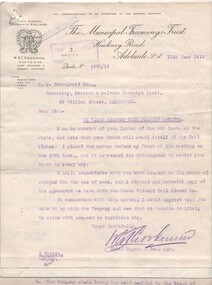 Melbourne Tram Museum
Administrative record - Correspondence, The Municipal Tramways Trust of Adelaide, "Woods Gilbert Rail Planning Machine", 1915 and 1916
... Limited of Victoria and the MTT giving details of Royalties, use and letters Patent. Gives the names of the parties who signed the agreement - dated 1915....Limited of Victoria and the MTT giving details of Royalties, use and letters Patent. Gives the names of the parties who signed the agreement - dated 1915. ...Carbon copy of Correspondence dated 15 June 1916 between The Municipal Tramways Trust of Adelaide and the Secretary of the Prahran and Malvern Tramways Trust regarding the "Woods Gilbert Rail Planning Machine". Consists of - Carbon copy (on quarto paper) from W. Goodman, on MTT letterhead to W. Strangward of the PMTT regarding assistance for the machine (and two carbon copies of the same letter on plain paper) and a carbon copy of the agreement between the Woods Gilbert Rail Planer Co. Limited of Victoria and the MTT giving details of Royalties, use and letters Patent. Gives the names of the parties who signed the agreement - dated 1915.trams, tramways, pmtt, letters, mtt, trackwork, rail wear, rail planning, machines -
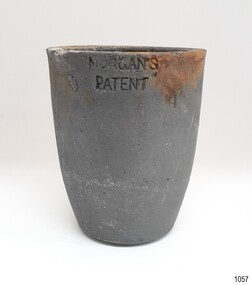 Flagstaff Hill Maritime Museum and Village
Functional object - Crucible, The Patent Plumbago Crucible Company, circa 1878
... Number or. Letters “MORGAN’S PATENT”. Details on the base "MORGAN'S PATENT" "THE PATENT PLUMBAGO CRUCIBLE COMPANY" Symbol [4] above "BATTERSEA WORKS LONDON" Handwritten on a white sticker in black pen "L89"...The collection is also historically significant for its association with the LOCH ARD, which was one of the worst and best-known ahipwrecks in Victoria’s history. flagstaff hill warrnambool flagstaff hill maritime museum maritime museum shipwreck coast flagstaff hill maritime village great ocean road loch line loch ard captain gibbs eva carmichael tom pearce glenample station mutton bird island loch ard gorge graphite crucible plumbago crucible morgan's crucible company Flagstaff Hill Maritime Museum and Village Fluxing pots crucible Morgan’s Patent Morgan brothers Patent Plumbago Crucible Co Battersea Works London Port Campbell Number or. Letters “MORGAN’S PATENT”. ...This crucible was raised from the wreck of the LOCH ARD. It is one of six similar relics, in a range of sizes, now in the Flagstaff Hill collection. All bear markings to indicate their manufacture by the Morgan brothers of Battersea, trading as the Patent Plumbago Crucible Co. A crucible is a container used for purifying and melting metals so that they can be cast in a mould to a predetermined shape and use. They must withstand extremely high temperatures, and abrupt cooling, and shed their contents with minimal adherence. The addition of graphite to the traditional firing clays greatly enhanced the durability of industrial crucibles in mid-Victorian Britain, a significant technological advance at a time of great activity in foundries and expansion of demand for refined metals. The Morgans first noticed the advantages of graphite crucibles at the Great Exhibition held in London in 1851. Initially, they contracted to be sole selling agents for the American-made products of Joseph Dixon and Co. from New Jersey, but in 1856 they obtained that firm’s manufacturing rights and began producing their own graphite crucibles from the South London site. The Morgans imported crystalline graphite in 4-5 cwt casks from the British colony of Ceylon (now Sri Lanka) and mixed it with conventional English (Stourbridge) clays to be fired in kilns. Their products were purchased by the Royal Mints in London and India, and exported to official mints in France and Germany. They were successful exhibitors of their crucibles and furnaces at the London Exhibition held in 1861 (Class 1, Mining, quarrying, metallurgy and mineral products, Exhibit 265, Patent Plumbago Crucible Co). The range of sizes represented by the six crucibles retrieved from the LOCH ARD, suggests they may have been part of a sample shipment intended for similar promotion in the Australian colonies ― at Melbourne’s International Exhibition to be held in 1880. The summary of the LOCH ARD cargo manifest, by Don Charlwood in ‘Wrecks and Reputations’, does not mention any crucibles, implying that they were not a large consignment of uniform items. A newspaper account of an 1864 tour of the Morgan brothers’ ‘Black Potteries’ at Battersea indicates: “All the pots were numbered according to their contents, each number standing for one kilogram, or a little over two pounds; a No. 2 crucible contains two kilogrammes; a No. 3, three kilogrammes, and so on.” These numbers are obscured by marine sediment on three of the crucibles in the Flagstaff Hill collection, but those legible on the remaining three are 5, 6, and 8. None of the six is of the same size from a visual appraisal. A brief history of the Loch Ard (1873-1878): - The sailing ship Loch Ard was one of the famous Loch Line of ships that sailed the long voyage from England to Australia. Barclay, Curdle and Co. built the three-masted iron vessel in Glasgow in 1873. It had sailed three trips to Australia and one trip to Calcutta before its fateful voyage. Loch Ard left England on March 2, 1878, under the command of recently married, 29-year-old Captain Gibbs. It was bound for Melbourne with a crew of 37, plus 17 passengers. The general cargo reflected the affluence of Melbourne at the time. Onboard were straw hats, umbrellas, perfumes, clay pipes, pianos, clocks, confectionery, linen and candles, and a heavier load of railway irons, cement, lead and copper. Other cargo included items intended for display in the Melbourne International Exhibition of 1880. The Loch Ard had been sailing for three months and was close to its destination on June 1, 1878. Captain Gibbs had expected to see land at about 3 am but the Loch Ard ran into a fog that greatly reduced visibility and there was no sign of land or the Cape Otway lighthouse. The fog lifted at 4 am and the sheer cliffs of Victoria's west coast were much closer to them than Captain Gibbs expected. He tried to manage the vessel but failed and the ship struck a reef at the base of Mutton Bird Island, near Port Campbell. The top deck loosened from the hull, and the masts and rigging crashed down, knocking passengers and crew overboard. The lifeboat was launched by Tom Pearce but crashed into the side of Loch Ard and capsized. He clung onto its overturned hull and sheltered under it. He drifted out to sea and the tide brought him back to what is now called Loch Ard Gorge. He swam to shore and found a cave for shelter. A passenger, Eva Carmichael, had raced onto the deck to find out what was happening and was confronted by towering cliffs above the ship. She was soon swept off the ship by a huge wave. Eva saw Tom Pearce on a small rocky beach and yelled to attract his attention. He swam out and dragged her to the shelter of the cave. He revived her with a bottle of brandy from a case that had washed up on the beach. Tom scaled a cliff in search of help and followed some horse hoof prints. He came from two men from Glenample Station, three and a half miles away. He told the men of the tragedy and then returned to the gorge while the two men rode back to the station to get help. They reached Loch Ard Gorge and took the two shipwreck survivors to Glenample Station to recover. Eva stayed at the station for six weeks before returning to Ireland by steamship. In Melbourne, Tom Pearce received a hero's welcome and was presented with a medal and some money. Of the 54 crew members and passengers on board, only two survived: the apprentice, Tom Pearce and the young woman passenger, Eva Carmichael, who lost her family in the tragedy. The shipwreck of the LOCH ARD is of State significance ― Victorian Heritage Register S417 Flagstaff Hill’s collection of artefacts from LOCH ARD is significant for being one of the largest collections of artefacts from this shipwreck in Victoria. It is significant for its association with the shipwreck, which is on the Victorian Heritage Register (VHR S417). The collection is significant because of the relationship between the objects, as together they have a high potential to interpret the story of the LOCH ARD. The LOCH ARD collection is archaeologically significant as the remains of a large international passenger and cargo ship. The LOCH ARD collection is historically significant for representing aspects of Victoria’s shipping history and its potential to interpret sub-theme 1.5 of Victoria’s Framework of Historical Themes (living with natural processes). The collection is also historically significant for its association with the LOCH ARD, which was one of the worst and best-known ahipwrecks in Victoria’s history.A Morgan’s Patent graphite crucible No.4 (i.e. 4kgs capacity), one of a set of three. It was recovered from the wreck of the LOCH ARD. It is in its original grey colouring with minimal sediment accretion on the top rim. It rises in a slight curve from a flat circular base to a wider rim with a pouring lip. Maker’s marks on the side of the container clearly identify the manufacturer. The maker's details are stamped into the base around and within a circle. A white sticker is attached. Made by the Patent Plumbago Crucible Company at the Battersea Works in London.Number or. Letters “MORGAN’S PATENT”. Details on the base "MORGAN'S PATENT" "THE PATENT PLUMBAGO CRUCIBLE COMPANY" Symbol [4] above "BATTERSEA WORKS LONDON" Handwritten on a white sticker in black pen "L89"flagstaff hill, warrnambool, flagstaff hill maritime museum, maritime museum, shipwreck coast, flagstaff hill maritime village, great ocean road, loch line, loch ard, captain gibbs, eva carmichael, tom pearce, glenample station, mutton bird island, loch ard gorge, graphite crucible, plumbago crucible, morgan's crucible company, flagstaff hill maritime museum and village, fluxing pots, crucible, morgan’s patent, morgan brothers, patent plumbago crucible co, battersea works, london, port campbell -
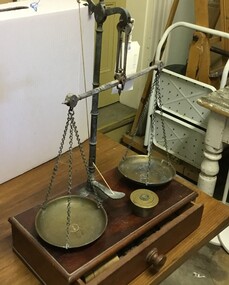 Clunes Museum
Functional object - APOTHECARY BALANCE SCALES, W & T AVERY, 1800'S
... .2 YELLOW LABEL AFFIXED TO THE BACK OF THE DRAWER: W & T AVERY, LATE T BEACH MANUFACTURERS OF ALL KINDS OF SCALES, SCALE BEAMS,STEELYARDS, PATENT WEIGHING, MACHINES, SCREW PLATES, DIE STOCKS, SCALE DIGBETH BIRMINGHAM .5 STAMPED ON REVERSE OF PENNYWEIGHTS: "STANDARD" WITH A CROWN IMAGE AND W & T A - FADING LABEL WITH F C DEIG PRINTED OTHER INFORMATION ILLEGIBLE .8 DISHES STAMPED WITH: ROYAL BY HIS MAJESTIES LETTERS PATENT ...BELONGED TO JOHN PATIENCE OF CLUNES, FORMERLY IN HIS GROCERY SHOP ON ALBERT ST NORTH CLUNES FOR DAILY USE WEIGHING INSTRUMENT APOTHECARY SCALES GOLD SCALES .2 YELLOW LABEL AFFIXED TO THE BACK OF THE DRAWER: W & T AVERY, LATE T BEACH MANUFACTURERS OF ALL KINDS OF SCALES, SCALE BEAMS,STEELYARDS, PATENT WEIGHING, MACHINES, SCREW PLATES, DIE STOCKS, SCALE DIGBETH BIRMINGHAM .5 STAMPED ON REVERSE OF PENNYWEIGHTS: "STANDARD" WITH A CROWN IMAGE AND W & T A - FADING LABEL WITH F C DEIG PRINTED OTHER INFORMATION ILLEGIBLE .8 DISHES STAMPED WITH: ROYAL BY HIS MAJESTIES LETTERS PATENT WOODEN BOX WITH DRAWER AND THREADED HOLE IN LID TO ACCOMODATE THE CENTRAL POLE OF THE SCALE ASSEMBLY. ...Founded in the early 18th century, the company was renamed W & T Avery in 1818. In 1979, GEC took over the company and renamed it GEC-Avery. In 2000, the US-American company Weigh-Tronix acquired the business and it is now known as Avery Weigh-Tronix. BELONGED TO JOHN PATIENCE OF CLUNES, FORMERLY IN HIS GROCERY SHOP ON ALBERT ST NORTH CLUNES FOR DAILY USEWOODEN BOX WITH DRAWER AND THREADED HOLE IN LID TO ACCOMODATE THE CENTRAL POLE OF THE SCALE ASSEMBLY. BOX CONTAINS SCALES ASSSEMBLY AND WEIGHTS .1 WOODEN BOX .2 DRAWER TO FIT BOX .3 .4 PIECES OF WOOD FINISHED ON ONE SIDE WITH BLUE FELT - ORIGINALLY AFFIXED TO THE DRAWER TO CREATE A SMALL COMPARTMENT WITHIN THE DRAWER .5 WOODEN CYLINDER WITH LID CONTAINS A SET OF METAL PENNYWEIGHTS RANGING FROM ONE TO SIX, W & T A STAMPED ON THE REVERSE OF EACH WEIGHT, ONE SINGLE WEIGHT 2OZ AND ONE SINGLE WEIGHT 1/2 OZ STAMPED ON REVERSE, THREE OTHER LIKE WEIGHTS WITH NO STAMPING. FOUR SQUARE BRASS SCRUPLES WITH "6" STAMPED INTO EACH. .6 ONE SET OF SIX BRASS TROY WEIGHTS NESTED .7 METAL ASSEMBLY PIN FOR THE SCALES .8 SCALE ASSEMBLY OF UPRIGHT POLE, BALANCE BAR, TWO METAL DISHES WITH METAL CHAIN ATTACHED .9 TWO UNSTAMPED METAL CIRCULAR WEIGHTS .2 YELLOW LABEL AFFIXED TO THE BACK OF THE DRAWER: W & T AVERY, LATE T BEACH MANUFACTURERS OF ALL KINDS OF SCALES, SCALE BEAMS,STEELYARDS, PATENT WEIGHING, MACHINES, SCREW PLATES, DIE STOCKS, SCALE DIGBETH BIRMINGHAM .5 STAMPED ON REVERSE OF PENNYWEIGHTS: "STANDARD" WITH A CROWN IMAGE AND W & T A - FADING LABEL WITH F C DEIG PRINTED OTHER INFORMATION ILLEGIBLE .8 DISHES STAMPED WITH: ROYAL BY HIS MAJESTIES LETTERS PATENT weighing instrument, apothecary scales, gold scales -
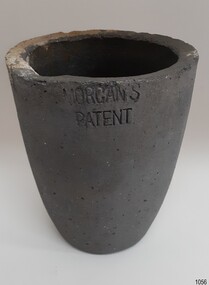 Flagstaff Hill Maritime Museum and Village
Functional object - Crucible, The Patent Plumbago Crucible Company, circa 1878
... Number “8”. Letters “MORGAN’S PATENT”. Details on the base "MORGAN'S PATENT" "THE PATENT PLUMBAGO CRUCIBLE COMPANY" Symbol [8] above "BATTERSEA WORKS LONDON" Handwritten on a white sticker in black pen "LA/89"...The collection is also historically significant for its association with the LOCH ARD, which was one of the worst and best-known shipwrecks in Victoria’s history. flagstaff hill warrnambool maritime museum shipwreck coast great ocean road loch line loch ard captain gibbs eva carmichael tom pearce glenample station mutton bird island loch ard gorge graphite crucible plumbago crucible morgans crucible company Flagstaff Hill Maritime Museum and Village Fluxing pots crucible Morgan’s Patent Morgan brothers Patent Plumbago Crucible Co Battersea Works London Port Campbell Number “8”. Letters “MORGAN’S PATENT”. ...This crucible was raised from the wreck of the LOCH ARD. It is one of six similar relics, in a range of sizes, now in the Flagstaff Hill collection. All bear markings to indicate their manufacture by the Morgan brothers of Battersea, trading as the Patent Plumbago Crucible Co. A crucible is a container used for purifying and melting metals so that they can be cast in a mould to a predetermined shape and use. They must withstand extremely high temperatures, and abrupt cooling, and shed their contents with minimal adherence. The addition of graphite to the traditional firing clays greatly enhanced the durability of industrial crucibles in mid-Victorian Britain, a significant technological advance at a time of great activity in foundries and expansion of demand for refined metals. The Morgans first noticed the advantages of graphite crucibles at the Great Exhibition held in London in 1851. Initially, they contracted to be sole selling agents for the American-made products of Joseph Dixon and Co. from New Jersey, but in 1856 they obtained that firm’s manufacturing rights and began producing their own graphite crucibles from the South London site. The Morgans imported crystalline graphite in 4-5 cwt casks from the British colony of Ceylon (now Sri Lanka) and mixed it with conventional English (Stourbridge) clays to be fired in kilns. Their products were purchased by the Royal Mints in London and India, and exported to official mints in France and Germany. They were successful exhibitors of their crucibles and furnaces at the London Exhibition held in 1861 (Class 1, Mining, quarrying, metallurgy and mineral products, Exhibit 265, Patent Plumbago Crucible Co). The range of sizes represented by the six crucibles retrieved from the LOCH ARD, suggests they may have been part of a sample shipment intended for similar promotion in the Australian colonies ― at Melbourne’s International Exhibition to be held in 1880. The summary of the LOCH ARD cargo manifest, by Don Charlwood in ‘Wrecks and Reputations’, does not mention any crucibles, implying that they were not a large consignment of uniform items. A newspaper account of an 1864 tour of the Morgan brothers’ ‘Black Potteries’ at Battersea indicates: “All the pots were numbered according to their contents, each number standing for one kilogram, or a little over two pounds; a No. 2 crucible contains two kilogrammes; a No. 3, three kilogrammes, and so on.” These numbers are obscured by marine sediment on three of the crucibles in the Flagstaff Hill collection, but those legible on the remaining three are 5, 6, and 8. None of the six is of the same size from a visual appraisal. A brief history of the Loch Ard (1873-1878): - The sailing ship Loch Ard was one of the famous Loch Line of ships that sailed the long voyage from England to Australia. Barclay, Curdle and Co. built the three-masted iron vessel in Glasgow in 1873. It had sailed three trips to Australia and one trip to Calcutta before its fateful voyage. Loch Ard left England on March 2, 1878, under the command of recently married, 29-year-old Captain Gibbs. It was bound for Melbourne with a crew of 37, plus 17 passengers. The general cargo reflected the affluence of Melbourne at the time. Onboard were straw hats, umbrellas, perfumes, clay pipes, pianos, clocks, confectionery, linen and candles, and a heavier load of railway irons, cement, lead and copper. Other cargo included items intended for display in the Melbourne International Exhibition of 1880. The Loch Ard had been sailing for three months and was close to its destination on June 1, 1878. Captain Gibbs had expected to see land at about 3 am but the Loch Ard ran into a fog that greatly reduced visibility and there was no sign of land or the Cape Otway lighthouse. The fog lifted at 4 am and the sheer cliffs of Victoria's west coast were much closer to them than Captain Gibbs expected. He tried to manage the vessel but failed and the ship struck a reef at the base of Mutton Bird Island, near Port Campbell. The top deck loosened from the hull, and the masts and rigging crashed down, knocking passengers and crew overboard. The lifeboat was launched by Tom Pearce but crashed into the side of Loch Ard and capsized. He clung onto its overturned hull and sheltered under it. He drifted out to sea and the tide brought him back to what is now called Loch Ard Gorge. He swam to shore and found a cave for shelter. A passenger, Eva Carmichael, had raced onto the deck to find out what was happening and was confronted by towering cliffs above the ship. She was soon swept off the ship by a huge wave. Eva saw Tom Pearce on a small rocky beach and yelled to attract his attention. He swam out and dragged her to the shelter of the cave. He revived her with a bottle of brandy from a case that had washed up on the beach. Tom scaled a cliff in search of help and followed some horse hoof prints. He came from two men from Glenample Station, three and a half miles away. He told the men of the tragedy and then returned to the gorge while the two men rode back to the station to get help. They reached Loch Ard Gorge and took the two shipwreck survivors to Glenample Station to recover. Eva stayed at the station for six weeks before returning to Ireland by steamship. In Melbourne, Tom Pearce received a hero's welcome and was presented with a medal and some money. Of the 54 crew members and passengers on board, only two survived: the apprentice, Tom Pearce and the young woman passenger, Eva Carmichael, who lost her family in the tragedy. The shipwreck of the LOCH ARD is of State significance ― Victorian Heritage Register S417. Flagstaff Hill’s collection of artefacts from LOCH ARD is significant for being one of the largest collections of artefacts from this shipwreck in Victoria. It is significant for its association with the shipwreck, which is on the Victorian Heritage Register (VHR S417). The collection is significant because of the relationship between the objects, as together they have a high potential to interpret the story of the LOCH ARD. The LOCH ARD collection is archaeologically significant as the remains of a large international passenger and cargo ship. The LOCH ARD collection is historically significant for representing aspects of Victoria’s shipping history and its potential to interpret sub-theme 1.5 of Victoria’s Framework of Historical Themes (living with natural processes). The collection is also historically significant for its association with the LOCH ARD, which was one of the worst and best-known shipwrecks in Victoria’s history.A Morgan’s Patent graphite crucible No.8 (i.e. 8kgs capacity), one of a set. It was recovered from the wreck of the LOCH ARD. It is in its original grey colouring with minimal sediment accretion on the top rim. It rises in a slight curve from a flat circular base to a wider rim with a pouring lip. Maker’s marks on the side of the container clearly identify the manufacturer. The maker's details are stamped into the base around and within a circle. A white sticker is attached. Made by the Patent Plumbago Crucible Company at the Battersea Works in London. Number “8”. Letters “MORGAN’S PATENT”. Details on the base "MORGAN'S PATENT" "THE PATENT PLUMBAGO CRUCIBLE COMPANY" Symbol [8] above "BATTERSEA WORKS LONDON" Handwritten on a white sticker in black pen "LA/89"flagstaff hill, warrnambool, maritime museum, shipwreck coast, great ocean road, loch line, loch ard, captain gibbs, eva carmichael, tom pearce, glenample station, mutton bird island, loch ard gorge, graphite crucible, plumbago crucible, morgans crucible company, flagstaff hill maritime museum and village, fluxing pots, crucible, morgan’s patent, morgan brothers, patent plumbago crucible co, battersea works, london, port campbell -
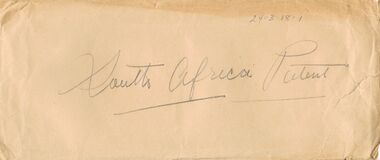 Bendigo Historical Society Inc.
Document - ABBOTT COLLECTION: ABBOTT ESTATE CORRESPONDENCE, 1937 - 47
... Approximately thirty seven envelopes containing business correspondence of the Abbott Companies and some personal letters, also contains patents for barbed wire granted in several countries by Harold Abbott and his brother in conjunction with ARC engineering....ORGANIZATION Business abbotts Harold Abbott Richard Abbott Barbed Wire Barblok Harold Abbott and others Approximately thirty seven envelopes containing business correspondence of the Abbott Companies and some personal letters, also contains patents for barbed wire granted in several countries by Harold Abbott and his brother in conjunction with ARC engineering. ...Approximately thirty seven envelopes containing business correspondence of the Abbott Companies and some personal letters, also contains patents for barbed wire granted in several countries by Harold Abbott and his brother in conjunction with ARC engineering.Harold Abbott and othersorganization, business, abbotts, harold abbott, richard abbott, barbed wire, barblok -
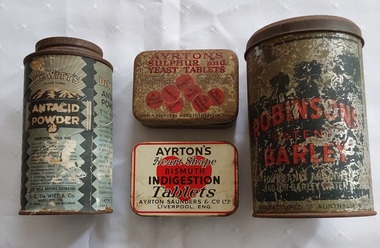 Mont De Lancey
Domestic object - Medicinal Tins, Ayrton Saunder's & Co Ltd, 1900's
... Robinson's Patent Barley' (indecipherable details) On the bottom of the tin Robinson's "Patent" Barley Letters Patent Granted 1923 Now expired Packed March 1951. 4.De Witt's Trademark Antacid Powder 2/6 for Indigestion. ...Robinson's Patent Barley' (indecipherable details) On the bottom of the tin Robinson's "Patent" Barley Letters Patent Granted 1923 Now expired Packed March 1951. 4.De Witt's Trademark Antacid Powder 2/6 for Indigestion. ...These vintage tins contained medicinal products to help relieve illness symptoms for the family at home in the 1900's. Two were manufactured in Australia and the two Ayrton's products were made in England.Three vintage medicinal tins and cardboard container. 1. Small Ayrton's heart shape Bismuth Indigestion Tablets tin with the Manufacturer details printed at the bottom of the lift up lid. It has a large red heart shape on a white background. Approx. 2ozs. It has a gold base with information for use and recommended dosages. 2. A small badly rusted and worn tin Ayrton's Sulphur and Yeast Tablets with seven red dots showing usage features of these tablets. Manufacturer details are listed at the bottom of the front lift up lid and the back of the tin has further information. 3. A cylindrical green Robinson's Patent Barley tin with a patterned rusted lid. The manufacturer details and usage information are indecipherable due to wear and rust. 4. A cylindrical lidded De Witt's Antacid Powder cardboard container with a rusted tin lid. Manufacturer details and usage are printed on a paper wrapper glued to the cylinder.1. 'Ayrton's Heart Shape Bismuth Indigestion Tablets Ayrton Saunders & Co Ltd Liverpool. England.' 2. 'Ayrton's Sulphur and Yeast Tablets Ayrton, Saunders & Co. Ltd. Liverpool. Eng.' 3. Robinson's Patent Barley' (indecipherable details) On the bottom of the tin Robinson's "Patent" Barley Letters Patent Granted 1923 Now expired Packed March 1951. 4.De Witt's Trademark Antacid Powder 2/6 for Indigestion. Contents 4ozs. Approx. Lasting Action' Inside the Ayrton's Sulphur and Yeast Tablets tin is a sticker with 'M Burgi' handwritten on it in biro.medicinal containers, tins, medication, containers -
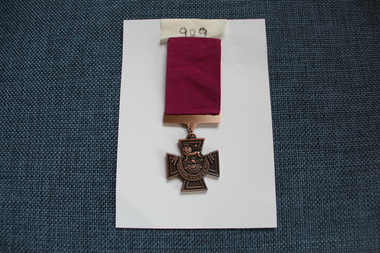 Lara RSL Sub Branch
Medal VC (Copy), Victorian Cross Medal (Copy of), 2020
... The Victoria Cross for Australia was created by letters patent signed by Elizabeth II, Queen of Australia, on 15 January 1991. ...The Victoria Cross for Australia was created by letters patent signed by Elizabeth II, Queen of Australia, on 15 January 1991. ...A Copy of the Victoria Cross for display only purpose.Copy of Victoria Cross for Lara R.S.L. Display purposes only.Victoria Cross Medal with Red RibbonOn Reverse it a marking stating COPY. The Victoria Cross for Australia is the highest award in the Australian Honours System, superseding the British Victoria Cross for issue to Australians. The Victoria Cross for Australia is the "decoration for according recognition to persons who in the presence of the enemy, perform acts of the most conspicuous gallantry, or daring or pre-eminent acts of valour or self-sacrifice or display extreme devotion to duty. The Victoria Cross for Australia was created by letters patent signed by Elizabeth II, Queen of Australia, on 15 January 1991. It is listed equal first with the British Victoria Cross on the Australian Order of Wear with precedence in Australia over all orders, decorations and medals. The decoration may be awarded to members of the Australian Defence Force and to other persons determined by the Australian Minister for Defence.] A person to whom the Victoria Cross for Australia has been awarded is entitled to the post nominals VC placed after the person's name.copy of victoria cross -
 Bendigo Historical Society Inc.
Document - MCCOLL, RANKIN AND STANISTREET COLLECTION: S MCDONALD PATENT WATER TRAP, 1950's
... Australian Patent No. 132,110. Includes letters about whether the patent has expired or needs renewing, the formation of a Company with the name Stuart McDonald Patent Water Trap and receipts from companies that had already purchased the trap...Australian Patent No. 132,110. Includes letters about whether the patent has expired or needs renewing, the formation of a Company with the name Stuart McDonald Patent Water Trap and receipts from companies that had already purchased the trap Document MCCOLL, RANKIN AND STANISTREET COLLECTION: S MCDONALD PATENT WATER TRAP ...A 'Loop Cobra'Binder File containing documentation re. the Stuart McDonald Patent Water Trap. Australian Patent No. 132,110. Includes letters about whether the patent has expired or needs renewing, the formation of a Company with the name Stuart McDonald Patent Water Trap and receipts from companies that had already purchased the trapgold, mining, stewart mcdonald, water tap, gold miining, patents, stuart mcdonald, water trap. -
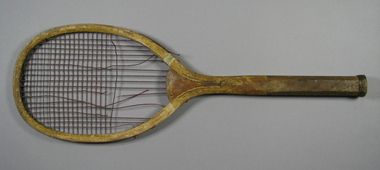 Tennis Australia
Racquet, Circa 1913
... Inscribed on left side of shaft: PATENTED. Letters 'EWE' carved onto throat on reverse. ...Inscribed on left side of shaft: PATENTED. Letters 'EWE' carved onto throat on reverse. ...A Wright & Ditson 'Challenge' model tennis racquet with transitional flat-top head and laminated convex throat. String whipping around shoulders. Model name printed across throat on obverse. Manufacturer's trademark/logo features across throat on reverse. Fine-grooved octagonal handle with leather end wrap. Manufacturer name imprinted on right side of shaft. Inscribed on left side of shaft: PATENTED. Letters 'EWE' carved onto throat on reverse. Materials: Wood, Metal, Lacquer, Glue, Ink, Leather, Gut, Stringtennis -
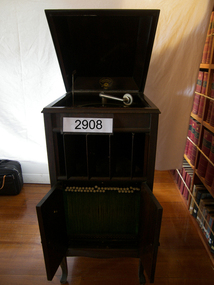 Flagstaff Hill Maritime Museum and Village
Gramophone, 1911
... Grafonolas were manufactured under the 1886 United States Letters Patent No. 341,214 which Columbia Graphophone company acquired through its predecessor American Graphophone Company. ...Grafonolas were manufactured under the 1886 United States Letters Patent No. 341,214 which Columbia Graphophone company acquired through its predecessor American Graphophone Company. ...Until late 1925, all record players reproduced sound by purely mechanical means and relied on a so-called "amplifying" horn to efficiently couple the vibrations of the stylus and diaphragm to the space occupied by the listeners. In 1906, the Victor Talking Machine Company, Columbia's arch competitor, introduced a line of models in which the horn and other hardware were concealed within a cabinet, made to look like fine furniture rather than a mechanical device. They named the new style a "Victrola". It quickly proved to be very popular and successful. Other makers, adopting the distinctive suffix, introduced their own "-ola" internal horn machines, such as Edison's Amberolas and Columbia's Grafonolas. They were soon outselling the external horn models. At first, like nearly all other early record players, all Grafonolas were driven by a spring motor that the user had to wind up with a crank before playing a record. In 1915, Columbia began to introduce electric-motor-driven models, as a majority of urban areas had been wired to electrical grids. The electrified Grafonolas supported both alternating and direct currents from 110 to 220 volts. Electrified Grafonolas never gained the popularity enjoyed by the spring motor-driven versions due to substantially higher prices and a lack of electrical service in rural areas. Grafonolas were manufactured under the 1886 United States Letters Patent No. 341,214 which Columbia Graphophone company acquired through its predecessor American Graphophone Company. Two models were available; a portable table model and bigger stationary floor model, offering limited mobility through the application of casters. The most notable table models included Grafonola Favorite introduced in 1911 and Grafonola Savoy introduced in 1915. The most notable floor models included Grafonola Symphony Grand introduced in 1907, Grafonola Regent introduced in 1909, Columbia Mignon introduced in 1910, Grafonola Princess introduced in 1911, Columbia Colonial introduced in 1913. Various period Grafonolas were introduced in 1917 to cater to an increasingly prosperous clientele. Columbia Phonograph Company began to manufacture a series of ornate, limited edition period machines. These were highly priced (some as high as US$2,100 ) special orders that provided consumers with options to choose styles which matched their interior décor. Although the Gramophone does not have a large monetary value, it is of social significance as it demonstrates the progress made in audio reproduction from the first Edison cylinder machines to improvements that allowed ordinary people to be able to buy music discs and enjoy music in their own homes. Gramophone with internal horn, floor model, mechanically operated by a crank handle. Colombian Grafonola Princess (Type F2) brand. Gramophone is in a wooden display cabinet with room for record storage underneath and is complete with handle. Manufactured in 1911 by Columbia, USA."Columbia Grafonola Type 2 Made in USA"flagstaff hill, warrnambool, shipwrecked-coast, flagstaff-hill, flagstaff-hill-maritime-museum, maritime-museum, shipwreck-coast, flagstaff-hill-maritime-village, record player, gramophone, mechanical gramophone, floor model gramophone, gramophone record, columbia graphophone company, american graphophone company, columbia, grafonola, grafonola princess, music, playing music, audio reproduction, sound equipment, domestic entertainment, 1911 gramophone
