
Showing 45 items matching "lifesavers"
-
 National Vietnam Veterans Museum (NVVM)
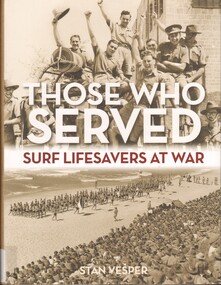
Book, Vesper, Stan, Those Who Served: Surf Lifesavers at War, 2015
... Those Who Served: Surf Lifesavers at War...Soldiers -- Australia Surf lifesaving (Aquatic sports) As Australia commemorates the 100th Anniversary of the ANZAC landing at Gallipoli, it is both saddening and heart warming to pause and reflect on those who died serving their communities and their country as surf lifesavers. Those Who Served: Surf Lifesavers at War Book Book Vesper, Stan ...As Australia commemorates the 100th Anniversary of the ANZAC landing at Gallipoli, it is both saddening and heart warming to pause and reflect on those who died serving their communities and their country as surf lifesavers.As Australia commemorates the 100th Anniversary of the ANZAC landing at Gallipoli, it is both saddening and heart warming to pause and reflect on those who died serving their communities and their country as surf lifesavers.soldiers -- australia, surf lifesaving (aquatic sports) -
 Ararat Gallery TAMA
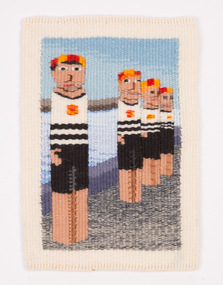
Joy Smith, Geelong Lifesavers, 2007
... Geelong Lifesavers...Geelong Lifesavers Joy Smith ... -
 Whitehorse Historical Society Inc.
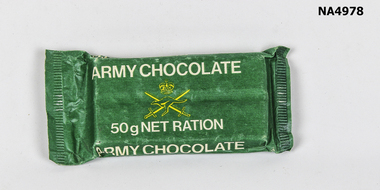
Uniform - Chocolate, After 1967
... Marked Army chocolate and 50g Net Ration with Australian Army Insignia; Makers name and address - Allen Lifesavers Limited, Lane Cove, NSW, 2066....Allen Lifesavers Limited, Lane Cove, NSW 2066...Marked Army chocolate and 50g Net Ration with Australian Army Insignia; Makers name and address - Allen Lifesavers Limited, Lane Cove, NSW, 2066. Uniform Chocolate ...Sample of Australian Army RationAn eight portion chocolate bar enclosed in green foil-backed paper. Marked Army chocolate and 50g Net Ration with Australian Army Insignia; Makers name and address - Allen Lifesavers Limited, Lane Cove, NSW, 2066.Allen Lifesavers Limited, Lane Cove, NSW 2066food & drink consumption, rations, australian army -
 Seaworks Maritime Museum
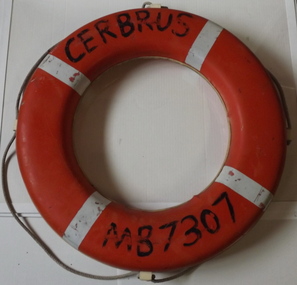
Lifesaver
... Lifesaver...Orange lifesaver with 'Cerbrus' painted on top and 'MB7307' on the bottom...R-No. 7617 (Other writing is obscured). Orange lifesaver with 'Cerbrus' painted on top and 'MB7307' on the bottom Lifesaver ...Orange lifesaver with 'Cerbrus' painted on top and 'MB7307' on the bottomCertificate of Approval No. 1050/ FAIRWAY. R-No. 7617 (Other writing is obscured). -
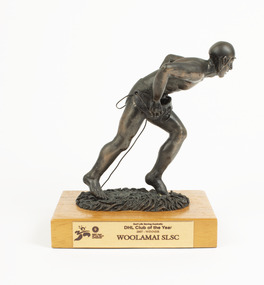 Woolamai Beach Surf Life Saving Club
Award - Statue, 2007 S.L.S.A. & D.H.L. Australian Surf Club of the Year
... Metal Statue of Lifesaver on Wooden Base. With Award inscription on base...Metal Statue of Lifesaver on Wooden Base. With Award inscription on base 2007 S.L.S.A. & D.H.L. ...Metal Statue of Lifesaver on Wooden Base. With Award inscription on base -
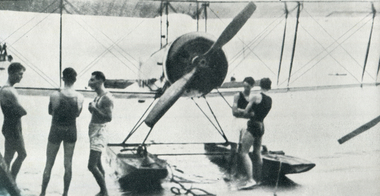 Ballarat Heritage Services
Image - Black and White, Joyflights in Sydney
... ...lifesaver...Black and white image of a biplane harbourside at Sydney where lifesavers acted as watchmen....flight aeroplane joyflights lifesaver Black and white image of a biplane harbourside at Sydney where lifesavers acted as watchmen. ...Black and white image of a biplane harbourside at Sydney where lifesavers acted as watchmen.flight, aeroplane, joyflights, lifesaver -
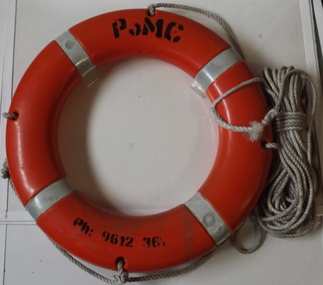 Seaworks Maritime Museum
PoMC lifebuoy
... lifesaver...Orange lifesaver with long length of rope attached with words PoMC (Port of Melbourne Corporation)....lifesaver lifebuoy PoMC' on upper edge. 'Ph: 9612 3619.' ...Orange lifesaver with long length of rope attached with words PoMC (Port of Melbourne Corporation).PoMC' on upper edge. 'Ph: 9612 3619.' On back: AMSA APPR. CERT. NO.2840. NYLEX logo, Nylex Rotomould.lifesaver, lifebuoy -
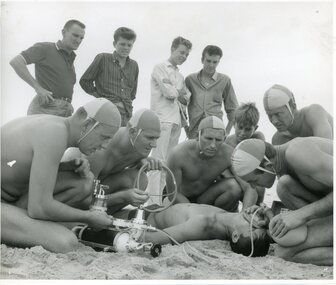 Geoffrey Kaye Museum of Anaesthetic History
Photograph, An Australian Photographic Agency
... There are five male onlookers watching behind the lifesavers, four are standing and one is crouching....There are five male onlookers watching behind the lifesavers, four are standing and one is crouching. ...Black and white photograph depicting a group of five male surf lifesavers wearing lifesaving caps crouched down on a beach, administering oxygen through an inhaler and oxygen tank to a male lying on the ground. There are five male onlookers watching behind the lifesavers, four are standing and one is crouching.•Printed stamp in black in on reverse: AN / AUSTRALIAN / PHOTOGRAPHIC / AGENCY / PICTURE BY / DONALD MCPHEDRON / NEWSPAPER HOUSE - 44 PITT STREET. / SYDNEY - AUSTRALIA / TELEPHONE 8U 7341 / NEGATIVE NO. •Handwritten in blue ink on reverse: 4/621939.oxygen tank, oxygen, surf lifesavers, beach -
 Lakes Entrance Historical Society
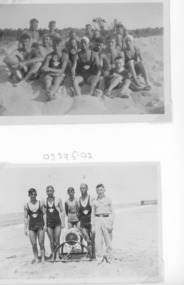
Photograph - Surf Lifesaving, 1938
... Also in album eight other black and white photographs of lifesavers posing with ropes and reel practising first aid and resuscitation 1938 c. 6 x 8.5...Also in album eight other black and white photographs of lifesavers posing with ropes and reel practising first aid and resuscitation 1938 c. 6 x 8.5 Volunteering Community Services Emergency Services Two small format black and white photographs of people from Surf Life Saving Club, posing for photograph on sand dunes. ...Also in album eight other black and white photographs of lifesavers posing with ropes and reel practising first aid and resuscitation 1938 c. 6 x 8.5Two small format black and white photographs of people from Surf Life Saving Club, posing for photograph on sand dunes. Two persons named, Tommy Todd and Jack Mitchelson. Lakes Entrance Victoriavolunteering, community services, emergency services -
 Lakes Entrance Historical Society
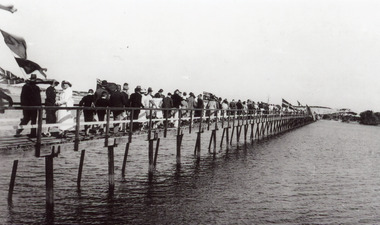
Photograph - Official opening of footbridge, Lakes Entrance Victoria 1937
... Black and white photograph of the footbridge over the Cunninghame Arm, showing a crowd of people following the Melbourne Lifesavers crossing the bridge after the official opening, Lakes Entrance Victoria...Official opening 27 March 1937 Waterfront Bridges Celebration Black and white photograph of the footbridge over the Cunninghame Arm, showing a crowd of people following the Melbourne Lifesavers crossing the bridge after the official opening, Lakes Entrance Victoria Photograph Official opening of footbridge, Lakes Entrance Victoria 1937 ...Official opening 27 March 1937Black and white photograph of the footbridge over the Cunninghame Arm, showing a crowd of people following the Melbourne Lifesavers crossing the bridge after the official opening, Lakes Entrance Victoriawaterfront, bridges, celebration -
 Lakes Entrance Historical Society
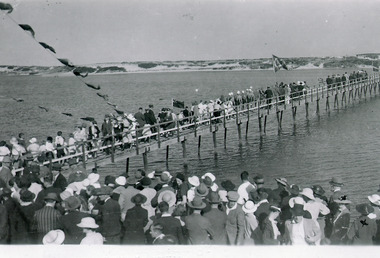
Photograph - Footbridge Lakes Entrance Victoria c1937, 1937
... Black and white photograph of the crowd following Melbourne Lifesavers across footbridge after the official opening in 1937, sand hummocks of southern shore in background. ...2 other copies exist Bridges Celebration Black and white photograph of the crowd following Melbourne Lifesavers across footbridge after the official opening in 1937, sand hummocks of southern shore in background. ...2 other copies existBlack and white photograph of the crowd following Melbourne Lifesavers across footbridge after the official opening in 1937, sand hummocks of southern shore in background. Lakes Entrance Victoriabridges, celebration -
 Lakes Entrance Historical Society
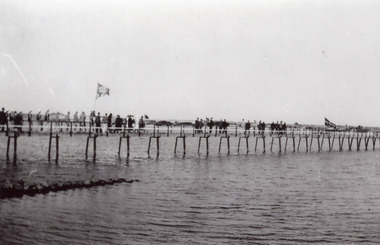
Photograph - Official opening of the Footbridge Lakes Entrance 1937, Jemmeson Edie, 1937
... Black and white photograph of the completed footbridge over the Cunninghame Arm, showing Lifesavers from Melbourne clubs leading the way across the bridge after the official opening. ...Bridges Celebration Black and white photograph of the completed footbridge over the Cunninghame Arm, showing Lifesavers from Melbourne clubs leading the way across the bridge after the official opening. ...Black and white photograph of the completed footbridge over the Cunninghame Arm, showing Lifesavers from Melbourne clubs leading the way across the bridge after the official opening. Lakes Entrance Victoriabridges, celebration -
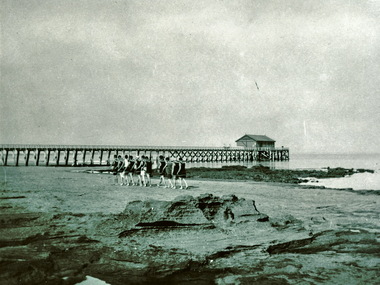 Ballaarat Mechanics' Institute (BMI Ballarat)
Lifesavers and jetty at front beach Queenscliff
... ...lifesavers...Please contact BMI for all print and usage inquiries. Queenscliff lifesavers jetty Lifesavers and jetty at front beach Queenscliff ...This photograph is from the Max Harris Collection held by the Ballaraat Mechanics' Institute. Please contact BMI for all print and usage inquiries.queenscliff, lifesavers, jetty -
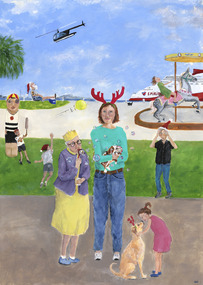 City of Greater Geelong
Painting - Acrylic on Paper, Vicki Clissold, Catch It, 2025
... Painting depicting children playing on the waterfront with two women in the foreground, one wearing a yellow hat and dress, the other wearing a teal shirt with red antlers. A carousel, lifesaver bollard and the spirit of Tasmania ship in the background....Signature - Vicki Painting depicting children playing on the waterfront with two women in the foreground, one wearing a yellow hat and dress, the other wearing a teal shirt with red antlers. A carousel, lifesaver bollard and the spirit of Tasmania ship in the background. ...Vicki is a Geelong-based visual artist whose practice spans murals, painting, and soft felt sculpture. She creates both large and small-scale murals throughout Geelong and surrounding districts, often drawing on themes of community and social connection. Working from her central Geelong studio, Pip-Squeak-Art, she produces commissioned pet portraits and exhibition pieces, alongside sculptural works crafted from wool. Her socially motivated approach is especially visible in her street-scape paintings, which appear in both her canvas work and public murals. Vicki also does conservation work on the City’s much loved bollards. Commissioned for the City of Greater Geelong 2025 Christmas program. The painting was reproduced as mural on a carousel. Painting depicting children playing on the waterfront with two women in the foreground, one wearing a yellow hat and dress, the other wearing a teal shirt with red antlers. A carousel, lifesaver bollard and the spirit of Tasmania ship in the background.Signature - Vicki -
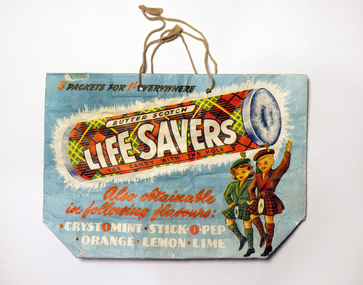 Melbourne Royal
Memorabilia - Showbag, Wilmers & Gladwin Pty Ltd, Life Savers Showbag, c. 1959
... ...Lifesavers...The name refers to the fact that the hole in the middle will prevent choking if the sweet is swallowed whole. Confectionery Lifesavers showbag commercial [obverse] 3 PACKETS FOR 1-' EVERYWHERE / BUTTER SCOTCH / LIFE SAVERS / THE CANDY WITH THE HOLE / Also obtainable / in following flavours: / Crystomint - Stick-O-Pep - Orange - Lemon - Lime" [reverse] Cooling Pep-O-Mint Life Savers, the candy mint with the hole / Also obtainable in following flavours: Spear-O-Mint - Assorted floral - Vi-O-Let - Musk - Clove - Thirst - An-O-Sed / 3 packets for 1'- everywhere / [bottom] Wilmers & Gladwin Pty Ltd Life Savers showbag, no content: paper bag with string cord handle, printed in colour; one side showing a roll of Butter Scotch Life Savers and two Scottish children dancing under it; the other, a roll of Pep-O-Mint Life Savers, set against an Arctic background Life Savers Showbag Memorabilia Showbag Wilmers & Gladwin Pty Ltd ...Life Savers were invented in America in 1912 and produced under an agreement in Australia from 1921. The name refers to the fact that the hole in the middle will prevent choking if the sweet is swallowed whole.Life Savers showbag, no content: paper bag with string cord handle, printed in colour; one side showing a roll of Butter Scotch Life Savers and two Scottish children dancing under it; the other, a roll of Pep-O-Mint Life Savers, set against an Arctic background[obverse] 3 PACKETS FOR 1-' EVERYWHERE / BUTTER SCOTCH / LIFE SAVERS / THE CANDY WITH THE HOLE / Also obtainable / in following flavours: / Crystomint - Stick-O-Pep - Orange - Lemon - Lime" [reverse] Cooling Pep-O-Mint Life Savers, the candy mint with the hole / Also obtainable in following flavours: Spear-O-Mint - Assorted floral - Vi-O-Let - Musk - Clove - Thirst - An-O-Sed / 3 packets for 1'- everywhere / [bottom] Wilmers & Gladwin Pty Ltdconfectionery, lifesavers, showbag, commercial -
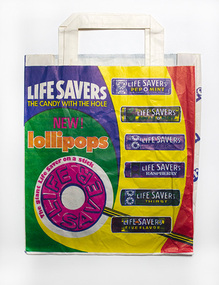 Melbourne Royal
Memorabilia - Showbag, Life Savers and Beechies gum Showbag, 1955-1970
... ...Lifesavers...Confectionery Life Savers showbag Lifesavers lollipops commercial [obverse] Reach for a beechies and smile! ...Together with 6 traditional rolls of Life Savers, this showbag offered the new lollipop version. Beechies gum is advertised on the verso of the showbag.Life Savers and Beechies gum showbag, no content: paper bag (printed in yellow, blue, red, green and pink) with handle, one side advertising the Life Savers range (Pep-o-Mint, Spear-o-Mint, musk, raspberry, thirst, and five flavor, and the new Life Savers lollipop); the other side advertising Beechies gum, with a yellow smiley face and five packs of gum showing the range of available flavours (strawberry, musk, orange, lime, spearmint, peppermint)[obverse] Reach for a beechies and smile! / [reverse] Life Savers, the cand with a hole / New! lollipops - the giant Life Saver on a stick / [sides] look at life through a Life Saverconfectionery, life savers, showbag, lifesavers, lollipops, commercial -
 Glenelg Shire Council Cultural Collection
Book - Book Publication - 1984 150th Anniversary of Portland, 1984
... Front cover has photographs of Kingsley, historic painting, harbour at sunset, lifesavers, oil rig and yachts Henty Beach; with red border. ...Front cover has photographs of Kingsley, historic painting, harbour at sunset, lifesavers, oil rig and yachts Henty Beach; with red border. ...A4 size publication 'Portland', made for 1984 150th Anniversary of Portland as Victoria's first permanent settlement. Covers cardboard, content, coloured photographs with black text. Front cover has photographs with black text. Front cover has photographs of Kingsley, historic painting, harbour at sunset, lifesavers, oil rig and yachts Henty Beach; with red border. Back Cover: Glenelg river -
 Melbourne Legacy
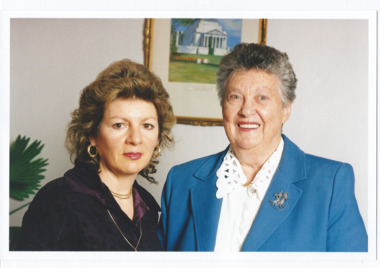
Photograph - Photo, Keeping a promise. Picking up the pieces, 2000
... Muriel nursed her husband and after his death found a void, Legacy was a 'lifesaver'. Jo joined the younger widows club where each of them still have children on their hands so they have more in common and meet every second month. ...Muriel nursed her husband and after his death found a void, Legacy was a 'lifesaver'. Jo joined the younger widows club where each of them still have children on their hands so they have more in common and meet every second month. ...A 2 page double spread feature in the Herald Sun on 29th August 2000 to promote Legacy prior to Legacy Week. The photo of widows Jo Stanley and Muriel Love is accompanied by the article 'Picking up the pieces'. They were helped by Legacy when their husbands passed away. Muriel nursed her husband and after his death found a void, Legacy was a 'lifesaver'. Jo joined the younger widows club where each of them still have children on their hands so they have more in common and meet every second month. The other article 'Keeping a promise' gives an overview of Legacy and an interview with David Kelly who was president in 2000.A story on how Legacy works and its impact on the lives of two widows.Colour photo x 2 of two widows and a newspaper article about them.Photocopy of a newspaper articles are titled 'Picking up the pieces' and 'Keeping a promise'.legacy promotion, legacy week -
 Flagstaff Hill Maritime Museum and Village
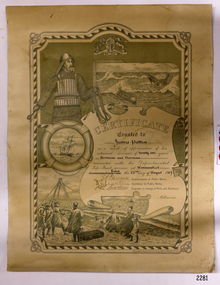
Award - Certificate of Service, F. W. Strahle, James Patten, 23-08-1907
... The images on the Certificate show a collage of rescue events performed by the lifesavers; a shipwreck rescue in progress, lifeboat conveying five boatmen using two oars each, and a bowman standing at the bow, a linesman wearing a life jacket and holding a rescue line, a lifesaver ring with images of three sailing ships inside it, a shipwreck near shore, a woman and girl in shallow water, a rescue using a breeches buoy on the lifeline, two rescuers walking towards the survivor, rescue crew wearing waterproof clothing, a rocket machine with a pulley to bring the survivor in a breaches buoy to shore, and a rescue crew member holding a flare. ...The images on the Certificate show a collage of rescue events performed by the lifesavers; a shipwreck rescue in progress, lifeboat conveying five boatmen using two oars each, and a bowman standing at the bow, a linesman wearing a life jacket and holding a rescue line, a lifesaver ring with images of three sailing ships inside it, a shipwreck near shore, a woman and girl in shallow water, a rescue using a breeches buoy on the lifeline, two rescuers walking towards the survivor, rescue crew wearing waterproof clothing, a rocket machine with a pulley to bring the survivor in a breaches buoy to shore, and a rescue crew member holding a flare. ...This certificate acknowledges 21 years of service given by James Patten, one of the original 1859 Lifeboat Warrnambool as a boatman and bowman. At the time, all retiring Volunteer lifeboatmen were honoured with this award. It was made as a lithograph that was created by F. W. Strahle at the request of the Department of Lands & Survey, Melbourne, Victoria. During his time of service, James Patten was awarded a medal and certificate by the Royal Humane Society of Australasia for his bravery. Patten and his friend Joseph Lowe, who couldn't swim, were with their friend James Ferrier in a boat on the Hopkins River, Warrnambool, when their boat capsized. Ferrier made it to shore, and Patten tried unsuccessfully to hold onto Lowe and bring him to shore. The event occurred on 18th April 1890. The images on the Certificate show a collage of rescue events performed by the lifesavers; a shipwreck rescue in progress, lifeboat conveying five boatmen using two oars each, and a bowman standing at the bow, a linesman wearing a life jacket and holding a rescue line, a lifesaver ring with images of three sailing ships inside it, a shipwreck near shore, a woman and girl in shallow water, a rescue using a breeches buoy on the lifeline, two rescuers walking towards the survivor, rescue crew wearing waterproof clothing, a rocket machine with a pulley to bring the survivor in a breaches buoy to shore, and a rescue crew member holding a flare. Volunteers at the time received a small payment, or 'retainer'', for their practices and a payment of gratitude for the rescues they attended. Across the years between 1856 to 1979 the combined service in Victoria saved 260 lives. Amazingly, some of the volunteers could not even swim.This certificate shows the State and Local Government's appreciation for the years of service spent by in the endeavour to save lives in peril in and on the local waters in the early 20th Century. The lithographed design depicts the many skills and services performed by the lifesavers of the era.Certificate of Service, unframed, awarded to James Patten on 23rd August 1907, recognising his 21 years of service with the original Warrnambool Life Boat Service as a Boatman and Bowman. Certificate is on rectangular, cream paper, lithographed design, printed and handwritten. Letterhead with the Royal Coat of Arms of the United Kingdom and a French motto. Images depict lifesaving crew, lifeboat, rescue equipment and a rescue in progress. The border is waves inside of frame of looped rope. Signatures of Commissioner of Public Works, Secretary of Public Works, and Engineer in charge of Ports and Harbours, Melbourne. Printed from a lithograph produced by F.W. Strahle on 23rd June 1907.MOTTO: "Dieu Droit Et Mon, Ni Soit Qui Mal y" TREXT: "Certificate granted to James Patten as a mark of appreciation of his esteemed services of 21 years as Boatman and Bowman connected with the Departmental Life-Boat service at Warrnambool - dated the 23rd day of August 1907." SIGNATURES: [Commissioner of Public Works], [Secretary of Public Works], [Engineer in charge of Ports and Harbours Melbourne] "Lithographed at the Dept of Lands & Survey - Melb/ by F.W. Strahle, 23.6.07"flagstaff hill, warrnambool, flagstaff-hill, maritime museum, maritime village, shipwreck-coast, flagstaff hill maritime museum & village, james patten, life-saving, lifesaving, rescue, bravery, drowning, joseph lowe, james ferrier, hopkins river, boat accident, certificate of service, 1890, 1907, bowman, boatman, departmental life-boat service, life-boat service, lifeboat service, august 1907, commissioner of public works, public works, ports and harbours melbourne, lands & survey melbourne, f w strahle, lithograph, 1856-1979, 260 lives saved, victorian volunteers, lifeboatmen, retired lifeboatmen -
 Mission to Seafarers Victoria
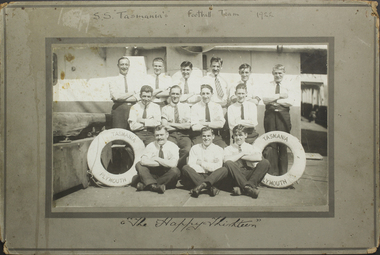
Photograph - Mounted photograph, Sepia, S.S. Tasmania's Football Team, 1922
... On either side of the front row is a lifesaver with the text "S.S. Tasmania/Plymouth". ...On either side of the front row is a lifesaver with the text "S.S. Tasmania/Plymouth". ...This is a photograph of crew members that formed the football team of the S.S. Tasmania. Taken place on the deck of the ship, it is a snapshot in timeAn addition to the collection of crew photographs in the MTSV Collection with all crew members featured in the image named and dated with name of ship making it a useful research and reference image.Black and white photograph of S.S. Tasmania football team in 1922. The photograph is mounted onto a grey green cardboard frame with the text, 'S.S. "Tasmania's" Football Team 1922' on the top. The bottom reads, 'The Happy Thirteen', handwritten in black ink. The photograph itself is of 13 men in three rows, 6 on top row standing, 4 in the middle row sitting on a bench and 3 on the bottom row sitting with their legs crossed. All men have their arms crossed across their chest. On either side of the front row is a lifesaver with the text "S.S. Tasmania/Plymouth". The men are posed on the ships deck. On front mount with photograph: 'S.S "Tasmania's" Football Team 1922' / The Happy Thirteen Inscribed back:of mount names in ink : Thomas Holohay / William Bridges / James. H. Stone / George Angus / James Arthurs / George Arthurs / C. Quinell / C. (Lawrence/labence ?) / W. Manon / M. Zard / I. Ancell LT/JL ?. Chipperfield / F. Franksuniform, team, s.s. tasmania, 1922, football, crew, life buoy, crews and ships -
 Warrnambool and District Historical Society Inc.
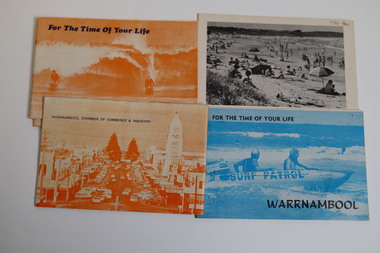
Booklet - Warrnambool Tourist Guides (5), Warrnambool Chamber of Commerce and Industry, Warrnambool - For the Time of Your Life, 1970-1975
... One booklet is stapled and two have the staples removed. .4,.5 -These are booklets of 40 pages with a front cover with a photograph in blue tones of a surf patrol boat and two lifesavers and a back cover with a black and white photograph (beach scene). ...One booklet is stapled and two have the staples removed. .4,.5 -These are booklets of 40 pages with a front cover with a photograph in blue tones of a surf patrol boat and two lifesavers and a back cover with a black and white photograph (beach scene). ...Warrnambool Tourist Guides 1970-1975.1,.2,.3 - These are booklets of 36 pages with an orange cover with an illustration of two people on surf boards on the front cover and an image of a main street on the back cover. The cover has blue printing. The pages contain a map, advertisements, black and white photographs and printed text. One booklet is stapled and two have the staples removed. .4,.5 -These are booklets of 40 pages with a front cover with a photograph in blue tones of a surf patrol boat and two lifesavers and a back cover with a black and white photograph (beach scene). The pages contain a map, advertisements, black and white photographs and printed text. One booklet is stapled and one has the staples removed. non-fictionWarrnambool Tourist Guides 1970-1975warrnambool tourism, tourism in warrnambool in the 1970s -
 Ballarat Tramway Museum
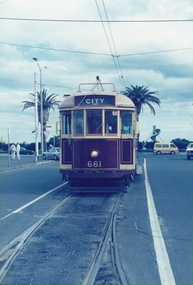
Photograph - Colour Photograph/s - set of 13, Lloyd Rogers, 30/04/1989 12:00:00 AM
... All have a photo number on rear and captions - see images 14 to 19. .1 - At Sth Melbourne Beach terminus. .2 - MMTB Paying fares dated Dec. 1968 in four languages inside tram. .3 - 661 and 878 at Brunswick Depot .4 - Y612 partly derailed at Brunswick .5 - 661, 8789 and 612 at Brunswick .6 - 661 at Batman Avenue .7 - Batman Avenue .8 - from the window looking forwards - reserved track. .9 - at South Melbourne Beach terminus with Bleak House in the background and an Advert for Swan Premium beer. .10 - ditto with Vopas Centre building in the background and an advert advertising Volvo motor cars - Swedish Lifesavers. .11 - ditto .12 - interior view of tram .13 - At Batman Ave with the shop on the railway side in the view....All have a photo number on rear and captions - see images 14 to 19. .1 - At Sth Melbourne Beach terminus. .2 - MMTB Paying fares dated Dec. 1968 in four languages inside tram. .3 - 661 and 878 at Brunswick Depot .4 - Y612 partly derailed at Brunswick .5 - 661, 8789 and 612 at Brunswick .6 - 661 at Batman Avenue .7 - Batman Avenue .8 - from the window looking forwards - reserved track. .9 - at South Melbourne Beach terminus with Bleak House in the background and an Advert for Swan Premium beer. .10 - ditto with Vopas Centre building in the background and an advert advertising Volvo motor cars - Swedish Lifesavers. .11 - ditto .12 - interior view of tram .13 - At Batman Ave with the shop on the railway side in the view. ...Yields information about the appearance of the operation of BTPS tram No. 661 in Melbourne on a tour.Set of 13 colour prints of BTPS / BTM tram No. 661 in Melbourne on a BTPS tour 30-4-1989. All photos by Lloyd Rogers, on AGFA paper. All have a photo number on rear and captions - see images 14 to 19. .1 - At Sth Melbourne Beach terminus. .2 - MMTB Paying fares dated Dec. 1968 in four languages inside tram. .3 - 661 and 878 at Brunswick Depot .4 - Y612 partly derailed at Brunswick .5 - 661, 8789 and 612 at Brunswick .6 - 661 at Batman Avenue .7 - Batman Avenue .8 - from the window looking forwards - reserved track. .9 - at South Melbourne Beach terminus with Bleak House in the background and an Advert for Swan Premium beer. .10 - ditto with Vopas Centre building in the background and an advert advertising Volvo motor cars - Swedish Lifesavers. .11 - ditto .12 - interior view of tram .13 - At Batman Ave with the shop on the railway side in the view.See images i14 to i19 for rear of photos.trams, tramways, melbourne, batman ave, brunswick depot, south melbourne beach, tram 661, tram 612, tram 878 -
 Sunshine and District Historical Society Incorporated
Archive - Lions Club of Sunshine
... 2088.01 (1) Sunshine Lions Club Notice of Special Meeting Thursday 8 February 2007 (2) Welcome to Lions Club Sunshine Change Over Night & 49th Charter Anniversary Programme 2002/2003 (3) Lions Australia Fact Sheets 1 2 3 & 4 (4) 50 Years of Sunshine (2 copies) (5) Lions Club Support Lifesaver Foundations stickers (6) Stockdale & Leggo Real Estate Sale of Lions Club Sunshine property (7) Lions Club of Sunshine Medi + Ready Emergency Information booklet. (8) Lions Club 60th Anniversary Dinner 2088.02 A grand total of 79 colour photographs including negatives. ...Sunshine Lions Club Lions 2088.01 (1) Sunshine Lions Club Notice of Special Meeting Thursday 8 February 2007 (2) Welcome to Lions Club Sunshine Change Over Night & 49th Charter Anniversary Programme 2002/2003 (3) Lions Australia Fact Sheets 1 2 3 & 4 (4) 50 Years of Sunshine (2 copies) (5) Lions Club Support Lifesaver Foundations stickers (6) Stockdale & Leggo Real Estate Sale of Lions Club Sunshine property (7) Lions Club of Sunshine Medi + Ready Emergency Information booklet. (8) Lions Club 60th Anniversary Dinner 2088.02 A grand total of 79 colour photographs including negatives. ...2088.01 (1) Sunshine Lions Club Notice of Special Meeting Thursday 8 February 2007 (2) Welcome to Lions Club Sunshine Change Over Night & 49th Charter Anniversary Programme 2002/2003 (3) Lions Australia Fact Sheets 1 2 3 & 4 (4) 50 Years of Sunshine (2 copies) (5) Lions Club Support Lifesaver Foundations stickers (6) Stockdale & Leggo Real Estate Sale of Lions Club Sunshine property (7) Lions Club of Sunshine Medi + Ready Emergency Information booklet. (8) Lions Club 60th Anniversary Dinner 2088.02 A grand total of 79 colour photographs including negatives. Also included is a A4 sheet of paper with five colour photographs which show a sausage sizzle at Sunvale Primary School on Election Day 2004 (Only 62 photographs have been uploaded to Victorian Collections). 2088.03 (1) Newsletters of the Lions Club of Sunshine - Volume 1, Issues 1 & 3, Sept. / Oct. 1997, Nov. / Dec. 1997, Jan. to Sept. 1998, six Lions Club Bulletin booklet programs, Brimbank Independent Vol., 13, No. 31, 10 August 1999. (2) Newspaper Articlessunshine lions club, lions -
 Flagstaff Hill Maritime Museum and Village
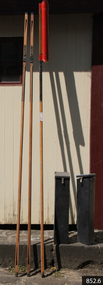
Equipment - Rocket set, John Dennett, ca. 1860s
... Flagstaff Hill Maritime Museum & Village Flagstaff Hill Maritime Museum Maritime Village Warrnambool Great Ocean Road shipwreck Life-saving lifesaving rescue crew rescue rocket rescue maritime accidents shipwreck victim rocket crew beach rescue line rescue rescue equipment rocket firing equipment rocket rescue equipment rocket apparatus beach apparatus petticoat breeches breeches buoy Rocket house rocket shed lifeboat men Rocket equipment rocket machine rocket head rocket launcher rocket line Marine technology William Schermuly line-firing pistol line throwing gun Schermuly pistol pistol rocket apparatus Beach Rescue Set Traveller block running block pulley hawser faking faking box faked line rescue boat lifeboat Lady Bay Warrnambool Harbour Port of Warrnambool Tramway Jetty volunteer lifesavers volunteer crew Breakwater Lifeboat Warrnambool rocket rescue method rocket rescue apparatus Captain Manby mortar Henry Trengrouse sky rocket John Dennett shore to ship Colonel Boxer two-stage rocket Italian hemp quadrant Schermuly line-throwing pistol line throwing cartridge rocket apparatus rescue stranded vessel tally board light line whip line endless whip petticoat buoy traveller chair traveller block Her Majesty’s Coast Guard Harbour Board line thrower line throwing beach cart hand barrow sand anchor hawser cutter life jacket faking board Irish hand barrow rocket head toting box explosives rocket shaft rocket pole Impressed one a shaft "8" A Dennett rocket set in six parts; the rocket head, three shafts (poles) and two rocket-head toting boxes. ...This rescue line-throwing rocket set was made for the Dennett rocket system, which was used by the Rocket Rescue crews in South West Victoria from around the 1860s to the 1890s. John Dennett - John Dennett was from Carisbrooke, in the Ilse of Wight, UK. In 1826 he invented, patented and demonstrated an improved method of rocket powered, line firing rescue equipment for saving lives. The rockets had a longer range than the mortars being used, they were lighter, needed less preparation time, only needed one line for repeated shots, and fewer people were needed to move the equipment. Very favourable reports of Dennett’s rockets were received by those in charge of His Majesty’s Naval and Military services. In 1832, Dennett’s rocket-thrown line was sent out to the wreck of the ‘Bainbridge’, and was responsible for nineteen survivors coming ashore in two boatloads, along the fired line. Dennett’s rocket received national fame, and a one-year contract to supply rockets to the Coastguards. He became known as ‘Rocket Man’ and his rockets were used in rescues at least until 1890, when his son Horatio was running the business. A rocket weighing 23 lb would have a range of about 250 yards (228 metres), on average. Saving lives in Warrnambool – The coastline of South West Victoria has had over 600 shipwrecks and many lost lives; even in Warrnambool’s Lady Bay there were around 16 known shipwrecks between 1850 and 1905, with eight lives lost. In 1859 the first Government-built lifeboat arrived at Warrnambool Harbour and a shed was soon built to house it, followed in 1864 by a rocket house to safely store the Rocket Rescue equipment. In 1878 the buildings were moved to the Breakwater area, and in 1910 the new Lifeboat Warrnambool arrived with its ‘self-righting’ design. For almost one hundred years the lifeboat and rocket crews, mostly local volunteers, trained regularly to maintain and improve their skills, summoned when needed by alarms, gunshots, ringing bells and foghorns. Some became local heroes but all served an important role. By the end of the 1950s the lifeboat and rescue equipment had become obsolete. Rocket Rescue Method - The first use of a lifesaving rocket rescue system is often credited to Captain Manby and his invention of a life mortar, first used in 1808 to fire a line onto a ship to rescue lives. Henry Trengrouse’s invention of 1820 was the first to use a sky rocket’s power to throw a line, and his invention included a chair for carrying the shipwrecked victims to shore. In 1832 John Dennett invented a rocket specifically for shore to ship rescue. It had an iron case and an 8 foot pole attached and could shoot the line as far as 250 yards (about 230 metres). From the 1860s the rocket rescue apparatus was in use. It comprised a breeches buoy and traveller block that was suspended on a line and manually pulled to and from the distressed vessel carrying passengers and items. Colonel Boxer, who had invented an early line-thrower, designed a rocket in 1865 with a range from 300 to 470 yards. It was the first two-stage rocket, with two rockets placed one in front of the other in a tube that carried the rescue line. The hemp line was faked, or coiled, in a particular way in a faking box to prevent twists and tangles when fired, and the angle of firing the rocket was measured by a quadrant-type instrument on the side of the rocket machine. Schermuly invented the line-throwing pistol around 1920, which used a small cartridge to fire the rocket. Victoria’s Government adopted lifesaving methods based on Her Majesty’s Coast Guard in Great Britain, which used Colonel Boxer’s rocket apparatus rescue method. The British Board of Trade published instructions in 1850 for both the beach rescue crew and ship’s crew. It involved setting up the rocket launcher on shore at a particular angle measured by the quadrant, inserting a rocket that had a light-weight line attached, then firing it across the stranded vessel. A tally board was then sent out with instructions in four languages. The ship’s crew would haul on the line to bring out the continuous whip line and attach the whip block to a mast or sturdy part the ship. The rescue crew on shore then hauled out a heavier hawser line, which the ship’s crew fixed above the whip block. The hawser is then tightened using the block on the shore end of the whip. The breeches buoy and endless whip are then attached to the traveller block on the hawser, allowing the shore crew to haul the buoy to and from the vessel, rescuing the stranded crew one at a time. The rocket system could also be used from one ship to another.The Dennett rocket set is quite rare - there are not many examples in existence and little information is available. This Dennett's rocket set is significant for its connection with local history, maritime history and marine technology. Lifesaving has been an important part of the services performed from Warrnambool's very early days, supported by State and Local Government, and based on the methods and experience of Great Britain. Hundreds of shipwrecks along the coast are evidence of the rough weather and rugged coastline. Ordinary citizens, the Harbour employees, and the volunteer boat and rescue crew, saved lives in adverse circumstances. Some were recognised as heroes, others went unrecognised. In Lady Bay, Warrnambool, there were around 16 known shipwrecks between 1850 and 1905. Many lives were saved but tragically, eight lives were lost.A Dennett rocket set in six parts; the rocket head, three shafts (poles) and two rocket-head toting boxes. The rocket head, mounted on one of the shafts, is a long, red painted, iron tube with rounded ends and a protruding fitting around each end. The wooden rocket shafts are octagonal, with a metal sheath at the ends, carved elongated slots towards each end, and a scribed channel above the black foot. The rocket head toting boxes are thick timber, covered in fabric and painted black. They have a hinged wooden lid that slants downwards from back to front, and a metal closure. Small deliberate holes, in groups of four, on the box’s sides, indicate missing attachments, likely to have been handles. Impressed one a shaft "8"flagstaff hill maritime museum & village, flagstaff hill, maritime museum, maritime village, warrnambool, great ocean road, shipwreck, life-saving, lifesaving, rescue crew, rescue, rocket rescue, maritime accidents, shipwreck victim, rocket crew, beach rescue, line rescue, rescue equipment, rocket firing equipment, rocket rescue equipment, rocket apparatus, beach apparatus, petticoat breeches, breeches buoy, rocket house, rocket shed, lifeboat men, rocket equipment, rocket machine, rocket head, rocket launcher, rocket line, marine technology, william schermuly, line-firing pistol, line throwing gun, schermuly pistol, pistol rocket apparatus, beach rescue set, traveller, block, running block, pulley, hawser, faking, faking box, faked line, rescue boat, lifeboat, lady bay, warrnambool harbour, port of warrnambool, tramway jetty, volunteer lifesavers, volunteer crew, breakwater, lifeboat warrnambool, rocket rescue method, rocket rescue apparatus, captain manby, mortar, henry trengrouse, sky rocket, john dennett, shore to ship, colonel boxer, two-stage rocket, italian hemp, quadrant, schermuly, line-throwing pistol, line throwing cartridge, rocket apparatus rescue, stranded vessel, tally board, light line, whip line, endless whip, petticoat buoy, traveller chair, traveller block, her majesty’s coast guard, harbour board, line thrower, line throwing, beach cart, hand barrow, sand anchor, hawser cutter, life jacket, faking board, irish hand barrow, rocket head toting box, explosives, rocket shaft, rocket pole -
 Flagstaff Hill Maritime Museum and Village
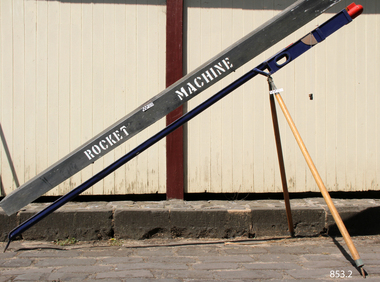
Equipment - Rocket Launcher, John Dennett, 1860s
... Flagstaff Hill Maritime Museum & Village Flagstaff Hill Maritime Museum Maritime Village Warrnambool Great Ocean Road shipwreck Life-saving lifesaving rescue crew rescue rocket rescue maritime accidents shipwreck victim rocket crew beach rescue line rescue rescue equipment rocket firing equipment rocket rescue equipment rocket apparatus beach apparatus petticoat breeches breeches buoy Rocket house rocket shed lifeboat men Rocket equipment rocket machine rocket head rocket launcher rocket line Marine technology William Schermuly line-firing pistol line throwing gun Schermuly pistol pistol rocket apparatus Beach Rescue Set Traveller block running block pulley hawser faking faking box faked line rescue boat lifeboat Lady Bay Warrnambool Harbour Port of Warrnambool Tramway Jetty volunteer lifesavers volunteer crew Breakwater Lifeboat Warrnambool rocket rescue method rocket rescue apparatus Captain Manby mortar Henry Trengrouse sky rocket John Dennett shore to ship Colonel Boxer two-stage rocket Italian hemp quadrant protractor Schermuly line-throwing pistol line throwing cartridge rocket apparatus rescue stranded vessel tally board light line whip line endless whip petticoat buoy traveller chair traveller block Her Majesty’s Coast Guard Harbour Board line thrower line throwing beach cart hand barrow sand anchor hawser cutter life jacket faking board Welsh hand barrow rocket set On box “ROCKET MACHINE” On quadrant “10” “20” “30” “40” Rocket launcher, named a Rocket Machine, and storage box. ...This rocket launching machine is used in conjunction with the Dennett Rocket Set. Both are part of the rocket rescue equipment that launches the line-throwing rescue rockets. A light line is threaded through the carved holes in the 8 foot long shaft and attached to the scribed channel at the base of the shaft. The rocket head is fitted to the shaft and inserted into the machine. The machine is set at an angle determined by the person in charge of the rescue crew, and the legs and base of the machine are adjusted accordingly with the use of the quadrant, or protractor, and plumb-bob on the side of the machine. The rocket is then ignited and fired across the vessel in distress. John Dennett - John Dennett was from Carisbrooke, in the Ilse of Wight, UK. In 1826 he invented, patented and demonstrated an improved method of rocket powered, line firing rescue equipment for saving lives. The rockets had a longer range than the mortars being used, they were lighter, needed less preparation time, only needed one line for repeated shots, and fewer people were needed to move the equipment. Very favourable reports of Dennett’s rockets were received by those in charge of His Majesty’s Naval and Military services. In 1832, Dennett’s rocket-thrown line was sent out to the wreck of the ‘Bainbridge’, and was responsible for nineteen survivors coming ashore in two boatloads, along the fired line. Dennett’s rocket received national fame, and a one-year contract to supply rockets to the Coastguards. He became known as ‘Rocket Man’ and his rockets were used in rescues at least until 1890, when his son Horatio was running the business. A rocket weighing 23 lb would have a range of about 250 yards (228 metres), on average. Saving lives in Warrnambool – The coastline of South West Victoria is the site of over 600 shipwrecks and many lost lives; even in Warrnambool’s Lady Bay there were around 16 known shipwrecks between 1850 and 1905, with eight lives lost. In 1859 the first Government-built lifeboat arrived at Warrnambool Harbour and a shed was soon built to house it. In 1858 the provision of rocket and mortar apparatus was approved for lifeboat stations in Victoria, and in 1864 a rocket house was built to safely store the rocket rescue equipment. In 1878 the buildings were moved to the Breakwater area, and in 1910 the new Lifeboat Warrnambool arrived with its ‘self-righting’ design. For almost a hundred years the lifeboat and rocket crews, mostly local volunteers, trained regularly to maintain their rescue skills. They were summoned when needed by alarms, gunshots, ringing bells and foghorns. Some became local heroes but all served an important role. By the end of the 1950s the lifeboat and rescue equipment had become obsolete. Rocket Rescue Method - The Government of Victoria adopted lifesaving methods based on Her Majesty’s Coast Guard in Great Britain. It authorised the first line-throwing rescue system in 1858. Captain Manby’s mortar powered a projectile connected to rope, invented in 1808. The equipment was updated to John Dennett’s 8-foot shaft and rocket method that had a longer range of about 250 yards. From the 1860s the breeches buoy and traveller block rocket rescue apparatus was in use. It was suspended on a hawser line and manually pulled to and from the distressed vessel carrying passengers and items. In the early 1870s Colonel Boxer’s rocket rescue method became the standard in Victoria. His two-stage rockets, charged by a gunpowder composition, could fire the line up to 500-600 yards, although 1000 yards range was possible. Boxer’s rocket carried the light line, which was faked, or coiled, in a particular way between pegs in a faking box to prevent twists and tangles when fired. The angle of firing the rocket to the vessel in distress was measured by a quadrant-type instrument on the side of the rocket machine. Decades later, in about 1920, Schermuly invented the line-throwing pistol that used a small cartridge to fire the rocket. The British Board of Trade published instructions for both the beach rescue crew and ship’s crew. It involved setting up the rocket launcher on shore at a particular angle measured by the quadrant, inserting a rocket that had a light-weight line threaded through its shaft, and then firing it across the stranded vessel, the line issuing freely from the faking board. A tally board was then sent out to the ship with instructions in four languages. The ship’s crew would haul on the line to bring out the heavier, continuous whip line, then secure the attached whip block to the mast or other sturdy part the ship. The rescue crew on shore then hauled out a stronger hawser line, which the ship’s crew fixed above the whip block. The hawser was then tightened using the block on the shore end of the whip. The breeches buoy and endless whip are then attached to the traveller block on the hawser, allowing the shore crew to haul the breeches buoy to and from the vessel, rescuing the stranded crew one at a time. This rocket launcher machine is significant for its connection with local history, maritime history and marine technology. Lifesaving has been an important part of the services performed from Warrnambool's very early days, supported by State and Local Government, and based on the methods and experience of Great Britain. Hundreds of shipwrecks along the coast are evidence of the rough weather and rugged coastline. Ordinary citizens, the Harbour employees, and the volunteer boat and rescue crew, saved lives in adverse circumstances. Some were recognised as heroes, others went unrecognised. In Lady Bay, Warrnambool, there were around 16 known shipwrecks between 1850 and 1905. Many lives were saved but tragically, eight lives were lost.Rocket launcher, named a Rocket Machine, and storage box. Launcher has a long open metal channel with a spike at the base, and narrow, rectangular device, which is the line-firing rocket machine, at the top, all painted blue. Two hinged wooden legs are attached where the channel and machine meet. The side of the machine has an oval cut-out window and an attached quadrant, or protractor, with a plumb-bob on it. The quadrant has angles marked in degrees. The long protective box has white stencilled letters along the side. Its lid has three hinges and is fastened with two metal latches.On box “ROCKET MACHINE” On quadrant “10” “20” “30” “40”flagstaff hill maritime museum & village, flagstaff hill, maritime museum, maritime village, warrnambool, great ocean road, shipwreck, life-saving, lifesaving, rescue crew, rescue, rocket rescue, maritime accidents, shipwreck victim, rocket crew, beach rescue, line rescue, rescue equipment, rocket firing equipment, rocket rescue equipment, rocket apparatus, beach apparatus, petticoat breeches, breeches buoy, rocket house, rocket shed, lifeboat men, rocket equipment, rocket machine, rocket head, rocket launcher, rocket line, marine technology, william schermuly, line-firing pistol, line throwing gun, schermuly pistol, pistol rocket apparatus, beach rescue set, traveller, block, running block, pulley, hawser, faking, faking box, faked line, rescue boat, lifeboat, lady bay, warrnambool harbour, port of warrnambool, tramway jetty, volunteer lifesavers, volunteer crew, breakwater, lifeboat warrnambool, rocket rescue method, rocket rescue apparatus, captain manby, mortar, henry trengrouse, sky rocket, john dennett, shore to ship, colonel boxer, two-stage rocket, italian hemp, quadrant, protractor, schermuly, line-throwing pistol, line throwing cartridge, rocket apparatus rescue, stranded vessel, tally board, light line, whip line, endless whip, petticoat buoy, traveller chair, traveller block, her majesty’s coast guard, harbour board, line thrower, line throwing, beach cart, hand barrow, sand anchor, hawser cutter, life jacket, faking board, welsh hand barrow, rocket set -
 Flagstaff Hill Maritime Museum and Village
Equipment - Hand Barrow, 1860s
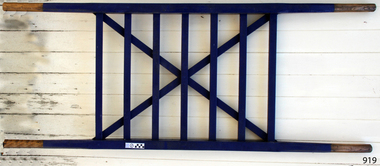
... Flagstaff Hill Maritime Museum and Village Flagstaff Hill Maritime Museum Maritime Village Warrnambool Great Ocean Road Lady Bay Warrnambool Harbour Port of Warrnambool Tramway Jetty Breakwater shipwreck life-saving lifesaving rescue crew rescue rocket rescue rocket crew lifeboat men beach rescue line rescue rescue equipment rocket firing equipment rocket rescue equipment maritime accidents shipwreck victim rocket equipment Marine technology rescue boat lifeboat volunteer lifesavers volunteer crew life saving rescue crew lifesaving rescue crew rocket apparatus rocket rescue method shore to ship rocket apparatus rescue stranded vessel line throwing mortar mortar rocket rescue apparatus line thrower line throwing Lifeboat Warrnambool hand barrow manual transport Welsh hand barrow Hand barrow; a transporting device carried between two people walking one in front of the other. ...This hand barrow, sometimes called a Welsh hand barrow, was used to transport a load of marine rescue equipment from the beach cart to the rescue site, particularly over hilly, uneven or rough terrain. Hand barrows were in common use in the 19th century. Saving lives in Warrnambool – The coastline of South West Victoria is the site of over 600 shipwrecks and many lost lives; even in Warrnambool’s Lady Bay there were around 16 known shipwrecks between 1850 and 1905, with eight lives lost. Victoria’s Government responded to the need for lifesaving equipment and, in 1858, the provision of rocket and mortar apparatus was approved for the lifeboat stations. In 1859 the first Government-built lifeboat arrived at Warrnambool Harbour and a shed was soon built for it on the Tramway Jetty, followed by a rocket house in 1864 to safely store the rocket rescue equipment. In 1878 the buildings were moved to the Breakwater (constructed from 1874-1890), and in 1910 the new Lifeboat Warrnambool arrived with its ‘self-righting’ design. For almost a hundred years the lifesaving and rescue crews, mostly local volunteers, trained regularly to rehearse and maintain their rescue skills. They were summoned when needed by alarms, gunshots, ringing bells and foghorns. In July 1873 a brass bell was erected at Flagstaff Hill specifically to call the rescue crew upon news of a shipwreck. Some crew members became local heroes but all served an important role. Rocket apparatus was used as recently as the 1950s. Rocket Rescue Method - Rocket rescue became the preferred lifesaving method of the rescue crews, being much safer that using a lifeboat in rough seas and poor conditions. The Government of Victoria adopted lifesaving methods based on Her Majesty’s Coast Guard in Great Britain. It authorised the first line-throwing rescue system in 1858. Captain Manby’s mortar powered a projectile connected to rope, invented in 1808. The equipment was updated to John Dennett’s 8-foot shaft and rocket method that had a longer range of about 250 yards. From the 1860s the breeches buoy and traveller block rocket rescue apparatus was in use. It was suspended on a hawser line and manually pulled to and from the distressed vessel carrying passengers and items. In the early 1870s Colonel Boxer’s rocket rescue method became the standard in Victoria. His two-stage rockets, charged by a gunpowder composition, could fire the line up to 500-600 yards, although 1000 yards range was possible. Boxer’s rocket carried the light line, which was faked, or coiled, in a particular way between pegs in a faking box to prevent twists and tangles when fired. The angle of firing the rocket to the vessel in distress was measured by a quadrant-type instrument on the side of the rocket machine. Decades later, in about 1920, Schermuly invented the line-throwing pistol that used a small cartridge to fire the rocket. . The British Board of Trade regularly published instructions for both the beach rescue crew and ship’s crew. It involved setting up the rocket launcher on shore at a particular angle, determined by the Head of the crew and measured by the quadrant, inserting a rocket that had a light-weight line threaded through its shaft, and then firing it across the stranded vessel, the line issuing freely from the faking board. A continuous whip line was then sent out to the ship’s crew, who hauled it in then followed the instructions – in four languages - on the attached tally board. The survivors would haul on the line to bring out the heavier, continuous whip line with a tail block connected to it. They then secured the block to the mast or other strong part the ship. The rescue crew on shore then hauled out a stronger hawser line, which the survivors fixed above the whip’s tail block. The hawser was then tightened by the crew pulling on it, or by using the hooked block on the shore end of the whip and attaching it to a sand anchor. The breeches buoy was attached to the traveller block on the hawser, and the shore crew then used the whip line to haul the breeches buoy to and from the vessel, rescuing the stranded crew one at a time. The rescue crew wore scarlet, numbered armbands and worked on a numerical rotation system, swapping members out to rest them. This hand barrow is significant for its connection with local history, maritime history and marine technology. Lifesaving has been an important part of the services performed from Warrnambool's very early days, supported by State and Local Government, and based on the methods and experience of Great Britain. Hundreds of shipwrecks along the coast are evidence of the rough weather and rugged coastline. Ordinary citizens, the Harbour employees, and the volunteer boat and rescue crew, saved lives in adverse circumstances. Some were recognised as heroes, others went unrecognised. In Lady Bay, Warrnambool, there were around 16 known shipwrecks between 1850 and 1905. Many lives were saved but tragically, eight lives were lost.Hand barrow; a transporting device carried between two people walking one in front of the other. A wooden ladder-like frame with two handles at each end, blue painted body with unpainted handles. Seven equal-length slats are joined at equal distance between two parallel poles, and two longer slats are attached diagonally between the first and last slats as a brace. flagstaff hill maritime museum and village, flagstaff hill, maritime museum, maritime village, warrnambool, great ocean road, lady bay, warrnambool harbour, port of warrnambool, tramway jetty, breakwater, shipwreck, life-saving, lifesaving, rescue crew, rescue, rocket rescue, rocket crew, lifeboat men, beach rescue, line rescue, rescue equipment, rocket firing equipment, rocket rescue equipment, maritime accidents, shipwreck victim, rocket equipment, marine technology, rescue boat, lifeboat, volunteer lifesavers, volunteer crew, life saving rescue crew, lifesaving rescue crew, rocket apparatus, rocket rescue method, shore to ship, rocket apparatus rescue, stranded vessel, line throwing mortar, mortar, rocket rescue apparatus, line thrower, line throwing, lifeboat warrnambool, hand barrow, manual transport, welsh hand barrow -
 Flagstaff Hill Maritime Museum and Village
Equipment - Traveller pulley block, 1860s
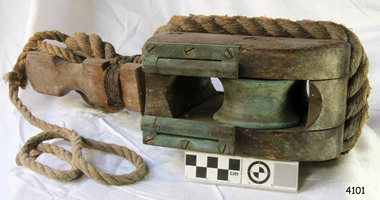
... Flagstaff Hill Maritime Museum and Village Flagstaff Hill Maritime Museum Maritime Village Warrnambool shipwreck life-saving lifesaving rescue crew rescue rocket rescue rocket crew lifeboat men beach rescue line rescue rescue equipment rocket firing equipment rocket rescue equipment maritime accidents shipwreck victim rocket equipment Marine technology rescue boat lifeboat volunteer lifesavers volunteer crew life saving rescue crew lifesaving rescue crew rocket apparatus rocket rescue method shore to ship rocket apparatus rescue stranded vessel line throwing mortar mortar rocket rescue apparatus line thrower line throwing Lifeboat Warrnambool beach apparatus breeches buoy petticoat breeches petticoat buoy traveller chair life jacket Traveller traveller block running block block pulley hawser faking faking box faked line faking board Italian hemp quadrant protractor tally board light line whip line endless whip beach cart hand barrow sand anchor Welsh hand barrow Her Majesty’s Coast Guard Harbour Board Government of Victoria Harbour Master L.S.R.C. ...The life saving breeches buoy was attached to a traveller block such as this one. The assembly was sent from shore to ship and back to transport the stranded people and goods safely to shore. Saving lives in Warrnambool – The coastline of South West Victoria is the site of over 600 shipwrecks and many lost lives; even in Warrnambool’s Lady Bay there were around 16 known shipwrecks between 1850 and 1905, with eight lives lost. Victoria’s Government responded to the need for lifesaving equipment and, in 1858, the provision of rocket and mortar apparatus was approved for the lifeboat stations. In 1859 the first Government-built lifeboat arrived at Warrnambool Harbour and a shed was soon built for it on the Tramway Jetty, followed by a rocket house in 1864 to safely store the rocket rescue equipment. In 1878 the buildings were moved to the Breakwater (constructed from 1874-1890), and in 1910 the new Lifeboat Warrnambool arrived with its ‘self-righting’ design. For almost a hundred years the lifesaving and rescue crews, mostly local volunteers, trained regularly to rehearse and maintain their rescue skills. They were summoned when needed by alarms, gunshots, ringing bells and foghorns. In July 1873 a brass bell was erected at Flagstaff Hill specifically to call the rescue crew upon news of a shipwreck. Some crew members became local heroes but all served an important role. Rocket apparatus was used as recently as the 1950s. Rocket Rescue Method - Rocket rescue became the preferred lifesaving method of the rescue crews, being much safer that using a lifeboat in rough seas and poor conditions. The Government of Victoria adopted lifesaving methods based on Her Majesty’s Coast Guard in Great Britain. It authorised the first line-throwing rescue system in 1858. Captain Manby’s mortar powered a projectile connected to rope, invented in 1808. The equipment was updated to John Dennett’s 8-foot shaft and rocket method that had a longer range of about 250 yards. From the 1860s the breeches buoy and traveller block rocket rescue apparatus was in use. It was suspended on a hawser line and manually pulled to and from the distressed vessel carrying passengers and items. In the early 1870s Colonel Boxer’s rocket rescue method became the standard in Victoria. His two-stage rockets, charged by a gunpowder composition, could fire the line up to 500-600 yards, although 1000 yards range was possible. Boxer’s rocket carried the light line, which was faked, or coiled, in a particular way between pegs in a faking box to prevent twists and tangles when fired. The angle of firing the rocket to the vessel in distress was measured by a quadrant-type instrument on the side of the rocket machine. Decades later, in 1920, Schermuly invented the line-throwing pistol that used a small cartridge to fire the rocket. . The British Board of Trade regularly published instructions for both the beach rescue crew and ship’s crew. It involved setting up the rocket launcher on shore at a particular angle, determined by the Head of the crew and measured by the quadrant, inserting a rocket that had a light-weight line threaded through its shaft, and then firing it across the stranded vessel, the line issuing freely from the faking board. A continuous whip line was then sent out to the ship’s crew, who hauled it in then followed the instructions – in four languages - on the attached tally board. The survivors would haul on the line to bring out the heavier, continuous whip line with a tail block connected to it. They then secured the block to the mast or other strong part the ship. The rescue crew on shore then hauled out a stronger hawser line, which the survivors fixed above the whip’s tail block. The hawser was then tightened by the crew pulling on it, or by using the hooked block on the shore end of the whip and attaching it to a sand anchor. The breeches buoy was attached to the traveller block on the hawser, and the shore crew then used the whip line to haul the breeches buoy to and from the vessel, rescuing the stranded crew one at a time. The rescue crew wore scarlet, numbered armbands and worked on a numerical rotation system, swapping members out to rest them.This traveller block is significant for its connection with local history, maritime history and marine technology. Lifesaving has been an important part of the services performed from Warrnambool's very early days, supported by State and Local Government, and based on the methods and experience of Great Britain. Hundreds of shipwrecks along the coast are evidence of the rough weather and rugged coastline. Ordinary citizens, the Harbour employees, and the volunteer boat and rescue crew, saved lives in adverse circumstances. Some were recognised as heroes, others went unrecognised. In Lady Bay, Warrnambool, there were around 16 known shipwrecks between 1850 and 1905. Many lives were saved but tragically, eight lives were lost. Wood and brass pulley block or 'traveller', used in conjunction with the Breeches Buoy. The block has double brass inline sheaves and brass rollers on each cheek of the pulley. Each shell is scored for the strop. The thimble on the strop has a wooden slat attached for quick release of the Breeches Buoy. A portion of rope is connected.flagstaff hill maritime museum and village, flagstaff hill, maritime museum, maritime village, warrnambool, shipwreck, life-saving, lifesaving, rescue crew, rescue, rocket rescue, rocket crew, lifeboat men, beach rescue, line rescue, rescue equipment, rocket firing equipment, rocket rescue equipment, maritime accidents, shipwreck victim, rocket equipment, marine technology, rescue boat, lifeboat, volunteer lifesavers, volunteer crew, life saving rescue crew, lifesaving rescue crew, rocket apparatus, rocket rescue method, shore to ship, rocket apparatus rescue, stranded vessel, line throwing mortar, mortar, rocket rescue apparatus, line thrower, line throwing, lifeboat warrnambool, beach apparatus, breeches buoy, petticoat breeches, petticoat buoy, traveller chair, life jacket, traveller, traveller block, running block, block, pulley, hawser, faking, faking box, faked line, faking board, italian hemp, quadrant, protractor, tally board, light line, whip line, endless whip, beach cart, hand barrow, sand anchor, welsh hand barrow, her majesty’s coast guard, harbour board, government of victoria, harbour master, l.s.r.c., lsrc -
 Flagstaff Hill Maritime Museum and Village
Container - Case, Early 20th century
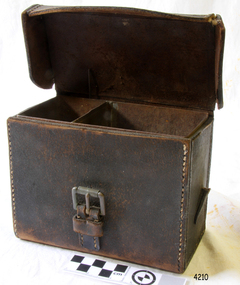
... Flagstaff Hill Maritime Museum and Village Flagstaff Hill Maritime Museum Maritime Village Warrnambool Great Ocean Road shipwreck life-saving lifesaving rescue crew rescue rocket rescue rocket crew lifeboat men beach rescue line rescue rescue equipment rocket firing equipment rocket rescue equipment maritime accidents shipwreck victim rocket equipment Marine technology rescue boat lifeboat volunteer lifesavers volunteer crew life saving rescue crew lifesaving rescue crew rocket apparatus rocket rescue method shore to ship rocket apparatus rescue stranded vessel line throwing mortar mortar rocket rescue apparatus line thrower line throwing line-firing pistol line throwing gun Schermuly pistol pistol rocket apparatus line throwing cartridge L.S.R.C. ...This small case is lined with a metal insert and shows remnants of a carry strap. It could have been used for storing and carrying fuses or cartridges for the life saving Rocket Launcher machine. The protective metal insert would help keep the contents dry or cool and protect from flame. It is part of the collection of rescue equipment in the Rocket House used by the life saving rescue crew. Saving lives in Warrnambool – The coastline of South West Victoria is the site of over 600 shipwrecks and many lost lives; even in Warrnambool’s Lady Bay there were around 16 known shipwrecks between 1850 and 1905, with eight lives lost. Victoria’s Government responded to the need for lifesaving equipment and, in 1858, the provision of rocket and mortar apparatus was approved for the lifeboat stations. In 1859 the first Government-built lifeboat arrived at Warrnambool Harbour and a shed was soon built for it on the Tramway Jetty, followed by a rocket house in 1864 to safely store the rocket rescue equipment. In 1878 the buildings were moved to the Breakwater (constructed from 1874-1890), and in 1910 the new Lifeboat Warrnambool arrived with its ‘self-righting’ design. For almost a hundred years the lifesaving and rescue crews, mostly local volunteers, trained regularly to rehearse and maintain their rescue skills. They were summoned when needed by alarms, gunshots, ringing bells and foghorns. In July 1873 a brass bell was erected at Flagstaff Hill specifically to call the rescue crew upon news of a shipwreck. Some crew members became local heroes but all served an important role. Rocket apparatus was used as recently as the 1950s. Rocket Rescue Method - Rocket rescue became the preferred lifesaving method of the rescue crews, being much safer that using a lifeboat in rough seas and poor conditions. The Government of Victoria adopted lifesaving methods based on Her Majesty’s Coast Guard in Great Britain. It authorised the first line-throwing rescue system in 1858. Captain Manby’s mortar powered a projectile connected to rope, invented in 1808. The equipment was updated to John Dennett’s 8-foot shaft and rocket method that had a longer range of about 250 yards. From the 1860s the breeches buoy and traveller block rocket rescue apparatus was in use. It was suspended on a hawser line and manually pulled to and from the distressed vessel carrying passengers and items. In the early 1870s Colonel Boxer’s rocket rescue method became the standard in Victoria. His two-stage rockets, charged by a gunpowder composition, could fire the line up to 500-600 yards, although 1000 yards range was possible. Boxer’s rocket carried the light line, which was faked, or coiled, in a particular way between pegs in a faking box to prevent twists and tangles when fired. The angle of firing the rocket to the vessel in distress was measured by a quadrant-type instrument on the side of the rocket machine. Decades later, in 1920, Schermuly invented the line-throwing pistol that used a small cartridge to fire the rocket. . The British Board of Trade regularly published instructions for both the beach rescue crew and ship’s crew. It involved setting up the rocket launcher on shore at a particular angle, determined by the Head of the crew and measured by the quadrant, inserting a rocket that had a light-weight line threaded through its shaft, and then firing it across the stranded vessel, the line issuing freely from the faking board. A continuous whip line was then sent out to the ship’s crew, who hauled it in then followed the instructions – in four languages - on the attached tally board. The survivors would haul on the line to bring out the heavier, continuous whip line with a tail block connected to it. They then secured the block to the mast or other strong part the ship. The rescue crew on shore then hauled out a stronger hawser line, which the survivors fixed above the whip’s tail block. The hawser was then tightened by the crew pulling on it, or by using the hooked block on the shore end of the whip and attaching it to a sand anchor. The breeches buoy was attached to the traveller block on the hawser, and the shore crew then used the whip line to haul the breeches buoy to and from the vessel, rescuing the stranded crew one at a time. The rescue crew wore scarlet, numbered armbands and worked on a numerical rotation system, swapping members out to rest them. This small leather carrying case is significant for its connection with the rocket rescue equipment, local history, maritime history and marine technology. Lifesaving has been an important part of the services performed from Warrnambool's very early days, supported by State and Local Government, and based on the methods and experience of Great Britain. Hundreds of shipwrecks along the coast are evidence of the rough weather and rugged coastline. Ordinary citizens, the Harbour employees, and the volunteer boat and rescue crew, saved lives in adverse circumstances. Some were recognised as heroes, others went unrecognised. In Lady Bay, Warrnambool, there were around 16 known shipwrecks between 1850 and 1905. Many lives were saved but tragically, eight lives were lost.Leather case, brown with contrasting stitching, protective metal insert divided into two compartments. Rectangular shape. Roller buckle on front with remnants of the matching strap. Also remnants of a leather strap on the side, possibly a shoulder strap.flagstaff hill maritime museum and village, flagstaff hill, maritime museum, maritime village, warrnambool, great ocean road, shipwreck, life-saving, lifesaving, rescue crew, rescue, rocket rescue, rocket crew, lifeboat men, beach rescue, line rescue, rescue equipment, rocket firing equipment, rocket rescue equipment, maritime accidents, shipwreck victim, rocket equipment, marine technology, rescue boat, lifeboat, volunteer lifesavers, volunteer crew, life saving rescue crew, lifesaving rescue crew, rocket apparatus, rocket rescue method, shore to ship, rocket apparatus rescue, stranded vessel, line throwing mortar, mortar, rocket rescue apparatus, line thrower, line throwing, line-firing pistol, line throwing gun, schermuly pistol, pistol rocket apparatus, line throwing cartridge, l.s.r.c., lsrc, leather case, cartridge case, fuse case, ammunition case -
 Flagstaff Hill Maritime Museum and Village
Uniform - Arm Bands, c. 1860s
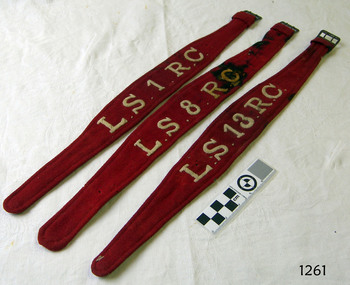
... Flagstaff Hill Maritime Museum and Village Flagstaff Hill Maritime Museum Maritime Village Warrnambool Great Ocean Road Lady Bay Warrnambool Harbour Port of Warrnambool Tramway Jetty Breakwater shipwreck life-saving lifesaving rescue crew rescue rocket rescue rocket crew lifeboat men beach rescue line rescue rescue equipment rocket firing equipment rocket rescue equipment maritime accidents shipwreck victim rocket equipment Marine technology rescue boat lifeboat volunteer lifesavers volunteer crew life saving rescue crew lifesaving rescue crew rocket apparatus rocket rescue method shore to ship rocket apparatus rescue stranded vessel line throwing mortar mortar rocket rescue apparatus line thrower line throwing Lifeboat Warrnambool Arm band armband scarlet arm band L.S.R.C. ...Members of the Life Saving Rescue Crew would wear scarlet arm bands such as these as part of their uniform, with each member having a different number. The crew would work as a team to haul in the victims of the shipwreck. The leader of the crew would call out one or several member's numbers to give them a break during the rescue, while other members took their place. All members would then be relieved at some time during the rescue. Saving lives in Warrnambool – The coastline of South West Victoria is the site of over 600 shipwrecks and many lost lives; even in Warrnambool’s Lady Bay there were around 16 known shipwrecks between 1850 and 1905, with eight lives lost. Victoria’s Government responded to the need for lifesaving equipment and, in 1858, the provision of rocket and mortar apparatus was approved for the lifeboat stations. In 1859 the first Government-built lifeboat arrived at Warrnambool Harbour and a shed was soon built for it on the Tramway Jetty, followed by a rocket house in 1864 to safely store the rocket rescue equipment. In 1878 the buildings were moved to the Breakwater (constructed from 1874-1890), and in 1910 the new Lifeboat Warrnambool arrived with its ‘self-righting’ design. For almost a hundred years the lifesaving and rescue crews, mostly local volunteers, trained regularly to rehearse and maintain their rescue skills. They were summoned when needed by alarms, gunshots, ringing bells and foghorns. In July 1873 a brass bell was erected at Flagstaff Hill specifically to call the rescue crew upon news of a shipwreck. Some crew members became local heroes but all served an important role. Rocket apparatus was used as recently as the 1950s. Rocket Rescue Method - Rocket rescue became the preferred lifesaving method of the rescue crews, being much safer that using a lifeboat in rough seas and poor conditions. The Government of Victoria adopted lifesaving methods based on Her Majesty’s Coast Guard in Great Britain. It authorised the first line-throwing rescue system in 1858. Captain Manby’s mortar powered a projectile connected to rope, invented in 1808. The equipment was updated to John Dennett’s 8-foot shaft and rocket method that had a longer range of about 250 yards. From the 1860s the breeches buoy and traveller block rocket rescue apparatus was in use. It was suspended on a hawser line and manually pulled to and from the distressed vessel carrying passengers and items. In the early 1870s Colonel Boxer’s rocket rescue method became the standard in Victoria. His two-stage rockets, charged by a gunpowder composition, could fire the line up to 500-600 yards, although 1000 yards range was possible. Boxer’s rocket carried the light line, which was faked, or coiled, in a particular way between pegs in a faking box to prevent twists and tangles when fired. The angle of firing the rocket to the vessel in distress was measured by a quadrant-type instrument on the side of the rocket machine. Decades later, in about 1920, Schermuly invented the line-throwing pistol that used a small cartridge to fire the rocket. . The British Board of Trade regularly published instructions for both the beach rescue crew and ship’s crew. It involved setting up the rocket launcher on shore at a particular angle, determined by the Head of the crew and measured by the quadrant, inserting a rocket that had a light-weight line threaded through its shaft, and then firing it across the stranded vessel, the line issuing freely from the faking board. A continuous whip line was then sent out to the ship’s crew, who hauled it in then followed the instructions – in four languages - on the attached tally board. The survivors would haul on the line to bring out the heavier, continuous whip line with a tail block connected to it. They then secured the block to the mast or other strong part the ship. The rescue crew on shore then hauled out a stronger hawser line, which the survivors fixed above the whip’s tail block. The hawser was then tightened by the crew pulling on it, or by using the hooked block on the shore end of the whip and attaching it to a sand anchor. The breeches buoy was attached to the traveller block on the hawser, and the shore crew then used the whip line to haul the breeches buoy to and from the vessel, rescuing the stranded crew one at a time. The rescue crew wore scarlet, numbered armbands and worked on a numerical rotation system, swapping members out to rest them. This set of scarlet arm bands is significant for its connection with local history, maritime history and marine technology. Lifesaving has been an important part of the services performed from Warrnambool's very early days, supported by State and Local Government, and based on the methods and experience of Great Britain. Hundreds of shipwrecks along the coast are evidence of the rough weather and rugged coastline. Ordinary citizens, the Harbour employees, and the volunteer boat and rescue crew, saved lives in adverse circumstances. Some were recognised as heroes, others went unrecognised. In Lady Bay, Warrnambool, there were around 16 known shipwrecks between 1850 and 1905. Many lives were saved but tragically, eight lives were lost.Arm bands; three scarlet flannel arm bands with black cotton backing and a metal buckle on one end. White cotton embroidery forms letters and numbers, with each arm band having a different number. Part of the uniform of the Life Saving and Rescue Crew.Embroidered on front "L.S. 1 R.C." "L.S. 8 R.C." "L.S. 13 R.C." flagstaff hill maritime museum and village, flagstaff hill, maritime museum, maritime village, warrnambool, great ocean road, lady bay, warrnambool harbour, port of warrnambool, tramway jetty, breakwater, shipwreck, life-saving, lifesaving, rescue crew, rescue, rocket rescue, rocket crew, lifeboat men, beach rescue, line rescue, rescue equipment, rocket firing equipment, rocket rescue equipment, maritime accidents, shipwreck victim, rocket equipment, marine technology, rescue boat, lifeboat, volunteer lifesavers, volunteer crew, life saving rescue crew, lifesaving rescue crew, rocket apparatus, rocket rescue method, shore to ship, rocket apparatus rescue, stranded vessel, line throwing mortar, mortar, rocket rescue apparatus, line thrower, line throwing, lifeboat warrnambool, arm band, armband, scarlet arm band, l.s.r.c., lsrc, red arm band -
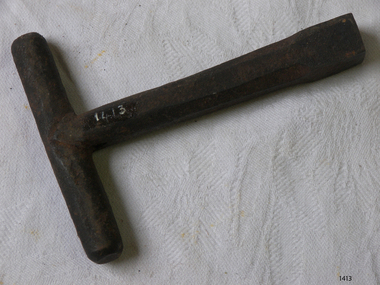 Flagstaff Hill Maritime Museum and Village
Equipment - Rocket Key, John Dennett, c. 1860s
... Flagstaff Hill Maritime Museum and Village Flagstaff Hill Maritime Museum Maritime Village Warrnambool Great Ocean Road Lady Bay Warrnambool Harbour Port of Warrnambool Tramway Jetty Breakwater shipwreck life-saving lifesaving rescue crew rescue rocket rescue rocket crew lifeboat men beach rescue line rescue rescue equipment rocket firing equipment rocket rescue equipment maritime accidents shipwreck victim rocket equipment Marine technology rescue boat lifeboat volunteer lifesavers volunteer crew life saving rescue crew lifesaving rescue crew rocket apparatus rocket rescue method shore to ship rocket apparatus rescue stranded vessel line throwing mortar mortar rocket rescue apparatus line thrower line throwing Lifeboat Warrnambool Rocket house rocket shed rocket machine rocket head rocket launcher rocket line beach rescue set rocket set John Dennett rocket key rocket launcher key life saving Key, part of the Rocket Rescue equipment. ...This rocket launcher key was used with the Dennett's Rocket Launcher system to remove the end cap of the Dennett's Rocket to expose the propellant to be fused . Saving lives in Warrnambool – The coastline of South West Victoria is the site of over 600 shipwrecks and many lost lives; even in Warrnambool’s Lady Bay there were around 16 known shipwrecks between 1850 and 1905, with eight lives lost. Victoria’s Government responded to the need for lifesaving equipment and, in 1858, the provision of rocket and mortar apparatus was approved for the lifeboat stations. In 1859 the first Government-built lifeboat arrived at Warrnambool Harbour and a shed was soon built for it on the Tramway Jetty, followed by a rocket house in 1864 to safely store the rocket rescue equipment. In 1878 the buildings were moved to the Breakwater (constructed from 1874-1890), and in 1910 the new Lifeboat Warrnambool arrived with its ‘self-righting’ design. For almost a hundred years the lifesaving and rescue crews, mostly local volunteers, trained regularly to rehearse and maintain their rescue skills. They were summoned when needed by alarms, gunshots, ringing bells and foghorns. In July 1873 a brass bell was erected at Flagstaff Hill specifically to call the rescue crew upon news of a shipwreck. Some crew members became local heroes but all served an important role. Rocket apparatus was used as recently as the 1950s. Rocket Rescue Method - Rocket rescue became the preferred lifesaving method of the rescue crews, being much safer that using a lifeboat in rough seas and poor conditions. The Government of Victoria adopted lifesaving methods based on Her Majesty’s Coast Guard in Great Britain. It authorised the first line-throwing rescue system in 1858. Captain Manby’s mortar powered a projectile connected to rope, invented in 1808. The equipment was updated to John Dennett’s 8-foot shaft and rocket method that had a longer range of about 250 yards. From the 1860s the breeches buoy and traveller block rocket rescue apparatus was in use. It was suspended on a hawser line and manually pulled to and from the distressed vessel carrying passengers and items. In the early 1870s Colonel Boxer’s rocket rescue method became the standard in Victoria. His two-stage rockets, charged by a gunpowder composition, could fire the line up to 500-600 yards, although 1000 yards range was possible. Boxer’s rocket carried the light line, which was faked, or coiled, in a particular way between pegs in a faking box to prevent twists and tangles when fired. The angle of firing the rocket to the vessel in distress was measured by a quadrant-type instrument on the side of the rocket machine. Decades later, in about 1920, Schermuly invented the line-throwing pistol that used a small cartridge to fire the rocket. . The British Board of Trade regularly published instructions for both the beach rescue crew and ship’s crew. It involved setting up the rocket launcher on shore at a particular angle, determined by the Head of the crew and measured by the quadrant, inserting a rocket that had a light-weight line threaded through its shaft, and then firing it across the stranded vessel, the line issuing freely from the faking board. A continuous whip line was then sent out to the ship’s crew, who hauled it in then followed the instructions – in four languages - on the attached tally board. The survivors would haul on the line to bring out the heavier, continuous whip line with a tail block connected to it. They then secured the block to the mast or other strong part the ship. The rescue crew on shore then hauled out a stronger hawser line, which the survivors fixed above the whip’s tail block. The hawser was then tightened by the crew pulling on it, or by using the hooked block on the shore end of the whip and attaching it to a sand anchor. The breeches buoy was attached to the traveller block on the hawser, and the shore crew then used the whip line to haul the breeches buoy to and from the vessel, rescuing the stranded crew one at a time. The rescue crew wore scarlet, numbered armbands and worked on a numerical rotation system, swapping members out to rest them. This rocket launcher key is a necessary part of the equipment for the the rocket launcher, which is significant for its connection with local history, maritime history and marine technology. Lifesaving has been an important part of the services performed from Warrnambool's very early days, supported by State and Local Government, and based on the methods and experience of Great Britain. Hundreds of shipwrecks along the coast are evidence of the rough weather and rugged coastline. Ordinary citizens, the Harbour employees, and the volunteer boat and rescue crew, saved lives in adverse circumstances. Some were recognised as heroes, others went unrecognised. In Lady Bay, Warrnambool, there were around 16 known shipwrecks between 1850 and 1905. Many lives were saved but tragically, eight lives were lost.Key, part of the Rocket Rescue equipment. T shaped metal key, round handle across the top and hexagonal shaped shaft and square end. Used to remove the end cap of the Dennett's Rocket to expose the propellant to be fused . Donation from Ports and Harbour.flagstaff hill maritime museum and village, flagstaff hill, maritime museum, maritime village, warrnambool, great ocean road, lady bay, warrnambool harbour, port of warrnambool, tramway jetty, breakwater, shipwreck, life-saving, lifesaving, rescue crew, rescue, rocket rescue, rocket crew, lifeboat men, beach rescue, line rescue, rescue equipment, rocket firing equipment, rocket rescue equipment, maritime accidents, shipwreck victim, rocket equipment, marine technology, rescue boat, lifeboat, volunteer lifesavers, volunteer crew, life saving rescue crew, lifesaving rescue crew, rocket apparatus, rocket rescue method, shore to ship, rocket apparatus rescue, stranded vessel, line throwing mortar, mortar, rocket rescue apparatus, line thrower, line throwing, lifeboat warrnambool, rocket house, rocket shed, rocket machine, rocket head, rocket launcher, rocket line, beach rescue set, rocket set, john dennett, rocket key, rocket launcher key, life saving
